air conditioning JAGUAR XFR 2010 1.G Owner's Guide
[x] Cancel search | Manufacturer: JAGUAR, Model Year: 2010, Model line: XFR, Model: JAGUAR XFR 2010 1.GPages: 3039, PDF Size: 58.49 MB
Page 1666 of 3039
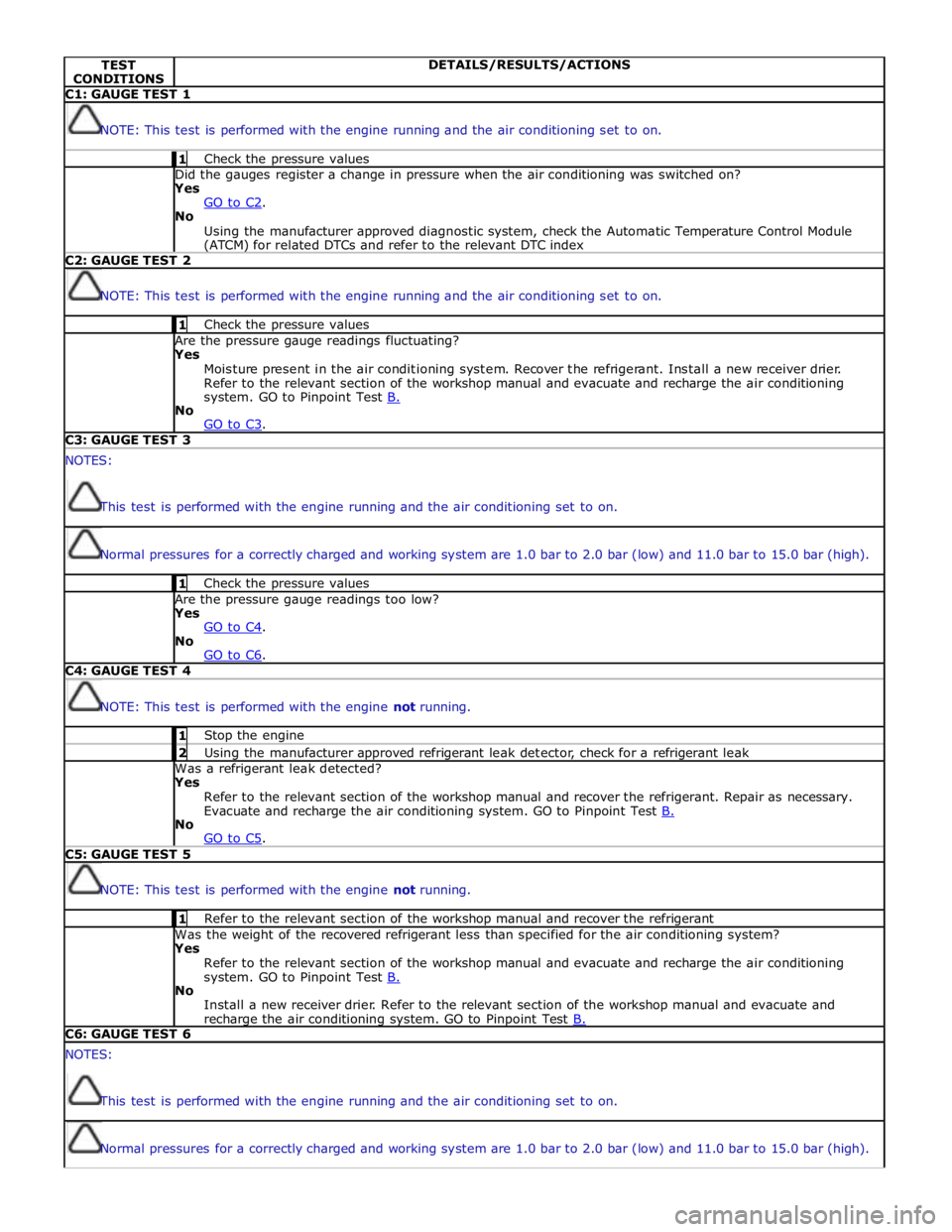
TEST
CONDITIONS DETAILS/RESULTS/ACTIONS C1: GAUGE TEST 1
NOTE: This test is performed with the engine running and the air conditioning set to on. 1 Check the pressure values Did the gauges register a change in pressure when the air conditioning was switched on? Yes
GO to C2. No
Using the manufacturer approved diagnostic system, check the Automatic Temperature Control Module (ATCM) for related DTCs and refer to the relevant DTC index C2: GAUGE TEST 2
NOTE: This test is performed with the engine running and the air conditioning set to on. 1 Check the pressure values Are the pressure gauge readings fluctuating? Yes
Moisture present in the air conditioning system. Recover the refrigerant. Install a new receiver drier.
Refer to the relevant section of the workshop manual and evacuate and recharge the air conditioning
system. GO to Pinpoint Test B. No
GO to C3. C3: GAUGE TEST 3 NOTES:
This test is performed with the engine running and the air conditioning set to on.
Normal pressures for a correctly charged and working system are 1.0 bar to 2.0 bar (low) and 11.0 bar to 15.0 bar (high). 1 Check the pressure values Are the pressure gauge readings too low? Yes
GO to C4. No
GO to C6. C4: GAUGE TEST 4
NOTE: This test is performed with the engine not running. 1 Stop the engine 2 Using the manufacturer approved refrigerant leak detector, check for a refrigerant leak Was a refrigerant leak detected? Yes
Refer to the relevant section of the workshop manual and recover the refrigerant. Repair as necessary.
Evacuate and recharge the air conditioning system. GO to Pinpoint Test B. No
GO to C5. C5: GAUGE TEST 5
NOTE: This test is performed with the engine not running. 1 Refer to the relevant section of the workshop manual and recover the refrigerant Was the weight of the recovered refrigerant less than specified for the air conditioning system? Yes
Refer to the relevant section of the workshop manual and evacuate and recharge the air conditioning
system. GO to Pinpoint Test B. No
Install a new receiver drier. Refer to the relevant section of the workshop manual and evacuate and recharge the air conditioning system. GO to Pinpoint Test B. C6: GAUGE TEST 6 NOTES:
This test is performed with the engine running and the air conditioning set to on.
Normal pressures for a correctly charged and working system are 1.0 bar to 2.0 bar (low) and 11.0 bar to 15.0 bar (high).
Page 1667 of 3039
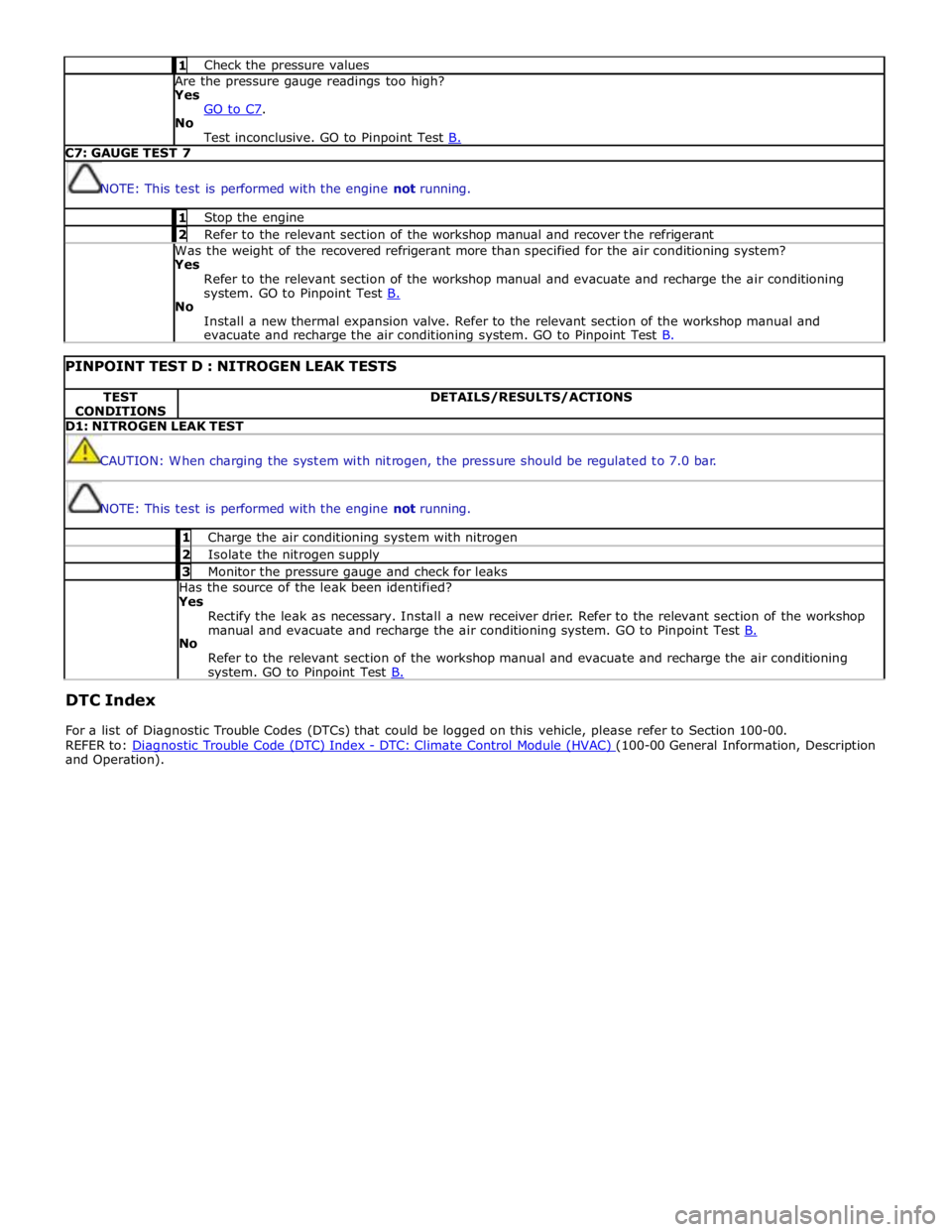
1 Check the pressure values Are the pressure gauge readings too high? Yes
GO to C7. No
Test inconclusive. GO to Pinpoint Test B. C7: GAUGE TEST 7
NOTE: This test is performed with the engine not running. 1 Stop the engine 2 Refer to the relevant section of the workshop manual and recover the refrigerant Was the weight of the recovered refrigerant more than specified for the air conditioning system? Yes
Refer to the relevant section of the workshop manual and evacuate and recharge the air conditioning
system. GO to Pinpoint Test B. No
Install a new thermal expansion valve. Refer to the relevant section of the workshop manual and
evacuate and recharge the air conditioning system. GO to Pinpoint Test B.
PINPOINT TEST D : NITROGEN LEAK TESTS TEST
CONDITIONS DETAILS/RESULTS/ACTIONS D1: NITROGEN LEAK TEST
CAUTION: When charging the system with nitrogen, the pressure should be regulated to 7.0 bar.
NOTE: This test is performed with the engine not running. 1 Charge the air conditioning system with nitrogen 2 Isolate the nitrogen supply 3 Monitor the pressure gauge and check for leaks Has the source of the leak been identified?
Yes
Rectify the leak as necessary. Install a new receiver drier. Refer to the relevant section of the workshop
manual and evacuate and recharge the air conditioning system. GO to Pinpoint Test B. No
Refer to the relevant section of the workshop manual and evacuate and recharge the air conditioning system. GO to Pinpoint Test B.
DTC Index
For a list of Diagnostic Trouble Codes (DTCs) that could be logged on this vehicle, please refer to Section 100-00.
REFER to: Diagnostic Trouble Code (DTC) Index - DTC: Climate Control Module (HVAC) (100-00 General Information, Description and Operation).
Page 1668 of 3039
Published: 11-May-2011
Climate Control System - General Information - Air Conditioning (A/C) System
Recovery, Evacuation and Charging
General Procedures
1. WARNING: Servicing must be carried out by personnel familliar with both
vehicle system and the charging and testing equipment. All operations
must be carried out in a well ventilated area away from open flame and
heat sources.
NOTE: The receiver drier need only be changed under the following
circumstances: There is dirt in the refrigerant circuit ( eg. compressor
seizure ), the system is leaking and refrigerant has been lost to
atmosphere, or the refrigerant circuit has been open more than 24 hours,
due to repair.
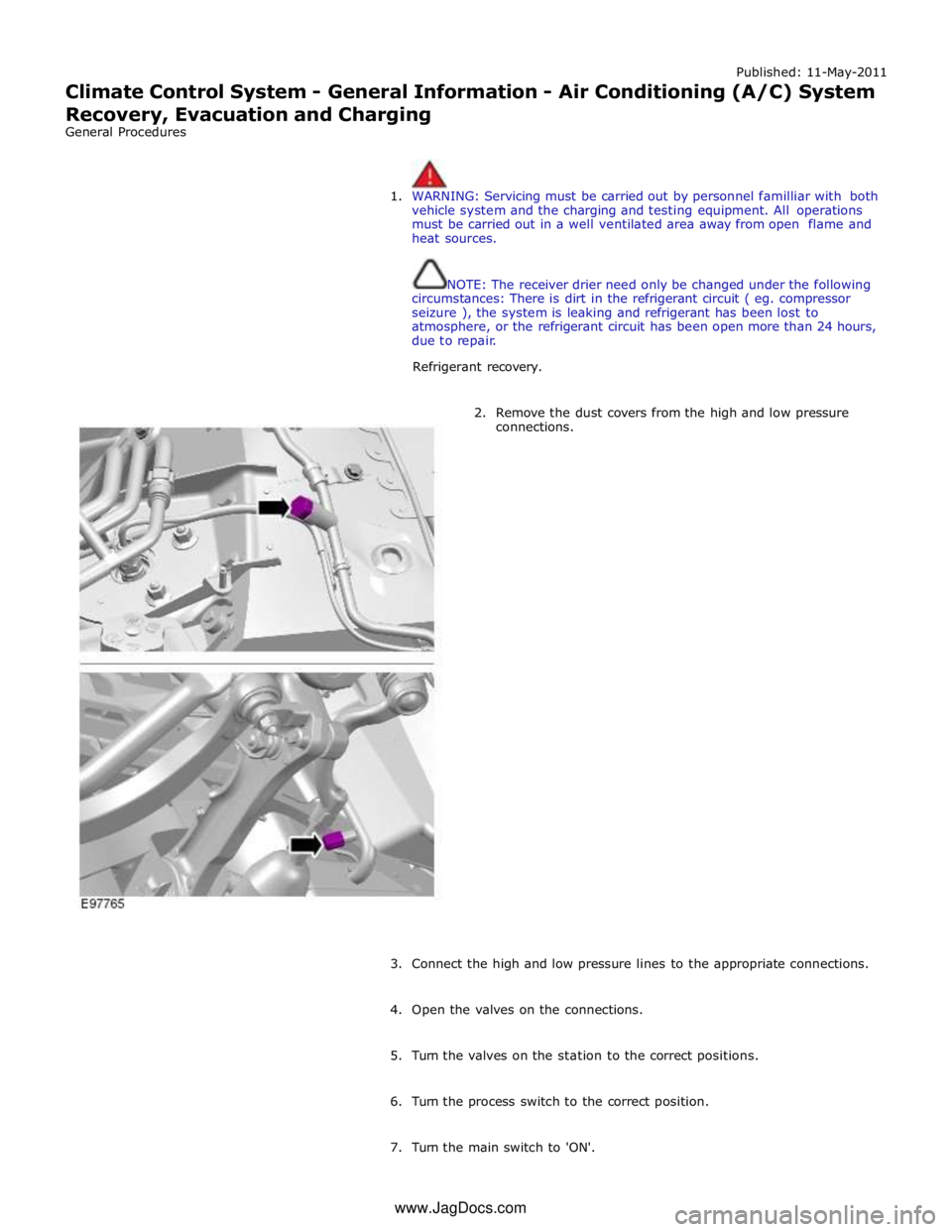
Refrigerant recovery.
2. Remove the dust covers from the high and low pressure
connections.
3. Connect the high and low pressure lines to the appropriate connections.
4. Open the valves on the connections.
5. Turn the valves on the station to the correct positions.
6. Turn the process switch to the correct position.
7. Turn the main switch to 'ON'. www.JagDocs.com
Page 1669 of 3039
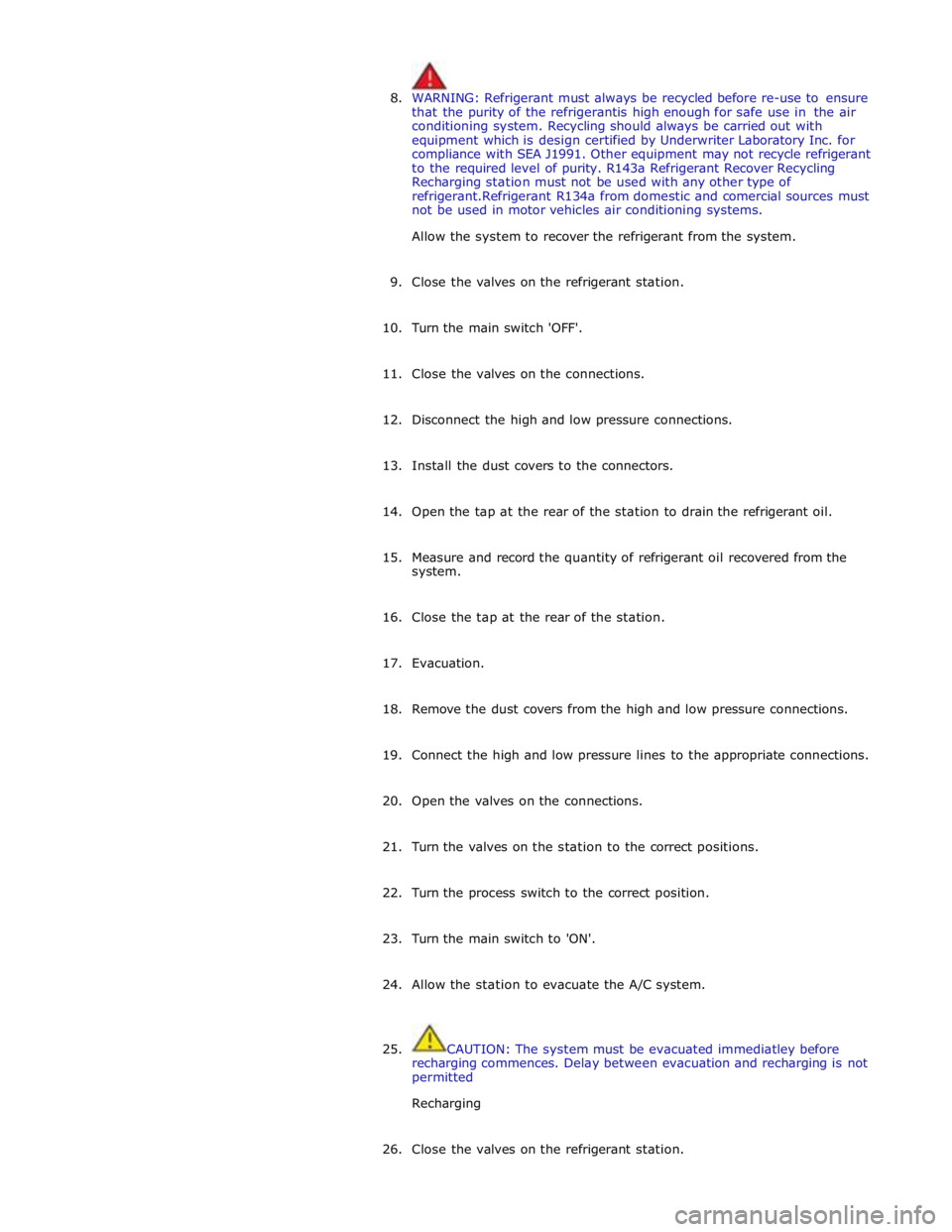
8. WARNING: Refrigerant must always be recycled before re-use to ensure
that the purity of the refrigerantis high enough for safe use in the air
conditioning system. Recycling should always be carried out with
equipment which is design certified by Underwriter Laboratory Inc. for
compliance with SEA J1991. Other equipment may not recycle refrigerant
to the required level of purity. R143a Refrigerant Recover Recycling
Recharging station must not be used with any other type of
refrigerant.Refrigerant R134a from domestic and comercial sources must
not be used in motor vehicles air conditioning systems.
Allow the system to recover the refrigerant from the system.
9. Close the valves on the refrigerant station.
10. Turn the main switch 'OFF'.
11. Close the valves on the connections.
12. Disconnect the high and low pressure connections.
13. Install the dust covers to the connectors.
14. Open the tap at the rear of the station to drain the refrigerant oil.
15. Measure and record the quantity of refrigerant oil recovered from the
system.
16. Close the tap at the rear of the station.
17. Evacuation.
18. Remove the dust covers from the high and low pressure connections.
19. Connect the high and low pressure lines to the appropriate connections.
20. Open the valves on the connections.
21. Turn the valves on the station to the correct positions.
22. Turn the process switch to the correct position.
23. Turn the main switch to 'ON'.
24. Allow the station to evacuate the A/C system.
25. CAUTION: The system must be evacuated immediatley before
recharging commences. Delay between evacuation and recharging is not
permitted
Recharging
26. Close the valves on the refrigerant station.
Page 1670 of 3039

27. Close the valve on the oil charger.
28. Disconnect the yellow line from the refrigerant station.
29. Remove the cover from the oil charger.
30. Pour the correct quantity of refrigerant oil into the oil charger.
31. Install the cover to the oil charger.
32. Connect the yellow line to the refrigerant station.
33. Open the valve on the oil charger.
34. Move the pointer on the refrigerant gauge to mark the position of the
refrigerant drop.
35. Slowly open the correct valve on the refrigerant to allow the vacuum to
pull the refrigerant into the system.
36. Close the valve on the refrigerant station when the correct amount of
refrigerant has been drawn into the air conditioning system.
37. Turn the main switch 'OFF'.
38. Close the valves on the connections.
39. Disconnect the high and low pressure connections.
Page 1671 of 3039
Published: 11-May-2011
Climate Control System - General Information - Air Conditioning (A/C) System
Flushing
General Procedures
1. WARNINGS:
Use extreme care and observe all safety precautions related to the
use of refrigerants. Due to refrigerant hazards, always wear safety
goggles and non-penetrable gloves when working on or flushing air
conditioning (A/C) systems. Failure to follow this instruction may result
in personal injury.
When flushing the A/C system, refer to the manufacturers
equipment instructions for additional information. Failure to do so may
result in system damage or personal injury.
The A/C refrigerant analyzer must be used before the recovery of
any vehicle's A/C refrigerant. Failure to do so puts shop bulk refrigerant
at risk of contamination. If the vehicle A/C refrigerant is contaminated,
refer the customer to return to the repair facility that performed the last
A/C repair. If the customer wishes to pay the additional cost, use the
A/C recovery equipment that is designated for recovering contaminated
A/C refrigerant. All contaminated A/C refrigerant must be disposed of as
hazardous waste. For additional information, refer to the manufacturers
equipment instructions. Failure to follow this instruction may result in
personal injury.
Prior to using the A/C flushing equipment for the first time, follow
the operating instructions. Failure to follow this instruction may result in
personal injury.
CAUTION: Prior to flushing, remove and discard the desiccant sack.
Depending on the equipment used, other A/C components may have to
be removed prior to flushing. For additional information, refer to the
manufacturers equipment instructions before flushing the A/C system.
Recover the refrigerant.
For additional information, refer to Air conditioning (A/C) System Recovery, Evacuation and Charging in this section.
2. Remove the desiccant sack.
For additional information, refer to Section 412-03 Air Conditioning.
3. Flush the system. For additional information, refer to the manufacturers
equipment instructions.
4. Install new refrigerant lines if blocked with debris.
5. Install a new desiccant sack.
For additional information, refer to Section 412-03 Air Conditioning.
6. Add the required amount of oil to the A/C system depending on the
repair procedure.
For additional information, refer to Refrigerant Oil Adding in this section.
7. Evacuate and charge the A/C system.
For additional information, refer to Air conditioning (A/C) System Recovery, Evacuation and Charging in this section.
8. Carry out fluorescent dye leak detection test.
Page 1674 of 3039
Published: 11-May-2011
Climate Control System - General Information - Electronic Leak Detection
General Procedures
1. WARNING: Good ventilation is necessary in the area where A/C leak
testing is to be carried out. If the surrounding air is contaminated with
refrigerant gas, the leak detector will indicate this gas all the time.
Odors from other chemicals such as antifreeze, diesel fuel, disc brake
cleaner, or other cleaning solvents can cause the same problem. A fan,
even in a well ventilated area, is very helpful in removing small traces of
contamination from the air that might affect the leak detector. Failure to
follow this instruction may result in personal injury.
Attach an R-134a manifold gauge set or use a UL-approved
recovery/recycling device such as an R-134a A/C refrigerant center (which
meets SAE Standard J 1991). For additional information, refer to the
manufacturers equipment instructions.
Both gauges should indicate 413-551 kPa (60-80 psi) at 24°C
(75°F) with the engine off.
If little or no pressure is indicated, carry out the air conditioning
(A/C) system recovery, evacuation and charging procedure.
For additional information, refer to Air Conditioning (AC) System Recovery, Evacuation and Charging in this section.
2. Use an R134-a Automatic calibration halogen leak detector to leak test
the refrigerant system. For additional information, refer to the
manufacturers equipment instructions.
3. If a leak is found, carry out the air conditioning (A/C) system recovery
procedure.
For additional information, refer to Air Conditioning (AC) System Recovery, Evacuation and Charging in this section.
Page 1675 of 3039
Published: 11-May-2011
Climate Control System - General Information - Fluorescent Dye Leak Detection
General Procedures
1. WARNING: Eye protection glasses supplied with the ultraviolet (UV)
lamp should be used to protect eyesight from harm.
NOTE: The air conditioning (A/C) system has an R-134a leak trace
dye wafer incorporated into the desiccant bag. The exact location of
leaks can be pinpointed by the bright yellow/green glow of the tracer
dye. Since more than one leak may exist, always inspect each
component. If it is necessary to add dye (due to a severe leakage for
example) use proprietary tracer dye injection equipment.
Check for leaks using ultraviolet (UV) lamp.
2. Check all components, fittings and lines of the A/C system.
3. Carry out the repair. For additional information, refer to Section 412-03 Air Conditioning.
4. After the leak is repaired, remove any traces of leak trace dye with a
general purpose oil solvent.
5. Check the A/C system for correct operation.
6. Verify the repair by operating the system for a short time and inspecting
with the (UV) lamp.
Page 1676 of 3039
Published: 11-May-2011
Climate Control System - General Information - Inspection and Assembly Requirements
General Procedures
1. Check for leaks using ultraviolet (UV) Lamp.
For additional information, refer to Flourescent Dye Leak Detection in this section.
2. NOTES:
Any time a hose or component connection leak is observed, the
component and fitting must be separated, cleaned and a new O-ring
fitted and lubricated with air conditioning compressor oil.
For additional information, refer to Specifications in this section.
When separating A/C joints, cap the open connections
immediately. Do not leave open to atmosphere.
O-ring seal surfaces must be free of dirt, lint, burrs and scratches. The
O-ring and connector should be lubricated with air conditioning
compressor oil.
For additional information, refer to Specifications in this section.
Page 1677 of 3039
Published: 11-May-2011
Climate Control System - General Information - Manifold Gauge Set Connection
General Procedures
1. WARNINGS:
Use extreme care and observe all safety precautions related to the
use of refrigerants. Failure to follow this instruction may result in
personal injury.
For additional information, refer to the manufacturers equipment
instructions. Failure to follow this instruction may result in personal
injury and system damage.
Install the manifold gauge set. For additional information, refer to the
manufacturers equipment instructions.
2. Carry out the repair.
3. Remove the manifold gauge set. For additional information, refer to the
manufacturers equipment instructions.
4. Carry out flourescent dye leak detection test.
For additional information, refer to Flourescent Dye Leak Detection in this section.
5. Check air conditioning (A/C) system for correct operation.