wheel JAGUAR XFR 2010 1.G Service Manual
[x] Cancel search | Manufacturer: JAGUAR, Model Year: 2010, Model line: XFR, Model: JAGUAR XFR 2010 1.GPages: 3039, PDF Size: 58.49 MB
Page 246 of 3039
Published: 17-Apr-2014
General Information - Diagnostic Trouble Code (DTC) Index DTC: Tire
Pressure Monitoring System Module (TPM)
Description and Operation
Tire Pressure Monitoring System (TPM)
CAUTION: Diagnosis by substitution from a donor vehicle is NOT acceptable. Substitution of control modules does not
guarantee confirmation of a fault and may also cause additional faults in the vehicle being checked and/or the donor vehicle.
NOTES:
If the control module or a component is suspect and the vehicle remains under manufacturer warranty, refer to the
Warranty Policy and Procedures manual, or determine if any prior approval programme is in operation, prior to the installation
of a new module/component.
Generic scan tools may not read the codes listed, or may read only 5-digit codes. Match the 5 digits from the scan tool to
the first 5 digits of the 7-digit code listed to identify the fault (the last 2 digits give extra information read by the
manufacturer approved diagnostic system).
When performing voltage or resistance tests, always use a digital multimeter (DMM) accurate to three decimal places,
and with an up-to-date calibration certificate. When testing resistance, always take the resistance of the DMM leads into
account.
Check and rectify basic faults before beginning diagnostic routines involving pinpoint tests.
If DTCs are recorded and, after performing the pinpoint tests a fault is not present, an intermittent concern may be the
cause. Always check for loose connections and corroded terminals.
Where an 'on demand self-test' is referred to, this can be accessed via the 'DTC Monitor' tab on the manufacturers
approved diagnostic system.
Check DDW for open campaigns. Refer to the corresponding bulletins and SSMs which may be valid for the specific
customer complaint and carry out the recommendations as required.
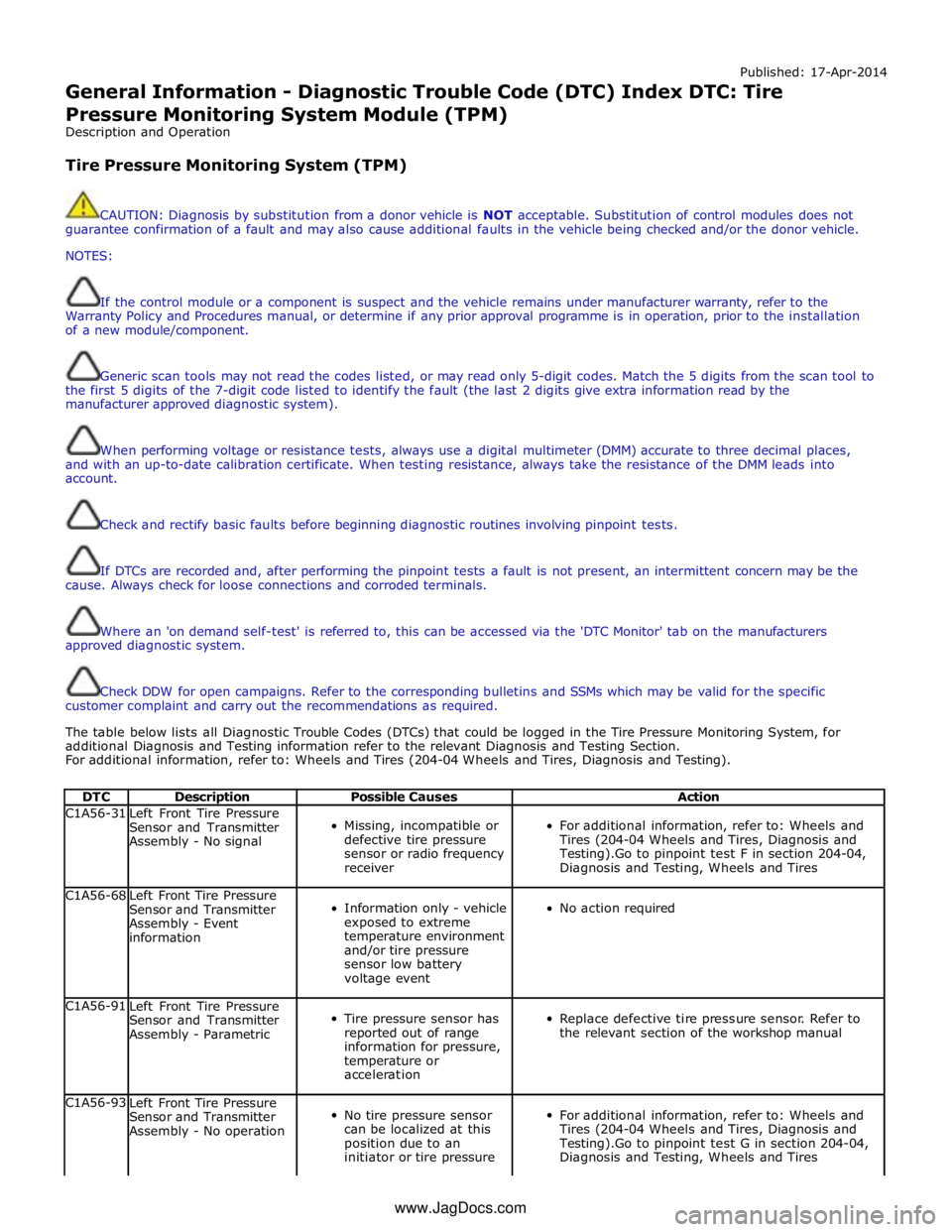
The table below lists all Diagnostic Trouble Codes (DTCs) that could be logged in the Tire Pressure Monitoring System, for
additional Diagnosis and Testing information refer to the relevant Diagnosis and Testing Section.
For additional information, refer to: Wheels and Tires (204-04 Wheels and Tires, Diagnosis and Testing).
DTC Description Possible Causes Action C1A56-31
Left Front Tire Pressure
Sensor and Transmitter
Assembly - No signal
Missing, incompatible or
defective tire pressure
sensor or radio frequency
receiver
For additional information, refer to: Wheels and
Tires (204-04 Wheels and Tires, Diagnosis and
Testing).Go to pinpoint test F in section 204-04,
Diagnosis and Testing, Wheels and Tires C1A56-68
Left Front Tire Pressure
Sensor and Transmitter
Assembly - Event
information
Information only - vehicle
exposed to extreme
temperature environment
and/or tire pressure
sensor low battery
voltage event
No action required C1A56-91
Left Front Tire Pressure
Sensor and Transmitter
Assembly - Parametric
Tire pressure sensor has
reported out of range
information for pressure,
temperature or
acceleration
Replace defective tire pressure sensor. Refer to
the relevant section of the workshop manual C1A56-93
Left Front Tire Pressure
Sensor and Transmitter
Assembly - No operation
No tire pressure sensor
can be localized at this
position due to an
initiator or tire pressure
For additional information, refer to: Wheels and
Tires (204-04 Wheels and Tires, Diagnosis and
Testing).Go to pinpoint test G in section 204-04,
Diagnosis and Testing, Wheels and Tires www.JagDocs.com
Page 247 of 3039

DTC Description Possible Causes Action sensor malfunction
C1A57-11
Left Front Initiator -
Circuit short to ground
Left front initiator circuit
is short to ground
For additional information, refer to: Wheels and
Tires (204-04 Wheels and Tires, Diagnosis and
Testing).Go to pinpoint test B1 in section 204-04,
Diagnosis and Testing, Wheels and Tires C1A57-12
Left Front Initiator -
Circuit short to battery
Left front initiator circuit
is short to power
For additional information, refer to: Wheels and
Tires (204-04 Wheels and Tires, Diagnosis and
Testing).Go to pinpoint test B2 in section 204-04,
Diagnosis and Testing, Wheels and Tires C1A57-13
Left Front Initiator -
Circuit open
Left front initiator circuit
open
For additional information, refer to: Wheels and
Tires (204-04 Wheels and Tires, Diagnosis and
Testing).Go to pinpoint test B9 in section 204-04,
Diagnosis and Testing, Wheels and Tires C1A58-31
Right Front Tire Pressure
Sensor and Transmitter
Assembly - No signal
Missing, incompatible or
defective tire pressure
sensor or radio frequency
receiver
For additional information, refer to: Wheels and
Tires (204-04 Wheels and Tires, Diagnosis and
Testing).Go to pinpoint test F in section 204-04,
Diagnosis and Testing, Wheels and Tires C1A58-68
Right Front Tire Pressure
Sensor and Transmitter
Assembly - Event
information
Information only - vehicle
exposed to extreme
temperature environment
and/or tire pressure
sensor low battery
voltage event
No action required C1A58-91
Right Front Tire Pressure
Sensor and Transmitter
Assembly - Parametric
Tire pressure sensor has
reported out of range
information for pressure,
temperature or
acceleration
Replace defective tire pressure sensor. refer to
the relevant section of the workshop manual C1A58-93
Right Front Tire Pressure
Sensor and Transmitter
Assembly - No operation
No tire pressure sensor
can be localized at this
position due to an
initiator or tire pressure
sensor malfunction
For additional information, refer to: Wheels and
Tires (204-04 Wheels and Tires, Diagnosis and
Testing).Go to pinpoint test G in section 204-04,
Diagnosis and Testing, Wheels and Tires C1A59-11
Right Front Initiator -
Circuit short to ground
Right front initiator circuit
is short to ground
For additional information, refer to: Wheels and
Tires (204-04 Wheels and Tires, Diagnosis and
Testing).Go to pinpoint test C1 in section 204-04,
Diagnosis and Testing, Wheels and Tires C1A59-12
Right Front Initiator -
Circuit short to battery
Right front initiator circuit
is short to power
For additional information, refer to: Wheels and
Tires (204-04 Wheels and Tires, Diagnosis and
Testing).Go to pinpoint test C2 in section 204-04,
Diagnosis and Testing, Wheels and Tires C1A59-13
Right Front Initiator -
Circuit open
Right front initiator circuit
open
For additional information, refer to: Wheels and
Tires (204-04 Wheels and Tires, Diagnosis and
Testing).Go to pinpoint test C9 in section 204-04,
Diagnosis and Testing, Wheels and Tires C1A60-31
Left Rear Tire Pressure
Sensor and Transmitter
Assembly - No signal
Missing, incompatible or
defective tire pressure
sensor or radio frequency
receiver
For additional information, refer to: Wheels and
Tires (204-04 Wheels and Tires, Diagnosis and
Testing).Go to pinpoint test F in section 204-04,
Diagnosis and Testing, Wheels and Tires C1A60-68
Left Rear Tire Pressure
Sensor and Transmitter
Assembly - Event
information
Information only - Vehicle
exposed to extreme
temperature environment
and/or tire pressure
sensor low battery
voltage event
No action required
Page 248 of 3039

DTC Description Possible Causes Action C1A60-91
Left Rear Tire Pressure
Sensor and Transmitter
Assembly - Parametric
Tire pressure sensor has
reported out of range
information for pressure,
temperature or
acceleration
Replace defective tire pressure sensor, refer to
the relevant section of the workshop manual C1A60-93
Left Rear Tire Pressure
Sensor and Transmitter
Assembly - No operation
No tire pressure sensor
can be localized at this
position due to an
initiator or tire pressure
sensor malfunction
For additional information, refer to: Wheels and
Tires (204-04 Wheels and Tires, Diagnosis and
Testing).Go to pinpoint test G in section 204-04,
Diagnosis and Testing, Wheels and Tires C1A61-11
Left Rear Initiator -
Circuit short to ground
Left rear initiator circuit
short to ground
For additional information, refer to: Wheels and
Tires (204-04 Wheels and Tires, Diagnosis and
Testing).Go to pinpoint test D1 in section 204-04,
Diagnosis and Testing, Wheels and Tires C1A61-12
Left Rear Initiator -
Circuit short to battery
Left rear initiator circuit
short to power
For additional information, refer to: Wheels and
Tires (204-04 Wheels and Tires, Diagnosis and
Testing).Go to pinpoint test D2 in section
204-04,Diagnosis and Testing, Wheels and Tires C1A61-13
Left Rear Initiator -
Circuit open
Left rear initiator circuit
open
For additional information, refer to: Wheels and
Tires (204-04 Wheels and Tires, Diagnosis and
Testing).Go to pinpoint test D9 in section 204-04,
Diagnosis and Testing, Wheels and Tires C1A62-31
Right Rear Tire Pressure
Sensor and Transmitter
Assembly - No signal
Missing, incompatible or
defective tire pressure
sensor or radio frequency
receiver
For additional information, refer to: Wheels and
Tires (204-04 Wheels and Tires, Diagnosis and
Testing).Go to pinpoint test F in section 204-04,
Diagnosis and Testing, Wheels and Tires C1A62-68
Right Rear Tire Pressure
Sensor and Transmitter
Assembly - Event
information
Information only - vehicle
exposed to extreme
temperature environment
and/or tire pressure
sensor low battery
voltage event
No action required C1A62-91
Right Rear Tire Pressure
Sensor and Transmitter
Assembly - Parametric
Tire pressure sensor has
reported out of range
information for pressure,
temperature or
acceleration
Replace defective tire pressure sensor, refer to
the relevant section of the workshop manual C1A62-93
Right Rear Tire Pressure
Sensor and Transmitter
Assembly - No operation
No tire pressure sensor
can be localized at this
position due to an
initiator or tire pressure
sensor malfunction
For additional information, refer to: Wheels and
Tires (204-04 Wheels and Tires, Diagnosis and
Testing).Go to pinpoint test G in section 204-04,
Diagnosis and Testing, Wheels and Tires C1A63-11
Right Rear Initiator -
Circuit short to ground
Right rear initiator circuit
short to ground
For additional information, refer to: Wheels and
Tires (204-04 Wheels and Tires, Diagnosis and
Testing).Go to pinpoint test E1 in section 204-04,
Diagnosis and Testing, Wheels and Tires C1A63-12
Right Rear Initiator -
Circuit short to battery
Right rear initiator circuit
short to power
For additional information, refer to: Wheels and
Tires (204-04 Wheels and Tires, Diagnosis and
Testing). Go to pinpoint test E2 in section 204-04,
Diagnosis and Testing, Wheels and Tires C1A63-13
Right Rear Initiator -
Circuit open
Right rear initiator circuit
open
For additional information, refer to: Wheels and
Tires (204-04 Wheels and Tires, Diagnosis and
Testing).Go to pinpoint test E9 in section 204-04,
Diagnosis and Testing, Wheels and Tires
Page 249 of 3039

DTC Description Possible Causes Action C1A64-68
Spare Wheel Tire
Pressure Sensor and Transmitter Assembly -
Event information
Information only - vehicle
exposed to extreme
temperature environment
and/or tire pressure
sensor low battery
voltage event
No action required C1A64-91
Spare Wheel Tire
Pressure Sensor and Transmitter Assembly -
Parametric
Tire pressure sensor has
reported out of range
information for pressure,
temperature or
acceleration
Replace defective tire pressure sensor, refer to
the relevant section of the workshop manual C1A64-93
Spare Wheel Tire
Pressure Sensor and Transmitter Assembly -
No operation
Missing, incompatible or
defective tire pressure
sensor or radio frequency
receiver
For additional information, refer to: Wheels and
Tires (204-04 Wheels and Tires, Diagnosis and
Testing).Go to pinpoint test H in section 204-04,
Diagnosis and Testing, Wheels and Tires C1D19-11
External Receiver Data
Line - Circuit short to
ground
Tire pressure monitoring
system radio frequency
receiver or data line
circuit is short to ground
For additional information, refer to: Wheels and
Tires (204-04 Wheels and Tires, Diagnosis and
Testing).Go to pinpoint test A in section
204-04,Diagnosis and Testing, Wheels and Tires C1D19-12
External Receiver Data
Line - Circuit short to
battery
Tire pressure monitoring
system radio frequency
receiver or data line
circuit is short to power
For additional information, refer to: Wheels and
Tires (204-04 Wheels and Tires, Diagnosis and
Testing).Go to pinpoint test I in section 204-04,
diagnosis and testing C1D19-87
External Receiver Data
Line - Missing message
Radio Frequency
reception blocked
Tire pressure monitoring
system radio frequency
receiver faulty
Tire pressure monitoring
system radio frequency
receiver or data line
circuits open circuit
Missing, incompatible or
defective tire pressure
sensors
For additional information, refer to: Wheels and
Tires (204-04 Wheels and Tires, Diagnosis and
Testing).Go to pinpoint test J in section 204-04,
Diagnosis and Testing, Wheels and Tires U0010-88
Medium Speed CAN
Communication Bus - Bus
off
CAN bus fault
Carry out CAN network integrity tests. Refer to
the electrical wiring diagrams and check CAN
network for short, open circuit U0140-00
Lost communication with
body control module - No
sub type information
CAN bus fault
Central junction box fault
Refer to the electrical wiring diagrams and check
central junction box power and ground supplies
for short, open circuit. Carry out CAN network
integrity tests U0142-00
Lost Communication With
Body Control Module "B" -
No sub type information
CAN bus fault
Rear junction box fault
Refer to the electrical wiring diagrams and check
rear junction box power and ground supplies for
short, open circuit. Carry out CAN network
integrity tests U0155-00
Lost Communications
With Instrument Panel
Cluster (IPC) Control
Module - No sub type
information
CAN bus fault
Instrument cluster fault
Refer to the electrical wiring diagrams and check
instrument cluster power and ground supplies for
short, open circuit. Carry out CAN network
integrity tests U0164-00
Lost Communication With
HVAC Control Module - No
sub type information
CAN bus fault
Climate control module
fault
Refer to the electrical wiring diagrams and check
climate control module power and ground supplies
for short, open circuit. Carry out CAN network
integrity tests
Page 260 of 3039

DTC Description Possible Causes Action suspect. P0783-77
3-4 Shift - Commanded
position not reachable
Gear Ratio Monitoring.
Mechanical Failures
Check and correct oil level. Clear DTC. If code
re-detects suspect Transmission (mechanical)
internal fault. Install a new Transmission as
required, refer to the warranty policy and
procedures manual if a module/component is
suspect. P0784-07
4-5 Shift - Mechanical
Failures
Gear Ratio Monitoring.
Mechanical Failures
Check and correct oil level. Clear DTC. If code
re-detects suspect Transmission (mechanical)
internal fault. Install a new Transmission as
required, refer to the warranty policy and
procedures manual if a module/component is
suspect. P0784-77
4-5 Shift - Commanded
position not reachable
Gear Ratio Monitoring.
Mechanical Failures
Check and correct oil level. Clear DTC. If code
re-detects suspect Transmission (mechanical)
internal fault. Install a new Transmission as
required, refer to the warranty policy and
procedures manual if a module/component is
suspect. P0798-1A
Pressure Control Solenoid
C Electrical - Circuit
Resistance Below Threshold
Pressure control solenoid
C Circuit resistance below
threshold
Suspect the Transmission Control Module. Install a
new Transmission Control Module as required,
refer to the warranty policy and procedures manual
if a module/component is suspect. P0798-1E
Pressure Control Solenoid
C Electrical - Circuit Short
to Ground
Pressure control solenoid
C electrical circuit short
to ground
Suspect the Transmission Control Module. Install a
new Transmission Control Module as required,
refer to the warranty policy and procedures manual
if a module/component is suspect. P0798-21
Pressure Control Solenoid
C Electrical - Signal
amplitude < minimum
Pressure Control Solenoid
C Electrical signal
amplitude < minimum
Suspect the Transmission Control Module. Install a
new Transmission Control Module as required,
refer to the warranty policy and procedures manual
if a module/component is suspect. P0814-62 Transmission Range
Display Circuit - Signal
compare failure
Transmission Range
Display Circuit signal
compare failure
Suspect the Transmission Control Module. Install a
new Transmission Control Module as required,
refer to the warranty policy and procedures manual
if a module/component is suspect. P0826-08
Up and Down Switch
circuit - Bus Signal
Message Failures
Invalid CAN signal from
Central Junction
Box/Instrument Cluster
Stuck Sprintronic switch
CAN bus circuit fault
Check Central Junction Box and Instrument Cluster
for stored DTCs. Check gear change switches for
correct operation. Refer to circuit diagrams and
check CAN bus for a circuit fault P0826-81
Up and Down Switch
Circuit - Invalid serial
data received
Invalid Can signal from
Central Junction Box /
Instrument Cluster
Stuck Sprintronic switch
CAN Bus Circuit fault
Check Central Junction Box and Instrument Cluster
for stored DTCs. Check Gear Change Switches for
correct operation. Refer to Circuit diagrams and
check CAN Bus for Circuit fault P0826-88
Up and Down Switch
Circuit - Bus off
Steering Wheel Module to
Central Junction Box /
Instrument Cluster LIN
Bus failure
Check Central Junction Box and Steering Wheel
Ice Switches for stored DTCs. Refer to Circuit
diagrams and check LIN Bus for Circuit fault P0829-07
5-6 Shift - Mechanical
Failures
Gear Ratio Monitoring.
Mechanical Failures
Check and correct oil level. Clear DTC. If code
re-detects suspect Transmission (mechanical)
internal fault. Install a new Transmission as
required, refer to the warranty policy and
procedures manual if a module/component is
suspect. www.JagDocs.com
Page 294 of 3039

Jacking and Lifting - Jacking
Description and Operation
Safety Precautions Published: 11-May-2011
WARNING: The jack provided with the vehicle is intended to be used in an emergency for changing a deflated tire. To
avoid damage to the vehicle, never use the jack to raise the vehicle for any other purpose. Refer to the Driver Handbook when
using the jack supplied with the vehicle. Failure to follow these instructions may result in personal injury.
The following safety precautions must be observed when raising the vehicle to carry out service operations:
Never rely on a jack alone to support a vehicle. Always use suitable vehicle stands to provide rigid support.
When working beneath a vehicle, whenever possible use a vehicle hoist instead of a jack and vehicle stands.
Make sure that the vehicle is standing on firm, level ground before using a jack.
Do not rely on the parking brake alone; chock the wheels and put the automatic transmission into Park if possible.
Check that any lifting equipment used has adequate capacity for the load being lifted and is in correct working order.
Page 296 of 3039
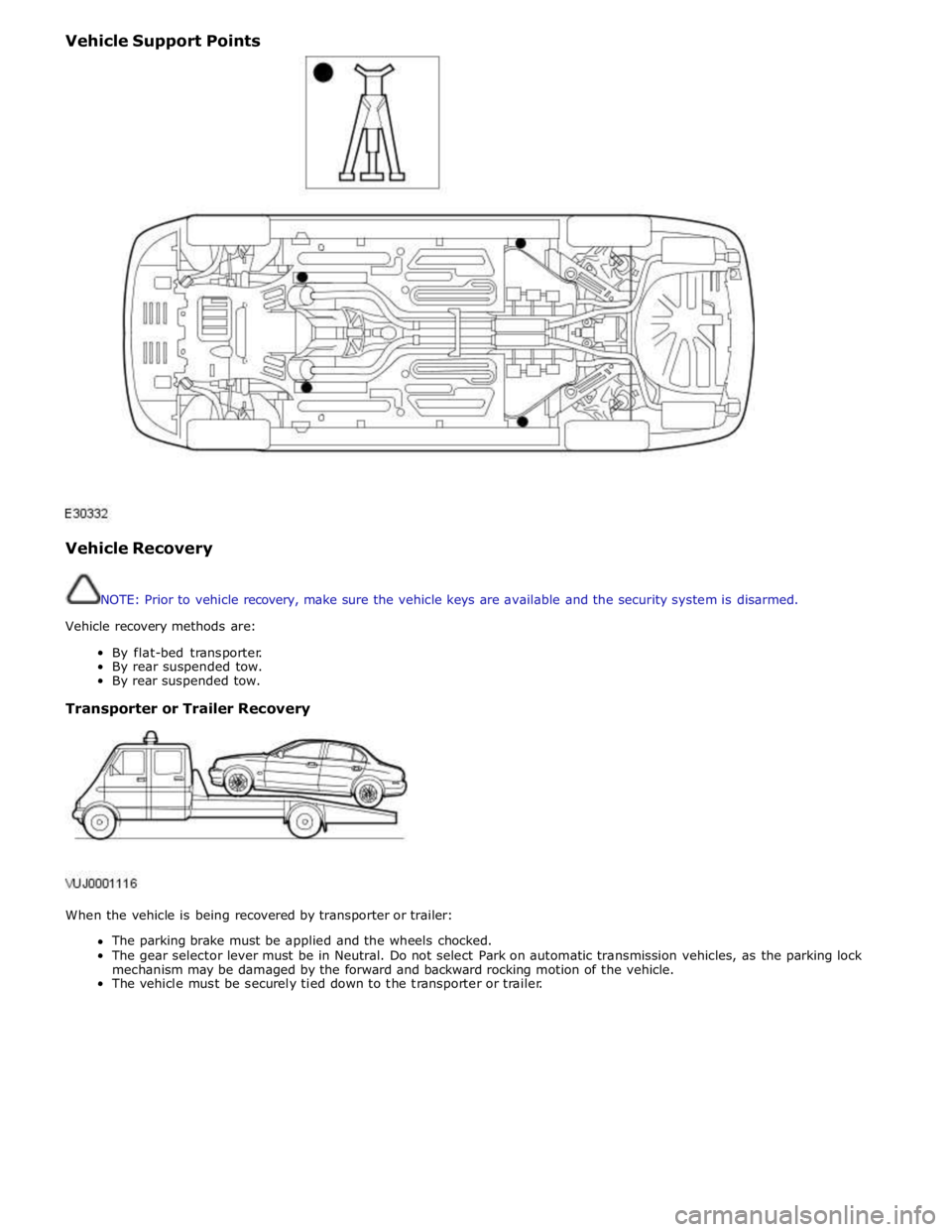
Vehicle Support Points
Vehicle Recovery
NOTE: Prior to vehicle recovery, make sure the vehicle keys are available and the security system is disarmed.
Vehicle recovery methods are:
By flat-bed transporter.
By rear suspended tow.
By rear suspended tow.
Transporter or Trailer Recovery
When the vehicle is being recovered by transporter or trailer:
The parking brake must be applied and the wheels chocked.
The gear selector lever must be in Neutral. Do not select Park on automatic transmission vehicles, as the parking lock
mechanism may be damaged by the forward and backward rocking motion of the vehicle.
The vehicle must be securely tied down to the transporter or trailer.
Page 297 of 3039
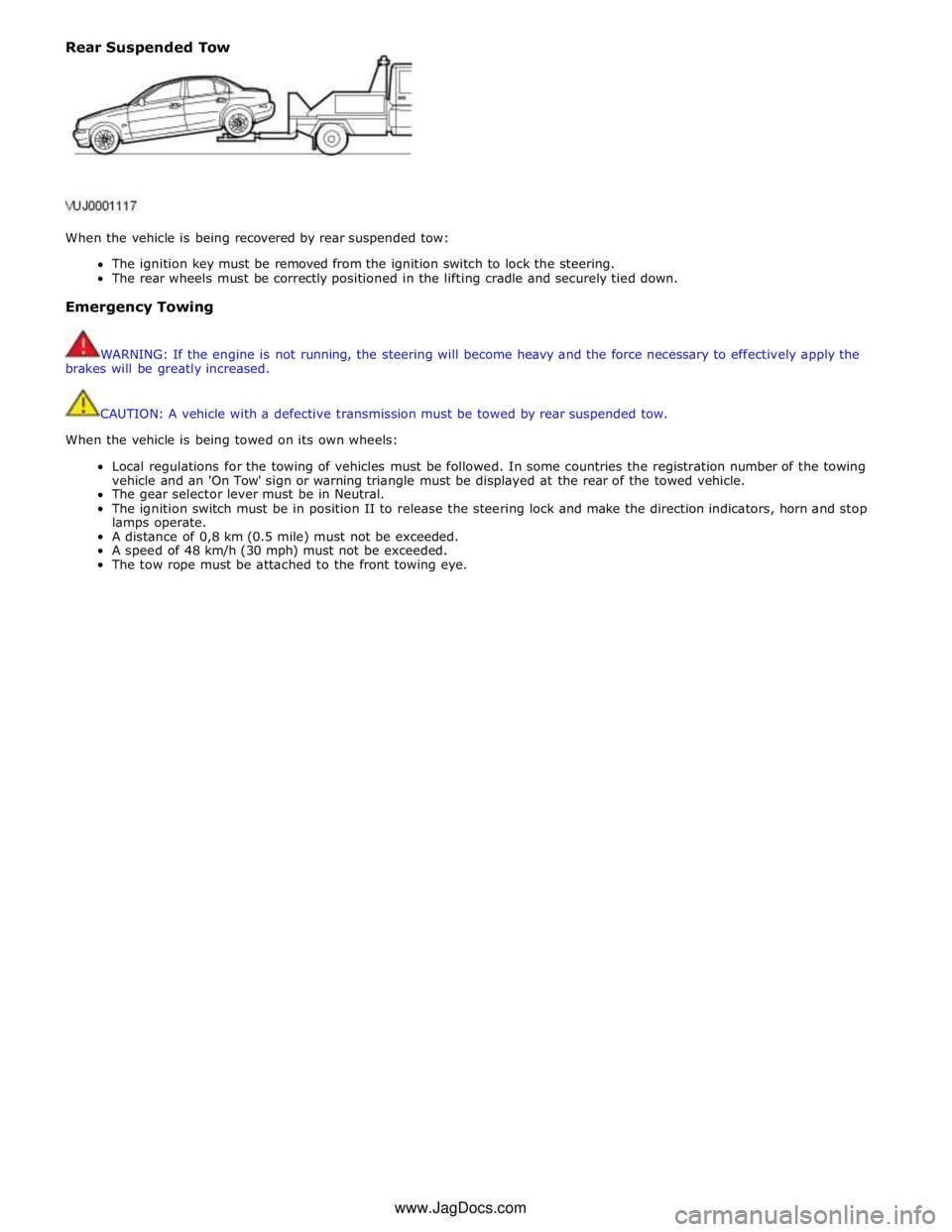
Rear Suspended Tow
When the vehicle is being recovered by rear suspended tow:
The ignition key must be removed from the ignition switch to lock the steering.
The rear wheels must be correctly positioned in the lifting cradle and securely tied down.
Emergency Towing
WARNING: If the engine is not running, the steering will become heavy and the force necessary to effectively apply the
brakes will be greatly increased.
CAUTION: A vehicle with a defective transmission must be towed by rear suspended tow.
When the vehicle is being towed on its own wheels:
Local regulations for the towing of vehicles must be followed. In some countries the registration number of the towing
vehicle and an 'On Tow' sign or warning triangle must be displayed at the rear of the towed vehicle.
The gear selector lever must be in Neutral.
The ignition switch must be in position II to release the steering lock and make the direction indicators, horn and stop
lamps operate.
A distance of 0,8 km (0.5 mile) must not be exceeded.
A speed of 48 km/h (30 mph) must not be exceeded.
The tow rope must be attached to the front towing eye. www.JagDocs.com
Page 299 of 3039

Published: 16-Sep-2013
Noise, Vibration and Harshness - Noise, Vibration and Harshness (NVH)
Diagnosis and Testing
Principle of Operation
For a detailed description of Noise, Vibration and Harshness issues, refer to the Description and Operation section of the
workshop manual.
REFER to: Noise, Vibration and Harshness (NVH) (100-04 Noise, Vibration and Harshness, Description and Operation).
Inspection and Verification
1. Verify the customer's concerns by operating the vehicle to duplicate the condition.
2. Visually inspect the vehicle to determine any obvious cause(s) of the concern(s).
3. If the inspection reveals obvious causes that can be readily identified, repair as necessary.
4. If the concern(s) remains after the inspection, determine the symptom(s) and refer to the Symptom Chart.
How To Use This Diagnostic Procedure Section
Noise, vibration and harshness (NVH) concerns have become more important as vehicles have become more sensitive to
these vibrations. This section is designed as an aid to identifying these situations
The section provides diagnostic procedures based on symptoms. If the condition occurs at high speed, for instance, the
most likely place to start is under High Speed Shake
The road test procedure will tell how to sort the conditions into categories and how to tell a vibration from a shake
A series of Road Test Quick Checks is provided to make sure that a cause is either pinpointed or eliminated
Name the condition, proceed to the appropriate section and locate the correct diagnosis. When the condition is
identified, the job is partly done
Follow the diagnostic procedure as outlined
Quick Checks are described within the step, while more involved tests and adjustments are outlined in General
Procedures
Always follow each step exactly and make notes to recall important findings later
Customer Interview
The road test and customer interview (if available) provide information that will help identify the concerns and will provide
direction to the correct starting point for diagnosis.
Identify the Condition
NVH problems usually occur in a number of areas:
tires
engine accessories
suspension
driveline
air leakage (wind noise)
squeaks and rattles
heating ventilation and air conditioning (HVAC)
electrical (e.g. motor noise)
transmission
engine
It is important, therefore, that an NVH concern be isolated into its specific area(s) as soon as possible. The easiest and
quickest way to do this is to carry out the Road Test as outlined.
Noise Diagnostic Procedure
Non-Axle Noise
The five most important sources of non-axle noise are exhaust, tires, roof racks, trim and mouldings, and transmission.
Therefore, make sure that none of the following conditions are the cause of the noise before proceeding with a driveline tear
down and diagnosis.
Under certain conditions, the pitch of the exhaust may sound very much like gear noise. At other times, it can be
mistaken for a wheel bearing rumble
Tires, especially snow tires, can have a high pitched tread whine or roar, similar to gear noise. Radial tires, to some
degree, have this characteristic. Also, any non-standard tire with an unusual tread construction may emit a roar or
whine type noise
Trim and mouldings can also cause whistling or a whining noise
Clunk may be a metallic noise heard when the automatic transmission is engaged in reverse or drive, or it may occur
when the throttle is applied or released. It is caused by backlash somewhere in the driveline
Bearing rumble sounds like marbles being tumbled. This condition is usually caused by a damaged wheel bearing
Page 300 of 3039
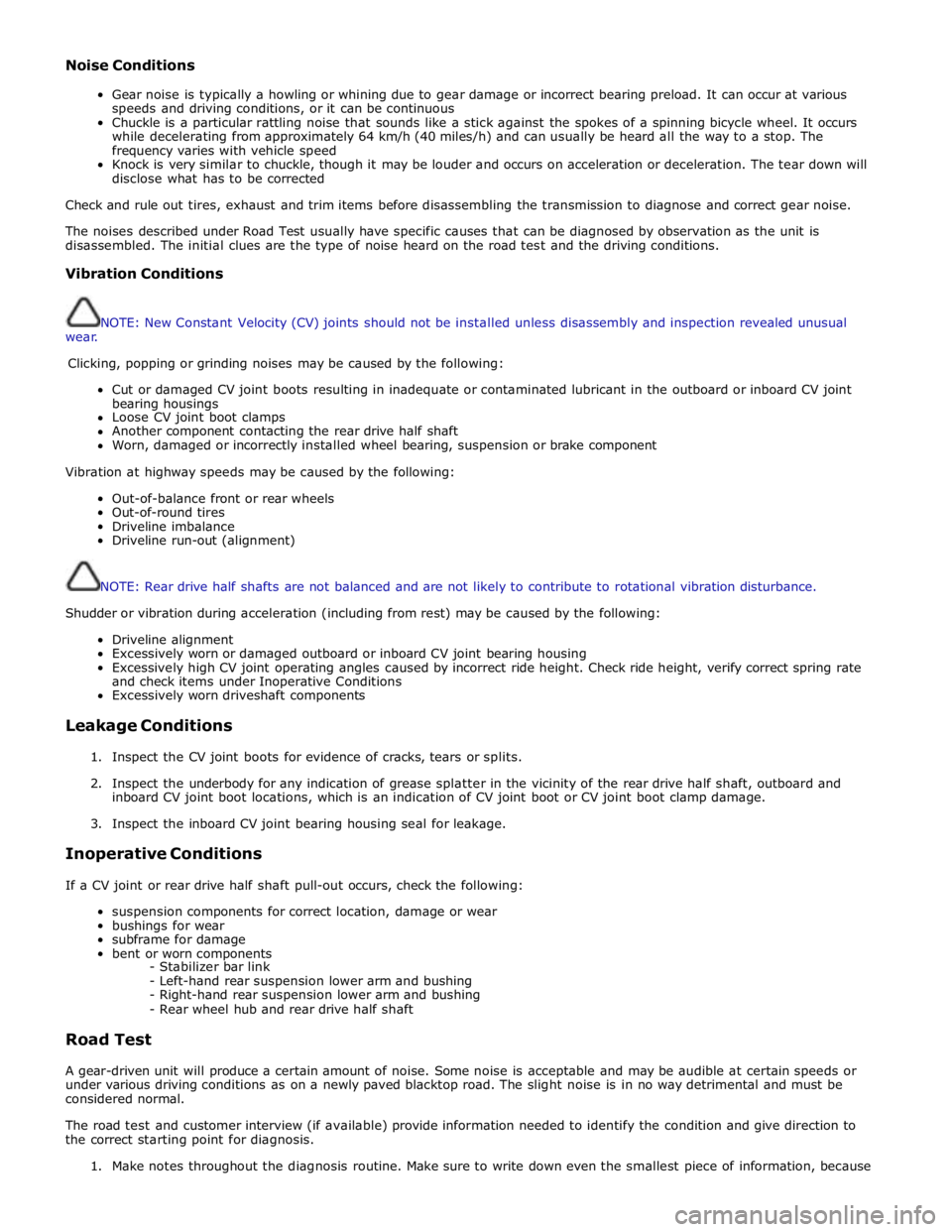
Noise Conditions
Gear noise is typically a howling or whining due to gear damage or incorrect bearing preload. It can occur at various
speeds and driving conditions, or it can be continuous
Chuckle is a particular rattling noise that sounds like a stick against the spokes of a spinning bicycle wheel. It occurs
while decelerating from approximately 64 km/h (40 miles/h) and can usually be heard all the way to a stop. The
frequency varies with vehicle speed
Knock is very similar to chuckle, though it may be louder and occurs on acceleration or deceleration. The tear down will
disclose what has to be corrected
Check and rule out tires, exhaust and trim items before disassembling the transmission to diagnose and correct gear noise.
The noises described under Road Test usually have specific causes that can be diagnosed by observation as the unit is
disassembled. The initial clues are the type of noise heard on the road test and the driving conditions.
Vibration Conditions
wear. NOTE: New Constant Velocity (CV) joints should not be installed unless disassembly and inspection revealed unusual
Clicking, popping or grinding noises may be caused by the following:
Cut or damaged CV joint boots resulting in inadequate or contaminated lubricant in the outboard or inboard CV joint
bearing housings
Loose CV joint boot clamps
Another component contacting the rear drive half shaft
Worn, damaged or incorrectly installed wheel bearing, suspension or brake component
Vibration at highway speeds may be caused by the following:
Out-of-balance front or rear wheels
Out-of-round tires
Driveline imbalance
Driveline run-out (alignment)
NOTE: Rear drive half shafts are not balanced and are not likely to contribute to rotational vibration disturbance.
Shudder or vibration during acceleration (including from rest) may be caused by the following:
Driveline alignment
Excessively worn or damaged outboard or inboard CV joint bearing housing
Excessively high CV joint operating angles caused by incorrect ride height. Check ride height, verify correct spring rate
and check items under Inoperative Conditions
Excessively worn driveshaft components
Leakage Conditions
1. Inspect the CV joint boots for evidence of cracks, tears or splits.
2. Inspect the underbody for any indication of grease splatter in the vicinity of the rear drive half shaft, outboard and
inboard CV joint boot locations, which is an indication of CV joint boot or CV joint boot clamp damage.
3. Inspect the inboard CV joint bearing housing seal for leakage.
Inoperative Conditions
If a CV joint or rear drive half shaft pull-out occurs, check the following:
suspension components for correct location, damage or wear
bushings for wear
subframe for damage
bent or worn components
- Stabilizer bar link
- Left-hand rear suspension lower arm and bushing
- Right-hand rear suspension lower arm and bushing
- Rear wheel hub and rear drive half shaft
Road Test
A gear-driven unit will produce a certain amount of noise. Some noise is acceptable and may be audible at certain speeds or
under various driving conditions as on a newly paved blacktop road. The slight noise is in no way detrimental and must be
considered normal.
The road test and customer interview (if available) provide information needed to identify the condition and give direction to
the correct starting point for diagnosis.
1. Make notes throughout the diagnosis routine. Make sure to write down even the smallest piece of information, because