warning JAGUAR XJ 2004 X350 / 3.G User Guide
[x] Cancel search | Manufacturer: JAGUAR, Model Year: 2004, Model line: XJ, Model: JAGUAR XJ 2004 X350 / 3.GPages: 227, PDF Size: 4.22 MB
Page 26 of 227
Security and Locks 2 - 11
Unlock the vehicle and disarm the
alarm using a key
Single-stage unlocking: Put the key in
the driver’s door lock, turn the key
towards the front of the vehicle and
release. This will unlock all the doors,
the luggage compartmen t is un-inhibited,
and turn on the interior lighting. This will
also disarm the system if it was armed,
the direction indicators will flash twice,
and the security LED will stop flashing.
Two-stage unlocking: Put the key in
the driver’s door lock, turn the key
towards the front of the vehicle and
release.
This will unlock the drivers door,
un-inhibited the luggage compartment
and turn on the interior lighting. This will
also disarm the system if it was armed,
the direction indicators will flash twice
and the security LED will stop flashing.
Turning the key towards the front of the
vehicle a second time will unlock all the
remaining doors.Direction Indicator Unlock
Alerts
The exterior direction indicators give two
flashes and two audible chirps sound as
unlocking takes place.
Note: If a fault exists with the intrusion
sensing or inclination sensing systems
(if fitted) when the vehicle is disarmed a
warning will be given. The exterior
direction indicators will flash twice
accompanied by tw o audible sounds
(if enabled) followed approximately one
second later by another flash from the
direction indicators and two audible
tones.
For further information, contact your
Jaguar Retailer.
Auto-relocking (Retailer
Enable Option)
This feature automatically centrally locks
and arms the vehicle (if security and
auto-relock are enabled) if the vehicle has
been unlocked with the key transmitter
having been previously locked and the
security system armed:
• And no door, hood or luggage compartment has been opened in the
last 45 seconds after the remote
unlock operation or,
• If the ignition remains off for 45 seconds after the remote unlock
operation.
Note: This feature can be enabled or
disabled, by a Jaguar Retailer, as required.
Page 27 of 227
2 - 12 Security and Locks
Luggage Compartment (Trunk)
The luggage compartment is locked and
unlocked electrically in conjunction with
the doors.
Neither the luggage compartment lid
release switch on the fascia nor the lid
release button will operate whilst the
vehicle is armed or in valet mode.
An attempt to operate these switches
whilst in valet mode will result in an
audible warning chime. To open the luggage compartment,
use any of the methods that follow:
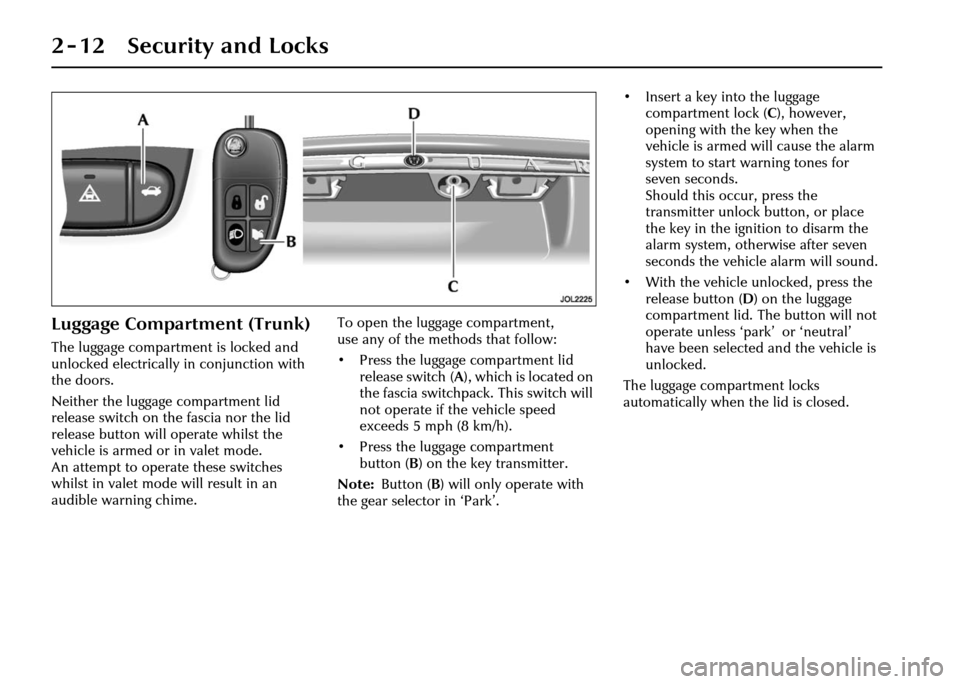
• Press the luggage compartment lid
release switch ( A), which is located on
the fascia switchpack. This switch will
not operate if the vehicle speed
exceeds 5 mph (8 km/h).
• Press the luggage compartment button ( B) on the key transmitter.
Note: Button ( B) will only operate with
the gear selector in ‘Park’. • Insert a key into the luggage
compartment lock ( C), however,
opening with the key when the
vehicle is armed will cause the alarm
system to start warning tones for
seven seconds.
Should this occur, press the
transmitter unlock button, or place
the key in the ignition to disarm the
alarm system, otherwise after seven
seconds the vehicle alarm will sound.
• With the vehicle unlocked, press the release button ( D) on the luggage
compartment lid. The button will not
operate unless ‘park’ or ‘neutral’
have been selected and the vehicle is
unlocked.
The luggage compartment locks
automatically when the lid is closed.
Page 30 of 227
Security and Locks 2 - 15
2. If the vehicle alarm system is armed and the luggage compartment is
opened using the key transmitter,
the alarm will not sound. The system
will be rearmed when the lid is closed,
provided the vehicle has not been
disarmed.
3. Neither the luggage compartment lid release switch on the fascia
switchpack nor the lid release button
will operate when the vehicle is
armed, or in valet mode. An attempt
to operate these switches whilst in
valet mode will result in an audible
warning chime.
4. Operating the inte rnal, external or
remote luggage compartment switches
more than 15 times within
20 seconds, or opening and closing
the luggage compartment will cause
opening to be inhibited for
20 seconds. Should this happen wait
20 seconds for normal operation to
resume. If required, the luggage
compartment may be opened by using
the key during the 20 second waiting
period.Alarms and Audible
Signals
Note: In certain markets, legislation
prohibits the use of audible confirmation
signals. In such cases, the sound source
has been removed from the system.
Audible Signals
Two audible signals will be heard
(if enabled) if an atte mpt is made to lock
the vehicle with a key in the drivers door
lock or the lock button is pressed on the
key transmitter if a door, the hood or the
luggage compartment is not fully closed
or, a key is in the ignition switch.
If the vehicle is unlocked with a key when
it is armed, the vehicle will disarm,
the direction indicators will flash twice
and two audible tones will be heard
(if enabled).
The full alarm will activate, as previously
described, unless the security system is
disarmed, either by pressing the unlock
button on the key tr ansmitter, or by
placing a key into the ignition switch and
turning the key to position ‘II’.
Full Alarm
Once armed, any of the following
circumstances will create a full alarm
state, sound the horns, sound the siren,
or a combination of both (as regional
legislation dictates) and flash the
direction indicators:
• Opening a door, luggage compartment lid (except with
transmitter) or hood.
• Movement in the passenger area (if intrusion sensors are fitted).
• Using a key in the ignition switch which is not programmed to the
vehicle.
• One press of the headlamp convenience button will switch on the
headlamps for 25 seconds or until the
button is pressed again, or until a key
is inserted in the ignition switch.
See Headlight convenience on
page 4 - 24 for more details.
• An attempt to lift, or tow the vehicle (when inclination sensor fitted).
• The vehicle battery is disconnected and the vehicle is fitted with a Battery
Backed Sounder (onl y Battery Backed
Sounder will be audible).
Page 32 of 227
Security and Locks 2 - 17
Security Features
The security system has been designed
for:
• Prevention of theft of the vehicle.
• Prevention of theft of items from the vehicle.
• Personal security.
The security system is integrated with the
vehicle electronics and engine
management systems making it far more
difficult for a thief to penetrate and steal
the vehicle.
Panic Alarm (if enabled)
When in or near the vehicle, the alarm
can be set off to dete r a possible offender.
For this feature to operate, the key must
not be in the ignition switch.
Pressing the headlamp convenience/panic
button on the key transmitter three times
within three seconds will activate the
‘Panic Alarm’.
The alarm is stopped by:
• Putting the key into the ignition switch and turning to position ‘II’.
Note:
1. The key transmitter cannot be used to cancel the Panic alarm. This prevents
unauthorised cancellation in an
emergency.
2. The panic alarm is normally enabled. If required, this feature can be
disabled or enabled by a Jaguar
Retailer.
3. The vehicle locking status will not change when the panic alarm is
activated.
Passive Arming (Retailer
Option)
Passive arming wi ll not lock the
doors, it only arms the security alarm
system.
Passive arming, if enabled by a Jaguar
Retailer, will automatically arm the
vehicle alarm system 30 seconds after the
last protected entry (door, luggage
compartment) is closed following the key
being removed from th e ignition switch.
When passive arming occurs the direction
indicators will flash once and a single
tone will be heard (if enabled). The red
security light on the fascia will start to
flash and will continue for as long as the
alarm is armed.
Opening the drivers door causes a
warning sound which continues for
15 seconds before the system goes into
the full alarm state. If any other door is
opened before the drivers door,
the system goes into the full alarm state
immediately.
When the system is pa ssively armed and a
key is used to open the trunk, a seven
second warning audible ticking will
sound before the full alarm is activated.
Page 34 of 227
Security and Locks 2 - 19
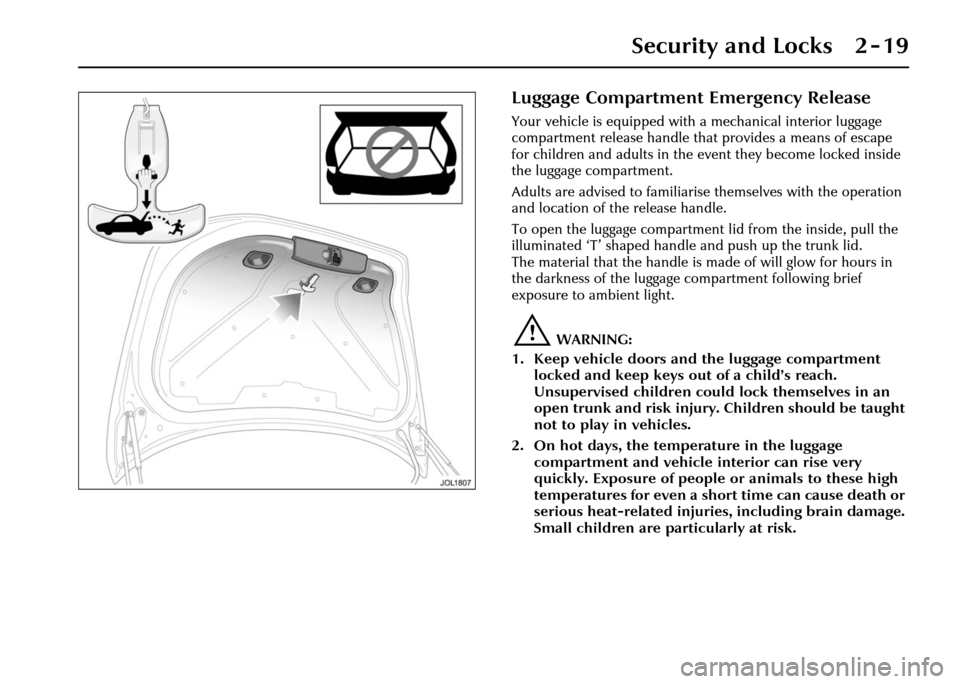
Luggage Compartment Emergency Release
Your vehicle is equipped with a mechanical interior luggage
compartment release handle that provides a means of escape
for children and adults in the event they become locked inside
the luggage compartment.
Adults are advised to familiaris e themselves with the operation
and location of the release handle.
To open the luggage compartment lid from the inside, pull the
illuminated ‘T’ shaped handle and push up the trunk lid.
The material that the handle is made of will glow for hours in
the darkness of the luggage compartment following brief
exposure to ambient light.
!WARNING:
1. Keep vehicle doors and the luggage compartment locked and keep keys out of a child’s reach.
Unsupervised children could lock themselves in an
open trunk and risk injury. Children should be taught
not to play in vehicles.
2. On hot days, the temperature in the luggage compartment and vehicle interior can rise very
quickly. Exposure of people or animals to these high
temperatures for even a short time can cause death or
serious heat-related injuries, including brain damage.
Small children are particularly at risk.
Page 35 of 227
2 - 20 Security and Locks
Garage Door Opener
Transceiver
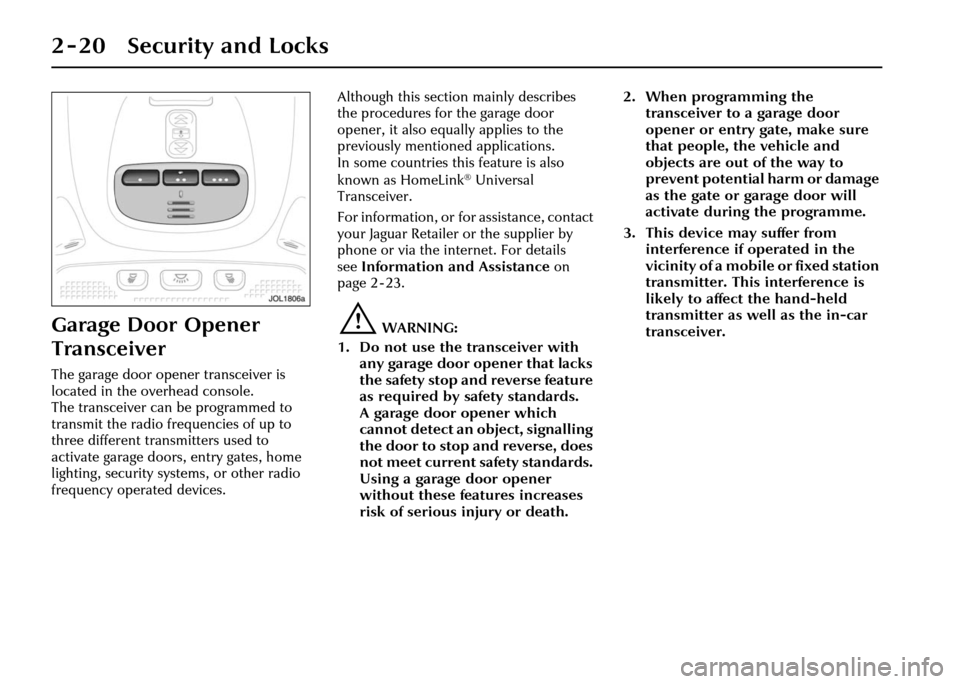
The garage door opener transceiver is
located in the overhead console.
The transceiver can be programmed to
transmit the radio frequencies of up to
three different transmitters used to
activate garage doors, entry gates, home
lighting, security systems, or other radio
frequency operated devices.Although this section mainly describes
the procedures for the garage door
opener, it also equally applies to the
previously mentioned applications.
In some countries this feature is also
known as HomeLink
® Universal
Transceiver.
For information, or for assistance, contact
your Jaguar Retailer or the supplier by
phone or via the internet. For details
see Information and Assistance on
page 2 - 23.
!WARNING:
1. Do not use the transceiver with any garage door opener that lacks
the safety stop and reverse feature
as required by safety standards.
A garage door opener which
cannot detect an object, signalling
the door to stop and reverse, does
not meet current safety standards.
Using a garage door opener
without these features increases
risk of serious injury or death. 2. When programming the
transceiver to a garage door
opener or entry gate, make sure
that people, the vehicle and
objects are out of the way to
prevent potential harm or damage
as the gate or garage door will
activate during the programme.
3. This device may suffer from interference if operated in the
vicinity of a mobile or fixed station
transmitter. This interference is
likely to affect the hand-held
transmitter as well as the in-car
transceiver.
Page 38 of 227
Security and Locks 2 - 23
Entry gate programming
The technology of some entry gates
requires you to press and re-press (cycle)
the hand-held transmitter every
2 seconds during programming.
Continue to press and hold the desired
overhead console button while you cycle
your hand-held transmitter until the
indicator light flashes rapidly.
Information and Assistance
For information on the range of available
compatible products or accessories,
or for assistance, contact your Jaguar
Retailer.
You can also contact the supplier’s
helpline on 1–800–355–3515 or the
website address for Homelink™ is
www.homelink.jci.com. Note:
Keep the original transmitter for
future use or programming procedures if,
for example, you purchase a new vehicle’
Caution: It is recommended that
when you sell or dispose of the
vehicle, the programmed transceiver
buttons be erased for security
purposes.
!WARNING:
The manufacturer is not responsible
for any radio or TV interference
caused by unauthorised
modifications to this equipment.
Such modifications could void the
user’s authority to operate the
equipment.
Page 42 of 227
Before Driving 3 - 3
3 Before Driving
Seats
!WARNING:
1. Do not make adjustments when the vehicle is moving.
2. Front passengers must not ride with the seat fully reclined.
All seats, except the rear bench type,
are adjusted electrically by switches on
the side of the seat cushion. Adjustment
can be made with or without the ignition
key inserted.
Three different positions can be stored
and recalled by a memory system for
each seat. (Steering wheel, pedals and
door mirrors positions are also
memorised for the driver.) See Memory
Setting on page 3 - 31.
Note: It is advisable to move the seat to
the correct position in relation to the gear
lever and front and side vision before
adjusting the steering column, pedals,
mirrors and seat belt.
Front Seat Adjustment
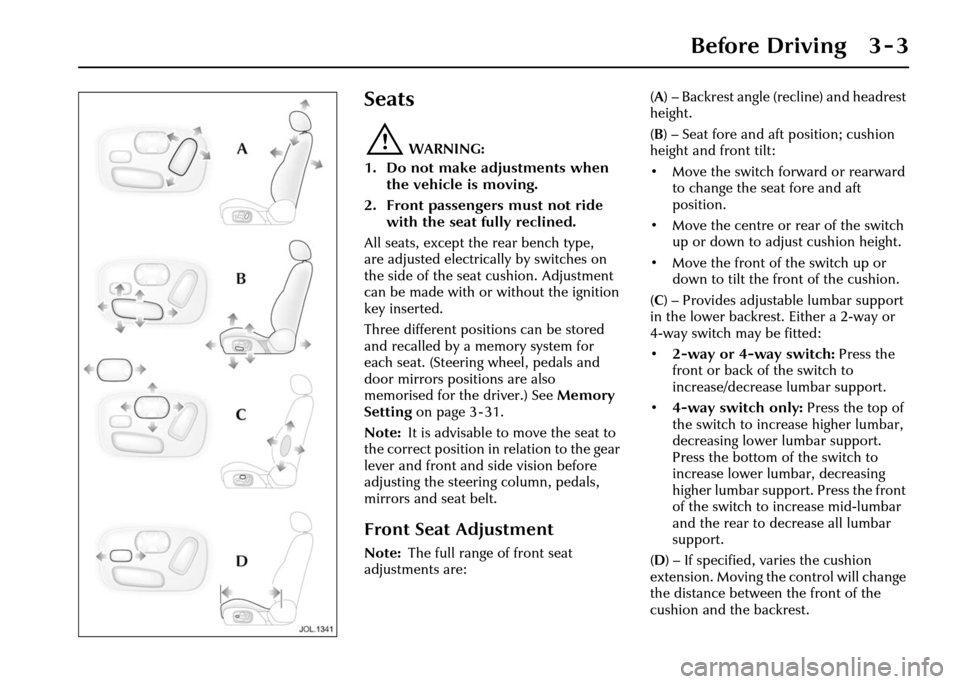
Note: The full range of front seat
adjustments are: (
A ) – Backrest angle (recline) and headrest
height.
( B ) – Seat fore and aft position; cushion
height and front tilt:
• Move the switch forward or rearward to change the seat fore and aft
position.
• Move the centre or rear of the switch up or down to adjust cushion height.
• Move the front of the switch up or down to tilt the front of the cushion.
( C ) – Provides adjustable lumbar support
in the lower backrest. Either a 2-way or
4-way switch may be fitted:
• 2-way or 4-way switch: Press the
front or back of the switch to
increase/decrease lumbar support.
• 4-way switch only: Press the top of
the switch to increase higher lumbar,
decreasing lower lumbar support.
Press the bottom of the switch to
increase lower lumbar, decreasing
higher lumbar support. Press the front
of the switch to increase mid-lumbar
and the rear to decrease all lumbar
support.
( D ) – If specified, varies the cushion
extension. Moving the control will change
the distance between the front of the
cushion and the backrest.
Page 43 of 227
3 - 4 Before Driving
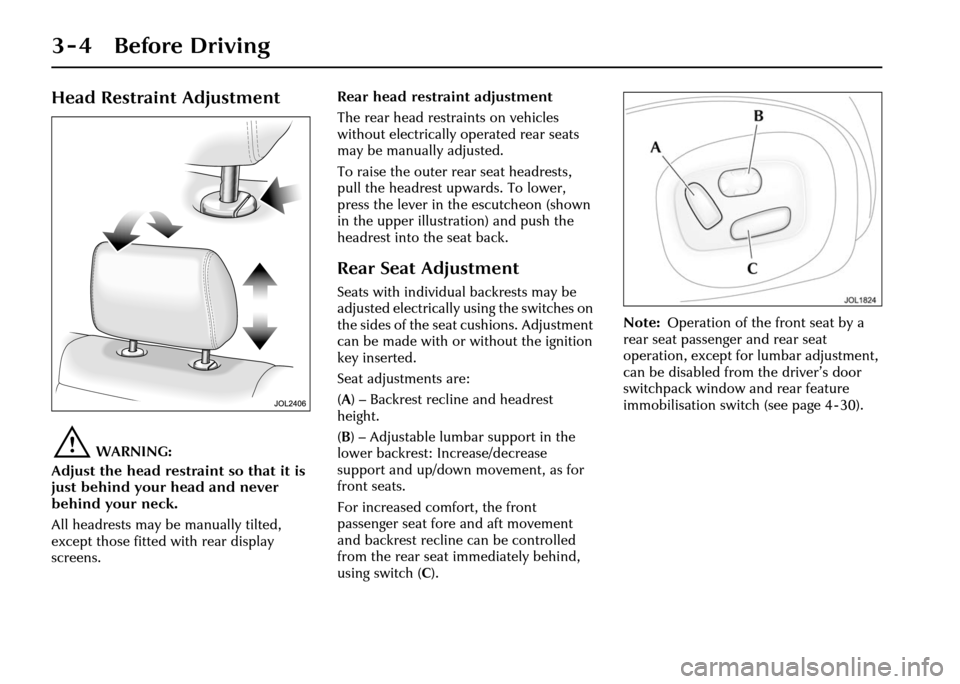
Head Restraint Adjustment
!WARNING:
Adjust the head restraint so that it is
just behind your head and never
behind your neck.
All headrests may be manually tilted,
except those fitted with rear display
screens. Rear head restraint adjustment
The rear head restraints on vehicles
without electrically operated rear seats
may be manually adjusted.
To raise the outer rear seat headrests,
pull the headrest upwards. To lower,
press the lever in the escutcheon (shown
in the upper illustra
tion) and push the
headrest into the seat back.
Rear Seat Adjustment
Seats with individual backrests may be
adjusted electrically using the switches on
the sides of the seat cushions. Adjustment
can be made with or without the ignition
key inserted.
Seat adjustments are:
( A ) – Backrest recline and headrest
height.
( B ) – Adjustable lumbar support in the
lower backrest: Increase/decrease
support and up/down movement, as for
front seats.
For increased comfort, the front
passenger seat fore and aft movement
and backrest recline can be controlled
from the rear seat immediately behind,
using switch ( C). Note:
Operation of the front seat by a
rear seat passenger and rear seat
operation, except for lumbar adjustment,
can be disabled from the driver’s door
switchpack window and rear feature
immobilisation switch (see page 4 - 30).
Page 45 of 227
3 - 6 Before Driving
Pedal Adjustment
!WARNING:
Do not adjust the pedals whilst driving.
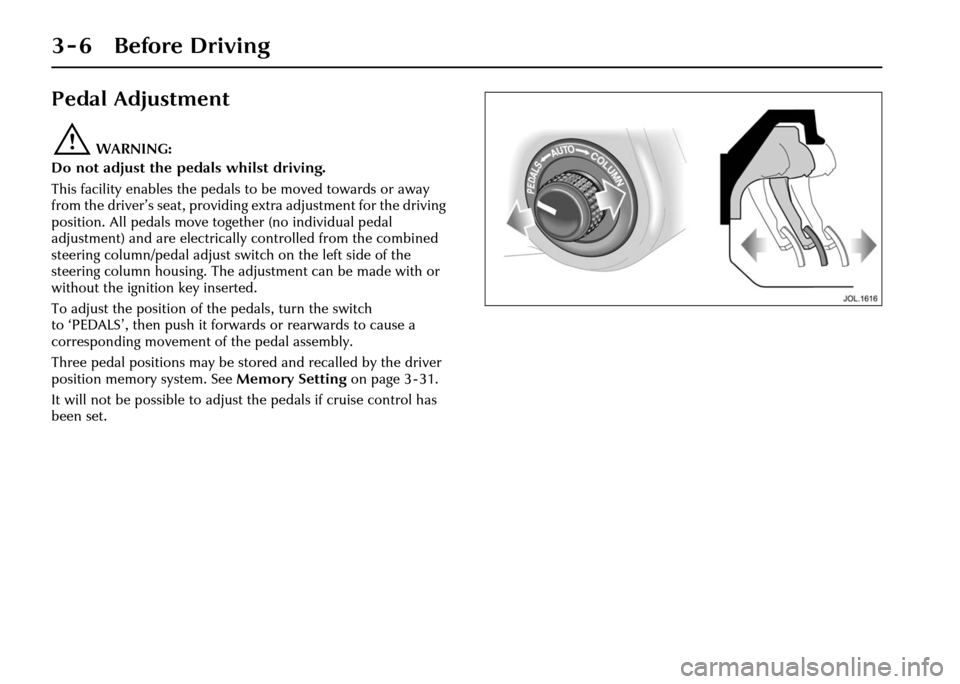
This facility enables the pedals to be moved towards or away
from the driver’s seat, providing extra adjustment for the driving
position. All pedals move together (no individual pedal
adjustment) and are electrically controlled from the combined
steering column/pedal adjust switch on the left side of the
steering column housing. The adjustment can be made with or
without the ignition key inserted.
To adjust the position of the pedals, turn the switch
to ‘PEDALS’, then push it forwards or rearwards to cause a
corresponding movement of the pedal assembly.
Three pedal positions may be stored and recalled by the driver
position memory system. See Memory Setting on page 3 - 31.
It will not be possible to adjust the pedals if cruise control has
been set.