ESP JAGUAR XJ 2004 X350 / 3.G Owner's Manual
[x] Cancel search | Manufacturer: JAGUAR, Model Year: 2004, Model line: XJ, Model: JAGUAR XJ 2004 X350 / 3.GPages: 227, PDF Size: 4.22 MB
Page 132 of 227
On the Road 4 - 61
Touring
Foreign travel
Before planning foreign travel, check with
a motoring organisation to ensure that
your vehicle will comply with legal
requirements of the countries you intend
to visit.
International motoring organisations are
helpful for all aspects of long distance
touring advice.
In some countries it is a legal requirement
to carry spare vehicle bulbs.
First aid kit
A first aid kit is compulsory equipment in
certain countries. Your Jaguar Retailer
can supply a first aid kit.Petroleum spirit in containers
Some countries forbid the carrying of
petrol in containers, as do most ferry and
hovercraft operators.
Cellular radio telephones
Ask your motoring organisation about the
use of cellular radio telephones before
travelling abroad, as some countries
exercise controls on the importation and
use of such equipment.
Roof-rack
Only the Jaguar approved roof-rack
should be used.
The maximum load, including the weight
of the rack, must not exceed the load
rating indicated on th
e roof-rack bars and
must be deducted from the vehicle
maximum luggage load.
Loads on the roof-rack may affect vehicle
handling, especially in crosswinds or
when cornering. Jaguar warning triangle
A warning triangle to give traffic
advanced notice of a disabled vehicle is
compulsory in many countries.
A triangle, designed to international
standards is fitted as standard equipment
in certain countries. The warning triangle
with its stand legs folded flat, is mounted
on the inside of the luggage compartment
lid.
In an emergency, remove the triangle and
unfold its stand legs. Place the triangle in
the road in accordance with local traffic
regulations to give oncoming traffic
warning of an im
mobilised vehicle.
Hazard warning lights must be used with
the warning triangle.
Page 137 of 227
4-66 On the Road
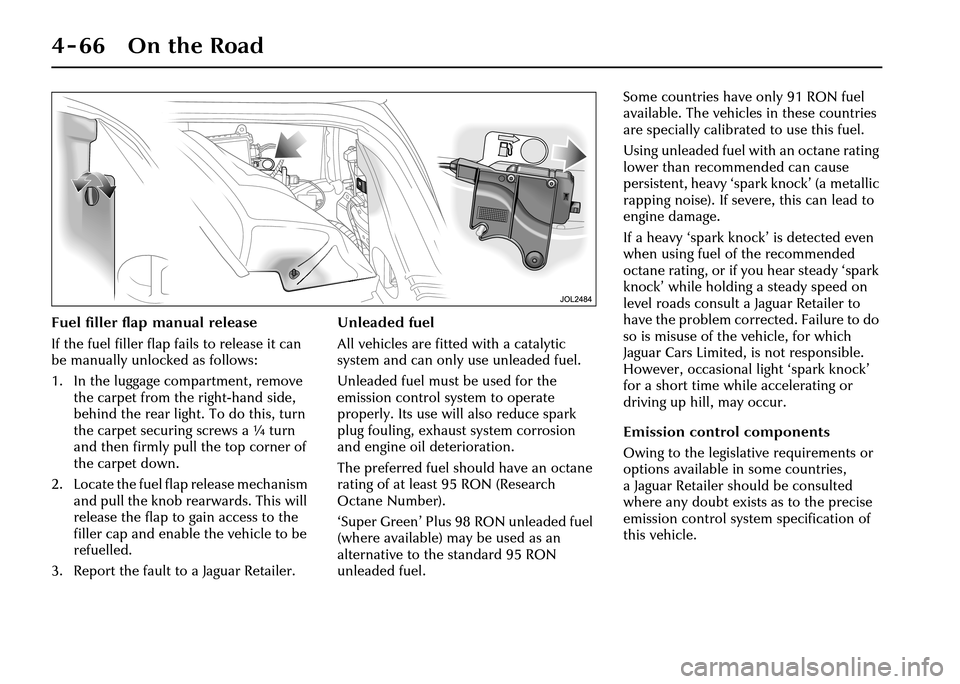
Fuel filler flap manual release
If the fuel filler flap fails to release it can
be manually unlocked as follows:
1. In the luggage compartment, remove
the carpet from the right-hand side,
behind the rear light. To do this, turn
the carpet securing screws a ¼ turn
and then firmly pull the top corner of
the carpet down.
2. Locate the fuel flap release mechanism and pull the knob rearwards. This will
release the flap to gain access to the
filler cap and enable the vehicle to be
refuelled.
3. Report the fault to a Jaguar Retailer. Unleaded fuel
All vehicles are fitted with a catalytic
system and can only use unleaded fuel.
Unleaded fuel must be used for the
emission control system to operate
properly. Its use will also reduce spark
plug fouling, exhaust system corrosion
and engine oil deterioration.
The preferred fuel should have an octane
rating of at least 95 RON (Research
Octane Number).
‘Super Green’ Plus 98 RON unleaded fuel
(where available) may be used as an
alternative to the standard 95 RON
unleaded fuel. Some countries have only 91 RON fuel
available. The vehicles in these countries
are specially calibrated to use this fuel.
Using unleaded fuel with an octane rating
lower than recomm
ended can cause
persistent, heavy ‘spark knock’ (a metallic
rapping noise). If severe, this can lead to
engine damage.
If a heavy ‘spark knock’ is detected even
when using fuel of the recommended
octane rating, or if you hear steady ‘spark
knock’ while holding a steady speed on
level roads consult a Jaguar Retailer to
have the problem corrected. Failure to do
so is misuse of the vehicle, for which
Jaguar Cars Limited, is not responsible.
However, occasional light ‘spark knock’
for a short time while accelerating or
driving up hill, may occur.
Emission control components
Owing to the legislative requirements or
options available in some countries,
a Jaguar Retailer should be consulted
where any doubt exists as to the precise
emission control system specification of
this vehicle.
Page 138 of 227

On the Road 4 - 67
Fuels containing alcohol
Caution: Take care not to spill fuel
during refuelling. Fuel containing
alcohol can cause paint damage,
which may not be covered under the
warranty.
Some fuel suppliers sell fuel containing
alcohol without advertising its presence.
Where uncertainty exists check with the
service station operator.
Note: Some difficulty in starting may be
encountered when using alcohol blended
fuel.
Ethanol
Fuels containing up to 10 per cent
ethanol (grain alcohol) may be used.
Ensure the fuel has octane ratings no
lower than those recommended for
unleaded fuel. Most drivers will not
notice any operating difference with fuel
containing ethanol. If a difference is
detected, the use of conventional
unleaded fuel should be resumed. Methanol
Some fuels contain methanol (methyl or
wood alcohol). If you use fuels containing
methanol the fuels must also contain
co-solvents and corrosion inhibitors for
methanol. Also, do not use fuels that
contain more than three per cent
methanol even if they
contain co-solvents
and corrosion inhibitors. Fuel system
damage or vehicle performance problems
resulting from the use of such fuels is not
the responsibility of Jaguar Cars Limited,
and may not be covered under the
warranty.
Methyl Tertiary Butyl Ether (MTBE)
Unleaded fuel containing an oxygenate
known as MTBE can be used provided the
ratio of MTBE to conventional fuel does
not exceed 15 per cent.
MTBE is an ether based compound,
derived from petroleum, which has been
specified by several refiners as the
substance to enhance the octane rating of
fuel.
Page 142 of 227
Climate Control 5 - 3
5 Climate Control
Introduction
The cabin is supplied with filtered air
from a fully automatic electronic climate
control system with manual overrides.
Two systems are available:
• A two zone system which allows the front occupants to set individual
temperatures for the left and right
sides of the interior.
• A four zone system which allows front and rear occupants to set individual
temperatures, i.e. two front zones and
two rear zones.
Occupant controls
The main climate control panel is located
in the centre console above the radio and
audio controls. There are two types of
control panel for either two or four zone
systems:
• A dedicated control panel with LCD (liquid crystal display) screen
(see page 5 - 6).
• A multi-function touch control and display unit shared with navigation
and other systems. Where this control
unit is fitted, refer to the Jaguar
Touch-screen Handbook for the
detailed operating instructions. Where the four zone climate control
system is fitted, an additional control/
display panel for rear passenger use is
located at the rear of the centre console,
between the front seats.
Voice control
The climate control system may also be
operated by spoken commands if the
optional voice activation system is fitted.
For full information on the use of this
system refer to the JaguarVoice
Handbook.
Recommended Operation
Automatic climate control
Automatic climate control provides
efficient regulation of the vehicle
environment without constant
adjustments from the occupant.
Sensors inside the vehicle monitor
temperature, humidity and direct
sunlight. In response, the electronic
control system automatically adjusts the
heat input, blower speed, air intake and
airflow distribution so as to maintain the
selected temperature(s) and reduce
misting.
Automatic operation provides optimum
comfort under most driving conditions. It is recommended that automatic
control (AUTO) is selected as the
normal operating mode.
Use of air conditioning
Air conditioning is an integral part of the
climate control system, providing cooled
and dehumidified
air for occupant
comfort; the dry airflow is also effective
in preventing misting of the windows.
While the air conditioner can be
manually switched off, it is recommended
that it is used in all climatic conditions
throughout the year, preferably in AUTO
mode.
Close all windows and the sunroof when
the air conditioning is on to ensure
satisfactory operation.
Use of air recirculation
The air conditioner/heater system is
supplied with fresh air via an intake flap.
Closing the flap causes the air inside the
vehicle to be recirculated. This helps to
prevent unpleasant odours from being
drawn into the vehicle and also to
improve the performance of the air
conditioner in very hot conditions.
However, the use of recirculated air will
cause screen misting after a short period
and should only be used as necessary.
Page 146 of 227
Climate Control 5 - 7
To Switch the System On
The climate control system operates in
position ‘II’ (run) of the ignition switch.
With the ignition key turned to the run
position, the system will switch on in the
operating mode last set.
For normal usage select AUTO mode.
AUTO Mode
Automatic operation provides a
controlled environment over a
temperature range of 61°F to 89°F (17°C
to 31°C) and should be regarded as the
normal operating mode.To select automatic climate
control press the AUTO
button; the word AUTO
appears on the LCD screen to confirm
selection.
Select the required temperature.
Front and rear screen heating and timed
air recirculation may be selected in AUTO
mode. Selecting any other control will
cancel AUTO operation.
Automatic operation cannot be
deselected using the AUTO button.
To exit AUTO mode, select another mode
or press the blower control knob to
switch the system off.
Temperature Selection
Separate controls allow
the driver and front
passenger zone
temperatures to be independently
adjusted. Press the red buttons to
increase temperature and the blue
buttons to decrease temperature.
Both driver and front passenger selected
temperatures are always displayed.
Pressing the driver’s buttons to select the
maximum or minimum temperature
settings causes the display to change
to HI or LO respectively and cancel
AUTO mode.
To quickly jump from HI or LO to a
convenient midrange temperature of 73°F
(23°C), press and hold AUTO for a few
seconds.
Dual Temperature Zones
With the DUAL button LED
illuminated, the system provides
separate temperature control of
the driver and front passenger zones.
Press DUAL to deselect dual temperature
control (LED off); the front passenger
temperature will change to that of the
driver side. Using the driver side
temperature control buttons will now
change both zone temperatures together.
To select dual temperature control, press
either the DUAL button or one of the
front passenger side red/blue
temperature control buttons. The DUAL
LED is illuminated.
External Temperature
The external (EXT) temperature is
displayed at the top of the screen.
Fahrenheit/Celsius Selection
Press the button to change the
scale between degrees
Fahrenheit (°F) and degrees
Celsius (°C) for the displayed
internal and external (EXT)
temperatures.
Page 148 of 227
Climate Control 5 - 9
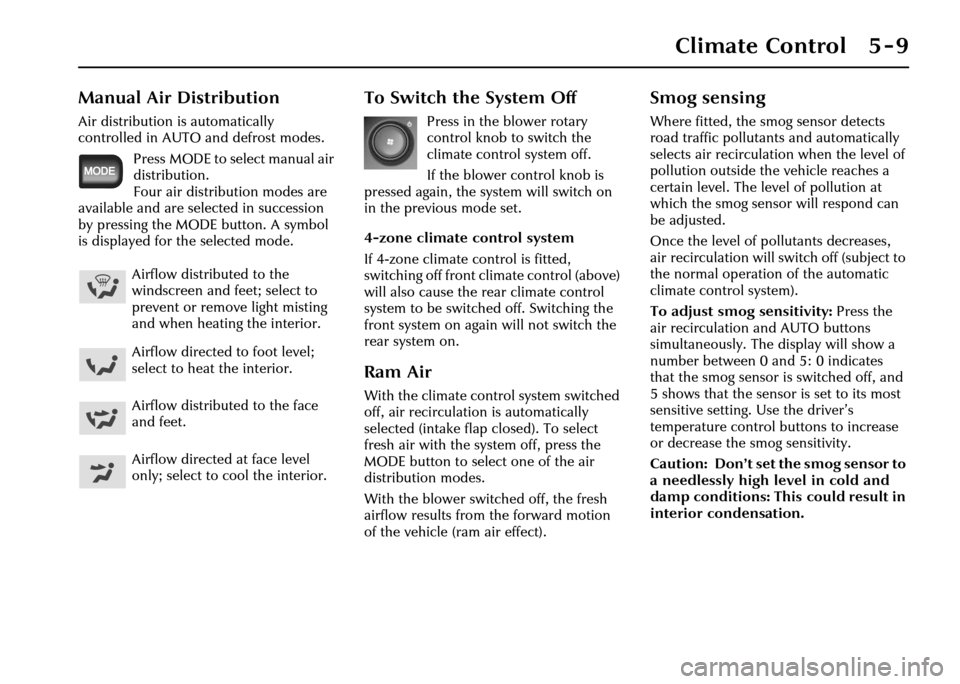
Manual Air Distribution
Air distribution is automatically
controlled in AUTO and defrost modes.Press MODE to select manual air
distribution.
Four air distribution modes are
available and are selected in succession
by pressing the MODE button. A symbol
is displayed for the selected mode.
To Switch the System Off
Press in the blower rotary
control knob to switch the
climate control system off.
If the blower control knob is
pressed again, the system will switch on
in the previous mode set.
4-zone climate control system
If 4-zone climate control is fitted,
switching off front climate control (above)
will also cause the rear climate control
system to be switched off. Switching the
front system on again will not switch the
rear system on.
Ram Air
With the climate control system switched
off, air recirculation is automatically
selected (intake flap closed). To select
fresh air with the system off, press the
MODE button to select one of the air
distribution modes.
With the blower switched off, the fresh
airflow results from the forward motion
of the vehicle (ram air effect).
Smog sensing
Where fitted, the smog sensor detects
road traffic pollutants and automatically
selects air recirculation when the level of
pollution outside the vehicle reaches a
certain level. The level of pollution at
which the smog sensor will respond can
be adjusted.
Once the level of pollutants decreases,
air recirculation will switch off (subject to
the normal operation of the automatic
climate control system).
To adjust smog sensitivity: Press the
air recirculation and AUTO buttons
simultaneously. The display will show a
number between 0 and 5: 0 indicates
that the smog sensor is switched off, and
5 shows that the sensor is set to its most
sensitive setting. Use the driver’s
temperature control bu ttons to increase
or decrease the smog sensitivity.
Caution: Don’t set the smog sensor to
a needlessly high level in cold and
damp conditions: This could result in
interior condensation.
Airflow distributed to the
windscreen and feet; select to
prevent or remove light misting
and when heating the interior.
Airflow directed to foot level;
select to heat the interior.
Airflow distributed to the face
and feet.
Airflow directed at face level
only; select to cool the interior.
Page 201 of 227

7-18 Maintenance
Tyres
Tyres of the correct type, manufacturer
and dimensions, with correct cold
inflation pressures are an integral part of
every vehicle’s design. Regular
maintenance of tyres contributes not only
to safety, but to the de signed function of
the vehicle. Road-holding, steering and
braking are especially vulnerable to
incorrectly pressurised, badly fitted or
worn tyres.
Tyres of the correct size and type, but of
different make have widely varying
characteristics. It is therefore
recommended that Jaguar approved tyres
are fitted to all wheels.
A tyre recommendation placard is placed
on the inside of the fuel filler flap, giving
information specific to the vehicle’s
wheel and tyre equipment.
Always ensure that the wheel nuts are
fully seated before finally tightening the
nuts in alternate sequence.
W, Y and Z-rated performance tyres are
optimised for driving dynamics and have
limited winter traction ability. Compared
with H-rated all-season tyres, they may
incur increased tread wear, reduced ride
comfort, and increased road noise.
Tyre Renewal
When renewing tyres, it is preferable to
fit a complete vehicle set. If either front
or rear tyres only need to be renewed,
new tyres must be fitted, as axle sets,
to replace worn ones. After new tyres
have been fitted the wheels need to be
dynamically balanced. The radial ply
tyres specified are designed to meet the
high-speed performance capability of this
vehicle (see page 8 - 7) . Do not fit tyres
with a different tread pattern, size or
speed rating.
Tyre Pressures
The recommended tyre pressures are
written on a label, inside the fuel filler
flap. These tyre pressures provide
optimum ride and handling
characteristics for all normal operating
conditions. The pressures should be
checked, and correctly set each week
with the tyres cold. Tyre temperatures
and pressures increase when running.
Deflating a warm tyre to the
recommended pressure will result in
under inflation whic h may be dangerous.
A slight natural pressure loss occurs with
time. If this exceeds 2 lbf/in² (0.14 bar,
14 kPa, 0.14 kg/cm²) per week, the cause
should be investigated and rectified.
Note: It is an offence in certain countries
to drive a vehicle with tyres that are not
inflated in accordance with the vehicle’s
proper use.
Page 202 of 227

Maintenance 7 - 19
Wear
All tyres fitted as original equipment
include tread wear indicators (TWI) in
their tread pattern. When the tread has
worn to a remaining depth of 1.6 mm the
indicators appear at the surface as bars
which connect the tread pattern across
the full width of the tyre.
It is illegal, in certain countries,
to continue to use tyres after the tread
has worn to less than 1.6 mm over three
quarters of the width and the entire
circumference of the tyre.It should be noted that the properties of
many tyres alter progressively with wear.
In particular the ‘wet grip’ and
aquaplaning resistance are gradually but
substantially reduce
d. Extra care and
speed restriction should therefore be
exercised on wet roads as the effective
tread depth diminishes.
Incorrect wheel alignm ent will accelerate
tyre wear. Fins on the inner or outer
edges of the tread pattern are caused by
excessive toe-in or toe-out respectively.
As fins may also be caused by high
cornering speeds or road camber, it is
advantageous to have the cause detected
by having the wheel alignment checked.
Tyre repair
It is recommended that damaged tyres
are discarded and new tyres fitted.
They must not be repaired in view of the
high performance capability of the
vehicle. Damage
Excessive local distortion can cause the
casing of a tyre to
fracture and may lead
to premature failure. Tyres should be
examined especially for cracked walls,
exposed cords, etc. Flints and other sharp
objects must be removed from the tyre
tread; if left in they may work through the
cover. Clean off any oil or grease
contamination by using a suitable
cleaner.
Caution: Do not use paraffin
(kerosene), because this has a
detrimental effect on rubber.
Tyre use after vehicle storage
After a long period of a vehicle standing,
tyres may become locally distorted with a
flat area. This will cause an uneven ride
for a few miles until the tyres have
warmed up and the ‘flat’ rounds off.
However, to reduce the effects of
flat-spots, the tyres of a stored vehicle
may be inflated to pressures not
exceeding 60 lbf/in² (4.2 bar, 420 kPa,
4.3 kg/cm²).
Page 203 of 227

7-20 Maintenance
United States Department of
Transportation/Uniform Tyre Quality
Grades
The following information relates to the
tyre grading system developed by the
National Highway Traffic Safety
Administration which will grade tyres by
tread wear, traction and temperature
performance.
Tread wear
The tread wear grade is a comparative
rating based on the wear rate of the tyre
when tested under controlled conditions
on a specified government test course.
For example, a tyre graded 150 would
wear one and a half (1.5) times as well on
the government course as a tyre
graded 100.
The relative performance of tyres
depends upon the actual conditions of
their use, however, and may depart
significantly from the norm due to
variations in driving habits, service
practices and differences in road
characteristics and climate. Traction – A, B, C
The traction grades, from the highest to
the lowest are ‘
A’, ‘ B’ and ‘ C’, and they
represent the tyre’s ability to stop on wet
pavements as measured under controlled
conditions on specified government test
surfaces of asphalt and concrete. A tyre
marked ‘ C’ may have poor traction
performance.
!WARNING:
The traction grade assigned to this
tyre is based on braking (straight
ahead) traction tests and does not
include cornering (turning) traction. Temperature – A, B, C
The temperature grades ‘
A’ (the highest),
‘ B ’ and ‘C ’ representing the tyre’s
resistance to the generation of heat and
its ability to dissipate heat when tested
under controlled conditions on a
specified indoor laboratory test wheel.
Sustained high temperature can cause the
material of the tyre to degenerate and
reduce tyre life, and excessive
temperature can lead to sudden tyre
failure.
The grade ‘ C’ corresponds to a level of
performance which all passenger car
tyres must meet under the Federal Motor
Vehicle Safety Standard No. 109.
Grades ‘ B’ and ‘ A’ represent higher levels
of performance on the laboratory test
wheel than the minimum required by
law.
!WARNING:
The temperature grade for this tyre is
established for a tyre that is properly
inflated and not over loaded.
Excessive speed, under-inflation or
excessive loading, either separately
or in combination, can cause heat
build-up and possible tyre failure.