ABS JAGUAR XJ 2004 X350 / 3.G Owners Manual
[x] Cancel search | Manufacturer: JAGUAR, Model Year: 2004, Model line: XJ, Model: JAGUAR XJ 2004 X350 / 3.GPages: 227, PDF Size: 4.22 MB
Page 4 of 227
On the Road
Instruments . . . . . . . . . . . . . . . . . . . . . . . . . . . . . 4 - 3
Warning Lights . . . . . . . . . . . . . . . . . . . . . . . . . . 4 - 5
Audible Warnings . . . . . . . . . . . . . . . . . . . . . . . 4 - 10
Message Centre . . . . . . . . . . . . . . . . . . . . . . . . . 4 - 12
Trip Computer . . . . . . . . . . . . . . . . . . . . . . . . . . 4 - 13
Messages . . . . . . . . . . . . . . . . . . . . . . . . . . . . . . 4 - 16
Exterior Lighting . . . . . . . . . . . . . . . . . . . . . . . . 4 - 23
Interior Lighting. . . . . . . . . . . . . . . . . . . . . . . . . 4 - 27
Window Operation . . . . . . . . . . . . . . . . . . . . . . 4 - 29
Wipers and Washers . . . . . . . . . . . . . . . . . . . . . 4 - 31
Sunroof . . . . . . . . . . . . . . . . . . . . . . . . . . . . . . . 4 - 33
Parkbrake . . . . . . . . . . . . . . . . . . . . . . . . . . . . . 4 - 34
Park Distance Control . . . . . . . . . . . . . . . . . . . . 4 - 35
Interior Features . . . . . . . . . . . . . . . . . . . . . . . . 4 - 37
Cigar Lighter and Ashtray . . . . . . . . . . . . . . . . . 4 - 37
Sun Visors and Vanity Mirrors . . . . . . . . . . . . . . 4 - 37
Centre Console . . . . . . . . . . . . . . . . . . . . . . . . . 4 - 38
Rear Armrest . . . . . . . . . . . . . . . . . . . . . . . . . . . 4 - 39Horn. . . . . . . . . . . . . . . . . . . . . . . . . . . . . . . . . 4 - 40
Sunglasses Stowage . . . . . . . . . . . . . . . . . . . . . . 4 - 40
Rear Sunblind . . . . . . . . . . . . . . . . . . . . . . . . . . 4 - 40
Side Sunblinds . . . . . . . . . . . . . . . . . . . . . . . . . 4 - 41
Starting/Stopping the Vehicle . . . . . . . . . . . . . . 4 - 42
Automatic Transmission . . . . . . . . . . . . . . . . . . 4 - 43
Sport Mode. . . . . . . . . . . . . . . . . . . . . . . . . . . . 4 - 45
Dynamic Stability Control (DSC) . . . . . . . . . . . . 4 - 46
Anti-lock Braking System (ABS) . . . . . . . . . . . . . 4 - 47
Cruise (Speed) Control . . . . . . . . . . . . . . . . . . . 4 - 49
Adaptive Cruise Control (ACC)
(Where fitted) . . . . . . . . . . . . . . . . . . . . . . . 4 - 51
Vehicle Suspension . . . . . . . . . . . . . . . . . . . . . . 4 - 58
General Driving Information . . . . . . . . . . . . . . . 4 - 59
Winter Driving . . . . . . . . . . . . . . . . . . . . . . . . . 4 - 60
Touring . . . . . . . . . . . . . . . . . . . . . . . . . . . . . . . 4 - 61
Towing a Trailer . . . . . . . . . . . . . . . . . . . . . . . . 4 - 62
Fuel and Refuelling . . . . . . . . . . . . . . . . . . . . . . 4 - 63
Page 21 of 227
2 - 6 Security and Locks
Key transmitter battery renewal
When the battery needs renewal there will be a significant
decrease in the effective range of the key transmitter. To renew
the battery, follow the procedure below:
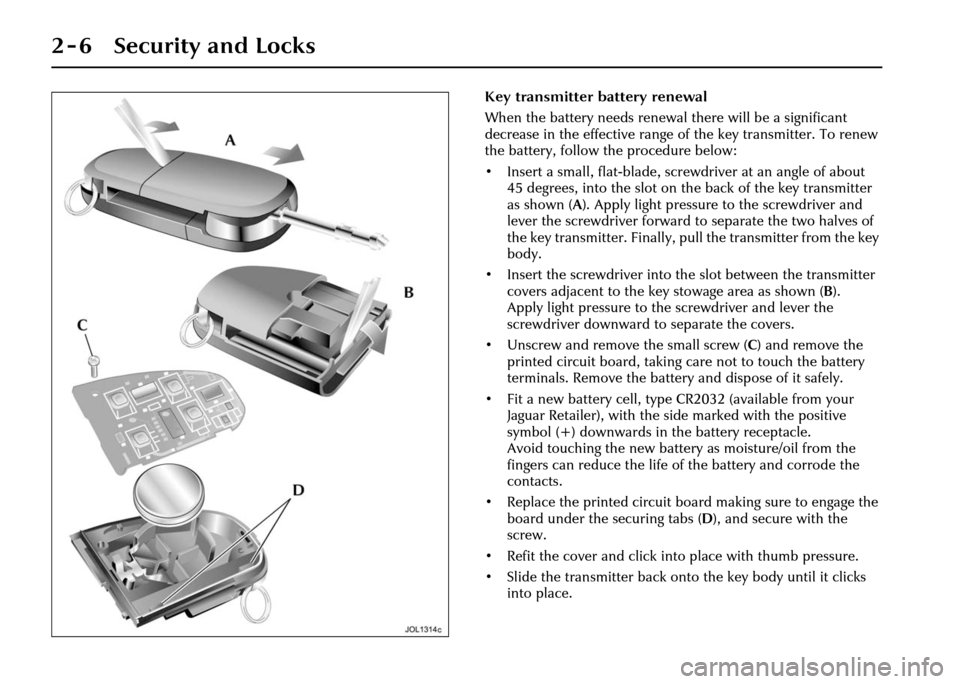
• Insert a small, flat-blade, screwdriver at an angle of about 45 degrees, into the slot on th e back of the key transmitter
as shown ( A). Apply light pressure to the screwdriver and
lever the screwdriver forward to separate the two halves of
the key transmitter. Finally, pu ll the transmitter from the key
body.
• Insert the screwdriver into th e slot between the transmitter
covers adjacent to the key stowage area as shown ( B).
Apply light pressure to the screwdriver and lever the
screwdriver downward to separate the covers.
• Unscrew and remove the small screw ( C) and remove the
printed circuit board, taking care not to touch the battery
terminals. Remove the battery and dispose of it safely.
• Fit a new battery cell, type CR2032 (available from your
Jaguar Retailer), with the si de marked with the positive
symbol (+) downwards in the battery receptacle.
Avoid touching the new battery as moisture/oil from the
fingers can reduce the life of the battery and corrode the
contacts.
• Replace the printed circuit board making sure to engage the board under the securing tabs (D ), and secure with the
screw.
• Refit the cover and click into place with thumb pressure.
• Slide the transmitter back onto the key body until it clicks
into place.
Page 55 of 227
3 - 16 Before Driving
Air bag fault warning light
The air bag warning light in the driver’s
instrument cluster will be lit for
approximately six seconds when the
ignition is turned on.
If the light remains on or flashes,
it indicates a fault within the air bag
electrical circuits. Report the fault to a
Jaguar Retailer immediately. It is safe to
drive the vehicle; however, in an accident
the air bags may not operate.
Air bag warning ligh t information is
shown on page 4 - 8. Air bag disposal
!WARNING:
Do not attempt to service, repair or
modify the air bag sy stem or its fuses.
All work on the air bag system,
including renewal after deployment
and renewal at the end of its service
life, must be carried out by an
authorised Jaguar Retailer.
In the event of the vehicle being
dismantled, air bag module removal and
disposal MUST be made by a qualified
person. Instructions can be obtained
from an authorised Jaguar Retailer. Front protection
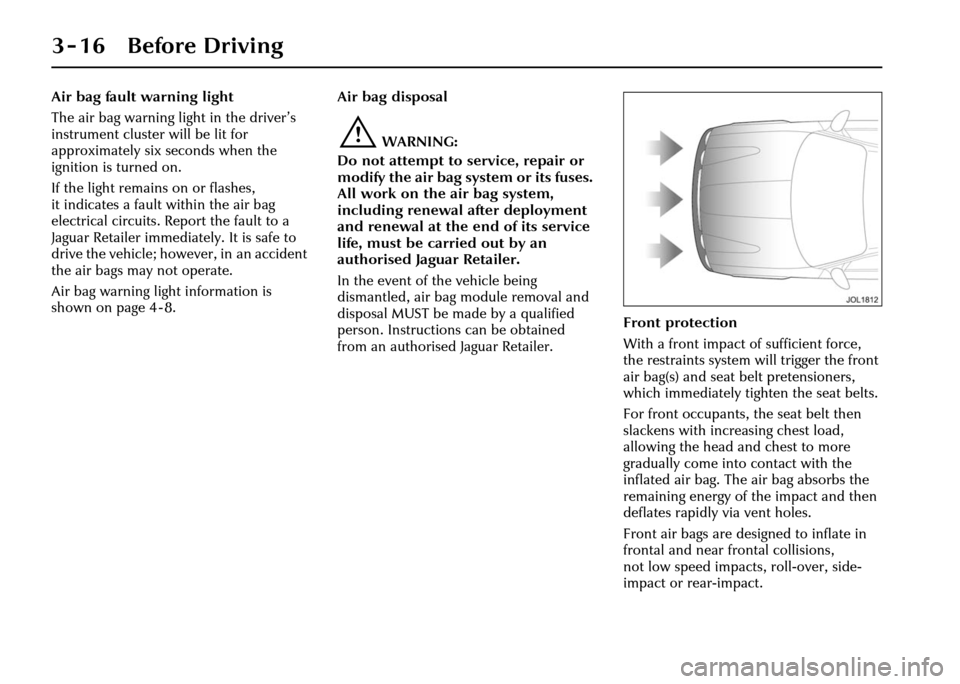
With a front impact of sufficient force,
the restraints system will trigger the front
air bag(s) and seat belt pretensioners,
which immediately tighten the seat belts.
For front occupants, the seat belt then
slackens with increasing chest load,
allowing the head and chest to more
gradually come into contact with the
inflated air bag. The air bag absorbs the
remaining energy of the impact and then
deflates rapidly via vent holes.
Front air bags are designed to inflate in
frontal and near fr
ontal collisions,
not low speed impacts, roll-over, side-
impact or rear-impact.
Page 59 of 227
3 - 20 Before Driving
Rear Impact Protection
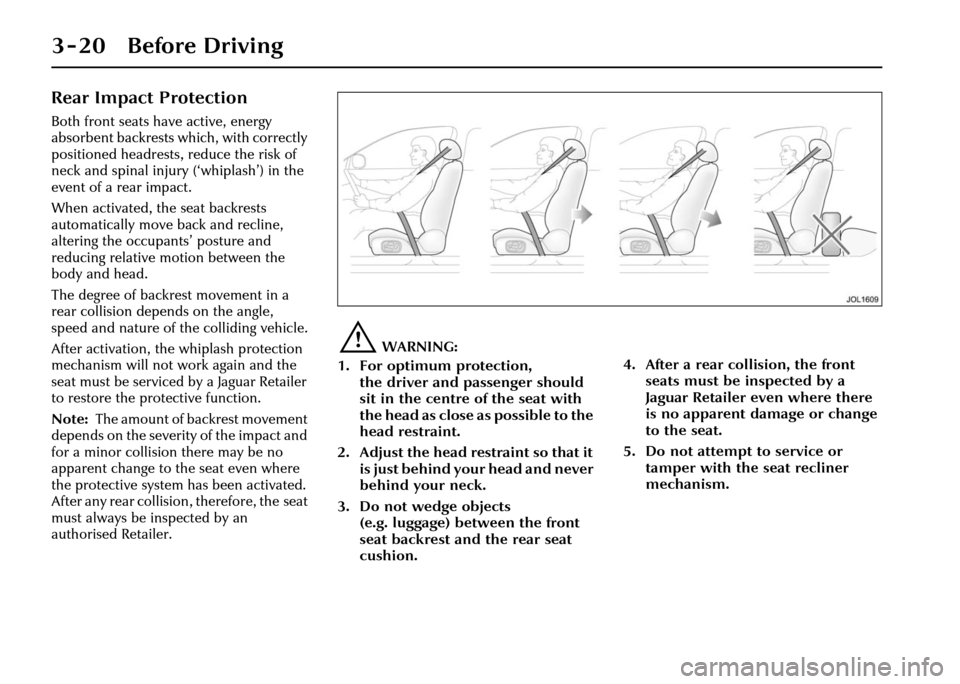
Both front seats have active, energy
absorbent backrests which, with correctly
positioned headrests, reduce the risk of
neck and spinal injury (‘whiplash’) in the
event of a rear impact.
When activated, the seat backrests
automatically move back and recline,
altering the occupants’ posture and
reducing relative motion between the
body and head.
The degree of backrest movement in a
rear collision depends on the angle,
speed and nature of the colliding vehicle.
After activation, the w hiplash protection
mechanism will not work again and the
seat must be serviced by a Jaguar Retailer
to restore the protective function.
Note: The amount of backrest movement
depends on the severity of the impact and
for a minor collision there may be no
apparent change to the seat even where
the protective system has been activated.
After any rear collisio n, therefore, the seat
must always be inspected by an
authorised Retailer.
!WARNING:
1. For optimum protection, the driver and passenger should
sit in the centre of the seat with
the head as close as possible to the
head restraint.
2. Adjust the head re straint so that it
is just behind your head and never
behind your neck.
3. Do not wedge objects (e.g. luggage) between the front
seat backrest and the rear seat
cushion. 4. After a rear collision, the front
seats must be inspected by a
Jaguar Retailer even where there
is no apparent da mage or change
to the seat.
5. Do not attempt to service or tamper with the seat recliner
mechanism.
Page 78 of 227
On the Road 4 - 7
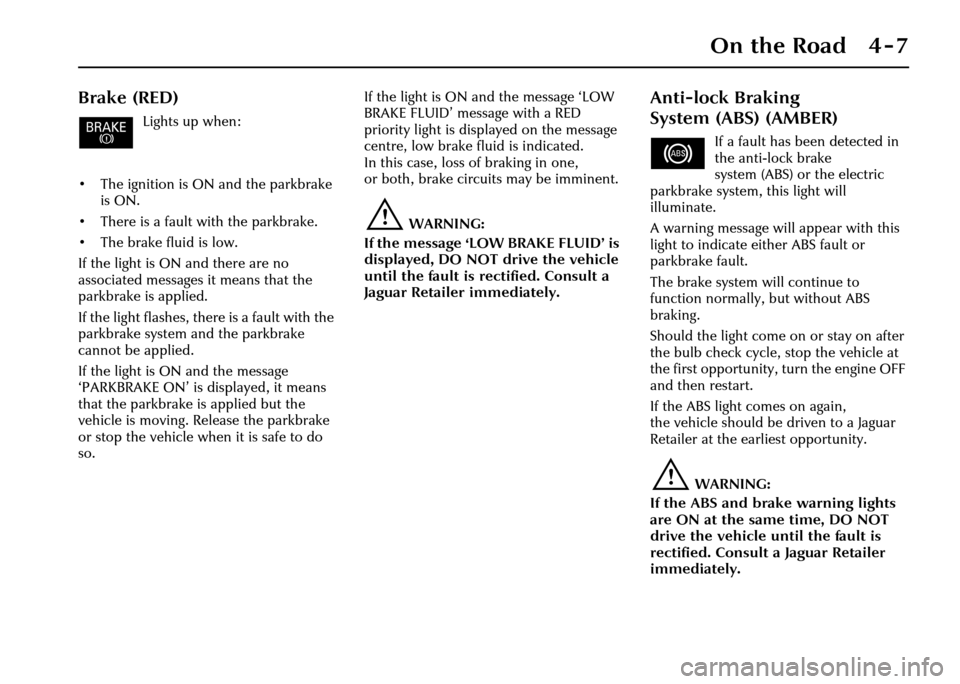
Brake (RED)
Lights up when:
• The ignition is ON and the parkbrake is ON.
• There is a fault with the parkbrake.
• The brake fluid is low.
If the light is ON and there are no
associated messages it means that the
parkbrake is applied.
If the light flashes, th ere is a fault with the
parkbrake system and the parkbrake
cannot be applied.
If the light is ON and the message
‘PARKBRAKE ON’ is displayed, it means
that the parkbrake is applied but the
vehicle is moving. Release the parkbrake
or stop the vehicle when it is safe to do
so. If the light is ON and the message ‘LOW
BRAKE FLUID’ message with a RED
priority light is displayed on the message
centre, low brake fluid is indicated.
In this case, loss of braking in one,
or both, brake circuits may be imminent.
!WARNING:
If the message ‘LOW BRAKE FLUID’ is
displayed, DO NOT drive the vehicle
until the fault is rectified. Consult a
Jaguar Retailer immediately.
Anti-lock Braking
System (ABS) (AMBER)
If a fault has been detected in
the anti-lock brake
system (ABS) or the electric
parkbrake system, this light will
illuminate.
A warning message will appear with this
light to indicate either ABS fault or
parkbrake fault.
The brake system will continue to
function normally, but without ABS
braking.
Should the light come on or stay on after
the bulb check cycle, stop the vehicle at
the first opportunity, turn the engine OFF
and then restart.
If the ABS light comes on again,
the vehicle should be driven to a Jaguar
Retailer at the earliest opportunity.
!WARNING:
If the ABS and brake warning lights
are ON at the same time, DO NOT
drive the vehicle until the fault is
rectified. Consult a Jaguar Retailer
immediately.
Page 88 of 227
On the Road 4 - 17
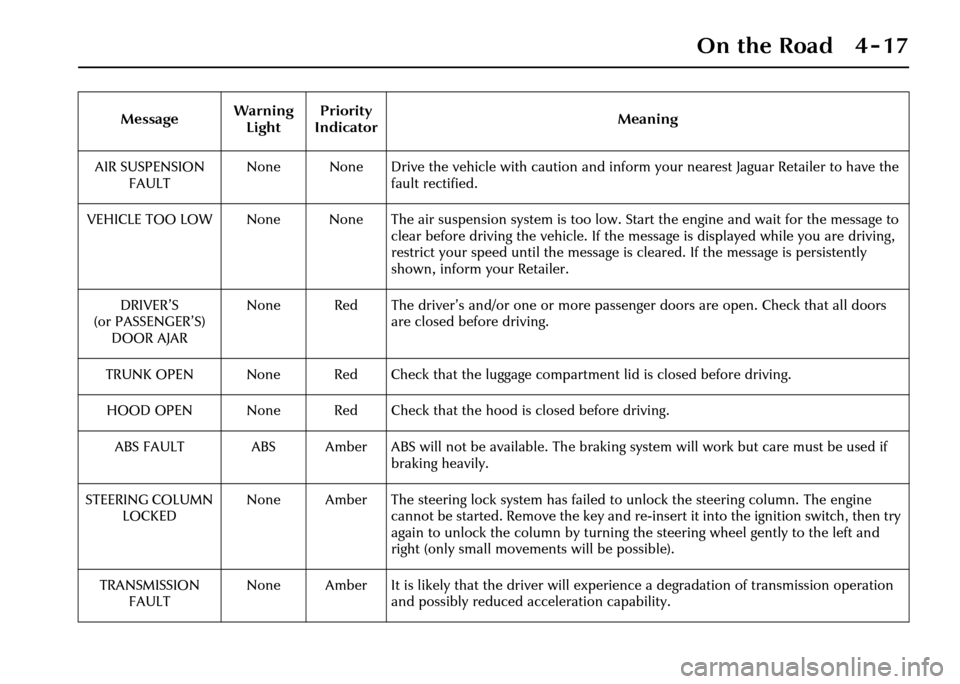
AIR SUSPENSION FAULT None None Drive the vehicle with caution and inform your nearest Jaguar Retailer to have the
fault rectified.
VEHICLE TOO LOW None None The air suspension system is too low. Start the engine and wait for the message to clear before driving the vehicle. If the message is displayed while you are driving,
restrict your speed until the message is cleared. If the message is persistently
shown, inform your Retailer.
DRIVER’S
(or PASSENGER’S) DOOR AJAR None Red The driver’s and/or one or more passenger doors are open. Check that all doors
are closed before driving.
TRUNK OPEN None Red Check that the luggage co mpartment lid is closed before driving.
HOOD OPEN None Red Check that the hood is closed before driving.
ABS FAULT ABS Amber ABS will not be available. The braki ng system will work but care must be used if
braking heavily.
STEERING COLUMN LOCKED None Amber The steering lock system has failed to unlock the steering column. The engine
cannot be started. Remove the key and re-insert it into th e ignition switch, then try
again to unlock the column by turning the steering wheel gently to the left and
right (only small movements will be possible).
TRANSMISSION FAULT None Amber It is likely that the driver will expe
rience a degradation of transmission operation
and possibly reduced ac celeration capability.
Message
Warning
Light Priority
Indicator Meaning
Page 117 of 227
4-46 On the Road
Dynamic Stability
Control (DSC)
Unless it has been switched off, dynamic
stability control is operational whenever
the engine is running. If the system is
operating, the warning light in the
instrument cluster will flash.
The DSC system controls the anti-lock
braking system (ABS), traction control
and yaw control of the vehicle.Yaw control determines the vehicle’s
direction relative to
the driver’s inputs
(sideslip and under/ov ersteer). It applies
braking pressure to individual wheels if
excessive variation is detected.
This ensures that the vehicle follows the
driver’s intended direction of travel.
Traction control will intervene to reduce
wheel spin, by automatically reducing the
power output from the engine and
applying braking to individual wheels.
This improves acceleration, particularly
on surfaces with uneven friction,
for example, one wheel on ice the other
on tarmac.
ABS helps to prevent the road wheels
from locking and skidding during
emergency braking.
When the system is operating,
the warning light in the instrument
cluster will flash.
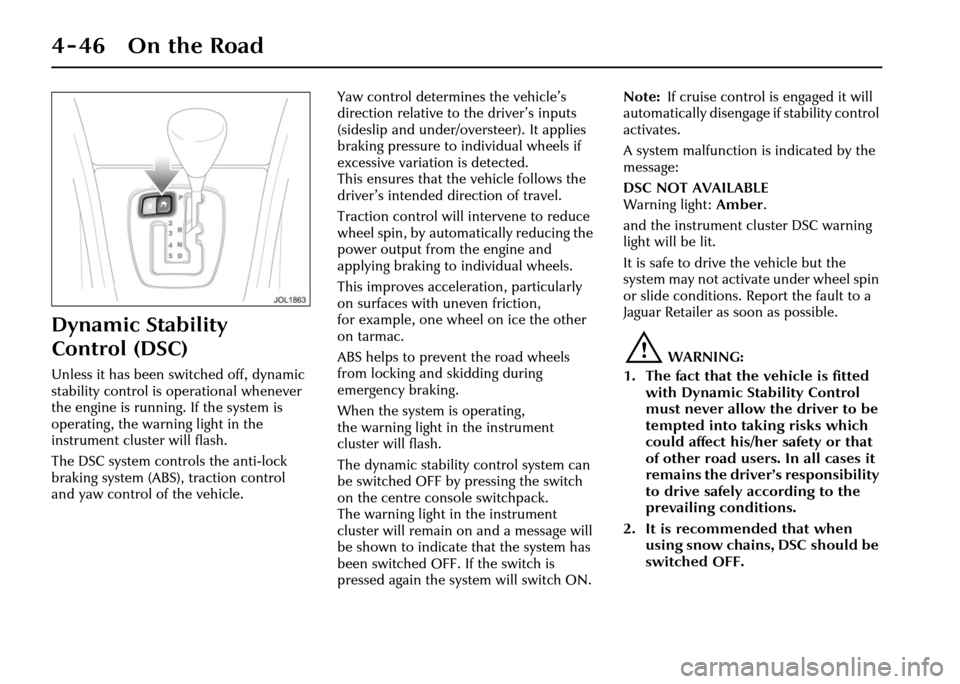
The dynamic stability control system can
be switched OFF by pressing the switch
on the centre console switchpack.
The warning light in the instrument
cluster will remain on and a message will
be shown to indicate that the system has
been switched OFF. If the switch is
pressed again the system will switch ON. Note:
If cruise control is engaged it will
automatically disengage if stability control
activates.
A system malfunction is indicated by the
message:
DSC NOT AVAILABLE
Warning light: Amber .
and the instrument cluster DSC warning
light will be lit.
It is safe to drive the vehicle but the
system may not activate under wheel spin
or slide conditions. Report the fault to a
Jaguar Retailer as soon as possible.
!WARNING:
1. The fact that the vehicle is fitted with Dynamic Stability Control
must never allow th e driver to be
tempted into taking risks which
could affect his/her safety or that
of other road users. In all cases it
remains the driver’s responsibility
to drive safely according to the
prevailing conditions.
2. It is recommended that when using snow chains, DSC should be
switched OFF.
Page 118 of 227
On the Road 4 - 47
Anti-lock Braking
System (ABS)
This system helps to prevent the road
wheels from locking and skidding during
emergency braking, assisting the driver to
maintain full steering and directional
stability.
The factor controlling ultimate stopping
distance and cornering ability is tyre/road
adhesion.
!WARNING:
1. The fact that a vehicle is fitted with ABS must never allow the
driver to be tempted into taking
risks which could affect his/her
safety or that of other road users.
2. The addition of ABS cannot overcome the consequences of
trying to stop in too short a
distance, cornering at too high a
speed, or the risk of aquaplaning. 3. The driver should always take
road conditions into account.
A slippery road surface always
requires more braking distance
for a given speed, even with ABS.
A possible increase in stopping
distance compared to locked
wheels may occur during ABS
operation on slushy snow, gravel,
sand, or some heavily corrugated
or ridged warning sections of road
surfaces.
ABS optimises tyre/road adhesion under
maximum braking conditions though it
cannot provide increased cornering
ability. There is no need for special
braking techniques, such as ‘pumping’
the brakes, to achieve optimum braking
distances and control on poor or slippery
road surfaces. Tyres must be in good
condition to achieve maximum adhesion. During normal brakin
g the ABS will not
be activated. Howe ver, if the braking
force applied begins to exceed tyre/road
adhesion the ABS will automatically
activate, preventing the road wheels from
locking.
In these circumstances a pulsating effect
will be felt from the brake pedal
indicating that the sy stem is functioning.
The pulsating effect is due to small
fluctuations in pressure supplied to the
brakes by the system to maintain full
tyre/road adhesion.
Under severe braking on some road
surfaces tyre noise may be apparent even
though the wheels will at no time become
locked.
Page 119 of 227
4-48 On the Road
ABS Monitoring
The ABS control module monitors the
ABS electrical system from ignition switch
ON to ignition switch OFF.
Any malfunction will be indicated by the
anti-lock warning light coming on.
Should a fault develo p in the ABS system,
the brake system will still operate
conventionally and with the same
standard of performance as vehicles not
equipped with ABS.
Caution: Consult a Jaguar Retailer
immediately if the warning light
comes on while driving, a system
failure is indicated.
Advice on ABS Braking
Techniques
For optimum ABS performance the
instructions on braking techniques during
ABS operation should be followed:
1. Do not release brake pressure when the pulsating effect is felt. Maintain a
constant pressure until the manoeuvre
is completed. 2. To familiarise yourself with the feel of
the brake pedal duri ng ABS braking,
practise an emergency stop
procedure, always making sure it is
safe to do so. With the seat belts fitted
to all occupants, drive the vehicle at
20 mph (32 km/h) and brake sharply.
3. ABS enables the driver to steer around obstacles during emergency braking.
However, the consequ ences of turning
sharply at high speed cannot be
overcome by the ABS.
4. Do not attempt to ‘pump’ the brakes to avoid skidding as this can interfere
with the ABS operation. The ABS will
not allow the wheels to skid under
normal road conditions.
5. The ABS will tend to keep the vehicle straight during braking. Because
braking distances may increase under
certain road conditio ns, it is necessary
to plan and make turning manoeuvres
as early as possible.
Emergency Brake Assist (EBA)
The EBA system measures the rate at
which the brake pressure increases.
If the system detect s an emergency
braking situation, EBA automatically
initiates the full br aking effect. This can
reduce stopping distances in critical
situations, which can help an
inexperienced driver to stop in the same
distance as an experienced driver.
!WARNING:
The EBA system is an additional safety
system: it is not intended to relieve
the driver of his responsibility for
exercising due care and attention
when driving.
Page 133 of 227
4-62 On the Road
Towing a Trailer
Your Jaguar Retailer, and the main
motoring organisations can advise you on
towing, towing weight capacities and
about regulations that apply in other
countries.
The following are important points of
safety, stability and comfort upon which
further advice should be sought:
• Maximum braked towing weight is permissible, provided long periods of
uphill driving on gradients over 8%
are not undertaken.
• In high altitude mountainous regions, the thinner atmosphere can reduce
engine performance. Above 3280 feet
(1000 metres) the stipulated
maximum permitted gross train
weight must be reduced by 10% for
every 3280 feet (1000 metres) in
altitude.
• The kerbside weight of the vehicle can be found on page 8 - 4.
• When towing at the maximum permissible rear axle load keep within
legal towing speeds but in any case do
not exceed 62 mph (100 km/h). • Tyres must be inflated to the normal
(higher) pressures shown on the tyre
pressure label on the fuel filler flap.
• The recommended maximum tow-ball nose weight is shown
on page 8 - 5. Having a lower nose
weight or exceeding the maximum
nose weight limit may impair the
vehicle’s handling.
• When towing, the nose weight of the trailer and the tow-bar assembly must
be deducted from the permissible
maximum load, see page 8 - 5.
• Avoid heavy braking. As the overrun brake on the traile r is not connected
to the ABS, heavy trailer braking
could critically affect the stability of
the outfit as a whole.
• Ensure that the towing vehicle’s engine, transmission, suspension,
brakes and tyres are fully efficient and
regularly serviced. Similarly check the
wheels, tyres, brakes and wheel
bearings of the trailer. Caution:
1. When not in use, it is
recommended that the removable
tow-ball is either securely stowed
in the luggage compartment or,
preferably, not in the vehicle.
Do not leave it loose in the
vehicle.
2. It is essential that only a Jaguar tow-bar and Jaguar electrical tow-
bar kit are supplied and fitted by a
Jaguar Retailer. Contact your
Jaguar Retailer for details of
additional parts that are advised
to be fitted before towing. This is
particularly important with this
vehicle having air suspension.
If unapproved towing equipment
is used whilst towing, the air
suspension speed lowering
function will not be inhibited.
This may result in a change in
trailer weight distribution and
attitude.