lock JAGUAR XJ6 1994 2.G Electrical Diagnostic Manual
[x] Cancel search | Manufacturer: JAGUAR, Model Year: 1994, Model line: XJ6, Model: JAGUAR XJ6 1994 2.GPages: 327, PDF Size: 13.73 MB
Page 69 of 327
Brakes (a)
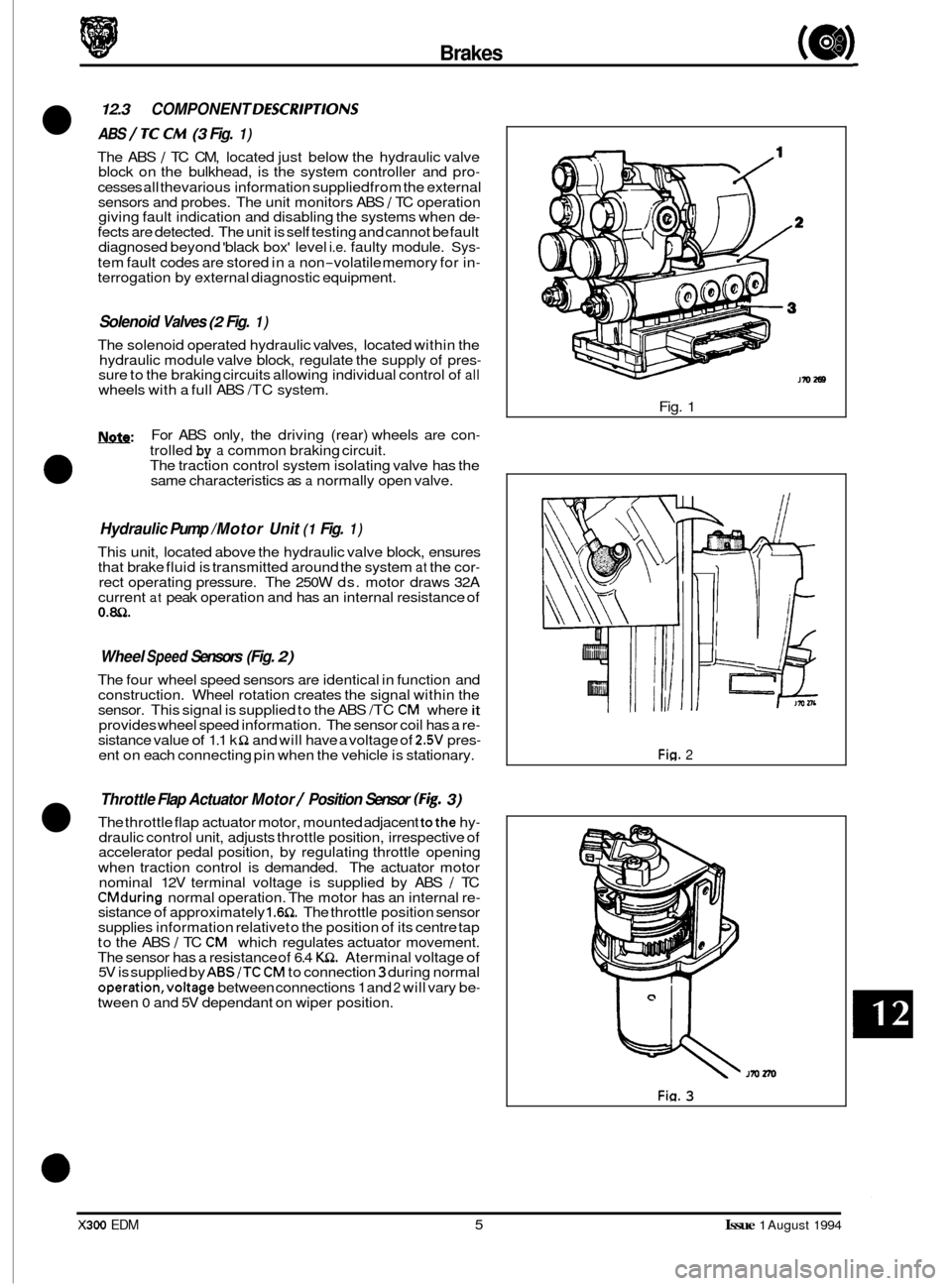
12.3 COMPONENT DESCRlPTlONS
ABS / TC CM (3 Fig. 1)
The ABS / TC CM, located just below the hydraulic valve
block on the bulkhead, is the system controller and pro-
cesses all thevarious information supplied from the external
sensors and probes. The unit monitors ABS / TC operation
giving fault indication and disabling the systems when de- fects are detected. The unit is self testing and cannot be fault
diagnosed beyond 'black box' level i.e. faulty module. Sys-
tem fault codes are stored in a non-volatile memory for in- terrogation by external diagnostic equipment.
Solenoid Valves (2 Fig. 1)
The solenoid operated hydraulic valves, located within the
hydraulic module valve block, regulate the supply of pres- sure to the braking circuits allowing individual control of all wheels with a full ABS /TC system.
Nnfe: For ABS only, the driving (rear) wheels are con-
trolled by a common braking circuit.
The traction control system isolating valve has the
same characteristics as
a normally open valve. a
Hydraulic Pump /Motor Unit (1 Fig. 1)
This unit, located above the hydraulic valve block, ensures
that brake fluid is transmitted around the system at the cor- rect operating pressure. The 250W ds. motor draws 32A
current at peak operation and has an internal resistance of 0.m.
Wheel Speed Sensors (Fig. 2)
The four wheel speed sensors are identical in function and
construction. Wheel rotation creates the signal within the
sensor. This signal is supplied to the ABS /TC
CM where it provides wheel speed information. The sensor coil has a re- sistance value of 1.1 k Q and will have a voltage of 2.5V pres- ent on each connecting pin when the vehicle is stationary.
Throttle Flap Actuator Motor / Position Sensor (Fig. 3)
The throttle flap actuator motor, mounted adjacent tothe hy- draulic control unit, adjusts throttle position, irrespective of
accelerator pedal position, by regulating throttle opening
when traction control is demanded. The actuator motor
nominal 12V terminal voltage is supplied by ABS
/ TC CMduring normal operation. The motor has an internal re- sistance of approximately 1.6Q. The throttle position sensor
supplies information relative to the position of its centre tap
to the ABS
/ TC CM which regulates actuator movement.
The sensor has a resistance of 6.4 K!2. Aterminal voltage of 5V is supplied by ABS/TC CM to connection 3 during normal
operation,voltage between connections 1 and 2 will vary be- tween 0 and 5V dependant on wiper position.
Fig. 1
Fig. 2
Jrn 270
Fia. 3
X300 EDM 5 Issue 1 August 1994
Page 74 of 327
Climate Control Systems
SECTION CON TENTS
Subsection Title SRO Page
14.1 ............. System Description ................................................................... 1
14.2 ............. Component Descriptions .............................................................. 3
14.2.1 ............ Control Panel ........................................................................\
3
14.2.2. ........... Control Panel Inputs / Outputs ......................................................... 3
14.2.3. ........... Solar Sensor ........................................................................\
. 4
14.2.4. ........... Engine Speed Signal .................................................................. 4
14.2.5 ............ Ambient Temperaturesensor ........................................................... 4
14.2.6 ............ Vehicle Speed Signal ................................................................. 4
14.2.7.
........... Evaporator Temperature Sensor ......................................................... 4
14.2.8. ........... Heater Matrix Temperature Sensor ...................................................... 5
14.2.9.
........... Coolant Temperature Signal ............................................................ 5
14.2.10
.......... Compressor ONSignal ................................................................ 5
14.2.11 ........... Motorized ln-car Aspirator ............................................................ 5
14.2.12 .......... CompressorLockSignal ............................................................... 5
14.2.13
.......... Refrigerant Pressure Switch ............................................................ 5
14.2.14
.......... Water Valve ........................................................................\
. 5
14.2.15 .......... Water Pump ........................................................................\
. 5
14.2.16
.......... Servo Motor Control .................................................................. 6
14.2.17 .......... Blower Motor Control ................................................................ 6
14.2.18 .......... Differential Control ................................................................... 6
14.2.19
.......... Heated Rear Window, Door Mirrors and Front Screen ...................................... 6
14.3 ............. Climate Control Module Connections ................................................... 7
14.4 ............. Climate Control System Test .......................................................... 10
14.4.1
............ Fault Code Extraction and Deletion Procedure ........................................... 10
14.5
............. Fault Codes ........................................................................\
11
14.6 ............. Actuator Check ..................................................................... 12
14.7
............. Diagnostic Tests .................................................................... 13
14.7.1
............ Fault Code 11 ...................................................................... 13
14.7.2.
........... Fault Code 12 ...................................................................... 14
14.7.3
............ Fault Code 13 ...................................................................... 15
14.7.4.
........... Fault Code 14 ...................................................................... 16
14.7.5
............ Fault Code 15 ...................................................................... 16
14.7.6
............ Fault Code21 ...................................................................... 17
14.7.7 ............ FaultCode22 ...................................................................... 17
14.7.8 ............ Fault Code23 ...................................................................... 18
14.7.9. ........... Fault Code 24 ...................................................................... 18
X300 EDM i Issue 1 August 1994
Page 76 of 327
Climate Control Systems
.-)
14.1 SYSTEM DESCRIPTION
The Air Conditioning electronic Control Module (A/ CCM) located on the right-hand side of the A / C unit, controls the 0 functions of the system.
These functions include:
0 In-car temperature control
0 In-car humidity control (Air conditioning vehicles only)
0 Air flow / volume and distribution
The temperature of the passenger compartment is continuously compared with the temperature selected on the con
- trol panel LCD. A digital microprocessor within the A/ CCM receives the data signals. Comparison of these signals
and those from system temperature sensors and feedback devices results in the appropriate output voltage changes
needed to vary the blend of air flow into the passenger compartment.
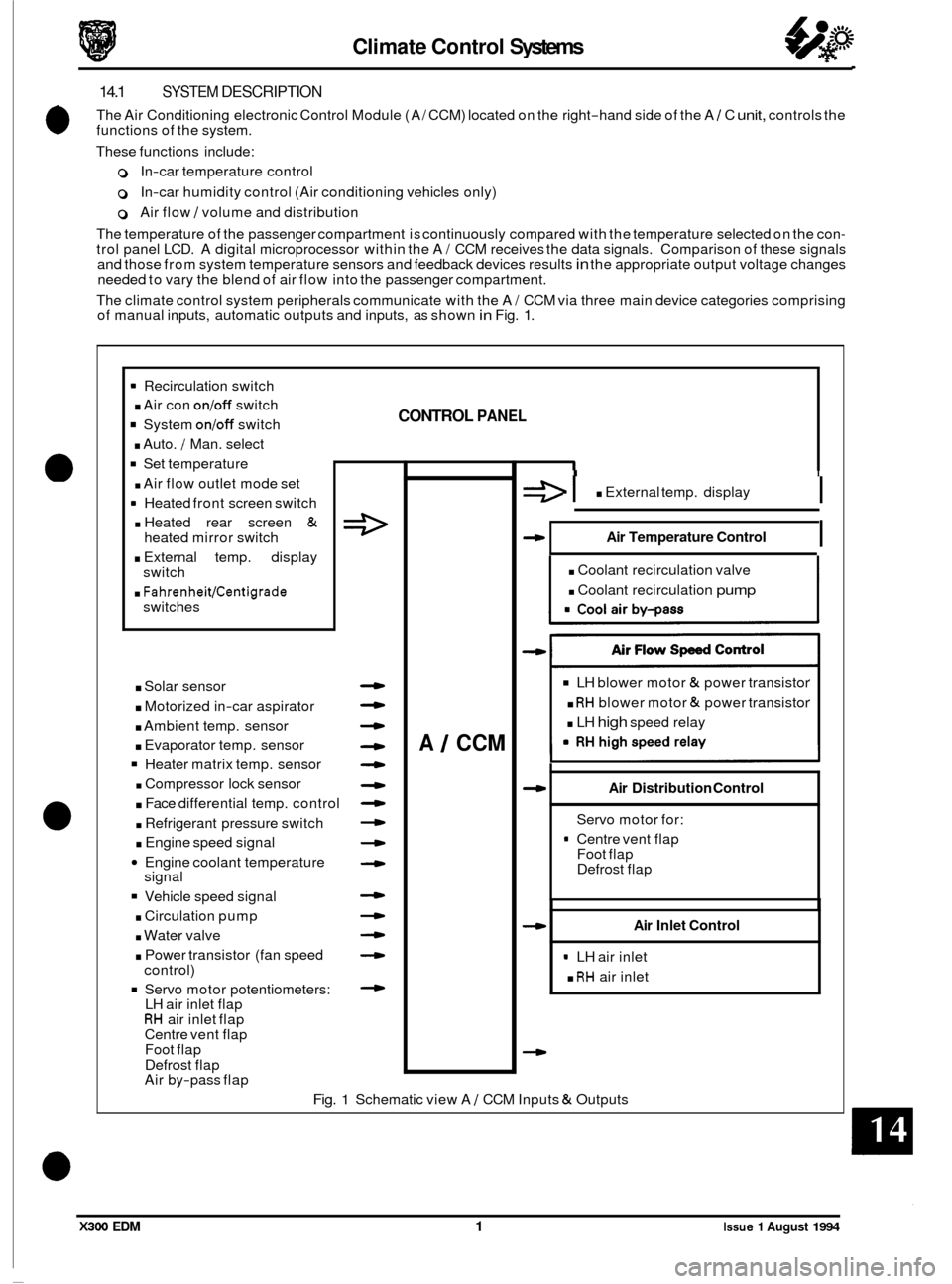
The climate control system peripherals communicate with the A/ CCM via three main device categories comprising
of manual inputs, automatic outputs and inputs, as shown
in Fig. 1.
Air Temperature Control I
9 Recirculation switch
. Air con on/off switch
System on/off switch
. Auto. / Man. select
Set temperature
. Air flow outlet mode set
Heated front screen switch
. Heated rear screen &
heated mirror switch
. External temp. display
switch
. FahrenheiVCentigrade switches
4
. Solar sensor
. Motorized in-car aspirator
. Ambient temp. sensor
. Evaporator temp. sensor
Heater matrix temp. sensor
. Compressor lock sensor
. Face differential temp. control
. Refrigerant pressure switch
. Engine speed signal
Engine coolant temperature
Vehicle speed signal
. Circulation pump
. Water valve
. Power transistor (fan speed
Servo motor potentiometers:
signal
control)
LH air inlet flap
RH air inlet flap
Centre vent flap
Foot flap
Defrost flap
Air by
-pass flap
Air Inlet Control
9 LH air inlet
. RH air inlet
CONTROL PANEL
1
A / CCM
I I
I . External temp. display I
. Coolant recirculation valve
. Coolant recirculation pump
LH blower motor & power transistor
. RH blower motor & power transistor
. LH high speed relay
Air Distribution Control
Servo motor for:
9 Centre vent flap
Foot flap
Defrost flap
Fig. 1 Schematic view A / CCM Inputs & Outputs
X300 EDM 1 Issue 1 August 1994
Page 78 of 327
Climate Control Systems
System Differences
m:
Heater only vehicles do not have the following fitted:
This section applies generally to both air conditioning and heater systems. System specific descriptions, pro-
cedures, tests etc. are indicated.
0 Solar sensor
0 Clutch request and acknowledge circuitry.
0 Refrigerant pressure switch.
0 Control panel - deletion of air conditioning button.
6 cyl. engined vehicles do not have either the electrical load inhibit or the compressor lock sensor.
Heated Front Screen
(HFS) is optional on both air conditioning and heater panel versions.
14.2 COMPONENT DESCRIPTIONS
14.2.1 Control Panel
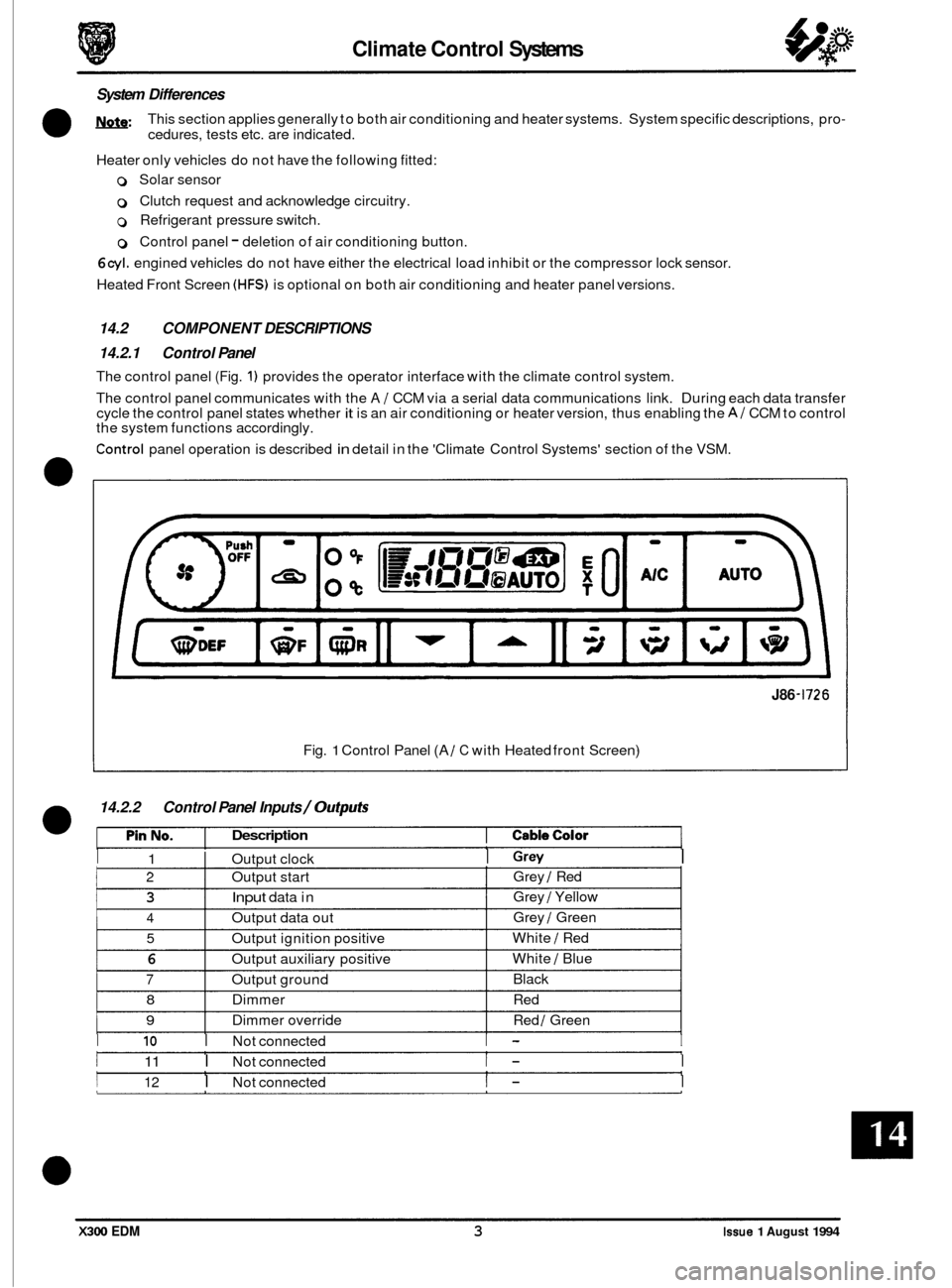
The control panel (Fig. 1) provides the operator interface with the climate control system.
The control panel communicates with the
A / CCM via a serial data communications link. During each data transfer
cycle the control panel states whether it is an air conditioning or heater version, thus enabling the A/ CCM to control
the system functions accordingly.
Tontrol panel operation is described in detail in the 'Climate Control Systems' section of the VSM.
-
Fig. 1 Control Panel (A / C with Heated front Screen)
J86 - I726
14.2.2 Control Panel Inputs /Outputs
Description I CableColor
I 1 I Output clock I Grey I
2 Output start Grey / Red
3 Input data
in Grey / Yellow
4 Output
data out Grey / Green
5 Output
ignition positive White / Red
6 Output auxiliary positive
White / Blue
7 Output
ground Black
8 Dimmer
Red
9 Dimmer override Red / Green
I 10 I Not connected I- I
I 11 I Not connected I- I
I 12 I Not connected l- I
X300 EDM 3 Issue 1 August 1994
Page 79 of 327
Climate Control Systems
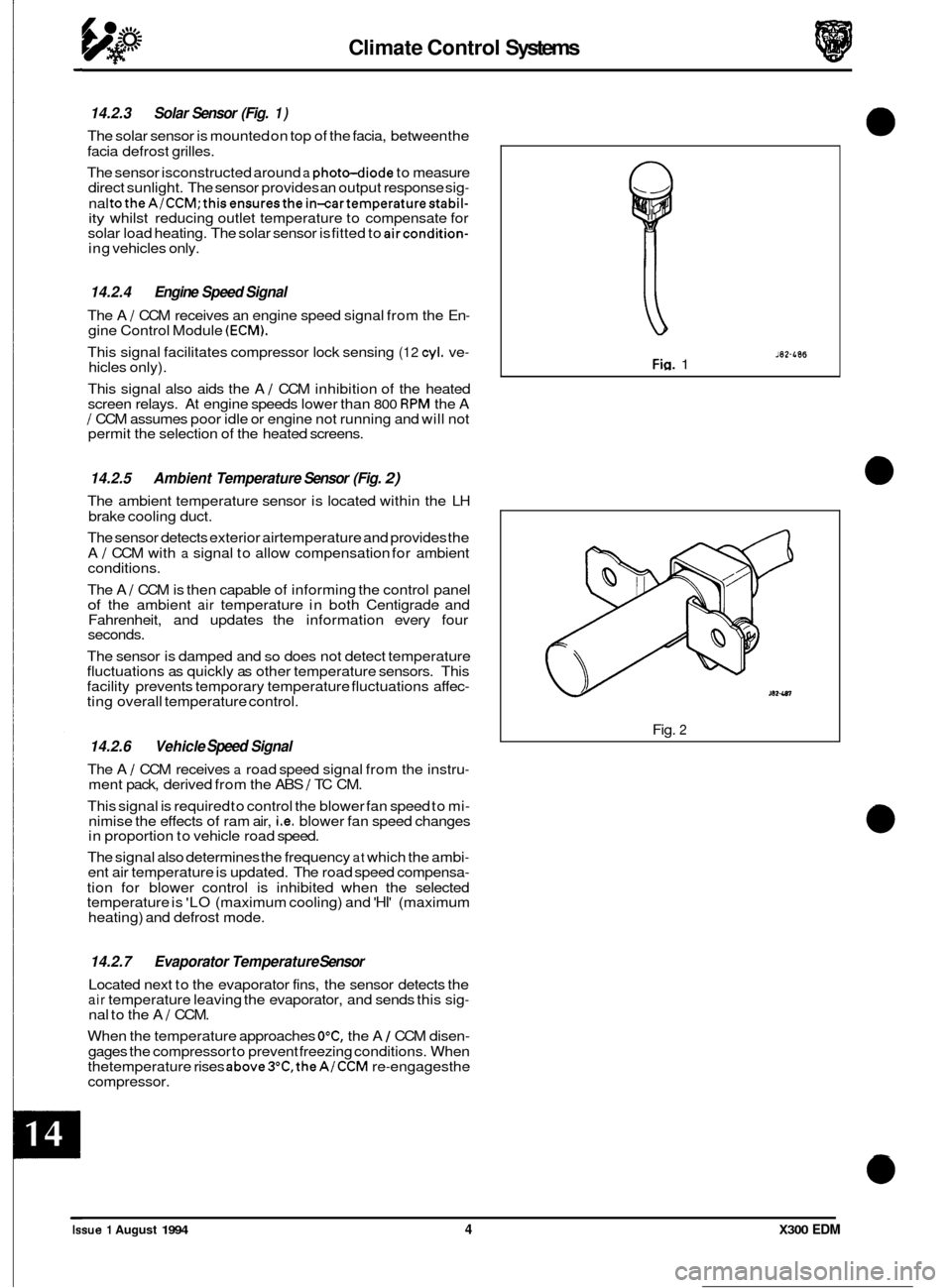
14.2.3 Solar Sensor (Fig. 1)
The solar sensor is mounted on top of the facia, between the
facia defrost grilles.
The sensor isconstructed around
a photo-diode to measure
direct sunlight. The sensor provides an output response sig-
nal totheA1CCM;thisensuresthe in-cartemperaturestabil- ity whilst reducing outlet temperature to compensate for
solar load heating. The solar sensor is fitted to aircondition- ing vehicles only.
14.2.4 Engine Speed Signal
The A 1 CCM receives an engine speed signal from the En- gine Control Module (ECM).
This signal facilitates compressor lock sensing (12 cyl. ve- hicles only).
This signal also aids the A
1 CCM inhibition of the heated
screen relays. At engine speeds lower than 800 RPM the A I CCM assumes poor idle or engine not running and will not
permit the selection of the heated screens.
14.2.5 Ambient Temperature Sensor (Fig. 2)
The ambient temperature sensor is located within the LH
brake cooling duct.
The sensor detects exterior airtemperature and provides the
A
I CCM with a signal to allow compensation for ambient
conditions.
The A
1 CCM is then capable of informing the control panel of the ambient air temperature in both Centigrade and
Fahrenheit, and updates the information every four
seconds.
The sensor is damped and
so does not detect temperature
fluctuations as quickly as other temperature sensors. This
facility prevents temporary temperature fluctuations affec
- ting overall temperature control.
14.2.6 Vehicle Speed Signal
The A 1 CCM receives a road speed signal from the instru- ment pack, derived from the ABS 1 TC CM.
This signal is required to control the blower fan speed to mi
- nimise the effects of ram air, i.e. blower fan speed changes
in proportion to vehicle road speed.
The signal also determines the frequency
at which the ambi- ent air temperature is updated. The road speed compensa-
tion for blower control is inhibited when the selected
temperature is 'LO (maximum cooling) and 'HI' (maximum
heating) and defrost mode.
14.2.7 Evaporator Temperature Sensor
Located next to the evaporator fins, the sensor detects the air temperature leaving the evaporator, and sends this sig- nal to the A 1 CCM.
When the temperature approaches
OOC, the A 1 CCM disen-
gages the compressor to prevent freezing conditions. When
thetemperature rises above3OC.theAlCCM re-engagesthe
compressor.
J82-L06 Fig. 1
Fig. 2
0
0
Issue 1 August 1994 4 X300 EDM
Page 80 of 327
Climate Control Systems
14.2.8 Heater Matrix Temperature Sensor
This sensor is positioned inside the air conditioning unit just
downstream of the heater matrix. The sensor monitors the
post
-heater air temperature, before the air is distributed to
the passenger compartment. In conjunction with the A / CCM this sensor provides the input to maintain a constant
outlet temperature.
14.2.9 Coolant Temperature Signal
This input is required to provide blower inhibit control, to
avoid cold
air being delivered in heating mode when the en- gine coolant temperature is below 3OOC. The input also
monitors the temperature of the coolant delivered to the
heater matrix to assist outlet temperature control.
14.2. IO Compressor ON Signal
This signal line monitors the compressor relay to inform the
A/ CCM of the compressor status and to facilitate lock detec-
tion and error sensing.
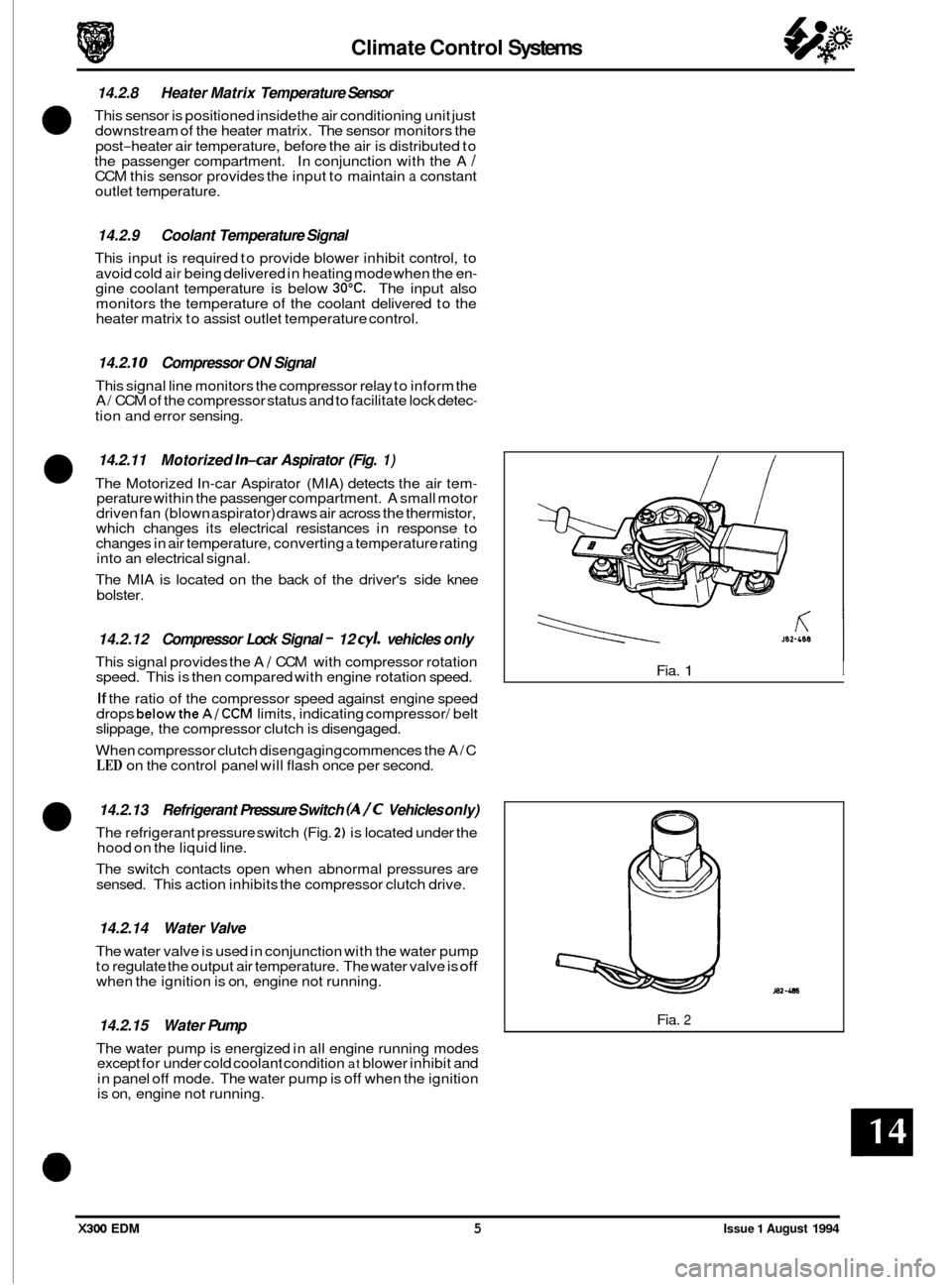
14.2.11 Motorized In-car Aspirator (Fig. 1)
The Motorized In-car Aspirator (MIA) detects the air tem- perature within the passenger compartment. A small motor
driven fan (blown aspirator) draws air across the thermistor,
which changes its electrical resistances in response to
changes in air temperature, converting
a temperature rating
into an electrical signal.
The MIA is located on the back of the driver's side knee
bolster.
14.2.12 Compressor Lock Signal - 12 cy/. vehicles only
This signal provides the A / CCM with compressor rotation
speed. This is then compared with engine rotation speed.
If the ratio of the compressor speed against engine speed
drops belowthe A/CCM limits, indicating compressor/ belt
slippage, the compressor clutch is disengaged.
When compressor clutch disengaging commences the A/C
LED on the control panel will flash once per second.
14.2.13 Refrigerant Pressure Switch (A/C Vehicles only)
The refrigerant pressure switch (Fig. 2) is located under the
hood on the liquid line.
The switch contacts open when abnormal pressures are
sensed. This action inhibits the compressor clutch drive.
14.2.14 Water Valve
The water valve is used in conjunction with the water pump
to regulate the output air temperature. The water valve is off when the ignition is on, engine not running.
14.2.15 Water Pump
The water pump is energized in all engine running modes
except for under cold coolant condition at blower inhibit and
in panel
off mode. The water pump is off when the ignition
is on, engine not running.
If
J82-488
KI Fia. 1 I
Fia. 2
X300 EDM 5 Issue 1 August 1994
Page 81 of 327
Climate Control Systems
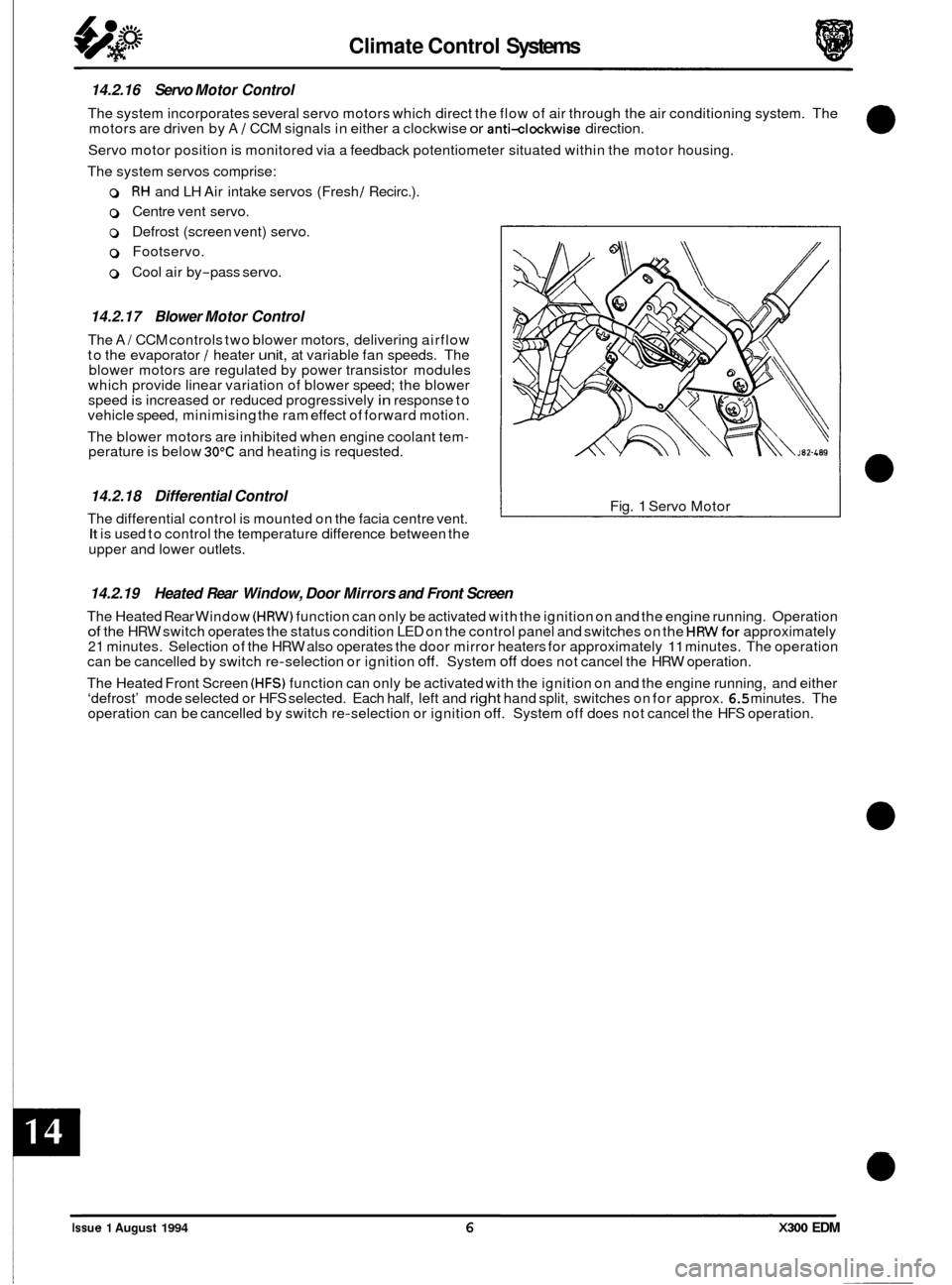
14.2.16 Servo Motor Control
The system incorporates several servo motors which direct the flow of air through the air conditioning system. The
motors are driven by A / CCM signals in either a clockwise or anti-clockwise direction.
Servo motor position is monitored via
a feedback potentiometer situated within the motor housing.
The system servos comprise:
o RH and LH Air intake servos (Fresh / Recirc.).
0 Centre vent servo.
o Defrost (screen vent) servo.
0 Footservo.
0 Cool air by-pass servo.
14.2.17 Blower Motor Control
The A/ CCM controls two blower motors, delivering airflow
to the evaporator / heater unit, at variable fan speeds. The
blower motors are regulated by power transistor modules
which provide linear variation of blower speed; the blower
speed
is increased or reduced progressively in response to
vehicle speed, minimising the ram effect of forward motion.
The blower motors are inhibited when engine coolant tem
- perature is below 30°C and heating is requested.
14.2.18 Differential Control
The differential control is mounted on the facia centre vent. It is used to control the temperature difference between the
upper and lower outlets. Fig.
1 Servo
Motor
14.2.19 Heated Rear Window, Door Mirrors and Front Screen
The Heated Rear Window (HRW) function can only be activated with the ignition on and the engine running. Operation of the HRW switch operates the status condition LED on the control panel and switches on the HRWfor approximately 21 minutes. Selection of the HRW also operates the door mirror heaters for approximately 11 minutes. The operation
can be cancelled by switch re-selection or ignition off. System off does not cancel the HRW operation.
The Heated Front Screen
(HFS) function can only be activated with the ignition on and the engine running, and either
‘defrost’ mode selected or HFS selected. Each half, left and right hand split, switches on for approx. 6.5 minutes. The
operation can be cancelled by switch re-selection or ignition off. System off does not cancel the HFS operation.
0
0
Issue 1 August 1994 6 X300 EDM
Page 83 of 327
Climate Control Systems
Climate Control Module Connections, continued
35 (16-way) Input Solar sensor
36 (16
-way) Input Centre vent servo motor feedback po- tentiometer
37
(16-way) Input RH air intake servo motor feedback po- tentiometer F / R
38 (16-way) Not used
39 (16
-way) Input Cool air bypass servo motor feedback
potentiometer
I 40(16-way) llnput I Coolant temperature signal
1 41 (16-way) llnput I RH blower motor voltage feedback
I 42 (16-way) I Output I RH blower motor drive signal
I 43(16-way) I Input
I Differential potentiometer
44 (16
-way) Input Defrost servo motor feedback poten-
tiometer
45
(%-way) Input LH air intake servo motor feedback po- tentiometer - F / R
46 (16-way) Not used
47 (16
-way) Input Foot servo motor feedback potentiome-
ter
48 (16
-way) Not used
49 (16
-way) Input LH blower motor voltage feedback
50 (16
-way) Output LH blower motor drive signal
51 (26
-way) Input Compressor ON signal
52 (26
-way) Output Water valve
53 (26
-way) Output RH Blower motor relay
54 (26
-way) Output Heated front screen relays
55 (26
-way) Output Heated Door Mirror relay
Specification
Open collector R = 578, connected to
IGN, activated low
Open collector
R = IKn, connected to
IG N, activated high
Open collector R = IKQ, connected to
IGN, activated high
Voltage /temperature values
Voltage
/ temperature values
Open collector
R = IKQ, connected to
IGN, activated high
AJ16
- Ground (lock sensor not fitted)
VI2 - Ign. voltage (lock sensor fitted)
Voltage
/ temperature values
Voltage
/ temperature values
Voltage
/ temperature values
Resistance 6W.
&IO%
0% closed - IV, 100% open - 4V
Resistance 6Kn
+IO%.
0% closed - IV, IOW0 open - 4V
Pulse
width modulated signal I
OV to 3V max. I
Resistance IOW. &IO%.
Min. IV, Max. 4V
Resistance
6W. +IO%.
0% closed - IV, IOW0 open - 4V
Resistance 6W.
+IO%.
Resistance 6W. &IO%.
0% closed - IV, 10096 open - 4V
I
Battery voltage when compressor ON
1 amp at 12 volts
Load
36Q at 12V IGN, activated low
0
0
0
0
Issue 1 August 1994 8 X300 EDM
Page 85 of 327
Climate Control Systems
Actlon
Simultaneously hold FACE and FAN and switch the ignition
ON
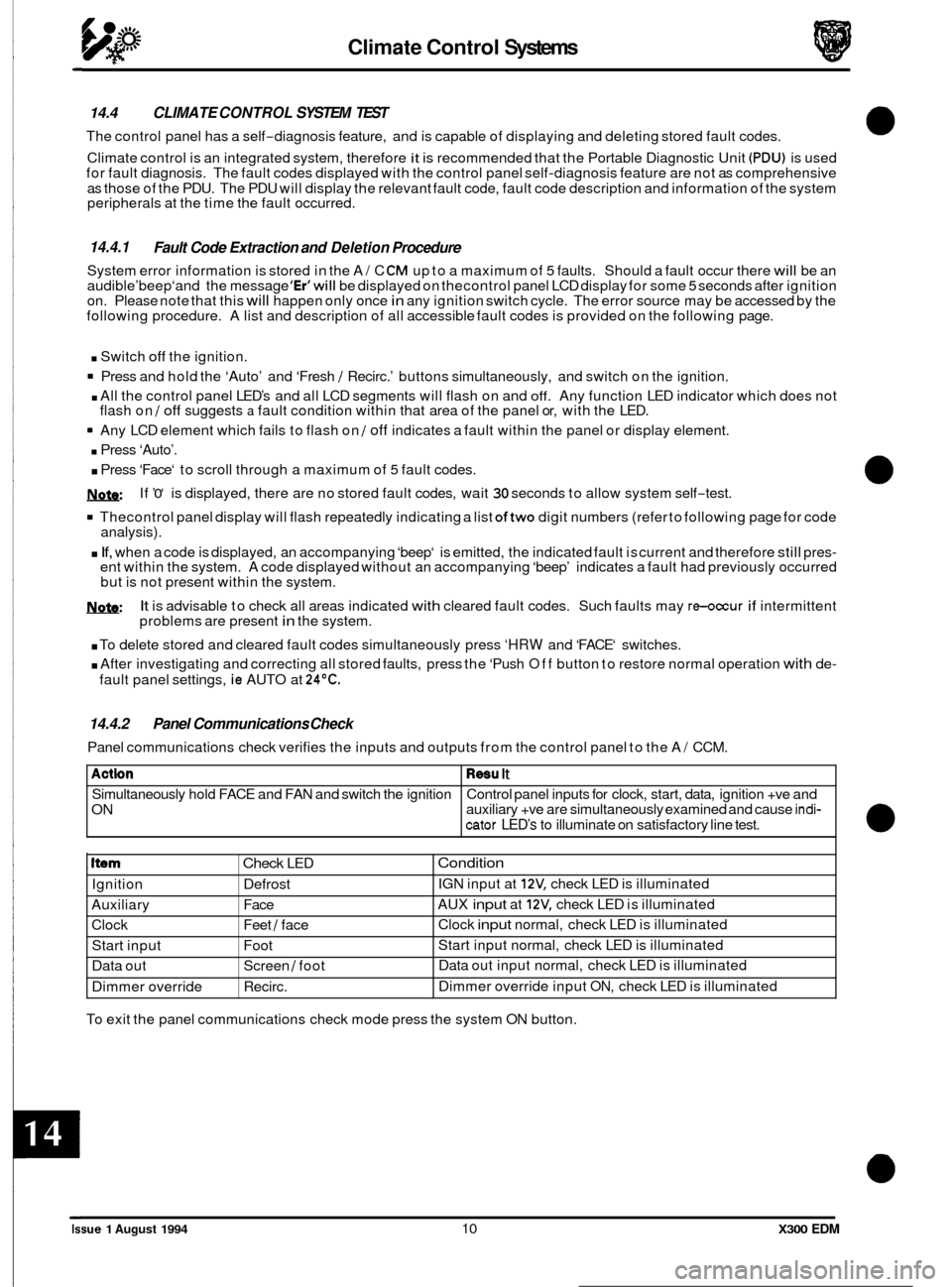
14.4 CLIMATE CONTROL SYSTEM TEST
The control panel has a self-diagnosis feature, and is capable of displaying and deleting stored fault codes.
Climate control is an integrated system, therefore
it is recommended that the Portable Diagnostic Unit (PDU) is used
for fault diagnosis. The fault codes displayed with the control panel self-diagnosis feature are not as comprehensive
as those of the PDU. The PDU will display the relevant fault code, fault code description and information of the system
peripherals at the time the fault occurred.
Resu It
Control panel inputs for clock, start, data, ignition +ve and
auxiliary +ve are simultaneously examined and cause indi-
cator LED’s to illuminate on satisfactory line test.
14.4.1
System error information is stored in the A/ C CM up to a maximum of 5 faults. Should a fault occur there will be an
audible’beep‘and the message ‘Er’will be displayed on thecontrol panel LCD display for some 5 seconds after ignition
on. Please note that this will happen only once in any ignition switch cycle. The error source may be accessed by the
following procedure. A list and description of all accessible fault codes is provided on the following page.
Fault Code Extraction and Deletion Procedure
I Item Check LED
Ignition Defrost
Auxiliary Face
Clock Feet
/ face
Start input Foot
Data out Screen
/ foot
Dimmer override Recirc.
. Switch off the ignition.
Press and hold the ‘Auto’ and ‘Fresh / Recirc.’ buttons simultaneously, and switch on the ignition.
. All the control panel LED’s and all LCD segments will flash on and off. Any function LED indicator which does not
flash on / off suggests a fault condition within that area of the panel or, with the LED.
Any LCD element which fails to flash on
/ off indicates a fault within the panel or display element.
. Press ‘Auto’.
. Press ‘Face‘ to scroll through a maximum of 5 fault codes.
W
Thecontrol panel display will flash repeatedly indicating a list oftwo digit numbers (refer to following page for code
analysis).
. If, when a code is displayed, an accompanying ‘beep‘ is emitted, the indicated fault is current and therefore still pres- ent within the system. A code displayed without an accompanying ‘beep’ indicates a fault had previously occurred
but is not present within the system.
It is advisable to check all areas indicated with cleared fault codes. Such faults may re-occur if intermittent
problems are present in the system.
If
’0‘ is
displayed, there are no stored fault codes, wait 30 seconds to allow system self-test.
W:
. To delete stored and cleared fault codes simultaneously press ‘HRW and ‘FACE‘ switches.
. After investigating and correcting all stored faults, press the ‘Push Off button to restore normal operation with de-
fault panel settings, ie AUTO at 24OC.
Condition
IGN input at 12V, check LED is illuminated
AUX
input at 12V, check LED is illuminated
Clock
input normal, check LED is illuminated
Start input normal, check LED is illuminated
Data out input normal, check LED is illuminated
Dimmer override input
ON, check LED is illuminated
14.4.2 Panel Communications Check
Panel communications check verifies the inputs and outputs from the control panel to the A/ CCM.
To exit the panel communications check mode press the system ON button.
Issue 1 August 1994 10 X300 EDM
Page 86 of 327
Climate Control Systems
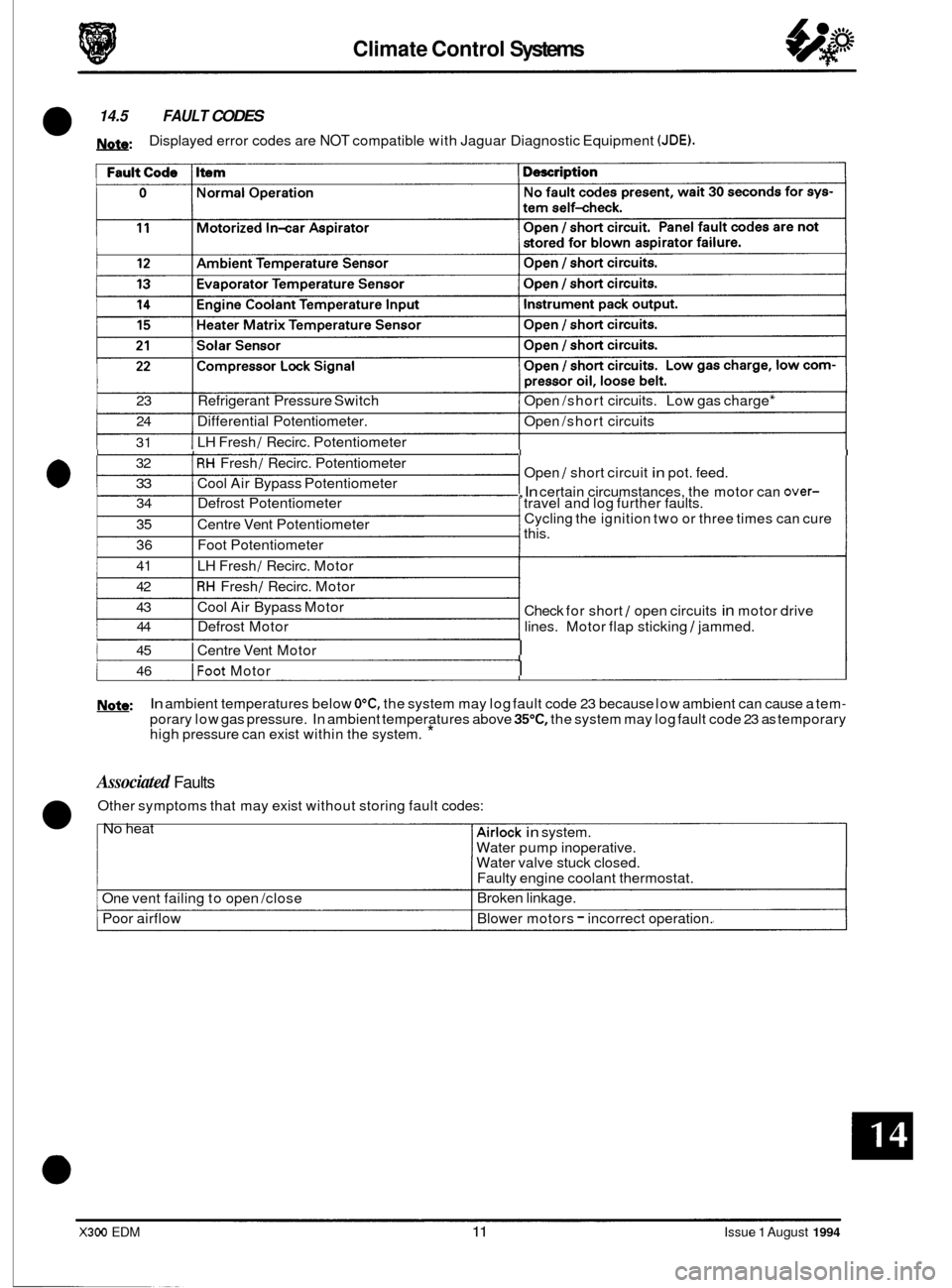
0 14.5 FAULT CODES
J&&: Displayed error codes are NOT compatible with Jaguar Diagnostic Equipment (JDE).
23 Refrigerant Pressure Switch Open /short circuits. Low gas charge*
24 Differential Potentiometer. Open /short circuits
31 LH Fresh
/ Recirc.
Potentiometer I I I I RH Fresh / Recirc. Potentiometer
Open / short circuit in pot. feed.
32
, In certain
circumstances, the motor can over- 0 33 Cool Air Bypass Potentiometer
34 Defrost Potentiometer travel and log further faults.
35
36 Foot Potentiometer Cycling
the ignition two or three times can cure
this.
Centre
Vent Potentiometer
41
42
I LH Fresh / Recirc. Motor
I RH Fresh / Recirc. Motor
43 Cool Air Bypass Motor
44 Defrost Motor lines. Motor flap sticking
/ jammed.
Check
for short
/ open circuits in motor drive
1 45 I Centre Vent Motor I
1 46 IFoot Motor I
W: In ambient temperatures below OOC, the system may log fault code 23 because low ambient can cause a tem-
porary low gas pressure. In ambient temperatures above 35"C, the system may log fault code 23 as temporary
high pressure can exist within the system. *
Associated Faults
Other symptoms that may exist without storing fault codes:
Airlock in system.
Water pump inoperative.
Water valve stuck closed.
Faulty engine coolant thermostat.
Broken linkage.
Blower motors
- incorrect operation.
No heat
One vent failing to open /close
Poor airflow
X300 EDM 11 Issue 1 August 1994