automatic transmission JAGUAR XJ6 1994 2.G Electrical Diagnostic Manual
[x] Cancel search | Manufacturer: JAGUAR, Model Year: 1994, Model line: XJ6, Model: JAGUAR XJ6 1994 2.GPages: 327, PDF Size: 13.73 MB
Page 27 of 327
lw Automatic Transmission (AJ16)
SYSTEM VOLTAGE MALFUNCTION - P 1794
The TCM monitors the supply voltage and will log this fault if the voltage is less than 10.5V when the engine speed is
greaterthan 1600rpm. This fault code is unlikelyto becaused by afault within theTCM and assuch thevehicle harness
and fuses etc. should be completely tested before the TCM is condemned.
Possible causes:
. Blown fuses.
. Faulty harness wiring /connections.
Effects:
Transmission default settings adopted.
. MIL illuminated.
Transmission warning lamp illuminated.
. Maximum fluid pressure available.
. Limp home mode applied.
Remedy:
Examine fuse F14 in LH heelboard fuse-box. Renew (if necessary) after determining cause of rupture.
. Repair or renew harness / connector.
KICK-DOWN SWITCH SYSTEM - P 1796
The diagnostic check on the mode switch input is a plausibility check which is performed continuously while in oper- ation. A fault is determined when kickdown is seen when the throttle angle is less than 50%. However a fault will only
be logged if the output speed is greater than 256 rpm. No fault is logged if there is already a throttle signal fault. The
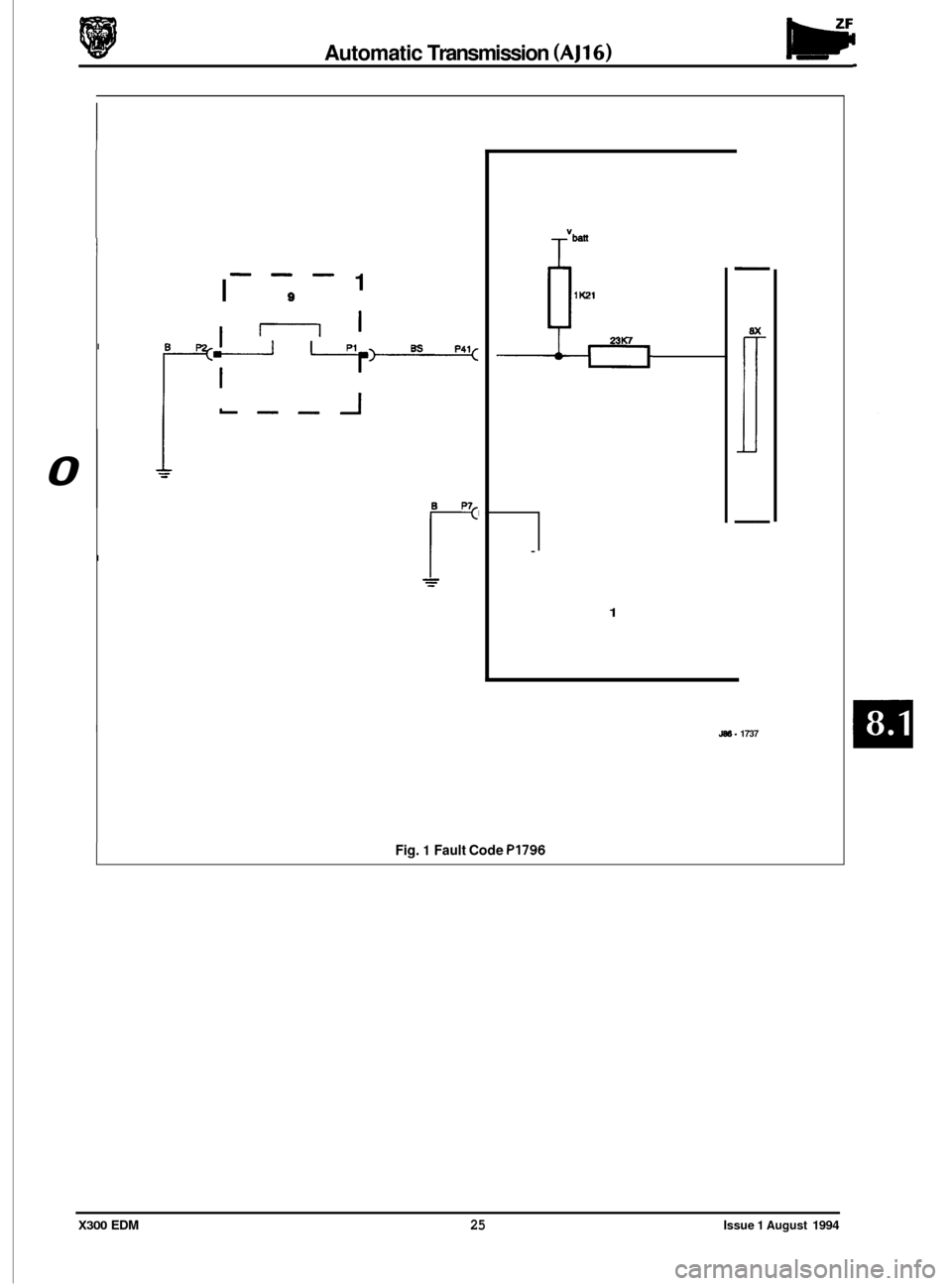
kickdown switch is located on the floor under the accelerator pedal and is operated when the throttle is fully open (ap- prox 90%). It is a normally open switch with one contact permanently to ground and the other is a signal to the TCM.
The signal wire is routed through the bulkhead harness and the gearbox harness to the TCM.
LHD
(FCO19) PIN 2 GROUND PIN 1 KD
SIGNAL
RHD
(CA074) PIN 2 GROUND PIN 1 KD
SIGNAL
Possible causes
. Faulty harness wiring /connections.
. Faulty switch (or switch adjustment).
Effects:
No kickdown facility.
Remedy:
. Repair or renew harness /connector.
. Re-adjust or renew switch.
0
0
0
Q
Issue 1 August 1994 24 X300 EDM
Page 28 of 327
Automatic Transmission (AJ16) w
I
1 ---
I 9
I
I
0
1
JBd. 1737
Fig. 1 Fault Code PI796
X300 EDM 25 Issue 1 August 1994
Page 29 of 327
Automatic Transmission (AJ16)
TCM FAULTS - PO603 / PO605 / P1608
0 Internal Control Module Keep Alive Memory Error - PO603
0 Internal Control Module ROM Test Error - PO605
0 Watch-dog Fault - PI608
Possible causes:
. Internal TCM circuit faults
Effects:
MIL illuminated.
. Transmission warning lamp illuminated (PO605 and PO1608 only).
. Maximum fluid pressure available (PO605 and PI608 only).
. Limp home mode applied (PO605 and PI608 only).
Remedy:
. RenewTCM.
Issue 1 August 1994 26 X300 EDM
Page 30 of 327

Automatic Transmission (AJ16) w
8.1.5
nector.
TRANSMISSION CONNECTOR
(GB003)
TRANSMISSION ELECTRICAL PIN POINT TESTS
THE FOLLOWING TESTS describe methods of testing the transmission control solenoid valves from the multi-pin con-
0 A = Road Speed Sensor
0 B = Pressure Regulator
0 D = Oil Temperature Signal
0 F = Road Speed Sensor
0 H = MVI Solenoid
0 J = Oil Temperature Ground
0 K = MV2 Solenoid
0 L = MWVK Solenoid
0 M = Solenoid Supply
The solenoid valves are located on the valve block in the transmission assembly and can be identified by their position.
Connection is made via a connector located on the LHS of the transmission assembly.
Impedance Checks
M
-L)
M
-K) 28-60ohm
0 M-H)
M-B 5-70hm
M)(A
K)(D
L 1-( F O/C
H)(J
B)(
L-K)
L
- H ) 56- 120 ohm
K
-H)
L
-B)
K
-B) 33-67ohm
H
-B)
All Pins
- Ground OK
5
m- 1738
Fig. 1 Transmission Multi-plug Connector
X300 EDM 27 Issue 1 August 1994
Page 31 of 327
Automatic Transmission (V12) Powertrain
SECTION CONTENTS
Subsection Title SRO Page
8.2.1 ............. Powertrain 4L-804 Transmission. Systeni Description ..................................... 1
8.2.2 ............. Component Descriptions .............................................................. 1
8.2.3 ............. Operating Principles .................................................................. 5
8.2.4.1 ........... Inputs ........................................................................\
...... 5
8.2.4.2 ........... Outputs ........................................................................\
.... 6
8.2.5 ............. Diagnostic Links ..................................................................... 7
8.2.6 ............. Diagnostic Fault Codes ............................................................... 8
8.2.7
............. Fault Diagnosis ...................................................................... 9
8.2.8 ............. Transmission Electrical Pin Point Tests .................................................. 27
8.2.4
............. Inputs / Outputs ...................................................................... 5
X300 EDM i Issue 1 August 1994
Page 32 of 327
Automatic Transmission (V12) Powertrain
8.2.1 POWERTRAIN
41-80-E TRANSMISSION, SYSTEM DESCRIPTION
The electronic transmission system fitted to 6.0 liter and 4.0 liter super-charged vehicles comprises the following com- ponents:
0 Hydra-matic 4L-80-E Automatic Transmission
0 Electronic Transmission Control Module
0 Performance Mode Switch
0 Kickdown Switch
0 Gear Selection Module (illuminated)
System control is effected by the transmission control module
(TCM), located behind the passenger side fascia, which continuously monitors requests made bythe driver via the gearselector, throttle pedal etc. This data is used inconjunc- tion with the speed input from the transmission and inputs from the engine management system, to calculate optimum
shift points and control parametersfor shift pressure and ignition retardation to enhance shift quality and reduce trans- mission unit wear.
TheTCM is also able to detect faults within the system and store the relevant fault codes for interrogation with diagnos- tic equipment.
Gear shifts are controlled
by three solenoid valves, and a pressure control regulator, located on the valve block within
the transmission unit assembly. If a serious fault occurs, the TCM removes all electrical power from these valves and
the transmission system reverts to a mechanical default condition. This condition allows only mechanical selection
of reverse and one forward gear, either
third or fourth, depending on prevailing conditions at the time of the default.
The performance mode switch and kick
-down switch are used to adjust transmission operation as required by the
driver. Performance mode selection, made via a switch mounted on the selector switch surround, can be either NOR- MAL, for everyday use, or SPORT, for enhanced performance. Kick-down is activated by a switch mounted below the
accelerator pedal and is used to initiate a downward gear change, increasing torque and acceleration.
8.2.2 COMPONENT DESCRIPTIONS
Transmission Unit
The powertrain 4L-80-E transmission unit houses the two solenoid valves which control gear shifts. A pressure control
valve is also located on the solenoid valve block. These three valves initiate and control shift patterns within the trans- mission unit by regulating fluid flow.
Performance Mode Switch
The two position performance mode switch allows selection of 'sport' or 'normal' mode as required by the driver. The
switch input to TCM causes a gear shift pattern change so that gear shifts take place at higher engine revs, enhancing
performance, when in 'sport' mode. For everyday use, 'normal' mode utilises a shift pattern for optimum driver com- fort.
Kickdown Switch
The 'kick-down' facility is activated when full downward travel of the accelerator pedal occurs.
Activation of the switch provides a signal to TCM indicating that greater acceleration, and hence downward gear shifts
are required. Switch height is adjustable
so that kick-down can be achieved at a pre-determined throttle opening.
Gear Selection Illumination Module
This module is located above the gear selector mechanism and its sole purpose is to display the selected gear (in red)
on receipt of a signal from the decoder module.
X300 EDM 1 Issue 1 August 1994
Page 33 of 327
Automatic Transmission (V12) Powertrain
7
J8K 1765
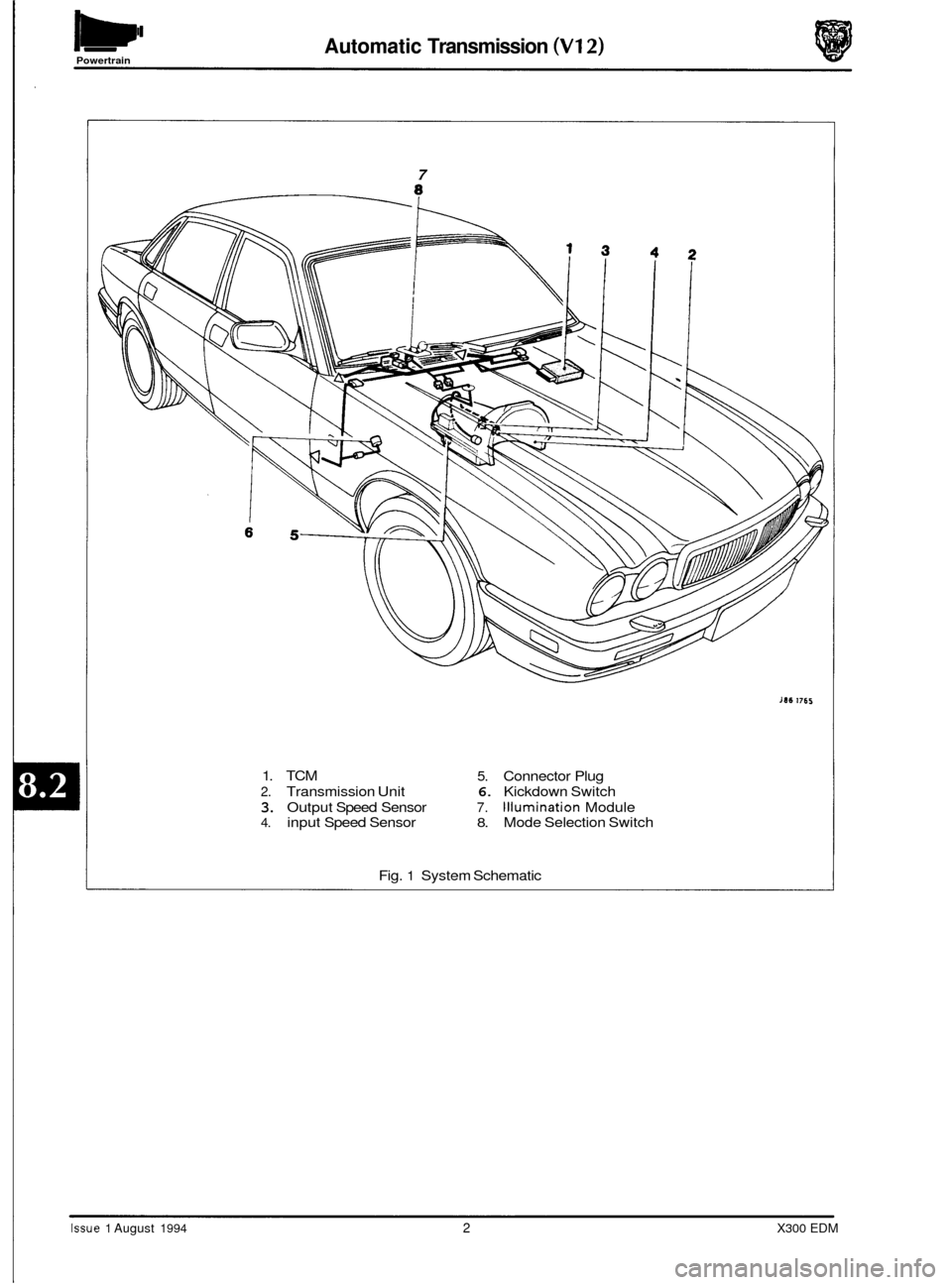
1. TCM 5. Connector Plug
2. Transmission Unit 6. Kickdown Switch
3. Output Speed Sensor 7. Illumination Module 4. input Speed Sensor 8. Mode Selection Switch
Fig.
1 System Schematic
Issue 1 August 1994 2 X300 EDM
Page 36 of 327
Automatic Transmission (V12) Powertrain
8.2.3 OPERATING PRlNClPL ES
The electronic control system is split into four main functional areas:
0 Shift Point Control
0 Lock-up Control
0 Pressure Modulation
0 Engine Torque Control
0
Shift Point Control
The optimum gear ratio is selected as a function of transmission output speed, engine load, position of selector switch
and program switch.
Lock-up Control
The torque converter clutch is engaged as a function of load, output speed, gear selected and drive program. Lock-up
is possible in second, third and fourth gear. Apply and release quality is controlled by the pulse width modulated pres-
sure regulator solenoid.
Pressure Modulation
Hydraulic pressure in the transmission shift friction elements is accurately matched to transmission output torque
using an electrically operated solenoid valve to control pressure level. Transmission input torque is calculated from
an output torque value, supplied by EMS, and converter slip.
Engine Torque Control
Engine torque control reduces the energy dissipated within the system during gear shifts. The effect of this control
increase the transmission service life by reducing slippage time, increases comfort by reducing clutch torque trans- mission and allows a greater transfer of power by the transmission unit.
8.2.4 INPUTS / OUTPUTS
8.2.4.1 INPUTS
Transmission Range
The transmission range is detectec ,ythe pressureswitch manifold located within the transmission unit. The manifold
transmits a coded message to the TCM indicating gear selector position.
Performance Mode Select
Performance mode select uses a two wire input to the TCM allowing selection of different transmission operating
modes.
Line A; Used for selection of traction control shift pattern and controlled
by the ABS /TC CM.
Line
B; Used for selection of 'Normal' or 'Sports' mode, manually selected at a two position rocker switch mounted
on the gear selector unit. Switch resistance is equal to or greaterthan look$, open circuit and equal to or less than 0.5$ closed circuit, measured across contacts at a current of 10mA.
Kickdown Switch
This signal is controlled by the operation ofthe kickdown switch on depression of the accelerator pedal to its full extent.
The switch remains in 'normally open' position until contact with the pedal closes the contacts. Switch resistance is
equal to or greater than look$, open circuit, and equal to or less than 0.5$ closed circuit, measured across contacts at
a current of
10Ma.
Calibration Select
The calibration select input allows identification of different vehicle specifications, ie 4.0 liter supercharged, or 6.0 liter (V12). The link, to ground, from the TCM is either short or open circuit, dependant upon internal software calibration
for each vehicle variant.
X300 EDM 5 Issue 1 August 1994
Page 37 of 327
Automatic Transmission (V12) Powertrain
Engine Speed
The engine speed is provided by an open collector signal supplied from the engine management control module
(ECM).
Throttle Position
This signal, from the ECM, performs the following two functions:
1.
2.
Engine Torque (and warm-up)
This signal, from the ECM, performs the following three functions:
1. During cranking to convey the completion of an engine warm
-up cycle to TCM.
2. To convey engine torque information, under normal running conditions, to TCM.
3. To convey engine torque fault signals to TCM.
Engine ‘warm
-up’ cycle commences from ignition ON until 500ms after the engine exceeds 400rpm. After this time
delay either an engine torque, or torque fault signal will be transmitted.
Transmission Input Speed
The transmission input speed sensor is mounted within the transmission housing and produces a variable frequency
signal, directly proportional to forward clutch housing rotational speed which is transmitted to the TCM. Sensor resis- tance equals 1.25kQ f 0.25.
Transmission Output Speed
The transmission output speed sensor is mounted within the transmission housing and produces a variable frequency
signal, directly proportional to the rear carrier rotational speed which is transmitted to the TCM. Sensor resistance
equals
1.25w2 + 0.25.
hake Application
When a brake application signal is received, due to brake switch operation, the torque convertor clutch lock-up sole- noid is de-energized, releasing lock-up mode if already applied
Transmission Oil Temperature
The transmission oil temperature sensor, located within the internal harness, monitors oil temperature and transmits a corresponding signal to the TCM.
To convey throttle position information to the TCM.
To indicate fault conditions between ECM and throttle potentiometer.
8.2.4.2 OUTPUTS
Gear Shift Solenoids
The two gear shift solenoids, located within the transmission housing, determine gear ratio when the selector is in any
of the forward gear positions.
Force Motor
The force motor, mounted within the transmission housing acts as a transmission torque fluid pressure regulator.
Torque Converter Clutch (TCC) Solenoid
The torque converter clutch solenoid, mounted within the transmission housing, provides a direct drive from the en- gine, via the converter clutch, to the driven wheels, giving the efficiency of a manual gearbox. The solenoid also pro- vides a ’ramp‘ apply and release to engage / disengage the clutch gently.
0
0
0
e
X300 EDM Issue 1 August 1994 6
Page 38 of 327
Automatic Transmission (V12) ~ Pow. rtrain
Engine
Torque Reduction and Malfunction Indication
This signal, to the ECM, has three modes of operation.
1. To indicate normal engine operation to the ECM.
2. During gearshifts, to request reduction of engine torque
3. During fault conditions, to inform the ECM.
During normal operation
theTCM outputs a constant duty cycle signal to the ECM. The signal is changed when torque
reduction is required to indicate to the ECM the degree of ignition retardation necessary. If a fault condition, relating
to OBD
II CARB legislation, occurs the TCM will transmit a signal to the ECM relating this event. The ECM will only
respond to this signal if its duration is 100 milli-seconds or longer.
If the signal from the torque reduction line is either HIGH or LOW for 2 or more seconds the EMS will recognise that
a fault may be present and transmit this information to the TCM.
If the signal from the torque reduction line lasts for 2 or more seconds the EMS will return to normal operation.
Sport Mode Indicator Lamp
The sport mode indicator lamp, mounted on the instrument panel, is illuminate when sport mode is selected and the
ignition switch is ON. Sport mode is selected at a two position switch mounted to the rear of the gear selector assembly.
Gearbox Failure Warning Lamp
The gearbox failure warning lamp, mounted on the instrument panel, is illuminated when afault is detected bytheTCM within the transmission electrical or mechanical systems.
Vehicle Speed (12 cylinder vehicles only)
This output signal is calculated from the transmission output speed and supplied to the ECM as an indication of vehicle
speed.
8.2.5 DIAGNOSTIC LINKS
Diagnostic
L line
One of a two wire interface used to activate stored diagnostic codes for reading by external equipment.
Diagnostic K Line
One of a two-wire interface used to communicate stored diagnostic codes for reading by external diagnostic equip- ment.
X300 EDM 7 Issue 1 August 1994