ignition JAGUAR XJ6 1994 2.G Electrical Diagnostic Manual
[x] Cancel search | Manufacturer: JAGUAR, Model Year: 1994, Model line: XJ6, Model: JAGUAR XJ6 1994 2.GPages: 327, PDF Size: 13.73 MB
Page 80 of 327
Climate Control Systems
14.2.8 Heater Matrix Temperature Sensor
This sensor is positioned inside the air conditioning unit just
downstream of the heater matrix. The sensor monitors the
post
-heater air temperature, before the air is distributed to
the passenger compartment. In conjunction with the A / CCM this sensor provides the input to maintain a constant
outlet temperature.
14.2.9 Coolant Temperature Signal
This input is required to provide blower inhibit control, to
avoid cold
air being delivered in heating mode when the en- gine coolant temperature is below 3OOC. The input also
monitors the temperature of the coolant delivered to the
heater matrix to assist outlet temperature control.
14.2. IO Compressor ON Signal
This signal line monitors the compressor relay to inform the
A/ CCM of the compressor status and to facilitate lock detec-
tion and error sensing.
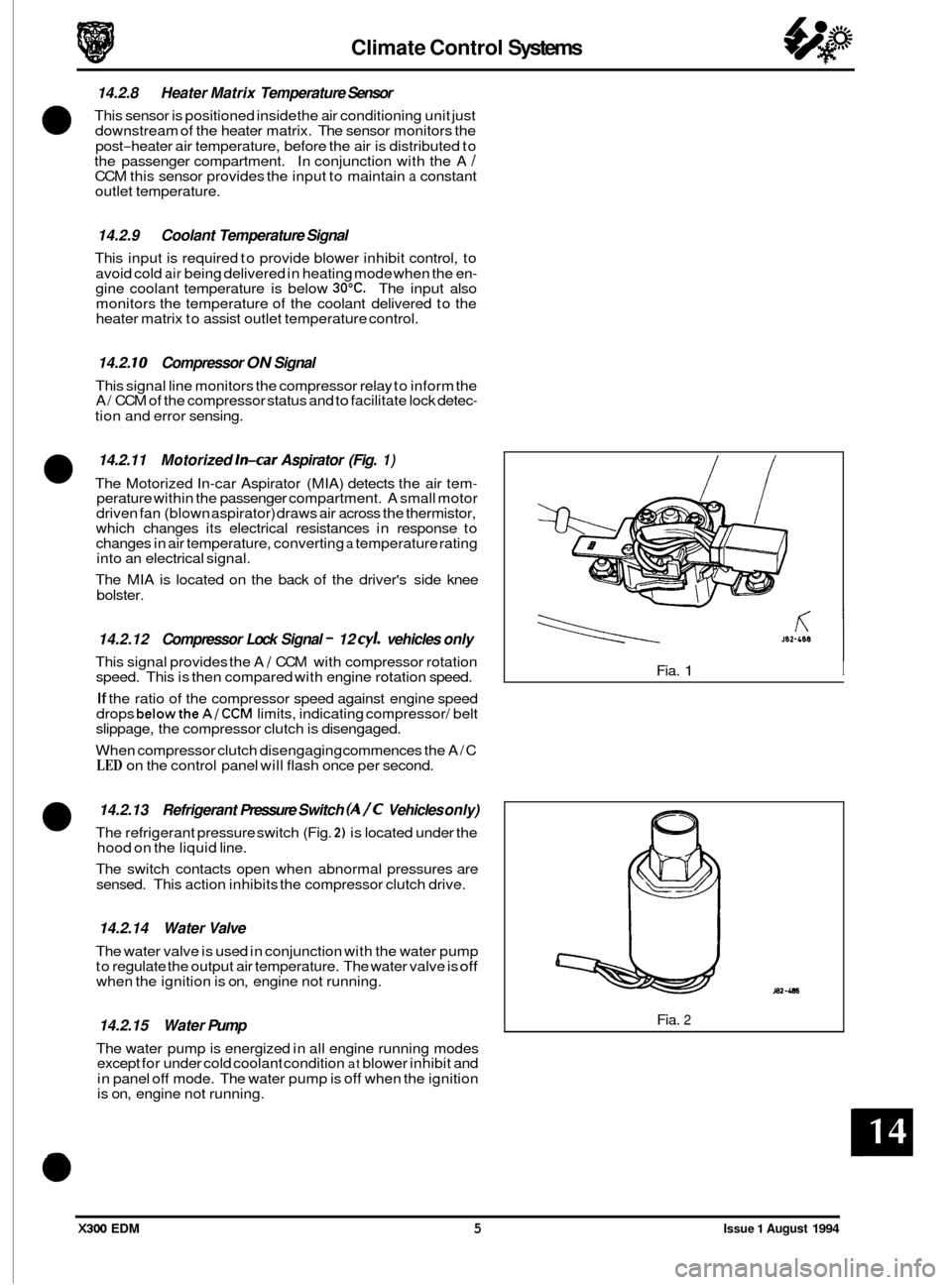
14.2.11 Motorized In-car Aspirator (Fig. 1)
The Motorized In-car Aspirator (MIA) detects the air tem- perature within the passenger compartment. A small motor
driven fan (blown aspirator) draws air across the thermistor,
which changes its electrical resistances in response to
changes in air temperature, converting
a temperature rating
into an electrical signal.
The MIA is located on the back of the driver's side knee
bolster.
14.2.12 Compressor Lock Signal - 12 cy/. vehicles only
This signal provides the A / CCM with compressor rotation
speed. This is then compared with engine rotation speed.
If the ratio of the compressor speed against engine speed
drops belowthe A/CCM limits, indicating compressor/ belt
slippage, the compressor clutch is disengaged.
When compressor clutch disengaging commences the A/C
LED on the control panel will flash once per second.
14.2.13 Refrigerant Pressure Switch (A/C Vehicles only)
The refrigerant pressure switch (Fig. 2) is located under the
hood on the liquid line.
The switch contacts open when abnormal pressures are
sensed. This action inhibits the compressor clutch drive.
14.2.14 Water Valve
The water valve is used in conjunction with the water pump
to regulate the output air temperature. The water valve is off when the ignition is on, engine not running.
14.2.15 Water Pump
The water pump is energized in all engine running modes
except for under cold coolant condition at blower inhibit and
in panel
off mode. The water pump is off when the ignition
is on, engine not running.
If
J82-488
KI Fia. 1 I
Fia. 2
X300 EDM 5 Issue 1 August 1994
Page 81 of 327
Climate Control Systems
14.2.16 Servo Motor Control
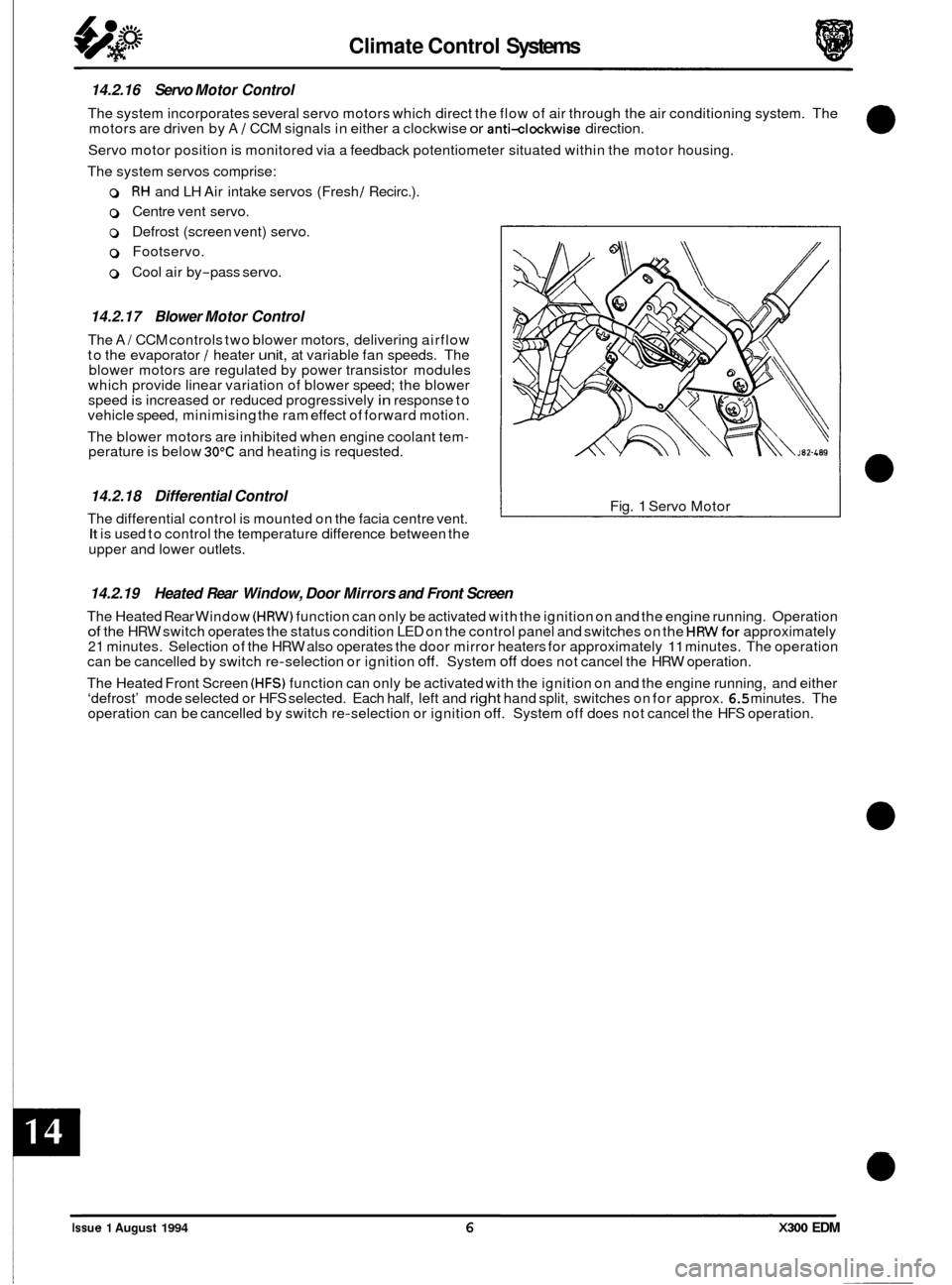
The system incorporates several servo motors which direct the flow of air through the air conditioning system. The
motors are driven by A / CCM signals in either a clockwise or anti-clockwise direction.
Servo motor position is monitored via
a feedback potentiometer situated within the motor housing.
The system servos comprise:
o RH and LH Air intake servos (Fresh / Recirc.).
0 Centre vent servo.
o Defrost (screen vent) servo.
0 Footservo.
0 Cool air by-pass servo.
14.2.17 Blower Motor Control
The A/ CCM controls two blower motors, delivering airflow
to the evaporator / heater unit, at variable fan speeds. The
blower motors are regulated by power transistor modules
which provide linear variation of blower speed; the blower
speed
is increased or reduced progressively in response to
vehicle speed, minimising the ram effect of forward motion.
The blower motors are inhibited when engine coolant tem
- perature is below 30°C and heating is requested.
14.2.18 Differential Control
The differential control is mounted on the facia centre vent. It is used to control the temperature difference between the
upper and lower outlets. Fig.
1 Servo
Motor
14.2.19 Heated Rear Window, Door Mirrors and Front Screen
The Heated Rear Window (HRW) function can only be activated with the ignition on and the engine running. Operation of the HRW switch operates the status condition LED on the control panel and switches on the HRWfor approximately 21 minutes. Selection of the HRW also operates the door mirror heaters for approximately 11 minutes. The operation
can be cancelled by switch re-selection or ignition off. System off does not cancel the HRW operation.
The Heated Front Screen
(HFS) function can only be activated with the ignition on and the engine running, and either
‘defrost’ mode selected or HFS selected. Each half, left and right hand split, switches on for approx. 6.5 minutes. The
operation can be cancelled by switch re-selection or ignition off. System off does not cancel the HFS operation.
0
0
Issue 1 August 1994 6 X300 EDM
Page 82 of 327
Climate Control Systems
0
0
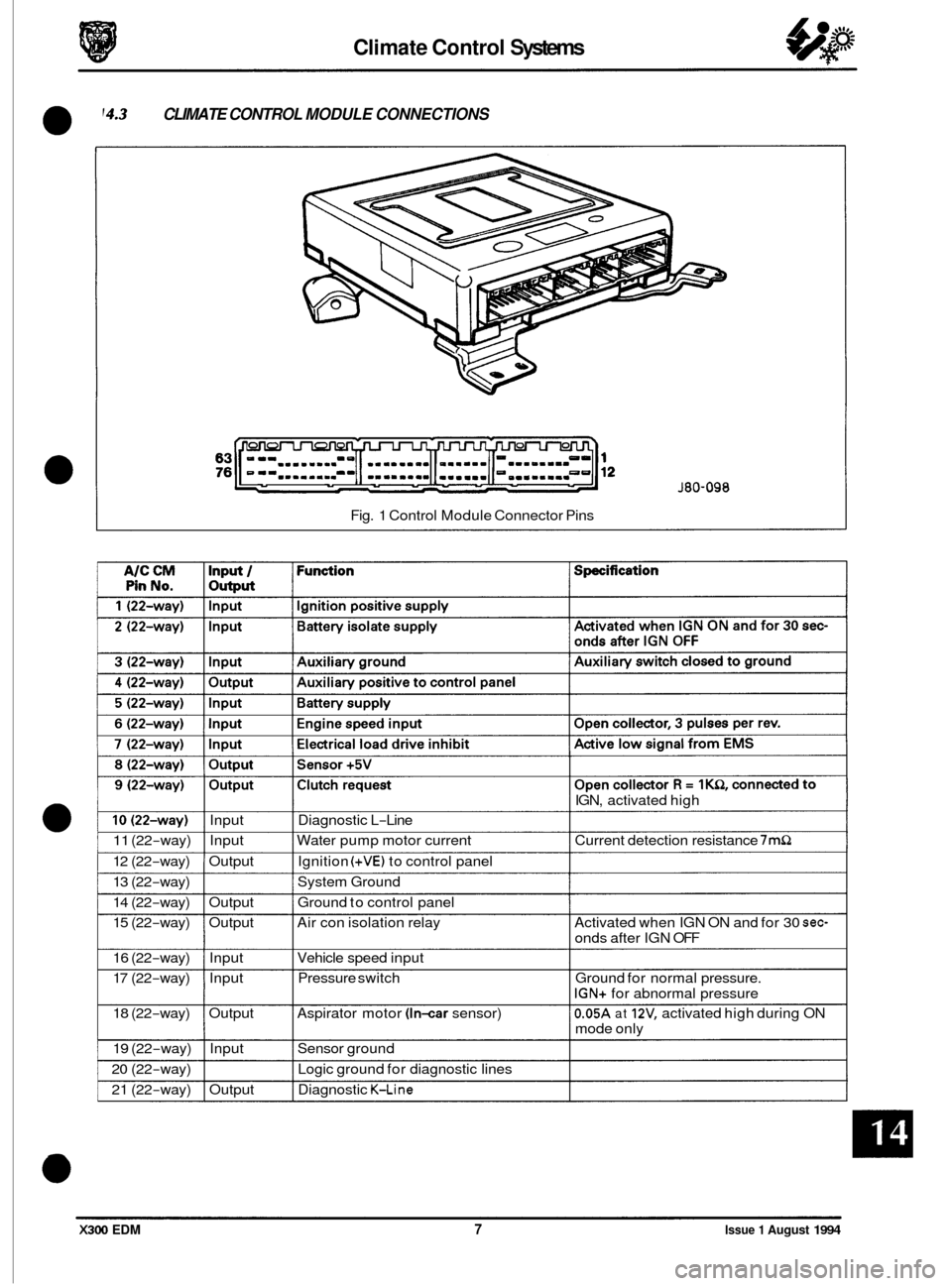
14.3 CLIMATE CONTROL MODULE CONNECTIONS
Fig. 1 Control Module Connector Pins
J80-098
IGN, activated high
0 Io(22-way) Input Diagnostic L-Line
11 (22-way) Input Water pump motor current Current detection resistance 7mQ
12 (22-way) Output Ignition (+VE) to control panel
13 (22
-way) System Ground
14 (22
-way) Output Ground to control panel
15 (22
-way) Output Air con isolation relay Activated when IGN ON and for 30 sec-
16 (22-way) Input Vehicle speed input
17 (22
-way) Input Pressure switch Ground for normal pressure.
IGN+ for abnormal pressure
18 (22
-way) Output Aspirator motor (In+ar sensor) 0.05A at 12V, activated high during ON
mode only
19 (22
-way) Input Sensor ground
20 (22
-way)
21 (22
-way) Output Diagnostic K-Line
onds after IGN OFF
Logic ground for diagnostic lines
X300 EDM 7 Issue 1 August 1994
Page 85 of 327
Climate Control Systems
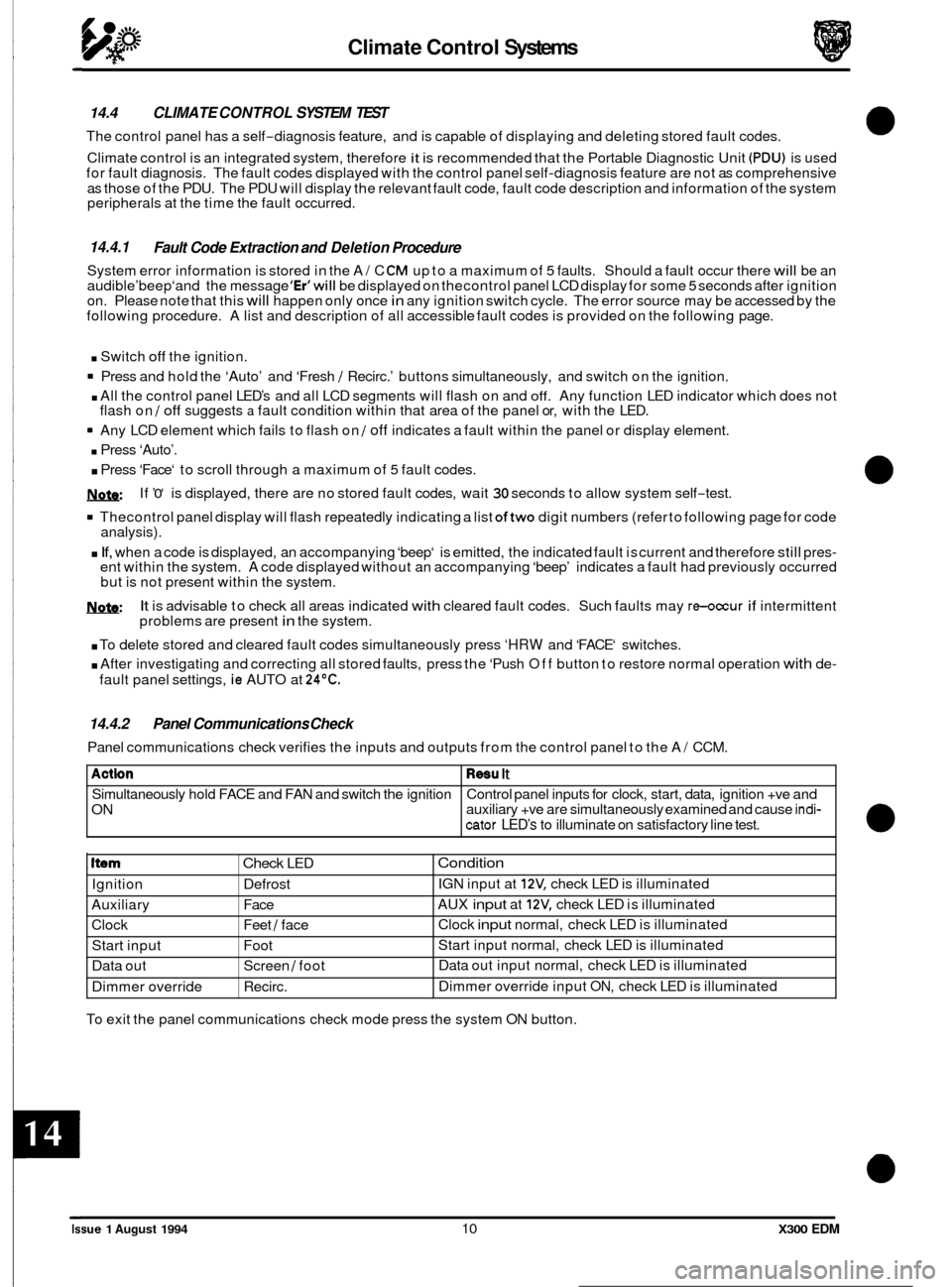
Actlon
Simultaneously hold FACE and FAN and switch the ignition
ON
14.4 CLIMATE CONTROL SYSTEM TEST
The control panel has a self-diagnosis feature, and is capable of displaying and deleting stored fault codes.
Climate control is an integrated system, therefore
it is recommended that the Portable Diagnostic Unit (PDU) is used
for fault diagnosis. The fault codes displayed with the control panel self-diagnosis feature are not as comprehensive
as those of the PDU. The PDU will display the relevant fault code, fault code description and information of the system
peripherals at the time the fault occurred.
Resu It
Control panel inputs for clock, start, data, ignition +ve and
auxiliary +ve are simultaneously examined and cause indi-
cator LED’s to illuminate on satisfactory line test.
14.4.1
System error information is stored in the A/ C CM up to a maximum of 5 faults. Should a fault occur there will be an
audible’beep‘and the message ‘Er’will be displayed on thecontrol panel LCD display for some 5 seconds after ignition
on. Please note that this will happen only once in any ignition switch cycle. The error source may be accessed by the
following procedure. A list and description of all accessible fault codes is provided on the following page.
Fault Code Extraction and Deletion Procedure
I Item Check LED
Ignition Defrost
Auxiliary Face
Clock Feet
/ face
Start input Foot
Data out Screen
/ foot
Dimmer override Recirc.
. Switch off the ignition.
Press and hold the ‘Auto’ and ‘Fresh / Recirc.’ buttons simultaneously, and switch on the ignition.
. All the control panel LED’s and all LCD segments will flash on and off. Any function LED indicator which does not
flash on / off suggests a fault condition within that area of the panel or, with the LED.
Any LCD element which fails to flash on
/ off indicates a fault within the panel or display element.
. Press ‘Auto’.
. Press ‘Face‘ to scroll through a maximum of 5 fault codes.
W
Thecontrol panel display will flash repeatedly indicating a list oftwo digit numbers (refer to following page for code
analysis).
. If, when a code is displayed, an accompanying ‘beep‘ is emitted, the indicated fault is current and therefore still pres- ent within the system. A code displayed without an accompanying ‘beep’ indicates a fault had previously occurred
but is not present within the system.
It is advisable to check all areas indicated with cleared fault codes. Such faults may re-occur if intermittent
problems are present in the system.
If
’0‘ is
displayed, there are no stored fault codes, wait 30 seconds to allow system self-test.
W:
. To delete stored and cleared fault codes simultaneously press ‘HRW and ‘FACE‘ switches.
. After investigating and correcting all stored faults, press the ‘Push Off button to restore normal operation with de-
fault panel settings, ie AUTO at 24OC.
Condition
IGN input at 12V, check LED is illuminated
AUX
input at 12V, check LED is illuminated
Clock
input normal, check LED is illuminated
Start input normal, check LED is illuminated
Data out input normal, check LED is illuminated
Dimmer override input
ON, check LED is illuminated
14.4.2 Panel Communications Check
Panel communications check verifies the inputs and outputs from the control panel to the A/ CCM.
To exit the panel communications check mode press the system ON button.
Issue 1 August 1994 10 X300 EDM
Page 86 of 327
Climate Control Systems
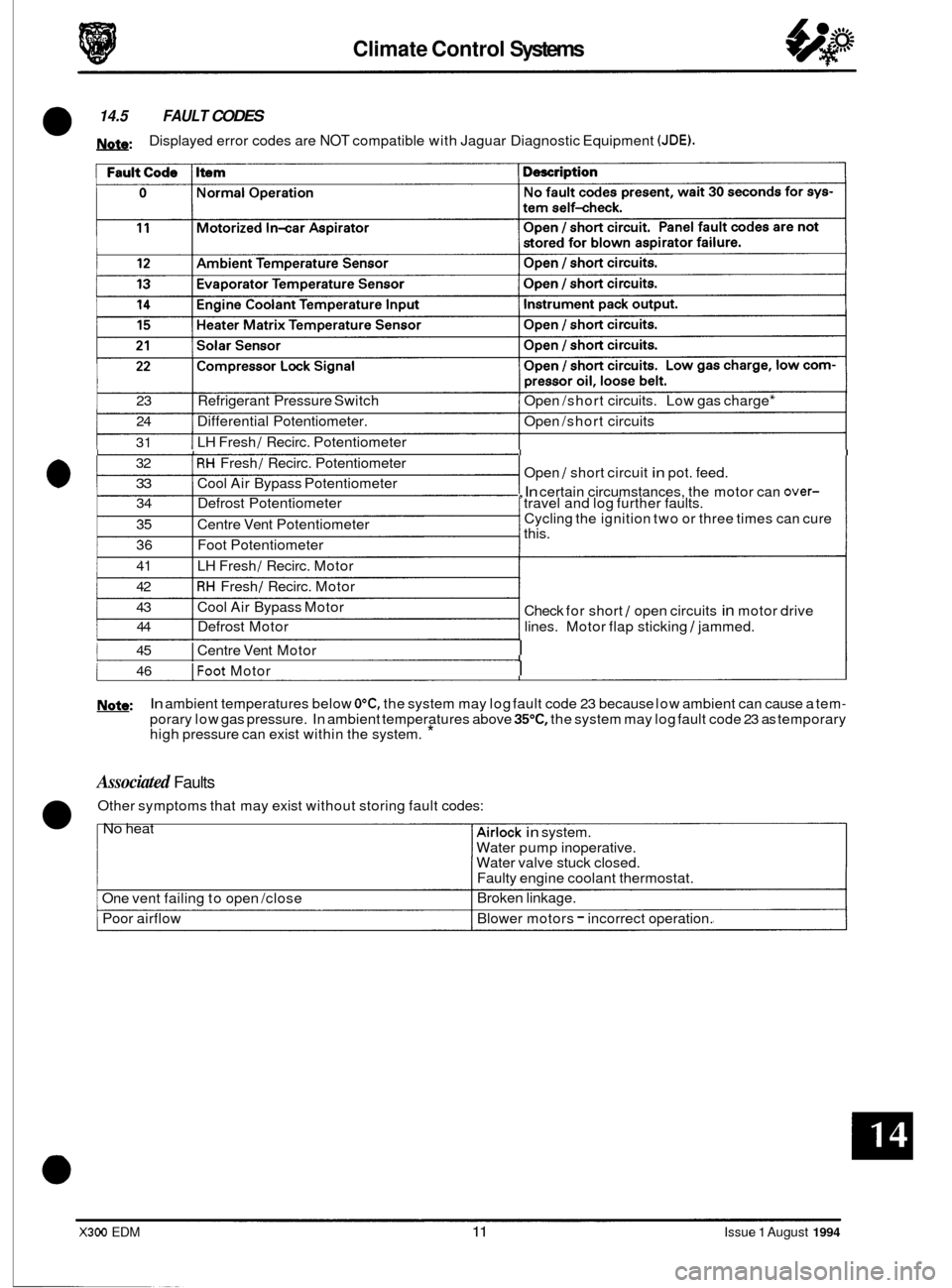
0 14.5 FAULT CODES
J&&: Displayed error codes are NOT compatible with Jaguar Diagnostic Equipment (JDE).
23 Refrigerant Pressure Switch Open /short circuits. Low gas charge*
24 Differential Potentiometer. Open /short circuits
31 LH Fresh
/ Recirc.
Potentiometer I I I I RH Fresh / Recirc. Potentiometer
Open / short circuit in pot. feed.
32
, In certain
circumstances, the motor can over- 0 33 Cool Air Bypass Potentiometer
34 Defrost Potentiometer travel and log further faults.
35
36 Foot Potentiometer Cycling
the ignition two or three times can cure
this.
Centre
Vent Potentiometer
41
42
I LH Fresh / Recirc. Motor
I RH Fresh / Recirc. Motor
43 Cool Air Bypass Motor
44 Defrost Motor lines. Motor flap sticking
/ jammed.
Check
for short
/ open circuits in motor drive
1 45 I Centre Vent Motor I
1 46 IFoot Motor I
W: In ambient temperatures below OOC, the system may log fault code 23 because low ambient can cause a tem-
porary low gas pressure. In ambient temperatures above 35"C, the system may log fault code 23 as temporary
high pressure can exist within the system. *
Associated Faults
Other symptoms that may exist without storing fault codes:
Airlock in system.
Water pump inoperative.
Water valve stuck closed.
Faulty engine coolant thermostat.
Broken linkage.
Blower motors
- incorrect operation.
No heat
One vent failing to open /close
Poor airflow
X300 EDM 11 Issue 1 August 1994
Page 87 of 327
Climate Control Systems
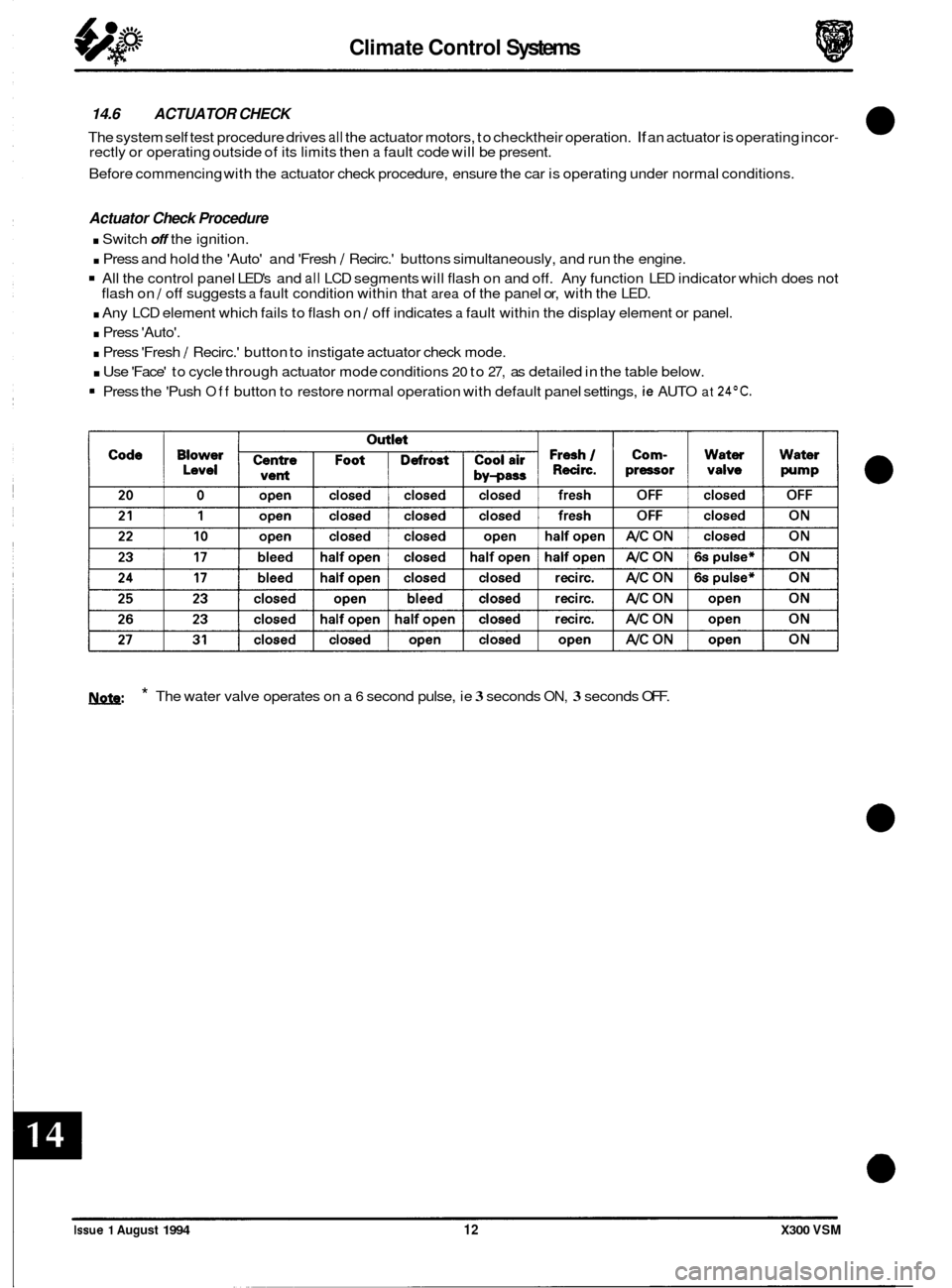
14.6 ACTUATOR CHECK
The system self test procedure drives all the actuator motors, to checktheir operation. If an actuator is operating incor- rectly or operating outside of its limits then a fault code will be present.
Before commencing with the actuator check procedure, ensure the car is operating under normal conditions.
Actuator Check Procedure
. Switch off the ignition.
. Press and hold the 'Auto' and 'Fresh / Recirc.' buttons simultaneously, and run the engine.
All the control panel LED's and all LCD segments will flash on and off. Any function LED indicator which does not
. Any LCD element which fails to flash on / off indicates a fault within the display element or panel.
. Press 'Auto'.
. Press 'Fresh / Recirc.' button to instigate actuator check mode.
. Use 'Face' to cycle through actuator mode conditions 20 to 27, as detailed in the table below.
flash
on
/ off suggests a fault condition within that area of the panel or, with the LED.
Press the 'Push Off button to restore normal operation with default panel settings, ie AUTO at 24OC.
1ynfe: * The water valve operates on a 6 second pulse, ie 3 seconds ON, 3 seconds OFF.
Issue 1 August 1994 12 X300 VSM
Page 88 of 327
Climate Control Systems
DIAGNOSTIC TESTS 0 14.7 14.7.1 Fault Code 11
Motorized In-car Aspirator
The Motorized In-car Aspirator (MIA) comprises of a small motor and a thermistor.
o Thermistor, harness or A/ CCM open circuit.
0 Thermistor, harness or A/ CCM short circuit to ground.
The MIA operates in the range of
0 to 5 volts and forms the main reference point for the whole system.
If the signal on pin 33 (12-way connector, A/ CCM) remains at less than 1 volt, suspect either a short circuit to ground
on the signal wire or an open circuit on the 5 volt supply to the thermistor. If the signal on pin 33 rises to approximately 5 volts, suspect an open circuit on the earth supply to the thermistor.
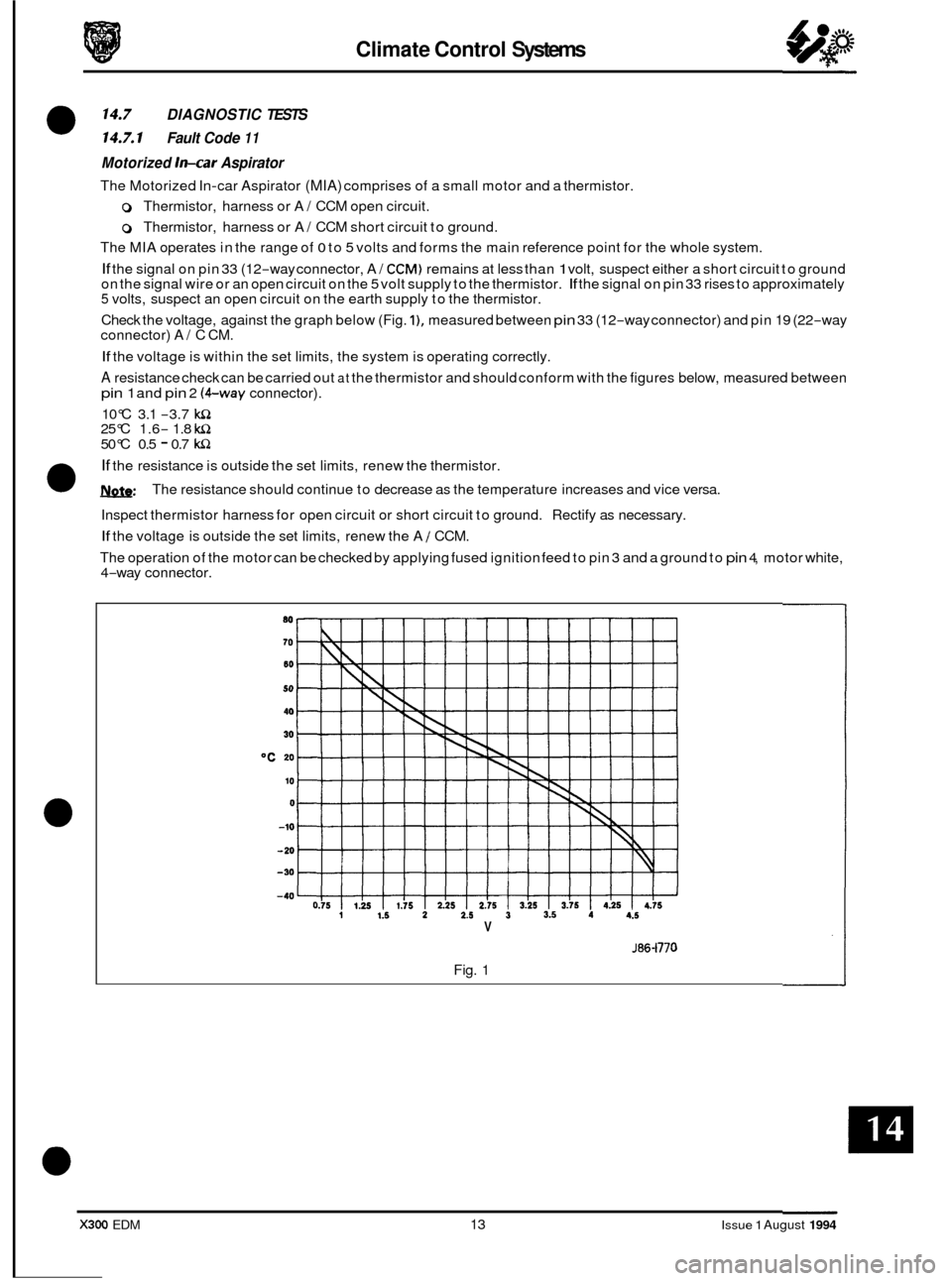
Check the voltage, against the graph below (Fig.
I), measured between pin 33 (12-way connector) and pin 19 (22-way
connector) A/ C CM.
If the voltage is within the set limits, the system is operating correctly.
A resistance check can be carried out at the thermistor and should conform with the figures below, measured between
pin 1 and pin 2 (&way connector).
10°C 3.1
-3.7 w1 25°C 1.6- 1.8 lcrz
50°C 0.5 - 0.7 lcrz
0 If the resistance is outside the set limits, renew the thermistor.
14lnfe: The resistance should continue to decrease as the temperature increases and vice versa.
Inspect thermistor harness for open circuit or short circuit to ground. Rectify as necessary.
If the voltage is outside the set limits, renew the A / CCM.
The operation of the motor can be checked by applying fused ignition feed to pin 3 and a ground to
pin 4, motor white,
4-way connector.
V
J66-1770
Fig. 1
X300 EDM 13 Issue 1 August 1994
Page 98 of 327
Climate Control Systems
14.7.22 BLOWER MOTORS
Disconnect the blower motors (LH & RH) multi-plugs and check motor operation by applying battery voltage (+12V) across pin 5 (+vel and pin 9 (-ve).
Non-functioning of both L H and RH motors *
Cause:
1. Loss of ignition voltage.
Remedy:
1.
2.
*
Examine fuse F12 in RH heelboard fuse-box. If fuse is blown determine reason for failure and renew.
Examine harness wiring from
RH heelboard fuse-box connection CA044/010 to splice CAS53. Repair or renew
wiring as necessary.
This fault will also affect the operation of seat control modules, power steering control module and door mirror
heaters.
Non-functioning of RH blower motor only
Cause:
1. Faulty relay operation.
2. Faulty harness wiring.
Remedy:
1. Ensure 12Vsupply between relay pin 1 and ground.
Ensure continuity between pins 3 and
5 when relay operated.
Ensure relay coil impedance of
7552 to 135Q across pins 1 and 2.
Ensure correct seating of relay on base. Examine pins for damage or deformity.
Check continuity of wiring from fuse F12
(RH heelboard fuse-box) to relay pin 1 and from relay pin 2 to A / CCM
pin 53 (26-way connector).
Check continuity of wiring from fuse
F11 (RH heelboard fuse-box) to relay pin 3, from relay pin 5 to motor pin 5, from motor pin 13 to A / CCM pin 41 (16-way connector), from motor pin 8 to ground and from motor pin 10 to A / CCM pin 42 (16-way connector).
2.
Non-functioning of L H blower motor only
Cause:
1. Faulty relay operation.
2. Faulty harness wiring.
Remedy:
1. Ensure 12V supply between relay pin 1 and ground.
Ensure continuity between pins 3 and
5 when relay operated.
Ensure relay coil impedance
of 7552 to 135Q across pins 1 and 2.
Ensure correct seating of relay on base. Examine pins for damage or deformity.
2. Check continuity of wiring from fuse F12 (RH heelboard fuse-box) to relay pin 1 and from relay pin 2 to A / CCM
pin 66 (26-way connector).
Check continuity of wiring from fuse
F11 (LH heelboard fuse box) to relay pin 3, from relay pin 5 to motor pin 5, from motor pin 13 to A / CCM pin 49 (16-way connector), from motor pin 8 to ground and from motor pin 10 to
A / CCM pin 50 (16-way connector).
X300 EDM 23 Issue 1 August 1994
Page 107 of 327
E I ect r ica I
15.1 SUPPLEMENTAL RESTRAINT SYSTEM
15.1.1 System Description
The Supplemental Restraint System (SRS) installation comprises:
0 electronic Diagnostic Module (DM)
0 driver and passenger-side air bag modules (including firing mechanisms)
0 two front impact sensors (left and right)
0 one safing sensor
0 dedicated wiring harness
0 two cable reel cassettes (integral part of the steering column harness)
0 Malfunction Indicator Lamp (MIL) and driver information message
The system is designed to provide protection for both driver and front seat passenger by automatically deploying air
bags in the event of a collision during forward travel. The driver
-side air bag is located in the centre of the steering
wheel assembly and the passenger-side air bag in the fascia panel.
In the event of a collision the impact
/ safing sensors operate, completing the electrical firing circuit and causing the
air bags to inflate within 32 milliseconds. At least two of the three sensors (at least one impact, and the safing sensor)
.must be activated to initiate firing. System operation is dependent upon battery voltage supplied directly, and via the
ignition switch, to the DM and the correct installation and operation of all system components, including the wiring
harness. Faults in system components, installation or wiring will be indicated by the MIL Lamp, located on the instru
- ment panel, which will illuminate 'SRS AIR BAG'. Indication is also given by the driver information message'AIR BAG'
displayed on the LCD panel below the speedometer.
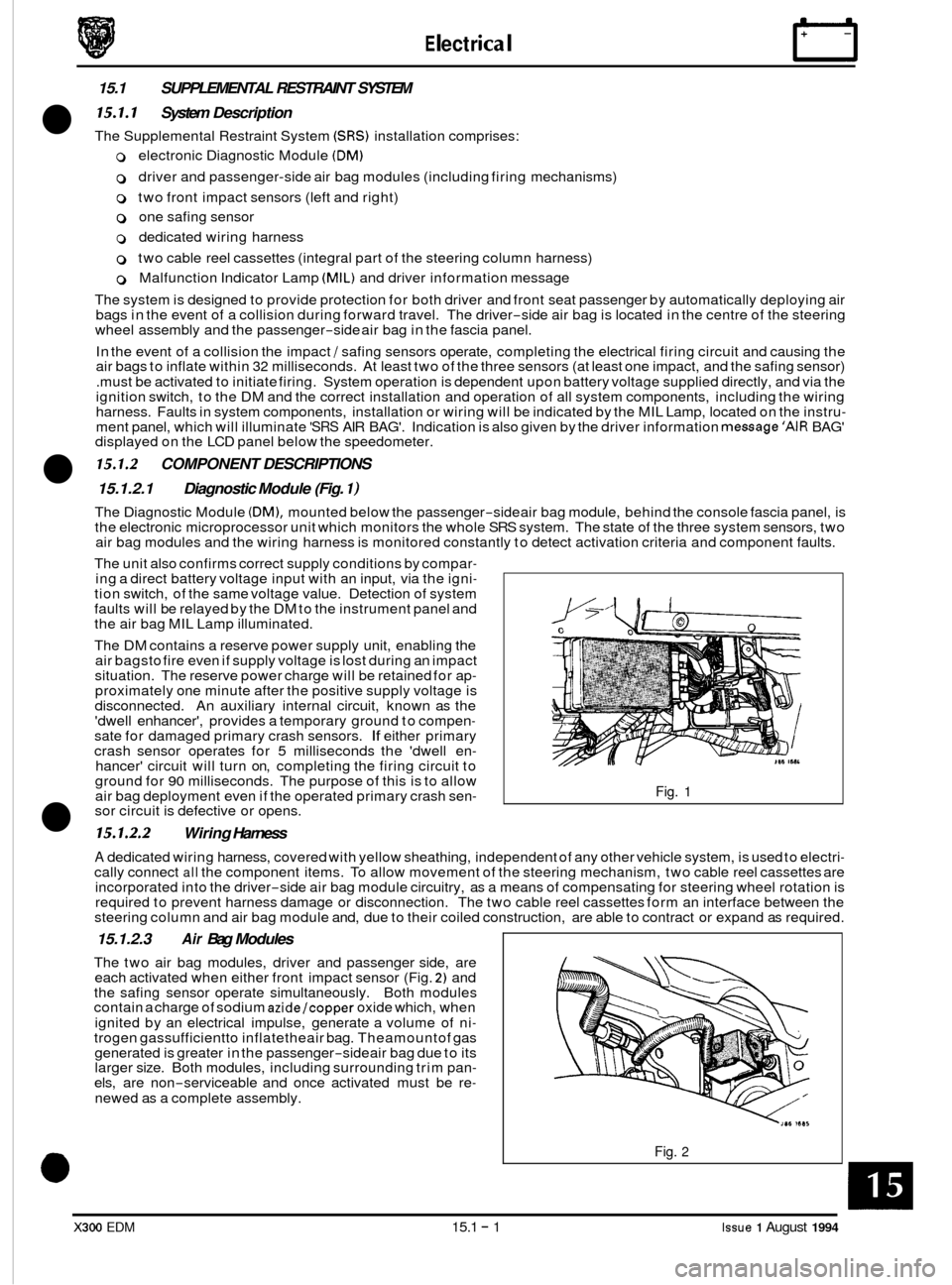
15.1.2.1 Diagnostic Module (Fig. I)
The Diagnostic Module (DM), mounted below the passenger-side air bag module, behind the console fascia panel, is
the electronic microprocessor unit which monitors the whole SRS system. The state of the three system sensors, two
air bag modules and the wiring harness is monitored constantly to detect activation criteria and component faults.
15.1.2 COMPONENT DESCRIPTIONS
The unit also confirms correct supply conditions by compar- ing a direct battery voltage input with an input, via the igni- tion switch, of the same voltage value. Detection of system
faults will be relayed by the DM to the instrument panel and
the air bag MIL Lamp illuminated.
The DM contains a reserve power supply unit, enabling the
air bagsto fire even if supply voltage is lost during an impact
situation. The reserve power charge will be retained for ap
- proximately one minute after the positive supply voltage is
disconnected. An auxiliary internal circuit, known as the
'dwell enhancer', provides a temporary ground to compen
- sate for damaged primary crash sensors. If either primary
crash sensor operates for 5 milliseconds the 'dwell en- hancer' circuit will turn on, completing the firing circuit to
ground for 90 milliseconds. The purpose of this is to allow
air bag deployment even if the operated primary crash sen- sor circuit is defective or opens.
15.1.2.2 Wiring Harness
Fig. 1
A dedicated wiring harness, covered with yellow sheathing, independent of any other vehicle system, is used to electri- cally connect all the component items. To allow movement of the steering mechanism, two cable reel cassettes are
incorporated into the driver-side air bag module circuitry, as a means of compensating for steering wheel rotation is
required to prevent harness damage or disconnection. The two cable reel cassettes form an interface between the
steering column and air bag module and, due to their coiled construction, are able to contract or expand as required.
15.1.2.3 Air Bag Modules
The two air bag modules, driver and passenger side, are
each activated when either front impact sensor (Fig. 2) and
the safing sensor operate simultaneously. Both modules
contain a charge of sodium
azide/copper oxide which, when
ignited by an electrical impulse, generate a volume of ni
- trogen gassufficientto inflatetheair bag. Theamountof gas
generated is greater in the passenger-side air bag due to its
larger size. Both modules, including surrounding trim pan- els, are non-serviceable and once activated must be re-
newed as a complete assembly.
Fig. 2
X300 EDM 15.1 - 1 Issue 1 August 1994
Page 109 of 327
Electrical rl
15.1.3 AIR BAG DISARMING/ ARMING PROCEDURE
warnings and cautions
WARNING: DISARM SRS BEFORE SERVICING ANY SRS OR STEERING COLUMN COMPONENT.
ALLOW A MINIMUM OF ONE MINUTE TIME DELAY FOR THE BACK
-UP POWER SUPPLY TO DISCHARGE,
AFTER THE BATTERY GROUND LEAD HAS BEEN DISCONNECTED.
THE SYSTEM COMPONENTS ARE NON
-SERVICEABLE, IF FAULTS ARE SUSPECTED, CHANGE COMPO- NENTS FOR NEW ITEMS ONLY.
NEVER PROBE THE CONNECTORS OF AN AIR BAG MODULE.
FAILURE TO OBSERVE THE ABOVE PROCEDURES MAY RESULT
IN ACCIDENTAL DEPLOYMENT OF AIR
BAG.
ALWAYS WEAR SAFETY GLASSES WHEN WORKING ON AIR BAG EQUIPPED VEHICLES.
PERSONNEL CARRYING AN AIR BAG MODULE MUST ENSURE THAT THE MODULE AND TRIM COVER
ARE POINTED AWAY FROM THE BODY. WHEN POSITIONED ON A BENCH
OR WORK SURFACE ENSURE
THAT THE AIR BAG MODULE AND TRIM COVER FACE UPWARDS, LIMITING MOTION ON ACCIDENTAL
DEPLOYMENT.
ALWAYS WEAR GLOVES WHEN HANDLING DEPLOYED AIR BAG MODULE, DEPOSITS OF SODIUM HY
- DROXIDE MAY BE PRESENT ON THE MODULE SURFACE. IF SODIUM HYDROXIDE CONTACTS ANY
AREA OF SKIN, WASH THE AFFECTED AREA IMMEDIATELY WITH MILD SOAP AND WATER. DISPOSE OF
THE DEPLOYED AIR BAG USING THE CORRECT PROCEDURES, REFER TO SECTION
15 OF THE VSM.
CAUTION:
When scrapping vehicles ensure air bags have been deployed.
If
a component has been renewed and the fault does not clear, refit original item and repeat diagnostic
procedure.
After servicing repeat diagnostic procedures to ensure correct system operation.
Renew air bag module if surrounding trim panels are damaged.
Do not attempt to repaint trim covers as paint may damage cover material.
Disarming
. Allow a minimum 1 minute time delay before attempting to diagnose or renew any component in the SRS system.
Remove driver-side air bag module and connect air bag simulator to cable reel cassette multi-plug.
. Remove passenger-side air bag module and connect air bag simulator to harness.
. Re-connect battery ground lead.
Disconnect
the battery ground lead.
This delay allows the DM back
-up power supply to discharge, preventing accidental firing of the air bag.
0
Arming
Disconnect the battery ground lead.
. Remove air bag simulators and install driver and passenger-side air bag modules. Ensure fasteners are tightened
. Re-connect battery ground lead.
Switch ignition 'on' and ensure air bag MIL Lamp extinguishes.
to specified torque.
X300 EDM 15.1 -3 Issue 1 August 1994