ignition JAGUAR XJ6 1994 2.G Electrical Diagnostic Manual
[x] Cancel search | Manufacturer: JAGUAR, Model Year: 1994, Model line: XJ6, Model: JAGUAR XJ6 1994 2.GPages: 327, PDF Size: 13.73 MB
Page 165 of 327
rl Electrical
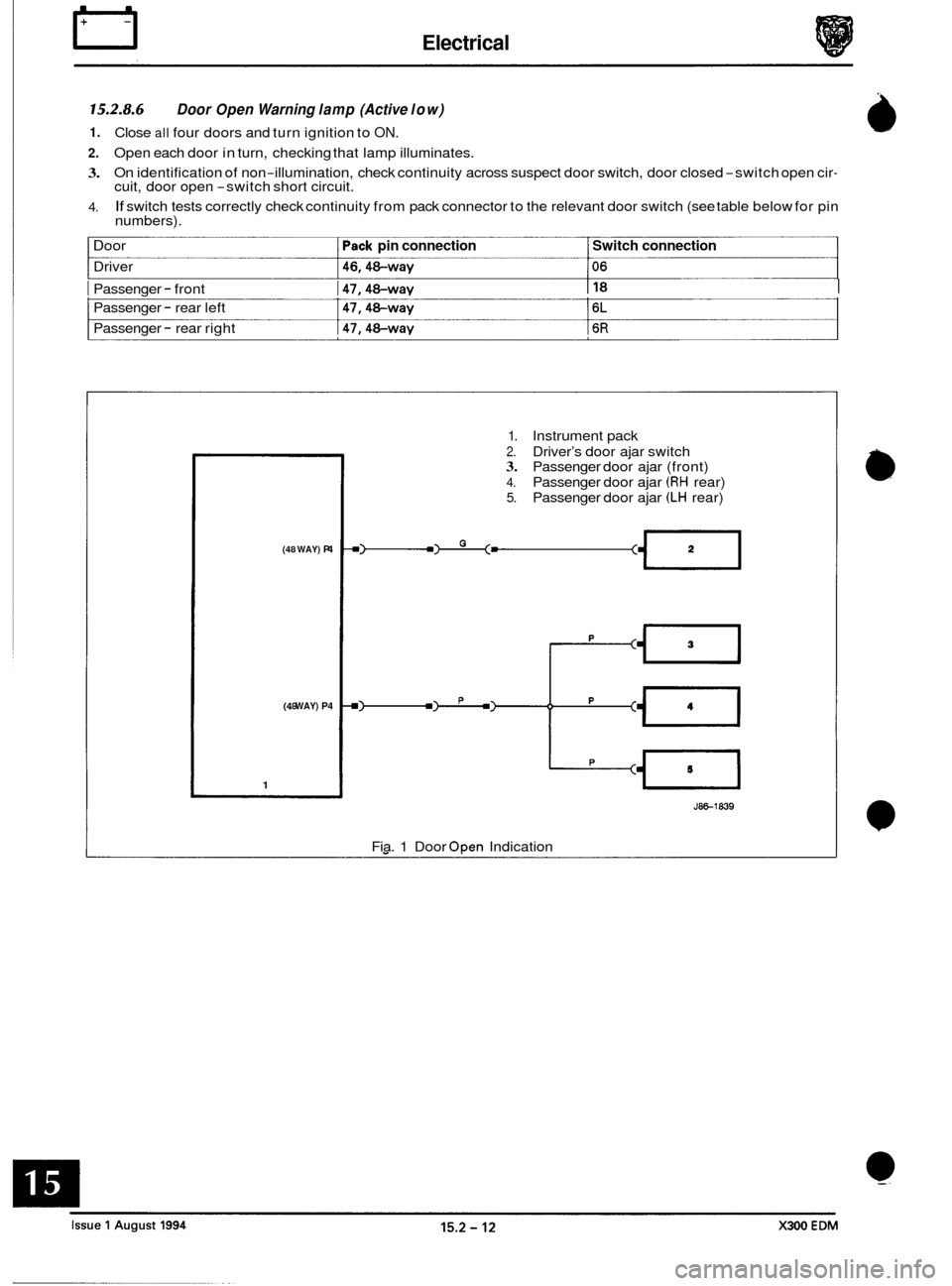
15.2.8.6
1.
2.
3.
4.
Door I Pack pin connection I Switch connection
Driver 146,48-way I06
Door Open Warning lamp (Active low)
Close all four doors and turn ignition to ON.
Open each door in turn, checking that lamp illuminates.
On identification of non
-illumination, check continuity across suspect door switch, door closed -switch open cir- cuit, door open -switch short circuit.
If switch tests correctly check continuity from pack connector to the relevant door switch (see table below for pin
numbers).
I Passenger - front 147,4&way 118 I
Passenger - rear left 147,4&way I6L
Passenger - rear right I47,4&way I6R
(48 WAY) P4
(48 WAY) P4
1. Instrument pack
2. Driver’s door ajar switch 3. Passenger door ajar (front)
4.
5.
Passenger door ajar (RH rear)
Passenger door ajar
(LH rear)
1
Fia. 1 Door ODen Indication
J@6-1839
Page 166 of 327
Electrical
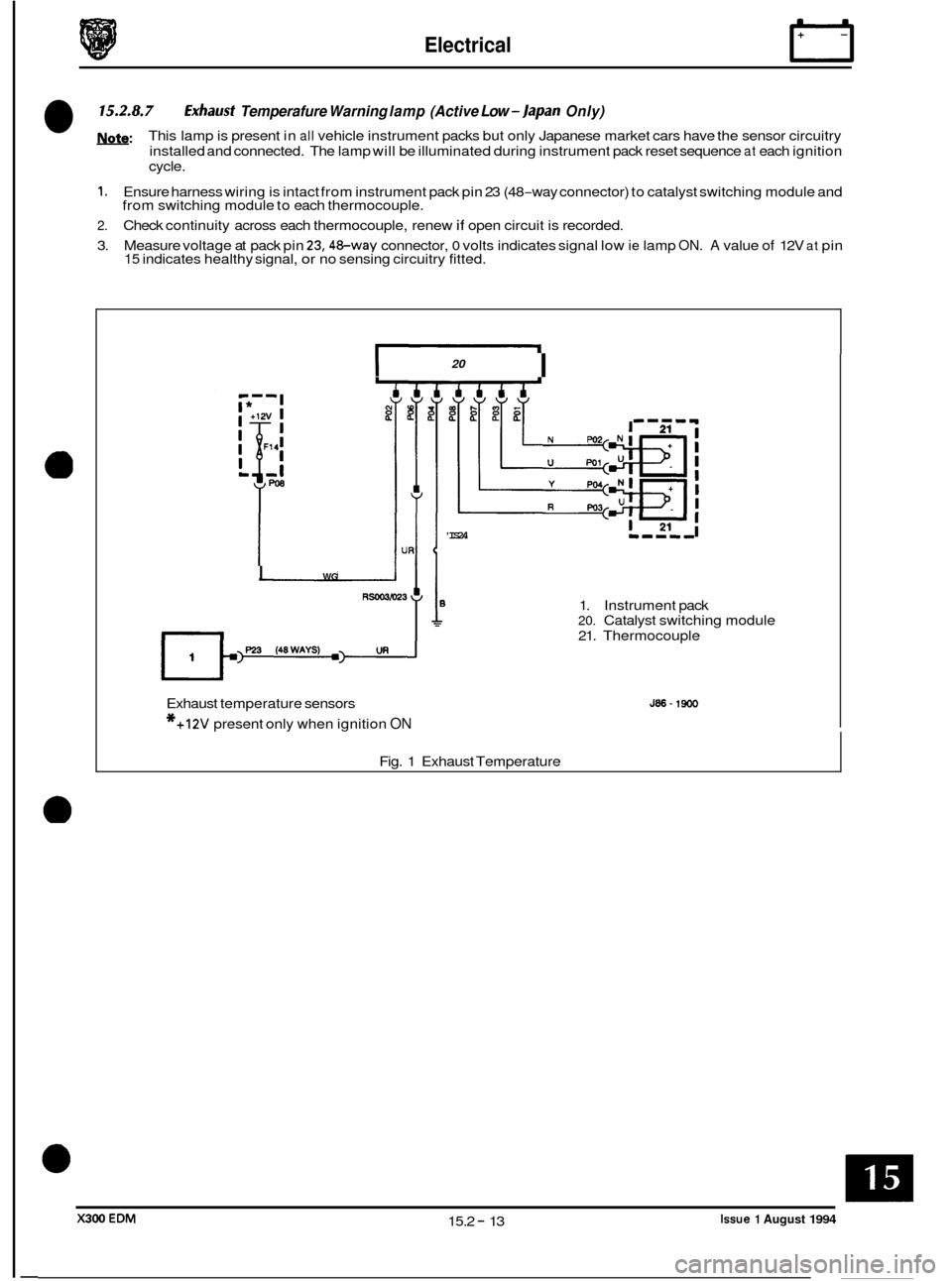
15.2.8.7 fxhausf Temperafure Warning lamp (Active Low -Japan Only)
U: This lamp is present in all vehicle instrument packs but only Japanese market cars have the sensor circuitry
installed and connected. The lamp will be illuminated during instrument pack reset sequence
at each ignition
cycle.
1. Ensure harness wiring is intact from instrument pack pin 23 (48-way connector) to catalyst switching module and
from switching module to each thermocouple.
2. Check continuity across each thermocouple, renew if open circuit is recorded.
3. Measure voltage at pack pin
23,48-way connector, 0 volts indicates signal low ie lamp ON. A value of 12V at pin 15 indicates healthy signal, or no sensing circuitry fitted.
I 20
L
I WG
Exhaust temperature sensors
*+12V present only when ignition ON
'IS24
1. Instrument pack 20. Catalyst switching module
21. Thermocouple
J86-1900
Fig. 1 Exhaust Temperature
x300 EDM 15.2 - 13 Issue 1 August 1994
Page 178 of 327
E I ect r ical IT
SPEED CONTROL
System Description
0 15.3 15.3.1
The speed control system provides an automatic cruise facility, allowing a constant speed to be maintained without
accelerator pedal operation. The system comprises the following components:
0 Electronic control unit
0 Vacuum dump valve
0 Control valve
0 Vacuum pump
0 Mechanical throttle linkage and bellows
0 Selection switch
0 Brake and clutch pedal switches
On selection of speed control, via the switches mounted on the driver's side fascia, the vacuum dump valve, pump and
control valve will energize, creating
a partial vacuum in the bellows assembly. The bellows assembly acts upon the
throttle linkage to adjust throttle position, maintaining vehicle speed at the value when control is selected.
Speed control is determined by the Speed Control Control Module
(SC CM) which monitors a speed signal delivered
from the instrument pack (initially from the ABS rear LH wheel speed sensor) to determine vehicle speed.
Speedcontrol isdisabled, returning control tothedriver,
byoperationofthevacuumdumpvalve,ifanyofthefollowing situations occur: 0
0 Braking
0 Clutch operation (3.2 / 4.0 litre manual transmission vehicles only)
o Drive de-select ie P, N or R (automatic transmissions only, both electronic and hydraulic)
0 Traction control system (where fitted) in operation
0 Rapid speed reduction without braking input, ie double brake switch failure
0 Actual speed drop to 3/4 of cruise setting (eg when towing excessive loads under adverse conditions)
0 Vehicle speeds below w 25 mph
0 Ignition OFF
0 De-selection at switch controls
15.3.2 COMPONENT DESCRlPTlO NS
15.3.2.1 Electronic Control Module
The Speed Control Control Module (SC CM), located behind the fascia, adjacent to the steering column, provides sys- tem control and an interface to external input signals from the instrument pack, gear selector module, traction control
system, control switches, and foot pedal switches. The set speed value is retained in SC CM memory and continuously
compared to actual vehicle speed. Adjustments are made, as necessary, to maintain set speed by control of the vac- uum pump and control valve. Connections to the SC CM are listed in the table on page 3.
X300 EDM 15.3 - 1 Issue 1 August 1994
Page 180 of 327
Electrical D ~
Ignition
+ve feed
Ignition +ve switched supply output I 01 03
06 Speed signal input
09 Traction Control input
10 Control valve control output
11 Ground
12 Ignition +ve input
14
15 ~
Stop
lamp input
17
1 Control switches input
18
j Gear select input
' Dump valve control output ~
20 I Vacuum
pump control output
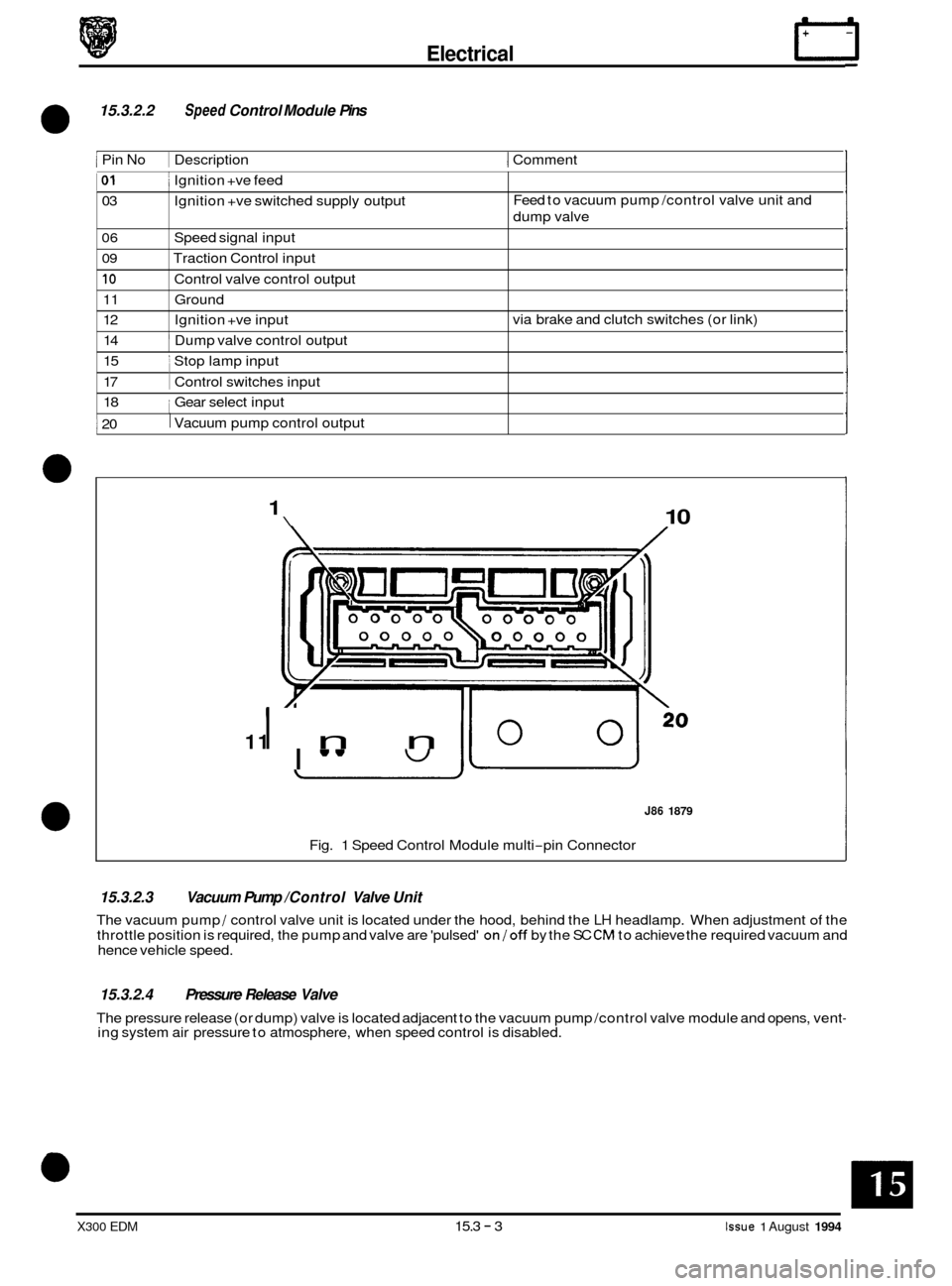
15.3.2.2 Speed Control Module Pins
1 Pin No 1 Description I Comment
0
Feed to vacuum pump /control valve unit and
dump valve
via brake and clutch switches (or link)
0
0
1 10
A
11 'I n n 01 *O
I" " 1:
J86 1879
Fig. 1 Speed Control Module multi-pin Connector
15.3.2.3 Vacuum Pump /Control Valve Unit
The vacuum pump / control valve unit is located under the hood, behind the LH headlamp. When adjustment of the
throttle position is required, the pump and valve are 'pulsed' on/off by the SC CM to achieve the required vacuum and
hence vehicle speed.
15.3.2.4 Pressure Release Valve
The pressure release (or dump) valve is located adjacent to the vacuum pump /control valve module and opens, vent- ing system air pressure to atmosphere, when speed control is disabled.
X300 EDM 15.3 - 3 Issue 1 August 1994
Page 184 of 327
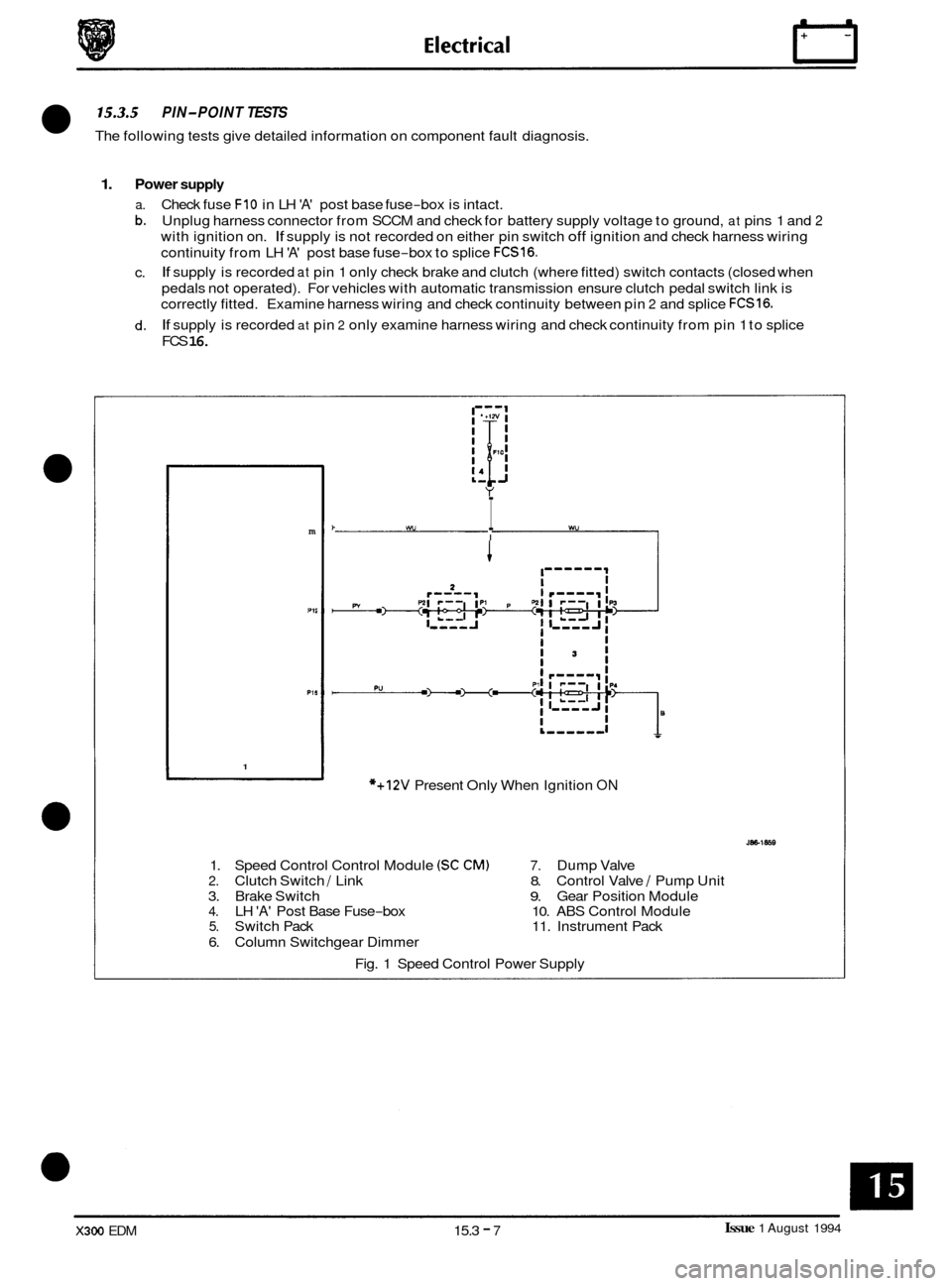
15.3.5 PIN-POINT TESTS
The following tests give detailed information on component fault diagnosis.
1. Power supply
a. Check fuse FIO in LH 'A' post base fuse-box is intact.
b. Unplug harness connector from SCCM and check for battery supply voltage to ground, at pins 1 and 2
with ignition on. If supply is not recorded on either pin switch off ignition and check harness wiring
continuity from LH
'A' post base fuse-box to splice FCS16.
If supply is recorded at pin 1 only check brake and clutch (where fitted) switch contacts (closed when
pedals not operated). For vehicles with automatic transmission ensure clutch pedal switch link is
correctly fitted. Examine harness wiring and check continuity between pin
2 and splice FCS16.
If supply is recorded at pin 2 only examine harness wiring and check continuity from pin 1 to splice
FCS
16.
c.
d.
m
P1I
1
k wv I wu I
I-------
*+12V Present Only When Ignition ON
1. Speed Control Control Module (SC CM) 7. Dump Valve
2. Clutch Switch / Link 8. Control Valve / Pump Unit
3. Brake Switch
9. Gear Position Module 4. LH 'A' Post Base Fuse-box 10. ABS Control Module 5. Switch Pack 11. Instrument Pack
6. Column Switchgear Dimmer
Fig. 1 Speed Control Power Supply
Issue 1 August 1994 X300 EDM 15.3 - 7
Page 185 of 327
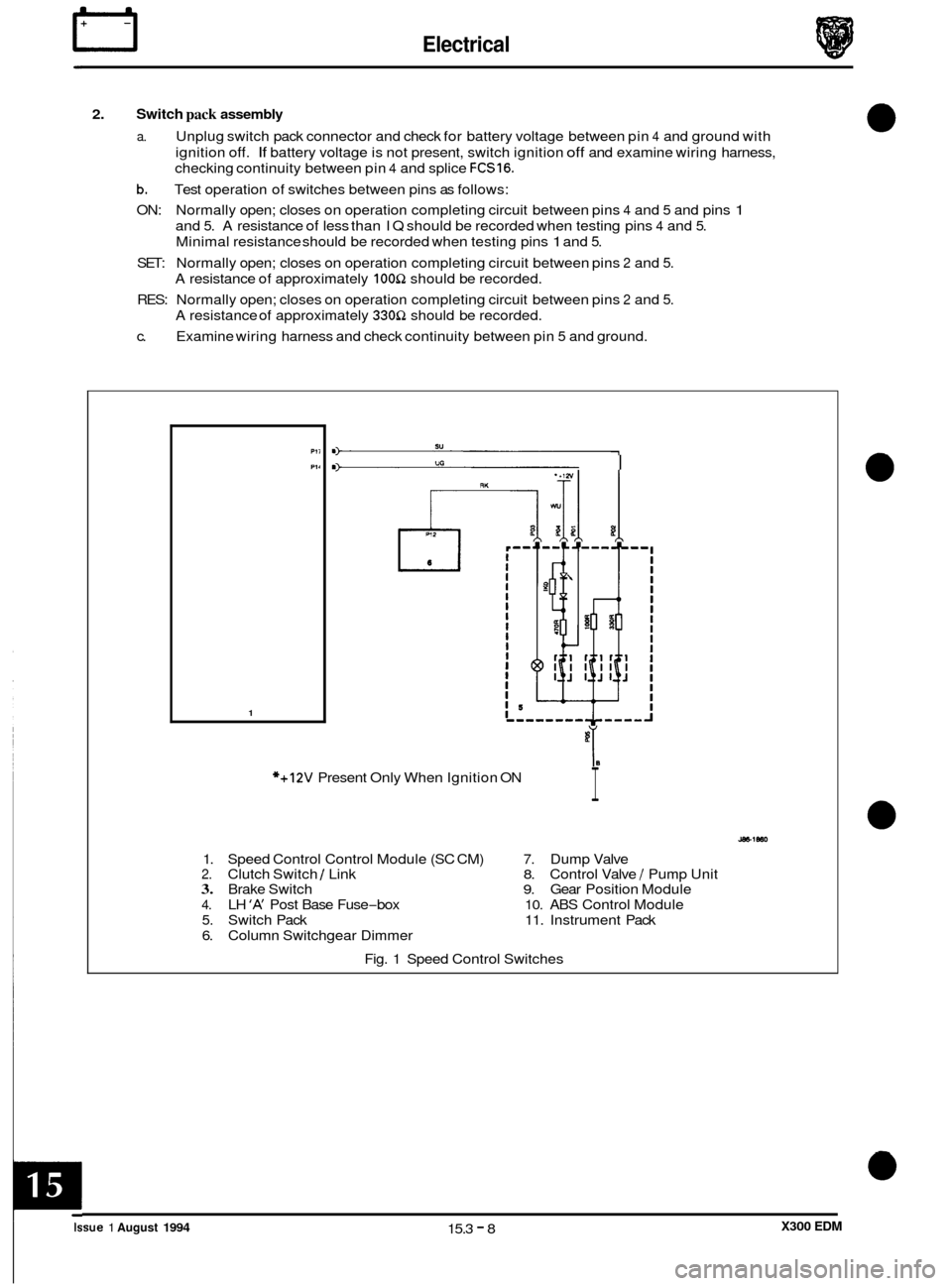
n Electrical
2. Switch pack assembly
a. Unplug switch pack connector and check for battery voltage between pin 4 and ground with
ignition
off. If battery voltage is not present, switch ignition off and examine wiring harness,
checking continuity between pin
4 and splice FCS16.
b. Test operation of switches between pins as follows:
ON: Normally open; closes on operation completing circuit between pins
4 and 5 and pins 1
and 5. A resistance of less than IQ should be recorded when testing pins 4 and 5.
Minimal resistance should be recorded when testing pins 1 and 5.
SET: Normally open; closes on operation completing circuit between pins 2 and 5.
A resistance of approximately 100Q should be recorded.
RES: Normally open; closes on operation completing circuit between pins
2 and 5.
A resistance of approximately 330Q should be recorded.
c. Examine wiring harness and check continuity between pin
5 and ground.
Ptl
PI1
1
m) su
I U0
I
*+12V Present Only When Ignition ON
1. Speed Control Control Module (SC CM)
7. Dump Valve 2. Clutch Switch I Link 8. Control Valve / Pump Unit 3. Brake Switch 9. Gear Position Module
4. LH ‘A’ Post Base Fuse-box 10. ABS Control Module
5. Switch Pack 11. Instrument Pack
6. Column Switchgear Dimmer
Fig. 1 Speed Control Switches
0
0
0
0
Issue 1 August 1994 15.3 - 8 X300 EDM
Page 186 of 327
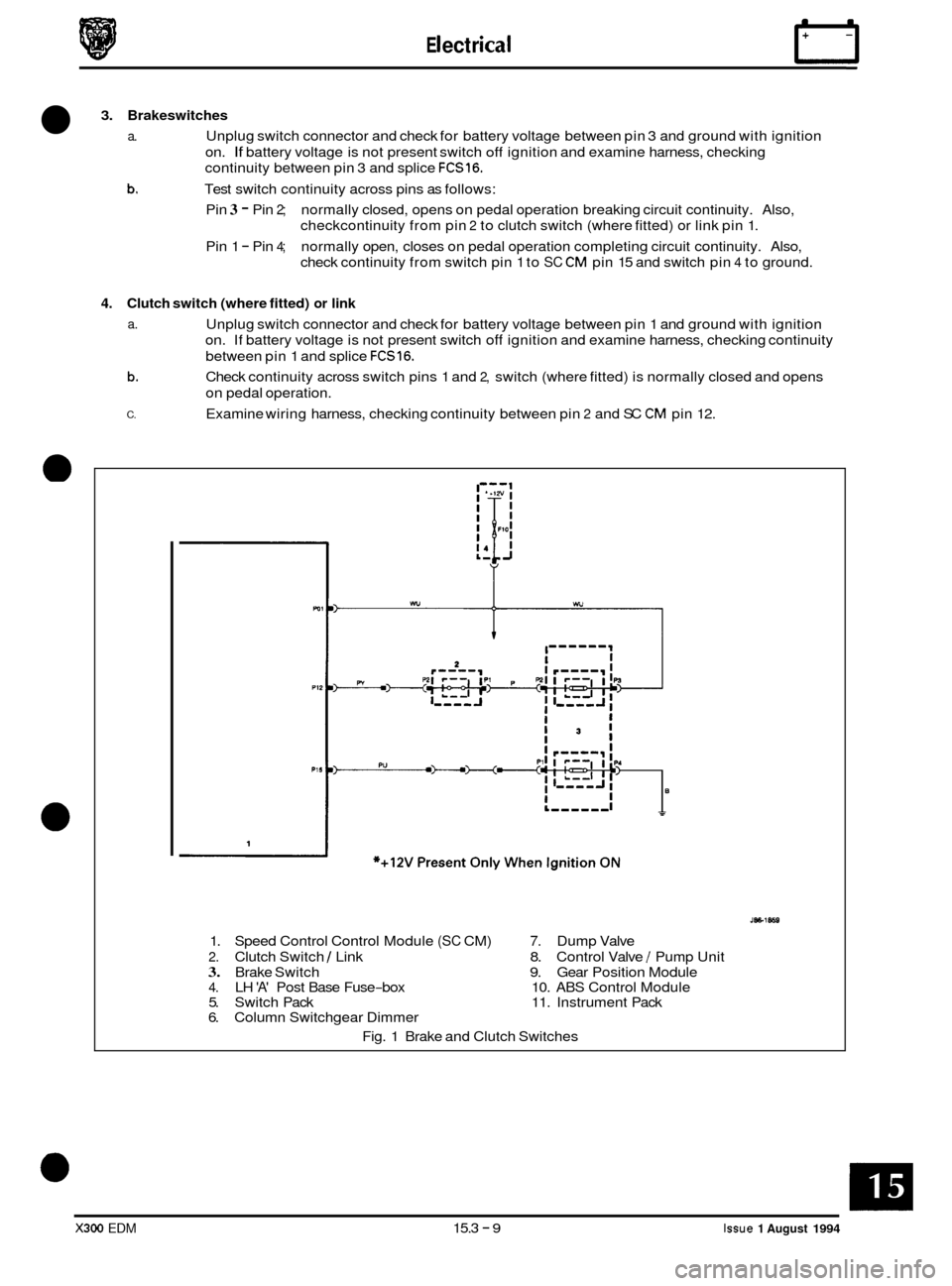
E I ect r ica I n
3. Brakeswitches
a. Unplug switch connector and check for battery voltage between pin 3 and ground with ignition
b.
on. If battery voltage is not present switch off ignition and examine harness, checking
continuity between pin 3 and splice
FCS16.
Test switch continuity across pins as follows:
Pin
3 - Pin 2; normally closed, opens on pedal operation breaking circuit continuity. Also,
checkcontinuity from pin
2 to clutch switch (where fitted) or link pin 1.
Pin 1
- Pin 4; normally open, closes on pedal operation completing circuit continuity. Also,
check continuity from switch pin 1 to
SC CM pin 15 and switch pin 4 to ground.
4. Clutch switch (where fitted) or link
a. Unplug switch connector and check for battery voltage between pin 1 and ground with ignition
on. If battery voltage is not present switch
off ignition and examine harness, checking continuity
between pin 1 and splice
FCS16.
Check continuity across switch pins 1 and 2, switch (where fitted) is normally closed and opens
on pedal operation.
Examine wiring harness, checking continuity between pin
2 and SC CM pin 12.
b.
C.
1
.---I
1. Speed Control Control Module (SC CM) 7. Dump Valve
2. Clutch Switch 1 Link 8. Control Valve / Pump Unit
3. Brake Switch 9. Gear Position Module 4. LH 'A' Post Base Fuse-box 10. ABS Control Module
5. Switch Pack 11. Instrument Pack
6. Column Switchgear Dimmer
Fig. 1 Brake and Clutch Switches
X300 EDM 15.3 - 9 Issue 1 August 1994
Page 190 of 327
15.4 DRIVER ERGONOMICS
15.4.1 System Description
Adjustment of the seats, steering column and exterior rear view mirrors position is effected by means of control
switches. The switches maintain the adjustment facility while depressed, movement ceasing when the switch is re- leased.
Manual adjustment can be achieved either with the ignition key in place or with the driver‘s door open, or having been
closed within the last
30 seconds.
The system offers the following facilities:
Entry
/ Exit mode; an automatic seat /column position setting for ease of driver entry into / exit from the vehicle.
Driving position set; automatic recall of up to three preferred settings.
Passenger seat set; automatic recall of up to three preferred settings.
Remote recall; automatic recall of up to two memory positions from
a remote transmitter (in key fob).
Reverse mirror dip; automatic adjustment of passenger rear view mirror when reversing.
U: Vehicles intended for the Japanese market are fitted with an additional ‘fold away’ mirror function. This func- tion allows mirrors to fold flat against the car when parking in enclosed areas.
15.4.1.1 Entry/ Exit Mode
Entry / Exit mode is designed to give easier vehicle entry and exit for the driver. The facility is selected by positioning
the mode switch, located on the LH side of the column cowl, to ‘auto’ which designates the current seat / column posi- tion, ie driving positions, as the memorized position. On removal of ignition key or opening of driver‘s door, with igni- tion key still in place, the driver’s seat will move to the rear (current position allowing) and the column will adopt ‘tilt
away’ mode automatically creating additional space for driver exit
/ entry. Insertion of key in ignition or closure of
driver‘s door (with ignition key in place) returns seat / column positions to the memorized (previous) position.
Operation of eitherthe brake pedal or
seat/column manual controls during entry/exit mode execution will abort posi- tional adjustments. Setting the mode switch to OFF disables operation of entry / exit mode.
15.4.1.2 Driving Position Set
Setting of seat, column and external rear view mirrors to preferred driving position is available using the memory but- tons located on the drivers door switch pack. With the ignition key in place enter settings to be memorized as follows:
Adjust seat, column and mirrors to desired positions.
Press the ’memory’ button
so that it becomes illuminated.
Press button
1,2 or 3 to store configuration within four seconds of memory button operation. Memory light will extin- guish and a chime will sound, indicating procedure complete.
The above procedure may be repeated two more times until each button
(1,2 & 3) has a preferred position stored in
memory, accommodating different driver settings. Operation of any push-button (1,2 or 3) will re-position seat col-
umn and mirrors to the stored settings.
Memory recall will operate under the following conditions:
. Ignition key in and gear selector in park.
8 Ignition key in and handbrake on.
8 Ignition key out and driver’s door open (or having been closed within the last 30 seconds).
Re
-setting the preferred position on any setting button automatically erases previously stored information. Memory
information is not erased if power supply to the seat and column / mirror control modules is lost (e.g. battery discon- nected).
15.4.1.3 Passenger Seat Set
The procedure for setting and recalling a preferred passenger seat position is identical to that for a driving position.
Memory recall will only operate with ignition key in auxiliary position or passenger door open, or having been closed
within the last
30 seconds.
X300 EDM 15.4 - 1 Issue 1 August 1994
Page 200 of 327
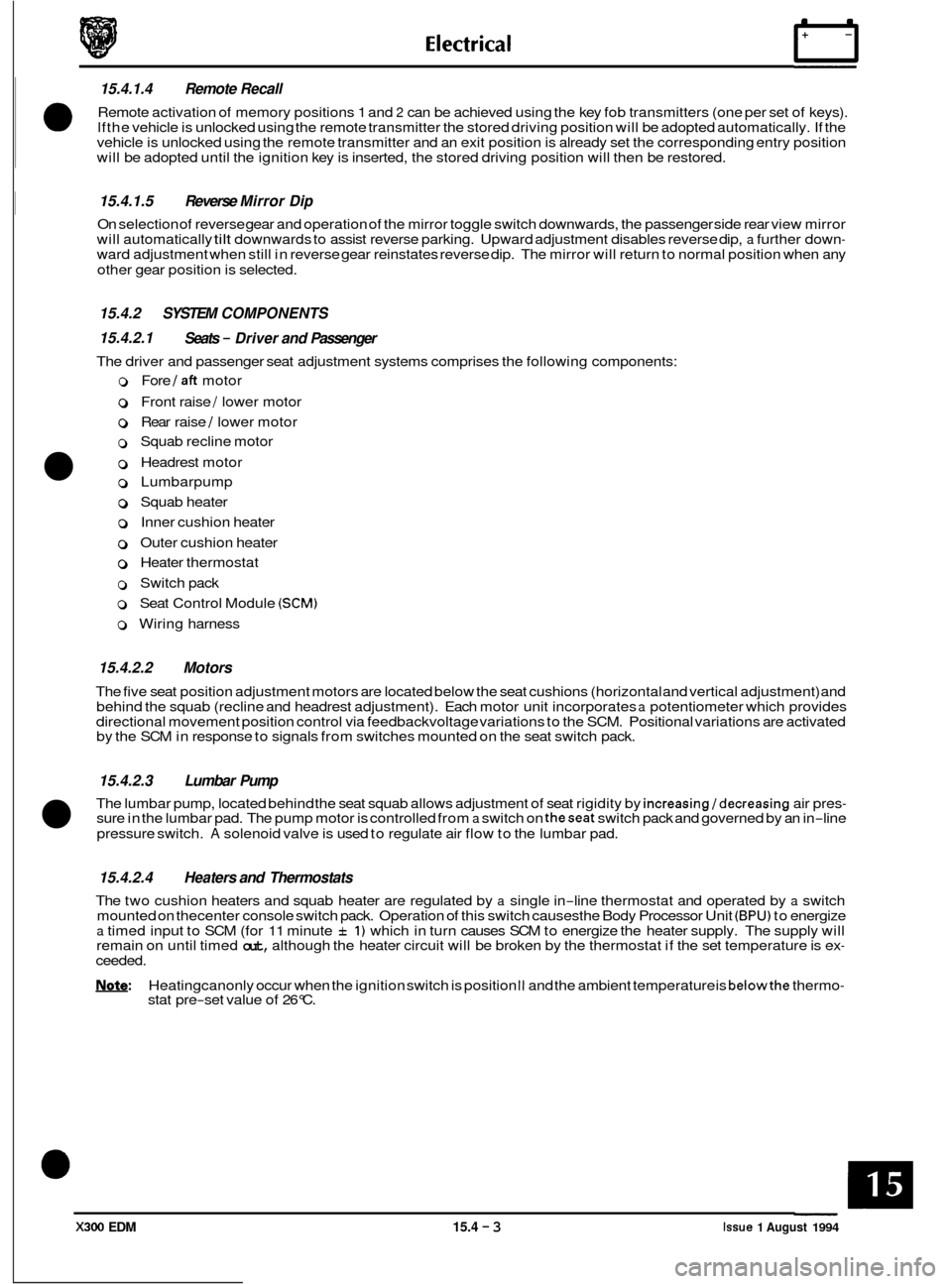
15.4.1.4 Remote Recall
Remote activation of memory positions 1 and 2 can be achieved using the key fob transmitters (one per set of keys).
lfthe vehicle is unlocked using the remote transmitter the stored driving position will be adopted automatically. If the
vehicle is unlocked using the remote transmitter and an exit position is already set the corresponding entry position
will be adopted until the ignition key is inserted, the stored driving position will then be restored. 0 ~
15.4.1.5
Reverse Mirror Dip
On selection of reverse gear and operation of the mirror toggle switch downwards, the passenger side rear view mirror
will automatically tilt downwards to assist reverse parking. Upward adjustment disables reverse dip, a further down- ward adjustment when still in reverse gear reinstates reverse dip. The mirror will return to normal position when any
other gear position is selected.
15.4.2 SYSTEM COMPONENTS
15.4.2.1 Seats
- Driver and Passenger
The driver and passenger seat adjustment systems comprises the following components:
o Fore / aft motor
o Front raise / lower motor
o Rear raise / lower motor
0 Squab recline motor
0 Headrest motor
0 Lumbarpump
0 Squab heater
0 Inner cushion heater
0 Outer cushion heater
0 Heater thermostat
0 Switch pack
o Seat Control Module (SCM)
o Wiring harness
15.4.2.2 Motors
The five seat position adjustment motors are located below the seat cushions (horizontal and vertical adjustment) and
behind the squab (recline and headrest adjustment). Each motor unit incorporates a potentiometer which provides
directional movement position control via feedbackvoltage variations to the SCM. Positional variations are activated
by the SCM in response to signals from switches mounted on the seat switch pack.
15.4.2.3 Lumbar Pump
The lumbar pump, located behind the seat squab allows adjustment of seat rigidity by increasing/decreasing air pres- sure in the lumbar pad. The pump motor is controlled from a switch on theseat switch pack and governed by an in-line
pressure switch.
A solenoid valve is used to regulate air flow to the lumbar pad.
15.4.2.4 Heaters and Thermostats
The two cushion heaters and squab heater are regulated by a single in-line thermostat and operated by a switch
mounted on thecenter console switch pack. Operation of this switch causesthe Body Processor Unit (BPU) to energize a timed input to SCM (for 11 minute f 1) which in turn causes SCM to energize the heater supply. The supply will
remain on until timed out, although the heater circuit will be broken by the thermostat if the set temperature is ex- ceeded.
Note: Heatingcan only occur when the ignition switch is position I1 and the ambient temperature is belowthe thermo- stat pre-set value of 26°C.
X300 EDM 15.4 - 3 Issue 1 August 1994
Page 207 of 327
IT Electrical
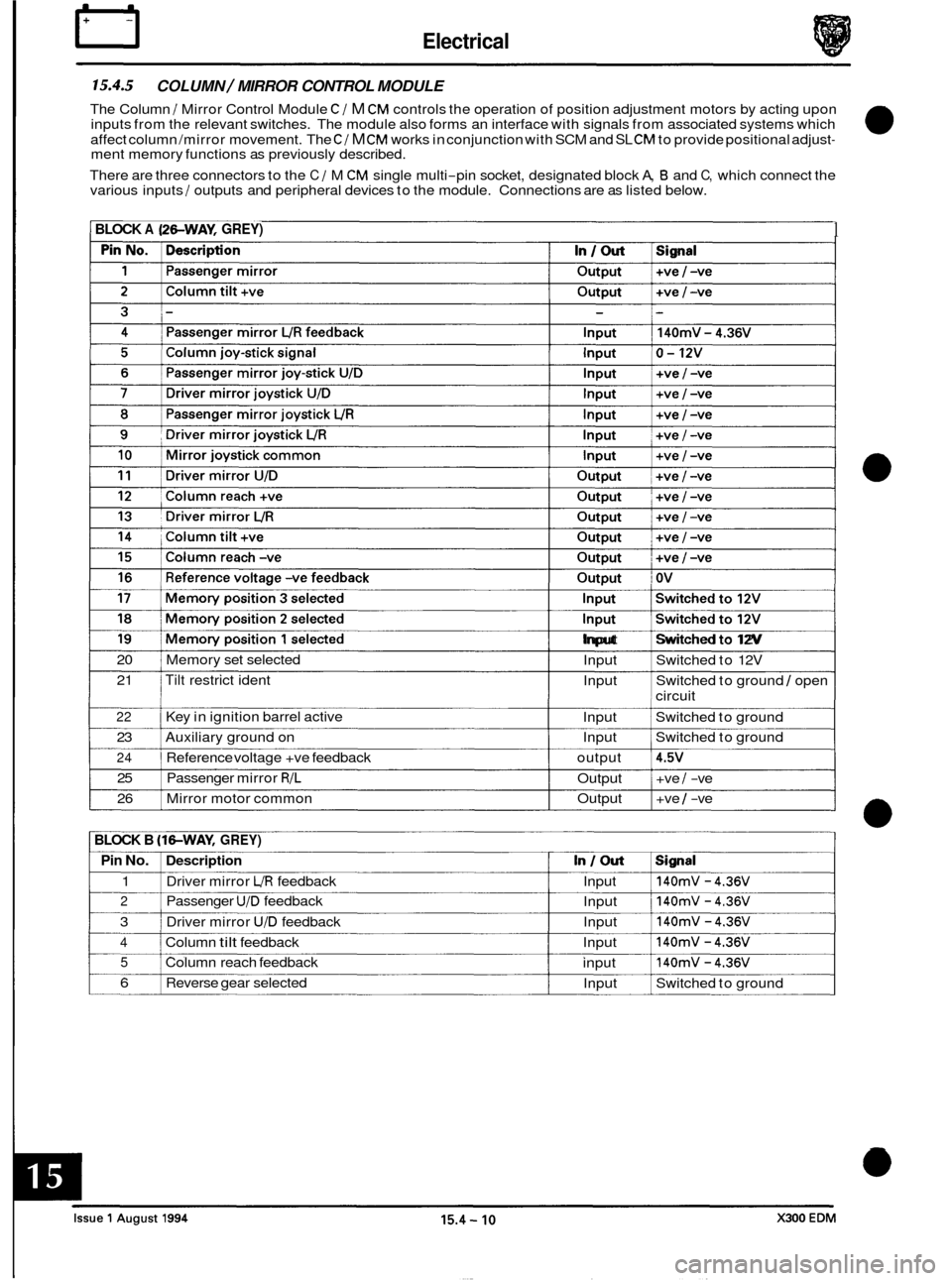
15.4.5 COLUMN / MIRROR CONTROL MODULE
The Column / Mirror Control Module C/ M CM controls the operation of position adjustment motors by acting upon
inputs from the relevant switches. The module also forms an interface with signals from associated systems which
affect column /mirror movement. The
C/ M CM works in conjunction with SCM and SL CM to provide positional adjust- ment memory functions as previously described.
There are three connectors to the
C I M CM single multi-pin socket, designated block A, B and C, which connect the
various inputs / outputs and peripheral devices to the module. Connections are as listed below.
I BLOCK A [26-WAY GREY) 1
I .. I I 41 Input Switched to 12V ..
20 Memory set selected
Input Switched to 12V
21
Tilt restrict ident Input Switched to ground 1 open
22 Key in ignition barrel active
Input Switched to ground
circuit
23
1 Auxiliary ground on Input 1 Switched to ground
24 1 Reference voltage +ve feedback output I4.5v
25 1 Passenger mirror R/L Output 1 +ve 1 -ve
26
1 Mirror motor common Output I +ve / -ve
BLOCK B (lgWAY, GREY)
Pin No. I Description I In / out lsignal
1 Driver mirror L/R feedback Input 140mV - 4.36V
2 Passenger U/D feedback
Input 140mV - 4.36V
3 Driver mirror U/D feedback Input 140mV - 4.36V
4 Column tilt feedback Input 140mV - 4.36V
5 Column reach feedback
input 140mV - 4.36V
6 Reverse gear selected
Input Switched to ground
-