warning JAGUAR XJ6 1994 2.G Electrical Diagnostic Manual
[x] Cancel search | Manufacturer: JAGUAR, Model Year: 1994, Model line: XJ6, Model: JAGUAR XJ6 1994 2.GPages: 327, PDF Size: 13.73 MB
Page 158 of 327
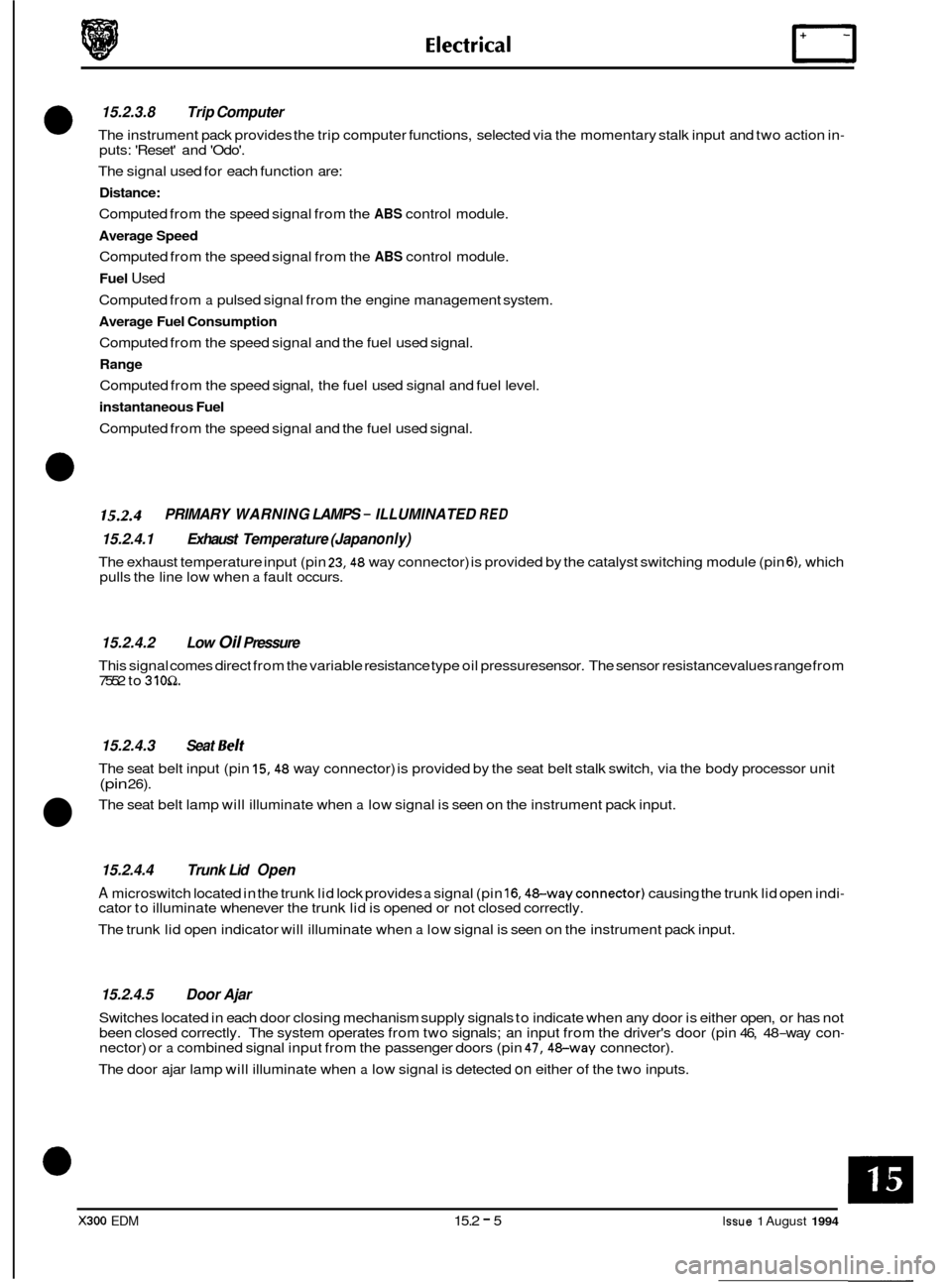
15.2.3.8 Trip Computer
The instrument pack provides the trip computer functions, selected via the momentary stalk input and two action in- puts: 'Reset' and 'Odo'.
The signal used for each function are:
Distance:
Computed from the speed signal from the ABS control module.
Average Speed
Computed from the speed signal from the ABS control module.
Fuel Used
Computed from a pulsed signal from the engine management system.
Average Fuel Consumption
Computed from the speed signal and the fuel used signal.
Range
Computed from the speed signal, the fuel used signal and fuel level.
instantaneous Fuel
Computed from the speed signal and the fuel used signal.
15.2.4 PRIMARY WARNING LAMPS - ILLUMINATED RED
15.2.4.1 Exhaust Temperature (Japan only)
The exhaust temperature input (pin 23,48 way connector) is provided by the catalyst switching module (pin 6), which
pulls the line low when a fault occurs.
15.2.4.2 Low Oil Pressure
This signal comes direct from the variable resistance type oil pressure sensor. The sensor resistancevalues range from
7552 to 310Q.
15.2.4.3 Seat Selt
The seat belt input (pin 15,48 way connector) is provided by the seat belt stalk switch, via the body processor unit
(pin 26).
The seat belt lamp will illuminate when
a low signal is seen on the instrument pack input.
15.2.4.4 Trunk Lid Open
A microswitch located in the trunk lid lock provides a signal (pin 16,4&wayconnector) causing the trunk lid open indi- cator to illuminate whenever the trunk lid is opened or not closed correctly.
The trunk lid open indicator will illuminate when
a low signal is seen on the instrument pack input.
15.2.4.5 Door Ajar
Switches located in each door closing mechanism supply signals to indicate when any door is either open, or has not
been closed correctly. The system operates from two signals; an input from the driver's door (pin 46, 48-way con- nector) or a combined signal input from the passenger doors (pin 47,4&way connector).
The door ajar lamp will illuminate when
a low signal is detected on either of the two inputs.
X300 EDM 15.2 - 5 Issue 1 August 1994
Page 159 of 327
E I ect r ica I
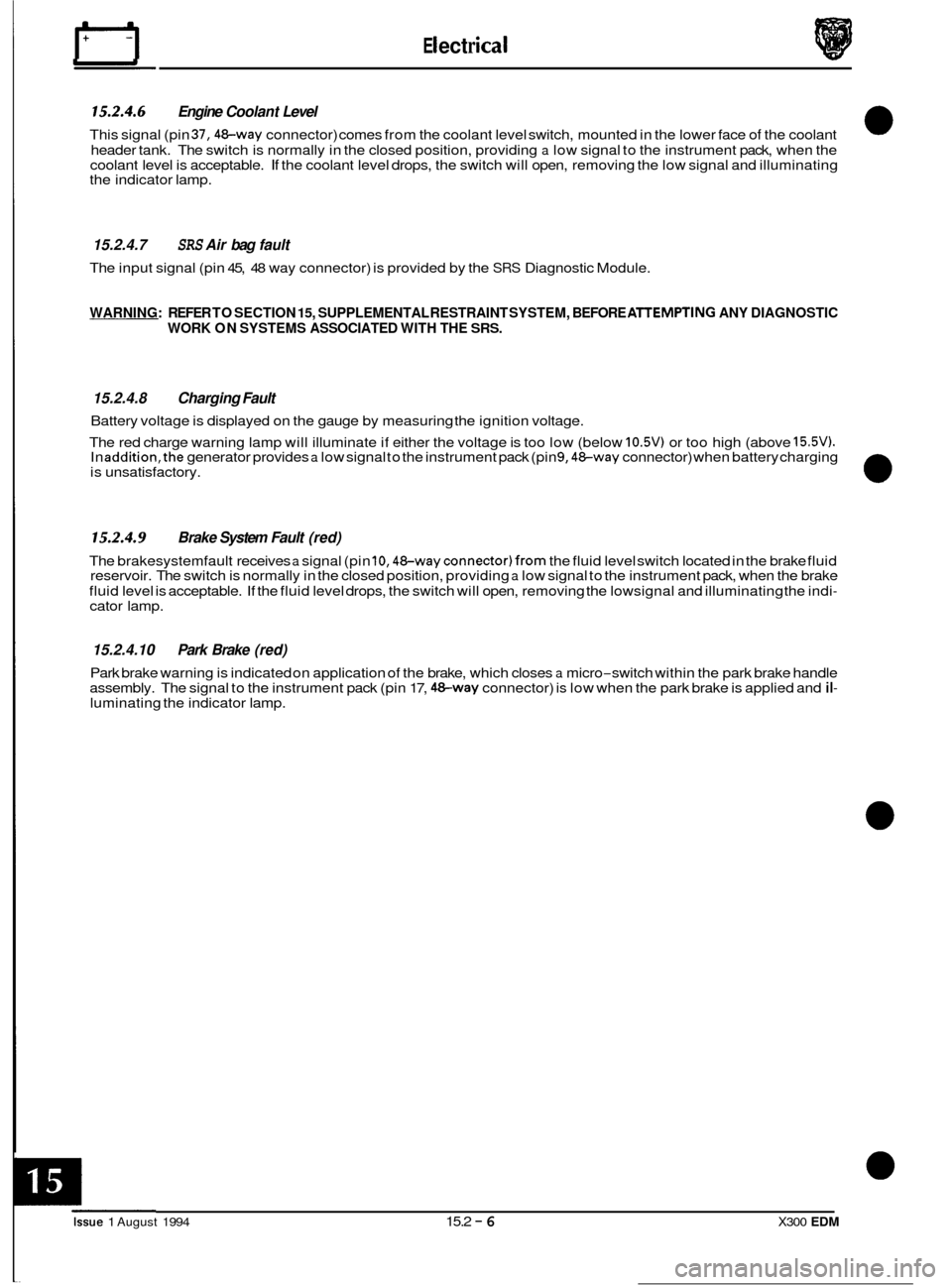
15.2.4.6 Engine Coolant Level
This signal (pin 37,48-way connector) comes from the coolant level switch, mounted in the lower face of the coolant
header tank. The switch is normally in the closed position, providing
a low signal to the instrument pack, when the
coolant level is acceptable. If the coolant level drops, the switch will open, removing the low signal and illuminating
the indicator lamp.
15.2.4.7 SRS Air bag fault
The input signal (pin 45, 48 way connector) is provided by the SRS Diagnostic Module.
WARNING: REFER TO SECTION 15, SUPPLEMENTAL RESTRAINT SYSTEM, BEFORE AlTEMPTlNG ANY DIAGNOSTIC
WORK ON SYSTEMS ASSOCIATED WITH THE
SRS.
15.2.4.8 Charging Fault
Battery voltage is displayed on the gauge by measuring the ignition voltage.
The red charge warning lamp will illuminate if either the voltage is too low (below
10.5V) or too high (above 15.5V). In addition,the generator provides a low signal to the instrument pack (pin 9,48-way connector) when battery charging
is unsatisfactory.
15.2.4.9 Brake System Fault (red)
The brakesystem fault receives a signal (pin 10,4&wayconnector)from the fluid level switch located in the brake fluid
reservoir. The switch is normally in the closed position, providing a low signal to the instrument pack, when the brake
fluid level is acceptable. If the fluid level drops, the switch will open, removing the lowsignal and illuminating the indi
- cator lamp.
15.2.4.10 Park Brake (red)
Park brake warning is indicated on application of the brake, which closes a micro-switch within the park brake handle
assembly. The signal to the instrument pack (pin 17, &way connector) is low when the park brake is applied and il- luminating the indicator lamp.
Issue 1 August 1994 15.2 - 6 X300 EDM
Page 160 of 327
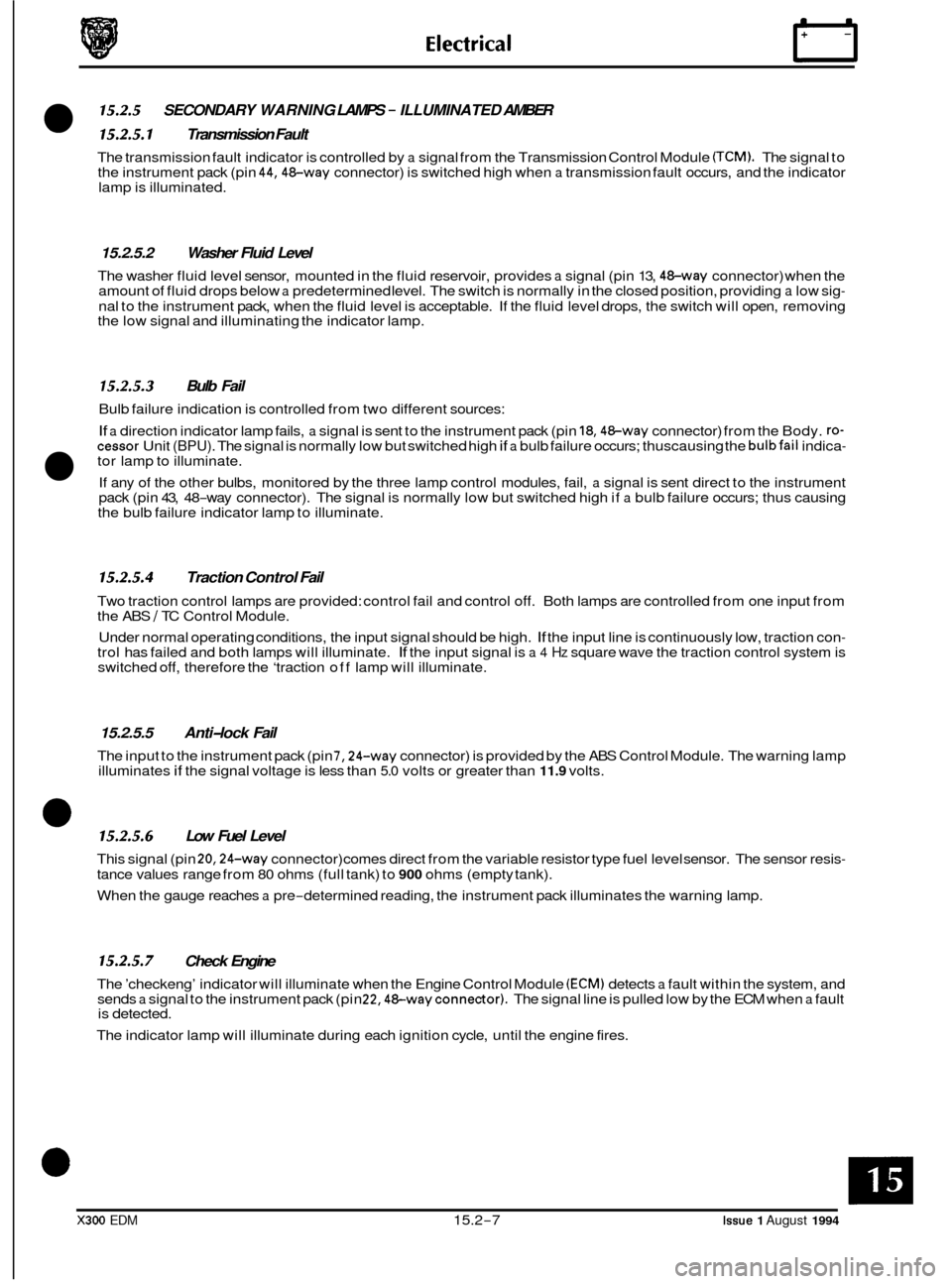
15.2.5 SECONDARY WARNING LAMPS - ILLUMINATED AMBER
15.2.5.1 Transmission Fault
The transmission fault indicator is controlled by a signal from the Transmission Control Module (TCM). The signal to
the instrument pack (pin 44,48-way connector) is switched high when a transmission fault occurs, and the indicator
lamp is illuminated.
15.2.5.2 Washer Fluid Level
The washer fluid level sensor, mounted in the fluid reservoir, provides a signal (pin 13, 48-way connector) when the
amount of fluid drops below a predetermined level. The switch is normally in the closed position, providing a low sig-
nal to the instrument pack, when the fluid level is acceptable. If the fluid level drops, the switch will open, removing
the low signal and illuminating the indicator lamp.
15.2.5.3 Bulb Fail
Bulb failure indication is controlled from two different sources:
If a direction indicator lamp fails, a signal is sent to the instrument pack (pin 18,48-way connector) from the Body. :o- cessor Unit (BPU). The signal is normally low but switched high if a bulb failure occurs; thuscausing the bulbfail indica-
If any of the other bulbs, monitored by the three lamp control modules, fail, a signal is sent direct to the instrument
pack (pin 43, 48-way connector). The signal is normally low but switched high if a bulb failure occurs; thus causing
the bulb failure indicator lamp to illuminate.
tor lamp to illuminate.
15.2.5.4 Traction Control Fail
Two traction control lamps are provided: control fail and control off. Both lamps are controlled from one input from
the ABS / TC Control Module.
Under normal operating conditions, the input signal should be high.
If the input line is continuously low, traction con- trol has failed and both lamps will illuminate. If the input signal is a 4 Hz square wave the traction control system is
switched off, therefore the ‘traction off lamp will illuminate.
15.2.5.5 Anti-lock Fail
The input to the instrument pack (pin 7,24-way connector) is provided by the ABS Control Module. The warning lamp
illuminates if the signal voltage is less than 5.0 volts or greater than 11.9 volts.
- 15.2.5.6 Low Fuel Level
This signal (pin 20,24-way connector) comes direct from the variable resistor type fuel level sensor. The sensor resis-
tance values range from 80 ohms (full tank) to 900 ohms (empty tank).
When the gauge reaches
a pre-determined reading, the instrument pack illuminates the warning lamp.
15.2.5.7 Check Engine
The ’checkeng’ indicator will illuminate when the Engine Control Module (ECM) detects a fault within the system, and
sends a signal to the instrument pack (pin 22,48-wayconnector). The signal line is pulled low by the ECM when a fault
is detected.
The indicator lamp will illuminate during each ignition cycle, until the engine fires.
X300 EDM 15.2-7 Issue 1 August 1994
Page 161 of 327
rl E I ect r i ca I
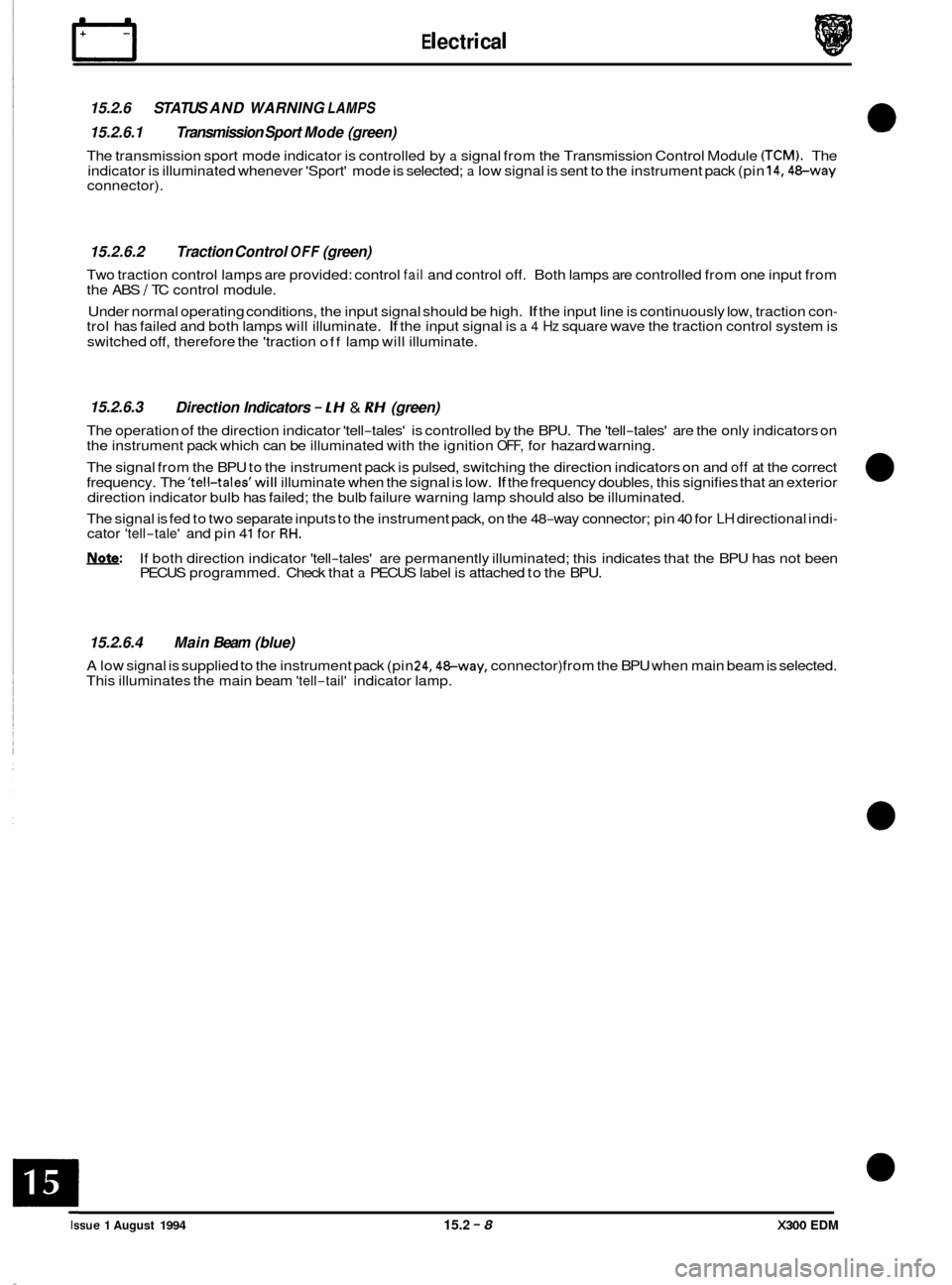
15.2.6 STATUS AND WARNING LAMPS
15.2.6.1 Transmission Sport Mode (green)
The transmission sport mode indicator is controlled by a signal from the Transmission Control Module (TCM). The
indicator is illuminated whenever 'Sport' mode is selected; a low signal is sent to the instrument pack (pin 14,48-way connector).
15.2.6.2 Traction Control OFF (green)
Two traction control lamps are provided: control fail and control off. Both lamps are controlled from one input from
the ABS I TC control module.
Under normal operating conditions, the input signal should be high.
If the input line is continuously low, traction con- trol has failed and both lamps will illuminate. If the input signal is a 4 Hz square wave the traction control system is
switched off, therefore the 'traction
off lamp will illuminate.
15.2.6.3
The operation of the direction indicator 'tell-tales' is controlled by the BPU. The 'tell-tales' are the only indicators on
the instrument pack which can be illuminated with the ignition OFF, for hazard warning.
The signal from the BPU to the instrument pack is pulsed, switching the direction indicators on and
off at the correct
frequency. The 'tell-tales'will illuminate when the signal is low. If the frequency doubles, this signifies that an exterior
direction indicator bulb has failed; the bulb failure warning lamp should also be illuminated.
The signal is fed to two separate inputs to the instrument pack, on the 48
-way connector; pin 40 for LH directional indi- cator 'tell-tale' and pin 41 for RH.
!We: If both direction indicator 'tell-tales' are permanently illuminated; this indicates that the BPU has not been
PECUS programmed. Check that a PECUS label is attached to the BPU.
Direction Indicators - LH & RH (green)
15.2.6.4 Main Beam (blue)
A low signal is supplied to the instrument pack (pin 24,48-way, connector) from the BPU when main beam is selected.
This illuminates the main beam 'tell-tail' indicator lamp.
Issue 1 August 1994 15.2 - 8 X300 EDM
Page 162 of 327
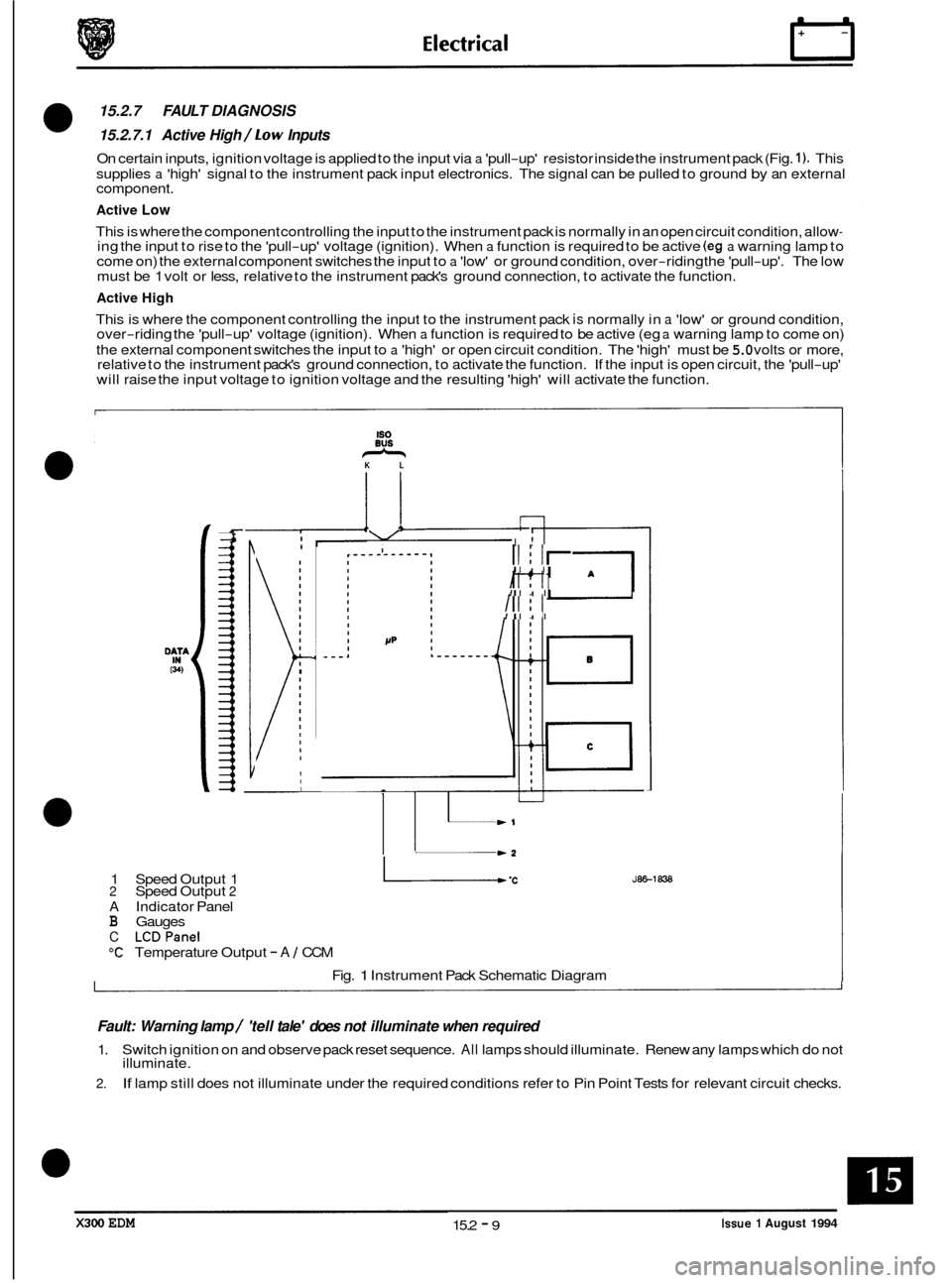
15.2.7 FAULT DIAGNOSIS
15.2.7.1 Active High /Low Inputs
On certain inputs, ignition voltage is applied to the input via a 'pull-up' resistor inside the instrument pack (Fig. 1). This
supplies
a 'high' signal to the instrument pack input electronics. The signal can be pulled to ground by an external
component.
Active Low
This is where the component controlling the input to the instrument pack is normally in an open circuit condition, allow- ing the input to rise to the 'pull-up' voltage (ignition). When a function is required to be active (eg a warning lamp to
come on) the external component switches the input to a 'low' or ground condition, over-riding the 'pull-up'. The low
must be 1 volt or less, relative to the instrument pack's ground connection, to activate the function.
Active High
This is where the component controlling the input to the instrument pack is normally in a 'low' or ground condition,
over-riding the 'pull-up' voltage (ignition). When a function is required to be active (eg a warning lamp to come on)
the external component switches the input to
a 'high' or open circuit condition. The 'high' must be 5.0 volts or more,
relative to the instrument pack's ground connection, to activate the function. If the input is open circuit, the 'pull-up'
will raise the input voltage to ignition voltage and the resulting 'high' will activate the function.
-&
60
eus KL
* \/ I I! I
I ~
I
I I
1
Ill I I '
Ill I I
I
w1
-2
1
Speed Output 1 L .C 2 Speed Output 2
A Indicator Panel B Gauges
C LCDPanel
"C Temperature Output - A 1 CCM
Fig.
1 Instrument Pack Schematic Diagram
JEE-1838
Fault: Warning lamp / 'tell tale' does not illuminate when required
1.
2.
Switch ignition on and observe pack reset sequence. All lamps should illuminate. Renew any lamps which do not
illuminate.
If lamp still does not illuminate under the required conditions refer to Pin Point Tests for relevant circuit checks.
X300 EDM Issue 1 August 1994 15.2 - 9
Page 165 of 327
rl Electrical
15.2.8.6
1.
2.
3.
4.
Door I Pack pin connection I Switch connection
Driver 146,48-way I06
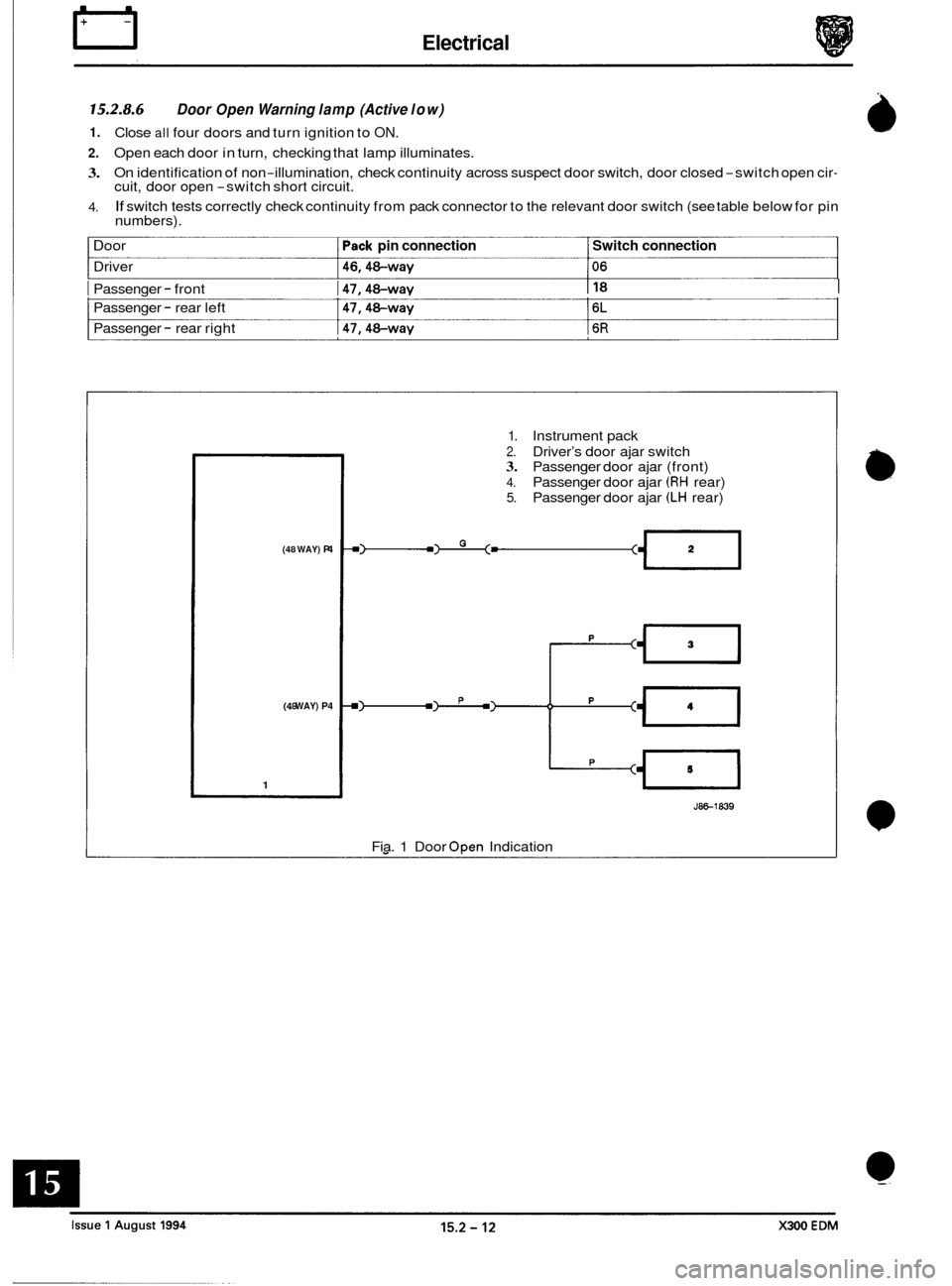
Door Open Warning lamp (Active low)
Close all four doors and turn ignition to ON.
Open each door in turn, checking that lamp illuminates.
On identification of non
-illumination, check continuity across suspect door switch, door closed -switch open cir- cuit, door open -switch short circuit.
If switch tests correctly check continuity from pack connector to the relevant door switch (see table below for pin
numbers).
I Passenger - front 147,4&way 118 I
Passenger - rear left 147,4&way I6L
Passenger - rear right I47,4&way I6R
(48 WAY) P4
(48 WAY) P4
1. Instrument pack
2. Driver’s door ajar switch 3. Passenger door ajar (front)
4.
5.
Passenger door ajar (RH rear)
Passenger door ajar
(LH rear)
1
Fia. 1 Door ODen Indication
J@6-1839
Page 166 of 327
Electrical
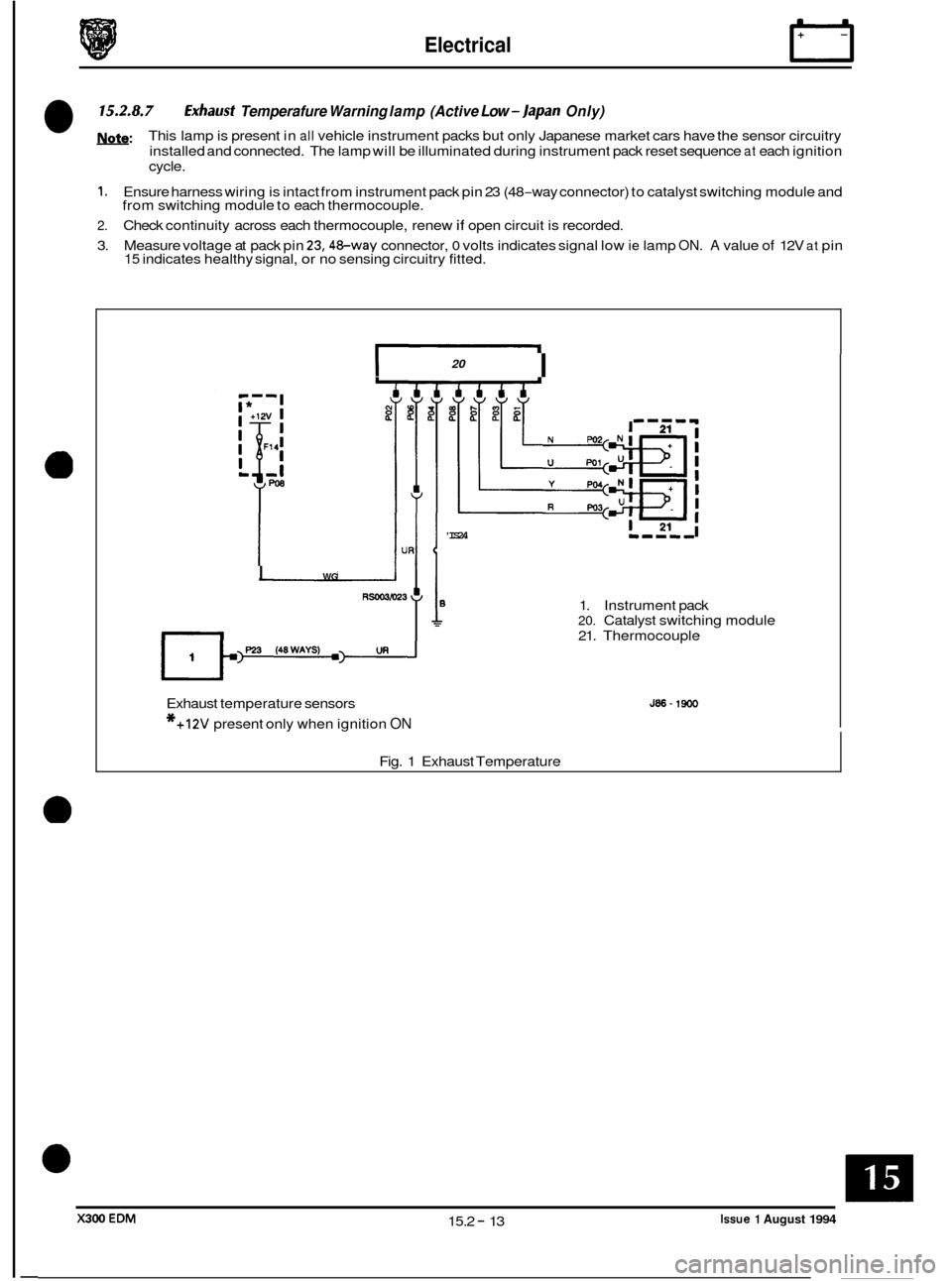
15.2.8.7 fxhausf Temperafure Warning lamp (Active Low -Japan Only)
U: This lamp is present in all vehicle instrument packs but only Japanese market cars have the sensor circuitry
installed and connected. The lamp will be illuminated during instrument pack reset sequence
at each ignition
cycle.
1. Ensure harness wiring is intact from instrument pack pin 23 (48-way connector) to catalyst switching module and
from switching module to each thermocouple.
2. Check continuity across each thermocouple, renew if open circuit is recorded.
3. Measure voltage at pack pin
23,48-way connector, 0 volts indicates signal low ie lamp ON. A value of 12V at pin 15 indicates healthy signal, or no sensing circuitry fitted.
I 20
L
I WG
Exhaust temperature sensors
*+12V present only when ignition ON
'IS24
1. Instrument pack 20. Catalyst switching module
21. Thermocouple
J86-1900
Fig. 1 Exhaust Temperature
x300 EDM 15.2 - 13 Issue 1 August 1994
Page 167 of 327
IT Electrical
15.2.8.8
1.
2.
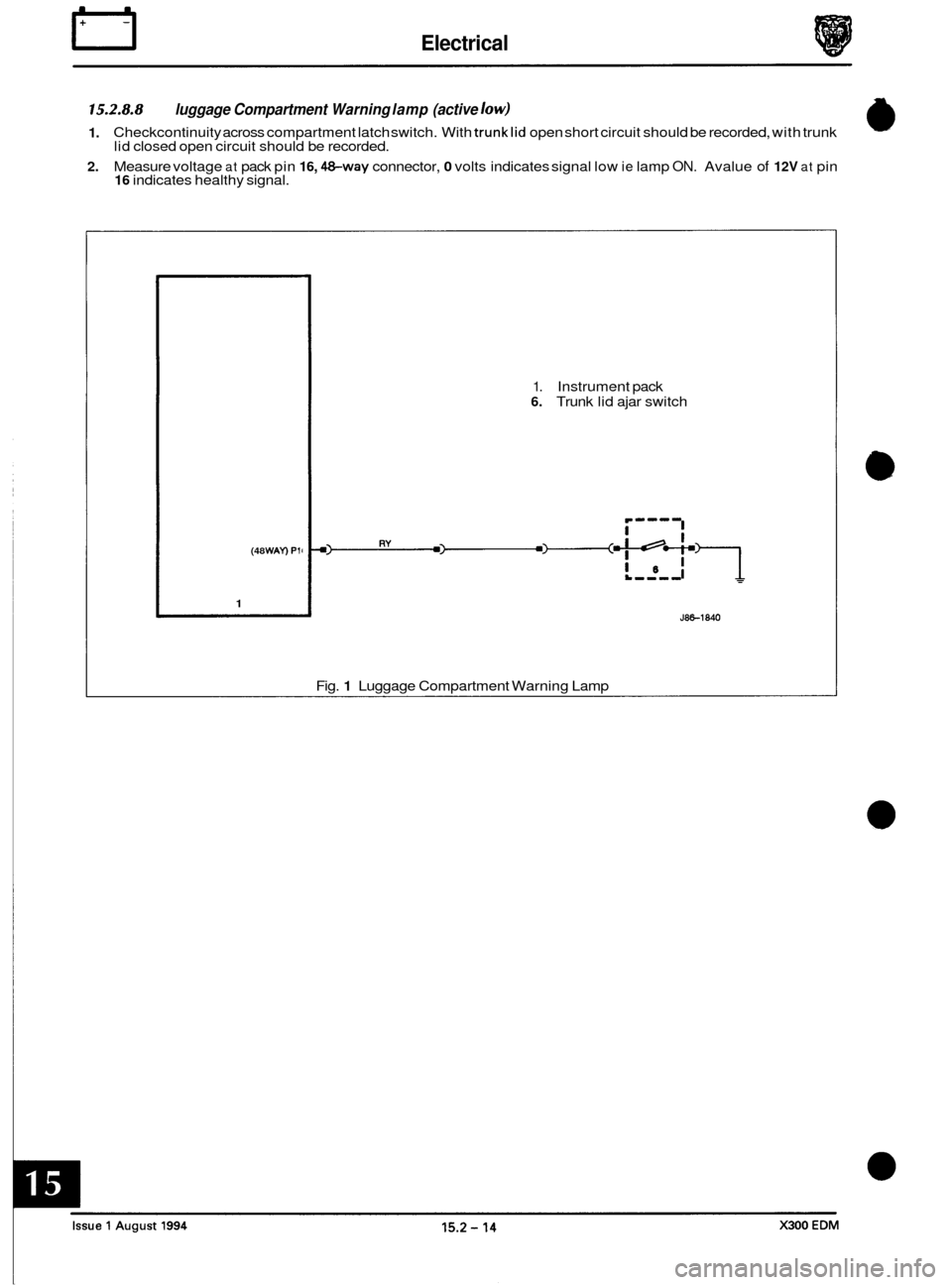
luggage Compartment Warning lamp (active low)
Checkcontinuity across compartment latch switch. With trunklid open short circuit should be recorded, with trunk
lid closed open circuit should be recorded.
Measure voltage
at pack pin 16, &way connector, 0 volts indicates signal low ie lamp ON. Avalue of 12V at pin 16 indicates healthy signal.
(48 WAY) Pli
1
1. Instrument pack 6. Trunk lid ajar switch
J86-1840
Fig. 1 Luggage Compartment Warning Lamp
Page 168 of 327
Electrical
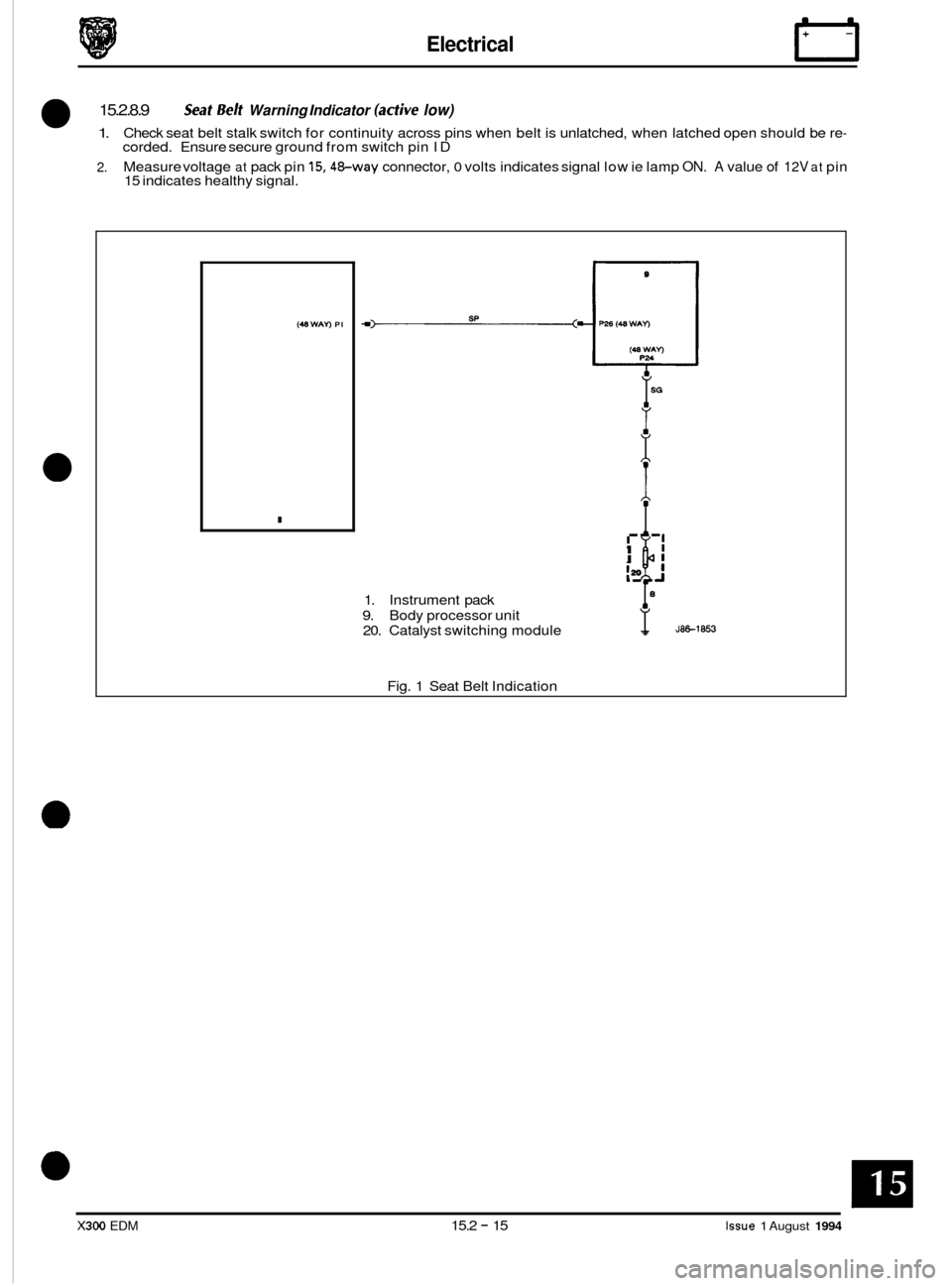
15.2.8.9
1.
2.
Seat Self Warning Indicator (acfive low)
Check seat belt stalk switch for continuity across pins when belt is unlatched, when latched open should be re- corded. Ensure secure ground from switch pin ID
Measure voltage
at pack pin 15,48-way connector, 0 volts indicates signal low ie lamp ON. A value of 12V at pin
15 indicates healthy signal.
(48 WAY) Pl
I
I
I
1. Instrument pack
9. Body processor unit
20. Catalyst switching module
Fig. 1 Seat Belt Indication
X300 EDM 15.2 - 15 Issue 1 August 1994