brake JAGUAR XJ6 1994 2.G Owner's Manual
[x] Cancel search | Manufacturer: JAGUAR, Model Year: 1994, Model line: XJ6, Model: JAGUAR XJ6 1994 2.GPages: 521, PDF Size: 17.35 MB
Page 192 of 521
Driveshafts & Final Drive
. Remove upper link assembly from differential and wide mounting bracket / 'A' frame.
. Release fixings, 'A' frame to differential, 'A' frame to wishbone tie and wide mounting bracket to 'A' frame.
. Remove wishbone tie assembly, rear mounting bracket and pendulum assembly.
. Release fixings differential nose to wide mounting bracket.
. Assembly and fitting is the reversal of this procedure, taking note of the following:
Drive shaft must be aligned in accordance with Sub
-Section 9.2.
Renew all self locking nuts.
Renew all bolts that were originally fitted with thread locking adhesive.
Replace all locking wire and split pins (cotter pins).
Tighten all fixings to the specified torque.
Correct the final drive oil level
if required.
Check and adjust rear wheel camber setting as required.
9.9 AXLE SHAFT ASSEMBLY, RENEW
SRO
47.10.01
Disconnect vehicle battery ground lead.
. Slacken appropriate axle shaft hub nut.
. Support the vehicle at the rear and remove rear road
. Remove brake caliper in accordance with 70.55.03. Sec-
wheel.
tion 12, but do not disconnect hydraulics.
Slacken hub carrier fulcrum and remove ABS sensor from
hub carrier.
. Remove axle shaft hub nut and collar.
. Remove fixings axle shaft to differential output shaft
flange, note camber shim.
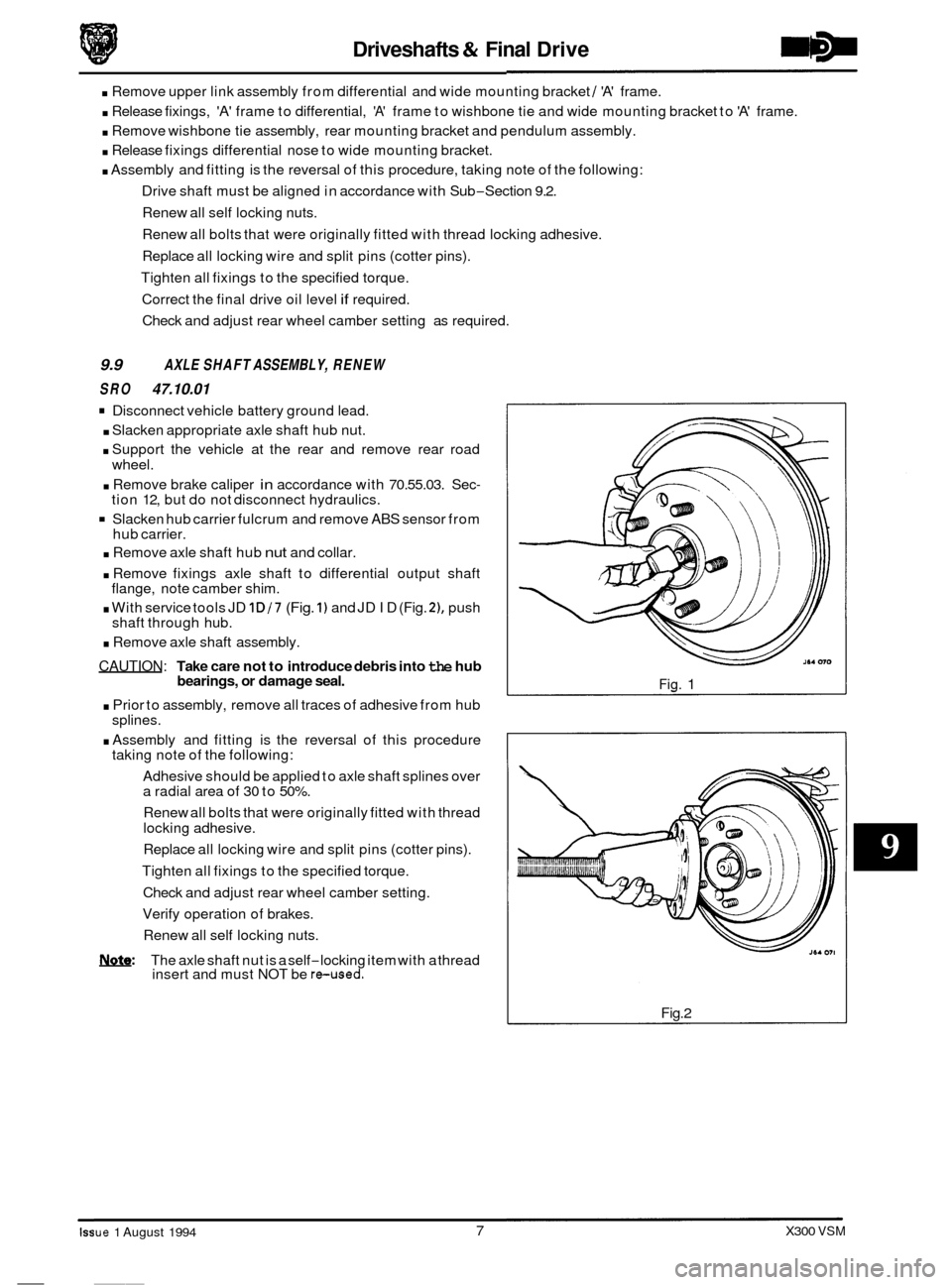
. With service tools JD 1D/7 (Fig. 1) and JD ID (Fig. 21, push
shaft through hub.
. Remove axle shaft assembly.
CAUTION: Take care not to introduce debris into the hub
bearings, or damage seal.
. Prior to assembly, remove all traces of adhesive from hub
. Assembly and fitting is the reversal of this procedure
Adhesive should be applied to axle shaft splines over
a radial area of
30 to 50%.
Renew all bolts that were originally fitted with thread
locking adhesive.
Replace all locking wire and split pins (cotter pins).
Tighten all fixings to the specified torque.
Check and adjust rear wheel camber setting.
Verify operation of brakes.
Renew all self locking nuts.
splines.
taking
note of the following:
0
NQ&: The axle shaft nut is a self-locking item with a thread
insert and must NOT be reused.
Fig. 1
Fig.2
- Iss ue 1 August 1994
__~
7 X300 VSM
Page 193 of 521
Driveshafts & Final Drive
9.10 REAR HUB BEARING, RENEW
SRO 64.15.14
9.11
SRO 64.15.15
REAR HUB OIL SEAL, RENEW
Removal
= Disconnect vehicle battery ground lead.
= Slacken appropriate axle shaft hub nut.
. Support the vehicle at the rear and remove rear road
m: To aid assembly, markthe position of the head of the
hub carrier fulcrum, relative to the wishbone slot.
. Disconnect handbrake cable inner and outer.
. Remove brake caliper in accordance with Section 12, but do not disconnect hydraulics.
. Slacken hub carrier fulcrum and remove ABS sensor from
hub carrier.
. Remove axle shaft hub nut (and discard), collar and hub
carrier fulcrum.
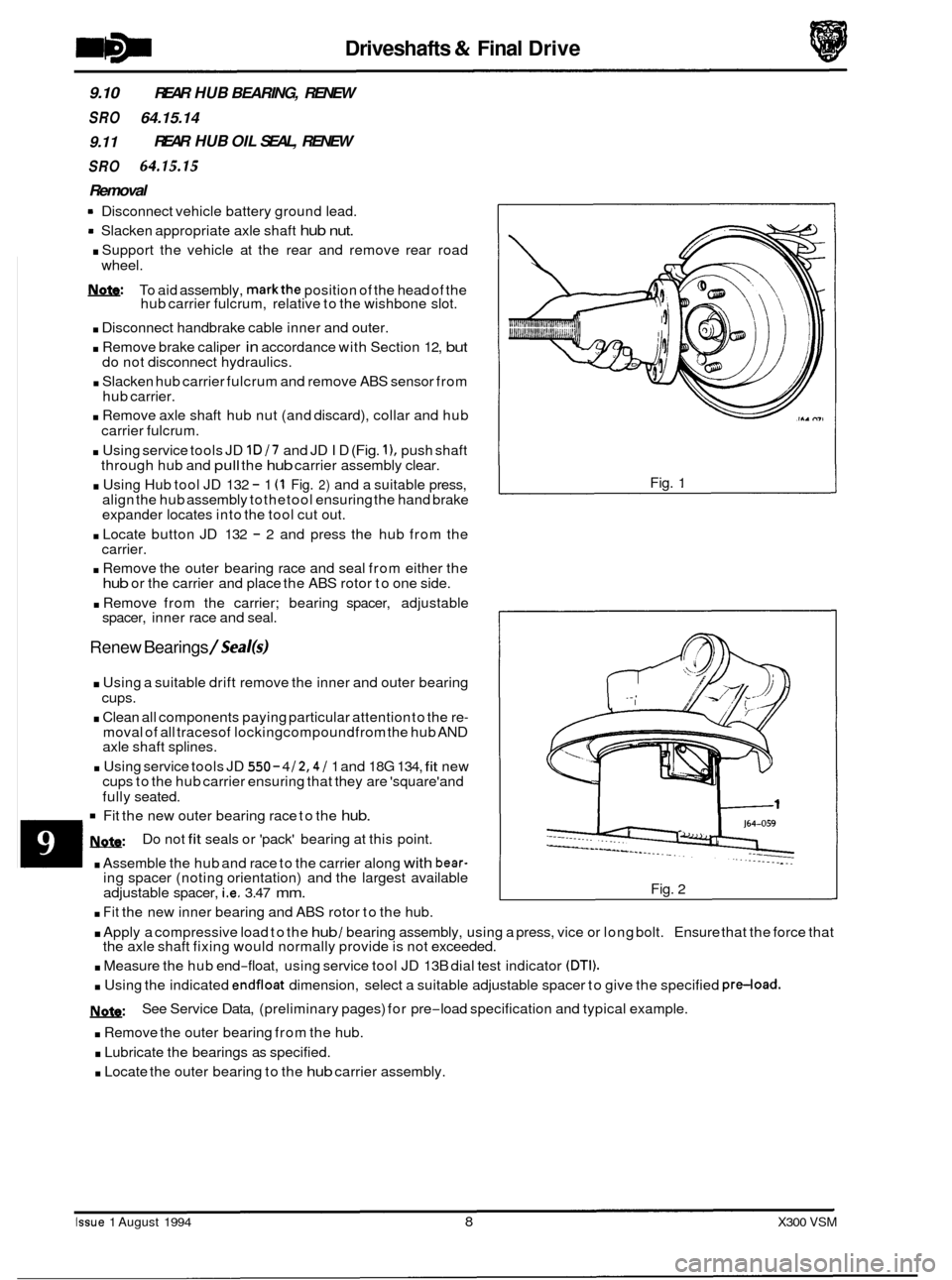
. Using service tools JD 1D/7 and JD ID (Fig. I), push shaft
through hub and pull the hub carrier assembly clear.
. Using Hub tool JD 132 - 1 (1 Fig. 2) and a suitable press,
align the hub assembly tothetool ensuring the hand brake
expander locates into the tool cut out.
. Locate button JD 132 - 2 and press the hub from the
carrier.
. Remove the outer bearing race and seal from either the hub or the carrier and place the ABS rotor to one side.
. Remove from the carrier; bearing spacer, adjustable
spacer, inner race and seal.
Renew Bearings /Sea/($
wheel.
. Using a suitable drift remove the inner and outer bearing
cups.
. Clean all components paying particular attention to the re- moval of all tracesof lockingcompoundfrom the hub AND
axle shaft splines.
. Using service tools JD 550 - 4 /2,4 / 1 and 18G 134, fit new
cups to the hub carrier ensuring that they are 'square'and
fully seated.
Fit the new outer bearing race to the hub.
&&Q:
. Assemble the hub and race to the carrier along with bear-
Do not fit seals or 'pack' bearing at this point.
ing spacer (noting orientation) and the largest available
adjustable spacer,
i.e. 3.47 mm.
. Fit the new inner bearing and ABS rotor to the hub. Fig.
1
Fig.
2
. Apply a compressive load to the hub / bearing assembly, using a press, vice or long bolt. Ensure that the force that
. Measure the hub end-float, using service tool JD 13B dial test indicator (DTI).
. Using the indicated endfloat dimension, select a suitable adjustable spacer to give the specified pre-load.
m:
. Remove the outer bearing from the hub.
. Lubricate the bearings as specified.
. Locate the outer bearing to the hub carrier assembly.
the axle shaft
fixing would normally provide is not exceeded.
See Service Data, (preliminary pages) for pre
-load specification and typical example.
Issue 1 August 1994 8 X300 VSM
Page 208 of 521
10.5 OUTER
TRACK ROD BALL JOINT, RENEW
sRo . Disconnect 57.55.02 vehicle battery ground lead.
. Raise the front of the vehicle and remove the appropriate
road wheel
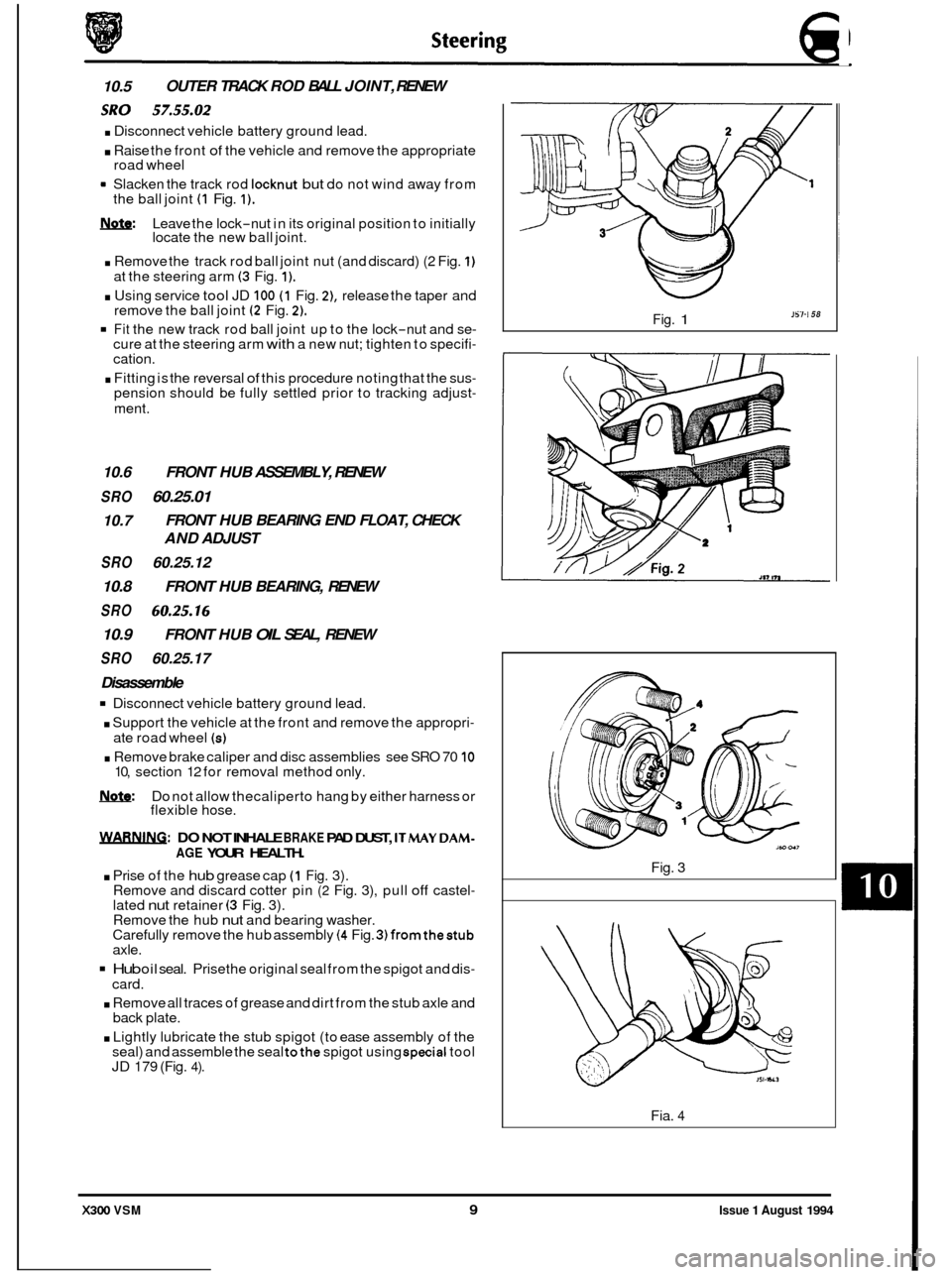
Slacken the track rod
locknut but do not wind away from
the ball joint (1 Fig. 1).
m: Leave the lock-nut in its original position to initially
locate the new ball joint.
. Remove the track rod ball joint nut (and discard) (2 Fig. 1)
at the steering arm (3 Fig. 1).
. Using service tool JD 100 (1 Fig. 2), release the taper and
remove the ball joint (2 Fig. 2).
Fit the new track rod ball joint up to the lock-nut and se- cure at the steering arm with a new nut; tighten to specifi- cation.
. Fitting is the reversal of this procedure noting that the sus- pension should be fully settled prior to tracking adjust-
ment.
0 10.6 FRONT HUB ASSEMBLY, RENEW
SRO 60.25.01
10.7
SRO 60.25.12
10.8 FRONT HUB BEARING, RENEW
SRO 60.25.16
10.9
SRO 60.25.17
Disassemble
Disconnect vehicle battery ground lead.
. Support the vehicle at the front and remove the appropri-
. Remove brake caliper and disc assemblies see SRO 70 10
IWQ: Do not allow thecaliperto hang by either harness or
flexible hose.
FRONT HUB BEARING END FLOAT, CHECK
AND ADJUST
FRONT HUB
OIL SEAL, RENEW
ate road wheel (s)
10, section 12 for removal method only.
WARNIM: DO NOT INHALE BRAKE PAD DUST, ITMAY DAM-
0
AGE YOUR HEALTH.
. Prise of the hub grease cap (1 Fig. 3).
Remove and discard cotter pin (2 Fig. 3), pull off castel- lated nut retainer (3 Fig. 3).
Remove the hub nut and bearing washer.
Carefully remove the hub assembly (4 Fig. 3)fromthestub axle.
Hub oil seal. Prise the original seal from the spigot and dis-
card.
. Remove all traces of grease and dirt from the stub axle and
back plate.
. Lightly lubricate the stub spigot (to ease assembly of the
seal) and assemble the seal tothe spigot using special tool JD 179 (Fig. 4).
JS7-i 58 Fig. 1
Fig. 3
Fia.
4
X300 VSM 9 Issue 1 August 1994
Page 217 of 521
Suspension Systems
11.4.3 Front End Inspection
Do not check and adjust front wheel alignment without carrying out the following inspection for front end damage and
wear:
. Check for specified air pressure in all four tires.
Raise front of vehicle off the floor; grasping upper and lower surface of the tire, shake each front wheel to check for
. Check front suspension lower arm ball joint and mounts for looseness, wear and damage.
Check steering gear mountings and all steering linkages for looseness.
. Renew parts if necessary.
. Grasp upper and lower surface of tire and shake each wheel to check wheel bearing end play.
. Check the action of the front dampers and the condition of their attachments, as sticking or binding front dampers
worn
bearings.
Check brake caliper mountings.
may not allow the vehicle to settle in to a normal level position, possibly affecting the front-wheel alignment.
m: Front wheel bearings are adjustable (0.001 to 0.003 in. endfloat).
11.4.4
. Check the wheel bearings.
. Inspect the front suspension upper joint and renew front suspension lower wishbone if needed.
Raise vehicle and position floor jacks beneath the front suspension lower wishbone.
Grasp the lower edge of the tire and move the wheel in and out.
While moving the wheel, observe the upper and lower wishbone.
. Movement between the vertical links and the wishbones indicates abnormal ball joint wear.
. Renew ball joints.
. Check the front wheel bearings.
. Check for excessive play and wear.
Upper / Lower Ball Joint Inspection
11.4.5 Damper Inspection
m: The gas-pressurized hydraulic front dampers are not serviceable, adjustable or refillable.
Verify that all attachments of the suspension components and the front dampers are tight. Renew any front damper
. Check front dampers for external damage.
. Check for oil leakage and vehicle sag.
that
has a damaged integral lower mounting bushing.
0 Oil Leak
Leakage is the condition in which the entire damper body is covered with oil and from where
it will drip on to
the pavement. Due to correct damper lubrication a light film of oil (weepage) can usually be seen on the upper
portion of the damper.
Should there be any leakage, ensure that the fluid does not originate from sources other than the front damper.
Renew worn or damaged dampers.
0 Vehicle Sag
Renewing front dampers will not correct the problem of vehicle sag, as basically this is controlled by the spring
units.
issue 1 August 1994 4 X300 VSM
Page 219 of 521
Suspension Systems
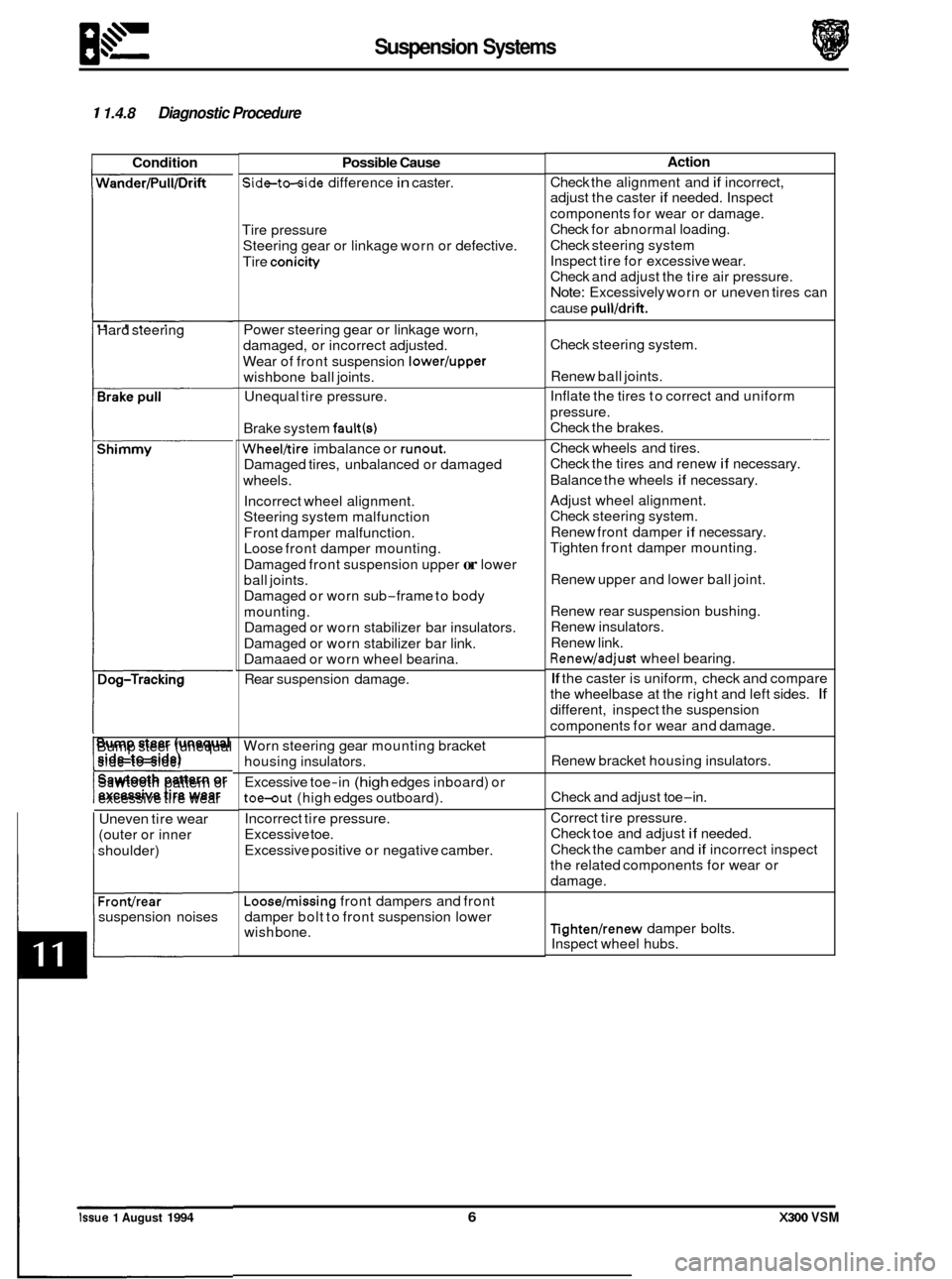
1 1.4.8 Diagnostic Procedure
Condition
Hard steering
Shimmy
I----
Bump steer (unequal
side-to-side)
Sawtooth pattern or
t excessive tire wear
Uneven tire wear
(outer or inner
shoulder)
Fronvrear
suspension noises
Possible Cause
Side-to-side difference in caster.
Tire pressure Steering gear or linkage worn or defective.
Tire
conicity
Power steering gear or linkage worn,
damaged, or incorrect adjusted.
Wear of front suspension
lower/upper
wishbone ball joints.
Unequal tire pressure.
Brake system
fault(s)
Wheel/tire imbalance or runout.
Damaged tires, unbalanced or damaged
wheels.
Incorrect wheel alignment.
Steering system malfunction
Front damper malfunction.
Loose front damper mounting.
Damaged front suspension upper
or lower
ball joints.
Damaged or worn sub
-frame to body
mounting. Damaged or worn stabilizer bar insulators.
Damaged or worn stabilizer bar link.
Damaaed or worn wheel bearina.
Rear suspension damage.
Worn steering gear mounting bracket
housing insulators.
Excessive toe
-in (high edges inboard) or
toe-out (high edges outboard).
Incorrect tire pressure.
Excessive toe.
Excessive positive or negative camber.
Loose/missing front dampers and front
damper bolt to front suspension lower
wish bone.
Action
Check the alignment and if incorrect,
adjust the caster
if needed. Inspect
components for wear or damage.
Check for abnormal loading.
Check steering system
Inspect tire for excessive wear.
Check and adjust the tire air pressure.
Note: Excessively worn or uneven tires can
cause
pull/drift.
Check steering system.
Renew ball joints.
Inflate the tires to correct and uniform
pressure.
Check the brakes.
Check wheels and tires.
Check the tires and renew
if necessary.
Balance the wheels
if necessary.
Adjust wheel alignment.
Check steering system.
Renew front damper
if necessary.
Tighten front damper mounting.
-
Renew upper and lower ball joint.
Renew rear suspension bushing.
Renew insulators.
Renew link.
Renew/adjust wheel bearing.
If the caster is uniform, check and compare
the wheelbase at the right and left sides.
If
different, inspect the suspension
components for wear and damage.
Renew bracket housing insulators.
Check and adjust toe
-in.
Correct tire pressure.
Check toe and adjust
if needed.
Check the camber and
if incorrect inspect
the related components for wear or
damage.
Tighten/renew damper bolts.
Inspect wheel hubs.
0
0
0
lssue 1 August 1994 6 X300 VSM
Page 220 of 521

Condition
30dy rolls
3ody leans
oor ride comfort
Seneral driving
nstability
Steering wheel does
lot return properly
S")
Suspension Systems I.\" b-
1 1.4.8 Diagnostic Procedure (continued)
Condition
30dy 'rolls'
3ody leans
'oor ride comfort
Seneral driving
nstability
Steering wheel does
lot return properly
Steering wheel pulls
:o one side
4bnormal noise
from suspension
system
Possible Cause
Weak front stabilizer bar.
Damaged or worn lower wishbone stabilizer
bar insulator. Damaged or worn stabilizer bar link
Damaged or worn rear suspension
wishbone bushing.
Damper malfunction.
Worn or deteriorated rear stabilizer bar
bushing(s). (supercharged, sports and XJ12
only)
Damaged or worn rear wishbone bushing
and weak springs.
Worn or deteriorated rear stabilizer bar
bushing(s). (supercharged, sports and XJ12
only)
Front or rear damper malfunction.
Weak
spring(s1
Damaged tires or unbalanced wheels.
Incorrect wheel alignment.
Steering system malfunction.
Damaged front suspension lower and upper
ball joints.
Damaged or worn sub
-frame to body
mounting.
Damaged or worn stabilizer bar link
Damaged or worn lower wishbone stabilizer
bar insulator.
Weak
spring(s)
Worn or deteriorated rear stabilizer bushing
(s). (supercharged, sports and XJ12 only)
Damaged tires or unbalanced wheels and
incorrect tire pressure.
Incorrect wheel alignment.
Steering system malfunction.
Damaged front suspension lower and upper
ball joints.
Incorrect tire pressure.
Damaged front suspension lower and upper
ball joints. Braking system malfunction.
Steering system malfunction.
Damaged or worn sub
-frame to body
mounting.
Damaged tires, unbalanced wheels and
incorrect tire pressure.
Poor lubrication /wear of wheel bearing.
Wear of front suspension lower and upper
ball joints.
Damaged or worn front stabilizer bar
Damaged or worn stabilizer bar link.
Damaged or worn stabilizer bar bracket.
Looseness of suspension connections.
Damaged or worn rear wishbone bushing.
Front and rear damper malfunction.
Weak
spring.Worn or deteriorated rear
stabilizer bushing
(s). (supercharged, sports
and
XJ12 only)
Action
3enew front stabilizer bar.
3enew insulators.
3enew link.
Renew bushing.
Renew damper
if necessary.
Renew Bushina
Renew bushings and springs.
Renew Bushings.
Renew dampers.
Renew springs.
Check the tires.
Adjust the wheel alignment.
Check steering system.
Renew ball joints.
Renew bushing.
Renew link.
Renew insulator.
Renew springs.
Renew bushing
Check tires.
Adjust the wheel alignment.
Check steering system.
Renew ball joints.
Check and correct tire pressure.
Renew ball joints.
Check brakes.
Check steering system.
Renew bushing.
Check tires.
Renew wheel bearing.
Renew ball joints.
Renew stabilizer bar.
Renew link.
Renew bracket.
Tighten connections.
Renew bushing.
Renew dampers.
Renew bushing
Issue 1 August 1994 X300 VSM 7
Page 222 of 521
SECTION CONTENTS
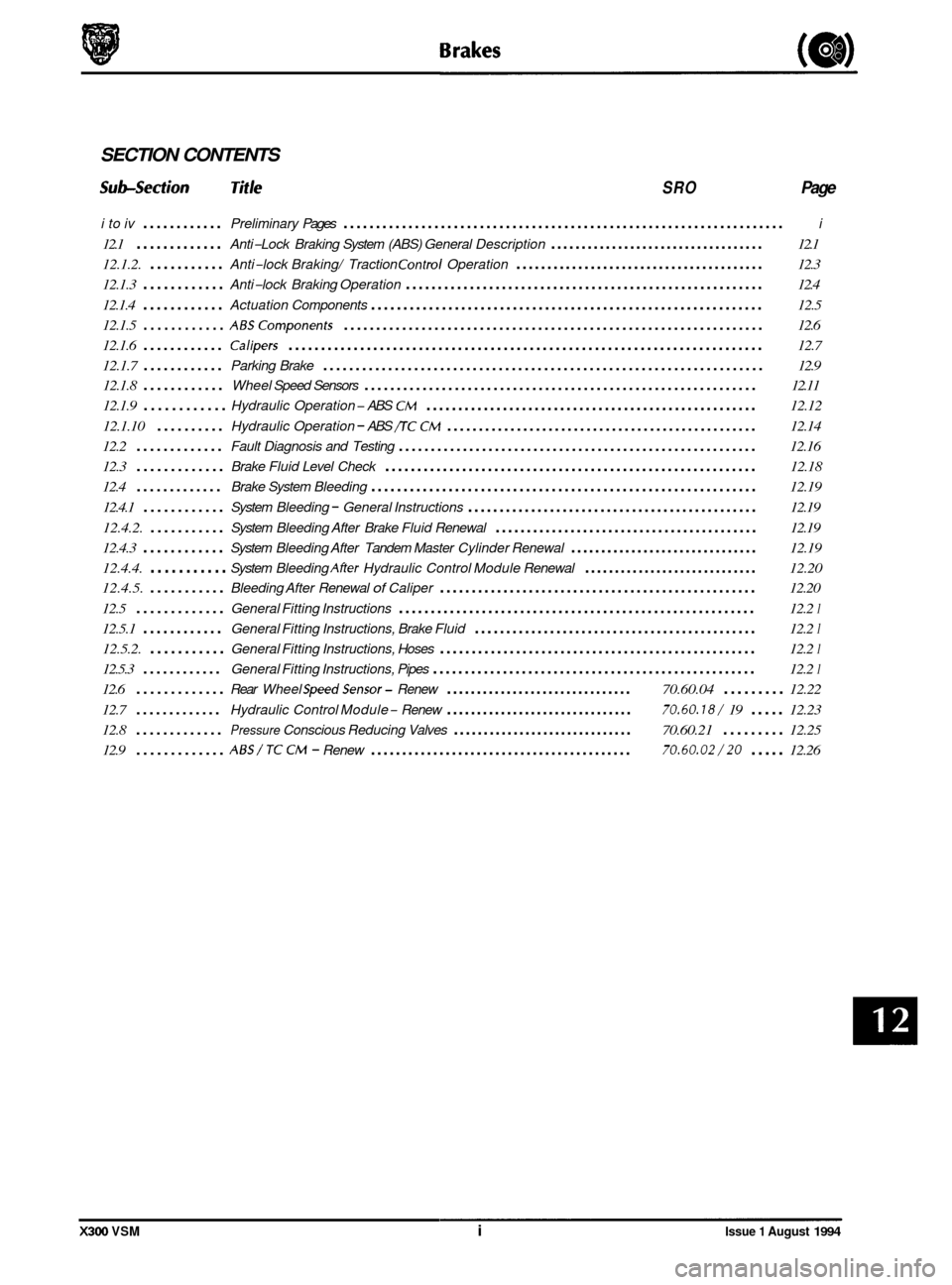
Subsection Tit/e SRO Page
i to iv ............ Preliminary Pages .................................................................... i
12.1 ............. Anti-Lock Braking System (ABS) General Description ................................... 12.1
12.1.2.
........... Anti-lock Braking/ Traction Contd Operation ........................................ 12.3
12.1.3
............ Anti-lock Braking Operation ........................................................ 12.4
12.1.4
............ Actuation Components ............................................................. 12.5
12.1.5
............ ABSComponents ................................................................. 12.6
12.1.6
............ Calipers ........................................................................\
. 12.7
12.1.7
............ Parking Brake .................................................................... 12.9
12.1.8
............ Wheel Speed Sensors ............................................................. 12.11
12.1.9
............ Hydraulic Operation - ABS CM .................................................... 12.12
12.2
............. Fault Diagnosis and Testing ........................................................ 12.16
12.4
............. Brake System Bleeding ............................................................ 12.19
12.1.10
.......... Hydraulic Operation - ABS /TC CM ................................................. 12.14
12.3
............. Brake Fluid Level Check .......................................................... 12.18
12.4.1
............ System Bleeding - General Instructions .............................................. 12.19
12.4.2.
........... System Bleeding After Brake Fluid Renewal .......................................... 12.19
12.4.3
............ System Bleeding After Tandem Master Cylinder Renewal ............................... 12.19
12.4.4.
........... System Bleeding Afier Hydraulic Control Module Renewal ............................. 12.20
12.4.5.
........... Bleeding After Renewal of Caliper .................................................. 12.20
12.5
............. General Fitting Instructions ........................................................ 12.2 1
12.5.1 ............ General Fitting Instructions, Brake Fluid ............................................. 12.2 1
12.5.2. ........... General Fitting Instructions, Hoses .................................................. 12.2 1
12.5.3 ............ General Fitting Instructions, Pipes ................................................... 12.2 1
12.6 ............. Rear Wheel Speedsensor- Renew ............................... 70.60.04 ......... 12.22
12.7
............. Hydraulic Control Module- Renew ............................... 70.60.18/ 19 ..... 12.23
12.8
............. Pressure Conscious Reducing Valves .............................. 70.60.21 ......... 12.25
12.9
............. ABS/TCCM - Renew .......................................... 70.60.02/20 ..... 12.26
X300 VSM i Issue 1 August 1994
Page 223 of 521

1. SERVICE TOOLS & EQUIPMENT
Description
Parking brake cable remover
Illustration
Notes
not
illustrated
Pipe connectors to hydraulic module:
M12
M10
Jaguar Number
JD.142
15
- 19
12 - 16
186.672
Description
U-
Molykote 11 1 Caliper to carrier securing bolts
6947017
Notes
JDS.9013
Replacer disc brake
piston seal
I
Brake hose clamp, Girling
Brake pedal hold down tool
11. TORQUE TIGHTENING SPECIFICATIONS
Fixing 1 Tightening Torque
(Nm)
Vacuum booster to pedal box I 21 -29 I
Tandem master cylinder to booster I 21 -29 I
Hvdraulic module to module bracket I 18 - 26 I
Caliper guide pins I 25 - 35 I
Caliper to vertical link I 120 - 160 I
Caliper to hub carrier I 54 - 66 I
111. SERVICE MATERIALS
Iv. SERVICE DATA
Front brake disc run out
Front brake
disc parallelism
Rear brake disc
run out
Rear brake disc parallelism 0.101
mm (0.004 in) max.
0.0127mm (0.0005in) max.
0.101
mm (0.004 in) max.
0.0127mm (0.0005in) max.
Issue 1 August 1994 ii X300 VSM
Page 224 of 521
12.1 ANTI-LOCK BRAKING SYSTEM (ASS), GENERAL DESCRIPTION
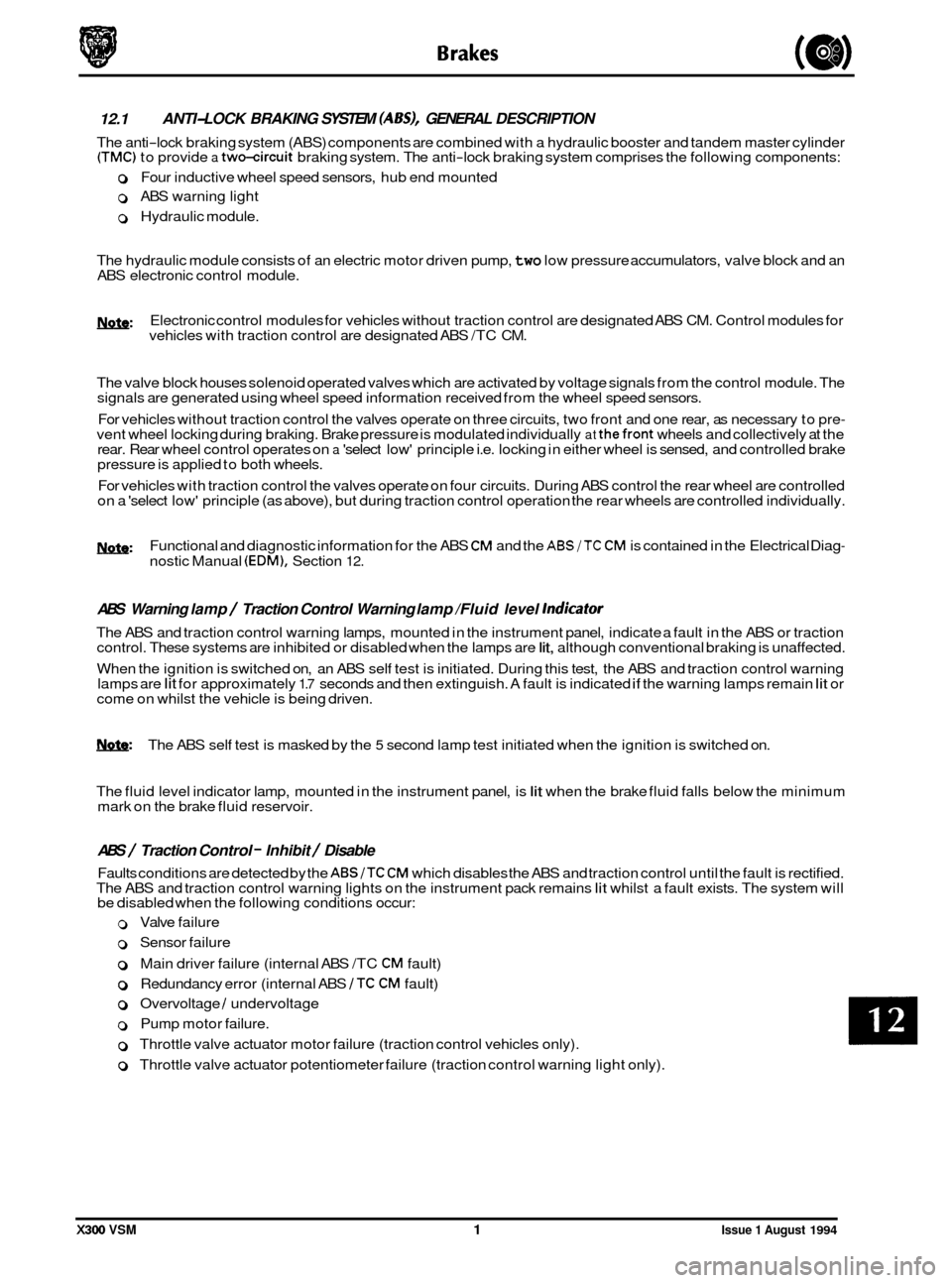
The anti-lock braking system (ABS) components are combined with a hydraulic booster and tandem master cylinder (TMC) to provide a two-circuit braking system. The anti-lock braking system comprises the following components:
0 Four inductive wheel speed sensors, hub end mounted
0 ABS warning light
0 Hydraulic module.
The hydraulic module consists of an electric motor driven pump,
two low pressure accumulators, valve block and an
ABS electronic control module.
m: Electronic control modules for vehicles without traction control are designated ABS CM. Control modules for
vehicles with traction control are designated ABS /TC CM.
The valve block houses solenoid operated valves which are activated by voltage signals from the control module. The
signals are generated using wheel speed information received from the wheel speed sensors.
For vehicles without traction control the valves operate on three circuits, two front and one rear, as necessary to pre
- vent wheel locking during braking. Brake pressure is modulated individually at thefront wheels and collectively at the
rear. Rear wheel control operates on a 'select low' principle i.e. locking in either wheel is sensed, and controlled brake
pressure is applied to both wheels.
For vehicles with traction control the valves operate on four circuits. During ABS control the rear wheel are controlled
on a 'select low' principle (as above), but during traction control operation the rear wheels are controlled individually.
0
1yQfB: Functional and diagnostic information for the ABS CM and the ABS/TC CM is contained in the Electrical Diag-
nostic Manual (EDM), Section 12.
ABS Warning lamp / Traction Control Warning lamp /Fluid level Indicator
The ABS and traction control warning lamps, mounted in the instrument panel, indicate a fault in the ABS or traction
control. These systems are inhibited or disabled when the lamps are lit, although conventional braking is unaffected.
When the ignition is switched on, an ABS self test is initiated. During this test, the ABS and traction control warning
lamps are
lit for approximately 1.7 seconds and then extinguish. A fault is indicated if the warning lamps remain lit or
come on whilst the vehicle is being driven.
W: The ABS self test is masked by the 5 second lamp test initiated when the ignition is switched on.
The fluid level indicator lamp, mounted in the instrument panel, is
lit when the brake fluid falls below the minimum
mark on the brake fluid reservoir.
ABS / Traction Control - Inhibit / Disable
Faults conditions are detected by the ABS/TC CM which disables the ABS and traction control until the fault is rectified.
The ABS and traction control warning lights on the instrument pack remains lit whilst a fault exists. The system will
be disabled when the following conditions occur:
0
0 Valve failure
0 Sensor failure
0 Main driver failure (internal ABS /TC CM fault)
0 Redundancy error (internal ABS JTC CM fault)
0 Overvoltage J undervoltage
0 Pump motor failure.
0 Throttle valve actuator motor failure (traction control vehicles only).
0 Throttle valve actuator potentiometer failure (traction control warning light only).
X300 VSM 1 Issue 1 August 1994
Page 226 of 521
Brakes (a)
12.1.2. Anti-lock Braking / Traction Control Operation
The rear wheels are controlled collectively on a 'select-low' principle during ABS operation. During traction control,
separate circuits allow individual control of the rear wheels. To facilitate this the valve block has four outlet ports.
The
ABS/TC CM is integrated with the valve block. The pump, motor, valve block and control module are supplied as
a unit and are non-sewiceable. Faulty units must be renewed as a whole.
Both front and rear brakes on
all vehicles are fitted with single piston caliper assemblies. Ventilated brake rotors, with
provision for parking brake shoes at the rear, are fitted all round.
0
Issue 1 August 1994 X300 VSM 3
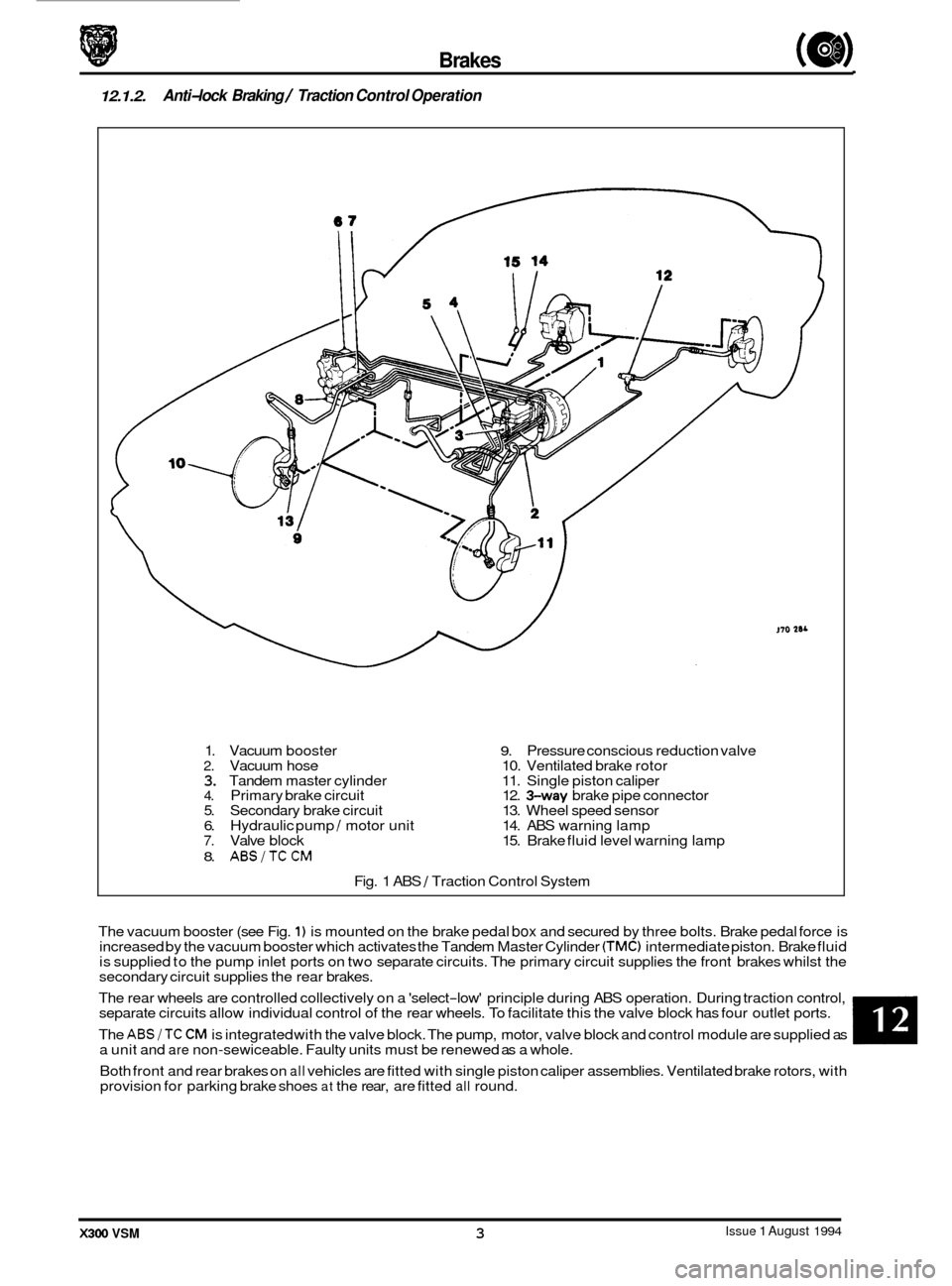
1. Vacuum booster 9. Pressure conscious reduction valve 2. Vacuum hose 10. Ventilated brake rotor 3. Tandem master cylinder 11. Single piston caliper 4. Primary brake circuit 12. %way brake pipe connector
5. Secondary brake circuit 13. Wheel speed sensor
6. Hydraulic pump / motor unit 14. ABS warning lamp 7. Valve block 15. Brake fluid level warning lamp
8. ABS/TCCM
Fig. 1 ABS / Traction Control System
The vacuum booster (see Fig.
1) is mounted on the brake pedal box and secured by three bolts. Brake pedal force is
increased by the vacuum booster which activates the Tandem Master Cylinder (TMC) intermediate piston. Brake fluid
is supplied to the pump inlet ports on two separate circuits. The primary circuit supplies the front brakes whilst the
secondary circuit supplies the rear brakes.