brake JAGUAR XJ6 1994 2.G Owner's Guide
[x] Cancel search | Manufacturer: JAGUAR, Model Year: 1994, Model line: XJ6, Model: JAGUAR XJ6 1994 2.GPages: 521, PDF Size: 17.35 MB
Page 227 of 521
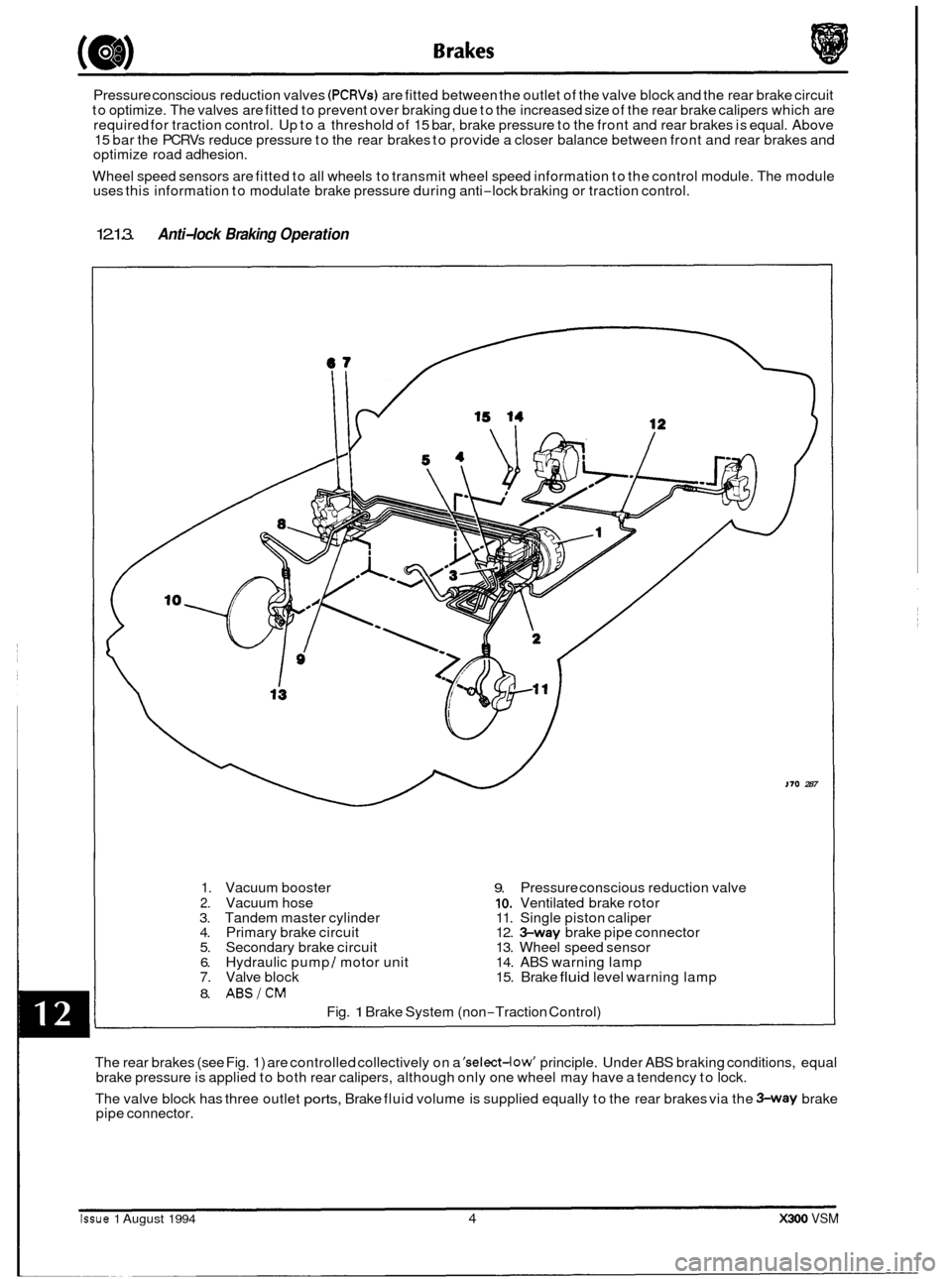
Pressure conscious reduction valves (PCRVs) are fitted between the outlet of the valve block and the rear brake circuit
to optimize. The valves are fitted to prevent over braking due to the increased size of the rear brake calipers which are
required for traction control. Up to a threshold of 15 bar, brake pressure to the front and rear brakes is equal. Above
15 bar the PCRVs reduce pressure to the rear brakes to provide a closer balance between front and rear brakes and
optimize road adhesion.
Wheel speed sensors are fitted to all wheels to transmit wheel speed information to the control module. The module
uses this information to modulate brake pressure during anti
-lock braking or traction control.
12.1.3. Anti-lock Braking Operation
170 287
1. Vacuum booster 9. Pressure conscious reduction valve
2. Vacuum hose 10. Ventilated brake rotor
3. Tandem master cylinder 11. Single piston caliper
4. Primary brake circuit 12.
%way brake pipe connector
5. Secondary brake circuit 13. Wheel speed sensor
6. Hydraulic pump I motor unit 14. ABS warning lamp 7. Valve block 15. Brake fluid level warning lamp
8. ABSICM
Fig. 1 Brake System (non-Traction Control)
The rear brakes (see Fig. 1) are controlled collectively on a
'select-low' principle. Under ABS braking conditions, equal
brake pressure is applied to both rear calipers, although only one wheel may have a tendency to lock.
The valve block has three outlet
ports, Brake fluid volume is supplied equally to the rear brakes via the %way brake
pipe connector.
Issue 1 August 1994 4 X300 VSM
Page 229 of 521
12.1.5. ABS Components
Hydraulic Module
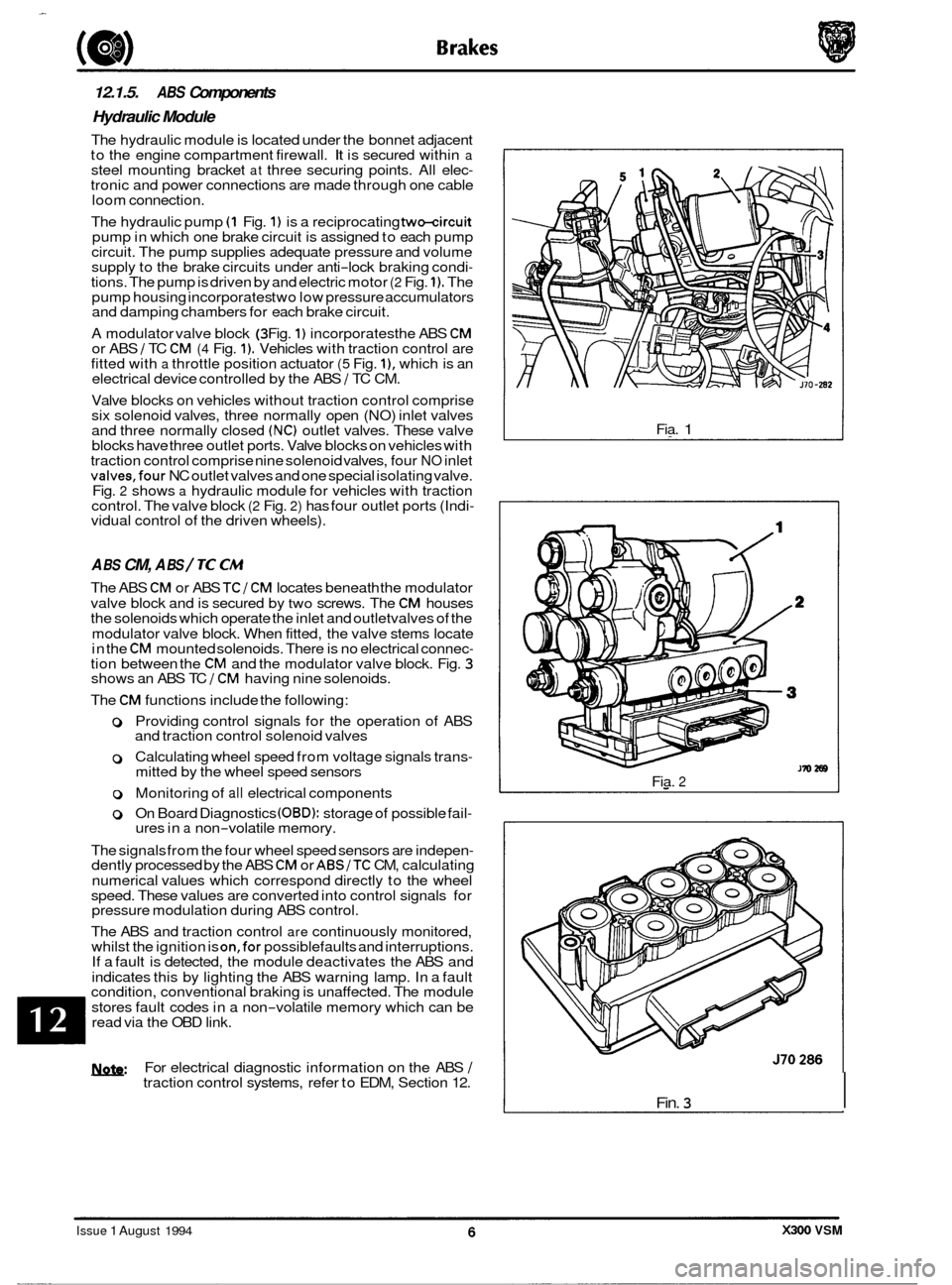
The hydraulic module is located under the bonnet adjacent
to the engine compartment firewall. It is secured within a steel mounting bracket at three securing points. All elec- tronic and power connections are made through one cable
loom connect ion.
The hydraulic pump
(1 Fig. 1) is a reciprocating two-circuit pump in which one brake circuit is assigned to each pump
circuit. The pump supplies adequate pressure and volume
supply to the brake circuits under anti
-lock braking condi- tions. The pump is driven by and electric motor (2 Fig. 1). The
pump housing incorporates two low pressure accumulators
and damping chambers for each brake circuit.
A modulator valve block
(3 Fig. 1) incorporates the ABS CM or ABS / TC CM (4 Fig. 1). Vehicles with traction control are
fitted with a throttle position actuator (5 Fig. I), which is an
electrical device controlled by the ABS 1 TC CM.
Valve blocks on vehicles without traction control comprise
six solenoid valves, three normally open (NO) inlet valves
and three normally closed
(NC) outlet valves. These valve
blocks have three outlet ports. Valve blocks on vehicles with
traction control comprise nine solenoid valves, four
NO inlet valves,four NC outlet valves and one special isolating valve.
Fig. 2 shows a hydraulic module for vehicles with traction
control. The valve block (2 Fig. 2) has four outlet ports (Indi- vidual control of the driven wheels).
A BS CM, A BS / TC CM
The ABS CM or ABS TCI CM locates beneath the modulator
valve block and is secured by
two screws. The CM houses
the solenoids which operate the inlet and outletvalves of the
modulator valve block. When fitted, the valve stems locate
in the
CM mounted solenoids. There is no electrical connec- tion between the CM and the modulator valve block. Fig. 3 shows an ABS TC 1 CM having nine solenoids.
The
CM functions include the following:
0 Providing control signals for the operation of ABS
and traction control solenoid valves
0 Calculating wheel speed from voltage signals trans- mitted by the wheel speed sensors
0 Monitoring of all electrical components
0 On Board Diagnostics (OBD): storage of possible fail- ures in a non-volatile memory.
The signals from the four wheel speed sensors are indepen
- dently processed by the ABS CM or ABSITC CM, calculating
numerical values which correspond directly to the wheel
speed. These values are converted into control signals for
pressure modulation during ABS control.
The ABS and traction control
are continuously monitored,
whilst the ignition is on,for possiblefaults and interruptions.
If a fault is detected, the module deactivates the ABS and
indicates this by lighting the ABS warning lamp. In a fault
condition, conventional braking is unaffected. The module
stores fault codes in a non
-volatile memory which can be
read via the OBD link.
U: For electrical diagnostic information on the ABS I traction control systems, refer to EDM, Section 12. Fia.
1
Fia. 2
Fin. 3 I
J70286
Issue 1 August 1994 X300 VSM
Page 230 of 521
0 12.1.6 Calipers
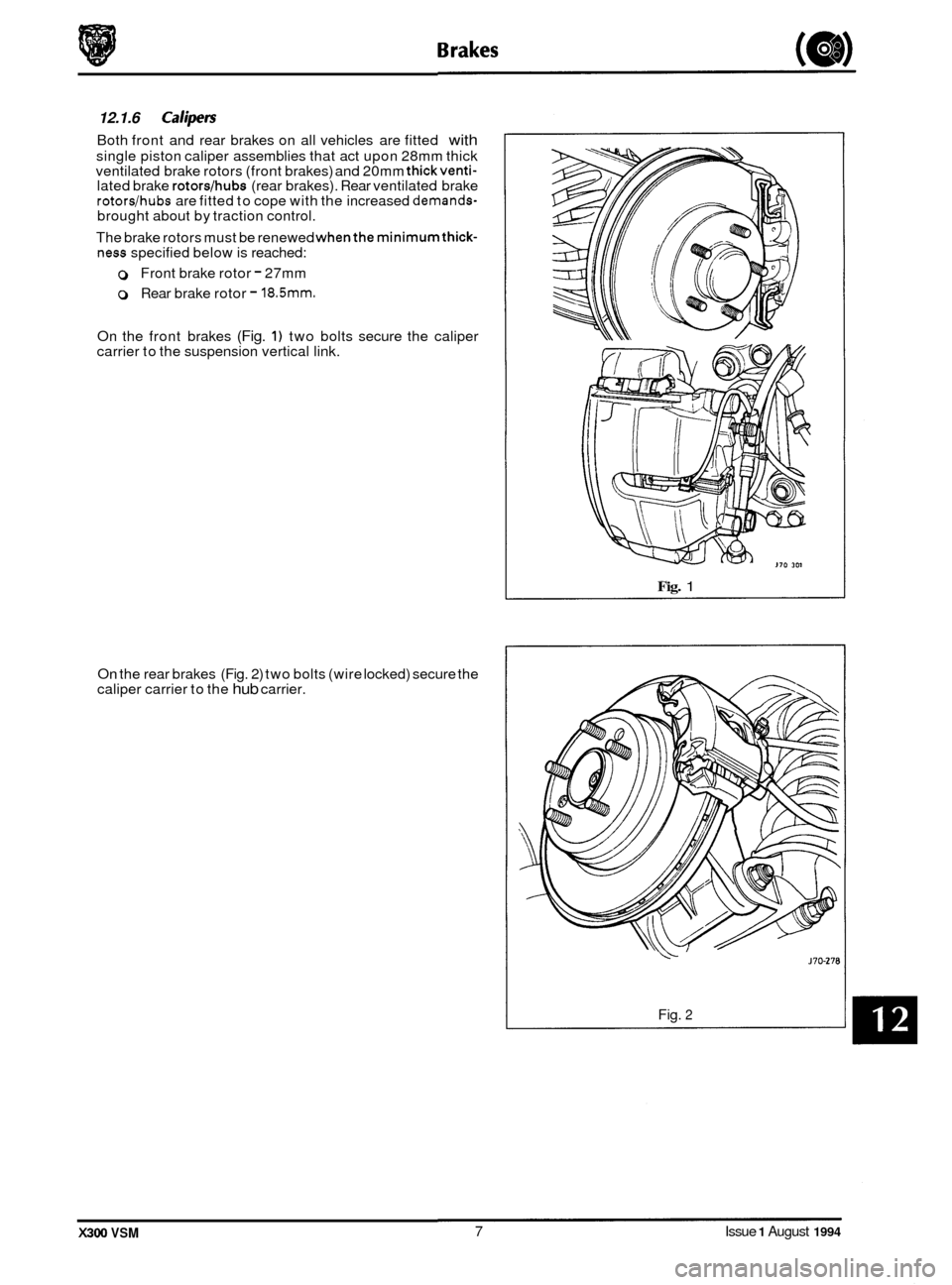
Both front and rear brakes on all vehicles are fitted with
single piston caliper assemblies that act upon 28mm thick
ventilated brake rotors (front brakes) and 20mm thickventi- lated brake rotors/hubs (rear brakes). Rear ventilated brake rotordhubs are fitted to cope with the increased demands- brought about by traction control.
The brake rotors must be renewed
whenthe minimumthick- ness specified below is reached:
0 Front brake rotor - 27mm
0 Rear brake rotor - 18.5mm.
On the front brakes (Fig. 1) two bolts secure the caliper
carrier to the suspension vertical link.
On the rear brakes (Fig. 2) two bolts (wire locked) secure the
caliper carrier to the hub carrier.
Fig. 1
\
Fig. 2
J70-278
X300 VSM 7 Issue 1 August 1994
Page 231 of 521
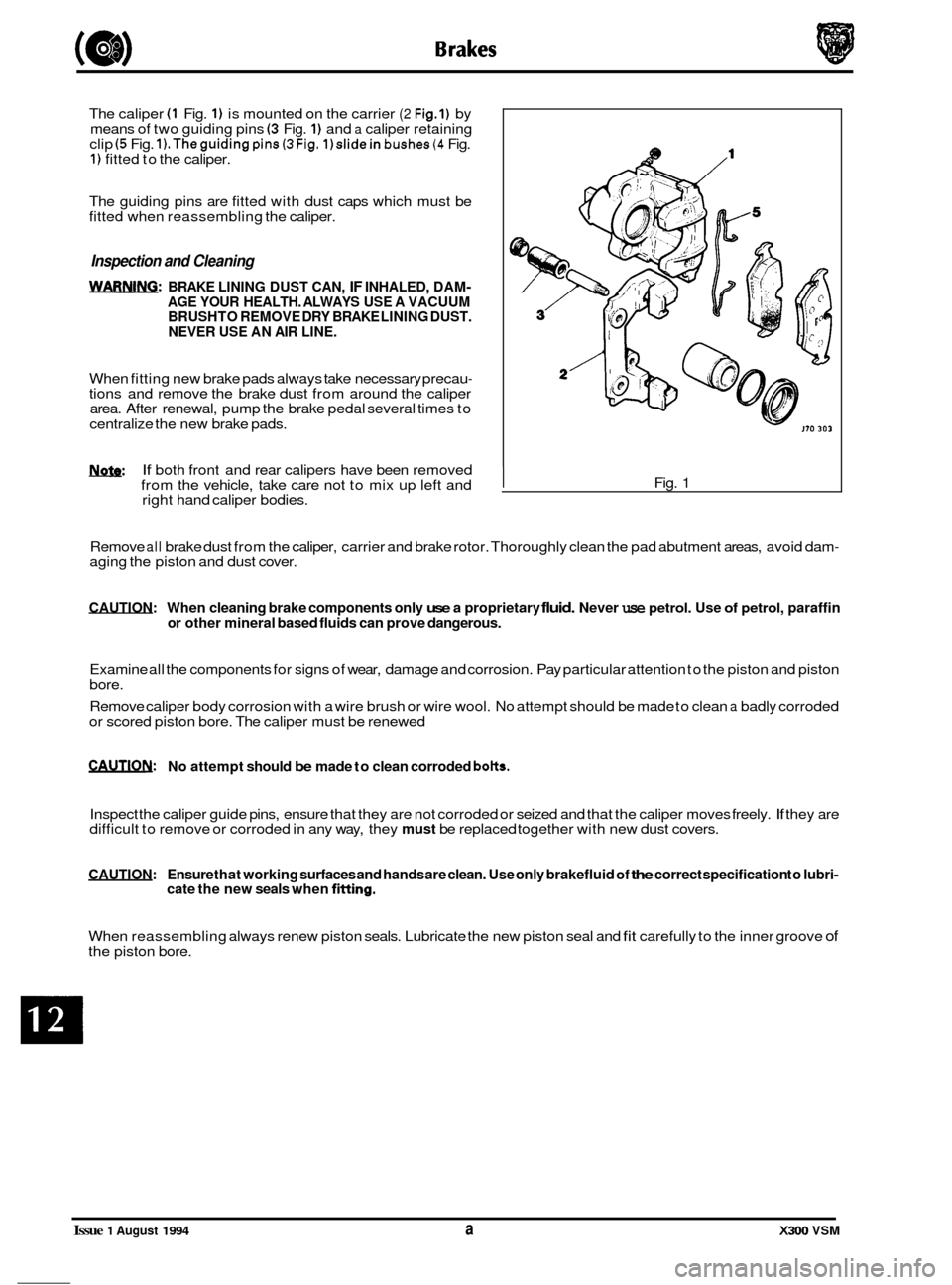
The caliper (1 Fig. 1) is mounted on the carrier (2 Fig.1) by
means of two guiding pins (3 Fig. 1) and a caliper retaining
clip (5 Fig. ILTheguiding pins(3Fig. 1)slidein bushes(4 Fig. 1) fitted to the caliper.
The guiding pins are fitted with dust caps which must be
fitted when reassembling the caliper.
Inspection and Cleaning
WAR- BRAKE LINING DUST CAN, IF INHALED, DAM-
AGE YOUR HEALTH. ALWAYS USE A VACUUM
BRUSH TO REMOVE DRY BRAKE LINING DUST.
NEVER USE AN AIR LINE.
When fitting new brake pads always take necessary precau- tions and remove the brake dust from around the caliper
area. After renewal, pump the brake pedal several times to
centralize the new brake pads.
W: If both front and rear calipers have been removed
from the vehicle, take care not to mix up left and
right hand caliper bodies. I Fig. 1
Remove
all brake dust from the caliper, carrier and brake rotor. Thoroughly clean the pad abutment areas, avoid dam- aging the piston and dust cover.
CAUTION: When cleaning brake components only use a proprietary fluid. Never use petrol. Use of petrol, paraffin
or other mineral based fluids can prove dangerous.
Examine all the components for signs of wear, damage and corrosion. Pay particular attention to the piston and piston
bore.
Remove caliper body corrosion with a wire brush or wire wool.
No attempt should be made to clean a badly corroded
or scored piston bore. The caliper must be renewed
CAUTIW: No attempt should be made to clean corroded bolts.
Inspect the caliper guide pins, ensure that they are not corroded or seized and that the caliper moves freely. If they are
difficult to remove or corroded in any way, they must be replaced together with new dust covers.
CAUTION: Ensure that working surfaces and hands are clean. Use only brake fluid of the correct specification to lubri- cate the new seals when fitting.
When reassembling always renew piston seals. Lubricate the new piston seal and fit carefully to the inner groove of the piston bore.
Issue 1 August 1994 a X300 VSM
Page 232 of 521
Brakes (e#
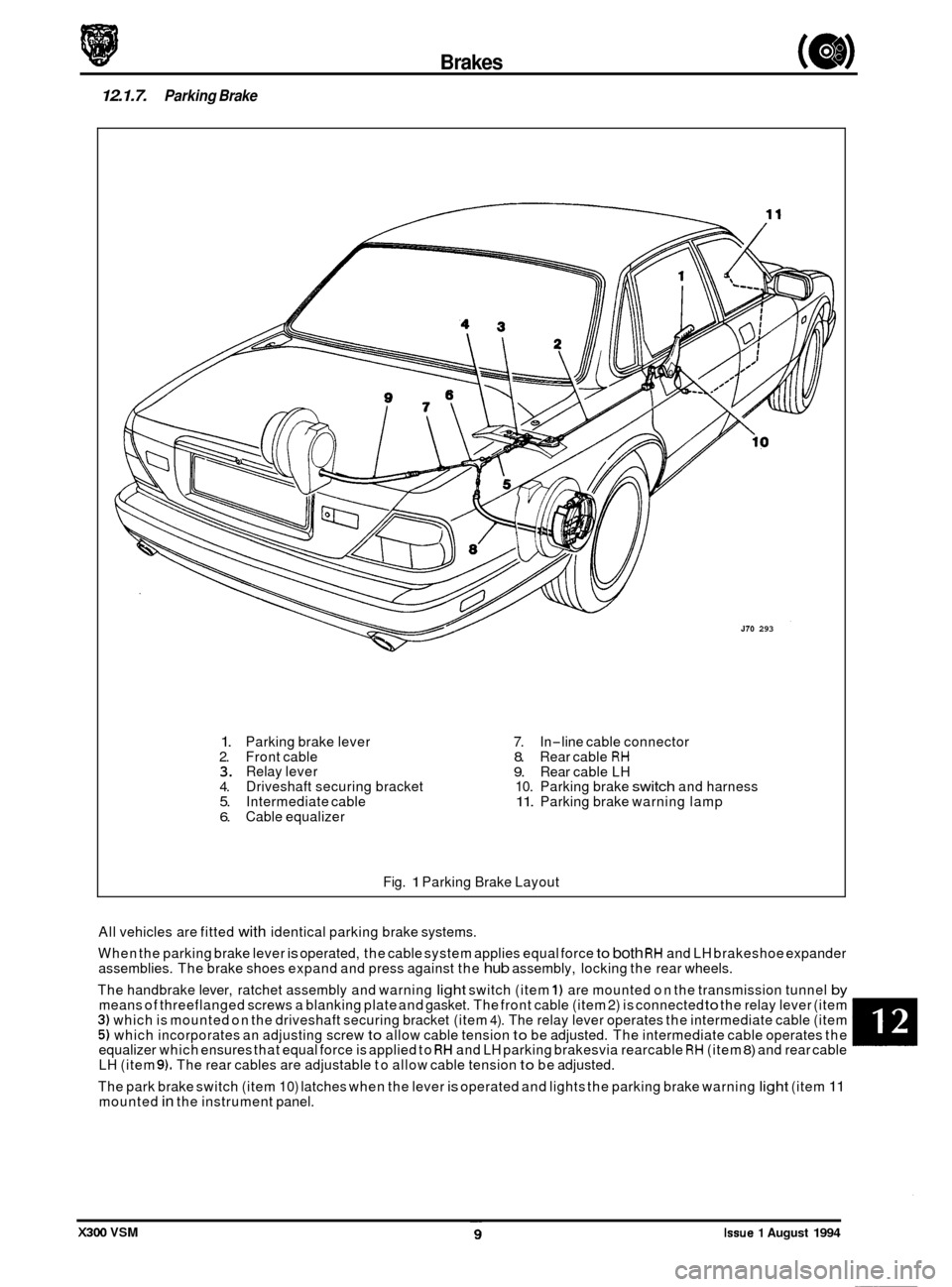
12.1.7. Parking Brake
J70 293
W
1. Parking brake lever 2. Front cable 3. Relay lever 4. Driveshaft securing bracket 5. Intermediate cable 6. Cable equalizer
7. In-line cable connector 8. Rear cable RH 9. Rear cable LH
10. Parking brake switch and harness 11. Parking brake warning lamp
Fig.
1 Parking Brake Layout
All vehicles are fitted with identical parking brake systems.
When the parking brake lever
is operated, the cable system applies equal force to both RH and LH brakeshoe expander
assemblies. The brake shoes expand and press against the hub assembly, locking the rear wheels.
The handbrake lever, ratchet assembly and warning
light switch (item 1) are mounted on the transmission tunnel by means of threeflanged screws a blanking plate and gasket. The front cable (item 2) is connected to the relay lever (item 3) which is mounted on the driveshaft securing bracket (item 4). The relay lever operates the intermediate cable (item 5) which incorporates an adjusting screw to allow cable tension to be adjusted. The intermediate cable operates the
equalizer which ensures that equal force is applied to RH and LH parking brakesvia rearcable RH (item 8) and rear cable
LH (item 9). The rear cables are adjustable to allow cable tension to be adjusted.
The park brake switch (item 10) latches when the lever
is operated and lights the parking brake warning light (item 11 mounted in the instrument panel.
X300 VSM Issue 1 August 1994
Page 233 of 521
Brakes
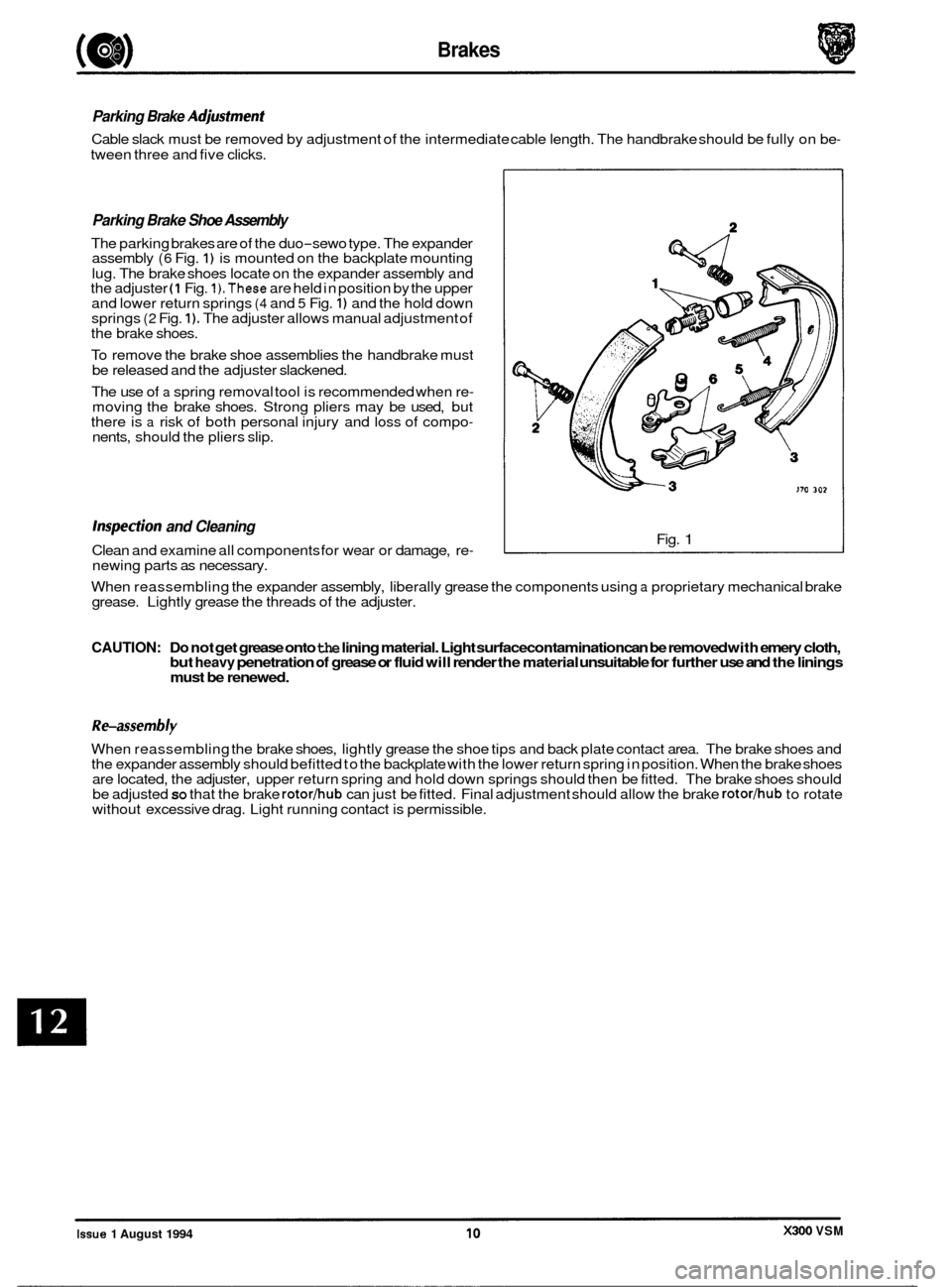
Parking Brake Adjusfmenf
Cable slack must be removed by adjustment of the intermediate cable length. The handbrake should be fully on be-
tween three and five clicks.
Parking Brake Shoe Assembly
The parking brakes are of the duo-sewo type. The expander
assembly (6 Fig. 1) is mounted on the backplate mounting
lug. The brake shoes locate on the expander assembly and
the adjuster
(1 Fig. I).These are held in position by the upper
and lower return springs (4 and 5 Fig. 1) and the hold down
springs (2 Fig. 1). The adjuster allows manual adjustment of
the brake shoes.
To remove the brake shoe assemblies the handbrake must
be released and the adjuster slackened.
The use of
a spring removal tool is recommended when re- moving the brake shoes. Strong pliers may be used, but
there is a risk of both personal injury and loss of compo- nents, should the pliers slip.
lnspedion and Cleaning
Clean and examine all components for wear or damage, re- newing parts as necessary. Fig.
1
When
reassembling the expander assembly, liberally grease the components using a proprietary mechanical brake
grease. Lightly grease the threads of the adjuster.
CAUTION: Do not get grease onto the lining material. Light surfacecontamination can be removed with emery cloth,
but heavy penetration of grease or fluid will render the material unsuitable for further use and the linings
must be renewed.
Re-assembly
When reassembling the brake shoes, lightly grease the shoe tips and back plate contact area. The brake shoes and
the expander assembly should befitted to the backplate with the lower return spring in position. When the brake shoes
are located, the adjuster, upper return spring and hold down springs should then be fitted. The brake shoes should
be adjusted
so that the brake rotorhub can just be fitted. Final adjustment should allow the brake rotor/hub to rotate
without excessive drag. Light running contact is permissible.
0
0
0
0
X300 VSM Issue 1 August 1994 10
Page 234 of 521
Brakes
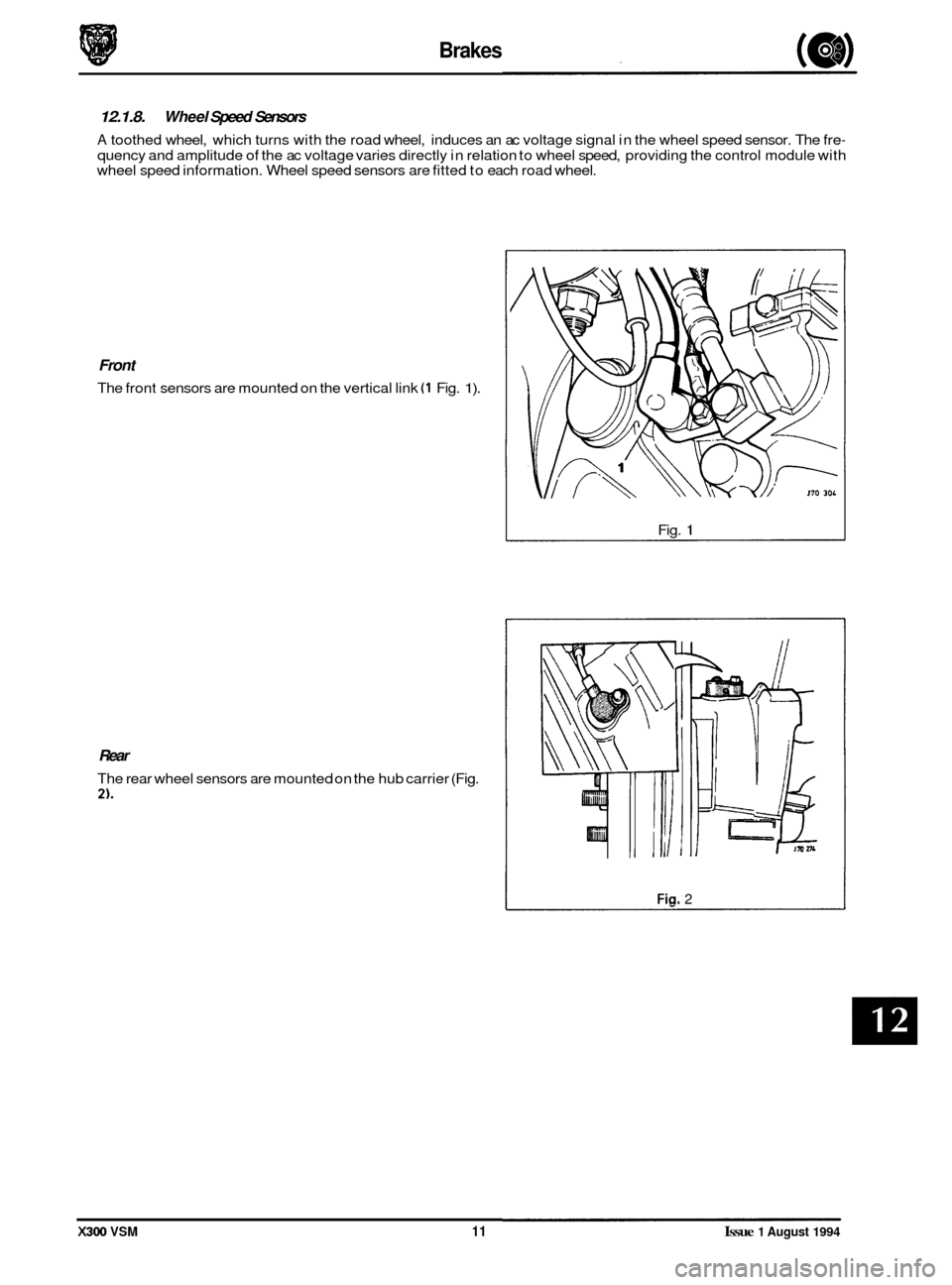
12.1.8. Wheel Speed Sensors
A toothed wheel, which turns with the road wheel, induces an ac voltage signal in the wheel speed sensor. The fre-
quency and amplitude of the ac voltage varies directly in relation to wheel speed, providing the control module with
wheel speed information. Wheel speed sensors are fitted to each road wheel.
Front
The front sensors are mounted on the vertical link (1 Fig. 1).
Fig. 1
Rear
The rear wheel sensors are mounted on the hub carrier (Fig.
2).
Fin. 2
X300 VSM 11 Issue 1 August 1994
Page 235 of 521
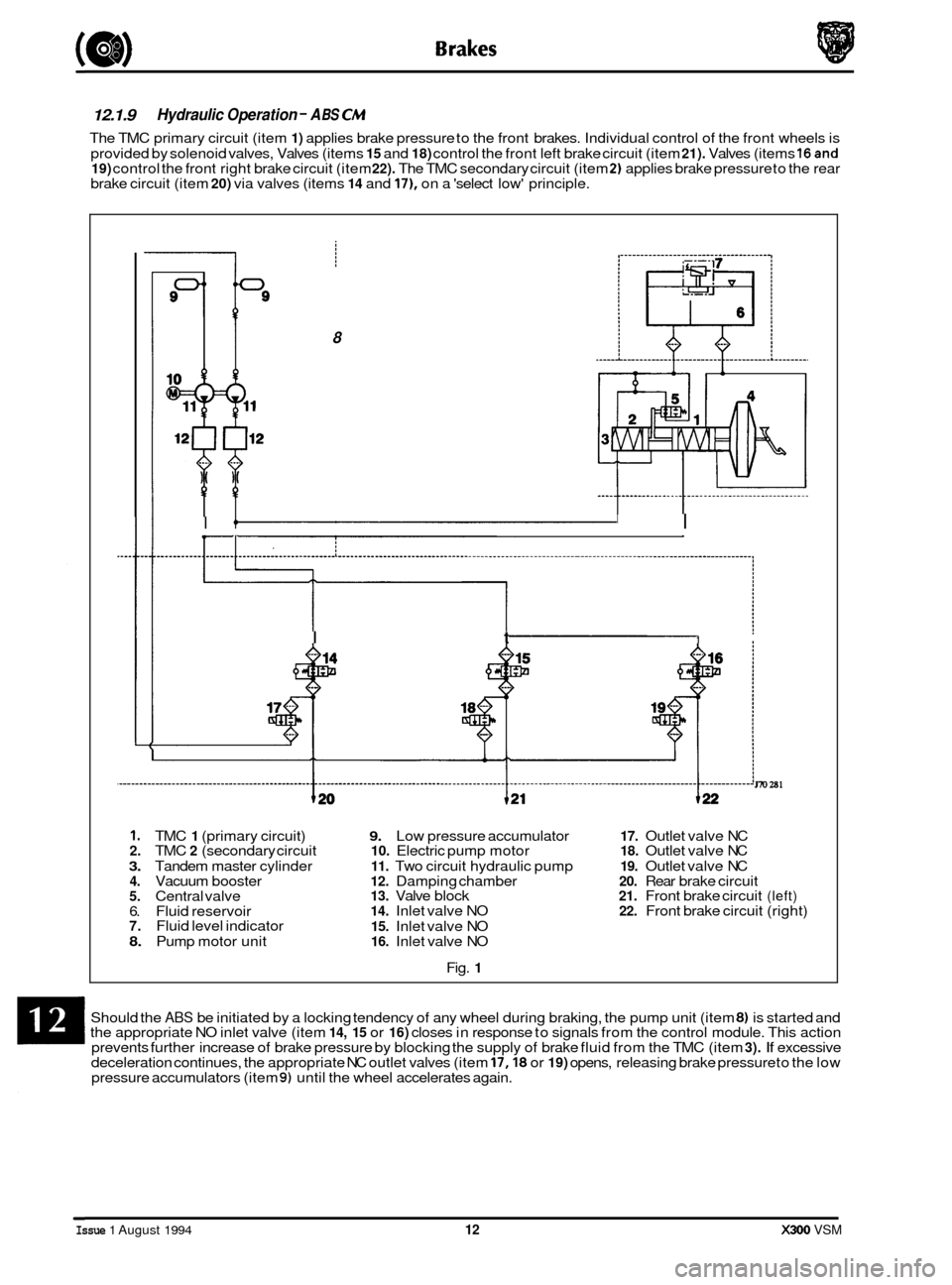
12.1.9
The TMC primary circuit (item 1) applies brake pressure to the front brakes. Individual control of the front wheels is
provided by solenoid valves, Valves (items
15 and 18) control the front left brake circuit (item 21). Valves (items 16and 19) control the front right brake circuit (item 22). The TMC secondary circuit (item 2) applies brake pressure to the rear
brake circuit (item 20) via valves (items 14 and 17), on a 'select low' principle.
Hydraulic Operation - A BS CM
8
I I + I
I t 1
'0281
1. TMC 1 (primary circuit) 9. Low pressure accumulator 17. Outlet valve NC 2. TMC 2 (secondary circuit 10. Electric pump motor 18. Outlet valve NC
3. Tandem master cylinder 11. Two circuit hydraulic pump 19. Outlet valve NC 4. Vacuum booster 12. Damping chamber 20. Rear brake circuit 5. Central valve 13. Valve block 21. Front brake circuit (left)
6. Fluid reservoir 14. Inlet valve NO 22. Front brake circuit (right) 7. Fluid level indicator 15. Inlet valve NO 8. Pump motor unit 16. Inlet valve NO
Fig.
1
Should the ABS be initiated by a locking tendency of any wheel during braking, the pump unit (item 8) is started and
the appropriate NO inlet valve (item 14, 15 or 16) closes in response to signals from the control module. This action
prevents further increase of brake pressure by blocking the supply of brake fluid from the TMC (item 3). If excessive
deceleration continues, the appropriate NC outlet valves (item 17,18 or 19) opens, releasing brake pressure to the low
pressure accumulators (item 9) until the wheel accelerates again.
Issue 1 August 1994 12 X300 VSM
Page 236 of 521
From the low pressure accumulators,volume is pumped back into theTMC, forcing the brake pedal back. To optimize the friction coefficient between tire and road, brake pressure is increased in small steps by closing the outlet valve and
opening the inlet valve and re-charging brake pressure.
During the pressure build
up phase, the volume required for replenishment is supplied by the TMC and additionally
by the pump from the low pressure accumulators. Since the delivered flow is generally greater than volume flow
drained from the brake circuits, the low pressure accumulators serve as intermediate accumulators to compensate for
temporary volume flow peaks.
The TMC piston positions, and therefore the brake pedal, vary with the fluid displacement in the brake caliper. As con
-
trolled pressure in the brake caliper decreases and increases during ABS, the brake pedal 'cycles', informing the driver
that controlled braking is in progress.
Actuation of the brake pedal, causes the central valve (item
5) in the TMC to close. This action prevents damage to the
TMC piston seals.
At the end of a brake application, volume is restored to the TMC, at
low pressure from the fluid reservoir (item 6).
Issue 1 August 1994 X300 VSM 13
Page 237 of 521
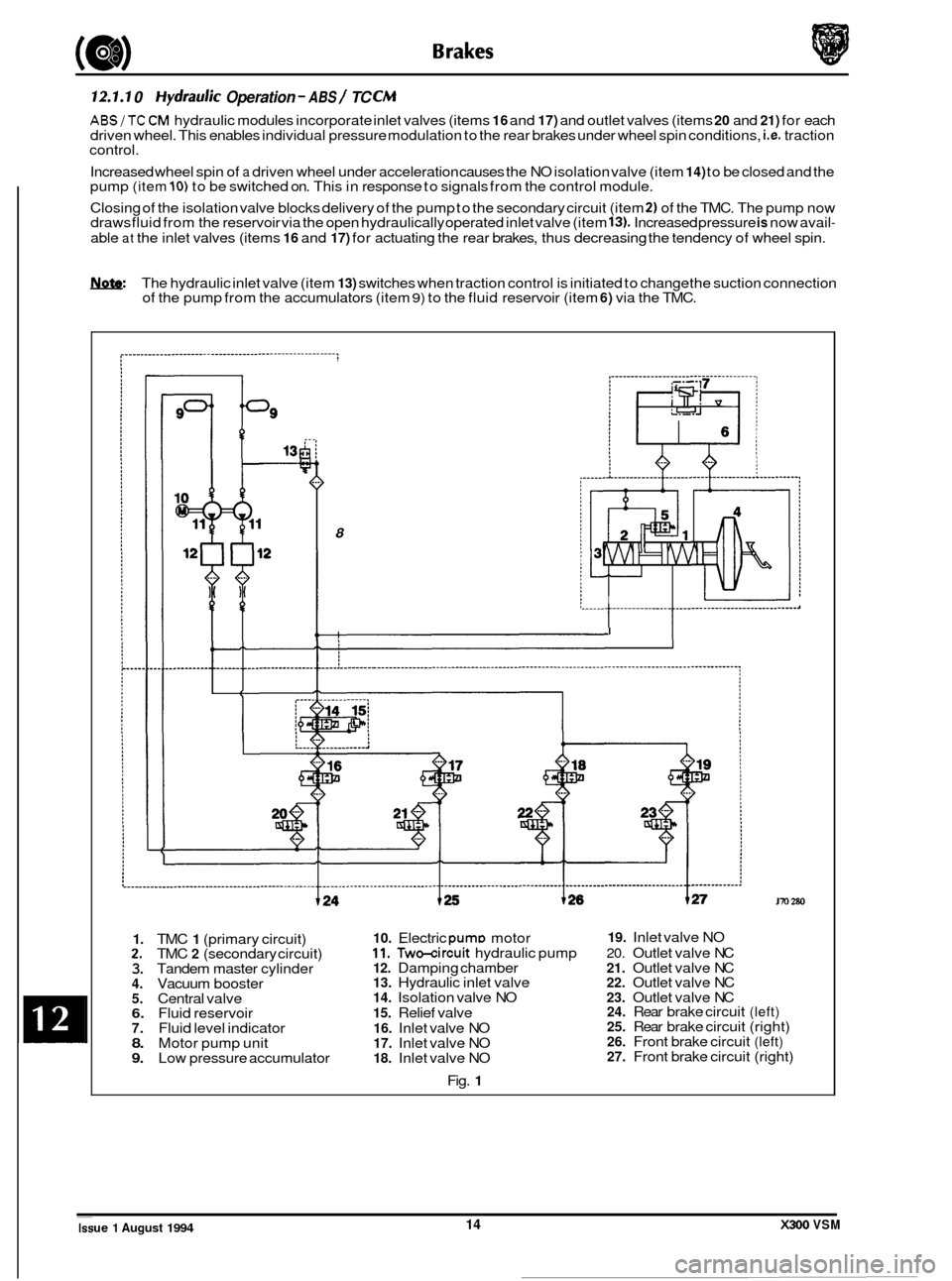
12.1.1 0 Hydrauric Operation - ABS 1 TC CM
ABS/TC CM hydraulic modules incorporate inlet valves (items 16 and 17) and outlet valves (items 20 and 21) for each
driven wheel. This enables individual pressure modulation to the rear brakes under wheel spin conditions, i.e. traction
control.
Increased wheel spin of
a driven wheel under acceleration causes the NO isolation valve (item 14) to be closed and the
pump (item 10) to be switched on. This in response to signals from the control module.
Closing of the isolation valve blocks delivery of the pump to the secondary circuit (item
2) of the TMC. The pump now
draws fluid from the reservoir via the open hydraulically operated inlet valve (item 13). Increased pressure is now avail-
able at the inlet valves (items 16 and 17) for actuating the rear brakes, thus decreasing the tendency of wheel spin.
The hydraulic inlet valve (item
13) switches when traction control is initiated to change the suction connection
of the pump from the accumulators (item 9) to the fluid reservoir (item 6) via the TMC.
1. TMC 1 (primary circuit)
8
I 1-
I
10. Electric DumD motor 19. Inlet valve NO
170 280
2. TMC 2 (secondary circuit) 11. Two-cirh hydraulic pump 20. Outlet valve NC
3. Tandem master cylinder 12. Damping chamber 21. Outlet valve NC
4. Vacuum booster 13. Hydraulic inlet valve 22. Outlet valve NC
5. Central valve 14. Isolation valve NO 23. Outlet valve NC
6. Fluid reservoir 15. Relief valve 7. Fluid level indicator 16. Inlet valve NO 8. Motor pump unit 17. Inlet valve NO 9. Low pressure accumulator 18. Inlet valve NO
Fig.
1 24.
Rear
brake circuit (left) 25. Rear brake circuit (right) 26. Front brake circuit (left) 27. Front brake circuit (right) ~
Issue 1 August 1994 14 X300 VSM