air condition JAGUAR XJ6 1994 2.G Owner's Guide
[x] Cancel search | Manufacturer: JAGUAR, Model Year: 1994, Model line: XJ6, Model: JAGUAR XJ6 1994 2.GPages: 521, PDF Size: 17.35 MB
Page 374 of 521
Black
Black
Black All
models
All Models
All Models
Black
Black All
Models
All Models
Black/
White Stripe
Black/
White Stripe
Black Non
Aircon.
Models
only
Non Power
Wash Models
only
Optional
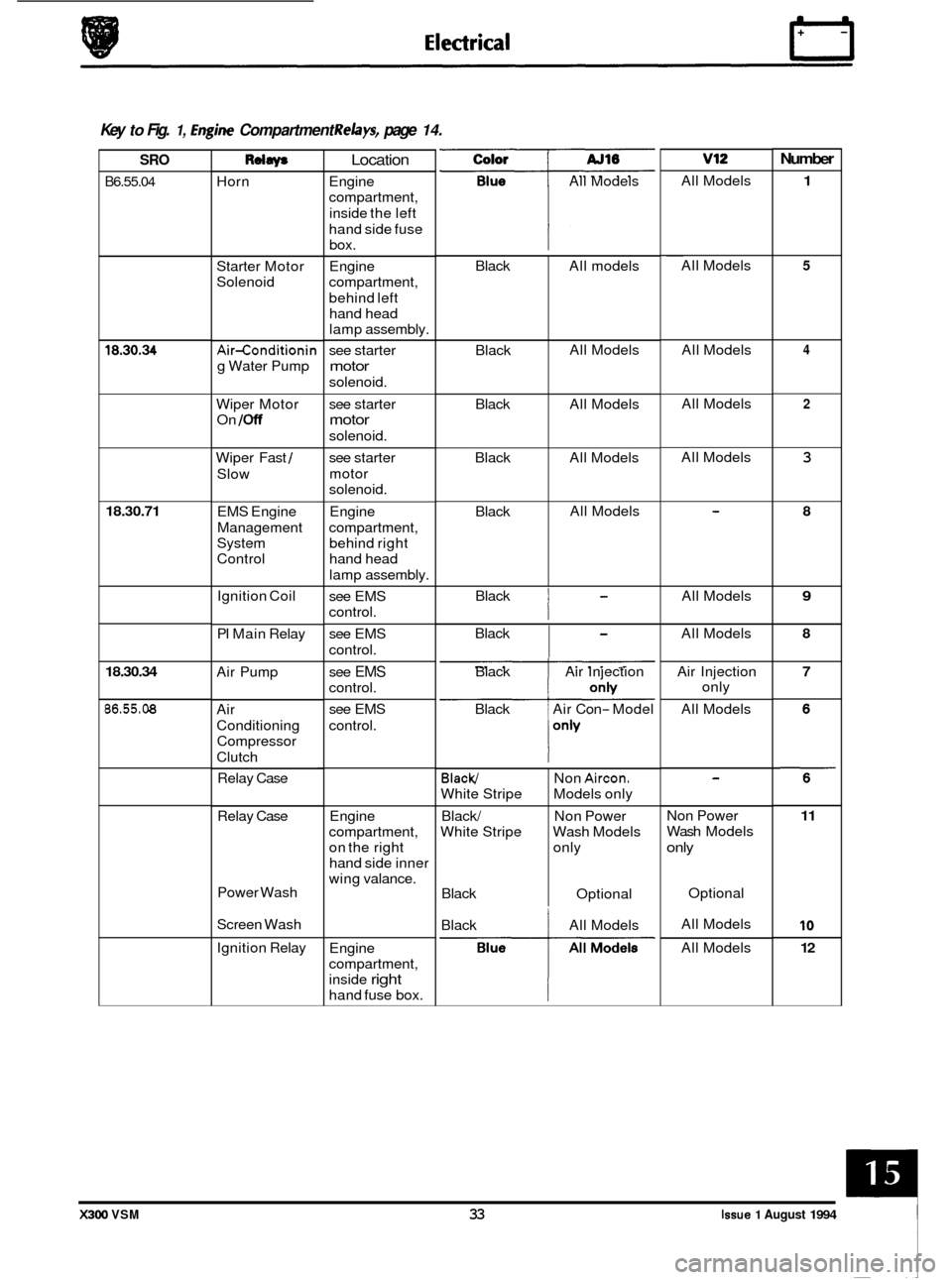
0 Key to Fig. 1, hgine Compartment Relays, page 14.
Number v12 Color
All Models
SRO
B6.55.04
Rdaw
Horn
Location
Engine
compartment,
inside the left
hand side fuse box.
Engine
compartment,
behind left hand head
lamp assembly.
see starter
motor
solenoid. All
Models
1 ~~
All
Models 5 Starter Motor
Solenoid
4 All Models
All Models 18.30.34 Air-conditionin
g Water Pump
Wiper Motor
On
/Off
2 see starter
motor
solenoid.
see starter
motor
solenoid. All
Models
3 Wiper Fast /
Slow
18.30.71 Engine
compartment, behind right
hand head
lamp assembly. 8 EMS Engine
Management
System
Control
Black
I
All Models 9 Ignition Coil
PI Main Relay see
EMS
control.
see EMS
control. Black
I
All
Models 8
Air Pump 7 see EMS
control.
see EMS
control. Black
Air Injection
Black Air Con
- Model Air
Injection
only
All Models
18.30.34
86.55.08 Air
Conditioning
Compressor
Clutch
Relay Case
Engine
compartment,
on the right
hand side inner
wing valance.
Relay
Case Non Power
Wash
Models
only
11
10
12
Power Wash
Screen Wash Optional
All Models
All Models
Black
All Models
Ignition Relay
Engine
compartment,
inside
right
hand fuse box.
X300 VSM 33 Issue 1 August 1994
Page 376 of 521
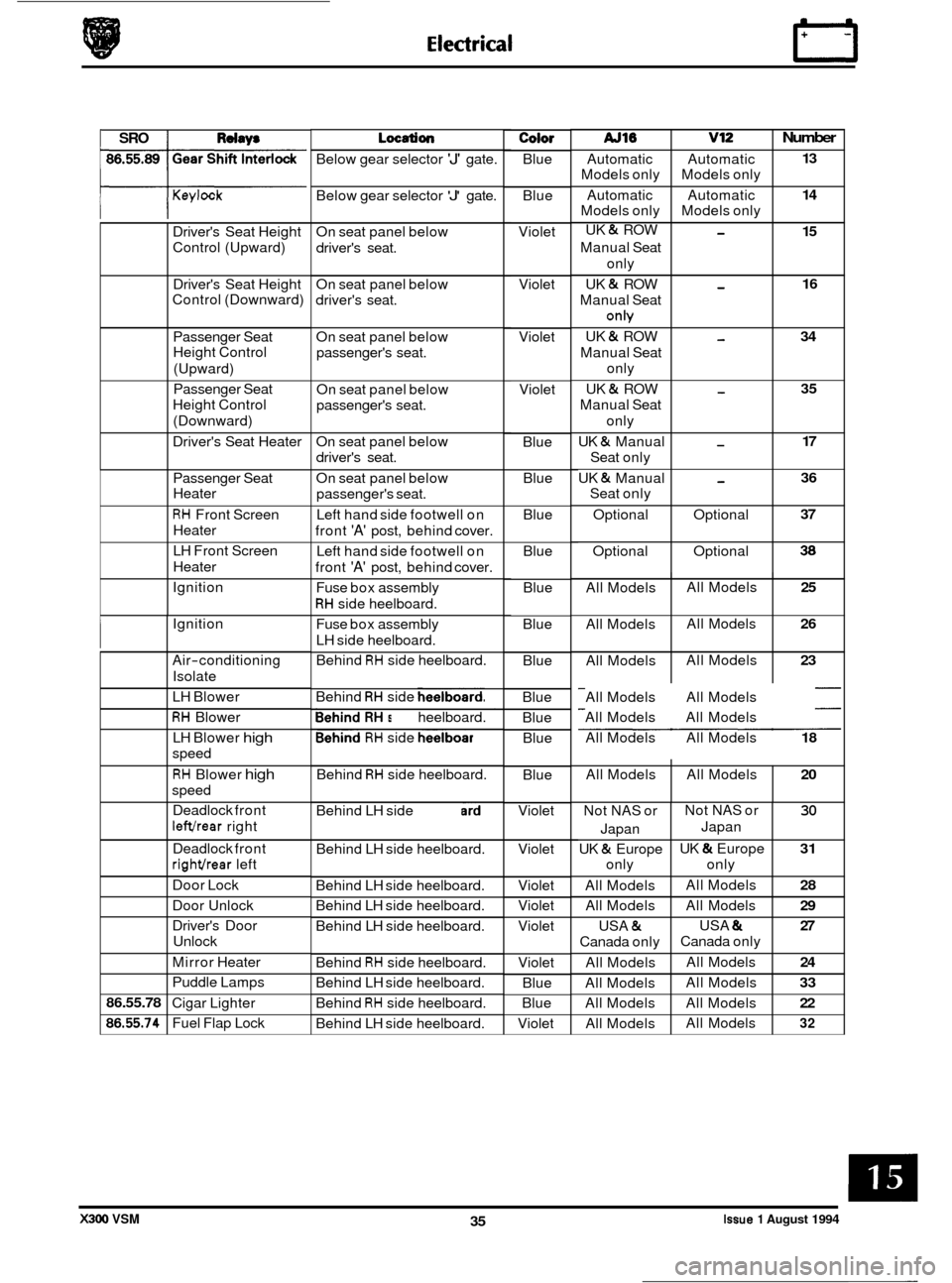
I SRO I Rdw* AJ16 v12
Automatic Automatic
Models only Models only
Automatic Automatic
Models only Models only
UK
& ROW -
Manual Seat
only
UK
& ROW -
Manual Seat
onh/
UK & ROW -
Manual Seat
only
Manual Seat
only
UK
& Manual -
Seat only
UK
& Manual -
Seat only
UK
& ROW -
Optional
Optional
Optional Optional
Keylock
Number
13
14
15
16
34
35
17
36
37
38
Driver's Seat Height
Control (Upward)
Driver's Seat Height
Control (Downward)
Passenger Seat
Height Control (Upward)
Passenger Seat
Height Control
(Downward)
Driver's Seat Heater
All Models
All Models
All Models
Passenger Seat
Heater
RH Front
Screen
Heater
LH Front Screen
Heater
Ignition All Models
25
All Models 26
All Models 23
Ignition
Air
-conditioning
Isolate
LH Blower
RH Blower
LH Blower
high
speed
RH Blower high
speed
Deadlock front
lefthear right All
Models All Models
20
Below gear selector 'J' gate.
Not NAS or
Japan
UK
& Europe
only
All Models
All Models
USA
&
Canada only
All Models
All Models
All Models
All Models
Below
gear selector
'J' gate.
Not NAS or
30
UK & Europe 31
All Models 28
All Models 29
USA & 27
All Models 24
All Models 33
All Models 22
All Models 32
Japan
only
Canada only
On
seat panel below
driver's seat.
86.55.78
86.55.74
On seat panel below
driver's seat.
Deadlock front
righthear left
Door Lock
Door Unlock
Driver's Door
Unlock
Mirror Heater
Puddle Lamps
Cigar Lighter
Fuel Flap Lock On
seat panel below
passenger's seat.
On seat panel below
passenger's seat.
On seat panel below
driver's seat.
On seat panel below
passenger's seat.
Left hand side footwell on
front
'A' post, behind cover.
Left hand side footwell on
front
'A' post, behind cover.
Fuse box assembly
RH side heelboard.
Fuse box assembly
LH side heelboard.
Behind
RH side heelboard.
Behind
RH side heelboard.
Behind RH side heelboard.
Behind
RH side heelboard.
Behind
RH side heelboard.
Behind LH side heelboard.
Behind LH side heelboard.
Behind LH side heelboard.
Behind LH side heelboard.
Behind LH side heelboard.
Behind
RH side heelboard.
Behind LH side heelboard.
Behind
RH side heelboard.
Behind LH side heelboard.
Color
Blue
Blue
Violet
Violet
Violet Violet Blue Blue
Blue
Blue
Blue
Blue
Blue
Blue
Blue Blue
Blue
Violet
Violet
Violet
Violet
Violet
Violet Blue
Blue
Violet All
Models All Models
All Models All Models
All Models All Models
18
X300 VSM 35 Issue 1 August 1994
Page 380 of 521
86.52.01
86.91 -83
19.75.21
86.80.24
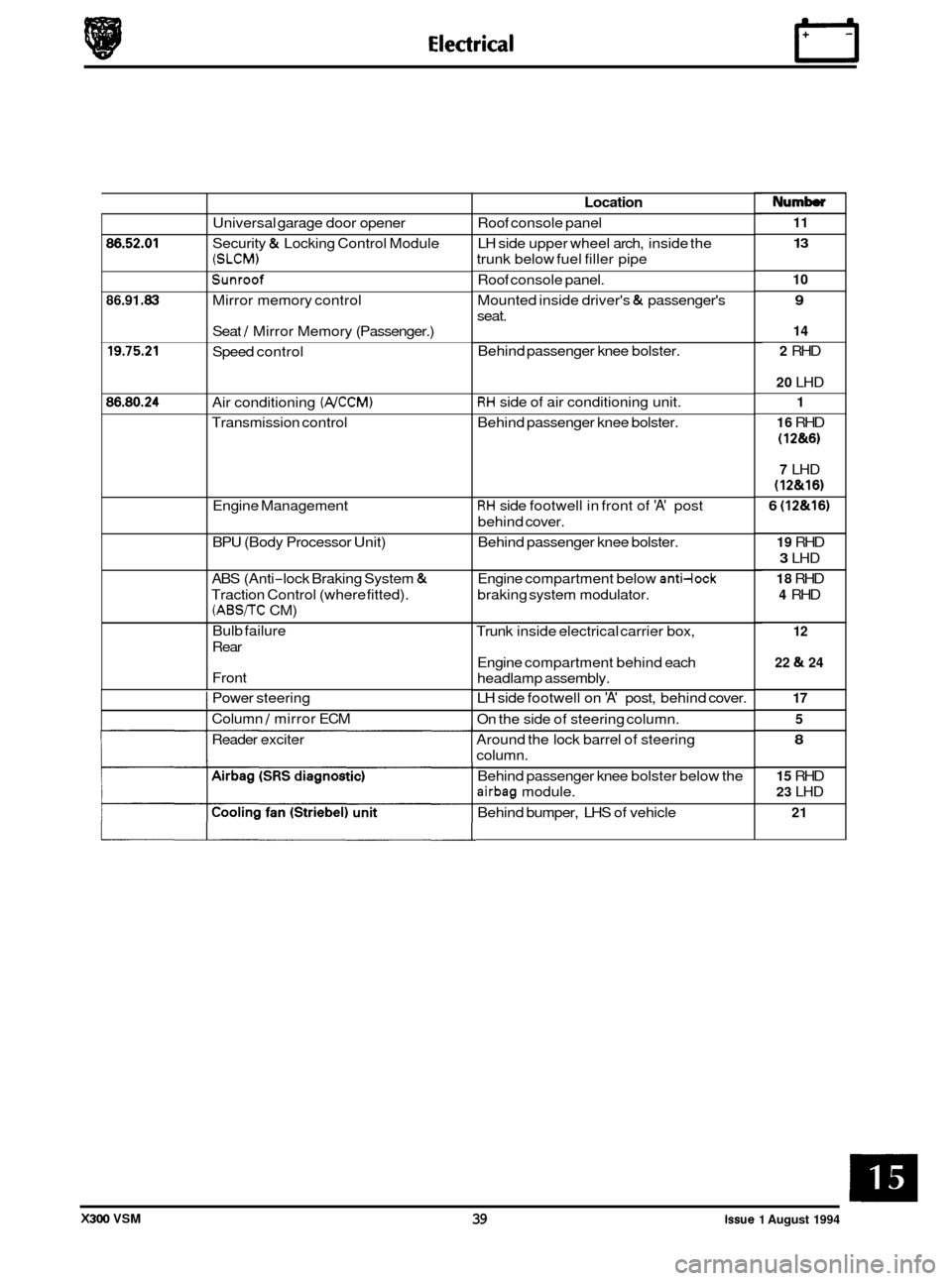
Universal garage door opener
Security
& Locking Control Module
(SLCM)
Sunroof
Mirror memory control
Seat
/ Mirror Memory (Passenger.)
Speed control
Air conditioning
(NCCM)
Transmission control
Engine Management
BPU (Body Processor Unit)
ABS (Anti
-lock Braking System &
Traction Control (where fitted).
(ABS/TC CM)
Bulb failure
Rear
Front
I Power steering
I Column / mirror ECM
Reader exciter
Location
Roof console panel
LH side upper wheel arch, inside the
trunk below fuel filler pipe
Roof console panel.
Mounted inside driver's
& passenger's
seat.
Behind passenger knee bolster.
RH side of air conditioning unit.
Behind passenger knee bolster.
RH side footwell in front of 'A' post
behind cover.
Behind passenger knee bolster.
Engine compartment below
anti-lock
braking system modulator.
Trunk inside electrical carrier box,
Engine compartment behind each
headlamp assembly.
LH side footwell on
'A' post, behind cover.
On the side of steering column.
Around the lock barrel of steering
column.
Behind passenger knee bolster below the
airbag module.
Behind bumper, LHS of vehicle
Numb
11
13
10
9
14
2
RHD
20 LHD
1
16
RHD
(1 2&6)
7 LHD
(12&16)
6 (12&16)
19 RHD
3 LHD
18 RHD
4 RHD
12
22
& 24
17 5
8
15 RHD
23 LHD
21
X300 VSM 39 issue 1 August 1994
Page 397 of 521
Specification
w IfrnrnJ
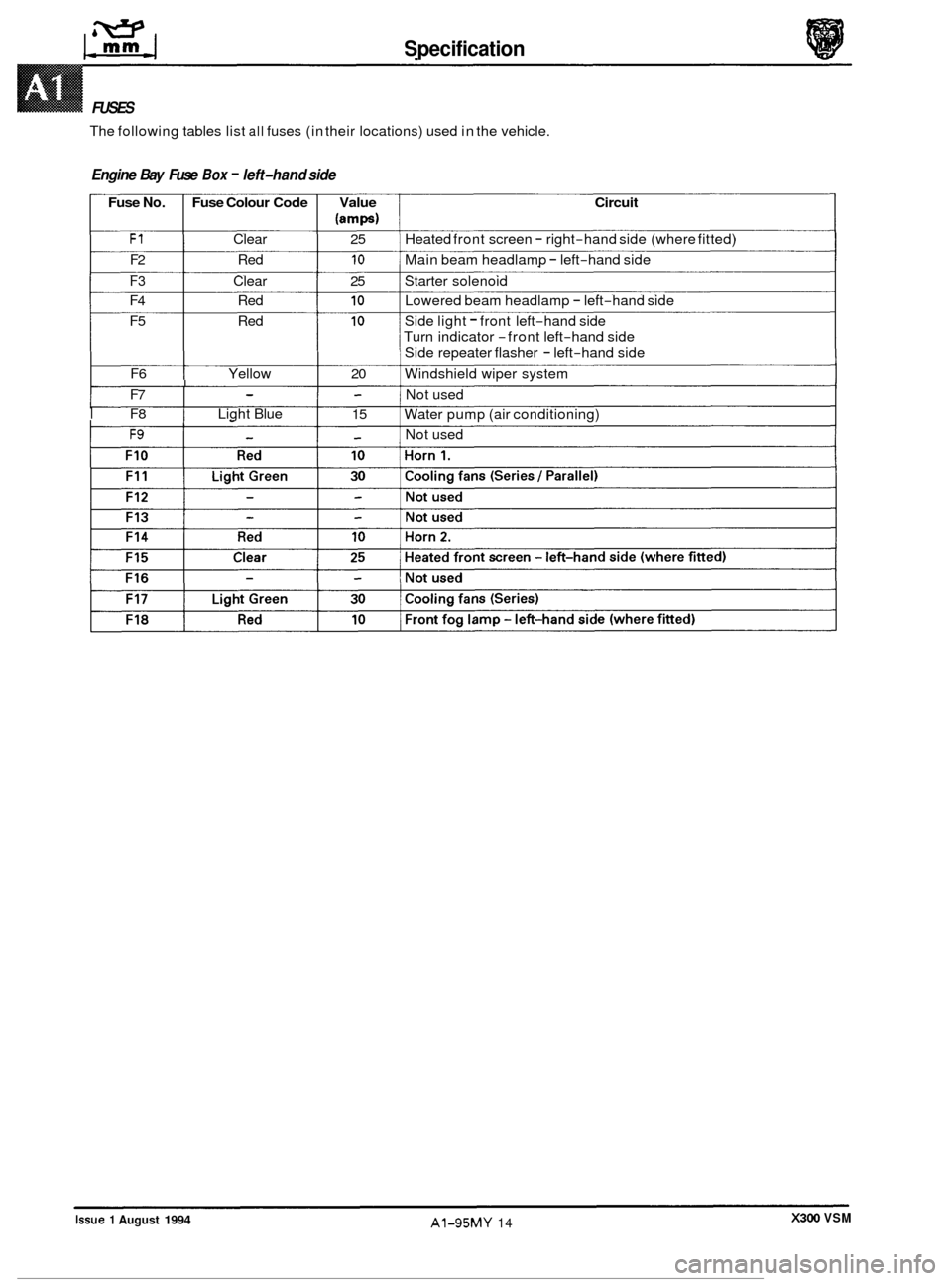
FUSES
The following tables list all fuses (in their locations) used in the vehicle.
Engine Bay Fuse Box - left-hand side
Fuse No. Fuse Colour Code Value Circuit
lamps)
F1 Clear 25 Heated front screen - right-hand side (where fitted)
F2 Red 10 Main beam headlamp - left-hand side
F3 Clear 25 Starter solenoid
F4 Red 10 Lowered beam headlamp - left-hand side
F5 Red 10 Side light - front left-hand side
Turn indicator
-front left-hand side
Side repeater flasher
- left-hand side
F6 Yellow 20 Windshield wiper system
I F8 I Light Blue
I Not used
F9 - - Not used
- - F7
15
Water pump (air conditioning) I - -
-l
X300 VSM Issue 1 August 1994 AI-95MY 14
Page 398 of 521

0
Engine Bay Fuse Box - right-hand side
Fuse No. Fuse Colour Code
- F1
F2 Red
F3
F4 Red
F5 Red
-
F6 Tan
F7 Clear
F8 Red
F9 -
FIO Tan
F12 Red
F13 Red
F14 Red F15
-
F16 Red
F17 Light Green
F18 Red
Value
(amps)
10
10
10
5
25
10
-
5
20
10
10
10
10
30
10
Circuit
Not used
Main beam headlamp
- right-hand side
Not used
Lowered beam
headlamD - riaht-hand side ."
Side light -front right-hand side
Turn indicator
-front right-hand side
Side repeater flasher
- right-hand side
Engine control module
(ECM)
Air pump (6 cyl. - where fitted)
Ignition coils
(VIZ)
Air conditioning clutch
Not used
Generator
Front lighting control module
- right-hand
Air conditioning clutch
Windshield wash
J headlamp power wash heaters and relays
Engine management system relay supply
Injectors
Engine management system
Starter relay Ignition coil sensing and air pump relay (6
cyl.)
Fuel injection relay
Engine management sensing
(VIZ)
Windshield washer pump
Lambda heaters
Idle speed control valve
Not used
Air pump control
Solenoid vacuum valve
(VIZ)
Water pump (supercharged)
Headlamp power wash pump
Front fog lamp
- right-hand side (where fitted)
0
0
Issue 1 August 1994 X300 VSM AI-95MY 15
Page 399 of 521
Specification
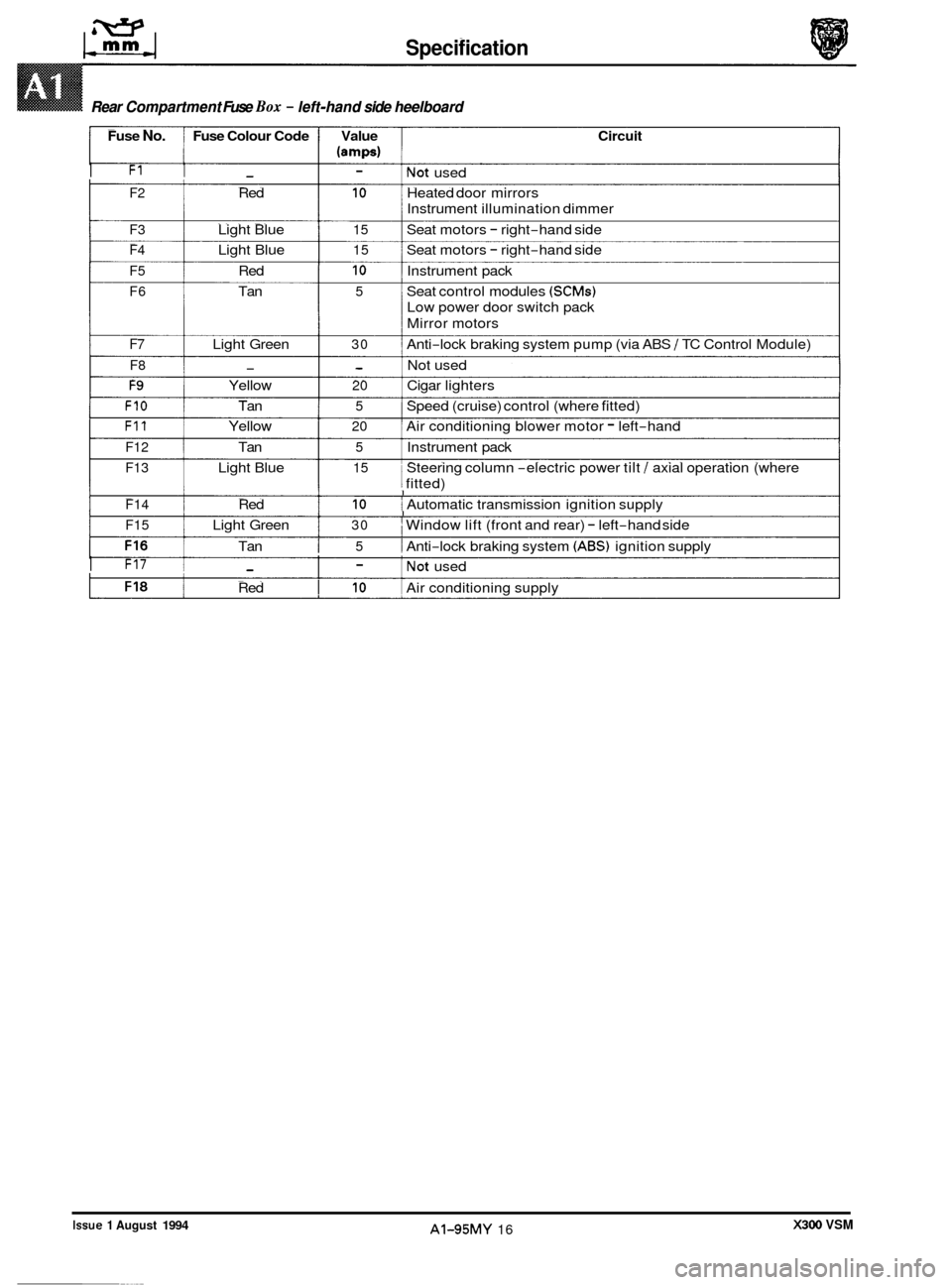
Rear Compartment Fuse Box - left-hand side heelboard
Fuse No. Fuse Colour Code Value Circuit
(amps)
I F1 I - I - lNot used
F2 Red 10 Heated door mirrors
F3 Light Blue 15 Seat motors - right-hand side
F4 Light Blue 15 Seat motors - right-hand side
F5 Red 10 Instrument pack
F6 Tan 5 Seat control modules (SCMs)
Low power door switch pack
Mirror motors
Instrument
illumination dimmer
F7 Light Green 30 Anti-lock braking system pump (via ABS / TC Control Module)
F8 - - Not used
F9 Yellow 20 Cigar lighters
FIO Tan 5 Speed (cruise) control (where fitted)
F11 Yellow 20 Air conditioning blower motor - left-hand
F12 Tan 5 Instrument pack
F13 Light Blue 15 Steering column -electric power tilt / axial operation (where
j fitted) 1 I I F14 Red 10 i Automatic transmission ignition supply I I I F15 Light Green 30 I Window lift (front and rear) - left-hand side
Tan
I 5 1 Anti-lock braking system (ABS) ignition supply
I F17 1 - I - lNot used
Red
I 10 I Air conditioning supply
Rear Compartment Fuse Box - left-hand side heelboard ~~
X300 VSM Issue 1 August 1994 AI-95MY 16
0
0
0
Page 400 of 521
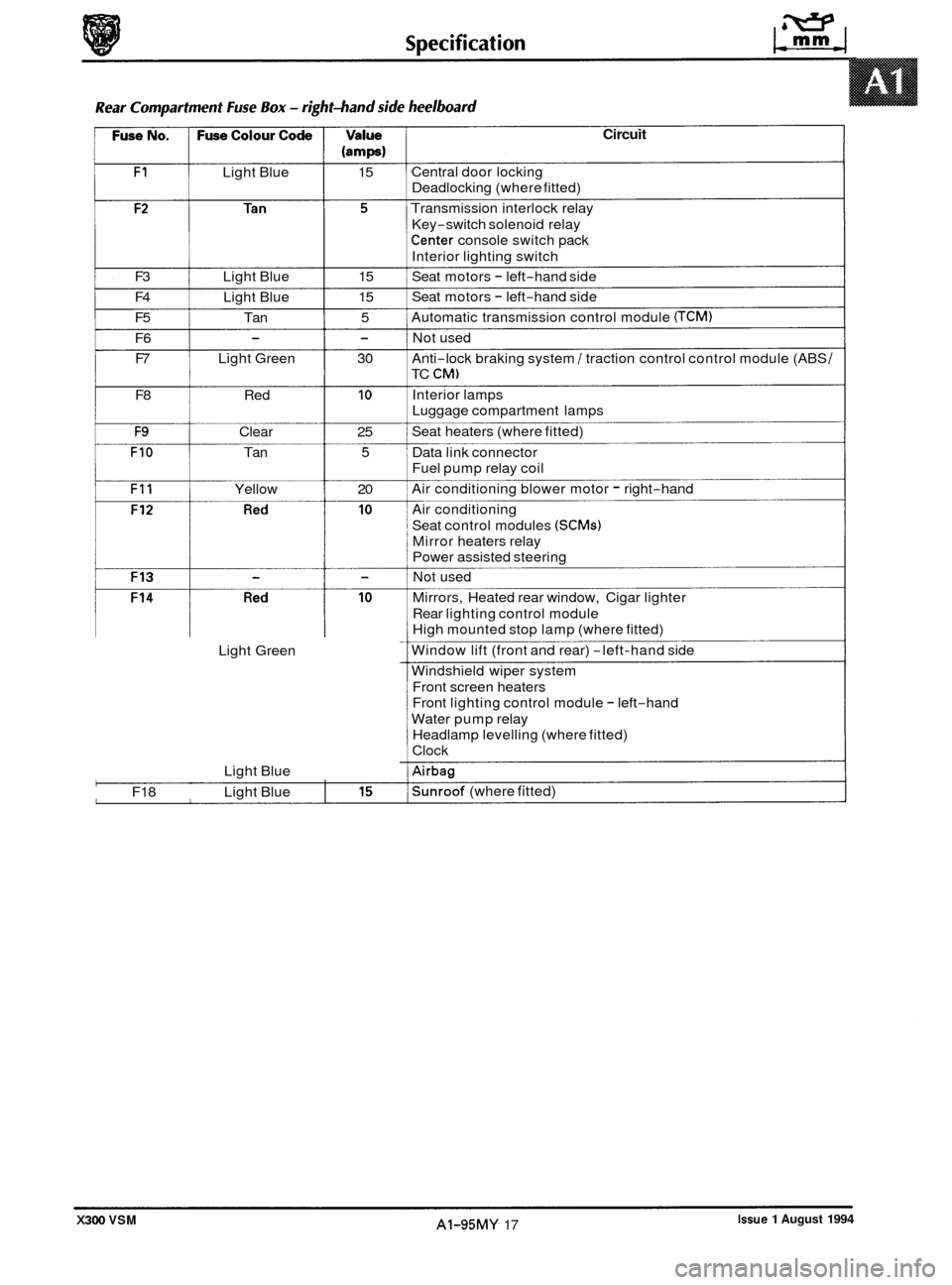
(amps)
F1 Light Blue 15
F3 Light Blue 15
F4 Light Blue 15
F5 Tan 5
F6 F7 Light Green 30
- -
F8 Red 10
F9 Clear 25
FIO Tan 5
F11 Yellow 20 0
Light Green
Light Blue
F18 Light Blue
0'
I
Circuit
Central door locking
Deadlocking (where fitted)
Transmission interlock relay
Key
-switch solenoid relay
Center console switch pack
Interior lighting switch
Seat motors
- left-hand side
Seat motors
- left-hand side
Automatic transmission control module
(TCM)
Not used
Anti
-lock braking system / traction control control module (ABS /
TC CM)
Interior lamps
Luggage compartment lamps
Seat heaters (where fitted)
Data link connector
Fuel pump relay coil
Air conditioning blower motor
- right-hand
Air conditioning
Seat control modules
(SCMs)
Mirror heaters relay
Power assisted steering
Not used
Mirrors, Heated rear window, Cigar lighter
Rear lighting control module
High mounted stop lamp (where fitted)
Window lift (front and rear)
-left-hand side
Windshield wiper system Front screen heaters
Front lighting control module
- left-hand
Water pump relay
Headlamp levelling (where fitted)
Clock
Airbag
Sunroof (where fitted)
Issue 1 August 1994 AI-95MY 17 X300 VSM
Page 412 of 521
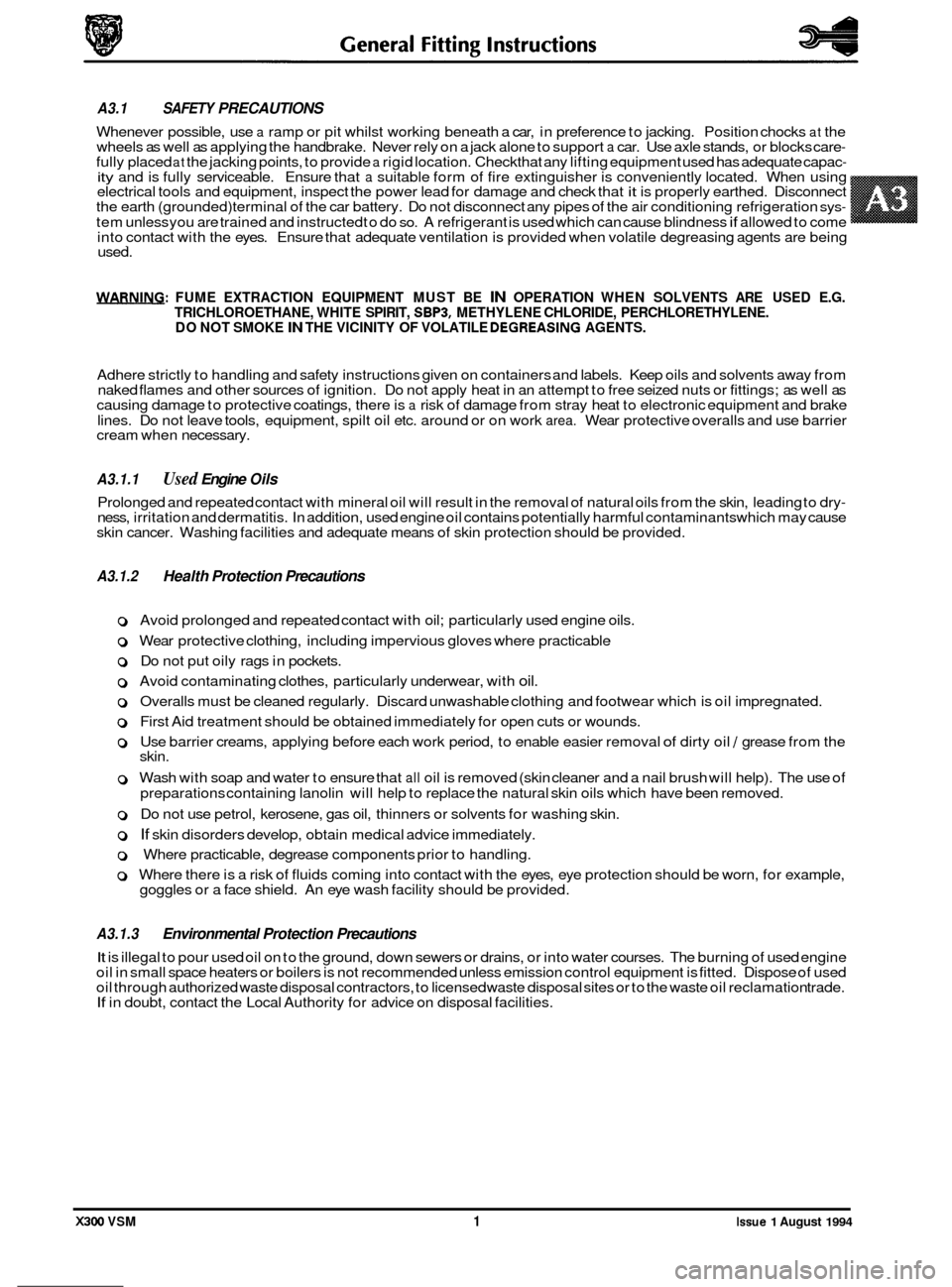
used.
WARNING: FUME EXTRACTION EQUIPMENT MUST BE IN OPERATION WHEN SOLVENTS ARE USED E.G.
TRICHLOROETHANE, WHITE SPIRIT, SBPB, METHYLENE CHLORIDE, PERCHLORETHYLENE.
DO NOT SMOKE IN THE VICINITY OF VOLATILE DEGREASING AGENTS.
Adhere strictly to handling and safety instructions given on containers and labels. Keep oils and solvents away from
naked flames and other sources of ignition. Do not apply heat in an attempt to free seized nuts or fittings; as well as
causing damage to protective coatings, there is
a risk of damage from stray heat to electronic equipment and brake
lines. Do not leave tools, equipment, spilt oil etc. around or on work
area. Wear protective overalls and use barrier
cream when necessary.
0 A3.1.1 Used Engine Oils
Prolonged and repeated contact with mineral oil will result in the removal of natural oils from the skin, leading to dry- ness, irritation and dermatitis. In addition, used engine oil contains potentially harmful contaminants which may cause
skin cancer. Washing facilities and adequate means of skin protection should be provided.
A3.1.2 Health Protection Precautions
0 Avoid prolonged and repeated contact with oil; particularly used engine oils.
o Wear protective clothing, including impervious gloves where practicable
0 Do not put oily rags in pockets.
0 Avoid contaminating clothes, particularly underwear, with oil.
0 Overalls must be cleaned regularly. Discard unwashable clothing and footwear which is oil impregnated.
o First Aid treatment should be obtained immediately for open cuts or wounds.
0 Use barrier creams, applying before each work period, to enable easier removal of dirty oil / grease from the
skin.
0 Wash with soap and water to ensure that all oil is removed (skin cleaner and a nail brush will help). The use of
preparations containing lanolin will help to replace the natural skin oils which have been removed.
o Do not use petrol, kerosene, gas oil, thinners or solvents for washing skin.
0 If skin disorders develop, obtain medical advice immediately.
0 Where practicable, degrease components prior to handling.
0 Where there is a risk of fluids coming into contact with the eyes, eye protection should be worn, for example,
goggles or a face shield. An eye wash facility should be provided.
A3.1.3 Environmental Protection Precautions
A3.1 SAFETY PRECAUTIONS
Whenever possible, use a ramp or pit whilst working beneath a car, in preference to jacking. Position chocks at the
wheels as well as applying the handbrake. Never rely on a jack alone to support a car. Use axle stands, or blocks care- fully placed at the jacking points, to provide a rigid location. Checkthat any lifting equipment used has adequate capac- ity and is fully serviceable. Ensure that a suitable form of fire extinguisher is conveniently located.
When using
electrical tools and equipment, inspect the power lead for damage and check that it is properly earthed. Disconnect
the earth (grounded) terminal of the car battery. Do not disconnect any pipes of the air conditioning refrigeration sys-
tem unless you are trained and instructed to do so. A refrigerant is used which can cause blindness if allowed to come
into contact with the eyes. Ensure that adequate ventilation is provided when volatile degreasing agents are being
It is illegal to pour used oil on to the ground, down sewers or drains, or into water courses. The burning of used engine
oil in small space heaters or boilers is not recommended unless emission control equipment is fitted. Dispose of used
oil through authorized waste disposal contractors, to licensed waste disposal sites or to the waste oil reclamation trade.
If in doubt, contact the Local Authority for advice on disposal facilities.
X300 VSM 1 Issue 1 August 1994
Page 413 of 521
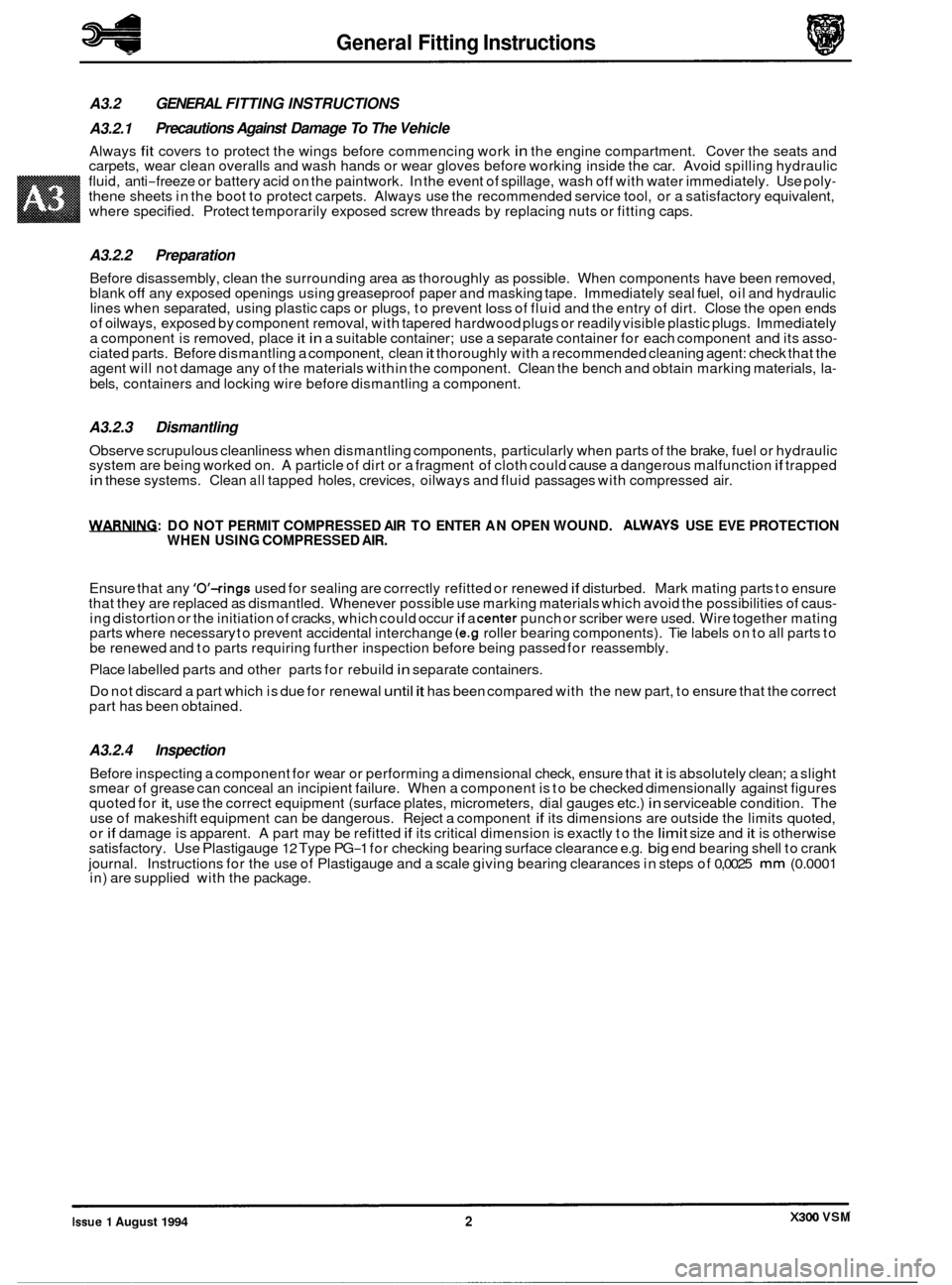
General Fitting Instructions
A3.2 GENERAL FITTING INSTRUCTIONS
A3.2.1
Always fit covers to protect the wings before commencing work in the engine compartment. Cover the seats and
carpets, wear clean overalls and wash hands or wear gloves before working inside the car. Avoid spilling hydraulic
fluid, anti
-freeze or battery acid on the paintwork. In the event of spillage, wash off with water immediately. Use poly- thene sheets in the boot to protect carpets. Always use the recommended service tool, or a satisfactory equivalent,
where specified. Protect temporarily exposed screw threads by replacing nuts or fitting caps.
Precautions Against Damage To The Vehicle
A3.2.2 Preparation
Before disassembly, clean the surrounding area as thoroughly as possible. When components have been removed,
blank off any exposed openings using greaseproof paper and masking tape. Immediately seal fuel, oil and hydraulic
lines when separated, using plastic caps or plugs, to prevent loss of fluid and the entry of dirt. Close the open ends
of oilways, exposed by component removal, with tapered hardwood plugs or readily visible plastic plugs. Immediately
a component is removed, place
it in a suitable container; use a separate container for each component and its asso- ciated parts. Before dismantling a component, clean it thoroughly with a recommended cleaning agent: check that the
agent will not damage any of the materials within the component. Clean the bench and obtain marking materials, la-
bels, containers and locking wire before dismantling a component.
A3.2.3 Dismantling
Observe scrupulous cleanliness when dismantling components, particularly when parts of the brake, fuel or hydraulic
system are being worked on. A particle of dirt or a fragment of cloth could cause a dangerous malfunction if trapped in these systems. Clean all tapped holes, crevices, oilways and fluid passages with compressed air.
WRNIFLG: DO NOT PERMIT COMPRESSED AIR TO ENTER AN OPEN WOUND. ALWAYS USE EVE PROTECTION
WHEN USING COMPRESSED AIR.
Ensure that any 'O'-rings used for sealing are correctly refitted or renewed if disturbed. Mark mating parts to ensure
that they are replaced as dismantled. Whenever possible use marking materials which avoid the possibilities of caus- ing distortion or the initiation of cracks, which could occur if a center punch or scriber were used. Wire together mating
parts where necessary to prevent accidental interchange (e.g roller bearing components). Tie labels on to all parts to
be renewed and to parts requiring further inspection before being passed for reassembly.
Place labelled parts and other parts for rebuild
in separate containers.
Do not discard a part which is due for renewal until it has been compared with the new part, to ensure that the correct
part has been obtained.
A3.2.4 Inspection
Before inspecting a component for wear or performing a dimensional check, ensure that it is absolutely clean; a slight
smear of grease can conceal an incipient failure. When a component is to be checked dimensionally against figures
quoted for
it, use the correct equipment (surface plates, micrometers, dial gauges etc.) in serviceable condition. The
use of makeshift equipment can be dangerous. Reject a component if its dimensions are outside the limits quoted,
or if damage is apparent. A part may be refitted if its critical dimension is exactly to the limit size and it is otherwise
satisfactory. Use Plastigauge 12 Type PG-1 for checking bearing surface clearance e.g. big end bearing shell to crank
journal. Instructions for the use of Plastigauge and a scale giving bearing clearances in steps of
0,0025 mm (0.0001
in) are supplied with the package.
0
0
0
X300 VSM Issue 1 August 1994 2
Page 414 of 521

in these areas indicates the onset of wear.
Hold the inner race between the fingers and thumb of one hand, spin the outer race and checkthat
it revolves absolutely
smoothly. Rotate the outer ring with a reciprocating motion, while holding the inner ring; feel for any obstruction to
rotation and reject the bearing if the action is not perfectly smooth. Lubricate the bearing generously with lubricant
appropriate to the installation. Inspect the shaft and bearing housing for discolouration or other marking which may
suggest that movement has taken place between the bearing and bearing seat.
If markings are found, use Loctite when
installing the replacement bearing.
Ensure that the shaft and housing
are clean and free from
burrs before fitting the bearing. If one bearing of a pair
shows an imperfection, it is generally advisable to renew
both bearings: an exception could be made only if the bear- ings had covered a low mileage and it could be established
that damage was confined to the one bearing.
- In the case of bearings which are lubricated with grease (e.g.
hub bearings) the space between the bearings should be
smeared with a recommended grade of grease, and the
bearings and seal should be re
-packed. When fitting the
bearing to the shaft, apply force only to the inner ring of
bearing (Fig.
1A). When fitting the bearing to the housing,
apply force only to outer ring (Fig. 1B).
Always mark components of separable bearings (e.g taper
roller bearings) when dismantling, to ensure correct
reassembly. Never
fit a new inner roller assembly to a used
outer track.
A3.2.6 Oil Seals
Always fit new oil seals when rebuilding an assembly.
Examine the seal before fitting to ensure that it is clean and
undamaged. Smear sealing lips with clean grease, pack
dust excluder seals with grease and pack grease into the
cavity between the sealing lips of duplex seals. Ensure that
the seal spring,
if provided, is correctly fitted.
Place the lip
of the seal towards the fluid to be sealed and
slide it into position on the shaft, using a fitting sleeve (Fig. 2) when possible to protect the sealing lip from damage by
threads, splines or sharp edges on the end of the shaft. If a fitting sleeve is not available, use plastic tube or adhesive
tape to prevent damage to the sealing lip.
Grease the outside diameter of the seal, place it square to the
housing recess and press it into position, using great care
and, where available, a seal installer (Fig. 3) to ensure that
the seal does not tilt. In some cases it may be preferable to
fit the seal to the housing before fitting it to the shaft. Never
let the weight of an unsupported shaft rest in a seal. If the
correct service tool is not available, use a piece of tube which
is approximately 0,4 mm (0.015 in) smaller than the outside
diameter of the seal. Use a press to install the seal or use a
hammer VERY GENTLY on the tubular drift if a press is un-
suitable or not available.
,107 001 A B
I Fig. 1
A3.2.5 Ball And Roller Bearings
CAUTION: Never replace a ball or roller bearing without first ensuring that it is in as-new condition.
Remove
all traces of lubricant from the bearing by washing it in petrol or a suitable degreaser. Maintain absolute
cleanliness throughout the operations. Inspect visually for markings of any form on rolling elements, bearing tracks,
outer surface of outer rings or inner surface of inner rings. Reject any bearings found to be marked, since any markings
Fig.
2
307 002
i
Fig. 3
Issue 1 August 1994 3 X300 VSM