air condition JAGUAR XJ6 1994 2.G User Guide
[x] Cancel search | Manufacturer: JAGUAR, Model Year: 1994, Model line: XJ6, Model: JAGUAR XJ6 1994 2.GPages: 521, PDF Size: 17.35 MB
Page 144 of 521

Automatic Transmission (AJI 6)
8.1.3 TRANSMISSION CONTROL MODULE, RENEW
0 (4, OL)
SRO 44.15.32
. Raise the trunk lid and disconnect the battery.
. Remove the passenger side dash liner for access.
Displace and remove the air conditioning footwell outlet
duct.
. Release and remove the footwell carpet securing fastener:
displace and reposition the carpet for access.
Release the Transmission Control Module
(TCM) bracket
to body bracket securing nut
(1 Fig. 1).
. DisplacetheTCM mounting brackettang (2 Fig. 1)fromthe
body bracket and mounting stud.
= Reposition the TCM, release the TCM multi-pin plug lever
lock and disconnect the multi
-pin plug (3 Fig. 1).
. Release and remove the TCM mounting bracket securing
bolts and remove the TCM.
= Fit and align the new TCM to the mounting bracket.
. Fit and tighten the TCM securing bolts.
. Connect the TCM harness multi-pin plug and secure the
Position the TCM to body mounting bracket, ensuring that
Fit and tighten the TCM securing nut.
. Position the footwell carpet and fit the carpet fastener.
. Fit and align the footwell outlet duct to air conditioning
. Position and fit the duct fastener to the blower motor slot.
. Refit the dash liner.
. Reconnect the battery.
multi-pin plug lever lock.
the tang locates
in the bracket slot and stud.
unit.
1
i
J44-703 U
Fig. 1
Issue 1 August 1994 X300 VSM 7
Page 217 of 521
Suspension Systems
11.4.3 Front End Inspection
Do not check and adjust front wheel alignment without carrying out the following inspection for front end damage and
wear:
. Check for specified air pressure in all four tires.
Raise front of vehicle off the floor; grasping upper and lower surface of the tire, shake each front wheel to check for
. Check front suspension lower arm ball joint and mounts for looseness, wear and damage.
Check steering gear mountings and all steering linkages for looseness.
. Renew parts if necessary.
. Grasp upper and lower surface of tire and shake each wheel to check wheel bearing end play.
. Check the action of the front dampers and the condition of their attachments, as sticking or binding front dampers
worn
bearings.
Check brake caliper mountings.
may not allow the vehicle to settle in to a normal level position, possibly affecting the front-wheel alignment.
m: Front wheel bearings are adjustable (0.001 to 0.003 in. endfloat).
11.4.4
. Check the wheel bearings.
. Inspect the front suspension upper joint and renew front suspension lower wishbone if needed.
Raise vehicle and position floor jacks beneath the front suspension lower wishbone.
Grasp the lower edge of the tire and move the wheel in and out.
While moving the wheel, observe the upper and lower wishbone.
. Movement between the vertical links and the wishbones indicates abnormal ball joint wear.
. Renew ball joints.
. Check the front wheel bearings.
. Check for excessive play and wear.
Upper / Lower Ball Joint Inspection
11.4.5 Damper Inspection
m: The gas-pressurized hydraulic front dampers are not serviceable, adjustable or refillable.
Verify that all attachments of the suspension components and the front dampers are tight. Renew any front damper
. Check front dampers for external damage.
. Check for oil leakage and vehicle sag.
that
has a damaged integral lower mounting bushing.
0 Oil Leak
Leakage is the condition in which the entire damper body is covered with oil and from where
it will drip on to
the pavement. Due to correct damper lubrication a light film of oil (weepage) can usually be seen on the upper
portion of the damper.
Should there be any leakage, ensure that the fluid does not originate from sources other than the front damper.
Renew worn or damaged dampers.
0 Vehicle Sag
Renewing front dampers will not correct the problem of vehicle sag, as basically this is controlled by the spring
units.
issue 1 August 1994 4 X300 VSM
Page 219 of 521
Suspension Systems
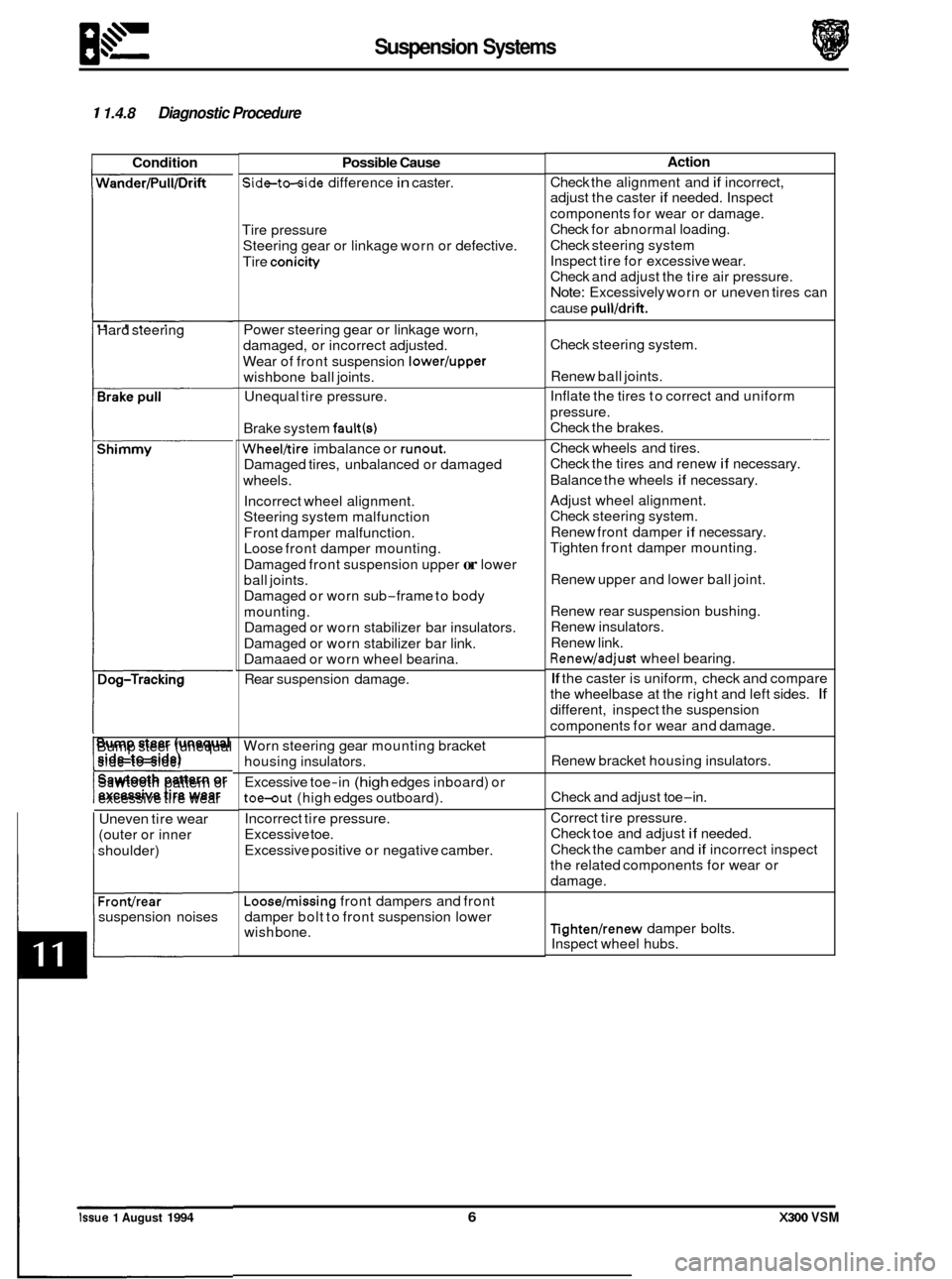
1 1.4.8 Diagnostic Procedure
Condition
Hard steering
Shimmy
I----
Bump steer (unequal
side-to-side)
Sawtooth pattern or
t excessive tire wear
Uneven tire wear
(outer or inner
shoulder)
Fronvrear
suspension noises
Possible Cause
Side-to-side difference in caster.
Tire pressure Steering gear or linkage worn or defective.
Tire
conicity
Power steering gear or linkage worn,
damaged, or incorrect adjusted.
Wear of front suspension
lower/upper
wishbone ball joints.
Unequal tire pressure.
Brake system
fault(s)
Wheel/tire imbalance or runout.
Damaged tires, unbalanced or damaged
wheels.
Incorrect wheel alignment.
Steering system malfunction
Front damper malfunction.
Loose front damper mounting.
Damaged front suspension upper
or lower
ball joints.
Damaged or worn sub
-frame to body
mounting. Damaged or worn stabilizer bar insulators.
Damaged or worn stabilizer bar link.
Damaaed or worn wheel bearina.
Rear suspension damage.
Worn steering gear mounting bracket
housing insulators.
Excessive toe
-in (high edges inboard) or
toe-out (high edges outboard).
Incorrect tire pressure.
Excessive toe.
Excessive positive or negative camber.
Loose/missing front dampers and front
damper bolt to front suspension lower
wish bone.
Action
Check the alignment and if incorrect,
adjust the caster
if needed. Inspect
components for wear or damage.
Check for abnormal loading.
Check steering system
Inspect tire for excessive wear.
Check and adjust the tire air pressure.
Note: Excessively worn or uneven tires can
cause
pull/drift.
Check steering system.
Renew ball joints.
Inflate the tires to correct and uniform
pressure.
Check the brakes.
Check wheels and tires.
Check the tires and renew
if necessary.
Balance the wheels
if necessary.
Adjust wheel alignment.
Check steering system.
Renew front damper
if necessary.
Tighten front damper mounting.
-
Renew upper and lower ball joint.
Renew rear suspension bushing.
Renew insulators.
Renew link.
Renew/adjust wheel bearing.
If the caster is uniform, check and compare
the wheelbase at the right and left sides.
If
different, inspect the suspension
components for wear and damage.
Renew bracket housing insulators.
Check and adjust toe
-in.
Correct tire pressure.
Check toe and adjust
if needed.
Check the camber and
if incorrect inspect
the related components for wear or
damage.
Tighten/renew damper bolts.
Inspect wheel hubs.
0
0
0
lssue 1 August 1994 6 X300 VSM
Page 244 of 521
Brakes
a 12.5 GENERAL FI77lNG lNSTRUCTlONS
12.5.1 Brake Fluid
WARNING: BRAKE FLUID IS CORROSIVE. EXTREME CARE MUST BE TAKEN WHEN HANDLING. AVOID SKIN OR EYE
CONTACT. AVOID INGESTION. IF SKIN OR EYES ARE ACCIDENTALLY SPLASHED WITH BRAKE FLUID,
RINSE THE AFFECTED AREA IMMEDIATELY WITH PLENTY OF WATER AND SEEK MEDICAL ATTENTION.
IF BRAKE FLUID
IS INGESTED, SEEK MEDICAL ATTENTION IMMEDIATELY.
CAUTION:
Fluid must not be allowed to contact the vehicle paintwork. Remove any spilt fluid from the paintwork
by rinsing away with running water. Methylated spirit (denatured alcohol) must not be used to clean the
contaminated area.
Cleaning Solvents
CAUTION: Never use methylated spirit (denatured alcohol) for cleaning purposes. Use only a proprietary brake
cleaning fluid.
m: THROUGHOUT THE FOLLOWING MAINTENANCE / SERVICE OPERATIONS, ABSOLUTE CLEANLINESS
MUST BE OBSERVED TO PREVENT GRIT OR OTHER FOREIGN MATTER CONTAMINATING THE BRAKE
TION. TO CLEAN BRAKE SYSTEM COMPONENTS, WASH
IN A PROPRIETARY BRAKE CLEANING FLUID.
REMOVE ALL TRACES OF CLEANING FLUID BEFORE REASSEMBLY. ALL BRAKE SYSTEM RUBBER COh PONENTS MUST BE DIPPED IN CLEAN BRAKE FLUID AND ASSEMBLED USING THE FINGERS ONLY.
SYSTEM.
IFTHE SYSTEM IS TO
BE FLUSHED, USE CLEAN BRAKE FLUID TO MINIMUM DOT 4 SPECIFICA-
12.5.2 Hoses
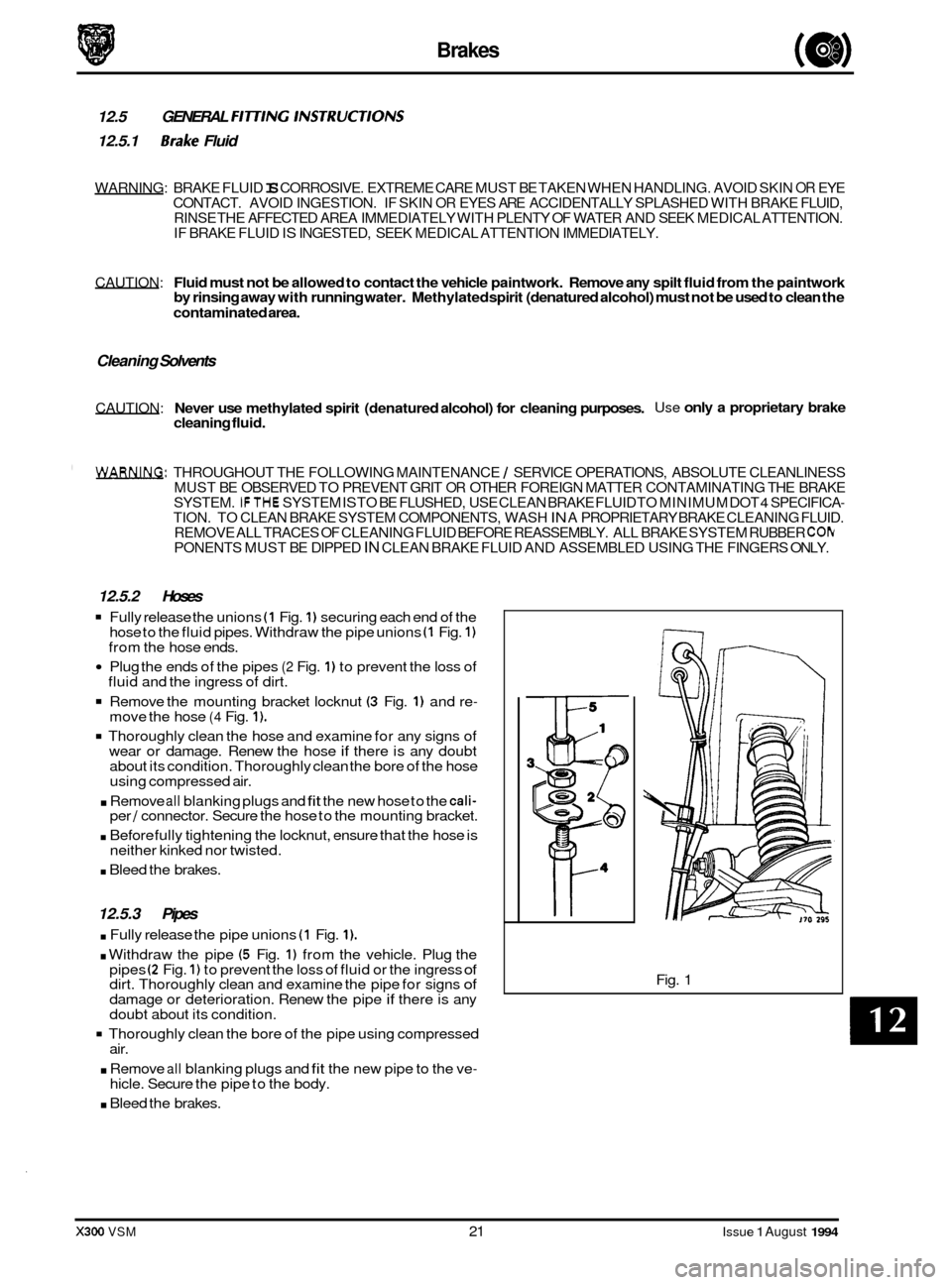
Fully release the unions (1 Fig. 1) securing each end of the
hose to the fluid pipes. Withdraw the pipe unions (1 Fig. 1) from the hose ends.
Plug the ends of the pipes (2 Fig. 1) to prevent the loss of
fluid and the ingress of dirt.
Remove the mounting bracket locknut (3 Fig. 1) and re- move the hose (4 Fig. 1).
Thoroughly clean the hose and examine for any signs of
wear or damage. Renew the hose if there is any doubt
about its condition. Thoroughly clean the bore of the hose
using compressed air.
. Remove all blanking plugs and fit the new hose to the cali- per / connector. Secure the hose to the mounting bracket.
. Before fully tightening the locknut, ensure that the hose is
neither kinked nor twisted.
. Bleed the brakes.
12.5.3 Pipes
. Fully release the pipe unions (1 Fig. 1).
. Withdraw the pipe (5 Fig. 1) from the vehicle. Plug the
pipes (2 Fig. 1) to prevent the loss of fluid or the ingress of dirt. Thoroughly clean and examine the pipe for signs of damage or deterioration. Renew the pipe if there is any
doubt about its condition.
Thoroughly clean the bore of the pipe using compressed
air.
. Remove all blanking plugs and fit the new pipe to the ve- hicle. Secure the pipe to the body.
. Bleed the brakes.
17
Fig. 1
X300 VSM 21 Issue 1 August 1994
Page 271 of 521
Body Components & Trim e
Remove the battery cover. Disconnect the battery.
. Remove the console ashtray, see subsection 13.3.28.
. Remove console veneer panel, see subsection 13.3.24.
. Remove the gear selector ident plate securing screws.
. Carefully reposition the radio console assembly from the
mounted position.
. Disconnect the assembly harness multi-plugs.
. Disconnect the antenna co-axial connector.
Undo and remove the ground lead to radio securing nut.
. Reposition the ground lead from radio stud.
. Disconnect the radio harness multi-plugs.
. Reposition the radio harness from the center console.
. Displace the radio console assembly.
. Remove the radio assembly from the console.
. Remove the radio retaining plate.
Undo and remove the air conditioning control module se
-
curing screws.
. Displace and remove the module.
. Undo and remove switch/clock module securing screws.
. Displace and remove the module assembly.
. Place the radio console aside.
. Place the new radio console to the front.
. Fit and fully seat the switch /clock module to the console.
. Fit and tighten the module securing screws.
. Fit and fully seat air conditioning module to the console.
. Fit and tighten the securing screws.
. Fit and fully seat the radio mounting plate to the console.
. Place the radio console to the center console position.
. Place the radio to the center console position.
* Route the radio harness / multi-plugs through the radio
. Connect the radio harness multi-plugs.
8 Connect the radio console harness multi-plugs.
. Route the radio ground and antenna leads through the
. Fully seat the radio console in the mounted position.
Reposition the ground lead to radio securing stud.
Fit and tighten the securing nut.
Connect the antenna co-axial to the radio.
. Reposition the excess harness / leads into the radio
mounting hole, ensuring that the harnesses are posi- tioned to allow the radio to be pushed fully home.
console
into the center console position.
radio console.
Fit and tighten the securing screws.
. Fully seat the radio into the console.
. Reposition and fit the selector ident plate.
. Fit and tighten the ident plate securing screws.
. Refit the console veneer panel. I
13.3.10 Radio Console, Renew
SRO
76.25.15
Issue 1 August 1994 16 X300 VSM
Page 276 of 521
Body Components & Trim ~
issue 1 August 1994 X300 VSM 21
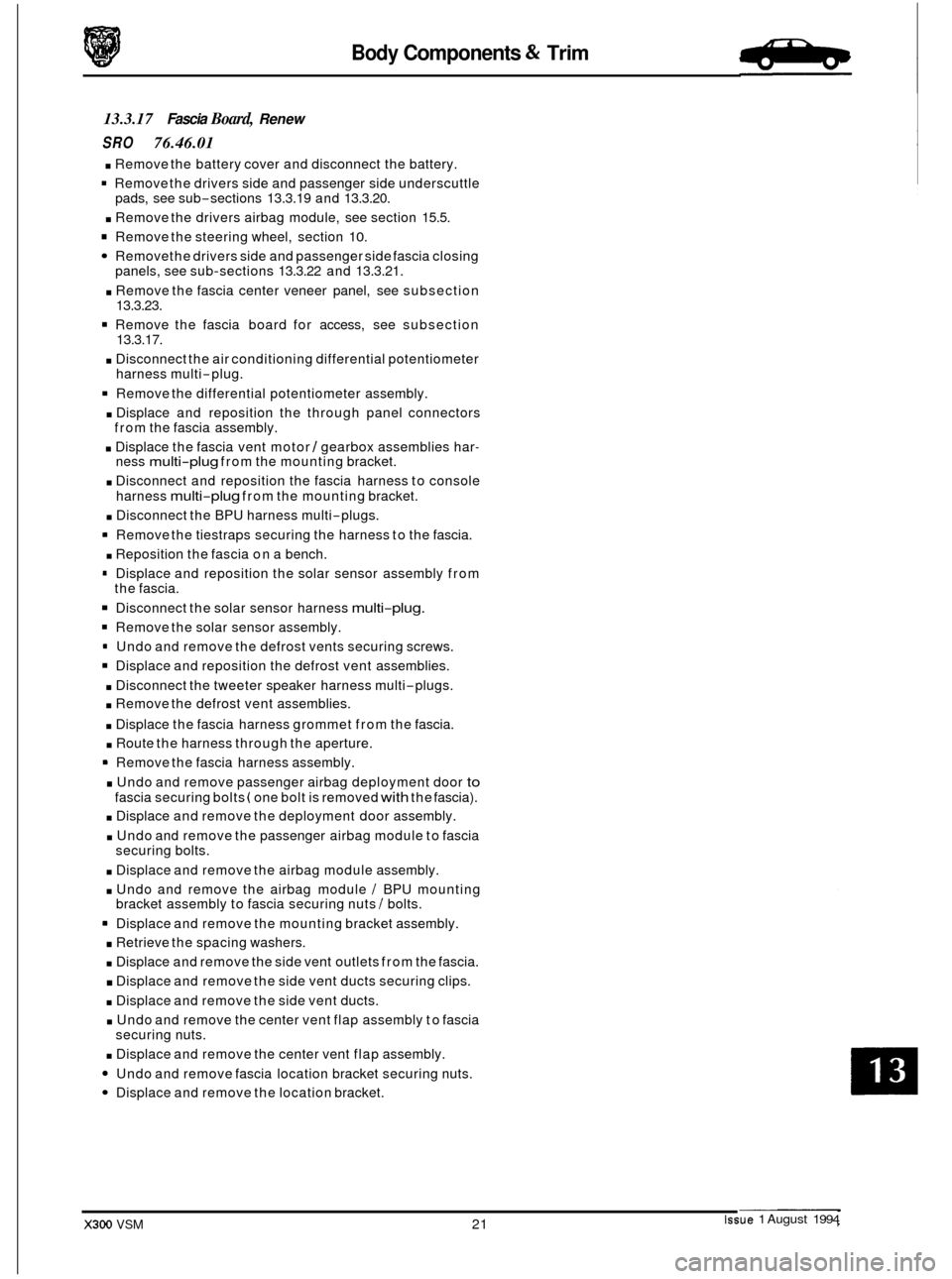
13.3.17 Fascia Board, Renew
SRO 76.46.01
. Remove
the battery cover and disconnect the battery.
Remove the drivers side and passenger side underscuttle
pads, see sub
-sections 13.3.19 and 13.3.20.
. Remove the drivers airbag module, see section 15.5.
Remove the steering wheel, section 10.
Remove the drivers side and passenger side fascia closing
. Remove the fascia center veneer panel, see subsection
Remove the fascia board for access, see subsection
. Disconnect the air conditioning differential potentiometer
Remove the differential potentiometer assembly.
. Displace and reposition the through panel connectors
from the fascia assembly.
. Displace the fascia vent motor / gearbox assemblies har- ness multi-plug from the mounting bracket.
. Disconnect and reposition the fascia harness to console
harness
multi-plug from the mounting bracket.
. Disconnect the BPU harness multi-plugs.
Remove the tiestraps securing the harness to the fascia.
. Reposition the fascia on a bench.
= Displace and reposition the solar sensor assembly from
Disconnect the solar sensor harness multi-plug.
Remove the solar sensor assembly.
= Undo and remove the defrost vents securing screws.
Displace and reposition the defrost vent assemblies.
. Disconnect the tweeter speaker harness multi-plugs.
. Remove the defrost vent assemblies.
. Displace the fascia harness grommet from the fascia.
. Route the harness through the aperture.
Remove the fascia harness assembly.
. Undo and remove passenger airbag deployment door to
fascia securing bolts ( one bolt is removed with the fascia).
. Displace and remove the deployment door assembly.
. Undo and remove the passenger airbag module to fascia
. Displace and remove the airbag module assembly.
. Undo and remove the airbag module I BPU mounting
bracket assembly to fascia securing nuts 1 bolts.
= Displace and remove the mounting bracket assembly.
. Retrieve the spacing washers.
. Displace and remove the side vent outlets from the fascia.
. Displace and remove the side vent ducts securing clips.
. Displace and remove the side vent ducts.
. Undo and remove the center vent flap assembly to fascia
. Displace and remove the center vent flap assembly.
Undo and remove fascia location bracket securing nuts.
Displace and remove the location bracket.
panels, see
sub
-sections 13.3.22 and 13.3.21.
13.3.23. 13.3.17.
harness multi
-plug.
the fascia.
securing bolts.
securing nuts.
Page 278 of 521
Body Components & Trim
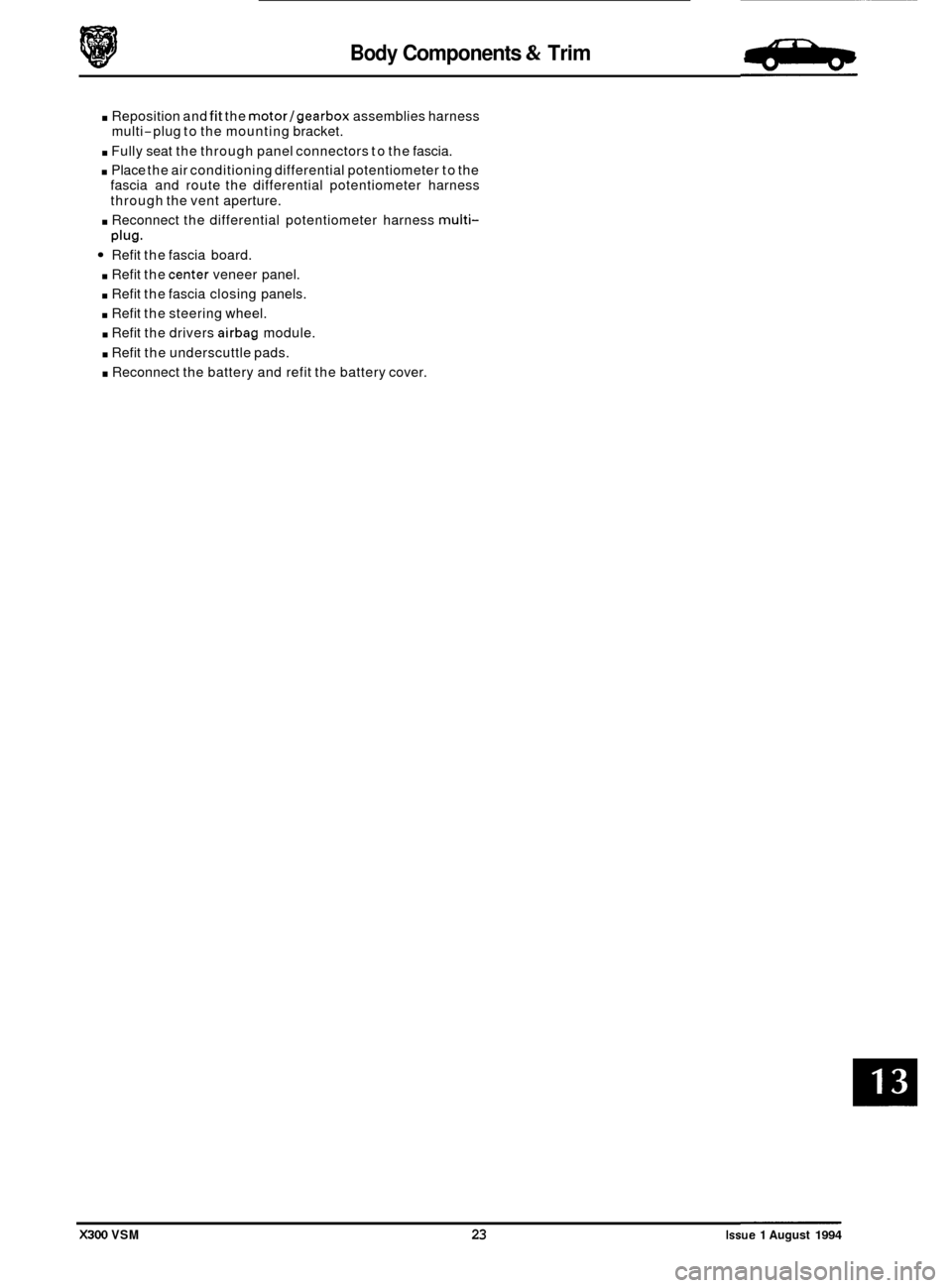
. Reposition and fit the motor/gearbox assemblies harness
. Fully seat the through panel connectors to the fascia.
. Place the air conditioning differential potentiometer to the
fascia and route the differential potentiometer harness
through the vent aperture.
. Reconnect the differential potentiometer harness multi-
Plug.
Refit the fascia board.
. Refit the center veneer panel.
. Refit the fascia closing panels.
. Refit the steering wheel.
. Refit the drivers airbag module.
. Refit the underscuttle pads.
. Reconnect the battery and refit the battery cover.
multi
-plug
to the mounting bracket.
X300 VSM 23 Issue 1 August 1994
Page 281 of 521
Body Components & Trim
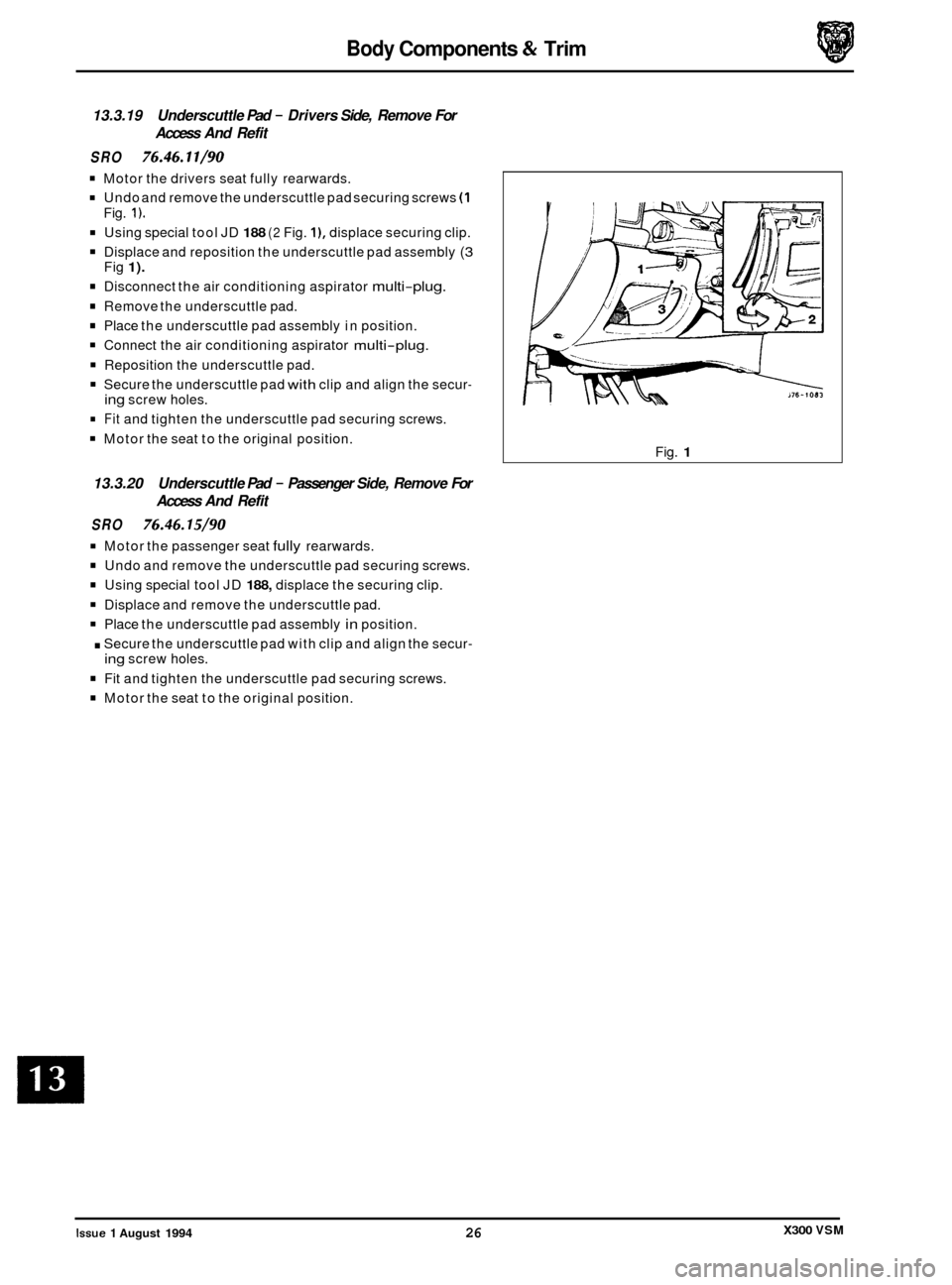
13.3.19 Underscuttle Pad - Drivers Side, Remove For
Access And Refit
SRO 76.46.11/90
Motor the drivers seat fully rearwards.
Undo and remove the underscuttle pad securing screws (1
Using special tool JD 188 (2 Fig. I), displace securing clip.
Displace and reposition the underscuttle pad assembly (3
Disconnect the air conditioning aspirator multi-plug.
Remove the underscuttle pad.
Place the underscuttle pad assembly in position.
Connect the air conditioning aspirator multi-plug.
Reposition the underscuttle pad.
Secure the underscuttle pad with clip and align the secur-
Fit and tighten the underscuttle pad securing screws.
Motor the seat to the original position.
Fig.
1).
Fig 1).
ing screw
holes.
13.3.20 Underscuttle Pad - Passenger Side, Remove For
Access And Refit
SRO 76.46.15/90
Motor the passenger seat fully rearwards.
Undo and remove the underscuttle pad securing screws.
Using special tool JD 188, displace the securing clip.
Displace and remove the underscuttle pad.
Place the underscuttle pad assembly in position.
. Secure the underscuttle pad with clip and align the secur-
Fit and tighten the underscuttle pad securing screws.
Motor the seat to the original position.
ing screw holes. Fig.
1
X300 VSM Issue 1 August 1994 26
Page 310 of 521
Climate Control Systems
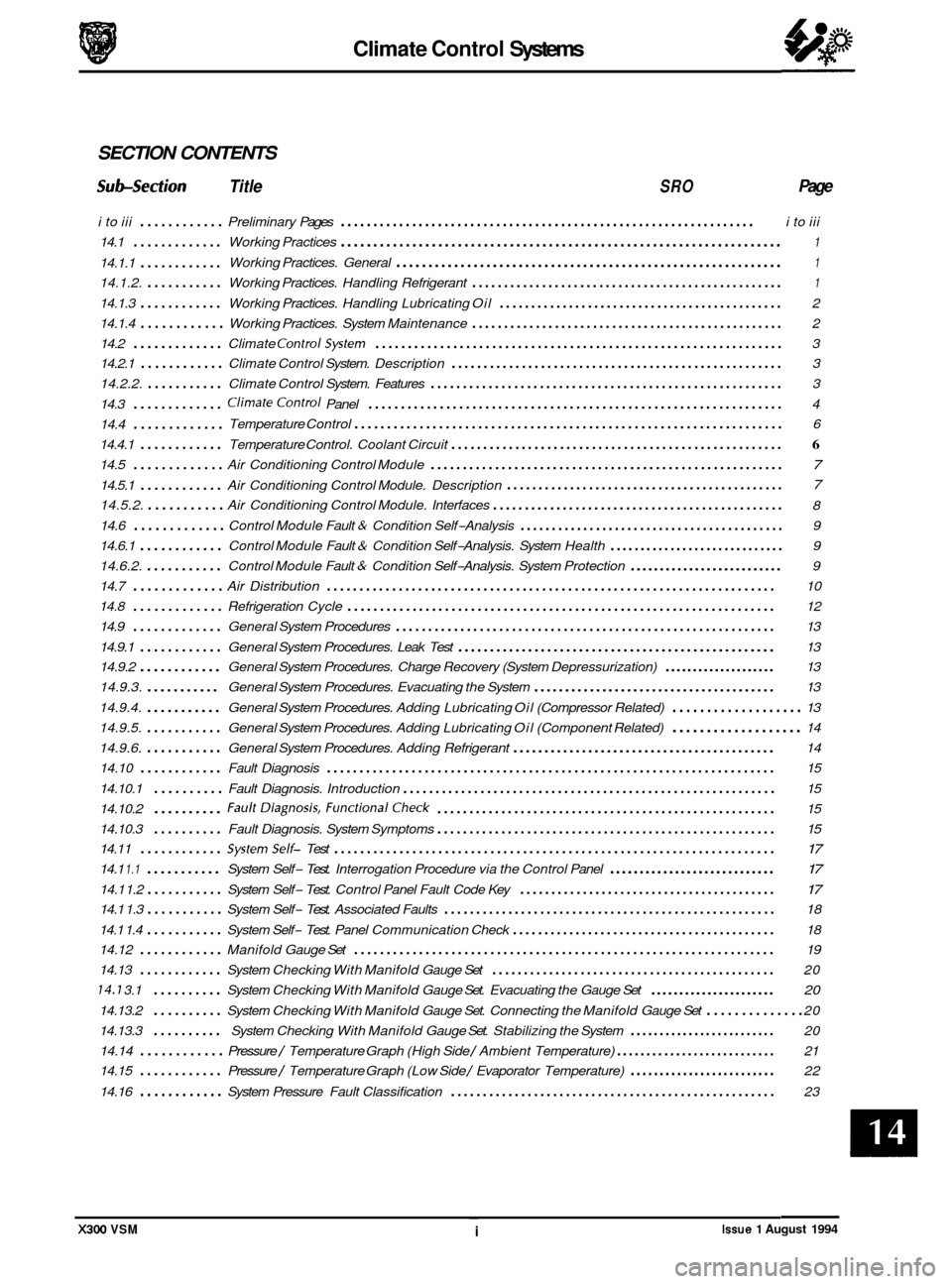
SECTION CONTENTS
Subsection Title SRO Page
i to iii ............ Preliminary Pages ................................................................ i to iii
14.1
............. Working Practices .................................................................... 1
Working Practices. General ............................................................ 1 14.1.1 ............
14.1.2. ........... Working Practices. Handling Refrigerant ................................................. 1
14.1.3 ............ Working Practices. Handling Lubricating Oil ............................................. 2
14.1.4
............ Working Practices. System Maintenance ................................................. 2
14.2
............. Climate ControlSystem ............................................................... 3
14.2.1
............ Climate Control System. Description .................................................... 3
14.2.2.
........... Climate Control System. Features ....................................................... 3
14.3
............. ClimateControl Panel ................................................................ 4
14.4
.............
14.4.1 ............ Temperature Control. Coolant Circuit .................................................... 6
14.5 ............. Air Conditioning Control Module ....................................................... 7
14.5.1 ............ Air Conditioning Control Module. Description 7
14.5.2. ........... Air Conditioning Control Module. Interfaces .............................................. 8
14.6
............. Control Module Fault & Condition Self-Analysis .......................................... 9
14.6.1
............ Control Module Fault & Condition Self-Analysis. System Health ............................. 9
14.6.2.
........... Control Module Fault & Condition Self-Analysis. System Protection .......................... 9
14.7
............. Air Distribution ..................................................................... 10
14.8
............. Refrigeration Cycle .................................................................. 12
14.9
............. General System Procedures ........................................................... 13
14.9.1
............ General System Procedures. Leak Test .................................................. 13
14.9.2
............ General System Procedures. Charge Recovery (System Depressurization) .................... 13
14.9.3.
........... General System Procedures. Evacuating the System ....................................... 13
14.9.4.
........... General System Procedures. Adding Lubricating Oil (Compressor Related) ................... 13
14.9.5.
........... General System Procedures. Adding Lubricating Oil (Component Related) ................... 14
14.9.6.
........... General System Procedures. Adding Refrigerant .......................................... 14
14.10
............ Fault Diagnosis ..................................................................... 15
14.10.1
.......... Fault Diagnosis. Introduction .......................................................... 15
14.10.2
.......... FaultDiagnosis. FunctionalCheck ..................................................... 15
14.10.3
14.11
............ Systemself- Test .................................................................... 17
14.1 1.1 ........... System Self- Test. Interrogation Procedure via the Control Panel ............................ 17
14.1 1.2 ........... System Self- Test. Control Panel Fault Code Key ......................................... 17
14.1 1.4 ........... System Self- Test. Panel Communication Check .......................................... 18
14.13
............ System Checking With Manifold Gauge Set ............................................. 20
14.7 3.1 .......... System Checking With Manifold Gauge Set. Evacuating the Gauge Set ...................... 20
14.13.2 .......... System Checking With Manifold Gauge Set. Connecting the Manifold Gauge Set .............. 20
14.13.3
.......... System Checking With Manifold Gauge Set. Stabilizing the System ......................... 20
14.14
............ Pressure / Temperature Graph (High Side / Ambient Temperature) ........................... 21
14.15
............ Pressure / Temperature Graph (Low Side / Evaporator Temperature) ......................... 22
14.16
............ System Pressure Fault Classification ................................................... 23
Temperature
Control
.................................................................. 6
............................................ a
.......... Fault Diagnosis. System Symptoms ..................................................... 15 a
14.1 1.3 ........... System Self- Test. Associated Faults .................................................... 18
14.12
............ Manifold Gauge Set ................................................................. 19
X300 VSM ~ i Issue 1 August 1994
Page 314 of 521
Climate Control Systems
14.1 WORKING PRACTICES
14.1.1 General
o Be aware of, and comply with all health and safety requirements, whether they be legislative or common sense.
This applies to conditions set both for the operator and workshop.
o Before commencing any repair or service procedure, disconnect the vehicle battery ground connection and
protect the vehicle where appropriate, from dirt or damage.
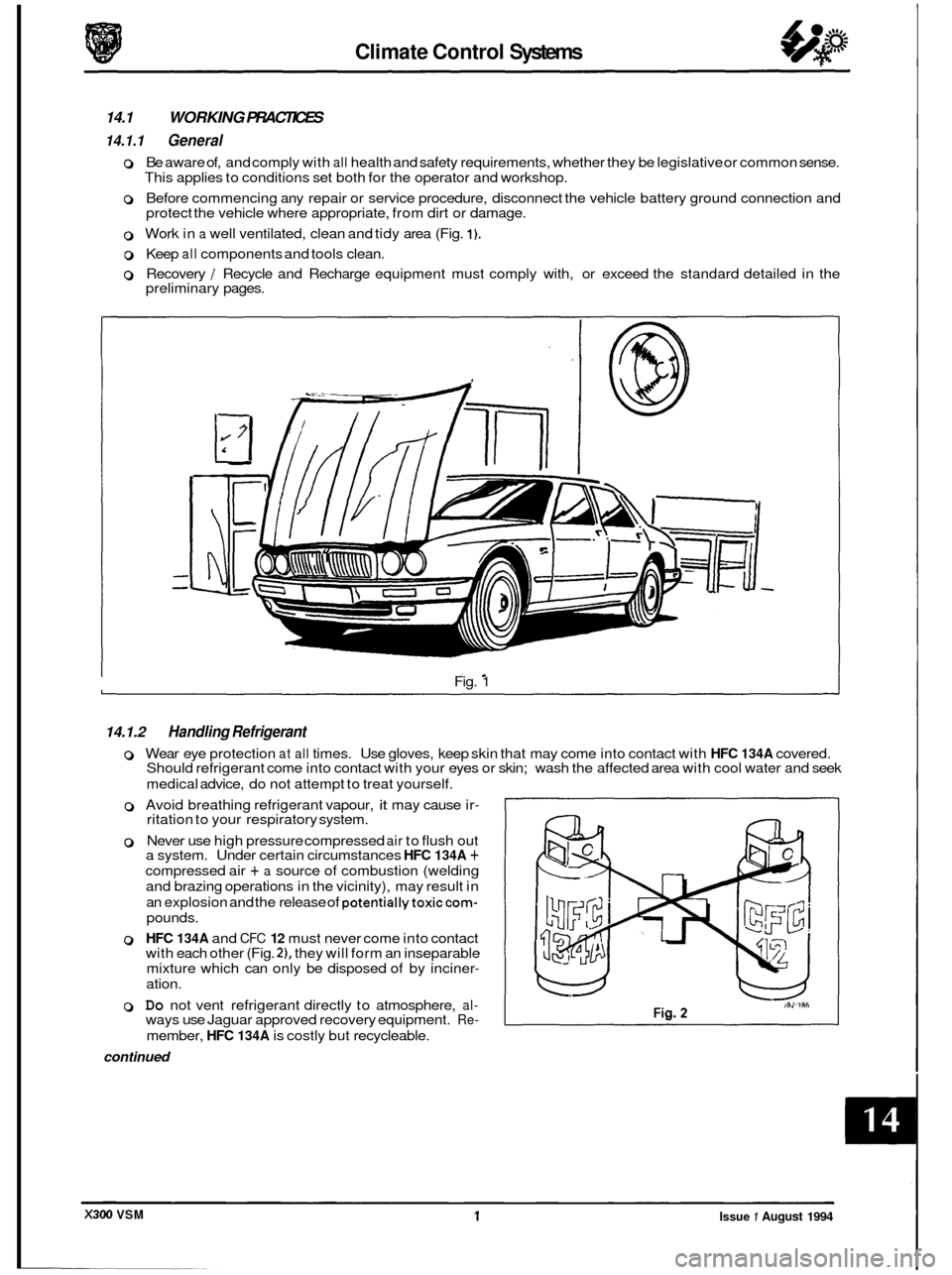
0 Work in a well ventilated, clean and tidy area (Fig. 1).
0 Keep all components and tools clean.
0 Recovery / Recycle and Recharge equipment must comply with, or exceed the standard detailed in the
preliminary pages.
Fig.
1
14.1.2 Handling Refrigerant
0 Wear eye protection at all times. Use gloves, keep skin that may come into contact with HFC 134A covered.
Should refrigerant come into contact with your eyes or skin; wash the affected area with cool water and seek
medical advice, do not attempt to treat yourself.
o Avoid breathing refrigerant vapour, it may cause ir- ritation to your respiratory system.
0 Never use high pressure compressed air to flush out
a system. Under certain circumstances HFC 134A +
compressed air + a source of combustion (welding
and brazing operations in the vicinity), may result in
an explosion and the release
of potentiallytoxiccom-
pounds.
0 HFC 134A and CFC 12 must never come into contact
with each other (Fig. 21, they will form an inseparable
mixture which can only be disposed of by inciner
-
ation.
0 Do not vent refrigerant directly to atmosphere, al- ways use Jaguar approved recovery equipment. Re-
member, HFC 134A is costly but recycleable.
continued
1 Issue 1 August 1994 X300 VSM