fuel pump JAGUAR XJ6 1994 2.G Workshop Manual
[x] Cancel search | Manufacturer: JAGUAR, Model Year: 1994, Model line: XJ6, Model: JAGUAR XJ6 1994 2.GPages: 521, PDF Size: 17.35 MB
Page 14 of 521
Introduction c
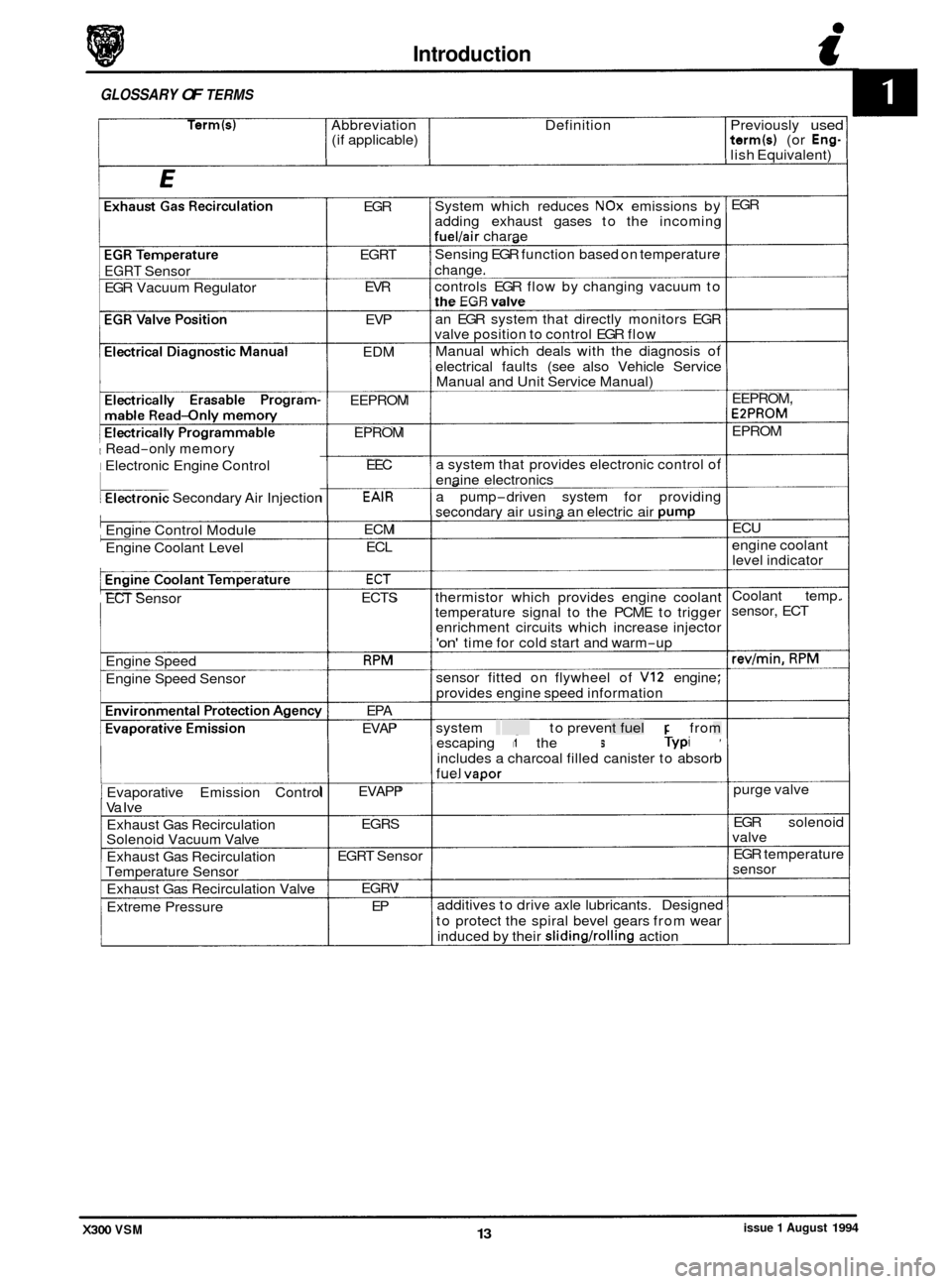
GLOSSARY OF TERMS
Term(s) Abbreviation Definition Previously used (if applicable) term(s) (or Eng- lish Equivalent)
0
EGRT Sensor
EGR Vacuum Regulator
1 Read-only memory
I Electronic Engine Control
kronic Secondary Air Injection
Engine Control Module
Engine Coolant Level
ECT Sensor
Engine Speed
Engine Speed Sensor
1 Evaporative Emission Control
Va Ive
Exhaust Gas Recirculation
Solenoid Vacuum Valve
Exhaust Gas Recirculation
Temperature Sensor
Exhaust Gas Recirculation Valve
Extreme Pressure EGR
EGRT EVR
EVP
EDM
EEPROM EPROM EEC
EAlR
ECM ECL
ECT
ECTS
RPM
EPA
EVAP
EVAPP EGRS
EGRT Sensor
EGRV EP System
which reduces
NOx emissions by
adding exhaust gases to the incoming
fuel/air charae
Sensing EGR function based on temperature
change.
controls EGR flow by changing vacuum to
the EGR valve
an EGR system that directly monitors EGR
valve position to control EGR flow
Manual which deals with the diagnosis of
electrical faults (see also Vehicle Service
Manual and Unit Service Manual)
a system that provides electronic control of
enaine electronics
a pump
-driven system for providing
secondarv air usina an electric air Dump
thermistor which provides engine coolant
temperature signal to the PCME to trigger
enrichment circuits which increase injector
'on' time for cold start and warm-up
sensor fitted on flywheel of
VI2 engine;
provides engine speed information
system designed to prevent fuel vapor from
escaping into the atmosphere. Typically
includes a charcoal filled canister to absorb
fuel
vaoor
additives to drive axle lubricants. Designed
to protect the spiral bevel gears from wear
induced by their
slidingholling action EGR
EEPROM,
EPPROM
EPROM ECU
engine coolant level indicator
Coolant temp.
sensor, ECT
revlmin. RPM
purge valve
EGR solenoid
valve
EGR temperature
sensor
X300 VSM issue 1 August 1994 13
Page 15 of 521
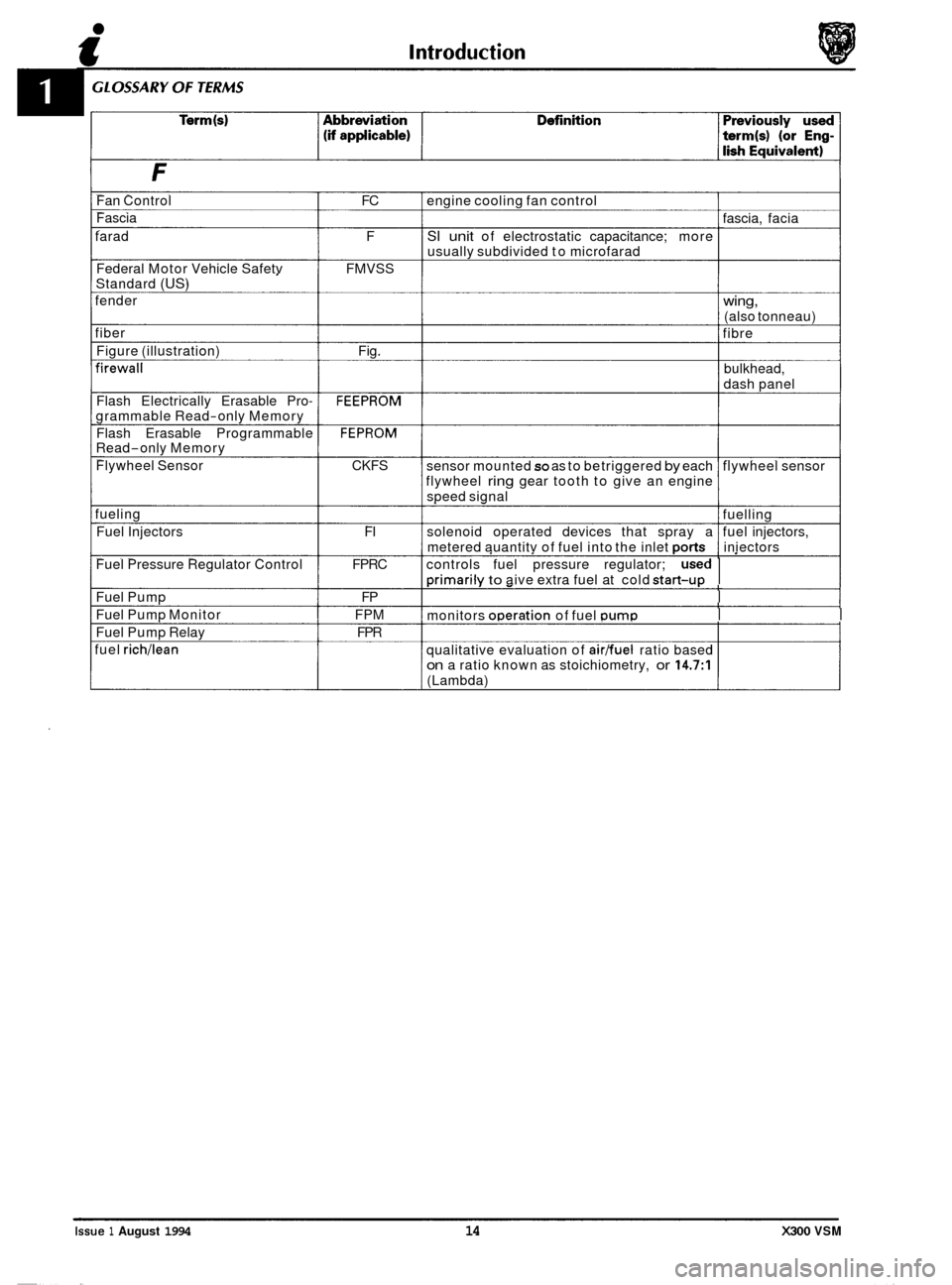
Fan Control FC
Fascia
farad F
I Federal Motor Vehicle Safetv I FMVSS
Standard (US)
fender
fiber
Figure (illustration) Fig.
firewall
Flash Electrically Erasable Pro- FEEPROM grammable Read-only Memory
Flash Erasable Programmable
FEPROM Read-only Memory
Flywheel Sensor CKFS
fueling Fuel Injectors FI
Fuel Pressure Regulator Control FPRC
Fuel Pump FP
Fuel Pump Monitor FPM
Fuel Pump Relay FPR
fuel
rich/lean
engine cooling fan control
SI unit of electrostatic capacitance; more
usually subdivided to microfarad fascia,
facia
wing,
(also tonneau)
fibre
bulkhead,
dash panel
sensor mounted
so as to be triggered by each flywheel sensor
flywheel ring gear tooth to give an engine
speed signal
fuelling
iniectors
solenoid operated
devices that spray a fuel injectors,
metered auantitv of fuel into the inlet
~0rt.s
Drimarilv to aive extra fuel at cold start-uo used I
controls fuel pressure regulator;
I I
monitors oDeration of fuel DumD I I
qualitative evaluation of airbuel ratio based on a ratio known as stoichiometry, or 14.7:l
(Lambda)
Issue 1 August 1994 14 X300 VSM
0
0
Page 22 of 521
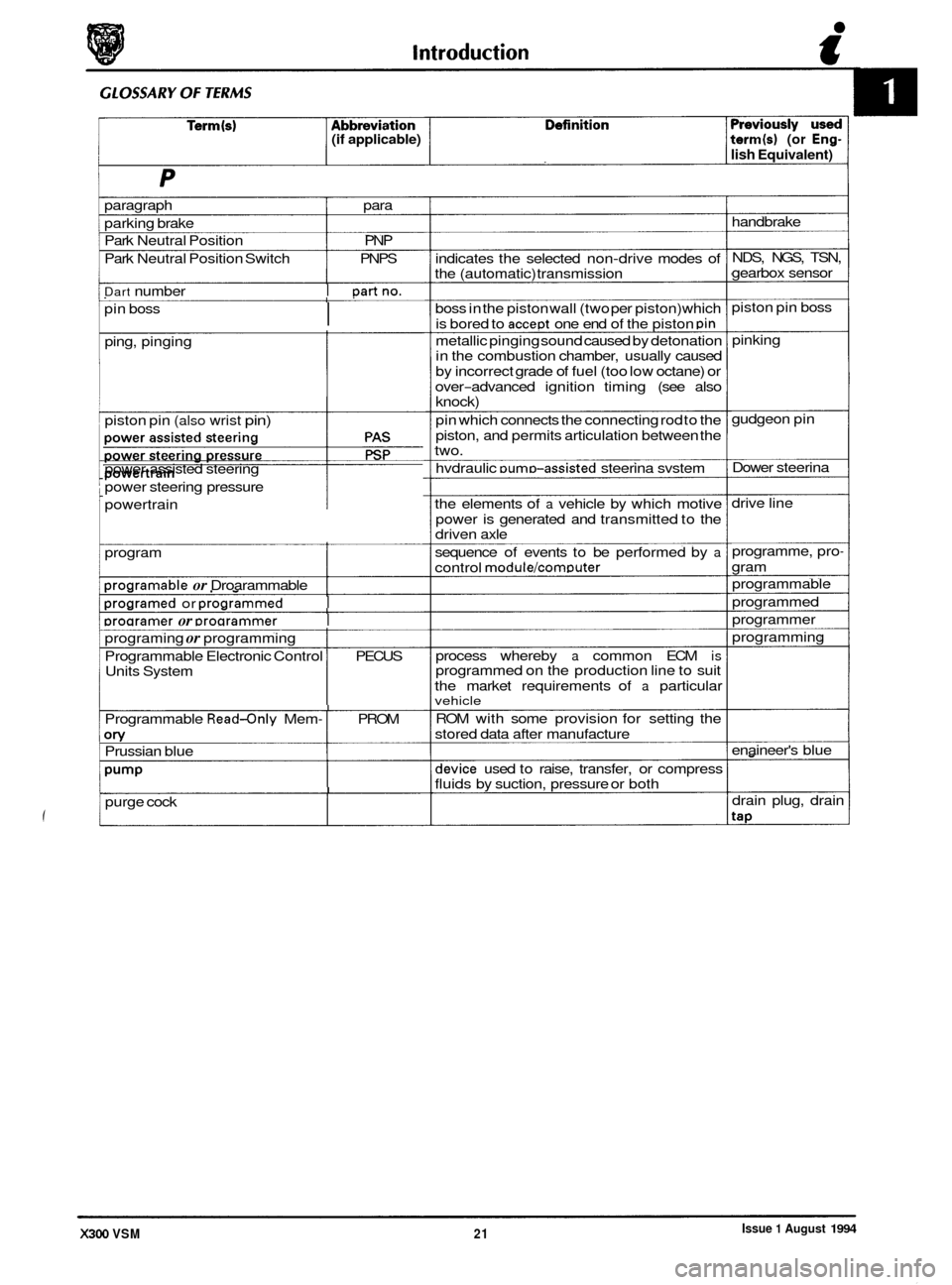
(if applicable) term(s) (or Eng-
lish Equivalent)
paragraph para
parking brake
Park Neutral Position PNP
Park Neutral Position Switch PNPS
Dart number I Dartno.
I pin boss
ping, pinging
piston pin
(also wrist pin)
power assisted steering
power steering pressure
. powertrain
program
Droaramable or Droarammable I
Droaramed or Droarammed I
Droaramer or Droarammer I
programing or programming
Programmable Electronic Control
I PECUS
Units System
I Programmable Read-only Mem- I PROM
on/ Prussian blue
Pump
purge cock I
indicates the selected non-drive modes of
the (automatic) transmission
boss in the piston wall (two per piston) which
is bored to
accept one end of the piston pin
metallic pinging sound caused by detonation
in the combustion chamber, usually caused
by incorrect grade of fuel (too low octane) or
over
-advanced ignition timing (see also knock)
pin which connects the connecting rod to the
piston, and permits articulation between the
two.
hvdraulic
DumD-assisted steerina svstem
the elements of
a vehicle by which motive
power is generated and transmitted to the
driven axle
sequence of events to be performed by
a
control module/comDuter
process whereby a common ECM is programmed on the production line to suit
the market requirements of
a particular vehicle
ROM with some provision for setting the
stored data after manufacture
device used to raise, transfer, or compress
fluids by suction, pressure or both handbrake
NDS, NGS, TSN,
gearbox sensor
piston pin boss
pinking
gudgeon pin
Dower steerina
drive line
programme, pro
-
gram
programmable
programmed
programmer
programming
enaineer's blue
drain plug, drain
tap
Issue 1 August 1994 X300 VSM 21
Page 61 of 521
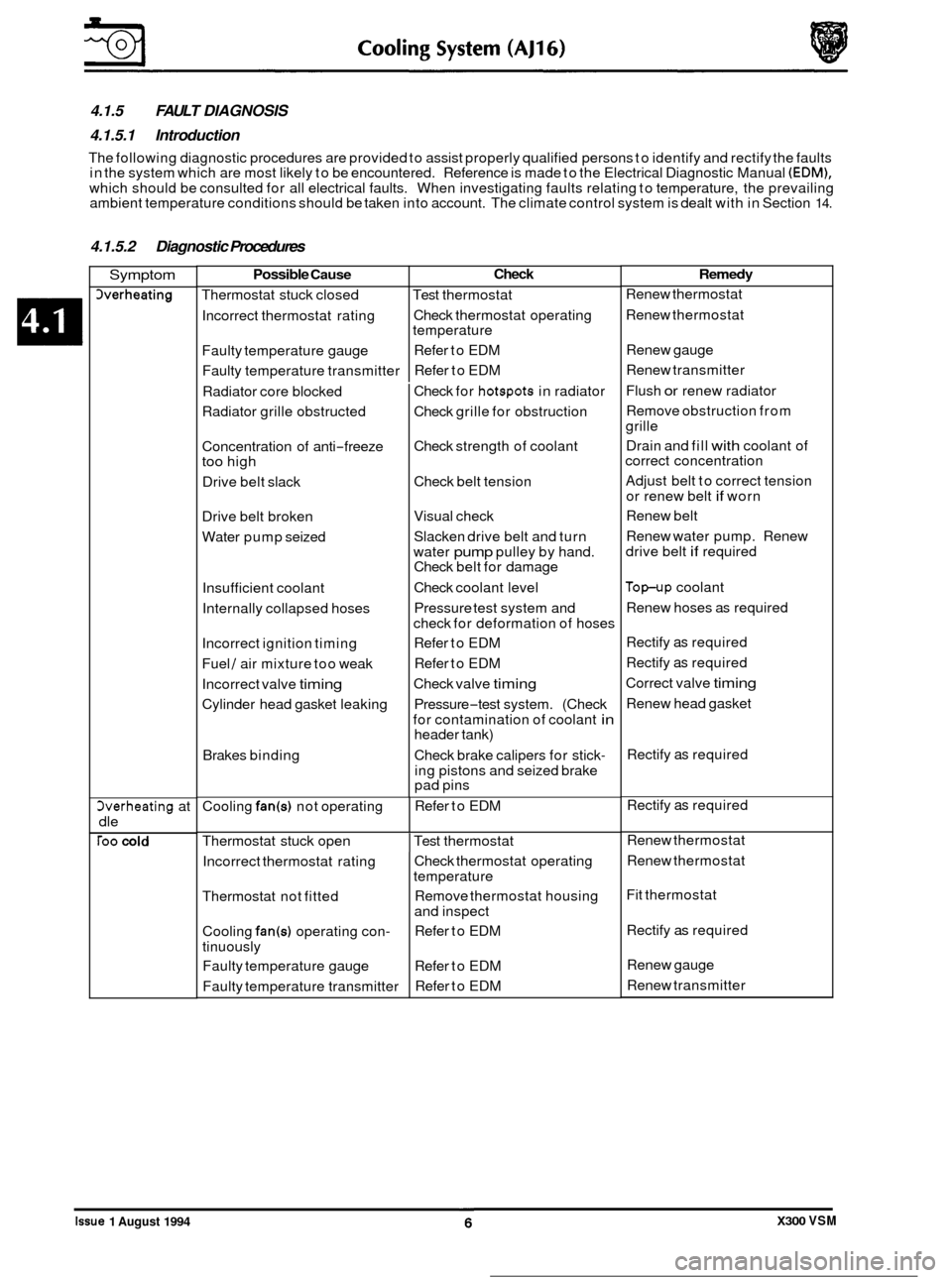
4.1.5 FAULT DIAGNOSIS
4.1.5.1 Introduction
The following diagnostic procedures are provided to assist properly qualified persons to identify and rectify the faults
in the system which are most likely to be encountered. Reference is made to the Electrical Diagnostic Manual (EDM),
which should be consulted for all electrical faults. When investigating faults relating to temperature, the prevailing
ambient temperature conditions should be taken into account. The climate control system is dealt with in Section 14.
Possible Cause
Thermostat stuck closed
Incorrect thermostat rating
Faulty temperature gauge
Faulty temperature transmitter
4.1.5.2 Diagnostic Procedures
Check
Test thermostat
Check thermostat operating
temperature
Refer to EDM
Refer to EDM
Symptom
herheating
Cooling fan(s) not operating 3verheating at
dle
roo cold
Refer to EDM
Incorrect thermostat rating
Thermostat not fitted
Cooling
fan(s) operating con-
tinuously Faulty temperature gauge
Faulty temperature transmitter
Radiator
core blocked
Radiator grille obstructed
Check thermostat operating
temperature
Remove thermostat housing
and inspect
Refer to EDM
Refer to EDM
Refer to EDM
Concentration of
anti
-freeze too high
Drive belt slack
Drive belt broken
Water pump seized
Insufficient coolant
Internally collapsed hoses
Incorrect ignition timing
Fuel
/ air mixture too weak
Incorrect valve
timing
Cylinder head gasket leaking
Brakes binding Check
for
hotspots in radiator
Check grille for obstruction
Check strength of coolant
Check belt tension
Visual check
Slacken drive belt and turn
water
pump pulley by hand.
Check belt for damage
Check coolant level
Pressure test system and
check for deformation of hoses
Refer to EDM
Refer to EDM
Check valve
timing
Pressure-test system. (Check
for contamination of coolant
in header tank)
Check brake calipers for stick
-
ing pistons and seized brake
pad pins
Thermostat stuck open
I Test thermostat
Remedy
Renew thermostat
Renew thermostat
Renew gauge
Renew transmitter
Flush
or renew radiator
Remove obstruction from
grille
Drain and fill
with coolant of
correct concentration
Adjust belt to correct tension
or renew belt
if worn
Renew belt
Renew water pump. Renew
drive belt
if required
Top-up coolant
Renew hoses as required
Rectify
as required
Rectify
as required
Correct valve
timing
Renew head gasket
Rectify
as required
Rectify
as required
Renew thermostat
Renew thermostat
Fit thermostat
Rectify
as required
Renew gauge
Renew transmitter
0
e
0
0
Issue 1 August 1994 X300 VSM
Page 70 of 521
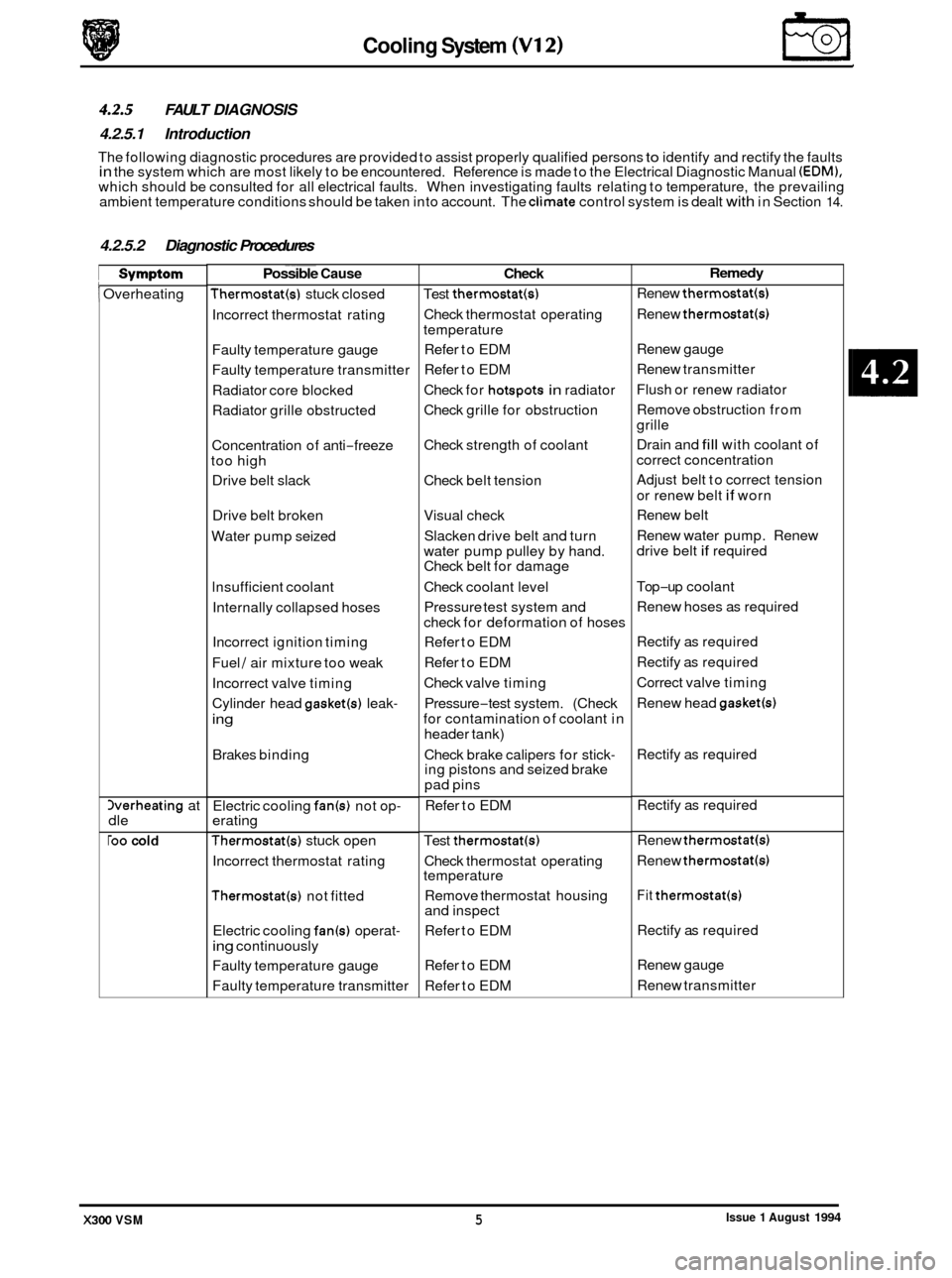
4.2.5.2 Diagnostic Procedures
1
I Symptom ..
Overheating
herheating at
dle
roo cold ~~~
Possible Cause
Thermostat(s) stuck
closed
Incorrect thermostat rating
Faulty temperature gauge
Faulty temperature transmitter
Radiator core blocked
Radiator grille obstructed
Concentration of anti
-freeze
too high
Drive belt slack
Drive belt broken
Water pump seized
lnsuff icient coolant
Internally collapsed hoses
Incorrect ignition timing
Fuel
/ air mixture too weak
Incorrect valve timing
Cylinder head
gasket(s) leak-
ing
Brakes binding
Electric cooling
fan(s) not op- erating
Thermostat(s) stuck open
Incorrect thermostat rating
Thermostatb) not fitted
Electric cooling
fan(s) operat-
ing continuously
Faulty temperature gauge
Faulty temperature transmitter
Check
Cooling System (V12)
4.2.5 FAULT DIAGNOSIS
4.2.5.1 Introduction
The following diagnostic procedures are provided to assist properly qualified persons to identify and rectify the faults in the system which are most likely to be encountered. Reference is made to the Electrical Diagnostic Manual (EDM), which should be consulted for all electrical faults. When investigating faults relating to temperature, the prevailing
ambient temperature conditions should be taken into account. The climate control system is dealt with in Section 14.
Test thermostat(s)
Check thermostat operating
temperature
Refer to EDM
Refer to EDM
Check for
hotspots in radiator
Check grille for obstruction
Check strength of coolant
Check belt tension
Visual check Slacken drive belt and turn
water pump pulley by hand.
Check belt for damage
Check coolant level
Pressure test system and
check for deformation of hoses
Refer to EDM
Refer to EDM
Check valve timing
Pressure
-test system. (Check
for contamination of coolant in
header tank)
Check brake calipers for stick
- ing pistons and seized brake
pad pins
..
Refer to EDM
Test
thermostat(4
Check thermostat operating
temperature
Remove thermostat housing
and inspect
Refer to EDM
Refer to EDM
Refer to EDM
Remedy
Renew thermostat(s)
Renew thermostat(s1
Renew gauge
Renew transmitter
Flush or renew radiator
Remove obstruction from
grille
Drain and
fill with coolant of
correct concentration
Adjust belt to correct tension
or renew belt
if worn
Renew belt
Renew water pump. Renew
drive belt
if required
Top
-up coolant
Renew hoses as required
Rectify as required
Rectify as required
Correct valve timing
Renew head
gasket(s)
Rectify as required
Rectify as required
Renew
thermostat(s1
Renew thermostatb)
Fit thermostat(s)
Rectify as required
Renew gauge
Renew transmitter
Issue 1 August 1994 X300 VSM 5
Page 75 of 521
Rear deck area
Behind rear bulkhead
Inside fuel tank 1
2
3
Inside fuel tank
Fuel
pump to fuel filter
Above rear axle assembly
Fuel filter to fuel rail
Inlet manifold
Inlet manifold
/fuel rail
Mounted on the fuel rail
Fuel regulator to fuel tank
Fuel tank to running
loss
control valve (NAS 4.0L
normally aspirated engine
only)
Running loss control valve
to primary carbon canister
(NAS 4.0L normally
aspirated engine only)
Left side of the fuel tank
4
5
6
7 8
9
10
11
12
13
14
Fuel tank to tank pressure
control (Rochester) valve
Connected between
emission vent lines as
shown on schematic
Rochester valve
to primary
carbon canister
Primary carbon canister to
secondary carbon canister
(NAS 4.0L normally
aspirated engine only)
15
16
17
18
Primary carbon canister to
atmosphere
Left side of vehicle,
in
front of the rear axle
To the right of the primary
carbon canister on the
other side of the vehicle
(NAS 4.0L normally
aspirated engine only).
Primary carbon canister
to
purge valve
Below the left head lamp
module
18
19
20
21
22
m Fuel, Emission Contro & Engine Management (AJ16) - .
0
0
0
0
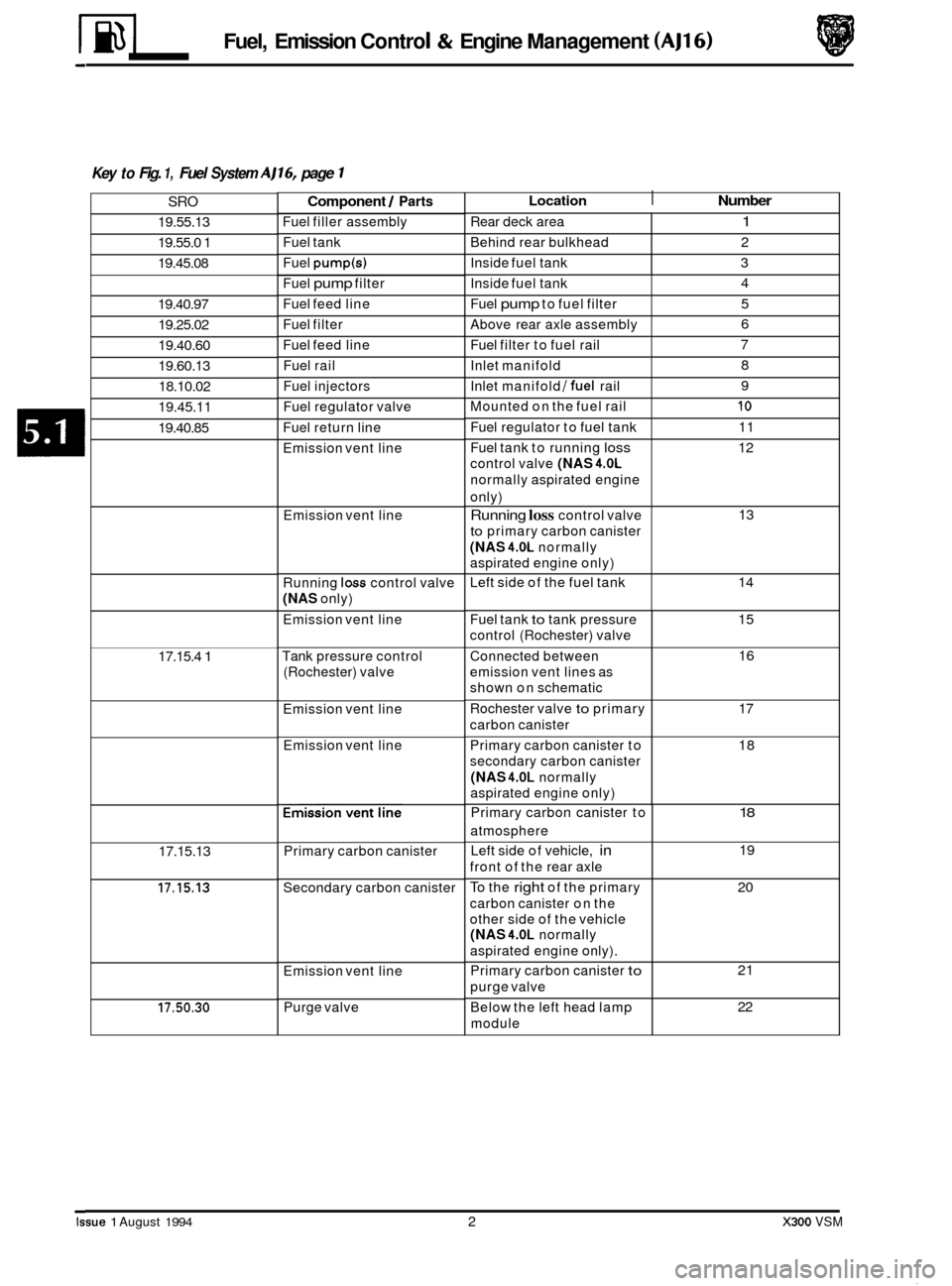
Key to Fig. 1, Fuel System AJ16, page 1
Location I Number Component / Parts
Fuel filler assembly
SRO
19.55.13
19.55.0 1
19.45.08
Fuel tank
Fuel
pump(s)
Fuel pump filter
Fuel feed line
Fuel filter
Fuel feed line
19.40.97
19.25.02
19.40.60
19.60.13 18.10.02
19.45.11
Fuel rail
Fuel injectors
Fuel regulator valve
19.40.85 Fuel return line
Emission vent line
Emission vent line
Running
loss control valve
(NAS only)
Emission vent line
Tank pressure control
(Rochester) valve
17.15.4 1
Emission vent line
Emission vent line
Emission vent line
Primary carbon canister
17.15.13
Secondary carbon canister 17.15.13
Emission vent line
Purge valve
17.50.30
Issue 1 August 1994 2 X300 VSM
Page 76 of 521
striker and the-fuel cap stowage magnet.
The fuel bowl, retained around the filler neck by a clip, containing a drain tube filter located over the mating drain tube,
is rubber moulded onto a steel armature and fitted to the BIW decking panel by five M5 nuts.
The fuel lid latching assembly fitted to the metal armature of the fuel bowl by an M5 nut, includes the locking pin and
the operating actuator.
The actuator operates from the central locking system driven by the security and locking control module
(SLCM).
The fuel tank, mounted across thevehicle behind the passenger compartment rear bulkhead, is held in position by two
retaining straps, tightened by two M5 fixing arrangements.
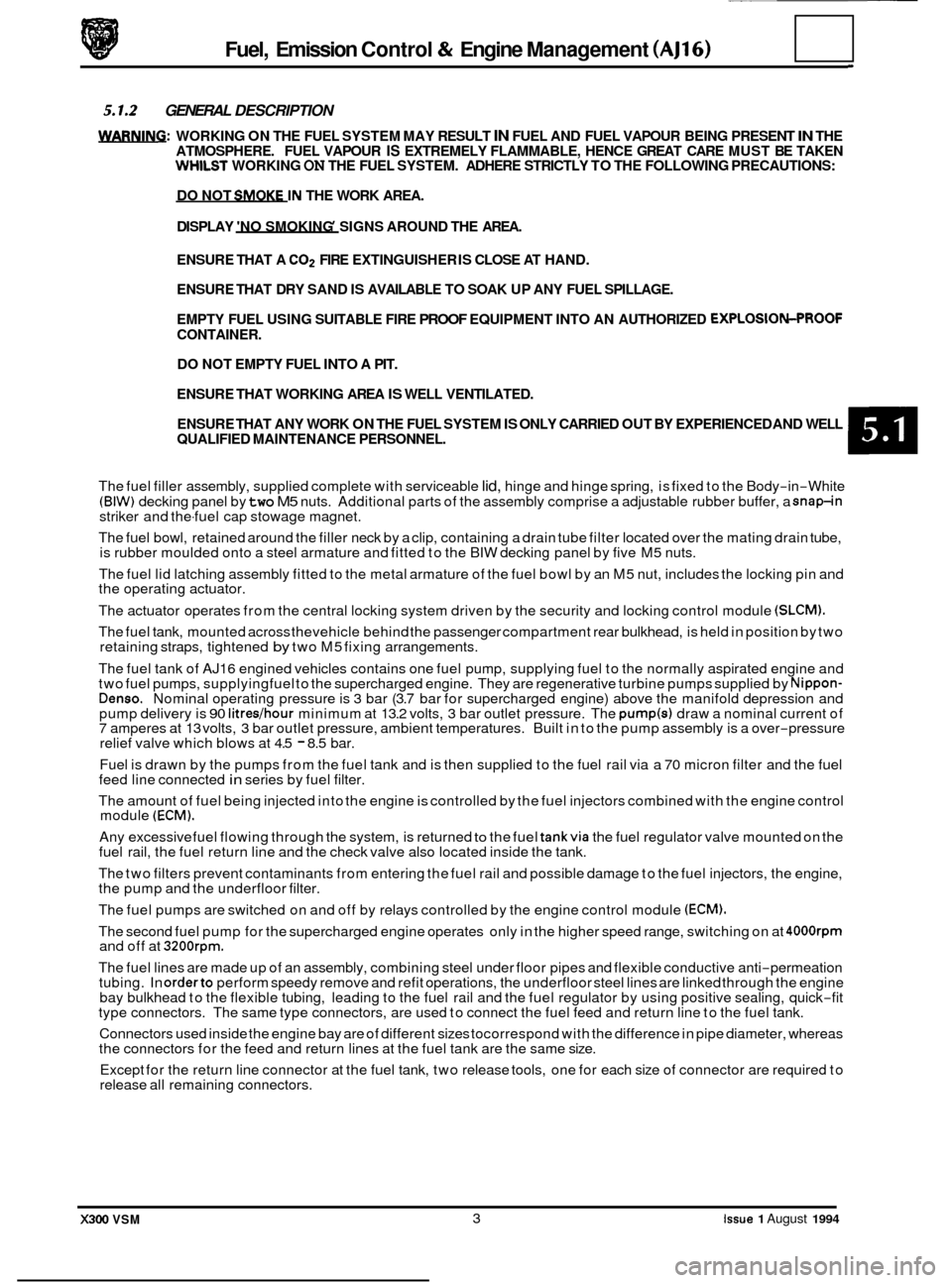
The fuel tank of AJ16 engined vehicles contains one fuel pump, supplying fuel to the normally aspirated engine and
two fuel pumps, supplyingfuel to the supercharged engine. They are regenerative turbine pumps supplied by
Nippon- Denso. Nominal operating pressure is 3 bar (3.7 bar for supercharged engine) above the manifold depression and
pump delivery is 90 litredhour minimum at 13.2 volts, 3 bar outlet pressure. The pump(s) draw a nominal current of 7 amperes at 13 volts, 3 bar outlet pressure, ambient temperatures. Built in to the pump assembly is a over-pressure
relief valve which blows at 4.5 - 8.5 bar.
Fuel is drawn by the pumps from the fuel tank and is then supplied to the fuel rail via a
70 micron filter and the fuel
feed line connected in series by fuel filter.
The amount of fuel being injected into the engine
is controlled by the fuel injectors combined with the engine control module (ECM). - Any excessive fuel flowing through the system, is returned to the fuel tankvia the fuel regulator valve mounted on the
fuel rail, the fuel return line and the check valve also located inside the tank.
The two filters prevent contaminants from entering the fuel rail and possible damage to the fuel injectors, the engine,
the pump and the underfloor filter.
The fuel pumps are switched on and off by relays controlled by the engine control module
(ECM).
The second fuel pump for the supercharged engine operates only in the higher speed range, switching on at 4000rpm and off at 3200rpm.
The fuel lines are made up of an assembly, combining steel under floor pipes and flexible conductive anti-permeation
tubing. In orderto perform speedy remove and refit operations, the underfloor steel lines are linked through the engine
bay bulkhead to the flexible tubing, leading to the fuel rail and the fuel regulator by using positive sealing, quick-fit
type connectors. The same type connectors, are used to connect the fuel feed and return line to the fuel tank.
Connectors used inside the engine bay are of different sizes tocorrespond with the difference in pipe diameter, whereas
the connectors for the feed and return lines at the fuel tank are the same size.
Except for the return line connector at the fuel tank, two release tools, one for each size of connector are required to
release all remaining connectors.
-~
Fuel, Emission Control & Engine Management (AJ16)
5.1.2 GENERAL DESCRIPTION
m: WORKING ON THE FUEL SYSTEM MAY RESULT IN FUEL AND FUEL VAPOUR BEING PRESENT IN THE
ATMOSPHERE. FUEL VAPOUR IS EXTREMELY FLAMMABLE, HENCE GREAT CARE MUST BE TAKEN WHllST WORKING ON THE FUEL SYSTEM. ADHERE STRICTLY TO THE FOLLOWING PRECAUTIONS:
DO NOT
SMOEIN THE WORK AREA.
DISPLAY 'NO SMOKING
' SIGNS AROUND THE AREA.
ENSURE THAT A
CO2 FIRE EXTINGUISHER IS CLOSE AT HAND.
ENSURE THAT DRY SAND
IS AVAILABLE TO SOAK UP ANY FUEL SPILLAGE.
EMPTY FUEL USING SUITABLE FIRE
PROOF EQUIPMENT INTO AN AUTHORIZED EXPLOSIOWROOF
CONTAINER.
DO NOT EMPTY FUEL
INTO A PIT.
ENSURE THAT WORKING AREA
IS WELL VENTILATED.
ENSURE THAT ANY WORK ON THE FUEL SYSTEM
IS ONLY CARRIED OUT BY EXPERIENCED AND WELL
QUALIFIED MAINTENANCE PERSONNEL.
The fuel filler assembly, supplied complete with serviceable lid, hinge and hinge spring, is fixed to the Body-in-White
(BIW) decking panel by two M5 nuts. Additional parts of the assembly comprise a adjustable rubber buffer, a snap-in
X300 VSM 3 Issue 1 August 1994
Page 91 of 521

+ 17.15.13
17.50.30
Component / parts
Fuel filler assembly
Fuel tank
Fuel pumps
Fuel
pump filter
Fuel feed line
Fuel filter
Fuel feed line
Fuel rail
Fuel injectors
Fuel regulator valve
Fuel return line
Emission vent line
Tank pressure control
(Rochester) valve
Emission vent line
Primary carbon canister
Emission vent line
Purge valve
Emission vent line
Location Number
Rear deck area
1
Behind rear bulkhead 2
Inside fuel tank 3
Inside fuel tank 4
Fuel
pump to fuel filter 5
Above rear axle assembly 6
Fuel filter to fuel rail 7
Inlet manifold
8
Inlet manifold /fuel rail 9
Mounted on the fuel rail 10
Fuel regulator to fuel tank 11
Fuel tank to tank pressure 12
control (Rochester) valve
Connected between
emission vent lines as
shown on schematic 13
Rochester valve to primary 14
carbon canister
Left side
of vehicle, in 15
front of the rear axle
Primary carbon canister to 16
purge valve
Below the left head lamp 17
module
Primary carbon canister
to at-
mosphere
18
0
0
0
Issue 1 August 1994 2 X300 VSM
Page 92 of 521
striker and the fuel cap stowage magnet.
The fuel bowl, retained around the filler neck by a clip, containing a drain tube filter located
overthe mating drain tube,
is rubber moulded onto a steel armature and fitted to the BIW decking panel. by five M5 nuts.
The fuel lid latching assembly fitted to the metal armature of the fuel bowl by an M5 nut, includes the locking pin and
the operating actuator.
The actuator operates from the central locking system driven by the Security and Locking Control Module (SLCM).
The fuel tank, mounted across the vehicle behind the passenger compartment rear bulkhead, is held in position by two
retaining straps, tightened by two M5 fixing arrangements.
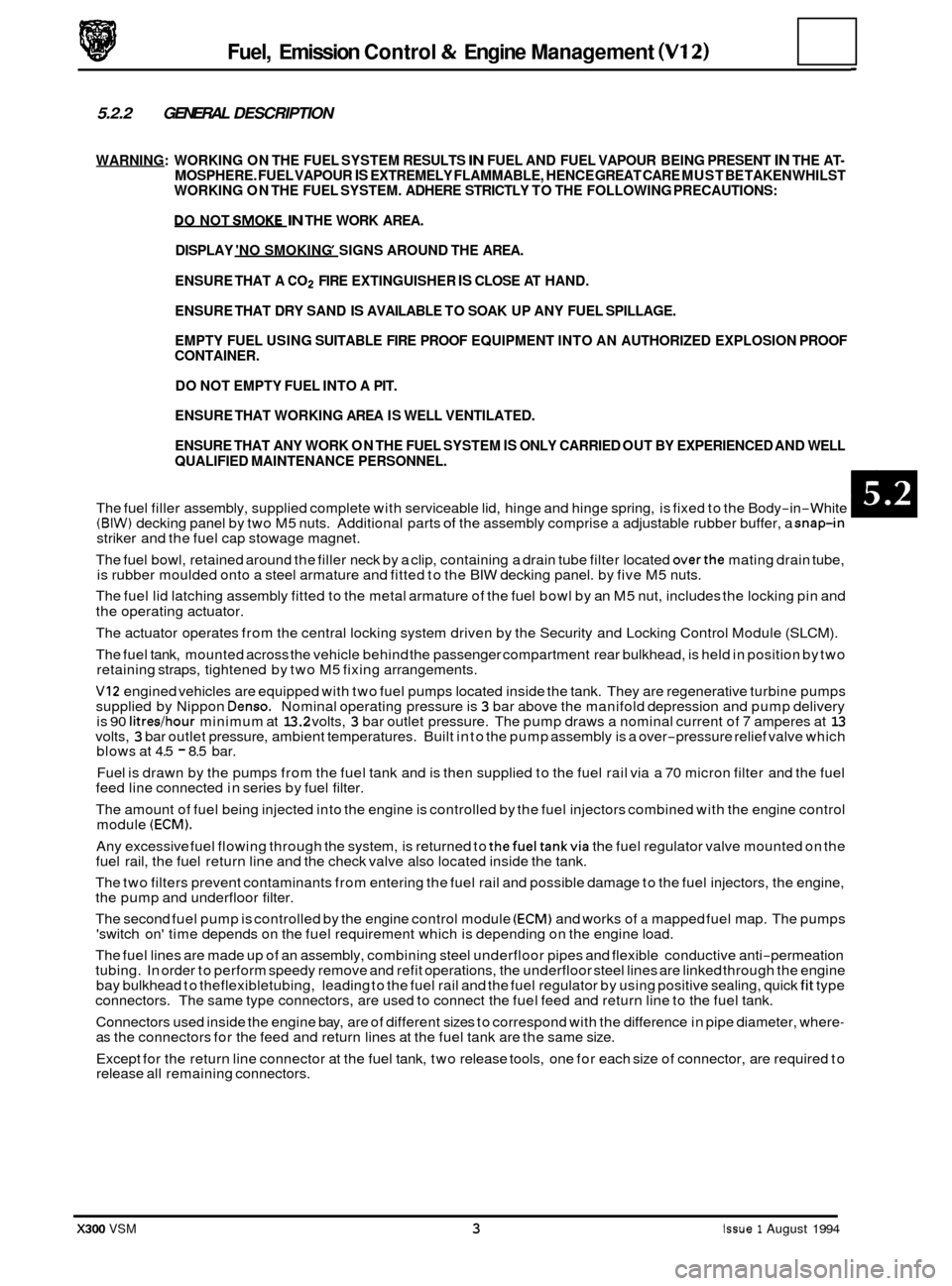
VI2 engined vehicles are equipped with two fuel pumps located inside the tank. They are regenerative turbine pumps
supplied by Nippon Denso. Nominal operating pressure is 3 bar above the manifold depression and pump delivery
is 90 litres/hour minimum at 13.2 volts, 3 bar outlet pressure. The pump draws a nominal current of 7 amperes at 13 volts, 3 bar outlet pressure, ambient temperatures. Built in to the pump assembly is a over-pressure relief valve which
blows at 4.5 - 8.5 bar.
Fuel is drawn by the pumps from the fuel tank and is then supplied to the fuel rail via a
70 micron filter and the fuel
feed line connected in series by fuel filter.
The amount of fuel being injected into the engine is controlled by the fuel injectors combined with the engine control
module (ECM).
Any excessive fuel flowing through the system, is returned to thefuel tankvia the fuel regulator valve mounted on the
fuel rail, the fuel return line and the check valve also located inside the tank.
The two filters prevent contaminants from entering the fuel rail and possible damage to the fuel injectors, the engine,
the pump and underfloor filter.
The second fuel pump is controlled by the engine control module
(ECM) and works of a mapped fuel map. The pumps
'switch on' time depends on the fuel requirement which is depending on the engine load.
The fuel lines are made up of an assembly, combining steel underfloor pipes and flexible conductive anti
-permeation
tubing. In order to perform speedy remove and refit operations, the underfloor steel lines are linked through the engine
bay bulkhead to theflexibletubing, leading to the fuel rail and the fuel regulator by using positive sealing, quick
fit type
connectors. The same type connectors, are used to connect the fuel feed and return line to the fuel tank.
Connectors used inside the engine bay, are of different sizes to correspond with the difference in pipe diameter, where
- as the connectors for the feed and return lines at the fuel tank are the same size.
Except for the return line connector at the fuel tank, two release tools, one for each size of connector, are required to
release all remaining connectors.
Fuel, Emission Control & Engine Management (V12)
5.2.2 GENERAL DESCRIPTION
WARNING: WORKING ON THE FUEL SYSTEM RESULTS IN FUEL AND FUEL VAPOUR BEING PRESENT IN THE AT- MOSPHERE. FUEL VAPOUR IS EXTREMELY FLAMMABLE, HENCE GREAT CARE MUST BE TAKEN WHILST
WORKING ON THE FUEL SYSTEM. ADHERE STRICTLY TO THE FOLLOWING PRECAUTIONS:
PO NOT SMOKF, IN THE WORK AREA.
DISPLAY 'NO SMOKING
' SIGNS AROUND THE AREA.
ENSURE THAT A
CO2 FIRE EXTINGUISHER IS CLOSE AT HAND.
ENSURE THAT DRY SAND
IS AVAILABLE TO SOAK UP ANY FUEL SPILLAGE.
EMPTY FUEL USING SUITABLE FIRE PROOF EQUIPMENT INTO AN AUTHORIZED EXPLOSION PROOF
CONTAINER.
DO NOT EMPTY FUEL INTO A PIT.
ENSURE THAT WORKING AREA IS WELL VENTILATED.
ENSURE THAT ANY WORK ON THE FUEL SYSTEM
IS ONLY CARRIED OUT BY EXPERIENCED AND WELL
QUALIFIED MAINTENANCE PERSONNEL.
The fuel filler assembly, supplied complete with serviceable lid, hinge and hinge spring, is fixed to the Body-in-White (BIW) decking panel by two M5 nuts. Additional parts of the assembly comprise a adjustable rubber buffer, a snap-in
X300 VSM 3 Issue 1 August 1994
Page 156 of 521
Automatic Transmission (V12 & AJl6 Supercharged) Pomrtrain
8.2.1 GENERAL DESCRIPTION
This section provides information relating to the Powertrain 4L80-E transmissions fitted to the 4,O liter supercharged
engine (4,OL SC) and to the 6,O liter engine (6,OL).
The Powertrain 4L80-E is a four-speed, high torque capacity, electronically controlled automatic transmission, which
comprises a torque converter with lock-up direct drive clutch and three planetary gear sets. Five multiple diskclutches,
one intermediate sprag clutch assembly, two roller clutch assemblies and two band assemblies provide the drive el- ements necessary for correct sequential gear engagement and operation.
The torque converter containing
a pump, a turbine (rotor), a stator assembly, and a clutch pressure disksplined to the
turbine, acts as a fluid coupling for smooth torque transmission from the engine. The converter also supplies addi- tional torque multiplication when necessary, and the torque converter clutch (TCC) pressure disk provides a mechan- ical direct drive or 'lock-up' above a certain speed in top gear for greater fuel economy.
Gearshift operations are controlled from the Transmission Control Module (TCM), which governs the electronically
controlled valve body situated within the transmission.
Three planetary gear sets provide reverse and the four forward ratios, the changing of which is fully automatic in rela
- tion to load, vehicle speed and throttle opening. The Transmission Control Module receives and integrates various ve- hicle sensor input signals, and transmits operating signals to the solenoids located in the control valve assembly.
These solenoids govern the transmission operating pressures, up-shift and down-shift gear selection patterns and
also the torque converter clutch operation by pulse width modulated control.
8.2.1.1 Gear Ranges
Selectable gear positions are: P - Park, R - Reverse, N - Neutral, D - Drive, 3, 2.
P - Park position of the shift lever provides a mechanical locking of the output shaft of the transmission, and as such,
must only be engaged when the the vehicle is stationary. In addition, and for
extra safety, the handbrake should also
be applied. It is necessary to have the ignition ON and the footbrake applied to move the shift lever from the Park
position. For ignition key removal the shift lever must be in the Park position. The engine can be started in the Park
position.
R - Reverse enables the vehicle to be operated in a rearwards direction. The engine cannot be started in the Reverse
position.
N
-Neutral position enables the engine to be started and operated without driving the vehicle. It also allows the vehicle
to be moved manually for access, ie for removal of the propeller shaft.
D
-Drive position allows the automatic selection of all four forward gear ratios during normal driving conditions for
maximum efficiency and fuel economy. On acceleration, down-shifts are obtained by depressing the accelerator pedal
or by manual selection. The engine cannot be started in this position.
3
- Manual third position allows automatic operation of the three lower gear ratios but inhibits selection of the fourth
ratio. This position is used for towing a trailer or negotiating hilly terrain when greater engine braking control is re- quired. The engine cannot be started in this position.
2 - Manual second position allows automatic operation of the two lower gear ratios but inhibits selection of the third
and fourth ratios. This position is used for heavy traffic congestion or negotiating hilly terrain when even greater en
- gine braking control is required than is provided by manual third. This ratio may be selected at any vehicle speed - even if the transmission is in third or fourth ratio, the transmission will immediately down-shift to second gear pro- vided the vehicle speed is below 137 km / h (85 mile / h). The engine cannot be started in this position.
N.g!b: With the Performance Mode switch in the NORMAL position, the vehicle will pull away in second gear. How- ever, if more than 75 per cent of throttle is applied when the vehicle speed is between zero and 13 km/ h (8 mile / h), then first gear will be selected. From 13 to 61 km/ h (8 to 38 mile/ h) first gear is obtainable by 'kick-down'.
In 'sport' mode thevehicle pulls away in first gear and the transmission operatesfully in all four forward gears.
X300 VSM 1 Issue 1 August 1994