battery location JAGUAR XJ6 1997 2.G User Guide
[x] Cancel search | Manufacturer: JAGUAR, Model Year: 1997, Model line: XJ6, Model: JAGUAR XJ6 1997 2.GPages: 227, PDF Size: 7.2 MB
Page 108 of 227
model but the designations are the same.
Refer to the wiring diagrams at the end of
Chapter 12.
f) Start the engine and check the alternator
for abnormal noises (a shrieking or
squealing sound indicates a bad bushing).
g) Check the specific gravity of the battery
electrolyte. If it’s low, charge the battery
(doesn’t apply to maintenance free
batteries).
h) Make sure that the battery is fully charged
(one bad cell in a battery can cause
overcharging by the alternator).
i) Disconnect the battery cables (negative
first, then positive). Caution:If the stereo
in your vehicle is equipped with an anti-
theft system, make sure you have the
correct activation code before
disconnecting the battery. Inspect the
battery posts and the cable clamps for
corrosion. Clean them thoroughly if
necessary (see Chapter 1). Reconnect the
positive cable, then the negative cable.
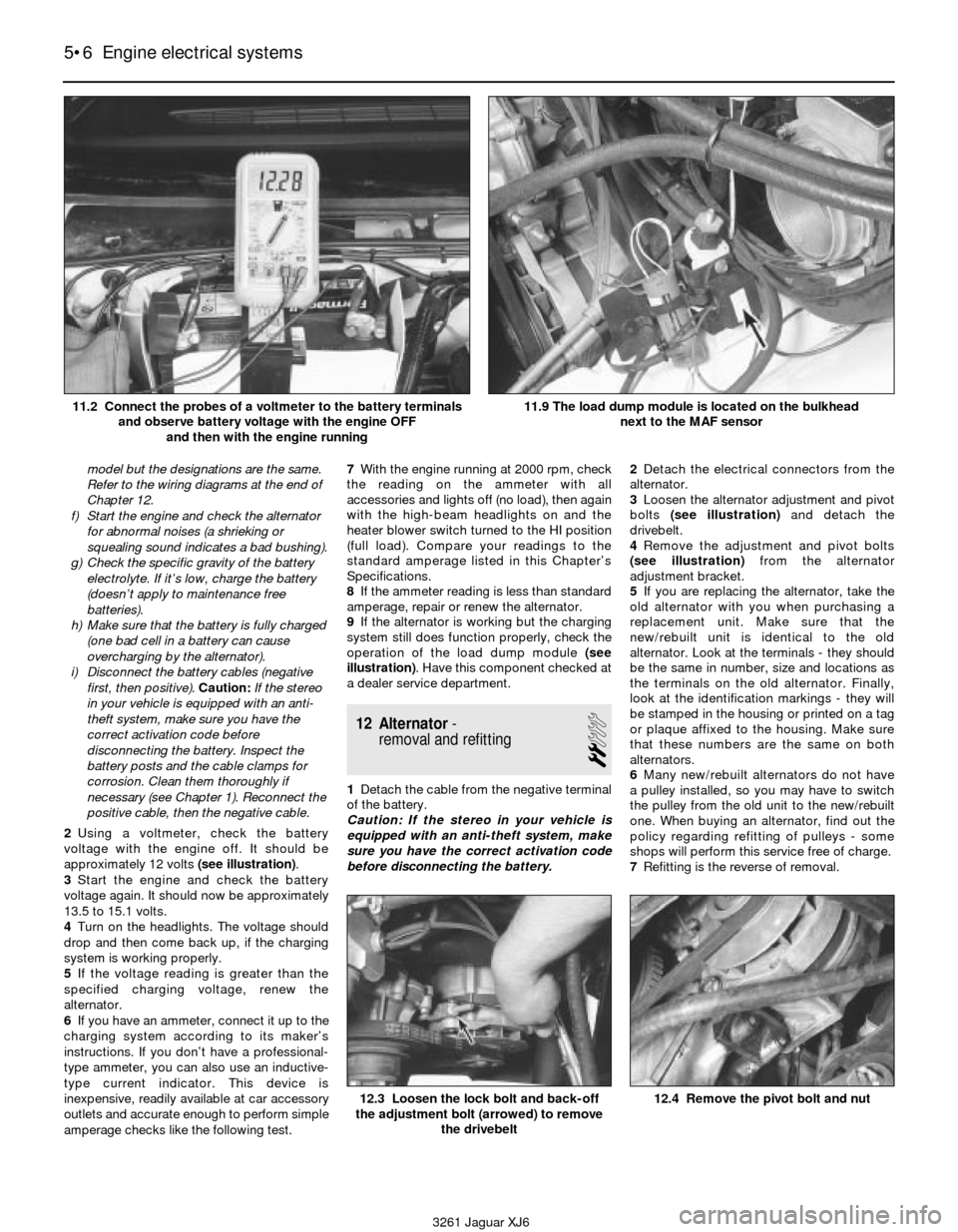
2Using a voltmeter, check the battery
voltage with the engine off. It should be
approximately 12 volts (see illustration).
3Start the engine and check the battery
voltage again. It should now be approximately
13.5 to 15.1 volts.
4Turn on the headlights. The voltage should
drop and then come back up, if the charging
system is working properly.
5If the voltage reading is greater than the
specified charging voltage, renew the
alternator.
6If you have an ammeter, connect it up to the
charging system according to its maker’s
instructions. If you don’t have a professional-
type ammeter, you can also use an inductive-
type current indicator. This device is
inexpensive, readily available at car accessory
outlets and accurate enough to perform simple
amperage checks like the following test.7With the engine running at 2000 rpm, check
the reading on the ammeter with all
accessories and lights off (no load), then again
with the high-beam headlights on and the
heater blower switch turned to the HI position
(full load). Compare your readings to the
standard amperage listed in this Chapter’s
Specifications.
8If the ammeter reading is less than standard
amperage, repair or renew the alternator.
9If the alternator is working but the charging
system still does function properly, check the
operation of the load dump module (see
illustration). Have this component checked at
a dealer service department.
12 Alternator-
removal and refitting
2
1Detach the cable from the negative terminal
of the battery.
Caution: If the stereo in your vehicle is
equipped with an anti-theft system, make
sure you have the correct activation code
before disconnecting the battery.2Detach the electrical connectors from the
alternator.
3Loosen the alternator adjustment and pivot
bolts (see illustration) and detach the
drivebelt.
4Remove the adjustment and pivot bolts
(see illustration)from the alternator
adjustment bracket.
5If you are replacing the alternator, take the
old alternator with you when purchasing a
replacement unit. Make sure that the
new/rebuilt unit is identical to the old
alternator. Look at the terminals - they should
be the same in number, size and locations as
the terminals on the old alternator. Finally,
look at the identification markings - they will
be stamped in the housing or printed on a tag
or plaque affixed to the housing. Make sure
that these numbers are the same on both
alternators.
6Many new/rebuilt alternators do not have
a pulley installed, so you may have to switch
the pulley from the old unit to the new/rebuilt
one. When buying an alternator, find out the
policy regarding refitting of pulleys - some
shops will perform this service free of charge.
7Refitting is the reverse of removal.
5•6 Engine electrical systems
12.3 Loosen the lock bolt and back-off
the adjustment bolt (arrowed) to remove
the drivebelt12.4 Remove the pivot bolt and nut
3261 Jaguar XJ6 11.2 Connect the probes of a voltmeter to the battery terminals
and observe battery voltage with the engine OFF
and then with the engine running
11.9 The load dump module is located on the bulkhead
next to the MAF sensor
Page 113 of 227
2The CHECK ENGINE warning light, which is
located on the instrument panel, comes on
when the ignition switch is turned to ON and
the engine is not running. When the engine is
started, the warning light should go out. If the
light remains on, the self-diagnosis system
has detected a malfunction. Note: The
CHECK ENGINE light on early models is
displayed on the dashboard VCM panel on the
right side. Later models are equipped with a
separate CHECK ENGINE light on the left side
of the instrument cluster.Note:Not all the
codes will cause the CHECK ENGINE light to
activate. When performing any fuel or
emissions systems diagnosis, always check
for codes that may be stored but not indicated
by the CHECK ENGINE light.
Obtaining fault code output
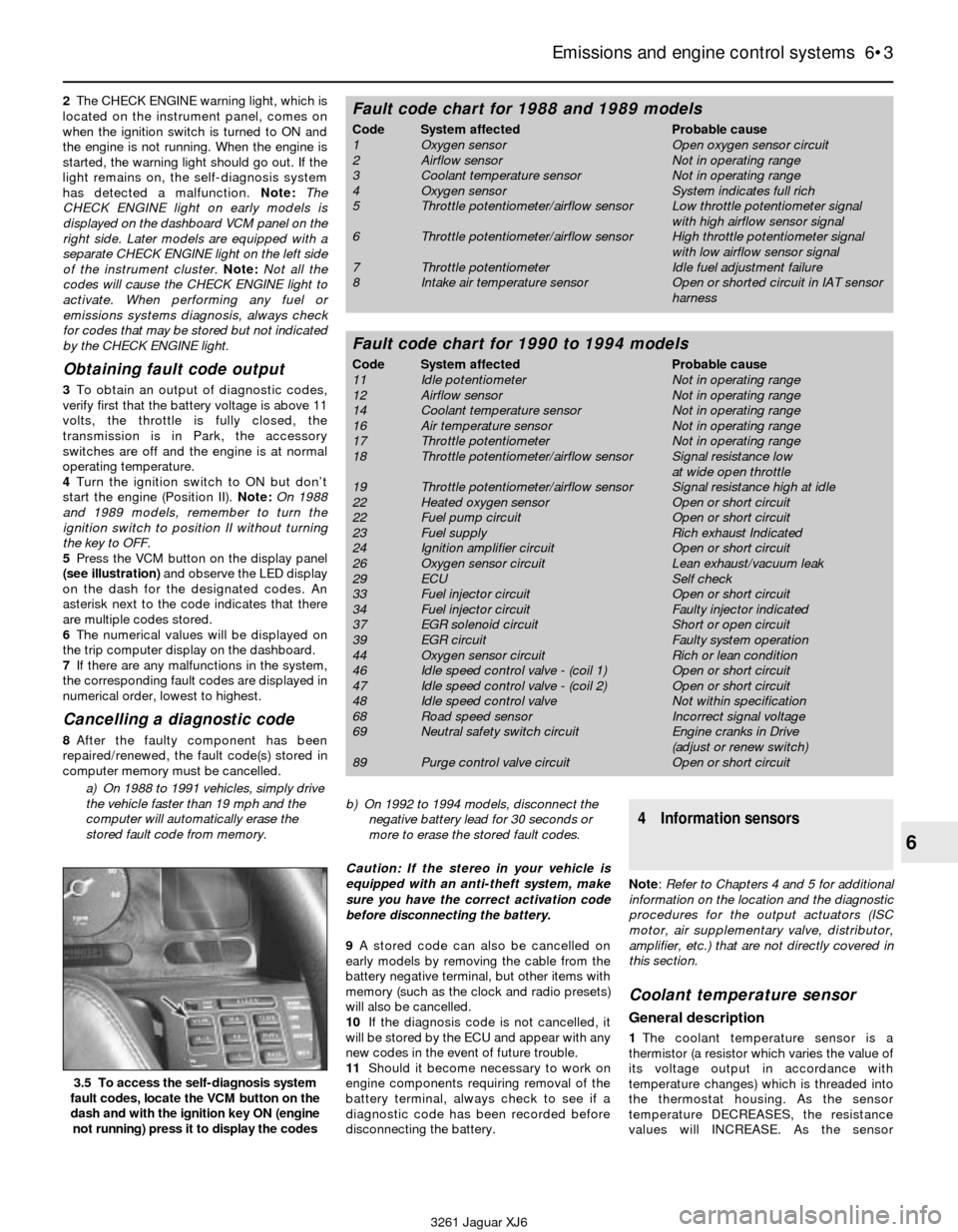
3To obtain an output of diagnostic codes,
verify first that the battery voltage is above 11
volts, the throttle is fully closed, the
transmission is in Park, the accessory
switches are off and the engine is at normal
operating temperature.
4Turn the ignition switch to ON but don’t
start the engine (Position II). Note:On 1988
and 1989 models, remember to turn the
ignition switch to position II without turning
the key to OFF.
5Press the VCM button on the display panel
(see illustration)and observe the LED display
on the dash for the designated codes. An
asterisk next to the code indicates that there
are multiple codes stored.
6The numerical values will be displayed on
the trip computer display on the dashboard.
7If there are any malfunctions in the system,
the corresponding fault codes are displayed in
numerical order, lowest to highest.
Cancelling a diagnostic code
8After the faulty component has been
repaired/renewed, the fault code(s) stored in
computer memory must be cancelled.
a) On 1988 to 1991 vehicles, simply drive
the vehicle faster than 19 mph and the
computer will automatically erase the
stored fault code from memory.b) On 1992 to 1994 models, disconnect the
negative battery lead for 30 seconds or
more to erase the stored fault codes.
Caution: If the stereo in your vehicle is
equipped with an anti-theft system, make
sure you have the correct activation code
before disconnecting the battery.
9A stored code can also be cancelled on
early models by removing the cable from the
battery negative terminal, but other items with
memory (such as the clock and radio presets)
will also be cancelled.
10If the diagnosis code is not cancelled, it
will be stored by the ECU and appear with any
new codes in the event of future trouble.
11Should it become necessary to work on
engine components requiring removal of the
battery terminal, always check to see if a
diagnostic code has been recorded before
disconnecting the battery.
4 Information sensors
Note: Refer to Chapters 4 and 5 for additional
information on the location and the diagnostic
procedures for the output actuators (ISC
motor, air supplementary valve, distributor,
amplifier, etc.) that are not directly covered in
this section.
Coolant temperature sensor
General description
1The coolant temperature sensor is a
thermistor (a resistor which varies the value of
its voltage output in accordance with
temperature changes) which is threaded into
the thermostat housing. As the sensor
temperature DECREASES, the resistance
values will INCREASE. As the sensor
Emissions and engine control systems 6•3
6
3.5 To access the self-diagnosis system
fault codes, locate the VCM button on the
dash and with the ignition key ON (engine
not running) press it to display the codes
3261 Jaguar XJ6
Fault code chart for 1988 and 1989 models
Code System affected Probable cause
1 Oxygen sensor Open oxygen sensor circuit
2 Airflow sensor Not in operating range
3 Coolant temperature sensor Not in operating range
4 Oxygen sensor System indicates full rich
5 Throttle potentiometer/airflow sensor Low throttle potentiometer signal
with high airflow sensor signal
6 Throttle potentiometer/airflow sensor High throttle potentiometer signal
with low airflow sensor signal
7 Throttle potentiometer Idle fuel adjustment failure
8 Intake air temperature sensor Open or shorted circuit in IAT sensor
harness
Fault code chart for 1990 to 1994 models
Code System affected Probable cause
11 Idle potentiometer Not in operating range
12 Airflow sensor Not in operating range
14 Coolant temperature sensor Not in operating range
16 Air temperature sensor Not in operating range
17 Throttle potentiometer Not in operating range
18 Throttle potentiometer/airflow sensor Signal resistance low
at wide open throttle
19 Throttle potentiometer/airflow sensor Signal resistance high at idle
22 Heated oxygen sensor Open or short circuit
22 Fuel pump circuit Open or short circuit
23 Fuel supply Rich exhaust Indicated
24 Ignition amplifier circuit Open or short circuit
26 Oxygen sensor circuit Lean exhaust/vacuum leak
29 ECU Self check
33 Fuel injector circuit Open or short circuit
34 Fuel injector circuit Faulty injector indicated
37 EGR solenoid circuit Short or open circuit
39 EGR circuit Faulty system operation
44 Oxygen sensor circuit Rich or lean condition
46 Idle speed control valve - (coil 1) Open or short circuit
47 Idle speed control valve - (coil 2) Open or short circuit
48 Idle speed control valve Not within specification
68 Road speed sensor Incorrect signal voltage
69 Neutral safety switch circuit Engine cranks in Drive
(adjust or renew switch)
89 Purge control valve circuit Open or short circuit
Page 118 of 227

5 Air Injector Reactor
(AIR) system
General information
1The air injection reactor system reduces
carbon monoxide and hydrocarbon content
in the exhaust gases by injecting fresh air into
the hot exhaust gases leaving the exhaust
ports. When fresh air is mixed with hot
exhaust gases, oxidation is increased,
reducing the concentration of hydrocarbons
and carbon monoxide and converting them
into harmless carbon dioxide and water.
2The air injection system is composed of an
air pump, diverter valve (bypass), check valve,
air injection manifold, vacuum delay valve,
vacuum control solenoid, air pump magnetic
clutch, air pump clutch relay and hoses (see
illustration). The air pump is driven by a belt
from the crankshaft and supplies compressed
air to the exhaust manifold(s). The check valve
prevents the reverse flow of exhaust gases into
the system. The vacuum-operated (early
models) or electrically-operated (later models)air cut-off valve prevents air from being drawn
into the exhaust when the air pump is switched
off. System vacuum to the air cut-off valve is
controlled by the solenoid vacuum valve in
parallel circuit with the air pump. A delay valve
prevents vacuum loss to the solenoid valve
during wide open throttle operation.
3Injected air is controlled by the computer,
the air pump clutch and the air pump clutch
relay. The AIR system is used during warm-up
(58 to 83° F) to control emissions while the
engine is running rich. The oxygen sensor
feedback system cannot function while the AIR
system is operating. The computer controls
both systems during warm-up and operating
temperatures. If problems occur with the
AIR system relay or circuit, the on-board
diagnosis system will set a code 66.
Check
4Check the condition of the air pump
drivebelt, the injection hoses and the injection
manifold. Make sure that all components are
intact and there are no leaks.
5Check the operation of the air pump clutch
relay (see illustration)and the air pump
clutch. First remove the relay and check forbattery voltage to the relay. Also, check the
relay itself. Refer to the relay checking
procedure in Chapter 12. Extract codes from
the self-diagnosis system (see Section 3) and
check for a code 66, AIR relay malfunction.
6Make sure the electrical connector is
securely fastened to the diverter valve (see
illustration). If everything appears OK but a
fault code still sets, have the system
diagnosed by a dealer service department or
other qualified repair workshop.
Air pump renewal
7Disconnect the cable from the negative
terminal of the battery.
Caution: If the stereo in your vehicle is
equipped with an anti-theft system, make
sure you have the correct activation code
before disconnecting the battery.
8Disconnect the electrical connector from
the air pump clutch.
9Loosen the clips from the air inlet and outlet
hose and separate them from the air injection
pump.
10Loosen the adjuster and pivot bolts (see
illustration)and nuts but do not remove them
from the air injection pump brackets.
6•8 Emissions and engine control systems
3261 Jaguar XJ6 5.2 Schematic of the Air Injection Reactor (AIR) system
5.6 Location of the AIR diverter valve on a 1992 model - check the
hoses for cracking and the electrical connector for security5.10 Loosen the pivot bolt and then the adjustment nut to remove
the drivebelt from the air pump. The adjustment nut has a lock bolt
that must be loosened before the pump will move down the adjuster
5.5 Location of the AIR pump relay on a 1992 model
Page 156 of 227
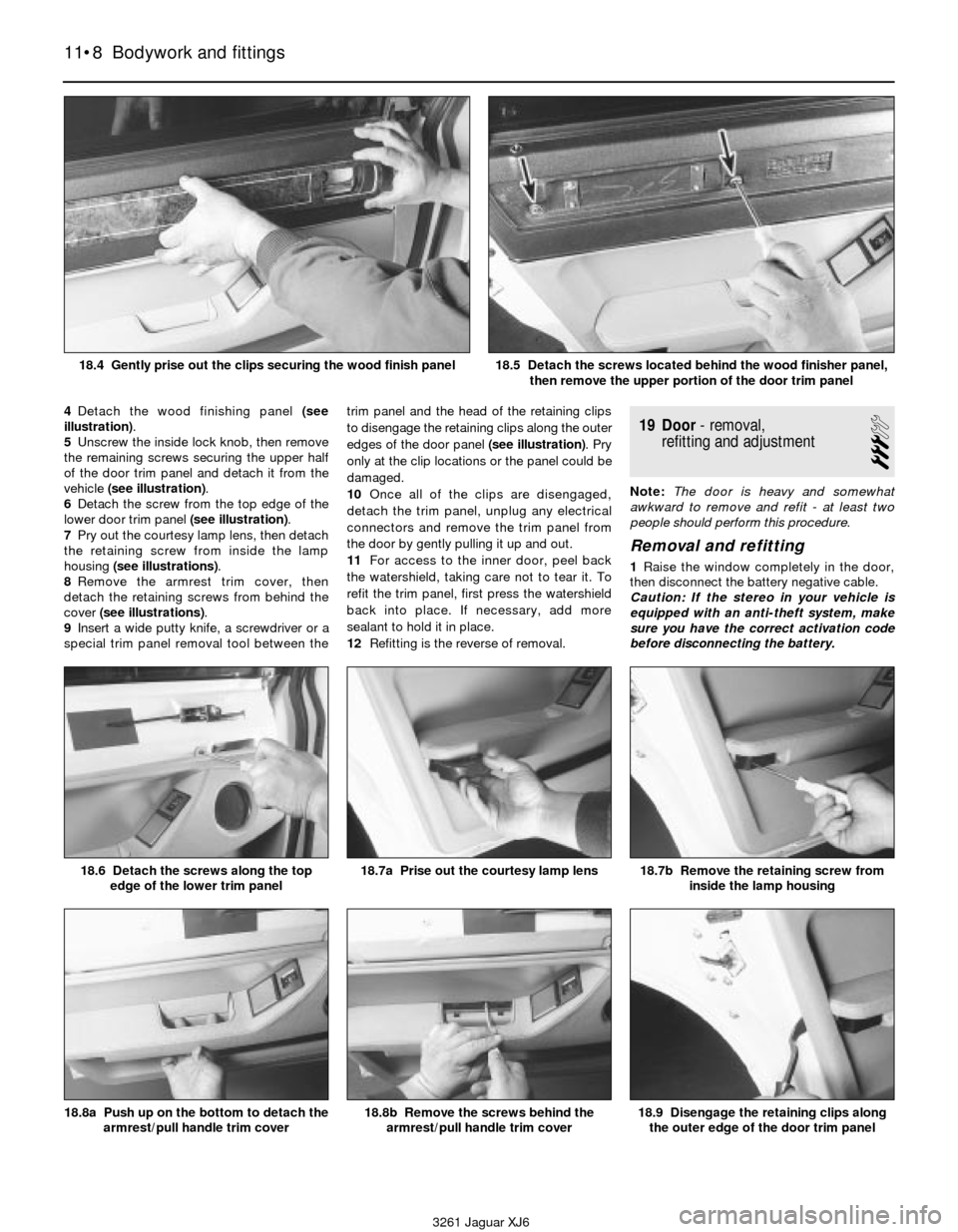
4Detach the wood finishing panel (see
illustration).
5Unscrew the inside lock knob, then remove
the remaining screws securing the upper half
of the door trim panel and detach it from the
vehicle (see illustration).
6Detach the screw from the top edge of the
lower door trim panel (see illustration).
7Pry out the courtesy lamp lens, then detach
the retaining screw from inside the lamp
housing (see illustrations).
8Remove the armrest trim cover, then
detach the retaining screws from behind the
cover (see illustrations).
9Insert a wide putty knife, a screwdriver or a
special trim panel removal tool between thetrim panel and the head of the retaining clips
to disengage the retaining clips along the outer
edges of the door panel (see illustration). Pry
only at the clip locations or the panel could be
damaged.
10Once all of the clips are disengaged,
detach the trim panel, unplug any electrical
connectors and remove the trim panel from
the door by gently pulling it up and out.
11For access to the inner door, peel back
the watershield, taking care not to tear it. To
refit the trim panel, first press the watershield
back into place. If necessary, add more
sealant to hold it in place.
12Refitting is the reverse of removal.19 Door- removal,
refitting and adjustment
3
Note:The door is heavy and somewhat
awkward to remove and refit - at least two
people should perform this procedure.
Removal and refitting
1Raise the window completely in the door,
then disconnect the battery negative cable.
Caution: If the stereo in your vehicle is
equipped with an anti-theft system, make
sure you have the correct activation code
before disconnecting the battery.
11•8 Bodywork and fittings
18.6 Detach the screws along the top
edge of the lower trim panel18.7a Prise out the courtesy lamp lens18.7b Remove the retaining screw from
inside the lamp housing
18.8a Push up on the bottom to detach the
armrest/pull handle trim cover18.8b Remove the screws behind the
armrest/pull handle trim cover18.9 Disengage the retaining clips along
the outer edge of the door trim panel
3261 Jaguar XJ6 18.4 Gently prise out the clips securing the wood finish panel
18.5 Detach the screws located behind the wood finisher panel,
then remove the upper portion of the door trim panel
Page 166 of 227

can be removed and tested using the
procedure below or by a dealer service
department or a repair workshop. Defective
relays must be replaced as a unit.
Testing
1It’s best to refer to the wiring diagram for
the circuit to determine the proper
connections for the relay you’re testing.
However, if you’re not able to determine the
correct connection from the wiring diagrams,
you may be able to determine the test
connections from the information that follows.
2On most relays, two of the terminals are the
relay’s control circuit (they connect to the
relay coil which, when energised, closes the
large contacts to complete the circuit). The
other terminals are the power circuit (they are
connected together within the relay when the
control-circuit coil is energised).
3Relays are sometimes marked as an aid to
help you determine which terminals are the
control circuit and which are the powercircuit (see illustration). As a general rule,
the two thicker wires connected to the relay
are the power circuit; the thinner wires are
the control circuit.
4Remove the relay from the vehicle and check
for continuity between the relay power circuit
terminals. There should be no continuity.5Connect a fused jumper wire between one
of the two control circuit terminals and the
positive battery terminal. Connect another
jumper wire between the other control circuit
terminal and earth. When the connections are
made, the relay should click. On some relays,
polarity may be critical, so, if the relay doesn’t
click, try swapping the jumper wires on the
control circuit terminals.
6With the jumper wires connected, check for
continuity between the power circuit
terminals. Now, there should be continuity.
8If the relay fails any of the above tests,
renew it.
7 Direction indicator/hazard
flasher- general information
Warning: Later model vehicles
are equipped with airbags. To
prevent accidental deployment6.3 Most relays are marked on the outside
to easily identify the control circuit and
power circuits
12•4 Body electrical system
3261 Jaguar XJ6 1990 to 1992 relay location details
Page 167 of 227

of the airbag, which could cause personal
injury or damage to the airbag system, DO
NOT work in the vicinity of the steering
column or instrument panel. The
manufacturer recommends that, on airbag
equipped models, the following procedure
be performed at a dealer service
department or other properly equipped
repair facility because of the special tools
and techniques required to disable the
airbag system.
The direction indicator and hazard flasher
systems are governed by the central
processing unit. The central processing unit
requires special testers and diagnostic
procedures which are beyond the scope of
this manual.
If the direction indicator/hazard flasher
system fails and the indicator bulbs are in
working condition take the vehicle to a dealer
service department or an automotive
electrical specialist for further diagnosis and
repair.8 Steering column switches-
removal and refitting
1
Warning: Later models are
equipped with airbags. To
prevent accidental deployment
of the airbag, which could cause
personal injury or damage to the airbag
system, DO NOT work in the vicinity of the
steering column or instrument panel. The
manufacturer recommends that, on airbag
equipped models, the following procedure
be performed at a dealer service
department or other properly equipped
repair facility because of the special tools
and techniques required to disable the
airbag system.
Caution: If the stereo in your vehicle is
equipped with an anti-theft system, make
sure you have the correct activation code
before disconnecting the battery.1Disconnect the negative battery cable.
2Remove the steering wheel (Chapter 10).
3Remove the lower steering column cover
(see Chapter 11).
4Remove the switch retaining screw(s) (see
illustration).
Body electrical system 12•5
12
3261 Jaguar XJ6 1993 to 1994 relay location details
8.4 Remove the switch retaining screws,
disconnect the electrical connectors and
pull the switches outward (arrowed)
Page 169 of 227

11 Fuel, oil and temperature
gauges- check
1
Warning: Later models are
equipped with airbags. To
prevent accidental deployment
of the airbag, which could cause
personal injury or damage to the airbag
system, DO NOT work in the vicinity of the
steering column or instrument panel. The
manufacturer recommends that, on airbag
equipped models, the following procedure
be performed at a dealer service
department or other properly equipped
repair facility because of the special tools
and techniques required to disable the
airbag system.
1All tests below require the ignition switch to
be turned to ON position when testing.
2Check the fuse if the gauge pointer does
not move from the empty, low or cold
positions. If the fuse is OK, locate the
particular sender unit for the circuit you’re
working on (see Chapter 4 for fuel sender unit
location, Chapter 2 for oil sender unit location,
or Chapter 3 for temperature sender unit
location). Connect the sender unit connector
to earth If the pointer goes to the full, high or
hot position renew the sender unit. If the
pointer stays in same position use a jumper
wire to earth the terminal on the back of the
gauge. If the pointer moves with the back of
the gauge earthed the problem lies in the wire
between the gauge and the sender unit. If the
pointer does not moves with the back of the
gauge earthed check for voltage at the other
terminal of the gauge. If voltage is present
renew the gauge.
12 Instrument cluster-
removal and refitting
1
Warning: Later models are
equipped with airbags. To
prevent accidental deployment
of the airbag, which could cause
personal injury or damage to the airbag
system, DO NOT work in the vicinity of the
steering column or instrument panel. The
manufacturer recommends that, on airbag
equipped models, the following procedure
be performed at a dealer service
department or other properly equipped
repair facility because of the special tools
and techniques required to disable the
airbag system.
Caution: If the stereo in your vehicle is
equipped with an anti-theft system, make
sure you have the correct activation code
before disconnecting the battery.
1Disconnect the negative battery cable.
2Remove the instrument cluster housing (see
Chapter 11).
3Remove the instrument cluster mounting
screws (see illustration). Separate the
instrument cluster from the cluster housing.
4Refitting is the reverse of removal.
13 Radio and speakers-
removal and refitting
2
Warning: Later models are
equipped with airbags. To
prevent accidental deployment
of the airbag, which could cause
personal injury or damage to the airbag
system, DO NOT work in the vicinity of the
steering column or instrument panel. The
manufacturer recommends that, on airbagequipped models, the following procedure
be performed at a dealer service
department or other properly equipped
repair facility because of the special tools
and techniques required to disable the
airbag system.
Caution: If the stereo in your vehicle is
equipped with an anti-theft system, make
sure you have the correct activation code
before disconnecting the battery.
1Disconnect the negative battery cable.
Radio
2Remove the radio trim bezel (Chapter 11).
3Remove the retaining screws (see
illustration), pull the radio/control panel
outward to access the backside and
disconnect the electrical connectors and
aerial lead. Detach the retaining clips and
separate the radio from the control panel.
4Refitting is the reverse of removal.
Speakers
5Remove the door trim panel (Chapter 11).
6Remove the nuts from the speaker
mounting studs (see illustration). Disconnect
the electrical connector and remove the
speaker from the vehicle.
7Refitting is the reverse of removal.
Body electrical system 12•7
12
3261 Jaguar XJ6 12.3 Remove the instrument cluster retaining screws (arrowed)
then separate the instrument cluster from the cluster housing
13.3 Remove the retaining screws (arrowed) and pull the
radio/control panel out enough to unplug the connectors
13.6 Remove the nuts from the retaining
studs (arrowed) to remove the speaker
Page 221 of 227
3261 Jaguar XJ6
REF•20Glossary of technical terms
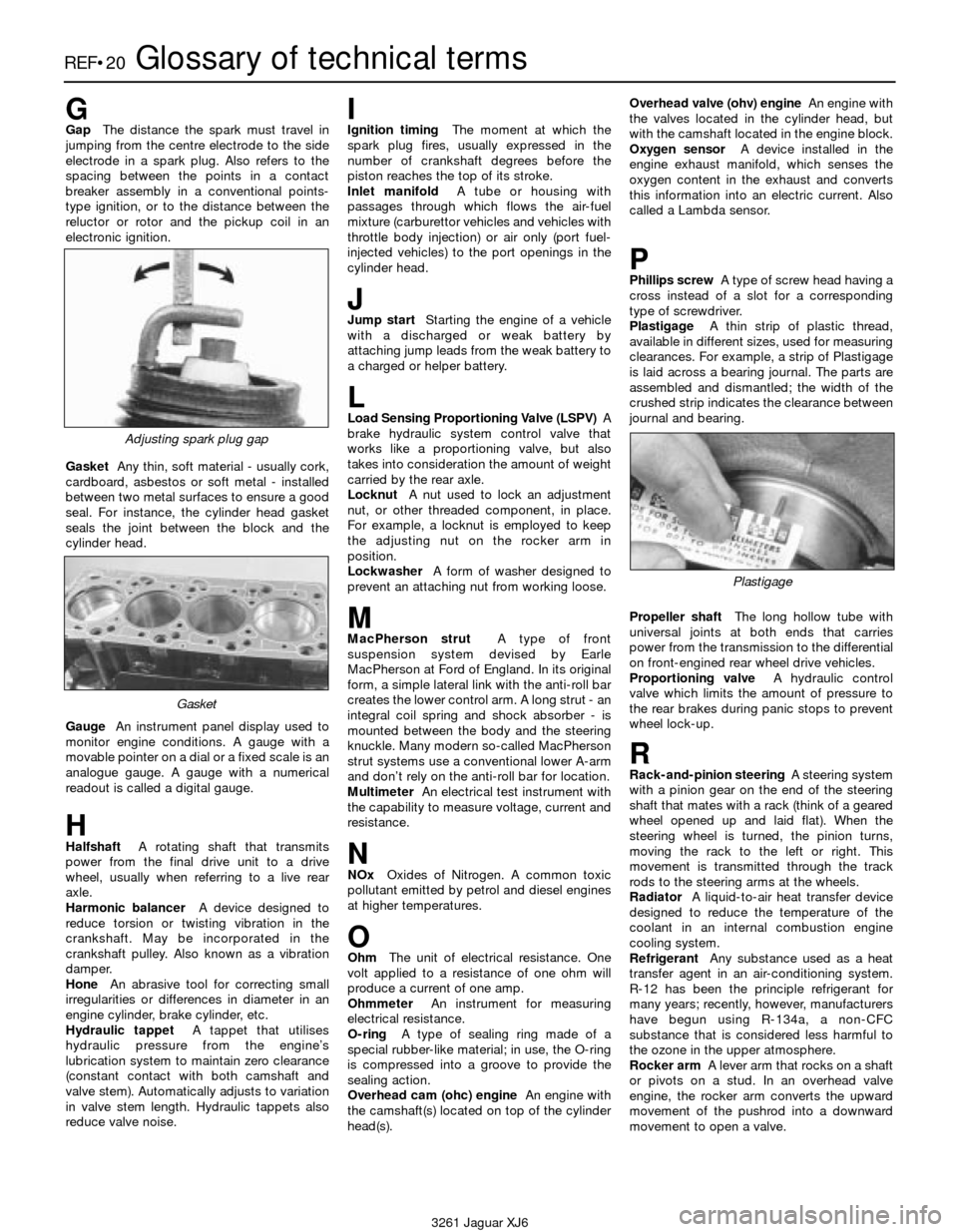
GGapThe distance the spark must travel in
jumping from the centre electrode to the side
electrode in a spark plug. Also refers to the
spacing between the points in a contact
breaker assembly in a conventional points-
type ignition, or to the distance between the
reluctor or rotor and the pickup coil in an
electronic ignition.
GasketAny thin, soft material - usually cork,
cardboard, asbestos or soft metal - installed
between two metal surfaces to ensure a good
seal. For instance, the cylinder head gasket
seals the joint between the block and the
cylinder head.
GaugeAn instrument panel display used to
monitor engine conditions. A gauge with a
movable pointer on a dial or a fixed scale is an
analogue gauge. A gauge with a numerical
readout is called a digital gauge.
HHalfshaftA rotating shaft that transmits
power from the final drive unit to a drive
wheel, usually when referring to a live rear
axle.
Harmonic balancerA device designed to
reduce torsion or twisting vibration in the
crankshaft. May be incorporated in the
crankshaft pulley. Also known as a vibration
damper.
HoneAn abrasive tool for correcting small
irregularities or differences in diameter in an
engine cylinder, brake cylinder, etc.
Hydraulic tappetA tappet that utilises
hydraulic pressure from the engine’s
lubrication system to maintain zero clearance
(constant contact with both camshaft and
valve stem). Automatically adjusts to variation
in valve stem length. Hydraulic tappets also
reduce valve noise.
IIgnition timingThe moment at which the
spark plug fires, usually expressed in the
number of crankshaft degrees before the
piston reaches the top of its stroke.
Inlet manifoldA tube or housing with
passages through which flows the air-fuel
mixture (carburettor vehicles and vehicles with
throttle body injection) or air only (port fuel-
injected vehicles) to the port openings in the
cylinder head.
JJump startStarting the engine of a vehicle
with a discharged or weak battery by
attaching jump leads from the weak battery to
a charged or helper battery.
LLoad Sensing Proportioning Valve (LSPV)A
brake hydraulic system control valve that
works like a proportioning valve, but also
takes into consideration the amount of weight
carried by the rear axle.
LocknutA nut used to lock an adjustment
nut, or other threaded component, in place.
For example, a locknut is employed to keep
the adjusting nut on the rocker arm in
position.
LockwasherA form of washer designed to
prevent an attaching nut from working loose.
MMacPherson strutA type of front
suspension system devised by Earle
MacPherson at Ford of England. In its original
form, a simple lateral link with the anti-roll bar
creates the lower control arm. A long strut - an
integral coil spring and shock absorber - is
mounted between the body and the steering
knuckle. Many modern so-called MacPherson
strut systems use a conventional lower A-arm
and don’t rely on the anti-roll bar for location.
MultimeterAn electrical test instrument with
the capability to measure voltage, current and
resistance.
NNOxOxides of Nitrogen. A common toxic
pollutant emitted by petrol and diesel engines
at higher temperatures.
OOhmThe unit of electrical resistance. One
volt applied to a resistance of one ohm will
produce a current of one amp.
OhmmeterAn instrument for measuring
electrical resistance.
O-ringA type of sealing ring made of a
special rubber-like material; in use, the O-ring
is compressed into a groove to provide the
sealing action.
Overhead cam (ohc) engineAn engine with
the camshaft(s) located on top of the cylinder
head(s).Overhead valve (ohv) engineAn engine with
the valves located in the cylinder head, but
with the camshaft located in the engine block.
Oxygen sensorA device installed in the
engine exhaust manifold, which senses the
oxygen content in the exhaust and converts
this information into an electric current. Also
called a Lambda sensor.
PPhillips screwA type of screw head having a
cross instead of a slot for a corresponding
type of screwdriver.
PlastigageA thin strip of plastic thread,
available in different sizes, used for measuring
clearances. For example, a strip of Plastigage
is laid across a bearing journal. The parts are
assembled and dismantled; the width of the
crushed strip indicates the clearance between
journal and bearing.
Propeller shaftThe long hollow tube with
universal joints at both ends that carries
power from the transmission to the differential
on front-engined rear wheel drive vehicles.
Proportioning valveA hydraulic control
valve which limits the amount of pressure to
the rear brakes during panic stops to prevent
wheel lock-up.
RRack-and-pinion steeringA steering system
with a pinion gear on the end of the steering
shaft that mates with a rack (think of a geared
wheel opened up and laid flat). When the
steering wheel is turned, the pinion turns,
moving the rack to the left or right. This
movement is transmitted through the track
rods to the steering arms at the wheels.
RadiatorA liquid-to-air heat transfer device
designed to reduce the temperature of the
coolant in an internal combustion engine
cooling system.
RefrigerantAny substance used as a heat
transfer agent in an air-conditioning system.
R-12 has been the principle refrigerant for
many years; recently, however, manufacturers
have begun using R-134a, a non-CFC
substance that is considered less harmful to
the ozone in the upper atmosphere.
Rocker armA lever arm that rocks on a shaft
or pivots on a stud. In an overhead valve
engine, the rocker arm converts the upward
movement of the pushrod into a downward
movement to open a valve.
Adjusting spark plug gap
Plastigage
Gasket