bodywork JAGUAR XJ6 1997 2.G User Guide
[x] Cancel search | Manufacturer: JAGUAR, Model Year: 1997, Model line: XJ6, Model: JAGUAR XJ6 1997 2.GPages: 227, PDF Size: 7.2 MB
Page 158 of 227
remove the door trim panel and watershield
as described in Section 18.
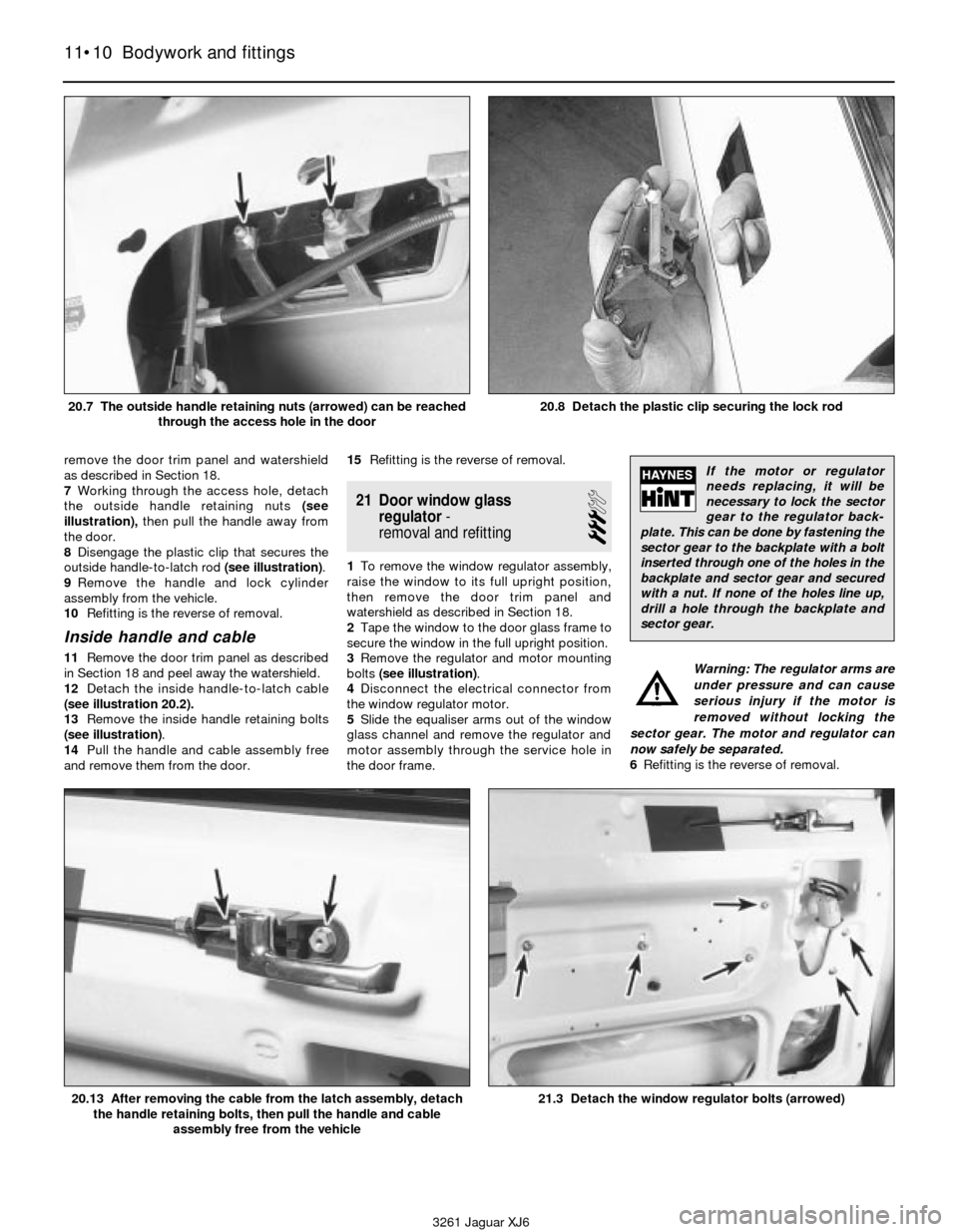
7Working through the access hole, detach
the outside handle retaining nuts (see
illustration),then pull the handle away from
the door.
8Disengage the plastic clip that secures the
outside handle-to-latch rod (see illustration).
9Remove the handle and lock cylinder
assembly from the vehicle.
10Refitting is the reverse of removal.
Inside handle and cable
11Remove the door trim panel as described
in Section 18 and peel away the watershield.
12Detach the inside handle-to-latch cable
(see illustration 20.2).
13Remove the inside handle retaining bolts
(see illustration).
14Pull the handle and cable assembly free
and remove them from the door.15Refitting is the reverse of removal.
21 Door window glass
regulator-
removal and refitting
3
1To remove the window regulator assembly,
raise the window to its full upright position,
then remove the door trim panel and
watershield as described in Section 18.
2Tape the window to the door glass frame to
secure the window in the full upright position.
3Remove the regulator and motor mounting
bolts (see illustration).
4Disconnect the electrical connector from
the window regulator motor.
5Slide the equaliser arms out of the window
glass channel and remove the regulator and
motor assembly through the service hole in
the door frame.Warning: The regulator arms are
under pressure and can cause
serious injury if the motor is
removed without locking the
sector gear. The motor and regulator can
now safely be separated.
6Refitting is the reverse of removal.
11•10 Bodywork and fittings
3261 Jaguar XJ6 20.7 The outside handle retaining nuts (arrowed) can be reached
through the access hole in the door
20.8 Detach the plastic clip securing the lock rod
20.13 After removing the cable from the latch assembly, detach
the handle retaining bolts, then pull the handle and cable
assembly free from the vehicle21.3 Detach the window regulator bolts (arrowed)
If the motor or regulator
needs replacing, it will be
necessary to lock the sector
gear to the regulator back-
plate. This can be done by fastening the
sector gear to the backplate with a bolt
inserted through one of the holes in the
backplate and sector gear and secured
with a nut. If none of the holes line up,
drill a hole through the backplate and
sector gear.
Page 159 of 227
22 Door window glass-
removal and refitting
3
1Raise the window to its full upright position,
then remove the door trim panel and
watershield as described in Section 18.
2Tape the window to the door glass frame to
secure the window in the full upright position.
3Detach the regulator assembly (Section 21)
and lower it to the bottom of the door.
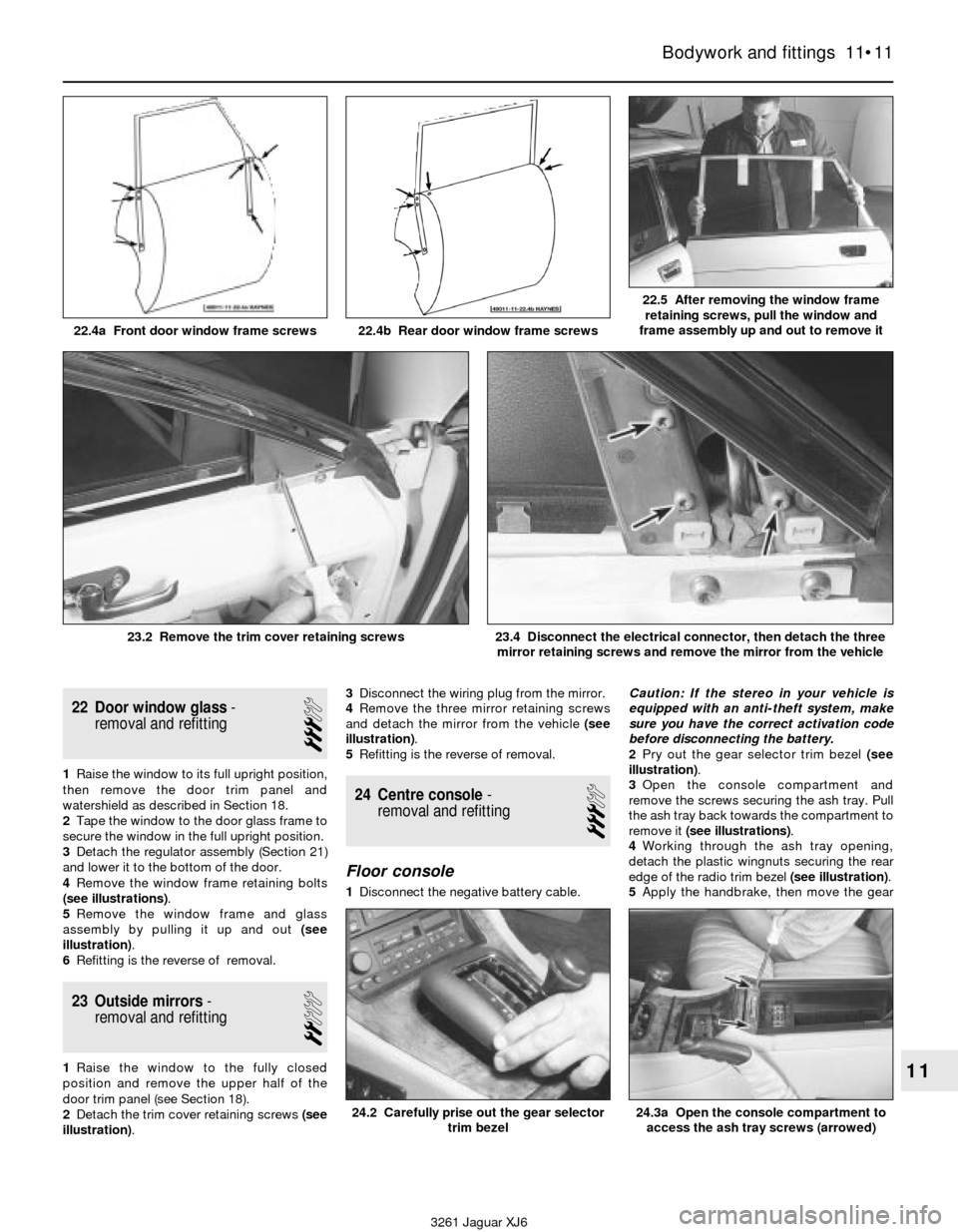
4Remove the window frame retaining bolts
(see illustrations).
5Remove the window frame and glass
assembly by pulling it up and out (see
illustration).
6Refitting is the reverse of removal.
23 Outside mirrors-
removal and refitting
2
1Raise the window to the fully closed
position and remove the upper half of the
door trim panel (see Section 18).
2Detach the trim cover retaining screws (see
illustration).3Disconnect the wiring plug from the mirror.
4Remove the three mirror retaining screws
and detach the mirror from the vehicle (see
illustration).
5Refitting is the reverse of removal.
24 Centre console-
removal and refitting
3
Floor console
1Disconnect the negative battery cable.Caution: If the stereo in your vehicle is
equipped with an anti-theft system, make
sure you have the correct activation code
before disconnecting the battery.
2Pry out the gear selector trim bezel (see
illustration).
3Open the console compartment and
remove the screws securing the ash tray. Pull
the ash tray back towards the compartment to
remove it (see illustrations).
4Working through the ash tray opening,
detach the plastic wingnuts securing the rear
edge of the radio trim bezel (see illustration).
5Apply the handbrake, then move the gear
Bodywork and fittings 11•11
11
22.4a Front door window frame screws 22.4b Rear door window frame screws
22.5 After removing the window frame
retaining screws, pull the window and
frame assembly up and out to remove it
3261 Jaguar XJ6 23.2 Remove the trim cover retaining screws
23.4 Disconnect the electrical connector, then detach the three
mirror retaining screws and remove the mirror from the vehicle
24.3a Open the console compartment to
access the ash tray screws (arrowed)24.2 Carefully prise out the gear selector
trim bezel
Page 160 of 227
selector towards the rear of the vehicle. Pull
up on the rear half of the radio trim bezel while
gently detaching the clips securing the front,
then remove the bezel from the vehicle.
6Remove the radio and heater control
assembly (see Chapter 12).
7Remove the dashboard centre trim panel
(see Section 26), then remove the centre air
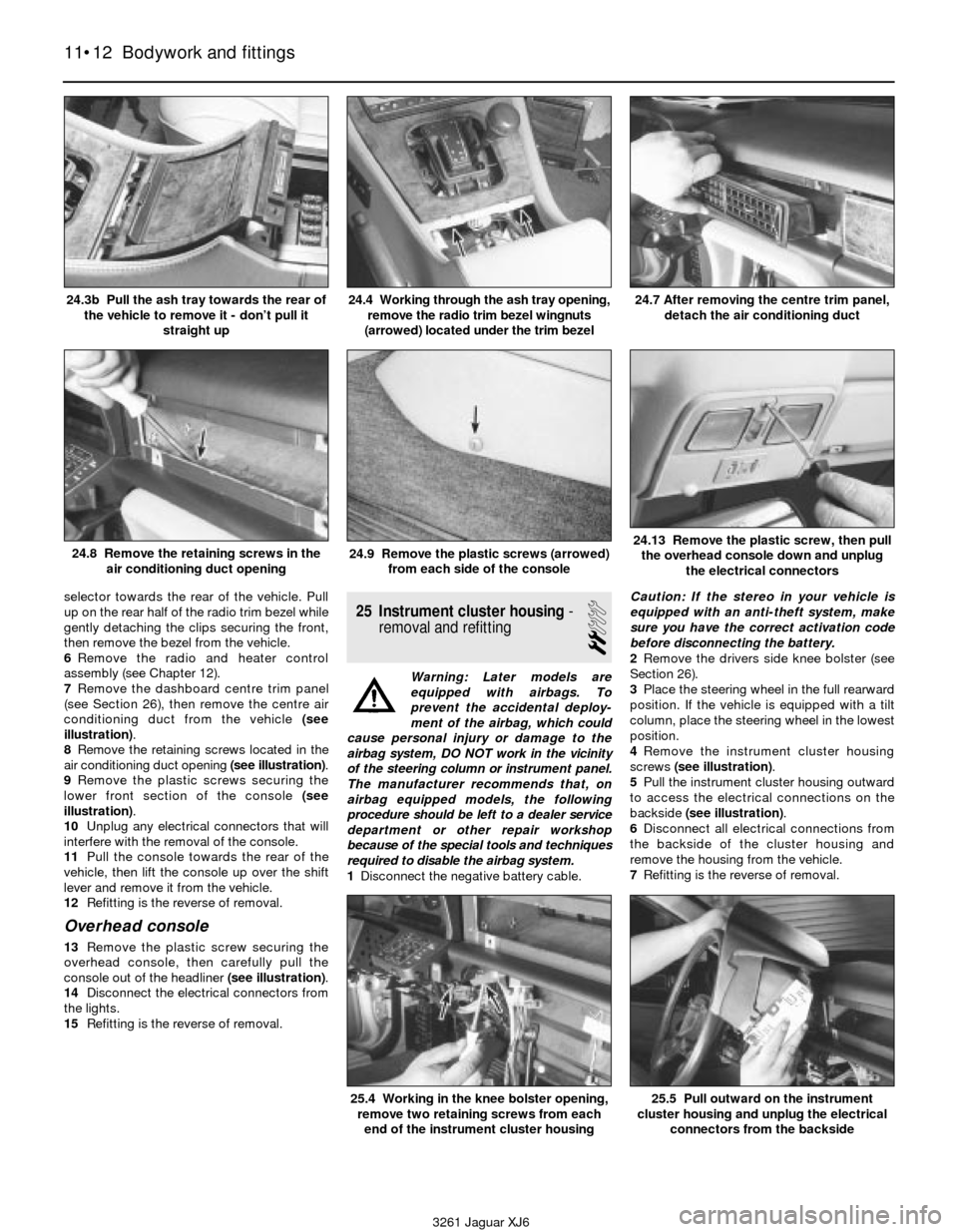
conditioning duct from the vehicle (see
illustration).
8Remove the retaining screws located in the
air conditioning duct opening (see illustration).
9Remove the plastic screws securing the
lower front section of the console (see
illustration).
10Unplug any electrical connectors that will
interfere with the removal of the console.
11Pull the console towards the rear of the
vehicle, then lift the console up over the shift
lever and remove it from the vehicle.
12Refitting is the reverse of removal.
Overhead console
13Remove the plastic screw securing the
overhead console, then carefully pull the
console out of the headliner (see illustration).
14Disconnect the electrical connectors from
the lights.
15Refitting is the reverse of removal.
25 Instrument cluster housing-
removal and refitting
2
Warning: Later models are
equipped with airbags. To
prevent the accidental deploy-
ment of the airbag, which could
cause personal injury or damage to the
airbag system, DO NOT work in the vicinity
of the steering column or instrument panel.
The manufacturer recommends that, on
airbag equipped models, the following
procedure should be left to a dealer service
department or other repair workshop
because of the special tools and techniques
required to disable the airbag system.
1Disconnect the negative battery cable. Caution: If the stereo in your vehicle is
equipped with an anti-theft system, make
sure you have the correct activation code
before disconnecting the battery.
2Remove the drivers side knee bolster (see
Section 26).
3Place the steering wheel in the full rearward
position. If the vehicle is equipped with a tilt
column, place the steering wheel in the lowest
position.
4Remove the instrument cluster housing
screws (see illustration).
5Pull the instrument cluster housing outward
to access the electrical connections on the
backside (see illustration).
6Disconnect all electrical connections from
the backside of the cluster housing and
remove the housing from the vehicle.
7Refitting is the reverse of removal.
11•12 Bodywork and fittings
24.3b Pull the ash tray towards the rear of
the vehicle to remove it - don’t pull it
straight up24.4 Working through the ash tray opening,
remove the radio trim bezel wingnuts
(arrowed) located under the trim bezel24.7 After removing the centre trim panel,
detach the air conditioning duct
24.8 Remove the retaining screws in the
air conditioning duct opening24.9 Remove the plastic screws (arrowed)
from each side of the console24.13 Remove the plastic screw, then pull
the overhead console down and unplug
the electrical connectors
3261 Jaguar XJ6
25.4 Working in the knee bolster opening,
remove two retaining screws from each
end of the instrument cluster housing25.5 Pull outward on the instrument
cluster housing and unplug the electrical
connectors from the backside
Page 161 of 227
26 Dashboard trim panels-
removal and refitting
2
Warning: Later models are
equipped with airbags. To
prevent the accidental deploy-
ment of the airbag, which could
cause personal injury or damage to the
airbag system, DO NOT work in the vicinity
of the steering column or instrument panel.
The manufacturer recommends that, on
airbag equipped models, the following
procedure should be left to a dealer service
department or other repair workshop
because of the special tools and techniques
required to disable the airbag system.
Caution: If the stereo in your vehicle is
equipped with an anti-theft system, make
sure you have the correct activation code
before disconnecting the battery
Knee bolster
1Knee bolsters are located on the lower half
of the instrument panel on the driver and
passenger sides of the vehicle. The removal of
these covers will allow access to a variety of
electrical, heating and air conditioning
components.
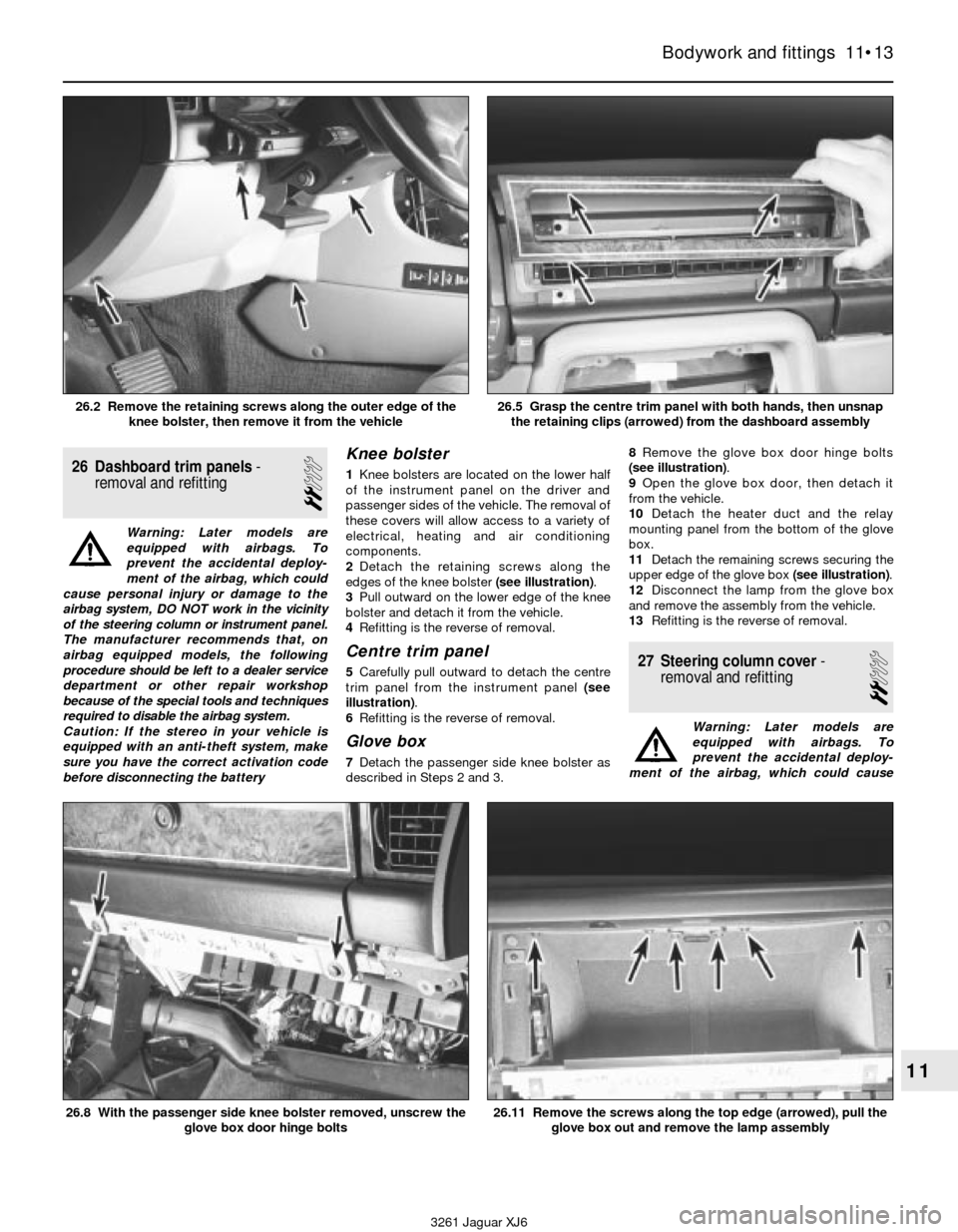
2Detach the retaining screws along the
edges of the knee bolster (see illustration).
3Pull outward on the lower edge of the knee
bolster and detach it from the vehicle.
4Refitting is the reverse of removal.
Centre trim panel
5Carefully pull outward to detach the centre
trim panel from the instrument panel (see
illustration).
6Refitting is the reverse of removal.
Glove box
7Detach the passenger side knee bolster as
described in Steps 2 and 3.8Remove the glove box door hinge bolts
(see illustration).
9Open the glove box door, then detach it
from the vehicle.
10Detach the heater duct and the relay
mounting panel from the bottom of the glove
box.
11Detach the remaining screws securing the
upper edge of the glove box (see illustration).
12Disconnect the lamp from the glove box
and remove the assembly from the vehicle.
13Refitting is the reverse of removal.
27 Steering column cover-
removal and refitting
2
Warning: Later models are
equipped with airbags. To
prevent the accidental deploy-
ment of the airbag, which could cause
Bodywork and fittings 11•13
11
3261 Jaguar XJ6 26.2 Remove the retaining screws along the outer edge of the
knee bolster, then remove it from the vehicle
26.5 Grasp the centre trim panel with both hands, then unsnap
the retaining clips (arrowed) from the dashboard assembly
26.8 With the passenger side knee bolster removed, unscrew the
glove box door hinge bolts26.11 Remove the screws along the top edge (arrowed), pull the
glove box out and remove the lamp assembly
Page 162 of 227

personal injury or damage to the airbag
system, DO NOT work in the vicinity of the
steering column or instrument panel. The
manufacturer recommends that, on airbag
equipped models, the following procedure
should be left to a dealer service
department or other repair workshop
because of the special tools and techniques
required to disable the airbag system.
1Remove the steering wheel (Chapter 10)
2Remove the knob from the rheostat
(dimmer) for the instrument panel lights (see
illustration).
3Remove the lower steering column cover
screws (see illustration), then detach the
lower cover.
4Working through the lower cover opening,
remove the four screws securing the upper
half of the cover, then pull the cover forward
and out to remove it (see illustration).
5Refitting is the reverse of removal.
28 Cowl cover-
removal and refitting
2
1Remove the windscreen wiper arms (see
Chapter 12).2Remove the retaining screws located along
the top of the cowl cover (see illustration).
3Lift the cowl cover up slightly, then detach
the electrical connectors and the spray nozzle
hoses from the backside of the cowl cover.
4Detach the cowl cover from the vehicle.
5Refitting is the reverse of removal.
29 Seats- removal and refitting
2
Front seat
1Position the seat all the way forward or all
the way to the rear to access the front seat
retaining bolts.
2Detach any bolt trim covers and remove the
retaining bolts (see illustration).
3Tilt the seat upward to access the
underneath, then unplug any electrical
connectors and lift the seat from the vehicle.
4Refitting is the reverse of removal.
Rear seat
5Remove retaining screws at the lower edge
of the seat cushion (see illustration). Then lift
up on the front edge and remove the cushion
from the vehicle.
6Detach the retaining bolts at the lower edge
of the seat back.
7Lift up on the lower edge of the seat back to
release the clips securing the top. Then
remove it from the vehicle.
8Refitting is the reverse of removal.
11•14 Bodywork and fittings
27.4 Remove the four screws securing the
upper half of the steering column cover
28.2 Remove the screws (arrowed)
located along the top of the cowl cover29.2 Use a Torx bit to remove the front
seat retaining bolts (arrowed)
3261 Jaguar XJ6 27.2 Pull off the knob from the instrument panel light rheostat
27.3 Remove the lower steering column cover screws
29.5 Detach the screws (arrowed) along
the lower edge of the seat cove
Page 223 of 227

3261 Jaguar XJ6
REF•22Index
AABS fault finding -9•2
Accelerator cable -4•8
Acknowledgements -0•4
Aerial - 12•8
Air cleaner -1•14, 4•7
Air conditioning -3•2, 3•7, 3•10, 3•11, 3•13, 3•14
Air induction system -4•9
Air Injector Reactor (AIR) system -6•8
Air intake plenum -4•13
Airbag - 0•5, 12•14
Alternator -5•6
Amplifier -5•3
Anti-lock Brake system (ABS) -9•2
Anti-roll bar - 10•3
Anti-theft system - REF•1
Antifreeze -0•11, 0•16, 1•2, 1•20, 3•2
Asbestos -0•5
ATF -0•16
Automatic transmission-7•1et seq
fault finding - 7•1, REF•15
fluid - 0•16, 1•2, 1•11, 1•19
filter - 1•19
Auxiliary shaft -2A•8
BBalljoints - 10•4
Battery -0•5, 0•15, 1•9, 5•1, 5•1
Big-end bearings -2B•13, 2B•17
Bleeding
brake system - 9•10
power steering - 10•11
Block -2B•10, 2B•11
Blower motors -3•7
Body corrosion - REF•11
Body electrical system- 12•1et seq
Bodywork and fittings- 11•1et seq
Bonnet - 11•3, 11•4
Boot - 11•7
lid - 11•3, 11•6, 11•7,
Boots (steering) - 10•9
Brake fluid -0•12, 0•16, 1•20
Brake lights - 12•12
switch - 9•13
Brake servo -1•12
Braking system-1•12, 9•1et seq
fault finding - REF•15, REF•16
MOT checks - REF•8 to REF•10
Bulbs -0•15, 12•11
Bumpers - 11•5
Burning -0•5
CCables -4•8, 5•2, 7•2, 7•4, 9•10, 9•11, 11•4, 11•10
Calipers -9•3
Camshafts -2A•9
Capacities -1•2
Carpets - 11•1
Cassette - REF•1
Catalytic converter -6•12
Central locking - 12•13
Centre console - 11•11
Charcoal canister -6•11
Charging -1•10
Charging system -5•5
Circuit breakers - 12•3
CO emissions (mixture) - REF•11
Coil (HT) -5•3
Coil spring - 10•5, 10•6
Compression check -2B•3
Compressor -3•13
Condenser -3•13
Connecting rods -2B•9, 2B•12, 2B•17, 2B•18
Console - 11•11, 11•12
Continuity check - 12•2
Control arms - 10•5, 10•6, 10•8
Conversion factors - REF•2
Coolant -0•11, 0•16, 1•2, 1•20, 3•2
Coolant reservoir -3•4, 3•5
Coolant temperature sensor -6•3
Cooling fans -3•3
Cooling system fault finding - REF•14
Cooling,heating and air conditioning systems-3•1et seq
Courtesy lights - 12•12
Cowl cover - 11•14
Crankcase ventilation system -1•16, 6•11
Crankshaft -2A•5, 2A•17, 2B•10, 2B•13, 2B•16
position sensor - 6•7
Cruise control - 12•13
Crushing -0•5
Cylinder head -2A•13, 2B•6, 2B•7, 2B•8
Cylinder honing -2B•12
DDashboard - 11•13
Dents - 11•2
Differential -8•1, 8•5
oil - 1•2, 1•11, 1•20
Dimensions - REF•1
Direction indicators - 12•4, 12•11, 12•12
Discs -9•4
Distributor -5•4
Doors - 11•7, 11•8, 11•9, 11•10, 11•10, REF•9
Drivebelt -1•16
Driveplate -2A•16
Driveshafts -8•1, 8•4, 8•5, REF•10
Drivetrain-1•14, 8•1et seq
Note:References throughout this index are in the form - “Chapter number” • “page number”
Page 224 of 227

3261 Jaguar XJ6
IndexREF•23
EEarth check - 12•2
ECU -6•2
EGR gas temperature sensor -6•7
Electric shock -0•5
Electric windows - 12•13
Electrical equipment -1•14, REF•9
Electrical system fault finding - 12•1, REF•17
Electronic control system and ECU -4•9, 6•2
Electronic Fuel Injection (EFI) system -4•9, 4•10
Emissions and engine control systems-6•1et seq
Engine electrical systems-5•1et seq
Engine in-car repair procedures-2A•1et seq
Engine fault finding - ref•13,ref•14
Engine oil -0•11, 0•16, 1•2, 1•6
Engine removal and overhaul procedures-2B•1et seq
Environmental considerations - REF•5
Evaporative Emission Control (EVAP) system -6•10
Evaporator and expansion valve -3•14
Exhaust emission checks - REF•11
Exhaust Gas Recirculation (EGR) system -6•9
Exhaust manifolds -2A•4
Exhaust system -1•11, 4•2, 4•14, REF•10
Expansion tank -3•4, 3•5
FFans -3•3
Fault finding- REF•12et seq
ABS -9•2
automatic transmission - 7•1, REF•15
brakes - REF•15, REF•16
cooling system - REF•14
electrical system - 12•1, REF•17
engine - REF•13, REF•14
fuel system - REF•14
suspension and steering systems - REF•16, REF•17
Filling (bodywork repair) - 11•2
Filters
automatic transmission fluid - 1•19
fuel - 1•15
oil - 1•6
Fire -0•5
Fluids -0•16
Fuel and exhaust systems-4•1et seq, REF•11
Fuel filter -1•15
Fuel gauge - 12•7
Fuel pressure relief -4•2
Fuel system fault finding - REF•14
Fume or gas intoxication -0•5
Fuses -0•15, 12•2
GGaiters - 10•9
Gashes - 11•2
Gaskets - REF•5
Glass - 11•3, 11•10, 11•11, 12•13
Glossary of technical terms- REF•3, REF•18et seq
Glove box - 11•13
Grille - 11•5
HHandbrake -1•12, 1•20, 9•1, 9•10, 9•11, REF•8
Handles - 11•9, 11•10
Hazard flasher - 12•4
HC emissions - REF•11
Headlights -1•18, 12•9, 12•10, 12•11
Heated rear window - 12•8
Heater -3•2, 3•7, 3•9, 3•10, 3•11, 3•12
High-mounted brake light - 12•12
Hinges - 11•3
Horn - 12•11
Hoses -1•10
Hub bearings - 1•17, 10•8
Hydraulic system -0•16
Hydrofluoric acid -0•5
IIdle Speed Control (ISC) motor -4•11
Ignition switch - 12•6
Ignition system -1•15
In-tank fuel pumps -4•4
Indicators - 12•4, 12•11, 12•12
Inertia switch -4•1, 12•12
Information sensors -6•3
Injectors -4•12
Instruments - 1•14, 11•12, 12•6, 12•7, 12•12
Intake Air Temperature (IAT) sensor -6•7
Intake manifold -2A•4
Interior lights - 12•12
Introduction -0•4
JJacking - REF•1
Joint mating faces - REF•5
Jump starting -0•7
KKickdown cable -7•2
Knee bolster - 11•13
LLatch - 11•4, 11•7, 11•9
Leaks -0•9, 1•10, 7•2
Locknuts,locktabs and washers - REF•5
Locks - 11•3, 11•7, 11•9, 12•6
Lubricants -0•16
MMain bearings -2B•13, 2B•16
Manifolds -2A•4
Manual valve -7•7
Mass Airflow (MAF) sensor -6•6
Master cylinder -9•6
Mirrors - 11•11, 12•14, REF•8
MOT test checks- REF•8et seq
Mounts -2A•18, 7•8
Multi Point Fuel Injection (MPFI) system -4•1