bonnet JAGUAR XJ6 1997 2.G User Guide
[x] Cancel search | Manufacturer: JAGUAR, Model Year: 1997, Model line: XJ6, Model: JAGUAR XJ6 1997 2.GPages: 227, PDF Size: 7.2 MB
Page 32 of 227
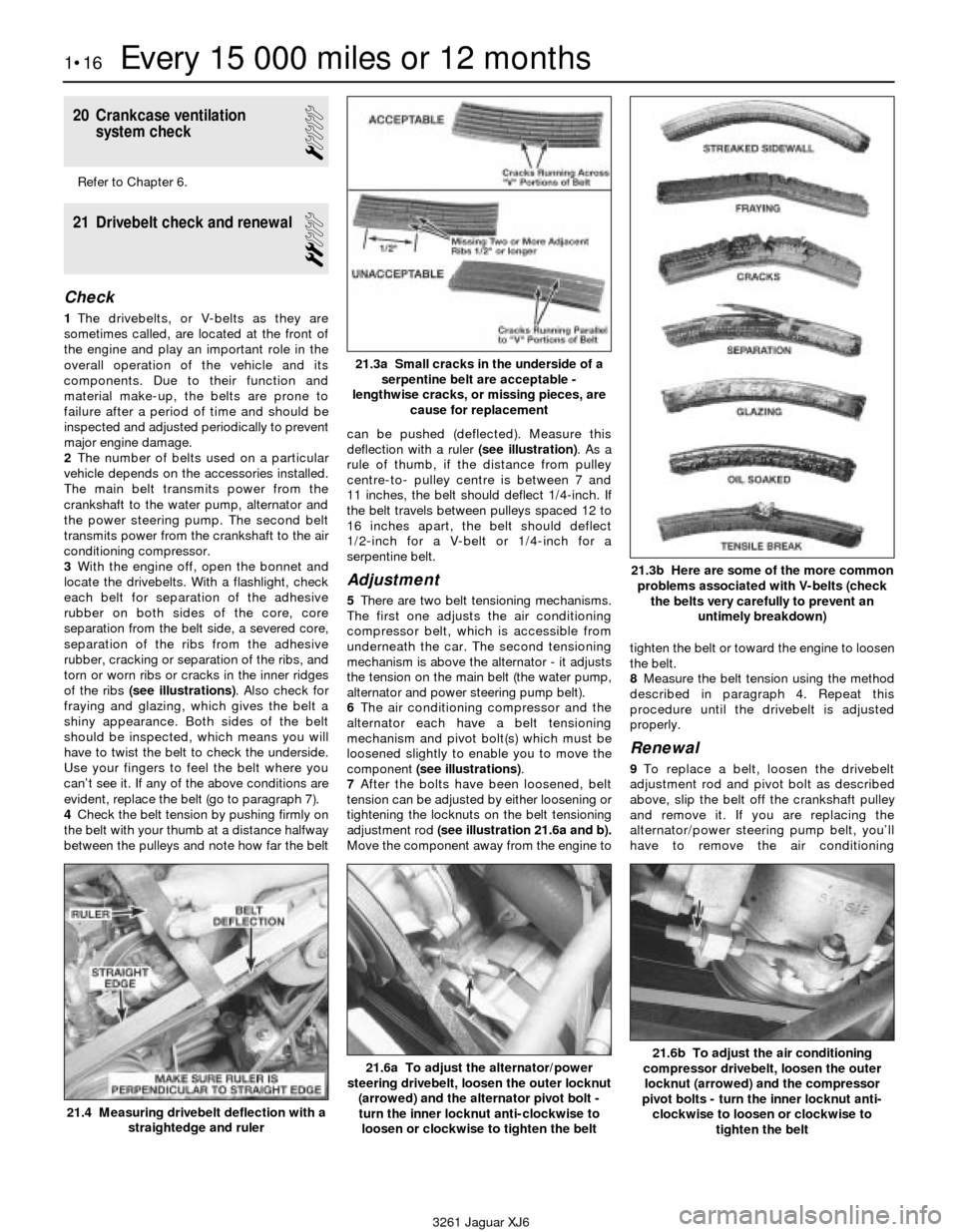
20 Crankcase ventilation
system check
1
Refer to Chapter 6.
21 Drivebelt check and renewal
2
Check
1The drivebelts, or V-belts as they are
sometimes called, are located at the front of
the engine and play an important role in the
overall operation of the vehicle and its
components. Due to their function and
material make-up, the belts are prone to
failure after a period of time and should be
inspected and adjusted periodically to prevent
major engine damage.
2The number of belts used on a particular
vehicle depends on the accessories installed.
The main belt transmits power from the
crankshaft to the water pump, alternator and
the power steering pump. The second belt
transmits power from the crankshaft to the air
conditioning compressor.
3With the engine off, open the bonnet and
locate the drivebelts. With a flashlight, check
each belt for separation of the adhesive
rubber on both sides of the core, core
separation from the belt side, a severed core,
separation of the ribs from the adhesive
rubber, cracking or separation of the ribs, and
torn or worn ribs or cracks in the inner ridges
of the ribs (see illustrations). Also check for
fraying and glazing, which gives the belt a
shiny appearance. Both sides of the belt
should be inspected, which means you will
have to twist the belt to check the underside.
Use your fingers to feel the belt where you
can’t see it. If any of the above conditions are
evident, replace the belt (go to paragraph 7).
4Check the belt tension by pushing firmly on
the belt with your thumb at a distance halfway
between the pulleys and note how far the beltcan be pushed (deflected). Measure this
deflection with a ruler (see illustration). As a
rule of thumb, if the distance from pulley
centre-to- pulley centre is between 7 and
11 inches, the belt should deflect 1/4-inch. If
the belt travels between pulleys spaced 12 to
16 inches apart, the belt should deflect
1/2-inch for a V-belt or 1/4-inch for a
serpentine belt.
Adjustment
5There are two belt tensioning mechanisms.
The first one adjusts the air conditioning
compressor belt, which is accessible from
underneath the car. The second tensioning
mechanism is above the alternator - it adjusts
the tension on the main belt (the water pump,
alternator and power steering pump belt).
6The air conditioning compressor and the
alternator each have a belt tensioning
mechanism and pivot bolt(s) which must be
loosened slightly to enable you to move the
component (see illustrations).
7After the bolts have been loosened, belt
tension can be adjusted by either loosening or
tightening the locknuts on the belt tensioning
adjustment rod (see illustration 21.6a and b).
Move the component away from the engine totighten the belt or toward the engine to loosen
the belt.
8Measure the belt tension using the method
described in paragraph 4. Repeat this
procedure until the drivebelt is adjusted
properly.
Renewal
9To replace a belt, loosen the drivebelt
adjustment rod and pivot bolt as described
above, slip the belt off the crankshaft pulley
and remove it. If you are replacing the
alternator/power steering pump belt, you’ll
have to remove the air conditioning
1•16Every 15 000 miles or 12 months
21.3a Small cracks in the underside of a
serpentine belt are acceptable -
lengthwise cracks, or missing pieces, are
cause for replacement
21.3b Here are some of the more common
problems associated with V-belts (check
the belts very carefully to prevent an
untimely breakdown)
21.4 Measuring drivebelt deflection with a
straightedge and ruler
21.6a To adjust the alternator/power
steering drivebelt, loosen the outer locknut
(arrowed) and the alternator pivot bolt -
turn the inner locknut anti-clockwise to
loosen or clockwise to tighten the belt21.6b To adjust the air conditioning
compressor drivebelt, loosen the outer
locknut (arrowed) and the compressor
pivot bolts - turn the inner locknut anti-
clockwise to loosen or clockwise to
tighten the belt
3261 Jaguar XJ6
Page 39 of 227
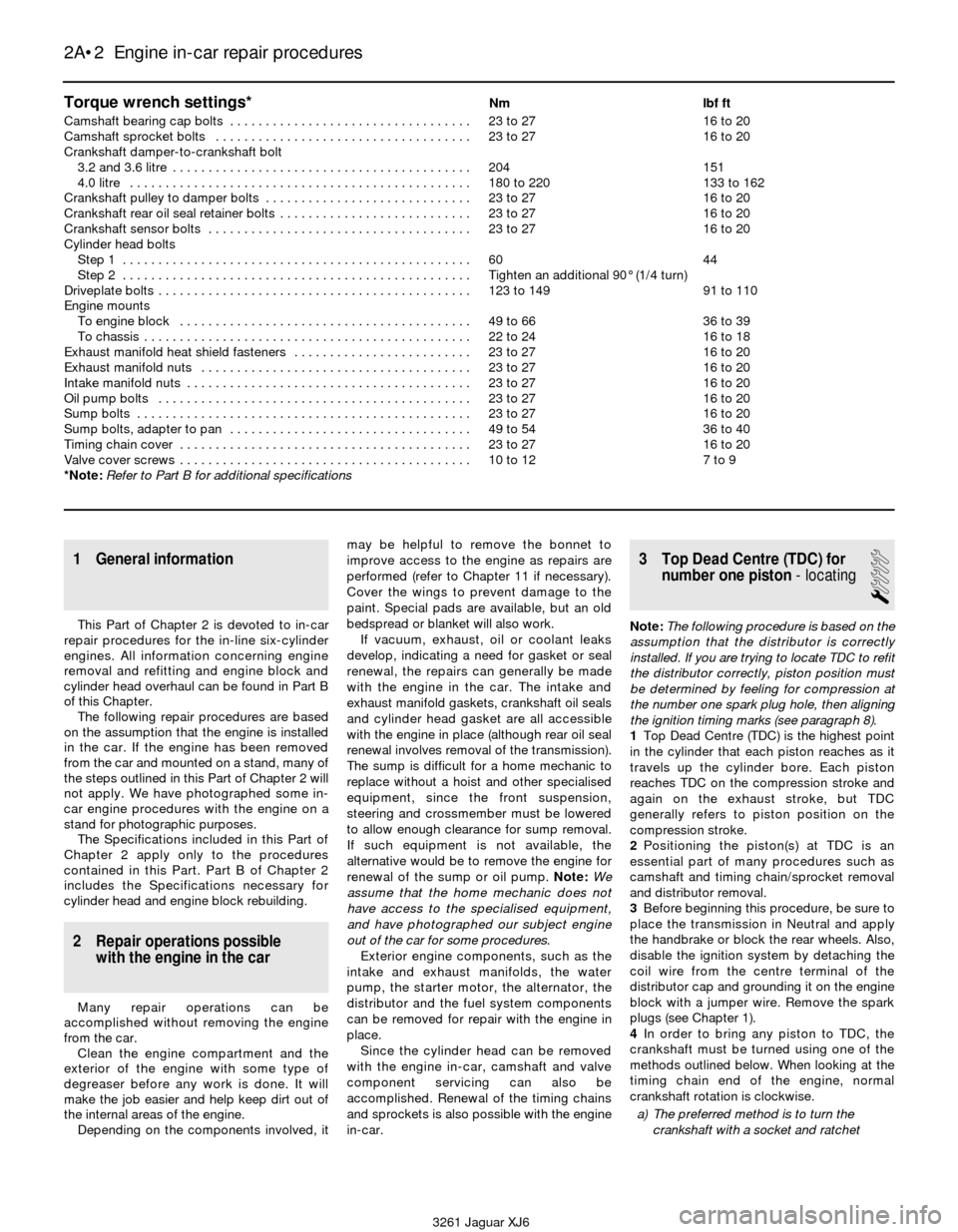
Torque wrench settings*Nm lbf ft
Camshaft bearing cap bolts . . . . . . . . . . . . . . . . . . . . . . . . . . . . . . . . . . 23 to 27 16 to 20
Camshaft sprocket bolts . . . . . . . . . . . . . . . . . . . . . . . . . . . . . . . . . . . . 23 to 27 16 to 20
Crankshaft damper-to-crankshaft bolt
3.2 and 3.6 litre . . . . . . . . . . . . . . . . . . . . . . . . . . . . . . . . . . . . . . . . . . 204 151
4.0 litre . . . . . . . . . . . . . . . . . . . . . . . . . . . . . . . . . . . . . . . . . . . . . . . . 180 to 220 133 to 162
Crankshaft pulley to damper bolts . . . . . . . . . . . . . . . . . . . . . . . . . . . . . 23 to 27 16 to 20
Crankshaft rear oil seal retainer bolts . . . . . . . . . . . . . . . . . . . . . . . . . . . 23 to 27 16 to 20
Crankshaft sensor bolts . . . . . . . . . . . . . . . . . . . . . . . . . . . . . . . . . . . . . 23 to 27 16 to 20
Cylinder head bolts
Step 1 . . . . . . . . . . . . . . . . . . . . . . . . . . . . . . . . . . . . . . . . . . . . . . . . . 60 44
Step 2 . . . . . . . . . . . . . . . . . . . . . . . . . . . . . . . . . . . . . . . . . . . . . . . . . Tighten an additional 90° (1/4 turn)
Driveplate bolts . . . . . . . . . . . . . . . . . . . . . . . . . . . . . . . . . . . . . . . . . . . . 123 to 149 91 to 110
Engine mounts
To engine block . . . . . . . . . . . . . . . . . . . . . . . . . . . . . . . . . . . . . . . . . 49 to 66 36 to 39
To chassis . . . . . . . . . . . . . . . . . . . . . . . . . . . . . . . . . . . . . . . . . . . . . . 22 to 24 16 to 18
Exhaust manifold heat shield fasteners . . . . . . . . . . . . . . . . . . . . . . . . . 23 to 27 16 to 20
Exhaust manifold nuts . . . . . . . . . . . . . . . . . . . . . . . . . . . . . . . . . . . . . . 23 to 27 16 to 20
Intake manifold nuts . . . . . . . . . . . . . . . . . . . . . . . . . . . . . . . . . . . . . . . . 23 to 27 16 to 20
Oil pump bolts . . . . . . . . . . . . . . . . . . . . . . . . . . . . . . . . . . . . . . . . . . . . 23 to 27 16 to 20
Sump bolts . . . . . . . . . . . . . . . . . . . . . . . . . . . . . . . . . . . . . . . . . . . . . . . 23 to 27 16 to 20
Sump bolts, adapter to pan . . . . . . . . . . . . . . . . . . . . . . . . . . . . . . . . . . 49 to 54 36 to 40
Timing chain cover . . . . . . . . . . . . . . . . . . . . . . . . . . . . . . . . . . . . . . . . . 23 to 27 16 to 20
Valve cover screws . . . . . . . . . . . . . . . . . . . . . . . . . . . . . . . . . . . . . . . . . 10 to 12 7 to 9
*Note:Refer to Part B for additional specifications
2A•2 Engine in-car repair procedures
3261 Jaguar XJ6
1 General information
This Part of Chapter 2 is devoted to in-car
repair procedures for the in-line six-cylinder
engines. All information concerning engine
removal and refitting and engine block and
cylinder head overhaul can be found in Part B
of this Chapter.
The following repair procedures are based
on the assumption that the engine is installed
in the car. If the engine has been removed
from the car and mounted on a stand, many of
the steps outlined in this Part of Chapter 2 will
not apply. We have photographed some in-
car engine procedures with the engine on a
stand for photographic purposes.
The Specifications included in this Part of
Chapter 2 apply only to the procedures
contained in this Part. Part B of Chapter 2
includes the Specifications necessary for
cylinder head and engine block rebuilding.
2 Repair operations possible
with the engine in the car
Many repair operations can be
accomplished without removing the engine
from the car.
Clean the engine compartment and the
exterior of the engine with some type of
degreaser before any work is done. It will
make the job easier and help keep dirt out of
the internal areas of the engine.
Depending on the components involved, itmay be helpful to remove the bonnet to
improve access to the engine as repairs are
performed (refer to Chapter 11 if necessary).
Cover the wings to prevent damage to the
paint. Special pads are available, but an old
bedspread or blanket will also work.
If vacuum, exhaust, oil or coolant leaks
develop, indicating a need for gasket or seal
renewal, the repairs can generally be made
with the engine in the car. The intake and
exhaust manifold gaskets, crankshaft oil seals
and cylinder head gasket are all accessible
with the engine in place (although rear oil seal
renewal involves removal of the transmission).
The sump is difficult for a home mechanic to
replace without a hoist and other specialised
equipment, since the front suspension,
steering and crossmember must be lowered
to allow enough clearance for sump removal.
If such equipment is not available, the
alternative would be to remove the engine for
renewal of the sump or oil pump. Note:We
assume that the home mechanic does not
have access to the specialised equipment,
and have photographed our subject engine
out of the car for some procedures.
Exterior engine components, such as the
intake and exhaust manifolds, the water
pump, the starter motor, the alternator, the
distributor and the fuel system components
can be removed for repair with the engine in
place.
Since the cylinder head can be removed
with the engine in-car, camshaft and valve
component servicing can also be
accomplished. Renewal of the timing chains
and sprockets is also possible with the engine
in-car.
3 Top Dead Centre (TDC) for
number one piston- locating
1
Note:The following procedure is based on the
assumption that the distributor is correctly
installed. If you are trying to locate TDC to refit
the distributor correctly, piston position must
be determined by feeling for compression at
the number one spark plug hole, then aligning
the ignition timing marks (see paragraph 8).
1Top Dead Centre (TDC) is the highest point
in the cylinder that each piston reaches as it
travels up the cylinder bore. Each piston
reaches TDC on the compression stroke and
again on the exhaust stroke, but TDC
generally refers to piston position on the
compression stroke.
2Positioning the piston(s) at TDC is an
essential part of many procedures such as
camshaft and timing chain/sprocket removal
and distributor removal.
3Before beginning this procedure, be sure to
place the transmission in Neutral and apply
the handbrake or block the rear wheels. Also,
disable the ignition system by detaching the
coil wire from the centre terminal of the
distributor cap and grounding it on the engine
block with a jumper wire. Remove the spark
plugs (see Chapter 1).
4In order to bring any piston to TDC, the
crankshaft must be turned using one of the
methods outlined below. When looking at the
timing chain end of the engine, normal
crankshaft rotation is clockwise.
a) The preferred method is to turn the
crankshaft with a socket and ratchet
Page 50 of 227
11 Cylinder head-
removal and refitting
4
Note:The engine must be completely cool
before beginning this procedure.
Removal
1Disconnect the battery negative cable.
Caution: If the stereo in your vehicle is
equipped with an anti-theft system, make
sure you have the correct activation code
before disconnecting the battery.
2Drain the coolant from the engine block and
radiator (see Chapter 1).
3Drain the engine oil and remove the oil filter
(see Chapter 1).
4Remove the bonnet for easier access, if
necessary (see Chapter 11).
5Remove the intake manifold (see Section 5).
6Remove the exhaust manifolds (Section 6).
7Remove the valve cover (see Section 4).
8Refer to Section 3 and Position the engine
at TDC for cylinder number 1. Remove the
distributor (see Chapter 5).
9Remove the camshafts and sprockets (see
Section 10). Place the upper chain between
the two upper chain guides and wrap a large
rubber band around the two guides, retaining
the chain and guides.
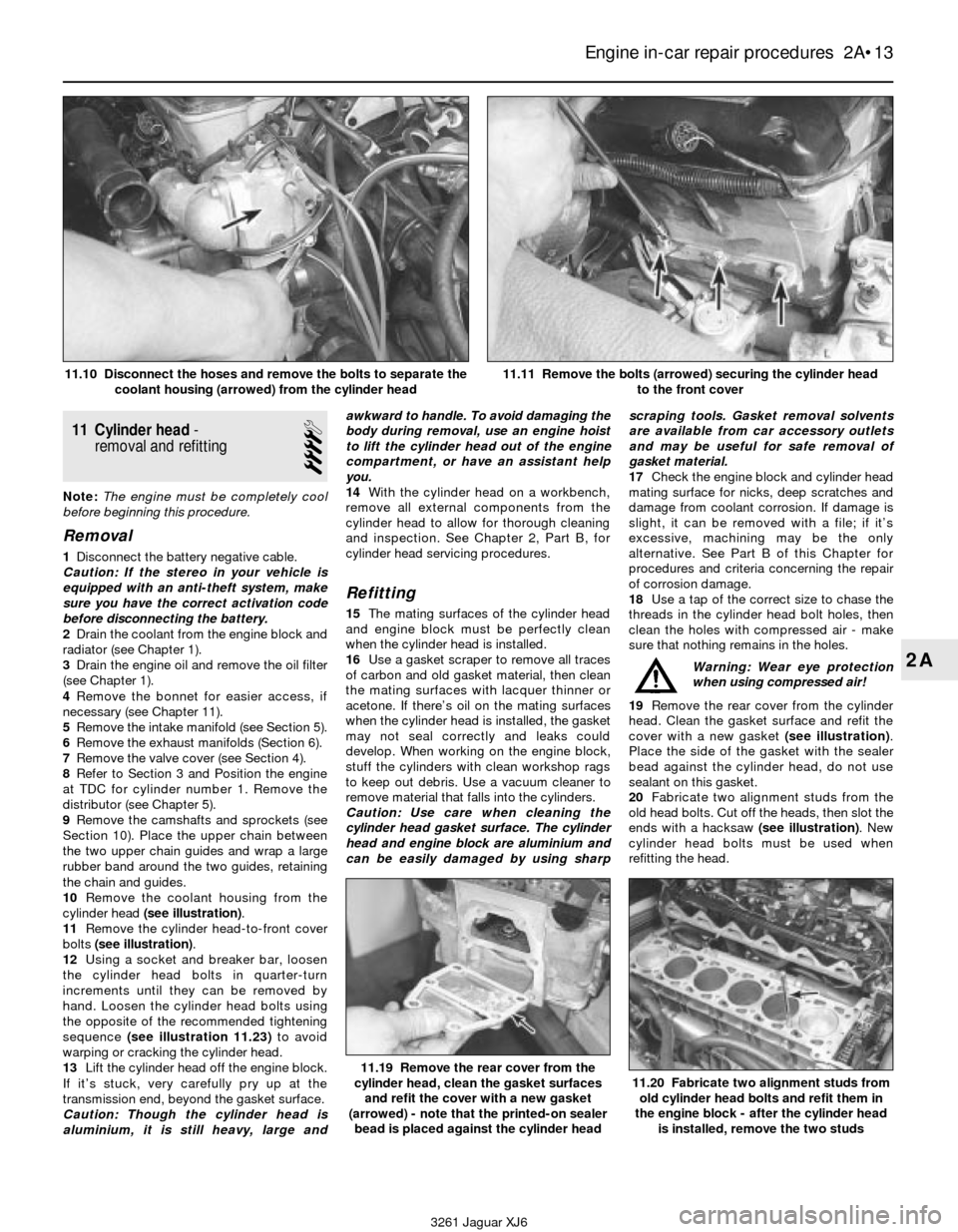
10Remove the coolant housing from the
cylinder head (see illustration).
11Remove the cylinder head-to-front cover
bolts (see illustration).
12Using a socket and breaker bar, loosen
the cylinder head bolts in quarter-turn
increments until they can be removed by
hand. Loosen the cylinder head bolts using
the opposite of the recommended tightening
sequence (see illustration 11.23)to avoid
warping or cracking the cylinder head.
13Lift the cylinder head off the engine block.
If it’s stuck, very carefully pry up at the
transmission end, beyond the gasket surface.
Caution: Though the cylinder head is
aluminium, it is still heavy, large andawkward to handle. To avoid damaging the
body during removal, use an engine hoist
to lift the cylinder head out of the engine
compartment, or have an assistant help
you.
14With the cylinder head on a workbench,
remove all external components from the
cylinder head to allow for thorough cleaning
and inspection. See Chapter 2, Part B, for
cylinder head servicing procedures.
Refitting
15The mating surfaces of the cylinder head
and engine block must be perfectly clean
when the cylinder head is installed.
16Use a gasket scraper to remove all traces
of carbon and old gasket material, then clean
the mating surfaces with lacquer thinner or
acetone. If there’s oil on the mating surfaces
when the cylinder head is installed, the gasket
may not seal correctly and leaks could
develop. When working on the engine block,
stuff the cylinders with clean workshop rags
to keep out debris. Use a vacuum cleaner to
remove material that falls into the cylinders.
Caution: Use care when cleaning the
cylinder head gasket surface. The cylinder
head and engine block are aluminium and
can be easily damaged by using sharpscraping tools. Gasket removal solvents
are available from car accessory outlets
and may be useful for safe removal of
gasket material.
17Check the engine block and cylinder head
mating surface for nicks, deep scratches and
damage from coolant corrosion. If damage is
slight, it can be removed with a file; if it’s
excessive, machining may be the only
alternative. See Part B of this Chapter for
procedures and criteria concerning the repair
of corrosion damage.
18Use a tap of the correct size to chase the
threads in the cylinder head bolt holes, then
clean the holes with compressed air - make
sure that nothing remains in the holes.
Warning: Wear eye protection
when using compressed air!
19Remove the rear cover from the cylinder
head. Clean the gasket surface and refit the
cover with a new gasket (see illustration).
Place the side of the gasket with the sealer
bead against the cylinder head, do not use
sealant on this gasket.
20Fabricate two alignment studs from the
old head bolts. Cut off the heads, then slot the
ends with a hacksaw (see illustration). New
cylinder head bolts must be used when
refitting the head.
Engine in-car repair procedures 2A•13
2A
11.19 Remove the rear cover from the
cylinder head, clean the gasket surfaces
and refit the cover with a new gasket
(arrowed) - note that the printed-on sealer
bead is placed against the cylinder head11.20 Fabricate two alignment studs from
old cylinder head bolts and refit them in
the engine block - after the cylinder head
is installed, remove the two studs
3261 Jaguar XJ6 11.10 Disconnect the hoses and remove the bolts to separate the
coolant housing (arrowed) from the cylinder head
11.11 Remove the bolts (arrowed) securing the cylinder head
to the front cover
Page 59 of 227
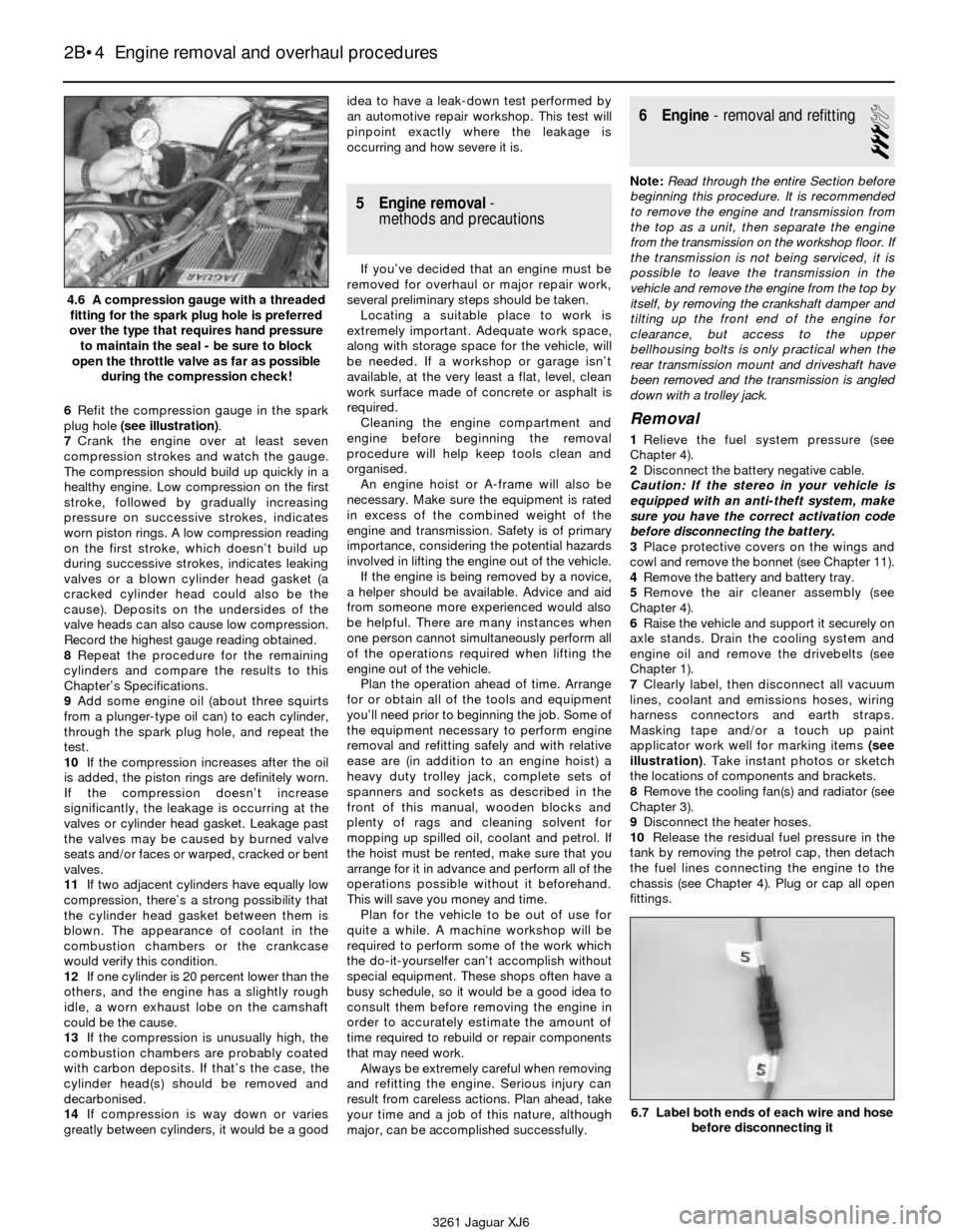
6Refit the compression gauge in the spark
plug hole (see illustration).
7Crank the engine over at least seven
compression strokes and watch the gauge.
The compression should build up quickly in a
healthy engine. Low compression on the first
stroke, followed by gradually increasing
pressure on successive strokes, indicates
worn piston rings. A low compression reading
on the first stroke, which doesn’t build up
during successive strokes, indicates leaking
valves or a blown cylinder head gasket (a
cracked cylinder head could also be the
cause). Deposits on the undersides of the
valve heads can also cause low compression.
Record the highest gauge reading obtained.
8Repeat the procedure for the remaining
cylinders and compare the results to this
Chapter’s Specifications.
9Add some engine oil (about three squirts
from a plunger-type oil can) to each cylinder,
through the spark plug hole, and repeat the
test.
10If the compression increases after the oil
is added, the piston rings are definitely worn.
If the compression doesn’t increase
significantly, the leakage is occurring at the
valves or cylinder head gasket. Leakage past
the valves may be caused by burned valve
seats and/or faces or warped, cracked or bent
valves.
11If two adjacent cylinders have equally low
compression, there’s a strong possibility that
the cylinder head gasket between them is
blown. The appearance of coolant in the
combustion chambers or the crankcase
would verify this condition.
12If one cylinder is 20 percent lower than the
others, and the engine has a slightly rough
idle, a worn exhaust lobe on the camshaft
could be the cause.
13If the compression is unusually high, the
combustion chambers are probably coated
with carbon deposits. If that’s the case, the
cylinder head(s) should be removed and
decarbonised.
14If compression is way down or varies
greatly between cylinders, it would be a goodidea to have a leak-down test performed by
an automotive repair workshop. This test will
pinpoint exactly where the leakage is
occurring and how severe it is.
5 Engine removal-
methods and precautions
If you’ve decided that an engine must be
removed for overhaul or major repair work,
several preliminary steps should be taken.
Locating a suitable place to work is
extremely important. Adequate work space,
along with storage space for the vehicle, will
be needed. If a workshop or garage isn’t
available, at the very least a flat, level, clean
work surface made of concrete or asphalt is
required.
Cleaning the engine compartment and
engine before beginning the removal
procedure will help keep tools clean and
organised.
An engine hoist or A-frame will also be
necessary. Make sure the equipment is rated
in excess of the combined weight of the
engine and transmission. Safety is of primary
importance, considering the potential hazards
involved in lifting the engine out of the vehicle.
If the engine is being removed by a novice,
a helper should be available. Advice and aid
from someone more experienced would also
be helpful. There are many instances when
one person cannot simultaneously perform all
of the operations required when lifting the
engine out of the vehicle.
Plan the operation ahead of time. Arrange
for or obtain all of the tools and equipment
you’ll need prior to beginning the job. Some of
the equipment necessary to perform engine
removal and refitting safely and with relative
ease are (in addition to an engine hoist) a
heavy duty trolley jack, complete sets of
spanners and sockets as described in the
front of this manual, wooden blocks and
plenty of rags and cleaning solvent for
mopping up spilled oil, coolant and petrol. If
the hoist must be rented, make sure that you
arrange for it in advance and perform all of the
operations possible without it beforehand.
This will save you money and time.
Plan for the vehicle to be out of use for
quite a while. A machine workshop will be
required to perform some of the work which
the do-it-yourselfer can’t accomplish without
special equipment. These shops often have a
busy schedule, so it would be a good idea to
consult them before removing the engine in
order to accurately estimate the amount of
time required to rebuild or repair components
that may need work.
Always be extremely careful when removing
and refitting the engine. Serious injury can
result from careless actions. Plan ahead, take
your time and a job of this nature, although
major, can be accomplished successfully.
6 Engine- removal and refitting
3
Note:Read through the entire Section before
beginning this procedure. It is recommended
to remove the engine and transmission from
the top as a unit, then separate the engine
from the transmission on the workshop floor. If
the transmission is not being serviced, it is
possible to leave the transmission in the
vehicle and remove the engine from the top by
itself, by removing the crankshaft damper and
tilting up the front end of the engine for
clearance,but access to the upper
bellhousing bolts is only practical when the
rear transmission mount and driveshaft have
been removed and the transmission is angled
down with a trolley jack.
Removal
1Relieve the fuel system pressure (see
Chapter 4).
2Disconnect the battery negative cable.
Caution: If the stereo in your vehicle is
equipped with an anti-theft system, make
sure you have the correct activation code
before disconnecting the battery.
3Place protective covers on the wings and
cowl and remove the bonnet (see Chapter 11).
4Remove the battery and battery tray.
5Remove the air cleaner assembly (see
Chapter 4).
6Raise the vehicle and support it securely on
axle stands. Drain the cooling system and
engine oil and remove the drivebelts (see
Chapter 1).
7Clearly label, then disconnect all vacuum
lines, coolant and emissions hoses, wiring
harness connectors and earth straps.
Masking tape and/or a touch up paint
applicator work well for marking items (see
illustration). Take instant photos or sketch
the locations of components and brackets.
8Remove the cooling fan(s) and radiator (see
Chapter 3).
9Disconnect the heater hoses.
10Release the residual fuel pressure in the
tank by removing the petrol cap, then detach
the fuel lines connecting the engine to the
chassis (see Chapter 4). Plug or cap all open
fittings.
2B•4 Engine removal and overhaul procedures
4.6 A compression gauge with a threaded
fitting for the spark plug hole is preferred
over the type that requires hand pressure
to maintain the seal - be sure to block
open the throttle valve as far as possible
during the compression check!
6.7 Label both ends of each wire and hose
before disconnecting it
3261 Jaguar XJ6
Page 74 of 227
3261 Jaguar XJ6
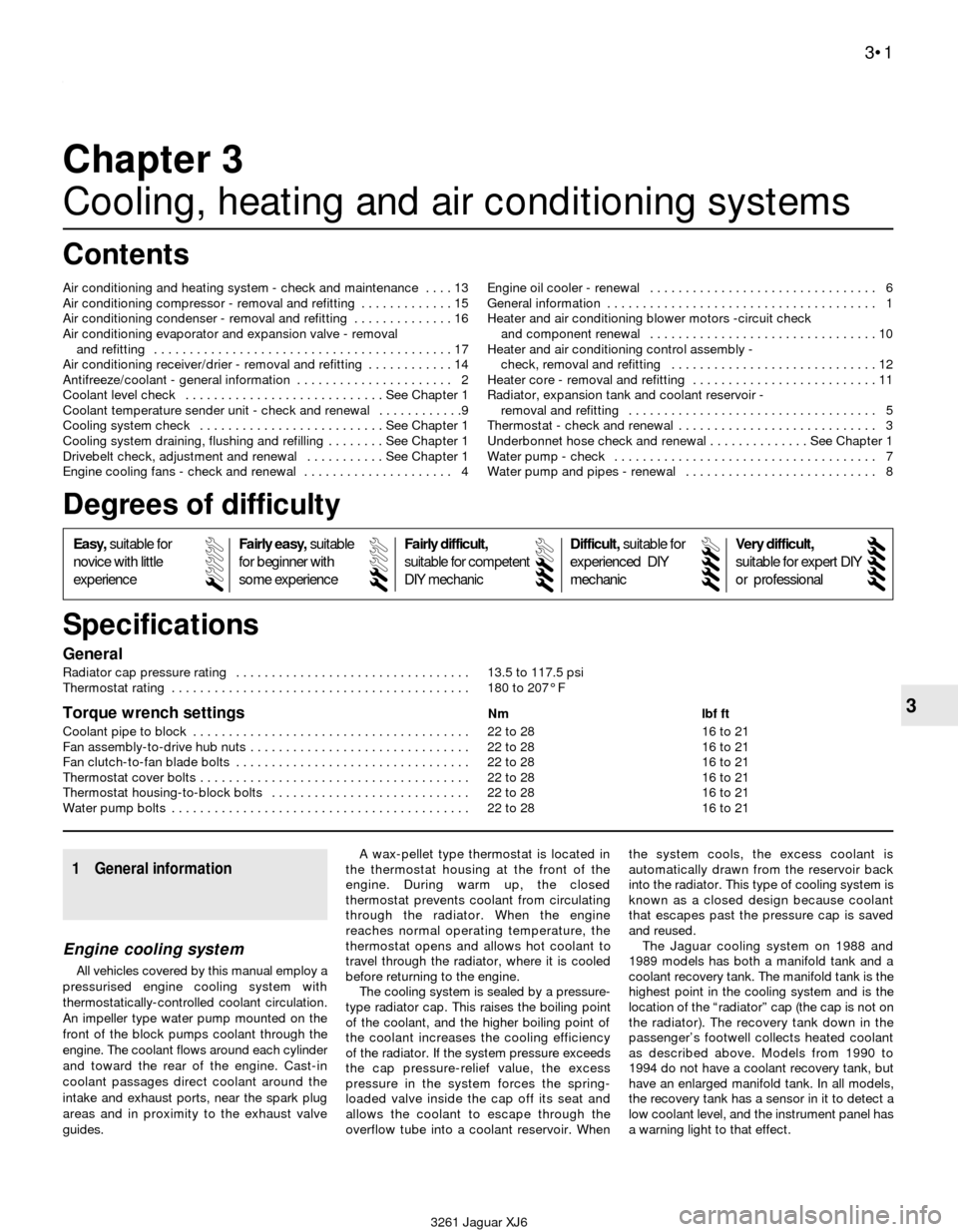
3
Chapter 3
Cooling, heating and air conditioning systems
General
Radiator cap pressure rating . . . . . . . . . . . . . . . . . . . . . . . . . . . . . . . . . 13.5 to 117.5 psi
Thermostat rating . . . . . . . . . . . . . . . . . . . . . . . . . . . . . . . . . . . . . . . . . . 180 to 207° F
Torque wrench settingsNm lbf ft
Coolant pipe to block . . . . . . . . . . . . . . . . . . . . . . . . . . . . . . . . . . . . . . . 22 to 28 16 to 21
Fan assembly-to-drive hub nuts . . . . . . . . . . . . . . . . . . . . . . . . . . . . . . . 22 to 28 16 to 21
Fan clutch-to-fan blade bolts . . . . . . . . . . . . . . . . . . . . . . . . . . . . . . . . . 22 to 28 16 to 21
Thermostat cover bolts . . . . . . . . . . . . . . . . . . . . . . . . . . . . . . . . . . . . . . 22 to 28 16 to 21
Thermostat housing-to-block bolts . . . . . . . . . . . . . . . . . . . . . . . . . . . . 22 to 28 16 to 21
Water pump bolts . . . . . . . . . . . . . . . . . . . . . . . . . . . . . . . . . . . . . . . . . . 22 to 28 16 to 21 Air conditioning and heating system - check and maintenance . . . . 13
Air conditioning compressor - removal and refitting . . . . . . . . . . . . . 15
Air conditioning condenser - removal and refitting . . . . . . . . . . . . . . 16
Air conditioning evaporator and expansion valve - removal
and refitting . . . . . . . . . . . . . . . . . . . . . . . . . . . . . . . . . . . . . . . . . . 17
Air conditioning receiver/drier - removal and refitting . . . . . . . . . . . . 14
Antifreeze/coolant - general information . . . . . . . . . . . . . . . . . . . . . . 2
Coolant level check . . . . . . . . . . . . . . . . . . . . . . . . . . . . See Chapter 1
Coolant temperature sender unit - check and renewal . . . . . . . . . . . .9
Cooling system check . . . . . . . . . . . . . . . . . . . . . . . . . . See Chapter 1
Cooling system draining, flushing and refilling . . . . . . . . See Chapter 1
Drivebelt check, adjustment and renewal . . . . . . . . . . . See Chapter 1
Engine cooling fans - check and renewal . . . . . . . . . . . . . . . . . . . . . 4Engine oil cooler - renewal . . . . . . . . . . . . . . . . . . . . . . . . . . . . . . . . 6
General information . . . . . . . . . . . . . . . . . . . . . . . . . . . . . . . . . . . . . . 1
Heater and air conditioning blower motors -circuit check
and component renewal . . . . . . . . . . . . . . . . . . . . . . . . . . . . . . . . 10
Heater and air conditioning control assembly -
check, removal and refitting . . . . . . . . . . . . . . . . . . . . . . . . . . . . . 12
Heater core - removal and refitting . . . . . . . . . . . . . . . . . . . . . . . . . . 11
Radiator, expansion tank and coolant reservoir -
removal and refitting . . . . . . . . . . . . . . . . . . . . . . . . . . . . . . . . . . . 5
Thermostat - check and renewal . . . . . . . . . . . . . . . . . . . . . . . . . . . . 3
Underbonnet hose check and renewal . . . . . . . . . . . . . . See Chapter 1
Water pump - check . . . . . . . . . . . . . . . . . . . . . . . . . . . . . . . . . . . . . 7
Water pump and pipes - renewal . . . . . . . . . . . . . . . . . . . . . . . . . . . 8
3•1
Specifications Contents
Easy,suitable for
novice with little
experienceFairly easy,suitable
for beginner with
some experienceFairly difficult,
suitable for competent
DIY mechanic
Difficult,suitable for
experienced DIY
mechanicVery difficult,
suitable for expert DIY
or professional
Degrees of difficulty
54321
1 General information
Engine cooling system
All vehicles covered by this manual employ a
pressurised engine cooling system with
thermostatically-controlled coolant circulation.
An impeller type water pump mounted on the
front of the block pumps coolant through the
engine. The coolant flows around each cylinder
and toward the rear of the engine. Cast-in
coolant passages direct coolant around the
intake and exhaust ports, near the spark plug
areas and in proximity to the exhaust valve
guides.A wax-pellet type thermostat is located in
the thermostat housing at the front of the
engine. During warm up, the closed
thermostat prevents coolant from circulating
through the radiator. When the engine
reaches normal operating temperature, the
thermostat opens and allows hot coolant to
travel through the radiator, where it is cooled
before returning to the engine.
The cooling system is sealed by a pressure-
type radiator cap. This raises the boiling point
of the coolant, and the higher boiling point of
the coolant increases the cooling efficiency
of the radiator. If the system pressure exceeds
the cap pressure-relief value, the excess
pressure in the system forces the spring-
loaded valve inside the cap off its seat and
allows the coolant to escape through the
overflow tube into a coolant reservoir. Whenthe system cools, the excess coolant is
automatically drawn from the reservoir back
into the radiator. This type of cooling system is
known as a closed design because coolant
that escapes past the pressure cap is saved
and reused.
The Jaguar cooling system on 1988 and
1989 models has both a manifold tank and a
coolant recovery tank. The manifold tank is the
highest point in the cooling system and is the
location of the “radiator” cap (the cap is not on
the radiator). The recovery tank down in the
passenger’s footwell collects heated coolant
as described above. Models from 1990 to
1994 do not have a coolant recovery tank, but
have an enlarged manifold tank. In all models,
the recovery tank has a sensor in it to detect a
low coolant level, and the instrument panel has
a warning light to that effect.
Page 89 of 227
3261 Jaguar XJ6
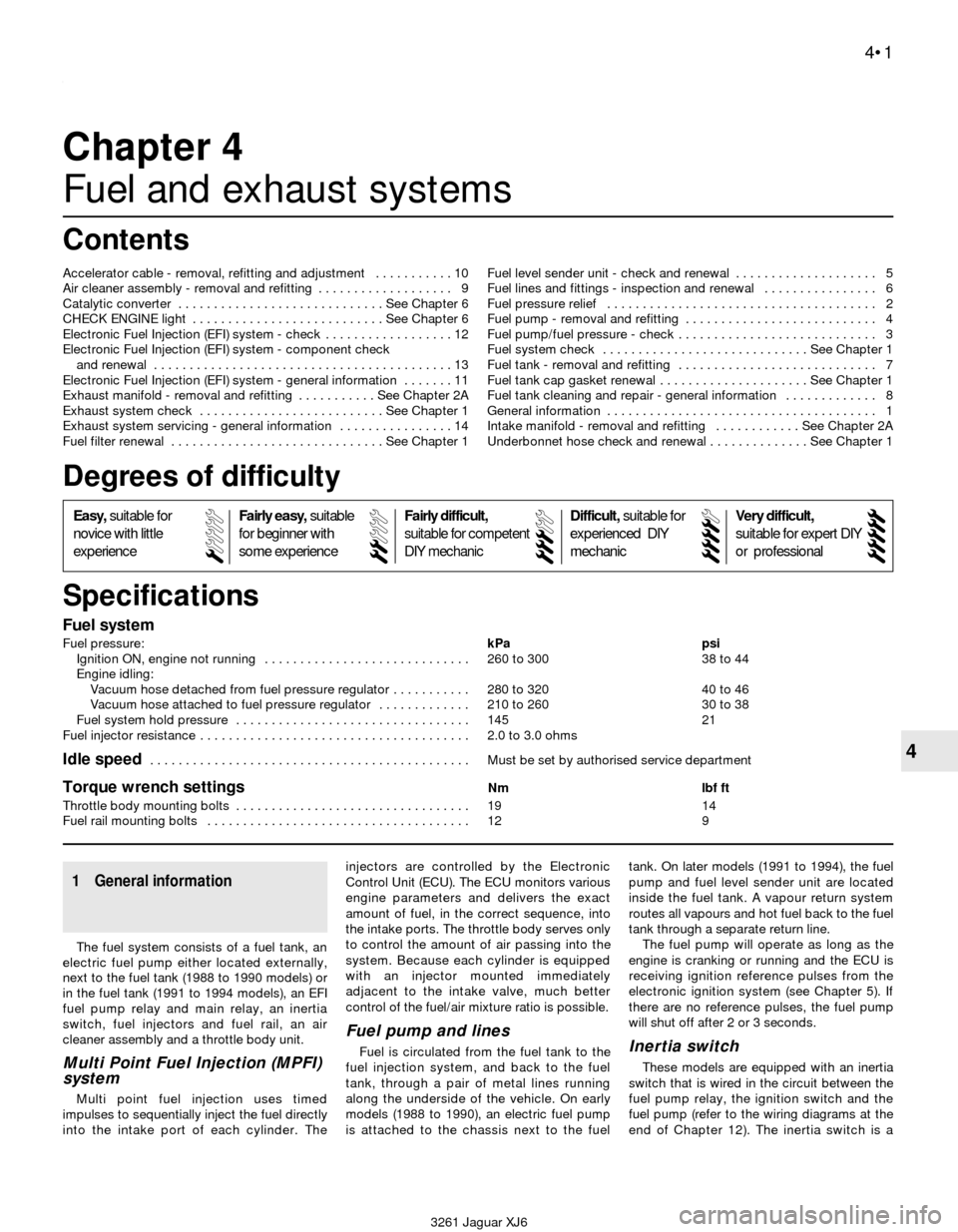
4
Chapter 4
Fuel and exhaust systems
Fuel system
Fuel pressure:kPa psi
Ignition ON, engine not running . . . . . . . . . . . . . . . . . . . . . . . . . . . . . 260 to 300 38 to 44
Engine idling:
Vacuum hose detached from fuel pressure regulator . . . . . . . . . . . 280 to 320 40 to 46
Vacuum hose attached to fuel pressure regulator . . . . . . . . . . . . . 210 to 260 30 to 38
Fuel system hold pressure . . . . . . . . . . . . . . . . . . . . . . . . . . . . . . . . . 145 21
Fuel injector resistance . . . . . . . . . . . . . . . . . . . . . . . . . . . . . . . . . . . . . . 2.0 to 3.0 ohms
Idle speed . . . . . . . . . . . . . . . . . . . . . . . . . . . . . . . . . . . . . . . . . . . . . Must be set by authorised service department
Torque wrench settingsNm lbf ft
Throttle body mounting bolts . . . . . . . . . . . . . . . . . . . . . . . . . . . . . . . . . 19 14
Fuel rail mounting bolts . . . . . . . . . . . . . . . . . . . . . . . . . . . . . . . . . . . . . 12 9 Accelerator cable - removal, refitting and adjustment . . . . . . . . . . . 10
Air cleaner assembly - removal and refitting . . . . . . . . . . . . . . . . . . . 9
Catalytic converter . . . . . . . . . . . . . . . . . . . . . . . . . . . . . See Chapter 6
CHECK ENGINE light . . . . . . . . . . . . . . . . . . . . . . . . . . . See Chapter 6
Electronic Fuel Injection (EFI) system - check . . . . . . . . . . . . . . . . . . 12
Electronic Fuel Injection (EFI) system - component check
and renewal . . . . . . . . . . . . . . . . . . . . . . . . . . . . . . . . . . . . . . . . . . 13
Electronic Fuel Injection (EFI) system - general information . . . . . . . 11
Exhaust manifold - removal and refitting . . . . . . . . . . . See Chapter 2A
Exhaust system check . . . . . . . . . . . . . . . . . . . . . . . . . . See Chapter 1
Exhaust system servicing - general information . . . . . . . . . . . . . . . . 14
Fuel filter renewal . . . . . . . . . . . . . . . . . . . . . . . . . . . . . . See Chapter 1Fuel level sender unit - check and renewal . . . . . . . . . . . . . . . . . . . . 5
Fuel lines and fittings - inspection and renewal . . . . . . . . . . . . . . . . 6
Fuel pressure relief . . . . . . . . . . . . . . . . . . . . . . . . . . . . . . . . . . . . . . 2
Fuel pump - removal and refitting . . . . . . . . . . . . . . . . . . . . . . . . . . . 4
Fuel pump/fuel pressure - check . . . . . . . . . . . . . . . . . . . . . . . . . . . . 3
Fuel system check . . . . . . . . . . . . . . . . . . . . . . . . . . . . . See Chapter 1
Fuel tank - removal and refitting . . . . . . . . . . . . . . . . . . . . . . . . . . . . 7
Fuel tank cap gasket renewal . . . . . . . . . . . . . . . . . . . . . See Chapter 1
Fuel tank cleaning and repair - general information . . . . . . . . . . . . . 8
General information . . . . . . . . . . . . . . . . . . . . . . . . . . . . . . . . . . . . . . 1
Intake manifold - removal and refitting . . . . . . . . . . . . See Chapter 2A
Underbonnet hose check and renewal . . . . . . . . . . . . . . See Chapter 1
4•1
Specifications Contents
Easy,suitable for
novice with little
experienceFairly easy,suitable
for beginner with
some experienceFairly difficult,
suitable for competent
DIY mechanic
Difficult,suitable for
experienced DIY
mechanicVery difficult,
suitable for expert DIY
or professional
Degrees of difficulty
54321
1 General information
The fuel system consists of a fuel tank, an
electric fuel pump either located externally,
next to the fuel tank (1988 to 1990 models) or
in the fuel tank (1991 to 1994 models), an EFI
fuel pump relay and main relay, an inertia
switch, fuel injectors and fuel rail, an air
cleaner assembly and a throttle body unit.
Multi Point Fuel Injection (MPFI)
system
Multi point fuel injection uses timed
impulses to sequentially inject the fuel directly
into the intake port of each cylinder. Theinjectors are controlled by the Electronic
Control Unit (ECU). The ECU monitors various
engine parameters and delivers the exact
amount of fuel, in the correct sequence, into
the intake ports. The throttle body serves only
to control the amount of air passing into the
system. Because each cylinder is equipped
with an injector mounted immediately
adjacent to the intake valve, much better
control of the fuel/air mixture ratio is possible.
Fuel pump and lines
Fuel is circulated from the fuel tank to the
fuel injection system, and back to the fuel
tank, through a pair of metal lines running
along the underside of the vehicle. On early
models (1988 to 1990), an electric fuel pump
is attached to the chassis next to the fueltank. On later models (1991 to 1994), the fuel
pump and fuel level sender unit are located
inside the fuel tank. A vapour return system
routes all vapours and hot fuel back to the fuel
tank through a separate return line.
The fuel pump will operate as long as the
engine is cranking or running and the ECU is
receiving ignition reference pulses from the
electronic ignition system (see Chapter 5). If
there are no reference pulses, the fuel pump
will shut off after 2 or 3 seconds.Inertia switch
These models are equipped with an inertia
switch that is wired in the circuit between the
fuel pump relay, the ignition switch and the
fuel pump (refer to the wiring diagrams at the
end of Chapter 12). The inertia switch is a
Page 111 of 227
3261 Jaguar XJ6
6
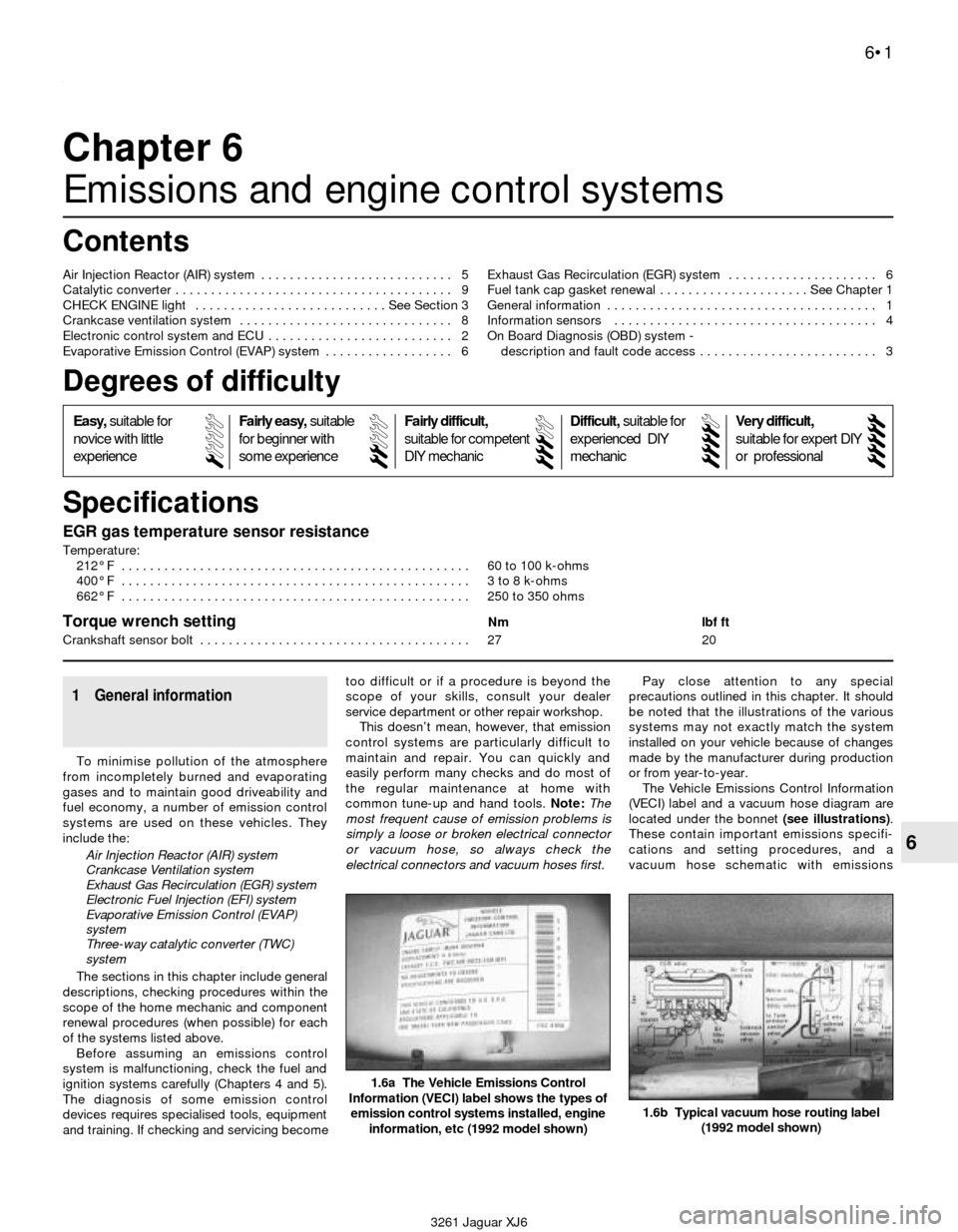
Chapter 6
Emissions and engine control systems
EGR gas temperature sensor resistance
Temperature:
212° F . . . . . . . . . . . . . . . . . . . . . . . . . . . . . . . . . . . . . . . . . . . . . . . . . 60 to 100 k-ohms
400° F . . . . . . . . . . . . . . . . . . . . . . . . . . . . . . . . . . . . . . . . . . . . . . . . . 3 to 8 k-ohms
662° F . . . . . . . . . . . . . . . . . . . . . . . . . . . . . . . . . . . . . . . . . . . . . . . . . 250 to 350 ohms
Torque wrench settingNm lbf ft
Crankshaft sensor bolt . . . . . . . . . . . . . . . . . . . . . . . . . . . . . . . . . . . . . . 27 20 Air Injection Reactor (AIR) system . . . . . . . . . . . . . . . . . . . . . . . . . . . 5
Catalytic converter . . . . . . . . . . . . . . . . . . . . . . . . . . . . . . . . . . . . . . . 9
CHECK ENGINE light . . . . . . . . . . . . . . . . . . . . . . . . . . . See Section 3
Crankcase ventilation system . . . . . . . . . . . . . . . . . . . . . . . . . . . . . . 8
Electronic control system and ECU . . . . . . . . . . . . . . . . . . . . . . . . . . 2
Evaporative Emission Control (EVAP) system . . . . . . . . . . . . . . . . . . 6Exhaust Gas Recirculation (EGR) system . . . . . . . . . . . . . . . . . . . . . 6
Fuel tank cap gasket renewal . . . . . . . . . . . . . . . . . . . . . See Chapter 1
General information . . . . . . . . . . . . . . . . . . . . . . . . . . . . . . . . . . . . . . 1
Information sensors . . . . . . . . . . . . . . . . . . . . . . . . . . . . . . . . . . . . . 4
On Board Diagnosis (OBD) system -
description and fault code access . . . . . . . . . . . . . . . . . . . . . . . . . 3
6•1
Specifications Contents
Easy,suitable for
novice with little
experienceFairly easy,suitable
for beginner with
some experienceFairly difficult,
suitable for competent
DIY mechanic
Difficult,suitable for
experienced DIY
mechanicVery difficult,
suitable for expert DIY
or professional
Degrees of difficulty
54321
1 General information
To minimise pollution of the atmosphere
from incompletely burned and evaporating
gases and to maintain good driveability and
fuel economy, a number of emission control
systems are used on these vehicles. They
include the:
Air Injection Reactor (AIR) system
Crankcase Ventilation system
Exhaust Gas Recirculation (EGR) system
Electronic Fuel Injection (EFI) system
Evaporative Emission Control (EVAP)
system
Three-way catalytic converter (TWC)
system
The sections in this chapter include general
descriptions, checking procedures within the
scope of the home mechanic and component
renewal procedures (when possible) for each
of the systems listed above.
Before assuming an emissions control
system is malfunctioning, check the fuel and
ignition systems carefully (Chapters 4 and 5).
The diagnosis of some emission control
devices requires specialised tools, equipment
and training. If checking and servicing becometoo difficult or if a procedure is beyond the
scope of your skills, consult your dealer
service department or other repair workshop.
This doesn’t mean, however, that emission
control systems are particularly difficult to
maintain and repair. You can quickly and
easily perform many checks and do most of
the regular maintenance at home with
common tune-up and hand tools. Note:The
most frequent cause of emission problems is
simply a loose or broken electrical connector
or vacuum hose, so always check the
electrical connectors and vacuum hoses first.Pay close attention to any special
precautions outlined in this chapter. It should
be noted that the illustrations of the various
systems may not exactly match the system
installed on your vehicle because of changes
made by the manufacturer during production
or from year-to-year.
The Vehicle Emissions Control Information
(VECI) label and a vacuum hose diagram are
located under the bonnet (see illustrations).
These contain important emissions specifi-
cations and setting procedures, and a
vacuum hose schematic with emissions
1.6a The Vehicle Emissions Control
Information (VECI) label shows the types of
emission control systems installed, engine
information, etc (1992 model shown)
1.6b Typical vacuum hose routing label
(1992 model shown)
Page 149 of 227
3261 Jaguar XJ6
11
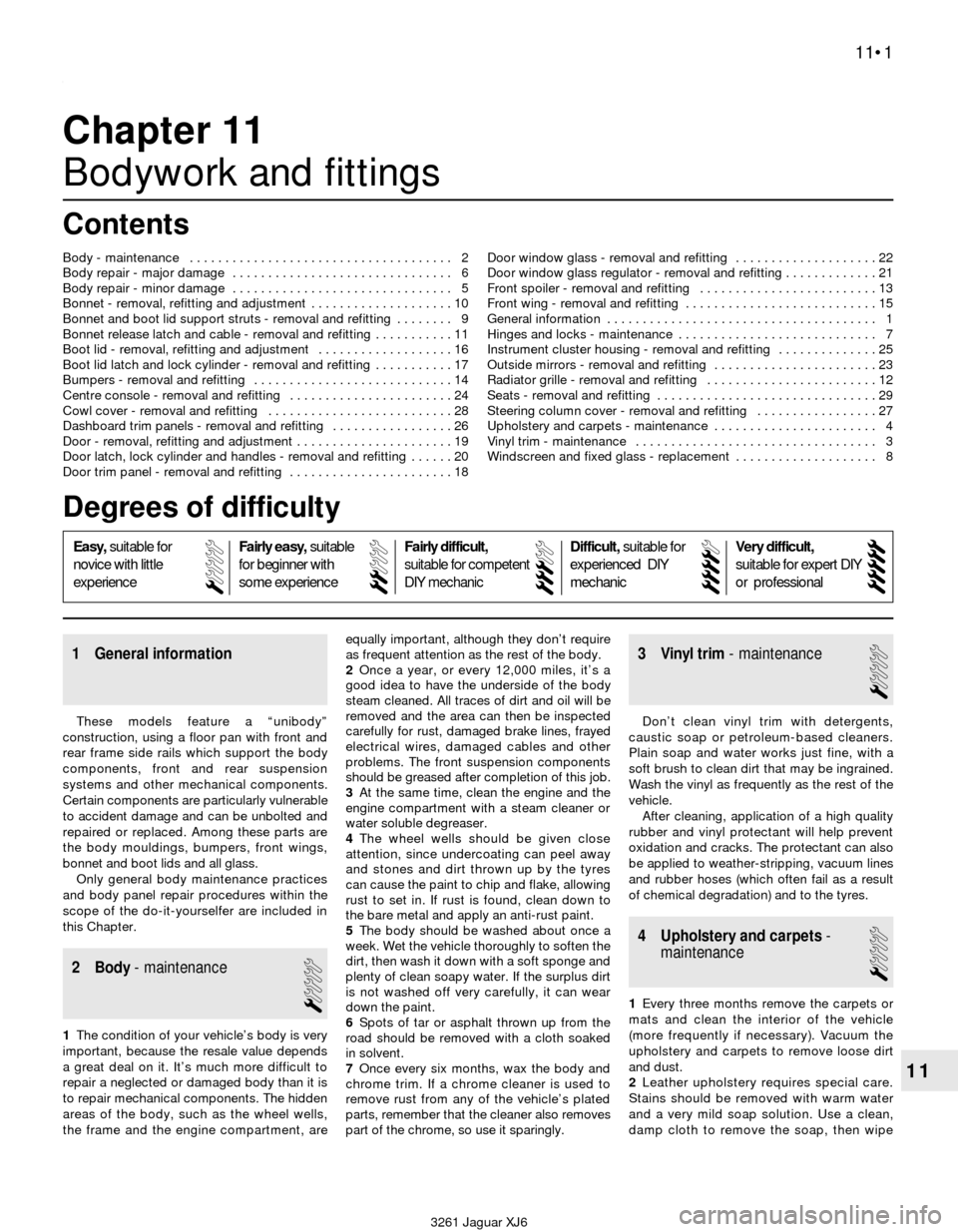
Chapter 11
Bodywork and fittings
Body - maintenance . . . . . . . . . . . . . . . . . . . . . . . . . . . . . . . . . . . . . 2
Body repair - major damage . . . . . . . . . . . . . . . . . . . . . . . . . . . . . . . 6
Body repair - minor damage . . . . . . . . . . . . . . . . . . . . . . . . . . . . . . . 5
Bonnet - removal, refitting and adjustment . . . . . . . . . . . . . . . . . . . . 10
Bonnet and boot lid support struts - removal and refitting . . . . . . . . 9
Bonnet release latch and cable - removal and refitting . . . . . . . . . . . 11
Boot lid - removal, refitting and adjustment . . . . . . . . . . . . . . . . . . . 16
Boot lid latch and lock cylinder - removal and refitting . . . . . . . . . . . 17
Bumpers - removal and refitting . . . . . . . . . . . . . . . . . . . . . . . . . . . . 14
Centre console - removal and refitting . . . . . . . . . . . . . . . . . . . . . . . 24
Cowl cover - removal and refitting . . . . . . . . . . . . . . . . . . . . . . . . . . 28
Dashboard trim panels - removal and refitting . . . . . . . . . . . . . . . . . 26
Door - removal, refitting and adjustment . . . . . . . . . . . . . . . . . . . . . . 19
Door latch, lock cylinder and handles - removal and refitting . . . . . . 20
Door trim panel - removal and refitting . . . . . . . . . . . . . . . . . . . . . . . 18Door window glass - removal and refitting . . . . . . . . . . . . . . . . . . . . 22
Door window glass regulator - removal and refitting . . . . . . . . . . . . . 21
Front spoiler - removal and refitting . . . . . . . . . . . . . . . . . . . . . . . . . 13
Front wing - removal and refitting . . . . . . . . . . . . . . . . . . . . . . . . . . . 15
General information . . . . . . . . . . . . . . . . . . . . . . . . . . . . . . . . . . . . . . 1
Hinges and locks - maintenance . . . . . . . . . . . . . . . . . . . . . . . . . . . . 7
Instrument cluster housing - removal and refitting . . . . . . . . . . . . . . 25
Outside mirrors - removal and refitting . . . . . . . . . . . . . . . . . . . . . . . 23
Radiator grille - removal and refitting . . . . . . . . . . . . . . . . . . . . . . . . 12
Seats - removal and refitting . . . . . . . . . . . . . . . . . . . . . . . . . . . . . . . 29
Steering column cover - removal and refitting . . . . . . . . . . . . . . . . . 27
Upholstery and carpets - maintenance . . . . . . . . . . . . . . . . . . . . . . . 4
Vinyl trim - maintenance . . . . . . . . . . . . . . . . . . . . . . . . . . . . . . . . . . 3
Windscreen and fixed glass - replacement . . . . . . . . . . . . . . . . . . . . 8
11•1
Contents
Easy,suitable for
novice with little
experienceFairly easy,suitable
for beginner with
some experienceFairly difficult,
suitable for competent
DIY mechanic
Difficult,suitable for
experienced DIY
mechanicVery difficult,
suitable for expert DIY
or professional
Degrees of difficulty
54321
1 General information
These models feature a “unibody”
construction, using a floor pan with front and
rear frame side rails which support the body
components, front and rear suspension
systems and other mechanical components.
Certain components are particularly vulnerable
to accident damage and can be unbolted and
repaired or replaced. Among these parts are
the body mouldings, bumpers, front wings,
bonnet and boot lids and all glass.
Only general body maintenance practices
and body panel repair procedures within the
scope of the do-it-yourselfer are included in
this Chapter.
2 Body- maintenance
1
1The condition of your vehicle’s body is very
important, because the resale value depends
a great deal on it. It’s much more difficult to
repair a neglected or damaged body than it is
to repair mechanical components. The hidden
areas of the body, such as the wheel wells,
the frame and the engine compartment, areequally important, although they don’t require
as frequent attention as the rest of the body.
2Once a year, or every 12,000 miles, it’s a
good idea to have the underside of the body
steam cleaned. All traces of dirt and oil will be
removed and the area can then be inspected
carefully for rust, damaged brake lines, frayed
electrical wires, damaged cables and other
problems. The front suspension components
should be greased after completion of this job.
3At the same time, clean the engine and the
engine compartment with a steam cleaner or
water soluble degreaser.
4The wheel wells should be given close
attention, since undercoating can peel away
and stones and dirt thrown up by the tyres
can cause the paint to chip and flake, allowing
rust to set in. If rust is found, clean down to
the bare metal and apply an anti-rust paint.
5The body should be washed about once a
week. Wet the vehicle thoroughly to soften the
dirt, then wash it down with a soft sponge and
plenty of clean soapy water. If the surplus dirt
is not washed off very carefully, it can wear
down the paint.
6Spots of tar or asphalt thrown up from the
road should be removed with a cloth soaked
in solvent.
7Once every six months, wax the body and
chrome trim. If a chrome cleaner is used to
remove rust from any of the vehicle’s plated
parts, remember that the cleaner also removes
part of the chrome, so use it sparingly.
3 Vinyl trim- maintenance
1
Don’t clean vinyl trim with detergents,
caustic soap or petroleum-based cleaners.
Plain soap and water works just fine, with a
soft brush to clean dirt that may be ingrained.
Wash the vinyl as frequently as the rest of the
vehicle.
After cleaning, application of a high quality
rubber and vinyl protectant will help prevent
oxidation and cracks. The protectant can also
be applied to weather-stripping, vacuum lines
and rubber hoses (which often fail as a result
of chemical degradation) and to the tyres.
4 Upholstery and carpets-
maintenance
1
1Every three months remove the carpets or
mats and clean the interior of the vehicle
(more frequently if necessary). Vacuum the
upholstery and carpets to remove loose dirt
and dust.
2Leather upholstery requires special care.
Stains should be removed with warm water
and a very mild soap solution. Use a clean,
damp cloth to remove the soap, then wipe
Page 151 of 227
spray painting technique is mastered. Cover
the repair area with a thick coat of primer. The
thickness should be built up using several thin
layers of primer rather than one thick one.
Using 600-grit wet-or-dry sandpaper, rub
down the surface of the primer until it is very
smooth. While doing this, the work area
should be thoroughly rinsed with water and
the wet-or-dry sandpaper periodically rinsed
as well. Allow the primer to dry before
spraying additional coats.
21Spray on the top coat, again building up
the thickness by using several thin layers of
paint. Begin spraying at the top of the repair
area and then, using a side-to-side motion,
work down until the whole repair area and
about two inches of the surrounding original
paint is covered. Remove all masking material
10 to 15 minutes after spraying on the final
coat of paint. Allow the new paint at least two
weeks to harden, then use a very fine rubbing
compound to blend the edges of the new
paint into the existing paint. Finally, apply a
coat of wax.
6 Body repair- major damage
5
1Major damage must be repaired by an auto
body workshop specifically equipped to
perform unibody repairs. These workshops
have the specialised equipment required to
do the job properly.
2If the damage is extensive, the body must
be checked for proper alignment or the
vehicle’s handling characteristics may be
adversely affected and other components
may wear at an accelerated rate.
3Due to the fact that most of the major body
components (bonnet, front wings, etc.) are
separate and replaceable units, any seriously
damaged components should be replaced
rather than repaired. Sometimes thecomponents can be found in a scrapyard that
specialises in used vehicle components, often
at considerable savings over the cost of new
parts.
7 Hinges and locks-
maintenance
1
Once every 3000 miles, or every three
months, the hinges and latch assemblies on
the doors, bonnet and boot should be given a
few drops of light oil or lock lubricant. The
door latch strikers should also be lubricated
with a thin coat of grease to reduce wear and
ensure free movement. Lubricate the door
and boot locks with spray-on graphite
lubricant.
8 Windscreen and fixed glass-
replacement
5
Replacement of the windscreen and fixed
glass requires the use of special fast-setting
adhesive/caulk materials and some
specialised tools. It is recommended that
these operations be left to a dealer or a
workshop specialising in glass work.
9 Bonnet and boot lid support
struts- removal and refitting
1
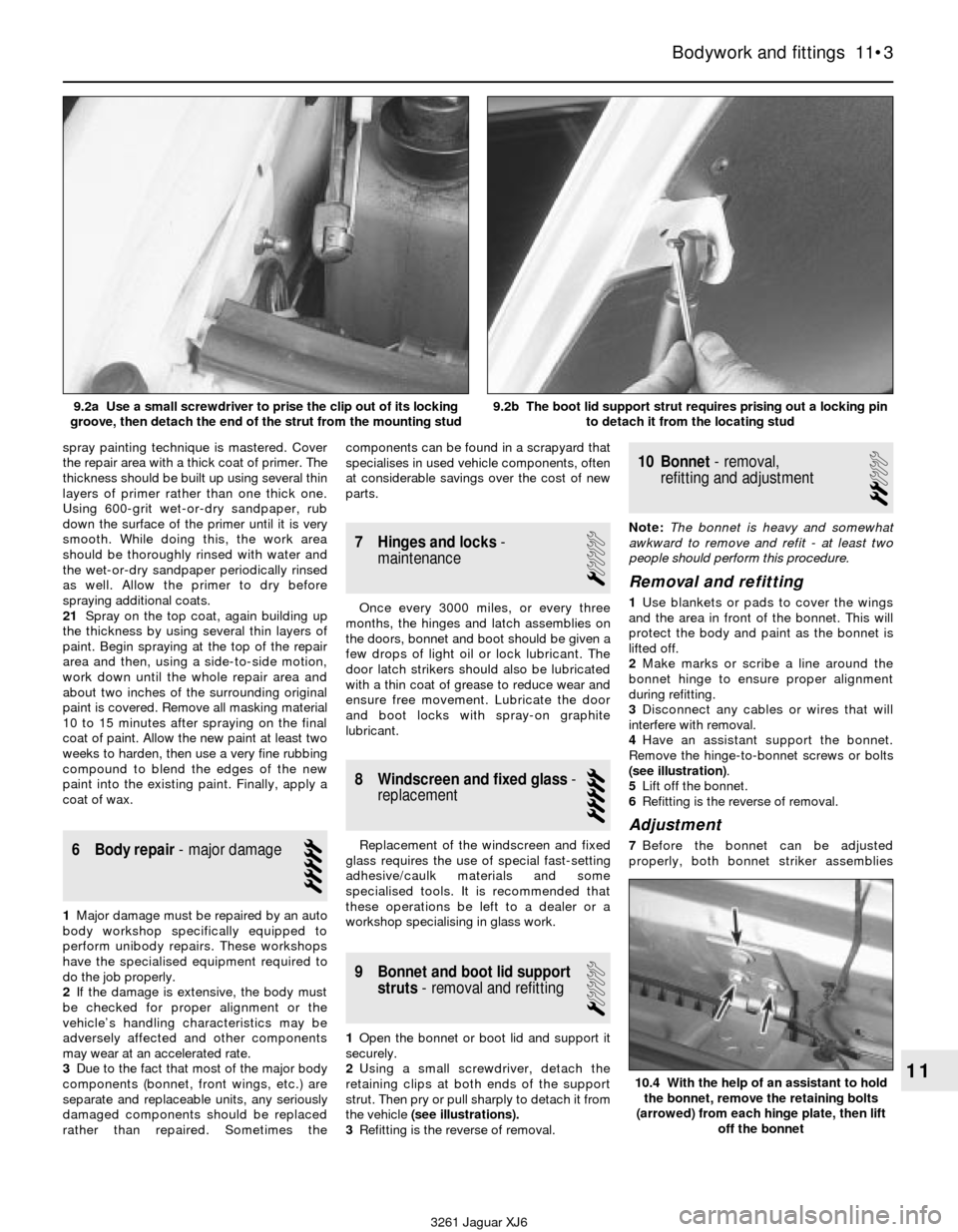
1Open the bonnet or boot lid and support it
securely.
2Using a small screwdriver, detach the
retaining clips at both ends of the support
strut. Then pry or pull sharply to detach it from
the vehicle(see illustrations).
3Refitting is the reverse of removal.
10 Bonnet- removal,
refitting and adjustment
2
Note:The bonnet is heavy and somewhat
awkward to remove and refit - at least two
people should perform this procedure.
Removal and refitting
1Use blankets or pads to cover the wings
and the area in front of the bonnet. This will
protect the body and paint as the bonnet is
lifted off.
2Make marks or scribe a line around the
bonnet hinge to ensure proper alignment
during refitting.
3Disconnect any cables or wires that will
interfere with removal.
4Have an assistant support the bonnet.
Remove the hinge-to-bonnet screws or bolts
(see illustration).
5Lift off the bonnet.
6Refitting is the reverse of removal.
Adjustment
7Before the bonnet can be adjusted
properly, both bonnet striker assemblies
Bodywork and fittings 11•3
1110.4 With the help of an assistant to hold
the bonnet, remove the retaining bolts
(arrowed) from each hinge plate, then lift
off the bonnet
3261 Jaguar XJ69.2b The boot lid support strut requires prising out a locking pin
to detach it from the locating stud
9.2a Use a small screwdriver to prise the clip out of its locking
groove, then detach the end of the strut from the mounting stud
Page 152 of 227

which are located on the inside of the bonnet
must first be loosened to allow correct
alignment of the bonnet.
8Fore-and-aft and side-to-side adjustment
of the bonnet is done by moving the bonnet in
relation to the hinge plates after loosening the
bolts.
9Scribe or trace a line around the entire
hinge plate to judge the amount of movement.
10Loosen the nuts or bolts and move the
bonnet into correct alignment. Move it only a
little at a time. Tighten the hinge bolts or nuts
and carefully lower the bonnet to check the
alignment.
11After the bonnet has been aligned
properly with the cowl and front wings, the
height and position of the bonnet striker
assembly should be adjusted to provide
positive engagement with the latch assembly
(see illustration).
12Adjust the bonnet bumpers on the wings
so the bonnet is flush with the wings when
closed (see illustration).13The bonnet latch assembly, as well as the
hinges, should be lubricated with white lithium-
base grease to prevent sticking and wear.
11 Bonnet release latch and
cable- removal and refitting
2
Latch
1Disconnect the bonnet release cables by
removing the cable retaining bolts and
disengaging the cable from the latch
assembly.(see illustration).
2Scribe a line around the latches to aid
alignment when refitting, then detach the
retaining bolts from the inner footwell (see
illustration)and remove the latch.
3Refitting is the reverse of removal.
Cable
4Disconnect the bonnet release cable as
described in (Section 11).5Detach all cable retaining clips located in
the engine compartment.
6Working in the passenger compartment,
remove the driver’s side kick panel surrounding
the bonnet release lever. Pull the release lever
forward and detach the release cables from the
handle and bracket assembly (see illustration).11.6 Remove the driver’s side kick panel
to access the bonnet release cables from
the passenger compartment
11•4 Bodywork and fittings
3261 Jaguar XJ6 10.11 Adjust the position of the bonnet striker by loosening the
locknut (A), then adjust the height of the bonnet striker (B) by
turning it in or out with a screwdriver
10.12 Remove the rubber bumper then loosen the locknut (A) -
adjust the bonnet bumper bolt (B) in or out so the bonnet is flush
with the wings in the closed position
11.1 Remove the cable retaining bolt(s) (arrowed) then disengage
the cable from the latch assembly11.2 Bonnet latch retaining bolts (arrowed) are located on both
sides of the engine compartment