ABS JAGUAR XJ6 1997 2.G Owner's Manual
[x] Cancel search | Manufacturer: JAGUAR, Model Year: 1997, Model line: XJ6, Model: JAGUAR XJ6 1997 2.GPages: 227, PDF Size: 7.2 MB
Page 140 of 227
4Remove the anti-roll bar from the vehicle.
5Refitting is the reverse of the removal
procedure. Be sure to tighten all fasteners to
the torque listed in this Chapter’s
Specifications.
4 Shock absorber (front)-
removal and refitting
2
Note: Always renew both left and right shocks
at the same time to prevent handling
peculiarities and abnormal ride quality.
1Loosen but do not remove the front wheel
nuts. Raise the front of the vehicle and
support it on axle stands. Remove the wheels.
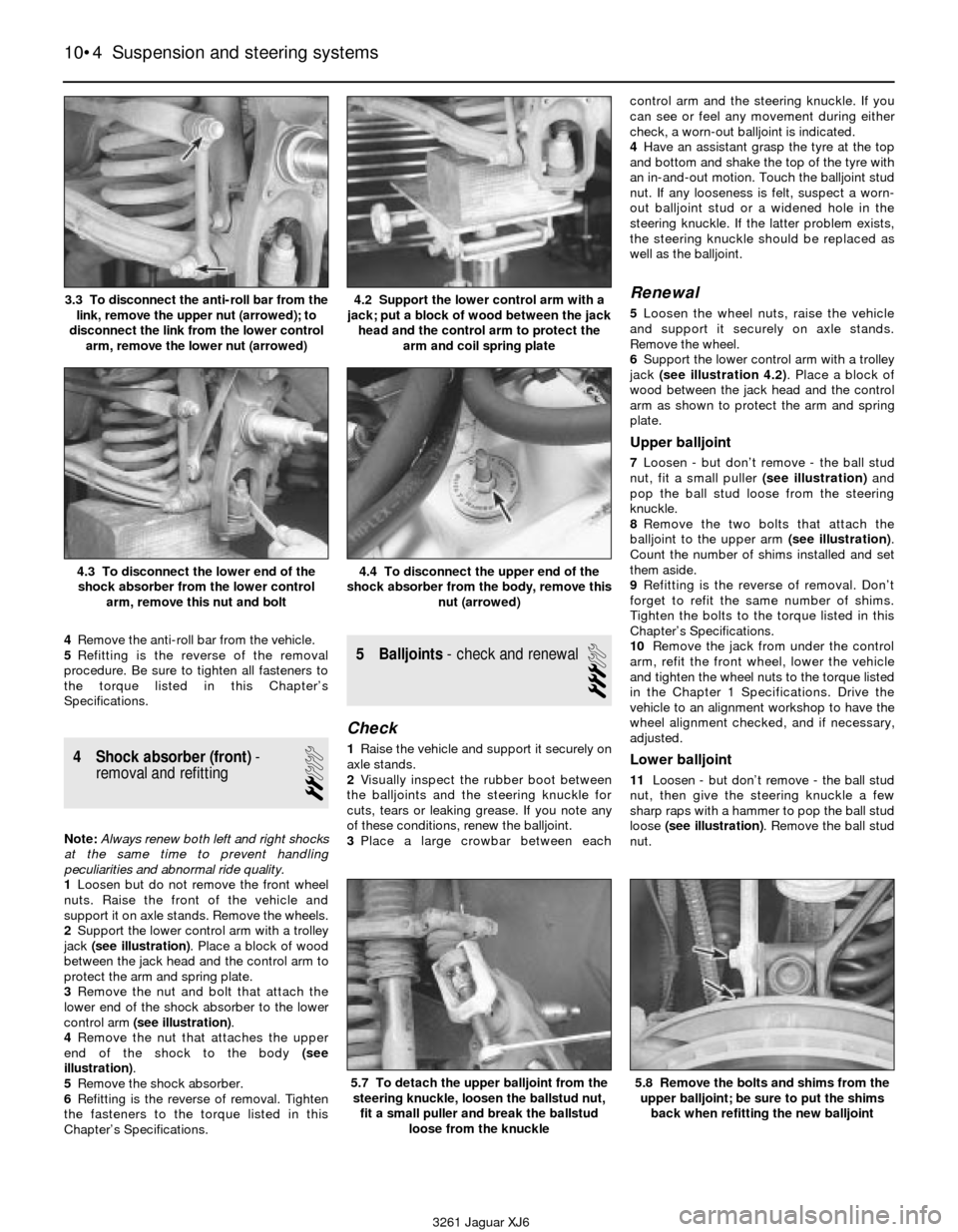
2Support the lower control arm with a trolley
jack (see illustration). Place a block of wood
between the jack head and the control arm to
protect the arm and spring plate.
3Remove the nut and bolt that attach the
lower end of the shock absorber to the lower
control arm (see illustration).
4Remove the nut that attaches the upper
end of the shock to the body (see
illustration).
5Remove the shock absorber.
6Refitting is the reverse of removal. Tighten
the fasteners to the torque listed in this
Chapter’s Specifications.
5 Balljoints- check and renewal
3
Check
1Raise the vehicle and support it securely on
axle stands.
2Visually inspect the rubber boot between
the balljoints and the steering knuckle for
cuts, tears or leaking grease. If you note any
of these conditions, renew the balljoint.
3Place a large crowbar between eachcontrol arm and the steering knuckle. If you
can see or feel any movement during either
check, a worn-out balljoint is indicated.
4Have an assistant grasp the tyre at the top
and bottom and shake the top of the tyre with
an in-and-out motion. Touch the balljoint stud
nut. If any looseness is felt, suspect a worn-
out balljoint stud or a widened hole in the
steering knuckle. If the latter problem exists,
the steering knuckle should be replaced as
well as the balljoint.
Renewal
5Loosen the wheel nuts, raise the vehicle
and support it securely on axle stands.
Remove the wheel.
6Support the lower control arm with a trolley
jack (see illustration 4.2). Place a block of
wood between the jack head and the control
arm as shown to protect the arm and spring
plate.
Upper balljoint
7Loosen - but don’t remove - the ball stud
nut, fit a small puller (see illustration)and
pop the ball stud loose from the steering
knuckle.
8Remove the two bolts that attach the
balljoint to the upper arm (see illustration).
Count the number of shims installed and set
them aside.
9Refitting is the reverse of removal. Don’t
forget to refit the same number of shims.
Tighten the bolts to the torque listed in this
Chapter’s Specifications.
10Remove the jack from under the control
arm, refit the front wheel, lower the vehicle
and tighten the wheel nuts to the torque listed
in the Chapter 1 Specifications. Drive the
vehicle to an alignment workshop to have the
wheel alignment checked, and if necessary,
adjusted.
Lower balljoint
11Loosen - but don’t remove - the ball stud
nut, then give the steering knuckle a few
sharp raps with a hammer to pop the ball stud
loose (see illustration). Remove the ball stud
nut.
10•4 Suspension and steering systems
3.3 To disconnect the anti-roll bar from the
link, remove the upper nut (arrowed); to
disconnect the link from the lower control
arm, remove the lower nut (arrowed)4.2 Support the lower control arm with a
jack; put a block of wood between the jack
head and the control arm to protect the
arm and coil spring plate
4.3 To disconnect the lower end of the
shock absorber from the lower control
arm, remove this nut and bolt4.4 To disconnect the upper end of the
shock absorber from the body, remove this
nut (arrowed)
5.7 To detach the upper balljoint from the
steering knuckle, loosen the ballstud nut,
fit a small puller and break the ballstud
loose from the knuckle5.8 Remove the bolts and shims from the
upper balljoint; be sure to put the shims
back when refitting the new balljoint
3261 Jaguar XJ6
Page 141 of 227
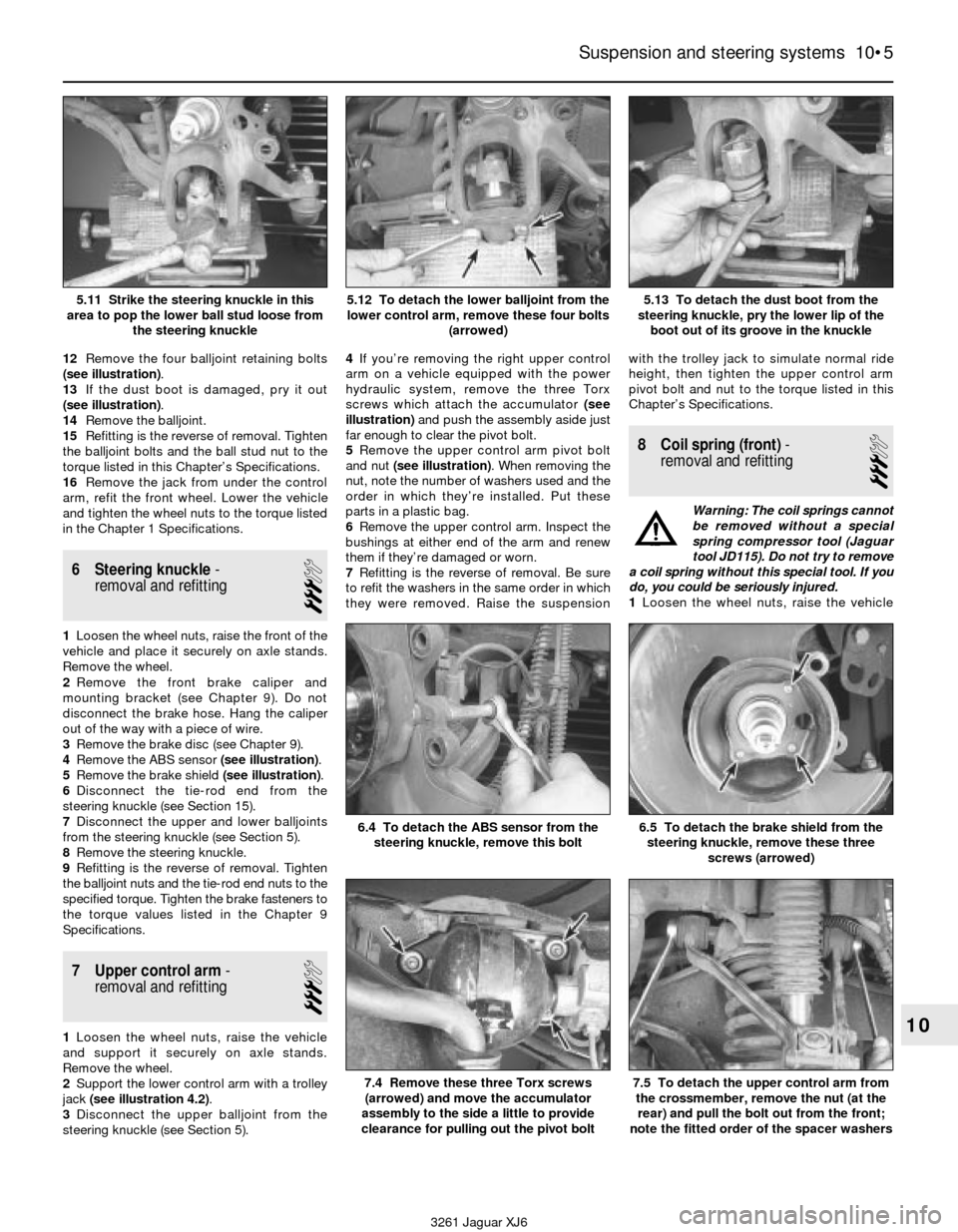
12Remove the four balljoint retaining bolts
(see illustration).
13If the dust boot is damaged, pry it out
(see illustration).
14Remove the balljoint.
15Refitting is the reverse of removal. Tighten
the balljoint bolts and the ball stud nut to the
torque listed in this Chapter’s Specifications.
16Remove the jack from under the control
arm, refit the front wheel. Lower the vehicle
and tighten the wheel nuts to the torque listed
in the Chapter 1 Specifications.
6 Steering knuckle-
removal and refitting
3
1Loosen the wheel nuts, raise the front of the
vehicle and place it securely on axle stands.
Remove the wheel.
2Remove the front brake caliper and
mounting bracket (see Chapter 9). Do not
disconnect the brake hose. Hang the caliper
out of the way with a piece of wire.
3Remove the brake disc (see Chapter 9).
4Remove the ABS sensor (see illustration).
5Remove the brake shield (see illustration).
6Disconnect the tie-rod end from the
steering knuckle (see Section 15).
7Disconnect the upper and lower balljoints
from the steering knuckle (see Section 5).
8Remove the steering knuckle.
9Refitting is the reverse of removal. Tighten
the balljoint nuts and the tie-rod end nuts to the
specified torque. Tighten the brake fasteners to
the torque values listed in the Chapter 9
Specifications.
7 Upper control arm-
removal and refitting
3
1Loosen the wheel nuts, raise the vehicle
and support it securely on axle stands.
Remove the wheel.
2Support the lower control arm with a trolley
jack (see illustration 4.2).
3Disconnect the upper balljoint from the
steering knuckle (see Section 5).4If you’re removing the right upper control
arm on a vehicle equipped with the power
hydraulic system, remove the three Torx
screws which attach the accumulator (see
illustration)and push the assembly aside just
far enough to clear the pivot bolt.
5Remove the upper control arm pivot bolt
and nut (see illustration). When removing the
nut, note the number of washers used and the
order in which they’re installed. Put these
parts in a plastic bag.
6Remove the upper control arm. Inspect the
bushings at either end of the arm and renew
them if they’re damaged or worn.
7Refitting is the reverse of removal. Be sure
to refit the washers in the same order in which
they were removed. Raise the suspensionwith the trolley jack to simulate normal ride
height, then tighten the upper control arm
pivot bolt and nut to the torque listed in this
Chapter’s Specifications.
8 Coil spring (front)-
removal and refitting
3
Warning: The coil springs cannot
be removed without a special
spring compressor tool (Jaguar
tool JD115). Do not try to remove
a coil spring without this special tool. If you
do, you could be seriously injured.
1Loosen the wheel nuts, raise the vehicle
Suspension and steering systems 10•5
10
5.11 Strike the steering knuckle in this
area to pop the lower ball stud loose from
the steering knuckle5.12 To detach the lower balljoint from the
lower control arm, remove these four bolts
(arrowed)5.13 To detach the dust boot from the
steering knuckle, pry the lower lip of the
boot out of its groove in the knuckle
6.5 To detach the brake shield from the
steering knuckle, remove these three
screws (arrowed)6.4 To detach the ABS sensor from the
steering knuckle, remove this bolt
7.4 Remove these three Torx screws
(arrowed) and move the accumulator
assembly to the side a little to provide
clearance for pulling out the pivot bolt7.5 To detach the upper control arm from
the crossmember, remove the nut (at the
rear) and pull the bolt out from the front;
note the fitted order of the spacer washers
3261 Jaguar XJ6
Page 142 of 227
and support it securely on axle stands.
Remove the wheel.
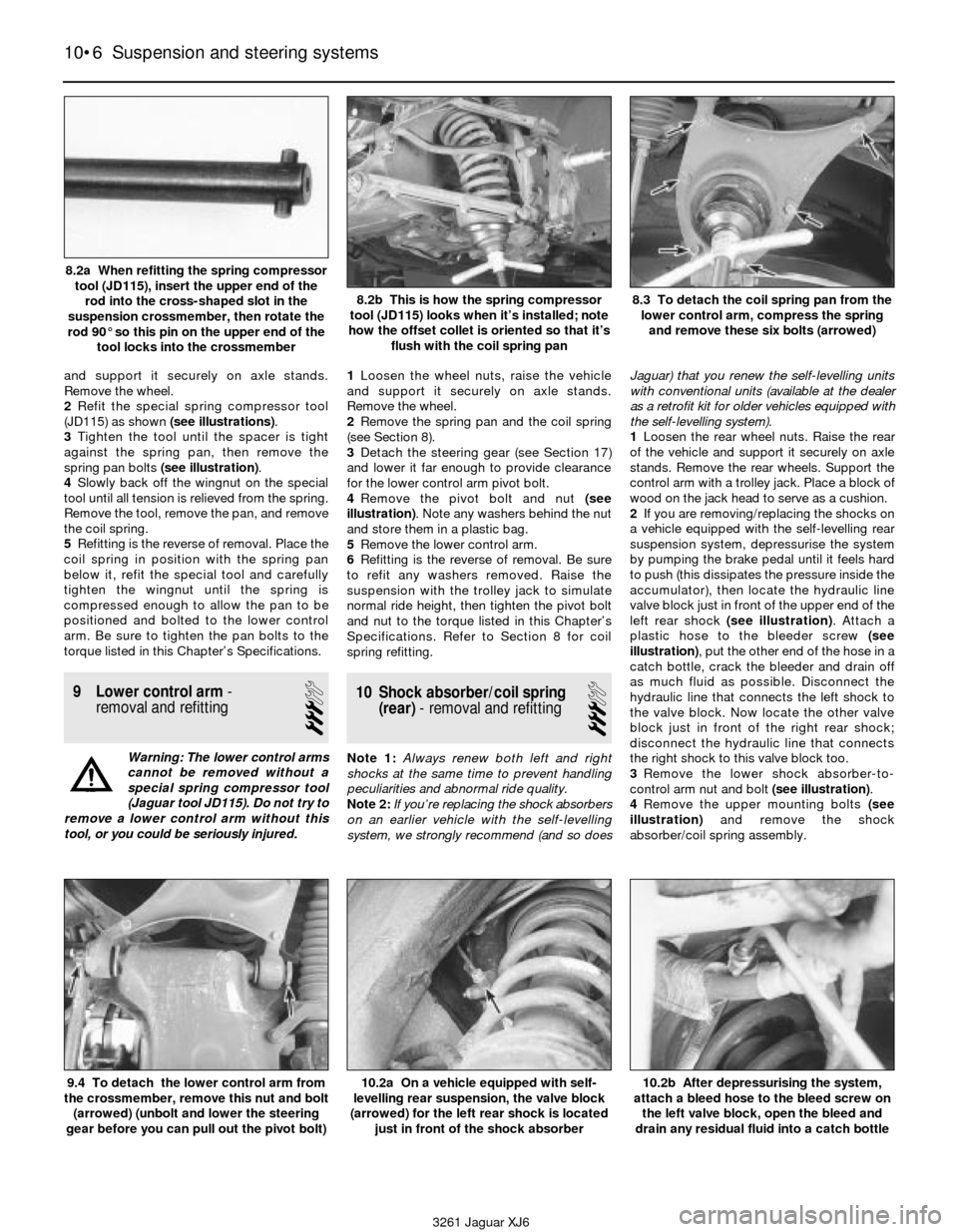
2Refit the special spring compressor tool
(JD115) as shown (see illustrations).
3Tighten the tool until the spacer is tight
against the spring pan, then remove the
spring pan bolts (see illustration).
4Slowly back off the wingnut on the special
tool until all tension is relieved from the spring.
Remove the tool, remove the pan, and remove
the coil spring.
5Refitting is the reverse of removal. Place the
coil spring in position with the spring pan
below it, refit the special tool and carefully
tighten the wingnut until the spring is
compressed enough to allow the pan to be
positioned and bolted to the lower control
arm. Be sure to tighten the pan bolts to the
torque listed in this Chapter’s Specifications.
9 Lower control arm-
removal and refitting
3
Warning: The lower control arms
cannot be removed without a
special spring compressor tool
(Jaguar tool JD115). Do not try to
remove a lower control arm without this
tool, or you could be seriously injured.1Loosen the wheel nuts, raise the vehicle
and support it securely on axle stands.
Remove the wheel.
2Remove the spring pan and the coil spring
(see Section 8).
3Detach the steering gear (see Section 17)
and lower it far enough to provide clearance
for the lower control arm pivot bolt.
4Remove the pivot bolt and nut (see
illustration). Note any washers behind the nut
and store them in a plastic bag.
5Remove the lower control arm.
6Refitting is the reverse of removal. Be sure
to refit any washers removed. Raise the
suspension with the trolley jack to simulate
normal ride height, then tighten the pivot bolt
and nut to the torque listed in this Chapter’s
Specifications. Refer to Section 8 for coil
spring refitting.
10 Shock absorber/coil spring
(rear)- removal and refitting
3
Note 1: Always renew both left and right
shocks at the same time to prevent handling
peculiarities and abnormal ride quality.
Note 2:If you’re replacing the shock absorbers
on an earlier vehicle with the self-levelling
system, we strongly recommend (and so doesJaguar) that you renew the self-levelling units
with conventional units (available at the dealer
as a retrofit kit for older vehicles equipped with
the self-levelling system).
1Loosen the rear wheel nuts. Raise the rear
of the vehicle and support it securely on axle
stands. Remove the rear wheels. Support the
control arm with a trolley jack. Place a block of
wood on the jack head to serve as a cushion.
2If you are removing/replacing the shocks on
a vehicle equipped with the self-levelling rear
suspension system, depressurise the system
by pumping the brake pedal until it feels hard
to push (this dissipates the pressure inside the
accumulator), then locate the hydraulic line
valve block just in front of the upper end of the
left rear shock (see illustration). Attach a
plastic hose to the bleeder screw (see
illustration), put the other end of the hose in a
catch bottle, crack the bleeder and drain off
as much fluid as possible. Disconnect the
hydraulic line that connects the left shock to
the valve block. Now locate the other valve
block just in front of the right rear shock;
disconnect the hydraulic line that connects
the right shock to this valve block too.
3Remove the lower shock absorber-to-
control arm nut and bolt (see illustration).
4Remove the upper mounting bolts (see
illustration)and remove the shock
absorber/coil spring assembly.
10•6 Suspension and steering systems
9.4 To detach the lower control arm from
the crossmember, remove this nut and bolt
(arrowed) (unbolt and lower the steering
gear before you can pull out the pivot bolt)10.2a On a vehicle equipped with self-
levelling rear suspension, the valve block
(arrowed) for the left rear shock is located
just in front of the shock absorber10.2b After depressurising the system,
attach a bleed hose to the bleed screw on
the left valve block, open the bleed and
drain any residual fluid into a catch bottle
3261 Jaguar XJ6 8.2a When refitting the spring compressor
tool (JD115), insert the upper end of the
rod into the cross-shaped slot in the
suspension crossmember, then rotate the
rod 90° so this pin on the upper end of the
tool locks into the crossmember
8.2b This is how the spring compressor
tool (JD115) looks when it’s installed; note
how the offset collet is oriented so that it’s
flush with the coil spring pan8.3 To detach the coil spring pan from the
lower control arm, compress the spring
and remove these six bolts (arrowed)
Page 143 of 227
5The shock/coil spring assemblies must be
dismantled, and the coil springs installed on
the new shocks. Although the shock/coil
spring assembly is similar in appearance to
the a MacPherson strut/coil spring assembly,
the spring on this unit is much stiffer.
Therefore, DO NOT attempt to take apart this
unit yourself with a strut spring compressor
tool. Instead, take the unit to a Jaguar dealer
service department or to a Jaguar specialist
workshop and have the springs installed on
the new shocks by professionals.6If you are retrofitting conventional shocks -
rather than refitting the same or another pair
of self-levelling shocks - unplug the electrical
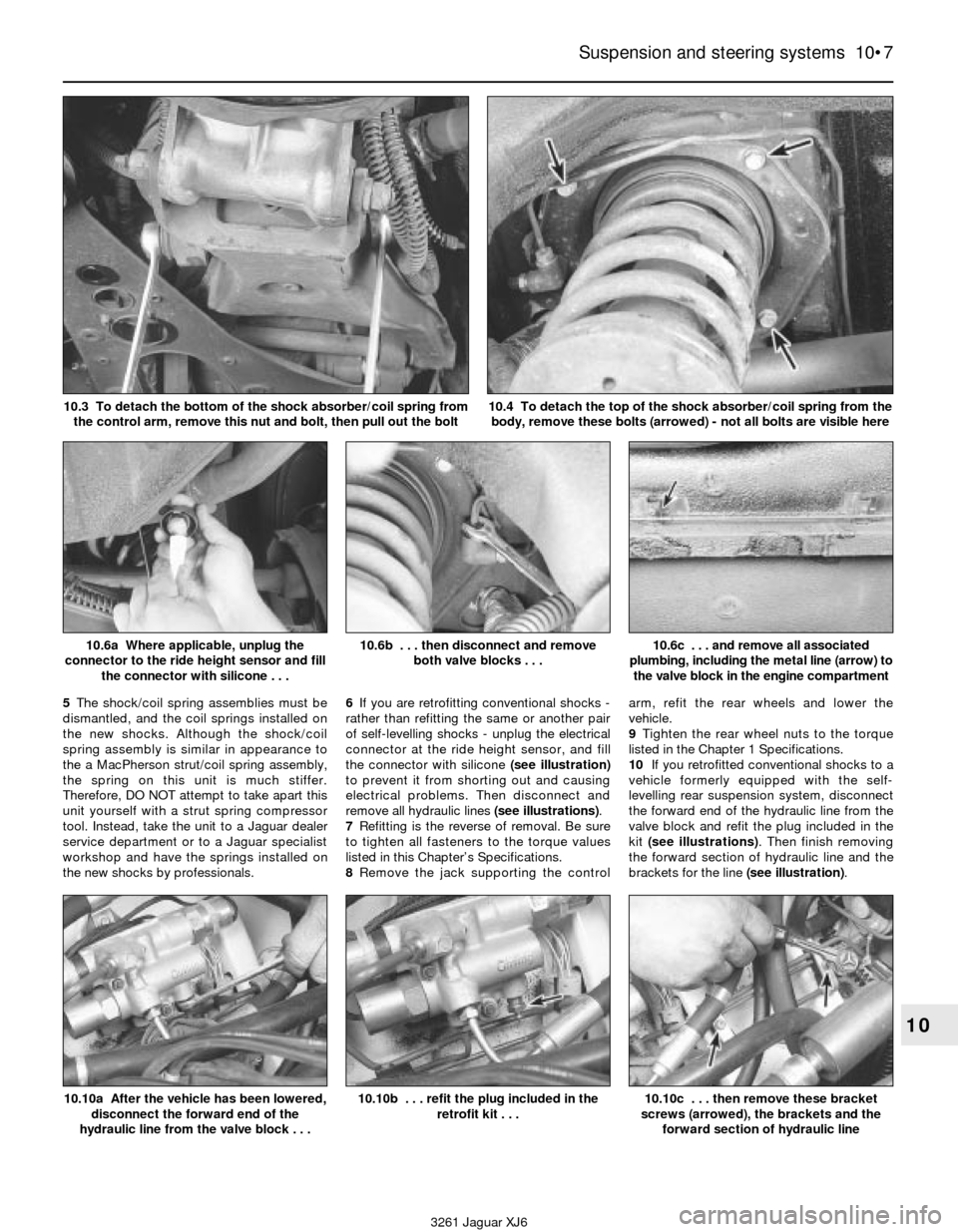
connector at the ride height sensor, and fill
the connector with silicone (see illustration)
to prevent it from shorting out and causing
electrical problems. Then disconnect and
remove all hydraulic lines (see illustrations).
7Refitting is the reverse of removal. Be sure
to tighten all fasteners to the torque values
listed in this Chapter’s Specifications.
8Remove the jack supporting the controlarm, refit the rear wheels and lower the
vehicle.
9Tighten the rear wheel nuts to the torque
listed in the Chapter 1 Specifications.
10If you retrofitted conventional shocks to a
vehicle formerly equipped with the self-
levelling rear suspension system, disconnect
the forward end of the hydraulic line from the
valve block and refit the plug included in the
kit (see illustrations). Then finish removing
the forward section of hydraulic line and the
brackets for the line (see illustration).
Suspension and steering systems 10•7
10
10.6a Where applicable, unplug the
connector to the ride height sensor and fill
the connector with silicone . . .10.6b . . . then disconnect and remove
both valve blocks . . .10.6c . . . and remove all associated
plumbing, including the metal line (arrow) to
the valve block in the engine compartment
3261 Jaguar XJ6 10.3 To detach the bottom of the shock absorber/coil spring from
the control arm, remove this nut and bolt, then pull out the bolt
10.4 To detach the top of the shock absorber/coil spring from the
body, remove these bolts (arrowed) - not all bolts are visible here
10.10a After the vehicle has been lowered,
disconnect the forward end of the
hydraulic line from the valve block . . .10.10b . . . refit the plug included in the
retrofit kit . . .10.10c . . . then remove these bracket
screws (arrowed), the brackets and the
forward section of hydraulic line
Page 144 of 227
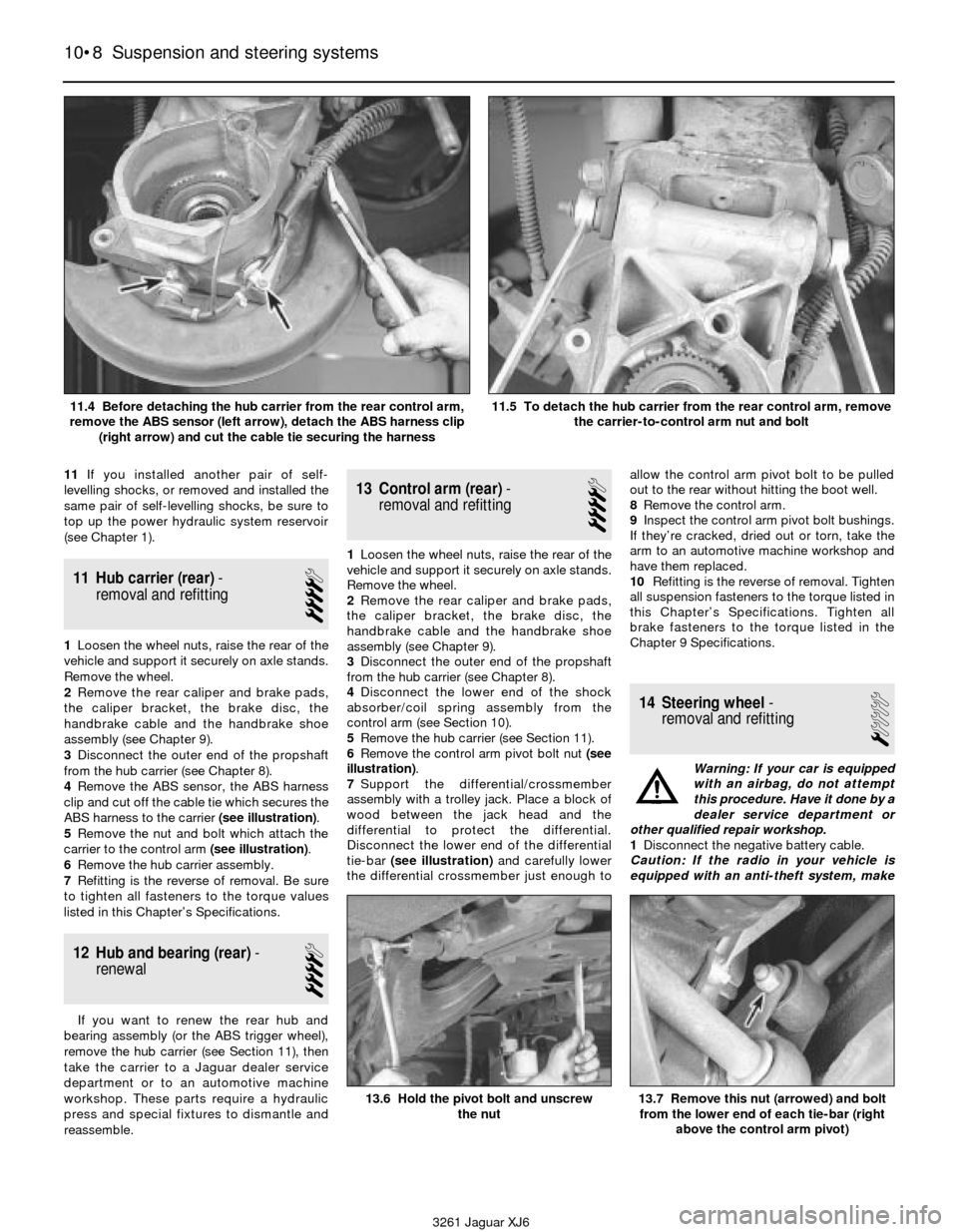
11If you installed another pair of self-
levelling shocks, or removed and installed the
same pair of self-levelling shocks, be sure to
top up the power hydraulic system reservoir
(see Chapter 1).
11 Hub carrier (rear)-
removal and refitting
4
1Loosen the wheel nuts, raise the rear of the
vehicle and support it securely on axle stands.
Remove the wheel.
2Remove the rear caliper and brake pads,
the caliper bracket, the brake disc, the
handbrake cable and the handbrake shoe
assembly (see Chapter 9).
3Disconnect the outer end of the propshaft
from the hub carrier (see Chapter 8).
4Remove the ABS sensor, the ABS harness
clip and cut off the cable tie which secures the
ABS harness to the carrier (see illustration).
5Remove the nut and bolt which attach the
carrier to the control arm (see illustration).
6Remove the hub carrier assembly.
7Refitting is the reverse of removal. Be sure
to tighten all fasteners to the torque values
listed in this Chapter’s Specifications.
12 Hub and bearing (rear)-
renewal
4
If you want to renew the rear hub and
bearing assembly (or the ABS trigger wheel),
remove the hub carrier (see Section 11), then
take the carrier to a Jaguar dealer service
department or to an automotive machine
workshop. These parts require a hydraulic
press and special fixtures to dismantle and
reassemble.
13 Control arm (rear)-
removal and refitting
4
1Loosen the wheel nuts, raise the rear of the
vehicle and support it securely on axle stands.
Remove the wheel.
2Remove the rear caliper and brake pads,
the caliper bracket, the brake disc, the
handbrake cable and the handbrake shoe
assembly (see Chapter 9).
3Disconnect the outer end of the propshaft
from the hub carrier (see Chapter 8).
4Disconnect the lower end of the shock
absorber/coil spring assembly from the
control arm (see Section 10).
5Remove the hub carrier (see Section 11).
6Remove the control arm pivot bolt nut (see
illustration).
7Support the differential/crossmember
assembly with a trolley jack. Place a block of
wood between the jack head and the
differential to protect the differential.
Disconnect the lower end of the differential
tie-bar (see illustration)and carefully lower
the differential crossmember just enough toallow the control arm pivot bolt to be pulled
out to the rear without hitting the boot well.
8Remove the control arm.
9Inspect the control arm pivot bolt bushings.
If they’re cracked, dried out or torn, take the
arm to an automotive machine workshop and
have them replaced.
10Refitting is the reverse of removal. Tighten
all suspension fasteners to the torque listed in
this Chapter’s Specifications. Tighten all
brake fasteners to the torque listed in the
Chapter 9 Specifications.
14 Steering wheel-
removal and refitting
1
Warning: If your car is equipped
with an airbag, do not attempt
this procedure. Have it done by a
dealer service department or
other qualified repair workshop.
1Disconnect the negative battery cable.
Caution: If the radio in your vehicle is
equipped with an anti-theft system, make
10•8 Suspension and steering systems
13.6 Hold the pivot bolt and unscrew
the nut13.7 Remove this nut (arrowed) and bolt
from the lower end of each tie-bar (right
above the control arm pivot)
3261 Jaguar XJ6 11.4 Before detaching the hub carrier from the rear control arm,
remove the ABS sensor (left arrow), detach the ABS harness clip
(right arrow) and cut the cable tie securing the harness
11.5 To detach the hub carrier from the rear control arm, remove
the carrier-to-control arm nut and bolt
Page 150 of 227
again with a dry cloth. Never use alcohol,
petrol, nail polish remover or thinner to clean
leather upholstery.
3After cleaning, regularly treat leather
upholstery with a leather wax. Never use car
wax on leather upholstery.
4In areas where the interior of the vehicle is
subject to bright sunlight, cover leather seats
with a sheet if the vehicle is to be left out for
any length of time.
5 Body repair- minor damage
3
Repair of minor scratches
1If the scratch is superficial and does not
penetrate to the metal of the body, repair is
very simple. Lightly rub the scratched area
with a fine rubbing compound to remove
loose paint and built-up wax. Rinse the area
with clean water.
2Apply touch-up paint to the scratch, using a
small brush. Continue to apply thin layers of
paint until the surface of the paint in the
scratch is level with the surrounding paint.
Allow the new paint at least two weeks to
harden, then blend it into the surrounding
paint by rubbing with a very fine rubbing
compound. Finally, apply a coat of wax to the
scratch area.
3If the scratch has penetrated the paint and
exposed the metal of the body, causing the
metal to rust, a different repair technique is
required. Remove all loose rust from the
bottom of the scratch with a pocket knife,
then apply rust inhibiting paint to prevent the
formation of rust in the future. Using a rubber
or nylon applicator, coat the scratched area
with glaze-type filler. If required, the filler can
be mixed with thinner to provide a very thin
paste, which is ideal for filling narrow
scratches. Before the glaze filler in the scratch
hardens, wrap a piece of smooth cotton cloth
around the tip of a finger. Dip the cloth in
thinner and then quickly wipe it along the
surface of the scratch. This will ensure that
the surface of the filler is slightly hollow. The
scratch can now be painted over as described
earlier in this section.
Repair of dents
4When repairing dents, the first job is to pull
the dent out until the affected area is as close
as possible to its original shape. There is no
point in trying to restore the original shape
completely as the metal in the damaged area
will have stretched on impact and cannot be
restored to its original contours. It is better to
bring the level of the dent up to a point which
is about 1/8-inch below the level of the
surrounding metal. In cases where the dent is
very shallow, it is not worth trying to pull it out
at all.
5If the back side of the dent is accessible, it
can be hammered out gently from behindusing a soft-face hammer. While doing this,
hold a block of wood firmly against the
opposite side of the metal to absorb the
hammer blows and prevent the metal from
being stretched.
6If the dent is in a section of the body which
has double layers, or some other factor makes
it inaccessible from behind, a different
technique is required. Drill several small holes
through the metal inside the damaged area,
particularly in the deeper sections. Screw
long, self-tapping screws into the holes just
enough for them to get a good grip in the
metal. Now the dent can be pulled out by
pulling on the protruding heads of the screws
with locking pliers.
7The next stage of repair is the removal of
paint from the damaged area and from an
inch or so of the surrounding metal. This is
done with a wire brush or sanding disc in a
drill motor, although it can be done just as
effectively by hand with sandpaper. To
complete the preparation for filling, score the
surface of the bare metal with a screwdriver or
the tang of a file, or drill small holes in the
affected area. This will provide a good grip
for the filler material. To complete the repair,
see the subsection on filling and painting later
in this Section.
Repair of rust holes or gashes
8Remove all paint from the affected area and
from an inch or so of the surrounding metal
using a sanding disc or wire brush mounted in
a drill motor. If these are not available, a few
sheets of sandpaper will do the job just as
effectively.
9With the paint removed, you will be able to
determine the severity of the corrosion and
decide whether to replace the whole panel, if
possible, or repair the affected area. New
body panels are not as expensive as most
people think and it is often quicker to refit a
new panel than to repair large areas of rust.
10Remove all trim pieces from the affected
area except those which will act as a guide to
the original shape of the damaged body, such
as headlight shells, etc. Using metal snips or a
hacksaw blade, remove all loose metal and
any other metal that is badly affected by rust.
Hammer the edges of the hole in to create a
slight depression for the filler material.
11Wire brush the affected area to remove
the powdery rust from the surface of the
metal. If the back of the rusted area is
accessible, treat it with rust inhibiting paint.
12Before filling is done, block the hole in
some way. This can be done with sheet metal
riveted or screwed into place, or by stuffing
the hole with wire mesh.
13Once the hole is blocked off, the affected
area can be filled and painted. See the
following subsection on filling and painting.
Filling and painting
14Many types of body fillers are available,
but generally speaking, body repair kits which
contain filler paste and a tube of resinhardener are best for this type of repair work.
A wide, flexible plastic or nylon applicator will
be necessary for imparting a smooth and
contoured finish to the surface of the filler
material. Mix up a small amount of filler on a
clean piece of wood or cardboard (use the
hardener sparingly). Follow the
manufacturer’s instructions on the package,
otherwise the filler will set incorrectly.
15Using the applicator, apply the filler paste
to the prepared area. Draw the applicator
across the surface of the filler to achieve the
desired contour and to level the filler surface.
As soon as a contour that approximates the
original one is achieved, stop working the
paste. If you continue, the paste will begin to
stick to the applicator. Continue to add thin
layers of paste at 20-minute intervals until the
level of the filler is just above the surrounding
metal.
16Once the filler has hardened, the excess
can be removed with a body file. From then
on, progressively finer grades of sandpaper
should be used, starting with a 180-grit paper
and finishing with 600-grit wet-or-dry paper.
Always wrap the sandpaper around a flat
rubber or wooden block, otherwise the
surface of the filler will not be completely flat.
During the sanding of the filler surface, the
wet-or-dry paper should be periodically rinsed
in water. This will ensure that a very smooth
finish is produced in the final stage.
17At this point, the repair area should be
surrounded by a ring of bare metal, which in
turn should be encircled by the finely
feathered edge of good paint. Rinse the repair
area with clean water until all of the dust
produced by the sanding operation is gone.
18Spray the entire area with a light coat of
primer. This will reveal any imperfections in
the surface of the filler. Repair the
imperfections with fresh filler paste or glaze
filler and once more smooth the surface with
sandpaper. Repeat this spray-and-repair
procedure until you are satisfied that the
surface of the filler and the feathered edge of
the paint are perfect. Rinse the area with
clean water and allow it to dry completely.
19The repair area is now ready for painting.
Spray painting must be carried out in a warm,
dry, windless and dust free atmosphere.
These conditions can be created if you have
access to a large indoor work area, but if you
are forced to work in the open, you will have
to pick the day very carefully. If you are
working indoors, dousing the floor in the work
area with water will help settle the dust which
would otherwise be in the air. If the repair area
is confined to one body panel, mask off the
surrounding panels. This will help minimise
the effects of a slight mismatch in paint
colour. Trim pieces such as chrome strips,
door handles, etc., will also need to be
masked off or removed. Use masking tape
and several thickness of newspaper for the
masking operations.
20Before spraying, shake the paint can
thoroughly, then spray a test area until the
11•2 Bodywork and fittings
3261 Jaguar XJ6
Page 165 of 227
wash system, radio memory and the ABS
main feed and pump circuits.
In-line fuses are located through out the
vehicle depending on the year, make and
model. Consult the wiring diagrams at the end
of this Chapter for further information.
In-line fuses also have a blade terminal
design, which allow fingertip removal and
renewal. If an electrical component fails,
always check the fuse first. A blown fuse is
easily identified through the clear plastic
body. Inspect the element for evidence of
damage (see illustration 3.3).
Be sure to renew blown fuses with the
correct type. Fuses are usually colour-coded
to indicate their rating. Fuses of different
ratings are physically interchangeable, but
only fuses of the proper rating should be
used. Replacing a fuse with one of a different
value than specified is not recommended.
Each electrical circuit needs a specific
amount of protection. The amperage value of
each fuse is moulded into the fuse body.If the renewal fuse immediately fails, don’t
renew it again until the cause of the problem
is isolated and corrected. Don’t substitute
anything else for the fuse. In most cases, this
will be a short circuit in the wiring caused by a
broken or deteriorated wire.
5 Circuit breakers-
general information
Circuit breakers generally protect
components such as electric windows, central
locking and headlights. On some models the
circuit breaker resets itself automatically, so
an electrical overload in the circuit will cause it
to fail momentarily, then come back on. If the
circuit doesn’t come back on, check it
immediately. Once the condition is corrected,
the circuit breaker will resume its normal
function. Some circuit breakers have a button
on top and must be reset manually.To test a circuit breaker, use an ohmmeter
to check continuity between the terminals. A
reading of zero to 1.0 ohms indicates a good
circuit breaker. An open circuit reading on the
meter indicates a bad circuit breaker.
6 Relays- general information
and testing
2
General information
Several electrical accessories in the vehicle,
such as the fuel injection system, electric
windows, central locking, etc, use relays to
transmit the electrical signal to the component.
Relays use a low-current circuit (the control
circuit) to open and close a high-current circuit
(the power circuit). If the relay is defective, that
component will not operate properly. The
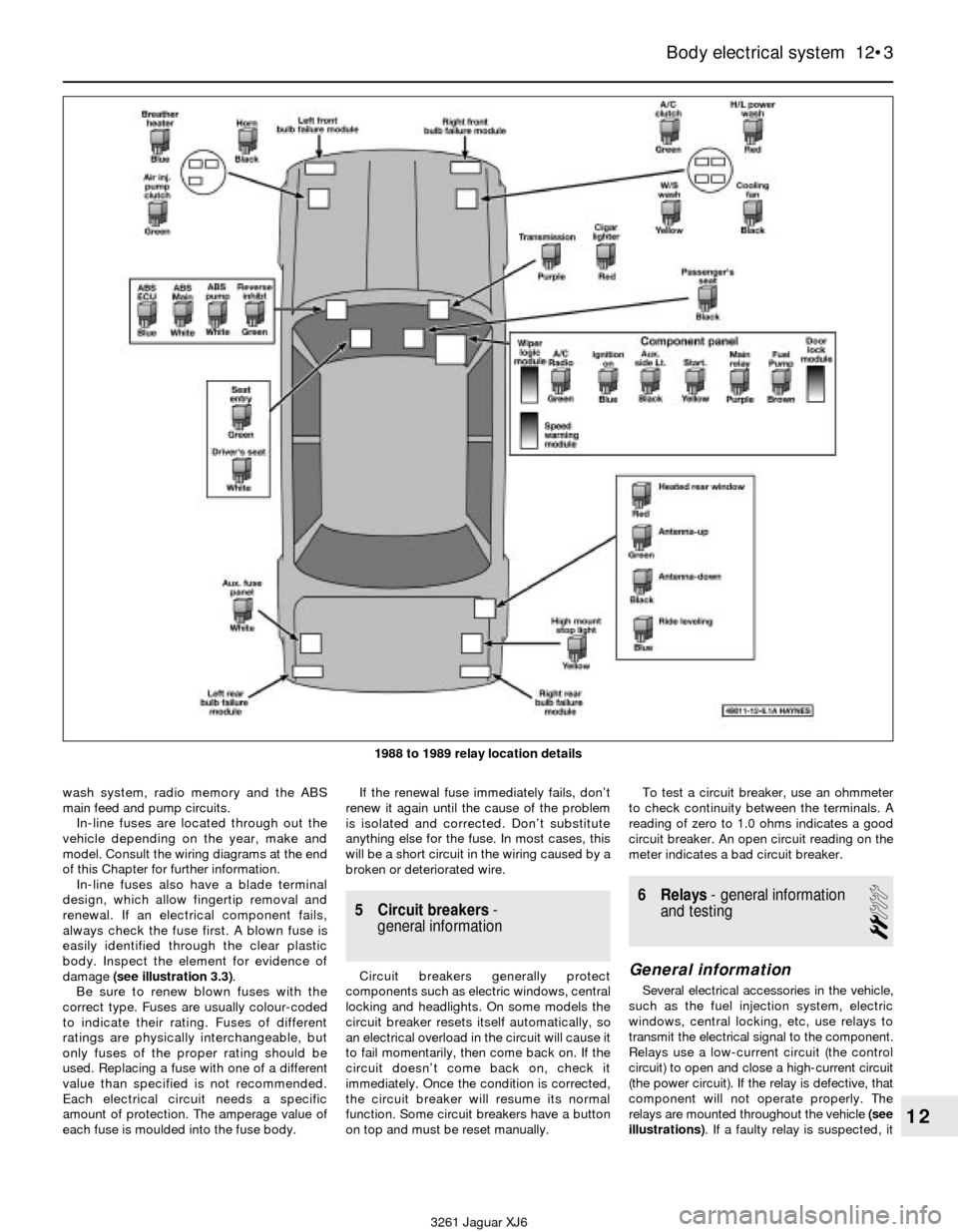
relays are mounted throughout the vehicle (see
illustrations). If a faulty relay is suspected, it
Body electrical system 12•3
12
3261 Jaguar XJ6 1988 to 1989 relay location details
Page 204 of 227

3261 Jaguar XJ6
Use of EnglishREF•3
As the main part of this book has been written in the US, it uses the appropriate US component names, phrases, and spelling. Some of these
differ from those used in the UK. Normally, these cause no difficulty, but to make sure, a glossary is printed below. When ordering spare parts,
remember the parts list may use some of these words:
AMERICAN ENGLISH
Aluminum Aluminium
Antenna Aerial
Authorized Authorised
Auto parts stores Motor factors
Axleshaft Halfshaft
Back-up Reverse
Barrel Choke/venturi
Block Chock
Box-end wrench Ring spanner
Bushing Bush
Carburetor Carburettor
Center Centre
Coast Freewheel
Color Colour
Convertible Drop head coupe
Cotter pin Split pin
Counterclockwise Anti-clockwise
Countershaft (of gearbox) Layshaft
Dashboard Facia
Denatured alcohol Methylated spirit
Dome lamp Interior light
Driveaxle Driveshaft
Driveshaft Propeller shaft
Fender Wing/mudguard
Firewall Bulkhead
Flashlight Torch
Float bowl Float chamber
Floor jack Trolley jack
Freeway, turnpike etc Motorway
Freeze plug Core plug
Frozen Seized
Gas tank Petrol tank
Gasoline (gas) Petrol
Gearshift Gearchange
Generator (DC) Dynamo
Ground (electrical) Earth
Header Exhaust manifold
Heat riser Hot spot
High Top gear
Hood (engine cover) Bonnet
Installation Refitting
Intake Inlet
Jackstands Axle stands
Jumper cable Jump lead
Keeper Collet
Kerosene Paraffin
Knock pin Roll pin
Lash Clearance
Lash Free-play
Latch Catch
Latches Locks
License plate Number plate
Light Lamp
Lock (for valve spring retainer) Split cotter (for valve spring cap)
Lopes Hunts
Lug nut/bolt Wheel nut/bolt
Metal chips or debris Swarf
Misses Misfires
AMERICAN ENGLISH
Muffler Silencer
Odor Odour
Oil pan Sump
Open flame Naked flame
Panel wagon/van Van
Parking brake Handbrake
Parking light Sidelight
Pinging Pinking
Piston pin or wrist pin Gudgeon pin
Piston pin or wrist pin Small end, little end
Pitman arm Drop arm
Power brake booster Servo unit
Primary shoe (of brake) Leading shoe (of brake)
Prussian blue Engineer’s blue
Pry Prise (force apart)
Prybar Lever
Prying Levering
Quarter window Quarterlight
Recap Retread
Release cylinder Slave cylinder
Repair shop Garage
Replacement Renewal
Ring gear (of differential) Crownwheel
Rocker panel (beneath doors) Sill panel (beneath doors)
Rod bearing Big-end bearing
Rotor/disk Disc (brake)
Secondary shoe (of brake) Trailing shoe (of brake)
Sedan Saloon
Setscrew, Allen screw Grub screw
Shock absorber, shock Damper
Snap-ring Circlip
Soft top Hood
Spacer Distance piece
Spare tire Spare wheel
Spark plug wires HT leads
Spindle arm Steering arm
Stabilizer or sway bar Anti-roll bar
Station wagon Estate car
Stumbles Hesitates
Tang or lock Tab washer
Throw-out bearing Thrust bearing
Tie-rod or connecting rod (of steering) Trackrod
Tire Tyre
Transmission Gearbox
Troubleshooting Fault finding/diagnosis
Trunk Boot (luggage compartment)
Turn signal Indicator
TV (throttle valve) cable Kickdown cable
Unpublicized Unpublicised
Valve cover Rocker cover
Valve lifter Tappet
Valve lifter or tappet Cam follower or tappet
Vapor Vapour
Vise Vice
Wheel cover Roadwheel trim
Whole drive line Transmission
Windshield Windscreen
Wrench Spanner
Page 206 of 227

3261 Jaguar XJ6
General repair proceduresREF•5
Whenever servicing, repair or overhaul work
is carried out on the car or its components, it
is necessary to observe the following
procedures and instructions. This will assist in
carrying out the operation efficiently and to a
professional standard of workmanship.
Joint mating faces and gaskets
When separating components at their
mating faces, never insert screwdrivers or
similar implements into the joint between the
faces in order to prise them apart. This can
cause severe damage which results in oil
leaks, coolant leaks, etc upon reassembly.
Separation is usually achieved by tapping
along the joint with a soft-faced hammer in
order to break the seal. However, note that
this method may not be suitable where
dowels are used for component location.
Where a gasket is used between the mating
faces of two components, ensure that it is
renewed on reassembly, and fit it dry unless
otherwise stated in the repair procedure. Make
sure that the mating faces are clean and dry,
with all traces of old gasket removed. When
cleaning a joint face, use a tool which is not
likely to score or damage the face, and remove
any burrs or nicks with an oilstone or fine file.
Make sure that tapped holes are cleaned
with a pipe cleaner, and keep them free of
jointing compound, if this is being used,
unless specifically instructed otherwise.
Ensure that all orifices, channels or pipes
are clear, and blow through them, preferably
using compressed air.
Oil seals
Oil seals can be removed by levering them
out with a wide flat-bladed screwdriver or
similar tool. Alternatively, a number of self-
tapping screws may be screwed into the seal,
and these used as a purchase for pliers or
similar in order to pull the seal free.
Whenever an oil seal is removed from its
working location, either individually or as part
of an assembly, it should be renewed.
The very fine sealing lip of the seal is easily
damaged, and will not seal if the surface it
contacts is not completely clean and free from
scratches, nicks or grooves. If the original
sealing surface of the component cannot be
restored, and the manufacturer has not made
provision for slight relocation of the seal
relative to the sealing surface, the component
should be renewed.
Protect the lips of the seal from any surface
which may damage them in the course of
fitting. Use tape or a conical sleeve where
possible. Lubricate the seal lips with oil before
fitting and, on dual-lipped seals, fill the space
between the lips with grease.
Unless otherwise stated, oil seals must be
fitted with their sealing lips toward the
lubricant to be sealed.
Use a tubular drift or block of wood of the
appropriate size to install the seal and, if the
seal housing is shouldered, drive the seal
down to the shoulder. If the seal housing isunshouldered, the seal should be fitted with
its face flush with the housing top face (unless
otherwise instructed).
Screw threads and fastenings
Seized nuts, bolts and screws are quite a
common occurrence where corrosion has set
in, and the use of penetrating oil or releasing
fluid will often overcome this problem if the
offending item is soaked for a while before
attempting to release it. The use of an impact
driver may also provide a means of releasing
such stubborn fastening devices, when used
in conjunction with the appropriate
screwdriver bit or socket. If none of these
methods works, it may be necessary to resort
to the careful application of heat, or the use of
a hacksaw or nut splitter device.
Studs are usually removed by locking two
nuts together on the threaded part, and then
using a spanner on the lower nut to unscrew
the stud. Studs or bolts which have broken off
below the surface of the component in which
they are mounted can sometimes be removed
using a stud extractor. Always ensure that a
blind tapped hole is completely free from oil,
grease, water or other fluid before installing
the bolt or stud. Failure to do this could cause
the housing to crack due to the hydraulic
action of the bolt or stud as it is screwed in.
When tightening a castellated nut to accept
a split pin, tighten the nut to the specified
torque, where applicable, and then tighten
further to the next split pin hole. Never
slacken the nut to align the split pin hole,
unless stated in the repair procedure.
When checking or retightening a nut or bolt
to a specified torque setting, slacken the nut
or bolt by a quarter of a turn, and then
retighten to the specified setting. However,
this should not be attempted where angular
tightening has been used.
For some screw fastenings, notably
cylinder head bolts or nuts, torque wrench
settings are no longer specified for the latter
stages of tightening, “angle-tightening” being
called up instead. Typically, a fairly low torque
wrench setting will be applied to the
bolts/nuts in the correct sequence, followed
by one or more stages of tightening through
specified angles.
Locknuts, locktabs and washers
Any fastening which will rotate against a
component or housing during tightening
should always have a washer between it and
the relevant component or housing.
Spring or split washers should always be
renewed when they are used to lock a critical
component such as a big-end bearing
retaining bolt or nut. Locktabs which are
folded over to retain a nut or bolt should
always be renewed.
Self-locking nuts can be re-used in non-
critical areas, providing resistance can be felt
when the locking portion passes over the bolt
or stud thread. However, it should be noted
that self-locking stiffnuts tend to lose theireffectiveness after long periods of use, and
should be renewed as a matter of course.
Split pins must always be replaced with
new ones of the correct size for the hole.
When thread-locking compound is found
on the threads of a fastener which is to be re-
used, it should be cleaned off with a wire
brush and solvent, and fresh compound
applied on reassembly.
Special tools
Some repair procedures in this manual
entail the use of special tools such as a press,
two or three-legged pullers, spring
compressors, etc. Wherever possible, suitable
readily-available alternatives to the
manufacturer’s special tools are described,
and are shown in use. In some instances,
where no alternative is possible, it has been
necessary to resort to the use of a
manufacturer’s tool, and this has been done
for reasons of safety as well as the efficient
completion of the repair operation. Unless you
are highly-skilled and have a thorough
understanding of the procedures described,
never attempt to bypass the use of any
special tool when the procedure described
specifies its use. Not only is there a very great
risk of personal injury, but expensive damage
could be caused to the components involved.
Environmental considerations
When disposing of used engine oil, brake
fluid, antifreeze, etc, give due consideration to
any detrimental environmental effects. Do not,
for instance, pour any of the above liquids
down drains into the general sewage system,
or onto the ground to soak away. Many local
council refuse tips provide a facility for waste
oil disposal, as do some garages. If none of
these facilities are available, consult your local
Environmental Health Department, or the
National Rivers Authority, for further advice.
With the universal tightening-up of
legislation regarding the emission of
environmentally-harmful substances from
motor vehicles, most current vehicles have
tamperproof devices fitted to the main
adjustment points of the fuel system. These
devices are primarily designed to prevent
unqualified persons from adjusting the fuel/air
mixture, with the chance of a consequent
increase in toxic emissions. If such devices
are encountered during servicing or overhaul,
they should, wherever possible, be renewed
or refitted in accordance with the vehicle
manufacturer’s requirements or current
legislation.
Note: It is
antisocial and
illegal to dump oil
down the drain.
To find the
location of your
local oil recycling
bank, call this
number free.
Page 210 of 227

3261 Jaguar XJ6
MOT test checksREF•9
Seat belts and seats
Note: The following checks are applicable to
all seat belts, front and rear.
MExamine the webbing of all the belts
(including rear belts if fitted) for cuts, serious
fraying or deterioration. Fasten and unfasten
each belt to check the buckles. If applicable,
check the retracting mechanism. Check the
security of all seat belt mountings accessible
from inside the vehicle.
MThe front seats themselves must be
securely attached and the backrests must
lock in the upright position.
Doors
MBoth front doors must be able to be opened
and closed from outside and inside, and must
latch securely when closed.
Vehicle identification
MNumber plates must be in good condition,
secure and legible, with letters and numbers
correctly spaced – spacing at (A) should be
twice that at (B).
MThe VIN plate and/or homologation plate
must be legible.
Electrical equipment
MSwitch on the ignition and check the
operation of the horn.
MCheck the windscreen washers and wipers,
examining the wiper blades; renew damaged
or perished blades. Also check the operation
of the stop-lights.
MCheck the operation of the sidelights and
number plate lights. The lenses and reflectors
must be secure, clean and undamaged.
MCheck the operation and alignment of the
headlights. The headlight reflectors must not
be tarnished and the lenses must be
undamaged.
MSwitch on the ignition and check the
operation of the direction indicators (including
the instrument panel tell-tale) and the hazard
warning lights. Operation of the sidelights and
stop-lights must not affect the indicators - if it
does, the cause is usually a bad earth at the
rear light cluster.
MCheck the operation of the rear foglight(s),
including the warning light on the instrument
panel or in the switch.
Footbrake
MExamine the master cylinder, brake pipes
and servo unit for leaks, loose mountings,
corrosion or other damage.
MThe fluid reservoir must be secure and the
fluid level must be between the upper (A) and
lower (B) markings.MInspect both front brake flexible hoses for
cracks or deterioration of the rubber. Turn the
steering from lock to lock, and ensure that the
hoses do not contact the wheel, tyre, or any
part of the steering or suspension mechanism.
With the brake pedal firmly depressed, check
the hoses for bulges or leaks under pressure.
Steering and suspension
MHave your assistant turn the steering wheel
from side to side slightly, up to the point where
the steering gear just begins to transmit this
movement to the roadwheels. Check for
excessive free play between the steering
wheel and the steering gear, indicating wear or
insecurity of the steering column joints, the
column-to-steering gear coupling, or the
steering gear itself.
MHave your assistant turn the steering wheel
more vigorously in each direction, so that the
roadwheels just begin to turn. As this is done,
examine all the steering joints, linkages,
fittings and attachments. Renew any
component that shows signs of wear or
damage. On vehicles with power steering,
check the security and condition of the
steering pump, drivebelt and hoses.
MCheck that the vehicle is standing level,
and at approximately the correct ride height.
Shock absorbers
MDepress each corner of the vehicle in turn,
then release it. The vehicle should rise and
then settle in its normal position. If the vehicle
continues to rise and fall, the shock absorber
is defective. A shock absorber which has
seized will also cause the vehicle to fail.
2Checks carried out
WITH THE VEHICLE ON THE
GROUND