ABS JAGUAR XJ6 1997 2.G User Guide
[x] Cancel search | Manufacturer: JAGUAR, Model Year: 1997, Model line: XJ6, Model: JAGUAR XJ6 1997 2.GPages: 227, PDF Size: 7.2 MB
Page 53 of 227

Inspection
8Clean and dry the pump body and both
rotors. Measure the outside diameter of the
outer rotor and thickness of both rotors.
9Place the outer rotor into the pump body
and use feeler gauges to measure the
clearance between the outer rotor and the
body (see illustration).
10Place a straightedge across the pump
body and measure between the straightedge
and the rotors to check the over-the-rotor
clearance (see illustration). Compare your
measurements to this Chapter’s Specifications
and renew the oil pump if any are beyond the
maximum allowable.
11Remove the oil pressure relief valve cap.
Remove and clean the relief valve components
(see illustration).
12Clean all components with solvent and
inspect them for wear and damage. If
excessive wear, damage or if any clearance is
beyond the Specifications, renew the entire
pump as an assembly.
13Check the oil pressure relief valve piston
sliding surface and valve spring. If either the
spring or the valve is damaged, they must be
renewed as a set.
Refitting
14Lubricate the drive and driven rotors with
clean engine oil and place them in the casewith the marks facing out. Apply a thin coat
of anaerobic sealant (Loctite 510 or 518) to
the gasket flange and refit the cover (see
illustration).
15Lubricate the oil pressure relief valve
piston with clean engine oil and refit the valve
components into the oil pump body (see
illustration 13.11).
16Apply a thin coat of anaerobic sealant
(Loctite 510 or 518) to the oil pump-to-engine
block-mounting surface, position the oil pump
body against the engine block and refit the
mounting bolts, tightening the bolts to the
torque listed in this Chapter’s Specifications.
Follow a criss-cross pattern when tightening
the bolts to avoid warping the oil pump body.
17If using the original oil pump, refit the
original sprocket shim pack (see illustration).
If a new pump is installed, start off with a
0.38 mm (0.015-inch) thick shim pack, refit the
drive sprocket and align the sprocket as
follows.
18Use a straightedge to check the alignment
of the oil pump sprocket with the crankshaft
sprocket (see illustration). If they are not
aligned, increase or decrease the shim pack at
the oil pump sprocket until alignment is correct,
then secure the oil pump sprocket bolts by
bending up the sheetmetal tabs. Note:You
may be able to use all or part of the original
shim pack from the original oil pump (if a new
pump is being fitted). If required, shims areavailable in 0.127 mm (0.005 inch), 0.254 mm
(0.010 inch) and 0.508 mm (0.020 inch) sizes.
19Fit new O-rings to each end of the transfer
tubes and refit the tubes into the transfer
housing. Note:Use petroleum jelly to lubricate
the O-rings.
20Apply a thin coat of RTV sealant to the
engine block-mounting surface of the transfer
housing. Lift the transfer housing and tubes
into place and push the front of the tubes
in the back of the oil pump, until you can start
the transfer housing-to-engine block bolts.
Tighten the bolts to the torque listed in this
Chapter’s Specifications.
21Refit the remaining parts in the reverse
order of removal.
22Add oil, start the engine and check for oil
pressure and leaks.
23Recheck the engine oil level.
14 Driveplate-
removal and refitting
4
Removal
1Raise the car and support it securely on
axle stands, then refer to Chapter 7 and
remove the transmission. If it’s leaking, now
would be a very good time to renew the front
pump seal/O-ring.
2A•16 Engine in-car repair procedures
13.9 Measure the outer rotor-to-body
clearance with feeler gauges (arrowed)13.10 With a straightedge held tight to the
pump surface, measure the clearance over
the rotors with feeler gauges13.11 Oil pressure relief valve components
A Relief valve cap
B TubeC Spring
D Valve
13.14 Apply a thin coat anaerobic sealant
(Loctite 510 or 518) to the pump cover
sealing surface
13.17 Refit the original shim pack
(arrowed) if the original pump is being
used - if a new pump is being installed,
refit a 0.38 mm (0.015-inch) shim pack
3261 Jaguar XJ6
13.18 Check the oil pump and crankshaft
sprocket alignment with a straightedge -
add or subtract shims until the sprockets
are aligned for smooth chain operation
Page 58 of 227
rebuilt engine or short block, some rebuilders
will not warranty their engines unless the
radiator has been professionally flushed. Also,
we don’t recommend overhauling the oil
pump - always refit a new one when an engine
is rebuilt.
Before beginning the engine overhaul, read
through the entire procedure to familiarise
yourself with the scope and requirements of
the job. Overhauling an engine isn’t difficult,
but it is time-consuming. Plan on the vehicle
being tied up for a minimum of two weeks,
especially if parts must be taken to an
automotive machine workshop for repair or
reconditioning. Check on availability of parts
and make sure that any necessary special
tools and equipment are obtained in advance.
Most work can be done with typical hand
tools, although a number of precision
measuring tools are required for inspecting
parts to determine if they must be renewed.
Often an automotive machine workshop will
handle the inspection of parts and offer
advice concerning reconditioning and
renewal. Note:Always wait until the engine
has been completely dismantled and all
components, especially the engine block,
have been inspected before deciding what
service and repair operations must be
performed by an automotive machine
workshop. Since the engine block’s condition
will be the major factor to consider when
determining whether to overhaul the original
engine or buy a rebuilt one, never purchase
parts or have machine work done on other
components until the engine block has been
thoroughly inspected. As a general rule, time
is the primary cost of an overhaul, so it
doesn’t pay to refit worn or substandard
parts.
If it turns out that a number of major
components are beyond reconditioning, it
may be cost effective to buy a factory-rebuilt
engine from a Jaguar dealership.
As a final note, to ensure maximum life and
minimum trouble from a rebuilt engine,
everything must be assembled with care in a
spotlessly-clean environment.
3 Vacuum gauge
diagnostic checks
2
A vacuum gauge provides valuable
information about what is going on in the
engine at a low cost. You can check for worn
rings or cylinder walls, leaking cylinder head or
intake manifold gaskets, incorrect carburettor
adjustments, restricted exhaust, stuck or
burned valves, weak valve springs, improper
ignition or valve timing and ignition problems.
Unfortunately, vacuum gauge readings are
easy to misinterpret, so they should be used
with other tests to confirm the diagnosis.
Both the absolute readings and the rate of
needle movement are important for accurate
interpretation. Most gauges measure vacuumin inches of mercury (in-Hg). As vacuum
increases (or atmospheric pressure decreases),
the reading will decrease. Also, for every
1000 foot increase in elevation above sea level;
the gauge readings will decrease about one
inch of mercury.
Connect the vacuum gauge directly to
intake manifold vacuum, not to ported (above
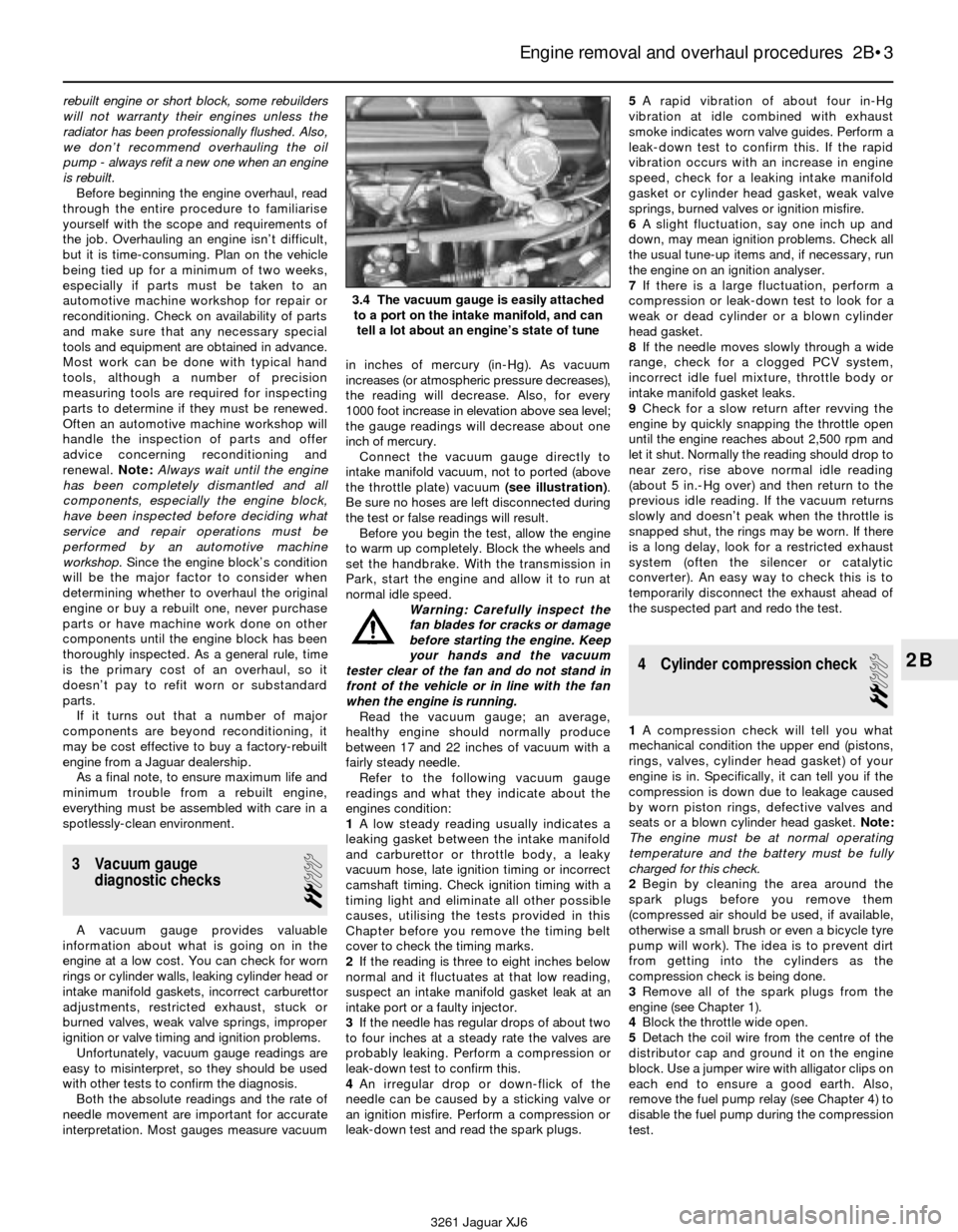
the throttle plate) vacuum (see illustration).
Be sure no hoses are left disconnected during
the test or false readings will result.
Before you begin the test, allow the engine
to warm up completely. Block the wheels and
set the handbrake. With the transmission in
Park, start the engine and allow it to run at
normal idle speed.
Warning: Carefully inspect the
fan blades for cracks or damage
before starting the engine. Keep
your hands and the vacuum
tester clear of the fan and do not stand in
front of the vehicle or in line with the fan
when the engine is running.
Read the vacuum gauge; an average,
healthy engine should normally produce
between 17 and 22 inches of vacuum with a
fairly steady needle.
Refer to the following vacuum gauge
readings and what they indicate about the
engines condition:
1A low steady reading usually indicates a
leaking gasket between the intake manifold
and carburettor or throttle body, a leaky
vacuum hose, late ignition timing or incorrect
camshaft timing. Check ignition timing with a
timing light and eliminate all other possible
causes, utilising the tests provided in this
Chapter before you remove the timing belt
cover to check the timing marks.
2If the reading is three to eight inches below
normal and it fluctuates at that low reading,
suspect an intake manifold gasket leak at an
intake port or a faulty injector.
3If the needle has regular drops of about two
to four inches at a steady rate the valves are
probably leaking. Perform a compression or
leak-down test to confirm this.
4An irregular drop or down-flick of the
needle can be caused by a sticking valve or
an ignition misfire. Perform a compression or
leak-down test and read the spark plugs.5A rapid vibration of about four in-Hg
vibration at idle combined with exhaust
smoke indicates worn valve guides. Perform a
leak-down test to confirm this. If the rapid
vibration occurs with an increase in engine
speed, check for a leaking intake manifold
gasket or cylinder head gasket, weak valve
springs, burned valves or ignition misfire.
6A slight fluctuation, say one inch up and
down, may mean ignition problems. Check all
the usual tune-up items and, if necessary, run
the engine on an ignition analyser.
7If there is a large fluctuation, perform a
compression or leak-down test to look for a
weak or dead cylinder or a blown cylinder
head gasket.
8If the needle moves slowly through a wide
range, check for a clogged PCV system,
incorrect idle fuel mixture, throttle body or
intake manifold gasket leaks.
9Check for a slow return after revving the
engine by quickly snapping the throttle open
until the engine reaches about 2,500 rpm and
let it shut. Normally the reading should drop to
near zero, rise above normal idle reading
(about 5 in.-Hg over) and then return to the
previous idle reading. If the vacuum returns
slowly and doesn’t peak when the throttle is
snapped shut, the rings may be worn. If there
is a long delay, look for a restricted exhaust
system (often the silencer or catalytic
converter). An easy way to check this is to
temporarily disconnect the exhaust ahead of
the suspected part and redo the test.
4 Cylinder compression check
2
1A compression check will tell you what
mechanical condition the upper end (pistons,
rings, valves, cylinder head gasket) of your
engine is in. Specifically, it can tell you if the
compression is down due to leakage caused
by worn piston rings, defective valves and
seats or a blown cylinder head gasket. Note:
The engine must be at normal operating
temperature and the battery must be fully
charged for this check.
2Begin by cleaning the area around the
spark plugs before you remove them
(compressed air should be used, if available,
otherwise a small brush or even a bicycle tyre
pump will work). The idea is to prevent dirt
from getting into the cylinders as the
compression check is being done.
3Remove all of the spark plugs from the
engine (see Chapter 1).
4Block the throttle wide open.
5Detach the coil wire from the centre of the
distributor cap and ground it on the engine
block. Use a jumper wire with alligator clips on
each end to ensure a good earth. Also,
remove the fuel pump relay (see Chapter 4) to
disable the fuel pump during the compression
test.
Engine removal and overhaul procedures 2B•3
2B
3.4 The vacuum gauge is easily attached
to a port on the intake manifold, and can
tell a lot about an engine’s state of tune
3261 Jaguar XJ6
Page 67 of 227
is the difference between the parallel and
perpendicular readings. Compare your results
to this Chapter’s Specifications.
8If the cylinder walls are badly scuffed or
scored, or if they’re out-of-round or tapered
beyond the limits given in this Chapter’s
Specifications, have the engine block rebored
and honed at an automotive machine
workshop. If a rebore is done, oversize
pistons and rings will be required.
9Using a precision straightedge and feeler
gauge, check the engine block deck (the
surface that mates with the cylinder head) for
distortion (see illustration 10.13). If it’s
distorted beyond the specified limit, it can be
resurfaced by an automotive machine
workshop.
10If the cylinders are in reasonably good
condition and not worn to the outside of the
limits, and if the piston-to-cylinder clearances
can be maintained properly, then they don’t
have to be rebored. Honing is all that’s
necessary (refer to Section 17).
17 Cylinder honing
3
1Prior to engine reassembly, the cylinder
bores must be honed so the new piston rings
will seat correctly and provide the best
possible combustion chamber seal. Note:If
you don’t have the tools or don’t want to
tackle the honing operation, most automotive
machine shops will do it for a reasonable fee.
2Before honing the cylinders, refit the main
bearing caps (without bearing inserts) and
tighten the bolts to the specified torque.
3Two types of cylinder hones are commonly
available - the flex hone or “bottle brush” type
and the more traditional surfacing hone with
spring-loaded stones. Both will do the job, but
for the less-experienced mechanic the “bottle
brush” hone will probably be easier to use.
You’ll also need some paraffin or honing oil,
rags and a variable-speed electric drill motor.
The drill motor should be operated at a
steady, slow speed. Proceed as follows:
a) Mount the hone in the drill motor,
compress the stones and slip it into the
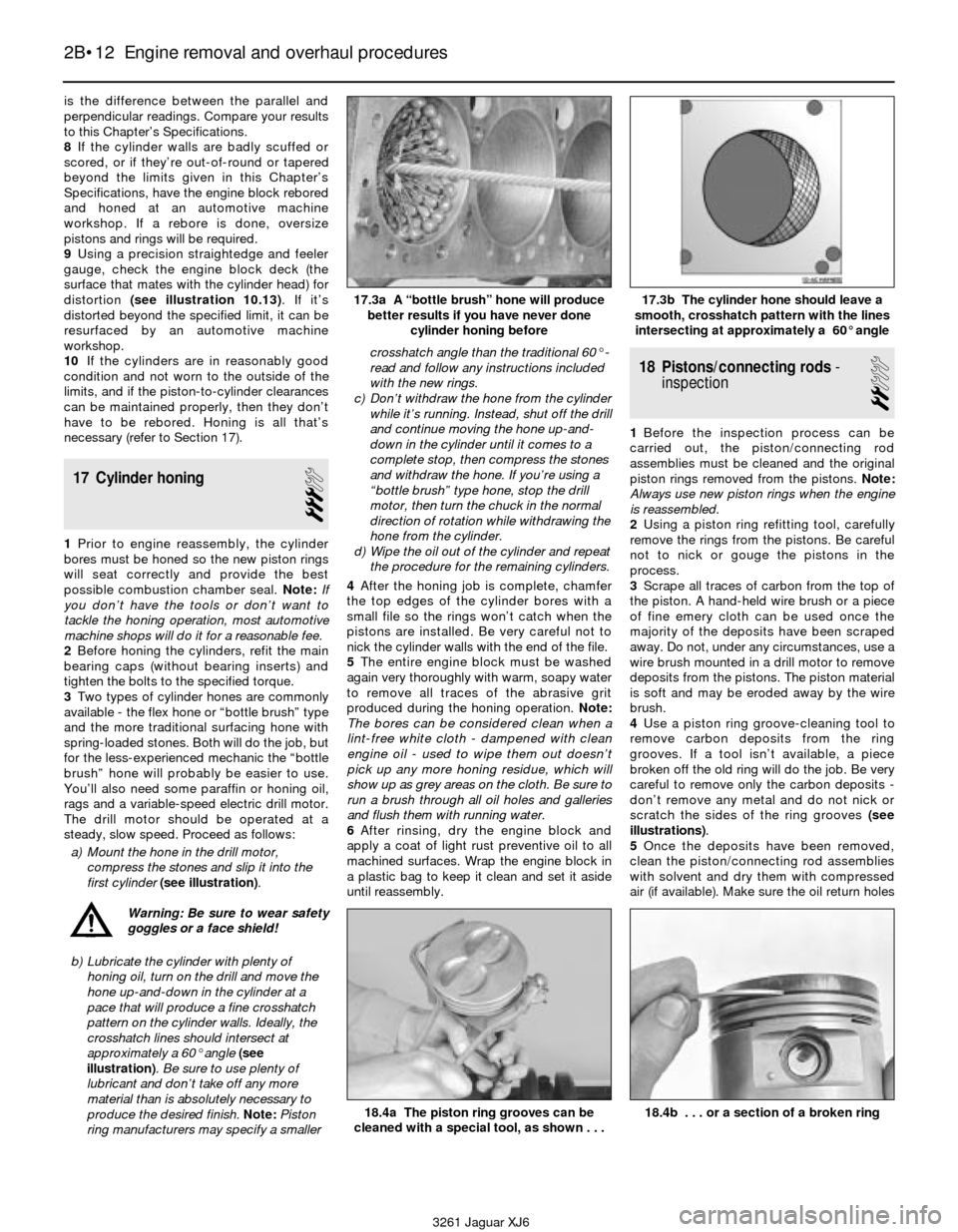
first cylinder (see illustration).
Warning: Be sure to wear safety
goggles or a face shield!
b) Lubricate the cylinder with plenty of
honing oil, turn on the drill and move the
hone up-and-down in the cylinder at a
pace that will produce a fine crosshatch
pattern on the cylinder walls. Ideally, the
crosshatch lines should intersect at
approximately a 60° angle (see
illustration). Be sure to use plenty of
lubricant and don’t take off any more
material than is absolutely necessary to
produce the desired finish. Note:Piston
ring manufacturers may specify a smallercrosshatch angle than the traditional 60° -
read and follow any instructions included
with the new rings.
c) Don’t withdraw the hone from the cylinder
while it’s running. Instead, shut off the drill
and continue moving the hone up-and-
down in the cylinder until it comes to a
complete stop, then compress the stones
and withdraw the hone. If you’re using a
“bottle brush” type hone, stop the drill
motor, then turn the chuck in the normal
direction of rotation while withdrawing the
hone from the cylinder.
d) Wipe the oil out of the cylinder and repeat
the procedure for the remaining cylinders.
4After the honing job is complete, chamfer
the top edges of the cylinder bores with a
small file so the rings won’t catch when the
pistons are installed. Be very careful not to
nick the cylinder walls with the end of the file.
5The entire engine block must be washed
again very thoroughly with warm, soapy water
to remove all traces of the abrasive grit
produced during the honing operation. Note:
The bores can be considered clean when a
lint-free white cloth - dampened with clean
engine oil - used to wipe them out doesn’t
pick up any more honing residue, which will
show up as grey areas on the cloth. Be sure to
run a brush through all oil holes and galleries
and flush them with running water.
6After rinsing, dry the engine block and
apply a coat of light rust preventive oil to all
machined surfaces. Wrap the engine block in
a plastic bag to keep it clean and set it aside
until reassembly.
18 Pistons/connecting rods-
inspection
2
1Before the inspection process can be
carried out, the piston/connecting rod
assemblies must be cleaned and the original
piston rings removed from the pistons. Note:
Always use new piston rings when the engine
is reassembled.
2Using a piston ring refitting tool, carefully
remove the rings from the pistons. Be careful
not to nick or gouge the pistons in the
process.
3Scrape all traces of carbon from the top of
the piston. A hand-held wire brush or a piece
of fine emery cloth can be used once the
majority of the deposits have been scraped
away. Do not, under any circumstances, use a
wire brush mounted in a drill motor to remove
deposits from the pistons. The piston material
is soft and may be eroded away by the wire
brush.
4Use a piston ring groove-cleaning tool to
remove carbon deposits from the ring
grooves. If a tool isn’t available, a piece
broken off the old ring will do the job. Be very
careful to remove only the carbon deposits -
don’t remove any metal and do not nick or
scratch the sides of the ring grooves (see
illustrations).
5Once the deposits have been removed,
clean the piston/connecting rod assemblies
with solvent and dry them with compressed
air (if available). Make sure the oil return holes
2B•12 Engine removal and overhaul procedures
17.3a A “bottle brush” hone will produce
better results if you have never done
cylinder honing before17.3b The cylinder hone should leave a
smooth, crosshatch pattern with the lines
intersecting at approximately a 60° angle
18.4a The piston ring grooves can be
cleaned with a special tool, as shown . . .18.4b . . . or a section of a broken ring
3261 Jaguar XJ6
Page 94 of 227
tank. If there is any doubt about the
amount of fuel in the tank, drain the fuel
tank completely before attempting this
procedure (Section 7, paragraph 1).
9Disconnect the cable from the negative
terminal of the battery. Disconnect the fuel level
sender unit/fuel pump electrical connector.
Caution: If the stereo in your vehicle is
equipped with an anti-theft system, make
sure you have the correct activation code
before disconnecting the battery.
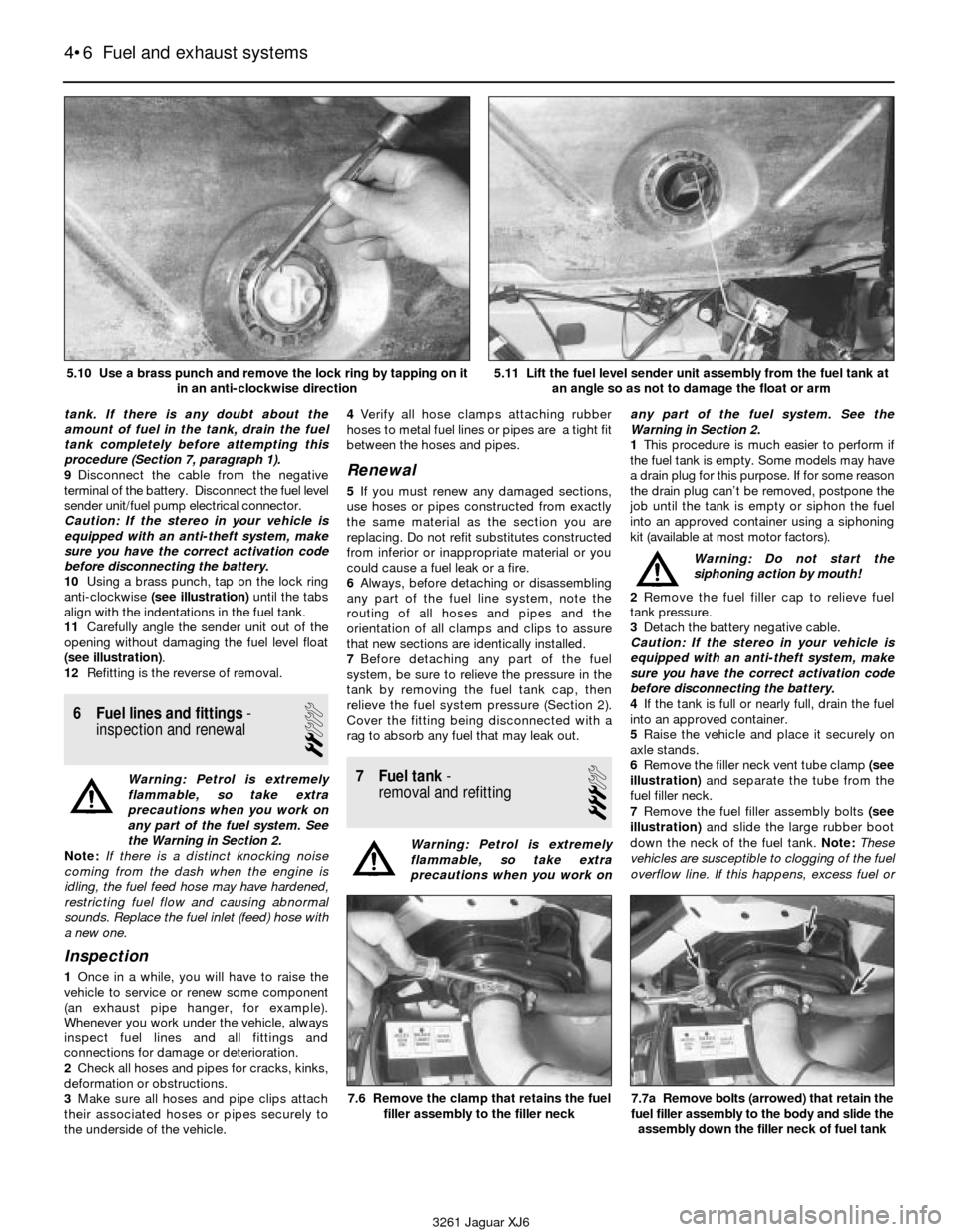
10Using a brass punch, tap on the lock ring
anti-clockwise (see illustration)until the tabs
align with the indentations in the fuel tank.
11Carefully angle the sender unit out of the
opening without damaging the fuel level float
(see illustration).
12Refitting is the reverse of removal.
6 Fuel lines and fittings-
inspection and renewal
2
Warning: Petrol is extremely
flammable, so take extra
precautions when you work on
any part of the fuel system. See
the Warning in Section 2.
Note:If there is a distinct knocking noise
coming from the dash when the engine is
idling, the fuel feed hose may have hardened,
restricting fuel flow and causing abnormal
sounds. Replace the fuel inlet (feed) hose with
a new one.
Inspection
1Once in a while, you will have to raise the
vehicle to service or renew some component
(an exhaust pipe hanger, for example).
Whenever you work under the vehicle, always
inspect fuel lines and all fittings and
connections for damage or deterioration.
2Check all hoses and pipes for cracks, kinks,
deformation or obstructions.
3Make sure all hoses and pipe clips attach
their associated hoses or pipes securely to
the underside of the vehicle.4Verify all hose clamps attaching rubber
hoses to metal fuel lines or pipes are a tight fit
between the hoses and pipes.
Renewal
5If you must renew any damaged sections,
use hoses or pipes constructed from exactly
the same material as the section you are
replacing. Do not refit substitutes constructed
from inferior or inappropriate material or you
could cause a fuel leak or a fire.
6Always, before detaching or disassembling
any part of the fuel line system, note the
routing of all hoses and pipes and the
orientation of all clamps and clips to assure
that new sections are identically installed.
7Before detaching any part of the fuel
system, be sure to relieve the pressure in the
tank by removing the fuel tank cap, then
relieve the fuel system pressure (Section 2).
Cover the fitting being disconnected with a
rag to absorb any fuel that may leak out.
7 Fuel tank-
removal and refitting
3
Warning: Petrol is extremely
flammable, so take extra
precautions when you work onany part of the fuel system. See the
Warning in Section 2.
1This procedure is much easier to perform if
the fuel tank is empty. Some models may have
a drain plug for this purpose. If for some reason
the drain plug can’t be removed, postpone the
job until the tank is empty or siphon the fuel
into an approved container using a siphoning
kit (available at most motor factors).
Warning: Do not start the
siphoning action by mouth!
2Remove the fuel filler cap to relieve fuel
tank pressure.
3Detach the battery negative cable.
Caution: If the stereo in your vehicle is
equipped with an anti-theft system, make
sure you have the correct activation code
before disconnecting the battery.
4If the tank is full or nearly full, drain the fuel
into an approved container.
5Raise the vehicle and place it securely on
axle stands.
6Remove the filler neck vent tube clamp (see
illustration)and separate the tube from the
fuel filler neck.
7Remove the fuel filler assembly bolts (see
illustration)and slide the large rubber boot
down the neck of the fuel tank. Note:These
vehicles are susceptible to clogging of the fuel
overflow line. If this happens, excess fuel or
4•6 Fuel and exhaust systems
7.6 Remove the clamp that retains the fuel
filler assembly to the filler neck7.7a Remove bolts (arrowed) that retain the
fuel filler assembly to the body and slide the
assembly down the filler neck of fuel tank
3261 Jaguar XJ6 5.10 Use a brass punch and remove the lock ring by tapping on it
in an anti-clockwise direction
5.11 Lift the fuel level sender unit assembly from the fuel tank at
an angle so as not to damage the float or arm
Page 114 of 227
temperature INCREASES, the resistance
values will DECREASE. A failure in this sensor
circuit should set a Code 3 (1988 and 1989)
or 13 (1990 to 1994). This code indicates a
failure in the coolant temperature sensor
circuit, so in most cases the appropriate
solution to the problem will be either repair of
a connector or wire, or renewal of the sensor.
Check
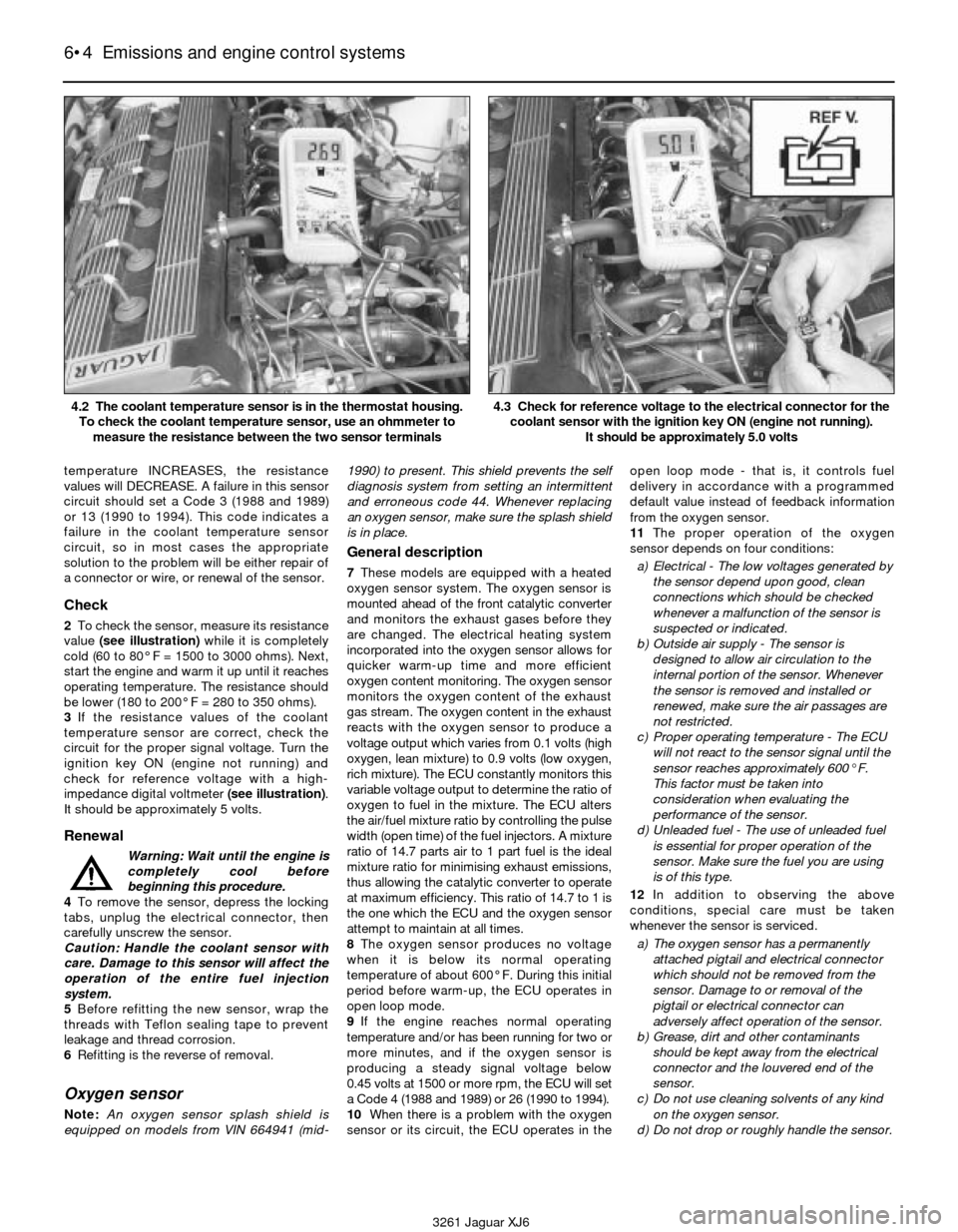
2To check the sensor, measure its resistance
value (see illustration)while it is completely
cold (60 to 80° F = 1500 to 3000 ohms). Next,
start the engine and warm it up until it reaches
operating temperature. The resistance should
be lower (180 to 200° F = 280 to 350 ohms).
3If the resistance values of the coolant
temperature sensor are correct, check the
circuit for the proper signal voltage. Turn the
ignition key ON (engine not running) and
check for reference voltage with a high-
impedance digital voltmeter (see illustration).
It should be approximately 5 volts.
Renewal
Warning: Wait until the engine is
completely cool before
beginning this procedure.
4To remove the sensor, depress the locking
tabs, unplug the electrical connector, then
carefully unscrew the sensor.
Caution: Handle the coolant sensor with
care. Damage to this sensor will affect the
operation of the entire fuel injection
system.
5Before refitting the new sensor, wrap the
threads with Teflon sealing tape to prevent
leakage and thread corrosion.
6Refitting is the reverse of removal.
Oxygen sensor
Note:An oxygen sensor splash shield is
equipped on models from VIN 664941 (mid-1990) to present. This shield prevents the self
diagnosis system from setting an intermittent
and erroneous code 44. Whenever replacing
an oxygen sensor, make sure the splash shield
is in place.
General description
7These models are equipped with a heated
oxygen sensor system. The oxygen sensor is
mounted ahead of the front catalytic converter
and monitors the exhaust gases before they
are changed. The electrical heating system
incorporated into the oxygen sensor allows for
quicker warm-up time and more efficient
oxygen content monitoring. The oxygen sensor
monitors the oxygen content of the exhaust
gas stream. The oxygen content in the exhaust
reacts with the oxygen sensor to produce a
voltage output which varies from 0.1 volts (high
oxygen, lean mixture) to 0.9 volts (low oxygen,
rich mixture). The ECU constantly monitors this
variable voltage output to determine the ratio of
oxygen to fuel in the mixture. The ECU alters
the air/fuel mixture ratio by controlling the pulse
width (open time) of the fuel injectors. A mixture
ratio of 14.7 parts air to 1 part fuel is the ideal
mixture ratio for minimising exhaust emissions,
thus allowing the catalytic converter to operate
at maximum efficiency. This ratio of 14.7 to 1 is
the one which the ECU and the oxygen sensor
attempt to maintain at all times.
8The oxygen sensor produces no voltage
when it is below its normal operating
temperature of about 600° F. During this initial
period before warm-up, the ECU operates in
open loop mode.
9If the engine reaches normal operating
temperature and/or has been running for two or
more minutes, and if the oxygen sensor is
producing a steady signal voltage below
0.45 volts at 1500 or more rpm, the ECU will set
a Code 4 (1988 and 1989) or 26 (1990 to 1994).
10When there is a problem with the oxygen
sensor or its circuit, the ECU operates in theopen loop mode - that is, it controls fuel
delivery in accordance with a programmed
default value instead of feedback information
from the oxygen sensor.
11The proper operation of the oxygen
sensor depends on four conditions:
a) Electrical - The low voltages generated by
the sensor depend upon good, clean
connections which should be checked
whenever a malfunction of the sensor is
suspected or indicated.
b) Outside air supply - The sensor is
designed to allow air circulation to the
internal portion of the sensor. Whenever
the sensor is removed and installed or
renewed, make sure the air passages are
not restricted.
c) Proper operating temperature - The ECU
will not react to the sensor signal until the
sensor reaches approximately 600° F.
This factor must be taken into
consideration when evaluating the
performance of the sensor.
d) Unleaded fuel - The use of unleaded fuel
is essential for proper operation of the
sensor. Make sure the fuel you are using
is of this type.
12In addition to observing the above
conditions, special care must be taken
whenever the sensor is serviced.
a) The oxygen sensor has a permanently
attached pigtail and electrical connector
which should not be removed from the
sensor. Damage to or removal of the
pigtail or electrical connector can
adversely affect operation of the sensor.
b) Grease, dirt and other contaminants
should be kept away from the electrical
connector and the louvered end of the
sensor.
c) Do not use cleaning solvents of any kind
on the oxygen sensor.
d) Do not drop or roughly handle the sensor.
6•4 Emissions and engine control systems
3261 Jaguar XJ6 4.2 The coolant temperature sensor is in the thermostat housing.
To check the coolant temperature sensor, use an ohmmeter to
measure the resistance between the two sensor terminals
4.3 Check for reference voltage to the electrical connector for the
coolant sensor with the ignition key ON (engine not running).
It should be approximately 5.0 volts
Page 123 of 227
3261 Jaguar XJ6
9
Chapter 9
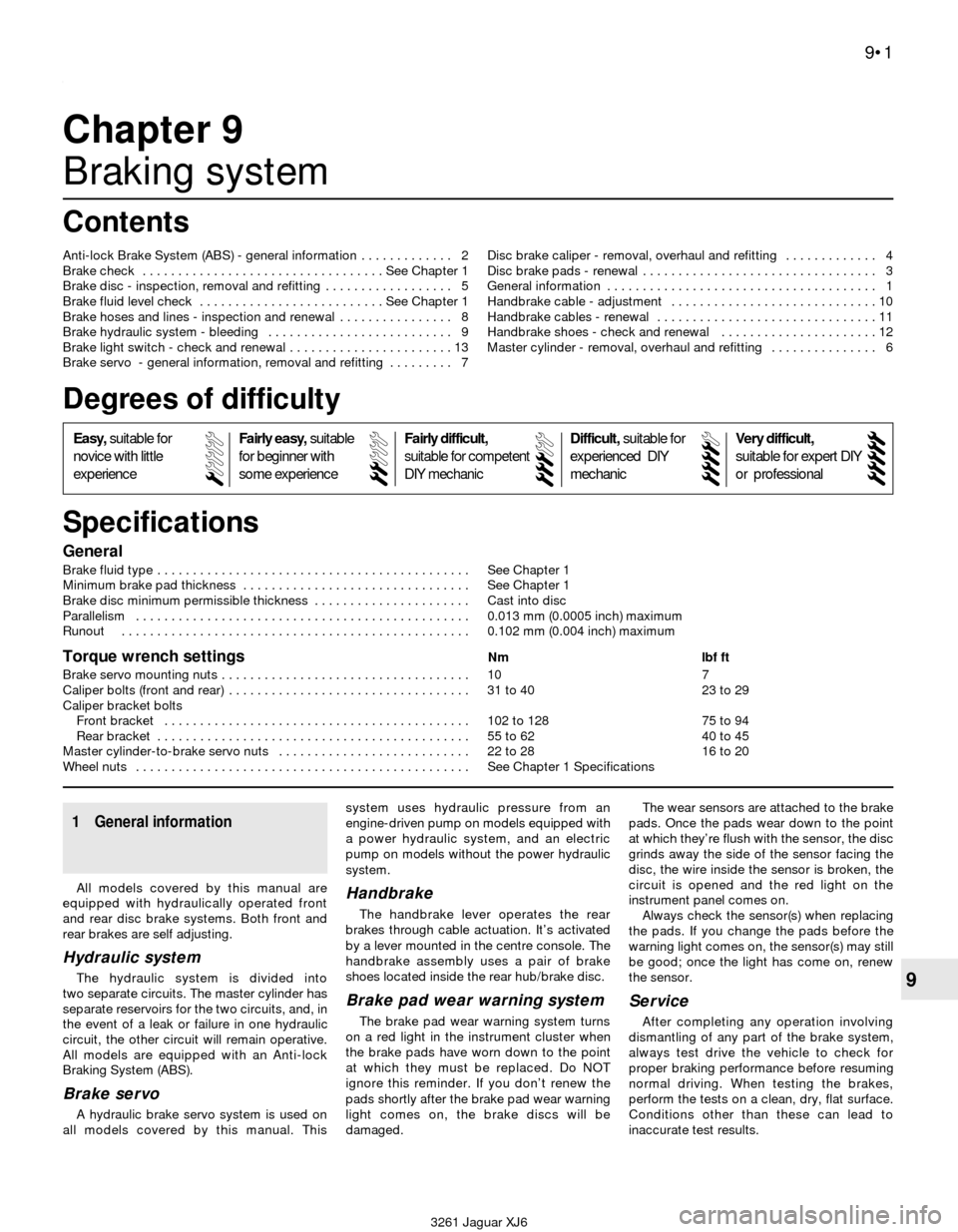
Braking system
General
Brake fluid type . . . . . . . . . . . . . . . . . . . . . . . . . . . . . . . . . . . . . . . . . . . . See Chapter 1
Minimum brake pad thickness . . . . . . . . . . . . . . . . . . . . . . . . . . . . . . . . See Chapter 1
Brake disc minimum permissible thickness . . . . . . . . . . . . . . . . . . . . . . Cast into disc
Parallelism . . . . . . . . . . . . . . . . . . . . . . . . . . . . . . . . . . . . . . . . . . . . . . . 0.013 mm (0.0005 inch) maximum
Runout . . . . . . . . . . . . . . . . . . . . . . . . . . . . . . . . . . . . . . . . . . . . . . . . . 0.102 mm (0.004 inch) maximum
Torque wrench settingsNm lbf ft
Brake servo mounting nuts . . . . . . . . . . . . . . . . . . . . . . . . . . . . . . . . . . . 10 7
Caliper bolts (front and rear) . . . . . . . . . . . . . . . . . . . . . . . . . . . . . . . . . . 31 to 40 23 to 29
Caliper bracket bolts
Front bracket . . . . . . . . . . . . . . . . . . . . . . . . . . . . . . . . . . . . . . . . . . . 102 to 128 75 to 94
Rear bracket . . . . . . . . . . . . . . . . . . . . . . . . . . . . . . . . . . . . . . . . . . . . 55 to 62 40 to 45
Master cylinder-to-brake servo nuts . . . . . . . . . . . . . . . . . . . . . . . . . . . 22 to 28 16 to 20
Wheel nuts . . . . . . . . . . . . . . . . . . . . . . . . . . . . . . . . . . . . . . . . . . . . . . . See Chapter 1 Specifications Anti-lock Brake System (ABS) - general information . . . . . . . . . . . . . 2
Brake check . . . . . . . . . . . . . . . . . . . . . . . . . . . . . . . . . . See Chapter 1
Brake disc - inspection, removal and refitting . . . . . . . . . . . . . . . . . . 5
Brake fluid level check . . . . . . . . . . . . . . . . . . . . . . . . . . See Chapter 1
Brake hoses and lines - inspection and renewal . . . . . . . . . . . . . . . . 8
Brake hydraulic system - bleeding . . . . . . . . . . . . . . . . . . . . . . . . . . 9
Brake light switch - check and renewal . . . . . . . . . . . . . . . . . . . . . . . 13
Brake servo - general information, removal and refitting . . . . . . . . . 7Disc brake caliper - removal, overhaul and refitting . . . . . . . . . . . . . 4
Disc brake pads - renewal . . . . . . . . . . . . . . . . . . . . . . . . . . . . . . . . . 3
General information . . . . . . . . . . . . . . . . . . . . . . . . . . . . . . . . . . . . . . 1
Handbrake cable - adjustment . . . . . . . . . . . . . . . . . . . . . . . . . . . . . 10
Handbrake cables - renewal . . . . . . . . . . . . . . . . . . . . . . . . . . . . . . . 11
Handbrake shoes - check and renewal . . . . . . . . . . . . . . . . . . . . . . 12
Master cylinder - removal, overhaul and refitting . . . . . . . . . . . . . . . 6
9•1
Specifications Contents
Easy,suitable for
novice with little
experienceFairly easy,suitable
for beginner with
some experienceFairly difficult,
suitable for competent
DIY mechanic
Difficult,suitable for
experienced DIY
mechanicVery difficult,
suitable for expert DIY
or professional
Degrees of difficulty
54321
1 General information
All models covered by this manual are
equipped with hydraulically operated front
and rear disc brake systems. Both front and
rear brakes are self adjusting.
Hydraulic system
The hydraulic system is divided into
two separate circuits. The master cylinder has
separate reservoirs for the two circuits, and, in
the event of a leak or failure in one hydraulic
circuit, the other circuit will remain operative.
All models are equipped with an Anti-lock
Braking System (ABS).
Brake servo
A hydraulic brake servo system is used on
all models covered by this manual. Thissystem uses hydraulic pressure from an
engine-driven pump on models equipped with
a power hydraulic system, and an electric
pump on models without the power hydraulic
system.
Handbrake
The handbrake lever operates the rear
brakes through cable actuation. It’s activated
by a lever mounted in the centre console. The
handbrake assembly uses a pair of brake
shoes located inside the rear hub/brake disc.
Brake pad wear warning system
The brake pad wear warning system turns
on a red light in the instrument cluster when
the brake pads have worn down to the point
at which they must be replaced. Do NOT
ignore this reminder. If you don’t renew the
pads shortly after the brake pad wear warning
light comes on, the brake discs will be
damaged.The wear sensors are attached to the brake
pads. Once the pads wear down to the point
at which they’re flush with the sensor, the disc
grinds away the side of the sensor facing the
disc, the wire inside the sensor is broken, the
circuit is opened and the red light on the
instrument panel comes on.
Always check the sensor(s) when replacing
the pads. If you change the pads before the
warning light comes on, the sensor(s) may still
be good; once the light has come on, renew
the sensor.
Service
After completing any operation involving
dismantling of any part of the brake system,
always test drive the vehicle to check for
proper braking performance before resuming
normal driving. When testing the brakes,
perform the tests on a clean, dry, flat surface.
Conditions other than these can lead to
inaccurate test results.
Page 124 of 227
Test the brakes at various speeds with both
light and heavy pedal pressure. The vehicle
should stop evenly without pulling to one side
or the other. Avoid locking the brakes,
because this slides the tyres and diminishes
braking efficiency and control of the vehicle.
Tyres, vehicle load and wheel alignment are
factors which also affect braking performance.
2 Anti-lock Brake system
(ABS)- general information
The Anti-lock Brake System is designed to
maintain vehicle steerability, directional stability
and optimum deceleration under severe
braking conditions on most road surfaces. It
does so by monitoring the rotational speed of
each wheel and controlling the brake line
pressure to each wheel during braking. This
prevents the wheels from locking up.
The ABS system has three main units - the
wheel speed sensors, the electronic control unit
and the modulator (hydraulic control unit). The
sensors - one at each wheel - send a variable
voltage signal to the electronic control unit,
which monitors these signals, compares them
to its program and determines whether a wheel
is about to lock up. When a wheel is about to
lock up, the control unit signals the hydraulic
unit to reduce hydraulic pressure (or not
increase it further) at that wheel’s brake caliper.
Pressure modulation is handled by three
electrically-operated solenoid valves - one for
each front wheel and one for the rear wheels -
inside the modulator.
If a problem develops within the system, an
“ABS” warning light will glow on the dashboard.
Sometimes, a visual inspection of the ABS
system can help you locate the problem.
Carefully inspect the ABS wiring harness. Pay
particularly close attention to the harness and
connections near each wheel. Look for signs of
chafing and other damage caused by
incorrectly routed wires. If a wheel sensor
harness is damaged, the sensor should be
replaced (the harness and sensor are integral).
Warning: Do NOT try to repair an
ABS wiring harness. The ABS
system is sensitive to even thesmallest changes in resistance. Repairing
the harness could alter resistance values
and cause the system to malfunction. If the
ABS wiring harness is damaged in any way,
it must be replaced.
Caution: Make sure the ignition is turned
off before unplugging or reattaching any
electrical connections.
Diagnosis and repair
If a dashboard warning light comes on and
stays on while the vehicle is in operation, the
ABS system requires attention. Although
special electronic ABS diagnostic testing tools
are necessary to properly diagnose the system,
you can perform a few preliminary checks
before taking the vehicle to a dealer service
department or other qualified repair workshop.
a) Check the brake fluid level in the master
cylinder reservoir.
b) Verify that all ABS system electrical
connectors in the engine compartment
are plugged in.
c) Check the fuses.
d) Follow the wiring harness to each front
wheel and to the differential sensor and
verify that all connections are secure and
that the wiring is undamaged.
If the above preliminary checks do not
rectify the problem, the vehicle should be
diagnosed by a dealer service department.
Due to the complex nature of this system, all
actual repair work must be done by a dealer
service department or other qualified repair
workshop.
3 Disc brake pads- renewal
2
Warning: Disc brake pads must
be replaced on both front wheels
or both rear wheels at the same
time - never renew the pads on
only one wheel. Also, the dust created by
the brake system may contain asbestos,
which is harmful to your health. Never blow
it out with compressed air and don’t inhale
any of it. An approved filtering mask should
be worn when working on the brakes. Do
not, under any circumstances, use
petroleum-based solvents to clean brake
parts. Use brake system cleaner only!
Note:The following procedure applies to both
the front and rear brake pads.
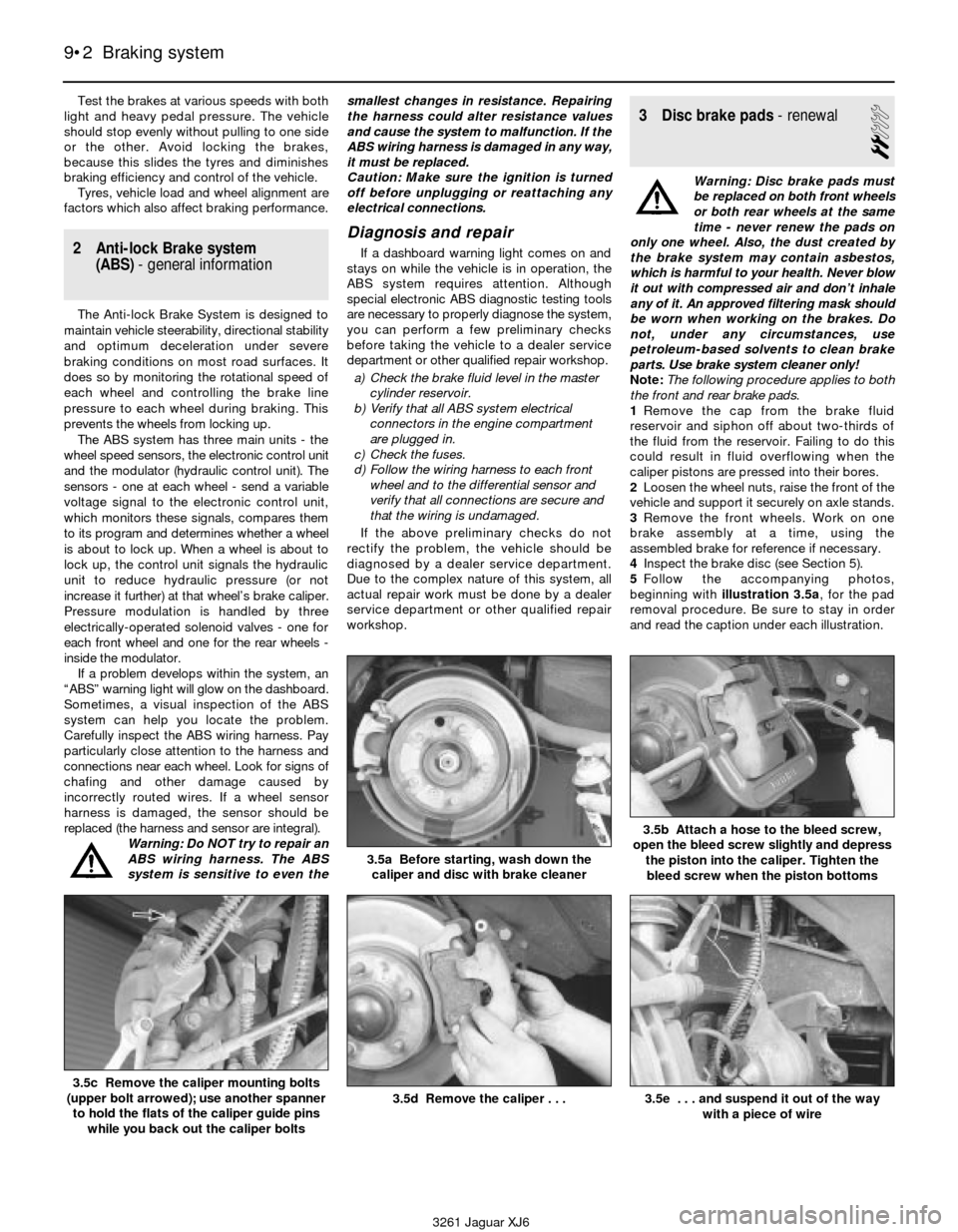
1Remove the cap from the brake fluid
reservoir and siphon off about two-thirds of
the fluid from the reservoir. Failing to do this
could result in fluid overflowing when the
caliper pistons are pressed into their bores.
2Loosen the wheel nuts, raise the front of the
vehicle and support it securely on axle stands.
3Remove the front wheels. Work on one
brake assembly at a time, using the
assembled brake for reference if necessary.
4Inspect the brake disc (see Section 5).
5Follow the accompanying photos,
beginning with illustration 3.5a, for the pad
removal procedure. Be sure to stay in order
and read the caption under each illustration.
9•2 Braking system
3.5a Before starting, wash down the
caliper and disc with brake cleaner
3.5b Attach a hose to the bleed screw,
open the bleed screw slightly and depress
the piston into the caliper. Tighten the
bleed screw when the piston bottoms
3.5c Remove the caliper mounting bolts
(upper bolt arrowed); use another spanner
to hold the flats of the caliper guide pins
while you back out the caliper bolts3.5d Remove the caliper . . .3.5e . . . and suspend it out of the way
with a piece of wire
3261 Jaguar XJ6
Page 127 of 227
been noticed during application of the brakes,
suspect disc runout.
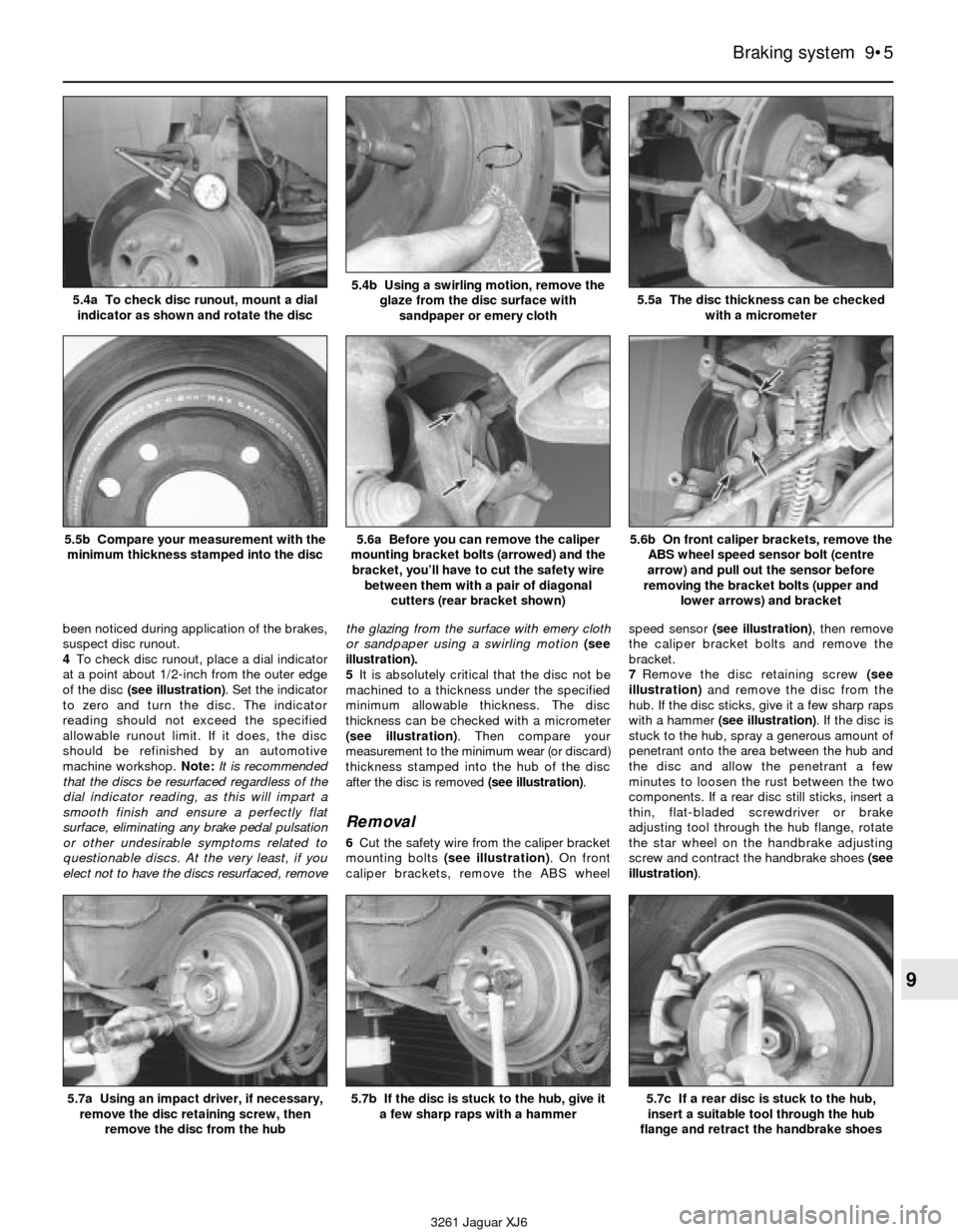
4To check disc runout, place a dial indicator
at a point about 1/2-inch from the outer edge
of the disc (see illustration). Set the indicator
to zero and turn the disc. The indicator
reading should not exceed the specified
allowable runout limit. If it does, the disc
should be refinished by an automotive
machine workshop. Note:It is recommended
that the discs be resurfaced regardless of the
dial indicator reading, as this will impart a
smooth finish and ensure a perfectly flat
surface, eliminating any brake pedal pulsation
or other undesirable symptoms related to
questionable discs. At the very least, if you
elect not to have the discs resurfaced, removethe glazing from the surface with emery cloth
or sandpaper using a swirling motion (see
illustration).
5It is absolutely critical that the disc not be
machined to a thickness under the specified
minimum allowable thickness. The disc
thickness can be checked with a micrometer
(see illustration). Then compare your
measurement to the minimum wear (or discard)
thickness stamped into the hub of the disc
after the disc is removed (see illustration).
Removal
6Cut the safety wire from the caliper bracket
mounting bolts (see illustration). On front
caliper brackets, remove the ABS wheelspeed sensor (see illustration), then remove
the caliper bracket bolts and remove the
bracket.
7Remove the disc retaining screw (see
illustration) and remove the disc from the
hub. If the disc sticks, give it a few sharp raps
with a hammer (see illustration). If the disc is
stuck to the hub, spray a generous amount of
penetrant onto the area between the hub and
the disc and allow the penetrant a few
minutes to loosen the rust between the two
components. If a rear disc still sticks, insert a
thin, flat-bladed screwdriver or brake
adjusting tool through the hub flange, rotate
the star wheel on the handbrake adjusting
screw and contract the handbrake shoes (see
illustration).
Braking system 9•5
9
5.4a To check disc runout, mount a dial
indicator as shown and rotate the disc5.4b Using a swirling motion, remove the
glaze from the disc surface with
sandpaper or emery cloth5.5a The disc thickness can be checked
with a micrometer
5.5b Compare your measurement with the
minimum thickness stamped into the disc5.6a Before you can remove the caliper
mounting bracket bolts (arrowed) and the
bracket, you’ll have to cut the safety wire
between them with a pair of diagonal
cutters (rear bracket shown)5.6b On front caliper brackets, remove the
ABS wheel speed sensor bolt (centre
arrow) and pull out the sensor before
removing the bracket bolts (upper and
lower arrows) and bracket
3261 Jaguar XJ6
5.7a Using an impact driver, if necessary,
remove the disc retaining screw, then
remove the disc from the hub5.7c If a rear disc is stuck to the hub,
insert a suitable tool through the hub
flange and retract the handbrake shoes5.7b If the disc is stuck to the hub, give it
a few sharp raps with a hammer
Page 137 of 227
3261 Jaguar XJ6
10
Chapter 10
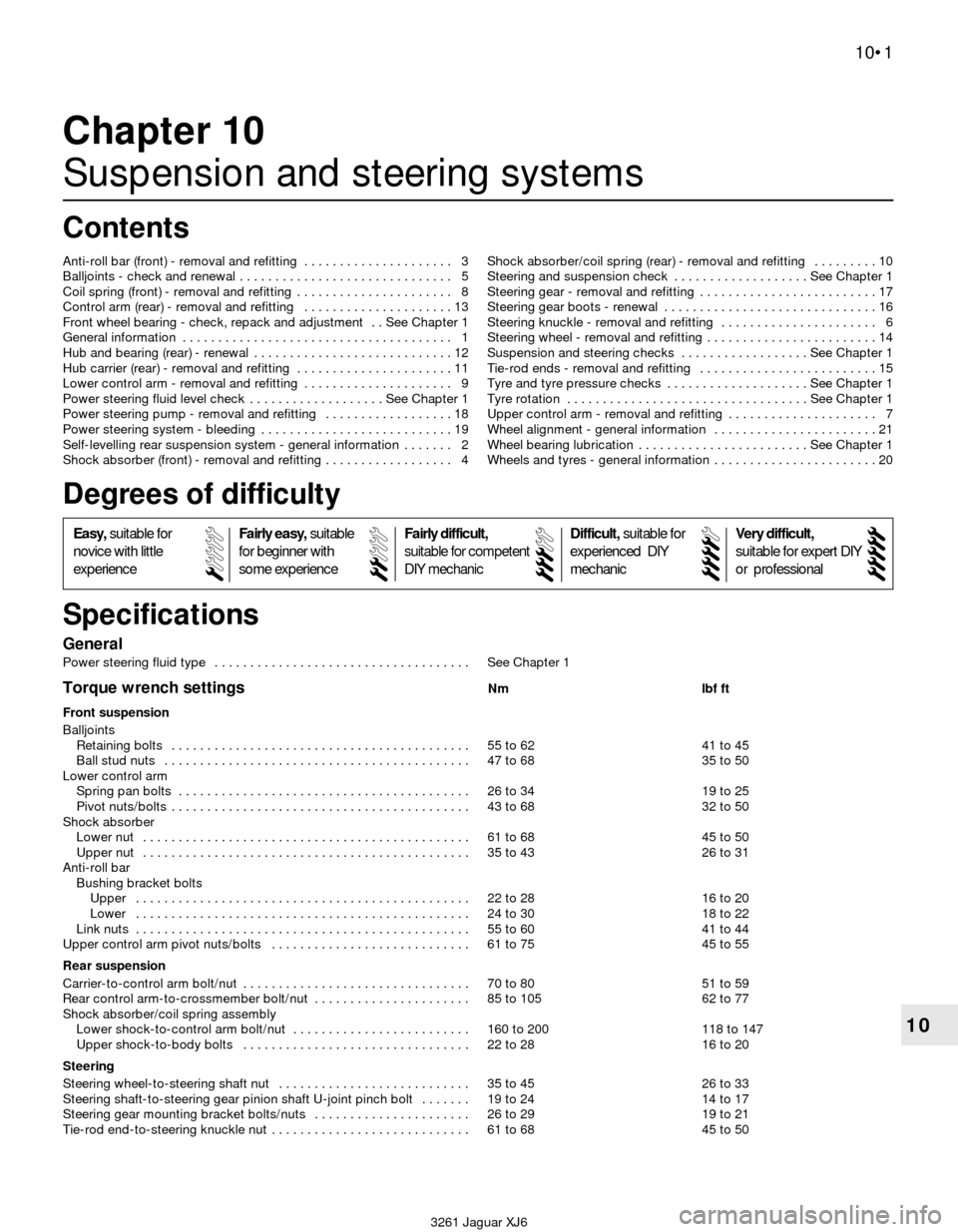
Suspension and steering systems
General
Power steering fluid type . . . . . . . . . . . . . . . . . . . . . . . . . . . . . . . . . . . . See Chapter 1
Torque wrench settingsNm lbf ft
Front suspension
Balljoints
Retaining bolts . . . . . . . . . . . . . . . . . . . . . . . . . . . . . . . . . . . . . . . . . . 55 to 62 41 to 45
Ball stud nuts . . . . . . . . . . . . . . . . . . . . . . . . . . . . . . . . . . . . . . . . . . . 47 to 68 35 to 50
Lower control arm
Spring pan bolts . . . . . . . . . . . . . . . . . . . . . . . . . . . . . . . . . . . . . . . . . 26 to 34 19 to 25
Pivot nuts/bolts . . . . . . . . . . . . . . . . . . . . . . . . . . . . . . . . . . . . . . . . . . 43 to 68 32 to 50
Shock absorber
Lower nut . . . . . . . . . . . . . . . . . . . . . . . . . . . . . . . . . . . . . . . . . . . . . . 61 to 68 45 to 50
Upper nut . . . . . . . . . . . . . . . . . . . . . . . . . . . . . . . . . . . . . . . . . . . . . . 35 to 43 26 to 31
Anti-roll bar
Bushing bracket bolts
Upper . . . . . . . . . . . . . . . . . . . . . . . . . . . . . . . . . . . . . . . . . . . . . . . 22 to 28 16 to 20
Lower . . . . . . . . . . . . . . . . . . . . . . . . . . . . . . . . . . . . . . . . . . . . . . . 24 to 30 18 to 22
Link nuts . . . . . . . . . . . . . . . . . . . . . . . . . . . . . . . . . . . . . . . . . . . . . . . 55 to 60 41 to 44
Upper control arm pivot nuts/bolts . . . . . . . . . . . . . . . . . . . . . . . . . . . . 61 to 75 45 to 55
Rear suspension
Carrier-to-control arm bolt/nut . . . . . . . . . . . . . . . . . . . . . . . . . . . . . . . . 70 to 80 51 to 59
Rear control arm-to-crossmember bolt/nut . . . . . . . . . . . . . . . . . . . . . . 85 to 105 62 to 77
Shock absorber/coil spring assembly
Lower shock-to-control arm bolt/nut . . . . . . . . . . . . . . . . . . . . . . . . . 160 to 200 118 to 147
Upper shock-to-body bolts . . . . . . . . . . . . . . . . . . . . . . . . . . . . . . . . 22 to 28 16 to 20
Steering
Steering wheel-to-steering shaft nut . . . . . . . . . . . . . . . . . . . . . . . . . . . 35 to 45 26 to 33
Steering shaft-to-steering gear pinion shaft U-joint pinch bolt . . . . . . . 19 to 24 14 to 17
Steering gear mounting bracket bolts/nuts . . . . . . . . . . . . . . . . . . . . . . 26 to 29 19 to 21
Tie-rod end-to-steering knuckle nut . . . . . . . . . . . . . . . . . . . . . . . . . . . . 61 to 68 45 to 50 Anti-roll bar (front) - removal and refitting . . . . . . . . . . . . . . . . . . . . . 3
Balljoints - check and renewal . . . . . . . . . . . . . . . . . . . . . . . . . . . . . . 5
Coil spring (front) - removal and refitting . . . . . . . . . . . . . . . . . . . . . . 8
Control arm (rear) - removal and refitting . . . . . . . . . . . . . . . . . . . . . 13
Front wheel bearing - check, repack and adjustment . . See Chapter 1
General information . . . . . . . . . . . . . . . . . . . . . . . . . . . . . . . . . . . . . . 1
Hub and bearing (rear) - renewal . . . . . . . . . . . . . . . . . . . . . . . . . . . . 12
Hub carrier (rear) - removal and refitting . . . . . . . . . . . . . . . . . . . . . . 11
Lower control arm - removal and refitting . . . . . . . . . . . . . . . . . . . . . 9
Power steering fluid level check . . . . . . . . . . . . . . . . . . . See Chapter 1
Power steering pump - removal and refitting . . . . . . . . . . . . . . . . . . 18
Power steering system - bleeding . . . . . . . . . . . . . . . . . . . . . . . . . . . 19
Self-levelling rear suspension system - general information . . . . . . . 2
Shock absorber (front) - removal and refitting . . . . . . . . . . . . . . . . . . 4Shock absorber/coil spring (rear) - removal and refitting . . . . . . . . . 10
Steering and suspension check . . . . . . . . . . . . . . . . . . . See Chapter 1
Steering gear - removal and refitting . . . . . . . . . . . . . . . . . . . . . . . . . 17
Steering gear boots - renewal . . . . . . . . . . . . . . . . . . . . . . . . . . . . . . 16
Steering knuckle - removal and refitting . . . . . . . . . . . . . . . . . . . . . . 6
Steering wheel - removal and refitting . . . . . . . . . . . . . . . . . . . . . . . . 14
Suspension and steering checks . . . . . . . . . . . . . . . . . . See Chapter 1
Tie-rod ends - removal and refitting . . . . . . . . . . . . . . . . . . . . . . . . . 15
Tyre and tyre pressure checks . . . . . . . . . . . . . . . . . . . . See Chapter 1
Tyre rotation . . . . . . . . . . . . . . . . . . . . . . . . . . . . . . . . . . See Chapter 1
Upper control arm - removal and refitting . . . . . . . . . . . . . . . . . . . . . 7
Wheel alignment - general information . . . . . . . . . . . . . . . . . . . . . . . 21
Wheel bearing lubrication . . . . . . . . . . . . . . . . . . . . . . . . See Chapter 1
Wheels and tyres - general information . . . . . . . . . . . . . . . . . . . . . . . 20
10•1
Specifications Contents
Easy,suitable for
novice with little
experienceFairly easy,suitable
for beginner with
some experienceFairly difficult,
suitable for competent
DIY mechanic
Difficult,suitable for
experienced DIY
mechanicVery difficult,
suitable for expert DIY
or professional
Degrees of difficulty
54321
Page 139 of 227
1 General information
Warning: Whenever any of the
suspension or steering fasteners
are loosened or removed, they
must be inspected and if
necessary, replaced with new ones of the
same part number or of original equipment
quality and design. Torque wrench settings
must be followed for proper reassembly
and component retention. Never attempt
to heat, straighten or weld any suspension
or steering component. Instead, renew any
bent or damaged part.
The front suspension (see illustrations)
consists of unequal-length upper and lower
control arms, shock absorbers and coil
springs. The upper ends of the shocks are
attached to the body; the lower ends
are attached to the lower control arms. The
upper ends of the coil springs are seated
against the suspension crossmember; the
lower ends are seated against removable
plates which are bolted to the lower control
arms. The steering knuckles are attached to
balljoints in the upper and lower control arms.
An anti-roll bar is attached to the suspension
crossmember with a pair of bushing brackets
and to the lower control arms via a connecting
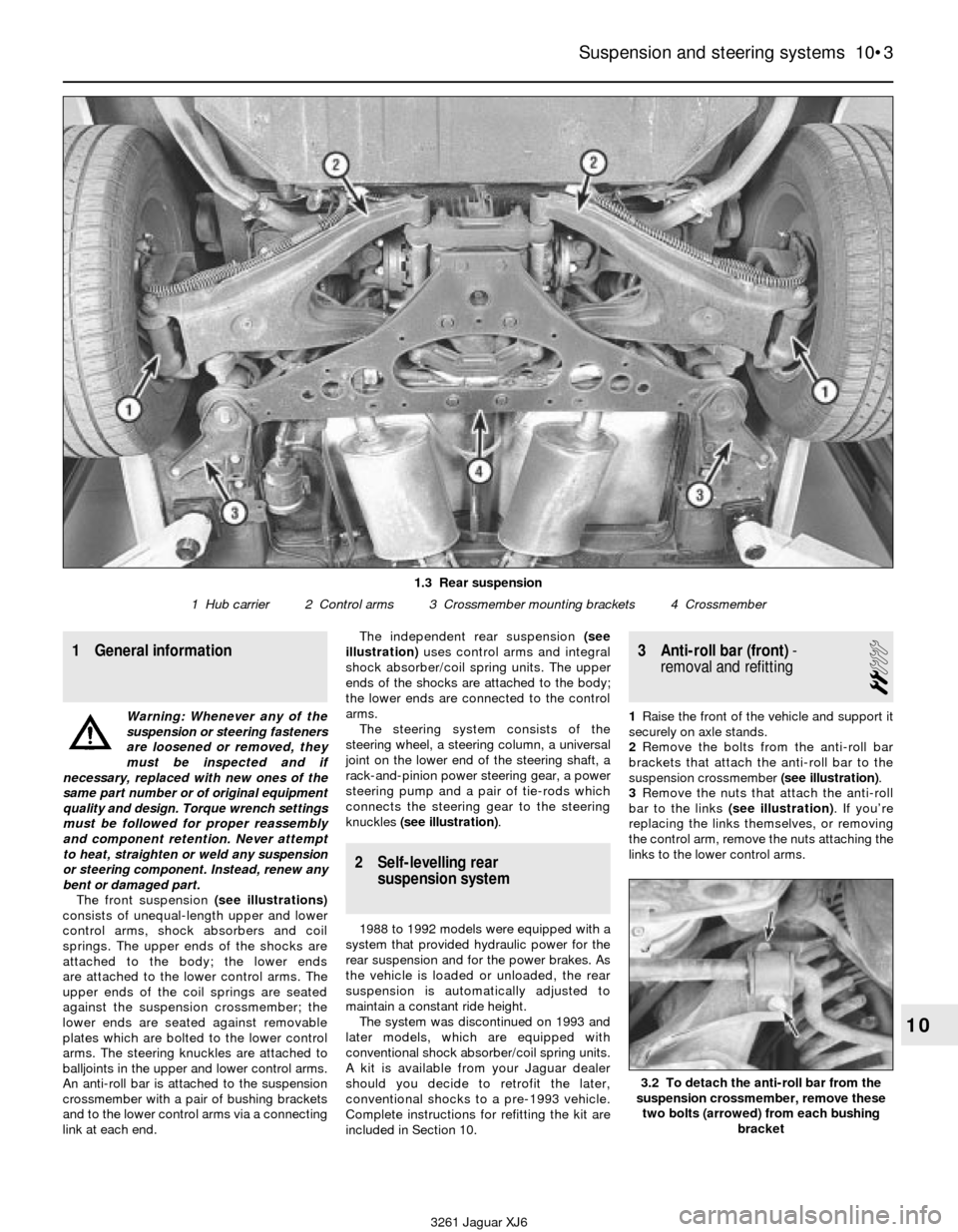
link at each end.The independent rear suspension (see
illustration)uses control arms and integral
shock absorber/coil spring units. The upper
ends of the shocks are attached to the body;
the lower ends are connected to the control
arms.
The steering system consists of the
steering wheel, a steering column, a universal
joint on the lower end of the steering shaft, a
rack-and-pinion power steering gear, a power
steering pump and a pair of tie-rods which
connects the steering gear to the steering
knuckles (see illustration).
2 Self-levelling rear
suspension system
1988 to 1992 models were equipped with a
system that provided hydraulic power for the
rear suspension and for the power brakes. As
the vehicle is loaded or unloaded, the rear
suspension is automatically adjusted to
maintain a constant ride height.
The system was discontinued on 1993 and
later models, which are equipped with
conventional shock absorber/coil spring units.
A kit is available from your Jaguar dealer
should you decide to retrofit the later,
conventional shocks to a pre-1993 vehicle.
Complete instructions for refitting the kit are
included in Section 10.
3 Anti-roll bar (front)-
removal and refitting
2
1Raise the front of the vehicle and support it
securely on axle stands.
2Remove the bolts from the anti-roll bar
brackets that attach the anti-roll bar to the
suspension crossmember (see illustration).
3Remove the nuts that attach the anti-roll
bar to the links (see illustration). If you’re
replacing the links themselves, or removing
the control arm, remove the nuts attaching the
links to the lower control arms.
Suspension and steering systems 10•3
10
1.3 Rear suspension
1 Hub carrier 2 Control arms 3 Crossmember mounting brackets 4 Crossmember
3.2 To detach the anti-roll bar from the
suspension crossmember, remove these
two bolts (arrowed) from each bushing
bracket
3261 Jaguar XJ6