heating JAGUAR XJ6 1997 2.G Owner's Manual
[x] Cancel search | Manufacturer: JAGUAR, Model Year: 1997, Model line: XJ6, Model: JAGUAR XJ6 1997 2.GPages: 227, PDF Size: 7.2 MB
Page 88 of 227

10With everything disconnected, pull the
heat-air conditioning housing back and out
from under the dash.
Caution: Do not force anything. If the unit
gets stuck, determine where the inter-
ference is before a duct, wire or hose is
broken.
11Pry off the series of black metal clips
connecting the main housing to the evaporator
case, then separate the evaporator case and
pull out the evaporator core. Note:When
refitting the evaporator core into the case, be
sure to refit the foam insulation in the same
way it was installed originally.
12The evaporator core can be cleaned with a
“fin comb” and blown off with compressed air.13The expansion valve is located on the
right side of the bulkhead on the engine side.
To renew it, remove the battery (Chapter 5) for
better access. Disconnect the lines from the
back of the valve as in Step 2. Disconnect the
high and low-pressure hoses from the frontof
the expansion valve (see illustration).
14If the evaporator core is renewed, make
sure the technician adds 1.4 ounces of new
refrigerant oil (of a type compatible with your
type of refrigerant) to the system.
15The remainder of the refitting is the
reverse of the removal process. Be sure to
use new O-rings, and new gaskets on the
expansion valve.
16Have the system evacuated, charged and
leak tested by the workshop that discharged
it.
Cooling, heating and air conditioning systems 3•15
3
17.13 Disconnect the lines at the front of
the expansion valve - always use two
spanners to avoid twisting a line - one
spanner holds the body of the valve
3261 Jaguar XJ6
Page 102 of 227
manifold as a single unit and have it repaired
by a dealer service department. Refer to
Chapter 2 for removal and refitting procedures.
14 Exhaust system servicing-
general information
Warning: Inspection and repair
of exhaust system components
should be done only after the
components have cooled.
1The exhaust system consists of the exhaust
manifold, catalytic converter, the silencer, the
tailpipe and all connecting pipes, brackets,
hangers and clamps. The exhaust system is
attached to the body with mounting brackets
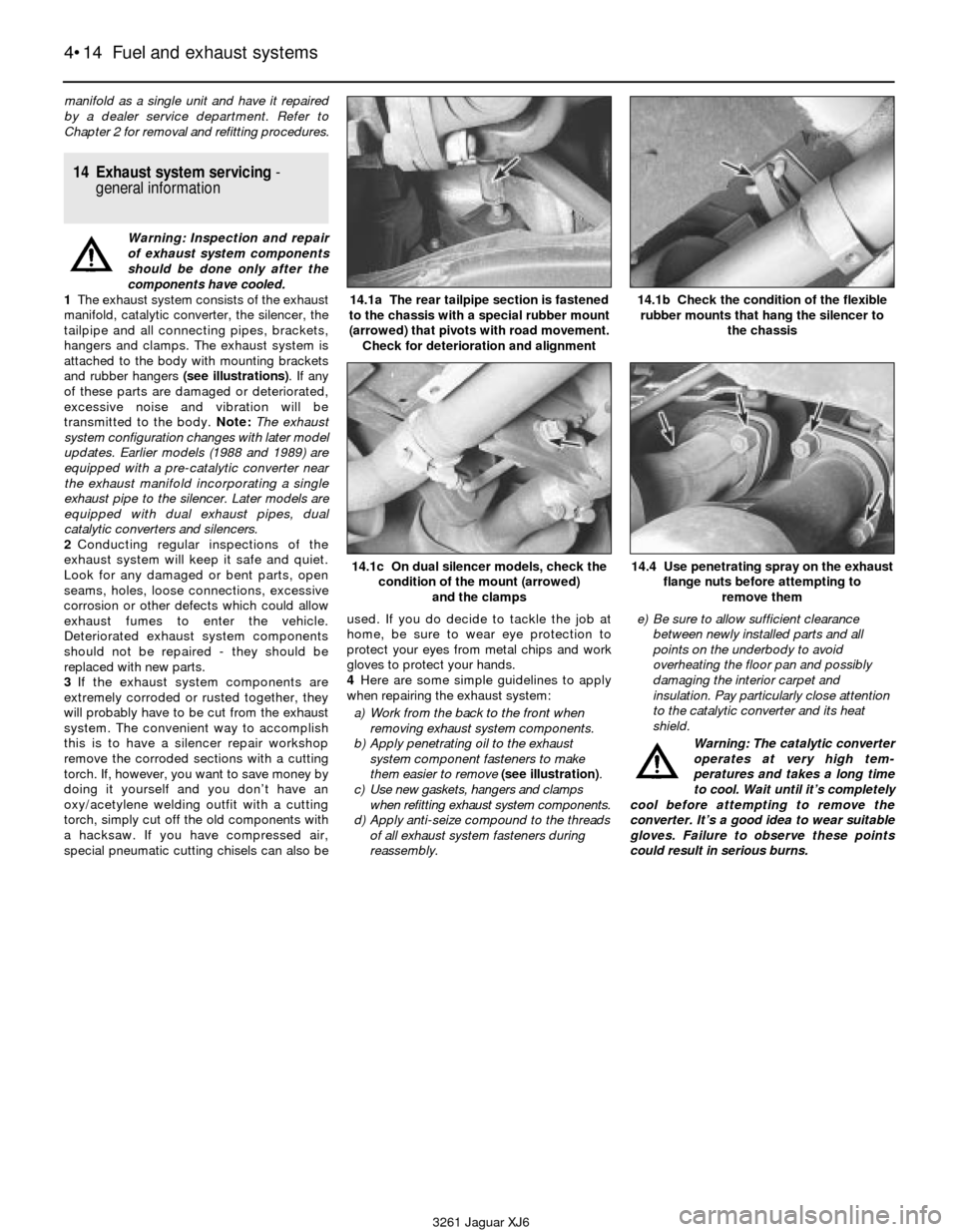
and rubber hangers (see illustrations). If any
of these parts are damaged or deteriorated,
excessive noise and vibration will be
transmitted to the body. Note:The exhaust
system configuration changes with later model
updates. Earlier models (1988 and 1989) are
equipped with a pre-catalytic converter near
the exhaust manifold incorporating a single
exhaust pipe to the silencer. Later models are
equipped with dual exhaust pipes, dual
catalytic converters and silencers.
2Conducting regular inspections of the
exhaust system will keep it safe and quiet.
Look for any damaged or bent parts, open
seams, holes, loose connections, excessive
corrosion or other defects which could allow
exhaust fumes to enter the vehicle.
Deteriorated exhaust system components
should not be repaired - they should be
replaced with new parts.
3If the exhaust system components are
extremely corroded or rusted together, they
will probably have to be cut from the exhaust
system. The convenient way to accomplish
this is to have a silencer repair workshop
remove the corroded sections with a cutting
torch. If, however, you want to save money by
doing it yourself and you don’t have an
oxy/acetylene welding outfit with a cutting
torch, simply cut off the old components with
a hacksaw. If you have compressed air,
special pneumatic cutting chisels can also beused. If you do decide to tackle the job at
home, be sure to wear eye protection to
protect your eyes from metal chips and work
gloves to protect your hands.
4Here are some simple guidelines to apply
when repairing the exhaust system:
a) Work from the back to the front when
removing exhaust system components.
b) Apply penetrating oil to the exhaust
system component fasteners to make
them easier to remove(see illustration).
c) Use new gaskets, hangers and clamps
when refitting exhaust system components.
d) Apply anti-seize compound to the threads
of all exhaust system fasteners during
reassembly.e) Be sure to allow sufficient clearance
between newly installed parts and all
points on the underbody to avoid
overheating the floor pan and possibly
damaging the interior carpet and
insulation. Pay particularly close attention
to the catalytic converter and its heat
shield.
Warning: The catalytic converter
operates at very high tem-
peratures and takes a long time
to cool. Wait until it’s completely
cool before attempting to remove the
converter. It’s a good idea to wear suitable
gloves. Failure to observe these points
could result in serious burns.
4•14 Fuel and exhaust systems
14.1c On dual silencer models, check the
condition of the mount (arrowed)
and the clamps
14.1a The rear tailpipe section is fastened
to the chassis with a special rubber mount
(arrowed) that pivots with road movement.
Check for deterioration and alignment14.1b Check the condition of the flexible
rubber mounts that hang the silencer to
the chassis
14.4 Use penetrating spray on the exhaust
flange nuts before attempting to
remove them
3261 Jaguar XJ6
Page 114 of 227
temperature INCREASES, the resistance
values will DECREASE. A failure in this sensor
circuit should set a Code 3 (1988 and 1989)
or 13 (1990 to 1994). This code indicates a
failure in the coolant temperature sensor
circuit, so in most cases the appropriate
solution to the problem will be either repair of
a connector or wire, or renewal of the sensor.
Check
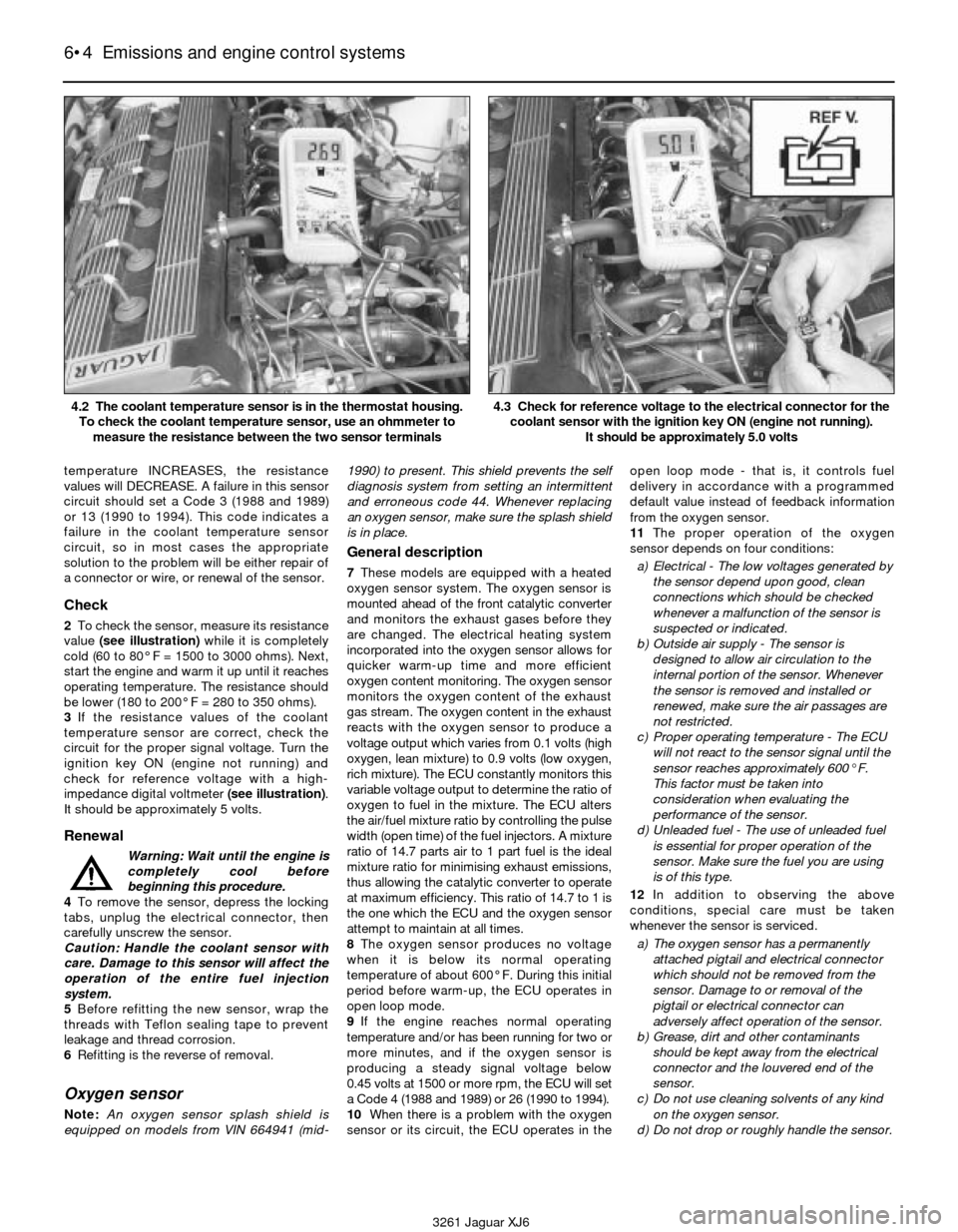
2To check the sensor, measure its resistance
value (see illustration)while it is completely
cold (60 to 80° F = 1500 to 3000 ohms). Next,
start the engine and warm it up until it reaches
operating temperature. The resistance should
be lower (180 to 200° F = 280 to 350 ohms).
3If the resistance values of the coolant
temperature sensor are correct, check the
circuit for the proper signal voltage. Turn the
ignition key ON (engine not running) and
check for reference voltage with a high-
impedance digital voltmeter (see illustration).
It should be approximately 5 volts.
Renewal
Warning: Wait until the engine is
completely cool before
beginning this procedure.
4To remove the sensor, depress the locking
tabs, unplug the electrical connector, then
carefully unscrew the sensor.
Caution: Handle the coolant sensor with
care. Damage to this sensor will affect the
operation of the entire fuel injection
system.
5Before refitting the new sensor, wrap the
threads with Teflon sealing tape to prevent
leakage and thread corrosion.
6Refitting is the reverse of removal.
Oxygen sensor
Note:An oxygen sensor splash shield is
equipped on models from VIN 664941 (mid-1990) to present. This shield prevents the self
diagnosis system from setting an intermittent
and erroneous code 44. Whenever replacing
an oxygen sensor, make sure the splash shield
is in place.
General description
7These models are equipped with a heated
oxygen sensor system. The oxygen sensor is
mounted ahead of the front catalytic converter
and monitors the exhaust gases before they
are changed. The electrical heating system
incorporated into the oxygen sensor allows for
quicker warm-up time and more efficient
oxygen content monitoring. The oxygen sensor
monitors the oxygen content of the exhaust
gas stream. The oxygen content in the exhaust
reacts with the oxygen sensor to produce a
voltage output which varies from 0.1 volts (high
oxygen, lean mixture) to 0.9 volts (low oxygen,
rich mixture). The ECU constantly monitors this
variable voltage output to determine the ratio of
oxygen to fuel in the mixture. The ECU alters
the air/fuel mixture ratio by controlling the pulse
width (open time) of the fuel injectors. A mixture
ratio of 14.7 parts air to 1 part fuel is the ideal
mixture ratio for minimising exhaust emissions,
thus allowing the catalytic converter to operate
at maximum efficiency. This ratio of 14.7 to 1 is
the one which the ECU and the oxygen sensor
attempt to maintain at all times.
8The oxygen sensor produces no voltage
when it is below its normal operating
temperature of about 600° F. During this initial
period before warm-up, the ECU operates in
open loop mode.
9If the engine reaches normal operating
temperature and/or has been running for two or
more minutes, and if the oxygen sensor is
producing a steady signal voltage below
0.45 volts at 1500 or more rpm, the ECU will set
a Code 4 (1988 and 1989) or 26 (1990 to 1994).
10When there is a problem with the oxygen
sensor or its circuit, the ECU operates in theopen loop mode - that is, it controls fuel
delivery in accordance with a programmed
default value instead of feedback information
from the oxygen sensor.
11The proper operation of the oxygen
sensor depends on four conditions:
a) Electrical - The low voltages generated by
the sensor depend upon good, clean
connections which should be checked
whenever a malfunction of the sensor is
suspected or indicated.
b) Outside air supply - The sensor is
designed to allow air circulation to the
internal portion of the sensor. Whenever
the sensor is removed and installed or
renewed, make sure the air passages are
not restricted.
c) Proper operating temperature - The ECU
will not react to the sensor signal until the
sensor reaches approximately 600° F.
This factor must be taken into
consideration when evaluating the
performance of the sensor.
d) Unleaded fuel - The use of unleaded fuel
is essential for proper operation of the
sensor. Make sure the fuel you are using
is of this type.
12In addition to observing the above
conditions, special care must be taken
whenever the sensor is serviced.
a) The oxygen sensor has a permanently
attached pigtail and electrical connector
which should not be removed from the
sensor. Damage to or removal of the
pigtail or electrical connector can
adversely affect operation of the sensor.
b) Grease, dirt and other contaminants
should be kept away from the electrical
connector and the louvered end of the
sensor.
c) Do not use cleaning solvents of any kind
on the oxygen sensor.
d) Do not drop or roughly handle the sensor.
6•4 Emissions and engine control systems
3261 Jaguar XJ6 4.2 The coolant temperature sensor is in the thermostat housing.
To check the coolant temperature sensor, use an ohmmeter to
measure the resistance between the two sensor terminals
4.3 Check for reference voltage to the electrical connector for the
coolant sensor with the ignition key ON (engine not running).
It should be approximately 5.0 volts
Page 121 of 227
canister. If fuel is leaking, renew the canister
and check the hoses and hose routing.
9Inspect the canister. If it’s cracked or
damaged, renew it.
10Check for a clogged filter or a damaged
pressure relief valve. Using low pressure
compressed air (such as from a tyre pump),
blow into the canister tank pipe. Air should
flow freely from the other pipes. If a problem is
found, renew the canister.
11Check the operation of the thermal
vacuum valve (TVV). With the engine cold and
idling, check for ported vacuum to the
temperature vacuum switch. Vacuum should
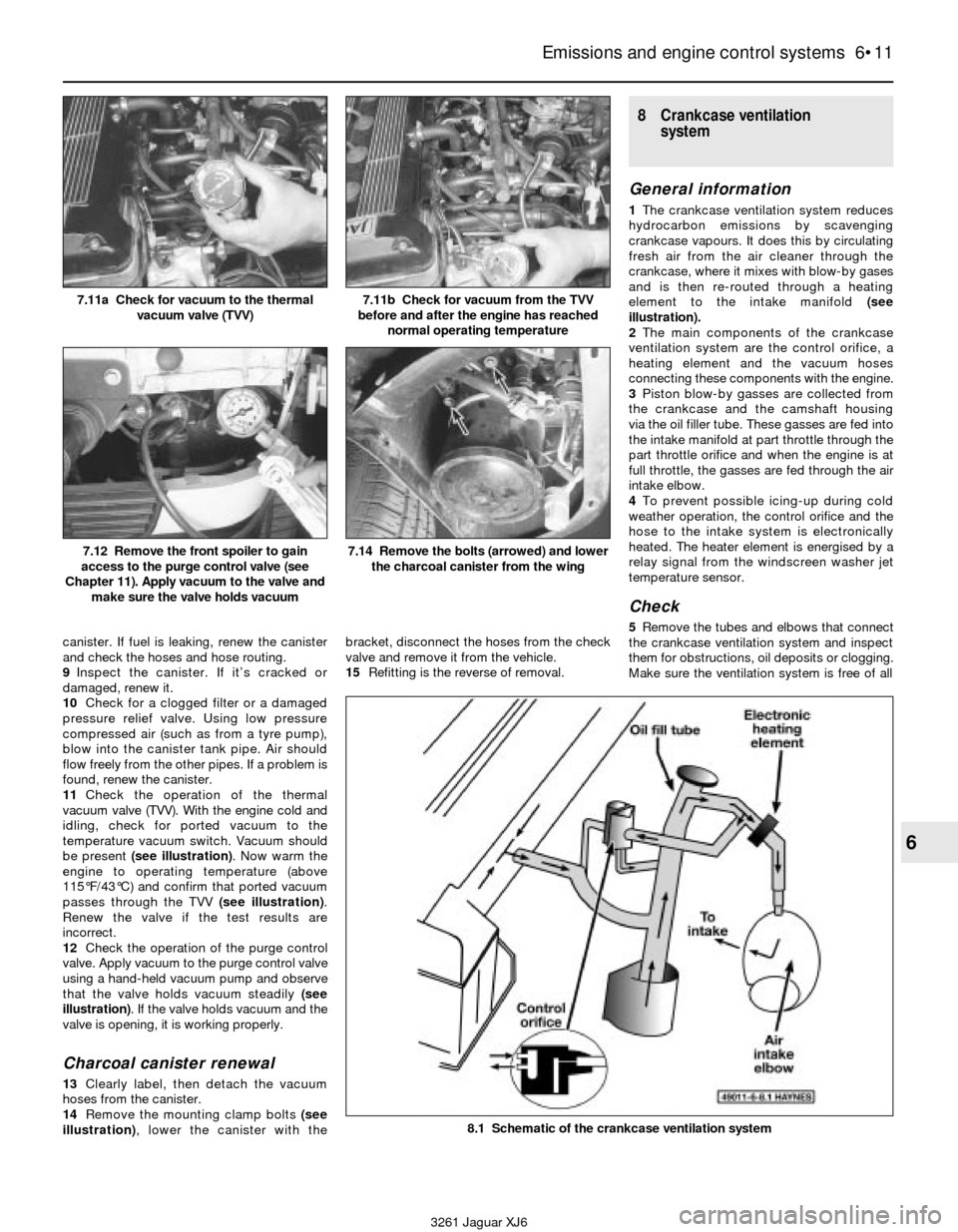
be present (see illustration). Now warm the
engine to operating temperature (above
115°F/43°C) and confirm that ported vacuum
passes through the TVV (see illustration).
Renew the valve if the test results are
incorrect.
12Check the operation of the purge control
valve. Apply vacuum to the purge control valve
using a hand-held vacuum pump and observe
that the valve holds vacuum steadily (see
illustration). If the valve holds vacuum and the
valve is opening, it is working properly.
Charcoal canister renewal
13Clearly label, then detach the vacuum
hoses from the canister.
14Remove the mounting clamp bolts (see
illustration), lower the canister with thebracket, disconnect the hoses from the check
valve and remove it from the vehicle.
15Refitting is the reverse of removal.
8 Crankcase ventilation
system
General information
1The crankcase ventilation system reduces
hydrocarbon emissions by scavenging
crankcase vapours. It does this by circulating
fresh air from the air cleaner through the
crankcase, where it mixes with blow-by gases
and is then re-routed through a heating
element to the intake manifold(see
illustration).
2The main components of the crankcase
ventilation system are the control orifice, a
heating element and the vacuum hoses
connecting these components with the engine.
3Piston blow-by gasses are collected from
the crankcase and the camshaft housing
via the oil filler tube. These gasses are fed into
the intake manifold at part throttle through the
part throttle orifice and when the engine is at
full throttle, the gasses are fed through the air
intake elbow.
4To prevent possible icing-up during cold
weather operation, the control orifice and the
hose to the intake system is electronically
heated. The heater element is energised by a
relay signal from the windscreen washer jet
temperature sensor.
Check
5Remove the tubes and elbows that connect
the crankcase ventilation system and inspect
them for obstructions, oil deposits or clogging.
Make sure the ventilation system is free of all
Emissions and engine control systems 6•11
6
7.11a Check for vacuum to the thermal
vacuum valve (TVV)7.11b Check for vacuum from the TVV
before and after the engine has reached
normal operating temperature
7.12 Remove the front spoiler to gain
access to the purge control valve (see
Chapter 11). Apply vacuum to the valve and
make sure the valve holds vacuum7.14 Remove the bolts (arrowed) and lower
the charcoal canister from the wing
8.1 Schematic of the crankcase ventilation system
3261 Jaguar XJ6
Page 122 of 227
obstructions to ensure complete recirculation
of gasses from the crankcase back into the
intake manifold. In the event of clogging, the
pressure will increase causing blow-by and oil
leaks through seals and gaskets.
6Check the operation of the heating element.
Check for battery voltage to the element while
the engine is cold. If no voltage is available
to the heating element, check the circuit from
the windscreen washer jet temperature
sensor.
Renewal
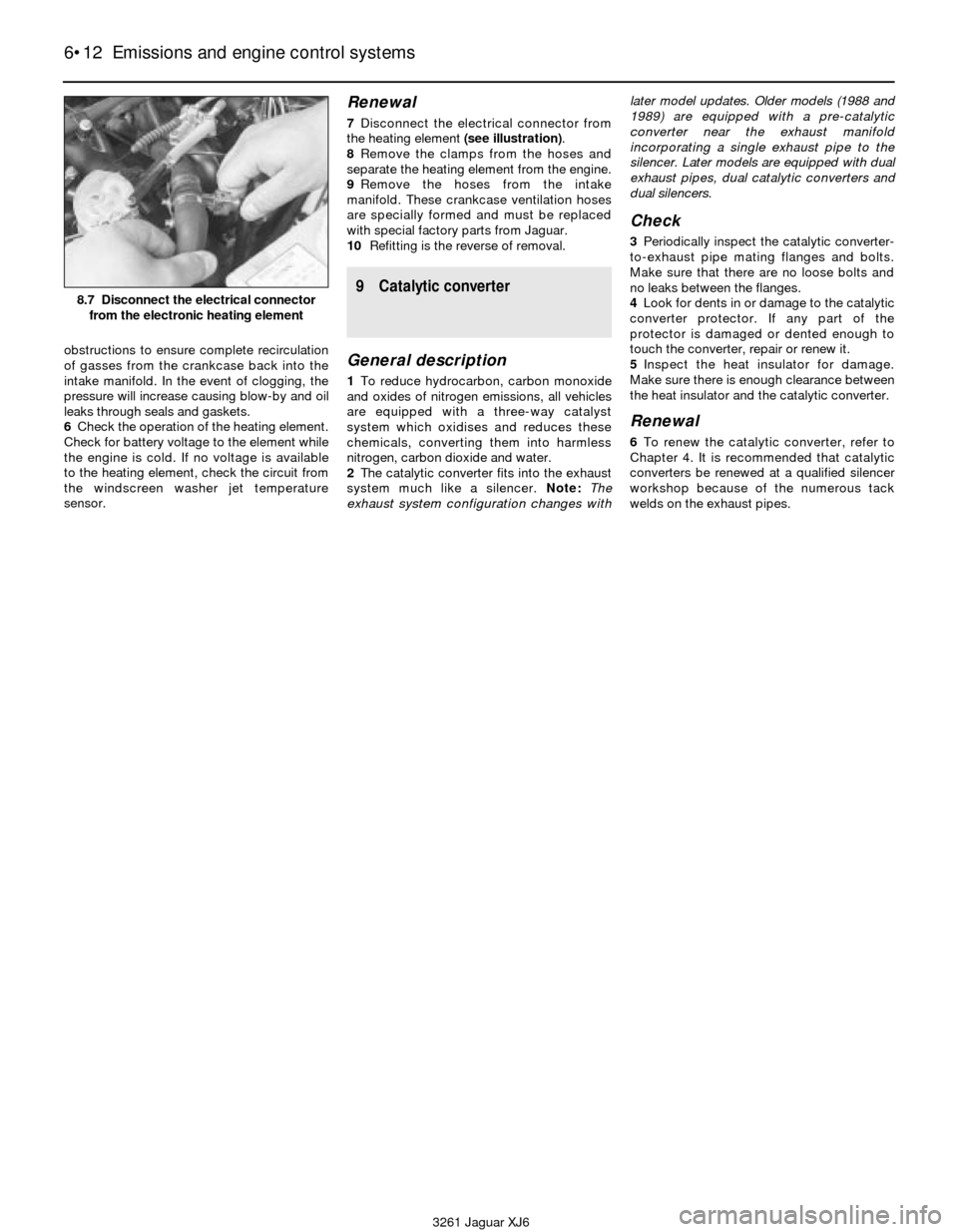
7Disconnect the electrical connector from
the heating element (see illustration).
8Remove the clamps from the hoses and
separate the heating element from the engine.
9Remove the hoses from the intake
manifold. These crankcase ventilation hoses
are specially formed and must be replaced
with special factory parts from Jaguar.
10Refitting is the reverse of removal.
9 Catalytic converter
General description
1To reduce hydrocarbon, carbon monoxide
and oxides of nitrogen emissions, all vehicles
are equipped with a three-way catalyst
system which oxidises and reduces these
chemicals, converting them into harmless
nitrogen, carbon dioxide and water.
2The catalytic converter fits into the exhaust
system much like a silencer. Note:The
exhaust system configuration changes withlater model updates. Older models (1988 and
1989) are equipped with a pre-catalytic
converter near the exhaust manifold
incorporating a single exhaust pipe to the
silencer. Later models are equipped with dual
exhaust pipes, dual catalytic converters and
dual silencers.
Check
3Periodically inspect the catalytic converter-
to-exhaust pipe mating flanges and bolts.
Make sure that there are no loose bolts and
no leaks between the flanges.
4Look for dents in or damage to the catalytic
converter protector. If any part of the
protector is damaged or dented enough to
touch the converter, repair or renew it.
5Inspect the heat insulator for damage.
Make sure there is enough clearance between
the heat insulator and the catalytic converter.
Renewal
6To renew the catalytic converter, refer to
Chapter 4. It is recommended that catalytic
converters be renewed at a qualified silencer
workshop because of the numerous tack
welds on the exhaust pipes.
6•12 Emissions and engine control systems
3261 Jaguar XJ6
8.7 Disconnect the electrical connector
from the electronic heating element
Page 161 of 227
26 Dashboard trim panels-
removal and refitting
2
Warning: Later models are
equipped with airbags. To
prevent the accidental deploy-
ment of the airbag, which could
cause personal injury or damage to the
airbag system, DO NOT work in the vicinity
of the steering column or instrument panel.
The manufacturer recommends that, on
airbag equipped models, the following
procedure should be left to a dealer service
department or other repair workshop
because of the special tools and techniques
required to disable the airbag system.
Caution: If the stereo in your vehicle is
equipped with an anti-theft system, make
sure you have the correct activation code
before disconnecting the battery
Knee bolster
1Knee bolsters are located on the lower half
of the instrument panel on the driver and
passenger sides of the vehicle. The removal of
these covers will allow access to a variety of
electrical, heating and air conditioning
components.
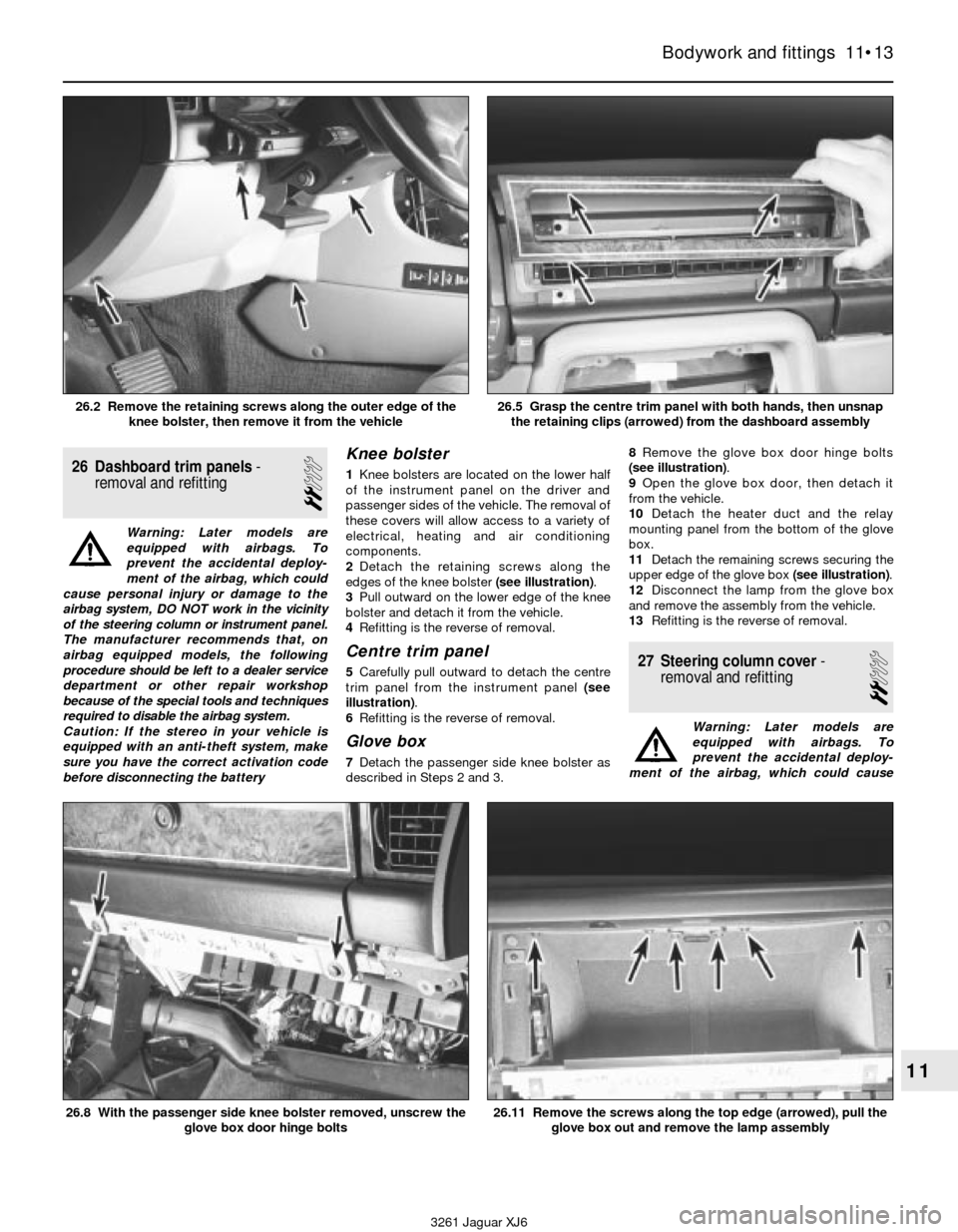
2Detach the retaining screws along the
edges of the knee bolster (see illustration).
3Pull outward on the lower edge of the knee
bolster and detach it from the vehicle.
4Refitting is the reverse of removal.
Centre trim panel
5Carefully pull outward to detach the centre
trim panel from the instrument panel (see
illustration).
6Refitting is the reverse of removal.
Glove box
7Detach the passenger side knee bolster as
described in Steps 2 and 3.8Remove the glove box door hinge bolts
(see illustration).
9Open the glove box door, then detach it
from the vehicle.
10Detach the heater duct and the relay
mounting panel from the bottom of the glove
box.
11Detach the remaining screws securing the
upper edge of the glove box (see illustration).
12Disconnect the lamp from the glove box
and remove the assembly from the vehicle.
13Refitting is the reverse of removal.
27 Steering column cover-
removal and refitting
2
Warning: Later models are
equipped with airbags. To
prevent the accidental deploy-
ment of the airbag, which could cause
Bodywork and fittings 11•13
11
3261 Jaguar XJ6 26.2 Remove the retaining screws along the outer edge of the
knee bolster, then remove it from the vehicle
26.5 Grasp the centre trim panel with both hands, then unsnap
the retaining clips (arrowed) from the dashboard assembly
26.8 With the passenger side knee bolster removed, unscrew the
glove box door hinge bolts26.11 Remove the screws along the top edge (arrowed), pull the
glove box out and remove the lamp assembly
Page 170 of 227
14 Electric aerial-
removal and refitting
2
Aerial motor assembly
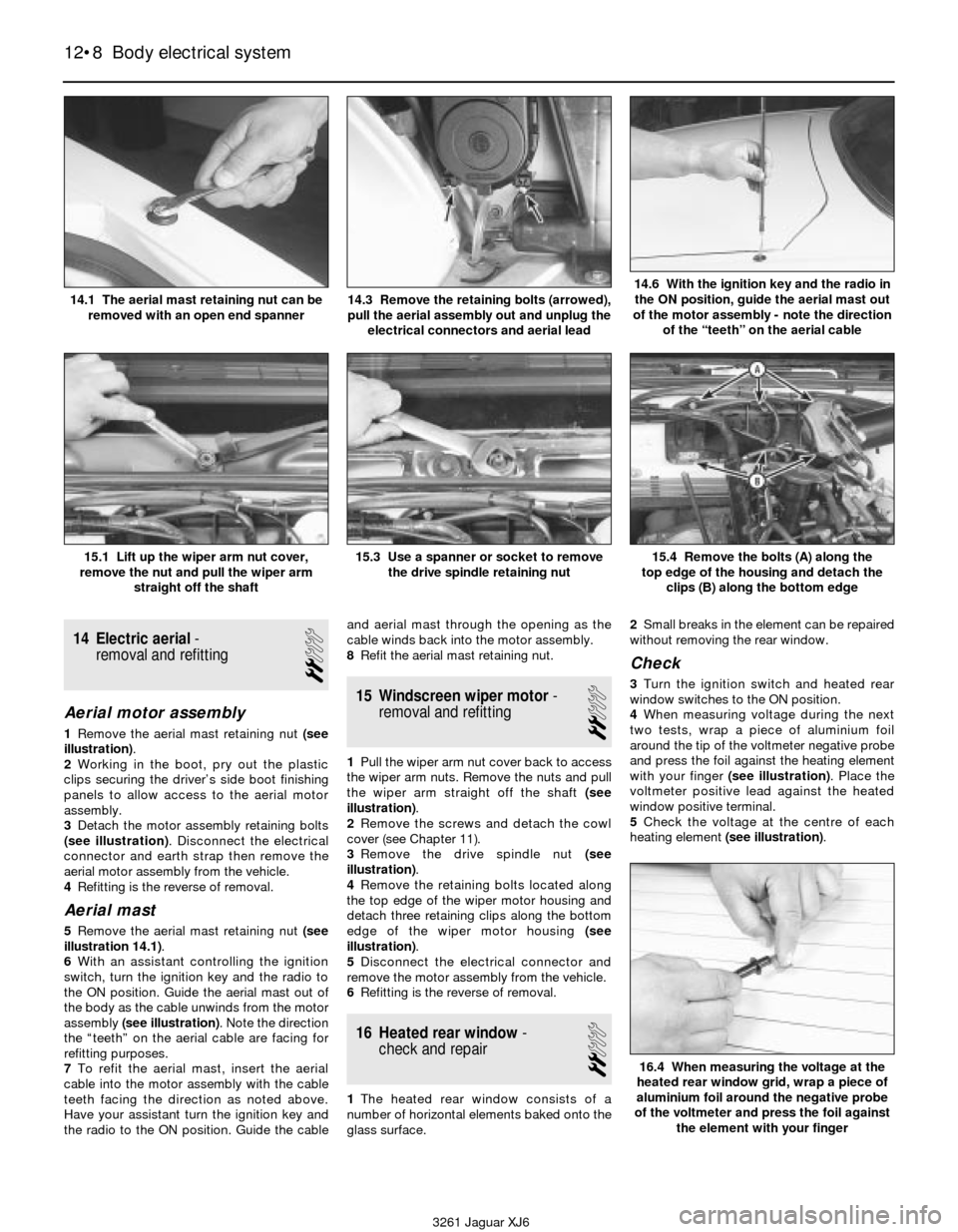
1Remove the aerial mast retaining nut (see
illustration).
2Working in the boot, pry out the plastic
clips securing the driver’s side boot finishing
panels to allow access to the aerial motor
assembly.
3Detach the motor assembly retaining bolts
(see illustration). Disconnect the electrical
connector and earth strap then remove the
aerial motor assembly from the vehicle.
4Refitting is the reverse of removal.
Aerial mast
5Remove the aerial mast retaining nut (see
illustration 14.1).
6With an assistant controlling the ignition
switch, turn the ignition key and the radio to
the ON position. Guide the aerial mast out of
the body as the cable unwinds from the motor
assembly (see illustration). Note the direction
the “teeth” on the aerial cable are facing for
refitting purposes.
7To refit the aerial mast, insert the aerial
cable into the motor assembly with the cable
teeth facing the direction as noted above.
Have your assistant turn the ignition key and
the radio to the ON position. Guide the cableand aerial mast through the opening as the
cable winds back into the motor assembly.
8Refit the aerial mast retaining nut.
15 Windscreen wiper motor-
removal and refitting
2
1Pull the wiper arm nut cover back to access
the wiper arm nuts. Remove the nuts and pull
the wiper arm straight off the shaft (see
illustration).
2Remove the screws and detach the cowl
cover (see Chapter 11).
3Remove the drive spindle nut (see
illustration).
4Remove the retaining bolts located along
the top edge of the wiper motor housing and
detach three retaining clips along the bottom
edge of the wiper motor housing (see
illustration).
5Disconnect the electrical connector and
remove the motor assembly from the vehicle.
6Refitting is the reverse of removal.
16 Heated rear window-
check and repair
2
1The heated rear window consists of a
number of horizontal elements baked onto the
glass surface.2Small breaks in the element can be repaired
without removing the rear window.
Check
3Turn the ignition switch and heated rear
window switches to the ON position.
4When measuring voltage during the next
two tests, wrap a piece of aluminium foil
around the tip of the voltmeter negative probe
and press the foil against the heating element
with your finger (see illustration). Place the
voltmeter positive lead against the heated
window positive terminal.
5Check the voltage at the centre of each
heating element (see illustration).
12•8 Body electrical system
14.1 The aerial mast retaining nut can be
removed with an open end spanner14.3 Remove the retaining bolts (arrowed),
pull the aerial assembly out and unplug the
electrical connectors and aerial lead14.6 With the ignition key and the radio in
the ON position, guide the aerial mast out
of the motor assembly - note the direction
of the “teeth” on the aerial cable
15.1 Lift up the wiper arm nut cover,
remove the nut and pull the wiper arm
straight off the shaft15.3 Use a spanner or socket to remove
the drive spindle retaining nut15.4 Remove the bolts (A) along the
top edge of the housing and detach the
clips (B) along the bottom edge
3261 Jaguar XJ6
16.4 When measuring the voltage at the
heated rear window grid, wrap a piece of
aluminium foil around the negative probe
of the voltmeter and press the foil against
the element with your finger
Page 171 of 227

6If the voltage is 6 volts, the element is okay
(there is no break). If the voltage is 12 volts,
the element is broken between the centre
of the element and the positive end. If the
voltage is 0 volts the element is broken
between the centre of the element and earth.
7To find the break, place the voltmeter
positive lead against the defogger positive
terminal. Place the voltmeter negative lead
with the foil strip against the heating element
at the positive terminal end and slide it toward
the negative terminal end. The point at which
the voltmeter deflects from zero to several
volts is the point at which the heating element
is broken (see illustration).
Repair
8Repair the break in the element using a
repair kit specifically recommended for this
purpose.
9Prior to repairing a break, turn off the system
and allow it to cool off for a few minutes.
10Lightly buff the element area with fine
steel wool, then clean it thoroughly with
rubbing alcohol.
11Use masking tape to mask off the area
being repaired.
12Thoroughly mix the epoxy, following the
instructions provided with the repair kit.
13Apply the epoxy material to the slit in the
masking tape, overlapping the undamaged
area about 3/4-inch on either end (see
illustration).
14Allow the repair to cure for 24 hours before
removing the tape and using the system.
17 Headlights- renewal
1
Warning: Later models are
equipped with halogen gas-filled
headlight bulbs which are underpressure and may shatter if the surface is
damaged or the bulb is dropped. Wear eye
protection and handle the bulbs carefully,
grasping only the base whenever possible.
Do not touch the surface of the bulb with
your fingers because the oil from your skin
could cause it to overheat and fail
prematurely. If you do touch the bulb
surface, clean it with rubbing alcohol.
Sealed beam units
1Remove the radiator grille (see Chapter 11).
2Detach the headlight bezel trim cover (see
illustration).
3Remove the headlight bezel (see
illustrations).
4Remove the screws which secure the
retaining ring and withdraw the ring. Support
the light as this is done (see illustration).
Body electrical system 12•9
12
16.13 Apply masking tape to the inside of
the window at the damaged area, then
brush on the special conductive coating17.2 Remove the screws (arrowed) and
detach the headlight bezel trim cover
17.3a Remove the two retaining screws
at the top and the one in the grille opening
(arrowed)17.3b The retaining screw at the
outside lower corner can be accessed
from under the bumper
3261 Jaguar XJ6 16.5 To determine if a heating element has broken, check the
voltage at the centre of each element. If the voltage is 6-volts, the
element is unbroken; if the voltage is 12-volts, the element is
broken between the centre and the positive end. If there is no
voltage, the element is broken between the centre and earth
16.7 To find the break, place the voltmeter positive lead against
the heated window positive terminal, place the voltmeter negative
lead with the foil strip against the heating element at the positive
terminal end and slide it toward the negative terminal end -
the point at which the voltmeter reading changes abruptly is the
point at which the element is broken
Page 213 of 227
3261 Jaguar XJ6
REF•12Fault finding
Introduction
This Section provides an easy reference guide to the more common
problems which may occur during the operation of your vehicle. These
problems and their possible causes are grouped under headings
denoting various components or systems, such as Engine, Cooling
system, etc. They also refer you to the Chapter and/or Section which
deals with the problem.
Remember that successful troubleshooting is not a mysterious
“black art” practised only by professional mechanics. It is simply the
result of the right knowledge combined with an intelligent, systematic
approach to the problem. Always work by a process of elimination,
starting with the simplest solution and working through to the mostcomplex - and never overlook the obvious. Anyone can run the petrol
tank dry or leave the lights on overnight, so don’t assume that you are
exempt from such oversights.
Finally, always establish a clear idea of why a problem has occurred
and take steps to ensure that it doesn’t happen again. If the electrical
system fails because of a poor connection, check all other connections
in the system to make sure that they don’t fail as well. If a particular
fuse continues to blow, find out why - don’t just replace one fuse after
another. Remember, failure of a small component can often be
indicative of potential failure or incorrect functioning of a more
important component or system.
Engine . . . . . . . . . . . . . . . . . . . . . . . . . . . . . .1
m mEngine backfires
m mEngine diesels (continues to run) after switching off
m mEngine hard to start when cold
m mEngine hard to start when hot
m mEngine lacks power
m mEngine lopes while idling or idles erratically
m mEngine misses at idle speed
m mEngine misses throughout driving speed range
m mEngine rattles at start-up
m mEngine rotates but will not start
m mEngine runs with oil pressure light on
m mEngine stalls
m mEngine starts but stops immediately
m mEngine stumbles on acceleration
m mEngine surges while holding accelerator steady
m mEngine will not rotate when attempting to start1
m mOil puddle under engine
m mPinking or knocking engine sounds during acceleration or uphill
m mStarter motor noisy or excessively rough in engagement
Fuel system . . . . . . . . . . . . . . . . . . . . . . . . .2
m
mExcessive fuel consumption
m mFuel leakage and/or fuel odour
Cooling system . . . . . . . . . . . . . . . . . . . . . .3
m
mCoolant loss
m mExternal coolant leakage
m mInternal coolant leakage
m mOvercooling
m mOverheating
m mPoor coolant circulation
Automatic transmission . . . . . . . . . . . . . . .4
m
mEngine will start in gears other than Park or Neutral
m mFluid leakage
m mShift cable problems
m mTransmission fluid brown or has a burned smell
m mTransmission slips, shifts roughly, is noisy or has no drive
m min forward or reverse gears
m mTransmission will not downshift with accelerator pedal
pressed to the floor
Brakes . . . . . . . . . . . . . . . . . . . . . . . . . . . . . .5
m mBrake pedal feels spongy when depressed
m mBrake pedal travels to the floor with little resistance
m mBrake roughness or chatter (pedal pulsates)
m mDragging brakes
m mExcessive brake pedal travel
m mExcessive pedal effort required to stop vehicle
m mGrabbing or uneven braking action
m mNoise (high-pitched squeal when the brakes are applied)
m mHandbrake does not hold
m mVehicle pulls to one side during braking
Suspension and steering systems . . . . . . .6
m
mAbnormal noise at the front end
m mAbnormal or excessive tyre wear
m mCupped tyres
m mErratic steering when braking
m mExcessive pitching and/or rolling around corners or
during braking
m mExcessive play or looseness in steering system
m mExcessive tyre wear on inside edge
m mExcessive tyre wear on outside edge
m mHard steering
m mPoor returnability of steering to centre
m mRattling or clicking noise in rack-and-pinion
m mShimmy, shake or vibration
m mSuspension bottoms
m mTyre tread worn in one place
m mVehicle pulls to one side
m mWander or poor steering stability
m mWheel makes a “thumping” noise
Electrical system . . . . . . . . . . . . . . . . . . . . .7
Battery will not hold a charge
Discharge warning light fails to come on when key is turned on
Discharge warning light fails to go out
Page 215 of 227
3261 Jaguar XJ6
REF•14Fault finding
2 Fuel system
Engine surges while holding accelerator steady
m mIntake air leak (Chapter 4).
m mFuel pump faulty (Chapter 4).
m mLoose fuel injector harness connections (Chapters 4 and 6).
m mDefective ECU (Chapter 6).
Pinking or knocking engine sounds during
acceleration or uphill
m mIncorrect grade of fuel.
m mDistributor installed incorrectly (Chapter 5).
m mFuel injection system in need of adjustment (Chapter 4).
m mImproper or damaged spark plugs or wires (Chapter 1).
m mWorn or damaged distributor components (Chapter 5).
m mFaulty emission system (Chapter 6).
m mVacuum leak (Chapter 4).
m mFuel rail feed (inlet) hose has hardened, resulting in knocking noise
near dash (see Chapter 4).
Engine lacks power
m mIncorrect ignition timing (Chapter 5).
m mExcessive play in distributor shaft (Chapter 5).
m mWorn rotor, distributor cap or wires (Chapters 1 and 5).
m mFaulty or incorrectly gapped spark plugs (Chapter 1).
m mFuel injection system malfunctioning (Chapter 4).
m mFaulty coil (Chapter 5).
m mBrakes binding (Chapter 1).
m mAutomatic transmission fluid level incorrect (Chapter 1).
m mFuel filter clogged and/or impurities in the fuel system (Chapter 1).
m mEmission control system not functioning properly (Chapter 6).
m mLow or uneven cylinder compression pressures (Chapter 2).
Engine rattles at start-up
m
mFailure of upper timing chain tensioner (Chapter 2).
Engine backfires
m
mEmissions system not functioning properly (Chapter 6).
m mIgnition timing incorrect (Chapter 1).
m mFaulty secondary ignition system (cracked spark plug insulator,
faulty plug leads, distributor cap and/or rotor) (Chapters 1 and 5).
m mFuel injection system malfunctioning (Chapter 4).
m mVacuum leak at fuel injector(s), intake manifold or vacuum hoses
(Chapter 4).
Engine stalls
m mIdle speed incorrect (Chapter 1).
m mFuel filter clogged and/or water and impurities in the fuel system
(Chapter 1).
m mDistributor components damp or damaged (Chapter 5).
m mFaulty emissions system components (Chapter 6).
m mFaulty or incorrectly gapped spark plugs (Chapter 1).
m mFaulty spark plug leads (Chapter 1).
m mVacuum leak in the fuel injection system, intake manifold or
vacuum hoses (Chapter 4).
Engine runs with oil pressure light on
m mLow oil level (Chapter 1).
m mIdle rpm too low (Chapter 1).
m mShort in wiring circuit (Chapter 12).
m mFaulty oil pressure sending unit (Chapter 2).
m mWorn engine bearings and/or oil pump (Chapter 2).
Engine diesels (continues to run)
after switching off
m mIdle speed too high (Chapter 4).
m mExcessive engine operating temperature (Chapter 3).
m mIncorrect fuel octane grade.
Excessive fuel consumption
m
mDirty or clogged air filter element (Chapter 1).
m mIncorrectly set ignition timing (Chapter 5).
m mEmissions system not functioning properly (Chapter 6).
m mFuel injection internal parts worn or damaged (Chapter 4).
m mLow tyre pressure or incorrect tyre size (Chapter 1).
Fuel leakage and/or fuel odour
m
mLeak in a fuel feed or vent line (Chapter 4).
m mTank overfilled.
m mFuel injector internal parts excessively worn (Chapter 4).
3 Cooling system
Overheating
m
mInsufficient coolant in system (Chapter 1).
m mWater pump drivebelt defective or out of adjustment (Chapter 1).
m mRadiator core blocked or grille restricted (Chapter 3).
m mThermostat faulty (Chapter 3).
m mRadiator cap not maintaining proper pressure (Chapter 3).
m mIgnition timing incorrect (Chapter 5).
Overcooling
m
mFaulty thermostat (Chapter 3).
External coolant leakage
m
mDeteriorated/damaged hoses; loose clamps (Chapters 1 and 3).
m mWater pump seal defective (Chapters 1 and 3).
m mLeakage from radiator core or manifold tank (Chapter 3).
m mEngine drain or water jacket core plugs leaking (Chapter 2).
m mHoses behind water pump leaking (Chapter 3).
Internal coolant leakage
m
mLeaking cylinder head gasket (Chapter 2).
m mCracked cylinder bore or cylinder head (Chapter 2).
Coolant loss
m
mToo much coolant in system (Chapter 1).
m mCoolant boiling away because of overheating (Chapter 3).
m mInternal or external leakage (Chapter 3).
m mFaulty radiator cap (Chapter 3).
Poor coolant circulation
m
mInoperative water pump (Chapter 3).
m mRestriction in cooling system (Chapters 1 and 3).
m mWater pump drivebelt defective/out of adjustment (Chapter 1).
m mThermostat sticking (Chapter 3).
1 Engine (continued)