roof JEEP CHEROKEE 1994 Service User Guide
[x] Cancel search | Manufacturer: JEEP, Model Year: 1994, Model line: CHEROKEE, Model: JEEP CHEROKEE 1994Pages: 1784, PDF Size: 77.09 MB
Page 1485 of 1784
INSTALLATION
(1) Position the drip rail moulding with clips at
the roof flange and force the clips onto the roof
flange.
(2) Apply sealant to the inner side of the moulding
to seal the roof flange.
AIR EXHAUST GRILLEÐXJ VEHICLES
REMOVAL
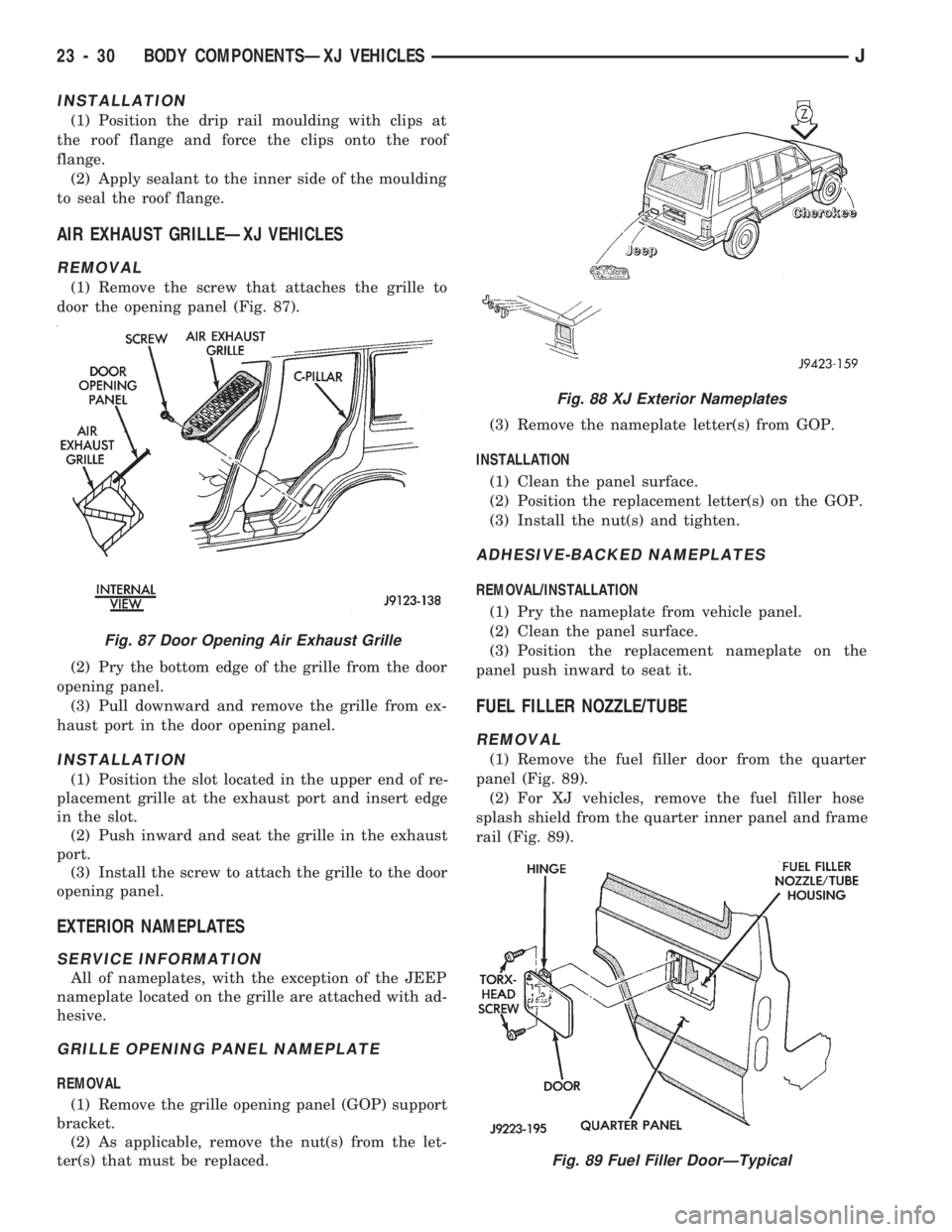
(1) Remove the screw that attaches the grille to
door the opening panel (Fig. 87).
(2) Pry the bottom edge of the grille from the door
opening panel.
(3) Pull downward and remove the grille from ex-
haust port in the door opening panel.
INSTALLATION
(1) Position the slot located in the upper end of re-
placement grille at the exhaust port and insert edge
in the slot.
(2) Push inward and seat the grille in the exhaust
port.
(3) Install the screw to attach the grille to the door
opening panel.
EXTERIOR NAMEPLATES
SERVICE INFORMATION
All of nameplates, with the exception of the JEEP
nameplate located on the grille are attached with ad-
hesive.
GRILLE OPENING PANEL NAMEPLATE
REMOVAL
(1) Remove the grille opening panel (GOP) support
bracket.
(2) As applicable, remove the nut(s) from the let-
ter(s) that must be replaced.(3) Remove the nameplate letter(s) from GOP.
INSTALLATION
(1) Clean the panel surface.
(2) Position the replacement letter(s) on the GOP.
(3) Install the nut(s) and tighten.
ADHESIVE-BACKED NAMEPLATES
REMOVAL/INSTALLATION
(1) Pry the nameplate from vehicle panel.
(2) Clean the panel surface.
(3) Position the replacement nameplate on the
panel push inward to seat it.
FUEL FILLER NOZZLE/TUBE
REMOVAL
(1) Remove the fuel filler door from the quarter
panel (Fig. 89).
(2) For XJ vehicles, remove the fuel filler hose
splash shield from the quarter inner panel and frame
rail (Fig. 89).
Fig. 89 Fuel Filler DoorÐTypical
Fig. 87 Door Opening Air Exhaust Grille
Fig. 88 XJ Exterior Nameplates
23 - 30 BODY COMPONENTSÐXJ VEHICLESJ
Page 1487 of 1784
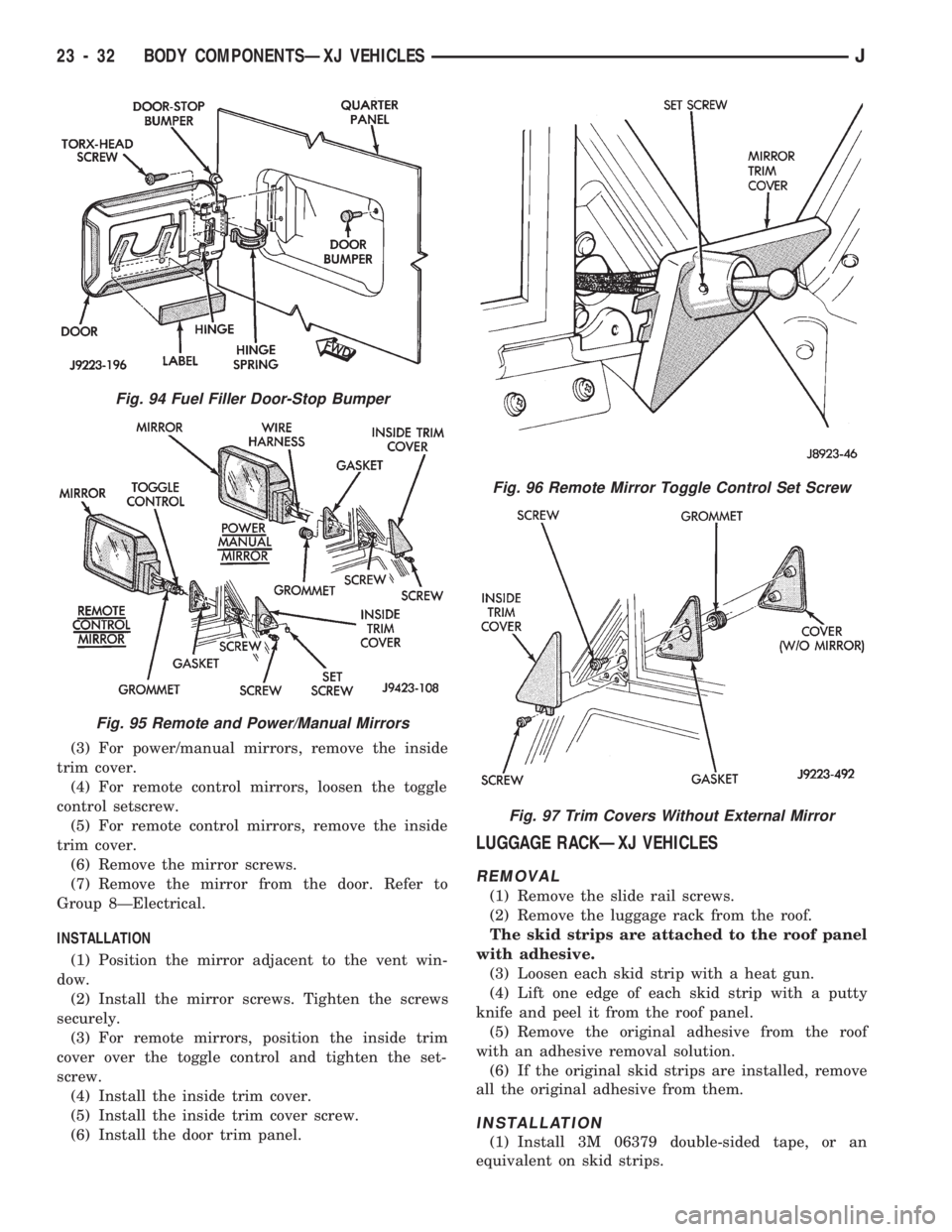
(3) For power/manual mirrors, remove the inside
trim cover.
(4) For remote control mirrors, loosen the toggle
control setscrew.
(5) For remote control mirrors, remove the inside
trim cover.
(6) Remove the mirror screws.
(7) Remove the mirror from the door. Refer to
Group 8ÐElectrical.
INSTALLATION
(1) Position the mirror adjacent to the vent win-
dow.
(2) Install the mirror screws. Tighten the screws
securely.
(3) For remote mirrors, position the inside trim
cover over the toggle control and tighten the set-
screw.
(4) Install the inside trim cover.
(5) Install the inside trim cover screw.
(6) Install the door trim panel.
LUGGAGE RACKÐXJ VEHICLES
REMOVAL
(1) Remove the slide rail screws.
(2) Remove the luggage rack from the roof.
The skid strips are attached to the roof panel
with adhesive.
(3) Loosen each skid strip with a heat gun.
(4) Lift one edge of each skid strip with a putty
knife and peel it from the roof panel.
(5) Remove the original adhesive from the roof
with an adhesive removal solution.
(6) If the original skid strips are installed, remove
all the original adhesive from them.
INSTALLATION
(1) Install 3M 06379 double-sided tape, or an
equivalent on skid strips.
Fig. 94 Fuel Filler Door-Stop Bumper
Fig. 95 Remote and Power/Manual Mirrors
Fig. 96 Remote Mirror Toggle Control Set Screw
Fig. 97 Trim Covers Without External Mirror
23 - 32 BODY COMPONENTSÐXJ VEHICLESJ
Page 1488 of 1784
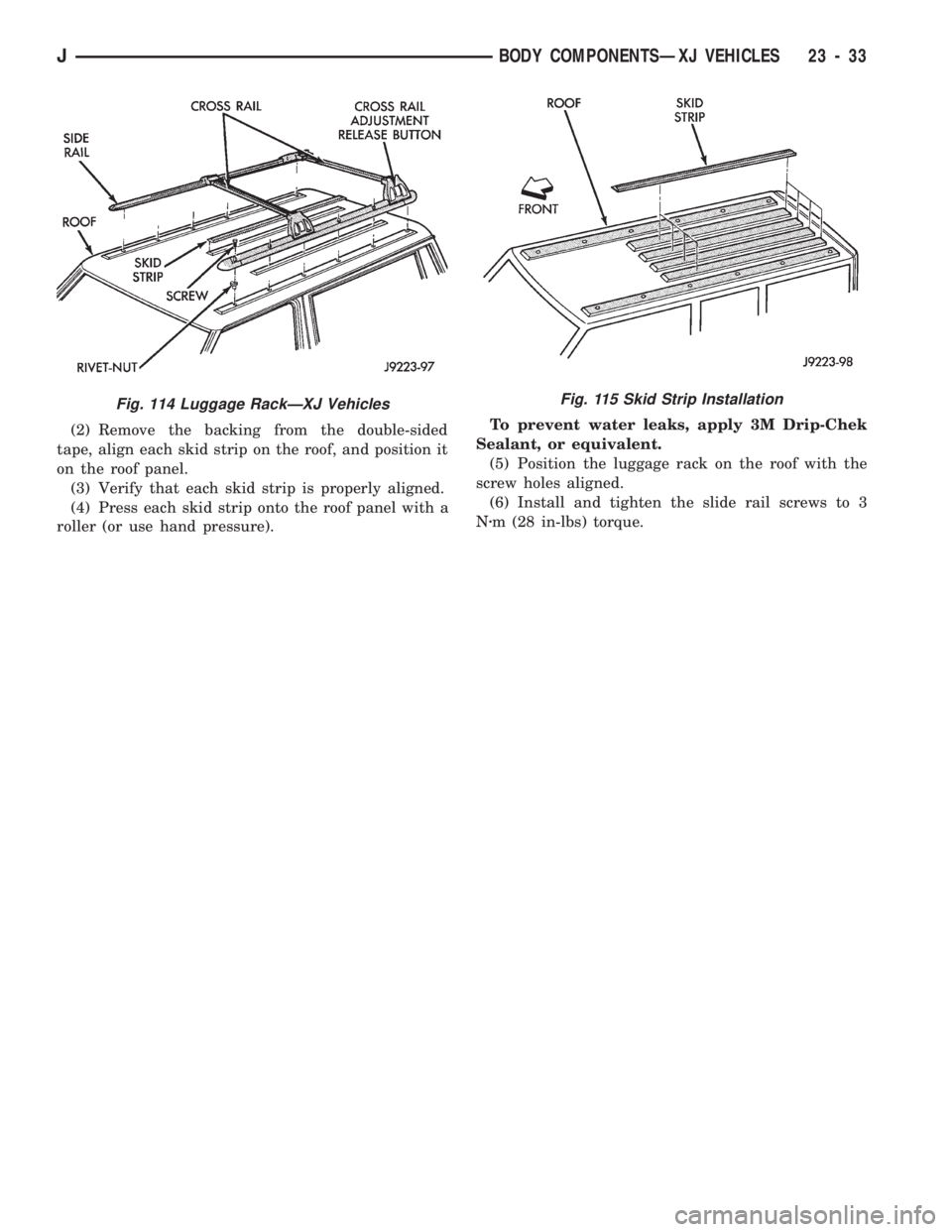
(2) Remove the backing from the double-sided
tape, align each skid strip on the roof, and position it
on the roof panel.
(3) Verify that each skid strip is properly aligned.
(4) Press each skid strip onto the roof panel with a
roller (or use hand pressure).To prevent water leaks, apply 3M Drip-Chek
Sealant, or equivalent.
(5) Position the luggage rack on the roof with the
screw holes aligned.
(6) Install and tighten the slide rail screws to 3
Nzm (28 in-lbs) torque.
Fig. 114 Luggage RackÐXJ VehiclesFig. 115 Skid Strip Installation
JBODY COMPONENTSÐXJ VEHICLES 23 - 33
Page 1522 of 1784
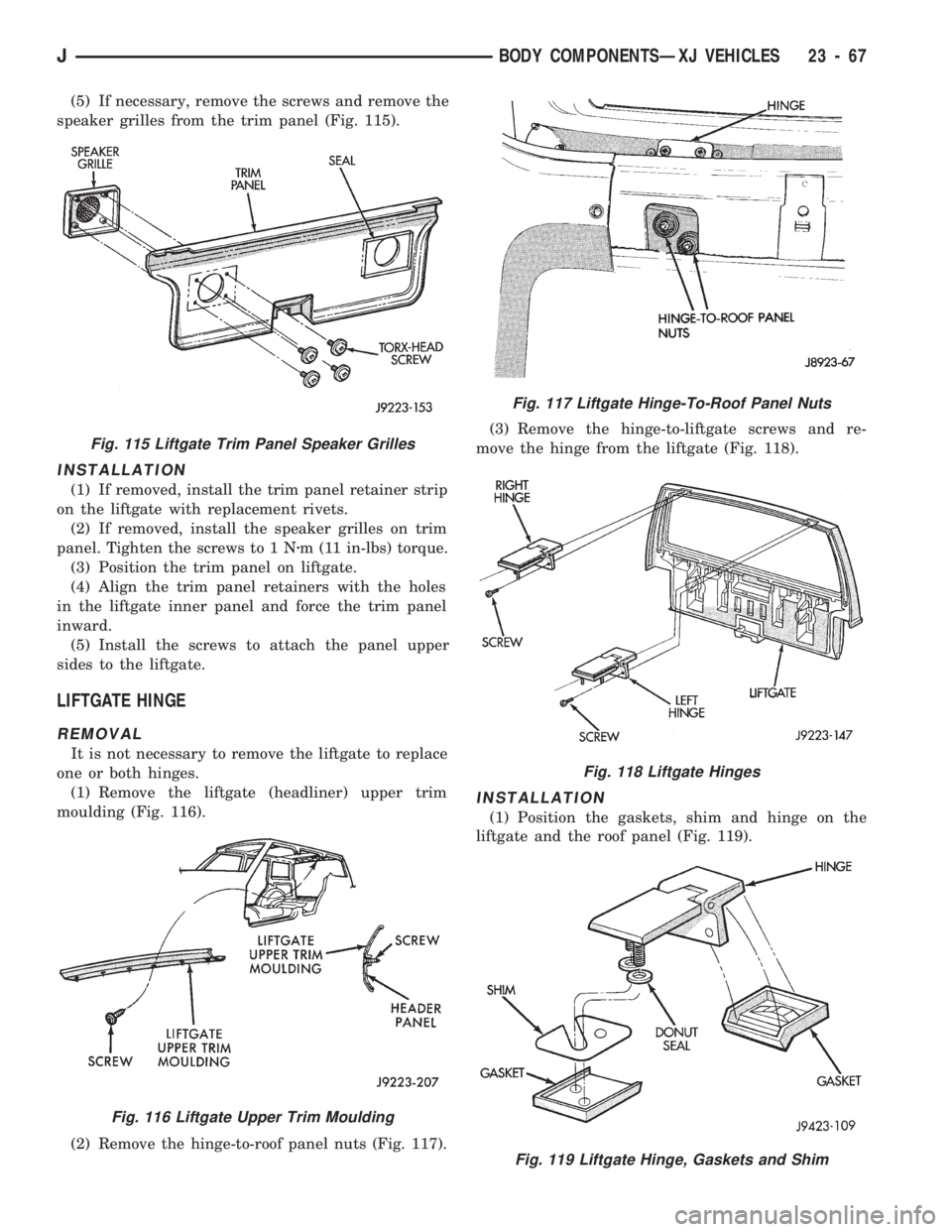
(5) If necessary, remove the screws and remove the
speaker grilles from the trim panel (Fig. 115).
INSTALLATION
(1) If removed, install the trim panel retainer strip
on the liftgate with replacement rivets.
(2) If removed, install the speaker grilles on trim
panel. Tighten the screws to 1 Nzm (11 in-lbs) torque.
(3) Position the trim panel on liftgate.
(4) Align the trim panel retainers with the holes
in the liftgate inner panel and force the trim panel
inward.
(5) Install the screws to attach the panel upper
sides to the liftgate.
LIFTGATE HINGE
REMOVAL
It is not necessary to remove the liftgate to replace
one or both hinges.
(1) Remove the liftgate (headliner) upper trim
moulding (Fig. 116).
(2) Remove the hinge-to-roof panel nuts (Fig. 117).(3) Remove the hinge-to-liftgate screws and re-
move the hinge from the liftgate (Fig. 118).
INSTALLATION
(1) Position the gaskets, shim and hinge on the
liftgate and the roof panel (Fig. 119).
Fig. 115 Liftgate Trim Panel Speaker Grilles
Fig. 116 Liftgate Upper Trim Moulding
Fig. 117 Liftgate Hinge-To-Roof Panel Nuts
Fig. 118 Liftgate Hinges
Fig. 119 Liftgate Hinge, Gaskets and Shim
JBODY COMPONENTSÐXJ VEHICLES 23 - 67
Page 1523 of 1784
(2) Install and tighten hinge-to-roof panel nuts to 9
Nzm (7 ft-lbs) torque.
(3) Install the liftgate-to-hinge screws. Tighten
screws to 9 Nzm (7 ft-lbs) torque.
(4) Install the liftgate (headliner) upper trim moul-
ding (Fig. 111).
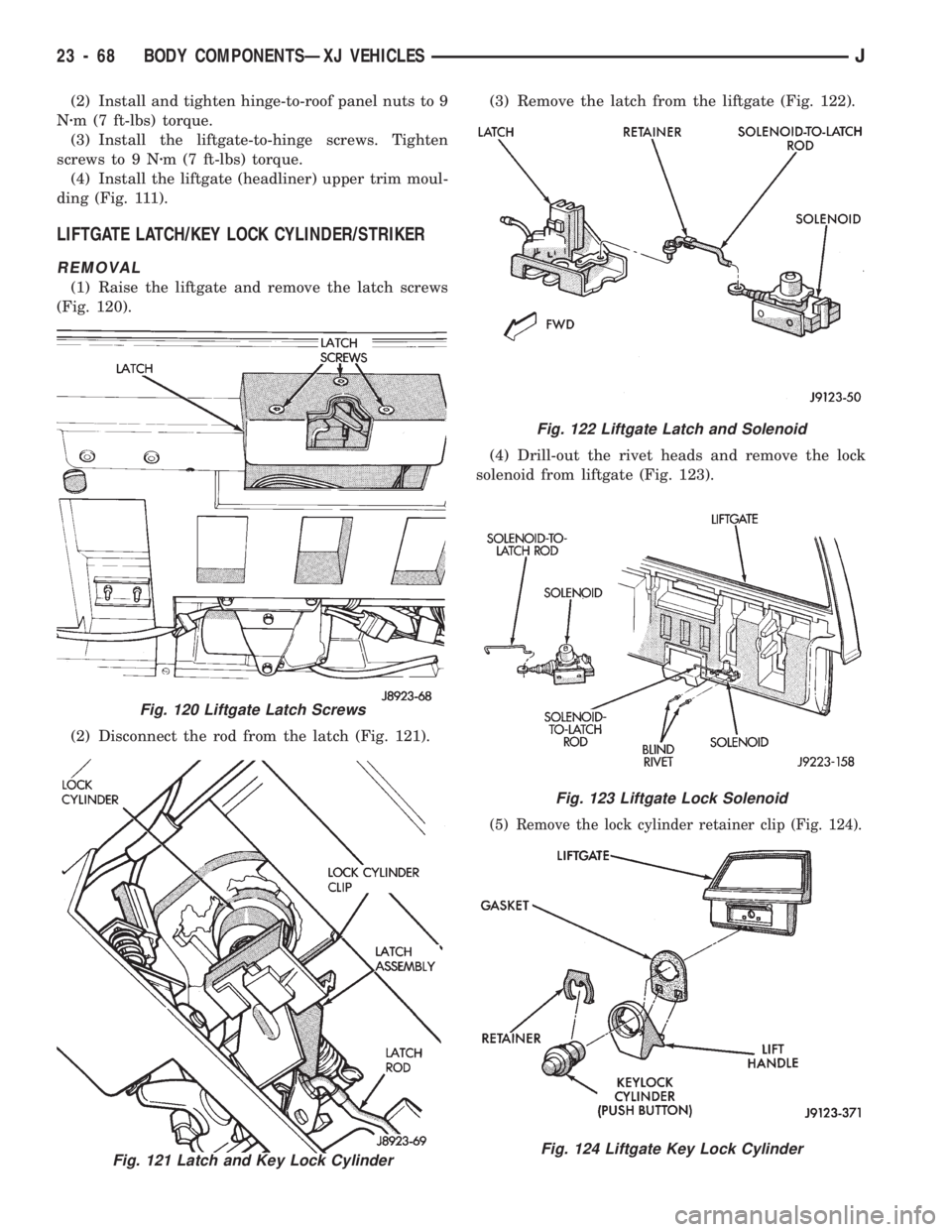
LIFTGATE LATCH/KEY LOCK CYLINDER/STRIKER
REMOVAL
(1) Raise the liftgate and remove the latch screws
(Fig. 120).
(2) Disconnect the rod from the latch (Fig. 121).(3) Remove the latch from the liftgate (Fig. 122).
(4) Drill-out the rivet heads and remove the lock
solenoid from liftgate (Fig. 123).
(5) Remove the lock cylinder retainer clip (Fig. 124).
Fig. 121 Latch and Key Lock Cylinder
Fig. 122 Liftgate Latch and Solenoid
Fig. 123 Liftgate Lock Solenoid
Fig. 124 Liftgate Key Lock Cylinder
Fig. 120 Liftgate Latch Screws
23 - 68 BODY COMPONENTSÐXJ VEHICLESJ
Page 1525 of 1784
INSTALLATION
(1) Connect the replacement support rod and cylin-
der to the ball studs.
(2) Secure the support rod and cylinder to the ball
studs with the retainer clips.
(3) Remove the support from the liftgate and test
the operation of the support rod.
LIFTGATE SUPPORT ROD CYLINDER DISPOSAL
WARNING: SAFETY GOGGLES MUST BE WORN
DURING THE DISPOSAL PROCEDURE. THE HIGH
PRESSURE GAS CHARGE IN THE SUPPORT ROD
CYLINDERS WILL BE RELEASED DURING THE
PROCEDURE.
(1) Remove the support rod cylinder(s) from the
liftgate.
(2) Position the support rod cylinder horizontally
in a vise and clamp the cylinder securely.
(3) Wrap the cylinder with 4-5 layers of shop tow-
els.
(4) Measure 1 and 1/2 inches inward from the end
of the cylinder. Mark this location on the towels with
chalk. The cylinder will be punctured at this location
to release the gas charge.
(5) Use a punch and hammer to puncture cylinder.
Force the punch through towels and into the cylinder
with a hammer. Continue striking the punch until
the gas begins to escapebut do not remove the
punch.
(6) Hold the towels and punch in position until all
the gas has escaped. Complete de-pressurization will
require about 4 to 10 seconds. After all the gas has
escaped, slowly remove the punch.
(7) Hold a towel over the hole in cylinder and press
the support rod piston all the way into the cylinder
to purge remaining oil.
(8) Remove the support rod cylinder from the vise
and discard it.
(9) If both support rod cylinders are being re-
placed, repeat this procedure for the remaining cylin-
der.
LIFTGATE SUPPORT ROD BALL STUD
REPLACEMENT
REMOVAL
(1) Open the liftgate.
(2) Support the liftgate in the open position.
(3) Remove the retainer clip that attaches the sup-
port rod and cylinder to the ball stud.
(4) Disconnect the support rod from the ball stud.
(5) Remove the ball stud from the liftgate with a
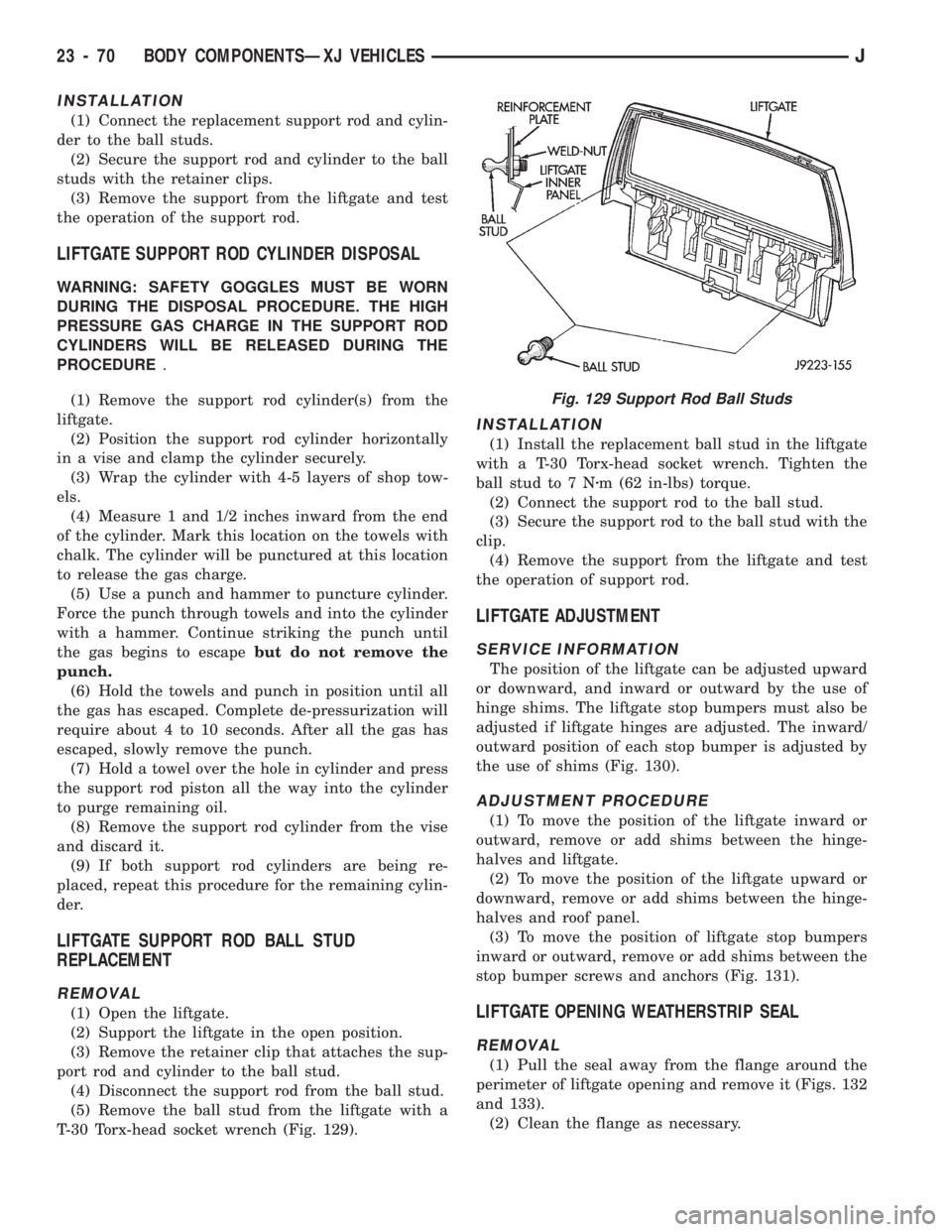
T-30 Torx-head socket wrench (Fig. 129).
INSTALLATION
(1) Install the replacement ball stud in the liftgate
with a T-30 Torx-head socket wrench. Tighten the
ball stud to 7 Nzm (62 in-lbs) torque.
(2) Connect the support rod to the ball stud.
(3) Secure the support rod to the ball stud with the
clip.
(4) Remove the support from the liftgate and test
the operation of support rod.
LIFTGATE ADJUSTMENT
SERVICE INFORMATION
The position of the liftgate can be adjusted upward
or downward, and inward or outward by the use of
hinge shims. The liftgate stop bumpers must also be
adjusted if liftgate hinges are adjusted. The inward/
outward position of each stop bumper is adjusted by
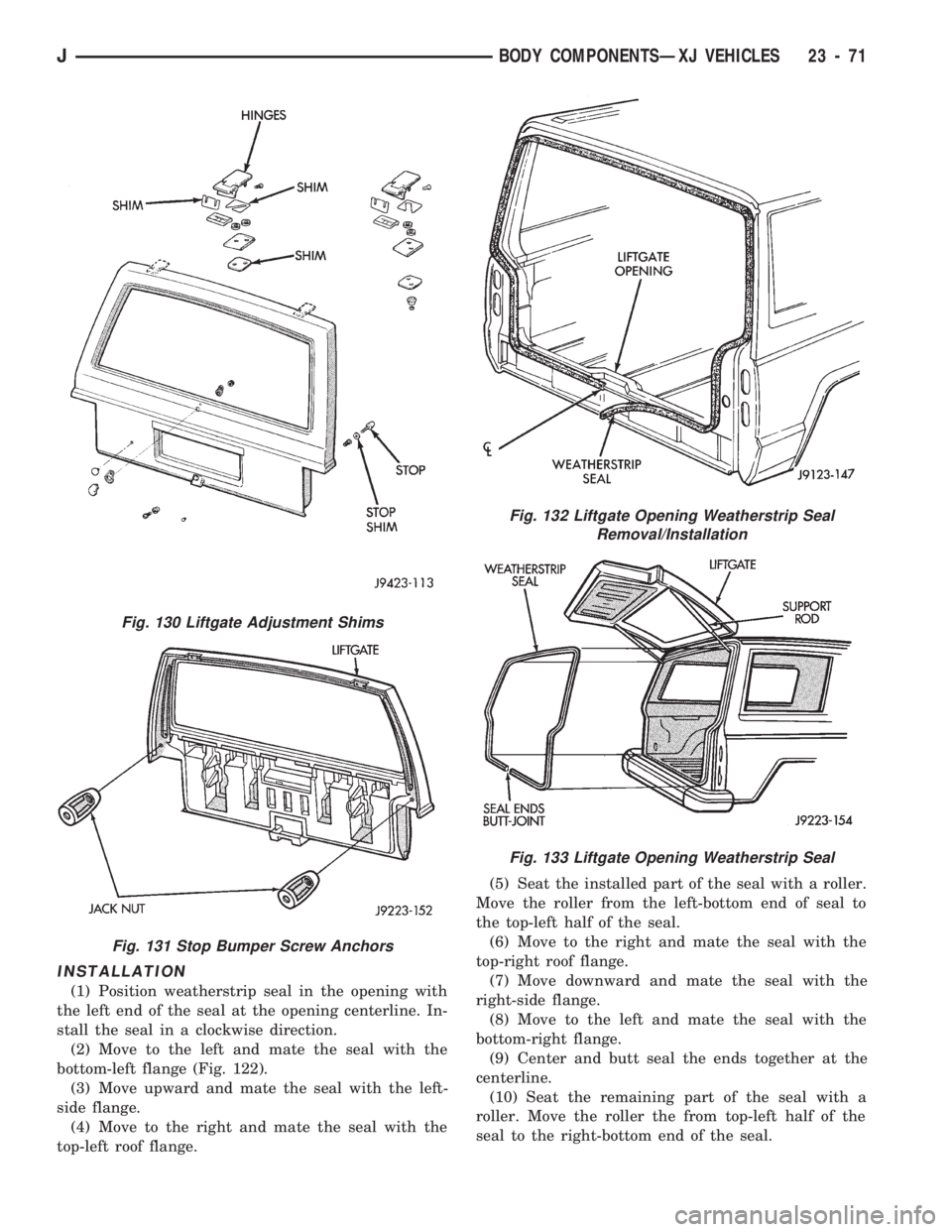
the use of shims (Fig. 130).
ADJUSTMENT PROCEDURE
(1) To move the position of the liftgate inward or
outward, remove or add shims between the hinge-
halves and liftgate.
(2) To move the position of the liftgate upward or
downward, remove or add shims between the hinge-
halves and roof panel.
(3) To move the position of liftgate stop bumpers
inward or outward, remove or add shims between the
stop bumper screws and anchors (Fig. 131).
LIFTGATE OPENING WEATHERSTRIP SEAL
REMOVAL
(1) Pull the seal away from the flange around the
perimeter of liftgate opening and remove it (Figs. 132
and 133).
(2) Clean the flange as necessary.
Fig. 129 Support Rod Ball Studs
23 - 70 BODY COMPONENTSÐXJ VEHICLESJ
Page 1526 of 1784
INSTALLATION
(1) Position weatherstrip seal in the opening with
the left end of the seal at the opening centerline. In-
stall the seal in a clockwise direction.
(2) Move to the left and mate the seal with the
bottom-left flange (Fig. 122).
(3) Move upward and mate the seal with the left-
side flange.
(4) Move to the right and mate the seal with the
top-left roof flange.(5) Seat the installed part of the seal with a roller.
Move the roller from the left-bottom end of seal to
the top-left half of the seal.
(6) Move to the right and mate the seal with the
top-right roof flange.
(7) Move downward and mate the seal with the
right-side flange.
(8) Move to the left and mate the seal with the
bottom-right flange.
(9) Center and butt seal the ends together at the
centerline.
(10) Seat the remaining part of the seal with a
roller. Move the roller the from top-left half of the
seal to the right-bottom end of the seal.
Fig. 130 Liftgate Adjustment Shims
Fig. 131 Stop Bumper Screw Anchors
Fig. 132 Liftgate Opening Weatherstrip Seal
Removal/Installation
Fig. 133 Liftgate Opening Weatherstrip Seal
JBODY COMPONENTSÐXJ VEHICLES 23 - 71
Page 1575 of 1784
REAR SHOULDER/LAP BELT/BUCKLEÐXJ VEHICLES
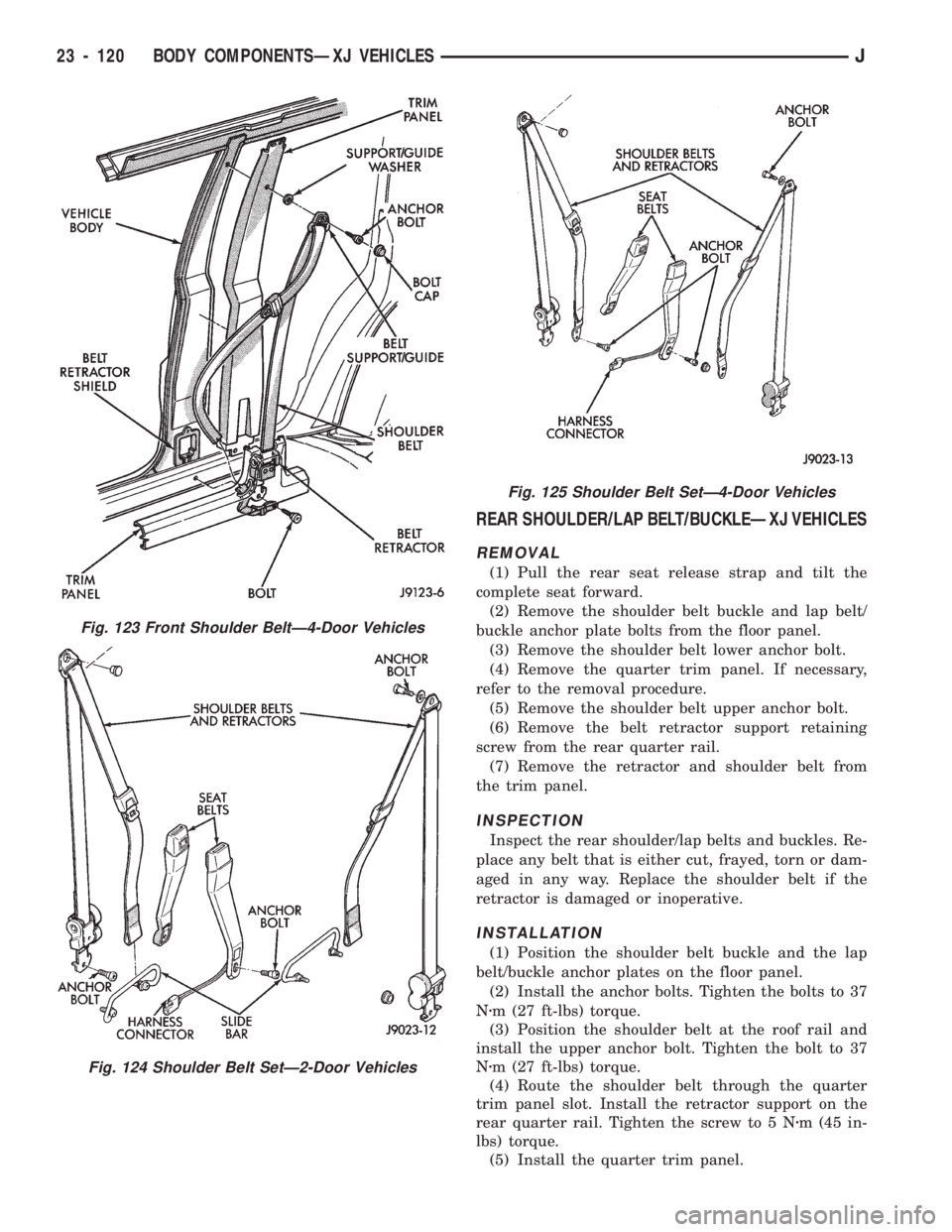
REMOVAL
(1) Pull the rear seat release strap and tilt the
complete seat forward.
(2) Remove the shoulder belt buckle and lap belt/
buckle anchor plate bolts from the floor panel.
(3) Remove the shoulder belt lower anchor bolt.
(4) Remove the quarter trim panel. If necessary,
refer to the removal procedure.
(5) Remove the shoulder belt upper anchor bolt.
(6) Remove the belt retractor support retaining
screw from the rear quarter rail.
(7) Remove the retractor and shoulder belt from
the trim panel.
INSPECTION
Inspect the rear shoulder/lap belts and buckles. Re-
place any belt that is either cut, frayed, torn or dam-
aged in any way. Replace the shoulder belt if the
retractor is damaged or inoperative.
INSTALLATION
(1) Position the shoulder belt buckle and the lap
belt/buckle anchor plates on the floor panel.
(2) Install the anchor bolts. Tighten the bolts to 37
Nzm (27 ft-lbs) torque.
(3) Position the shoulder belt at the roof rail and
install the upper anchor bolt. Tighten the bolt to 37
Nzm (27 ft-lbs) torque.
(4) Route the shoulder belt through the quarter
trim panel slot. Install the retractor support on the
rear quarter rail. Tighten the screw to 5 Nzm (45 in-
lbs) torque.
(5) Install the quarter trim panel.
Fig. 123 Front Shoulder BeltÐ4-Door Vehicles
Fig. 124 Shoulder Belt SetÐ2-Door Vehicles
Fig. 125 Shoulder Belt SetÐ4-Door Vehicles
23 - 120 BODY COMPONENTSÐXJ VEHICLESJ
Page 1576 of 1784
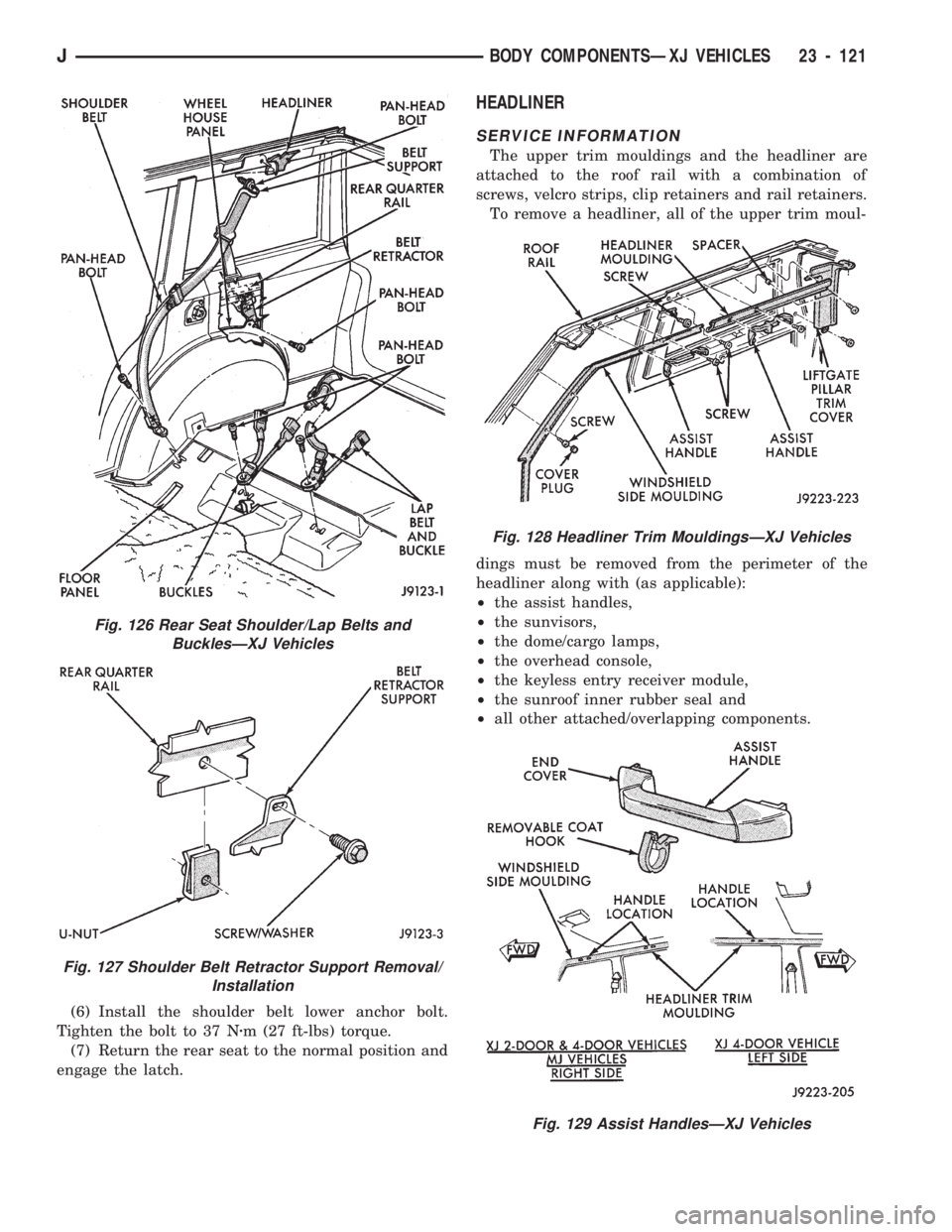
(6) Install the shoulder belt lower anchor bolt.
Tighten the bolt to 37 Nzm (27 ft-lbs) torque.
(7) Return the rear seat to the normal position and
engage the latch.
HEADLINER
SERVICE INFORMATION
The upper trim mouldings and the headliner are
attached to the roof rail with a combination of
screws, velcro strips, clip retainers and rail retainers.
To remove a headliner, all of the upper trim moul-
dings must be removed from the perimeter of the
headliner along with (as applicable):
²the assist handles,
²the sunvisors,
²the dome/cargo lamps,
²the overhead console,
²the keyless entry receiver module,
²the sunroof inner rubber seal and
²all other attached/overlapping components.
Fig. 128 Headliner Trim MouldingsÐXJ Vehicles
Fig. 129 Assist HandlesÐXJ Vehicles
Fig. 126 Rear Seat Shoulder/Lap Belts and
BucklesÐXJ Vehicles
Fig. 127 Shoulder Belt Retractor Support Removal/
Installation
JBODY COMPONENTSÐXJ VEHICLES 23 - 121
Page 1577 of 1784
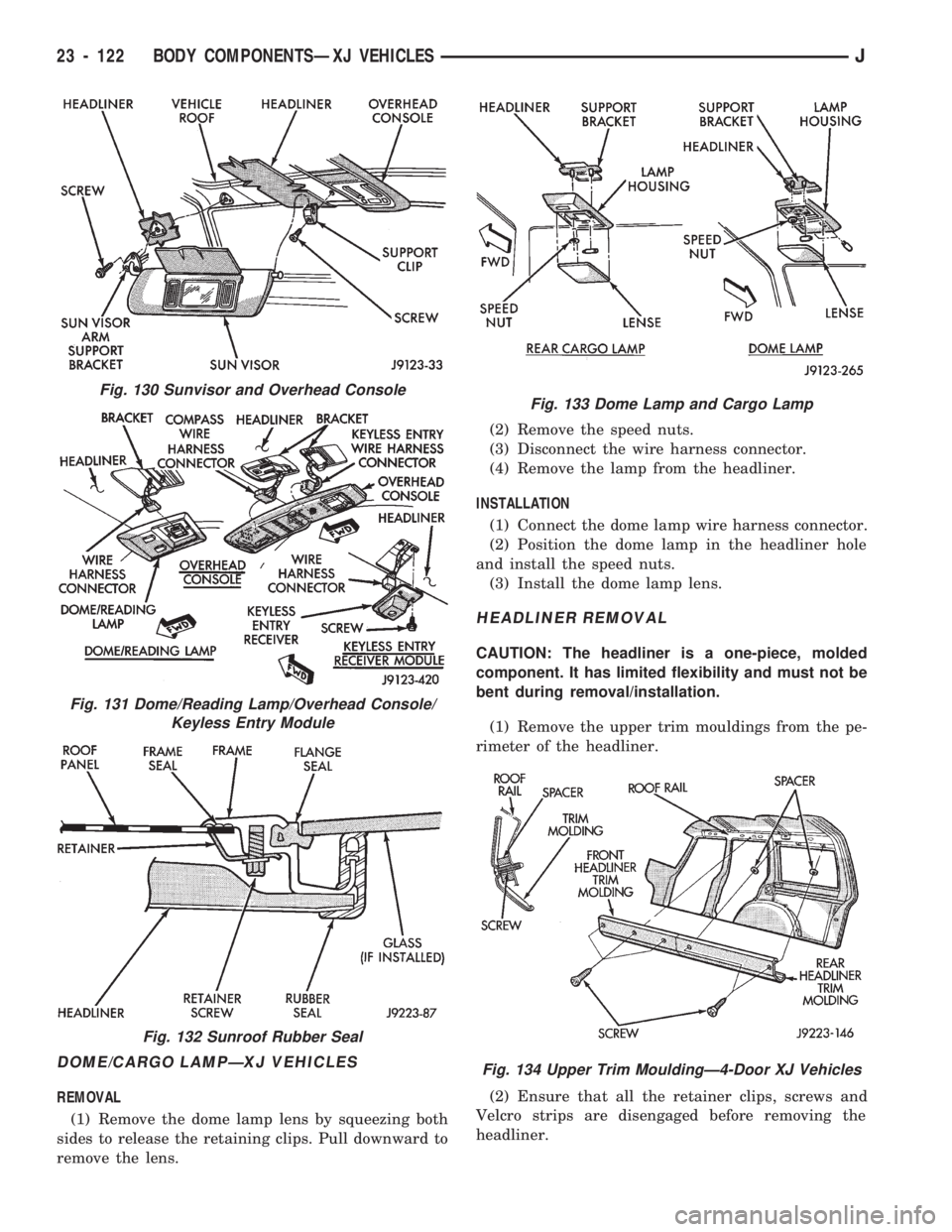
DOME/CARGO LAMPÐXJ VEHICLES
REMOVAL
(1) Remove the dome lamp lens by squeezing both
sides to release the retaining clips. Pull downward to
remove the lens.(2) Remove the speed nuts.
(3) Disconnect the wire harness connector.
(4) Remove the lamp from the headliner.
INSTALLATION
(1) Connect the dome lamp wire harness connector.
(2) Position the dome lamp in the headliner hole
and install the speed nuts.
(3) Install the dome lamp lens.
HEADLINER REMOVAL
CAUTION: The headliner is a one-piece, molded
component. It has limited flexibility and must not be
bent during removal/installation.
(1) Remove the upper trim mouldings from the pe-
rimeter of the headliner.
(2) Ensure that all the retainer clips, screws and
Velcro strips are disengaged before removing the
headliner.
Fig. 130 Sunvisor and Overhead Console
Fig. 131 Dome/Reading Lamp/Overhead Console/
Keyless Entry Module
Fig. 132 Sunroof Rubber Seal
Fig. 133 Dome Lamp and Cargo Lamp
Fig. 134 Upper Trim MouldingÐ4-Door XJ Vehicles
23 - 122 BODY COMPONENTSÐXJ VEHICLESJ