front JEEP CHEROKEE 1994 Service Repair Manual
[x] Cancel search | Manufacturer: JEEP, Model Year: 1994, Model line: CHEROKEE, Model: JEEP CHEROKEE 1994Pages: 1784, PDF Size: 77.09 MB
Page 1634 of 1784
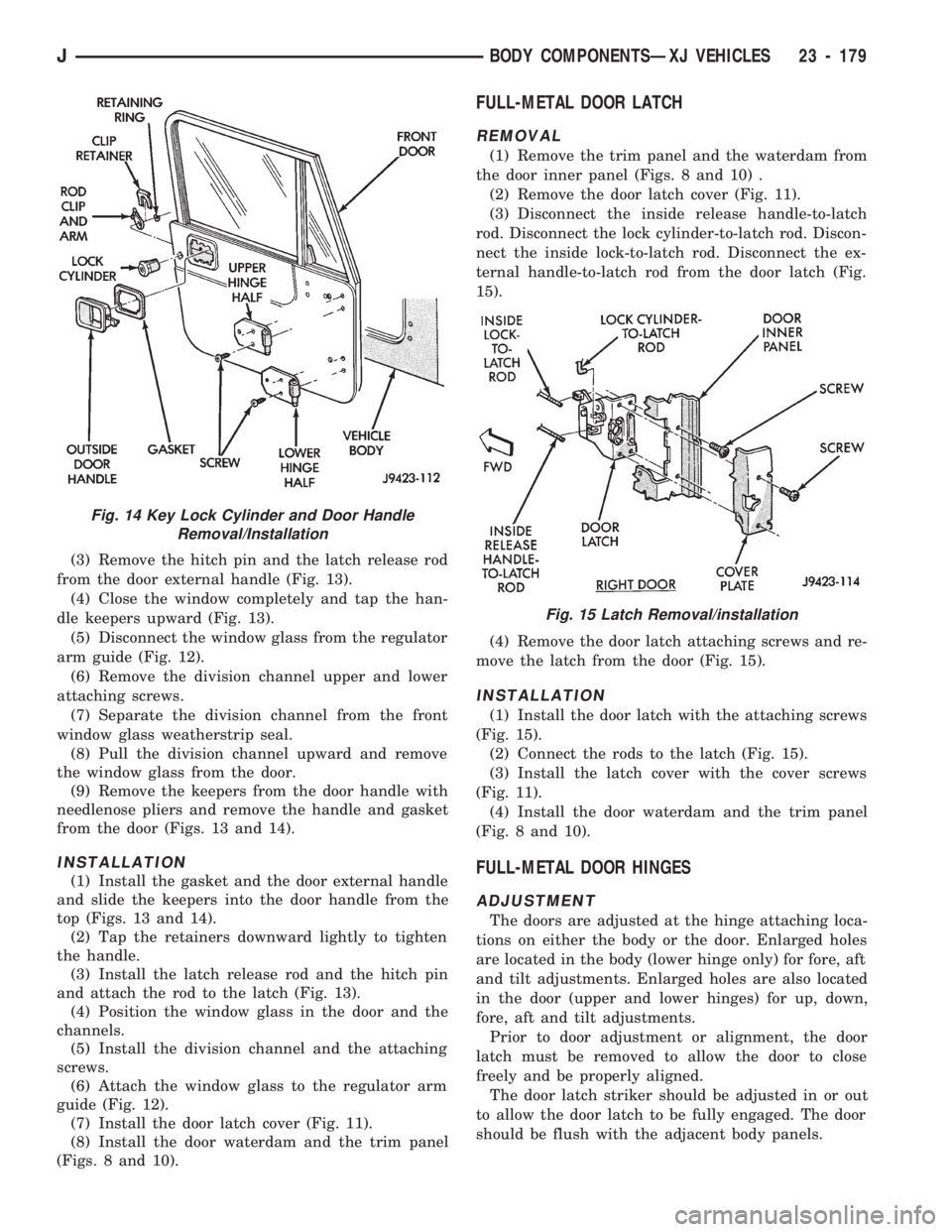
(3) Remove the hitch pin and the latch release rod
from the door external handle (Fig. 13).
(4) Close the window completely and tap the han-
dle keepers upward (Fig. 13).
(5) Disconnect the window glass from the regulator
arm guide (Fig. 12).
(6) Remove the division channel upper and lower
attaching screws.
(7) Separate the division channel from the front
window glass weatherstrip seal.
(8) Pull the division channel upward and remove
the window glass from the door.
(9) Remove the keepers from the door handle with
needlenose pliers and remove the handle and gasket
from the door (Figs. 13 and 14).
INSTALLATION
(1) Install the gasket and the door external handle
and slide the keepers into the door handle from the
top (Figs. 13 and 14).
(2) Tap the retainers downward lightly to tighten
the handle.
(3) Install the latch release rod and the hitch pin
and attach the rod to the latch (Fig. 13).
(4) Position the window glass in the door and the
channels.
(5) Install the division channel and the attaching
screws.
(6) Attach the window glass to the regulator arm
guide (Fig. 12).
(7) Install the door latch cover (Fig. 11).
(8) Install the door waterdam and the trim panel
(Figs. 8 and 10).
FULL-METAL DOOR LATCH
REMOVAL
(1) Remove the trim panel and the waterdam from
the door inner panel (Figs. 8 and 10) .
(2) Remove the door latch cover (Fig. 11).
(3) Disconnect the inside release handle-to-latch
rod. Disconnect the lock cylinder-to-latch rod. Discon-
nect the inside lock-to-latch rod. Disconnect the ex-
ternal handle-to-latch rod from the door latch (Fig.
15).
(4) Remove the door latch attaching screws and re-
move the latch from the door (Fig. 15).
INSTALLATION
(1) Install the door latch with the attaching screws
(Fig. 15).
(2) Connect the rods to the latch (Fig. 15).
(3) Install the latch cover with the cover screws
(Fig. 11).
(4) Install the door waterdam and the trim panel
(Fig. 8 and 10).
FULL-METAL DOOR HINGES
ADJUSTMENT
The doors are adjusted at the hinge attaching loca-
tions on either the body or the door. Enlarged holes
are located in the body (lower hinge only) for fore, aft
and tilt adjustments. Enlarged holes are also located
in the door (upper and lower hinges) for up, down,
fore, aft and tilt adjustments.
Prior to door adjustment or alignment, the door
latch must be removed to allow the door to close
freely and be properly aligned.
The door latch striker should be adjusted in or out
to allow the door latch to be fully engaged. The door
should be flush with the adjacent body panels.
Fig. 15 Latch Removal/installation
Fig. 14 Key Lock Cylinder and Door Handle
Removal/Installation
JBODY COMPONENTSÐXJ VEHICLES 23 - 179
Page 1636 of 1784
INSTALLATION
(1) Apply adhesive to the front, rear and bottom
edges of the door from the beltline downward.
(2) Install the upper front corner of the seal on the
door first using your fingers or a wooden wand to po-
sition the seal in the channel. Place the inner shoul-
der of the seal in the channel-to-window frame above
the beltline.
(3) Force the retainers, starting at the rear edge of
the door, into the door panel holes.
(4) Ensure that the seal is completely seated
around the door.
BELTLINE SEAL REPLACEMENT
REMOVAL
(1) Carefully remove the beltline weatherstrip seal
(Fig. 17) from the door with a weatherstrip seal re-
moval tool or similar pry tool.
(2) Pry the seal upward to remove it from within
the glass and door panel.
INSTALLATION
(1) Position the seal between the door panel and
the glass. Force the seal downward with your fingers
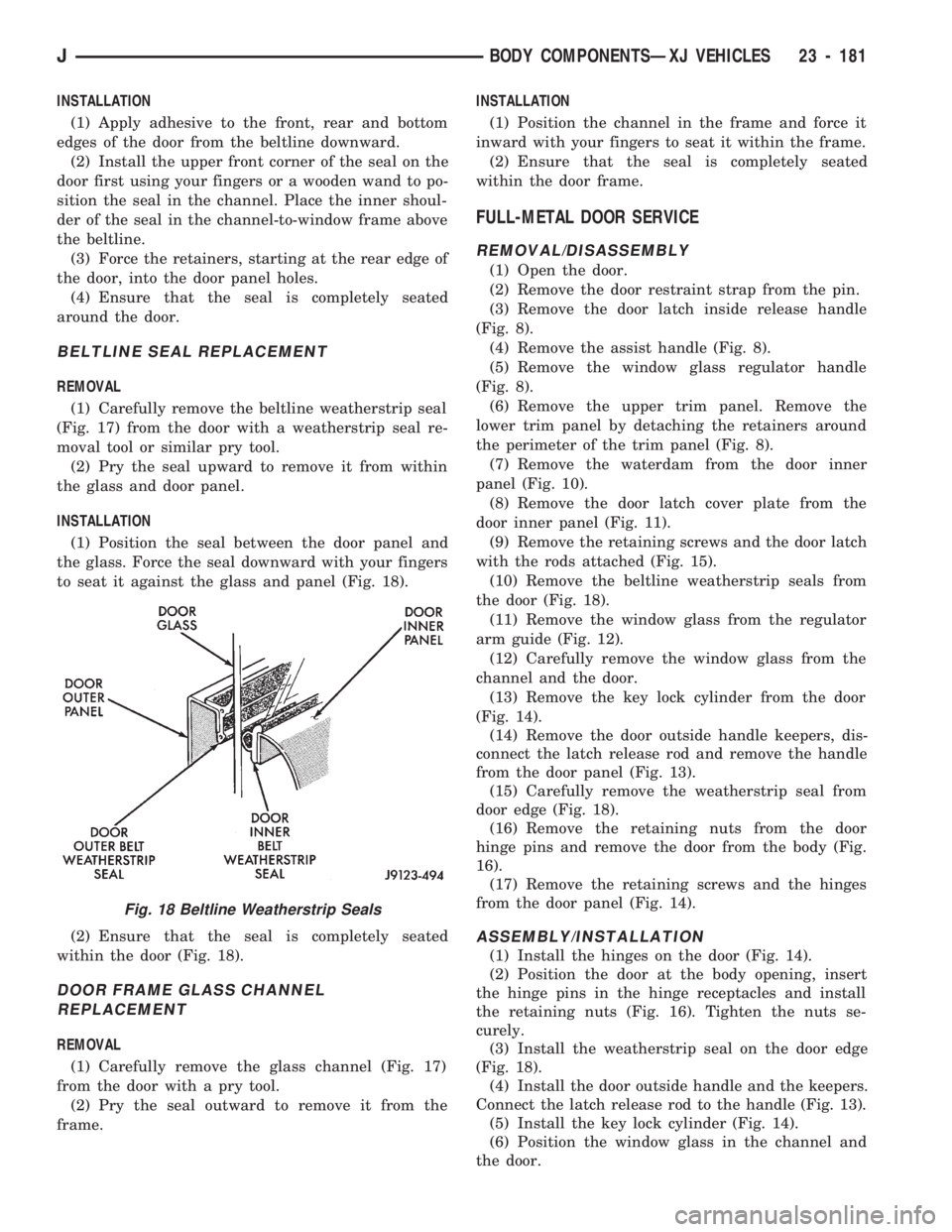
to seat it against the glass and panel (Fig. 18).
(2) Ensure that the seal is completely seated
within the door (Fig. 18).
DOOR FRAME GLASS CHANNEL
REPLACEMENT
REMOVAL
(1) Carefully remove the glass channel (Fig. 17)
from the door with a pry tool.
(2) Pry the seal outward to remove it from the
frame.INSTALLATION
(1) Position the channel in the frame and force it
inward with your fingers to seat it within the frame.
(2) Ensure that the seal is completely seated
within the door frame.
FULL-METAL DOOR SERVICE
REMOVAL/DISASSEMBLY
(1) Open the door.
(2) Remove the door restraint strap from the pin.
(3) Remove the door latch inside release handle
(Fig. 8).
(4) Remove the assist handle (Fig. 8).
(5) Remove the window glass regulator handle
(Fig. 8).
(6) Remove the upper trim panel. Remove the
lower trim panel by detaching the retainers around
the perimeter of the trim panel (Fig. 8).
(7) Remove the waterdam from the door inner
panel (Fig. 10).
(8) Remove the door latch cover plate from the
door inner panel (Fig. 11).
(9) Remove the retaining screws and the door latch
with the rods attached (Fig. 15).
(10) Remove the beltline weatherstrip seals from
the door (Fig. 18).
(11) Remove the window glass from the regulator
arm guide (Fig. 12).
(12) Carefully remove the window glass from the
channel and the door.
(13) Remove the key lock cylinder from the door
(Fig. 14).
(14) Remove the door outside handle keepers, dis-
connect the latch release rod and remove the handle
from the door panel (Fig. 13).
(15) Carefully remove the weatherstrip seal from
door edge (Fig. 18).
(16) Remove the retaining nuts from the door
hinge pins and remove the door from the body (Fig.
16).
(17) Remove the retaining screws and the hinges
from the door panel (Fig. 14).
ASSEMBLY/INSTALLATION
(1) Install the hinges on the door (Fig. 14).
(2) Position the door at the body opening, insert
the hinge pins in the hinge receptacles and install
the retaining nuts (Fig. 16). Tighten the nuts se-
curely.
(3) Install the weatherstrip seal on the door edge
(Fig. 18).
(4) Install the door outside handle and the keepers.
Connect the latch release rod to the handle (Fig. 13).
(5) Install the key lock cylinder (Fig. 14).
(6) Position the window glass in the channel and
the door.
Fig. 18 Beltline Weatherstrip Seals
JBODY COMPONENTSÐXJ VEHICLES 23 - 181
Page 1645 of 1784
INTERIOR COMPONENTS
INDEX
page page
Carpet/Floor Mats....................... 198
Floor Consoles......................... 197
Front Shoulder Belts..................... 196
Glove Box............................. 194
Instrument Cluster and Gauge Housings...... 190
Instrument Cluster Bezel.................. 191Instrument Panel........................ 190
Instrument Panel Components.............. 191
Instrument Panel Service.................. 192
Rear Shoulder Belts..................... 196
Seats................................ 195
Sunvisors............................. 196
INSTRUMENT PANEL
SERVICE INFORMATION
The instrument panel is constructed of sheet metal
and is attached to cowl panel with screws. The in-
strument panel and defroster grille pad is attached
to the instrument panel with screws.
INSTRUMENT CLUSTER AND GAUGE HOUSINGS
REMOVAL
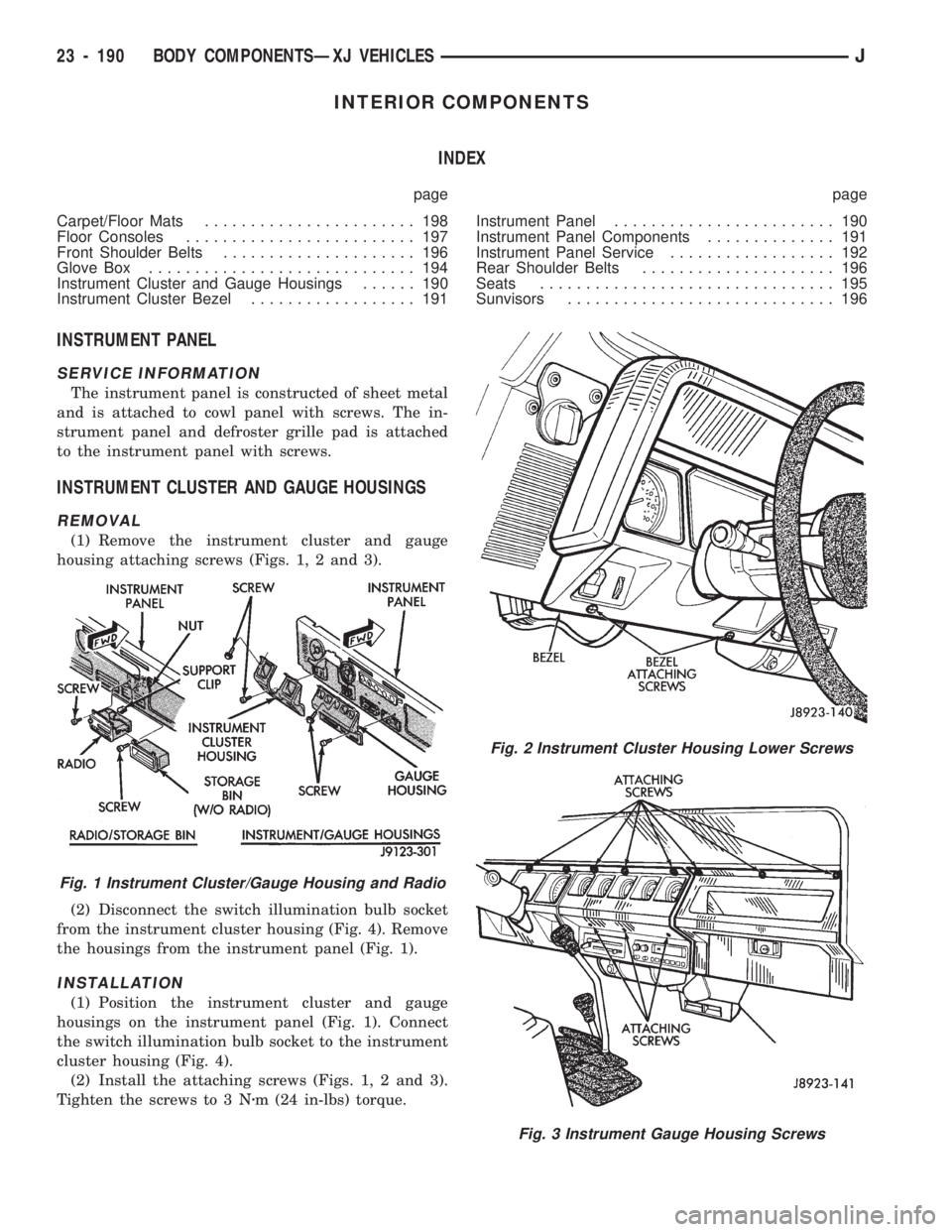
(1) Remove the instrument cluster and gauge
housing attaching screws (Figs. 1, 2 and 3).
(2) Disconnect the switch illumination bulb socket
from the instrument cluster housing (Fig. 4). Remove
the housings from the instrument panel (Fig. 1).
INSTALLATION
(1) Position the instrument cluster and gauge
housings on the instrument panel (Fig. 1). Connect
the switch illumination bulb socket to the instrument
cluster housing (Fig. 4).
(2) Install the attaching screws (Figs. 1, 2 and 3).
Tighten the screws to 3 Nzm (24 in-lbs) torque.
Fig. 2 Instrument Cluster Housing Lower Screws
Fig. 3 Instrument Gauge Housing Screws
Fig. 1 Instrument Cluster/Gauge Housing and Radio
23 - 190 BODY COMPONENTSÐXJ VEHICLESJ
Page 1648 of 1784
(4) Cover the hood surface area in front of the
windshield.
(5) Remove the windshield-to-instrument panel re-
taining brackets (Fig. 12) and tilt the windshield for-
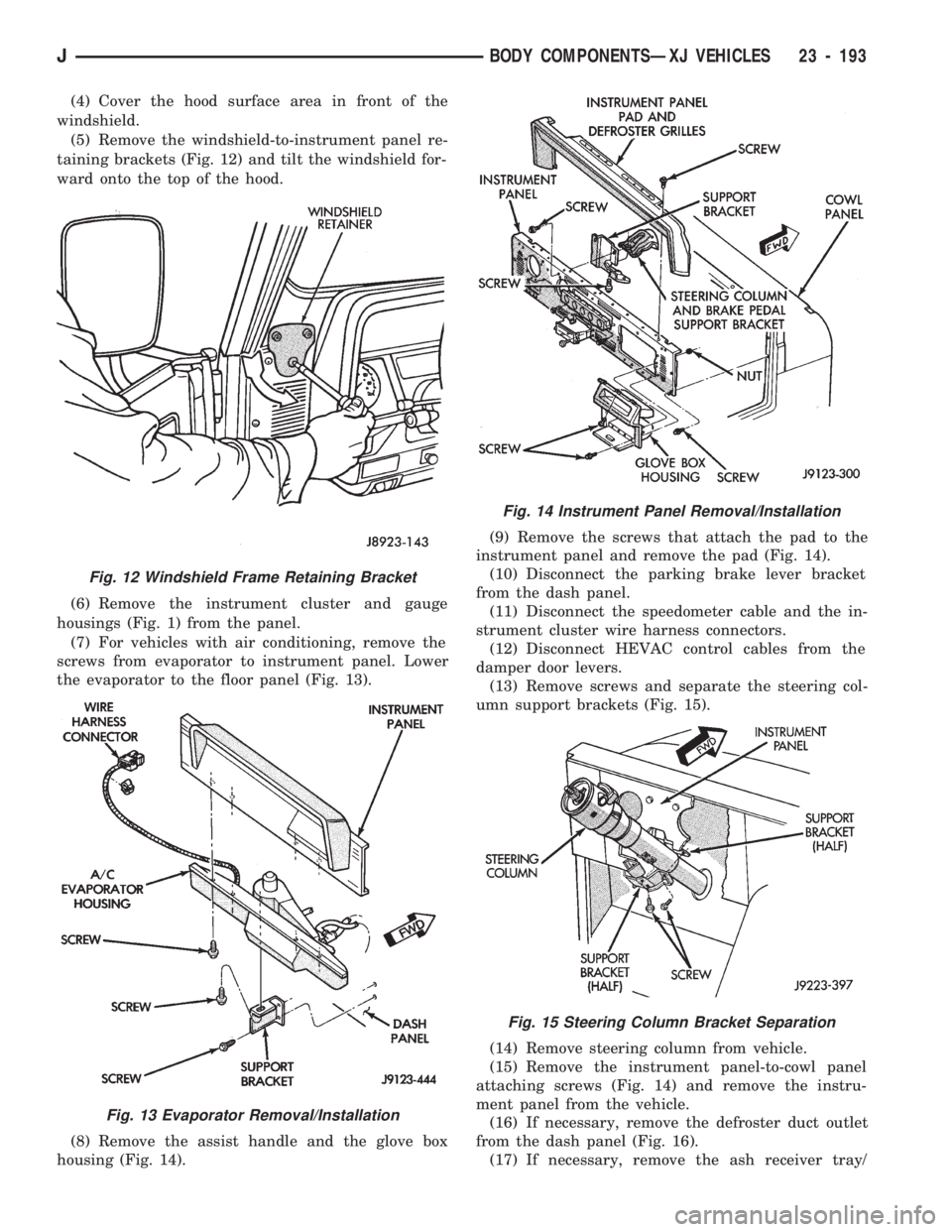
ward onto the top of the hood.
(6) Remove the instrument cluster and gauge
housings (Fig. 1) from the panel.
(7) For vehicles with air conditioning, remove the
screws from evaporator to instrument panel. Lower
the evaporator to the floor panel (Fig. 13).
(8) Remove the assist handle and the glove box
housing (Fig. 14).(9) Remove the screws that attach the pad to the
instrument panel and remove the pad (Fig. 14).
(10) Disconnect the parking brake lever bracket
from the dash panel.
(11) Disconnect the speedometer cable and the in-
strument cluster wire harness connectors.
(12) Disconnect HEVAC control cables from the
damper door levers.
(13) Remove screws and separate the steering col-
umn support brackets (Fig. 15).
(14) Remove steering column from vehicle.
(15) Remove the instrument panel-to-cowl panel
attaching screws (Fig. 14) and remove the instru-
ment panel from the vehicle.
(16) If necessary, remove the defroster duct outlet
from the dash panel (Fig. 16).
(17) If necessary, remove the ash receiver tray/
Fig. 12 Windshield Frame Retaining Bracket
Fig. 13 Evaporator Removal/Installation
Fig. 14 Instrument Panel Removal/Installation
Fig. 15 Steering Column Bracket Separation
JBODY COMPONENTSÐXJ VEHICLES 23 - 193
Page 1650 of 1784
(3) If necessary, remove the retaining screws and
the hinge from the glove box door.
INSTALLATION
(1) If removed, install the hinge on the glove box
door with screws. Tighten the screws securely.
(2) Position the glove box door and hinge on the
glove box housing.
(3) Install the hinge-to-glove box housing screws
and adjust the door for proper fit within the opening.
Tighten the screws securely.
DOOR LATCH STRIKER ADJUSTMENT
The glove box door lock cylinder latch striker is at-
tached to the glove box housing opening with screws.
The striker can be moved in or out for adjustment.
SEATS
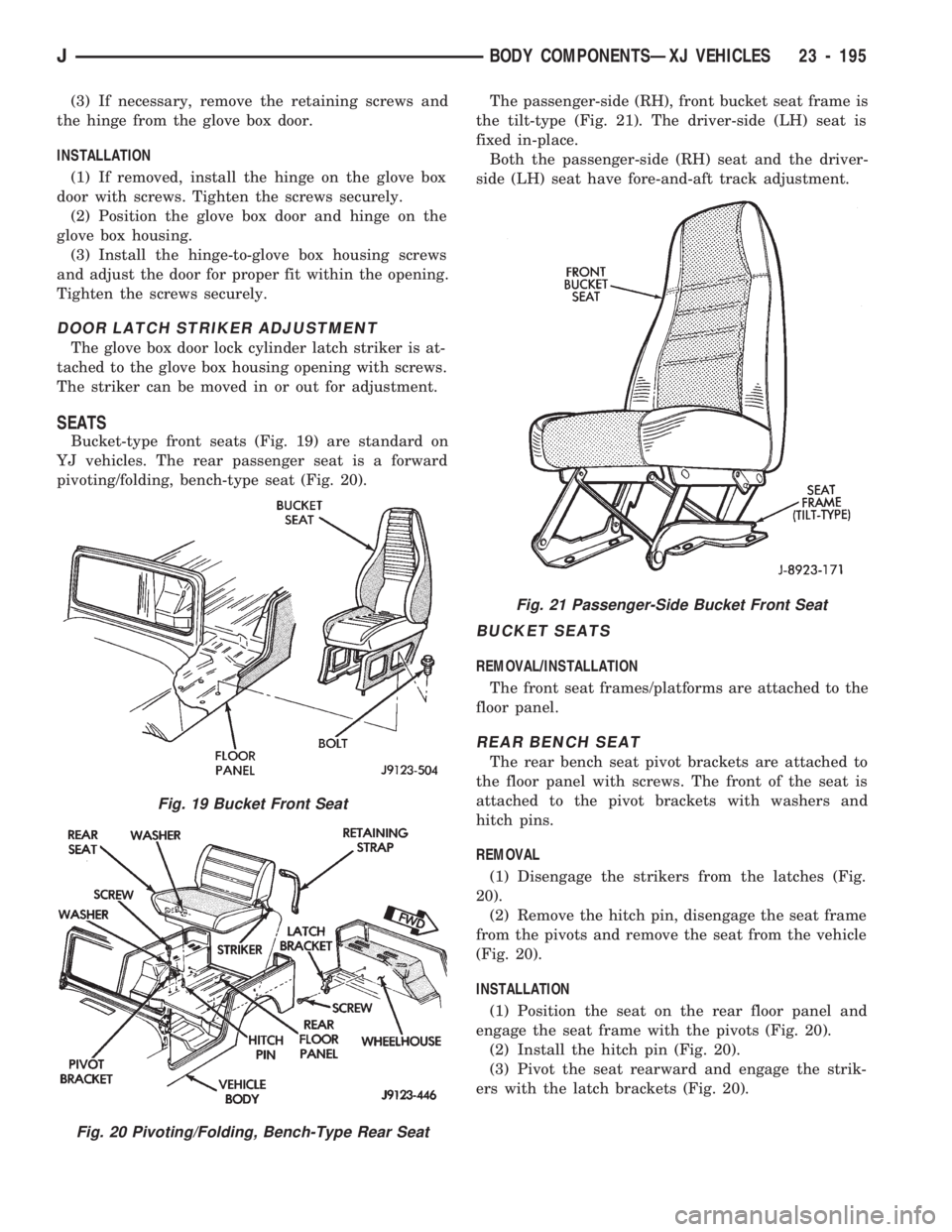
Bucket-type front seats (Fig. 19) are standard on
YJ vehicles. The rear passenger seat is a forward
pivoting/folding, bench-type seat (Fig. 20).The passenger-side (RH), front bucket seat frame is
the tilt-type (Fig. 21). The driver-side (LH) seat is
fixed in-place.
Both the passenger-side (RH) seat and the driver-
side (LH) seat have fore-and-aft track adjustment.
BUCKET SEATS
REMOVAL/INSTALLATION
The front seat frames/platforms are attached to the
floor panel.
REAR BENCH SEAT
The rear bench seat pivot brackets are attached to
the floor panel with screws. The front of the seat is
attached to the pivot brackets with washers and
hitch pins.
REMOVAL
(1) Disengage the strikers from the latches (Fig.
20).
(2) Remove the hitch pin, disengage the seat frame
from the pivots and remove the seat from the vehicle
(Fig. 20).
INSTALLATION
(1) Position the seat on the rear floor panel and
engage the seat frame with the pivots (Fig. 20).
(2) Install the hitch pin (Fig. 20).
(3) Pivot the seat rearward and engage the strik-
ers with the latch brackets (Fig. 20).
Fig. 19 Bucket Front Seat
Fig. 20 Pivoting/Folding, Bench-Type Rear Seat
Fig. 21 Passenger-Side Bucket Front Seat
JBODY COMPONENTSÐXJ VEHICLES 23 - 195
Page 1651 of 1784
FRONT SHOULDER BELTS
REMOVAL
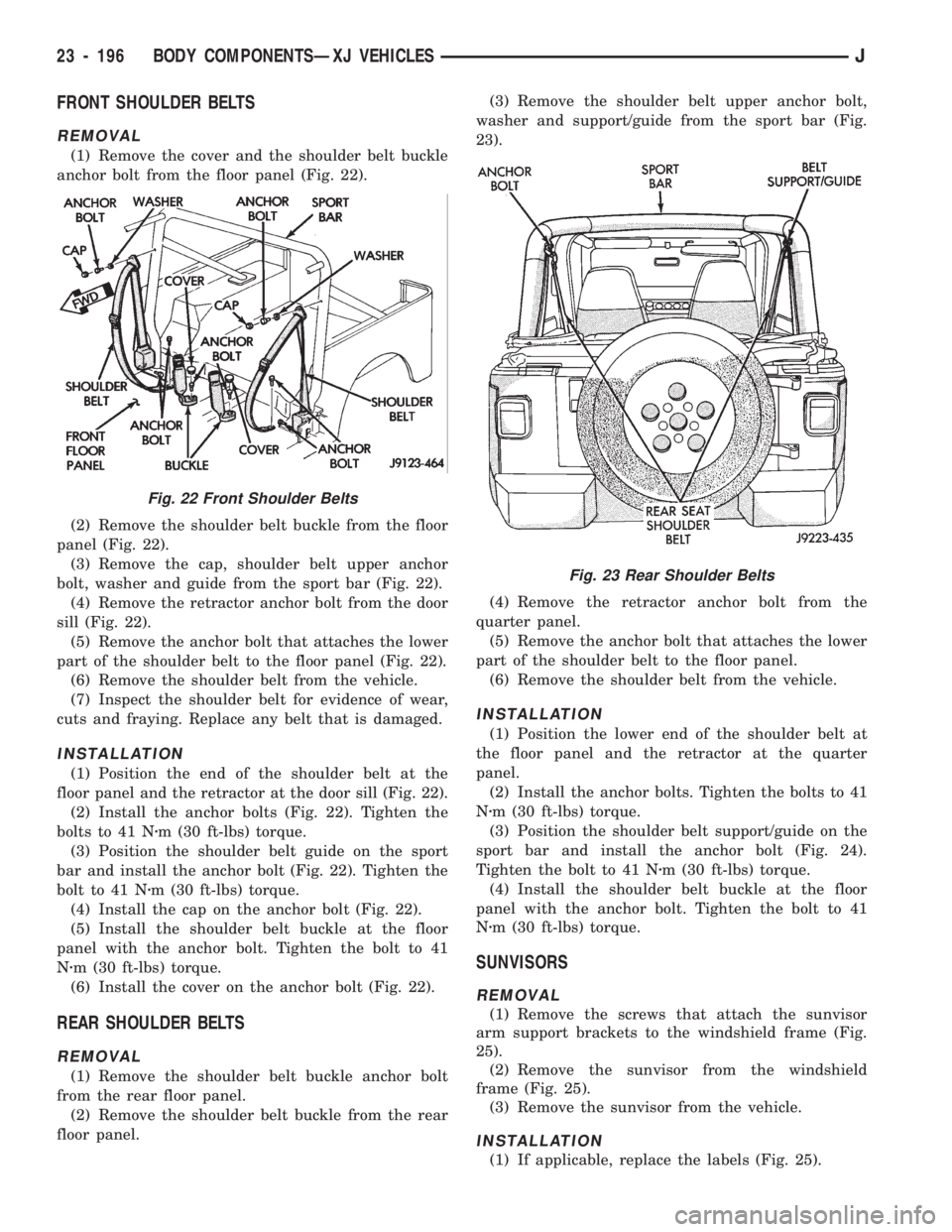
(1) Remove the cover and the shoulder belt buckle
anchor bolt from the floor panel (Fig. 22).
(2) Remove the shoulder belt buckle from the floor
panel (Fig. 22).
(3) Remove the cap, shoulder belt upper anchor
bolt, washer and guide from the sport bar (Fig. 22).
(4) Remove the retractor anchor bolt from the door
sill (Fig. 22).
(5) Remove the anchor bolt that attaches the lower
part of the shoulder belt to the floor panel (Fig. 22).
(6) Remove the shoulder belt from the vehicle.
(7) Inspect the shoulder belt for evidence of wear,
cuts and fraying. Replace any belt that is damaged.
INSTALLATION
(1) Position the end of the shoulder belt at the
floor panel and the retractor at the door sill (Fig. 22).
(2) Install the anchor bolts (Fig. 22). Tighten the
bolts to 41 Nzm (30 ft-lbs) torque.
(3) Position the shoulder belt guide on the sport
bar and install the anchor bolt (Fig. 22). Tighten the
bolt to 41 Nzm (30 ft-lbs) torque.
(4) Install the cap on the anchor bolt (Fig. 22).
(5) Install the shoulder belt buckle at the floor
panel with the anchor bolt. Tighten the bolt to 41
Nzm (30 ft-lbs) torque.
(6) Install the cover on the anchor bolt (Fig. 22).
REAR SHOULDER BELTS
REMOVAL
(1) Remove the shoulder belt buckle anchor bolt
from the rear floor panel.
(2) Remove the shoulder belt buckle from the rear
floor panel.(3) Remove the shoulder belt upper anchor bolt,
washer and support/guide from the sport bar (Fig.
23).
(4) Remove the retractor anchor bolt from the
quarter panel.
(5) Remove the anchor bolt that attaches the lower
part of the shoulder belt to the floor panel.
(6) Remove the shoulder belt from the vehicle.
INSTALLATION
(1) Position the lower end of the shoulder belt at
the floor panel and the retractor at the quarter
panel.
(2) Install the anchor bolts. Tighten the bolts to 41
Nzm (30 ft-lbs) torque.
(3) Position the shoulder belt support/guide on the
sport bar and install the anchor bolt (Fig. 24).
Tighten the bolt to 41 Nzm (30 ft-lbs) torque.
(4) Install the shoulder belt buckle at the floor
panel with the anchor bolt. Tighten the bolt to 41
Nzm (30 ft-lbs) torque.
SUNVISORS
REMOVAL
(1) Remove the screws that attach the sunvisor
arm support brackets to the windshield frame (Fig.
25).
(2) Remove the sunvisor from the windshield
frame (Fig. 25).
(3) Remove the sunvisor from the vehicle.
INSTALLATION
(1) If applicable, replace the labels (Fig. 25).
Fig. 22 Front Shoulder Belts
Fig. 23 Rear Shoulder Belts
23 - 196 BODY COMPONENTSÐXJ VEHICLESJ
Page 1653 of 1784
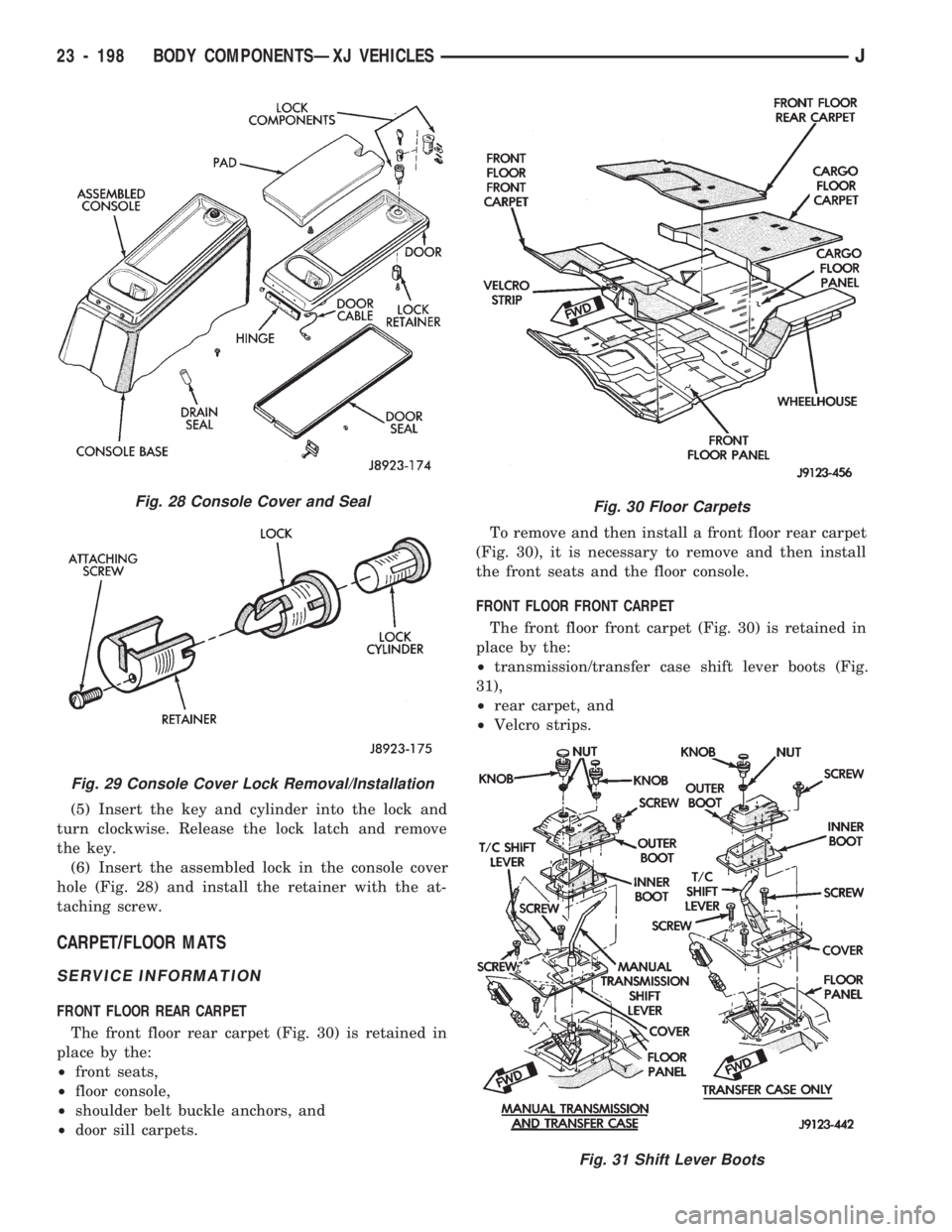
(5) Insert the key and cylinder into the lock and
turn clockwise. Release the lock latch and remove
the key.
(6) Insert the assembled lock in the console cover
hole (Fig. 28) and install the retainer with the at-
taching screw.
CARPET/FLOOR MATS
SERVICE INFORMATION
FRONT FLOOR REAR CARPET
The front floor rear carpet (Fig. 30) is retained in
place by the:
²front seats,
²floor console,
²shoulder belt buckle anchors, and
²door sill carpets.To remove and then install a front floor rear carpet
(Fig. 30), it is necessary to remove and then install
the front seats and the floor console.
FRONT FLOOR FRONT CARPET
The front floor front carpet (Fig. 30) is retained in
place by the:
²transmission/transfer case shift lever boots (Fig.
31),
²rear carpet, and
²Velcro strips.
Fig. 28 Console Cover and Seal
Fig. 29 Console Cover Lock Removal/Installation
Fig. 30 Floor Carpets
Fig. 31 Shift Lever Boots
23 - 198 BODY COMPONENTSÐXJ VEHICLESJ
Page 1654 of 1784
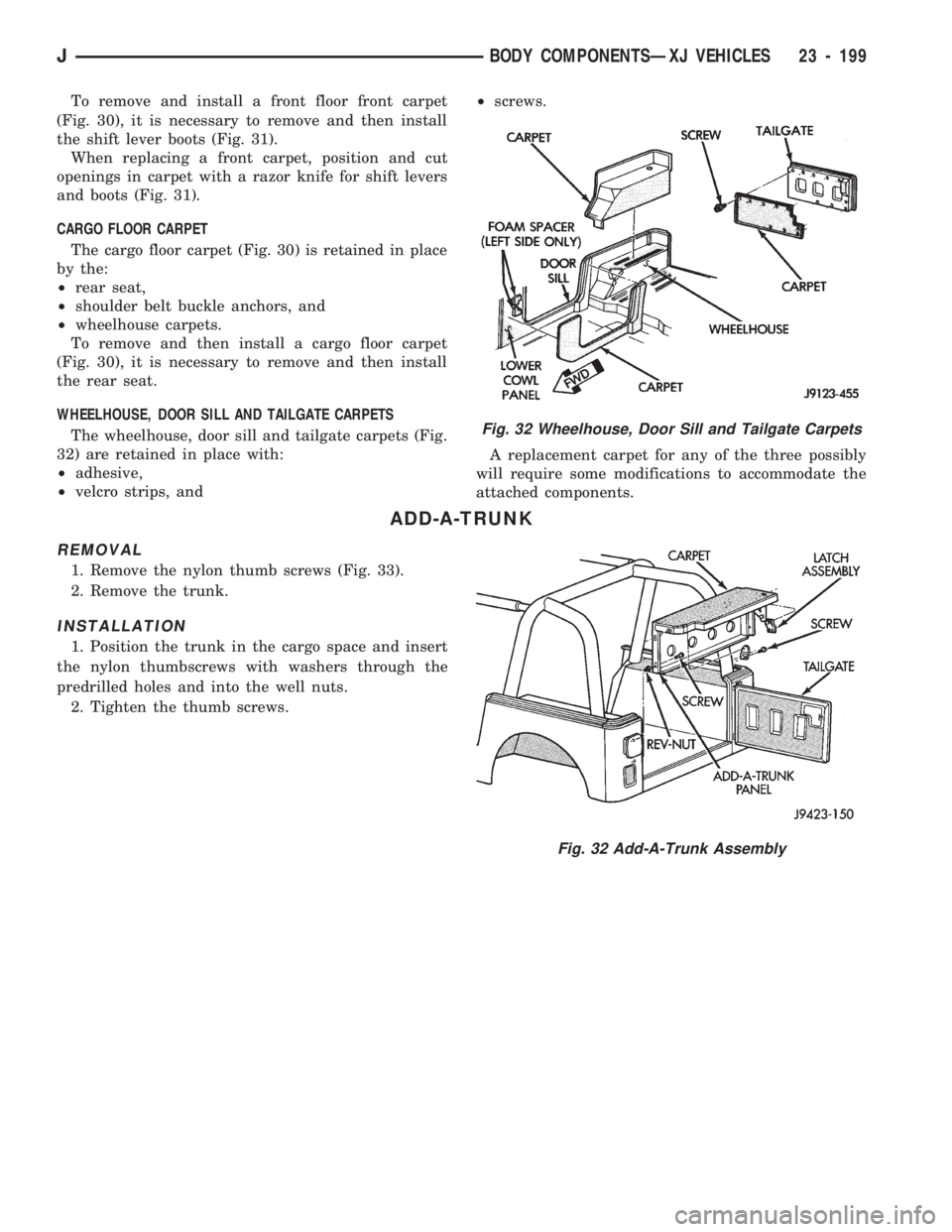
To remove and install a front floor front carpet
(Fig. 30), it is necessary to remove and then install
the shift lever boots (Fig. 31).
When replacing a front carpet, position and cut
openings in carpet with a razor knife for shift levers
and boots (Fig. 31).
CARGO FLOOR CARPET
The cargo floor carpet (Fig. 30) is retained in place
by the:
²rear seat,
²shoulder belt buckle anchors, and
²wheelhouse carpets.
To remove and then install a cargo floor carpet
(Fig. 30), it is necessary to remove and then install
the rear seat.
WHEELHOUSE, DOOR SILL AND TAILGATE CARPETS
The wheelhouse, door sill and tailgate carpets (Fig.
32) are retained in place with:
²adhesive,
²velcro strips, and²screws.
A replacement carpet for any of the three possibly
will require some modifications to accommodate the
attached components.
ADD-A-TRUNK
REMOVAL
1. Remove the nylon thumb screws (Fig. 33).
2. Remove the trunk.
INSTALLATION
1. Position the trunk in the cargo space and insert
the nylon thumbscrews with washers through the
predrilled holes and into the well nuts.
2. Tighten the thumb screws.
Fig. 32 Wheelhouse, Door Sill and Tailgate Carpets
Fig. 32 Add-A-Trunk Assembly
JBODY COMPONENTSÐXJ VEHICLES 23 - 199
Page 1657 of 1784
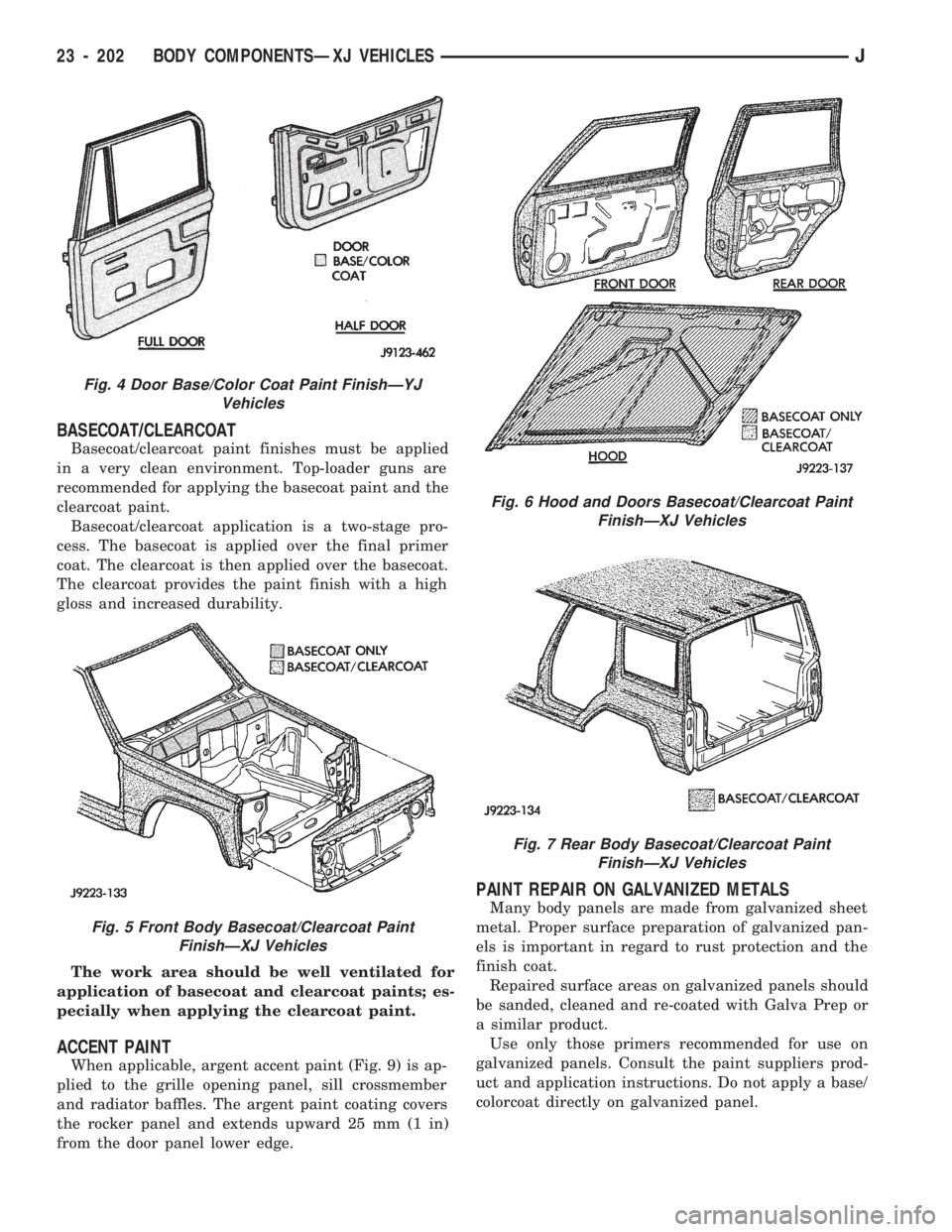
BASECOAT/CLEARCOAT
Basecoat/clearcoat paint finishes must be applied
in a very clean environment. Top-loader guns are
recommended for applying the basecoat paint and the
clearcoat paint.
Basecoat/clearcoat application is a two-stage pro-
cess. The basecoat is applied over the final primer
coat. The clearcoat is then applied over the basecoat.
The clearcoat provides the paint finish with a high
gloss and increased durability.
The work area should be well ventilated for
application of basecoat and clearcoat paints; es-
pecially when applying the clearcoat paint.
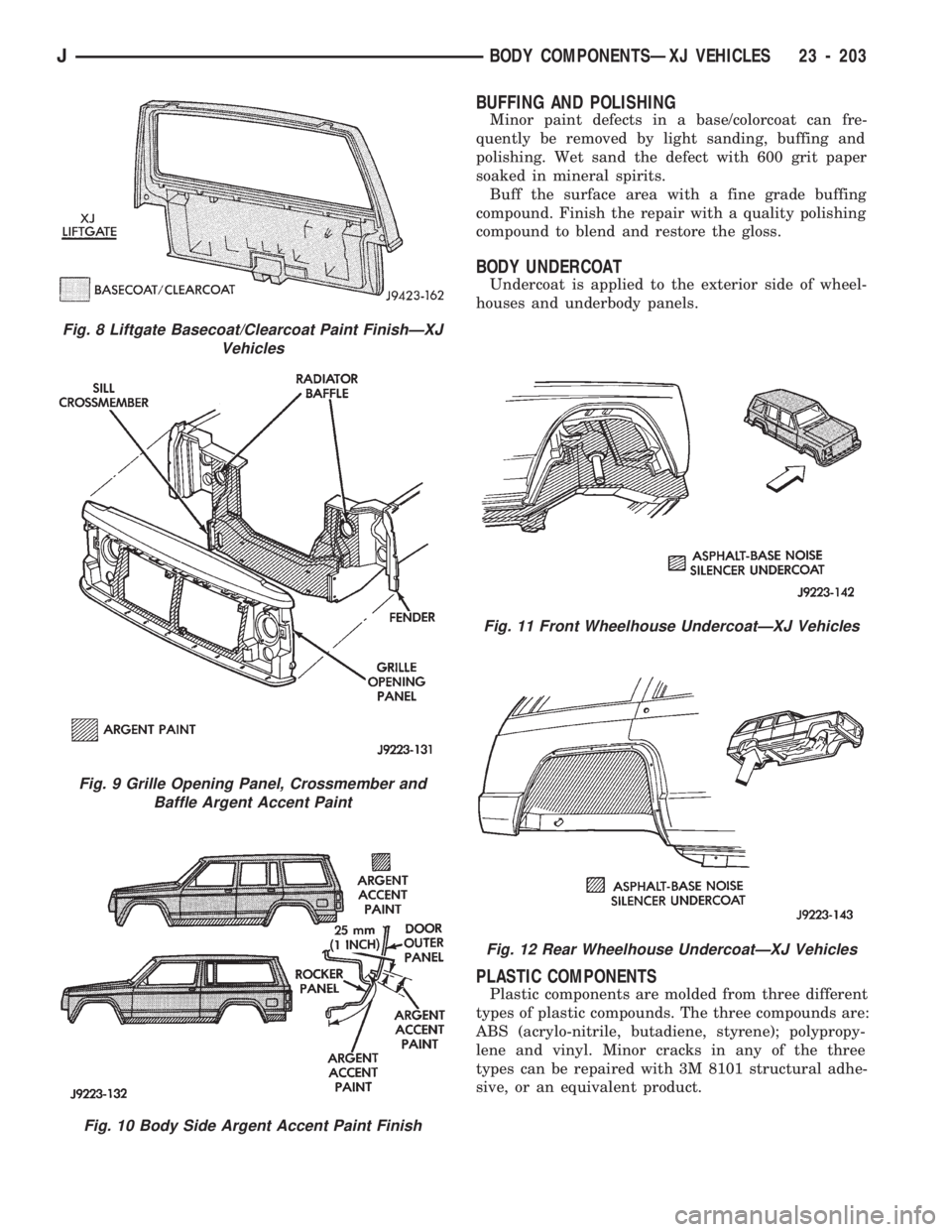
ACCENT PAINT
When applicable, argent accent paint (Fig. 9) is ap-
plied to the grille opening panel, sill crossmember
and radiator baffles. The argent paint coating covers
the rocker panel and extends upward 25 mm (1 in)
from the door panel lower edge.
PAINT REPAIR ON GALVANIZED METALS
Many body panels are made from galvanized sheet
metal. Proper surface preparation of galvanized pan-
els is important in regard to rust protection and the
finish coat.
Repaired surface areas on galvanized panels should
be sanded, cleaned and re-coated with Galva Prep or
a similar product.
Use only those primers recommended for use on
galvanized panels. Consult the paint suppliers prod-
uct and application instructions. Do not apply a base/
colorcoat directly on galvanized panel.
Fig. 4 Door Base/Color Coat Paint FinishÐYJ
Vehicles
Fig. 5 Front Body Basecoat/Clearcoat Paint
FinishÐXJ Vehicles
Fig. 6 Hood and Doors Basecoat/Clearcoat Paint
FinishÐXJ Vehicles
Fig. 7 Rear Body Basecoat/Clearcoat Paint
FinishÐXJ Vehicles
23 - 202 BODY COMPONENTSÐXJ VEHICLESJ
Page 1658 of 1784
BUFFING AND POLISHING
Minor paint defects in a base/colorcoat can fre-
quently be removed by light sanding, buffing and
polishing. Wet sand the defect with 600 grit paper
soaked in mineral spirits.
Buff the surface area with a fine grade buffing
compound. Finish the repair with a quality polishing
compound to blend and restore the gloss.
BODY UNDERCOAT
Undercoat is applied to the exterior side of wheel-
houses and underbody panels.
PLASTIC COMPONENTS
Plastic components are molded from three different
types of plastic compounds. The three compounds are:
ABS (acrylo-nitrile, butadiene, styrene); polypropy-
lene and vinyl. Minor cracks in any of the three
types can be repaired with 3M 8101 structural adhe-
sive, or an equivalent product.
Fig. 8 Liftgate Basecoat/Clearcoat Paint FinishÐXJ
Vehicles
Fig. 9 Grille Opening Panel, Crossmember and
Baffle Argent Accent Paint
Fig. 10 Body Side Argent Accent Paint Finish
Fig. 11 Front Wheelhouse UndercoatÐXJ Vehicles
Fig. 12 Rear Wheelhouse UndercoatÐXJ Vehicles
JBODY COMPONENTSÐXJ VEHICLES 23 - 203