interior JEEP CHEROKEE 1995 Service Manual Online
[x] Cancel search | Manufacturer: JEEP, Model Year: 1995, Model line: CHEROKEE, Model: JEEP CHEROKEE 1995Pages: 2198, PDF Size: 82.83 MB
Page 1882 of 2198
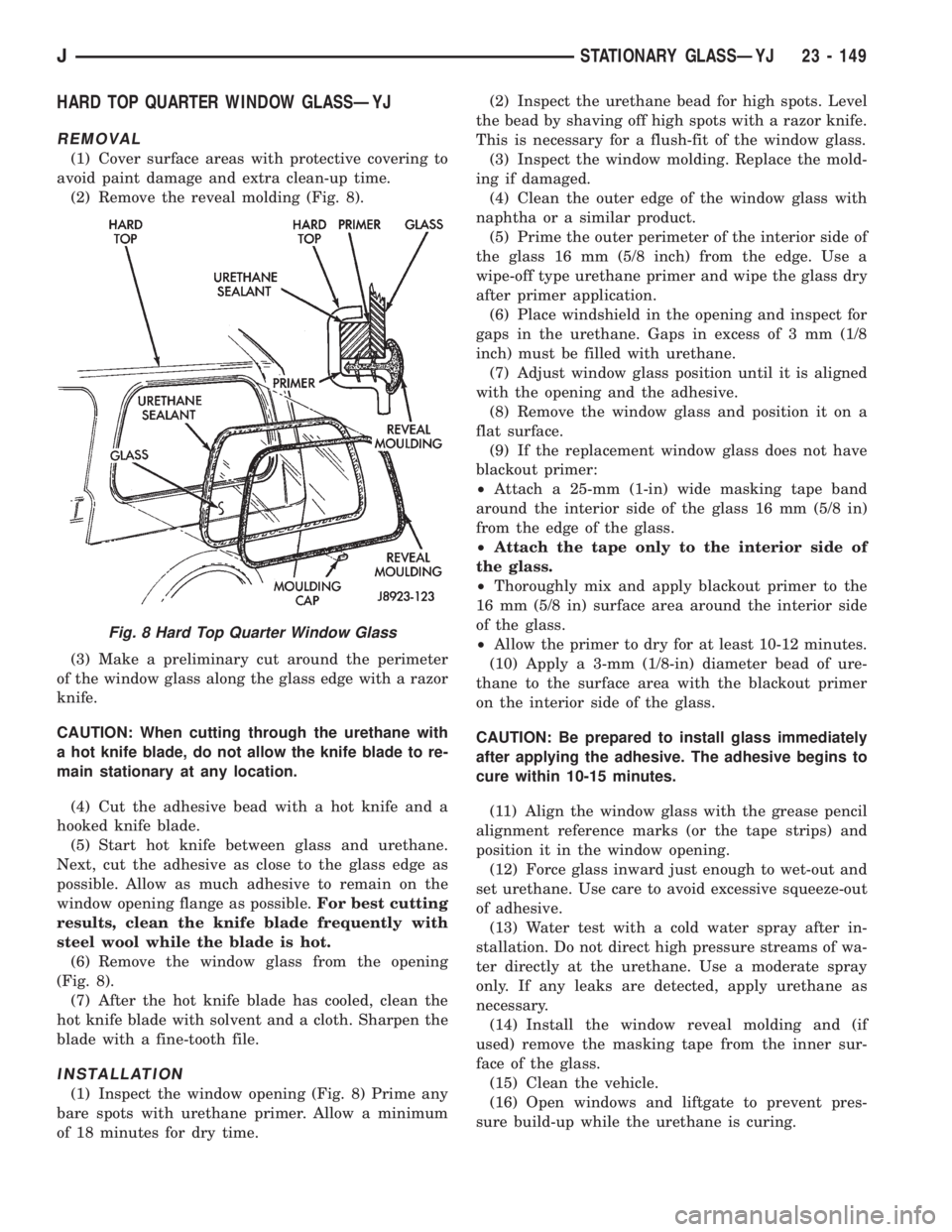
HARD TOP QUARTER WINDOW GLASSÐYJ
REMOVAL
(1) Cover surface areas with protective covering to
avoid paint damage and extra clean-up time.
(2) Remove the reveal molding (Fig. 8).
(3) Make a preliminary cut around the perimeter
of the window glass along the glass edge with a razor
knife.
CAUTION: When cutting through the urethane with
a hot knife blade, do not allow the knife blade to re-
main stationary at any location.
(4) Cut the adhesive bead with a hot knife and a
hooked knife blade.
(5) Start hot knife between glass and urethane.
Next, cut the adhesive as close to the glass edge as
possible. Allow as much adhesive to remain on the
window opening flange as possible.For best cutting
results, clean the knife blade frequently with
steel wool while the blade is hot.
(6) Remove the window glass from the opening
(Fig. 8).
(7) After the hot knife blade has cooled, clean the
hot knife blade with solvent and a cloth. Sharpen the
blade with a fine-tooth file.
INSTALLATION
(1) Inspect the window opening (Fig. 8) Prime any
bare spots with urethane primer. Allow a minimum
of 18 minutes for dry time.(2) Inspect the urethane bead for high spots. Level
the bead by shaving off high spots with a razor knife.
This is necessary for a flush-fit of the window glass.
(3) Inspect the window molding. Replace the mold-
ing if damaged.
(4) Clean the outer edge of the window glass with
naphtha or a similar product.
(5) Prime the outer perimeter of the interior side of
the glass 16 mm (5/8 inch) from the edge. Use a
wipe-off type urethane primer and wipe the glass dry
after primer application.
(6) Place windshield in the opening and inspect for
gaps in the urethane. Gaps in excess of 3 mm (1/8
inch) must be filled with urethane.
(7) Adjust window glass position until it is aligned
with the opening and the adhesive.
(8) Remove the window glass and position it on a
flat surface.
(9) If the replacement window glass does not have
blackout primer:
²Attach a 25-mm (1-in) wide masking tape band
around the interior side of the glass 16 mm (5/8 in)
from the edge of the glass.
²Attach the tape only to the interior side of
the glass.
²Thoroughly mix and apply blackout primer to the
16 mm (5/8 in) surface area around the interior side
of the glass.
²Allow the primer to dry for at least 10-12 minutes.
(10) Apply a 3-mm (1/8-in) diameter bead of ure-
thane to the surface area with the blackout primer
on the interior side of the glass.
CAUTION: Be prepared to install glass immediately
after applying the adhesive. The adhesive begins to
cure within 10-15 minutes.
(11) Align the window glass with the grease pencil
alignment reference marks (or the tape strips) and
position it in the window opening.
(12) Force glass inward just enough to wet-out and
set urethane. Use care to avoid excessive squeeze-out
of adhesive.
(13) Water test with a cold water spray after in-
stallation. Do not direct high pressure streams of wa-
ter directly at the urethane. Use a moderate spray
only. If any leaks are detected, apply urethane as
necessary.
(14) Install the window reveal molding and (if
used) remove the masking tape from the inner sur-
face of the glass.
(15) Clean the vehicle.
(16) Open windows and liftgate to prevent pres-
sure build-up while the urethane is curing.
Fig. 8 Hard Top Quarter Window Glass
JSTATIONARY GLASSÐYJ 23 - 149
Page 1884 of 2198
INTERIOR COMPONENTS
INDEX
page page
Add-A-TrunkÐYJ........................ 157
Bucket SeatsÐYJ........................ 153
CarpetÐYJ............................. 156
Floor ConsolesÐYJ...................... 155
Front Shoulder BeltsÐYJ.................. 154
Glove BoxÐYJ.......................... 152
Instrument Cluster and Gauge HousingsÐYJ.... 151Instrument Cluster BezelÐYJ............... 151
Instrument Panel ComponentsÐYJ........... 152
Instrument PanelÐYJ..................... 151
Rear Bench SeatÐYJ..................... 153
Rear Shoulder BeltsÐYJ................... 154
SeatsÐYJ............................. 153
SunvisorsÐYJ.......................... 155
INSTRUMENT PANELÐYJ
The instrument panel is constructed of sheet metal
and is attached to cowl panel with screws. The in-
strument panel and defroster grille pad is attached
to the instrument panel with screws.
INSTRUMENT CLUSTER AND GAUGE HOUSINGSÐ
YJ
REMOVAL
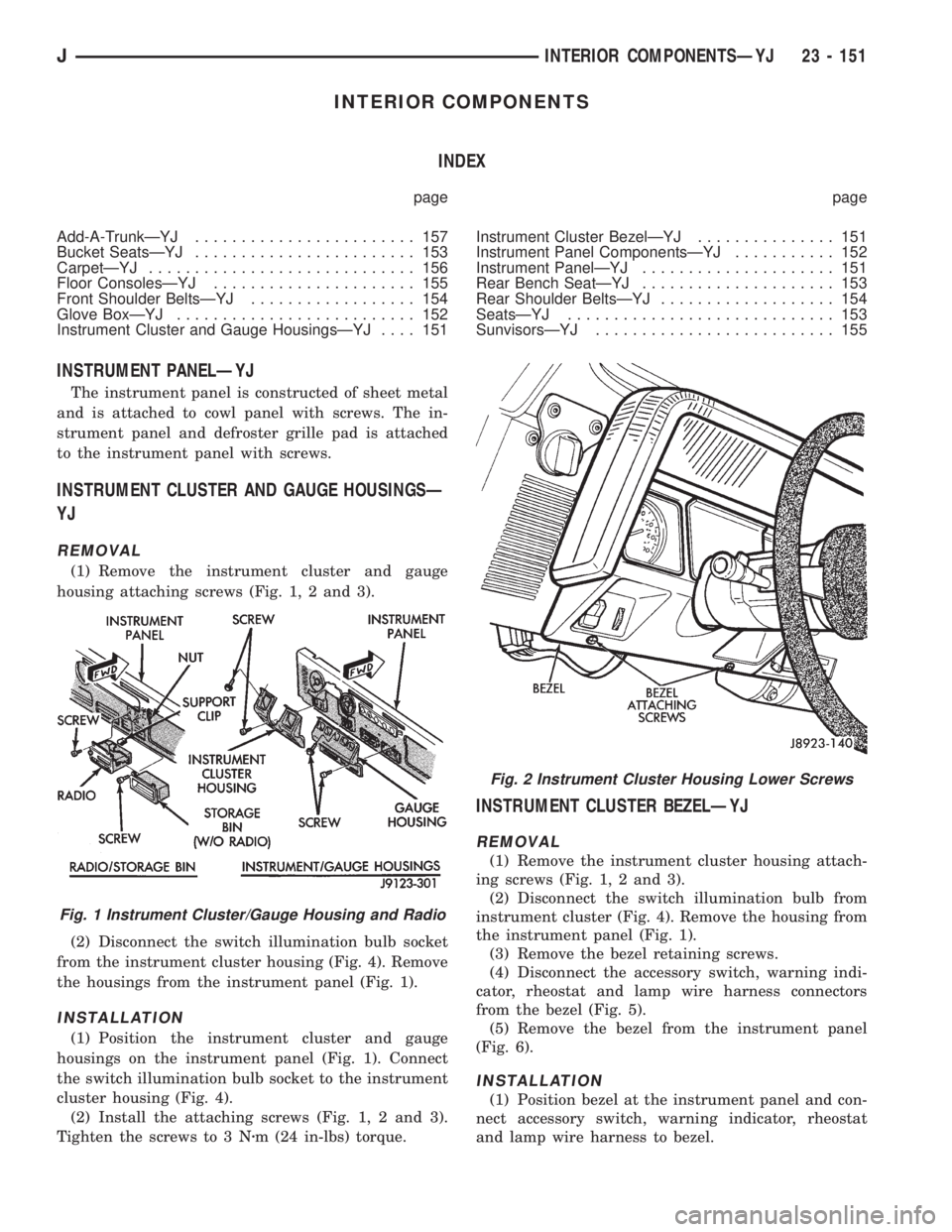
(1) Remove the instrument cluster and gauge
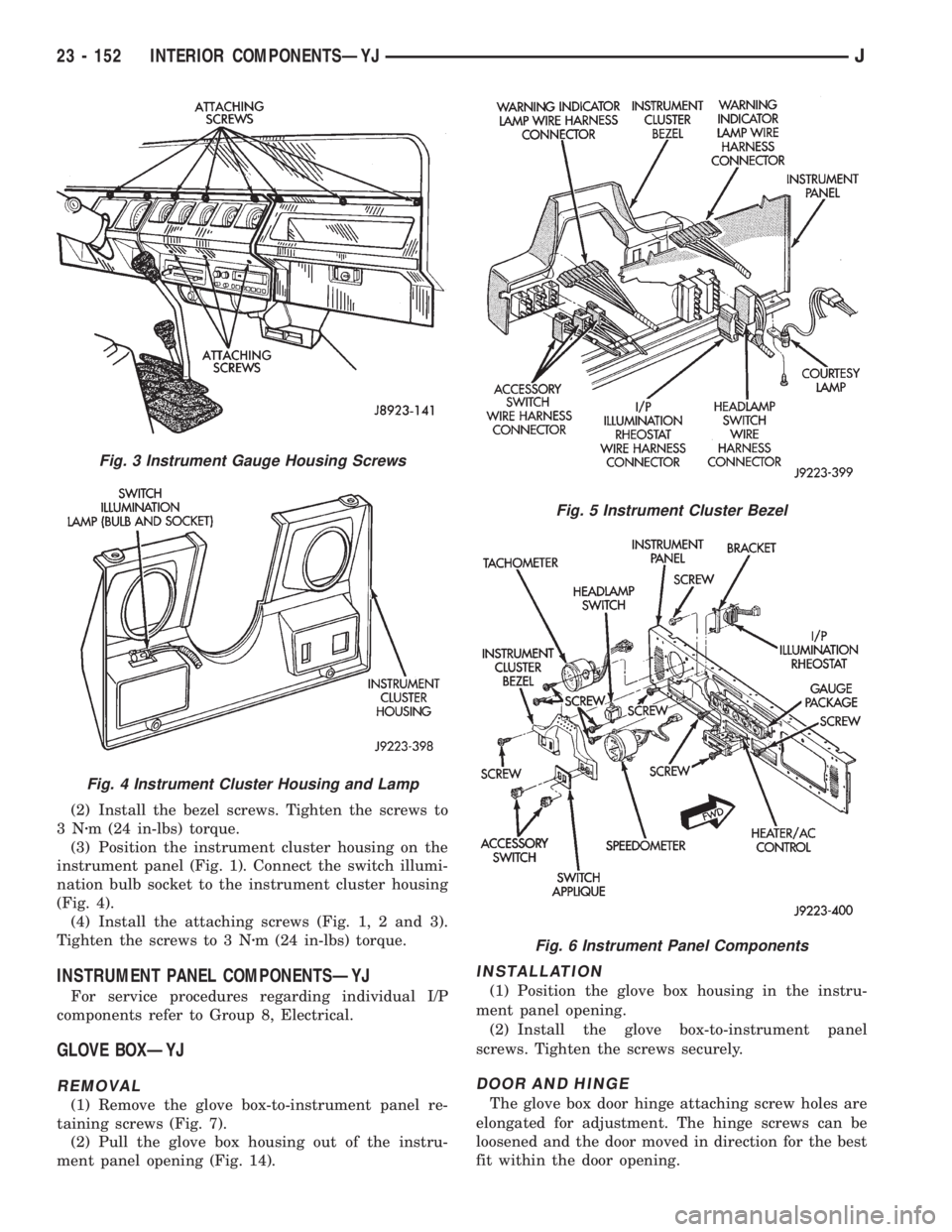
housing attaching screws (Fig. 1, 2 and 3).
(2) Disconnect the switch illumination bulb socket
from the instrument cluster housing (Fig. 4). Remove
the housings from the instrument panel (Fig. 1).
INSTALLATION
(1) Position the instrument cluster and gauge
housings on the instrument panel (Fig. 1). Connect
the switch illumination bulb socket to the instrument
cluster housing (Fig. 4).
(2) Install the attaching screws (Fig. 1, 2 and 3).
Tighten the screws to 3 Nzm (24 in-lbs) torque.
INSTRUMENT CLUSTER BEZELÐYJ
REMOVAL
(1) Remove the instrument cluster housing attach-
ing screws (Fig. 1, 2 and 3).
(2) Disconnect the switch illumination bulb from
instrument cluster (Fig. 4). Remove the housing from
the instrument panel (Fig. 1).
(3) Remove the bezel retaining screws.
(4) Disconnect the accessory switch, warning indi-
cator, rheostat and lamp wire harness connectors
from the bezel (Fig. 5).
(5) Remove the bezel from the instrument panel
(Fig. 6).
INSTALLATION
(1) Position bezel at the instrument panel and con-
nect accessory switch, warning indicator, rheostat
and lamp wire harness to bezel.
Fig. 1 Instrument Cluster/Gauge Housing and Radio
Fig. 2 Instrument Cluster Housing Lower Screws
JINTERIOR COMPONENTSÐYJ 23 - 151
Page 1885 of 2198
(2) Install the bezel screws. Tighten the screws to
3Nzm (24 in-lbs) torque.
(3) Position the instrument cluster housing on the
instrument panel (Fig. 1). Connect the switch illumi-
nation bulb socket to the instrument cluster housing
(Fig. 4).
(4) Install the attaching screws (Fig. 1, 2 and 3).
Tighten the screws to 3 Nzm (24 in-lbs) torque.
INSTRUMENT PANEL COMPONENTSÐYJ
For service procedures regarding individual I/P
components refer to Group 8, Electrical.
GLOVE BOXÐYJ
REMOVAL
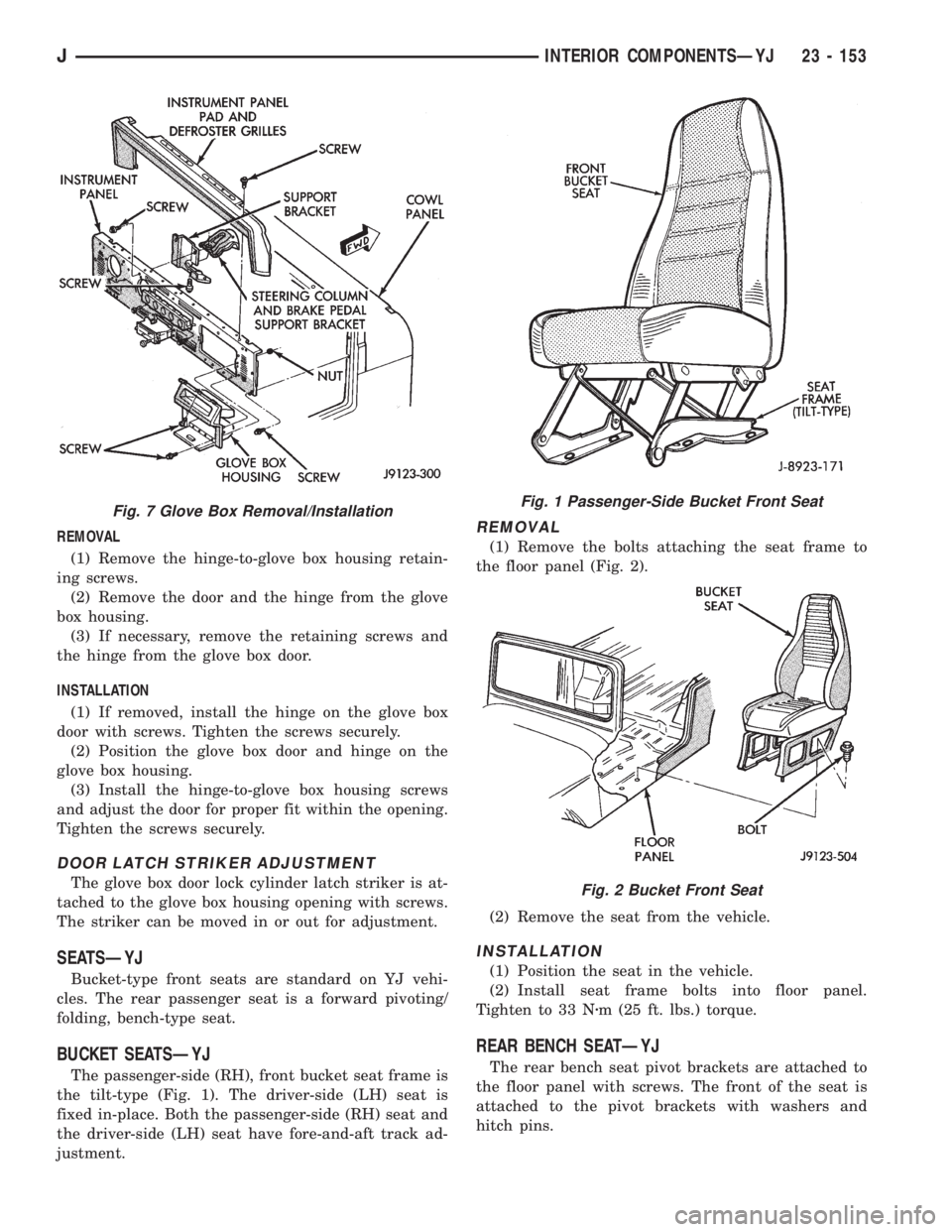
(1) Remove the glove box-to-instrument panel re-
taining screws (Fig. 7).
(2) Pull the glove box housing out of the instru-
ment panel opening (Fig. 14).
INSTALLATION
(1) Position the glove box housing in the instru-
ment panel opening.
(2) Install the glove box-to-instrument panel
screws. Tighten the screws securely.
DOOR AND HINGE
The glove box door hinge attaching screw holes are
elongated for adjustment. The hinge screws can be
loosened and the door moved in direction for the best
fit within the door opening.
Fig. 3 Instrument Gauge Housing Screws
Fig. 4 Instrument Cluster Housing and Lamp
Fig. 5 Instrument Cluster Bezel
Fig. 6 Instrument Panel Components
23 - 152 INTERIOR COMPONENTSÐYJJ
Page 1886 of 2198
REMOVAL
(1) Remove the hinge-to-glove box housing retain-
ing screws.
(2) Remove the door and the hinge from the glove
box housing.
(3) If necessary, remove the retaining screws and
the hinge from the glove box door.
INSTALLATION
(1) If removed, install the hinge on the glove box
door with screws. Tighten the screws securely.
(2) Position the glove box door and hinge on the
glove box housing.
(3) Install the hinge-to-glove box housing screws
and adjust the door for proper fit within the opening.
Tighten the screws securely.
DOOR LATCH STRIKER ADJUSTMENT
The glove box door lock cylinder latch striker is at-
tached to the glove box housing opening with screws.
The striker can be moved in or out for adjustment.
SEATSÐYJ
Bucket-type front seats are standard on YJ vehi-
cles. The rear passenger seat is a forward pivoting/
folding, bench-type seat.
BUCKET SEATSÐYJ
The passenger-side (RH), front bucket seat frame is
the tilt-type (Fig. 1). The driver-side (LH) seat is
fixed in-place. Both the passenger-side (RH) seat and
the driver-side (LH) seat have fore-and-aft track ad-
justment.
REMOVAL
(1) Remove the bolts attaching the seat frame to
the floor panel (Fig. 2).
(2) Remove the seat from the vehicle.
INSTALLATION
(1) Position the seat in the vehicle.
(2) Install seat frame bolts into floor panel.
Tighten to 33 Nzm (25 ft. lbs.) torque.
REAR BENCH SEATÐYJ
The rear bench seat pivot brackets are attached to
the floor panel with screws. The front of the seat is
attached to the pivot brackets with washers and
hitch pins.
Fig. 7 Glove Box Removal/InstallationFig. 1 Passenger-Side Bucket Front Seat
Fig. 2 Bucket Front Seat
JINTERIOR COMPONENTSÐYJ 23 - 153
Page 1887 of 2198
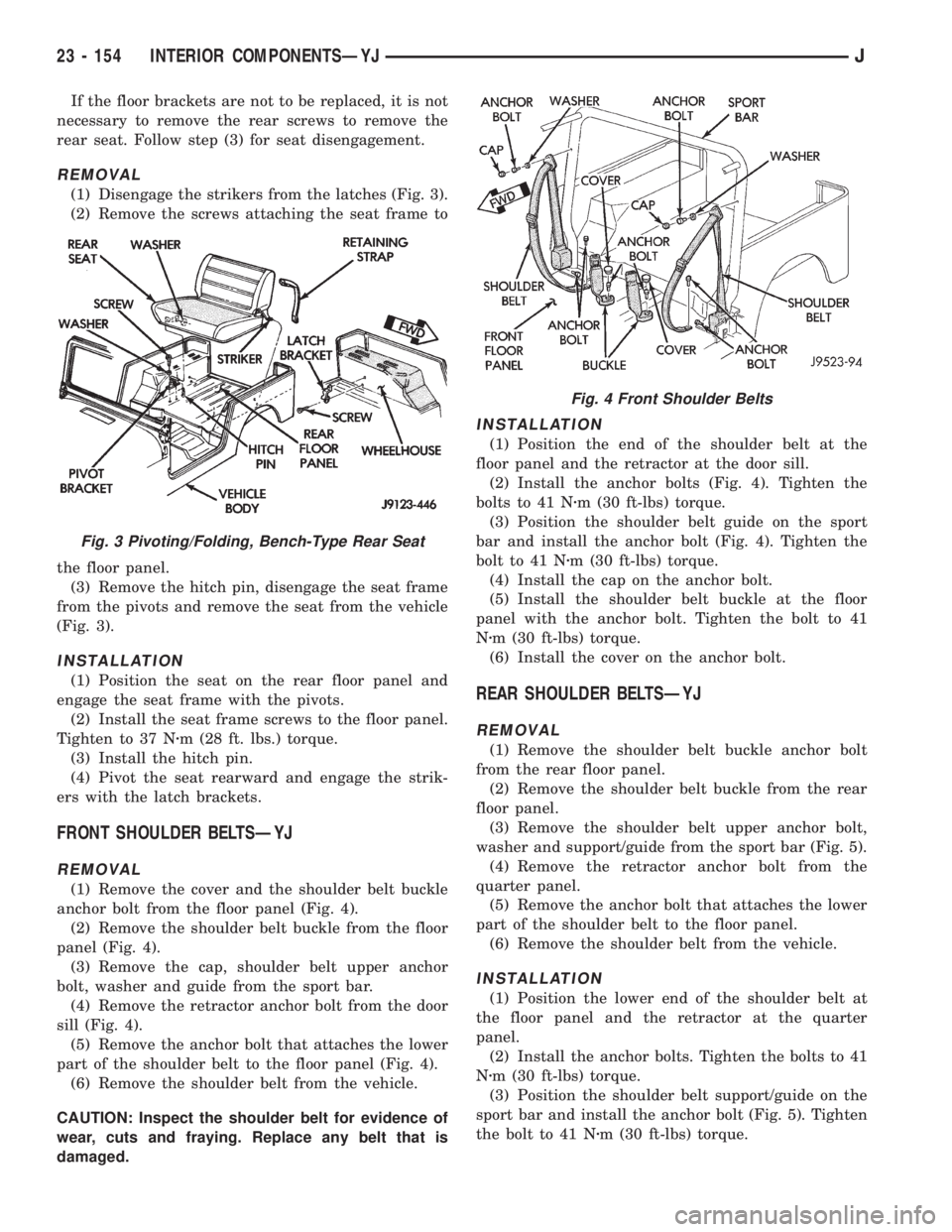
If the floor brackets are not to be replaced, it is not
necessary to remove the rear screws to remove the
rear seat. Follow step (3) for seat disengagement.
REMOVAL
(1) Disengage the strikers from the latches (Fig. 3).
(2) Remove the screws attaching the seat frame to
the floor panel.
(3) Remove the hitch pin, disengage the seat frame
from the pivots and remove the seat from the vehicle
(Fig. 3).
INSTALLATION
(1) Position the seat on the rear floor panel and
engage the seat frame with the pivots.
(2) Install the seat frame screws to the floor panel.
Tighten to 37 Nzm (28 ft. lbs.) torque.
(3) Install the hitch pin.
(4) Pivot the seat rearward and engage the strik-
ers with the latch brackets.
FRONT SHOULDER BELTSÐYJ
REMOVAL
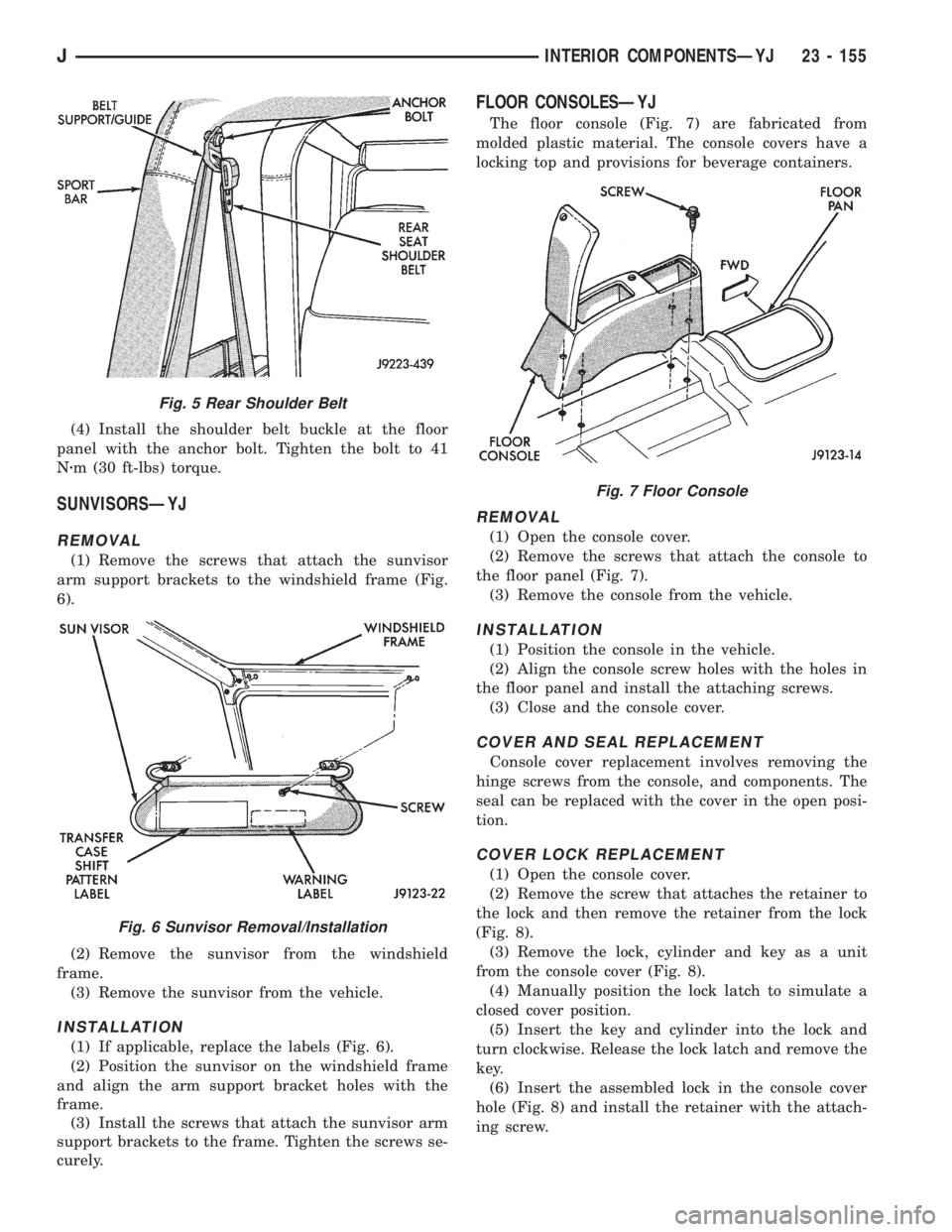
(1) Remove the cover and the shoulder belt buckle
anchor bolt from the floor panel (Fig. 4).
(2) Remove the shoulder belt buckle from the floor
panel (Fig. 4).
(3) Remove the cap, shoulder belt upper anchor
bolt, washer and guide from the sport bar.
(4) Remove the retractor anchor bolt from the door
sill (Fig. 4).
(5) Remove the anchor bolt that attaches the lower
part of the shoulder belt to the floor panel (Fig. 4).
(6) Remove the shoulder belt from the vehicle.
CAUTION: Inspect the shoulder belt for evidence of
wear, cuts and fraying. Replace any belt that is
damaged.
INSTALLATION
(1) Position the end of the shoulder belt at the
floor panel and the retractor at the door sill.
(2) Install the anchor bolts (Fig. 4). Tighten the
bolts to 41 Nzm (30 ft-lbs) torque.
(3) Position the shoulder belt guide on the sport
bar and install the anchor bolt (Fig. 4). Tighten the
bolt to 41 Nzm (30 ft-lbs) torque.
(4) Install the cap on the anchor bolt.
(5) Install the shoulder belt buckle at the floor
panel with the anchor bolt. Tighten the bolt to 41
Nzm (30 ft-lbs) torque.
(6) Install the cover on the anchor bolt.
REAR SHOULDER BELTSÐYJ
REMOVAL
(1) Remove the shoulder belt buckle anchor bolt
from the rear floor panel.
(2) Remove the shoulder belt buckle from the rear
floor panel.
(3) Remove the shoulder belt upper anchor bolt,
washer and support/guide from the sport bar (Fig. 5).
(4) Remove the retractor anchor bolt from the
quarter panel.
(5) Remove the anchor bolt that attaches the lower
part of the shoulder belt to the floor panel.
(6) Remove the shoulder belt from the vehicle.
INSTALLATION
(1) Position the lower end of the shoulder belt at
the floor panel and the retractor at the quarter
panel.
(2) Install the anchor bolts. Tighten the bolts to 41
Nzm (30 ft-lbs) torque.
(3) Position the shoulder belt support/guide on the
sport bar and install the anchor bolt (Fig. 5). Tighten
the bolt to 41 Nzm (30 ft-lbs) torque.
Fig. 3 Pivoting/Folding, Bench-Type Rear Seat
Fig. 4 Front Shoulder Belts
23 - 154 INTERIOR COMPONENTSÐYJJ
Page 1888 of 2198
(4) Install the shoulder belt buckle at the floor
panel with the anchor bolt. Tighten the bolt to 41
Nzm (30 ft-lbs) torque.
SUNVISORSÐYJ
REMOVAL
(1) Remove the screws that attach the sunvisor
arm support brackets to the windshield frame (Fig.
6).
(2) Remove the sunvisor from the windshield
frame.
(3) Remove the sunvisor from the vehicle.
INSTALLATION
(1) If applicable, replace the labels (Fig. 6).
(2) Position the sunvisor on the windshield frame
and align the arm support bracket holes with the
frame.
(3) Install the screws that attach the sunvisor arm
support brackets to the frame. Tighten the screws se-
curely.
FLOOR CONSOLESÐYJ
The floor console (Fig. 7) are fabricated from
molded plastic material. The console covers have a
locking top and provisions for beverage containers.
REMOVAL
(1) Open the console cover.
(2) Remove the screws that attach the console to
the floor panel (Fig. 7).
(3) Remove the console from the vehicle.
INSTALLATION
(1) Position the console in the vehicle.
(2) Align the console screw holes with the holes in
the floor panel and install the attaching screws.
(3) Close and the console cover.
COVER AND SEAL REPLACEMENT
Console cover replacement involves removing the
hinge screws from the console, and components. The
seal can be replaced with the cover in the open posi-
tion.
COVER LOCK REPLACEMENT
(1) Open the console cover.
(2) Remove the screw that attaches the retainer to
the lock and then remove the retainer from the lock
(Fig. 8).
(3) Remove the lock, cylinder and key as a unit
from the console cover (Fig. 8).
(4) Manually position the lock latch to simulate a
closed cover position.
(5) Insert the key and cylinder into the lock and
turn clockwise. Release the lock latch and remove the
key.
(6) Insert the assembled lock in the console cover
hole (Fig. 8) and install the retainer with the attach-
ing screw.
Fig. 5 Rear Shoulder Belt
Fig. 6 Sunvisor Removal/Installation
Fig. 7 Floor Console
JINTERIOR COMPONENTSÐYJ 23 - 155
Page 1889 of 2198
CARPETÐYJ
PASSENGER COMPARTMENT FRONT CARPET
SECTION
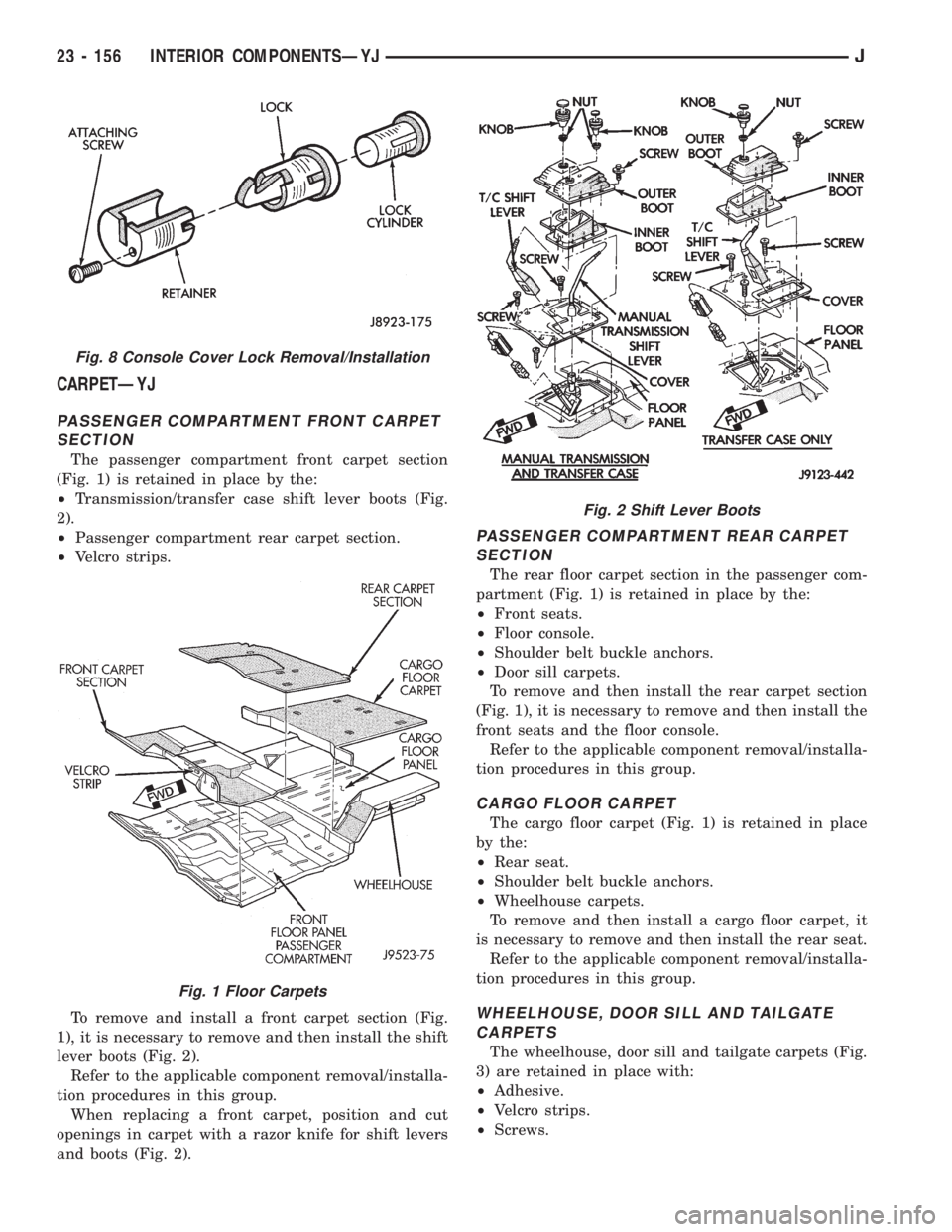
The passenger compartment front carpet section
(Fig. 1) is retained in place by the:
²Transmission/transfer case shift lever boots (Fig.
2).
²Passenger compartment rear carpet section.
²Velcro strips.
To remove and install a front carpet section (Fig.
1), it is necessary to remove and then install the shift
lever boots (Fig. 2).
Refer to the applicable component removal/installa-
tion procedures in this group.
When replacing a front carpet, position and cut
openings in carpet with a razor knife for shift levers
and boots (Fig. 2).
PASSENGER COMPARTMENT REAR CARPET
SECTION
The rear floor carpet section in the passenger com-
partment (Fig. 1) is retained in place by the:
²Front seats.
²Floor console.
²Shoulder belt buckle anchors.
²Door sill carpets.
To remove and then install the rear carpet section
(Fig. 1), it is necessary to remove and then install the
front seats and the floor console.
Refer to the applicable component removal/installa-
tion procedures in this group.
CARGO FLOOR CARPET
The cargo floor carpet (Fig. 1) is retained in place
by the:
²Rear seat.
²Shoulder belt buckle anchors.
²Wheelhouse carpets.
To remove and then install a cargo floor carpet, it
is necessary to remove and then install the rear seat.
Refer to the applicable component removal/installa-
tion procedures in this group.
WHEELHOUSE, DOOR SILL AND TAILGATE
CARPETS
The wheelhouse, door sill and tailgate carpets (Fig.
3) are retained in place with:
²Adhesive.
²Velcro strips.
²Screws.
Fig. 8 Console Cover Lock Removal/Installation
Fig. 1 Floor Carpets
Fig. 2 Shift Lever Boots
23 - 156 INTERIOR COMPONENTSÐYJJ
Page 1890 of 2198
A replacement carpet for any of the three may re-
quire some modifications to accommodate the at-
tached components.
ADD-A-TRUNKÐYJ
REMOVAL
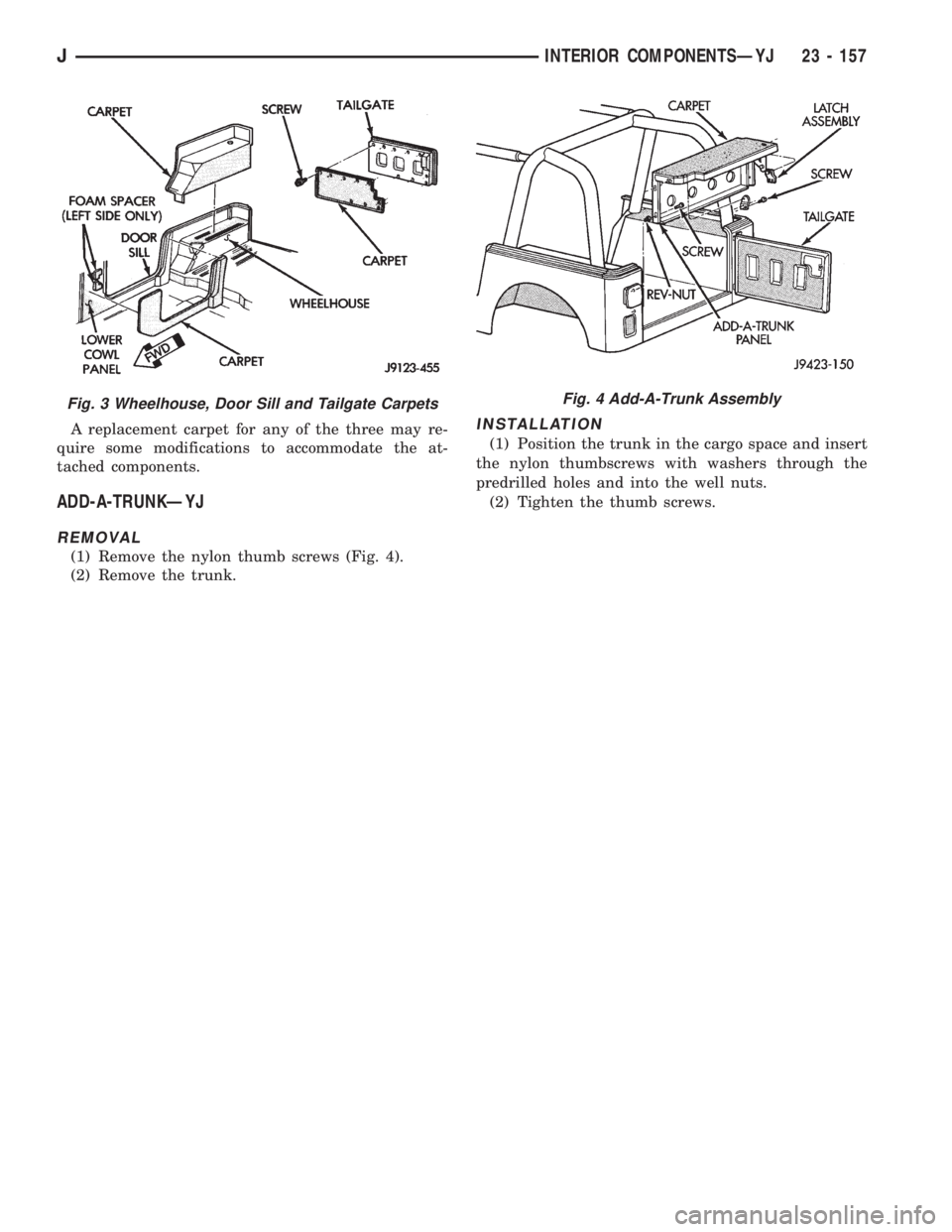
(1) Remove the nylon thumb screws (Fig. 4).
(2) Remove the trunk.
INSTALLATION
(1) Position the trunk in the cargo space and insert
the nylon thumbscrews with washers through the
predrilled holes and into the well nuts.
(2) Tighten the thumb screws.
Fig. 3 Wheelhouse, Door Sill and Tailgate CarpetsFig. 4 Add-A-Trunk Assembly
JINTERIOR COMPONENTSÐYJ 23 - 157
Page 1898 of 2198
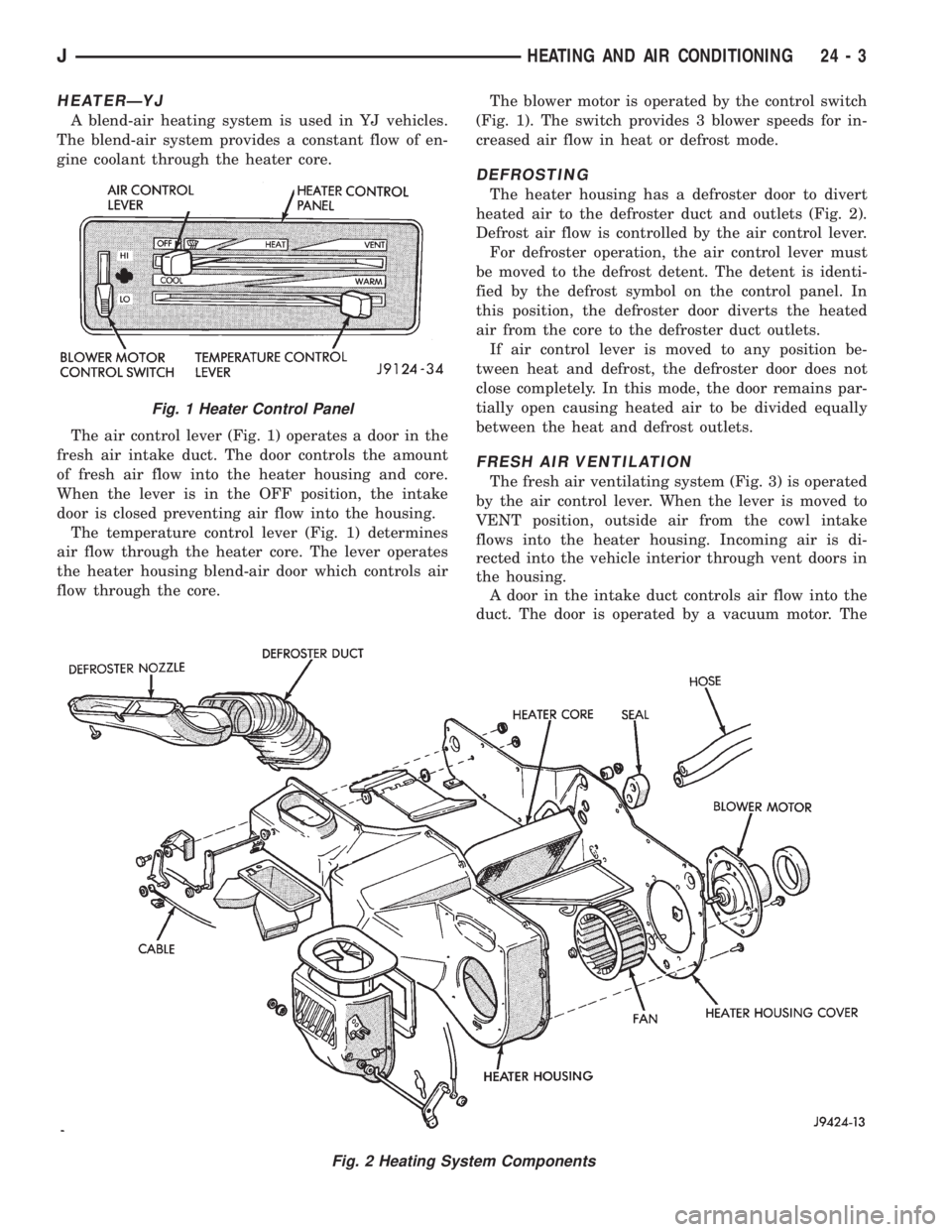
HEATERÐYJ
A blend-air heating system is used in YJ vehicles.
The blend-air system provides a constant flow of en-
gine coolant through the heater core.
The air control lever (Fig. 1) operates a door in the
fresh air intake duct. The door controls the amount
of fresh air flow into the heater housing and core.
When the lever is in the OFF position, the intake
door is closed preventing air flow into the housing.
The temperature control lever (Fig. 1) determines
air flow through the heater core. The lever operates
the heater housing blend-air door which controls air
flow through the core.The blower motor is operated by the control switch
(Fig. 1). The switch provides 3 blower speeds for in-
creased air flow in heat or defrost mode.
DEFROSTING
The heater housing has a defroster door to divert
heated air to the defroster duct and outlets (Fig. 2).
Defrost air flow is controlled by the air control lever.
For defroster operation, the air control lever must
be moved to the defrost detent. The detent is identi-
fied by the defrost symbol on the control panel. In
this position, the defroster door diverts the heated
air from the core to the defroster duct outlets.
If air control lever is moved to any position be-
tween heat and defrost, the defroster door does not
close completely. In this mode, the door remains par-
tially open causing heated air to be divided equally
between the heat and defrost outlets.
FRESH AIR VENTILATION
The fresh air ventilating system (Fig. 3) is operated
by the air control lever. When the lever is moved to
VENT position, outside air from the cowl intake
flows into the heater housing. Incoming air is di-
rected into the vehicle interior through vent doors in
the housing.
A door in the intake duct controls air flow into the
duct. The door is operated by a vacuum motor. The
Fig. 2 Heating System Components
Fig. 1 Heater Control Panel
JHEATING AND AIR CONDITIONING 24 - 3
Page 1907 of 2198
REFRIGERANT OIL
It is important to have the correct amount of oil in
the A/C system. This will ensure proper lubrication of
the compressor. Too little oil will result in damage to
the compressor. Too much oil will reduce the cooling
capacity of the system.
The oil used in the SD7H15 compressor is a poly-
alkylene glycol synthetic oil SP-20 PAG, wax-free re-
frigerant oil. Only refrigerant oil of the same type
should be used to service the system. Do not use any
other oil. The oil container should be kept tightly
capped until it is ready for use and then capped after
use to prevent contamination. Refrigerant oil will
quickly absorb any moisture it comes in contact with.
OIL LEVEL CHECK
It will not be necessary to check oil level in the
compressor or to add oil unless there has been an oil
loss. This may be due to a rupture or leak from a
line, shaft seal, evaporator or condenser. Oil loss at a
leak point will be evident by the presence of a wet,
shiny surface around the leak.
When an A/C system is assembled at the factory,
all components (except the compressor) are refriger-
ant oil free. After the system has been charged and
operated, the oil in the compressor is dispersed
through the system. The receiver-drier, evaporator,
condenser and compressor will retain a significant
amount of oil.
Refrigerant oil must be added when a receiver-
drier, evaporator, condenser or compressor are re-
placed. When the compressor is replaced, the oil
must be drained from the replaced compressor and
measured. Drain all the oil from the new compressor.
Add back into the new compressor the amount of oil
that was drained out of the old compressor.
Add an additional 30 ml (1 fluid oz.) of com-
pressor oil to the system when a receiver-drier,
condenser or evaporator is replaced.
AIR CONDITIONING PERFORMANCE TESTS
Humidity has an important bearing on the temper-
ature of the air delivered to the vehicle's interior. It
is important to understand the effect humidity has
on the performance of the system. When humidity is
high, the evaporator has to perform a double duty. It
must lower the air temperature and the temperature
of the moisture carried in the air. Condensing the
moisture in the air transfers a great deal of heat en-
ergy into the evaporator fins and tubing. This re-
duces the amount of heat the evaporator can absorb
from the air. High humidity greatly reduces the evap-
orator's ability to lower the temperature of the air.Evaporator capacity used to reduce the amount of
moisture in the air is not wasted. Wringing some of
the moisture out of the air entering the vehicle adds
to the comfort of the passengers. However, an owner
may expect too much from their air conditioning sys-
tem on humid days. A performance test is the best
way to determine whether or not the system is per-
forming up to standard. This test also provides valu-
able clues to the possible cause of trouble.
Air temperature in test room must be 21ÉC (70ÉF)
minimum for this test.
(1) Connect a Tachometer and manifold gauge set.
(2) Set A/C controls to Max A/C, temperature lever
on full cool and blower on high.
(3) Start engine and adjust idle to 1,000 RPM with
A/C clutch engaged.
(4) Engine should be warmed up with doors, win-
dows and hood closed.
(5) Insert a thermometer in the left center A/C out-
let. Operate the A/C and engine for 5 minutes. The
A/C clutch may cycle depending on ambient temper-
atures.
(6) After 5 minutes note the discharge air temper-
ature. If the clutch cycles, take the reading before
the clutch disengages.
(7) On LHD XJ vehicles open the hood and discon-
nect vacuum line going to the heater water control
valve. Observe the valve arm for movement as the
line is disconnected. Plug the vacuum line to prevent
leakage. If it does not move repair vacuum circuit.
(8) Operate the A/C for 2 more minutes and take
the discharge air temperature reading again. On XJ
vehicles if the temperature increased by more than
2ÉC (5ÉF) check the blend air door cable for correct
operation.
(9) Compare the discharge air temperature to the
A/C Performance (Temperature and Pressure) Chart.
If the discharge air temperature is high, refer to Re-
frigerant Leak Testing and Refrigerant System Diag-
nosis Chart.
(10) Compare the compressor discharge and suc-
tion pressures to the A/C Performance (Temperature
and Pressure) Chart. If the compressor discharge or
suction pressure is not normal, check the operation of
the refrigerant system. Refer to Refrigerant System
Diagnosis Chart.
If pressures are abnormal, refer to the Pressure
and Performance Diagnosis Charts.
The following chart have been developed for quick
reference.
24 - 12 HEATING AND AIR CONDITIONINGJ