ABS JEEP CHEROKEE 2023 User Guide
[x] Cancel search | Manufacturer: JEEP, Model Year: 2023, Model line: CHEROKEE, Model: JEEP CHEROKEE 2023Pages: 276, PDF Size: 12.55 MB
Page 216 of 276
214SERVICING AND MAINTENANCE
CHECKING OIL LEVEL
To ensure proper engine lubrication, the engine oil must
be maintained at the correct level. Check the oil level at
regular intervals, such as every fuel stop. The best time to
check the engine oil level is about five minutes after a fully
warmed up engine is shut off.
Checking the oil while the vehicle is on level ground will
improve the accuracy of the oil level readings.
There are four possible dipstick types:
Crosshatched zone.
Crosshatched zone marked SAFE.
Crosshatched zone marked with MIN at the low end of
the range and MAX at the high end of the range.
Crosshatched zone marked with dimples at the MIN
and the MAX ends of the range.
NOTE:Always maintain the oil level within the crosshatch
markings on the dipstick.
NOTE:Use care when filling under hood fluids such as Engine Oil,
Windshield Washer Solvent, Antifreeze etc. to minimize
spillage onto top of engine. Any excess fluid that is spilled
onto the top of the engine should be removed using
compressed air or absorbent cloth.
Adding 1 qt (1 L) of oil when the reading is at the low end
of the dipstick range will raise the oil level to the high end
of the range marking.
ADDING WASHER FLUID
The windshield and rear window washers share the same
fluid reservoir. The fluid reservoir is located in the front of
the engine compartment. Be sure to check the fluid level
in the reservoir at regular intervals. Fill the reservoir with
windshield washer solvent (not radiator antifreeze) and
operate the system for a few seconds to flush out the
residual water.
When refilling the washer fluid reservoir, take some
washer fluid and apply it to a cloth or towel and wipe clean
the wiper blades, this will help blade performance.
To prevent freeze-up of your windshield washer system in
cold weather, select a solution or mixture that meets or
exceeds the temperature range of your climate. This rating
information can be found on most washer fluid containers.
NOTE:Use care when filling under hood fluids such as Engine Oil,
Windshield Washer Solvent, Antifreeze etc. to minimize
spillage onto top of engine. Any excess fluid that is spilled
onto the top of the engine should be removed using
compressed air or absorbent cloth.
MAINTENANCE-FREE BATTERY
Your vehicle is equipped with a maintenance-free battery.
You will never have to add water, and periodic
maintenance is not required.
CAUTION!
Overfilling or underfilling the crankcase will cause
aeration or loss of oil pressure. This could damage your
engine.
WARNING!
Commercially available windshield washer solvents are
flammable. They could ignite and burn you. Care must
be exercised when filling or working around the washer
solution.
WARNING!
Battery fluid is a corrosive acid solution and can burn
or even blind you. Do not allow battery fluid to
contact your eyes, skin, or clothing. Do not lean over
a battery when attaching clamps. If acid splashes in
eyes or on skin, flush the area immediately with large
amounts of water
Úpage 200.
Battery gas is flammable and explosive. Keep flame
or sparks away from the battery. Do not use a
booster battery or any other booster source with an
output greater than 12 Volts. Do not allow cable
clamps to touch each other.
Battery posts, terminals, and related accessories
contain lead and lead compounds. Wash hands after
handling.
23_KL_OM_EN_USC_t.book Page 214
Page 219 of 276
SERVICING AND MAINTENANCE217
Engine Air Cleaner Filter Installation
NOTE:Inspect and clean the housing assembly if significant dirt
or debris is present before replacing the engine air cleaner
filter.
1. Install the engine air cleaner filter into the housing
assembly with the engine air cleaner filter
inspection surface facing downward.
2. Install the engine air cleaner filter cover onto the housing assembly locating tabs.
3. Install screws to secure the engine air cleaner filter cover to the housing assembly.
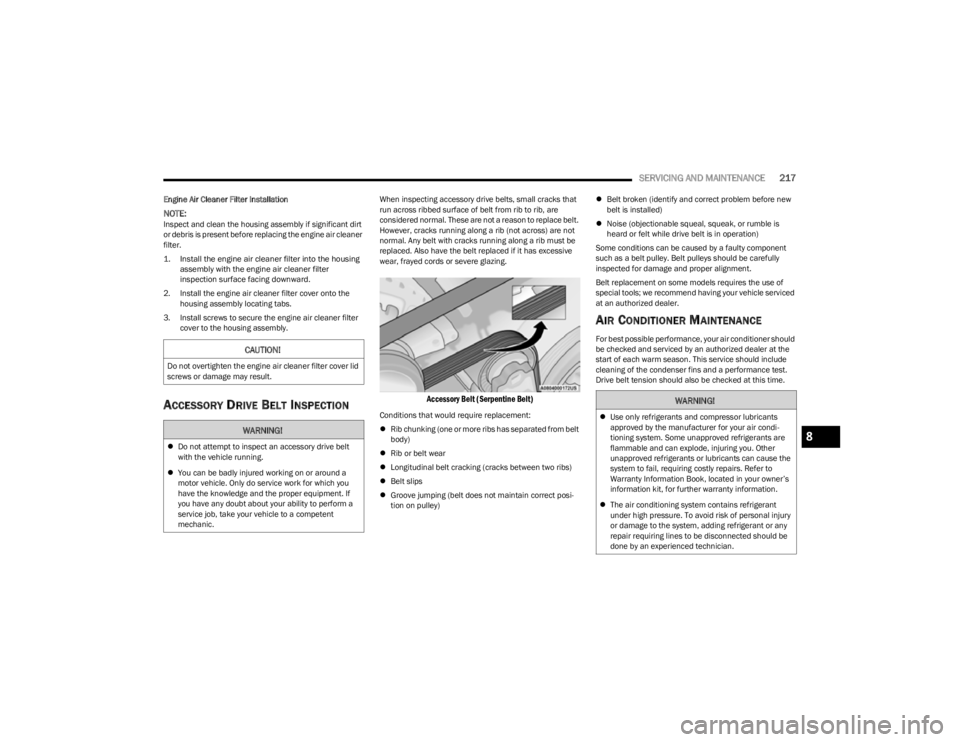
ACCESSORY DRIVE BELT INSPECTION
When inspecting accessory drive belts, small cracks that
run across ribbed surface of belt from rib to rib, are
considered normal. These are not a reason to replace belt.
However, cracks running along a rib (not across) are not
normal. Any belt with cracks running along a rib must be
replaced. Also have the belt replaced if it has excessive
wear, frayed cords or severe glazing.
Accessory Belt (Serpentine Belt)
Conditions that would require replacement:
Rib chunking (one or more ribs has separated from belt
body)
Rib or belt wear
Longitudinal belt cracking (cracks between two ribs)
Belt slips
Groove jumping (belt does not maintain correct posi -
tion on pulley)
Belt broken (identify and correct problem before new
belt is installed)
Noise (objectionable squeal, squeak, or rumble is
heard or felt while drive belt is in operation)
Some conditions can be caused by a faulty component
such as a belt pulley. Belt pulleys should be carefully
inspected for damage and proper alignment.
Belt replacement on some models requires the use of
special tools; we recommend having your vehicle serviced
at an authorized dealer.
AIR CONDITIONER MAINTENANCE
For best possible performance, your air conditioner should
be checked and serviced by an authorized dealer at the
start of each warm season. This service should include
cleaning of the condenser fins and a performance test.
Drive belt tension should also be checked at this time.CAUTION!
Do not overtighten the engine air cleaner filter cover lid
screws or damage may result.
WARNING!
Do not attempt to inspect an accessory drive belt
with the vehicle running.
You can be badly injured working on or around a
motor vehicle. Only do service work for which you
have the knowledge and the proper equipment. If
you have any doubt about your ability to perform a
service job, take your vehicle to a competent
mechanic.
WARNING!
Use only refrigerants and compressor lubricants
approved by the manufacturer for your air condi -
tioning system. Some unapproved refrigerants are
flammable and can explode, injuring you. Other
unapproved refrigerants or lubricants can cause the
system to fail, requiring costly repairs. Refer to
Warranty Information Book, located in your owner’s
information kit, for further warranty information.
The air conditioning system contains refrigerant
under high pressure. To avoid risk of personal injury
or damage to the system, adding refrigerant or any
repair requiring lines to be disconnected should be
done by an experienced technician.
8
23_KL_OM_EN_USC_t.book Page 217
Page 226 of 276
224SERVICING AND MAINTENANCE
NOTE:
It is the owner's responsibility to maintain the proper
level of protection against freezing according to the
temperatures occurring in the area where the vehicle is
operated.
Use care when filling under hood fluids such as Engine
Oil, Windshield Washer Solvent, Antifreeze etc. to mini -
mize spillage onto top of engine. Any excess fluid that
is spilled onto the top of the engine should be removed
using compressed air or absorbent cloth.
Some vehicles require special tools to add coolant
properly. Failure to fill these systems properly could
lead to severe internal engine damage. If any coolant is
needed to be added to the system, please contact a
local authorized dealer.
Mixing engine coolant types is not recommended and
can result in cooling system damage. If HOAT and OAT
coolant are mixed in an emergency, have an authorized
dealer drain, flush, and refill with OAT coolant
(conforming to MS.90032) as soon as possible.
Cooling System Pressure Cap
The cap must be fully tightened to prevent loss of engine
coolant (antifreeze), and to ensure that engine coolant will
return to the radiator from the coolant expansion bottle/
recovery tank (if equipped).
The cap should be inspected and cleaned if there is any
accumulation of foreign material on the sealing surfaces.
Disposal Of Used Coolant
Used ethylene glycol-based coolant (antifreeze) is a
regulated substance requiring proper disposal. Check with
your local authorities to determine the disposal rules for
your community. To prevent ingestion by animals or
children, do not store ethylene glycol-based coolant in
open containers or allow it to remain in puddles on the
ground, clean up any ground spills immediately. If
ingested, seek emergency assistance immediately.
Coolant Level
The coolant bottle provides a quick visual method for
determining that the coolant level is adequate. With the
engine off and cold, the level of the engine coolant
(antifreeze) in the bottle should be between the ranges
indicated on the bottle.
The radiator normally remains completely full, so there is
no need to remove the radiator/coolant pressure cap
unless checking for engine coolant freeze point or replacing coolant. Advise your service attendant of this. As
long as the engine operating temperature is satisfactory,
the coolant only needs to be checked once a month.
When additional engine coolant is needed to maintain the
proper level, only OAT coolant that meets the
requirements of the manufacturer Material Standard
MS.90032 should be added to the coolant bottle. Do not
overfill.
Cooling System Notes
NOTE:When the vehicle is stopped after a few miles/kilometers
of operation, you may observe vapor coming from the front
of the engine compartment. This is normally a result of
moisture from rain, snow, or high humidity accumulating
on the radiator and being vaporized when the thermostat
opens, allowing hot engine coolant (antifreeze) to enter
the radiator.
If an examination of your engine compartment shows no
evidence of radiator or hose leaks, the vehicle may be
safely driven. The vapor will soon dissipate.
Do not overfill the coolant expansion bottle.
Check the coolant freeze point in the radiator and in
the coolant expansion bottle. If engine coolant needs
to be added, the contents of the coolant expansion
bottle must also be protected against freezing.
If frequent engine coolant additions are required, the
cooling system should be pressure tested for leaks.
Maintain engine coolant concentration at a minimum
of 50% OAT coolant (conforming to MS.90032) and
distilled water for proper corrosion protection of your
engine which contains aluminum components.
WARNING!
Do not open hot engine cooling system. Never add
engine coolant (antifreeze) when the engine is over -
heated. Do not loosen or remove the cap to cool an
overheated engine. Heat causes pressure to build up
in the cooling system. To prevent scalding or injury,
do not remove the pressure cap while the system is
hot or under pressure.
Do not use a pressure cap other than the one speci -
fied for your vehicle. Personal injury or engine
damage may result.
23_KL_OM_EN_USC_t.book Page 224
Page 227 of 276
SERVICING AND MAINTENANCE225
Make sure that the coolant expansion bottle overflow
hoses are not kinked or obstructed.
Keep the front of the radiator clean. If your vehicle is
equipped with air conditioning, keep the front of the
condenser clean.
Do not change the thermostat for Summer or Winter
operation. If replacement is ever necessary, install
ONLY the correct type thermostat. Other designs may
result in unsatisfactory engine cooling performance,
poor gas mileage, and increased emissions.
BRAKE SYSTEM
In order to ensure brake system performance, all brake
system components should be inspected periodically.
Refer to the Maintenance Plan for the proper
maintenance intervals
Úpage 209.
Fluid Level Check — Brake Master Cylinder
The fluid level of the brake master cylinder should be
checked whenever the vehicle is serviced, or immediately
if the Brake System Warning Light is on. If necessary, add
fluid to bring level within the designated marks on the side
of the reservoir of the brake master cylinder. Be sure to
clean the top of the master cylinder area before removing cap. With disc brakes, fluid level can be expected to fall as
the brake pads wear. Brake fluid level should be checked
when pads are replaced. If the brake fluid is abnormally
low, check the system for leaks. For further information
Úpage 256.
AUTOMATIC TRANSMISSION
Special Additives
It is strongly recommended against using any special
additives in the transmission. Automatic Transmission
Fluid (ATF) is an engineered product and its performance
may be impaired by supplemental additives. Therefore, do
not add any fluid additives to the transmission. Avoid
using transmission sealers as they may adversely affect
seals.
Fluid Level Check
The fluid level is preset at the factory and does not require
adjustment under normal operating conditions. Routine
fluid level checks are not required; therefore the
transmission has no dipstick. An authorized dealer can
check your transmission fluid level using special service
tools. If you notice fluid leakage or transmission
malfunction, visit an authorized dealer immediately to
have the transmission fluid level checked. Operating the
vehicle with an improper fluid level can cause severe
transmission damage.
WARNING!
Riding the brakes can lead to brake failure and possibly
a collision. Driving with your foot resting or riding on the
brake pedal can result in abnormally high brake
temperatures, excessive lining wear, and possible brake
damage. You would not have your full braking capacity
in an emergency.
WARNING!
Use only manufacturer's recommended brake fluid.
For further information Úpage 256. Using the wrong
type of brake fluid can severely damage your brake
system and/or impair its performance. The proper
type of brake fluid for your vehicle is also identified
on the original factory installed hydraulic master
cylinder reservoir.
To avoid contamination from foreign matter or mois -
ture, use only new brake fluid or fluid that has been
in a tightly closed container. Keep the master
cylinder reservoir cap secured at all times. Brake
fluid in a open container absorbs moisture from the
air resulting in a lower boiling point. This may cause
it to boil unexpectedly during hard or prolonged
braking, resulting in sudden brake failure. This could
result in a collision.
Overfilling the brake fluid reservoir can result in
spilling brake fluid on hot engine parts, causing the
brake fluid to catch fire. Brake fluid can also damage
painted and vinyl surfaces, care should be taken to
avoid its contact with these surfaces.
Do not allow petroleum-based fluid to contaminate
the brake fluid. Brake seal components could be
damaged, causing partial or complete brake failure.
This could result in a collision.
CAUTION!
Do not use chemical flushes in your transmission as the
chemicals can damage your transmission components.
Such damage is not covered by the New Vehicle Limited
Warranty.
8
23_KL_OM_EN_USC_t.book Page 225
Page 237 of 276
SERVICING AND MAINTENANCE235
TIRES
TIRE SAFETY INFORMATION
Tire safety information will cover aspects of the following
information: Tire Markings, Tire Identification Numbers,
Tire Terminology and Definitions, Tire Pressures, and Tire
Loading.
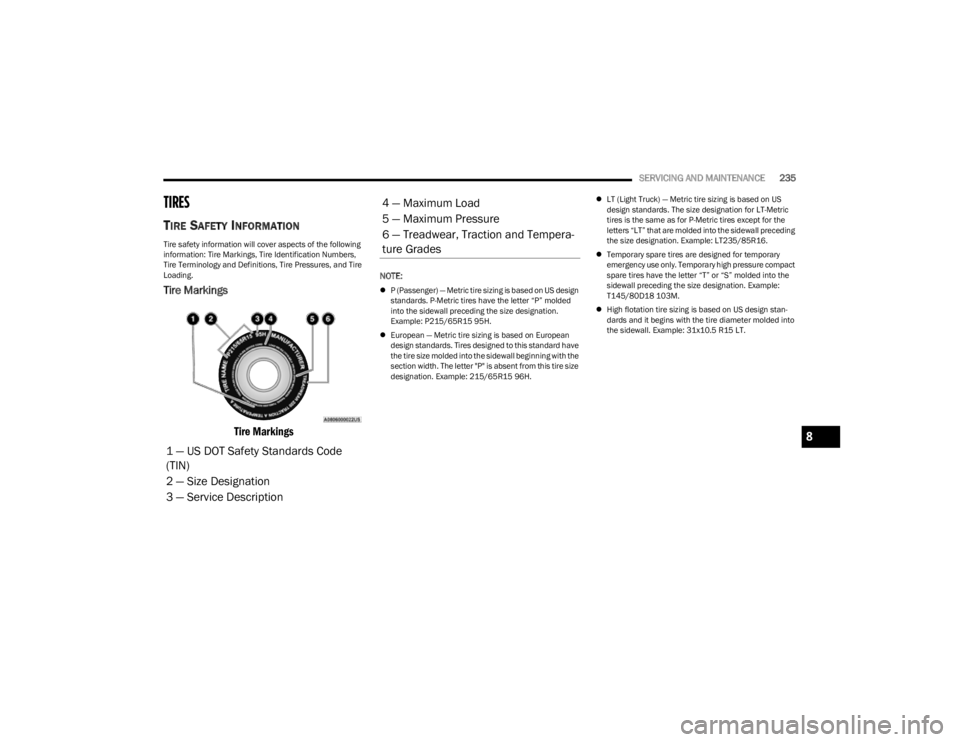
Tire Markings
Tire Markings
NOTE:
P (Passenger) — Metric tire sizing is based on US design
standards. P-Metric tires have the letter “P” molded
into the sidewall preceding the size designation.
Example: P215/65R15 95H.
European — Metric tire sizing is based on European
design standards. Tires designed to this standard have
the tire size molded into the sidewall beginning with the
section width. The letter "P" is absent from this tire size
designation. Example: 215/65R15 96H.
LT (Light Truck) — Metric tire sizing is based on US
design standards. The size designation for LT-Metric
tires is the same as for P-Metric tires except for the
letters “LT” that are molded into the sidewall preceding
the size designation. Example: LT235/85R16.
Temporary spare tires are designed for temporary
emergency use only. Temporary high pressure compact
spare tires have the letter “T” or “S” molded into the
sidewall preceding the size designation. Example:
T145/80D18 103M.
High flotation tire sizing is based on US design stan -
dards and it begins with the tire diameter molded into
the sidewall. Example: 31x10.5 R15 LT.
1 — US DOT Safety Standards Code
(TIN)
2 — Size Designation
3 — Service Description
4 — Maximum Load
5 — Maximum Pressure
6 — Treadwear, Traction and Tempera -
ture Grades
8
23_KL_OM_EN_USC_t.book Page 235
Page 239 of 276
SERVICING AND MAINTENANCE237
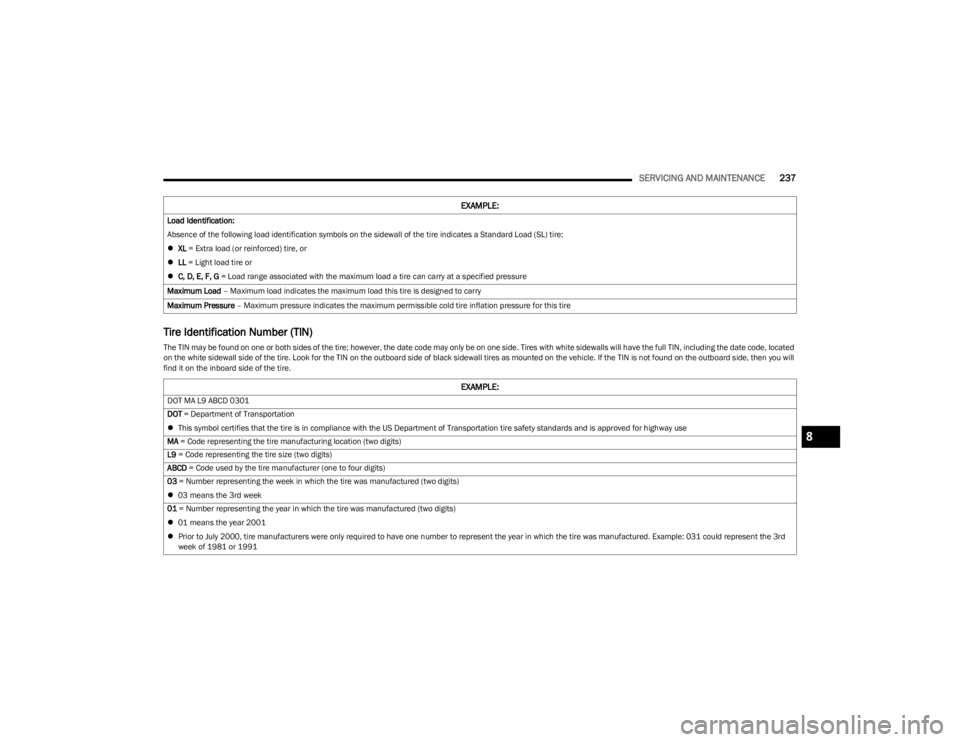
Tire Identification Number (TIN)
The TIN may be found on one or both sides of the tire; however, the date code may only be on one side. Tires with white sidewalls will have the full TIN, including the date code, located
on the white sidewall side of the tire. Look for the TIN on the outboard side of black sidewall tires as mounted on the vehicle. If the TIN is not found on the outboard side, then you will
find it on the inboard side of the tire.Load Identification:
Absence of the following load identification symbols on the sidewall of the tire indicates a Standard Load (SL) tire:
XL = Extra load (or reinforced) tire, or
LL = Light load tire or
C, D, E, F, G = Load range associated with the maximum load a tire can carry at a specified pressure
Maximum Load – Maximum load indicates the maximum load this tire is designed to carry
Maximum Pressure – Maximum pressure indicates the maximum permissible cold tire inflation pressure for this tire
EXAMPLE:
EXAMPLE:
DOT MA L9 ABCD 0301
DOT = Department of Transportation
This symbol certifies that the tire is in compliance with the US Department of Transportation tire safety standards and is approved for highway use
MA = Code representing the tire manufacturing location (two digits)
L9 = Code representing the tire size (two digits)
ABCD = Code used by the tire manufacturer (one to four digits)
03 = Number representing the week in which the tire was manufactured (two digits)
03 means the 3rd week
01 = Number representing the year in which the tire was manufactured (two digits)
01 means the year 2001
Prior to July 2000, tire manufacturers were only required to have one number to represent the year in which the tire was manufactured. Example: 031 could represent the 3rd
week of 1981 or 1991
8
23_KL_OM_EN_USC_t.book Page 237
Page 262 of 276
260CUSTOMER ASSISTANCE
PUERTO RICO AND US VIRGIN ISLANDS
FCA Caribbean LLC
P.O. Box 191857
San Juan 00919-1857
Phone: (877) 426-5337
Fax: (787) 782-3345
CUSTOMER ASSISTANCE FOR THE
H
EARING OR SPEECH IMPAIRED
(TDD/TTY)
To assist customers who have hearing difficulties, FCA US
LLC has installed special TDD (Telecommunication
Devices for the Deaf) equipment at its customer center.
Any hearing or speech impaired customer, who has access
to a TDD or a conventional teletypewriter (TTY) in the
United States, can communicate with FCA US LLC by
dialing 1-800-380-2479.
Canadian residents with hearing difficulties that require
assistance can use the special needs relay service offered
by Bell Canada. For TTY teletypewriter users, dial 711 and
for Voice callers, dial 1-800-855-0511 to connect with a
Bell Relay Service operator.
SERVICE CONTRACT
You may have purchased a service contract for a vehicle
to help protect you from the high cost of unexpected
repairs after FCA US LLC's New Vehicle Limited Warranty
expires. The Mopar® Vehicle Protection plans are the
ONLY vehicle extended protection plans authorized,
endorsed and backed by FCA US LLC to provide additional protection beyond your vehicle’s warranty. If you
purchased a Mopar® Vehicle Protection Plan, you will
receive Plan Provisions and an Owner Identification Card
in the mail within three weeks of the vehicle delivery date.
If you have any questions about the service contract, call
FCA US LLC's Service Contract National Customer Hotline
at 1-800-521-9922 (Canadian residents, call (800)
465-2001 English / (800) 387-9983 French).
FCA US LLC is not responsible for any service contract you
may have purchased from another manufacturer. If you
require service after the FCA US LLC New Vehicle Limited
Warranty expires, please refer to the contract documents,
and contact the person listed in those documents.
We appreciate that you have made a major investment
when you purchased the vehicle. An authorized dealer has
also made a major investment in facilities, tools, and
training to ensure that you are absolutely delighted with
the ownership experience.
WARRANTY INFORMATION
See the Warranty Information for the terms and provisions
of FCA US LLC warranties applicable to this vehicle and
market. Refer to www.mopar.com/om for further
information.
See the Warranty Information for the terms and provisions
of FCA Canada Inc. warranties applicable to this vehicle
and market. Refer to www.owners.mopar.ca/en for further
information.
Use this QR code to access your digital
experience.
MOPAR® PARTS
Mopar® original equipment parts & accessories and
factory filled fluids are available from an authorized
dealer. They are recommended for your vehicle to keep it
operating at its best and maintain its original condition.WARNING!
Engine exhaust (internal combustion engines only),
some of its constituents, and certain vehicle
components contain, or emit, chemicals known to the
State of California to cause cancer and birth defects, or
other reproductive harm. In addition, certain fluids
contained in vehicles and certain products of
component wear contain, or emit, chemicals known to
the State of California to cause cancer and birth
defects, or other reproductive harm.
23_KL_OM_EN_USC_t.book Page 260
Page 265 of 276
263
INDEX
AAbout Your Brakes ....................................................... 253
Adaptive Cruise Control (ACC) (Cruise Control) ...... 90, 92
Adding Engine Coolant (Antifreeze) ............................ 223
Adding Fuel................................................................... 113
Additives, Fuel .............................................................. 255
Air Bag........................................................................... 167 Air Bag Operation.................................................... 168
Air Bag Warning Light .................................... 166
, 169
Driver Knee Air Bag ................................................ 172
Enhanced Accident Response ...................... 175
, 207
Event Data Recorder (EDR).................................... 207 Front Air Bag .................................................. 167
, 169
If Deployment Occurs ............................................. 174
Knee Impact Bolsters ............................................. 172
Maintaining Your Air Bag System .......................... 175
Maintenance ........................................................... 175
Redundant Air Bag Warning Light ......................... 167
Transporting Pets.................................................... 186
Air Bag Light ................................................. 68
, 166, 187
Air Cleaner, Engine (Engine Air Cleaner Filter) ........... 216
Air Conditioner Maintenance ...................................... 217
Air Conditioner Refrigerant ................................. 217
, 218
Air Conditioner System ................................................ 217
Air Conditioning Filter ........................................... 48
, 218
Air Conditioning, Operating Tips ..................................... 48 Air Filter......................................................................... 216
Air Pressure Tires ......................................................................... 241 Alarm
Arm The System......................................................... 20
Disarm The System ................................................... 20
Security Alarm..................................................... 20
, 70
All Wheel Drive (AWD)..................................................... 85 Antifreeze (Engine Coolant) ............................... 223
, 256
Disposal ...................................................................224
Anti-Lock Brake System (ABS) ..................................... 143
Anti-Lock Warning Light.................................................. 70
Assist, Hill Start ............................................................. 148
Audio Systems (Radio) ................................................. 126
Auto Down Power Windows............................................ 53
Auto Up Power Windows ................................................ 53
Automatic Climate Controls ........................................... 45
Automatic Dimming Mirror ............................................. 34 Automatic Door Locks ............................................. 23
, 24
Automatic Headlights ..................................................... 40 Automatic High Beams ................................................... 40
Automatic Temperature Control (ATC) .......................... 48
Automatic Transaxle ....................................................... 81
Automatic Transmission ................................................. 81 Adding Fluid ............................................................. 226
Fluid And Filter Change ...........................................226
Fluid Change ............................................................226Fluid Level Check ....................................................225Fluid Type ................................................................. 226
Special Additives ..................................................... 225Torque Converter....................................................... 85
Autostick.......................................................................... 84 AUX Cord.......................................................................... 50Auxiliary (Power Outlet) .................................................. 51
BBattery.................................................................... 69, 214
Keyless Key Fob Replacement................................. 14
Battery Saver Feature .................................................... 42
Belts, Seat..................................................................... 187
Blind Spot Monitoring .................................................. 150
Body Mechanism Lubrication ...................................... 219
Bodywork ...................................................................... 250
B-Pillar Location ........................................................... 238
Brake Assist System............................................ 144
, 154
Brake Control System .................................................. 143
Brake Fluid.................................................................... 225
Brake System ......................................................225
, 253
Anti-Lock (ABS) ........................................................ 253 Fluid Check .............................................................. 225Master Cylinder ....................................................... 225Parking....................................................................... 78
Warning Light ............................................................ 68
Brake/Transmission Interlock ....................................... 81
Brightness, Interior Lights.............................................. 42
Bulb Replacement ........................................................ 233
Bulbs, Light ................................................................... 188
CCamera, Rear................................................................ 112
Capacities, Fluid ........................................................... 256
Caps, Filler Oil (Engine) ..................................................... 212
, 213
Radiator (Coolant Pressure) ................................... 224
Car Washes................................................................... 250
Carbon Monoxide Warning .......................................... 18811
23_KL_OM_EN_USC_t.book Page 263