lock JEEP CJ 1953 Owners Manual
[x] Cancel search | Manufacturer: JEEP, Model Year: 1953, Model line: CJ, Model: JEEP CJ 1953Pages: 376, PDF Size: 19.96 MB
Page 156 of 376
F2
EXHAUST EMISSION CONTROL SYSTEMS
the throttle
stop
screw to idle the
engine
at 650
to 700 rpm.
F2-17. Carburetor Idle Setting
The
"Lean
Best
Idle"
Method of Idle Setting is as
follows:
a.
Any scheduled service of ignition system should
precede this adjustment
b.
Connect tachometer to engine.
c.
Warm
up
engine
and stabilize temperatures.
d.
Adjust
engine
idle to speed desired, using throt
tle idle speed adjusting screw.
e.
Turn
idle mixture screws out (counterclockwise)
until
a
loss
of
engine
speed is indicated; then slowly
turn
mixture screws in (clockwise-leaner)
until
maximum speed (rpm) is reached. Continue
turning
in (clockwise) until speed begins to drop;
turn
mixture adjustment back out (counterclock
wise-richer)
until maximum speed is just regained
at
a "lean as possible" mixture adjustment.
F2-18. Distributor
The
ignition distributor used with the
Exhaust
Emission
Control
System is the same as that used
on
engines
without
Exhaust
Emission
Control.
Check
the distributor cam dwell angle and point
condition.
Check
ignition timing and adjust to specifications shown on the last
page
of this section.
F2-19.
Anti-Backfire
Valve
The
anti-backfire valve remains closed except when
the throttle is closed rapidly from an open position.
To
check the valve for proper operation, accelerate
the
engine
in neutral, allowing the throttle to close
rapidly.
The valve is operating satisfactorily when
no exhaust system backfire occurs. A further check
to determine whether the valve is functioning can
be made by removing from the anti-backfire valve
the large
hose
which connects the valve to the
pump.
With
a finger placed over the open end of
the
hose
(not the valve), accelerate the
engine
and allow the throttle to close rapidly. The valve is
operating satisfactorily if a momentary air rushing
noise is audible.
F2-20.
Check
Valve
The
check valves in the lines to the air distribution manifolds prevent the reverse flow of exhaust
gases
to the pump in the event the pump should, for
any
reason,
become
inoperative or should exhaust
pressure
ever exceed pump pressure.
To
check this valve for proper operation, remove the air supply
hose
from the pump at the check
valve.
With
the
engine
running, listen for exhaust
leakage at the check valve which is connected to
the distribution manifold.
F2-21.
Air
Pump
Check
for proper drive belt tension with belt tension
gauge
W-283. The belt strand tension should be 60 pounds measured on the
longest
accessible span
between two pulleys. DO NOT PRY ON THE
DIE
CAST
PUMP
HOUSING. To
check the pump for proper operation, remove
the air
outlet
hose
at the pump.
With
the
engine
running,
air discharge should be felt at one of
the pump
outlet
openings. The pump
outlet
air
pressure,
as determined by the relief valve, is preset
and
is not adjustable.
The
air pump
rear
cover assembly, housing the pressed in inlet and discharge tubes, and the pres
sure
relief valve are the only pump components
recommended for service replacement. These parts
are
to be replaced only when damaged as a result
of handling or in the event the relief valve was
tampered with.
F2-22.
Intake Manifold
Intake
manifold leaks must not be overlooked. Air
leakage at the intake manifold may be compen
sated for by
richer
idle mixture setting, however, this
will
usually cause uneven fuel-air distribution
and
will
always result in
loss
of performance and
exhaust emission control. To check for air leakage
into the intake manifold, apply kerosene or naph
tha,
on the intake manifold to cylinder head joints
and
observe whether any changes in
engine
rpm
occur.
If an air leak is indicated, check the mani
fold to cylinder head bolt torque. The correct torque is 25-35 lbs. ft. [3,46 a 4,84 kg-m.]. If the
leak
is
still
evident,
loosen
the manifold assembly
and
torque-tighten the bolts evenly.
Start
from the center and use proper torque values. Replace the
manifold
gasket if the leak
still
exists.
Clean
both
mating surfaces and check for
burrs
or other ir
regularities.
Always
torque the bolts evenly to the specified
torque value to prevent warpage.
F2-23.
Carburetor
Air
Cleaner
—Oil
Bath
Every
6,000
miles [9,600 km.] disconnect attach
ing
hoses
and unscrew the wing nut from the top
of the air cleaner and lift it off the carburetor.
Lift
the cover and filter element off the oil sump.
Clean
the inside surface of the sump and
refill
to
indicated
oil level with SAE 40 or 50
engine
oil
above 32 F; SAE 20 below 32 F.
Wash
filter element in kerosene and
drain.
Reassemble the air
cleaner
and install on carburetor.
More
frequent cleaning and replacement are advis able when the car is operated in dusty areas or on
unpaved
roads. Accumulated
dirt
restricts air flow,
reducing
fuel economy and performance.
F2-24.
REMOVAL PROCEDURES
The
following paragraphs
give
the procedures for removing the major units of the exhaust emission
control
system and the required equipment needed.
F2-2S.
Air
Pump
Loosen
the air pump mounting bracket bolts. Re move the air pump air hose(s). Separate the air pump from its mounting bracket. At time of install
ation,
torque tighten the air pump mounting bolts
to
30-40
lbs.-ft [4,15 a 5,53 kg-m.].
Adjust
the
belt strand tension to 60 pounds. 156
Page 161 of 376
'Jeep*
UNIVERSAL
SERIES
SERVICE
MANUAL
COOLING
SYSTEM
Contents
SUBJECT
PAR.
GENERAL
.G-l Antifreeze Solutions. .G-l6
Cylinder
Block.
..................
.G-8
Draining
Cooling System............... G-3
Engine
Overheating..
.................
.G-19
Fan
Belt.
......... .........
.G-18
Filling
Cooling System.................
G-2
Inhibited
Coolant Solution .G-l7
Temperature
Sending Unit.
...........
.G-l0
Thermostat
.........................
G-9
RADIATOR
.G-5
Radiator
and Heater Hoses.............
G-7
SUBJECT
PAR.
Radiator
Pressure
Cap.................
G-4
Radiator
Removal and Replacement..... G-6
WATER
PUMP.
. . .G-ll
Water
Pump Disassembly. .............G-13
Water
Pump Inspection.
..............
.G-12
Water
Pump Reassembly.
.............
.G-14
Water
Pump Removal and Replacement. .G-l5
SERVICE
DIAGNOSIS.
.G-20
SPECIFICATIONS
. .G-21
ANTIFREEZE
CHART.
..... ... .G-22
G-l. GENERAL
a.
The satisfactory performance of the Hurricane
F4
engine
is controlled to a great
extent
by the proper operation of the cooling system. The
engine
block is full length water jacketed which prevents
distortion of the cylinder walls. Directed cooling
and
large water holes, properly placed in the cylin
der head gasket cause more water to flow past the
valve
seats
(which are the
hottest
parts of the
block)
and
carry
the heat away from the valves, giving positive cooling of valves and seats.
Minimum
temperature of the coolant is controlled by a thermostat mounted in the
outlet
passage of
the engine. When the coolant temperature is below
thermostat-rated temperature, the thermostat re mains closed and the coolant is directed through
the radiator-bypass
hose
to the water pump. When the thermostat opens, coolant flow is directed to
the top of the radiator. The radiator dissipates the
excess
engine
heat before the coolant is recirculated
through the engine.
The
cooling system is pressurized. Operating pres
sure
is regulated by the rating of the radiator cap
which
contains a relief valve, b. The Dauntless V-6
engine
efficiency and performance is controlled to a great
extent
by proper
operation of the cooling system. The cooling system
does
more than cool the engine. It also directs
the flow of coolant to provide the
best
operating
temperature range for each part of the engine.
In
the Dauntless V-6
engine
coolant is forced by
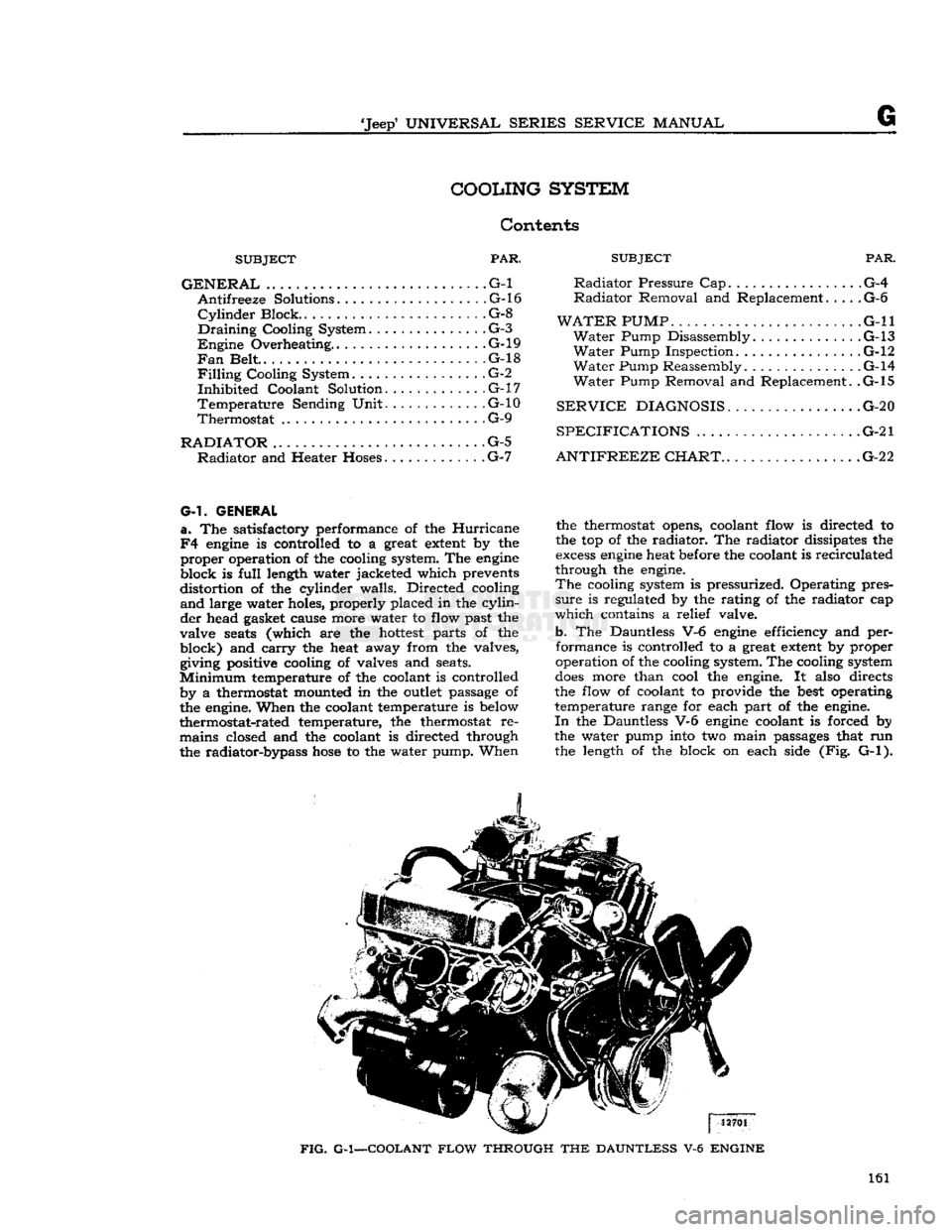
the water pump into two main passages that run the length of the block on each side (Fig. G-l).
FIG.
G-1—COOLANT
FLOW
THROUGH
THE
DAUNTLESS
V-6
ENGINE
161
Page 162 of 376
COOLING
SYSTEM
14263
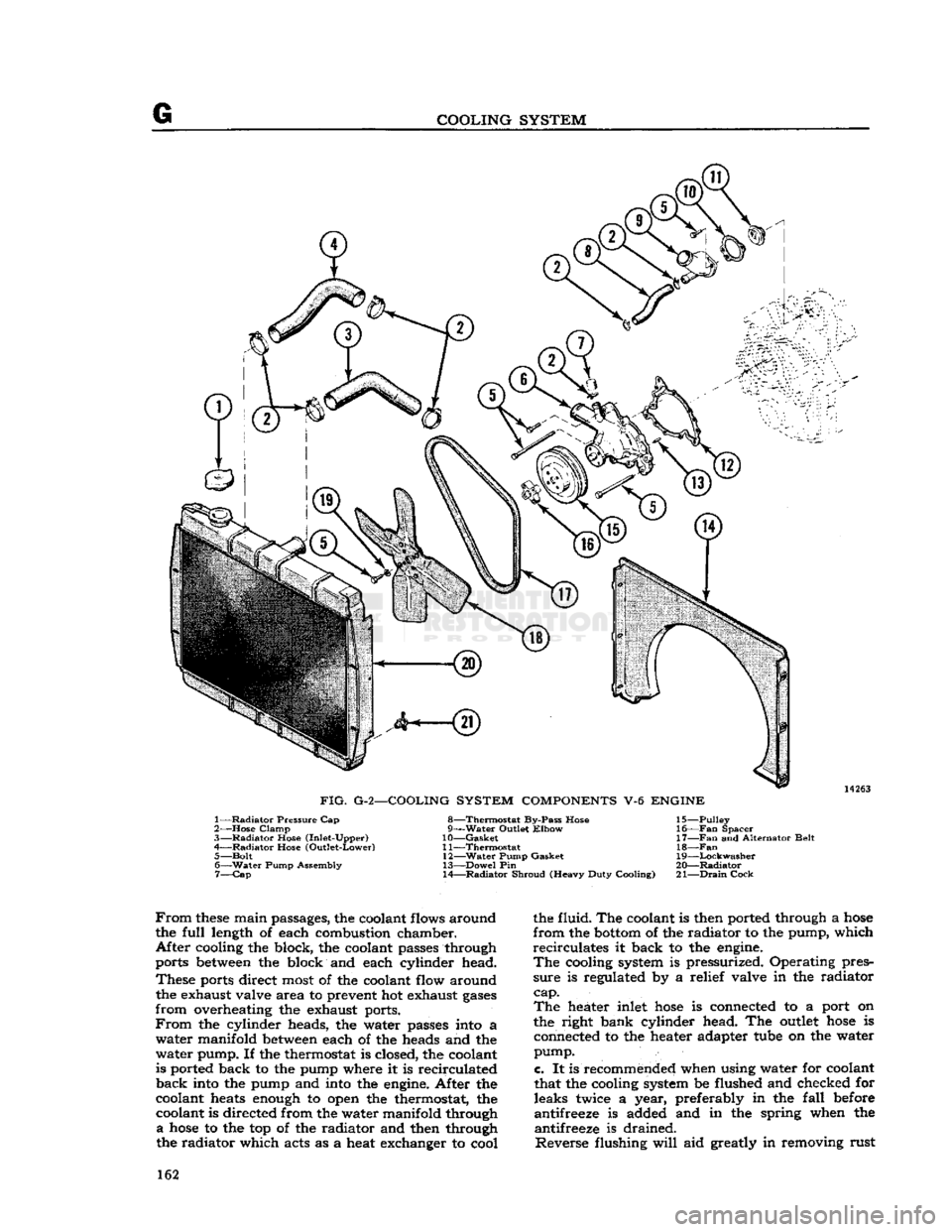
FIG.
G-2—COOLING SYSTEM
COMPONENTS
V-6
ENGINE
1—
Radiator
Pressure Cap
2—
Hose
Clamp
3—
Radiator
Hose (Inlet-Upper)
4—
Radiator
Hose (Outlet-Lower) 5—
Bolt
6—
Water
Pump Assembly 7—
Cap
8—Thermostat
By-Pass Hose
g—Water Outlet
Elbow
10—
Gasket
11—
Thermostat
12—
Water
Pump Gasket
13—
Dowel
Pin
14—
Radiator
Shroud (Heavy Duty Cooling) 15—
Pulley
16—
Fan
Spacer
17—
Fan
and Alternator Belt
18—Fan
19—
Lockwasher
20—
Radiator
21—
Drain
Cock
From
these
main passages, the coolant flows around
the
full
length of each combustion chamber.
After
cooling the block, the coolant passes through
ports between the block and each cylinder head.
These
ports direct most of the coolant flow around the exhaust valve area to prevent hot exhaust
gases
from
overheating the exhaust ports.
From
the cylinder heads, the water passes into a
water
manifold between each of the heads and the
water
pump. If the thermostat is closed, the coolant
is ported back to the pump where it is recirculated
back
into the pump and into the engine. After the
coolant heats enough to open the thermostat, the coolant is directed from the water manifold through
a
hose
to the top of the radiator and then through
the radiator which acts as a heat exchanger to cool the fluid. The coolant is then ported through a
hose
from
the bottom of the radiator to the pump, which
recirculates
it back to the engine.
The
cooling system is pressurized. Operating pres
sure
is regulated by a relief valve in the radiator
cap. The
heater inlet
hose
is connected to a port on
the right bank cylinder head. The outlet
hose
is connected to the heater adapter tube on the water
pump.
c.
It is recommended when using water for coolant
that the cooling system be flushed and checked for leaks twice a year, preferably in the
fall
before
antifreeze is added and in the spring when the antifreeze is drained.
Reverse
flushing
will
aid greatly in removing rust 162
Page 164 of 376
G
COOLING SYSTEM
engine
connections. Insert flushing gun and flush
heater core.
Care
must be taken when applying air
pressure to prevent damage to the heater core.
G-2.
Filling
Cooling System
To
fill
the cooling system, remove the
fill
cap and
fill
the tank to the top. Replace the cap and run
the
engine
at medium speed for approximately one
minute. Remove the cap and recheck the coolant level. Add more coolant if necessary to bring the level back to the top of the tank. If the cooling system is filled when the
engine
is cold, recheck the coolant level after the
engine
has warmed up.
This
will
ensure that the thermostat has opened allow ing complete cooling system circulation.
Always
correct any cooling system leaks before installing antifreeze. A corrosion inhibitor should be used in the cooling system to prevent the forma
tion of rust and scale. A quality brand antifreeze containing a corrosion inhibitor should be used.
When
the antifreeze is drained in the spring, a
corrosion inhibitor should be added with the water.
Note:
Cooling system components for both V6 and
F4
engines
are shown in
Figs.
G-2 and G-3.
G-3. Draining
Cooling System
To
completely
drain
the cooling system, open the
drain
in the
bottom
of the radiator and also a
drain
on the right side of the cylinder block on the
Hurricane
F4 engine. The Dauntless V-6
engine
has two
drain
plugs, one located on each side of the cylinder block. Both plugs must be removed to
completely
drain
the cooling system.
Remove the radiator cap to break any vacuum
that may have developed.
Should
the cooling solution be lost from the system
and
the
engine
become
overheated do not
refill
the system immediately but allow the
engine
to cool or
refill
slowly while the
engine
is running. If
cold solution is poured into the radiator while the
engine
is overheated there is danger of cracking the
cylinder
block and/or cylinder head.
G-4.
Radiator Pressure
Cap
All
radiators are equipped with pressure caps which
reduce evaporation of cooling solution and make the
engines
more efficient by permitting slightly
higher operating temperatures. When operating
properly,
the pressure cap permits pressure build-up
in
the cooling system during periods of severe heat
load.
This
pressure increases the boiling point of the coolant and thus reduces overflow losses. The
effectiveness
of the cap is limited by its opening
pressure and the boiling point of the coolant (see
note
below). The pressure cap employs a spring-
loaded, rubber-faced pressure seal which presses against a seat in the radiator top tank. Spring pres
sure
determines the opening pressure of the valve.
A
typical pressure cap is shown in Fig. G-5.
Note:
Refer to cooling system specifications (Par.
G-21)
for opening (relief) pressure when the ve
hicle is equipped with either the
Hurricane
F4
or
Dauntless V-6 engine. If a new cap is required, always install a cap of the same type and pressure
rating
specified. It should never be altered or re
placed by a plain cap.
A
vacuum release valve (Fig. G-5) is employed to
prevent undesirable vacuum build-up when the system
cools
down. The vacuum release valve is
held against its seat under light spring pressure.
Vacuum
in the system is relieved by the valve
which
opens
at V2 to 1 psi. [0,035 a 0,07 kg-cm2]
vacuum.
A pressure tester can be used to check and
test
the vacuum pressure rate (see Fig. G-6).
Although the mechanism of the pressure cap re quires no maintenance, the cap should be inspected
periodically for cleanliness and freedom of opera tion. The pressure cap gasket and radiator filler neck seat should also be inspected to be sure they
are
providing a proper seal. If the rubber face of
the valve is defective, a new cap should be installed.
Filler
neck reseating
tools
are commercially
avail
able to correct minor
defects
at the surface of the seat. Follow instructions of the reseating tool manu
facturer.
To
remove the radiator pressure cap when the
engine
coolant temperature is high or boiling, place
a
cloth over the pressure cap and
turn
counter clockwise about Vi
turn
until the first (pressure release)
stop
is reached. Keep the cap in this posi
tion until all pressure is released.
Then
push cap
down and
turn
still
further until cap can be re moved. To install the pressure cap, place it in posi
tion and
turn
it clockwise as far as it
will
go.
Caution:
Use extreme care in removing the radiator
pressure cap. In overheated systems, the sudden release of pressure can cause a steam flash and this
flash,
or the
loosened
cap can cause serious personal
injury.
G-5.
RADIATOR
Maintenance of the radiator consists of keeping
the exterior of the radiator core clean, the interior free from rust and scale, and the radiator free from
leaks.
Check
the cooling system fluid level and for
leaks each
2000
miles
[3.200
km.] or every 30
days, whichever occurs first.
This
exterior of the
radiator
core should be cleaned and the radiator inspected for leaks each
6000
miles
[9.600
km.]
of normal service of the vehicle. Cleaning should be performed by blowing out with air stream or water stream directed from the
rear
of the radiator.
Visual
inspection is not sufficient as the accumula tion of small particles of foreign material on core
surfaces can restrict cooling without closing the core openings.
Radiator
leakage occasionally results from cor
rosion perforation of the metal but most leakage results from mechanical failure of soldered joints
when too much strain has been put on the joint.
Fractures
occur most
often
at the joint where the
radiator
inlet and
outlet
pipes are attached to the
tanks.
When the seams break, the entire soldered
joint
is
exposed
and can corrode, but breakage
rather
than corrosion is the
primary
cause of seam
leakage. Examine the radiator carefully for leaks before and after cleaning. Cleaning may uncover points of leakage already existing but plugged with
rust.
White, rusty, or colored leakage stains indicate 164
Page 165 of 376
'Jeep*
UNIVERSAL SERIES SERVICE
MANUAL
G
FIG.
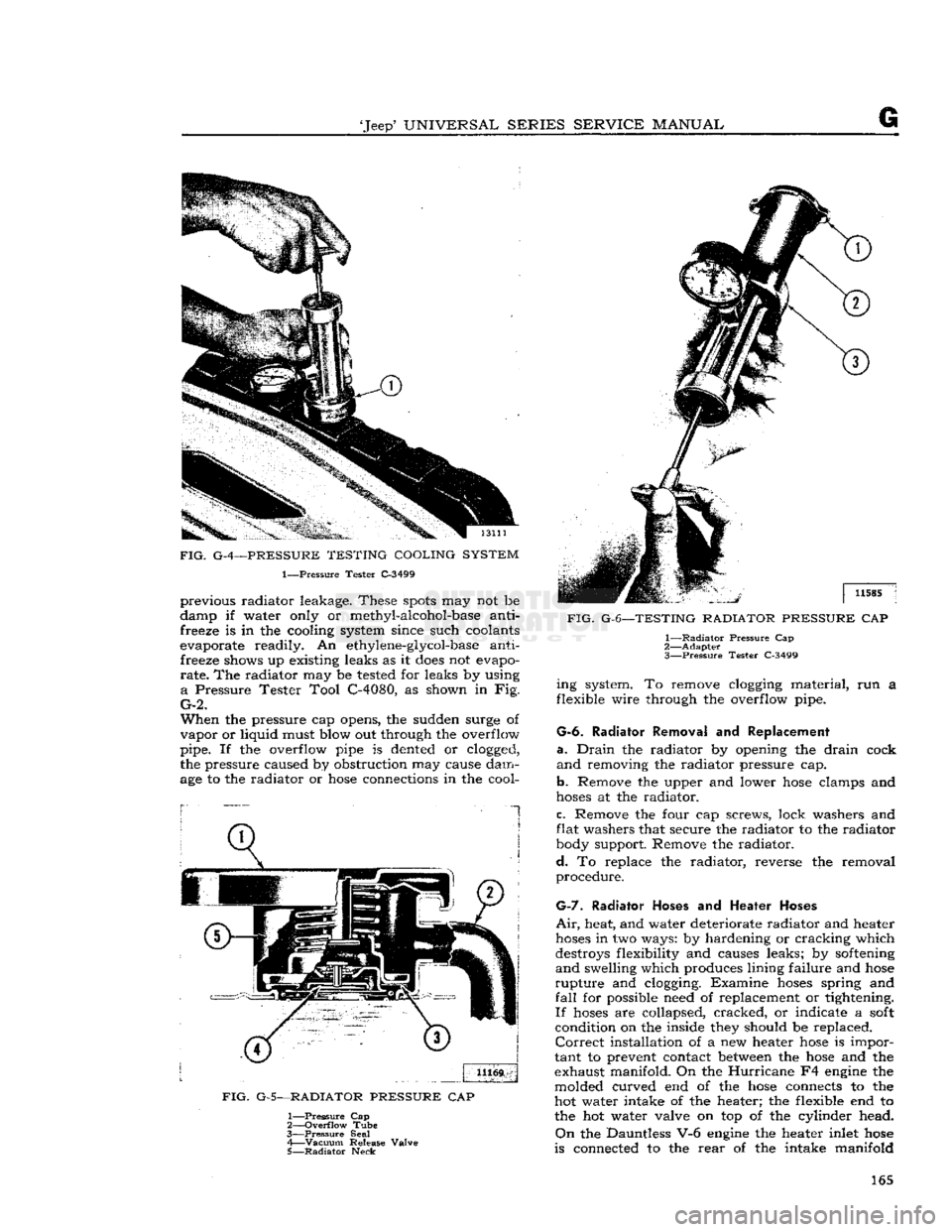
G-4—PRESSURE TESTING COOLING SYSTEM
1—Pressure Tester C-3499 previous radiator leakage. These
spots
may not be
damp if water only or methyl-alcohol-base anti freeze is in the cooling system since such coolants
evaporate readily. An ethylene-glycol-base anti freeze shows up existing leaks as it
does
not evapo
rate.
The radiator may be tested for leaks by using
a
Pressure Tester Tool C-4080, as shown in Fig.
G-2.
When
the pressure cap opens, the sudden surge of
vapor
or liquid must blow out through the overflow
pipe. If the overflow pipe is dented or clogged,
the pressure caused by obstruction may cause dam
age to the radiator or
hose
connections in the cool-
1
FIG.
G-5—RADIATOR PRESSURE
CAP
1—
Pressure
Cap
2—
Overflow
Tube
3—
Pressure
Seal 4—
Vacuum
Release Valve
5—
Radiator
Neck
FIG.
G-6—TESTING RADIATOR PRESSURE
CAP
1—
Radiator
Pressure Cap
2—
Adapter
3—
Pressure
Tester C-3499 ing system. To remove clogging material, run a
flexible wire through the overflow pipe.
G-6.
Radiator Removal
and
Replacement
a.
Drain
the radiator by opening the
drain
cock
and
removing the radiator pressure cap.
b.
Remove the upper and lower
hose
clamps and
hoses
at the radiator.
c.
Remove the four cap screws, lock washers and
flat washers that secure the radiator to the radiator
body support. Remove the radiator.
d.
To replace the radiator, reverse the removal
procedure.
G-7.
Radiator
Hoses
and
Heater Hoses
Air,
heat, and water deteriorate radiator and heater
hoses
in two ways: by hardening or cracking which
destroys flexibility and causes leaks; by softening
and
swelling which produces lining failure and
hose
rupture
and clogging. Examine
hoses
spring and
fall
for possible need of replacement or tightening.
If
hoses
are collapsed, cracked, or indicate a
soft
condition on the inside they should be replaced.
Correct
installation of a new heater
hose
is impor
tant to prevent contact between the
hose
and the
exhaust manifold. On the
Hurricane
F4 engine the
molded curved end of the
hose
connects to the
hot water intake of the heater; the flexible end to the hot water valve on top of the cylinder head.
On
the Dauntless V-6 engine the heater inlet
hose
is connected to the
rear
of the intake manifold 165
Page 166 of 376
G
COOLING SYSTEM and
the outlet
hose
is connected to the water pump
housing.
When
installing a new hose, clean the pipe connec
tions and apply a thin layer of nonhardening seal
ing compound. Hose clamps should be properly
located over the connections to provide secure fastening. The pressurized cooling system pressure
can
blow off improperly installed hoses.
G-8.
Cylinder
Block
Any
coolant leaks at the engine block water joints
are
aggravated by pump pressure in the water
jacket
and by pressure developed in the cooling system when the pressure cap is in place.
Small
leaks showing up only as moist
spots
often
cannot
be detected when the engine is hot except by the
appearance of rust, corrosion, and dye stains where
leakage evaporated. Also, expansion and contrac tion of the engine block resulting from extreme
temperature changes can aggravate leaks. For
these
reasons, when checking for coolant leaks inspect
the block when it is cold and while the engine is
running.
A
leaking
drain
cock or plug that cannot be stopped
leaking
by tightening should be replaced.
Leaking
core-hole expansion plugs should be replaced.
If
tightening gasketed joints
will
not correct leak
age, install new gaskets. Use a sealing compound
where recommended.
G-9.
Thermostat
a.
The cooling system of the engine is designed
to provide adequate cooling under most adverse conditions. However, it is necessary to employ
some
device to provide quick warming and to prevent
overcooling during normal operation. Automatic
control
of engine operating temperature is provided
by a water flow control thermostat installed in the
water
outlet of the
Hurricane
F4 engine. The ther
mostat is a heat-operated valve. It should always
be maintained in working order and the vehicle
should never be driven without one installed as there would then be no control of engine tempera
ture.
The temperature at which the thermostat
opens
is preset and cannot be altered.
b.
The thermostat on the
Hurricane
F4 engine is
located in a housing on the top front of the cylinder
head.
On the Dauntless V-6 engine it is located
in
the thermostat housing of the air intake manifold.
The
standard engine thermostat for the
Hurricane
F4
and Dauntless V-6 engine has a normal rating
of
190°F.
[87.8°C]
and should begin to open at
a
coolant temperature between
180°F.
[82°C]
to
192°F.
[89°C]
and be fully open at
202°F.
[94°C.].
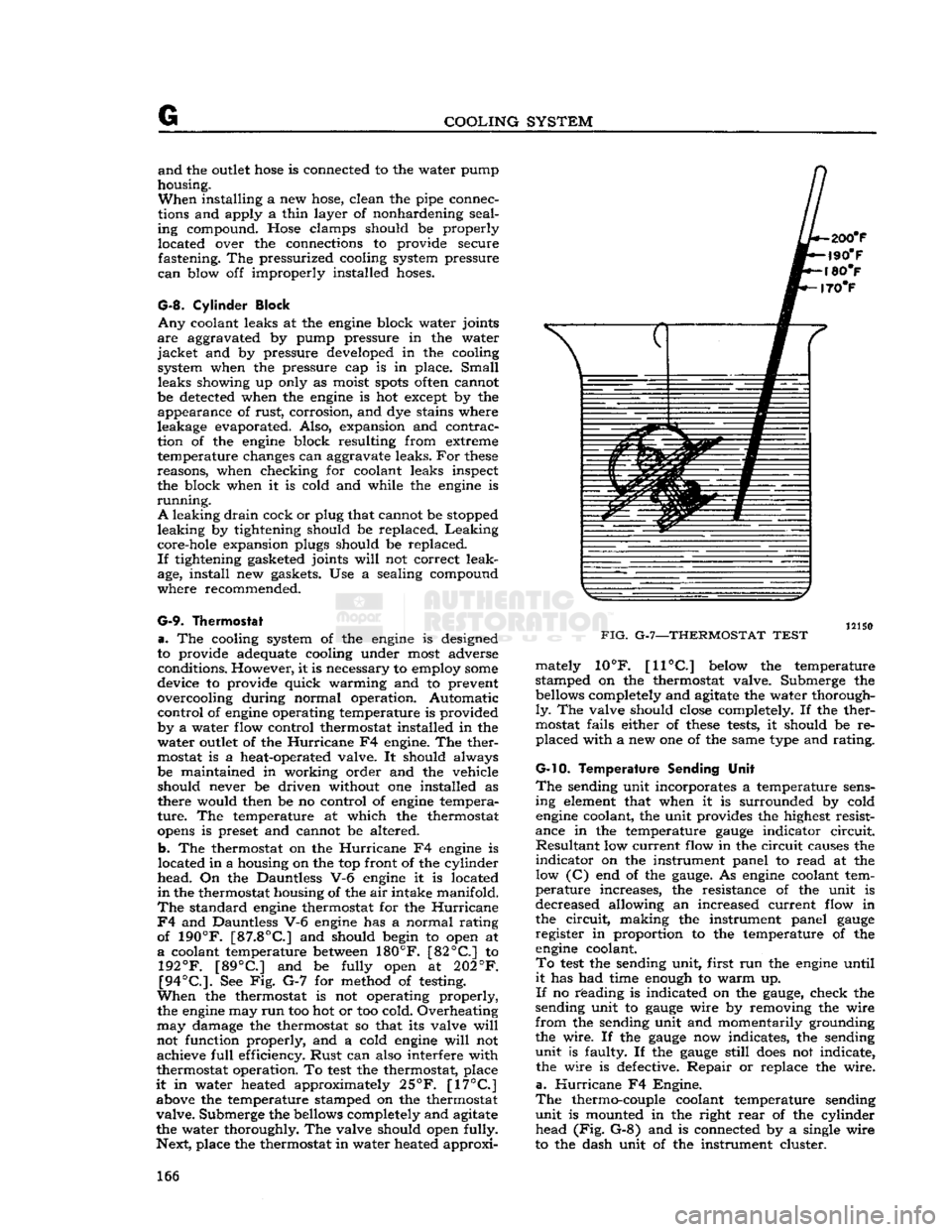
See Fig. G-7 for method of testing.
When
the thermostat is not operating properly, the engine may
run
too hot or too cold. Overheating
may
damage the thermostat so that its valve
will
not function properly, and a cold engine
will
not achieve
full
efficiency.
Rust
can also interfere with
thermostat operation. To
test
the thermostat, place
it
in water heated approximately
25°F.
[17°C]
above the temperature stamped on the thermostat
valve.
Submerge the bellows completely and agitate
the water thoroughly. The valve should open fully.
Next, place the thermostat in water heated approxi-
FIG.
G-7—THERMOSTAT
TEST
mately 10°F.
[11°C]
below the temperature
stamped on the thermostat valve. Submerge the bellows completely and agitate the water thorough
ly.
The valve should close completely. If the ther
mostat fails either of
these
tests, it should be re placed with a new one of the same type and rating.
G-10. Temperature
Sending Unit
The
sending unit incorporates a temperature sens ing element that when it is surrounded by cold engine coolant, the unit provides the highest resist
ance in the temperature
gauge
indicator
circuit.
Resultant
low current flow in the circuit causes the
indicator
on the instrument panel to read at the low (C) end of the
gauge.
As engine coolant tem
perature
increases, the resistance of the unit is
decreased allowing an increased current flow in
the
circuit,
making the instrument panel
gauge
register in proportion to the temperature of the engine coolant.
To
test
the sending unit, first run the engine until
it
has had time enough to warm up.
If
no reading is indicated on the
gauge,
check the
sending unit to
gauge
wire by removing the wire
from
the sending unit and momentarily grounding
the wire. If the
gauge
now indicates, the sending
unit
is faulty. If the
gauge
still
does
not indicate, the wire is defective.
Repair
or replace the wire,
a.
Hurricane
F4 Engine.
The
thermo-couple coolant temperature sending
unit
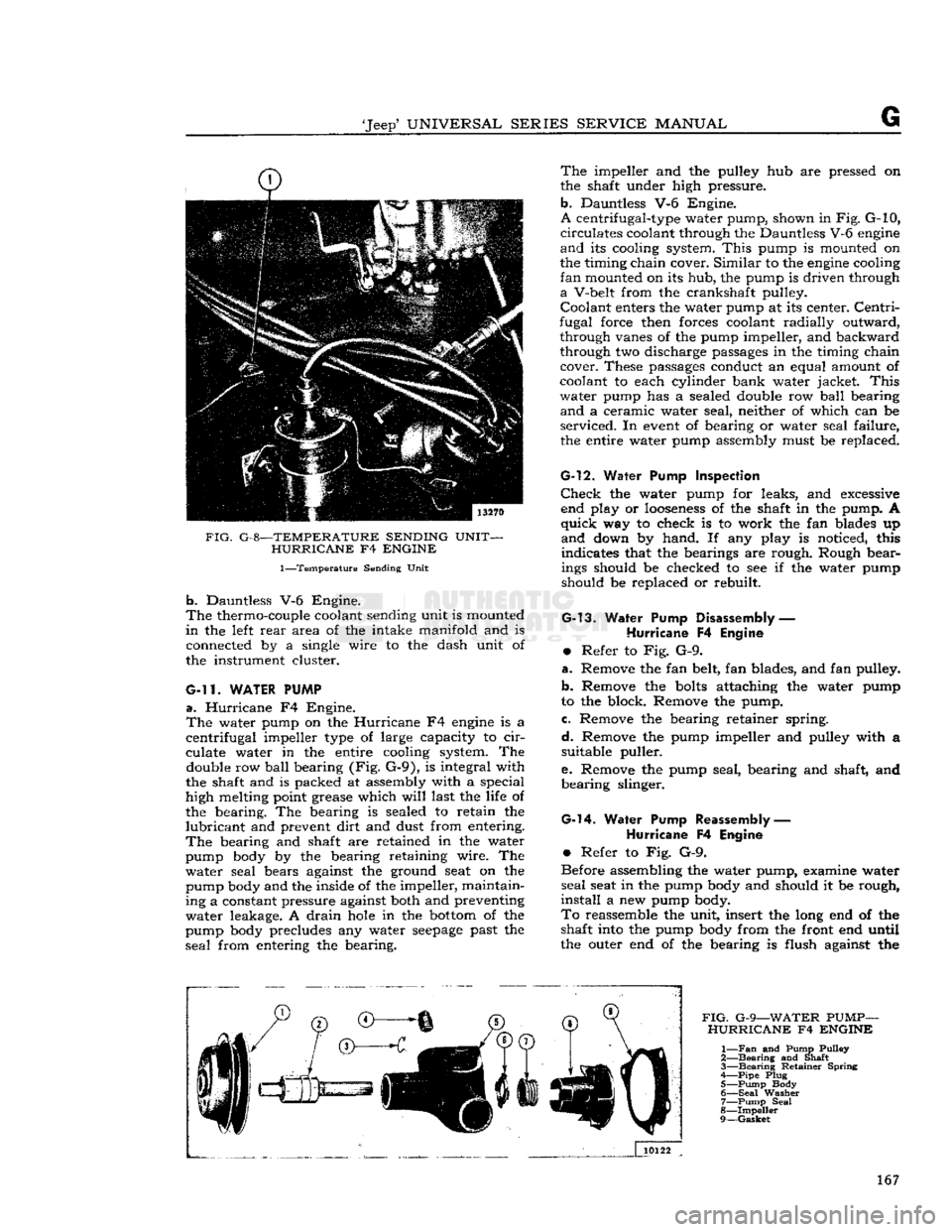
is mounted in the right
rear
of the cylinder head (Fig. G-8) and is connected by a single wire
to the dash unit of the instrument cluster. 166
Page 167 of 376
'Jeep*
UNIVERSAL
SERIES
SERVICE
MANUAL
FIG.
G-8—TEMPERATURE SENDING UNIT- HURRICANE
F4
ENGINE
1—Temperature
Sending Unit
b.
Dauntless V-6 Engine.
The
thermo-couple coolant sending unit is mounted
in
the left
rear
area of the intake manifold and is
connected by a single wire to the dash unit of
the instrument cluster.
G-ll.
WATER PUMP
a.
Hurricane
F4 Engine.
The
water pump on the
Hurricane
F4
engine
is a
centrifugal
impeller type of large capacity to
cir
culate water in the entire cooling system. The double row
ball
bearing (Fig. G-9), is integral with
the shaft and is packed at assembly with a special
high melting point grease which
will
last the life of
the bearing. The bearing is sealed to retain the
lubricant
and prevent
dirt
and dust from entering.
The
bearing and shaft are retained in the water
pump body by the bearing retaining wire. The
water
seal bears against the ground seat on the
pump body and the inside of the impeller, maintain
ing a constant pressure against both and preventing
water
leakage. A
drain
hole
in the
bottom
of the
pump body precludes any water
seepage
past the
seal
from entering the bearing.
The
impeller and the pulley hub are pressed on
the shaft under high pressure,
b.
Dauntless V-6 Engine.
A
centrifugal-type water pump, shown in
Fig.
G-10,
circulates
coolant through the Dauntless V-6
engine
and
its cooling system.
This
pump is mounted on
the timing chain cover.
Similar
to the
engine
cooling
fan
mounted on its hub, the pump is driven through
a
V-belt from the crankshaft pulley.
Coolant
enters the water pump at its center.
Centri
fugal force then forces coolant radially outward, through vanes of the pump impeller, and backward
through two discharge passages in the timing chain cover. These passages conduct an equal amount of
coolant to each cylinder bank water jacket.
This
water
pump has a sealed double row
ball
bearing
and
a ceramic water seal, neither of which can be
serviced.
In
event
of bearing or water seal failure, the entire water pump assembly must be replaced.
G-l2.
Water
Pump Inspection
Check
the water pump for leaks, and excessive end play or
looseness
of the shaft in the pump. A
quick
way to check is to work the fan blades up
and
down by hand. If any play is noticed, this
indicates that the bearings are rough. Rough bearings should be checked to see if the water pump
should be replaced or rebuilt.
G-13.
Water Pump
Disassembly
—
Hurricane
F4
Engine
•
Refer to Fig. G-9.
a.
Remove the fan belt, fan blades, and fan pulley.
b.
Remove the
bolts
attaching the water pump
to the block. Remove the pump.
c.
Remove the bearing retainer spring.
d.
Remove the pump impeller and pulley with a suitable puller.
e.
Remove the pump seal, bearing and shaft, and
bearing
slinger.
G-l4.
Water Pump Reassembly
—
Hurricane
F4
Engine
•
Refer to Fig. G-9.
Before assembling the water pump, examine water
seal
seat in the pump body and should it be rough,
install
a new pump body.
To
reassemble the unit, insert the long end of the shaft into the pump body from the front end until
the outer end of the bearing is flush against the
FIG.
G-9—WATER
PUMP-
HURRICANE
F4
ENGINE
1—
Fan
and Pump Pulley
2—
Bearing
and Shaft
3—
Bearing
Retainer Spring
A—Pipe
Plug 5—
Pump
Body
6—
Seal
Washer 7—
Pump
Seal
8—
Impeller
9—
Gasket
167
Page 169 of 376
'Jeep'
UNIVERSAL
SERIES SERVICE
MANUAL
G
cation period. It is
good
preventive maintenance to
replace a badly frayed, worn or cracked fan belt
before it breaks in operation.
To
replace the fan belt,
loosen
the attaching
bolts
at each generator or alternator brace-to-engine mounting and pivot the alternator or generator to
ward
the
engine
to gain slack needed to install the new belt Remove the old belt. Position the new
belt over the fan pulley, over the crankshaft pulley,
then over the generator or alternator pulley.
Pull
the generator or alternator away from the
engine
until
belt tension is
firm.
Then tighten the generator
or
alternator mounting
bolts
and check the tension
as indicated above. Reset the generator or alternator as necessary for correct belt tension.
Finally,
torque
the generator or alternator mounting
bolts
25 to 35 lb-ft. [3,4 a 4,8 kg-m.].
Note:
On the Dauntless V-6
engine
when adjusting
the fan belt tension, the alternator mounting
bolts
should be torqued 30 to 40 lb-ft. [4,14 to 5,53
kg-m.].
If a fan belt tension
gauge
(W-283) is
avail
able, proper tension should be 80 pounds [36,2 kg.].
G-l
9. Engine Overheating
An
engine
will
not be damaged by high coolant
temperatures unless the coolant boils. The pres
surized
cooling system on the 'Jeep' vehicles raises the boiling point of the coolant solution. Should
overheating be encountered, and the fault is be
lieved to be in the cooling system check for the
following:
a.
Proper coolant level. See
Filling
Cooling Sys
tem Par. G-2.
b. Poor air flow.
Check
for dirty radiator core. (See Radiator Par. G-5).
Check
for faulty belt
pulley operation, worn or
loose
fan belt, or dam aged fan.
Clean,
repair, replace or adjust as neces
sary.
c. Foaming coolant.
Check
for air leaks at water
pump,
hose
connection and filler cap. Tighten, re
pair
or replace as necessary.
d.
Surging or "after boil".
Check
pressure cap and
replace if valves or gasket are faulty.
e.
External
leaks.
Check
the following for leaks:
Hoses and clamps, water pump, radiator, head gas
ket, core plugs and drain cocks, as well as the cylin der head or block for
cracks.
f.
Internal
leaks.
Check
for faulty head gasket,
cracked
cylinder head or block.
g. Poor coolant flow.
Check
hose
condition, water pump, fan belt, and repair or replace as necessary. Inspect block for rust or scale, and clean and flush
the system, if necessary.
h.
Check
the temperature
gauge.
169
Page 170 of 376
G
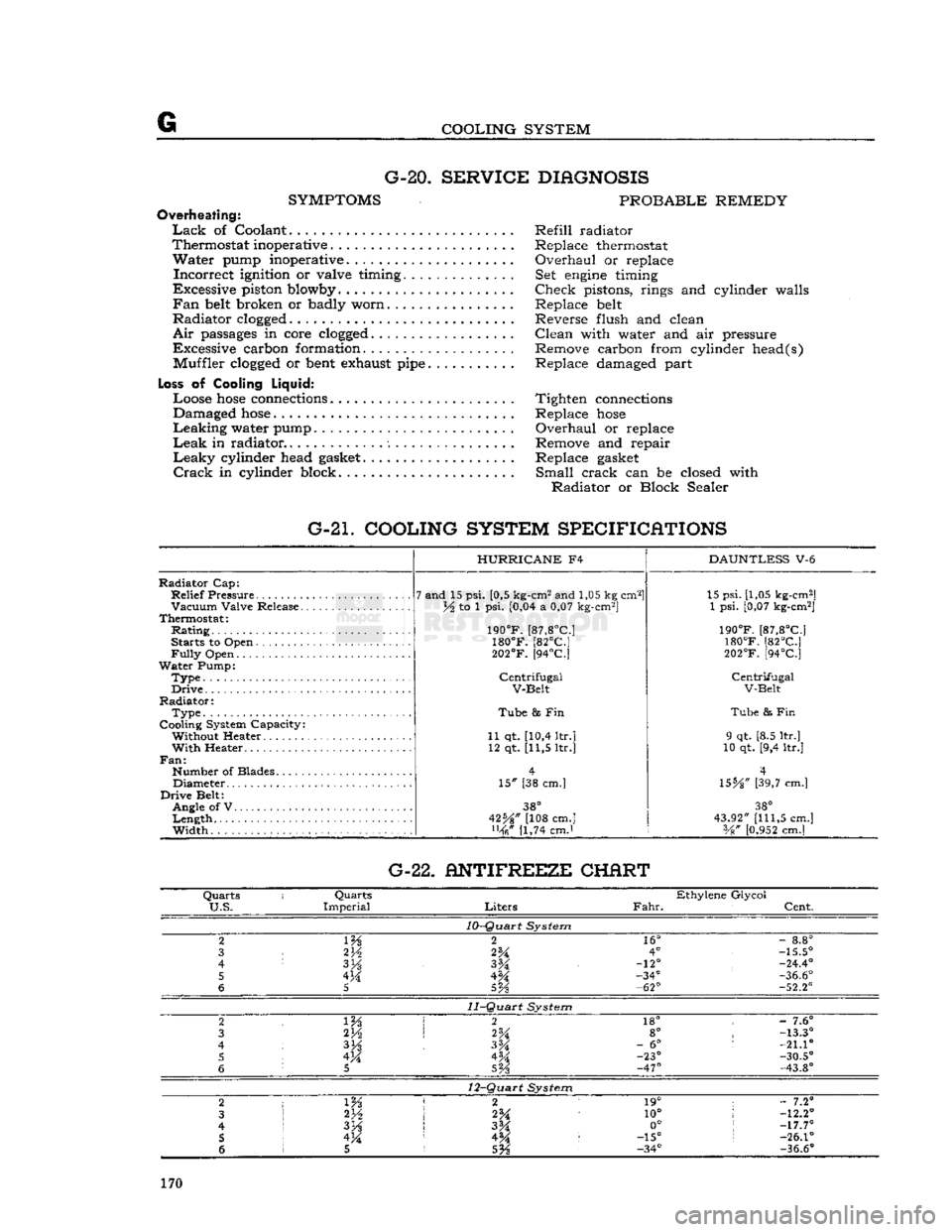
COOLING SYSTEM G-20.
SERVICE DIAGNOSIS
SYMPTOMS
PROBABLE REMEDY
Overheating:
Lack
of Coolant Refill radiator
Thermostat inoperative . Replace thermostat
Water
pump inoperative. Overhaul or replace
Incorrect
ignition or valve timing. Set
engine
timing
Excessive piston blowby Check pistons, rings and cylinder walls
Fan
belt
broken or badly worn Replace
belt
Radiator
clogged
Reverse flush and clean
Air
passages
in core
clogged
Clean with water and air pressure
Excessive carbon formation. Remove carbon from cylinder head(s) Muffler
clogged
or
bent
exhaust
pipe
Replace damaged part
Loss
of Cooling
Liquid:
Loose
hose
connections
Tighten
connections
Damaged
hose
Replace
hose
Leaking
water pump Overhaul or replace
Leak
in radiator Remove and repair
Leaky
cylinder head
gasket
Replace
gasket
Crack
in cylinder block. Small crack can be closed with
Radiator
or Block Sealer
G-21. COOLING SYSTEM SPECIFICATIONS
Radiator
Cap:
Relief
Pressure
Vacuum
Valve Release.
Thermostat:
Rating
Starts to Open
Fully
Open
Water
Pump:
Type.
Drive
Radiator:
Type
Cooling System Capacity: Without Heater
With
Heater..
Fan:
Number of Blades Diameter
Drive
Belt: Angle of V
Length
Width
HURRICANE
F4
7 and 15 psi. [0,5 kg-cm2 and 1,05 kg cm2]
lA to 1 psi. [0,04 a 0,07 kg-cm2]
190°F.
[87,8°C]
180°F.
[82°C]
202°F.
[94°C]
Centrifugal
V-Belt
Tube
8s Fin
11 qt. [10,4 ltr.] 12 qt. [11,5 ltr.]
15" [38 cm.]
38°
42%" [108 cm.] [1,74 cmJ
DAUNTLESS
V-6 15 psi. [1,05 kg-cm2]
1 psi. [0,07 kg-cm2]
190°F.
[87,8°C]
180°F.
[82°C]
202°F.
[94°C]
Centrifugal
V-Belt
Tube
& Fin
9 qt. [8.5 ltr.]
10 qt. [9,4 ltr.]
4
\SbA"
[39,7 cm.]
38°
43.92"
[111,5
cm.] Vg"
[0.952
cm.] G-22. ANTIFREEZE CHERT
Quarts
i
Quarts
Ethylene Glycol
U.S.
Imperial
Liters
Fahr.
Cent.
10-Quart
System
2
m
2
16°
-
8.8°
3
2V2
2%
4°
-15.5°
4
3H
-12°
-24.4°
5 4M -34°
-36.6°
6
5
5Vs
-62°
-52.2°
11-Quart
System
2 2
18° -
7.6°
3 2H
2%
8°
-13.3°
4
3%
-
6°
:
-21.10
5 4M 4M -23°
-30.5°
6
5
SVs
-47°
-43.8°
12-Quart
System
2
1 m 2 1
19° ;
- 7.2°
3
2*A
10°
!
-12.2°
4
I
3H
3M 0°
;
-17.7°
5 !
4M 4^ :
-15°
s
-26.1°
6 1 5
5%
-34°
-36.6°
170
Page 171 of 376
'Jeep'
UNIVERSAL SERIES SERVICE
MANUAL
H
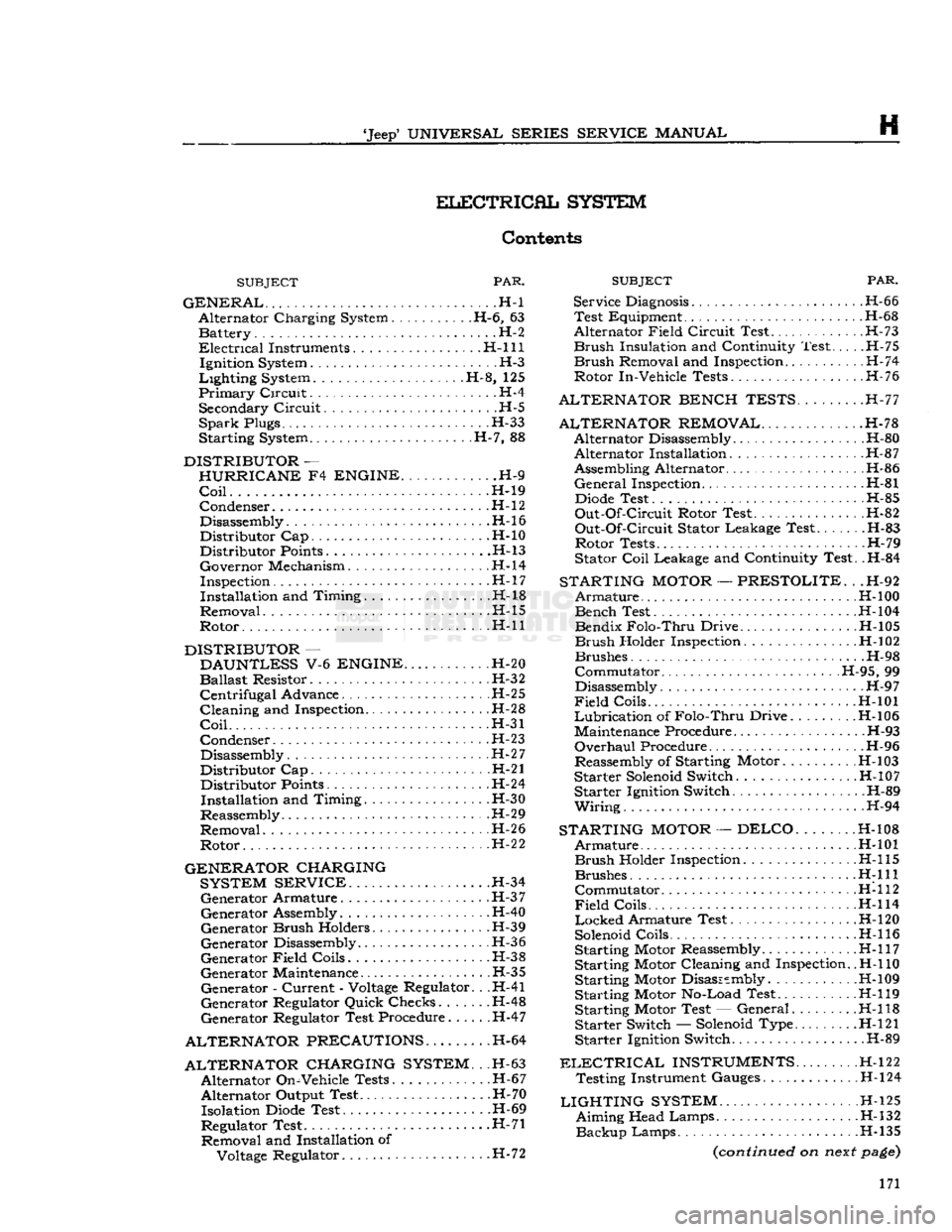
ELECTRICAL
SYSTEM
Contents
SUBJECT
PAR.
GENERAL
. -H-l Alternator Charging System H-6, 63 Battery. . . .H-2
Electrical
Instruments. H-l 11 Ignition System H-3
Lighting
System H-8, 125
Primary
Circuit.
.. H-4 Secondary
Circuit
H-5
SparkPlugs H-33
Starting System H-7, 88
DISTRIBUTOR
—
HURRICANE
F4
ENGINE
H-9
Coil
H-19 Condenser
.H-l
2
Disassembly.
.........................
.H-16
Distributor Cap H-10 Distributor
Points
H-13
Governor Mechanism H-l4
Inspection H-l
7
Installation and Timing H-18
Removal H-15
Rotor H-ll
DISTRIBUTOR
—
DAUNTLESS
V-6
ENGINE
H-20
Ballast
Resistor. H-32
Centrifugal
Advance H-25
Cleaning and Inspection H-28
Coil
H-31
Condenser H-23
Disassembly. H-27
Distributor Cap H-21 Distributor
Points
H-24
Installation and Timing. . .H-30
Reassembly. H-29
Removal H-2 6
Rotor H-2
2
GENERATOR CHARGING SYSTEM SERVICE
H-34 Generator Armature H-3
7
Generator Assembly. H-40
Generator
Brush
Holders H-39
Generator Disassembly H-36
Generator
Field
Coils.
H-38
Generator Maintenance H-35 Generator -
Current
-
Voltage
Regulator. . .H-41
Generator Regulator Quick Checks...... .H-48
Generator Regulator Test Procedure H-47
ALTERNATOR PRECAUTIONS.
H-64
ALTERNATOR CHARGING SYSTEM.
. .H-63 Alternator On-Vehicle Tests. .H-67
Alternator Output Test. .H-70 Isolation
Diode
Test H-69
Regulator Test .H-71 Removal and Installation of
Voltage
Regulator. H-72
SUBJECT
PAR.
Service
Diagnosis
H-66 Test Equipment H-68
Alternator
Field
Circuit
Test H-73
Brush
Insulation and Continuity Test H-75
Brush
Removal and Inspection H-74
Rotor In-Vehicle Tests H-76
ALTERNATOR BENCH TESTS.
.H-77
ALTERNATOR REMOVAL
H-78 Alternator Disassembly H-80 Alternator Installation. H-87
Assembling Alternator H-86
General
Inspection H-81
Diode
Test H-85
Out-Of-Circuit
Rotor Test. .H-82
Out-Of-Circuit
Stator Leakage Test.. . H-83 Rotor Tests H-79
Stator
Coil
Leakage and Continuity Test. .H-84
STARTING
MOTOR
—
PRESTOLITE.
. .H-92
Armature
.H-l
00 Bench Test H-l04
Bendix
Folo-Thru
Drive H-105
Brush
Holder Inspection. .H-102
Brushes H-98
Commutator H-95, 99
Disassembly H-9 7
Field
Coils H-101
Lubrication
of
Folo-Thru
Drive H-l06
Maintenance Procedure H-93
Overhaul
Procedure H-96
Reassembly of Starting Motor. .
H-l
03
Starter
Solenoid
Switch H-10 7 Starter Ignition Switch. .H-89
Wiring.
. . . H-94
STARTING
MOTOR
—DELCO
H-108
Armature
H-101
Brush
Holder Inspection H-l 15 Brushes
H:lll
Commutator H-112
Field
Coils........
H-114
Locked
Armature Test. . . H-l20
Solenoid
Coils H-l 16
Starting Motor Reassembly H-l 17
Starting Motor Cleaning and Inspection.
.H-l
10
Starting Motor Disassembly .H-109 Starting Motor No-Load Test H-119
Starting Motor Test — General H-l 18 Starter Switch —
Solenoid
Type. H-l21
Starter Ignition Switch. .H-89
ELECTRICAL
INSTRUMENTS
H-122 Testing Instrument Gauges H-l24
LIGHTING
SYSTEM
H-l25 Aiming Head Lamps H-132
Backup
Lamps H-135
(continued
on
next
page)
171