air condition JEEP CJ 1953 Service Manual
[x] Cancel search | Manufacturer: JEEP, Model Year: 1953, Model line: CJ, Model: JEEP CJ 1953Pages: 376, PDF Size: 19.96 MB
Page 7 of 376
'Jeep*
UNIVERSAL SERIES
SERVICE
MANUAL
B
LUBRICATION
AND
PERIODIC SERVICES
Contents
PAR. SUBJECT
PAR.
SUBJECT
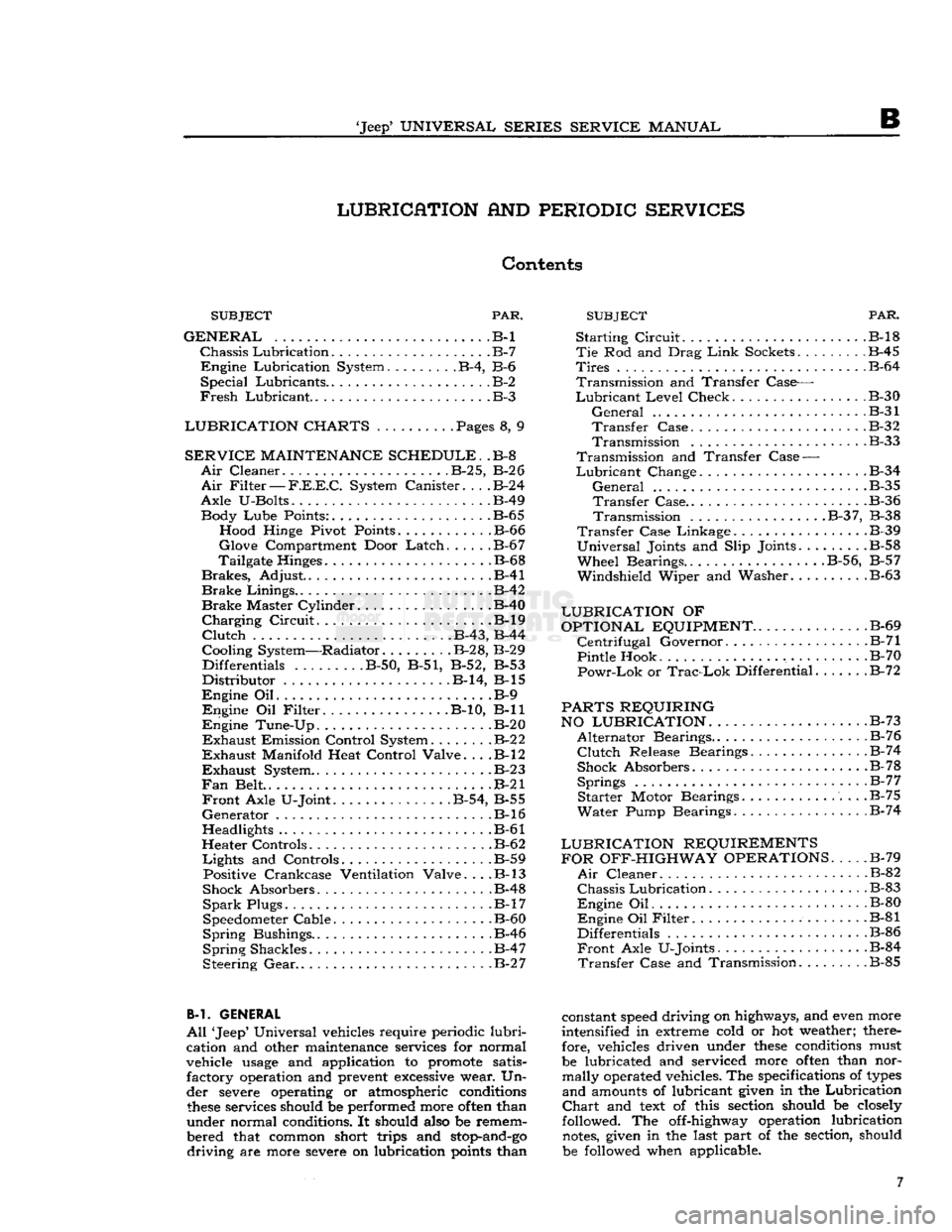
GENERAL
.B-l
Chassis
Lubrication
B-7
Engine
Lubrication System B-4, B-6
Special
Lubricants B-2
Fresh
Lubricant.
.B-3
LUBRICATION CHARTS
. Pages 8, 9
SERVICE
MAINTENANCE SCHEDULE.
.B-8
Air
Cleaner
B-2
5,
B-2
6
Air
Filter
—
F.E.E.C.
System Canister
B-2
4
Axle
U-Bolts B-49 Body
Lube
Points: B-65 Hood Hinge Pivot Points B-66
Glove
Compartment Door
Latch
B-6
7
Tailgate Hinges .B-68
Brakes,
Adjust .B-41
Brake
Linings .B-42
Brake
Master Cylinder B-40
Charging
Circuit
B-l9
Clutch
. B-43, B-44
Cooling System—Radiator. B-28, B-29 Differentials
........
.B-50, B-51, B-52, B-53
Distributor
B-14, B-l5
Engine
Oil B-9
Engine
Oil
Filter
B-10, B-ll
Engine
Tune-Up B-20
Exhaust
Emission Control System
B-2
2
Exhaust
Manifold Heat Control Valve. . . .B-l2
Exhaust
System
B-2 3
Fan
Belt . .B-21
Front
Axle U-Joint B-54, B-55
Generator
.B-16
Headlights B-61
Heater Controls B-62
Lights
and Controls B-59 Positive Crankcase Ventilation Valve. . . .B-l3
Shock Absorbers B-48
Spark
Plugs. B-17
Speedometer Cable. .B-60
Spring
Bushings.. . .B-46
Spring
Shackles .B-47
Steering
Gear
B-2 7
B-l. GENERAL
All
'Jeep' Universal vehicles require periodic
lubri
cation and other maintenance services for normal
vehicle
usage
and application to promote satis factory operation and prevent
excessive
wear. Un
der severe operating or atmospheric conditions
these
services should be performed more
often
than
under normal conditions. It should also be remem
bered that common short trips and
stop-and-go
driving
are more severe on lubrication
points
than
Starting
Circuit
B-l8
Tie
Rod and Drag
Link
Sockets
.
B-45
Tires
B-64
Transmission
and Transfer Case—
Lubricant
Level
Check B-30
General
B-31
Transfer
Case B-32
Transmission
.B-33
Transmission
and Transfer
Case
—
Lubricant
Change .B-34
General
.B-35
Transfer
Case B-36
Transmission
B-3
7, B-38
Transfer
Case Linkage B-39
Universal
Joints and Slip Joints.
.......
.B-58
Wheel
Bearings..
.........
. . .B-56, B-57
Windshield
Wiper and Washer B-63
LUBRICATION
OF
OPTIONAL EQUIPMENT
B-69
Centrifugal
Governor. .B-71
Pintle Hook .B-70
Powr-Lok
or
Trac-Lok
Differential B-72
PARTS REQUIRING
NO LUBRICATION.
. . .B-73
Alternator
Bearings. B-76
Clutch
Release Bearings.
.............
.B-74
Shock Absorbers B-78
Springs
B-7
7
Starter
Motor Bearings B-75
Water
Pump Bearings B-74
LUBRICATION REQUIREMENTS FOR OFF-HIGHWAY OPERATIONS
B-79
Air
Cleaner B-82
Chassis
Lubrication
B-83
Engine
Oil B-80
Engine
Oil
Filter
B-81
Differentials .B-86
Front
Axle U-Joints. B-84
Transfer
Case and Transmission .B-85
constant
speed
driving on highways, and even more
intensified in extreme cold or hot weather; there fore, vehicles driven under
these
conditions must
be lubricated and serviced more
often
than nor mally operated vehicles. The specifications of
types
and
amounts of lubricant given in the Lubrication
Chart
and
text
of this section should be closely
followed. The off-highway operation lubrication
notes,
given in the last part of the section, should
be followed when applicable. 7
Page 12 of 376
B
LUBRICATION B-3.
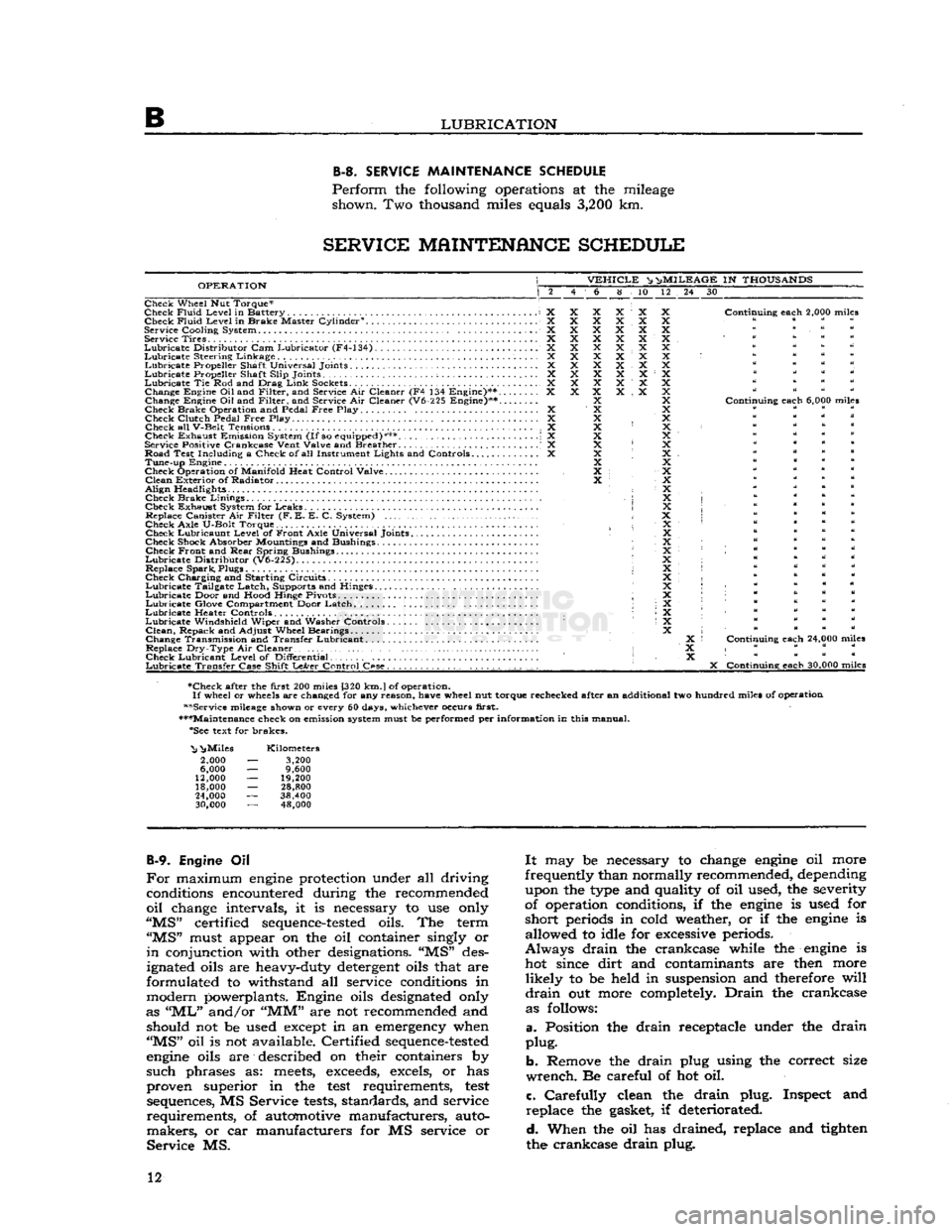
SERVICE
MAINTENANCE
SCHEDULE
Perform
the following operations at the mileage shown. Two thousand miles equals
3,200
km.
SERVICE
MAINTENANCE
SCHEDULE
OPERATION
VEHICLE
^ n>
MILEAGE
IN
THOUSANDS
6 8 10 12 24 30
Check Wheel Nut Torque*
Check
Fluid
Level
in Battery X Check
Fluid
Level
in Brake Master Cylinder0. X
Service
Cooling
System X Service Tires X
Lubricate
Distributor
Cam Lubricator (F4-134) X
Lubricate
Steering Linkage X
Lubricate
Propeller Shaft Universal Joints X
Lubricate
Propeller Shaft
Slip
Joints ; X
Lubricate
Tie Rod and Drag
Link
Sockets................................... X Change Engine
Oil
and
Filter,
and Service Air Cleaner (F4 134 Engine)** X
Change Engine Oil and
Filter,
and Service Air Cleaner (V6-225 Engine)**....
Check Brake Operation and Pedal
Free
Play X Check
Clutch
Pedal
Free
Play. .... X
Check all
V-Belt
Tensions X
Check Exhaust Emission System
(If
so equipped)*** \ X
Service Positive
Crankcase
Vent
Valve
and Breather . .' X
Road Test
Including
a Check of all Instrument
Lights
and Controls X Tune-up Engine
Check Operation of
Manifold
Heat
Control
Valve
Clean
Exterior of Radiator
Align
Headlights • Check Brake
Linings
,
Check Exhaust System for Leaks Replace Canister Air
Filter
(F. E. E. C. System)
Check
Axle
U-Bolt
Torque. Check Lubricaunt
Level
of Front
Axle
Universal Joints
Check Shock Absorber Mountings and Bushings Check Front and
Rear
Spring Bushings
Lubricate
Distributor
(V6-225).
Replace Spark, Plugs
Check Charging and Starting Circuits
Lubricate
Tailgate Latch, Supports and Hinges.
Lubricate
Door and
Hood
Hinge Pivots ;
Lubricate
Glove Compartment Door Latch
Lubricate
Heater Controls •
Lubricate
Windshield
Wiper and Washer Controls
Clean,
Repack and
Adjust
Wheel Bearings
Change Transmission and Transfer Lubricant. .
Replace
Dry-Type
Air Cleaner • Check Lubricant
Level
of
Differential
Lubricate
Transfer
Case
Shift
LeArer
Control
C«se.
. , . . . . . . . .
Continuing
each
2,000 miles
Continuing
each
6,000 miles
Continuing
each
24,000 miles
X
Continuing
each
30,000 miles
•Check after the
first
200 miles [320
km.
J
of operation.
If
wheel or wheels are changed for any
reason,
have
wheel nut torque rechecked after an additional two hundred miles of operation
••Service mileage shown or every 60 days, whichever occurs
first.
•••Maintenance check on emission system must be performed per
information
in this manual. "See text for brakes.
"Nj
^Miles
2,000
6,000
12,000
18,000
24,000
30,000
Kilometers
3,200
9,600
19,200
28,800
38,400 48,000
B-9.
Engine Oil
For
maximum
engine
protection under all driving conditions encountered during the recommended
oil
change intervals, it is necessary to use only
"MS"
certified
sequence-tested
oils. The term
"MS"
must appear on the oil container singly or
in
conjunction with other designations. "MS" des
ignated oils are heavy-duty detergent oils that are
formulated to withstand all service conditions in
modern powerplants. Engine oils designated only
as
"ML"
and/or
"MM"
are not recommended and should not be used except in an emergency when
"MS"
oil is not available. Certified
sequence-tested
engine
oils are described on their containers by
such
phrases as:
meets,
exceeds,
excels, or has
proven superior in the
test
requirements,
test
sequences, MS Service
tests,
standards, and service
requirements,
of automotive manufacturers, auto
makers,
or car manufacturers for MS service or
Service
MS.
It
may be necessary to change
engine
oil more
frequently than normally recommended, depending upon the type and quality of oil used, the severity
of operation conditions, if the
engine
is used for
short
periods in cold weather, or if the
engine
is allowed to idle for excessive periods.
Always
drain
the crankcase while the
engine
is hot since
dirt
and contaminants are then more
likely
to be held in suspension and therefore
will
drain
out more completely.
Drain
the crankcase as follows:
a.
Position the
drain
receptacle under the
drain
plug.
b.
Remove the
drain
plug using the correct size
wrench.
Be careful of hot oil.
c.
Carefully
clean the
drain
plug. Inspect and
replace
the gasket, if deteriorated.
d.
When the oil has drained, replace and tighten
the crankcase
drain
plug. 12
Page 14 of 376
LUBRICATION
vital
to the life of the
engine.
When the vehicle
is operated under abnormal conditions, (for ex
ample when driven on secondary roads or through
fields) then service of the air cleaner must be more frequent
Note:
Under extreme continually dusty and dirty
conditions where the vehicle operates in clouds of dust and
dirt,
service the air cleaner daily.
a.
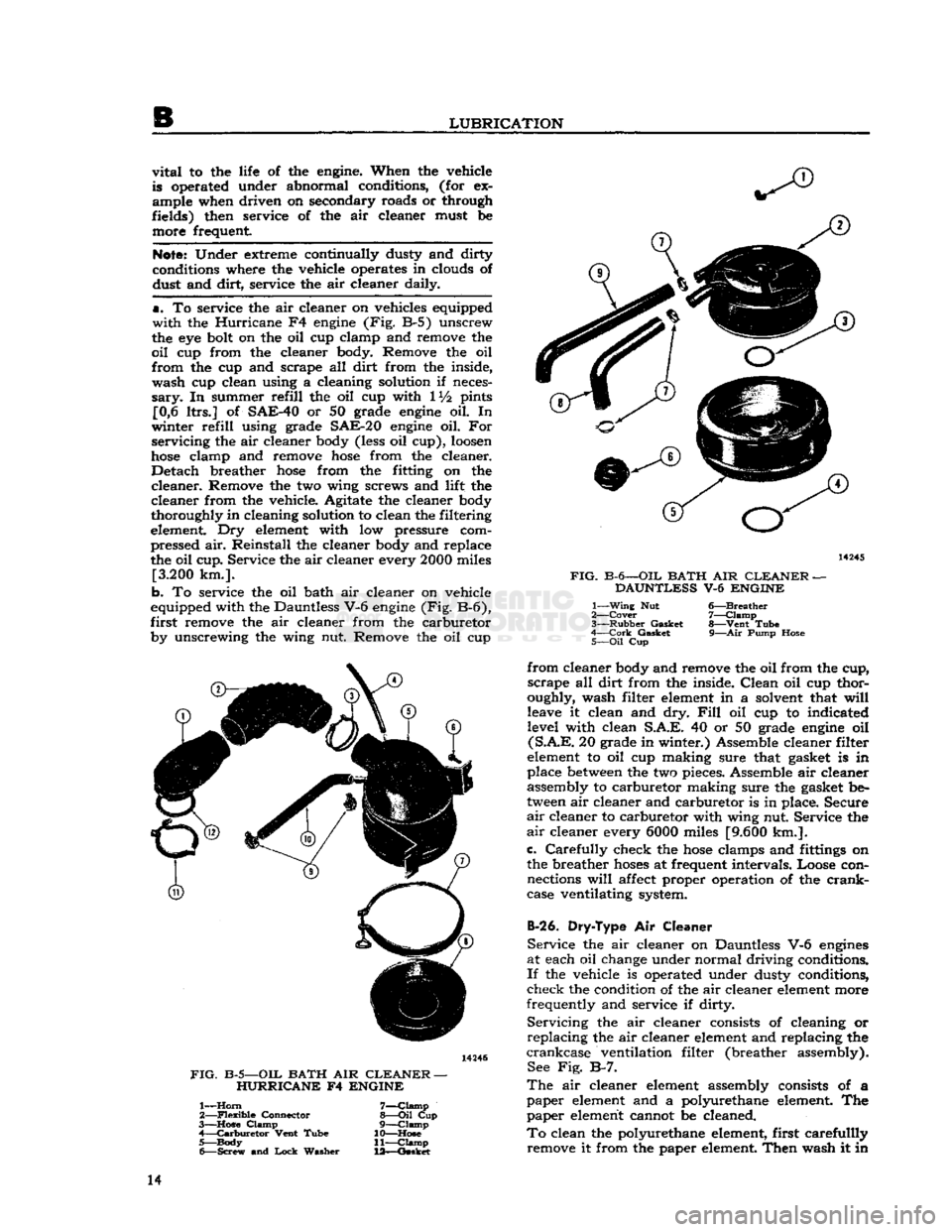
To service the air cleaner on vehicles equipped
with the
Hurricane
F4
engine
(Fig. B-5) unscrew
the eye
bolt
on the oil cup clamp and remove the
oil
cup from the cleaner body. Remove the oil from the cup and scrape all
dirt
from the inside, wash cup clean using a cleaning solution if neces
sary.
In summer
refill
the oil cup with IV2 pints [0,6 ltrs.] of
SAE-40
or 50 grade
engine
oil. In
winter
refill
using grade
SAE-20
engine
oil. For
servicing the air cleaner
body
(less
oil cup),
loosen
hose
clamp and remove
hose
from the cleaner. Detach breather
hose
from the fitting on the cleaner. Remove the two wing screws and lift the
cleaner from the vehicle. Agitate the cleaner
body
thoroughly in cleaning solution to clean the filtering
element.
Dry
element
with low pressure com pressed air. Reinstall the cleaner
body
and replace
the oil cup. Service the air cleaner every
2000
miles
[3.200
km.].
b. To service the oil bath air cleaner on vehicle
equipped with the Dauntless V-6
engine
(Fig. B-6),
first
remove the air cleaner from the carburetor
by unscrewing the wing nut. Remove the oil cup
FIG.
B-5—OIL
BATH AIR
CLEANER
-
HURRICANE F4 ENGINE 1—
Horn
7—Clamp
2—
Flexible
Connector
8—Oil
Cup
3—
Hon
Clamp
9—Clamp
A—Carburetor
Vent Tube 10—Hose 5— Body 11—Clamp
6—
Screw
and
Lock
Washer 13—Gasket
FIG.
B-6—OIL BATH AIR
CLEANER
-
DAUNTLESS V-6 ENGINE
1—WinB
Nut
2—
Cover
3—
Rubber
Gasket
4—
Cork
Gasket
5—
Oil
Cup 6—
Breather
7—
Clamp
8—
Vent
Tube 9—
Air
Pump Hose from cleaner
body
and remove the oil from the cup,
scrape all
dirt
from the inside.
Clean
oil cup thor
oughly, wash filter
element
in a solvent that
will
leave it clean and dry.
Fill
oil cup to indicated
level with clean
S.A.E.
40 or 50 grade
engine
oil
(S.A.E.
20 grade in winter.) Assemble cleaner filter
element
to oil cup making sure that gasket is in
place
between
the two pieces. Assemble air cleaner assembly to carburetor making sure the gasket
be
tween
air cleaner and carburetor is in place. Secure
air
cleaner to carburetor with wing nut. Service the
air
cleaner every
6000
miles
[9.600
km.],
c.
Carefully
check the
hose
clamps and
fittings
on
the breather
hoses
at frequent intervals. Loose connections
will
affect proper operation of the
crank
case ventilating system.
B-26. Dry-Type
Air Cleaner Service the air cleaner on Dauntless V-6
engines
at each oil change under normal driving conditions.
If
the vehicle is operated under dusty conditions,
check the condition of the air cleaner
element
more
frequently and service if dirty.
Servicing
the air cleaner consists of cleaning or replacing the air cleaner
element
and replacing the
crankcase
ventilation filter (breather assembly). See Fig. B-7.
The
air cleaner
element
assembly consists of a
paper
element
and a polyurethane
element
The
paper
element
cannot be cleaned.
To
clean the polyurethane
element,
first carefullly remove it from the paper
element
Then
wash it in 14
Page 18 of 376
B
LUBRICATION
B-72.
Powr-Lok
or Trac-Lok
Differential
Refer
to Par. B-53.
B-73.
PARTS
REQUIRING
NO
LUBRICATION
B-74.
Water Pump Bearing,
Clutch
Release
Bearing
The
water pump and clutch release bearings are
prelubricated
for life when manufactured and cannot be relubricated.
B-7S.
Starter
Motor
Bearings
The
starting motor bearings are lubricated at assembly to last
between
normal rebuild periods.
B-76.
Alternator Bearings
The
alternator bearings are lubricated at assembly
and
require no further lubrication.
B-77.
Springs
The
vehicle springs should not be lubricated. At assembly the leaves are coated with a long-lasting
special
lubricant which is designed to last the life
of the springs. Spraying with the usual mixture of
oil
and kerosene has a tendency to wash this
lubri
cant
from
between
the leaves, making it necessary
to relubricate
often
to eliminate squeaking.
B-78.
Shock Absorbers
Hydraulic
direct-action shock absorbers are per manently sealed and require no periodic
lubrica
tion service. Shock absorber mounting bushings
are
not to be lubricated.
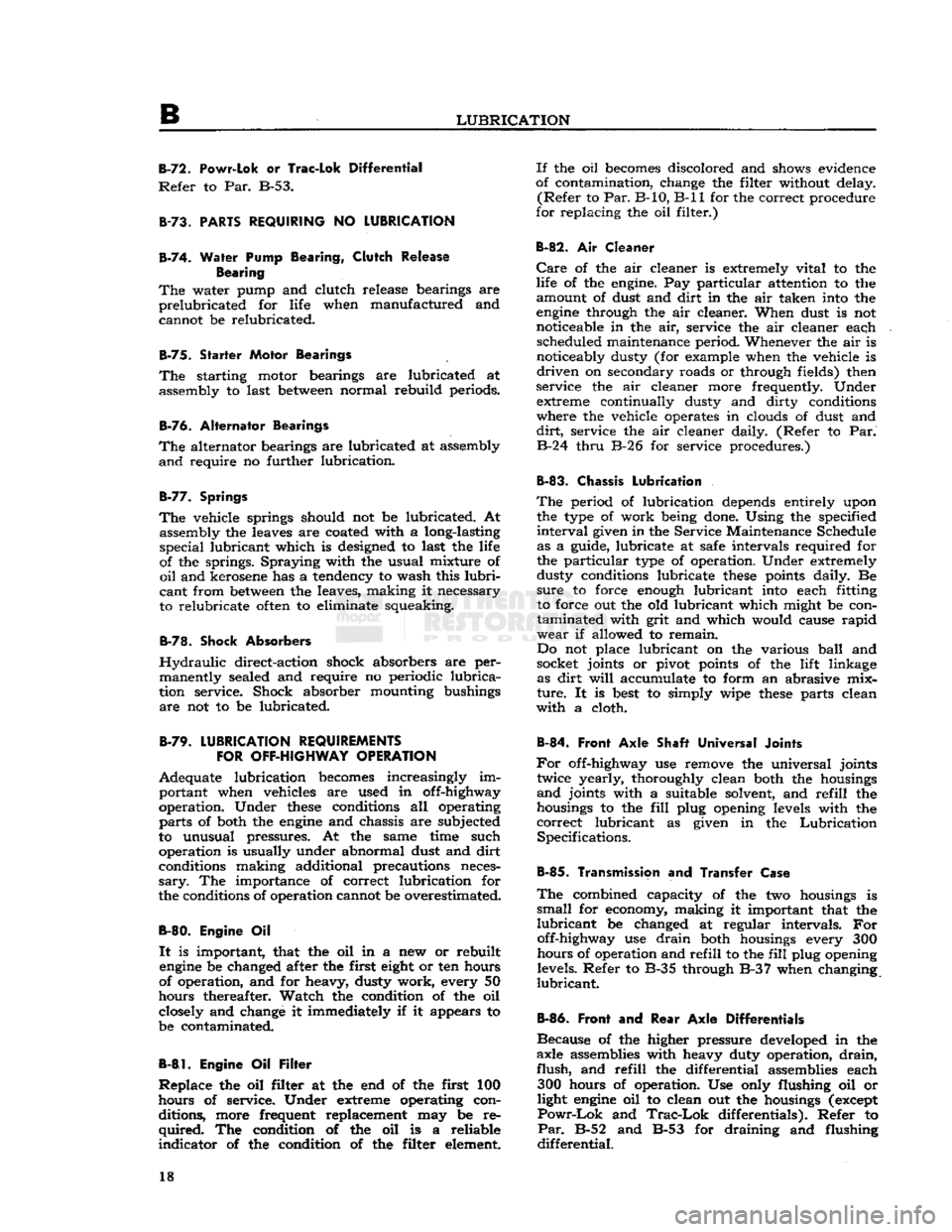
B-79.
LUBRICATION
REQUIREMENTS
FOR
OFF-HIGHWAY
OPERATION
Adequate lubrication
becomes
increasingly im portant when vehicles are used in off-highway
operation. Under
these
conditions all operating
parts
of both the
engine
and chassis are subjected
to unusual pressures. At the same time such operation is usually under abnormal dust and
dirt
conditions making additional precautions neces
sary.
The importance of correct lubrication for
the conditions of operation cannot be overestimated.
B-80.
Engine
Oil
It
is important, that the oil in a new or rebuilt
engine
be changed after the first
eight
or ten hours
of operation, and for heavy, dusty work, every 50
hours
thereafter. Watch the condition of the oil closely and change it immediately if it appears to
be contaminated.
i-Il.
Engine
Oil
Filter
Replace
the oil filter at the end of the first 100
hours
of service. Under extreme operating con ditions, more frequent replacement may be re
quired.
The condition of the oil is a reliable
indicator
of the condition of the filter element.
If
the oil
becomes
discolored and shows evidence
of contamination, change the filter without delay.
(Refer
to
Par.
B-10, B-ll for the correct procedure
for replacing the oil filter.)
B-82.
Air Cleaner
Care
of the air cleaner is extremely vital to the life of the engine. Pay particular attention to the
amount of dust and
dirt
in the air taken into the
engine
through the air cleaner. When dust is not
noticeable in the air, service the air cleaner each scheduled maintenance period. Whenever the air is
noticeably dusty (for example when the vehicle is
driven
on secondary roads or through fields) then
service the air cleaner more frequently. Under extreme continually dusty and dirty conditions
where the vehicle operates in clouds of dust and
dirt,
service the air cleaner daily. (Refer to Par.
B-24
thru
B-26 for service procedures.)
B-83.
Chassis
Lubrication
The
period of lubrication depends entirely upon the type of work being done. Using the specified
interval
given in the Service Maintenance Schedule as a guide, lubricate at safe intervals required for
the particular type of operation. Under extremely
dusty conditions lubricate
these
points daily. Be
sure
to force enough lubricant into each fitting to force out the old lubricant which might be con
taminated with grit and which would cause
rapid
wear
if allowed to remain.
Do not place lubricant on the various
ball
and socket joints or pivot points of the lift linkage as
dirt
will
accumulate to form an abrasive mix
ture.
It is
best
to simply wipe
these
parts clean
with
a cloth.
B-84.
Front
Axle
Shaft Universal Joints
For
off-highway use remove the universal joints twice yearly, thoroughly clean both the housings
and
joints with a suitable solvent, and
refill
the
housings to the
fill
plug opening levels with the
correct
lubricant as given in the
Lubrication
Specifications.
B-85.
Transmission and Transfer
Case
The
combined capacity of the two housings is
small
for economy, making it important that the
lubricant
be changed at regular intervals. For off-highway use
drain
both housings every 300
hours
of operation and
refill
to the
fill
plug opening
levels. Refer to B-35 through B-37 when changing
lubricant.
B-86.
Front and
Rear
Axle
Differentials
Because of the higher pressure developed in the
axle assemblies with heavy duty operation,
drain,
flush,
and
refill
the differential assemblies each 300 hours of operation. Use only flushing oil or light
engine
oil to clean out the housings (except
Powr-Lok
and
Trac-Lok
differentials). Refer to
Par.
B-52 and B-53 for draining and flushing
differential.
18
Page 19 of 376
Jeep*
UNIVERSAL SERIES SERVICE
MANUAL
c
TUNE-UP
Contents
SUBJECT
PAR.
GENERAL
C-l
TUNE-UP
.C-2
Air
Cleaner
C-21
Battery
. C-3
Carburetor
Adjustments
C-2 5
Coil
C-20
Crankcase
Ventilation C-6
Cylinder
Compression C-9
Cylinder
Head(s) .C-5
Dash
Pot Adjustments .C-26
Distributor
Service C-10
thru
C-13
Distributor
Resistance Test C-l6
Fan
Belt
C-2 7
Fuel
Lines
and Screens
C-2
2
C-l.
GENERAL
An
engine tune-up should be performed for all
Jeep Vehicles each 6000 miles [9.600 km.] or at the end of each 250 hours off-the-road operation,
to ensure best possible performance at all times.
The
tune-up should follow the sequence given in
this section.
Because of federal laws limiting exhaust emissions,
it
is even more important that the engine tune-up is
done
accurately, using the specifications listed
on the tune-up sticker found in each engine com
partment.
Note;
To ensure proper operation and effectiveness
of the exhaust emission control system, and to
comply with
Federal
and State requirements, a
recheck
of ignition timing, idle speed and idle mix
ture
and necessary adjustments must be performed
after the first
2,000
miles [3.200 km.] of vehicle
operation.
A
minor engine tune-up should be performed every
6,000
miles [9.600 km.] or at the end of 250 hours
of off-the-road use.
Major
engine tune-up should
be performed every 12,000 miles [19.300 km.].
The
parts of units which affect power and perform
ance may be divided into three groups:
(1) Units affecting compression
(2) Units affecting ignition
(3) Units affecting carburetion
The
tune-up procedure should cover
these
groups
in
the order given. While the items affecting com
pression and ignition may be handled according
to personal preference, correction of items in the
carburetion
group should not be attempted until
all
items affecting compression and ignition have
been satisfactorily corrected.
Note:
To make sure hydro-carbon and carbon
monoxide emissions
will
be within limits, it is very
impotrant
that the adjustments be followed exactly
as listed on the sticker found in each engine compartment.
SUBJECT
PAR.
Fuel
Pump . . C-23
Heat
Control
Valve C-7
Ignition
Cables C-19
Ignition
Timing
. C-14
Ignition
Wires C-l8
Manifold
C-5
Manifold
Vacuum C-24
Point
Dwell C-17
Primary
Circuit
Tests
.................
C-15
Spark
Plugs C-4
Tappets
C-8
ROAD TEST C-2
8
SERVICE
DIAGNOSIS
. : C-29
TUNE-UP SPECIFICATIONS..
C-30
Minor
engine tune-up consists of the following.
Inspect
and correct as required:
Battery
cables and connections.
Alternator
and regulator wiring.
Primary
— Secondary wiring, distributor cap.
Cylinder
head torque.
Contact
point dwell.
Vacuum
and centrifugal advance.
Ignition
timing.
Spark
plugs for correct air gap.
Adjust
idle speed and idle air mixture.
Adjust
all drive belt tensions.
Clean
carburetor air cleaner.
Lubricate
exhaust manifold damper.
Major
engine tune-up includes the following.
Inspect
and correct as required:
Battery
condition and charging
circuit.
Clean,
lubricate
and tighten battery cable connec
tions.
Ingition
system.
Spark
plugs; replace if necessary or clean and gap.
Compression
check.
Primary—Secondary
wiring, distributor cap.
Replace
contact points and condenser.
Lubricate
distributor cam with cam grease.
Adjust
contact points.
Check
vacuum and centrifugal advance. Set ignition timing.
Torque
cylinder head.
Adjust
idle speed and idle air mixture.
Replace
fuel filter element (every 12,000 miles [19.300
km.]).
Adjust
all drive belt tensions.
IMPORTANT: SPECIFICATIONS
FOR EN-
GINE
RPM.
DISTRIBUTOR POINT DWELL,
AND IGNITION TIMING GIVEN
IN
TUNE- UP SECTION
C
REFER
TO
VEHICLES
WITH
AND WITHOUT EXHAUST EMISSION CON
TROL
SYSTEMS.
FOR
VEHICLES
EQUIPPED WITH EXHAUST
EMISSION CONTROL SYSTEMS ALSO
REFER
TO
SECTION
Fl (F4-134
ENGINE)
AND
F2 (V6-225
ENGINE).
19
Page 20 of 376
c
TUNE-UP
C-2.
TUNE-UP SEQUENCE
The
following
Pars.
C-3 through
C-2
7
give the
sequence and describe the services to be performed
when tuning the engine.
C-3.
Clean
and
Check
Battery
Inspect
battery and cables. If the battery is not
satisfactory, install a fully-charged battery to allow
completion of the tune-up.
Note: If the battery fails any of the following tests,
remember that the cause may be other electrical
trouble, and not necessarily only a defective battery.
Refer
to Section H for electrical troubleshooting
and
tests.
a.
Check
the specific gravity of the eletrolyte in
each cell of the battery. A hydrometer reading of 1.260 indicates that the battery is fully charged.
If
the reading is 1.225 or below, the battery
needs
recharging.
If one or more cells is 25 "points" (.025)
or
more lower than the other cells, this indicates
that the cell is shorted, the cell is about to
fail,
or
there is a
crack
in the battery partition in the case.
Unless the battery is repaired or replaced, battery trouble
will
soon be experienced.
b.
Check
the electrolyte level in each cell, add
distilled
water to maintain the solution %" [9.5
mm.] above the plates. Avoid overfilling. Replace
the filler caps and tighten securely. It is important
to keep the electrolyte level above the plates at
all
times because plates that are exposed for any
length of time
will
be seriously damaged.
c.
Check
the wing nuts on the hold-down frame
for tightness. Tighten them only with finger pres
sure,
never with pliers or a wrench. Excessive pres
sure
could damage the battery case.
d.
Clean
the battery terminals and cable connec-
FIG.
C-l—FRAME
GROUND
STRAP
—
HURRICANE
F4
1—
Right
Front
Engine Mount
2—
Frame
Ground
Strap
DAUNTLESS
V-6
tors.
Prepare a strong solution of baking soda and
water
and brush it around the terminals to remove
any
corrosion that is present. The cell caps must
be tight and their vents sealed to prevent cleaning
solution entering the cells. After cleaning install
cable connectors on terminals and coat the ter
minals
and connectors with heavy grease.
e. Inspect the battery cables and replace if badly
corroded
or frayed.
Check
tightness of terminal
screws to ensure
good
electrical connections.
Check
the tightness of the negative ground cable connec tion at the engine to ensure a
good
ground con nection.
f.
Load
test
the battery. Connect a voltmeter across the battery. Run the starting motor for 15 seconds.
If
the voltage
does
not drop below 10 volts on a 12 volt battery the battery is satisfactory. If the
voltage falls below
these
values, yet the specific
gravity
is above
1.225,
the condition of the battery
is questionable.
g.
Make sure the engine to frame ground strap or
cable connections are tight. If
these
connections
are
loose,
corroded or dirty,
hard
starting or failure
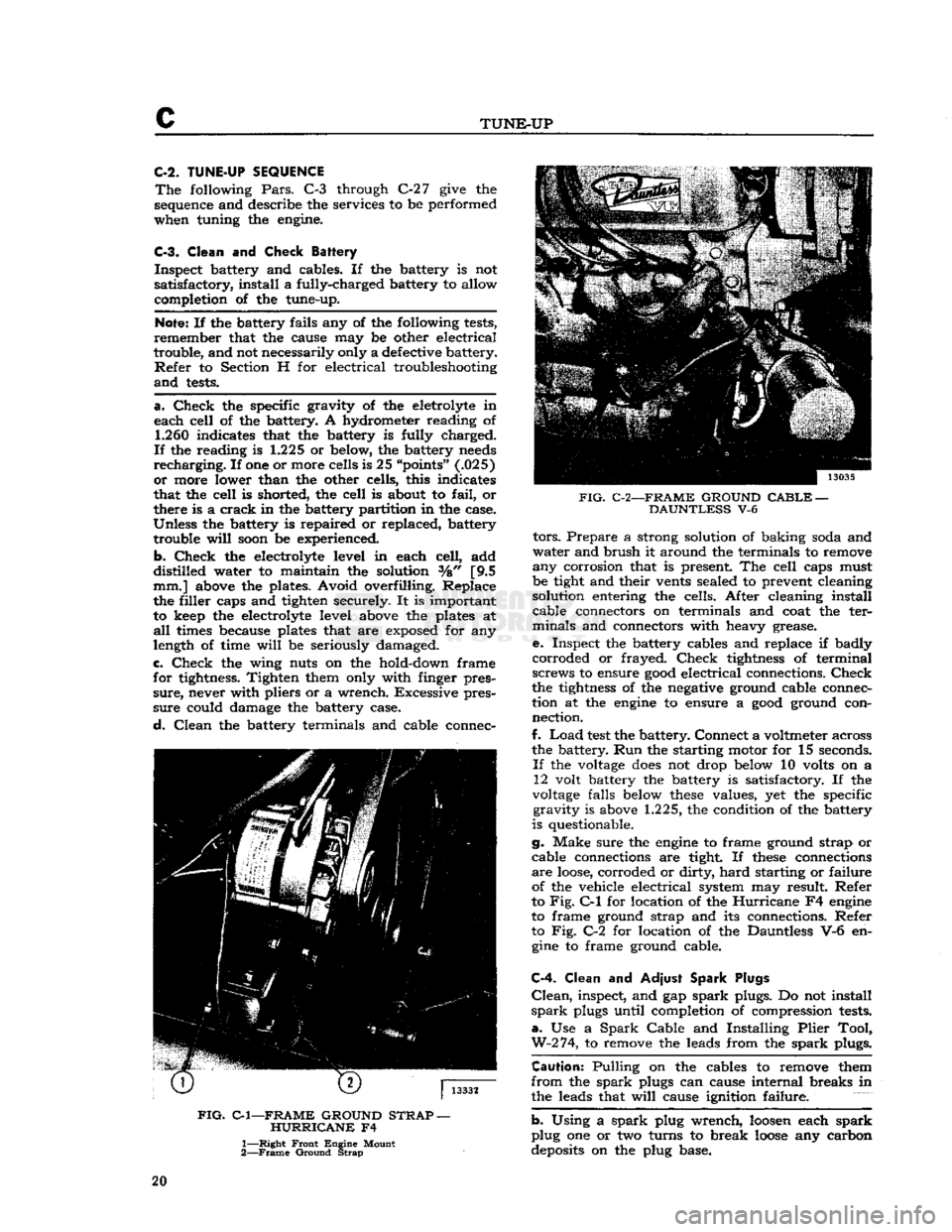
of the vehicle electrical system may result. Refer
to
Fig.
C-l
for location of the
Hurricane
F4 engine
to frame ground strap and its connections. Refer to Fig. C-2 for location of the Dauntless V-6 en gine to frame ground cable.
C-4.
Clean and
Adjust
Spark Plugs
Clean,
inspect, and gap
spark
plugs. Do not install
spark
plugs until completion of compression tests.
a.
Use a
Spark
Cable
and Installing
Plier
Tool,
W-2
74,
to remove the leads from the
spark
plugs.
Caution:
Pulling on the cables to remove them
from
the
spark
plugs can cause internal breaks in
the leads that
will
cause ignition failure.
b.
Using a
spark
plug wrench, loosen each
spark
plug one or two turns to break
loose
any carbon
deposits on the plug base. 20
Page 21 of 376
'Jeep'
UNIVERSAL SERIES SERVICE
MANUAL
FIG.
C-3—SETTING SPARK PLUG
GAP
1—Wire
Gauge 2—Spark Plug
c.
Blow out all carbon and
dirt
from each
spark
plug hole with compressed air. If compressed air is
not available, start the engine and accelerate to 1000 rpm. to blow out the carbon and
dirt.
Stop
the engine.
d.
Remove the plugs carefully with a
spark
plug
wrench.
e. Inspect the plugs for serviceability. Especially
check
for burned and eroded electrodes, blistering
of porcelain at the firing tip, cracked porcelain, or
black
deposits and fouling. These conditions in
dicate that the plugs have not been operating at
the correct temperature. Replace bad or worn plugs
in
sets.
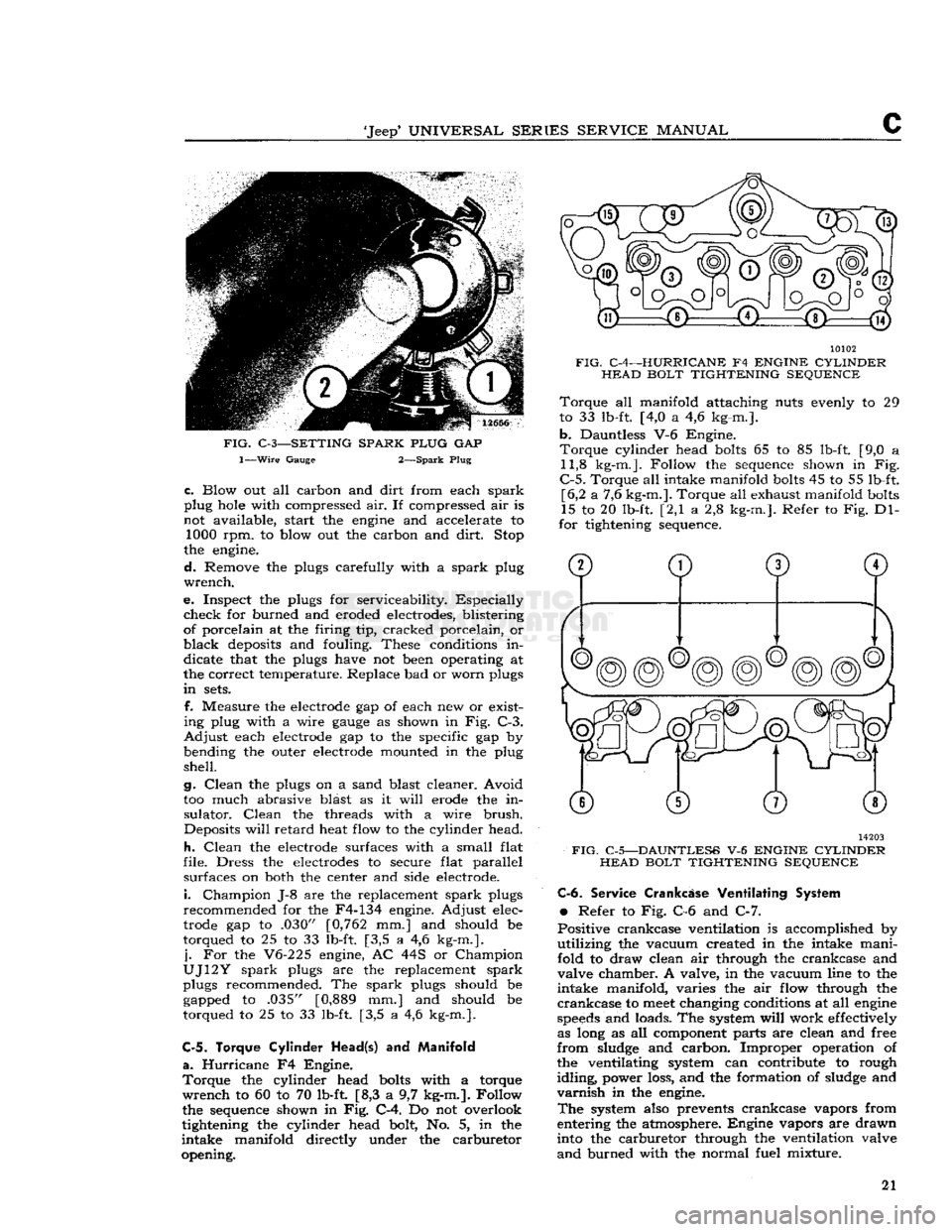
f. Measure the electrode gap of each new or exist
ing plug with a wire
gauge
as shown in Fig. C-3.
Adjust
each electrode gap to the specific gap by
bending the outer electrode mounted in the plug
shell.
g.
Clean
the plugs on a sand blast cleaner. Avoid
too much abrasive blast as it
will
erode the in
sulator.
Clean
the threads with a wire
brush.
Deposits
will
retard
heat flow to the cylinder head.
h.
Clean
the electrode surfaces with a small flat
file. Dress the electrodes to secure flat parallel surfaces on both the center and side electrode.
i.
Champion J-8 are the replacement
spark
plugs
recommended for the F4-134 engine. Adjust elec
trode gap to .030" [0,762 mm.] and should be
torqued to 25 to 33 lb-ft. [3,5 a 4,6 kg-m.].
j.
For the V6-225 engine, AC 44S or Champion
UJ12Y
spark
plugs are the replacement
spark
plugs recommended. The
spark
plugs should be gapped to .035" [0,889 mm.] and should be
torqued to 25 to 33 lb-ft. [3,5 a 4,6 kg-m.].
C-5. Torque Cylinder
Head(s)
and
Manifold
a.
Hurricane
F4 Engine.
Torque
the cylinder head bolts with a torque
wrench
to 60 to 70 lb-ft [8,3 a 9,7 kg-m.]. Follow
the sequence shown in Fig. C-4. Do not overlook
tightening the cylinder head bolt, No. 5, in the
intake
manifold directly under the carburetor
opening. 10102
FIG.
C-4—HURRICANE
F4
ENGINE CYLINDER HEAD BOLT TIGHTENING SEQUENCE
Torque
all manifold attaching nuts evenly to 29
to 33 lb-ft. [4,0 a 4,6 kg-m.].
b.
Dauntless V-6 Engine.
Torque
cylinder head bolts 65 to 85 lb-ft. [9,0 a 11,8 kg-m.]. Follow the sequence shown in Fig.
C-5.
Torque all intake manifold bolts 45 to 55 lb-ft. [6,2 a 7,6 kg-m.]. Torque all exhaust manifold bolts
15 to 20 lb-ft. [2,1 a 2,8 kg-m.]. Refer to Fig. Dl-
for tightening sequence. 14203
FIG.
C-5—DAUNTLESS
V-6
ENGINE CYLINDER HEAD BOLT TIGHTENING SEQUENCE C-6.
Service
Crankcase
Ventilating System
•
Refer to Fig. C-6 and C-7.
Positive crankcase ventilation is accomplished by
utilizing
the vacuum created in the intake mani
fold to draw clean air through the crankcase and
valve chamber. A valve, in the vacuum line to the
intake
manifold, varies the air flow through the
crankcase
to
meet
changing conditions at all engine
speeds
and loads. The system
will
work effectively as long as all component parts are clean and free
from
sludge and carbon. Improper operation of the ventilating system can contribute to rough
idling,
power loss, and the formation of sludge and
varnish
in the engine.
The
system also prevents crankcase vapors from
entering the atmosphere. Engine vapors are drawn
into the carburetor through the ventilation valve
and
burned with the normal fuel mixture. 21
Page 23 of 376
![JEEP CJ 1953 Service Manual
Jeep
UNIVERSAL SERIES SERVICE
MANUAL
C The
valve, connecting pipes, and
hoses
must be
inspected and serviced at intervals of
2,000
[3.200
km.],
6,000
[9.600 km.] and 12,000 [19.300 km](/img/16/57040/w960_57040-22.png "JEEP CJ 1953 Service Manual
Jeep
UNIVERSAL SERIES SERVICE
MANUAL
C The
valve, connecting pipes, and
hoses
must be
inspected and serviced at intervals of
2,000
[3.200
km.],
6,000
[9.600 km.] and 12,000 [19.300 km")
'Jeep'
UNIVERSAL SERIES SERVICE
MANUAL
C The
valve, connecting pipes, and
hoses
must be
inspected and serviced at intervals of
2,000
[3.200
km.],
6,000
[9.600 km.] and 12,000 [19.300 km.]
miles, continuing each
6,000
miles [9.600 km.] of
vehicle operation thereafter. It may be necessary to inspect and clean the system more frequently
under
adverse driving or weather conditions.
Replace
the valve each 12,000 miles [19.300 km.],
a.
Dauntless V-6 Engine.
Filtered
air from the carburetor air cleaner enters the engine crankcase through a hose. The ventilation valve is mounted on the right cylinder bank
rocker
arm cover (Fig. C-7) and is connected by a
hose
to a fitting at the base of the carburetor at the
intake
manifold opening. The valve varies the air
flow through the crankcase to
meet
changing condi
tions at all engine
speeds
and loads. To check the operation of the system, remove the valve with the
hose
attached from the rocker arm cover.
With
the engine running at fast idle, a vacuum must be felt
at the open end of the ventilation valve. If no
vacuum
is present, the valve and
hose
should be
inspected and cause of the restriction determined.
To
check the valve disconnect it from the air
13334
FIG.
C-9—POSITIVE CRANKCASE VENTILATION SYSTEM
— F4
ENGINE (TYPICAL)
1—Valve
Open 2—Valve Closed
23
Page 24 of 376
c
TUNE-UP
14011
FIG.
C-8—POSITIVE CRANKCASE VENTILATION VALVE
vacuum
hose
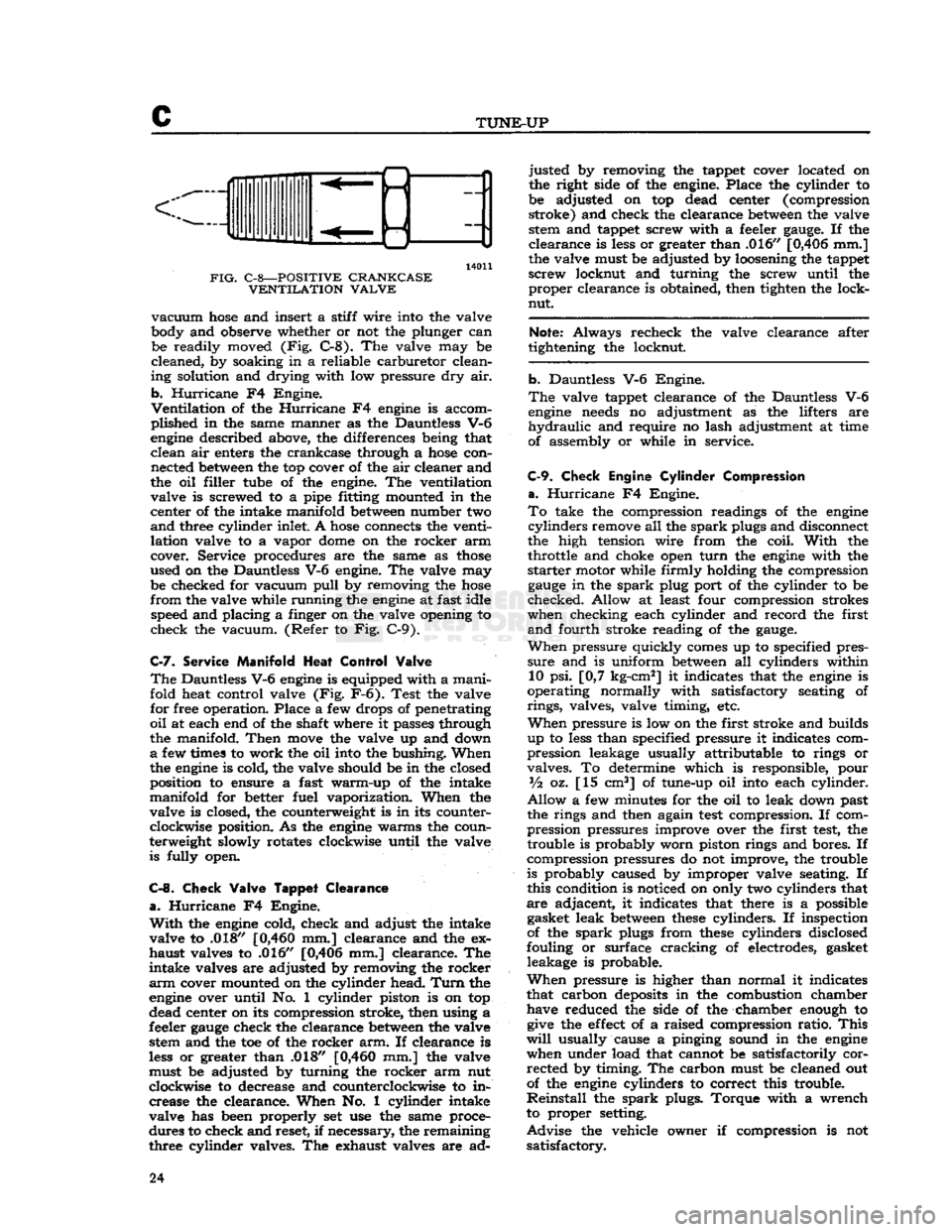
and insert a stiff wire into the valve
body and observe whether or not the plunger can be readily moved (Fig. C-8). The valve may be
cleaned, by soaking in a reliable carburetor clean
ing solution and drying with low pressure dry air.
b.
Hurricane
F4 Engine.
Ventilation
of the
Hurricane
F4
engine
is accom
plished in the same manner as the Dauntless V-6
engine
described above, the differences being that clean air enters the crankcase through a
hose
con nected
between
the top cover of the air cleaner and
the oil filler tube of the engine. The ventilation valve is screwed to a pipe fitting mounted in the
center of the intake manifold
between
number two
and
three cylinder inlet. A
hose
connects the venti
lation valve to a vapor
dome
on the rocker arm
cover. Service procedures are the same as
those
used on the Dauntless V-6 engine. The valve may be checked for vacuum
pull
by removing the
hose
from
the valve while running the
engine
at fast idle speed and placing a finger on the valve opening to
check the vacuum. (Refer to Fig. C-9).
C-7.
Service
Manifold
Heat
Control
Valve
The
Dauntless V-6
engine
is equipped with a manifold heat control valve (Fig. F-6). Test the valve
for free operation. Place a few drops of penetrating
oil
at each end of the shaft where it passes through
the manifold.
Then
move
the valve up and down
a
few times to work the oil into the bushing. When
the
engine
is cold, the valve should be in the closed
position to ensure a fast warm-up of the intake
manifold for better fuel vaporization. When the
valve is closed, the counterweight is in its counter clockwise position. As the
engine
warms the coun
terweight slowly rotates clockwise until the valve is fully open.
C-8.
Check
Valve
Tappet
Clearance
a.
Hurricane
F4 Engine.
With
the
engine
cold, check and adjust the intake
valve to .018"
[0,460
mm.] clearance and the ex
haust valves to .016" [0,406 mm.] clearance. The
intake valves are adjusted by removing the rocker
arm
cover mounted on the cylinder head.
Turn
the
engine
over until No. 1 cylinder piston is on top
dead center on its compression stroke, then using a
feeler
gauge
check the clearance
between
the valve stem and the toe of the rocker arm. If clearance is
less
or greater than .018"
[0,460
mm.] the valve
must be adjusted by turning the rocker arm nut
clockwise to decrease and counterclockwise to in crease the clearance. When No. 1 cylinder intake
valve has been properly set use the same proce
dures to check and reset, if necessary, the remaining
three cylinder valves. The exhaust valves are ad justed by removing the tappet cover located on
the right side of the engine. Place the cylinder to
be adjusted on top dead center (compression stroke) and check the clearance
between
the valve stem and tappet screw with a feeler
gauge.
If the
clearance is
less
or greater than .016" [0,406 mm.]
the valve must be adjusted by loosening the tappet
screw locknut and turning the screw until the proper clearance is obtained, then tighten the lock-
nut.
Note:
Always recheck the valve clearance after
tightening the locknut.
b. Dauntless V-6 Engine.
The
valve tappet clearance of the Dauntless V-6
engine
needs
no adjustment as the lifters are
hydraulic
and require no lash adjustment at time
of assembly or while in service.
C-9.
Check
Engine
Cylinder
Compression
a.
Hurricane
F4 Engine.
To
take the compression readings of the
engine
cylinders
remove all the
spark
plugs and disconnect
the high tension wire from the coil.
With
the throttle and choke open
turn
the
engine
with the
starter
motor while firmly holding the compression
gauge
in the
spark
plug port of the cylinder to be
checked. Allow at least four compression strokes
when checking each cylinder and record the first
and
fourth stroke reading of the
gauge.
When
pressure quickly
comes
up to specified pres
sure
and is uniform
between
all cylinders within 10 psi. [0,7 kg-cm2] it indicates that the
engine
is
operating normally with satisfactory seating of
rings,
valves, valve timing, etc.
When
pressure is low on the first stroke and builds
up to
less
than specified pressure it indicates com
pression leakage usually attributable to rings or
valves. To determine which is responsible, pour
Vz
oz. [15 cm3] of tune-up oil into each cylinder.
Allow
a few minutes for the oil to leak down past
the rings and then again
test
compression. If com
pression pressures improve over the first
test,
the trouble is probably worn piston rings and bores. If
compression pressures do not improve, the trouble
is probably caused by improper valve seating. If
this condition is noticed on only two cylinders that
are adjacent, it indicates that there is a possible gasket leak
between
these
cylinders. If inspection
of the
spark
plugs from
these
cylinders disclosed
fouling or surface cracking of electrodes, gasket leakage is probable.
When
pressure is higher than normal it indicates
that carbon
deposits
in the combustion chamber have reduced the side of the chamber enough to
give
the
effect
of a raised compression ratio.
This
will
usually cause a pinging sound in the
engine
when under load that cannot be satisfactorily corrected by timing. The carbon must be cleaned out
of the
engine
cylinders to correct this trouble.
Reinstall
the
spark
plugs. Torque with a wrench
to proper setting.
Advise
the vehicle owner if compression is not satisfactory. 24
Page 31 of 376
'Jeep'
UNIVERSAL
SERIES
SERVICE
MANUAL
C
FIG.
C-22—-CHECKING
FUEL
PUMP
PRESSURE
—
DAUNTLESS
V-6
ENGINE a
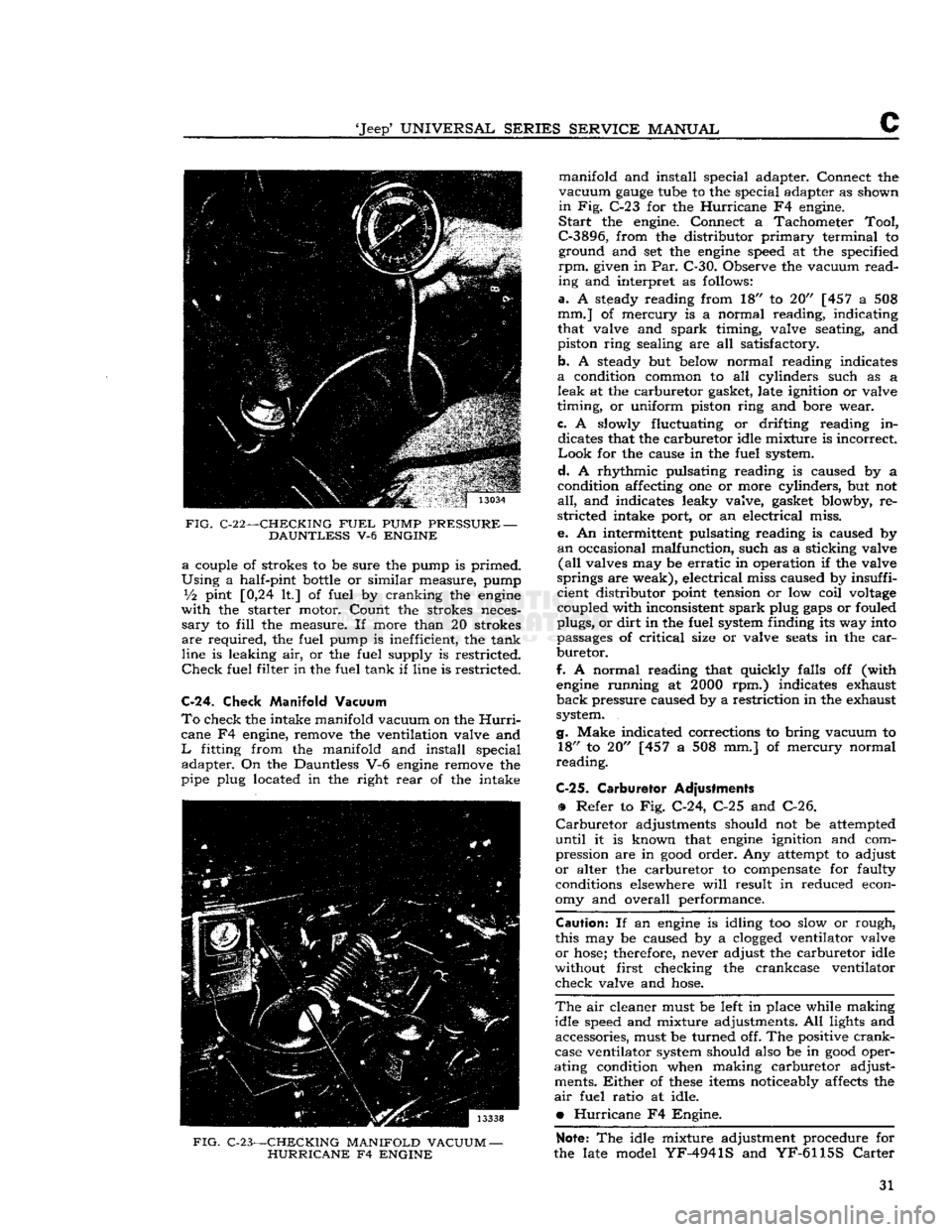
couple of strokes to be sure the pump is primed.
Using
a half-pint
bottle
or similar measure, pump
Vi
pint [0,24 It] of fuel by cranking the
engine
with
the starter motor. Count the strokes neces
sary
to
fill
the measure. If more than 20 strokes
are
required, the fuel pump is inefficient, the tank
line is leaking air, or the fuel supply is restricted.
Check
fuel filter in the fuel tank if line is restricted.
C-24.
Check Manifold Vacuum
To
check the intake manifold vacuum on the
Hurri
cane F4 engine, remove the ventilation valve and
L
fitting from the manifold and install special adapter. On the Dauntless V-6
engine
remove the
pipe plug located in the right
rear
of the intake
FIG.
C-23—CHECKING MANIFOLD VACUUM
—
HURRICANE
F4
ENGINE
manifold and install special adapter. Connect the
vacuum
gauge
tube to the special adapter as shown
in
Fig. C-23 for the
Hurricane
F4 engine.
Start
the engine. Connect a Tachometer
Tool,
C-3896,
from the distributor
primary
terminal to ground and set the
engine
speed at the specified
rpm.
given in Par. C-30. Observe the vacuum
read
ing and interpret as follows:
a.
A steady reading from 18" to 20" [457 a 508
mm.] of mercury is a normal reading, indicating
that valve and
spark
timing, valve seating, and
piston ring sealing are all satisfactory.
b. A steady but below normal reading indicates
a
condition common to all cylinders such as a
leak
at the carburetor gasket, late ignition or valve
timing, or uniform piston ring and bore wear.
c.
A slowly fluctuating or drifting reading in dicates that the carburetor idle mixture is incorrect
Look
for the cause in the fuel system.
d.
A rhythmic pulsating reading is caused by a
condition affecting one or more cylinders, but not
all,
and indicates leaky valve, gasket blowby, re
stricted intake port, or an electrical miss.
e. An intermittent pulsating reading is caused by
an
occasional malfunction, such as a sticking valve
(all
valves may be
erratic
in operation if the valve
springs are weak), electrical miss caused by insuffi
cient distributor point tension or low coil
voltage
coupled with inconsistent
spark
plug
gaps
or fouled
plugs, or
dirt
in the fuel system finding its way into
passages of
critical
size or valve
seats
in the
car
buretor.
f.
A normal reading that quickly falls off (with
engine
running at
2000
rpm.) indicates exhaust
back
pressure caused by a restriction in the exhaust
system.
g.
Make indicated corrections to bring vacuum to 18" to 20" [457 a 508 mm.] of mercury normal
reading.
C-25.
Carburetor Adjustments
•
Refer to Fig. C-24, C-25 and C-26.
Carburetor
adjustments should not be attempted
until
it is known that
engine
ignition and com
pression are in
good
order. Any attempt to adjust
or
alter the carburetor to compensate for faulty conditions elsewhere
will
result in reduced econ
omy and overall performance.
Caution:
If an
engine
is idling too slow or rough,
this may be caused by a
clogged
ventilator valve
or
hose;
therefore, never adjust the carburetor idle
without first checking the crankcase ventilator
check valve and
hose.
The
air cleaner must be left in place while making
idle speed and mixture adjustments. All lights and accessories, must be turned off. The positive
crank
case ventilator system should also be in
good
oper
ating condition when making carburetor adjust ments.
Either
of
these
items noticeably affects the
air
fuel ratio at idle.
•
Hurricane
F4 Engine.
Note:
The idle mixture adjustment procedure for
the late model
YF-4941S
and
YF-6115S
Carter
31