engine JEEP COMPASS 2008 1.G Owners Manual
[x] Cancel search | Manufacturer: JEEP, Model Year: 2008, Model line: COMPASS, Model: JEEP COMPASS 2008 1.GPages: 399, PDF Size: 6.59 MB
Page 331 of 399

CAUTION!
Mixing of coolants other than specified Hybrid Or-
ganic Additive Technology (HOAT) engine coolants,
may result in engine damage and may decrease
corrosion protection. If a non-HOAT coolant is intro-
duced into the cooling system in an emergency, it
should be replaced with the specified coolant as soon
as possible.
Do not use plain water alone or alcohol base engine
coolant (antifreeze) products. Do not use additional
rust inhibitors or antirust products, as they may not
be compatible with the radiator engine coolant and
may plug the radiator.
This vehicle has not been designed for use with
Propylene Glycol based coolants. Use of Propylene
Glycol based coolants is not recommended.
Adding Coolant
Your vehicle has been built with an improved engine
coolant that allows extended maintenance intervals. This
coolant can be used up to 5 Years or 100,000 miles before
replacement. To prevent reducing this extended mainte-
nance period, it is important that you use the same
coolant throughout the life of your vehicle. Please review
these recommendations for using Hybrid Organic Addi-
tive Technology (HOAT) coolant.
When adding coolant, a minimum solution of 50% rec-
ommended Mopar Antifreeze/ Coolant 5 Year/100,000
Mile Formula HOAT (Hybrid Organic Additive Technol-
ogy), or equivalent, in water should be used. Use higher
concentrations (not to exceed 70%) if temperatures below
234ÉF (237ÉC ) are anticipated.
Use only high purity water such as distilled or deionized
water when mixing the water/engine coolant solution.
MAINTAINING YOUR VEHICLE 331
7
Page 332 of 399

The use of lower quality water will reduce the amount of
corrosion protection in the engine cooling system.
Please note that it is the owner's responsibility to main-
tain the proper level of protection against freezing ac-
cording to the temperatures occurring in the area where
the vehicle is operated.
NOTE:Mixing coolant types will decrease the life of the
engine coolant and will require more frequent coolant
changes.
Cooling System Pressure Cap
The cap must be fully tightened to prevent loss of
coolant, and to insure that coolant will return to the
radiator from the coolant recovery bottle.
The cap should be inspected and cleaned if there is any
accumulation of foreign material on the sealing surfaces.
WARNING!
²The warning words ªDO NOT OPEN HOTº on
the cooling system pressure cap are a safety pre-
caution. Never add coolant when the engine is
overheated. Do not loosen or remove the cap to
cool an overheated engine. Heat causes pressure to
build up in the cooling system. To prevent scald-
ing or injury, do not remove the pressure cap while
the system is hot or under pressure.
²Do not use a pressure cap other than the one
specified for your vehicle. Personal injury or en-
gine damage may result.
332 MAINTAINING YOUR VEHICLE
Page 333 of 399

Disposal of Used Engine Coolant
Used ethylene glycol based engine coolant is a regulated
substance requiring proper disposal. Check with your
local authorities to determine the disposal rules for your
community. To prevent ingestion by animals or children
do not store ethylene glycol based engine coolant in open
containers or allow it to remain in puddles on the
ground. If ingested by a child, contact a physician
immediately. Clean up any ground spills immediately.
Coolant Level
The coolant bottle provides a quick visual method for
determining that the coolant level is adequate. With the
engine idling and warm to normal operating tempera-
ture, the level of the coolant in the bottle should be
between the ªADDº and ªFULLº lines, shown on the
bottle.
The radiator normally remains completely full, so there is
no need to remove the radiator cap unless checking forcoolant freeze point or replacing coolant. Advise your
service attendant of this. As long as the engine operating
temperature is satisfactory, the coolant bottle need only
be checked once a month.
When additional coolant is needed to maintain the
proper level, it should be added to the coolant bottle. Do
not overfill.
Points To Remember
NOTE:When the vehicle is stopped after a few miles (a
few kilometers) of operation, you may observe vapor
coming from the front of the engine compartment. This is
normally a result of moisture from rain, snow, or high
humidity accumulating on the radiator and being vapor-
ized when the thermostat opens, allowing hot coolant to
enter the radiator.
MAINTAINING YOUR VEHICLE 333
7
Page 334 of 399

If an examination of your engine compartment shows no
evidence of radiator or hose leaks, the vehicle may be
safely driven. The vapor will soon dissipate.
²Do not overfill the coolant recovery bottle.
²Check coolant freeze point in the radiator and in the
coolant recovery bottle. If antifreeze needs to be
added, contents of coolant recovery bottle must also be
protected against freezing.
²If frequent coolant additions are required, or if the
level in the coolant recovery bottle does not drop when
the engine cools, the cooling system should be pres-
sure tested for leaks.
²Maintain coolant concentration at 50% HOAT engine
coolant (minimum) and distilled water for proper
corrosion protection of your engine which contains
aluminum components.
²Make sure that the radiator and coolant recovery
bottle overflow hoses are not kinked or obstructed.
²Keep the front of the radiator clean. If your vehicle is
equipped with air conditioning, keep the front of the
condenser clean, also.
²Do not change the thermostat for summer or winter
operation. If replacement is ever necessary, install
ONLY the correct type thermostat. Other designs may
result in unsatisfactory coolant performance, poor gas
mileage, and increased emissions.
334 MAINTAINING YOUR VEHICLE
Page 336 of 399

WARNING!
Riding the brakes can lead to brake failure and
possibly an accident. Driving with your foot resting
or riding on the brake pedal can result in abnormally
high brake temperatures, excessive lining wear, and
possible brake damage. You wouldn't have your full
braking capacity in an emergency.
Brake And Power Steering System Hoses
When servicing the vehicle for scheduled maintenance,
inspect the surface of the hoses and nylon tubing for
evidence of heat and mechanical damage. Hard and
brittle rubber, cracking, tears, cuts, abrasions, and exces-
sive swelling suggest deterioration of the rubber. Particu-
lar attention should be made to examining those hose
surfaces nearest to high heat sources, such as the exhaust
manifold.Inspect all hose clamps and couplings to make sure they
are secure and no leaks are present.
Insure nylon tubing in these areas has not melted or
collapsed.
NOTE:Often, fluids such as oil, power steering fluid,
and brake fluid are used during assembly plant opera-
tions to ease the assembly of hoses to couplings. There-
fore, oil wetness at the hose-coupling area is not neces-
sarily an indication of leakage. Actual dripping of hot
fluid when systems are under pressure (during vehicle
operation) should be noted before a hose is replaced
based on leakage.
NOTE:Inspection of brake hoses should be done when-
ever the brake system is serviced and at every engine oil
change.
336 MAINTAINING YOUR VEHICLE
Page 338 of 399

WARNING!
Use of a brake fluid that may have a lower initial
boiling point or unidentified as to specification, may
result in sudden brake failure during hard prolonged
braking. You could have an accident.
CAUTION!
Use of improper brake fluids will affect overall
clutch system performance. Improper brake fluids
may damage the clutch system resulting in loss of
clutch function and the ability to shift the transaxle.
WARNING!
Overfilling the brake fluid reservoir can result in
spilling brake fluid on hot engine parts and the
brake fluid catching fire.
Use only brake fluid that has been in a tightly closed
container to avoid contamination from foreign matter.
Do not allow petroleum based fluid to contaminate the
brake fluid as seal damage will result!
338 MAINTAINING YOUR VEHICLE
Page 339 of 399

Automatic Transaxle (CVT)
Selection Of Lubricant
It is important that the proper lubricant is used in the
transaxle to assure optimum transaxle performance. Use
only the manufacturer's recommended transmission
fluid which has been formulated with special metal to
metal friction coefficient additives to provide the proper
steel belt traction on the drive and driven pulleys. Refer
to ªFluids, Lubricants and Genuine Partsº for correct
fluid type.
CAUTION!
Using a transmission fluid other than the manufac-
turers recommended fluid will cause belt slip and
result in a complete transmission failure! Refer to
ªFluids, Lubricants, and Genuine Partsº for correct
fluid type.
Fluid Level Check
The fluid level in the automatic transaxle should be
checked only by a trained technician.
Fluid and Filter Changes
Refer to the ªMaintenance Scheduleº in Section 8 of this
manual for the correct change interval.
Special Additives
Do not add any materials (other than leak detection dyes)
to Continuously Variable Transaxle (CVT) Fluid
(CVTF+4). CVTF+4 is an engineered product and its
performance may be impaired by supplemental addi-
tives.
Manual Transaxle
Lubricant Selection
Use only the manufacturers recommended transmission
fluid. Refer to ªFluids, Lubricants, and Genuine Partsº
for correct fluid type.
MAINTAINING YOUR VEHICLE 339
7
Page 347 of 399
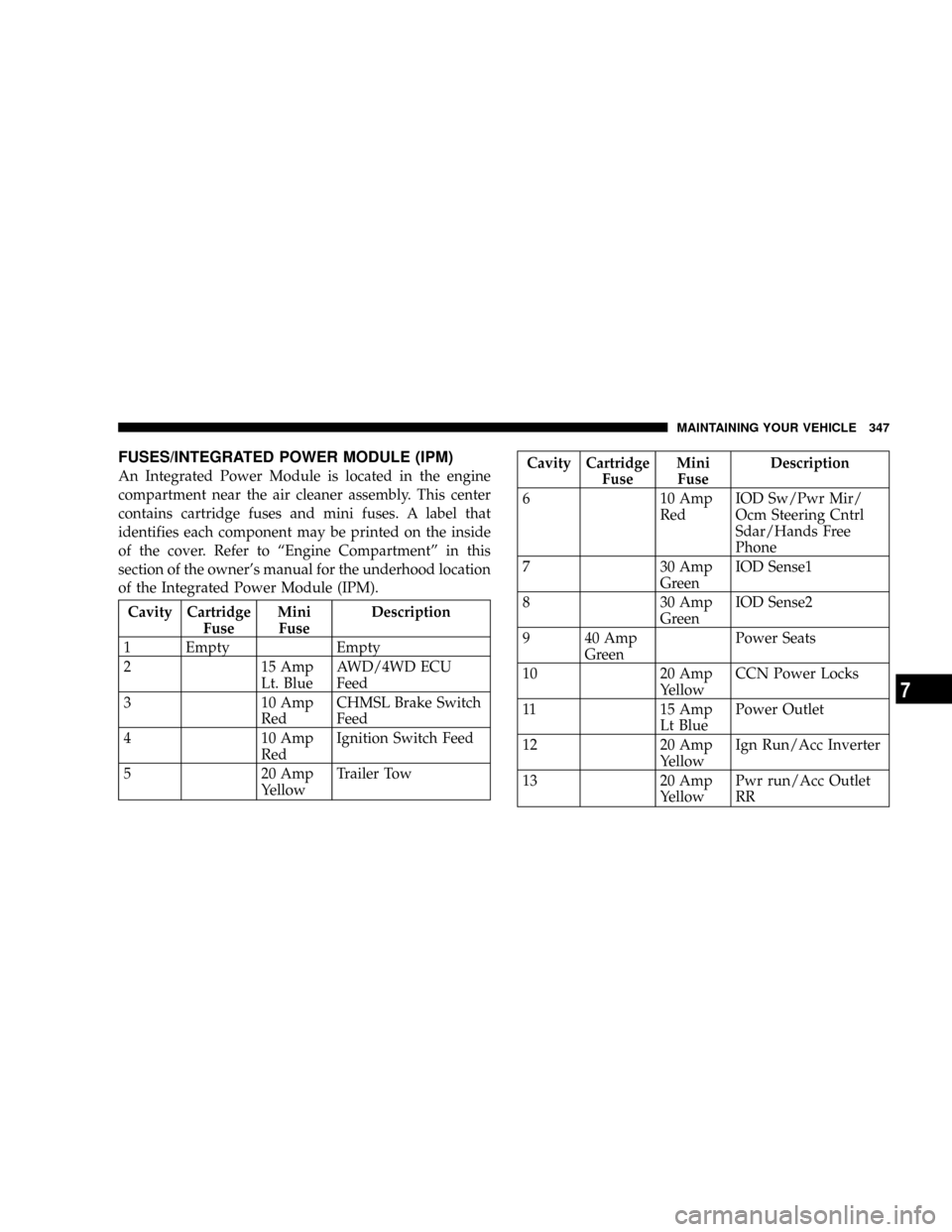
FUSES/INTEGRATED POWER MODULE (IPM)
An Integrated Power Module is located in the engine
compartment near the air cleaner assembly. This center
contains cartridge fuses and mini fuses. A label that
identifies each component may be printed on the inside
of the cover. Refer to ªEngine Compartmentº in this
section of the owner's manual for the underhood location
of the Integrated Power Module (IPM).
Cavity Cartridge
FuseMini
FuseDescription
1 Empty Empty
2 15 Amp
Lt. BlueAWD/4WD ECU
Feed
3 10 Amp
RedCHMSL Brake Switch
Feed
4 10 Amp
RedIgnition Switch Feed
5 20 Amp
YellowTrailer Tow
Cavity Cartridge
FuseMini
FuseDescription
6 10 Amp
RedIOD Sw/Pwr Mir/
Ocm Steering Cntrl
Sdar/Hands Free
Phone
7 30 Amp
GreenIOD Sense1
8 30 Amp
GreenIOD Sense2
9 40 Amp
GreenPower Seats
10 20 Amp
YellowCCN Power Locks
11 15 Amp
Lt BluePower Outlet
12 20 Amp
YellowIgn Run/Acc Inverter
13 20 Amp
YellowPwr run/Acc Outlet
RR
MAINTAINING YOUR VEHICLE 347
7
Page 352 of 399

²Reach into engine compartment and pull red lock out
at connector.
²Twist the bulb to the left and pull outward from
assembly.
NOTE:These are halogen bulbs. Take care not to touch
the bulb with your fingers. Body oils from your fingers
could cause excessive heat buildup which reduces bulb
life.
Remove green connector from back of bulb by pulling
straight back
Twisting Bulb From Socket
352 MAINTAINING YOUR VEHICLE
Page 360 of 399
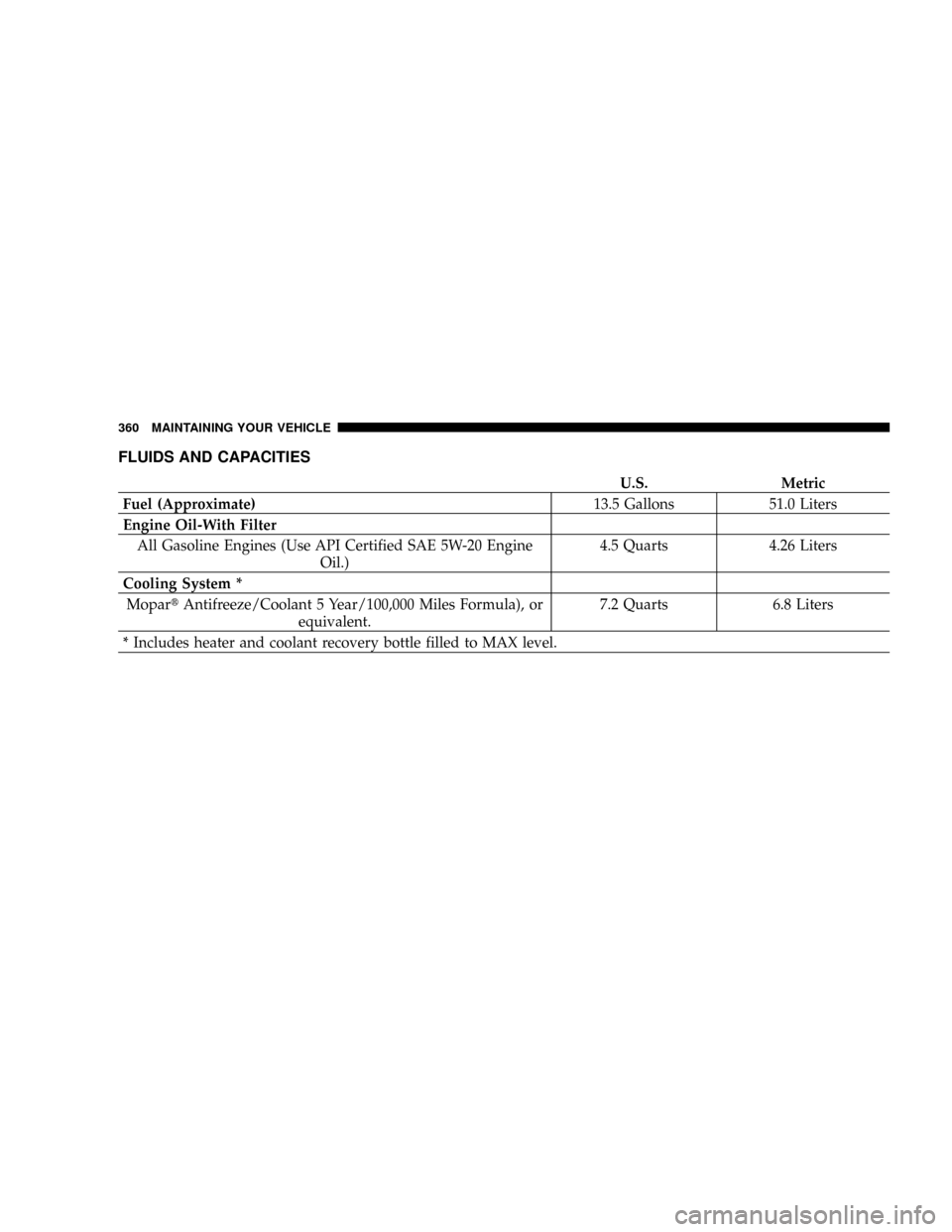
FLUIDS AND CAPACITIES
U.S. Metric
Fuel (Approximate)13.5 Gallons 51.0 Liters
Engine Oil-With Filter
All Gasoline Engines (Use API Certified SAE 5W-20 Engine
Oil.)4.5 Quarts 4.26 Liters
Cooling System *
MopartAntifreeze/Coolant 5 Year/100,000 Miles Formula), or
equivalent.7.2 Quarts 6.8 Liters
* Includes heater and coolant recovery bottle filled to MAX level.
360 MAINTAINING YOUR VEHICLE