brake light JEEP COMPASS 2013 1.G Owner's Manual
[x] Cancel search | Manufacturer: JEEP, Model Year: 2013, Model line: COMPASS, Model: JEEP COMPASS 2013 1.GPages: 517, PDF Size: 4.91 MB
Page 345 of 517
Off” button for five seconds. Refer to “Electronic Stability
Control (ESC)” in this section of the manual.
HDC operation can be overridden with brake application
to slow the vehicle down below the HDC control speed.
Conversely, if more speed is desired during HDC control,
the accelerator pedal will increase vehicle speed like
normal. When either the brake or the accelerator is
released, HDC will control the vehicle back to the origi-
nal set speed.
HDC is only intended for low speed off-road driving. At
vehicle speeds above 31 mph (50 km/h) HDC will no
longer function. If the “HDC Indicator Light” begins to
flash this indicates that the brakes are getting too hot and
the vehicle should be stopped to allow the brakes to cool.WARNING!
HDC is only intended to assist the driver in control-
ling vehicle speed when descending hills. The driver
must remain attentive to the driving conditions and
is responsible for maintaining a safe vehicle speed.
Hill Start Assist (HSA) – Manual Transmission
Only
The HSA system is designed to assist the driver when
starting a vehicle from a stop on a hill. HSA will maintain
the level of brake pressure the driver applied for a short
period of time after the driver takes their foot off of the
brake pedal. If the driver does not apply the throttle
during this short period of time, the system will release
brake pressure and the vehicle will roll down the hill. The
system will release brake pressure in proportion to
amount of throttle applied as the vehicle starts to move in
the intended direction of travel.5
STARTING AND OPERATING 343
Page 346 of 517
HSA Activation Criteria
The following criteria must be met in order for HSA to
activate:
•Vehicle must be stopped.
• Vehicle must be on a 7% grade or greater hill.
• Gear selection matches vehicle uphill direction (i.e.,
vehicle facing uphill is in forward gear; vehicle back-
ing uphill is in REVERSE gear).
WARNING!
There may be situations on minor hills (i.e., less than
8%), with a loaded vehicle, or while pulling a trailer,
when the system will not activate and slight rolling
may occur. This could cause a collision with another
vehicle or object. Always remember the driver is
responsible for braking the vehicle.
Disabling/Enabling HSA
If you wish to turn on or off the HSA system, it can be
done using the Customer Programmable Features in the
Electronic Vehicle Information Center (EVIC). Refer to
“Electronic Vehicle Information Center (EVIC)” in “Un-
derstanding Your Instrument Panel” for further informa-
tion.
For vehicles not equipped with the EVIC, perform the
following steps:
NOTE: You must complete Steps 1 through 8 within 90
seconds.
1. Center the steering wheel (front wheels pointing straight forward).
2. Shift the transmission into NEUTRAL.
3. Apply the parking brake.
4. Start the engine.
344 STARTING AND OPERATING
Page 347 of 517
5. Release the clutch pedal (if equipped).
6. Rotate the steering wheel one-half turn to the left.
7. Press the “ESC Off” switch (located in the lowerswitch bank below the climate controls) four times
within 20 seconds. The “ESC Activation/Malfunction
Indicator Light” should turn on and turn off two
times.
8. Rotate the steering wheel back to center and then an additional half-turn to the right.
9. Turn the ignition switch to the OFF position and then back to the ON position. If the sequence was com-
pleted properly, the “ESC Activation/Malfunction In-
dicator Light” will blink several times to confirm HSA
is disabled.
10. Repeat these steps if you want to return this feature to it’s previous setting.Electronic Stability Control (ESC)
This system enhances directional control and stability of
the vehicle under various driving conditions. ESC cor-
rects for over-steering or under-steering of the vehicle by
applying the brake of the appropriate wheel to assist in
counteracting the over-steering or under-steering condi-
tion. Engine power may also be reduced to help the
vehicle maintain the desired path. ESC uses sensors in
the vehicle to determine the vehicle path intended by the
driver and compares it to the actual path of the vehicle.
When the actual path does not match the intended path,
ESC applies the brake of the appropriate wheel to assist
in counteracting the over-steer or under-steer condition
•Over-steer - when the vehicle is turning more than
appropriate for the steering wheel position.
• Under-steer - when the vehicle is turning less than
appropriate for the steering wheel position.
5
STARTING AND OPERATING 345
Page 395 of 517
and trailer configuration / loading to comply with Gross
Axle Weight Rating (GAWR) requirements.
WARNING!
•An improperly adjusted Weight Distributing Hitch
system may reduce handling, stability, braking
performance, and could result in a collision.
• Weight Distributing Systems may not be compat-
ible with Surge Brake Couplers. Consult with your
hitch and trailer manufacturer or a reputable Rec-
reational Vehicle dealer for additional information.
Trailer Hitch Classification
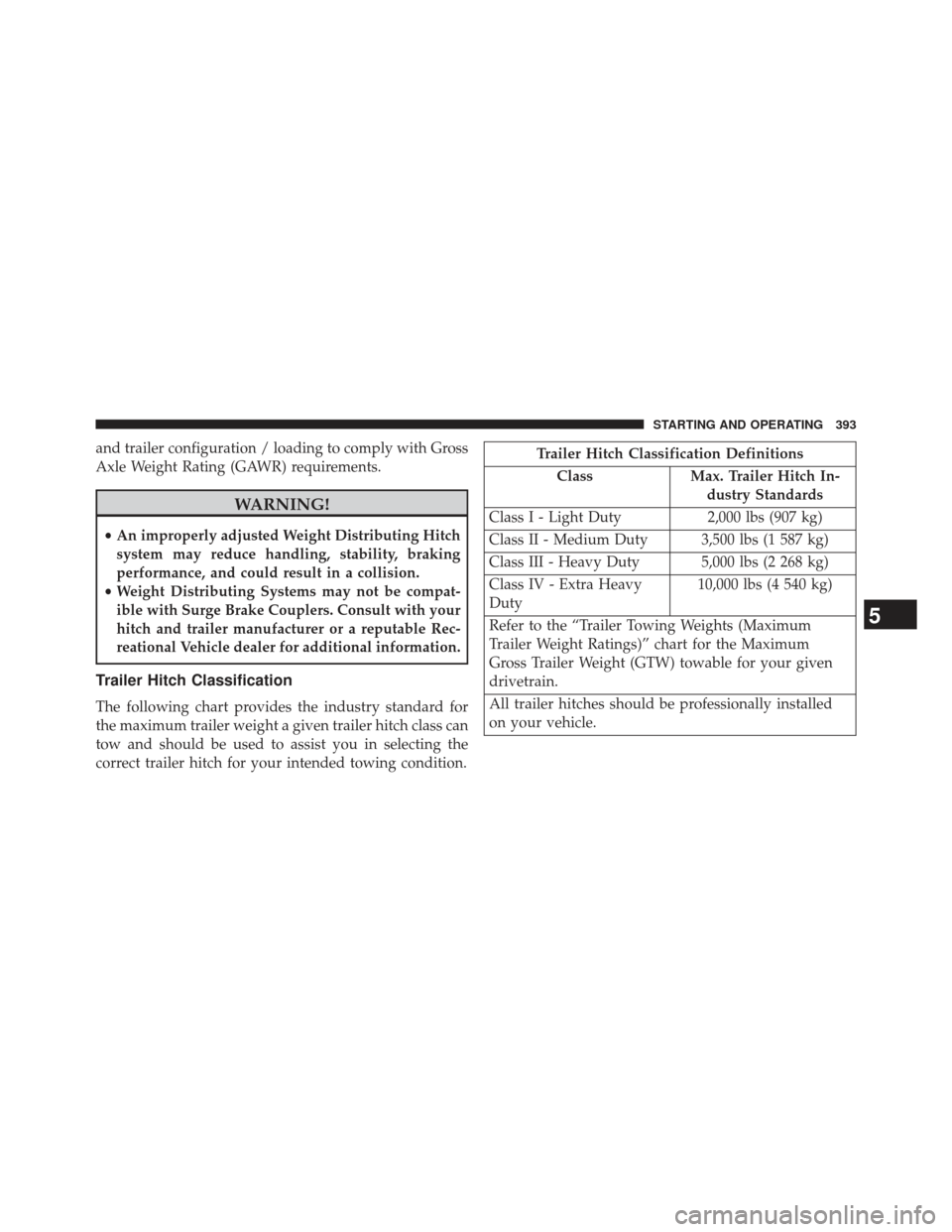
The following chart provides the industry standard for
the maximum trailer weight a given trailer hitch class can
tow and should be used to assist you in selecting the
correct trailer hitch for your intended towing condition.
Trailer Hitch Classification Definitions
Class Max. Trailer Hitch In-
dustry Standards
Class I - Light Duty 2,000 lbs (907 kg)
Class II - Medium Duty 3,500 lbs (1 587 kg)
Class III - Heavy Duty 5,000 lbs (2 268 kg)
Class IV - Extra Heavy
Duty 10,000 lbs (4 540 kg)
Refer to the “Trailer Towing Weights (Maximum
Trailer Weight Ratings)” chart for the Maximum
Gross Trailer Weight (GTW) towable for your given
drivetrain.
All trailer hitches should be professionally installed
on your vehicle.
5
STARTING AND OPERATING 393
Page 401 of 517
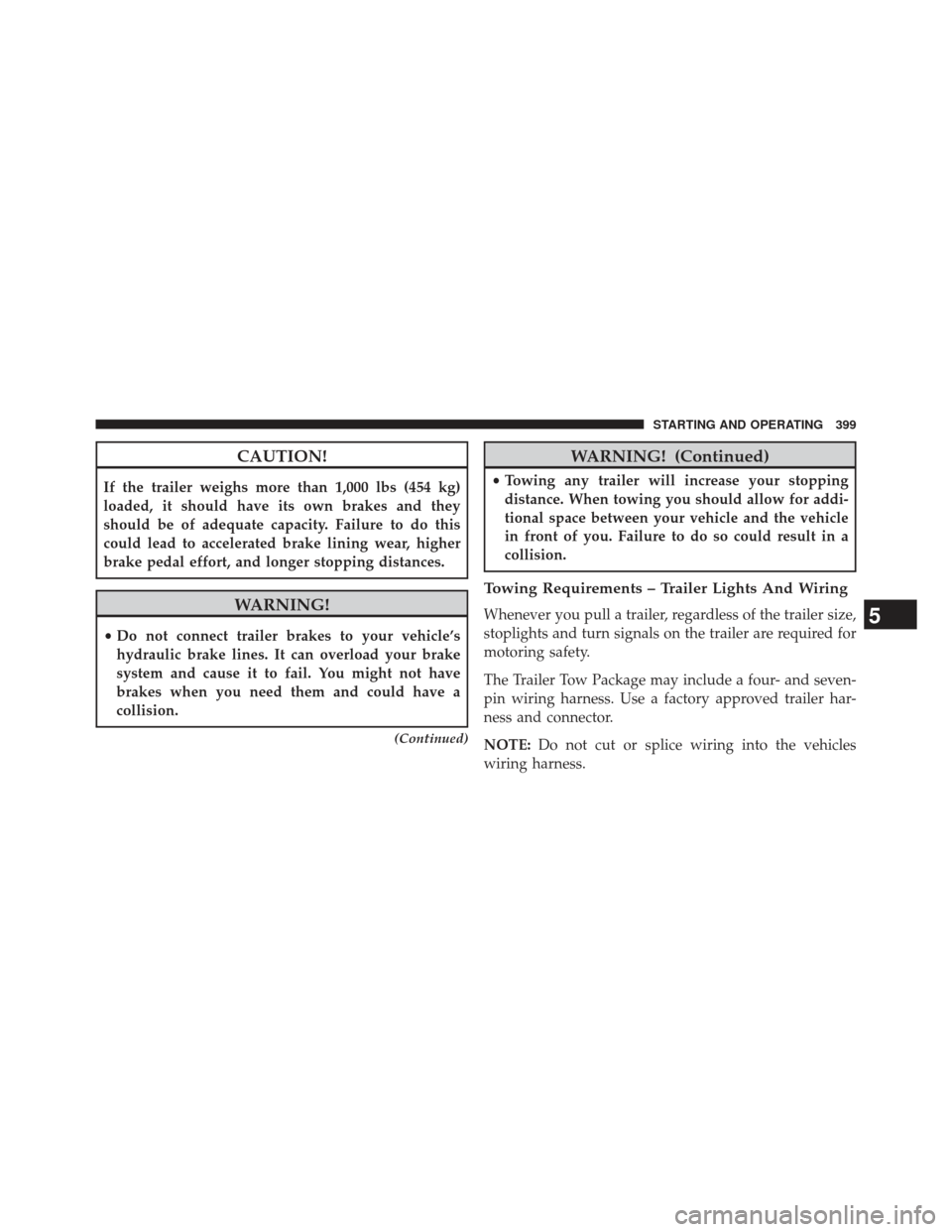
CAUTION!
If the trailer weighs more than 1,000 lbs (454 kg)
loaded, it should have its own brakes and they
should be of adequate capacity. Failure to do this
could lead to accelerated brake lining wear, higher
brake pedal effort, and longer stopping distances.
WARNING!
•Do not connect trailer brakes to your vehicle’s
hydraulic brake lines. It can overload your brake
system and cause it to fail. You might not have
brakes when you need them and could have a
collision.
(Continued)
WARNING! (Continued)
• Towing any trailer will increase your stopping
distance. When towing you should allow for addi-
tional space between your vehicle and the vehicle
in front of you. Failure to do so could result in a
collision.
Towing Requirements – Trailer Lights And Wiring
Whenever you pull a trailer, regardless of the trailer size,
stoplights and turn signals on the trailer are required for
motoring safety.
The Trailer Tow Package may include a four- and seven-
pin wiring harness. Use a factory approved trailer har-
ness and connector.
NOTE: Do not cut or splice wiring into the vehicles
wiring harness.5
STARTING AND OPERATING 399
Page 455 of 517
•Make sure that the coolant expansion bottle overflow
hoses are not kinked or obstructed.
• Keep the front of the radiator clean. If your vehicle is
equipped with air conditioning, keep the front of the
condenser clean.
• Do not change the thermostat for Summer or Winter
operation. If replacement is ever necessary, install
ONLY the correct type thermostat. Other designs may
result in unsatisfactory engine coolant (antifreeze)
performance, poor gas mileage, and increased emis-
sions.
Brake System
In order to assure brake system performance, all brake
system components should be inspected periodically.
Refer to the “Maintenance Schedule” for the proper
maintenance intervals.
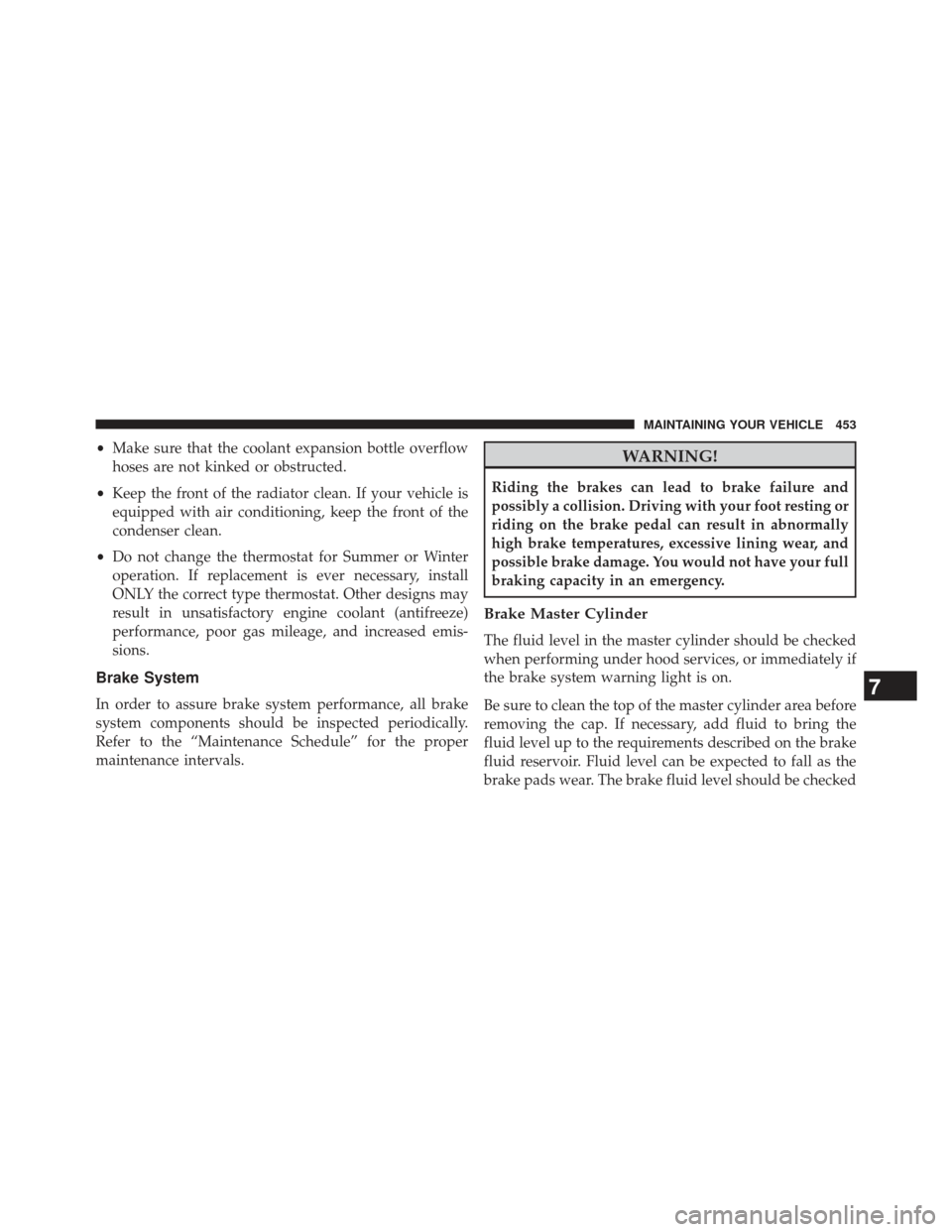
WARNING!
Riding the brakes can lead to brake failure and
possibly a collision. Driving with your foot resting or
riding on the brake pedal can result in abnormally
high brake temperatures, excessive lining wear, and
possible brake damage. You would not have your full
braking capacity in an emergency.
Brake Master Cylinder
The fluid level in the master cylinder should be checked
when performing under hood services, or immediately if
the brake system warning light is on.
Be sure to clean the top of the master cylinder area before
removing the cap. If necessary, add fluid to bring the
fluid level up to the requirements described on the brake
fluid reservoir. Fluid level can be expected to fall as the
brake pads wear. The brake fluid level should be checked
7
MAINTAINING YOUR VEHICLE 453
Page 468 of 517
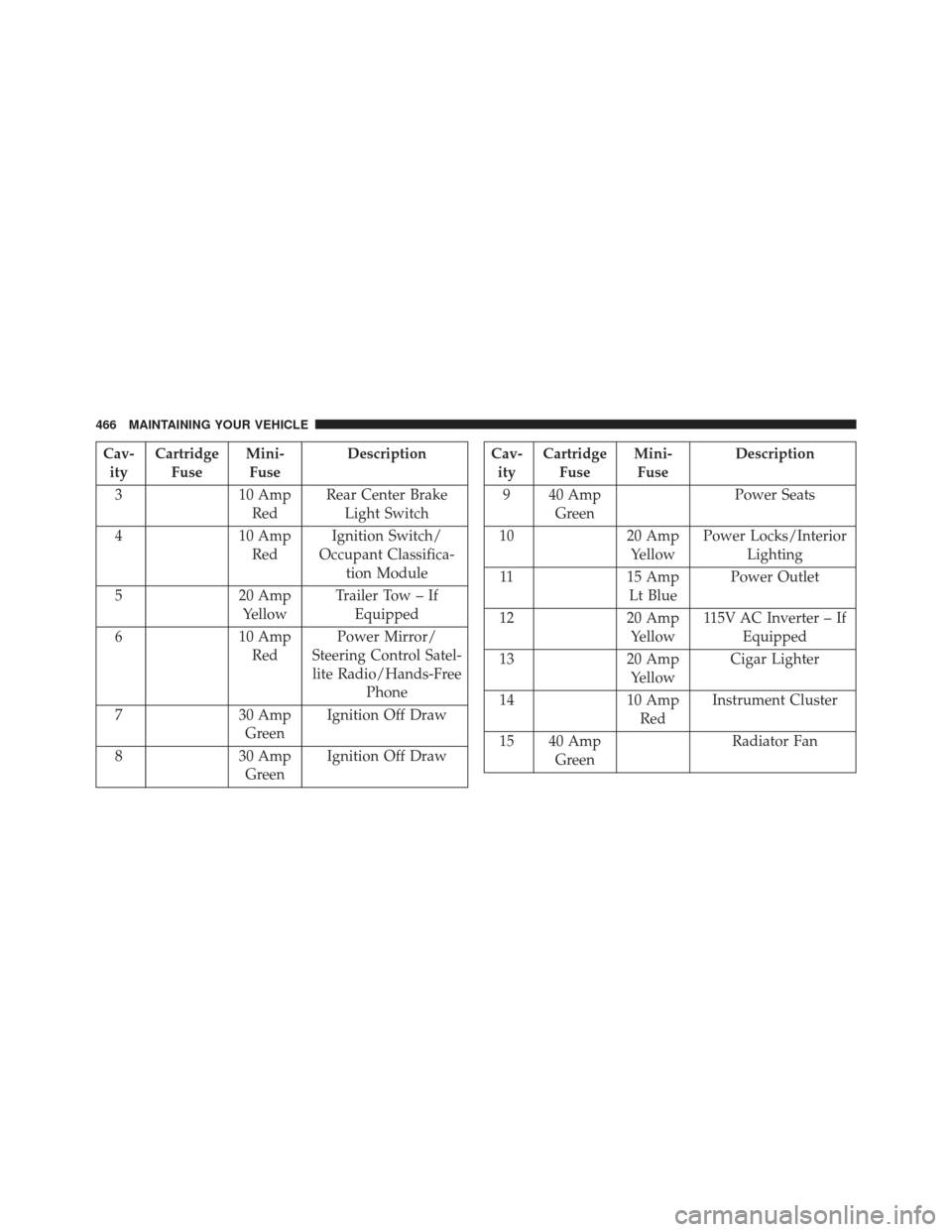
Cav-ity Cartridge
Fuse Mini-
Fuse Description
3 10 Amp
Red Rear Center Brake
Light Switch
4 10 Amp
Red Ignition Switch/
Occupant Classifica- tion Module
5 20 Amp
Yellow Trailer Tow – If
Equipped
6 10 Amp
Red Power Mirror/
Steering Control Satel- lite Radio/Hands-Free Phone
7 30 Amp
Green Ignition Off Draw
8 30 Amp
Green Ignition Off DrawCav-
ity Cartridge
Fuse Mini-
Fuse Description
9 40 Amp Green Power Seats
10 20 Amp
Yellow Power Locks/Interior
Lighting
11 15 Amp
Lt Blue Power Outlet
12 20 Amp
Yellow 115V AC Inverter – If
Equipped
13 20 Amp
Yellow Cigar Lighter
14 10 Amp
Red Instrument Cluster
15 40 Amp Green Radiator Fan
466 MAINTAINING YOUR VEHICLE
Page 479 of 517
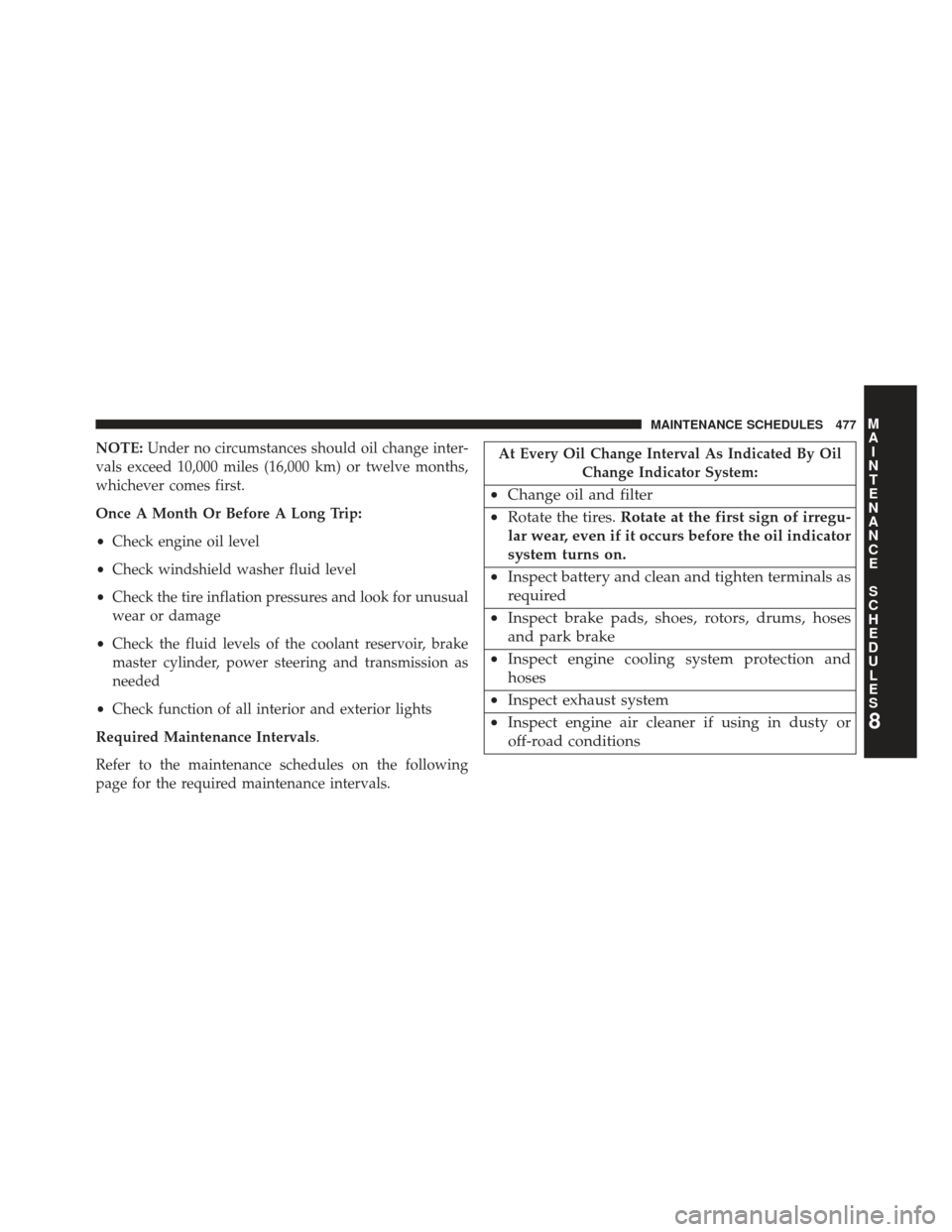
NOTE:Under no circumstances should oil change inter-
vals exceed 10,000 miles (16,000 km) or twelve months,
whichever comes first.
Once A Month Or Before A Long Trip:
• Check engine oil level
• Check windshield washer fluid level
• Check the tire inflation pressures and look for unusual
wear or damage
• Check the fluid levels of the coolant reservoir, brake
master cylinder, power steering and transmission as
needed
• Check function of all interior and exterior lights
Required Maintenance Intervals.
Refer to the maintenance schedules on the following
page for the required maintenance intervals.At Every Oil Change Interval As Indicated By Oil Change Indicator System:
•Change oil and filter
• Rotate the tires. Rotate at the first sign of irregu-
lar wear, even if it occurs before the oil indicator
system turns on.
• Inspect battery and clean and tighten terminals as
required
• Inspect brake pads, shoes, rotors, drums, hoses
and park brake
• Inspect engine cooling system protection and
hoses
• Inspect exhaust system
• Inspect engine air cleaner if using in dusty or
off-road conditions
8
M
A I
N T
E
N
A
N
C E
S
C
H E
D
U L
E
SMAINTENANCE SCHEDULES 477
Page 498 of 517
ABS (Anti-Lock Brake System)................337
Adding Engine Coolant (Antifreeze) ............449
Adding Fuel ............................ .386
Adding Washer Fluid ..................... .444
Additives, Fuel .......................... .384
Airbag ..................................61
Airbag Deployment ........................71
Airbag Light .............................68
Airbag Maintenance ........................73
Airbag, Side ..............................64
Airbag, Window (Side Curtain) ................65
Air Cleaner, Engine (Engine Air Cleaner Filter) . . . .440
Air Conditioner Maintenance .................442
Air Conditioning ......................... .297
Air Conditioning Controls ...................297
Air Conditioning Filter .....................308
Air Conditioning, Operating Tips ..............309
Air Conditioning Refrigerant .................442
Air Conditioning System ....................297 Air Pressure, Tires
........................ .360
Alarm Light ............................ .217
Alarm System (Security Alarm) ................18
Alterations/Modifications, Vehicle ...............8
Antenna, Satellite Radio .....................256
Antifreeze (Engine Coolant) ..................449
Capacities ........................... .472
Disposal ............................ .451
Anti-Lock Brake System (ABS) ................337
Anti-Lock Warning Light ....................214
Anti-Theft Security Alarm (Theft Alarm) ..........18
Appearance Care ........................ .459
Assistance Towing ........................ .125
Automatic Dimming Mirror ..................108
Automatic Door Locks ......................31
Automatic Temperature Control (ATC) ..........301
Automatic Transaxle ........................12
Automatic Transmission ....................321
Fluid and Filter Changes .................457
494 INDEX
Page 499 of 517
Fluid Level Check..................... .456
Fluid Type .......................... .455
Gear Ranges ......................... .323
Special Additives ...................... .456
Autostick .............................. .329
Battery ................................ .441
Keyless Transmitter Replacement (RKE) ........25
Belts, Seat ...............................98
Body Mechanism Lubrication .................443
B-Pillar Location ......................... .355
Brake Assist System ...................... .340
Brake Fluid ............................ .474
Brake, Parking .......................... .334
Brakes ................................ .336
Brake System ........................... .336
Anti-Lock (ABS) ...................... .337
Master Cylinder ....................... .453
Parking ............................. .334Warning Light
........................ .215
Brake/Transmission Interlock .................322
Bulb Replacement ........................ .469
Bulbs, Light ............................ .101
Calibration, Compass ..................... .237
Capacities, Antifreeze (Engine Coolant) ..........472
Capacities, Fluid ......................... .472
Caps, Filler Fuel ............................... .386
Oil (Engine) ......................... .431
Power Steering ....................... .333
Radiator (Coolant Pressure) ...............450
Carbon Monoxide Warning ...................97
Cargo Area Cover ........................ .198
Cargo Area Features ...................... .197
Cargo Compartment ...................... .197
Light .............................. .197
Luggage Carrier ...................... .204
10
INDEX 495