wheel JEEP COMPASS 2015 1.G Manual PDF
[x] Cancel search | Manufacturer: JEEP, Model Year: 2015, Model line: COMPASS, Model: JEEP COMPASS 2015 1.GPages: 560, PDF Size: 11.51 MB
Page 448 of 560
WARNING!(Continued)
•Keep Tire Service Kit away from open flames or
heat source.
•A loose Tire Service Kit thrown forward in a
collision or hard stop could endanger the occupants
of the vehicle. Always stow the Tire Service Kit in
the place provided. Failure to follow these warn-
ings can result in injuries that are serious or fatal to
you, your passengers, and others around you.
•Take care not to allow the contents of Tire Service
Kit to come in contact with hair, eyes, or clothing.
Tire Service Kit is harmful if inhaled, swallowed,
or absorbed through the skin. It causes skin, eye,
and respiratory irritation. Flush immediately with
plenty of water if there is any contact with eyes or
skin. Change clothing as soon as possible, if there
is any contact with clothing.
(Continued)
WARNING!(Continued)
•Tire Service Kit Sealant solution contains latex. In
case of an allergic reaction or rash, consult a phy-
sician immediately. Keep Tire Service Kit out of
reach of children. If swallowed, rinse mouth imme-
diately with plenty of water and drink plenty of
water. Do not induce vomiting! Consult a physician
immediately.
Sealing A Tire With Tire Service Kit
(A) Whenever You Stop To Use Tire Service Kit:
1. Pull over to a safe location and turn on the vehicle’s
Hazard Warning flashers.
2. Verify that the valve stem (on the wheel with the
deflated tire) is in a position that is near to the ground.
This will allow the Tire Service Kit Hoses (6) and (7) to
reach the valve stem and keep the Tire Service Kit flat
446 WHAT TO DO IN EMERGENCIES
Page 459 of 560
FREEING A STUCK VEHICLE
If your vehicle becomes stuck in mud, sand or snow, it can
often be moved using a rocking motion. Turn the steering
wheel right and left to clear the area around the front
wheels. Then shift back and forth between DRIVE and
REVERSE (with automatic transmission) or 2nd gear and
REVERSE (with manual transmission), while gently press-
ing the accelerator. Use the least amount of accelerator
pedal pressure that will maintain the rocking motion,
without spinning the wheels, or racing the engine.
CAUTION!
Racing the engine or spinning the wheels may lead to
transmission overheating and failure. Allow the en-
gine to idle with the transmission in NEUTRAL for at
least one minute after every five rocking-motion
cycles. This will minimize overheating and reduce
(Continued)
CAUTION!(Continued)
the risk of clutch or transmission failure during
prolonged efforts to free a stuck vehicle.
NOTE:Press the#ESC Off#switch, to place the Electronic
Stability Control (ESC) system in#Partial Off#mode,
before rocking the vehicle. Refer to “Electronic Brake
Control” in “Starting And Operating” for further infor-
mation. Once the vehicle has been freed, press the#ESC
Off#switch again to restore#ESC On#mode.
CAUTION!
•When “rocking” a stuck vehicle by shifting be-
tween DRIVE/2nd gear and REVERSE, do not spin
the wheels faster than 15 mph (24 km/h), or drive-
train damage may result.
(Continued)
6
WHAT TO DO IN EMERGENCIES 457
Page 460 of 560
CAUTION!(Continued)
•Revving the engine or spinning the wheels too fast
may lead to transmission overheating and failure.
It can also damage the tires. Do not spin the wheels
above 30 mph (48 km/h) while in gear (no trans-
mission shifting occurring).
WARNING!
Fast spinning tires can be dangerous. Forces gener-
ated by excessive wheel speeds may cause damage, or
even failure, of the axle and tires. A tire could
explode and injure someone. Do not spin your vehi-
cle’s wheels faster than 30 mph (48 km/h) or for
longer than 30 seconds continuously without stop-
ping when you are stuck and do not let anyone near
a spinning wheel, no matter what the speed.
SHIFT LEVER OVERRIDE
If a malfunction occurs and the shift lever cannot be
moved out of the PARK position, you can use the
following procedure to temporarily move the shift lever:
1. Turn the engine OFF.
2. Firmly apply the parking brake.
3. Using a small screwdriver or similar tool, remove the
shift lever override access cover (located on the right
side of the shift lever housing).
458 WHAT TO DO IN EMERGENCIES
Page 462 of 560
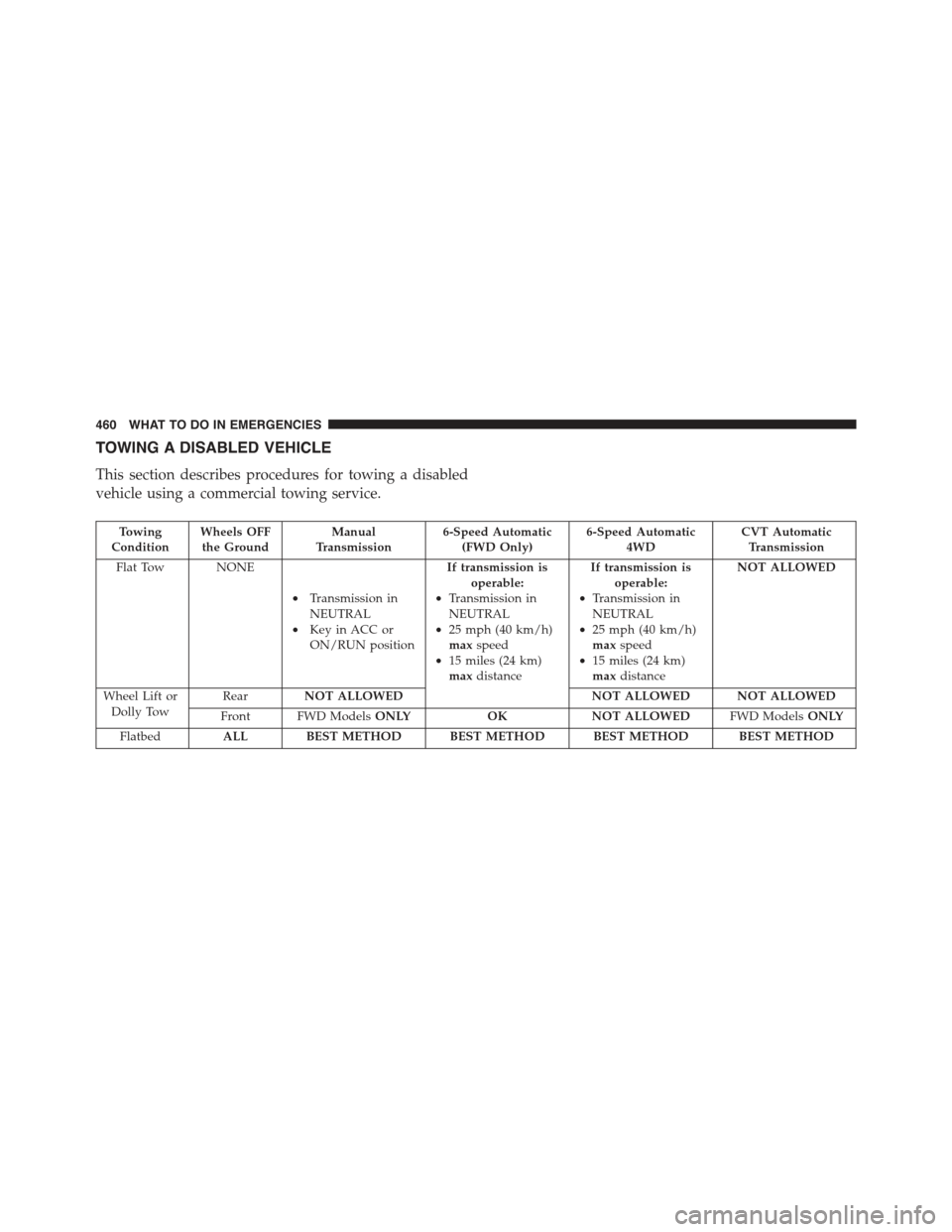
TOWING A DISABLED VEHICLE
This section describes procedures for towing a disabled
vehicle using a commercial towing service.
To w i n gConditionWheels OFFthe GroundManualTransmission6-Speed Automatic(FWD Only)6-Speed Automatic4WDCVT AutomaticTransmission
Flat Tow NONE
•Transmission inNEUTRAL•Key in ACC orON/RUN position
If transmission isoperable:•Transmission inNEUTRAL•25 mph (40 km/h)maxspeed•15 miles (24 km)maxdistance
If transmission isoperable:•Transmission inNEUTRAL•25 mph (40 km/h)maxspeed•15 miles (24 km)maxdistance
NOT ALLOWED
Wheel Lift orDolly TowRearNOT ALLOWEDNOT ALLOWED NOT ALLOWED
Front FWD ModelsONLYOKNOT ALLOWEDFWD ModelsONLY
FlatbedALL BEST METHOD BEST METHOD BEST METHOD BEST METHOD
460 WHAT TO DO IN EMERGENCIES
Page 463 of 560
With Ignition Key
Automatic Transmission
•Front Wheel Drive (FWD) vehicles can be towed with
the front wheels elevated, or on a flatbed truck (all four
wheelsOFFthe ground).
•Four-Wheel Drive (4WD) vehicles can be towed on a
flatbed truck (all four wheelsOFFthe ground).
If the transmission is operable, Front Wheel Drive (FWD)
and Four Wheel Drive (4WD) vehicles, with the 6-speed
automatic transmission only (NOTthe Continuously
Variable automatic transmission [CVT]), may be flat
towed (with all four wheels on the ground) under the
following conditions:
•The transmission must be in NEUTRAL.
•The towing speed must not exceed 25 mph (40 km/h).
•The towing distance must not exceed 15 miles (24 km).
Front Wheel Drive (FWD) models (with 6-speed auto-
maticonly) may also be towed (under the same limita-
tions shown above) with the rear wheels elevated.
CAUTION!
•DO NOT flat tow any vehicle equipped with a
CVT automatic transmission. Damage to the drive-
train will result. If these vehicles require towing,
make sure all drive wheels are OFF the ground.
•Towing this vehicle in violation of the above re-
quirements can cause severe transmission and/or
transfer case damage. Damage from improper tow-
ing is not covered under the New Vehicle Limited
Warranty..
If the vehicle’s battery is discharged, refer to “Shift Lever
Override” in this section for instructions on shifting the
automatic transmission out of PARK for towing.
6
WHAT TO DO IN EMERGENCIES 461
Page 464 of 560
Manual Transmission
•Front Wheel Drive (FWD) or Four-Wheel Drive (4WD)
vehicles can be flat towed (all four wheels on the
ground) with the transmission in NEUTRAL.
•FWD vehicles can be towed with the front wheels
elevated.
•FWD or 4WD vehicles can be towed on a flatbed truck
(all wheelsOFFthe ground).
CAUTION!
•DO NOT flat tow any disabled vehicle if condition
is related to the clutch, transmission or driveline.
Additional damage to the drivetrain could result.
(Continued)
CAUTION!(Continued)
•Towing this vehicle in violation of the above re-
quirements can cause severe engine, transmission,
or drivetrain damage. Damage from improper tow-
ing is not covered under the New Vehicle Limited
Warranty.
All Transmissions
If you must use the accessories (wipers, defroster, etc.)
while being towed, the key must be in the ON/RUN
position, not the ACC position. Make certain the trans-
mission remains in NEUTRAL.
462 WHAT TO DO IN EMERGENCIES
Page 503 of 560
Special Care
•If you drive on salted or dusty roads or if you drive
near the ocean, hose off the undercarriage at least once
a month.
•It is important that the drain holes in the lower edges
of the doors, rocker panels, and trunk be kept clear and
open.
•If you detect any stone chips or scratches in the paint,
touch them up immediately. The cost of such repairs is
considered the responsibility of the owner.
•If your vehicle is damaged due to a collision or similar
cause that destroys the paint and protective coating,
have your vehicle repaired as soon as possible. The
cost of such repairs is considered the responsibility of
the owner.
•If you carry special cargo such as chemicals, fertilizers,
de-icer salt, etc., be sure that such materials are well
packaged and sealed.
•If a lot of driving is done on gravel roads, consider
mud or stone shields behind each wheel.
•Use MOPAR® Touch Up Paint on scratches as soon as
possible. Your authorized dealer has touch up paint to
match the color of your vehicle.
Wheel And Wheel Trim Care
•All wheels and wheel trim, especially aluminum and
chrome plated wheels, should be cleaned regularly
with a mild soap and water to prevent corrosion.
•To remove heavy soil and/or excessive brake dust, use
MOPAR® Wheel Cleaner.
7
MAINTAINING YOUR VEHICLE 501
Page 504 of 560
NOTE:If your vehicle is equipped with Dark Vapor or
Black Satin Chrome wheels DO NOT USE wheel cleaners,
abrasives or polishing compounds. They will perma-
nently damage this finish and such damage is not cov-
ered by the New Vehicle Limited Warranty. USE ONLY
MILD SOAP AND WATER WITH A SOFT CLOTH. Used
on a regular basis this is all that is required to maintain
this finish.
CAUTION!
Do not use scouring pads, steel wool, a bristle brush,
or metal polishes. Do not use oven cleaner. These
products may damage the wheel’s protective finish.
Avoid automatic car washes that use acidic solutions
or harsh brushes that may damage the wheel’s pro-
tective finish. Only MOPAR® Wheel Cleaner or
equivalent is recommended.
Stain Repel Fabric Cleaning Procedure —
If Equipped
Stain Repel seats may be cleaned in the following manner:
•Remove as much of the stain as possible by blotting
with a clean, dry towel.
•Blot any remaining stain with a clean, damp towel.
•For tough stains, apply MOPAR® Total Clean, or a
mild soap solution to a clean, damp cloth and remove
stain. Use a fresh, damp towel to remove soap residue.
•For grease stains, apply MOPAR® Multi-Purpose
Cleaner to a clean, damp cloth and remove stain. Use
a fresh, damp towel to remove soap residue.
•Do not use any harsh solvents or any other form of
protectants on Stain Repel products.
502 MAINTAINING YOUR VEHICLE
Page 538 of 560
Traction Grades
The Traction grades, from highest to lowest, are AA, A, B,
and C. These grades represent the tire’s ability to stop on
wet pavement, as measured under controlled conditions on
specified government test surfaces of asphalt and concrete.
A tire marked C may have poor traction performance.
WARNING!
The traction grade assigned to this tire is based on
straight-ahead braking traction tests, and does not
include acceleration, cornering, hydroplaning, or
peak traction characteristics.
Temperature Grades
The temperature grades are A (the highest), B, and C,
representing the tire’s resistance to the generation of
heat and its ability to dissipate heat, when tested under
controlled conditions on a specified indoor laboratory
test wheel. Sustained high temperature can cause the
material of the tire to degenerate and reduce tire life, and
excessive temperature can lead to sudden tire failure. The
grade C corresponds to a level of performance, which all
passenger car tires must meet under the Federal Motor
Vehicle Safety Standard No. 109. Grades B and A repre-
sent higher levels of performance on the laboratory test
wheel, than the minimum required by law.
WARNING!
The temperature grade for this tire is established for
a tire that is properly inflated and not overloaded.
Excessive speed, under-inflation, or excessive load-
ing, either separately or in combination, can cause
heat buildup and possible tire failure.
536 IF YOU NEED CONSUMER ASSISTANCE
Page 543 of 560
Older Children And Child Restraints..........79
Seating Positions........................82
Child Safety Locks.........................34
Clean Air Gasoline........................403
Cleaning
Wheels...............................501
Climate Control..........................297
Clock..................................243
Clutch.................................491
Clutch Fluid.............................491
Coin Holder.............................199
Cold Weather Operation....................318
Compact Disc (CD) Maintenance..............296
Compact Spare Tire........................386
Compass...............................228
Compass Calibration.......................239
Compass Variance.........................239
Connector
UCI . . . . . . . . . . . . . . . . . . . . . . . . . . . . . . . ..287
Universal Consumer Interface (UCI)..........287
Console................................199
Contract, Service..........................531
Coolant (Antifreeze).......................514
Coolant Pressure Cap (Radiator Cap)...........488
Cooling System...........................485
Adding Coolant (Antifreeze)...............487
Coolant Level..........................485
Disposal of Used Coolant.................489
Drain, Flush, and Refill...................486
Inspection............................489
Points to Remember.....................490
Pressure Cap..........................488
Radiator Cap..........................488
Selection of Coolant (Antifreeze).............486
Corrosion Protection.......................499
Cruise Light.............................220
Cupholders.............................199
CustomerAssistance.......................52910
INDEX 541