child lock JEEP COMPASS 2015 1.G Owners Manual
[x] Cancel search | Manufacturer: JEEP, Model Year: 2015, Model line: COMPASS, Model: JEEP COMPASS 2015 1.GPages: 560, PDF Size: 11.51 MB
Page 12 of 560
▫Sound Horn With Remote Key Lock.........22
▫Flash Lights With Remote Key Lock/Unlock . . .23
▫Using The Panic Alarm..................24
▫Programming Additional Transmitters........25
▫Transmitter Battery Replacement...........25
▫General Information....................26
!REMOTE STARTING SYSTEM — IF EQUIPPED . .26
▫How To Use Remote Start................27
!DOOR LOCKS.........................30
▫Manual Door Locks.....................30
▫Power Door Locks.....................31
▫Child-Protection Door Lock System —
Rear Doors..........................34
!POWER WINDOWS — IF EQUIPPED........35
▫Power Window Switches.................35
▫Auto-Down..........................37
▫Window Lockout Switch.................37
!LIFTGATE............................38
!OCCUPANT RESTRAINT SYSTEMS..........39
▫Important Safety Precautions..............40
▫Seat Belt Systems......................41
▫Supplemental Restraint System (SRS)........61
▫Child Restraints.......................76
▫Transporting Pets......................97
!ENGINE BREAK-IN RECOMMENDATIONS....97
10 THINGS TO KNOW BEFORE STARTING YOUR VEHICLE
Page 15 of 560
NOTE:If you try to remove the key before you place the
shift lever in PARK, the key may become trapped tem-
porarily in the ignition switch cylinder. If this occurs,
place the shift lever in PARK, rotate the key clockwise
slightly, then remove the key as described above. If a
malfunction occurs, the system will trap the key in the
ignition cylinder to warn you that this safety feature is
inoperable. The engine can be started and stopped but
the key cannot be removed until you obtain service.
WARNING!
•Before exiting a vehicle, always apply the parking
brake, shift the transmission into PARK and re-
move the Key Fob from the ignition. When leaving
the vehicle, always lock your vehicle.
•Never leave children alone in a vehicle, or with
access to an unlocked vehicle.
(Continued)
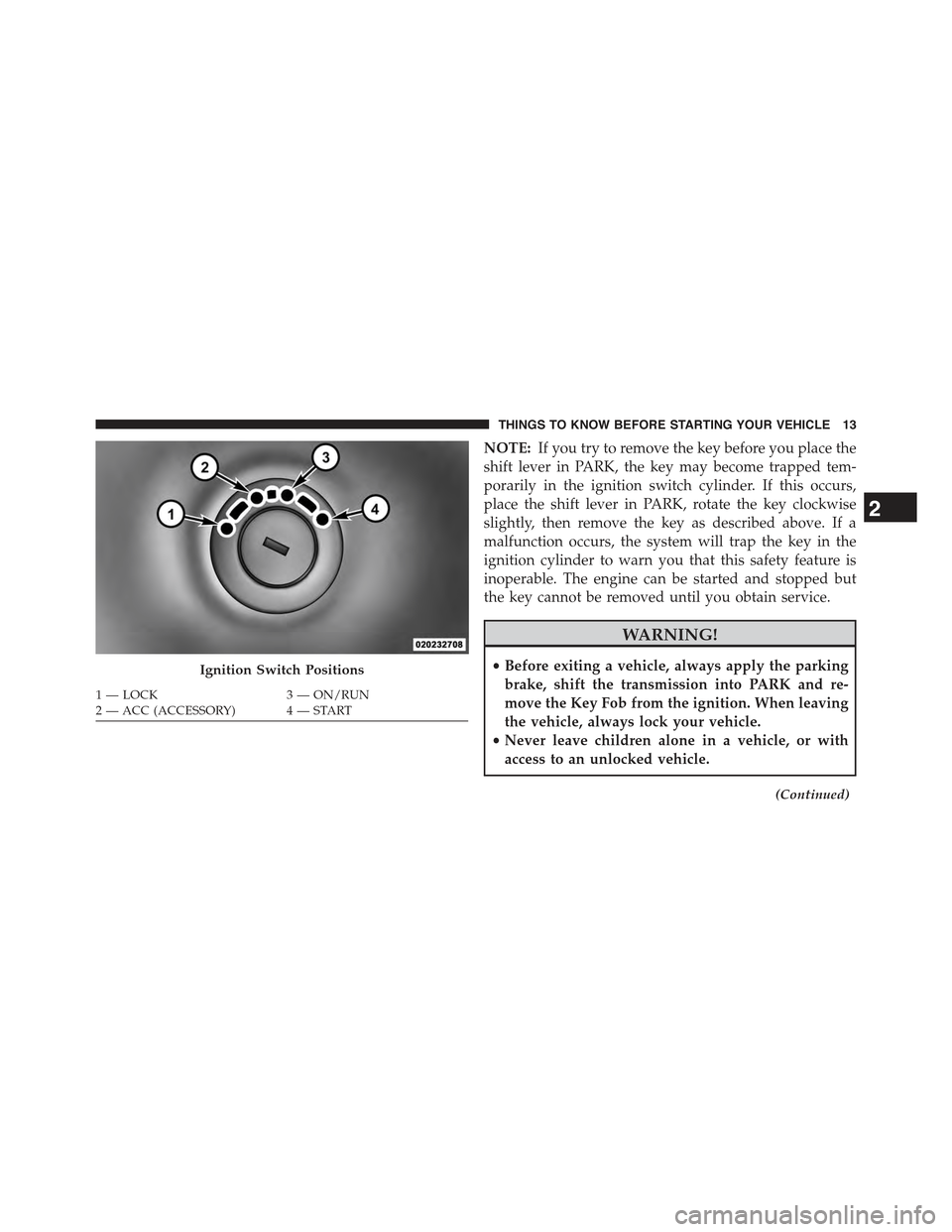
Ignition Switch Positions
1—LOCK3—ON/RUN2—ACC(ACCESSORY) 4—START
2
THINGS TO KNOW BEFORE STARTING YOUR VEHICLE 13
Page 16 of 560
WARNING!(Continued)
•Allowing children to be in a vehicle unattended is
dangerous for a number of reasons. A child or others
could be seriously or fatally injured. Children
should be warned not to touch the parking brake,
brake pedal or the transmission gear selector.
•Do not leave the Key Fob in or near the vehicle, or
in a location accessible to children. A child could
operate power windows, other controls, or move
the vehicle.
•Do not leave children or animals inside parked
vehicles in hot weather. Interior heat build-up may
cause serious injury or death.
CAUTION!
Always remove the key from the ignition and lock all
doors when leaving the vehicle unattended.
Locking Doors With A Key
You can insert the key with either side up. To lock the
door, turn the key to the right. To unlock the door, turn
the key to the left. Refer to “Maintenance Procedures” in
“Maintaining Your Vehicle” for further information.
Key-In-Ignition Reminder
Opening the driver’s door when the key is in the ignition
and the ignition position is LOCK or ACC, sounds a
signal to remind you to remove the key.
NOTE:With the driver’s door open and the key in the
ignition, the power door locks will not lock and Remote
Keyless Entry (RKE) transmitter will not function.
14 THINGS TO KNOW BEFORE STARTING YOUR VEHICLE
Page 29 of 560
NOTE:
•The vehicle must be equipped with an automatic
transmission to be equipped with Remote Start.
•Obstructions between the vehicle and the Key Fob may
reduce this range.
How To Use Remote Start
All of the following conditions must be met before the
engine will remote start:
•Shift lever in PARK
•Doors closed
•Hood closed
•Hazard switch off
•Brake switch inactive (brake pedal not pushed)
•Ignition key removed from ignition switch
•Battery at an acceptable charge level
•RKE PANIC button not pushed
•System not disabled from previous remote start event
•Vehicle theft alarm not active
WARNING!
•Do not start or run an engine in a closed garage or
confined area. Exhaust gas contains Carbon Mon-
oxide (CO) which is odorless and colorless. Carbon
Monoxide is poisonous and can cause serious in-
jury or death when inhaled.
•Keep Remote Keyless Entry (RKE) transmitters
away from children. Operation of the Remote Start
System, windows, door locks or other controls
could cause serious injury or death.
2
THINGS TO KNOW BEFORE STARTING YOUR VEHICLE 27
Page 32 of 560
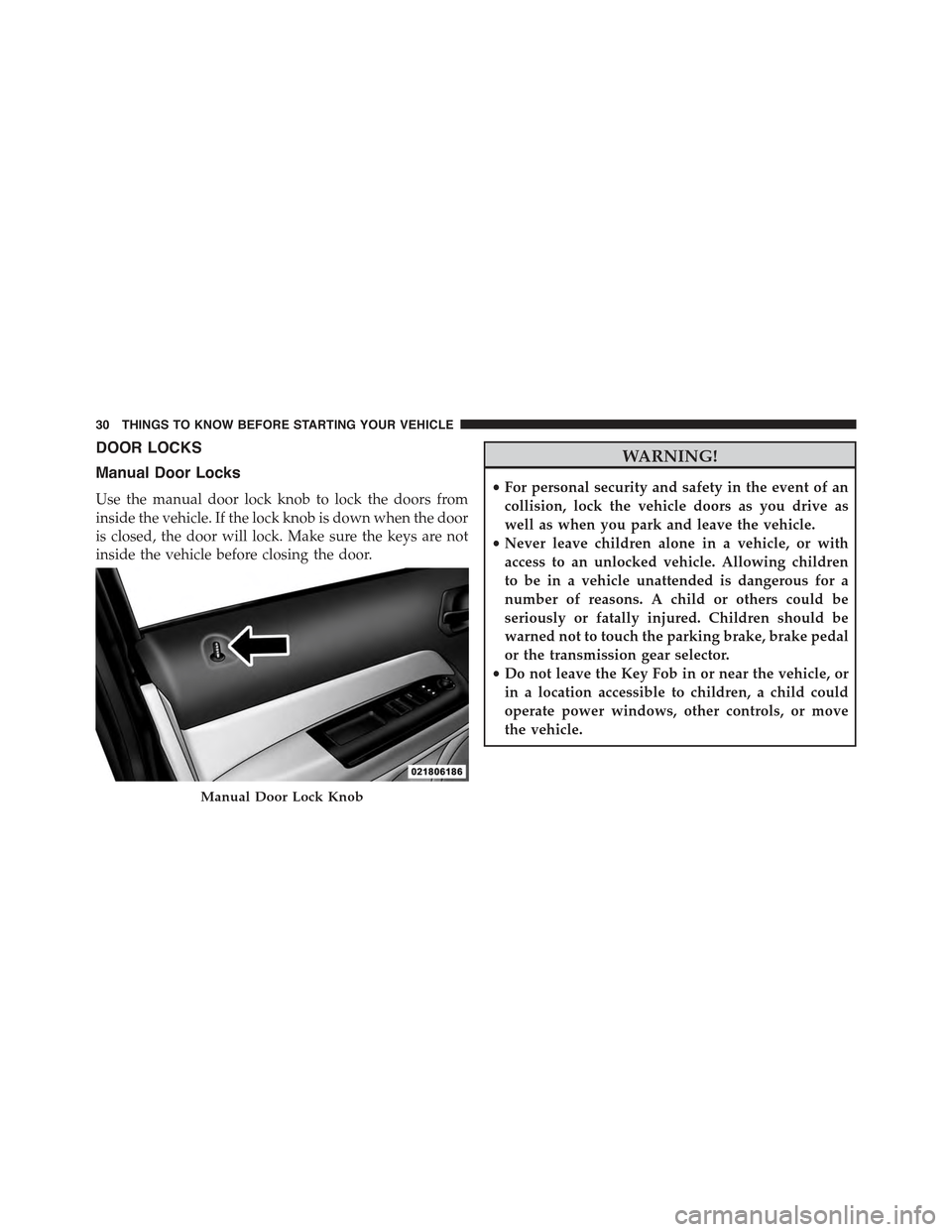
DOOR LOCKS
Manual Door Locks
Use the manual door lock knob to lock the doors from
inside the vehicle. If the lock knob is down when the door
is closed, the door will lock. Make sure the keys are not
inside the vehicle before closing the door.
WARNING!
•For personal security and safety in the event of an
collision, lock the vehicle doors as you drive as
well as when you park and leave the vehicle.
•Never leave children alone in a vehicle, or with
access to an unlocked vehicle. Allowing children
to be in a vehicle unattended is dangerous for a
number of reasons. A child or others could be
seriously or fatally injured. Children should be
warned not to touch the parking brake, brake pedal
or the transmission gear selector.
•Do not leave the Key Fob in or near the vehicle, or
in a location accessible to children, a child could
operate power windows, other controls, or move
the vehicle.
Manual Door Lock Knob
30 THINGS TO KNOW BEFORE STARTING YOUR VEHICLE
Page 36 of 560
NOTE:
•If you do not hear the chime it means that the system
did not enter the programming mode and you will
need to repeat the procedure.
•Use the Automatic Unlock Doors On Exit feature in
accordance with local laws.
Child-Protection Door Lock System —
Rear Doors
To provide a safer environment for small children riding
in the rear seats, the rear doors are equipped with
Child-Protection Door Lock system.
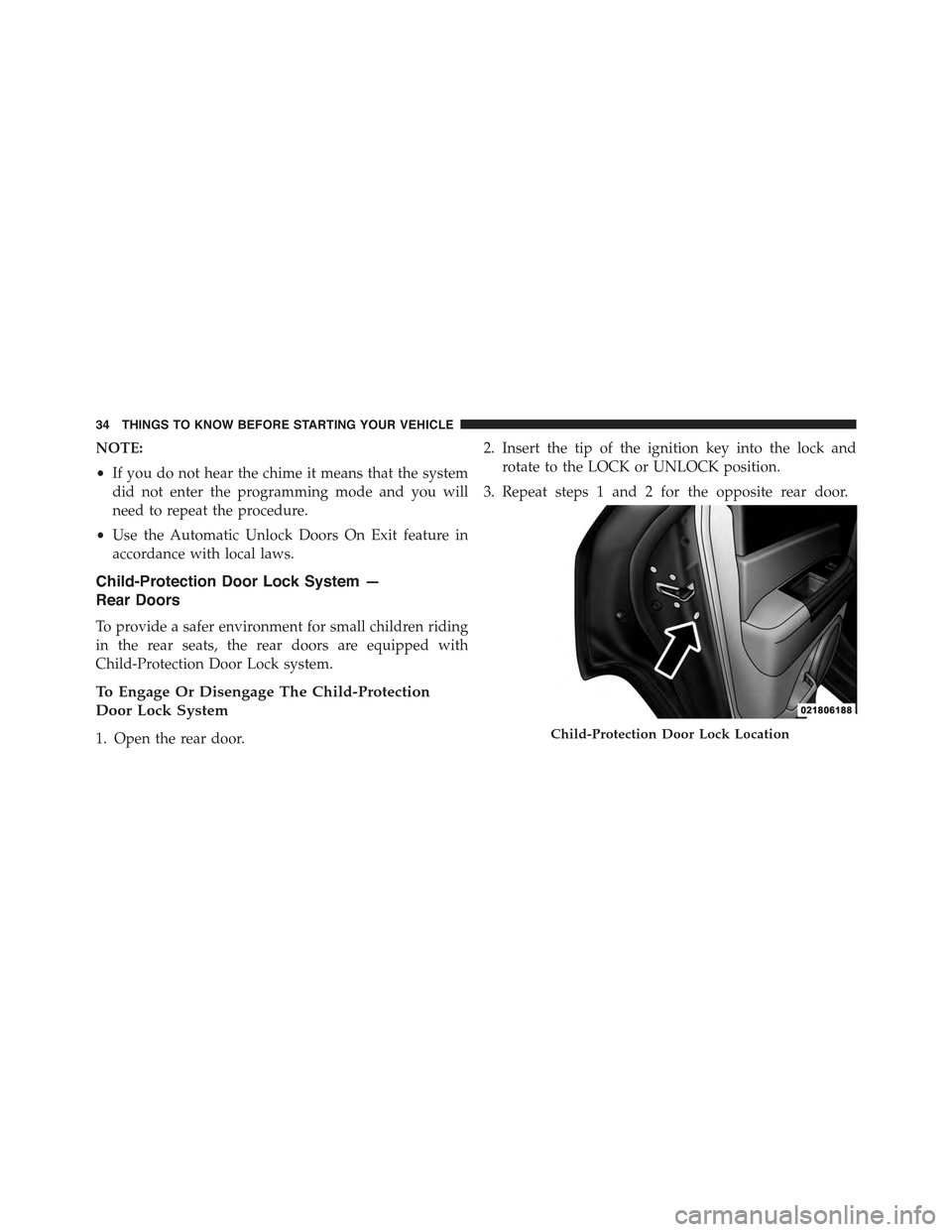
To Engage Or Disengage The Child-Protection
Door Lock System
1. Open the rear door.
2. Insert the tip of the ignition key into the lock and
rotate to the LOCK or UNLOCK position.
3. Repeat steps 1 and 2 for the opposite rear door.
Child-Protection Door Lock Location
34 THINGS TO KNOW BEFORE STARTING YOUR VEHICLE
Page 37 of 560
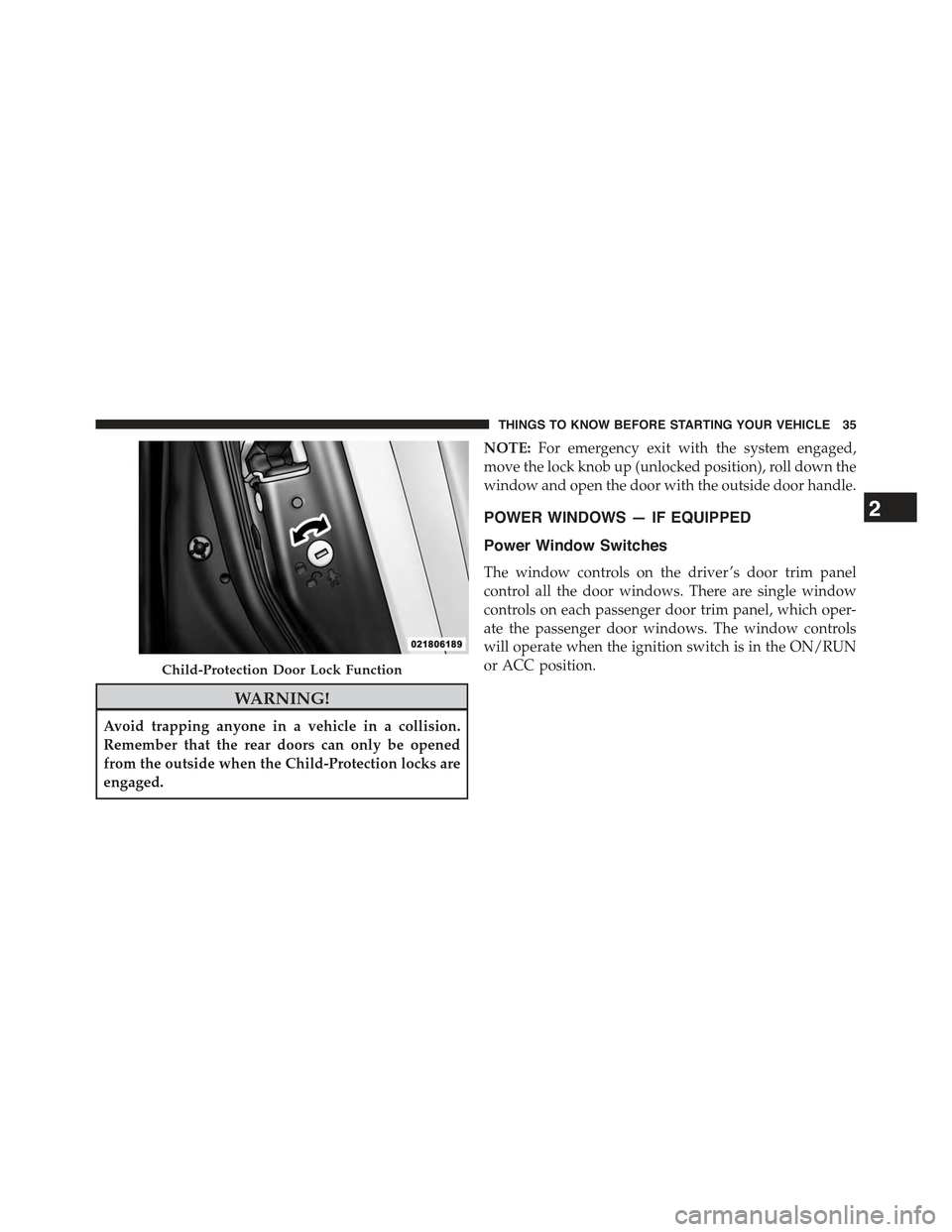
WARNING!
Avoid trapping anyone in a vehicle in a collision.
Remember that the rear doors can only be opened
from the outside when the Child-Protection locks are
engaged.
NOTE:For emergency exit with the system engaged,
move the lock knob up (unlocked position), roll down the
window and open the door with the outside door handle.
POWER WINDOWS — IF EQUIPPED
Power Window Switches
The window controls on the driver ’s door trim panel
control all the door windows. There are single window
controls on each passenger door trim panel, which oper-
ate the passenger door windows. The window controls
will operate when the ignition switch is in the ON/RUN
or ACC position.Child-Protection Door Lock Function
2
THINGS TO KNOW BEFORE STARTING YOUR VEHICLE 35
Page 38 of 560
NOTE:
•For vehicles not equipped with the Electronic Vehicle
Information Center (EVIC), the power window
switches will remain active for 45 seconds after the
ignition switch is turned to the LOCK position. Open-
ing either front door will cancel this feature.
•For vehicles equipped with the EVIC, the power
window switches will remain active for up to 10 min-
utes after the ignition switch is turned to the LOCK
position. Opening either front door will cancel this
feature. The time for this feature is programmable.
Refer to “Electronic Vehicle Information Center
(EVIC)/Personal Settings (Customer-Programmable
Features)” in “Understanding Your Instrument Panel”
for further information.
WARNING!
Never leave children unattended in a vehicle, and do
not let children play with power windows. Do not
leave the Key Fob in or near the vehicle, or in a
location accessible to children. Occupants, particu-
larly unattended children, can become entrapped by
the windows while operating the power window
switches. Such entrapment may result in serious
injury or death.
36 THINGS TO KNOW BEFORE STARTING YOUR VEHICLE
Page 56 of 560
Seat Belts And Pregnant Women
We recommend that pregnant women use the seat belts
throughout their pregnancy. Keeping the mother safe is
the best way to keep the baby safe.
Pregnant women should wear the lap part of the seat belt
across the thighs and as snug across the hips as possible.
Keep the seat belt low so that it does not come across the
abdomen. That way the strong bones of the hips will take
the force if there is a collision.
Seat Belt Pretensioner
The front seat belt system is equipped with pretensioning
devices that are designed to remove slack from the seat belt
in the event of a collision. These devices may improve the
performance of the seat belt by removing slack from the
seat belt early in a collision. Pretensioners work for all size
occupants, including those in child restraints.
NOTE:These devices are not a substitute for proper seat
belt placement by the occupant. The seat belt still must be
worn snugly and positioned properly.
The pretensioners are triggered by the Occupant Re-
straint Controller (ORC). Like the air bags, the preten-
sioners are single use items. A deployed pretensioner or
a deployed air bag must be replaced immediately.
Energy Management Feature
This vehicle has a seat belt system with an Energy Man-
agement feature in the front seating positions that may
help further reduce the risk of injury in the event of a
collision. This seat belt system has a retractor assembly that
is designed to release webbing in a controlled manner.
Automatic Locking Retractor (ALR) — If Equipped
The seat belts in the passenger seating positions may be
equipped with a switchable Automatic Locking Retractor
(ALR) which is used to secure a child restraint system.
54 THINGS TO KNOW BEFORE STARTING YOUR VEHICLE
Page 57 of 560
For additional information, refer to “Installing Child
Restraints Using The Vehicle Seat Belt” under the “Child
Restraints” section of this manual. The table below
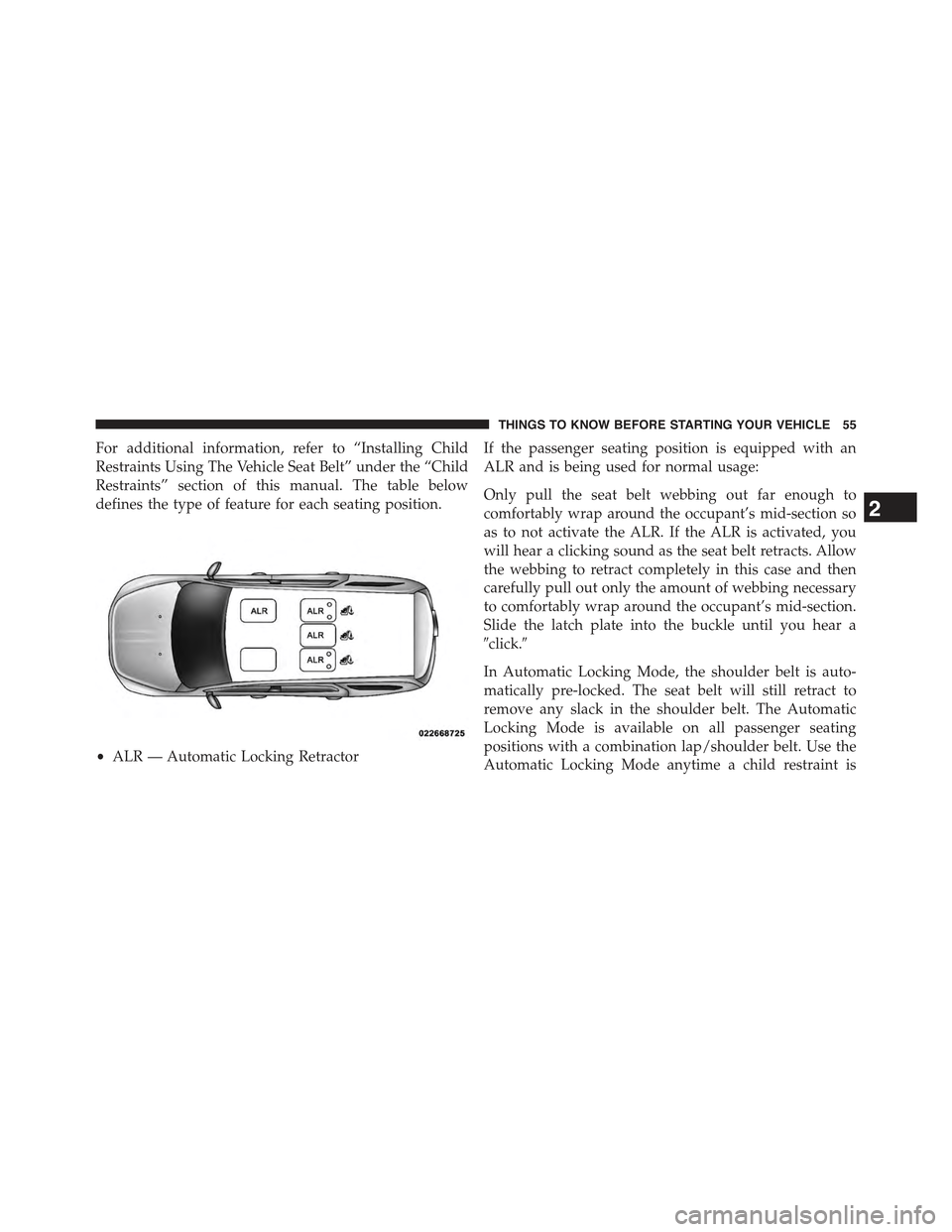
defines the type of feature for each seating position.
If the passenger seating position is equipped with an
ALR and is being used for normal usage:
Only pull the seat belt webbing out far enough to
comfortably wrap around the occupant’s mid-section so
as to not activate the ALR. If the ALR is activated, you
will hear a clicking sound as the seat belt retracts. Allow
the webbing to retract completely in this case and then
carefully pull out only the amount of webbing necessary
to comfortably wrap around the occupant’s mid-section.
Slide the latch plate into the buckle until you hear a
#click.#
In Automatic Locking Mode, the shoulder belt is auto-
matically pre-locked. The seat belt will still retract to
remove any slack in the shoulder belt. The Automatic
Locking Mode is available on all passenger seating
positions with a combination lap/shoulder belt. Use the
Automatic Locking Mode anytime a child restraint is•ALR — Automatic Locking Retractor
2
THINGS TO KNOW BEFORE STARTING YOUR VEHICLE 55