engine overheat JEEP COMPASS 2023 User Guide
[x] Cancel search | Manufacturer: JEEP, Model Year: 2023, Model line: COMPASS, Model: JEEP COMPASS 2023Pages: 344, PDF Size: 18.8 MB
Page 263 of 344
IN CASE OF EMERGENCY261
5. Remove funnel from filler pipe, clean off prior to putting back in the spare tire storage area.
IF YOUR ENGINE OVERHEATS
If the vehicle is overheating, it will need to be
serviced by an authorized dealer.
In any of the following situations, you can reduce
the potential for overheating your engine by taking
the appropriate action.
On highways — slow down.
In city traffic — while stopped, place the trans -
mission in NEUTRAL, but do not increase engine
idle speed.
NOTE:There are steps that you can take to slow down an
impending overheat condition:
If your Air Conditioner (A/C) is on, turn it off. The
A/C system adds heat to the engine cooling
system and turning the A/C off can help remove
this heat.
You can also turn the temperature control to
maximum heat, the mode control to floor and
the blower control to high. This allows the heater
core to act as a supplement to the radiator and
aids in removing heat from the engine cooling
system.
WARNING!
Never have any smoking materials lit in or
near the vehicle when the fuel door is open or
the tank is being filled.
Never add fuel when the engine is running.
This is in violation of most state and federal
fire regulations and may cause the Malfunc -
tion Indicator Light to turn on.
A fire may result if fuel is pumped into a
portable container that is inside of a vehicle.
You could be burned. Always place fuel
containers on the ground while filling.CAUTION!
Driving with a hot cooling system could damage
your vehicle. If the temperature gauge reads
“H,” pull over and stop the vehicle. Idle the
vehicle with the air conditioner turned off until
the pointer drops back into the normal range.
If the pointer remains on the “H” and you hear
continuous chimes, turn the engine off
immediately and call for service.WARNING!
You or others can be badly burned by hot engine
coolant (antifreeze) or steam from your radiator.
If you see or hear steam coming from under the
hood, do not open the hood until the radiator
has had time to cool. Never try to open a cooling
system pressure cap when the radiator or
coolant bottle is hot.
7
22_MP_OM_EN_USC_t.book Page 261
Page 265 of 344
IN CASE OF EMERGENCY263
(Continued)
Use the least amount of accelerator pedal
pressure that will maintain the rocking motion
without spinning the wheels or racing the engine.
NOTE:Push the ESC OFF button (if necessary), to place
the Electronic Stability Control (ESC) system in
“Partial Off” mode, before rocking the vehicle
Ú
page 189. Once the vehicle has been freed,
push the ESC OFF button again to restore “ESC On”
mode.
WARNING!
Fast spinning tires can be dangerous. Forces
generated by excessive wheel speeds may
cause damage, or even failure, of the axle and
tires. A tire could explode and injure someone.
Do not spin your vehicle's wheels faster than
30 mph (48 km/h) or for longer than 30
seconds continuously without stopping when
you are stuck and do not let anyone near a
spinning wheel, no matter what the speed.
CAUTION!
Racing the engine or spinning the wheels may
lead to transmission overheating and failure.
Allow the engine to idle with the transmission
in NEUTRAL for at least one minute after every
five rocking-motion cycles. This will minimize
overheating and reduce the risk of clutch or
transmission failure during prolonged efforts
to free a stuck vehicle.
When “rocking” a stuck vehicle by shifting
between DRIVE/SECOND gear and REVERSE,
do not spin the wheels faster than 15 mph
(24 km/h), or drivetrain damage may result.
Revving the engine or spinning the wheels too
fast may lead to transmission overheating and
failure. It can also damage the tires. Do not
spin the wheels above 30 mph (48 km/h)
while in gear (no transmission shifting occur -
ring).
CAUTION!
7
22_MP_OM_EN_USC_t.book Page 263
Page 281 of 344
SERVICING AND MAINTENANCE279
(Continued)
(Continued)
In addition, have the exhaust system inspected
each time the vehicle is raised for lubrication or oil
change. Replace as required.
Under normal operating conditions, the catalytic
converter will not require maintenance. However, it
is important to keep the engine properly tuned to
ensure proper catalyst operation and prevent
possible catalyst damage.
NOTE:Intentional tampering with emissions control
systems can result in civil penalties being
assessed against you.
In unusual situations involving grossly
malfunctioning engine operation, a scorching odor
may suggest severe and abnormal catalyst
overheating. If this occurs, stop the vehicle, turn off
the engine and allow it to cool. Service, including a
tune-up to manufacturer specifications, should be
obtained immediately.To minimize the possibility of catalytic converter
damage:
Do not interrupt the ignition when the transmis
-
sion is in gear and the vehicle is in motion.
Do not try to start the vehicle by pushing or
towing the vehicle.
Do not idle the engine with any ignition compo -
nents disconnected or removed, such as when
diagnostic testing, or for prolonged periods
during very rough idle or malfunctioning oper -
ating conditions.
COOLING SYSTEM
WARNING!
Exhaust gases can injure or kill. They contain
Carbon Monoxide (CO), which is colorless and
odorless. Breathing it can make you uncon -
scious and can eventually poison you
Ú page 240.
A hot exhaust system can start a fire if you
park over materials that can burn, such mate -
rials might be grass or leaves, and those items
that come into contact with your exhaust
system. Do not park or operate your vehicle in
areas where your exhaust system can contact
anything that can burn.
CAUTION!
The catalytic converter requires the use of
unleaded fuel only. Leaded gasoline will
destroy the effectiveness of the catalyst as an
emissions control device and may seriously
reduce engine performance and cause
serious damage to the engine.
Damage to the catalytic converter can result if
your vehicle is not kept in proper operating
condition. In the event of engine malfunction,
particularly involving engine misfire or other
apparent loss of performance, have your
vehicle serviced promptly. Continued opera -
tion of your vehicle with a severe malfunction
could cause the converter to overheat,
resulting in possible damage to the converter
and vehicle.
CAUTION!
WARNING!
You or others can be badly burned by hot
engine coolant (antifreeze) or steam from your
radiator. If you see or hear steam coming from
under the hood, do not open the hood until the
radiator has had time to cool. Never open a
cooling system pressure cap when the radi -
ator or coolant bottle is hot.
Keep hands, tools, clothing, and jewelry away
from the radiator cooling fan when the hood is
raised. The fan starts automatically and may
start at any time, whether the engine is
running or not.
8
22_MP_OM_EN_USC_t.book Page 279
Page 283 of 344
SERVICING AND MAINTENANCE281
Use only high purity water such as distilled or
deionized water when mixing the water/engine
coolant solution. The use of lower quality water
will reduce the amount of corrosion protection
in the engine cooling system.
NOTE:
It is the owner's responsibility to maintain the
proper level of protection against freezing
according to the temperatures occurring in the
area where the vehicle is operated.
Some vehicles require special tools to add
coolant properly. Failure to fill these systems
properly could lead to severe internal engine
damage. If any coolant is needed to be added to
the system, please contact an authorized
dealer.
Mixing engine coolant types is not recom -
mended and can result in cooling system
damage. If HOAT and OAT coolant are mixed in
an emergency, have a authorized dealer drain,
flush, and refill with OAT coolant (conforming to
MS.90032) as soon as possible.
Cooling System Pressure Cap
The cap must be fully tightened to prevent loss of
engine coolant (antifreeze), and to ensure that engine
coolant will return to the radiator from the coolant
expansion bottle/recovery tank (if equipped).
The cap should be inspected and cleaned if there
is any accumulation of foreign material on the
sealing surfaces.
Disposal Of Used Coolant
Used ethylene glycol-based coolant (antifreeze) is
a regulated substance requiring proper disposal.
Check with your local authorities to determine the
disposal rules for your community. To prevent
ingestion by animals or children, do not store
ethylene glycol-based coolant in open containers
or allow it to remain in puddles on the ground.
If ingested by a child or pet, seek emergency
assistance immediately. Clean up any ground spills
immediately.
Coolant Level
The coolant expansion bottle provides a quick
visual method for determining that the coolant
level is adequate. With the engine off and cold, the
level of the engine coolant (antifreeze) in the bottle
should be between the “MIN” and “MAX” marks.
As long as the engine operating temperature is
satisfactory, the coolant bottle need only be
checked once a month.
When additional engine coolant is needed to
maintain the proper level, it should be added to the
coolant bottle. Do not overfill.
Cooling System Notes
NOTE:When the vehicle is stopped after a few miles/
kilometers of operation, you may observe vapor
coming from the front of the engine compartment.
This is normally a result of moisture from rain,
snow, or high humidity accumulating on the
radiator and being vaporized when the thermostat
opens, allowing hot engine coolant (antifreeze) to
enter the radiator.
If an examination of your engine compartment
shows no evidence of radiator or hose leaks, the
vehicle may be safely driven. The vapor will soon
dissipate.
WARNING!
Do not open hot engine cooling system. Never
add engine coolant (antifreeze) when the
engine is overheated. Do not loosen or
remove the cap to cool an overheated engine.
Heat causes pressure to build-up in the
cooling system. To prevent scalding or injury,
do not remove the pressure cap while the
system is hot or under pressure.
Do not use a pressure cap other than the one
specified for your vehicle. Personal injury or
engine damage may result.
8
22_MP_OM_EN_USC_t.book Page 281
Page 324 of 344
322TECHNICAL SPECIFICATIONS
(Continued)
MATERIALS ADDED TO FUEL
Besides using unleaded gasoline with the proper
octane rating, gasolines that contain detergents,
corrosion and stability additives are
recommended. Using gasolines that have these
additives will help improve fuel economy, reduce
emissions, and maintain vehicle performance.Designated TOP TIER Detergent Gasoline
contains a higher level of detergents to
further aide in minimizing engine and
fuel system deposits. When available,
the usage of TOP TIER Detergent gasoline is
recommended. Visit
www.toptiergas.com for a list
of TOP TIER Detergent Gasoline Retailers.
Indiscriminate use of fuel system cleaning agents
should be avoided. Many of these materials
intended for gum and varnish removal may contain
active solvents or similar ingredients. These can
harm fuel system gasket and diaphragm materials.
FUEL SYSTEM CAUTIONS
NOTE:Intentional tampering with the emissions control
system can result in civil penalties being assessed
against you.
CAUTION!
Follow these guidelines to maintain your
vehicle’s performance:
The use of leaded gasoline is prohibited by
Federal law. Using leaded gasoline can impair
engine performance and damage the emis -
sions control system.
An out-of-tune engine or certain fuel or ignition
malfunctions can cause the catalytic
converter to overheat. If you notice a pungent
burning odor or some light smoke, your engine
may be out of tune or malfunctioning and may
require immediate service. Contact an autho -
rized dealer for service assistance.
The use of fuel additives, which are now being
sold as octane enhancers, is not recom -
mended. Most of these products contain high
concentrations of methanol. Fuel system
damage or vehicle performance problems
resulting from the use of such fuels or addi -
tives is not the responsibility of the manufac-
turer and may void or not be covered under
the New Vehicle Limited Warranty.
CAUTION!
22_MP_OM_EN_USC_t.book Page 322
Page 333 of 344
331
Door Ajar
................................................... 90, 91Door Ajar Light.......................................... 90, 91Driver’s Seat Back Tilt..................................... 28Driving........................................................... 161
E
Easy Entry Seats.............................................. 33Electric Brake Control System....................... 188Anti-Lock Brake System............................. 187Traction Control System.................. 191, 194Electric Parking Brake................................... 103Electrical Power Outlets................................... 59Electronic Stability Control (ESC)...................189Electronic Throttle Control Warning Light........ 91Emergency Braking........................................ 200Emergency Gas Can Refueling...................... 260Emergency, In Case Of Hazard Warning Flasher............................ 244Jacking...................................................... 247Jump Starting............................................ 258Tow Hooks................................................. 266Towing....................................................... 264Emission Control System Maintenance........... 99Engine........................................................... 271Air Cleaner................................................. 274Block Heater............................................. 102Break-In Recommendations...................... 102Checking Oil Level..................................... 272Coolant (Antifreeze)................................... 323
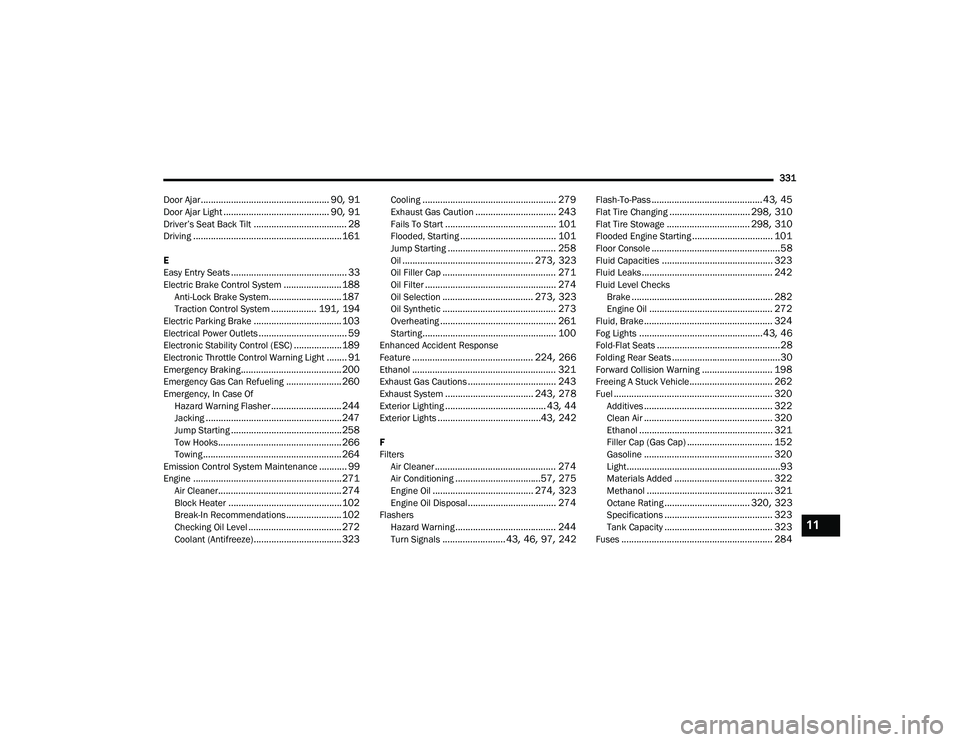
Cooling..................................................... 279Exhaust Gas Caution................................ 243Fails To Start............................................ 101Flooded, Starting...................................... 101Jump Starting........................................... 258Oil.................................................... 273, 323Oil Filler Cap............................................. 271Oil Filter.................................................... 274Oil Selection.................................... 273, 323Oil Synthetic............................................. 273Overheating.............................................. 261Starting..................................................... 100Enhanced Accident Response
Feature................................................ 224, 266Ethanol......................................................... 321Exhaust Gas Cautions................................... 243Exhaust System................................... 243, 278Exterior Lighting........................................ 43, 44Exterior Lights.........................................43, 242
F
FiltersAir Cleaner
................................................ 274Air Conditioning..................................57, 275Engine Oil........................................ 274, 323Engine Oil Disposal................................... 274FlashersHazard Warning........................................ 244Turn Signals.........................43, 46, 97, 242
Flash-To-Pass............................................ 43, 45Flat Tire Changing................................ 298, 310Flat Tire Stowage................................. 298, 310Flooded Engine Starting................................ 101Floor Console...................................................58Fluid Capacities............................................ 323Fluid Leaks.................................................... 242Fluid Level ChecksBrake........................................................ 282Engine Oil................................................. 272Fluid, Brake................................................... 324Fog Lights.................................................43, 46Fold-Flat Seats.................................................28Folding Rear Seats...........................................30Forward Collision Warning............................ 198Freeing A Stuck Vehicle................................. 262Fuel............................................................... 320Additives................................................... 322Clean Air................................................... 320Ethanol..................................................... 321Filler Cap (Gas Cap).................................. 152Gasoline................................................... 320Light.............................................................93Materials Added....................................... 322Methanol.................................................. 321Octane Rating.................................. 320, 323Specifications........................................... 323Tank Capacity........................................... 323Fuses............................................................ 284
11
22_MP_OM_EN_USC_t.book Page 331
Page 336 of 344
334 Lubrication, Body
........................................... 275Lug Nuts/Bolts.............................................. 319Luggage Carrier............................................... 72
M
Maintenance................................................... 65Maintenance Free Battery............................. 272Maintenance Schedule.................................. 267Malfunction Indicator Light (Check Engine)..... 93Manual Service...................................................... 327Memory Feature (Memory Seats).................... 27Memory Seat................................................... 27Memory Settings............................................. 27Methanol....................................................... 321Mirrors............................................................. 37Automatic Dimming..................................... 37Heated................................................. 37, 39Outside................................................. 37, 38Rearview............................................ 37, 244Vanity.......................................................... 38Modifications/AlterationsVehicle........................................................ 10Monitor, Tire Pressure System....................... 201Mopar Parts................................................... 327Multi-Function Control Lever............................ 43
N
New Vehicle Break-In Period.......................... 102
O
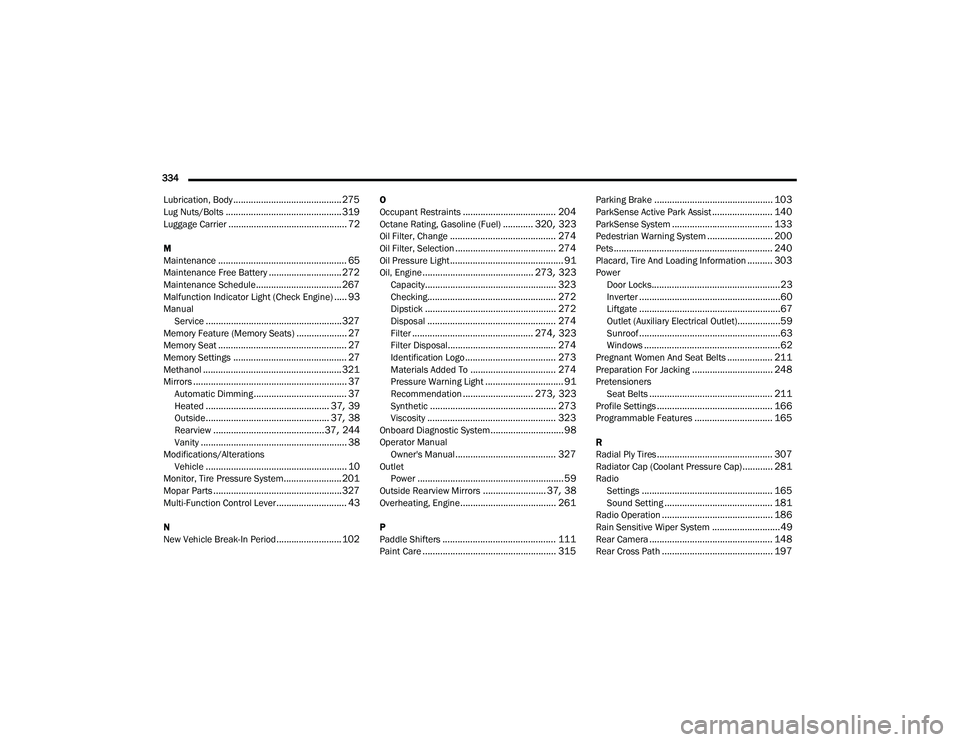
Occupant Restraints..................................... 204Octane Rating, Gasoline (Fuel)............ 320, 323Oil Filter, Change.......................................... 274Oil Filter, Selection........................................ 274Oil Pressure Light............................................. 91Oil, Engine............................................ 273, 323Capacity.................................................... 323Checking................................................... 272Dipstick.................................................... 272Disposal................................................... 274Filter................................................ 274, 323Filter Disposal........................................... 274Identification Logo.................................... 273Materials Added To.................................. 274Pressure Warning Light............................... 91Recommendation............................ 273, 323Synthetic.................................................. 273Viscosity................................................... 323Onboard Diagnostic System............................. 98Operator ManualOwner's Manual........................................ 327OutletPower.......................................................... 59Outside Rearview Mirrors......................... 37, 38Overheating, Engine...................................... 261
P
Paddle Shifters............................................. 111Paint Care..................................................... 315
Parking Brake............................................... 103ParkSense Active Park Assist........................ 140ParkSense System........................................ 133Pedestrian Warning System.......................... 200Pets............................................................... 240Placard, Tire And Loading Information.......... 303PowerDoor Locks...................................................23Inverter........................................................60Liftgate........................................................67Outlet (Auxiliary Electrical Outlet).................59Sunroof........................................................63Windows......................................................62Pregnant Women And Seat Belts.................. 211Preparation For Jacking................................ 248PretensionersSeat Belts................................................. 211Profile Settings.............................................. 166Programmable Features............................... 165
R
Radial Ply Tires.............................................. 307Radiator Cap (Coolant Pressure Cap)............ 281RadioSettings.................................................... 165Sound Setting........................................... 181Radio Operation............................................ 186Rain Sensitive Wiper System...........................49Rear Camera................................................. 148Rear Cross Path............................................ 197
22_MP_OM_EN_USC_t.book Page 334