light JEEP GLADIATOR 2023 Owners Manual
[x] Cancel search | Manufacturer: JEEP, Model Year: 2023, Model line: GLADIATOR, Model: JEEP GLADIATOR 2023Pages: 448, PDF Size: 17.37 MB
Page 348 of 448
346IN CASE OF EMERGENCY
5. Start the engine in the vehicle that has the booster battery, let the engine idle a few
minutes, and then start the engine in the
vehicle with the discharged battery.
6. Once the engine is started, follow the discon -
necting procedure.
Disconnecting The Jumper Cables
1. Disconnect the negative
(-)
end of the jumper
cable from the engine ground of the vehicle
with the discharged battery.
2. Disconnect the opposite end of the negative (-)
jumper cable from the negative (-) post of the
booster battery. 3. Disconnect the positive
(+) end of the jumper
cable from the positive (+) post of the booster
battery.
4. Disconnect the opposite end of the positive (+)
jumper cable from the positive (+) post of the
discharged vehicle.
5. Reinstall the protective cover over the positive (+) post of the discharged vehicle.
If frequent jump starting is required to start your
vehicle you should have the battery and charging
system tested at an authorized dealer.
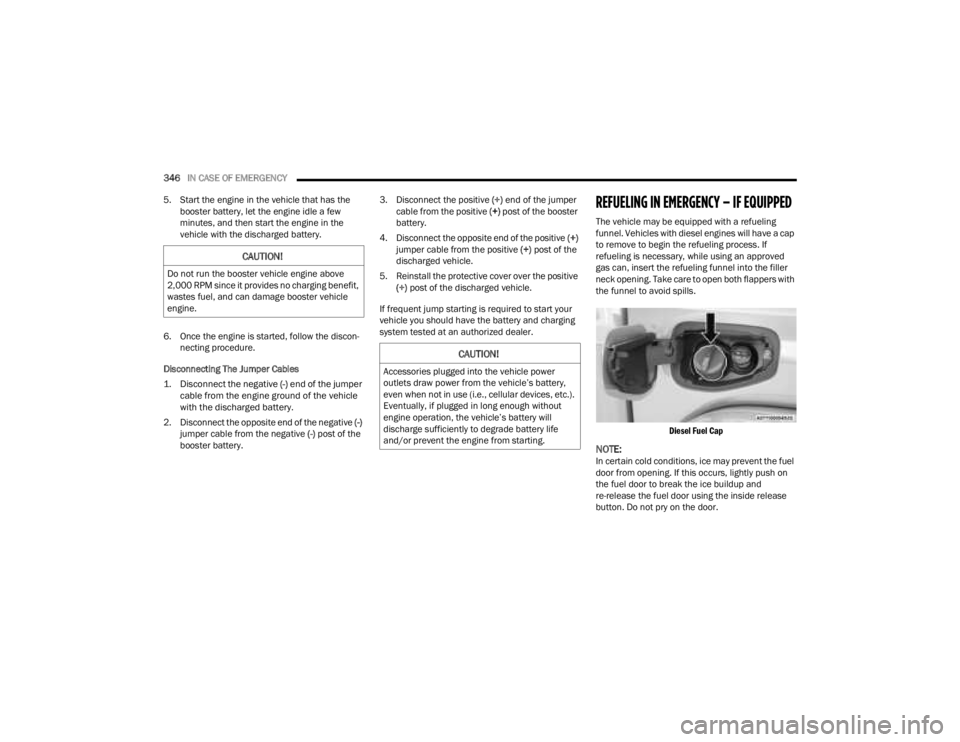
REFUELING IN EMERGENCY – IF EQUIPPED
The vehicle may be equipped with a refueling
funnel. Vehicles with diesel engines will have a cap
to remove to begin the refueling process. If
refueling is necessary, while using an approved
gas can, insert the refueling funnel into the filler
neck opening. Take care to open both flappers with
the funnel to avoid spills.
Diesel Fuel Cap
NOTE:In certain cold conditions, ice may prevent the fuel
door from opening. If this occurs, lightly push on
the fuel door to break the ice buildup and
re-release the fuel door using the inside release
button. Do not pry on the door.
CAUTION!
Do not run the booster vehicle engine above
2,000 RPM since it provides no charging benefit,
wastes fuel, and can damage booster vehicle
engine.
CAUTION!
Accessories plugged into the vehicle power
outlets draw power from the vehicle’s battery,
even when not in use (i.e., cellular devices, etc.).
Eventually, if plugged in long enough without
engine operation, the vehicle’s battery will
discharge sufficiently to degrade battery life
and/or prevent the engine from starting.
23_JT_OM_EN_USC_t.book Page 346
Page 349 of 448
IN CASE OF EMERGENCY347
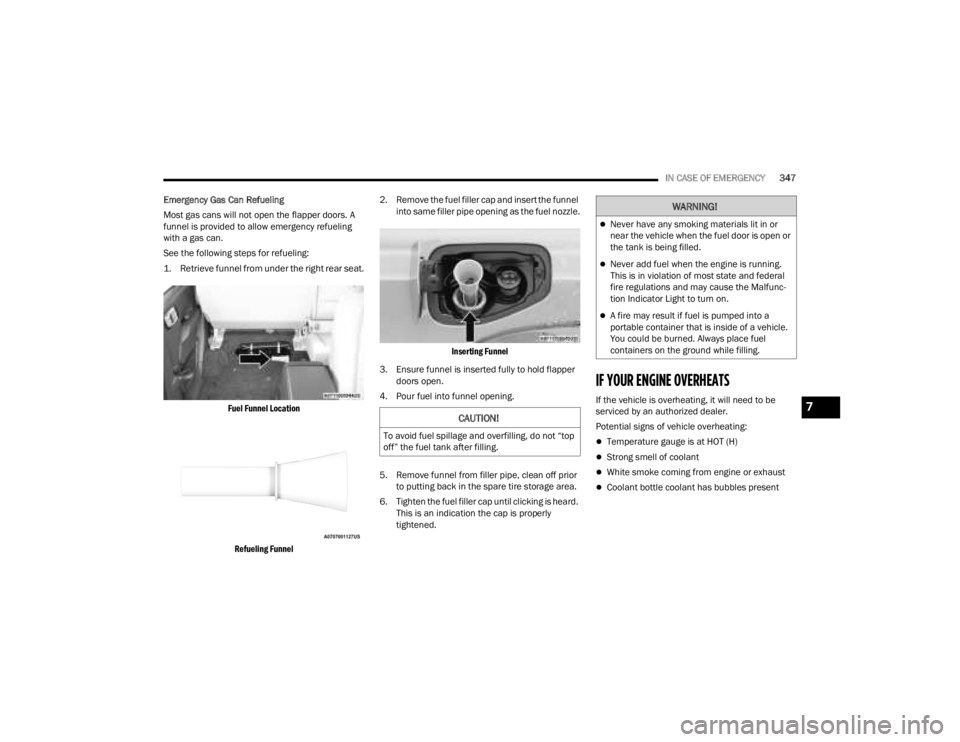
Emergency Gas Can Refueling
Most gas cans will not open the flapper doors. A
funnel is provided to allow emergency refueling
with a gas can.
See the following steps for refueling:
1. Retrieve funnel from under the right rear seat.
Fuel Funnel Location
Refueling Funnel
2. Remove the fuel filler cap and insert the funnel
into same filler pipe opening as the fuel nozzle.
Inserting Funnel
3. Ensure funnel is inserted fully to hold flapper doors open.
4. Pour fuel into funnel opening.
5. Remove funnel from filler pipe, clean off prior to putting back in the spare tire storage area.
6. Tighten the fuel filler cap until clicking is heard. This is an indication the cap is properly
tightened.
IF YOUR ENGINE OVERHEATS
If the vehicle is overheating, it will need to be
serviced by an authorized dealer.
Potential signs of vehicle overheating:
Temperature gauge is at HOT (H)
Strong smell of coolant
White smoke coming from engine or exhaust
Coolant bottle coolant has bubbles present
CAUTION!
To avoid fuel spillage and overfilling, do not “top
off” the fuel tank after filling.
WARNING!
Never have any smoking materials lit in or
near the vehicle when the fuel door is open or
the tank is being filled.
Never add fuel when the engine is running.
This is in violation of most state and federal
fire regulations and may cause the Malfunc -
tion Indicator Light to turn on.
A fire may result if fuel is pumped into a
portable container that is inside of a vehicle.
You could be burned. Always place fuel
containers on the ground while filling.
7
23_JT_OM_EN_USC_t.book Page 347
Page 355 of 448
353
SERVICING AND MAINTENANCE
SCHEDULED SERVICING — GASOLINE
ENGINE
Your vehicle is equipped with an automatic oil
change indicator system. The oil change indicator
system will remind you that it is time to take your
vehicle in for scheduled maintenance.
Based on engine operation conditions, the oil
change indicator message will illuminate. This
means that service is required for your vehicle.
Operating conditions such as frequent short-trips,
trailer tow, or extremely hot or cold ambient
temperatures will influence when the “Change Oil”
or “Oil Change Required” message is displayed.
Have your vehicle serviced as soon as possible,
within the next 500 miles (805 km).
On vehicles equipped with an instrument cluster
display, “Oil Change Required” will be displayed
and a single chime will sound, indicating that an oil
change is necessary. On vehicles not equipped with an instrument
cluster display, “Change Oil” will flash in the
instrument cluster odometer and a single chime
will sound, indicating that an oil change is
necessary.
An authorized dealer will reset the oil change
indicator message after completing the scheduled
oil change. To reset the system follow the steps
described Ú
page 122.
NOTE:Under no circumstances should oil change
intervals exceed 10,000 miles (16,000 km),
12 months or 350 hours of engine run time,
whichever comes first. The 350 hours of engine
run or idle time is generally only a concern for fleet
customers. Once A Month Or Before A Long Trip:
Check engine oil level.
Check windshield washer fluid level.
Check the tire pressures and look for unusual
wear or damage, rotate at the first sign of irreg
-
ular wear.
Check the fluid levels of the coolant reservoir,
brake master cylinder, and power steering, and
fill as needed.
Check function of all interior and exterior lights.
8
23_JT_OM_EN_USC_t.book Page 353
Page 359 of 448
SERVICING AND MAINTENANCE357
SCHEDULED SERVICING — DIESEL ENGINE
Your vehicle is equipped with an automatic oil
change indicator system. The oil change indicator
system will remind you that it is time to take your
vehicle in for scheduled maintenance.
Based on engine operation conditions, the oil
change indicator message will illuminate. This
means that service is required for your vehicle.
Operating conditions such as frequent short-trips,
trailer tow, extremely hot or cold ambient
temperatures will influence when the “Oil Change
Required” message is displayed. Have your vehicle
serviced as soon as possible, within the next
500 miles (805 km).
An authorized dealer will reset the oil change
indicator message after completing the scheduled
oil change. If a scheduled oil change is performed
by someone other than an authorized dealer, to
reset the message Úpage 121.
NOTE:Under no circumstances should oil change
intervals exceed 10,000 miles (16,000 km) or
12 months, whichever comes first.
Engine Oil Filter Replacement
Residual oil in the housing may spill from the
housing when the new filter is installed if the
residual oil is not either removed from the housing
or enough time has not elapsed to allow the oil to
drain back into the engine. When servicing the oil
filter on this engine, open the filter cap
approximately six turns until the cap o-ring is
visible and stop. Wait five minutes with the cap in
this position to allow dirty engine oil to drain back
into the engine. After five minutes, the cap and
filter assembly can be removed and discarded. Once A Month Or Before A Long Trip:Check engine oil level
Check windshield washer fluid level
Check the tire pressures and look for unusual
wear or damage
Check the fluid levels of the coolant reservoir,
brake master cylinder, and fill as needed
Check function of all interior and exterior lights
8
23_JT_OM_EN_USC_t.book Page 357
Page 370 of 448
368SERVICING AND MAINTENANCE
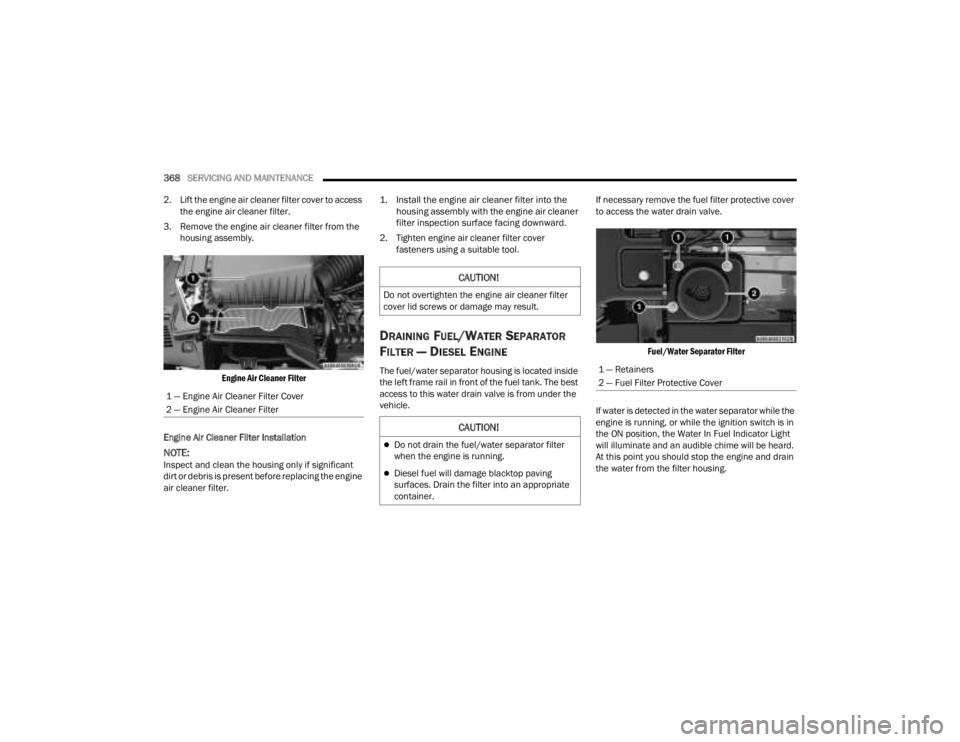
2. Lift the engine air cleaner filter cover to access the engine air cleaner filter.
3. Remove the engine air cleaner filter from the housing assembly.
Engine Air Cleaner Filter
Engine Air Cleaner Filter Installation
NOTE:Inspect and clean the housing only if significant
dirt or debris is present before replacing the engine
air cleaner filter.
1. Install the engine air cleaner filter into the
housing assembly with the engine air cleaner
filter inspection surface facing downward.
2. Tighten engine air cleaner filter cover fasteners using a suitable tool.
DRAINING FUEL/WATER SEPARATOR
F
ILTER — DIESEL ENGINE
The fuel/water separator housing is located inside
the left frame rail in front of the fuel tank. The best
access to this water drain valve is from under the
vehicle. If necessary remove the fuel filter protective cover
to access the water drain valve.
Fuel/Water Separator Filter
If water is detected in the water separator while the
engine is running, or while the ignition switch is in
the ON position, the Water In Fuel Indicator Light
will illuminate and an audible chime will be heard.
At this point you should stop the engine and drain
the water from the filter housing.
1 — Engine Air Cleaner Filter Cover
2 — Engine Air Cleaner Filter
CAUTION!
Do not overtighten the engine air cleaner filter
cover lid screws or damage may result.
CAUTION!
Do not drain the fuel/water separator filter
when the engine is running.
Diesel fuel will damage blacktop paving
surfaces. Drain the filter into an appropriate
container.
1 — Retainers
2 — Fuel Filter Protective Cover
23_JT_OM_EN_USC_t.book Page 368
Page 371 of 448
SERVICING AND MAINTENANCE369
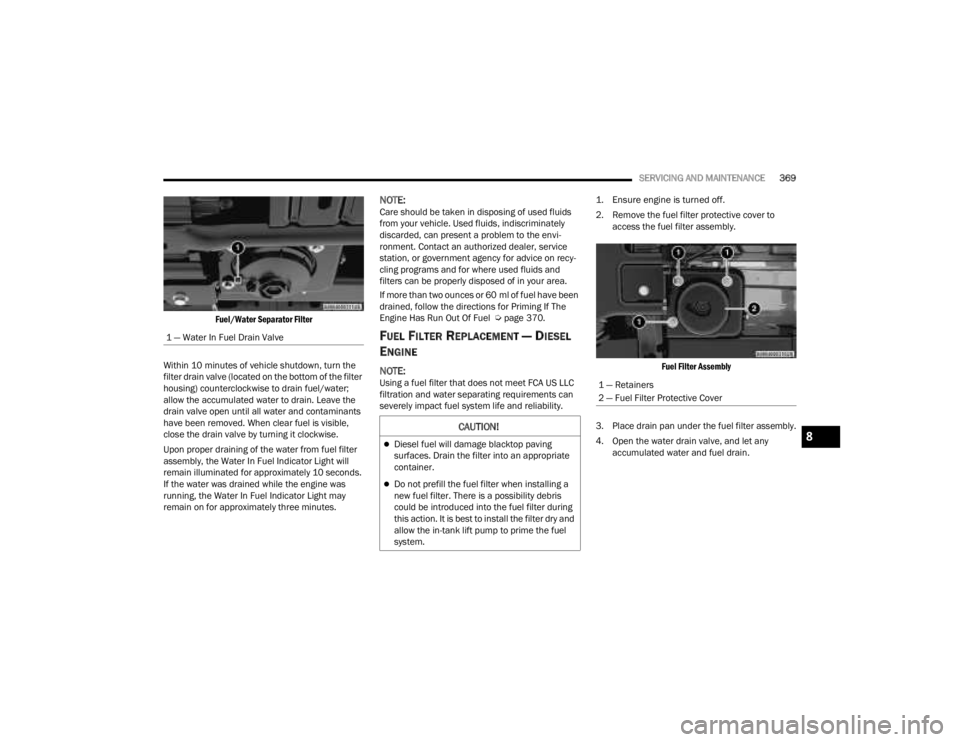
Fuel/Water Separator Filter
Within 10 minutes of vehicle shutdown, turn the
filter drain valve (located on the bottom of the filter
housing) counterclockwise to drain fuel/water;
allow the accumulated water to drain. Leave the
drain valve open until all water and contaminants
have been removed. When clear fuel is visible,
close the drain valve by turning it clockwise.
Upon proper draining of the water from fuel filter
assembly, the Water In Fuel Indicator Light will
remain illuminated for approximately 10 seconds.
If the water was drained while the engine was
running, the Water In Fuel Indicator Light may
remain on for approximately three minutes.
NOTE:Care should be taken in disposing of used fluids
from your vehicle. Used fluids, indiscriminately
discarded, can present a problem to the envi -
ronment. Contact an authorized dealer, service
station, or government agency for advice on recy -
cling programs and for where used fluids and
filters can be properly disposed of in your area.
If more than two ounces or 60 ml of fuel have been
drained, follow the directions for Priming If The
Engine Has Run Out Of Fuel Ú page 370.
FUEL FILTER REPLACEMENT — DIESEL
E
NGINE
NOTE:Using a fuel filter that does not meet FCA US LLC
filtration and water separating requirements can
severely impact fuel system life and reliability.
1. Ensure engine is turned off.
2. Remove the fuel filter protective cover to
access the fuel filter assembly.
Fuel Filter Assembly
3. Place drain pan under the fuel filter assembly.
4. Open the water drain valve, and let any accumulated water and fuel drain.
1 — Water In Fuel Drain Valve
CAUTION!
Diesel fuel will damage blacktop paving
surfaces. Drain the filter into an appropriate
container.
Do not prefill the fuel filter when installing a
new fuel filter. There is a possibility debris
could be introduced into the fuel filter during
this action. It is best to install the filter dry and
allow the in-tank lift pump to prime the fuel
system.
1 — Retainers
2 — Fuel Filter Protective Cover
8
23_JT_OM_EN_USC_t.book Page 369
Page 382 of 448
380SERVICING AND MAINTENANCE
(Continued)
BRAKE SYSTEM
In order to ensure brake system performance, all
brake system components should be inspected
periodically. For the proper maintenance intervals
Úpage 354.
Fluid Level Check — Brake Master Cylinder
The fluid level of the master cylinder should be
checked whenever the vehicle is serviced, or
immediately if the Brake System Warning Light is
on. If necessary, add fluid to bring level within the
designated marks on the side of the reservoir of
the brake master cylinder. Be sure to clean the top
of the master cylinder area before removing cap.
With disc brakes, fluid level can be expected to fall
as the brake pads wear. Brake fluid level should be
checked when pads are replaced. If the brake fluid
is abnormally low, check the system for leaks.
For further information Ú page 426.
FRONT/REAR AXLE FLUID
For normal service, periodic fluid level checks are
not required. When the vehicle is serviced for other
reasons the exterior surfaces of the axle assembly
should be inspected. If gear oil leakage is
suspected, inspect the fluid level.
Fluid Level Check
Lubricant should be approximately 1/8 inch
(3 mm) below the bottom edge of the oil fill hole.
NOTE:Make sure that the vehicle is level and supported
by the axles.
Adding Fluid
Add lubricant only at the fill hole and only to the
level specified above.
Selection Of Lubricant
Use only the manufacturer’s recommended fluid
Úpage 426.
WARNING!
Riding the brakes can lead to brake failure and
possibly a collision. Driving with your foot resting
or riding on the brake pedal can result in
abnormally high brake temperatures, excessive
lining wear, and possible brake damage. You
would not have your full braking capacity in an
emergency.
WARNING!
Use only manufacturer recommended brake
fluid Ú page 426. Using the wrong type of
brake fluid can severely damage your brake
system and/or impair its performance. The
proper type of brake fluid for your vehicle is
also identified on the original factory installed
hydraulic master cylinder reservoir.
To avoid contamination from foreign matter or
moisture, use only new brake fluid or fluid that
has been in a tightly closed container. Keep
the master cylinder reservoir cap secured at
all times. Brake fluid in a open container
absorbs moisture from the air resulting in a
lower boiling point. This may cause it to boil
unexpectedly during hard or prolonged
braking, resulting in sudden brake failure. This
could result in a collision.
Overfilling the brake fluid reservoir can result
in spilling brake fluid on hot engine parts,
causing the brake fluid to catch fire. Brake
fluid can also damage painted and vinyl
surfaces, care should be taken to avoid its
contact with these surfaces.
Do not allow petroleum based fluid to contam -
inate the brake fluid. Brake seal components
could be damaged, causing partial or
complete brake failure. This could result in a
collision.
WARNING!
23_JT_OM_EN_USC_t.book Page 380
Page 389 of 448
SERVICING AND MAINTENANCE387
F20 30 Amp Pink –Central Body Controller (CBC) 1-INTERIOR LIGHTS
F21 ––Spare*
F22 –10 Amp RedEngine Control Module (ECM)/Powertrain Control Module
(PCM)
F23 –10 Amp RedPowertrain Control Module (PCM)/Engine Control Module
(ECM)
F24 ––Spare*
F25 –10 Amp Red Module Shift By Wire (MOD_SBW)
F26 40 Amp Green –Central Body Controller (CBC) 2-EXTERIOR LIGHTS #1
F27 30 Amp Pink –Front Wipers
F28 40 Amp Green –Central Body Controller (CBC) 3-POWER LOCKS
F29 40 Amp Green –Central Body Controller (CBC) 4-EXTERIOR LIGHTS #2
F30 ––Spare*
F31 –10 Amp Red DIAGNOSTIC PORT
F32 –10 Amp RedHeating Ventilation Air Conditioning Mod (HVAC CTRL MOD)/
Steering Column Lock (SCL)/Occupant Classification Module
(OCM)/Driver Presence Detection Module (DPDM)
F33 –10 Amp RedParkTronics System (PTS)/Infrared Camera Module (IRCM)/
Airbag Disable Lamps (AIRBAG DISABLE LMPS)
F34 –10 Amp RedElectronic Stability Control (ESC)/Electric Hydraulic Power
Steering (EHPS)/Smart Bar Control Module (SBCM) WAKE UP
F35 30 Amp Pink –BRAKE VAC PMP*
Cavity Cartridge Fuse Micro Fuse Description
* If Equipped
8
23_JT_OM_EN_USC_t.book Page 387
Page 390 of 448
388SERVICING AND MAINTENANCE
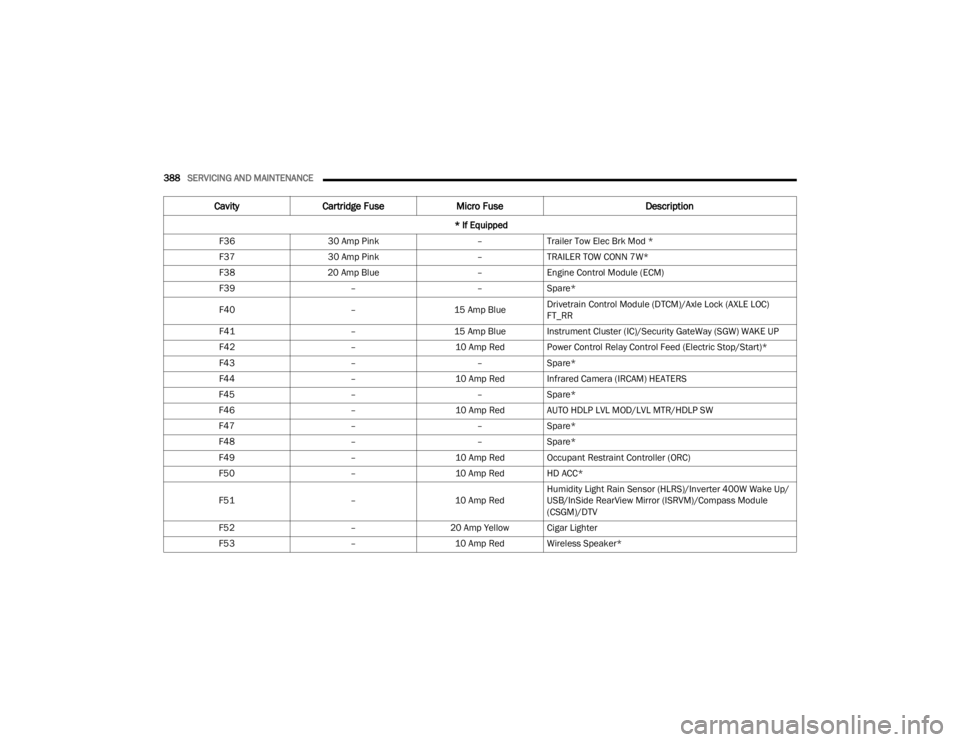
F36 30 Amp Pink –Trailer Tow Elec Brk Mod *
F37 30 Amp Pink –TRAILER TOW CONN 7W*
F38 20 Amp Blue –Engine Control Module (ECM)
F39 ––Spare*
F40 –15 Amp BlueDrivetrain Control Module (DTCM)/Axle Lock (AXLE LOC)
FT_RR
F41 –15 Amp Blue Instrument Cluster (IC)/Security GateWay (SGW) WAKE UP
F42 –10 Amp Red Power Control Relay Control Feed (Electric Stop/Start)*
F43 ––Spare*
F44 –10 Amp Red Infrared Camera (IRCAM) HEATERS
F45 ––Spare*
F46 –10 Amp Red AUTO HDLP LVL MOD/LVL MTR/HDLP SW
F47 ––Spare*
F48 ––Spare*
F49 –10 Amp Red Occupant Restraint Controller (ORC)
F50 –10 Amp Red HD ACC*
F51 –10 Amp RedHumidity Light Rain Sensor (HLRS)/Inverter 400W Wake Up/
USB/InSide RearView Mirror (ISRVM)/Compass Module
(CSGM)/DTV
F52 –20 Amp Yellow Cigar Lighter
F53 –10 Amp Red Wireless Speaker*
CavityCartridge Fuse Micro Fuse Description
* If Equipped
23_JT_OM_EN_USC_t.book Page 388
Page 396 of 448
394SERVICING AND MAINTENANCE
10. Remove connector from bulb.
11. Push connector onto new bulb base, and push the connector locking tab to the lock position.
12. Reinstall bulb housing. Rotate the bulb a quarter turn clockwise.
NOTE:We recommend seeing an authorized dealer for
service.
FRONT PARK/TURN SIGNAL
See the following steps to replace:
1. Remove the front wheel liner fasteners to access bulb sockets.
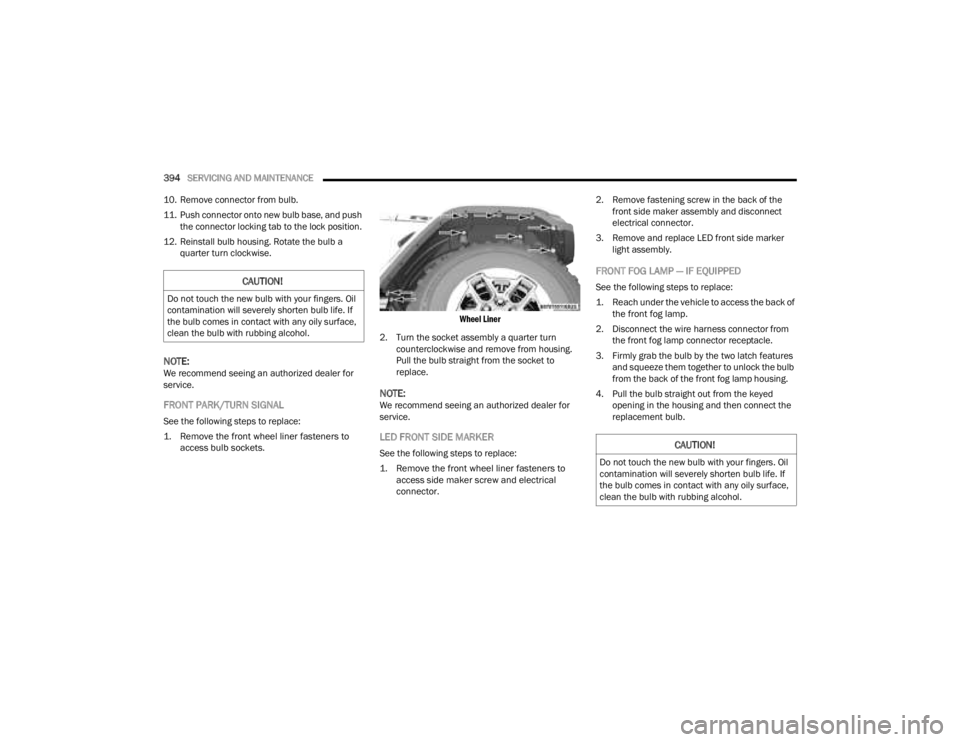
Wheel Liner
2. Turn the socket assembly a quarter turn counterclockwise and remove from housing.
Pull the bulb straight from the socket to
replace.
NOTE:We recommend seeing an authorized dealer for
service.
LED FRONT SIDE MARKER
See the following steps to replace:
1. Remove the front wheel liner fasteners to access side maker screw and electrical
connector.
2. Remove fastening screw in the back of the
front side maker assembly and disconnect
electrical connector.
3. Remove and replace LED front side marker light assembly.
FRONT FOG LAMP — IF EQUIPPED
See the following steps to replace:
1. Reach under the vehicle to access the back of the front fog lamp.
2. Disconnect the wire harness connector from the front fog lamp connector receptacle.
3. Firmly grab the bulb by the two latch features and squeeze them together to unlock the bulb
from the back of the front fog lamp housing.
4. Pull the bulb straight out from the keyed opening in the housing and then connect the
replacement bulb.CAUTION!
Do not touch the new bulb with your fingers. Oil
contamination will severely shorten bulb life. If
the bulb comes in contact with any oily surface,
clean the bulb with rubbing alcohol.
CAUTION!
Do not touch the new bulb with your fingers. Oil
contamination will severely shorten bulb life. If
the bulb comes in contact with any oily surface,
clean the bulb with rubbing alcohol.
23_JT_OM_EN_USC_t.book Page 394