fuel cap JEEP GLADIATOR 2023 User Guide
[x] Cancel search | Manufacturer: JEEP, Model Year: 2023, Model line: GLADIATOR, Model: JEEP GLADIATOR 2023Pages: 448, PDF Size: 17.37 MB
Page 297 of 448
SAFETY295
(Continued)
TPMS Warning Light. Driving the vehicle may cause
the tire pressure to rise to approximately 28 psi
(193 kPa), but the TPMS Warning Light will still be
on. In this situation, the TPMS Warning Light will
turn off only after the tires are inflated to the
vehicle’s recommended cold placard pressure
value.
NOTE:When filling warm tires, the tire pressure may need
to be increased up to an additional 4 psi (28 kPa)
above the recommended cold placard pressure in
order to turn the TPMS Warning Light off.
NOTE:
The TPMS is not intended to replace normal tire
care and maintenance, or to provide warning of
a tire failure or condition.
The TPMS should not be used as a tire pressure
gauge while adjusting your tire pressure, unless
your vehicle is equipped with a Tire Fill Alert
(TFA) system.
Driving on a significantly underinflated tire
causes the tire to overheat and can lead to tire
failure. Underinflation also reduces fuel effi
-
ciency and tire tread life, and may affect the
vehicle’s handling and stopping ability.
The TPMS is not a substitute for proper tire
maintenance, and it is the driver’s responsibility
to maintain correct tire pressure using an accu -
rate tire pressure gauge, even if underinflation
has not reached the level to trigger illumination
of the TPMS Warning Light.
Seasonal temperature changes will affect tire
pressure, and the TPMS will monitor the actual
tire pressure in the tire Ú page 432.
System Operation
The Tire Pressure Monitoring System (TPMS) uses
wireless technology with wheel rim mounted
electronic sensors to monitor tire pressure levels.
Sensors, mounted to each wheel as part of the
valve stem, transmit tire pressure readings to the
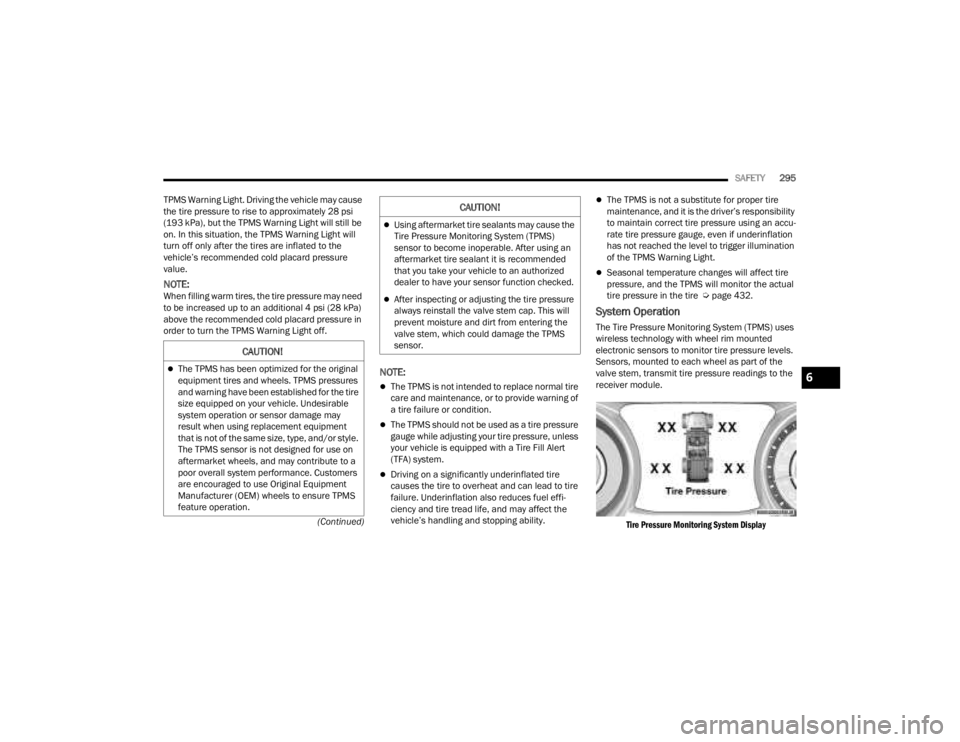
receiver module.
Tire Pressure Monitoring System Display
CAUTION!
The TPMS has been optimized for the original
equipment tires and wheels. TPMS pressures
and warning have been established for the tire
size equipped on your vehicle. Undesirable
system operation or sensor damage may
result when using replacement equipment
that is not of the same size, type, and/or style.
The TPMS sensor is not designed for use on
aftermarket wheels, and may contribute to a
poor overall system performance. Customers
are encouraged to use Original Equipment
Manufacturer (OEM) wheels to ensure TPMS
feature operation.
Using aftermarket tire sealants may cause the
Tire Pressure Monitoring System (TPMS)
sensor to become inoperable. After using an
aftermarket tire sealant it is recommended
that you take your vehicle to an authorized
dealer to have your sensor function checked.
After inspecting or adjusting the tire pressure
always reinstall the valve stem cap. This will
prevent moisture and dirt from entering the
valve stem, which could damage the TPMS
sensor.
CAUTION!
6
23_JT_OM_EN_USC_t.book Page 295
Page 348 of 448
346IN CASE OF EMERGENCY
5. Start the engine in the vehicle that has the booster battery, let the engine idle a few
minutes, and then start the engine in the
vehicle with the discharged battery.
6. Once the engine is started, follow the discon -
necting procedure.
Disconnecting The Jumper Cables
1. Disconnect the negative
(-)
end of the jumper
cable from the engine ground of the vehicle
with the discharged battery.
2. Disconnect the opposite end of the negative (-)
jumper cable from the negative (-) post of the
booster battery. 3. Disconnect the positive
(+) end of the jumper
cable from the positive (+) post of the booster
battery.
4. Disconnect the opposite end of the positive (+)
jumper cable from the positive (+) post of the
discharged vehicle.
5. Reinstall the protective cover over the positive (+) post of the discharged vehicle.
If frequent jump starting is required to start your
vehicle you should have the battery and charging
system tested at an authorized dealer.
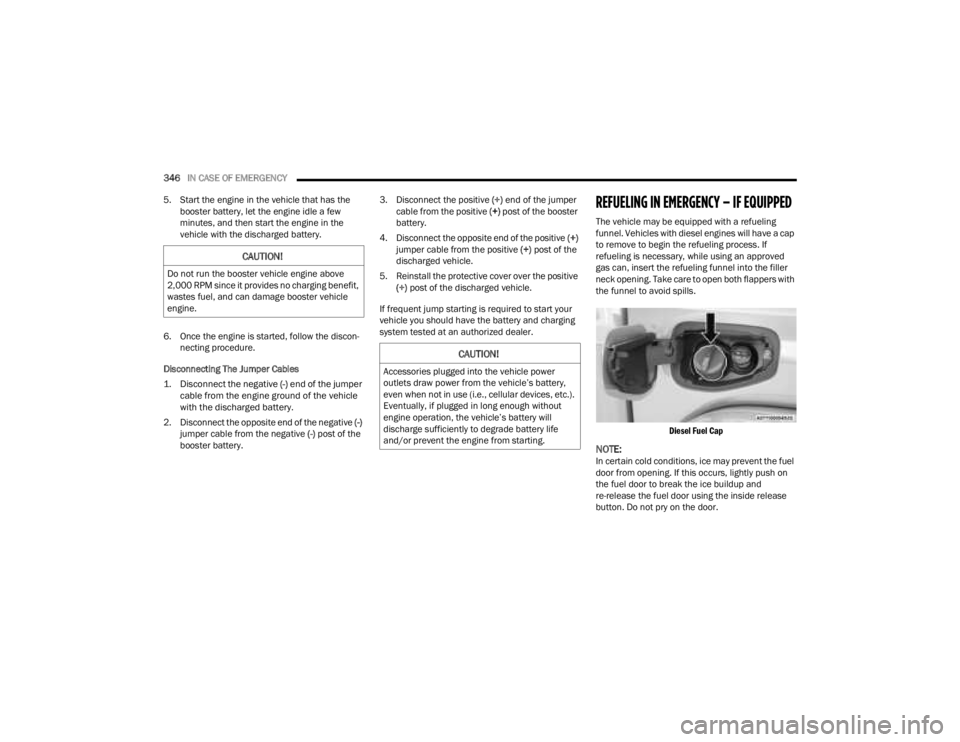
REFUELING IN EMERGENCY – IF EQUIPPED
The vehicle may be equipped with a refueling
funnel. Vehicles with diesel engines will have a cap
to remove to begin the refueling process. If
refueling is necessary, while using an approved
gas can, insert the refueling funnel into the filler
neck opening. Take care to open both flappers with
the funnel to avoid spills.
Diesel Fuel Cap
NOTE:In certain cold conditions, ice may prevent the fuel
door from opening. If this occurs, lightly push on
the fuel door to break the ice buildup and
re-release the fuel door using the inside release
button. Do not pry on the door.
CAUTION!
Do not run the booster vehicle engine above
2,000 RPM since it provides no charging benefit,
wastes fuel, and can damage booster vehicle
engine.
CAUTION!
Accessories plugged into the vehicle power
outlets draw power from the vehicle’s battery,
even when not in use (i.e., cellular devices, etc.).
Eventually, if plugged in long enough without
engine operation, the vehicle’s battery will
discharge sufficiently to degrade battery life
and/or prevent the engine from starting.
23_JT_OM_EN_USC_t.book Page 346
Page 349 of 448
IN CASE OF EMERGENCY347
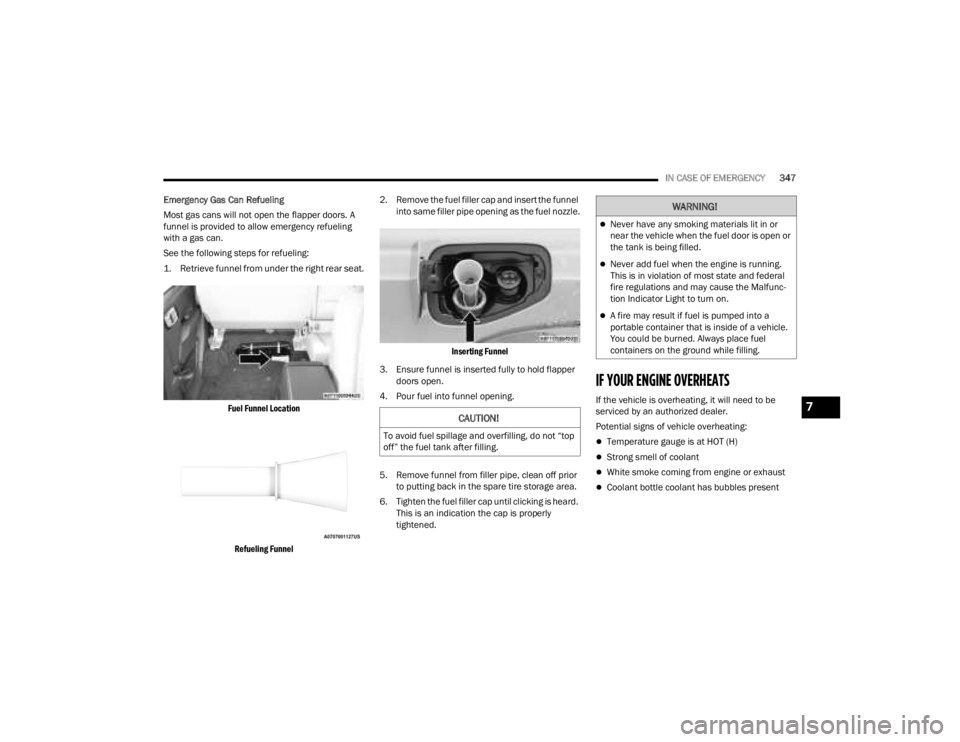
Emergency Gas Can Refueling
Most gas cans will not open the flapper doors. A
funnel is provided to allow emergency refueling
with a gas can.
See the following steps for refueling:
1. Retrieve funnel from under the right rear seat.
Fuel Funnel Location
Refueling Funnel
2. Remove the fuel filler cap and insert the funnel
into same filler pipe opening as the fuel nozzle.
Inserting Funnel
3. Ensure funnel is inserted fully to hold flapper doors open.
4. Pour fuel into funnel opening.
5. Remove funnel from filler pipe, clean off prior to putting back in the spare tire storage area.
6. Tighten the fuel filler cap until clicking is heard. This is an indication the cap is properly
tightened.
IF YOUR ENGINE OVERHEATS
If the vehicle is overheating, it will need to be
serviced by an authorized dealer.
Potential signs of vehicle overheating:
Temperature gauge is at HOT (H)
Strong smell of coolant
White smoke coming from engine or exhaust
Coolant bottle coolant has bubbles present
CAUTION!
To avoid fuel spillage and overfilling, do not “top
off” the fuel tank after filling.
WARNING!
Never have any smoking materials lit in or
near the vehicle when the fuel door is open or
the tank is being filled.
Never add fuel when the engine is running.
This is in violation of most state and federal
fire regulations and may cause the Malfunc -
tion Indicator Light to turn on.
A fire may result if fuel is pumped into a
portable container that is inside of a vehicle.
You could be burned. Always place fuel
containers on the ground while filling.
7
23_JT_OM_EN_USC_t.book Page 347
Page 372 of 448
370SERVICING AND MAINTENANCE
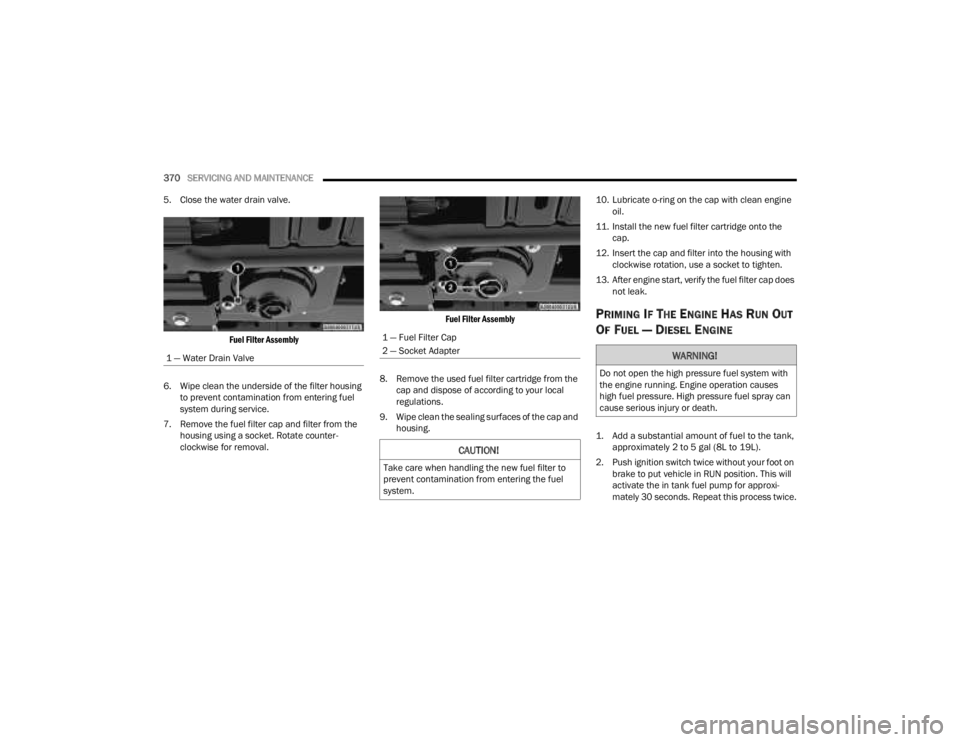
5. Close the water drain valve.
Fuel Filter Assembly
6. Wipe clean the underside of the filter housing to prevent contamination from entering fuel
system during service.
7. Remove the fuel filter cap and filter from the housing using a socket. Rotate counter -
clockwise for removal.
Fuel Filter Assembly
8. Remove the used fuel filter cartridge from the cap and dispose of according to your local
regulations.
9. Wipe clean the sealing surfaces of the cap and housing. 10. Lubricate o-ring on the cap with clean engine
oil.
11. Install the new fuel filter cartridge onto the cap.
12. Insert the cap and filter into the housing with clockwise rotation, use a socket to tighten.
13. After engine start, verify the fuel filter cap does not leak.
PRIMING IF THE ENGINE HAS RUN OUT
O
F FUEL — DIESEL ENGINE
1. Add a substantial amount of fuel to the tank,
approximately 2 to 5 gal (8L to 19L).
2. Push ignition switch twice without your foot on brake to put vehicle in RUN position. This will
activate the in tank fuel pump for approxi -
mately 30 seconds. Repeat this process twice.
1 — Water Drain Valve
1 — Fuel Filter Cap
2 — Socket Adapter
CAUTION!
Take care when handling the new fuel filter to
prevent contamination from entering the fuel
system.
WARNING!
Do not open the high pressure fuel system with
the engine running. Engine operation causes
high fuel pressure. High pressure fuel spray can
cause serious injury or death.
23_JT_OM_EN_USC_t.book Page 370
Page 381 of 448

SERVICING AND MAINTENANCE379
Coolant Level
The coolant bottle provides a quick visual method
for determining that the coolant level is adequate.
With the engine in the off and cold, the level of the
engine coolant (antifreeze) in the bottle should be
between the ranges indicated on the bottle.
The radiator normally remains completely full, so
there is no need to remove the radiator/coolant
pressure cap unless checking for engine coolant
freeze point or replacing coolant. Advise your
service attendant of this. As long as the engine
operating temperature is satisfactory, the coolant
only needs to be checked once a month.
When additional engine coolant is needed to
maintain the proper level, only OAT coolant that
meets the requirements of FCA Material Standard
MS.90032 should be added to the coolant bottle.
Do not overfill.
Cooling System Notes
NOTE:When the vehicle is stopped after a few miles/kilo -
meters of operation, you may observe vapor
coming from the front of the engine compartment.
This is normally a result of moisture from rain,
snow, or high humidity accumulating on the
radiator and being vaporized when the thermostat
opens, allowing hot engine coolant (antifreeze) to
enter the radiator. If an examination of your engine compartment
shows no evidence of radiator or hose leaks, the
vehicle may be safely driven. The vapor will soon
dissipate.
Do not overfill the coolant expansion bottle.
Check the freezing point of the coolant in the
radiator and in the coolant expansion bottle. If
determined that more engine coolant needs to
be added to the radiator, the contents of the
coolant expansion bottle must also be protected
against freezing.
If frequent engine coolant additions are
required, the cooling system should be pressure
tested for leaks.
Maintain engine coolant concentration at a
minimum of 50% OAT coolant (conforming to
MS.90032) and distilled water for proper corro
-
sion protection of your engine which contains
aluminum components.
Make sure that the coolant expansion bottle
overflow hoses are not kinked or obstructed.
Keep the front of the radiator clean. With air
conditioning, keep the front of the condenser
clean.
Do not change the thermostat for Summer or
Winter operation. If replacement is ever neces -
sary, install ONLY the correct type thermostat. Other designs may result in unsatisfactory
engine system performance, poor gas mileage,
and increased emissions.
CHARGE AIR COOLER — INTER-COOLER
(D
IESEL ENGINE)
The charge air cooler is positioned in front of the
radiator and the air conditioner condenser. Air
enters the engine through the air cleaner and
passes through the turbocharger, where it is
pressurized. This pressurized air rapidly reaches
high temperature. The air is then directed through
a hose to the charge air cooler and through
another hose to the intake manifold of the engine.
This cooling process enables more efficient
burning of fuel resulting in fewer emissions.
To guarantee optimum performance of the system,
keep the surfaces of the charge air cooler,
condenser and radiator clean and free of debris.
Periodically check the hoses leading to and from
the charge air cooler for cracks or loose clamps
resulting in loss of pressure and reduced engine
performance.
8
23_JT_OM_EN_USC_t.book Page 379
Page 403 of 448
SERVICING AND MAINTENANCE401
To determine the maximum loading conditions of
your vehicle, locate the statement “The combined
weight of occupants and cargo should never
exceed XXX kg or XXX lbs” on the Tire And Loading
Information Placard. The combined weight of
occupants, cargo/luggage and trailer tongue
weight (if applicable) should never exceed the
weight referenced here.
Steps For Determining Correct Load Limit—
(1) Locate the statement “The combined
weight of occupants and cargo should
never exceed XXX kg or XXX lbs.” on your
vehicle's placard.
(2) Determine the combined weight of
the driver and passengers that will be
riding in your vehicle.
(3) Subtract the combined weight of the
driver and passengers from XXX kg or
XXX lbs.
(4) The resulting figure equals the
available amount of cargo and luggage
load capacity. For example, if “XXX”
amount equals 1400 lbs. and there will
be five 150 lbs passengers in your
vehicle, the amount of available cargo and luggage load capacity is 650 lbs.
(1400-750 (5x150) = 650 lbs.)
(5) Determine the combined weight of
luggage and cargo being loaded on the
vehicle. That weight may not safely
exceed the available cargo and luggage
load capacity calculated in Step 4.
(6) If your vehicle will be towing a trailer,
load from your trailer will be transferred
to your vehicle. Consult this manual to
determine how this reduces the
available cargo and luggage load
capacity of your vehicle.
Metric Example For Load Limit
For example, if “XXX” amount equals 635 kg and
there will be five 68 kg passengers in your vehicle,
the amount of available cargo and luggage load
capacity is 295 kg (635-340 (5x68) = 295 kg) as
shown in step 4.
NOTE:
If your vehicle will be towing a trailer, load from
your trailer will be transferred to your vehicle.
The following table shows examples on how to
calculate total load, cargo/luggage, and towing
capacities of your vehicle with varying seating
configurations and number and size of occu
-pants. This table is for illustration purposes only
and may not be accurate for the seating and
load carry capacity of your vehicle.
For the following example, the combined weight
of occupants and cargo should never exceed
865 lbs (392 kg).
TIRES — GENERAL INFORMATION
Tire Pressure
Proper tire inflation pressure is essential to the
safe and satisfactory operation of your vehicle.
Four primary areas are affected by improper tire
pressure:
Safety
Fuel Economy
Tread Wear
Ride Comfort and Vehicle Stability
WARNING!
Overloading of your tires is dangerous.
Overloading can cause tire failure, affect vehicle
handling, and increase your stopping distance.
Use tires of the recommended load capacity for
your vehicle. Never overload them.
8
23_JT_OM_EN_USC_t.book Page 401
Page 404 of 448
402SERVICING AND MAINTENANCE
Safety
Both underinflation and overinflation affect the
stability of the vehicle and can produce a feeling of
sluggish response or over responsiveness in the
steering.
NOTE:
Unequal tire pressures from side to side may
cause erratic and unpredictable steering
response.
Unequal tire pressure from side to side may
cause the vehicle to drift left or right.
Fuel Economy
Underinflated tires will increase tire rolling
resistance resulting in higher fuel consumption.
Tread Wear
Improper cold tire inflation pressures can cause
abnormal wear patterns and reduced tread life,
resulting in the need for earlier tire replacement.
Ride Comfort And Vehicle Stability
Proper tire inflation contributes to a comfortable
ride. Overinflation produces a jarring and
uncomfortable ride.
Tire Inflation Pressures
The proper cold tire inflation pressure is listed on
the driver's side B-pillar or rear edge of the driver's
side door.
At least once a month:
Check and adjust tire pressure with a good
quality pocket-type pressure gauge. Do not
make a visual judgment when determining proper inflation. Tires may look properly inflated
even when they are underinflated.
Inspect tires for signs of tire wear or visible
damage.
Inflation pressures specified on the placard are
always “cold tire inflation pressure”. Cold tire
inflation pressure is defined as the tire pressure
after the vehicle has not been driven for at least
three hours, or driven less than 1 mile (1.6 km)
after sitting for a minimum of three hours. The cold
tire inflation pressure must not exceed the
maximum inflation pressure molded into the tire
sidewall.
Check tire pressures more often if subject to a
wide range of outdoor temperatures, as tire
pressures vary with temperature changes.
Tire pressures change by approximately 1 psi
(7 kPa) per 12°F (7°C) of air temperature change.
Keep this in mind when checking tire pressure
inside a garage, especially in the Winter.WARNING!
Improperly inflated tires are dangerous and
can cause collisions.
Underinflation increases tire flexing and can
result in overheating and tire failure.
Overinflation reduces a tire's ability to cushion
shock. Objects on the road and chuckholes
can cause damage that result in tire failure.
Overinflated or underinflated tires can affect
vehicle handling and can fail suddenly,
resulting in loss of vehicle control.
Unequal tire pressures can cause steering
problems. You could lose control of your
vehicle.
Unequal tire pressures from one side of the
vehicle to the other can cause the vehicle to
drift to the right or left.
Always drive with each tire inflated to the
recommended cold tire inflation pressure.
CAUTION!
After inspecting or adjusting the tire pressure,
always reinstall the valve stem cap. This will
prevent moisture and dirt from entering the
valve stem, which could damage the valve stem.
23_JT_OM_EN_USC_t.book Page 402
Page 425 of 448

TECHNICAL SPECIFICATIONS423
Fuel Water Separation — Must Use
Mopar® Approved Fuel Filter Elements
Biodiesel fuel has a natural affinity to water and
water accelerates microbial growth. Your Mopar®
filtration system is designed to provide adequate
fuel water separation capabilities.
Fuel In Oil Dilution — Must Adhere To
Required Oil Change Interval
Fuel dilution of lubricating oil has been observed
with the use of biodiesel fuel. Fuel in oil must not
exceed 5%. To ensure this limit is met your oil
change interval must be maintained within the
suggested schedule. The regular use of biodiesel
between 6% and 20% requires intervals shorter
than the outlined 10,000 miles (16,000 km) and must not exceed the suggested schedule. When
routinely operating on biodiesel between 6% and
20%, oil and filter replacement intervals must not
exceed 8,000 miles (13,000 km) or six months,
which ever comes first.
Biodiesel Fuel Filter Change Intervals
The use of biodiesel requires more frequent fuel
filter change intervals. When operating on
biodiesel between 6% and 20%, fuel filter
replacement intervals should be every second oil
change, and must not exceed 16,000 miles
(25,750 km).
NOTE:Under no circumstances should oil change
intervals exceed 8,000 miles (12,875 km) or six
months, if regular operation occurs with 6% - 20%
biodiesel blends. Under no circumstances should
fuel filter replacement intervals exceed every
second oil change and must not exceed
16,000 miles (25,750 km), if regular operation
occurs with 6% - 20% biodiesel blends. Failure to
comply with these Oil Change and fuel filter
requirements for vehicles operating on biodiesel
blends up to B20 may result in premature engine
wear. Such wear is not covered by the New Vehicle
Limited Warranty. The engine may suffer severe
damage if operated with concentrations of
biodiesel higher than 20%.
FLUID CAPACITIES
US
Metric
Fuel (Approximate)
3.6L Gasoline Engine 22.0 gal83.0 L
Engine Oil with Filter
3.6L Gasoline Engine 5.0 qt4.7 L
Cooling System *
3.6L Gasoline Engine 13.0 qt12.3 L
*Includes coolant recovery bottle filled to MAX level.
9
23_JT_OM_EN_USC_t.book Page 423
Page 436 of 448

434
Belts, Seat
..................................................... 329Blind Spot Monitoring.................................... 287Bluetooth Connecting To A Particular Mobile Phone Or Audio Device After Pairing
................248Body Mechanism Lubrication........................ 374B-Pillar Location............................................. 400Brake Assist System...................................... 280Brake Control System.................................... 280Brake Fluid.......................................... 380, 426Brake System...................................... 380, 418Anti-Lock (ABS).......................................... 418Fluid Check............................................... 380Master Cylinder......................................... 380Parking...................................................... 152Warning Light............................................ 132Brake/Transmission Interlock....................... 157Bulb Replacement............................... 392, 393Bulbs, Light.......................................... 330, 392Bumper End Cap Removal............................. 208
C
Camera, Rear................................................ 189Capacities, Fluid............................................ 423Caps, FillerFuel........................................................... 191Oil (Engine)................................................ 362Radiator (Coolant Pressure)...................... 378Car Washes................................................... 412Carbon Monoxide Warning............................ 331
Carpet Safety Information............................. 414Carpeting...................................................... 415CD................................................................. 242Cellular Phone.............................................. 276Center High Mounted Stop Light................... 395Certification Label......................................... 195Chains, Tire................................................... 408Charge Air Cooler.......................................... 379Chart, Tire Sizing........................................... 397Checking Your Vehicle For Safety................. 328Checks, Safety.............................................. 328Child Restraint.............................................. 318Child RestraintsBooster Seats........................................... 321Child Seat Installation.............................. 327How To Stow An unused ALR Seat Belt.... 325Infant And Child Restraints....................... 320Locating The LATCH Anchorages.............. 324Lower Anchors And Tethers For Children.. 322Older Children And Child Restraints......... 320Seating Positions...................................... 321Clean Air Gasoline......................................... 419CleaningWheels..................................................... 407Climate Control................................................ 61Automatic.................................................... 62Manual........................................................ 64CNG And LP Fuel System Modifications........ 420Cold Weather Operation............................... 146Compact Spare Tire...................................... 406
Connected Services...................................... 258Connected Services FAQ............................... 272Connected Services Features....................... 261Connected Services, Getting Started............ 260Connected Services, Introduction................. 258ConnectorUCI...............................................................71Universal Consumer Interface (UCI).............71Console............................................................69Floor............................................................69Contract, Service........................................... 430Controls........................................................ 234Cooling Pressure Cap (Radiator Cap)............ 378Cooling System............................................. 377Adding Coolant (Antifreeze)...................... 378Coolant Level............................................ 379Cooling Capacity....................................... 423Disposal Of Used Coolant......................... 378Drain, Flush, And Refill............................. 377Inspection........................................ 377, 379Points To Remember................................ 379Pressure Cap............................................ 378Radiator Cap............................................. 378Selection Of Coolant (Antifreeze)......................... 377, 423, 424Corrosion Protection..................................... 411Cruise Control (Speed
Control)............................. 139, 140, 141, 173Customer Assistance.................................... 428Cybersecurity................................................ 214
23_JT_OM_EN_USC_t.book Page 434
Page 437 of 448

435
D
Daytime Running Lights
................................... 57Defroster, Windshield.................................... 329De-Icer, Remote Start...................................... 22Deleting A Phone........................................... 248Diesel Exhaust Fluid............................ 193, 371Diesel Fuel..................................................... 421Diesel Fuel Requirements............................. 421Bulk Storage Of......................................... 193Diesel Fuel System, Re-Priming..................... 370Dimmer Control Switch.................................... 60Dimmer Switch Headlight..................................................... 57DipsticksOil (Engine)................................................ 364Disable Vehicle Towing.................................. 350Disc Drive...................................................... 242Disconnecting................................................ 248DisposalAntifreeze (Engine Coolant)....................... 378Disturb........................................................... 251Do Not Use E-85 In Non-Flex Fuel Vehicles... 420Door Ajar Light............................................... 133Door Frame................................................... 104Installation................................................ 104Removal.................................................... 104Door LocksAutomatic.................................................... 27Door Off Mirror Kit........................................... 34
Doors............................................................... 24Removal............................................... 28, 32Removal, Front............................................ 28Removal, Rear............................................. 32Drag & Drop.................................................. 232Draining Fuel/Water Separator Filter............ 368Driver Memory Presets................................. 240Driver’s Seat Back Tilt............................... 43, 44Driving.......................................................... 207Driving Tips................................................... 207
E
Electric Brake Control System....................... 280Anti-Lock Brake System............................ 279Electronic Roll Mitigation................. 280, 286Electric Remote Mirrors................................... 52Electrical Outlet, Auxiliary (Power Outlet)......... 77Electrical Power Outlets................................... 77Electronic Speed Control (Cruise Control)..... 173Electronic Stability Control
(ESC)........................................... 135, 136, 281EmergencyIn Case Of................................................. 332SOS Emergency Call................................. 332Emergency Brake.......................................... 152Emergency Braking....................................... 293Emergency Gas Can Refueling...................... 346
Emergency, In Case OfJacking...................................................... 335Jump Starting........................................... 343Tow Hooks................................................ 351Engine........................................................... 362Air Cleaner................................................ 366Block Heater............................................. 148Break-In Recommendations..................... 151Checking Oil Level.................................... 364Compartment.................................. 362, 363Compartment Identification............. 362, 363Coolant (Antifreeze).................................. 424Cooling...................................................... 377Exhaust Gas Caution................................ 331Fails To Start............................................. 147Flooded, Starting...................................... 147Fuel Requirements................................... 423Idling......................................................... 150Jump Starting........................................... 343Oil...........................................365, 423, 424Oil Filler Cap............................................. 362Oil Filter.................................................... 366Oil Reset................................................... 122Oil Selection..................................... 365, 423Oil Synthetic.............................................. 366Overheating.............................................. 347Starting..................................................... 144Enhanced Accident Response
Feature................................................ 317, 352
11
23_JT_OM_EN_USC_t.book Page 435