oil filter JEEP GLADIATOR 2023 User Guide
[x] Cancel search | Manufacturer: JEEP, Model Year: 2023, Model line: GLADIATOR, Model: JEEP GLADIATOR 2023Pages: 448, PDF Size: 17.37 MB
Page 365 of 448
SERVICING AND MAINTENANCE363
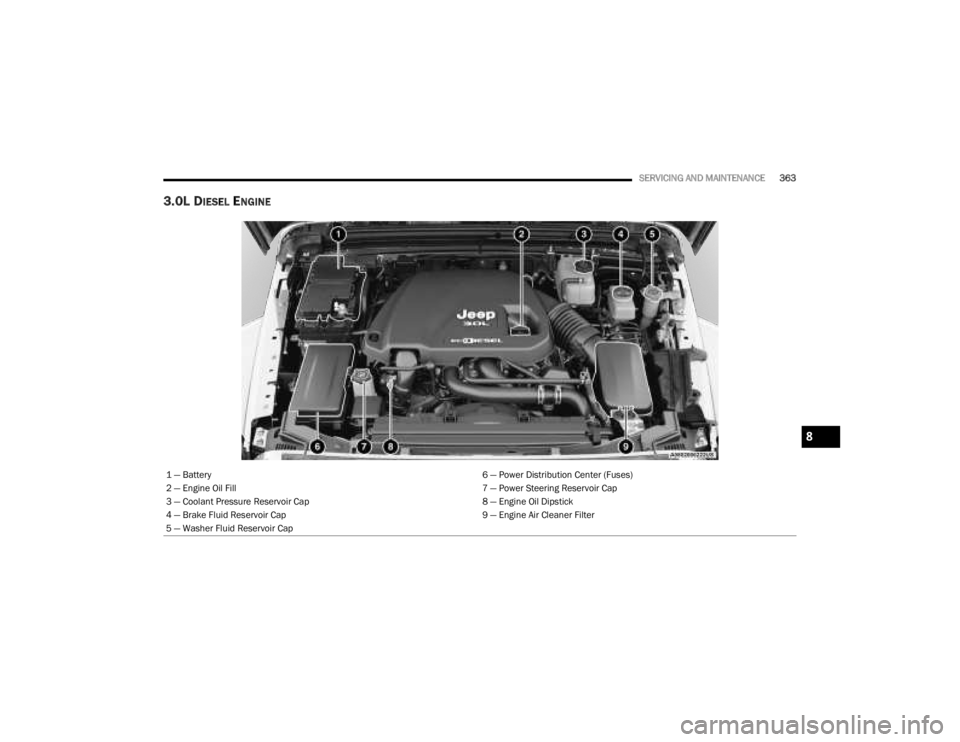
3.0L DIESEL ENGINE
1 — Battery 6 — Power Distribution Center (Fuses)
2 — Engine Oil Fill 7 — Power Steering Reservoir Cap
3 — Coolant Pressure Reservoir Cap 8 — Engine Oil Dipstick
4 — Brake Fluid Reservoir Cap 9 — Engine Air Cleaner Filter
5 — Washer Fluid Reservoir Cap
8
23_JT_OM_EN_USC_t.book Page 363
Page 368 of 448
366SERVICING AND MAINTENANCE
American Petroleum Institute (API)
Approved Engine Oil
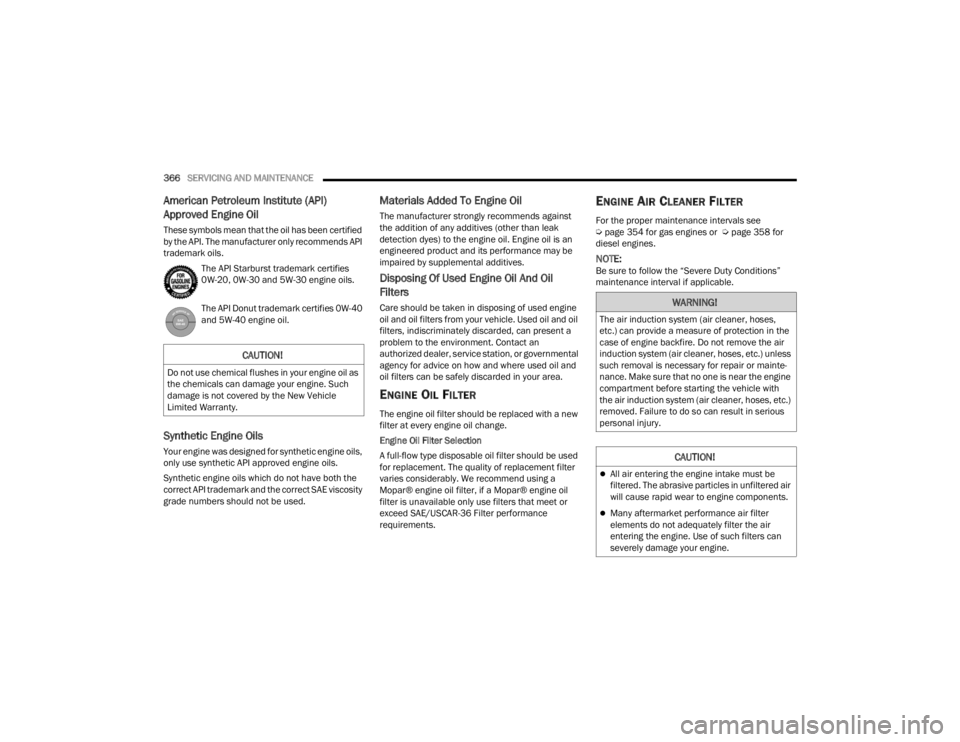
These symbols mean that the oil has been certified
by the API. The manufacturer only recommends API
trademark oils.
The API Starburst trademark certifies
0W-20, 0W-30 and 5W-30 engine oils.
The API Donut trademark certifies 0W-40
and 5W-40 engine oil.
Synthetic Engine Oils
Your engine was designed for synthetic engine oils,
only use synthetic API approved engine oils.
Synthetic engine oils which do not have both the
correct API trademark and the correct SAE viscosity
grade numbers should not be used.
Materials Added To Engine Oil
The manufacturer strongly recommends against
the addition of any additives (other than leak
detection dyes) to the engine oil. Engine oil is an
engineered product and its performance may be
impaired by supplemental additives.
Disposing Of Used Engine Oil And Oil
Filters
Care should be taken in disposing of used engine
oil and oil filters from your vehicle. Used oil and oil
filters, indiscriminately discarded, can present a
problem to the environment. Contact an
authorized dealer, service station, or governmental
agency for advice on how and where used oil and
oil filters can be safely discarded in your area.
ENGINE OIL FILTER
The engine oil filter should be replaced with a new
filter at every engine oil change.
Engine Oil Filter Selection
A full-flow type disposable oil filter should be used
for replacement. The quality of replacement filter
varies considerably. We recommend using a
Mopar® engine oil filter, if a Mopar® engine oil
filter is unavailable only use filters that meet or
exceed SAE/USCAR-36 Filter performance
requirements.
ENGINE AIR CLEANER FILTER
For the proper maintenance intervals see
Úpage 354 for gas engines or Ú page 358 for
diesel engines.
NOTE:Be sure to follow the “Severe Duty Conditions”
maintenance interval if applicable.
CAUTION!
Do not use chemical flushes in your engine oil as
the chemicals can damage your engine. Such
damage is not covered by the New Vehicle
Limited Warranty.
WARNING!
The air induction system (air cleaner, hoses,
etc.) can provide a measure of protection in the
case of engine backfire. Do not remove the air
induction system (air cleaner, hoses, etc.) unless
such removal is necessary for repair or mainte -
nance. Make sure that no one is near the engine
compartment before starting the vehicle with
the air induction system (air cleaner, hoses, etc.)
removed. Failure to do so can result in serious
personal injury.
CAUTION!
All air entering the engine intake must be
filtered. The abrasive particles in unfiltered air
will cause rapid wear to engine components.
Many aftermarket performance air filter
elements do not adequately filter the air
entering the engine. Use of such filters can
severely damage your engine.
23_JT_OM_EN_USC_t.book Page 366
Page 372 of 448
370SERVICING AND MAINTENANCE
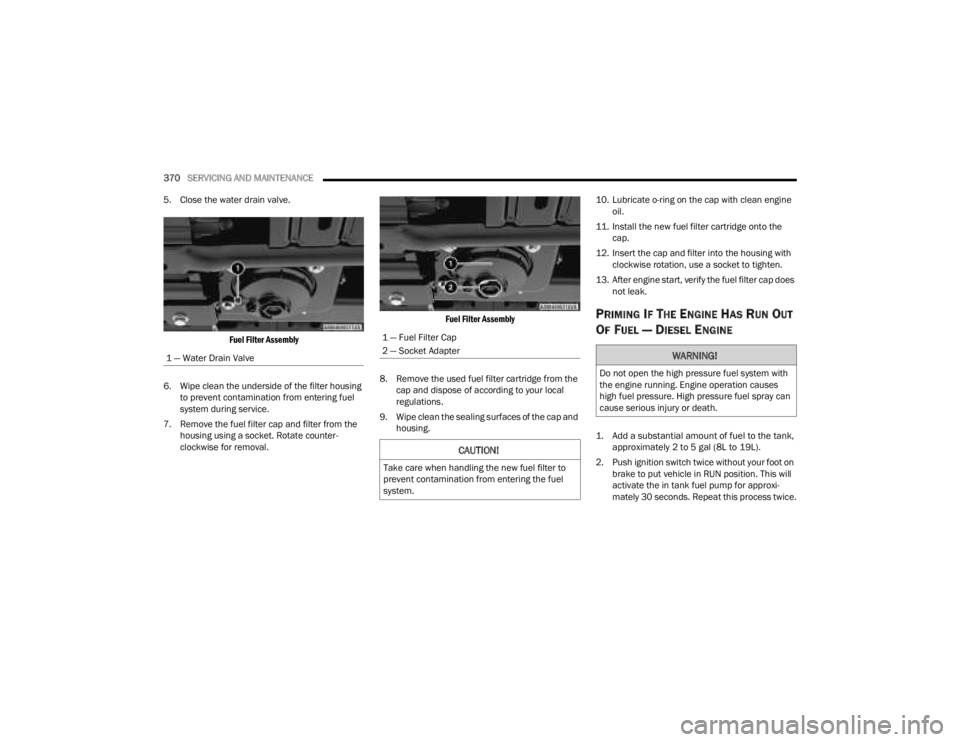
5. Close the water drain valve.
Fuel Filter Assembly
6. Wipe clean the underside of the filter housing to prevent contamination from entering fuel
system during service.
7. Remove the fuel filter cap and filter from the housing using a socket. Rotate counter -
clockwise for removal.
Fuel Filter Assembly
8. Remove the used fuel filter cartridge from the cap and dispose of according to your local
regulations.
9. Wipe clean the sealing surfaces of the cap and housing. 10. Lubricate o-ring on the cap with clean engine
oil.
11. Install the new fuel filter cartridge onto the cap.
12. Insert the cap and filter into the housing with clockwise rotation, use a socket to tighten.
13. After engine start, verify the fuel filter cap does not leak.
PRIMING IF THE ENGINE HAS RUN OUT
O
F FUEL — DIESEL ENGINE
1. Add a substantial amount of fuel to the tank,
approximately 2 to 5 gal (8L to 19L).
2. Push ignition switch twice without your foot on brake to put vehicle in RUN position. This will
activate the in tank fuel pump for approxi -
mately 30 seconds. Repeat this process twice.
1 — Water Drain Valve
1 — Fuel Filter Cap
2 — Socket Adapter
CAUTION!
Take care when handling the new fuel filter to
prevent contamination from entering the fuel
system.
WARNING!
Do not open the high pressure fuel system with
the engine running. Engine operation causes
high fuel pressure. High pressure fuel spray can
cause serious injury or death.
23_JT_OM_EN_USC_t.book Page 370
Page 375 of 448
SERVICING AND MAINTENANCE373
Refrigerant Recovery And Recycling
R-1234yf
R-1234yf Air Conditioning Refrigerant is a Hydroflu -
oroolefin (HFO) that is endorsed by the
Environmental Protection Agency and is an
ozone-friendly substance with a low
global-warming potential. The manufacturer
recommends that air conditioning service be
performed by an authorized dealer using recovery
and recycling equipment.
NOTE:Use only manufacturer approved A/C system PAG
compressor oil, and refrigerants.
Cabin Air Filter Replacement
The cabin air filter is located in the fresh air inlet
behind the glove compartment. Perform the
following procedure to replace the filter:
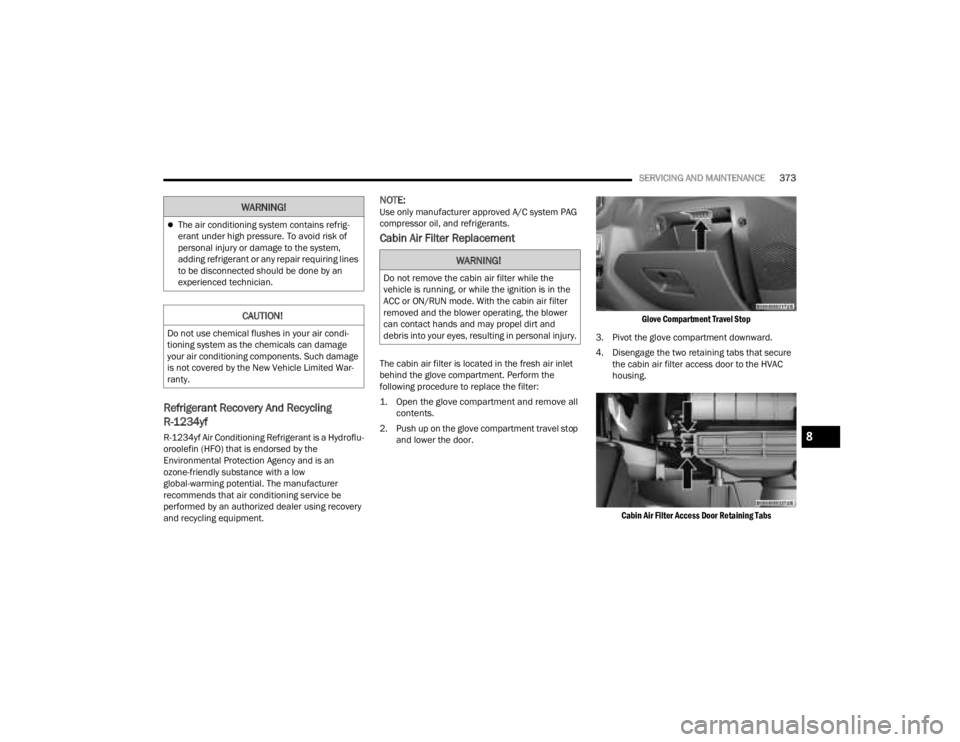
1. Open the glove compartment and remove all contents.
2. Push up on the glove compartment travel stop and lower the door.
Glove Compartment Travel Stop
3. Pivot the glove compartment downward.
4. Disengage the two retaining tabs that secure the cabin air filter access door to the HVAC
housing.
Cabin Air Filter Access Door Retaining Tabs
The air conditioning system contains refrig -
erant under high pressure. To avoid risk of
personal injury or damage to the system,
adding refrigerant or any repair requiring lines
to be disconnected should be done by an
experienced technician.
CAUTION!
Do not use chemical flushes in your air condi -
tioning system as the chemicals can damage
your air conditioning components. Such damage
is not covered by the New Vehicle Limited War -
ranty.
WARNING!
WARNING!
Do not remove the cabin air filter while the
vehicle is running, or while the ignition is in the
ACC or ON/RUN mode. With the cabin air filter
removed and the blower operating, the blower
can contact hands and may propel dirt and
debris into your eyes, resulting in personal injury.
8
23_JT_OM_EN_USC_t.book Page 373
Page 376 of 448
374SERVICING AND MAINTENANCE
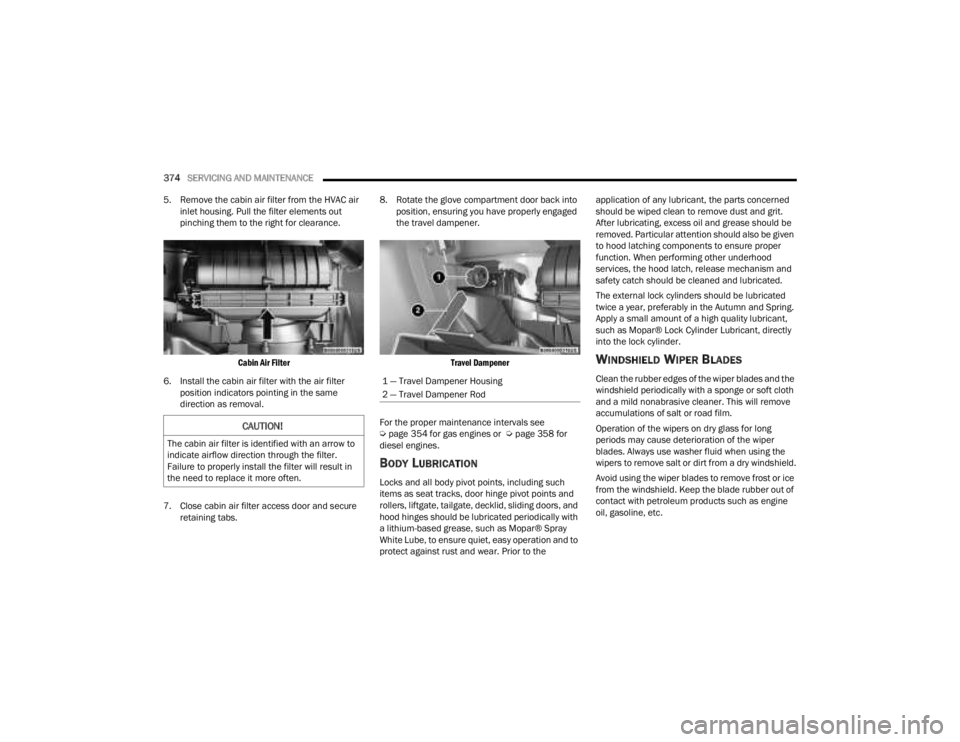
5. Remove the cabin air filter from the HVAC air inlet housing. Pull the filter elements out
pinching them to the right for clearance.
Cabin Air Filter
6. Install the cabin air filter with the air filter position indicators pointing in the same
direction as removal.
7. Close cabin air filter access door and secure retaining tabs. 8. Rotate the glove compartment door back into
position, ensuring you have properly engaged
the travel dampener.
Travel Dampener
For the proper maintenance intervals see
Ú page 354 for gas engines or Ú page 358 for
diesel engines.
BODY LUBRICATION
Locks and all body pivot points, including such
items as seat tracks, door hinge pivot points and
rollers, liftgate, tailgate, decklid, sliding doors, and
hood hinges should be lubricated periodically with
a lithium-based grease, such as Mopar® Spray
White Lube, to ensure quiet, easy operation and to
protect against rust and wear. Prior to the application of any lubricant, the parts concerned
should be wiped clean to remove dust and grit.
After lubricating, excess oil and grease should be
removed. Particular attention should also be given
to hood latching components to ensure proper
function. When performing other underhood
services, the hood latch, release mechanism and
safety catch should be cleaned and lubricated.
The external lock cylinders should be lubricated
twice a year, preferably in the Autumn and Spring.
Apply a small amount of a high quality lubricant,
such as Mopar® Lock Cylinder Lubricant, directly
into the lock cylinder.
WINDSHIELD WIPER BLADES
Clean the rubber edges of the wiper blades and the
windshield periodically with a sponge or soft cloth
and a mild nonabrasive cleaner. This will remove
accumulations of salt or road film.
Operation of the wipers on dry glass for long
periods may cause deterioration of the wiper
blades. Always use washer fluid when using the
wipers to remove salt or dirt from a dry windshield.
Avoid using the wiper blades to remove frost or ice
from the windshield. Keep the blade rubber out of
contact with petroleum products such as engine
oil, gasoline, etc.
CAUTION!
The cabin air filter is identified with an arrow to
indicate airflow direction through the filter.
Failure to properly install the filter will result in
the need to replace it more often.
1 — Travel Dampener Housing
2 — Travel Dampener Rod
23_JT_OM_EN_USC_t.book Page 374
Page 424 of 448
422TECHNICAL SPECIFICATIONS
BIODIESEL FUEL REQUIREMENTS
A maximum blend of 5% biodiesel meeting ASTM
specification D975 is recommended for use with
your diesel engine. If frequent operation with
biodiesel blends that are between 6% and 20%
(B6–B20) is desired, the maintenance schedule is
subject to shorter intervals.
The oil and filter change along with fuel filter
replacement is subject to shorter intervals when
operating your engine on biodiesel greater than
5%. Do not use biodiesel greater than 20%.
For regular use of biodiesel blends between 6%
and 20% (B6–B20) it is important that you
understand and comply with these requirements
Úpage 358.
Biodiesel is a fuel produced from renewable
resources typically derived from animal fat,
rapeseed oil (Rapeseed Methyl Ester (RME) base),
or soybean oil (Soy Methyl Ester (SME or SOME)
base). Biodiesel fuel has inherent limitations which
require that you understand and adhere to the
following requirements if you use blends of
biodiesel between 6% and 20% (B6–B20). There
are no unique restrictions for the use of B5.
Biodiesel Fuel Properties — Low Ambient
Temperatures
Biodiesel fuel may gel or solidify at low ambient
temperatures, which may pose problems for both
storage and operation. Precautions can be
necessary at low ambient temperatures, such as
storing the fuel in a heated building or a heated
storage tank, or using cold temperature additives.
Fuel Quality — Must Comply With ASTM
Standards
The quality of Biodiesel fuel may vary widely. Only
fuel produced by a BQ9000 supplier to the
following specifications may be blended to meet
biodiesel blend B6 – B20 fuel meeting ASTM
specification D-7467:
Petrodiesel fuel meeting ASTM specification
D-975 and biodiesel fuel (B100) meeting ASTM
specification D-6751
Fuel Oxidation Stability — Must Use Fuel
Within Six Months Of Manufacture
Biodiesel fuel has poor oxidation stability which
can result in long term storage problems. Fuel
produced to approved ASTM standards, if stored
properly, provides for protection against fuel
oxidation for up to six months.
CAUTION!
Failure to comply with Oil Change requirements
for vehicles operating on biodiesel blends
between 6% and 20% (B6–B20) will result in
premature engine wear. Such wear is not
covered by the New Vehicle Limited Warranty.
CAUTION!
Use of blends greater than 20% is not approved.
Use of blends greater than 20% can result in
engine damage. Such damage is not covered by
the New Vehicle Limited Warranty.
CAUTION!
In the event that the vehicle is filled with
biodiesel and not used for more than a month,
the fuel should either be used up by driving (up
to quarter tank) and filled with standard diesel
blends with less than 5% that is normally
available. This will help prevent the fuel filter
clogging and potential damage to the fuel
injection system due to degraded biodiesel,
which is not covered by the New Vehicle Limited
Warranty.
23_JT_OM_EN_USC_t.book Page 422
Page 425 of 448
TECHNICAL SPECIFICATIONS423
Fuel Water Separation — Must Use
Mopar® Approved Fuel Filter Elements
Biodiesel fuel has a natural affinity to water and
water accelerates microbial growth. Your Mopar®
filtration system is designed to provide adequate
fuel water separation capabilities.
Fuel In Oil Dilution — Must Adhere To
Required Oil Change Interval
Fuel dilution of lubricating oil has been observed
with the use of biodiesel fuel. Fuel in oil must not
exceed 5%. To ensure this limit is met your oil
change interval must be maintained within the
suggested schedule. The regular use of biodiesel
between 6% and 20% requires intervals shorter
than the outlined 10,000 miles (16,000 km) and must not exceed the suggested schedule. When
routinely operating on biodiesel between 6% and
20%, oil and filter replacement intervals must not
exceed 8,000 miles (13,000 km) or six months,
which ever comes first.
Biodiesel Fuel Filter Change Intervals
The use of biodiesel requires more frequent fuel
filter change intervals. When operating on
biodiesel between 6% and 20%, fuel filter
replacement intervals should be every second oil
change, and must not exceed 16,000 miles
(25,750 km).
NOTE:Under no circumstances should oil change
intervals exceed 8,000 miles (12,875 km) or six
months, if regular operation occurs with 6% - 20%
biodiesel blends. Under no circumstances should
fuel filter replacement intervals exceed every
second oil change and must not exceed
16,000 miles (25,750 km), if regular operation
occurs with 6% - 20% biodiesel blends. Failure to
comply with these Oil Change and fuel filter
requirements for vehicles operating on biodiesel
blends up to B20 may result in premature engine
wear. Such wear is not covered by the New Vehicle
Limited Warranty. The engine may suffer severe
damage if operated with concentrations of
biodiesel higher than 20%.
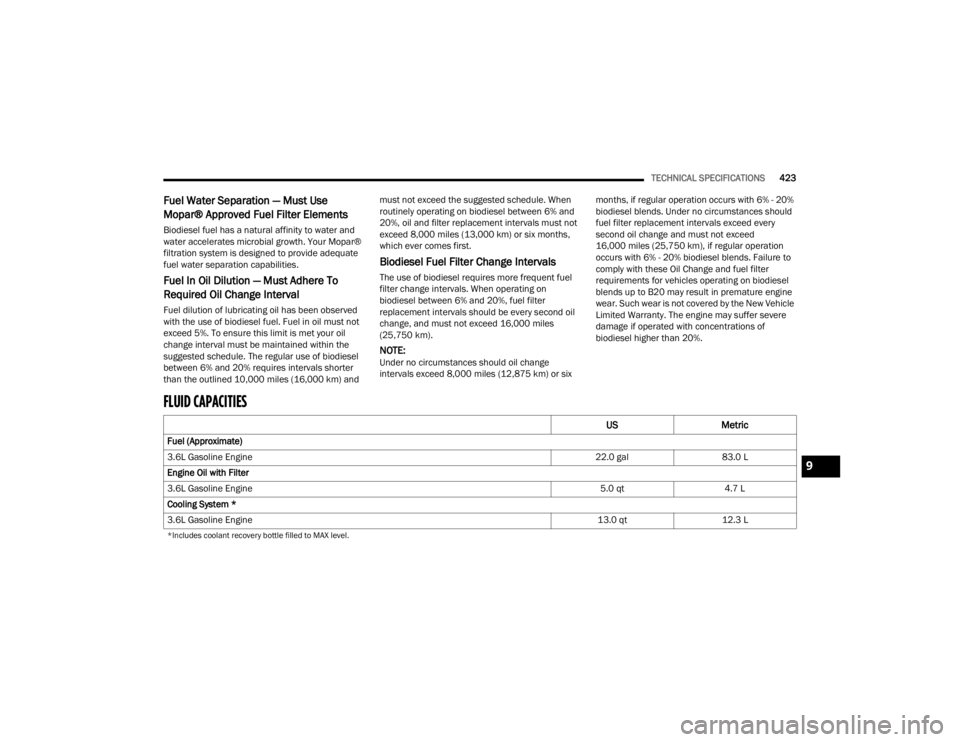
FLUID CAPACITIES
US
Metric
Fuel (Approximate)
3.6L Gasoline Engine 22.0 gal83.0 L
Engine Oil with Filter
3.6L Gasoline Engine 5.0 qt4.7 L
Cooling System *
3.6L Gasoline Engine 13.0 qt12.3 L
*Includes coolant recovery bottle filled to MAX level.
9
23_JT_OM_EN_USC_t.book Page 423
Page 426 of 448
424TECHNICAL SPECIFICATIONS
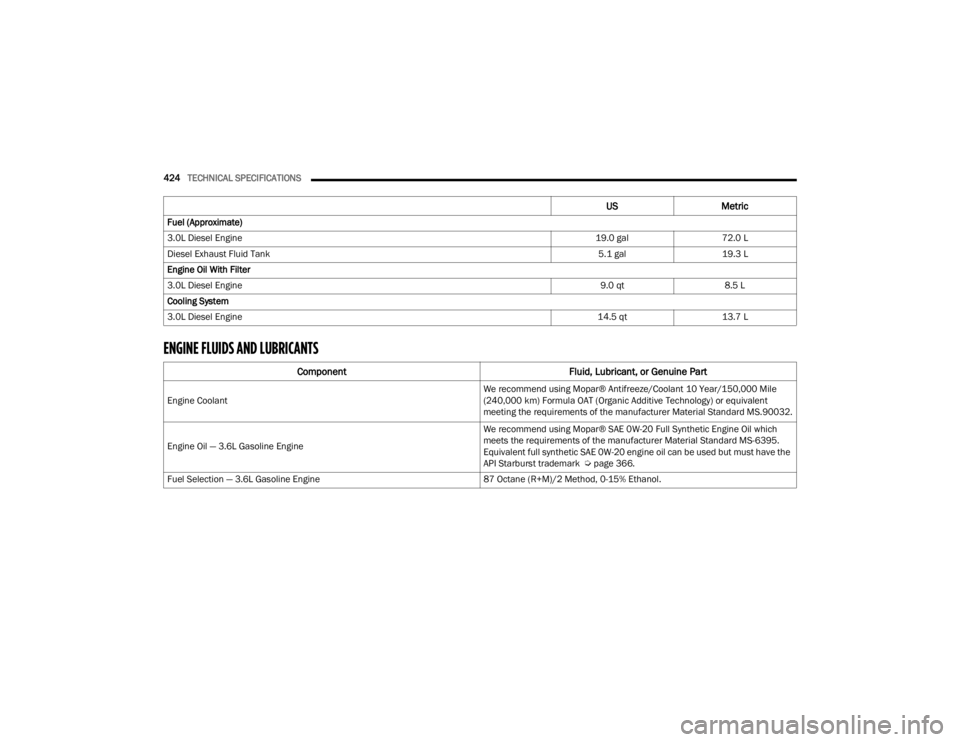
ENGINE FLUIDS AND LUBRICANTS
USMetric
Fuel (Approximate)
3.0L Diesel Engine 19.0 gal72.0 L
Diesel Exhaust Fluid Tank 5.1 gal19.3 L
Engine Oil With Filter
3.0L Diesel Engine 9.0 qt8.5 L
Cooling System
3.0L Diesel Engine 14.5 qt13.7 L
Component Fluid, Lubricant, or Genuine Part
Engine Coolant
We recommend using Mopar® Antifreeze/Coolant 10 Year/150,000 Mile
(240,000 km) Formula OAT (Organic Additive Technology) or equivalent
meeting the requirements of the manufacturer Material Standard MS.90032.
Engine Oil — 3.6L Gasoline Engine We recommend using Mopar® SAE 0W-20 Full Synthetic Engine Oil which
meets the requirements of the manufacturer Material Standard MS-6395.
Equivalent full synthetic SAE 0W-20 engine oil can be used but must have the
API Starburst trademark Ú
page 366.
Fuel Selection — 3.6L Gasoline Engine 87 Octane (R+M)/2 Method, 0-15% Ethanol.
23_JT_OM_EN_USC_t.book Page 424
Page 427 of 448
TECHNICAL SPECIFICATIONS425
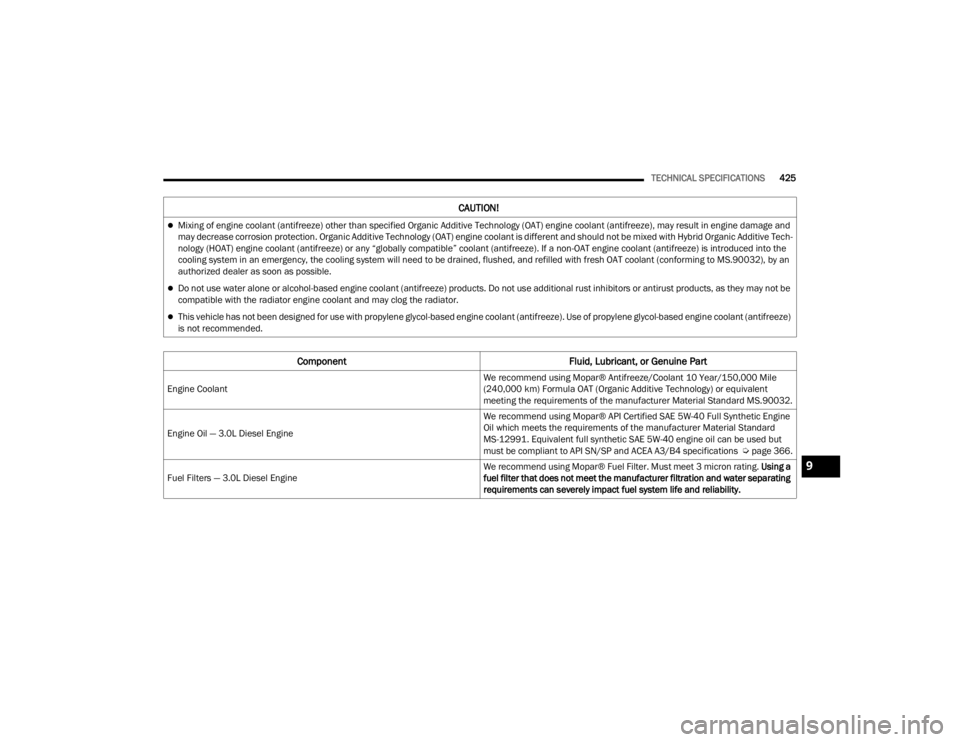
CAUTION!
Mixing of engine coolant (antifreeze) other than specified Organic Additive Technology (OAT) engine coolant (antifreeze), may result in engine damage and
may decrease corrosion protection. Organic Additive Technology (OAT) engine coolant is different and should not be mixed with Hybrid Organic Additive Tech -
nology (HOAT) engine coolant (antifreeze) or any “globally compatible” coolant (antifreeze). If a non-OAT engine coolant (antifreeze) is introduced into the
cooling system in an emergency, the cooling system will need to be drained, flushed, and refilled with fresh OAT coolant (conforming to MS.90032), by an
authorized dealer as soon as possible.
Do not use water alone or alcohol-based engine coolant (antifreeze) products. Do not use additional rust inhibitors or antirust products, as they may not be
compatible with the radiator engine coolant and may clog the radiator.
This vehicle has not been designed for use with propylene glycol-based engine coolant (antifreeze). Use of propylene glycol-based engine coolant (antifreeze)
is not recommended.
Component Fluid, Lubricant, or Genuine Part
Engine Coolant We recommend using Mopar® Antifreeze/Coolant 10 Year/150,000 Mile
(240,000 km) Formula OAT (Organic Additive Technology) or equivalent
meeting the requirements of the manufacturer Material Standard MS.90032.
Engine Oil — 3.0L Diesel Engine We recommend using Mopar® API Certified SAE 5W-40 Full Synthetic Engine
Oil which meets the requirements of the manufacturer Material Standard
MS-12991. Equivalent full synthetic SAE 5W-40 engine oil can be used but
must be compliant to API SN/SP and ACEA A3/B4 specifications
Úpage 366.
Fuel Filters — 3.0L Diesel Engine We recommend using Mopar® Fuel Filter. Must meet 3 micron rating.
Using a
fuel filter that does not meet the manufacturer filtration and water separating
requirements can severely impact fuel system life and reliability.
9
23_JT_OM_EN_USC_t.book Page 425
Page 437 of 448
435
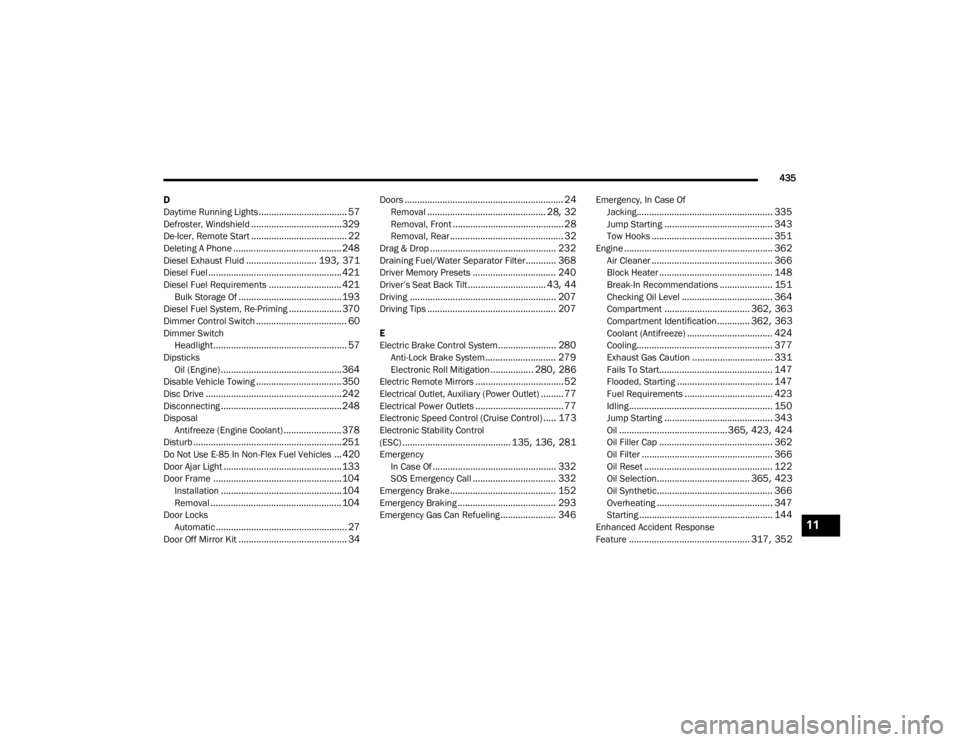
D
Daytime Running Lights
................................... 57Defroster, Windshield.................................... 329De-Icer, Remote Start...................................... 22Deleting A Phone........................................... 248Diesel Exhaust Fluid............................ 193, 371Diesel Fuel..................................................... 421Diesel Fuel Requirements............................. 421Bulk Storage Of......................................... 193Diesel Fuel System, Re-Priming..................... 370Dimmer Control Switch.................................... 60Dimmer Switch Headlight..................................................... 57DipsticksOil (Engine)................................................ 364Disable Vehicle Towing.................................. 350Disc Drive...................................................... 242Disconnecting................................................ 248DisposalAntifreeze (Engine Coolant)....................... 378Disturb........................................................... 251Do Not Use E-85 In Non-Flex Fuel Vehicles... 420Door Ajar Light............................................... 133Door Frame................................................... 104Installation................................................ 104Removal.................................................... 104Door LocksAutomatic.................................................... 27Door Off Mirror Kit........................................... 34
Doors............................................................... 24Removal............................................... 28, 32Removal, Front............................................ 28Removal, Rear............................................. 32Drag & Drop.................................................. 232Draining Fuel/Water Separator Filter............ 368Driver Memory Presets................................. 240Driver’s Seat Back Tilt............................... 43, 44Driving.......................................................... 207Driving Tips................................................... 207
E
Electric Brake Control System....................... 280Anti-Lock Brake System............................ 279Electronic Roll Mitigation................. 280, 286Electric Remote Mirrors................................... 52Electrical Outlet, Auxiliary (Power Outlet)......... 77Electrical Power Outlets................................... 77Electronic Speed Control (Cruise Control)..... 173Electronic Stability Control
(ESC)........................................... 135, 136, 281EmergencyIn Case Of................................................. 332SOS Emergency Call................................. 332Emergency Brake.......................................... 152Emergency Braking....................................... 293Emergency Gas Can Refueling...................... 346
Emergency, In Case OfJacking...................................................... 335Jump Starting........................................... 343Tow Hooks................................................ 351Engine........................................................... 362Air Cleaner................................................ 366Block Heater............................................. 148Break-In Recommendations..................... 151Checking Oil Level.................................... 364Compartment.................................. 362, 363Compartment Identification............. 362, 363Coolant (Antifreeze).................................. 424Cooling...................................................... 377Exhaust Gas Caution................................ 331Fails To Start............................................. 147Flooded, Starting...................................... 147Fuel Requirements................................... 423Idling......................................................... 150Jump Starting........................................... 343Oil...........................................365, 423, 424Oil Filler Cap............................................. 362Oil Filter.................................................... 366Oil Reset................................................... 122Oil Selection..................................... 365, 423Oil Synthetic.............................................. 366Overheating.............................................. 347Starting..................................................... 144Enhanced Accident Response
Feature................................................ 317, 352
11
23_JT_OM_EN_USC_t.book Page 435