oil temperature JEEP GLADIATOR 2023 User Guide
[x] Cancel search | Manufacturer: JEEP, Model Year: 2023, Model line: GLADIATOR, Model: JEEP GLADIATOR 2023Pages: 448, PDF Size: 17.37 MB
Page 152 of 448

150STARTING AND OPERATING
NOTE:
Use of Climatized ULSD Fuel or Number 1 ULSD
fuel results in a noticeable decrease in fuel
economy.
Climatized ULSD fuel is a blend of Number 2
ULSD fuel and Number 1 ULSD fuel which
reduces the temperature at which wax crystals
form in fuel.
The fuel grade should be clearly marked on the
pump at the fuel station.
The engine requires the use of Ultra Low Sulfur
Diesel Fuel . Use of incorrect fuel could result in
engine and exhaust system damage
Ú page 421.
If climatized or Number 1 ULSD fuel is not avail -
able, and you are operating below 20°F (-6°C),
in sustained arctic conditions, Mopar®
Premium Diesel Fuel Treatment (or equivalent) is recommended to avoid gelling (see Fuel Oper
-
ating Range Chart).
Engine Oil Usage
See Engine Fluids and Lubricants for the correct
engine oil viscosity Ú page 424.
Engine Warm-Up
Avoid full throttle operation when the engine is
cold. When starting a cold engine, bring the engine
up to operating speed slowly to allow the oil
pressure to stabilize as the engine warms up.
If temperatures are below 32°F (0°C), operate the
engine at moderate speeds for five minutes before
full loads are applied.
ENGINE IDLING
Avoid prolonged idling. Long periods of idling may
be harmful to your engine because combustion chamber temperatures can drop so low that the
fuel may not burn completely. Incomplete
combustion allows carbon and varnish to form on
piston rings, cylinder head valves, turbocharger,
and injector nozzles. Also, the unburned fuel can
enter the crankcase, diluting the oil and causing
rapid wear to the engine.
STOPPING THE ENGINE
After full load operation, idle the engine for a few
minutes before shutting it down. This idle period
will allow the lubricating oil and coolant to carry
excess heat away from the turbocharger.
NOTE:Refer to the following chart for proper engine
shutdown.
Driving Condition Load Turbocharger Temperature Idle Time (min.) Before Engine
Shutdown
Stop and Go EmptyCoolNone
Stop and Go Medium 0.5
Highway Speeds MediumWarm 1.0
City Traffic Maximum GCWR 1.5
Highway Speeds Maximum GCWR 2.0
Uphill Grade Maximum GCWR Hot2.5
23_JT_OM_EN_USC_t.book Page 150
Page 153 of 448

STARTING AND OPERATING151
NOTE:Under certain conditions the Stop/Start system
may be temporarily disabled and the engine fan
will run after the engine is turned off to protect the
engine. These conditions are under high load and
high temperature conditions.
COOLING SYSTEM TIPS — AUTOMATIC
T
RANSMISSION
To reduce the potential for engine and
transmission overheating in high ambient
temperature conditions, take the following actions:
City Driving — When stopped, shift the transmis -
sion into NEUTRAL (N) and increase engine idle
speed.
Highway Driving — Reduce your speed.
Up Steep Hills — Select a lower transmission
gear.
Air Conditioning — Turn it off temporarily.
NOTE:If the coolant temperature is too high, the A/C will
automatically turn off.
Do Not Operate The Engine With Low Oil
Pressure
If the Low Oil Pressure Warning Light turns on while
driving, stop the vehicle and shut down the engine
as soon as possible. After the vehicle is safely
stopped, restart the engine and monitor the lamp. If the lamp is still illuminated, shut the engine off,
contact an authorized dealer, and do not operate
the vehicle until the cause is corrected. If the lamp
is no longer illuminated, the engine can be
operated, but should be taken to an authorized
dealer as soon as possible for further inspection.
NOTE:Do not operate the vehicle until the cause is
corrected. This light does not show how much oil is
in the engine. The engine oil level must be checked
under the hood.
Do Not Operate The Engine With Failed
Parts
All engine failures give some warning before the
parts fail. Be on the alert for changes in
performance, sounds, and visual evidence that the
engine requires service. Some important clues are:
Engine misfiring or vibrating severely
Sudden loss of power
Unusual engine noises
Fuel, oil or coolant leaks
Sudden change, outside the normal operating
range, in the engine operating temperature
Excessive smoke
Oil pressure drop
ENGINE BREAK-IN RECOMMENDATIONS —
GASOLINE ENGINE (IF EQUIPPED)
A long break-in period is not required for the engine
and drivetrain (transmission and axle) in your
vehicle.
Drive moderately during the first 300 miles
(500 km). After the initial 60 miles (100 km),
speeds up to 50 or 55 mph (80 or 90 km/h) are
desirable.
While cruising, brief full-throttle acceleration within
the limits of local traffic laws contributes to a good
break-in. Wide-open throttle acceleration in low
gear can be detrimental and should be avoided.
The engine oil installed in the engine at the factory
is a high-quality energy conserving type lubricant.
Oil changes should be consistent with anticipated
climate conditions under which vehicle operations
will occur.
For the recommended viscosity and quality grades
see Ú page 424.
CAUTION!
If oil pressure falls to less than normal readings,
shut the engine off immediately. Failure to do so
could result in immediate and severe engine
damage.
4
23_JT_OM_EN_USC_t.book Page 151
Page 154 of 448
152STARTING AND OPERATING
NOTE:A new engine may consume some oil during its first
few thousand miles (kilometers) of operation. This
should be considered a normal part of the break-in
and not interpreted as a problem.
ENGINE BREAK-IN RECOMMENDATIONS —
DIESEL ENGINE (IF EQUIPPED)
The diesel engine does not require a break-in
period due to its construction. Normal operation is
allowed, providing the following recommendations
are followed:
Warm up the engine before placing it under
load.
Do not operate the engine at idle for prolonged
periods.
Use the appropriate transmission gear to
prevent engine lugging.
Observe vehicle oil pressure and temperature
indicators.
Check the coolant and oil levels frequently.
Vary throttle position at highway speeds when
carrying or towing significant weight.
NOTE:Light duty operation such as light trailer towing or
no load operation will extend the time before the
engine is at full efficiency. Reduced fuel economy
and power may be seen at this time.
The engine oil installed in the engine at the factory
is a high-quality energy conserving type lubricant.
Oil changes should be consistent with anticipated
climate conditions under which vehicle operations
will occur. For recommended viscosity and quality
grades Úpage 424. NON-DETERGENT OR
STRAIGHT MINERAL OILS MUST NEVER BE USED.
PARKING BRAKE
Before exiting the vehicle, make sure that the
parking brake is fully applied. Also, be certain to
leave an automatic transmission in PARK, or
manual transmission in REVERSE or FIRST gear.
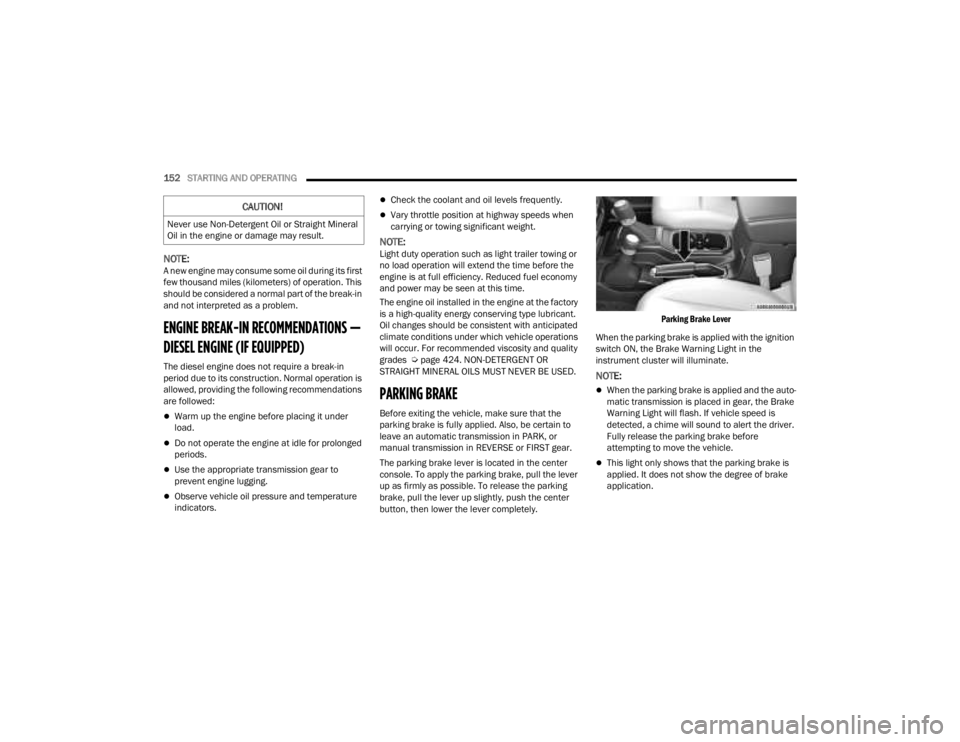
The parking brake lever is located in the center
console. To apply the parking brake, pull the lever
up as firmly as possible. To release the parking
brake, pull the lever up slightly, push the center
button, then lower the lever completely.
Parking Brake Lever
When the parking brake is applied with the ignition
switch ON, the Brake Warning Light in the
instrument cluster will illuminate.
NOTE:
When the parking brake is applied and the auto -
matic transmission is placed in gear, the Brake
Warning Light will flash. If vehicle speed is
detected, a chime will sound to alert the driver.
Fully release the parking brake before
attempting to move the vehicle.
This light only shows that the parking brake is
applied. It does not show the degree of brake
application.
CAUTION!
Never use Non-Detergent Oil or Straight Mineral
Oil in the engine or damage may result.
23_JT_OM_EN_USC_t.book Page 152
Page 280 of 448
278MULTIMEDIA
DRIVETRAIN
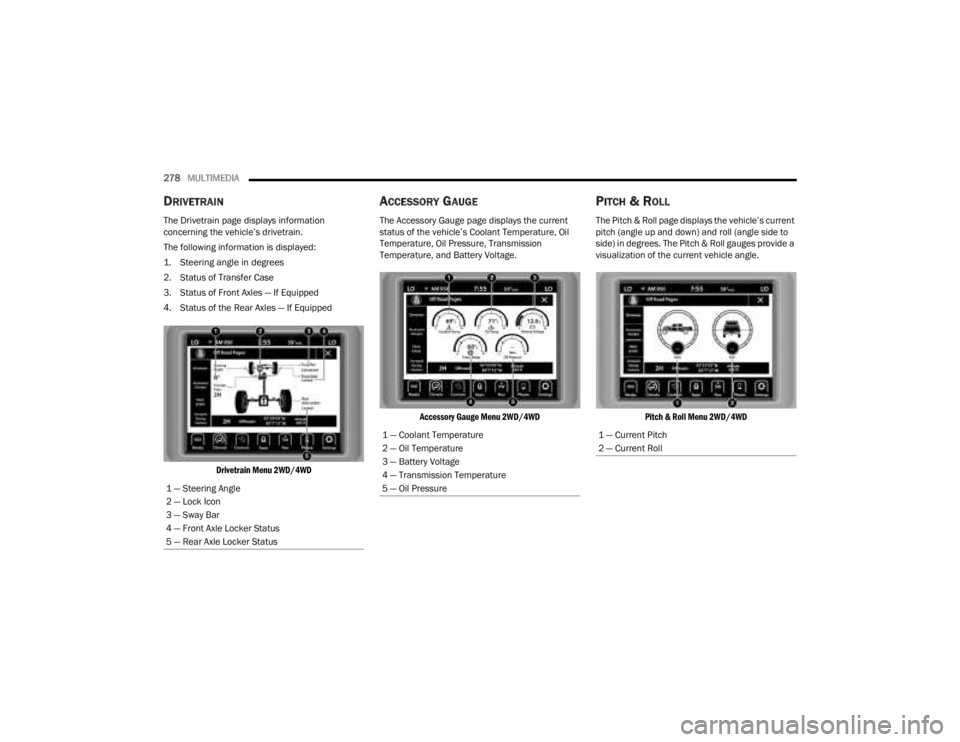
The Drivetrain page displays information
concerning the vehicle’s drivetrain.
The following information is displayed:
1. Steering angle in degrees
2. Status of Transfer Case
3. Status of Front Axles — If Equipped
4. Status of the Rear Axles — If Equipped
Drivetrain Menu 2WD/4WD
ACCESSORY GAUGE
The Accessory Gauge page displays the current
status of the vehicle’s Coolant Temperature, Oil
Temperature, Oil Pressure, Transmission
Temperature, and Battery Voltage.
Accessory Gauge Menu 2WD/4WD
PITCH & ROLL
The Pitch & Roll page displays the vehicle’s current
pitch (angle up and down) and roll (angle side to
side) in degrees. The Pitch & Roll gauges provide a
visualization of the current vehicle angle.
Pitch & Roll Menu 2WD/4WD
1 — Steering Angle
2 — Lock Icon
3 — Sway Bar
4 — Front Axle Locker Status
5 — Rear Axle Locker Status
1 — Coolant Temperature
2 — Oil Temperature
3 — Battery Voltage
4 — Transmission Temperature
5 — Oil Pressure1 — Current Pitch
2 — Current Roll
23_JT_OM_EN_USC_t.book Page 278
Page 355 of 448
353
SERVICING AND MAINTENANCE
SCHEDULED SERVICING — GASOLINE
ENGINE
Your vehicle is equipped with an automatic oil
change indicator system. The oil change indicator
system will remind you that it is time to take your
vehicle in for scheduled maintenance.
Based on engine operation conditions, the oil
change indicator message will illuminate. This
means that service is required for your vehicle.
Operating conditions such as frequent short-trips,
trailer tow, or extremely hot or cold ambient
temperatures will influence when the “Change Oil”
or “Oil Change Required” message is displayed.
Have your vehicle serviced as soon as possible,
within the next 500 miles (805 km).
On vehicles equipped with an instrument cluster
display, “Oil Change Required” will be displayed
and a single chime will sound, indicating that an oil
change is necessary. On vehicles not equipped with an instrument
cluster display, “Change Oil” will flash in the
instrument cluster odometer and a single chime
will sound, indicating that an oil change is
necessary.
An authorized dealer will reset the oil change
indicator message after completing the scheduled
oil change. To reset the system follow the steps
described Ú
page 122.
NOTE:Under no circumstances should oil change
intervals exceed 10,000 miles (16,000 km),
12 months or 350 hours of engine run time,
whichever comes first. The 350 hours of engine
run or idle time is generally only a concern for fleet
customers. Once A Month Or Before A Long Trip:
Check engine oil level.
Check windshield washer fluid level.
Check the tire pressures and look for unusual
wear or damage, rotate at the first sign of irreg
-
ular wear.
Check the fluid levels of the coolant reservoir,
brake master cylinder, and power steering, and
fill as needed.
Check function of all interior and exterior lights.
8
23_JT_OM_EN_USC_t.book Page 353
Page 359 of 448

SERVICING AND MAINTENANCE357
SCHEDULED SERVICING — DIESEL ENGINE
Your vehicle is equipped with an automatic oil
change indicator system. The oil change indicator
system will remind you that it is time to take your
vehicle in for scheduled maintenance.
Based on engine operation conditions, the oil
change indicator message will illuminate. This
means that service is required for your vehicle.
Operating conditions such as frequent short-trips,
trailer tow, extremely hot or cold ambient
temperatures will influence when the “Oil Change
Required” message is displayed. Have your vehicle
serviced as soon as possible, within the next
500 miles (805 km).
An authorized dealer will reset the oil change
indicator message after completing the scheduled
oil change. If a scheduled oil change is performed
by someone other than an authorized dealer, to
reset the message Úpage 121.
NOTE:Under no circumstances should oil change
intervals exceed 10,000 miles (16,000 km) or
12 months, whichever comes first.
Engine Oil Filter Replacement
Residual oil in the housing may spill from the
housing when the new filter is installed if the
residual oil is not either removed from the housing
or enough time has not elapsed to allow the oil to
drain back into the engine. When servicing the oil
filter on this engine, open the filter cap
approximately six turns until the cap o-ring is
visible and stop. Wait five minutes with the cap in
this position to allow dirty engine oil to drain back
into the engine. After five minutes, the cap and
filter assembly can be removed and discarded. Once A Month Or Before A Long Trip:Check engine oil level
Check windshield washer fluid level
Check the tire pressures and look for unusual
wear or damage
Check the fluid levels of the coolant reservoir,
brake master cylinder, and fill as needed
Check function of all interior and exterior lights
8
23_JT_OM_EN_USC_t.book Page 357
Page 366 of 448

364SERVICING AND MAINTENANCE
(Continued)
CHECKING OIL LEVEL
To ensure proper engine lubrication, the engine oil
must be maintained at the correct level. Check the
oil level at regular intervals, such as every fuel
stop. The best time to check the engine oil level is
about five minutes after a fully warmed up engine
is shut off.
Checking the oil while the vehicle is on level ground
will improve the accuracy of the oil level readings.
There are four possible dipstick types:
Crosshatched zone.
Crosshatched zone marked SAFE.
Crosshatched zone marked with MIN at the low
end of the range and MAX at the high end of the
range.
Crosshatched zone marked with dimples at the
MIN and the MAX ends of the range.
NOTE:Always maintain the oil level within the crosshatch
markings on the dipstick.
Adding 1 qt (1 L) of oil when the reading is at the
low end of the dipstick range will raise the oil level
to the high end of the range marking.
ADDING WASHER FLUID
The fluid reservoir is located in the engine
compartment. Be sure to check the fluid level at
regular intervals. Fill the reservoir with windshield
washer solvent only (not radiator antifreeze). When
refilling the washer fluid reservoir, take some
washer fluid and apply it to a cloth or towel and
wipe clean the wiper blades; this will help blade
performance.
To prevent freeze-up of your windshield washer
system in cold weather, select a solution or mixture
that meets or exceeds the temperature range of
your climate. This rating information can be found
on most washer fluid containers.
MAINTENANCE-FREE BATTERY
Your vehicle is equipped with a maintenance-free
battery. You will never have to add water, and
periodic maintenance is not required.
CAUTION!
Overfilling or underfilling the crankcase will
cause aeration or loss of oil pressure. This could
damage your engine.
WARNING!
Commercial windshield washer solvents are
flammable. They could ignite and burn you. Care
must be exercised when filling or working around
the washer solution.
WARNING!
Battery fluid is a corrosive acid solution and
can burn or even blind you. Do not allow
battery fluid to contact your eyes, skin, or
clothing. Do not lean over a battery when
attaching clamps. If acid splashes in eyes or
on skin, flush the area immediately with large
amounts of water Úpage 343.
Battery gas is flammable and explosive. Keep
flame or sparks away from the battery. Do not
use a booster battery or any other booster
source with an output greater than 12 Volts.
Do not allow cable clamps to touch each
other.
Battery posts, terminals, and related accesso -
ries contain lead and lead compounds. Wash
hands after handling.
23_JT_OM_EN_USC_t.book Page 364
Page 382 of 448
380SERVICING AND MAINTENANCE
(Continued)
BRAKE SYSTEM
In order to ensure brake system performance, all
brake system components should be inspected
periodically. For the proper maintenance intervals
Úpage 354.
Fluid Level Check — Brake Master Cylinder
The fluid level of the master cylinder should be
checked whenever the vehicle is serviced, or
immediately if the Brake System Warning Light is
on. If necessary, add fluid to bring level within the
designated marks on the side of the reservoir of
the brake master cylinder. Be sure to clean the top
of the master cylinder area before removing cap.
With disc brakes, fluid level can be expected to fall
as the brake pads wear. Brake fluid level should be
checked when pads are replaced. If the brake fluid
is abnormally low, check the system for leaks.
For further information Ú page 426.
FRONT/REAR AXLE FLUID
For normal service, periodic fluid level checks are
not required. When the vehicle is serviced for other
reasons the exterior surfaces of the axle assembly
should be inspected. If gear oil leakage is
suspected, inspect the fluid level.
Fluid Level Check
Lubricant should be approximately 1/8 inch
(3 mm) below the bottom edge of the oil fill hole.
NOTE:Make sure that the vehicle is level and supported
by the axles.
Adding Fluid
Add lubricant only at the fill hole and only to the
level specified above.
Selection Of Lubricant
Use only the manufacturer’s recommended fluid
Úpage 426.
WARNING!
Riding the brakes can lead to brake failure and
possibly a collision. Driving with your foot resting
or riding on the brake pedal can result in
abnormally high brake temperatures, excessive
lining wear, and possible brake damage. You
would not have your full braking capacity in an
emergency.
WARNING!
Use only manufacturer recommended brake
fluid Ú page 426. Using the wrong type of
brake fluid can severely damage your brake
system and/or impair its performance. The
proper type of brake fluid for your vehicle is
also identified on the original factory installed
hydraulic master cylinder reservoir.
To avoid contamination from foreign matter or
moisture, use only new brake fluid or fluid that
has been in a tightly closed container. Keep
the master cylinder reservoir cap secured at
all times. Brake fluid in a open container
absorbs moisture from the air resulting in a
lower boiling point. This may cause it to boil
unexpectedly during hard or prolonged
braking, resulting in sudden brake failure. This
could result in a collision.
Overfilling the brake fluid reservoir can result
in spilling brake fluid on hot engine parts,
causing the brake fluid to catch fire. Brake
fluid can also damage painted and vinyl
surfaces, care should be taken to avoid its
contact with these surfaces.
Do not allow petroleum based fluid to contam -
inate the brake fluid. Brake seal components
could be damaged, causing partial or
complete brake failure. This could result in a
collision.
WARNING!
23_JT_OM_EN_USC_t.book Page 380
Page 424 of 448

422TECHNICAL SPECIFICATIONS
BIODIESEL FUEL REQUIREMENTS
A maximum blend of 5% biodiesel meeting ASTM
specification D975 is recommended for use with
your diesel engine. If frequent operation with
biodiesel blends that are between 6% and 20%
(B6–B20) is desired, the maintenance schedule is
subject to shorter intervals.
The oil and filter change along with fuel filter
replacement is subject to shorter intervals when
operating your engine on biodiesel greater than
5%. Do not use biodiesel greater than 20%.
For regular use of biodiesel blends between 6%
and 20% (B6–B20) it is important that you
understand and comply with these requirements
Úpage 358.
Biodiesel is a fuel produced from renewable
resources typically derived from animal fat,
rapeseed oil (Rapeseed Methyl Ester (RME) base),
or soybean oil (Soy Methyl Ester (SME or SOME)
base). Biodiesel fuel has inherent limitations which
require that you understand and adhere to the
following requirements if you use blends of
biodiesel between 6% and 20% (B6–B20). There
are no unique restrictions for the use of B5.
Biodiesel Fuel Properties — Low Ambient
Temperatures
Biodiesel fuel may gel or solidify at low ambient
temperatures, which may pose problems for both
storage and operation. Precautions can be
necessary at low ambient temperatures, such as
storing the fuel in a heated building or a heated
storage tank, or using cold temperature additives.
Fuel Quality — Must Comply With ASTM
Standards
The quality of Biodiesel fuel may vary widely. Only
fuel produced by a BQ9000 supplier to the
following specifications may be blended to meet
biodiesel blend B6 – B20 fuel meeting ASTM
specification D-7467:
Petrodiesel fuel meeting ASTM specification
D-975 and biodiesel fuel (B100) meeting ASTM
specification D-6751
Fuel Oxidation Stability — Must Use Fuel
Within Six Months Of Manufacture
Biodiesel fuel has poor oxidation stability which
can result in long term storage problems. Fuel
produced to approved ASTM standards, if stored
properly, provides for protection against fuel
oxidation for up to six months.
CAUTION!
Failure to comply with Oil Change requirements
for vehicles operating on biodiesel blends
between 6% and 20% (B6–B20) will result in
premature engine wear. Such wear is not
covered by the New Vehicle Limited Warranty.
CAUTION!
Use of blends greater than 20% is not approved.
Use of blends greater than 20% can result in
engine damage. Such damage is not covered by
the New Vehicle Limited Warranty.
CAUTION!
In the event that the vehicle is filled with
biodiesel and not used for more than a month,
the fuel should either be used up by driving (up
to quarter tank) and filled with standard diesel
blends with less than 5% that is normally
available. This will help prevent the fuel filter
clogging and potential damage to the fuel
injection system due to degraded biodiesel,
which is not covered by the New Vehicle Limited
Warranty.
23_JT_OM_EN_USC_t.book Page 422
Page 440 of 448

438
Leaks, Fluid
................................................... 330Leather Surfaces........................................... 417Life Of Tires................................................... 404Light Bulbs........................................... 330, 392Lights............................................................. 3304WD.......................................................... 1384WD Auto.................................................. 1394WD Low................................................... 1384WD Part Time.......................................... 138AdBlue UREA Injection System Failure...... 138Air Bag.................................... 132, 306, 329Automatic Headlights.................................. 58Axle Locker Fault....................................... 138Bed.............................................................. 59Brake Assist Warning................................ 283Brake Warning.......................................... 132Bulb Replacement..................................... 393Cargo......................................................... 139Center Mounted Stop................................ 395Daytime Running......................................... 57Dimmer Switch, Headlight........................... 57Electronic Throttle Control......................... 133Engine Check Malfunction Indicator..........136Engine Coolant Temperature..................... 133Exterior............................................... 56, 330Fog............................................58, 140, 394Front And Rear Axle Lock.......................... 138Hazard Warning Flasher............................ 332Headlight Switch......................................... 56Headlights.......................................... 56, 393
High Beam..........................................57, 141High Beam/Low Beam Select...................... 57Hood Open............................................... 133Instrument Cluster....................................... 56Interior......................................................... 59Lights On Reminder..................................... 58Low Diesel Exhaust Emissions Additive.... 139Low Fuel................................................... 136Neutral..................................................... 139Off Road................................................... 139Oil Pressure.............................................. 134Oil Temperature........................................ 134Passing........................................................ 58Rear Axle Lock.......................................... 138Rear Servicing.......................................... 395Rear Tail Lamps....................................... 395Seat Belt Reminder.................................. 134Security Alarm.......................................... 135Service..................................................... 393Service 4WD............................................. 136Service Forward Collision......................... 137Side Marker.............................................. 395StopStart.................................................. 140Sway Bar Fault.......................................... 137Tire Pressure Monitoring (TPMS)..... 137, 294Traction Control........................................ 283Transmission Temperature....................... 134Turn Signal............................................... 330Turn Signals........................... 140, 394, 395Two Wheel Drive High............................... 140
Load Shed Battery Saver Mode..................... 127Loading Vehicle............................................. 195Tires.......................................................... 400Locking Axle.................................................. 165, 166LocksAutomatic Door............................................27Child Protection...........................................27Power Door..................................................25Low Tire Pressure System............................. 294Lowering The Soft Top
S
........................83, 86Lubrication, Body.......................................... 374Lug Nuts/Bolts.............................................. 418Luggage Carrier............................................. 115
M
Maintenance Free Battery............................ 364Maintenance Schedule........................ 353, 357ManualPark Release............................................ 348Service...................................................... 431Manual Transmission........................... 153, 381Fluid Level Check...................................... 381Lubricant Selection.......................... 381, 426Shift Speeds............................................. 154Media Mode.................................................. 242Methanol....................................................... 420Methylcyclopentadienyl Manganese
Tricarbonyl (MMT) In Gasoline...................... 420
23_JT_OM_EN_USC_t.book Page 438