fuel JEEP GLADIATOR 2023 Repair Manual
[x] Cancel search | Manufacturer: JEEP, Model Year: 2023, Model line: GLADIATOR, Model: JEEP GLADIATOR 2023Pages: 448, PDF Size: 17.37 MB
Page 373 of 448
SERVICING AND MAINTENANCE371
3. Start the engine using the Normal Starting procedure Ú page 148.
NOTE:The engine may run rough until the air is forced
from all the fuel lines.
NOTE:
Use of biodiesel mixture in excess of 20% can
negatively impact the fuel filter's ability to sepa -
rate water from the fuel, resulting in high pres -
sure fuel system corrosion or damage.
In addition, commercially available fuel addi -
tives are not necessary for the proper operation
of your diesel engine.
For extreme cold conditions, "Mopar® Premium
Diesel Fuel Treatment" is recommended to
assist with cold starting.
INTERVENTION REGENERATION
S
TRATEGY — MESSAGE PROCESS FLOW
This engine meets all required diesel engine
emissions standards. To achieve these emissions
standards, your vehicle is equipped with a
state-of-the-art engine and exhaust system. These
systems are seamlessly integrated into your
vehicle and managed by the Powertrain Control
Module (PCM). The PCM manages engine
combustion to allow the exhaust system’s catalyst
to trap and burn Particulate Matter (PM)
pollutants, with no input or interaction on your part. Additionally, your vehicle has the ability to alert you
to additional maintenance required on your vehicle
or engine Ú
page 121.
DIESEL EXHAUST FLUID
Diesel Exhaust Fluid (DEF) sometimes known
simply by the name of its active component, UREA,
is a key component of Selective Catalytic
Reduction (SCR) systems, which help diesel
vehicles meet stringent emission regulations. DEF
is a liquid reducing agent that reacts with engine
exhaust in the presence of a catalyst to convert
smog-forming Nitrogen Oxides (NOx) into harmless
nitrogen and water vapor.
For further information Ú page 424.
CAUTION!
The starter motor will engage for approximately
30 seconds at a time. Allow two minutes
between cranking intervals.
WARNING!
Do not use alcohol or gasoline as a fuel blending
agent. They can be unstable under certain
conditions and be hazardous or explosive when
mixed with diesel fuel.
CAUTION!
Due to lack of lubricants in alcohol or gasoline,
the use of these fuels can cause damage to the
fuel system.
WARNING!
A hot exhaust system can start a fire if you park
over materials that can burn, such as grass or
leaves, and those items that come into contact
with your exhaust system. Do not park or oper -
ate your vehicle in areas where your exhaust sys -
tem can contact anything that can burn.
8
23_JT_OM_EN_USC_t.book Page 371
Page 378 of 448

376SERVICING AND MAINTENANCE
(Continued)
EXHAUST SYSTEM
The best protection against carbon monoxide entry
into the vehicle body is a properly maintained
engine exhaust system.
If you notice a change in the sound of the exhaust
system, or if the exhaust fumes can be detected
inside the vehicle, or when the underside or rear of
the vehicle is damaged, have an authorized
technician inspect the complete exhaust system
and adjacent body areas for broken, damaged,
deteriorated, or mispositioned parts. Open seams
or loose connections could permit exhaust fumes
to seep into the passenger compartment. In
addition, have the exhaust system inspected each
time the vehicle is raised for lubrication or oil
change. Replace as required. Under normal operating conditions, the catalytic
converter will not require maintenance. However, it
is important to keep the engine properly tuned to
ensure proper catalyst operation and prevent
possible catalyst damage.
NOTE:Intentional tampering with emissions control
systems can result in civil penalties being
assessed against you.
In unusual situations involving grossly
malfunctioning engine operation, a scorching odor
may suggest severe and abnormal catalyst
overheating. If this occurs, stop the vehicle, turn off
the engine and allow it to cool. Service, including a
tune-up to manufacturer's specifications, should
be obtained immediately.
To minimize the possibility of catalytic converter
damage:
Do not interrupt the ignition when the transmis
-
sion is in gear and the vehicle is in motion.
Do not try to start the vehicle by pushing or
towing the vehicle.
Do not idle the engine with any ignition compo -
nents disconnected or removed, such as when
diagnostic testing, or for prolonged periods
during very rough idle or malfunctioning oper -
ating conditions.
WARNING!
Exhaust gases can injure or kill. They contain
Carbon Monoxide (CO), which is colorless and
odorless. Breathing it can make you uncon -
scious and can eventually poison you. To
avoid breathing CO see Ú page 328.
A hot exhaust system can start a fire if you
park over materials that can burn, such as
grass or leaves, and those items that come
into contact with your exhaust system. Do not
park or operate your vehicle in areas where
your exhaust system can contact anything that
can burn.
CAUTION!
The catalytic converter requires the use of
unleaded fuel only. Leaded gasoline will
destroy the effectiveness of the catalyst as an
emissions control device, may seriously
reduce engine performance and cause
serious damage to the engine.
Damage to the catalytic converter can result if
your vehicle is not kept in proper operating
condition. In the event of engine malfunction,
particularly involving engine misfire or other
apparent loss of performance, have your
vehicle serviced promptly. Continued opera -
tion of your vehicle with a severe malfunction
could cause the converter to overheat,
resulting in possible damage to the converter
and vehicle.
WARNING!
23_JT_OM_EN_USC_t.book Page 376
Page 381 of 448

SERVICING AND MAINTENANCE379
Coolant Level
The coolant bottle provides a quick visual method
for determining that the coolant level is adequate.
With the engine in the off and cold, the level of the
engine coolant (antifreeze) in the bottle should be
between the ranges indicated on the bottle.
The radiator normally remains completely full, so
there is no need to remove the radiator/coolant
pressure cap unless checking for engine coolant
freeze point or replacing coolant. Advise your
service attendant of this. As long as the engine
operating temperature is satisfactory, the coolant
only needs to be checked once a month.
When additional engine coolant is needed to
maintain the proper level, only OAT coolant that
meets the requirements of FCA Material Standard
MS.90032 should be added to the coolant bottle.
Do not overfill.
Cooling System Notes
NOTE:When the vehicle is stopped after a few miles/kilo -
meters of operation, you may observe vapor
coming from the front of the engine compartment.
This is normally a result of moisture from rain,
snow, or high humidity accumulating on the
radiator and being vaporized when the thermostat
opens, allowing hot engine coolant (antifreeze) to
enter the radiator. If an examination of your engine compartment
shows no evidence of radiator or hose leaks, the
vehicle may be safely driven. The vapor will soon
dissipate.
Do not overfill the coolant expansion bottle.
Check the freezing point of the coolant in the
radiator and in the coolant expansion bottle. If
determined that more engine coolant needs to
be added to the radiator, the contents of the
coolant expansion bottle must also be protected
against freezing.
If frequent engine coolant additions are
required, the cooling system should be pressure
tested for leaks.
Maintain engine coolant concentration at a
minimum of 50% OAT coolant (conforming to
MS.90032) and distilled water for proper corro
-
sion protection of your engine which contains
aluminum components.
Make sure that the coolant expansion bottle
overflow hoses are not kinked or obstructed.
Keep the front of the radiator clean. With air
conditioning, keep the front of the condenser
clean.
Do not change the thermostat for Summer or
Winter operation. If replacement is ever neces -
sary, install ONLY the correct type thermostat. Other designs may result in unsatisfactory
engine system performance, poor gas mileage,
and increased emissions.
CHARGE AIR COOLER — INTER-COOLER
(D
IESEL ENGINE)
The charge air cooler is positioned in front of the
radiator and the air conditioner condenser. Air
enters the engine through the air cleaner and
passes through the turbocharger, where it is
pressurized. This pressurized air rapidly reaches
high temperature. The air is then directed through
a hose to the charge air cooler and through
another hose to the intake manifold of the engine.
This cooling process enables more efficient
burning of fuel resulting in fewer emissions.
To guarantee optimum performance of the system,
keep the surfaces of the charge air cooler,
condenser and radiator clean and free of debris.
Periodically check the hoses leading to and from
the charge air cooler for cracks or loose clamps
resulting in loss of pressure and reduced engine
performance.
8
23_JT_OM_EN_USC_t.book Page 379
Page 388 of 448

386SERVICING AND MAINTENANCE
CavityCartridge Fuse Micro Fuse Description
* If Equipped
F01 ––Spare*
F02 40 Amp Green –Starter
F03 –5 Amp Tan Intelligent Battery Sensor (IBS)
F04 –20 Amp Yellow Fuel Pump MTR/FPCM
F05 –5 Amp Tan Security Gateway
F06 ––Spare*
F07 ––Spare*
F08 –15 Amp Blue Trans Control Module TCM-8HP CYGNUS
F09 ––Spare*
F10 –15 Amp BlueKeyless Ignition Node (KIN)/Radio Frequency Hub (RFHUB)/
Electric Steering Column Lock (ESCL)
F11 –10 Amp Red UCI Port (USB & AUX)
F12 –25 Amp Clear HIFI Amplifier
F13 ––Spare*
F14 ––Spare*
F15 –15 Amp BlueInstrument Panel Cluster (IPC)/Switch Bank-Heavy Duty
Electrical Pkg (SWITCH BANK-HD ELEC)
F16 ––Spare*
F17 ––Spare*
F18 –10 Amp Red Air Conditioning Clutch (AC CLUTCH)
F19 ––Spare*
23_JT_OM_EN_USC_t.book Page 386
Page 392 of 448

390SERVICING AND MAINTENANCE
F74 ––Spare*
F75 ––Spare*
F76 –20 Amp Yellow ECM (GAS)/PCM (DSL)
F77 –10 Amp Red Heated Mirrors
F78 ––Spare*
F79 –20 Amp Yellow SMART BAR CTRL MOD
F80 –15 Amp Blue Powertrain Control Module (PCM)/Solenoid 1 2 Block Shift
F81 30 Amp Pink –REAR DEFROSTER (EBL)
F82 30 Amp Pink –FUEL HTR*
F83 60 Amp Yellow –GLOW PLUG*
F84 30 Amp Pink –UREA HTR CTRL UNIT*
F85 –10 Amp Red PM SENSOR*
F86 ––Spare*
F87 –10 Amp Red SUPPLY/PURGING PMP*
F88 20 Amp Blue –NOx SENSOR #1/#2*
F89 –10 Amp RedSteering Column Control Module (SCCM)/Cruise Control
(CRUISE CTL)/Digital TV (DTV)/Airbag Disable Lamp
F90 20 Amp Blue –TRAILER TOW PARK LMP*
F91 –20 Amp Yellow Horn
F92 40 Amp Green –HD ACCY #2*
Cavity Cartridge Fuse Micro Fuse Description
* If Equipped
23_JT_OM_EN_USC_t.book Page 390
Page 403 of 448
SERVICING AND MAINTENANCE401
To determine the maximum loading conditions of
your vehicle, locate the statement “The combined
weight of occupants and cargo should never
exceed XXX kg or XXX lbs” on the Tire And Loading
Information Placard. The combined weight of
occupants, cargo/luggage and trailer tongue
weight (if applicable) should never exceed the
weight referenced here.
Steps For Determining Correct Load Limit—
(1) Locate the statement “The combined
weight of occupants and cargo should
never exceed XXX kg or XXX lbs.” on your
vehicle's placard.
(2) Determine the combined weight of
the driver and passengers that will be
riding in your vehicle.
(3) Subtract the combined weight of the
driver and passengers from XXX kg or
XXX lbs.
(4) The resulting figure equals the
available amount of cargo and luggage
load capacity. For example, if “XXX”
amount equals 1400 lbs. and there will
be five 150 lbs passengers in your
vehicle, the amount of available cargo and luggage load capacity is 650 lbs.
(1400-750 (5x150) = 650 lbs.)
(5) Determine the combined weight of
luggage and cargo being loaded on the
vehicle. That weight may not safely
exceed the available cargo and luggage
load capacity calculated in Step 4.
(6) If your vehicle will be towing a trailer,
load from your trailer will be transferred
to your vehicle. Consult this manual to
determine how this reduces the
available cargo and luggage load
capacity of your vehicle.
Metric Example For Load Limit
For example, if “XXX” amount equals 635 kg and
there will be five 68 kg passengers in your vehicle,
the amount of available cargo and luggage load
capacity is 295 kg (635-340 (5x68) = 295 kg) as
shown in step 4.
NOTE:
If your vehicle will be towing a trailer, load from
your trailer will be transferred to your vehicle.
The following table shows examples on how to
calculate total load, cargo/luggage, and towing
capacities of your vehicle with varying seating
configurations and number and size of occu
-pants. This table is for illustration purposes only
and may not be accurate for the seating and
load carry capacity of your vehicle.
For the following example, the combined weight
of occupants and cargo should never exceed
865 lbs (392 kg).
TIRES — GENERAL INFORMATION
Tire Pressure
Proper tire inflation pressure is essential to the
safe and satisfactory operation of your vehicle.
Four primary areas are affected by improper tire
pressure:
Safety
Fuel Economy
Tread Wear
Ride Comfort and Vehicle Stability
WARNING!
Overloading of your tires is dangerous.
Overloading can cause tire failure, affect vehicle
handling, and increase your stopping distance.
Use tires of the recommended load capacity for
your vehicle. Never overload them.
8
23_JT_OM_EN_USC_t.book Page 401
Page 404 of 448
402SERVICING AND MAINTENANCE
Safety
Both underinflation and overinflation affect the
stability of the vehicle and can produce a feeling of
sluggish response or over responsiveness in the
steering.
NOTE:
Unequal tire pressures from side to side may
cause erratic and unpredictable steering
response.
Unequal tire pressure from side to side may
cause the vehicle to drift left or right.
Fuel Economy
Underinflated tires will increase tire rolling
resistance resulting in higher fuel consumption.
Tread Wear
Improper cold tire inflation pressures can cause
abnormal wear patterns and reduced tread life,
resulting in the need for earlier tire replacement.
Ride Comfort And Vehicle Stability
Proper tire inflation contributes to a comfortable
ride. Overinflation produces a jarring and
uncomfortable ride.
Tire Inflation Pressures
The proper cold tire inflation pressure is listed on
the driver's side B-pillar or rear edge of the driver's
side door.
At least once a month:
Check and adjust tire pressure with a good
quality pocket-type pressure gauge. Do not
make a visual judgment when determining proper inflation. Tires may look properly inflated
even when they are underinflated.
Inspect tires for signs of tire wear or visible
damage.
Inflation pressures specified on the placard are
always “cold tire inflation pressure”. Cold tire
inflation pressure is defined as the tire pressure
after the vehicle has not been driven for at least
three hours, or driven less than 1 mile (1.6 km)
after sitting for a minimum of three hours. The cold
tire inflation pressure must not exceed the
maximum inflation pressure molded into the tire
sidewall.
Check tire pressures more often if subject to a
wide range of outdoor temperatures, as tire
pressures vary with temperature changes.
Tire pressures change by approximately 1 psi
(7 kPa) per 12°F (7°C) of air temperature change.
Keep this in mind when checking tire pressure
inside a garage, especially in the Winter.WARNING!
Improperly inflated tires are dangerous and
can cause collisions.
Underinflation increases tire flexing and can
result in overheating and tire failure.
Overinflation reduces a tire's ability to cushion
shock. Objects on the road and chuckholes
can cause damage that result in tire failure.
Overinflated or underinflated tires can affect
vehicle handling and can fail suddenly,
resulting in loss of vehicle control.
Unequal tire pressures can cause steering
problems. You could lose control of your
vehicle.
Unequal tire pressures from one side of the
vehicle to the other can cause the vehicle to
drift to the right or left.
Always drive with each tire inflated to the
recommended cold tire inflation pressure.
CAUTION!
After inspecting or adjusting the tire pressure,
always reinstall the valve stem cap. This will
prevent moisture and dirt from entering the
valve stem, which could damage the valve stem.
23_JT_OM_EN_USC_t.book Page 402
Page 421 of 448
TECHNICAL SPECIFICATIONS419
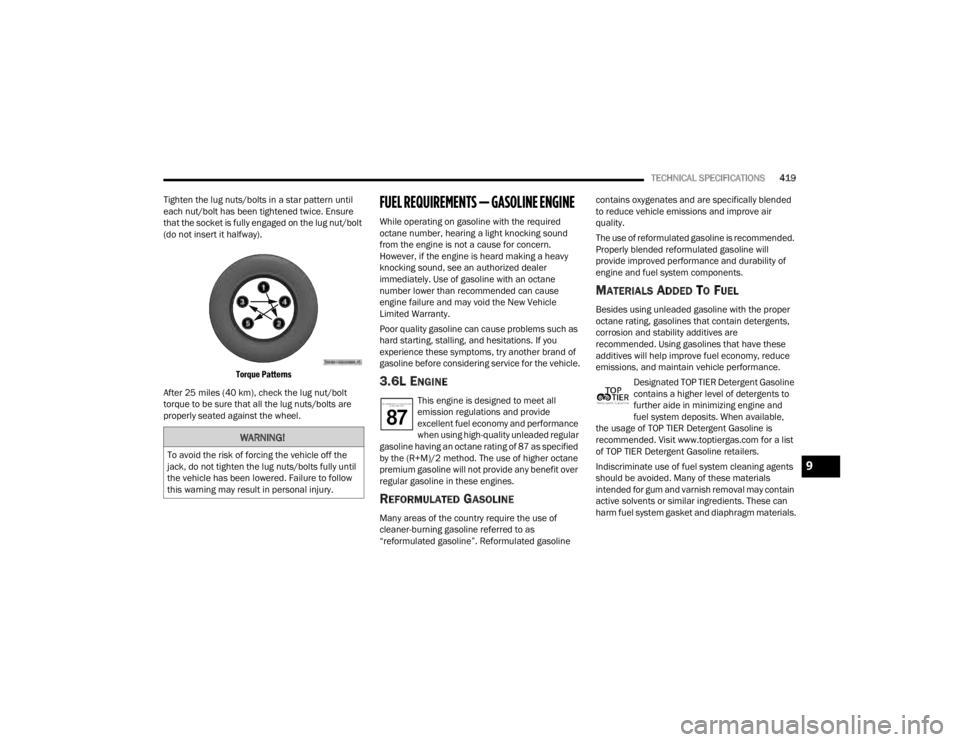
Tighten the lug nuts/bolts in a star pattern until
each nut/bolt has been tightened twice. Ensure
that the socket is fully engaged on the lug nut/bolt
(do not insert it halfway).
Torque Patterns
After 25 miles (40 km), check the lug nut/bolt
torque to be sure that all the lug nuts/bolts are
properly seated against the wheel.
FUEL REQUIREMENTS — GASOLINE ENGINE
While operating on gasoline with the required
octane number, hearing a light knocking sound
from the engine is not a cause for concern.
However, if the engine is heard making a heavy
knocking sound, see an authorized dealer
immediately. Use of gasoline with an octane
number lower than recommended can cause
engine failure and may void the New Vehicle
Limited Warranty.
Poor quality gasoline can cause problems such as
hard starting, stalling, and hesitations. If you
experience these symptoms, try another brand of
gasoline before considering service for the vehicle.
3.6L ENGINE
This engine is designed to meet all
emission regulations and provide
excellent fuel economy and performance
when using high-quality unleaded regular
gasoline having an octane rating of 87 as specified
by the (R+M)/2 method. The use of higher octane
premium gasoline will not provide any benefit over
regular gasoline in these engines.
REFORMULATED GASOLINE
Many areas of the country require the use of
cleaner-burning gasoline referred to as
“reformulated gasoline”. Reformulated gasoline contains oxygenates and are specifically blended
to reduce vehicle emissions and improve air
quality.
The use of reformulated gasoline is recommended.
Properly blended reformulated gasoline will
provide improved performance and durability of
engine and fuel system components.
MATERIALS ADDED TO FUEL
Besides using unleaded gasoline with the proper
octane rating, gasolines that contain detergents,
corrosion and stability additives are
recommended. Using gasolines that have these
additives will help improve fuel economy, reduce
emissions, and maintain vehicle performance.
Designated TOP TIER Detergent Gasoline
contains a higher level of detergents to
further aide in minimizing engine and
fuel system deposits. When available,
the usage of TOP TIER Detergent Gasoline is
recommended. Visit www.toptiergas.com for a list
of TOP TIER Detergent Gasoline retailers.
Indiscriminate use of fuel system cleaning agents
should be avoided. Many of these materials
intended for gum and varnish removal may contain
active solvents or similar ingredients. These can
harm fuel system gasket and diaphragm materials.
WARNING!
To avoid the risk of forcing the vehicle off the
jack, do not tighten the lug nuts/bolts fully until
the vehicle has been lowered. Failure to follow
this warning may result in personal injury.9
23_JT_OM_EN_USC_t.book Page 419
Page 422 of 448

420TECHNICAL SPECIFICATIONS
(Continued)
GASOLINE/OXYGENATE BLENDS
Some fuel suppliers blend unleaded gasoline with
oxygenates such as ethanol.
Problems that result from using gasoline
containing more than 15% ethanol (E-15) or
gasoline containing methanol are not the
responsibility of the manufacturer and may void
the New Vehicle Limited Warranty.
DO NOT USE E-85 IN NON-FLEX FUEL
V
EHICLES
Non-Flex Fuel Vehicles (FFV) are compatible with
gasoline containing up to 15% ethanol (E-15). Use
of gasoline with higher ethanol content may void
the New Vehicle Limited Warranty. If a Non-FFV vehicle is inadvertently fueled with
E-85 fuel, the engine will have some or all of these
symptoms:
Operate in a lean mode.
OBD II Malfunction Indicator Light on.
Poor engine performance.
Poor cold start and cold drivability.
Increased risk for fuel system component corro
-
sion.
CNG AND LP FUEL SYSTEM
M
ODIFICATIONS
Modifications that allow the engine to run on
Compressed Natural Gas (CNG) or Liquid Propane
(LP) may result in damage to the engine,
emissions, and fuel system components. Problems
that result from running CNG or LP are not the
responsibility of the manufacturer and may void
the New Vehicle Limited Warranty.
METHYLCYCLOPENTADIENYL
M
ANGANESE TRICARBONYL (MMT) IN
G
ASOLINE
MMT is a manganese-containing metallic additive
that is blended into some gasolines to increase
octane. Gasoline blended with MMT provides no
performance advantage beyond gasoline of the
same octane number without MMT. Gasoline blended with MMT reduces spark plug life and
reduces emissions system performance in some
vehicles. The manufacturer recommends that
gasoline without MMT be used in your vehicle. The
MMT content of gasoline may not be indicated on
the gasoline pump; therefore, you should ask your
gasoline retailer whether the gasoline contains
MMT. MMT is prohibited in Federal law and
California reformulated gasoline.
FUEL SYSTEM CAUTIONS
CAUTION!
DO NOT use E-85, gasoline containing methanol,
or gasoline containing more than 15% ethanol
(E-15). Use of these blends may result in starting
and drivability problems, damage critical fuel
system components, cause emissions to exceed
the applicable standard, and/or cause the
Malfunction Indicator Light to illuminate. Please
observe pump labels as they should clearly
communicate if a fuel contains greater than
15% ethanol (E-15).
CAUTION!
Follow these guidelines to maintain your
vehicle’s performance:
The use of leaded gasoline is prohibited by
Federal law. Using leaded gasoline can impair
engine performance and damage the emis
-
sions control system.
An out-of-tune engine, certain fuel or ignition
malfunctions can cause the catalytic
converter to overheat. If you notice a pungent
burning odor or some light smoke, your engine
may be out-of-tune or malfunctioning and may
require immediate service. Contact an autho -
rized dealer for service assistance.
23_JT_OM_EN_USC_t.book Page 420
Page 423 of 448
TECHNICAL SPECIFICATIONS421
NOTE:Intentional tampering with the emissions control
system can result in civil penalties being assessed
against you.
FUEL REQUIREMENTS – DIESEL ENGINE
Federal law requires that you must fuel this vehicle
with Ultra Low Sulfur Highway Diesel fuel (15 ppm
Sulfur maximum) and prohibits the use of Low
Sulfur Highway Diesel fuel (500 ppm Sulfur
maximum) to avoid damage to the emissions
control system.
Use good quality diesel fuel from a reputable
supplier in your vehicle. For most year-round
service, Number 2 diesel fuel meeting ASTM
(formerly known as the American Society for
Testing and Materials) specification D-975 Grade
S15 will provide good performance. If the vehicle is exposed to extreme cold (below 20°F or -7°C), or
is required to operate at colder-than-normal
conditions for prolonged periods, use climatized
Number 2 diesel fuel or dilute the Number 2 diesel
fuel with 50% Number 1 diesel fuel. This will
provide better protection from fuel gelling or
wax-plugging of the fuel filters.
Diesel fuel is seldom completely free of water. To
prevent fuel system trouble, drain the
accumulated water from the fuel/water separator
using the fuel/water separator drain provided on
the fuel filter housing. If you buy good quality fuel
and follow the listed cold weather
recommendations, fuel conditioners should not be
required in your vehicle. If available in your area, a
high cetane “premium” diesel fuel may offer
improved cold-starting and warm-up performance.
DIESEL FUEL SPECIFICATIONS
This diesel engine has been developed to take
advantage of the high energy content and
generally lower cost Number 2 Ultra Low Sulfur
diesel fuel or Number 2 Ultra Low Sulfur climatized
diesel fuels.
NOTE:
If you accidentally fill the fuel tank with gasoline
or DEF on your diesel vehicle, do not start the
engine. Damage to the engine and fuel system
could occur. Please call an authorized dealer for
service.
A maximum blend of 5% biodiesel meeting
ASTM specification D-975 may be used with
your diesel engine without any adjustments to
regular service schedules.
Commercially available fuel additives are not
necessary for the proper operation of your
diesel engine.
Number 1 Ultra Low Sulfur diesel fuel should
only be used where extended arctic conditions
(-10°F or -23°C) exist.
The use of fuel additives, which are now being
sold as octane enhancers, is not recom
-
mended. Most of these products contain high
concentrations of methanol. Fuel system
damage or vehicle performance problems
resulting from the use of such fuels or addi -
tives is not the responsibility of The manufac -
turer and may void or not be covered under
the New Vehicle Limited Warranty.
CAUTION!
WARNING!
Do not use alcohol or gasoline as a fuel blending
agent. They can be unstable under certain
conditions and hazardous or explosive when
mixed with diesel fuel.
CAUTION!
If the Water in Fuel Indicator Light remains on,
DO NOT START engine before you drain the water
from the fuel filter(s) to avoid engine damage
Ú page 368.
9
23_JT_OM_EN_USC_t.book Page 421