height JEEP GRAND CHEROKEE 2023 User Guide
[x] Cancel search | Manufacturer: JEEP, Model Year: 2023, Model line: GRAND CHEROKEE, Model: JEEP GRAND CHEROKEE 2023Pages: 424, PDF Size: 15.48 MB
Page 137 of 424
STARTING AND OPERATING135
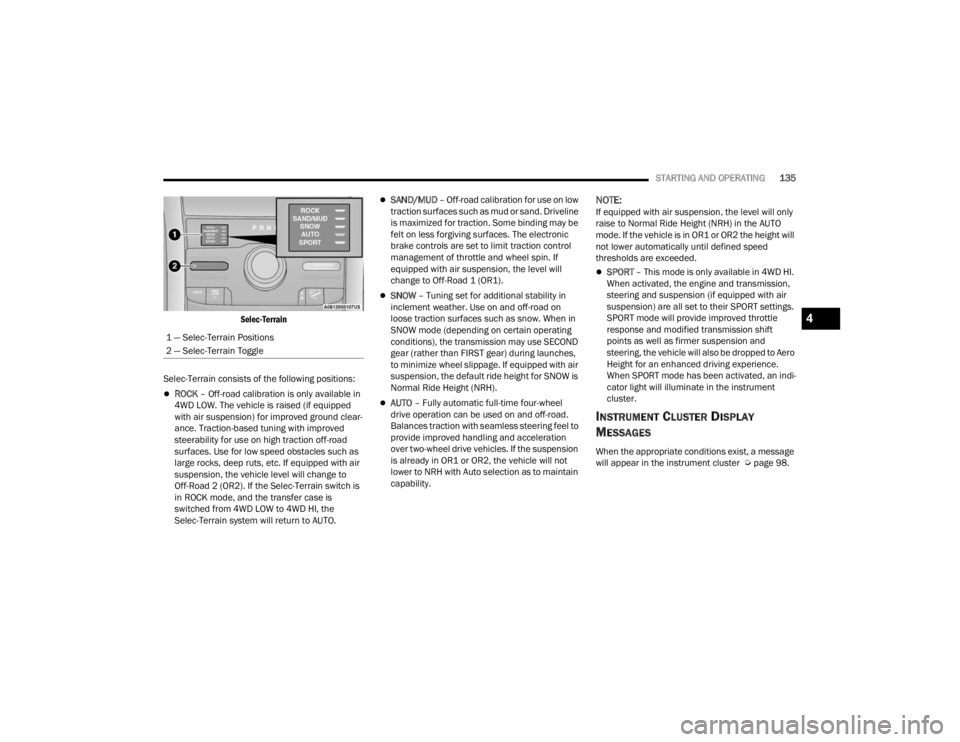
Selec-Terrain
Selec-Terrain consists of the following positions:
ROCK – Off-road calibration is only available in
4WD LOW. The vehicle is raised (if equipped
with air suspension) for improved ground clear -
ance. Traction-based tuning with improved
steerability for use on high traction off-road
surfaces. Use for low speed obstacles such as
large rocks, deep ruts, etc. If equipped with air
suspension, the vehicle level will change to
Off-Road 2 (OR2). If the Selec-Terrain switch is
in ROCK mode, and the transfer case is
switched from 4WD LOW to 4WD HI, the
Selec-Terrain system will return to AUTO.
SAND/MUD – Off-road calibration for use on low
traction surfaces such as mud or sand. Driveline
is maximized for traction. Some binding may be
felt on less forgiving surfaces. The electronic
brake controls are set to limit traction control
management of throttle and wheel spin. If
equipped with air suspension, the level will
change to Off-Road 1 (OR1).
SNOW – Tuning set for additional stability in
inclement weather. Use on and off-road on
loose traction surfaces such as snow. When in
SNOW mode (depending on certain operating
conditions), the transmission may use SECOND
gear (rather than FIRST gear) during launches,
to minimize wheel slippage. If equipped with air
suspension, the default ride height for SNOW is
Normal Ride Height (NRH).
AUTO – Fully automatic full-time four-wheel
drive operation can be used on and off-road.
Balances traction with seamless steering feel to
provide improved handling and acceleration
over two-wheel drive vehicles. If the suspension
is already in OR1 or OR2, the vehicle will not
lower to NRH with Auto selection as to maintain
capability.
NOTE:If equipped with air suspension, the level will only
raise to Normal Ride Height (NRH) in the AUTO
mode. If the vehicle is in OR1 or OR2 the height will
not lower automatically until defined speed
thresholds are exceeded.
SPORT – This mode is only available in 4WD HI.
When activated, the engine and transmission,
steering and suspension (if equipped with air
suspension) are all set to their SPORT settings.
SPORT mode will provide improved throttle
response and modified transmission shift
points as well as firmer suspension and
steering, the vehicle will also be dropped to Aero
Height for an enhanced driving experience.
When SPORT mode has been activated, an indi -
cator light will illuminate in the instrument
cluster.
INSTRUMENT CLUSTER DISPLAY
M
ESSAGES
When the appropriate conditions exist, a message
will appear in the instrument cluster Ú page 98.
1 — Selec-Terrain Positions
2 — Selec-Terrain Toggle
4
23_WL_OM_EN_USC_t.book Page 135
Page 138 of 424
136STARTING AND OPERATING
QUADRA-LIFT — IF EQUIPPED
DESCRIPTION
The Quadra-Lift Air Suspension system provides
full time load leveling capability along with the
benefit of vehicle height adjustment by a toggle
switch. The vehicle will automatically raise and
lower the ride height to adapt to the appropriate
driving conditions. At higher speeds, the vehicle
will lower to an aerodynamic ride height and when
operating in off-road modes, the vehicle will raise
the ride height accordingly. The buttons near the
terrain switch in the center console area can be
used to set preferred ride height to match the
appropriate conditions.
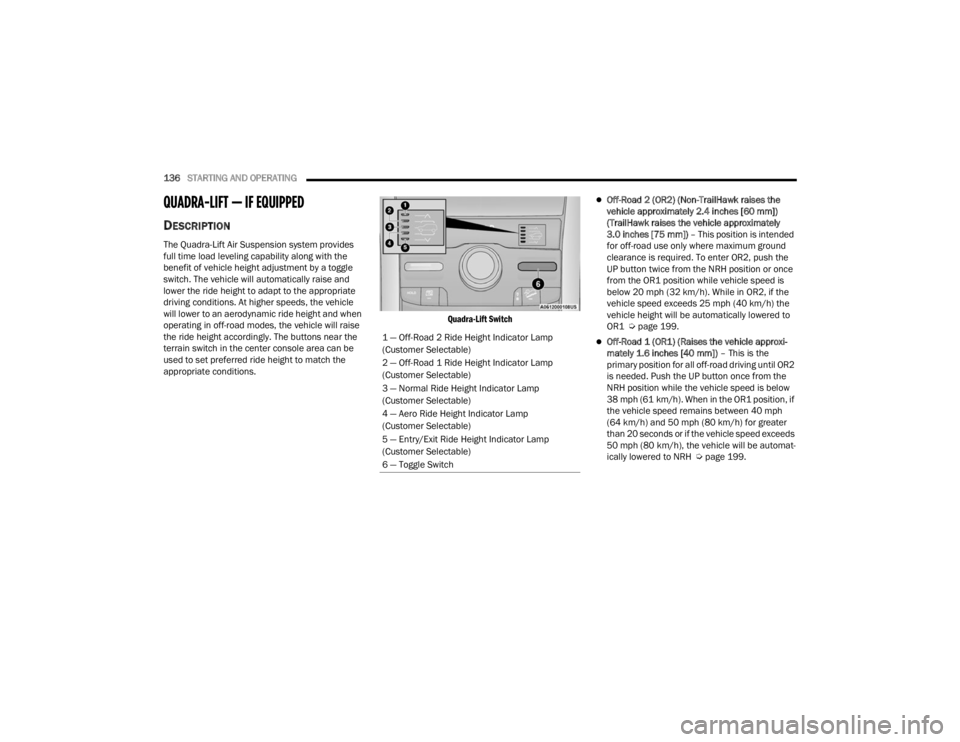
Quadra-Lift Switch
Off-Road 2 (OR2) (Non-TrailHawk raises the
vehicle approximately 2.4 inches [60 mm])
(TrailHawk raises the vehicle approximately
3.0 inches [75 mm])
– This position is intended
for off-road use only where maximum ground
clearance is required. To enter OR2, push the
UP button twice from the NRH position or once
from the OR1 position while vehicle speed is
below 20 mph (32 km/h). While in OR2, if the
vehicle speed exceeds 25 mph (40 km/h) the
vehicle height will be automatically lowered to
OR1 Ú page 199.
Off-Road 1 (OR1) (Raises the vehicle approxi -
mately 1.6 inches [40 mm]) – This is the
primary position for all off-road driving until OR2
is needed. Push the UP button once from the
NRH position while the vehicle speed is below
38 mph (61 km/h). When in the OR1 position, if
the vehicle speed remains between 40 mph
(64 km/h) and 50 mph (80 km/h) for greater
than 20 seconds or if the vehicle speed exceeds
50 mph (80 km/h), the vehicle will be automat -
ically lowered to NRH Ú page 199.
1 — Off-Road 2 Ride Height Indicator Lamp
(Customer Selectable)
2 — Off-Road 1 Ride Height Indicator Lamp
(Customer Selectable)
3 — Normal Ride Height Indicator Lamp
(Customer Selectable)
4 — Aero Ride Height Indicator Lamp
(Customer Selectable)
5 — Entry/Exit Ride Height Indicator Lamp
(Customer Selectable)
6 — Toggle Switch
23_WL_OM_EN_USC_t.book Page 136
Page 139 of 424

STARTING AND OPERATING137
Normal Ride Height (NRH) 0.0 inches (0 mm) –
This is the standard position of the suspension
and is meant for normal driving.
Aero Height (Lowers the vehicle approximately
-0.8 inches [-21 mm] Front and -1.0 inches
[-25 mm] Rear) – This position provides
improved aerodynamics by lowering the vehicle.
The vehicle will automatically enter Aero when
the vehicle speed remains between 62 mph
(100 km/h) and 66 mph (106 km/h) for greater
than 20 seconds or if the vehicle speed exceeds
66 mph (106 km/h). The vehicle will return to
NRH from Aero if the vehicle speed remains
between 30 mph (48 km/h) and 35 mph
(56 km/h) for greater than 20 seconds or if the
vehicle speed falls below 30 mph (48 km/h).
The vehicle will enter Aero, regardless of vehicle
speed if the vehicle is in SPORT mode.
Entry/Exit Height (Lowers the vehicle approxi -
mately -1.8 inches [-46 mm] Front and
-2.0 inches [-50 mm] Rear) – This position
lowers the vehicle for easier passenger entry
and exit as well as lowering the rear of the
vehicle for easier loading and unloading of
cargo. To enter Entry/Exit, push the DOWN
button twice from NRH while the vehicle speed
is below 4 mph (6 km/h). To exit Entry/Exit,
push the UP button twice while in Entry/Exit or
drive the vehicle over 6 mph (10 km/h).
NOTE:Automatic lowering of the vehicle into Entry/Exit
can be enabled through the Uconnect Touch -
screen Radio by selecting the “Auto Entry/Exit”
setting. If this feature is enabled, the vehicle will
only lower if the gear selector is in PARK, the
terrain switch is in AUTO, the transfer case is in
AUTO and the vehicle level is either in Normal or
Aero Height. The vehicle will not automatically
lower to Entry/Exit height if the air suspension level
is in OR2 or OR1. If the vehicle is equipped with
Intrusion Theft Module (ITM), the lowering will be
suppressed when the ignition is switched OFF and
the door is open to prevent setting the alarm off.
The Selec-Terrain system will automatically change
the vehicle to the proper height based on the
position of the Selec-Terrain switch. The height can
be changed from the default Selec-Terrain setting
by normal use of the air suspension buttons
Ú page 134.
The system requires that the engine be running for
all changes. When lowering the vehicle all of the
doors must be closed. If a door is opened at any
time while the vehicle is lowering the change will
not be completed until the open door(s) is/are
closed.
The Quadra-Lift Air Suspension system uses a
lifting and lowering pattern which keeps the
headlights from incorrectly shining into oncoming
traffic. When raising the vehicle, the rear of the vehicle will move up first and then the front. When
lowering the vehicle, the front will move down first
and then the rear.
After the engine is turned off, it may be noticed that
the air suspension system operates briefly; this is
normal. The system is correcting the position of the
vehicle to ensure a proper appearance.
To assist with changing a spare tire, the
Quadra-Lift Air Suspension system has a feature
which allows the automatic leveling to be disabled
Ú
page 204.
Default Ride Height
Select Aero Height or Normal Ride Height as the
default for all vehicle speeds and operation.
This is the selected height that the suspension
will level for speed changes (e.g. raising from
Entry/Exit Height at speed, lowering from Off
Road Height at speed, etc.).
Default ride height can be changed by manually
adjusting the ride height switch to Normal Ride
Height or Aero Height and staying in the
selected height for 2.5 seconds. It will be stored
as the default ride height and the height will be
maintained until a new default ride height is
selected.
If equipped with a touchscreen radio, all enabling/
disabling of air suspension features must be done
through the radio Ú page 204.
4
23_WL_OM_EN_USC_t.book Page 137
Page 140 of 424

138STARTING AND OPERATING
AIR SUSPENSION MODES
The Air Suspension system has multiple modes to
protect the system in unique situations:
Tire/Jack Mode
To assist with changing a spare tire, the air
suspension system has a feature which allows the
automatic leveling to be disabled Ú page 204.
NOTE:This mode is intended to be enabled with the
ignition on.
Auto Entry/Exit Mode
To assist in entering and exiting the vehicle, the air
suspension system has a feature which
automatically lowers the vehicle to Entry/Exit ride
height Úpage 204.
NOTE:This mode is intended to be enabled with the
ignition on. Transport Mode
To assist with flat bed towing, the air suspension
system has a feature which will put the vehicle into
Entry/Exit height and disable the automatic load
leveling system Ú
page 204.
NOTE:This mode is intended to be enabled with the
ignition on.
Suspension Display Messages Mode
The “Suspension Display Messages” setting allows
you to only display suspension warnings
Úpage 204.
NOTE:This mode is intended to be enabled with the
ignition on.
Wheel Alignment Mode
Before performing a wheel alignment this mode
must be enabled Ú page 204.
NOTE:This mode is intended to be enabled with the
ignition on.
If equipped with a touchscreen radio, all enabling/
disabling of air suspension features must be done
through the radio Ú page 204.
INSTRUMENT CLUSTER DISPLAY
M
ESSAGES
When the appropriate conditions exist, a message
will appear in the instrument cluster Ú page 98.
OPERATION
The indicator lamps 1 through 5 will illuminate to
show the current position of the vehicle. Flashing
indicator lamps will show a position which the
system is working to achieve. When raising, if
multiple indicator lamps are flashing while raising,
the highest flashing indicator lamp is the position
the system is working to achieve. When lowering, if
multiple indicators are flashing while lowering, the
lowest solid indicator lamp is the position the
system is working to achieve.
Toggle up once will move the suspension one
position higher from the current position,
assuming all conditions are met (i.e. ignition on,
speed below threshold, etc). Toggle up can be
pushed multiple times. Each toggle up will raise
the requested level by one position up to a
maximum position of OR2 or the highest position
allowed based on current conditions (i.e. vehicle
speed, etc).
Toggle down once will move the suspension one
position lower from the current level, assuming all
conditions are met (i.e. ignition on, doors closed,
speed below threshold, etc). Toggle down can be
WARNING!
The air suspension system uses a high pressure
volume of air to operate the system. To avoid
personal injury or damage to the system, see an
authorized dealer for service.
23_WL_OM_EN_USC_t.book Page 138
Page 141 of 424

STARTING AND OPERATING139
pushed multiple times. Each toggle down will lower
the requested level by one position down to a
minimum of Entry/Exit Height or the lowest
position allowed based on current conditions (i.e.
vehicle speed, etc.)
Automatic height changes will occur based on
vehicle speed and the current vehicle height. The
indicator lamps and instrument cluster display
messages will operate the same for automatic
changes and user requested changes.
Off-Road 2 (OR2) Ride Height – Indicator lamps
1 through 5 will be illuminated.
Off-Road 1 (OR1) Ride Height – Indicator lamps
2 through 5 will be illuminated.
Normal Ride Height (NRH) – Indicator lamps 3
through 5 will be illuminated.
Aero Ride Height– Indicator lamps 4 and 5 will
be illuminated.
Entry/Exit Ride Height– Indicator lamp 5 will be
illuminated.
Transport Mode – Indicator lamp 5 will be illumi -
nated. Driving above 3 mph (5 km/h) or dese -
lecting setting in the radio will disable Transport
Mode.
Tire/Jack Mode – Indicator lamps 3 through
5 will be illuminated. Driving above 5 mph
(8 km/h) or deselecting setting in the radio will
disable Tire/Jack Mode.
Wheel Alignment Mode – Indicator lamps 3
through 5 will be illuminated. Driving above
5 mph (8 km/h) or deselecting setting in the
radio will disable Wheel Alignment Mode.
FUEL SAVER TECHNOLOGY 5.7L ONLY —
IF EQUIPPED
This feature offers improved fuel economy by
shutting off four of the engine's eight cylinders
during light load and cruise conditions. The system
is automatic with no driver inputs or additional
driving skills required.
NOTE:This system may take some time to return to full
functionality after a battery disconnect.
POWER STEERING
The electric power steering system provides
enhanced vehicle response and increased ease of
maneuverability in tight spaces. The power
steering system adapts to different driving
conditions. If the electric power steering system
experiences a fault that prevents it from providing
assistance, you will still have the ability to steer the
vehicle manually.
NOTE:Alternate electric power steering efforts (Normal,
Comfort and Sport) can be selected through the
Uconnect System Ú page 204. If SPORT mode is
selected, steering efforts are optimized for sporty
driving.
If the Electric Power Steering warning
icon is displayed and the “Service Power
Steering” or the “Power Steering Assist
Off – Service System” message is
displayed within the instrument cluster display,
this indicates the vehicle needs to be taken to the
dealer for service Ú page 108.
NOTE:
Even if the power steering assistance is no
longer operational, it is still possible to steer the
vehicle. Under these conditions there will be a
substantial increase in steering effort, espe -
cially at low speeds and during parking maneu -
vers.
If the condition persists, see an authorized
dealer for service.
WARNING!
Continued operation with reduced assist could
pose a safety risk to yourself and others. Service
should be obtained as soon as possible.
4
23_WL_OM_EN_USC_t.book Page 139
Page 181 of 424
STARTING AND OPERATING179
(Continued)
The Night Vision alert status telltale will
be gray when the warnings are
suppressed. The telltale will also turn
gray to indicate that the alerts are
suppressed due to environmental factors (e.g.
daylight hours, external temperature is greater
than 86°F (30°C)) or if the gear selector is in
REVERSE. When the Night Vision alerts are active,
the telltale will be green Ú page 108.
Camera Washers
When the front window washer is activated, the
Night Vision camera will also be washed
Ú page 64.
DETECTION RANGE
The system can detect people 4 ft (1.25 m) tall or
greater in the upright position. The system can also
detect animals that are four-legged and 3 ft (1 m)
tall or greater in the upright position.
The detection distance for the system is between
26 ft (8 m) and 328 ft (100 m) from the front of the
vehicle.
The system may not be able to detect pedestrians
or animals in the following situations:
Pedestrian/animal is outside of the detection
range
Pedestrian/animal is fully or partially covered
Pedestrian/animal does not reach the minimum
detection height
NOTE:Other objects on the road that meet the height/
shape/temperature (e.g. sun exposure) of pedes -
trians/animals may be detected and classified as
targets.
WARNING!
Do not jerk the steering wheel in response to
a warning.
Never attempt to swerve around animals if
doing so would endanger you or others.
Do not stare at the image while driving. You
could crash and you or others could be
injured.
The Night Vision system only provides alerts to
objects of interest and cannot serve as a
substitute for the driver’s personal judgment.
The warnings are meant to direct your atten-
tion to the detected objects, but the Night
Vision system does not automatically brake
the vehicle and may not provide a warning
with enough time to help avoid a crash.
Warnings are only provided if a pedestrian or
large animal is detected by the system.
It is always the driver’s responsibility to be
attentive of road, traffic, and weather condi -
tions, vehicle speed, distance to the vehicle
ahead, and most importantly, brake opera -
tion, to ensure safe operation of the vehicle
under all road conditions. Your complete
attention is always required while driving to
maintain safe control of your vehicle.
WARNING!
4
23_WL_OM_EN_USC_t.book Page 179
Page 188 of 424

186STARTING AND OPERATING
(Continued)
Gross Combination Weight Rating (GCWR)
The GCWR is the total allowable weight of your
vehicle and trailer when weighed in combination.
Gross Axle Weight Rating (GAWR)
The GAWR is the maximum capacity of the front
and rear axles. Distribute the load over the front
and rear axles evenly. Make sure that you do not
exceed either front or rear GAWR Úpage 184.
Tongue Weight (TW)
The TW is the downward force exerted on the hitch
ball by the trailer. You must consider this as part of
the load on your vehicle.
Trailer Frontal Area
The frontal area is the maximum height multiplied
by the maximum width of the front of a trailer.
Trailer Sway Control (TSC)
The TSC can be a mechanical telescoping link that
can be installed between the hitch receiver and the
trailer tongue that typically provides adjustable
friction associated with the telescoping motion to
dampen any unwanted trailer swaying motions
while traveling.
The electronic TSC (if equipped) recognizes a
swaying trailer and automatically applies individual
wheel brakes and/or reduces engine power to
attempt to eliminate the trailer sway.
Weight-Carrying Hitch
A weight-carrying hitch supports the trailer tongue
weight, just as if it were luggage located at a hitch
ball or some other connecting point of the vehicle.
These kinds of hitches are used to tow small and
medium sized trailers.
Weight-Distributing Hitch
A weight-distributing system works by applying
leverage through spring (load) bars. They are
typically used for heavier loads to distribute trailer
tongue weight to the tow vehicle's front axle and
the trailer axle(s). When used in accordance with
the manufacturer's directions, it provides for a
more level ride, offering more consistent steering
and brake control thereby enhancing towing
safety. The addition of a friction/hydraulic sway
control also dampens sway caused by traffic and
crosswinds and contributes positively to tow
vehicle and trailer stability. Trailer Sway Control
(TSC) and a weight-distributing (load equalizing)
hitch are recommended for heavier Tongue
Weights (TW) and may be required depending on
vehicle and trailer configuration/loading to comply
with Gross Axle Weight Rating (GAWR)
requirements.
WARNING!
It is important that you do not exceed the
maximum front or rear GAWR. A dangerous
driving condition can result if either rating is
exceeded. You could lose control of the vehicle
and have a collision.
WARNING!
If the gross trailer weight is 5,000 lb
(2,267 kg) or more, it is recommended to use
a weight-distributing hitch to ensure stable
handling of your vehicle. If you use a standard
weight-carrying hitch, you could lose control of
your vehicle and cause a collision.
23_WL_OM_EN_USC_t.book Page 186
Page 189 of 424
STARTING AND OPERATING187
RECOMMENDED DISTRIBUTION HITCH
ADJUSTMENT
1. Verify that the vehicle is at the Normal Ride
Height.
NOTE:The vehicle must remain in the engine run position
with all doors closed while attaching a trailer for
proper leveling of the air suspension system.
2. Position the vehicle to be ready to connect to the trailer (do not connect the trailer). 3. For vehicles equipped with Quadra-Lift air
suspension, use the touchscreen radio
settings to enable Tire/Jack mode. Tire/Jack
mode will be canceled and the procedure must
be restarted if the vehicle is driven at speeds
above 5mph (8 km/h).
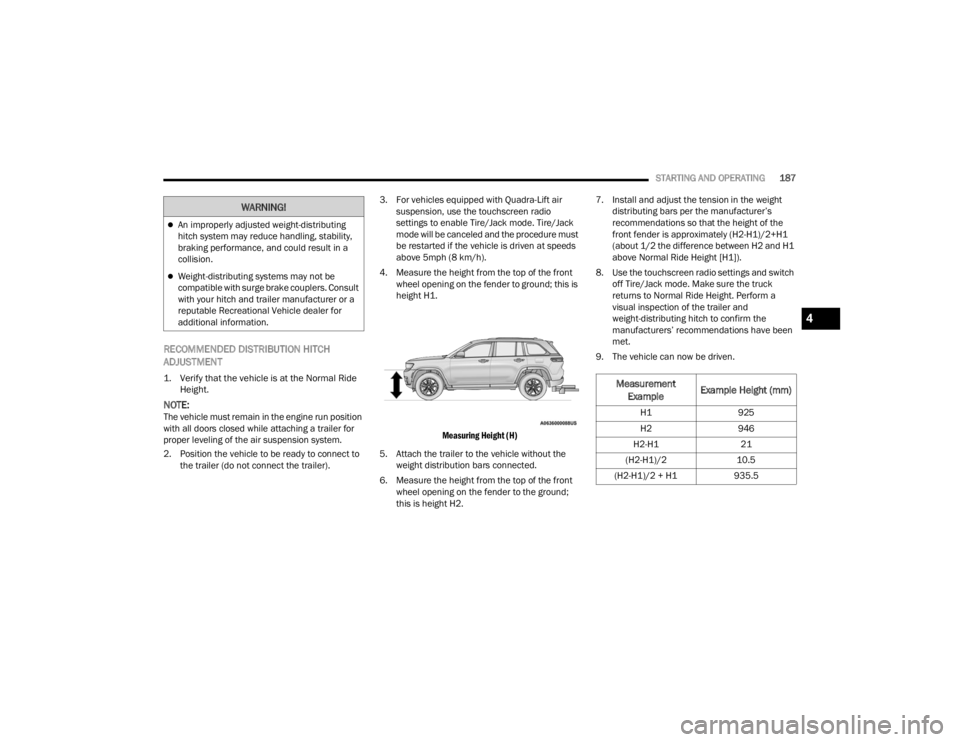
4. Measure the height from the top of the front wheel opening on the fender to ground; this is
height H1.
Measuring Height (H)
5. Attach the trailer to the vehicle without the weight distribution bars connected.
6. Measure the height from the top of the front wheel opening on the fender to the ground;
this is height H2. 7. Install and adjust the tension in the weight
distributing bars per the manufacturer’s
recommendations so that the height of the
front fender is approximately (H2-H1)/2+H1
(about 1/2 the difference between H2 and H1
above Normal Ride Height [H1]).
8. Use the touchscreen radio settings and switch off Tire/Jack mode. Make sure the truck
returns to Normal Ride Height. Perform a
visual inspection of the trailer and
weight-distributing hitch to confirm the
manufacturers’ recommendations have been
met.
9. The vehicle can now be driven.
An improperly adjusted weight-distributing
hitch system may reduce handling, stability,
braking performance, and could result in a
collision.
Weight-distributing systems may not be
compatible with surge brake couplers. Consult
with your hitch and trailer manufacturer or a
reputable Recreational Vehicle dealer for
additional information.
WARNING!
Measurement Example Example Height (mm)
H1
925
H2 946
H2-H1 21
(H2-H1)/2 10.5
(H2-H1)/2 + H1 935.5
4
23_WL_OM_EN_USC_t.book Page 187
Page 197 of 424

STARTING AND OPERATING195
RECREATIONAL TOWING (BEHIND MOTORHOME)
TOWING THIS VEHICLE BEHIND ANOTHER VEHICLE
NOTE:
When towing your vehicle, always follow applicable state and provincial laws. Contact state and provincial Highway Safety offices for additional details.
Vehicles equipped with Quadra-Lift must be placed in Transport Mode before tying them down (from the body) on a trailer or flatbed truck Úpage 136. If the
vehicle cannot be placed in Transport Mode (for example, engine will not run), tie-downs should be fastened over the tires using specific straps (not to the
body). Failure to follow these instructions may cause fault codes to be set and/or cause loss of proper tie-down tension.
Towing Condition Wheels OFF The Ground Two-Wheel Drive Models Four-Wheel Drive Models
Without 4WD LOW Four-Wheel Drive Models
With 4WD LOW
Flat Tow NONENOT ALLOWEDNOT ALLOWEDSee Instructions
Transmission in PARK
Ensure vehicle is set to
Normal Ride Height — if
equipped
Transfer case in N
(NEUTRAL)
Tow in forward direction
Dolly Tow Front
NOT ALLOWEDNOT ALLOWEDNOT ALLOWED
Rear OKNOT ALLOWEDNOT ALLOWED
On Trailer ALLOKOKOK
4
23_WL_OM_EN_USC_t.book Page 195
Page 198 of 424

196STARTING AND OPERATING
RECREATIONAL TOWING — TWO-WHEEL
D
RIVE MODELS
DO NOT flat tow this vehicle. Damage to the
drivetrain will result.
Recreational towing (for two-wheel drive models) is
allowed ONLY if the rear wheels are OFF the
ground. This may be accomplished using a tow
dolly or vehicle trailer. If using a tow dolly, follow
this procedure:
1. Properly secure the dolly to the tow vehicle,
following the dolly manufacturer's
instructions.
2. Drive the rear wheels onto the tow dolly.
3. Apply the Electric Park Brake. Shift the transmission into PARK.
4. Turn the ignition OFF.
5. Properly secure the rear wheels to the dolly, following the dolly manufacturer’s
instructions.
6. Install a suitable clamping device, designed for towing, to secure the front wheels in the
straight position.
RECREATIONAL TOWING —
Q
UADRA-TRAC I (SINGLE-SPEED
T
RANSFER CASE WITHOUT 4WD LOW
R
ANGE) FOUR-WHEEL DRIVE MODELS
Recreational towing is not allowed. These models
do not have a N (NEUTRAL) position in the transfer
case.
NOTE:This vehicle may be towed on a flatbed or vehicle
trailer provided all four wheels are OFF the ground.
RECREATIONAL TOWING —
Q
UADRA–TRAC II WITH 4WD LOW
R
ANGE
The transfer case must be shifted into N
(NEUTRAL) and the transmission must be in PARK
(P) for recreational towing. The N (NEUTRAL)
selection button is adjacent to the air suspension
switch. Shifts into and out of transfer case N
(NEUTRAL) can take place with the selector switch
in any mode position.
NOTE:
Ensure vehicle is set to Normal Ride Height - if
equipped Ú page 136.
If the vehicle is equipped with Quadra-Lift air
suspension, the engine should be started and
left running for a minimum of 60 seconds (with
all the doors closed) at least once every 24
hours. This process allows the air suspension to
adjust the vehicle’s ride height to compensate
for temperature effects.
CAUTION!
Towing with the rear wheels on the ground will
cause severe transmission damage. Damage
from improper towing is not covered under the
New Vehicle Limited Warranty.
CAUTION!
Towing this vehicle in violation of the above
requirements can cause severe transmission
and/or transfer case damage. Damage from
improper towing is not covered under the New
Vehicle Limited Warranty.
23_WL_OM_EN_USC_t.book Page 196