lights JEEP GRAND CHEROKEE 2023 Repair Manual
[x] Cancel search | Manufacturer: JEEP, Model Year: 2023, Model line: GRAND CHEROKEE, Model: JEEP GRAND CHEROKEE 2023Pages: 424, PDF Size: 15.48 MB
Page 286 of 424
284SAFETY
Knee Impact Bolsters
The Knee Impact Bolsters help protect the knees
of the driver and front passenger, and position the
front occupants for improved interaction with the
front air bags.
Supplemental Driver And Front Passenger
Knee Air Bags
This vehicle is equipped with a Supplemental
Driver Knee Air Bag mounted in the instrument
panel below the steering column and a
Supplemental Passenger Knee Air Bag mounted in
the instrument panel below the glove
compartment. The Supplemental Knee Air Bags
provide enhanced protection during a frontal
impact by working together with the seat belts,
pretensioners, and front air bags.
Supplemental Side Air Bags
Supplemental Seat-Mounted Side Air Bags (SABs)
This vehicle is equipped with Supplemental
Seat-Mounted Side Air Bags (SABs). Supplemental Seat-Mounted Side Air Bags (SABs)
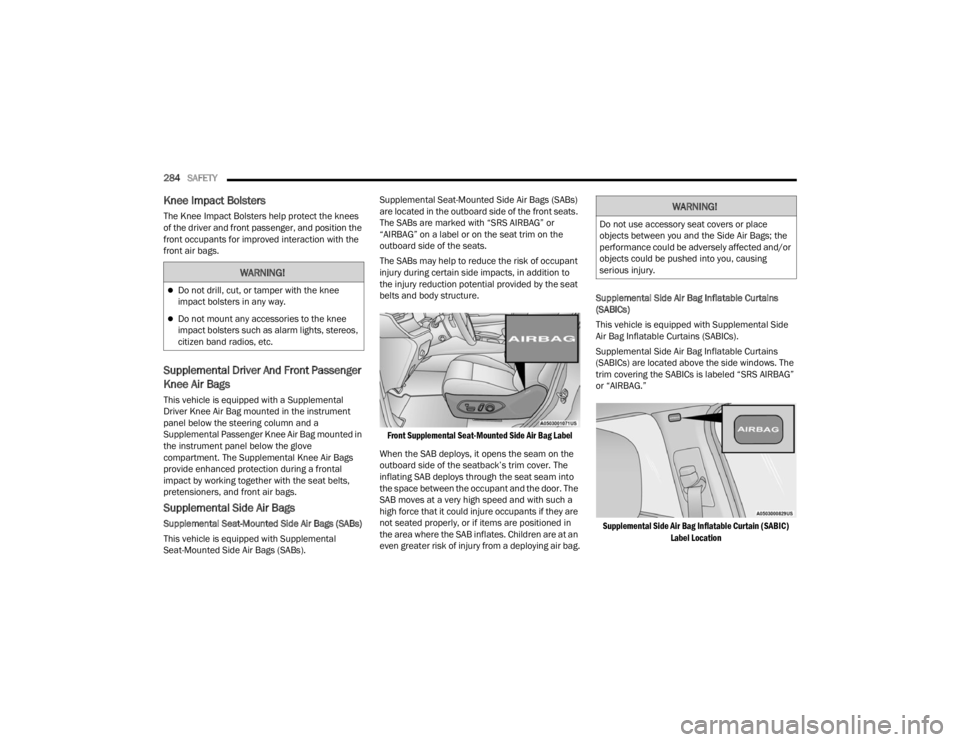
are located in the outboard side of the front seats.
The SABs are marked with “SRS AIRBAG” or
“AIRBAG” on a label or on the seat trim on the
outboard side of the seats.
The SABs may help to reduce the risk of occupant
injury during certain side impacts, in addition to
the injury reduction potential provided by the seat
belts and body structure.
Front Supplemental Seat-Mounted Side Air Bag Label
When the SAB deploys, it opens the seam on the
outboard side of the seatback’s trim cover. The
inflating SAB deploys through the seat seam into
the space between the occupant and the door. The
SAB moves at a very high speed and with such a
high force that it could injure occupants if they are
not seated properly, or if items are positioned in
the area where the SAB inflates. Children are at an
even greater risk of injury from a deploying air bag. Supplemental Side Air Bag Inflatable Curtains
(SABICs)
This vehicle is equipped with Supplemental Side
Air Bag Inflatable Curtains (SABICs).
Supplemental Side Air Bag Inflatable Curtains
(SABICs) are located above the side windows. The
trim covering the SABICs is labeled “SRS AIRBAG”
or “AIRBAG.”
Supplemental Side Air Bag Inflatable Curtain (SABIC) Label Location
WARNING!
Do not drill, cut, or tamper with the knee
impact bolsters in any way.
Do not mount any accessories to the knee
impact bolsters such as alarm lights, stereos,
citizen band radios, etc.
WARNING!
Do not use accessory seat covers or place
objects between you and the Side Air Bags; the
performance could be adversely affected and/or
objects could be pushed into you, causing
serious injury.
23_WL_OM_EN_USC_t.book Page 284
Page 289 of 424
SAFETY287
As the air bags deflate, you may see some
smoke-like particles. The particles are a normal
by-product of the process that generates the
non-toxic gas used for air bag inflation. These
airborne particles may irritate the skin, eyes,
nose, or throat. If you have skin or eye irritation,
rinse the area with cool water. For nose or throat
irritation, move to fresh air. If the irritation
continues, see your doctor. If these particles
settle on your clothing, follow the garment
manufacturer’s instructions for cleaning.
Do not drive your vehicle after the air bags have
deployed. If you are involved in another collision,
the air bags will not be in place to protect you.
NOTE:
Air bag covers may not be obvious in the interior
trim, but they will open during air bag deploy -
ment.
After any collision, the vehicle should be taken
to an authorized dealer immediately.
Enhanced Accident Response System
In the event of an impact, if the communication
network remains intact, and the power remains
intact, depending on the nature of the event, the
Occupant Restraint Controller (ORC) will determine
whether to have the Enhanced Accident Response
System perform the following functions:
Cut off fuel to the engine (if equipped)
Cut off battery power to the electric motor (if
equipped)
Flash hazard lights as long as the battery has
power
Turn on the interior lights, which remain on as
long as the battery has power or for 15 minutes
from the intervention of the Enhanced Accident
Response System
Unlock the power door locks
Your vehicle may also be designed to perform any
of these other functions in response to the
Enhanced Accident Response System:
Turn off the Fuel Filter Heater, Turn off the HVAC
Blower Motor, Close the HVAC Circulation Door
Cut off battery power to the:
Engine
Electric Motor (if equipped)
Electric power steering
Brake booster
Electric park brake
Automatic transmission gear selector
Horn
Front wiper
NOTE:After an accident, remember to cycle the ignition to
the STOP (OFF/LOCK) position and remove the key
from the ignition switch to avoid draining the
battery. Carefully check the vehicle for fuel leaks in
the engine compartment and on the ground near
the engine compartment and fuel tank before
resetting the system and starting the engine. If
there are no fuel leaks or damage to the vehicle
electrical devices (e.g. headlights) after an
accident, reset the system by following the
procedure described here. If you have any doubt,
contact an authorized dealer.
Enhanced Accident Response System
Reset Procedure
If Applicable, refer to the “Hybrid Supplement” for
additional information.
In order to reset the Enhanced Accident Response
System functions after an event, the ignition switch
must be changed from ignition START or ON/RUN
to ignition OFF. Carefully check the vehicle for fuel
leaks in the engine compartment and on the
ground near the engine compartment and fuel
tank before resetting the system and starting the
engine.
WARNING!
Deployed air bags and seat belt pretensioners
cannot protect you in another collision. Have the air
bags, seat belt pretensioners, and the seat belt
retractor assemblies replaced by an authorized
dealer immediately. Also, have the Occupant
Restraint Controller System serviced as well.
6
23_WL_OM_EN_USC_t.book Page 287
Page 307 of 424
SAFETY305
PERIODIC SAFETY CHECKS YOU SHOULD
M
AKE OUTSIDE THE VEHICLE
Tires
Examine tires for excessive tread wear and uneven
wear patterns. Check for stones, nails, glass, or
other objects lodged in the tread or sidewall.
Inspect the tread for cuts and cracks. Inspect
sidewalls for cuts, cracks, and bulges. Check the
lug nut/bolt torque for tightness. Check the tires
(including spare) for proper cold inflation pressure.
Lights
Have someone observe the operation of brake
lights and exterior lights while you work the
controls. Check turn signal and high beam
indicator lights on the instrument panel.
Door Latches
Check for proper closing, latching, and locking.
Fluid Leaks
Check area under the vehicle after overnight
parking for fuel, coolant, oil, or other fluid leaks.
Also, if gasoline fumes are detected or if fuel or
brake fluid leaks are suspected, the cause should
be located and corrected immediately.
EXHAUST GAS
NEVER place any objects under the floor mat
(e.g., towels, keys, etc.). These objects could
change the position of the floor mat and may
cause interference with the accelerator,
brake, or clutch pedals.
If the vehicle carpet has been removed and
re-installed, always properly attach carpet to
the floor and check the floor mat fasteners are
secure to the vehicle carpet. Fully depress
each pedal to check for interference with the
accelerator, brake, or clutch pedals then
re-install the floor mats.
It is recommended to only use mild soap and
water to clean your floor mats. After cleaning,
always check your floor mat has been properly
installed and is secured to your vehicle using
the floor mat fasteners by lightly pulling mat.
WARNING!
WARNING!
Exhaust gases can injure or kill. They contain
carbon monoxide (CO), which is colorless and
odorless. Breathing it can make you
unconscious and can eventually poison you. To
avoid breathing (CO), follow these safety tips:
Do not run the engine in a closed garage or in
confined areas any longer than needed to
move your vehicle in or out of the area.
If you are required to drive with the trunk/lift -
gate/rear doors open, make sure that all
windows are closed and the climate control
BLOWER switch is set at high speed. DO NOT
use the recirculation mode.
If it is necessary to sit in a parked vehicle with
the engine running, adjust your heating or
cooling controls to force outside air into the
vehicle. Set the blower at high speed.
6
23_WL_OM_EN_USC_t.book Page 305
Page 311 of 424
IN CASE OF EMERGENCY309
(Continued)
SOS Call System Limitations
Vehicles sold in Mexico
DO NOT have SOS Call
system capabilities.
SOS or other emergency line operators in Mexico
may not answer or respond to SOS system calls.
If the SOS Call system detects a malfunction, any
of the following may occur at the time the
malfunction is detected, and at the beginning of
each ignition cycle:
The overhead console lights located within the
ASSIST and SOS buttons will continuously illumi -
nate red.
The Device Screen will display the following
message “Vehicle device requires service.
Please contact an authorized dealer.”
An In-Vehicle Audio message will state “Vehicle
device requires service. Please contact an
authorized dealer.”
Even if the SOS Call system is fully functional, factors
beyond FCA US LLC’s control may prevent or stop the
SOS Call system operation. These include, but are not
limited to, the following factors:
The ignition is in the OFF position
The vehicle’s electrical systems are not intact
The SOS Call system software and/or hardware
are damaged during a crash
The vehicle battery loses power or becomes
disconnected during a vehicle crash
LTE (voice/data) or 4G (data) network and/or
Global Positioning Satellite signals are unavail
-
able or obstructed
Equipment malfunction at the SOS operator facility
Operator error by the SOS operator
LTE (voice/data) or 4G (data) network congestion
Weather
Buildings, structures, geographic terrain, or
tunnels
Never place anything on or near the vehicle’s
operable network and GPS antennas. You
could prevent operable network and GPS
signal reception, which can prevent your
vehicle from placing an emergency call. An
operable network and GPS signal reception is
required for the SOS Call system to function
properly.
The SOS Call system is embedded into the
vehicle’s electrical system. Do not add after -
market electrical equipment to the vehicle’s
electrical system. This may prevent your
vehicle from sending a signal to initiate an
emergency call. To avoid interference that can
cause the SOS Call system to fail, never add
aftermarket equipment (e.g., two-way mobile
radio, CB radio, data recorder, etc.) to your
vehicle’s electrical system or modify the
antennas on your vehicle. IF YOUR VEHICLE
LOSES BATTERY POWER FOR ANY REASON
(INCLUDING DURING OR AFTER AN ACCI -
DENT), THE JEEP® CONNECT FEATURES,
APPS AND SERVICES, AMONG OTHERS, WILL
NOT OPERATE.
Modifications to any part of the SOS Call
system could cause the air bag system to fail
when you need it. You could be injured if the
air bag system is not there to help protect you.
WARNING!
WARNING!
Ignoring the overhead console light could
mean you will not have SOS Call services. If
the overhead console light is illuminated, have
an authorized dealer service the SOS Call
system immediately.
The Occupant Restraint Control module turns on
the air bag Warning Light on the instrument panel
if a malfunction in any part of the system is
detected. If the Air Bag Warning Light is illumi -
nated, have an authorized dealer service the
Occupant Restraint Control system immediately.
WARNING!
7
23_WL_OM_EN_USC_t.book Page 309
Page 332 of 424
330
SERVICING AND MAINTENANCE
SCHEDULED SERVICING
Your vehicle is equipped with an automatic oil
change indicator system. The oil change indicator
system will remind you that it is time to take your
vehicle in for scheduled maintenance.
Based on engine operation conditions, the oil
change indicator message will illuminate. This
means that service is required for your vehicle.
Operating conditions such as frequent short-trips,
trailer tow, extremely hot or cold ambient
temperatures, and E85 fuel usage will influence
when the “Oil Change Required” message is
displayed. Have your vehicle serviced as soon as
possible, within the next 500 miles (805 km).An authorized dealer will reset the oil change
indicator message after completing the scheduled
oil change.
NOTE:Under no circumstances should oil change
intervals exceed 10,000 miles (16,000 km),
12 months or 350 hours of engine run time,
whichever comes first. The 350 hours of engine
run or idle time is generally only a concern for fleet
customers.
Once A Month Or Before A Long Trip:
Check engine oil level.
Check windshield washer fluid level.
Check the tire inflation pressures and look for
unusual wear or damage.
Check the fluid levels of the coolant reservoir,
brake master cylinder and fill as needed.
Check function of all interior and exterior lights.
23_WL_OM_EN_USC_t.book Page 330
Page 376 of 424
374SERVICING AND MAINTENANCE
BULB REPLACEMENT
Replacement Bulbs, Names, And Part
Numbers
In the instance a bulb needs to be replaced, this
section includes bulb description and replacement
part numbers.
Interior Bulbs
The Interior lights are LED, for replacement of any
LED lamps, see an authorized dealer.
Exterior Bulbs
The exterior lights are LED, for replacement of any
LED lamps, see an authorized dealer.
TIRES
TIRE SAFETY INFORMATION
Tire safety information will cover aspects of the
following information: Tire Markings, Tire
Identification Numbers, Tire Terminology and
Definitions, Tire Pressures, and Tire Loading.
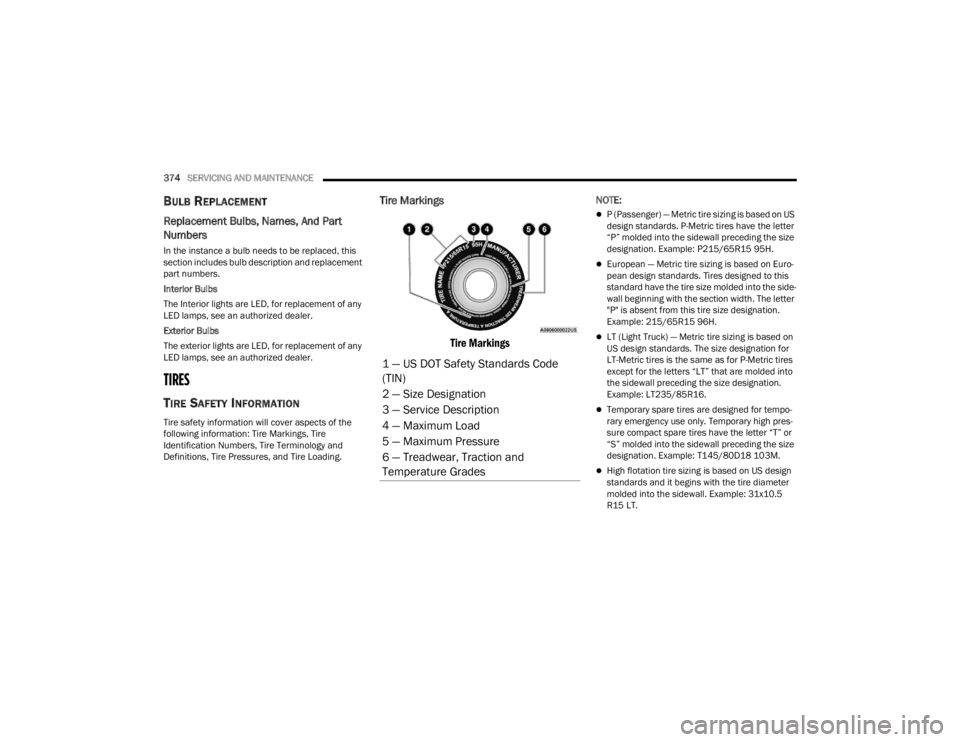
Tire Markings
Tire Markings
NOTE:
P (Passenger) — Metric tire sizing is based on US
design standards. P-Metric tires have the letter
“P” molded into the sidewall preceding the size
designation. Example: P215/65R15 95H.
European — Metric tire sizing is based on Euro -
pean design standards. Tires designed to this
standard have the tire size molded into the side -
wall beginning with the section width. The letter
"P" is absent from this tire size designation.
Example: 215/65R15 96H.
LT (Light Truck) — Metric tire sizing is based on
US design standards. The size designation for
LT-Metric tires is the same as for P-Metric tires
except for the letters “LT” that are molded into
the sidewall preceding the size designation.
Example: LT235/85R16.
Temporary spare tires are designed for tempo -
rary emergency use only. Temporary high pres -
sure compact spare tires have the letter “T” or
“S” molded into the sidewall preceding the size
designation. Example: T145/80D18 103M.
High flotation tire sizing is based on US design
standards and it begins with the tire diameter
molded into the sidewall. Example: 31x10.5
R15 LT.
1 — US DOT Safety Standards Code
(TIN)
2 — Size Designation
3 — Service Description
4 — Maximum Load
5 — Maximum Pressure
6 — Treadwear, Traction and
Temperature Grades
23_WL_OM_EN_USC_t.book Page 374
Page 395 of 424
SERVICING AND MAINTENANCE393
The following maintenance recommendations will
enable you to obtain maximum benefit from the
corrosion resistance built into your vehicle.
What Causes Corrosion?
Corrosion is the result of deterioration or removal
of paint and protective coatings from your vehicle.
The most common causes are:
Road salt, dirt and moisture accumulation.
Stone and gravel impact.
Insects, tree sap and tar.
Salt in the air near seacoast localities.
Atmospheric fallout/industrial pollutants.
BODY AND UNDERBODY MAINTENANCE
Cleaning Headlights
Your vehicle is equipped with plastic headlights
and fog lights that are lighter and less susceptible
to stone breakage than glass headlights.
Plastic is not as scratch resistant as glass and
therefore different lens cleaning procedures must
be followed. To minimize the possibility of scratching the lenses
and reducing light output, avoid wiping with a dry
cloth. To remove road dirt, wash with a mild soap
solution followed by rinsing.
Do not use abrasive cleaning components,
solvents, steel wool or other aggressive material to
clean the lenses.
PRESERVING THE BODYWORK
Washing
Wash your vehicle regularly. Always wash your
vehicle in the shade using Mopar® Car Wash, or
a mild car wash soap, and rinse the panels
completely with water.
If insects, tar, or other similar deposits have
accumulated on your vehicle, use Mopar®
Super Kleen Bug and Tar Remover to remove.
Use a high quality cleaner wax, such as Mopar®
Cleaner Wax to remove road film, stains and to
protect your paint finish. Use precautions to not
scratch the paint.
Avoid using abrasive compounds and power
buffing that may diminish the gloss or thin out
the paint finish.
Special Care
If you drive on salted or dusty roads or if you
drive near the ocean, hose off the undercarriage
at least once a month.
It is important that the drain holes in the lower
edges of the doors, rocker panels, and trunk be
kept clear and open.
If you detect any stone chips or scratches in the
paint, touch them up immediately.
If your vehicle is damaged due to a collision or
similar cause that destroys the paint and protec
-
tive coating, have your vehicle repaired as soon
as possible.
CAUTION!
Do not use abrasive or strong cleaning mate -
rials such as steel wool or scouring powder
that will scratch metal and painted surfaces.
Use of power washers exceeding 1,200 psi
(8,274 kPa) can result in damage or removal
of paint and decals.
8
23_WL_OM_EN_USC_t.book Page 393
Page 412 of 424

410 Anti-Lock Brake System (ABS)
............. 111, 248Anti-Lock Warning Light................................. 111Apps.............................................................. 233Arming System Security Alarm............................................. 26Assist, Hill Start............................................. 254Audio Systems (Radio)......................... 104, 203Auto Down Power Windows............................. 82Auto Hold............................................. 115, 125Automatic Folding Mirrors............................... 53Automatic Headlights...................................... 59Automatic High Beams.................................... 59Automatic Temperature Control (ATC)............. 72Automatic Transmission...................... 119, 127Adding Fluid.............................................. 351Fluid And Filter Change............................. 351Fluid Change............................................. 351Fluid Level Check...................................... 351Fluid Type........................................ 351, 402Special Additives....................................... 351Automatic Transmission Limp Home Mode... 129AutoPark........................................................ 120Autostick........................................................ 130Operation.................................................. 130AUX Cord.......................................................... 77Auxiliary Driving Systems............................... 258
Auxiliary Electrical Outlet (Power Outlet).......... 78Auxiliary Power Outlet...................................... 78Axle Fluid...................................................... 402
B
Battery................................................. 109, 338Charging System Light.............................. 109Keyless Key Fob Replacement.................... 19Battery Saver Feature...................................... 62Belts, Seat.................................................... 303Body Mechanism Lubrication....................... 343Bodywork...................................................... 392B-Pillar Location............................................ 379Brake Assist System..................................... 250Brake Control System, Electronic.................. 250Brake Fluid.......................................... 350, 402Brake System...................................... 350, 396Anti-Lock (ABS)......................................... 396Fluid Check............................................... 350Master Cylinder........................................ 350Parking..................................................... 123Warning Light........................................... 108Brake/Transmission Interlock...................... 127Bulb Replacement........................................ 374Bulbs, Light................................................... 305
C
Camera, Front............................................... 176Camera, Night Vision..................................... 177Camera, Rear....................................... 174, 181Camera, Rear Washer................................... 174Camera, Surround View................................ 181Capacities, Fluid............................................ 400Caps, FillerOil (Engine)............................................... 334Radiator (Coolant Pressure)..................... 348Car Washes................................................... 393Carbon Monoxide Warning................... 305, 306Care And Maintenance................................. 392Cargo Area Cover.............................................92Cargo Area Storage..........................................90Cargo Compartment.........................................90Cargo Tie-Downs..............................................91Cellular Phone............................................... 247Center Console, Front......................................75Center Console, Rear.......................................75Chains, Tire................................................... 389ChargingWireless.......................................................80Chart, Tire Sizing........................................... 375Check Engine Light
(Malfunction Indicator Light)......................... 118
23_WL_OM_EN_USC_t.book Page 410
Page 413 of 424

411
Checking Your Vehicle For Safety
.................. 303Checks, Safety............................................... 303Child Restraint............................................... 289Child Restraints Booster Seats............................................ 291Child Seat Installation............................... 300How To Stow An unused ALR Seat Belt..... 297Infant And Child Restraints....................... 290Locating The LATCH Anchorages............... 295Lower Anchors And Tethers For Children.. 292Older Children And Child Restraints..........291Seating Positions...................................... 292Child Safety Locks........................................... 31Clean Air Gasoline......................................... 398CleaningWheels...................................................... 388Climate Control................................................ 66Automatic.................................................... 66Rear............................................................ 69CNG And LP Fuel System Modifications......... 398Cold Weather Operation................................ 122Compact Spare Tire....................................... 386Contract, Service........................................... 405Cooling Pressure Cap (Radiator Cap).............348
Cooling System............................................. 346Adding Coolant (Antifreeze)...................... 347Coolant Level................................... 348, 349Cooling Capacity....................................... 400Disposal Of Used Coolant......................... 348Drain, Flush, And Refill............................. 347Inspection............................... 347, 348, 349Points To Remember................................ 349Pressure Cap............................................ 348Radiator Cap............................................ 348Selection Of Coolant(Antifreeze)......................... 347, 400, 401Corrosion Protection..................................... 392Cruise Control (Speed Control)..................... 142Cruise Light.......................................... 115, 116Customer Assistance.................................... 403Customer Programmable Features............... 204Cybersecurity................................................ 203
D
Daytime Running Lights................................... 58Defroster, Windshield................................... 304De-Icer, Remote Start...................................... 26De-Icer, Windshield.......................................... 66Diagnostic System, Onboard......................... 117Digital Instrument Cluster ¹.............................. 96
DipsticksOil (Engine)............................................... 337DisposalAntifreeze (Engine Coolant)...................... 348Do Not Use E-85 In Non-Flex Fuel Vehicles... 398Door Ajar....................................................... 109Door Locks................................................27, 31Child-Protection Door Lock — Rear Doors....31Doors...............................................................27Driver’s Seat Back Tilt......................................36Driving........................................................... 199Tips........................................................... 199DrowsyDriverDetection................................. 249
E
Electric Brake Control System....................... 250Anti-Lock Brake System............................ 248Electronic Roll Mitigation................. 251, 257Electric Parking Brake................................... 123Electrical Outlet, Auxiliary (Power Outlet).........78
Electronic Stability Control (ESC)... 111, 112, 251
Electronic Sway Bar Disconnect.................... 133Electronic Throttle Control Warning Light...... 109
11
23_WL_OM_EN_USC_t.book Page 411
Page 414 of 424

412 Emergency Freeing A Stuck Vehicle
............................. 325Hazard Warning Flashers.......................... 307Jump Starting............................................ 319Manual Park Release................................ 323Refueling................................................... 321Tow Hooks................................................. 328Towing A Disabled Vehicle......................... 326Emergency Braking........................................ 263Emergency, In Case OfJacking...................................................... 310Emission Control System Maintenance......... 118Engine........................................................... 334Air Cleaner................................................. 339Break-In Recommendations...................... 122Checking Oil Level..................................... 337Compartment......................... 334, 335, 336Compartment Identification... 334, 335, 336Coolant (Antifreeze)................................... 109Cooling...................................................... 346Exhaust Gas Caution....................... 305, 306Fails To Start............................................. 122Flooded, Starting....................................... 122Fuel Requirements.......................... 397, 400Jump Starting............................................ 319Oil.................................................... 338, 400
Oil Filler Cap............................................. 334Oil Filter.................................................... 339Oil Selection........................... 338, 400, 401Oil Synthetic............................................. 339Starting..................................................... 119Engine Oil Life Reset
b
............................... 100
Enhanced Accident Response Feature...287, 329
Ethanol......................................................... 398Exhaust Gas Cautions.......................... 305, 306Exhaust System................................... 305, 345Extend, Seats................................................... 43Exterior Lights............................... 57, 305, 374
F
FamCam System........................................... 177FiltersAir Cleaner................................................ 339Air Conditioning..................................73, 341Engine Oil................................................. 339Engine Oil Disposal................................... 339FireTV............................................................ 240FlashersTurn Signals.................................... 116, 305Flash-To-Pass................................................... 59Flooded Engine Starting................................ 122Fluid Capacities............................................ 400
Fluid Leaks.................................................... 305Fluid Level ChecksBrake........................................................ 350Engine Oil................................................. 337Fluids And Lubricants.................................... 402Fog Lights.............................................. 61, 115Fold-Flat Seats.................................................36Forward Collision Warning.......... 113, 115, 261Four Wheel Drive............... 113, 114, 131, 134Operation.................................................. 131Shifting..................................................... 114System...................................................... 131Four Wheel Drive Operation.......................... 131Freeing A Stuck Vehicle................................. 325Front And Rear ParkSense System............... 159Front Axle (Differential)................................. 351Front View Camera........................................ 176Fuel............................................................... 397Additives................................................... 398Clean Air................................................... 398Ethanol..................................................... 398Gasoline................................................... 397Materials Added....................................... 398Methanol.................................................. 398
23_WL_OM_EN_USC_t.book Page 412