tongue JEEP GRAND CHEROKEE 2023 Owners Manual
[x] Cancel search | Manufacturer: JEEP, Model Year: 2023, Model line: GRAND CHEROKEE, Model: JEEP GRAND CHEROKEE 2023Pages: 424, PDF Size: 15.48 MB
Page 8 of 424

6
PARKVIEW REAR BACK UP CAMERA .............. 174 Zoom View ..................................................... 175
Viewing At Speed ........................................... 176
TRAILCAM SYSTEM — IF EQUIPPED ..................176
FAMCAM SYSTEM — IF EQUIPPED ................... 177
NIGHT VISION CAMERA SYSTEM —
IF EQUIPPED ......................................................... 177
Detection Range............................................ 179
Service The Night Vision System .................. 180
Night Vision System Limitations ................... 180
SURROUND VIEW CAMERA SYSTEM —
IF EQUIPPED ........................................................ 181
Zoom View ..................................................... 183
REFUELING THE VEHICLE .................................. 183
VEHICLE LOADING .............................................. 184
Gross Vehicle Weight Rating (GVWR) .......... 184
Payload .......................................................... 184
Gross Axle Weight Rating (GAWR) ................ 184
Tire Size.......................................................... 184
Rim Size ......................................................... 184
Inflation Pressure .......................................... 185
Curb Weight ................................................... 185Loading .......................................................... 185 TRAILER TOWING ................................................ 185
Common Towing Definitions......................... 185
Trailer Hitch Classification ............................ 188
Trailer Towing Weights (Maximum Trailer
Weight Ratings) ............................................ 189
Trailer Hitch Receiver Cover Removal —
If Equipped..................................................... 191Trailer And Tongue Weight ........................... 191Towing Requirements .................................. 192
Towing Tips ................................................... 194
RECREATIONAL TOWING
(BEHIND MOTORHOME) .................................... 195
Towing This Vehicle Behind Another Vehicle ..195
Recreational Towing — Two-Wheel
Drive Models.................................................. 196
Recreational Towing — Quadra-Trac I
(Single-Speed Transfer Case without 4WD
LOW Range) Four-Wheel Drive Models ........ 196
Recreational Towing — Quadra–Trac II with
4WD LOW Range ........................................... 196
DRIVING TIPS ...................................................... 199
On-Road Driving Tips..................................... 199
Off-Road Driving Tips .................................... 200
MULTIMEDIA
UCONNECT SYSTEMS ......................................... 203
CYBERSECURITY ................................................. 203
UCONNECT SETTINGS ......................................... 204 Customer Programmable Features ............ 204
STEERING WHEEL AUDIO CONTROLS .............. 228
Radio Operation ............................................ 228
Media Mode .................................................. 228
PASSENGER SCREEN — IF EQUIPPED ............. 228
Passenger Screen Permissions ................... 229Home Screen ................................................. 229
Audio And Video ............................................ 230
Rear Seat Entertainment With Amazon Fire TV
Built-In — If Equipped .................................... 232
HDMI Projecting ............................................ 232
Device Manager ............................................ 232
Navigation...................................................... 233
Camera .......................................................... 233
3RD PARTY APPS ................................................ 233
23_WL_OM_EN_USC_t.book Page 6
Page 187 of 424

STARTING AND OPERATING185
INFLATION PRESSURE
This is the cold tire inflation pressure for your
vehicle for all loading conditions up to full GAWR.
CURB WEIGHT
The curb weight of a vehicle is defined as the total
weight of the vehicle with all fluids, including
vehicle fuel, at full capacity conditions, and with no
occupants or cargo loaded into the vehicle. The
front and rear curb weight values are determined
by weighing your vehicle on a commercial scale
before any occupants or cargo are added.
LOADING
The actual total weight and the weight of the front
and rear of your vehicle at the ground can best be
determined by weighing it when it is loaded and
ready for operation.
The entire vehicle should first be weighed on a
commercial scale to ensure that the GVWR has not
been exceeded. The weight on the front and rear of
the vehicle should then be determined separately
to be sure that the load is properly distributed over
the front and rear axle. Weighing the vehicle may
show that the GAWR of either the front or rear axles
has been exceeded but the total load is within the
specified GVWR. If so, weight must be shifted from
front to rear or rear to front as appropriate until the
specified weight limitations are met. Store the heavier items down low and be sure that the
weight is distributed equally. Stow all loose items
securely before driving.
Improper weight distributions can have an adverse
effect on the way your vehicle steers and handles
and the way the brakes operate.
TRAILER TOWING
In this section you will find safety tips and
information on limits to the type of towing you can
reasonably do with your vehicle. Before towing a
trailer, carefully review this information to tow your
load as efficiently and safely as possible.
To maintain the New Vehicle Limited Warranty
coverage, follow the requirements and
recommendations in this manual concerning
vehicles used for trailer towing.
COMMON TOWING DEFINITIONS
The following trailer towing related definitions will
assist you in understanding the following
information:
Gross Vehicle Weight Rating (GVWR)
The GVWR is the total allowable weight of your
vehicle. This includes driver, passengers, cargo
and tongue weight. The total load must be limited
so that you do not exceed the GVWR Ú
page 184.
Gross Trailer Weight (GTW)
The GTW is the weight of the trailer plus the weight
of all cargo, consumables and equipment
(permanent or temporary) loaded in or on the
trailer in its "loaded and ready for operation"
condition.
The recommended way to measure GTW is to put
your fully loaded trailer on a vehicle scale. The
entire weight of the trailer must be supported by
the scale.
WARNING!
Do not load your vehicle any heavier than the
GVWR or the maximum front and rear GAWR. If
you do, parts on your vehicle can break, or it can
change the way your vehicle handles. This could
cause you to lose control. Overloading can
shorten the life of your vehicle.
WARNING!
If the gross trailer weight is 5,000 lb (2,267 kg)
or more, it is recommended to use a
weight-distributing hitch to ensure stable
handling of your vehicle. If you use a standard
weight-carrying hitch, you could lose control of
your vehicle and cause a collision.
4
23_WL_OM_EN_USC_t.book Page 185
Page 188 of 424

186STARTING AND OPERATING
(Continued)
Gross Combination Weight Rating (GCWR)
The GCWR is the total allowable weight of your
vehicle and trailer when weighed in combination.
Gross Axle Weight Rating (GAWR)
The GAWR is the maximum capacity of the front
and rear axles. Distribute the load over the front
and rear axles evenly. Make sure that you do not
exceed either front or rear GAWR Úpage 184.
Tongue Weight (TW)
The TW is the downward force exerted on the hitch
ball by the trailer. You must consider this as part of
the load on your vehicle.
Trailer Frontal Area
The frontal area is the maximum height multiplied
by the maximum width of the front of a trailer.
Trailer Sway Control (TSC)
The TSC can be a mechanical telescoping link that
can be installed between the hitch receiver and the
trailer tongue that typically provides adjustable
friction associated with the telescoping motion to
dampen any unwanted trailer swaying motions
while traveling.
The electronic TSC (if equipped) recognizes a
swaying trailer and automatically applies individual
wheel brakes and/or reduces engine power to
attempt to eliminate the trailer sway.
Weight-Carrying Hitch
A weight-carrying hitch supports the trailer tongue
weight, just as if it were luggage located at a hitch
ball or some other connecting point of the vehicle.
These kinds of hitches are used to tow small and
medium sized trailers.
Weight-Distributing Hitch
A weight-distributing system works by applying
leverage through spring (load) bars. They are
typically used for heavier loads to distribute trailer
tongue weight to the tow vehicle's front axle and
the trailer axle(s). When used in accordance with
the manufacturer's directions, it provides for a
more level ride, offering more consistent steering
and brake control thereby enhancing towing
safety. The addition of a friction/hydraulic sway
control also dampens sway caused by traffic and
crosswinds and contributes positively to tow
vehicle and trailer stability. Trailer Sway Control
(TSC) and a weight-distributing (load equalizing)
hitch are recommended for heavier Tongue
Weights (TW) and may be required depending on
vehicle and trailer configuration/loading to comply
with Gross Axle Weight Rating (GAWR)
requirements.
WARNING!
It is important that you do not exceed the
maximum front or rear GAWR. A dangerous
driving condition can result if either rating is
exceeded. You could lose control of the vehicle
and have a collision.
WARNING!
If the gross trailer weight is 5,000 lb
(2,267 kg) or more, it is recommended to use
a weight-distributing hitch to ensure stable
handling of your vehicle. If you use a standard
weight-carrying hitch, you could lose control of
your vehicle and cause a collision.
23_WL_OM_EN_USC_t.book Page 186
Page 192 of 424

190STARTING AND OPERATING
Grand Cherokee L — 3rd Row Seats
NOTE:
The trailer tongue weight must be considered as part of the combined weight of occupants and cargo, and should never exceed the weight referenced on the
Tire And Loading Information Placard Úpage 374. The addition of passengers and cargo may require reducing trailer tongue weight and Gross Trailer Weight
(GTW). Redistributing cargo (to the trailer) may be necessary to avoid exceeding Rear Gross Axle Weight Rating (GAWR).
Vehicles not factory-equipped with the trailer tow package are limited to 3,500 lb (1,588 kg) GTW and 350 lb (158 kg) TW.
Engine ModelGCWRFrontal Area Maximum GTW Maximum Trailer TW
(See Note)
3.6L RWD Without Trailer Tow
Prep Group 9,000 lb (4,082 kg) 30 sq ft (2.79 sq m) 3,500 lb (1,588 kg) 350 lb (159 kg)
3.6L RWD With Trailer Tow
Prep Group 11,700 lb (5,307 kg) 40 sq ft (3.72 sq m) 6,200 lb (2,812 kg) 620 lb (281 kg)
3.6L AWD Without Trailer Tow
Prep Group 9,000 lb (4,082 kg) 30 sq ft (2.79 sq m) 3,500 lb (1,588 kg) 350 lb (159 kg)
3.6L AWD With Trailer Tow
Prep Group 11,700 lb (5,307 kg) 40 sq ft (3.72 sq m) 6,200 lb (2,812 kg) 620 lb (281 kg)
5.7L AWD With Trailer Tow
Prep Group 13,100 lb (5,942 kg) 40 sq ft (3.72 sq m) 7,200 lb (3,266 kg) 720 lb (327 kg)
Refer to local laws for maximum trailer towing speeds.
23_WL_OM_EN_USC_t.book Page 190
Page 193 of 424
STARTING AND OPERATING191
TRAILER HITCH RECEIVER COVER
R
EMOVAL — IF EQUIPPED
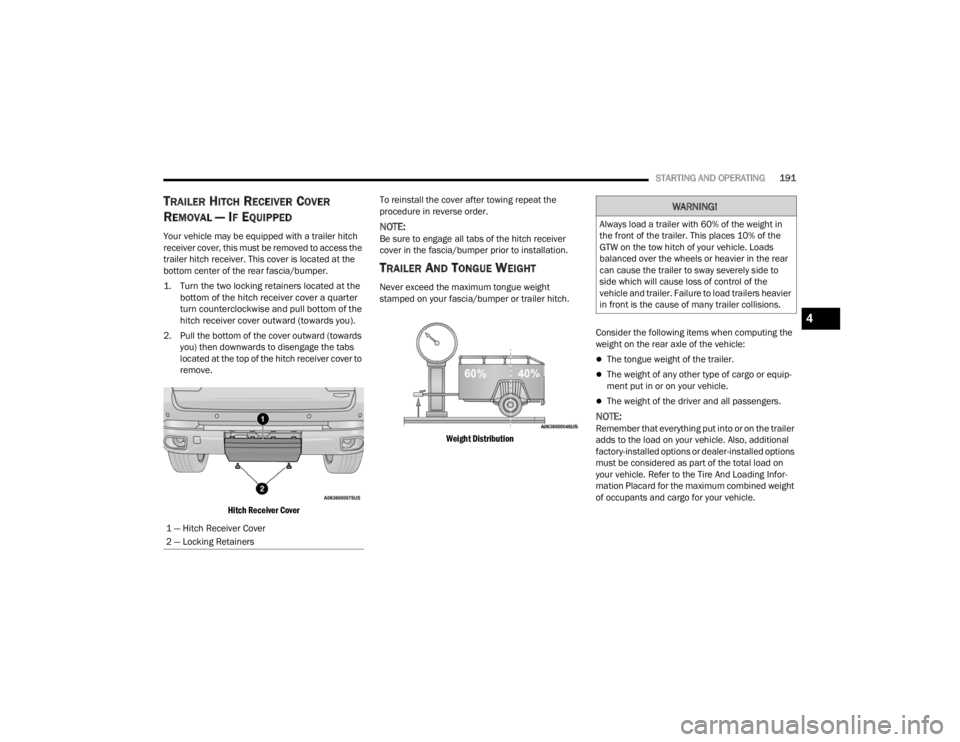
Your vehicle may be equipped with a trailer hitch
receiver cover, this must be removed to access the
trailer hitch receiver. This cover is located at the
bottom center of the rear fascia/bumper.
1. Turn the two locking retainers located at the
bottom of the hitch receiver cover a quarter
turn counterclockwise and pull bottom of the
hitch receiver cover outward (towards you).
2. Pull the bottom of the cover outward (towards you) then downwards to disengage the tabs
located at the top of the hitch receiver cover to
remove.
Hitch Receiver Cover
To reinstall the cover after towing repeat the
procedure in reverse order.NOTE:Be sure to engage all tabs of the hitch receiver
cover in the fascia/bumper prior to installation.
TRAILER AND TONGUE WEIGHT
Never exceed the maximum tongue weight
stamped on your fascia/bumper or trailer hitch.
Weight Distribution
Consider the following items when computing the
weight on the rear axle of the vehicle:
The tongue weight of the trailer.
The weight of any other type of cargo or equip
-
ment put in or on your vehicle.
The weight of the driver and all passengers.
NOTE:Remember that everything put into or on the trailer
adds to the load on your vehicle. Also, additional
factory-installed options or dealer-installed options
must be considered as part of the total load on
your vehicle. Refer to the Tire And Loading Infor -
mation Placard for the maximum combined weight
of occupants and cargo for your vehicle.
1 — Hitch Receiver Cover
2 — Locking Retainers
WARNING!
Always load a trailer with 60% of the weight in
the front of the trailer. This places 10% of the
GTW on the tow hitch of your vehicle. Loads
balanced over the wheels or heavier in the rear
can cause the trailer to sway severely side to
side which will cause loss of control of the
vehicle and trailer. Failure to load trailers heavier
in front is the cause of many trailer collisions.
4
23_WL_OM_EN_USC_t.book Page 191
Page 194 of 424

192STARTING AND OPERATING
(Continued)
(Continued)
TOWING REQUIREMENTS
To promote proper break-in of the new vehicle
drivetrain components, the following guidelines
are recommended.
Perform the maintenance listed in the Scheduled
Servicing Ú
page 330. When towing a trailer,
never exceed the GAWR or GCWR ratings.
Towing Requirements — Tires
Do not attempt to tow a trailer while using a
compact spare tire.
Do not drive more than 50 mph (80 km/h) when
towing while using a full size spare tire.
Proper tire inflation pressures are essential to
the safe and satisfactory operation of your
vehicle.
Check the trailer tires for proper tire inflation
pressures before trailer usage.
Check for signs of tire wear or visible tire
damage before towing a trailer.
Replacing tires with a higher load carrying
capacity will not increase the vehicle's GVWR
and GAWR limits.
For further information Ú page 374.
CAUTION!
Do not tow a trailer at all during the first
500 miles (805 km) the new vehicle is driven.
The engine, axle or other parts could be
damaged.
Then, during the first 500 miles (805 km) that
a trailer is towed, do not drive over 50 mph
(80 km/h) and do not make starts at full
throttle. This helps the engine and other parts
of the vehicle wear in at the heavier loads.
WARNING!
Make certain that the load is secured in the
trailer and will not shift during travel. When
trailering cargo that is not fully secured,
dynamic load shifts can occur that may be
difficult for the driver to control. You could lose
control of your vehicle and have a collision.
When hauling cargo or towing a trailer, do not
overload your vehicle or trailer. Overloading can
cause a loss of control, poor performance or
damage to brakes, axle, engine, transmission,
steering, suspension, chassis structure or tires.
Safety chains must always be used between
your vehicle and trailer. Always connect the
chains to the hook retainers of the vehicle
hitch. Cross the chains under the trailer
tongue and allow enough slack for turning
corners.
Vehicles with trailers should not be parked on
a grade. When parking, apply the parking
brake on the tow vehicle. Put the tow vehicle
transmission in PARK (P). For four-wheel drive
vehicles, make sure the transfer case is not in
NEUTRAL (N). Always, block or "chock" the
trailer wheels.
GCWR must not be exceeded.
Total weight must be distributed between the
tow vehicle and the trailer such that the
following four ratings are not exceeded :
GVWR
GTW
WARNING!
GAWR
Tongue weight rating for the trailer hitch
utilized
WARNING!
23_WL_OM_EN_USC_t.book Page 192
Page 259 of 424

SAFETY257
Feedback To The Driver:
The instrument cluster has an SSC icon and the
SSC switch has an LED which offer feedback to the
driver about the state SSC is in.
The cluster icon and switch light will illuminate
and remain on solid when SSC is enabled or
activated. This is the normal operating condition
for SSC.
The cluster icon and switch light will flash for
several seconds then extinguish when the driver
pushes the SSC switch but enable conditions
are not met.
The cluster icon and switch light will flash for
several seconds then extinguish when SSC
disables due to excess speed.
The cluster icon and switch light will flash then
extinguish when SSC deactivates due to over -
heated brakes.
Traction Control System (TCS)
The TCS monitors the amount of wheel spin of
each of the driven wheels. If wheel spin is
detected, the TCS may apply brake pressure to the
spinning wheel(s) and/or reduce engine power to
provide enhanced acceleration and stability. A
feature of the TCS, Brake Limited Differential (BLD)
functions similarly to a limited slip differential and
controls the wheel spin across a driven axle. If one
wheel on a driven axle is spinning faster than the
other, the system will apply the brake of the
spinning wheel. This will allow more engine power
to be applied to the wheel that is not spinning. BLD
may remain enabled even if TCS and Electronic
Stability Control (ESC) are in reduced modes.
Trailer Sway Control (TSC)
TSC uses sensors in the vehicle to recognize an
excessively swaying trailer and will take the
appropriate actions to attempt to stop the sway.
TSC will become active automatically once an
excessively swaying trailer is recognized.
NOTE:TSC cannot stop all trailers from swaying. Always
use caution when towing a trailer and follow the
trailer tongue weight recommendations
Ú page 185.
When TSC is functioning, the ESC Activation/
Malfunction Indicator Light will flash, the engine
power may be reduced and you may feel the
brakes being applied to individual wheels to
attempt to stop the trailer from swaying. TSC is
disabled when the ESC system is in the “Partial
Off” mode.
WARNING!
SSC is only intended to assist the driver in
controlling vehicle speed when driving in off
road conditions. The driver must remain
attentive to the driving conditions and is
responsible for maintaining a safe vehicle
speed.
WARNING!
If TSC activates while driving, slow the vehicle
down, stop at the nearest safe location, and
adjust the trailer load to eliminate trailer sway.6
23_WL_OM_EN_USC_t.book Page 257
Page 382 of 424

380SERVICING AND MAINTENANCE
To determine the maximum loading conditions of
your vehicle, locate the statement “The combined
weight of occupants and cargo should never
exceed XXX kg or XXX lbs” on the Tire And Loading
Information Placard. The combined weight of
occupants, cargo/luggage and trailer tongue
weight (if applicable) should never exceed the
weight referenced here.
Steps For Determining Correct Load Limit—
(1) Locate the statement “The combined
weight of occupants and cargo should
never exceed XXX kg or XXX lbs.” on your
vehicle's placard.
(2) Determine the combined weight of
the driver and passengers that will be
riding in your vehicle.
(3) Subtract the combined weight of the
driver and passengers from XXX kg or
XXX lbs. (4) The resulting figure equals the
available amount of cargo and luggage
load capacity. For example, if “XXX”
amount equals 1400 lbs. and there will
be five 150 lb passengers in your
vehicle, the amount of available cargo
and luggage load capacity is 650 lbs.
(1400-750 (5x150) = 650 lbs.)
(5) Determine the combined weight of
luggage and cargo being loaded on the
vehicle. That weight may not safely
exceed the available cargo and luggage
load capacity calculated in Step 4.
(6) If your vehicle will be towing a trailer,
load from your trailer will be transferred
to your vehicle. Consult this manual to
determine how this reduces the
available cargo and luggage load
capacity of your vehicle.
Metric Example For Load Limit
For example, if “XXX” amount equals 635 kg and
there will be five 68 kg passengers in your vehicle,
the amount of available cargo and luggage load
capacity is 295 kg (635-340 (5x68) = 295 kg) as
shown in step 4.
NOTE:
If your vehicle will be towing a trailer, load from
your trailer will be transferred to your vehicle.
The following table shows examples on how to
calculate total load, cargo/luggage, and towing
capacities of your vehicle with varying seating
configurations and number and size of occu
-
pants. This table is for illustration purposes only
and may not be accurate for the seating and
load carry capacity of your vehicle.
For the following example, the combined weight
of occupants and cargo should never exceed
865 lbs (392 kg).
23_WL_OM_EN_USC_t.book Page 380
Page 420 of 424

418 Side Distance Warning
.................................. 165Signals, Turn........................................ 116, 305Snow Chains (Tire Chains)............................. 389Snow Tires..................................................... 386Spare Tires................................. 313, 386, 387Speed Control Accel/Decel (ACC Only)............................. 146Sport Mode.................................................... 131Starting................................................... 24, 119Button......................................................... 22Cold Weather............................................ 122Engine Fails To Start................................. 122Remote....................................................... 24Starting And Operating.................................. 119Starting Procedures....................................... 119Steering........................................................... 32Power........................................................ 139Tilt Column.................................................. 32Wheel, Heated............................................. 33Wheel, Tilt................................................... 32Wheel, Voice Recognition............................ 33Steering Wheel Audio Controls...................... 228Steering Wheel Mounted Sound
System Controls............................................ 228Stop/Start................................... 113, 116, 140Storage............................................................ 74Cargo Area.................................................. 90Storage, Vehicle............................................. 392Storing Your Vehicle...................................... 392Streaming...................................................... 234
Sun Roof............................................ 83, 84, 86Opening....................................................... 84Sun Visor......................................................... 51Sunglasses Storage......................................... 75Sunshade Operation................... 76, 84, 85, 86Surround View Camera................................. 181Sway Bar DisconnectElectronic................................................. 133Sway Control, Trailer..................................... 257Symbol Glossary.............................................. 12Synthetic Engine Oil...................................... 339System, Remote Starting................................. 24
T
Telescoping Steering Column.......................... 32Temperature Control, Automatic (ATC)............. 72Third Party Apps............................................ 233Third Row USB................................................. 78Tie Down Hooks, Cargo.................................... 91Tilt Steering Column........................................ 32Tire And Loading Information Placard........... 379Tire Identification Number (TIN).................... 377Tire Markings................................................ 374Tire Safety Information................................. 374Tire Terminology And Definitions.................. 378Tires...................................305, 382, 386, 391Aging (Life Of Tires).................................. 384Air Pressure.............................................. 382Chains...................................................... 389
Changing.................................................. 310Compact Spare......................................... 386General Information........................ 382, 386High Speed............................................... 383Inflation Pressure..................................... 382Life Of Tires.............................................. 384Load Capacity........................................... 379
Pressure Monitoring System (TPMS).. 113, 264
Quality Grading......................................... 391Radial....................................................... 383Replacement............................................ 385Rotation.................................................... 391Run Flat.................................................... 384Safety.............................................. 374, 382Sizes......................................................... 375Snow Tires................................................ 386Spare Tires.............................313, 386, 387Spinning................................................... 384Trailer Towing........................................... 192Tread Wear Indicators.............................. 384Types........................................................ 385Wheel Nut Torque..................................... 396To Open Hood..................................................87Tongue Weight/Trailer Weight............. 186, 191Towing........................................................... 185Disabled Vehicle....................................... 326Guide........................................................ 189Recreational............................................. 195Weight...................................................... 189Towing Behind A Motorhome........................ 195
23_WL_OM_EN_USC_t.book Page 418
Page 421 of 424

419
Towing This Vehicle Behind Another Vehicle
....195
Traction Control............................................. 257Traffic Sign Assist System.............................. 151TrailCam System............................................ 176Trailer Frontal Area........................................ 186Trailer Sway Control (TSC)................... 186, 257Trailer Towing................................................ 185Hitch Cover Removal................................. 191Hitches...................................................... 188Minimum Requirements............................ 192Tips........................................................... 194Trailer And Tongue Weight........................ 191Weight-Carrying Hitch................................ 186Weight-Distributing Hitch........................... 186Wiring........................................................ 193Trailer Weight................................................ 189Transfer Case................................................ 352Fluid.......................................................... 402Maintenance............................................. 352Transmission................................................. 127Automatic........................................ 127, 351Fluid.......................................................... 402Maintenance............................................. 351Shifting...................................................... 126Transporting Pets.......................................... 303Tread Wear Indicators................................... 384Trip Computer................................................ 104Turn Signals................................................... 116
U
Uconnect (Radio).......................................... 203Uconnect 5/5 NAV........................................ 203Uconnect Settings......................................... 204Customer Programmable Features...... 29, 31Passive Entry Programming.................. 29, 31Uniform Tire Quality Grades.......................... 391Universal Garage Door Opener (Homelink®) —
If Equipped
b
................................................. 53Unleaded Gasoline....................................... 397Untwisting Procedure, Seat Belt................... 273USB Second Row................................................ 78Third Row.................................................... 78USB Port.......................................................... 77
V
Vanity Mirrors.................................................. 50Vehicle Identification Number (VIN).............. 396Vehicle Loading................................... 184, 379Vehicle Maintenance.................................... 338Vehicle Modifications/Alterations.................... 12Vehicle Security Alarm..................................... 26Vehicle Settings............................................ 204Vehicle Storage............................................. 392Voice Command............................................... 33Voice Recognition System (VR)........................ 33
W
Warning Lights
(Instrument Cluster Descriptions)
................. 108Warning Lights And Messages...................... 108Warnings, Roll Over..........................................11Warranty Information.................................... 406Washers, Windshield.................... 64, 112, 337Washing Vehicle............................................ 393Wheel And Wheel Tire Care........................... 388Wheel And Wheel Tire Trim........................... 388Wind Buffeting.................................................83Window Fogging...............................................73Window Lockout Switch...................................83Windows..........................................................81Power...........................................................81Reset Auto-Up..............................................82Windshield Defroster.................................... 304Windshield DeIcer............................................66Windshield Washers.............................. 64, 337Fluid.......................................................... 337Windshield Wiper Blades.............................. 343Windshield Wipers...........................................64Wipers Blade Replacement........................... 343Wipers, Intermittent.........................................64Wipers, Rain Sensitive.....................................65Wireless Charging Pad.....................................80
11
23_WL_OM_EN_USC_t.book Page 419