Body JEEP LIBERTY 2002 KJ / 1.G Workshop Manual
[x] Cancel search | Manufacturer: JEEP, Model Year: 2002, Model line: LIBERTY, Model: JEEP LIBERTY 2002 KJ / 1.GPages: 1803, PDF Size: 62.3 MB
Page 611 of 1803

REMOTE KEYLESS ENTRY
TRANSMITTER
DIAGNOSIS AND TESTING - REMOTE KEYLESS
ENTRY TRANSMITTER
The most reliable, efficient, and accurate means to
diagnose the remote keyless entry transmitter
requires the use of a DRBIIItscan tool and the
proper Diagnostic Procedures manual. The DRBIIIt
scan tool can provide confirmation that the PCI data
bus is functional, and that all of the electronic mod-
ules are sending and receiving the proper messages
on the PCI data bus.
STANDARD PROCEDURE
STANDARD PROCEDURE - RKE TRANSMITTER
BATTERIES
The Remote Keyless Entry (RKE) transmitter case
snaps open and shut for battery access. To replace
the RKE transmitter batteries:(1) Using a thin coin, gently pry at the notch in
the center seam of the RKE transmitter case halves
near the key ring until the two halves unsnap.
(2) Lift the back half of the transmitter case off of
the RKE transmitter.
(3) Remove the two batteries from the RKE trans-
mitter.
(4) Replace the two batteries with new Panasonic
2016, or equivalent. Be certain that the batteries are
installed with their polarity correctly oriented.
(5) Align the two RKE transmitter case halves
with each other, and squeeze them firmly and evenly
together until they snap back into place.
STANDARD PROCEDURE - RKE TRANSMITTER
CUSTOMER PREFERENCES
AUTOMATIC (ROLLING) LOCKS
The rolling locks feature can be toggled ON/OFF
by using the DRB IIItonly.
HORN CHIRP DISABLING / ENABLING
The horn chirp can be toggled using a DRB IIItor
by using the Remote Keyless Entry (RKE) transmit-
ter.
To DISABLE (cancel) the horn chirp feature, press
and hold the transmitter LOCK button for four to ten
seconds. While pressing the LOCK button in, press
the UNLOCK button. Release both buttons.
To ENABLE the horn chirp feature, repeat the
above procedure.
OPTICAL CHIRP (FLASH) DISABLING / ENABLING
The optical chirp can be toggled using a DRB IIIt
or by using the Remote Keyless Entry (RKE) trans-
mitter.
To DISABLE (cancel) the optical chirp feature,
press and hold the transmitter LOCK button for four
to ten seconds. While pressing the LOCK button in,
press the TAILGATE RELEASE button. Release both
buttons.
To ENABLE the optical chirp feature, repeat the
above procedure.
TAIL GATE RELEASE DELAY
Press the UNLOCK button for four to ten seconds.
While pressing the UNLOCK button, press the TAIL
GATE RELEASE button. Release both buttons.
This will toggle between PRESS AND HOLD and
PRESS (no delay).
UNLOCK SEQUENCE
The unlock sequence can be toggled using a DRB
IIItor by using the Remote Keyless Entry (RKE)
transmitter.
Fig. 5 RKE Module Remove/Install
1 - SCREW (4)
2 - RKE MODULE
3 - BODY CONTROL MODULE
4 - JUNCTION BLOCK
8N - 8 POWER LOCKSKJ
REMOTE KEYLESS ENTRY MODULE (Continued)
Page 612 of 1803

Press and hold the transmitter UNLOCK button
for four to ten seconds. While pressing the UNLOCK
button in, press the LOCK button. Release both but-
tons.
This will toggle between Driver door first and
Unlock all doors function.
STANDARD PROCEDURE - RKE TRANSMITTER
PROGRAMING
New Remote Keyless Entry (RKE) transmitters can
be programed using the DRBIIItscan tool and the
proper Diagnostic Procedures manual. The DRBIIIt
scan tool can provide confirmation that the PCI data
bus is functional, and that all of the electronic mod-
ules are sending and receiving the proper messages
on the PCI data bus.
The following procedure can be used as long as one
functioning transmitter is available:
(1) Using the original transmitter, press the
UNLOCK button for 4 to 10 seconds.
(2) Without releasing the UNLOCK button, press
the PANIC button (within the 4 to 10 second inter-
val).
(3) Release both buttons.
(4) Press LOCK and UNLOCK simultaneously on
the original transmitter.
(5) Release both buttons.
(6) Press any button on the ORIGINAL transmit-
ter. A chime tone from the instrument cluster will
confirm the programming of the ORIGINAL trans-
mitter.
(7) On NEW transmitter, press LOCK and
UNLOCK simultaneously.
(8) Release both buttons.
(9) Press any button on the NEW transmitter. A
chime tone from the instrument cluster will confirm
the programming of the NEW transmitter.
(10) Up to four transmitters can be programed for
one vehicle.
SPECIFICATIONS - REMOTE KEYLESS ENTRY
TRANSMITTER
RANGE
Normal operation range is up to a distance of 3 to
7 meters (10 to 23 ft.) of the vehicle. Range may be
better or worse depending on the environment
around the vehicle.
TAILGATE CYLINDER LOCK
SWITCH
DESCRIPTION
The tailgate cylinder lock switch is integral to the
key lock cylinder inside the tailgate. The tailgate cyl-
inder lock switch is a normally-open momentary
switch that is hard wired directly to the Body Con-
trol Module (BCM), and closes a path to ground
through an internal resistor when the lock cylinder is
rotated to the unlock or lock position.
The tailgate cylinder lock switch cannot be
adjusted or repaired.
OPERATION
The tailgate cylinder lock switch is actuated when
the key is inserted in the lock cylinder and turned to
the unlock or lock position. The tailgate cylinder lock
switch closes a path to ground through an internal
resistor for the Body Control Module (BCM) when
the tailgate key lock cylinder is in the lock or unlock
position, and opens the ground path when the lock
cylinder is in the neutral position. The BCM reads
the switch status, then sends the proper switch sta-
tus messages to other electronic modules over the
Programmable Communications Interface (PCI) data
bus network. The tailgate cylinder lock switch unlock
status message is used by the BCM as an input for
Vehicle Theft Security System (VTSS) operation and
to tell the BCM to lock or unlock the tailgate. There
is no mechanical linkage between the tailgate key
cylinder and the latches.
DIAGNOSIS AND TESTING - TAILGATE
CYLINDER LOCK SWITCH
(1) Disconnect and isolate the battery negative
cable.
(2) Remove tailgate trim panel (Refer to 23 -
BODY/DECKLID/HATCH/LIFTGATE/TAILGATE/
TRIM PANEL - REMOVAL).
(3) Disconnect tailgate cylinder lock switch har-
ness connector.
(4) Using a ohmmeter, test for resistances as
shown in the Tailgate Cylinder Lock Switch Table.
KJPOWER LOCKS 8N - 9
REMOTE KEYLESS ENTRY TRANSMITTER (Continued)
Page 613 of 1803

TAILGATE CYLINDER LOCK SWITCH TABLE
SWITCH POSITION RESISTANCE
NEUTRAL 0 OHMS
LOCK (CLOCKWISE) 2 K OHMS 10 %
UNLOCK (COUNTER-
CLOCKWISE)470 OHMS 10 %
(5) If switch resistance is not correct, replace
switch.
REMOVAL
(1) Disconnect and isolate the battery negative
cable.
(2) Remove the tailgate trim panel.(Refer to 23 -
BODY/DECKLID/HATCH/LIFTGATE/TAILGATE/
TRIM PANEL - REMOVAL).
(3) Remove the retainer clip from the pin on the
back of the door lock cylinder (Fig. 6).
(4) Remove the washer from the pin on the back of
the door lock cylinder.
(5) Remove the door cylinder lock switch from the
back of the lock cylinder.
INSTALLATION
(1) Position the tailgate cylinder lock switch onto
the back of the lock cylinder with the wire harness
oriented toward the bottom.
(2) Position the washer over the switch.
(3) Install the retainer clip onto the pin on the
back of the tailgate lock cylinder. Be certain that thecenter tab of the retainer is engaged in the retention
hole on the lock lever.
(4) Install the trim panel (Refer to 23 - BODY/
DECKLID/HATCH/LIFTGATE/TAILGATE/TRIM
PANEL - INSTALLATION).
(5) Connect the battery negative cable.
Fig. 6 Lock Cylinder Switch Remove/Install -Typical
1 - LEVER
2 - RETAINER
3 - LOCK CYLINDER
4 - SWITCH
5 - PLIERS
6 - OUTSIDE DOOR HANDLE
8N - 10 POWER LOCKSKJ
TAILGATE CYLINDER LOCK SWITCH (Continued)
Page 614 of 1803

POWER MIRRORS
TABLE OF CONTENTS
page page
POWER MIRRORS
DESCRIPTION.........................11
OPERATION...........................11
DIAGNOSIS AND TESTING - POWER
MIRRORS...........................11
POWER MIRROR SWITCH
DIAGNOSIS AND TESTING - POWER MIRROR
SWITCH............................12REMOVAL.............................13
INSTALLATION.........................13
SIDEVIEW MIRROR
REMOVAL.............................13
POWER MIRRORS
DESCRIPTION
The available power operated sideview mirrors
allow the driver to adjust both outside mirrors elec-
trically from the drivers seat by operating a switch
on the driver side front door trim panel (Fig. 1).
OPERATION
The power mirrors receive ignition current through
a fuse in the junction block, and will only operate
when the ignition switch is in the Run position.
DIAGNOSIS AND TESTING - POWER MIRRORS
WIRING VOLTAGE TEST
The following wiring test determines whether or
not voltage is continuous through the body harness
to switch.
(1) Remove the power mirror switch (Refer to 8 -
ELECTRICAL/POWER MIRRORS/POWER MIRROR
SWITCH - REMOVAL).
(2) Disconnect wire connector from back of power
mirror switch.
(3) Switch ignition to the RUN position.
(4) Connect the clip end of a 12 volt test light to
Pin 5 in the harness connector at the mirror switch.
Touch the test light probe to Pin 3.
If the test light illuminates, the wiring circuit
between the battery and switch is OK.
If the lamp does not illuminate, first check fuse 25
in the Junction Block (JB). If fuse 25 is OK, then
check for a broken wire.
Refer to the appropriate wiring information. The
wiring information includes wiring diagrams, proper
wire and connector repair procedures, details of wire
harness routing and retention, connector pin-out
information and location views for the various wire
harness connectors, splices and grounds.
POWER MIRROR MOTOR TEST
If the power mirror switch is receiving proper cur-
rent and ground and mirrors do not operate, proceed
with power mirror motor test. Refer to the appropri-
ate wiring information. The wiring information
includes wiring diagrams, proper wire and connector
repair procedures, details of wire harness routing
and retention, connector pin-out information and
location views for the various wire harness connec-
tors, splices and grounds.
Fig. 1 POWER MIRROR SWITCH
1 - DOOR TRIM PANEL
2 - DOOR LOCK SWITCH
3 - POWER MIRROR SWITCH
KJPOWER MIRRORS 8N - 11
Page 615 of 1803
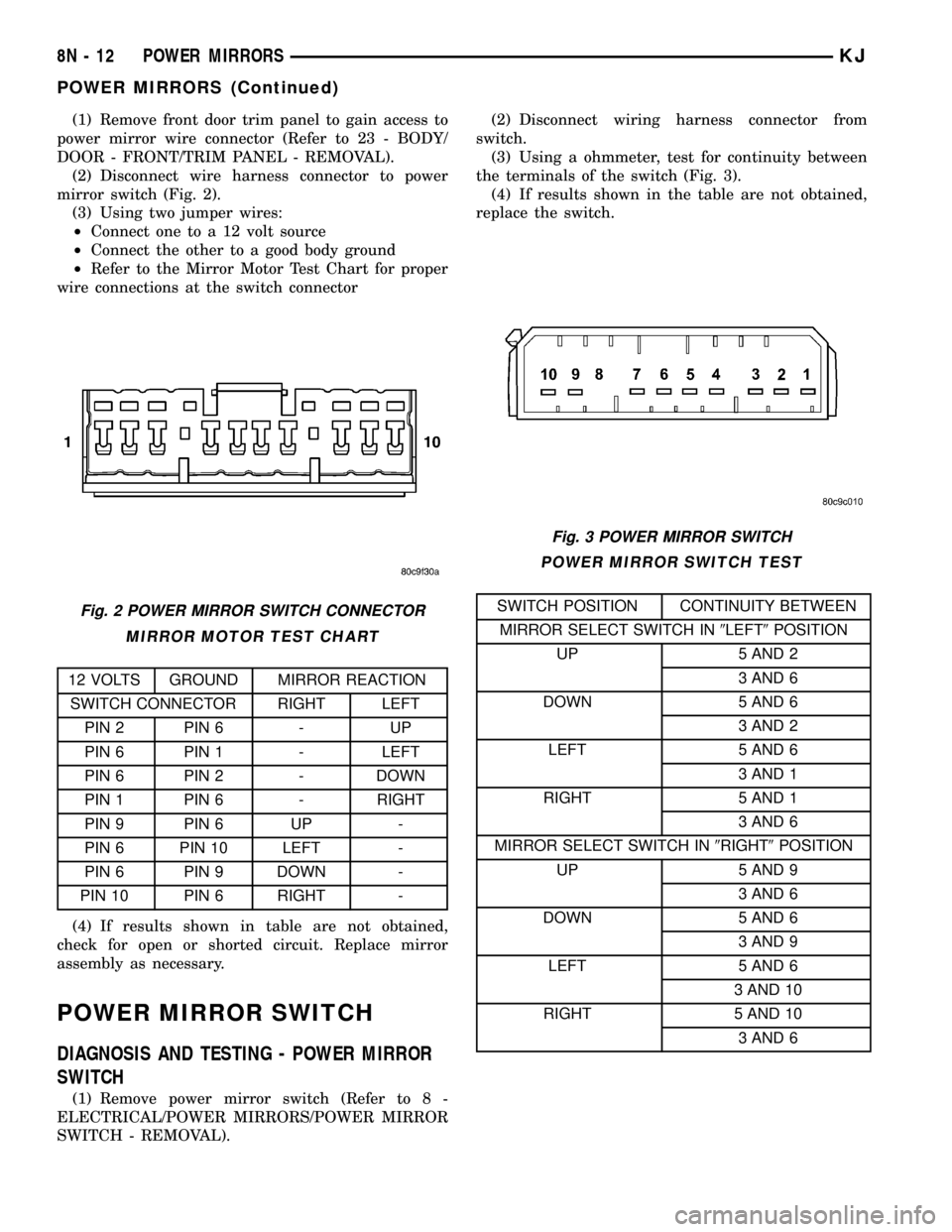
(1) Remove front door trim panel to gain access to
power mirror wire connector (Refer to 23 - BODY/
DOOR - FRONT/TRIM PANEL - REMOVAL).
(2) Disconnect wire harness connector to power
mirror switch (Fig. 2).
(3) Using two jumper wires:
²Connect one to a 12 volt source
²Connect the other to a good body ground
²Refer to the Mirror Motor Test Chart for proper
wire connections at the switch connector
MIRROR MOTOR TEST CHART
12 VOLTS GROUND MIRROR REACTION
SWITCH CONNECTOR RIGHT LEFT
PIN 2 PIN 6 - UP
PIN 6 PIN 1 - LEFT
PIN 6 PIN 2 - DOWN
PIN 1 PIN 6 - RIGHT
PIN 9 PIN 6 UP -
PIN 6 PIN 10 LEFT -
PIN 6 PIN 9 DOWN -
PIN 10 PIN 6 RIGHT -
(4) If results shown in table are not obtained,
check for open or shorted circuit. Replace mirror
assembly as necessary.
POWER MIRROR SWITCH
DIAGNOSIS AND TESTING - POWER MIRROR
SWITCH
(1) Remove power mirror switch (Refer to 8 -
ELECTRICAL/POWER MIRRORS/POWER MIRROR
SWITCH - REMOVAL).(2) Disconnect wiring harness connector from
switch.
(3) Using a ohmmeter, test for continuity between
the terminals of the switch (Fig. 3).
(4) If results shown in the table are not obtained,
replace the switch.
POWER MIRROR SWITCH TEST
SWITCH POSITION CONTINUITY BETWEEN
MIRROR SELECT SWITCH IN9LEFT9POSITION
UP 5 AND 2
3 AND 6
DOWN 5 AND 6
3 AND 2
LEFT 5 AND 6
3 AND 1
RIGHT 5 AND 1
3 AND 6
MIRROR SELECT SWITCH IN9RIGHT9POSITION
UP 5 AND 9
3 AND 6
DOWN 5 AND 6
3 AND 9
LEFT 5 AND 6
3 AND 10
RIGHT 5 AND 10
3 AND 6Fig. 2 POWER MIRROR SWITCH CONNECTOR
Fig. 3 POWER MIRROR SWITCH
8N - 12 POWER MIRRORSKJ
POWER MIRRORS (Continued)
Page 616 of 1803

REMOVAL
(1) Disconnect and isolate the battery negative
cable.
(2) Remove door trim panel (Refer to 23 - BODY/
DOOR - FRONT/TRIM PANEL - REMOVAL).
(3) Disconnect wire harness connector from switch
(Fig. 4).(4) Remove switch from door trim panel.INSTALLATION
(1) Install switch to door trim panel.
(2) Connect wire harness connector to switch.
(3) Install door trim panel (Refer to 23 - BODY/
DOOR - FRONT/TRIM PANEL - INSTALLATION).
(4) Connect battery negative cable.
SIDEVIEW MIRROR
REMOVAL
(1) For removal procedures, (Refer to 23 - BODY/
EXTERIOR/SIDE VIEW MIRROR - REMOVAL).
Fig. 4 DOOR LOCK/MIRROR SWITCH
1 - DOOR TRIM PANEL
2 - DOOR LOCK SWITCH
3 - POWER MIRROR SWITCH
KJPOWER MIRRORS 8N - 13
POWER MIRROR SWITCH (Continued)
Page 619 of 1803
DIAGNOSIS AND TESTING - SEAT TRACK
(1) Remove the power seat switch from the seat
(Refer to 8 - ELECTRICAL/POWER SEATS/DRIVER
SEAT SWITCH - REMOVAL).
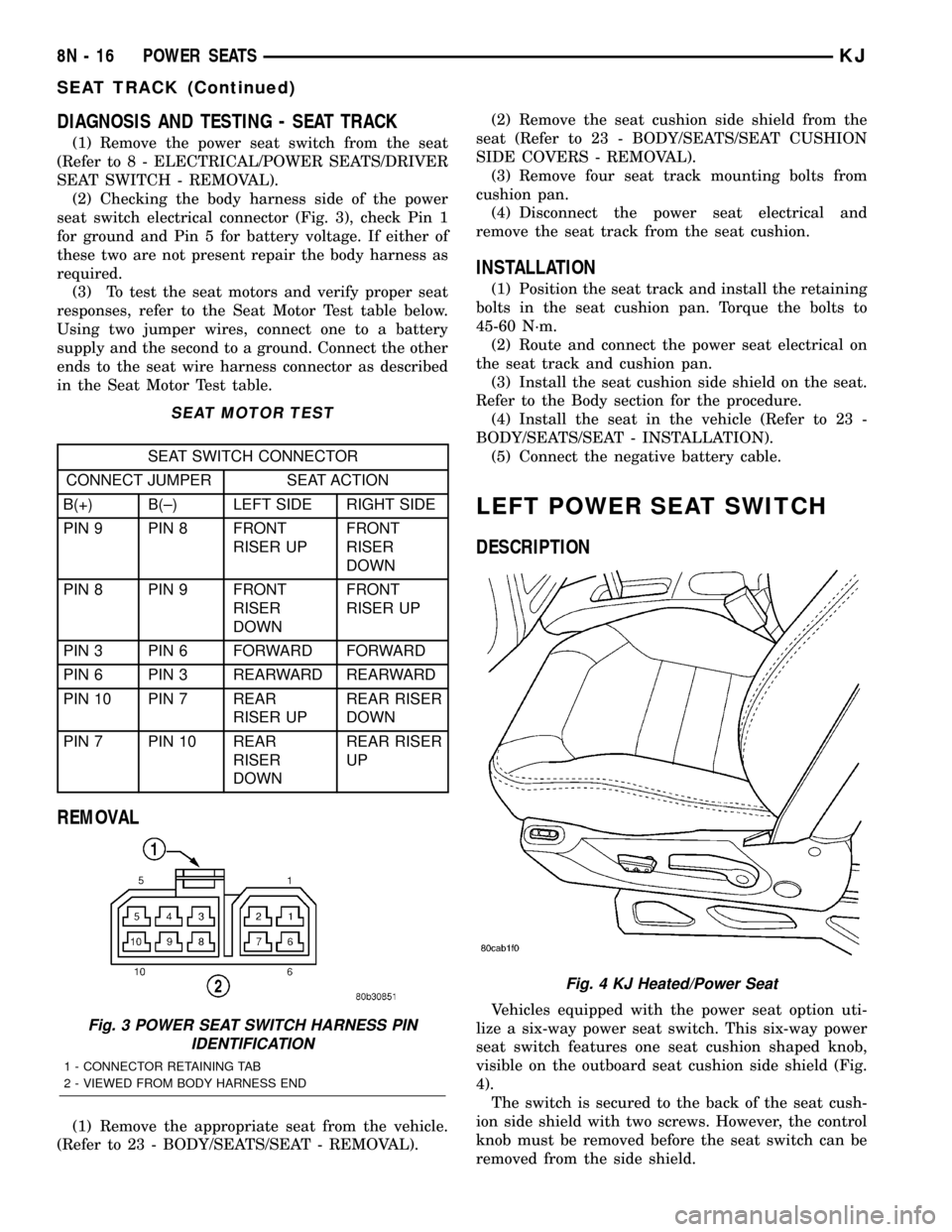
(2) Checking the body harness side of the power
seat switch electrical connector (Fig. 3), check Pin 1
for ground and Pin 5 for battery voltage. If either of
these two are not present repair the body harness as
required.
(3) To test the seat motors and verify proper seat
responses, refer to the Seat Motor Test table below.
Using two jumper wires, connect one to a battery
supply and the second to a ground. Connect the other
ends to the seat wire harness connector as described
in the Seat Motor Test table.
SEAT MOTOR TEST
SEAT SWITCH CONNECTOR
CONNECT JUMPER SEAT ACTION
B(+) B(±) LEFT SIDE RIGHT SIDE
PIN 9 PIN 8 FRONT
RISER UPFRONT
RISER
DOWN
PIN 8 PIN 9 FRONT
RISER
DOWNFRONT
RISER UP
PIN 3 PIN 6 FORWARD FORWARD
PIN 6 PIN 3 REARWARD REARWARD
PIN 10 PIN 7 REAR
RISER UPREAR RISER
DOWN
PIN 7 PIN 10 REAR
RISER
DOWNREAR RISER
UP
REMOVAL
(1) Remove the appropriate seat from the vehicle.
(Refer to 23 - BODY/SEATS/SEAT - REMOVAL).(2) Remove the seat cushion side shield from the
seat (Refer to 23 - BODY/SEATS/SEAT CUSHION
SIDE COVERS - REMOVAL).
(3) Remove four seat track mounting bolts from
cushion pan.
(4) Disconnect the power seat electrical and
remove the seat track from the seat cushion.
INSTALLATION
(1) Position the seat track and install the retaining
bolts in the seat cushion pan. Torque the bolts to
45-60 N´m.
(2) Route and connect the power seat electrical on
the seat track and cushion pan.
(3) Install the seat cushion side shield on the seat.
Refer to the Body section for the procedure.
(4) Install the seat in the vehicle (Refer to 23 -
BODY/SEATS/SEAT - INSTALLATION).
(5) Connect the negative battery cable.
LEFT POWER SEAT SWITCH
DESCRIPTION
Vehicles equipped with the power seat option uti-
lize a six-way power seat switch. This six-way power
seat switch features one seat cushion shaped knob,
visible on the outboard seat cushion side shield (Fig.
4).
The switch is secured to the back of the seat cush-
ion side shield with two screws. However, the control
knob must be removed before the seat switch can be
removed from the side shield.
Fig. 3 POWER SEAT SWITCH HARNESS PIN
IDENTIFICATION
1 - CONNECTOR RETAINING TAB
2 - VIEWED FROM BODY HARNESS END
Fig. 4 KJ Heated/Power Seat
8N - 16 POWER SEATSKJ
SEAT TRACK (Continued)
Page 624 of 1803

POWER WINDOWS
TABLE OF CONTENTS
page page
POWER WINDOWS
DESCRIPTION.........................21
OPERATION...........................21
DIAGNOSIS AND TESTING - POWER
WINDOWS...........................21
WINDOW MOTOR
REMOVAL.............................22WINDOW SWITCH
DIAGNOSIS AND TESTING - WINDOW
SWITCH............................22
REMOVAL.............................23
INSTALLATION.........................23
POWER WINDOWS
DESCRIPTION
The power window system allows each of the door
windows to be raised and lowered electrically by
actuating a switch on the center console. A master
switch on the front of the center console allows the
driver to raise or lower each of the passenger door
windows and to lock out the individual switches on
the rear of the center console from operation. The
power window system receives battery feed through
fuse 13 in the Power Distribution Center (PDC), only
when the ignition switch is in the RUN or ACCES-
SORY position.
OPERATION
WINDOW SWITCH
The power window switches control the battery
and ground feeds to the power window motors. Both
of the rear door power window switches receive their
battery and ground feeds through the circuitry of the
front window switch. When the power window lock-
out switch is in the Lock position, the battery feed
for the rear door window switches is interrupted.
WINDOW MOTOR
Front door window lift motors use permanent type
magnets. The B+ and ground applied at the motor
terminal pins will cause the motor to rotate in one
direction. Reversing current through the motor ter-
minals will cause the motor to rotate in the opposite
direction.
Refer to the appropriate wiring information. The
wiring information includes wiring diagrams, proper
wire and connector repair procedures, details of wire
harness routing and retention, connector pin-out
information and location views for the various wire
harness connectors, splices and grounds.
DIAGNOSIS AND TESTING - POWER
WINDOWS
WIRING VOLTAGE TEST
The following wiring test determines whether or
not voltage is continuous through the body harness
to the front switch.
(1) Remove the power window switch and bezel
(Refer to 8 - ELECTRICAL/POWER WINDOWS/
POWER WINDOW SWITCH - REMOVAL).
(2) Disconnect wire connector from back of power
window switch.
(3) Switch ignition to the ON position.
(4) Connect the clip end of a 12 volt test light to
Pin 14 of the window switch harness connector.
Touch the test light probe to Pin 10.
²If the test light illuminates, the wiring circuit
between the battery and switch is OK.
²If the lamp does not illuminate, first check fuse
13 in the Power Distribution Center (PDC). If fuse 13
is OK, then check for a broken wire.
Refer to the appropriate wiring information. The
wiring information includes wiring diagrams, proper
wire and connector repair procedures, details of wire
harness routing and retention, connector pin-out
information and location views for the various wire
harness connectors, splices and grounds.
POWER WINDOW MOTOR TEST
If the power window motor is receiving proper cur-
rent and ground and does not operate, proceed with
motor test. Refer to the appropriate wiring informa-
tion. The wiring information includes wiring dia-
grams, proper wire and connector repair procedures,
details of wire harness routing and retention, connec-
tor pin-out information and location views for the
various wire harness connectors, splices and grounds.
(1) Remove front door trim panel as necessary to
gain access to power window motor wire connector
KJPOWER WINDOWS 8N - 21
Page 625 of 1803
(Refer to 23 - BODY/DOOR - FRONT/TRIM PANEL -
REMOVAL).
(2) Disconnect power window motor wire connector
from door harness.
(3) Using two jumper wires, connect one to a bat-
tery (+) source and the other to a good ground (-).
(4) Connect the Negative (-) jumper probe to one of
the motor connector terminals.
(5) Momentarily touch the Positive (+) jumper
probe to the other motor connector terminal.
When positive probe is connected the motor should
rotate in one direction to either move window up or
down. If window is all the way up or down the motor
will grunt and the inner door panel will flex when
actuated in that one direction.
(6) Reverse jumper probes at the motor connector
terminals and window should now move in opposite
direction. If window does not move or grunt, replace
the motor.
If window moved completely up or down, reverse
the jumper probes and cycle window to the opposite
position to verify full operation.
If motor grunts and does not move, verify that reg-
ulator is not binding.
WINDOW MOTOR
REMOVAL
The window motor is incorporated into the window
regulator assembly. If the window motor requires
replacement, the window regulator must be replaced.
(Refer to 23 - BODY/DOOR - FRONT/WINDOW
REGULATOR - REMOVAL) or (Refer to 23 - BODY/
DOORS - REAR/WINDOW REGULATOR - REMOV-
AL).
WINDOW SWITCH
DIAGNOSIS AND TESTING - WINDOW SWITCH
(1) Remove the switch to be tested (Refer to 8 -
ELECTRICAL/POWER WINDOWS/POWER WIN-
DOW SWITCH - REMOVAL).
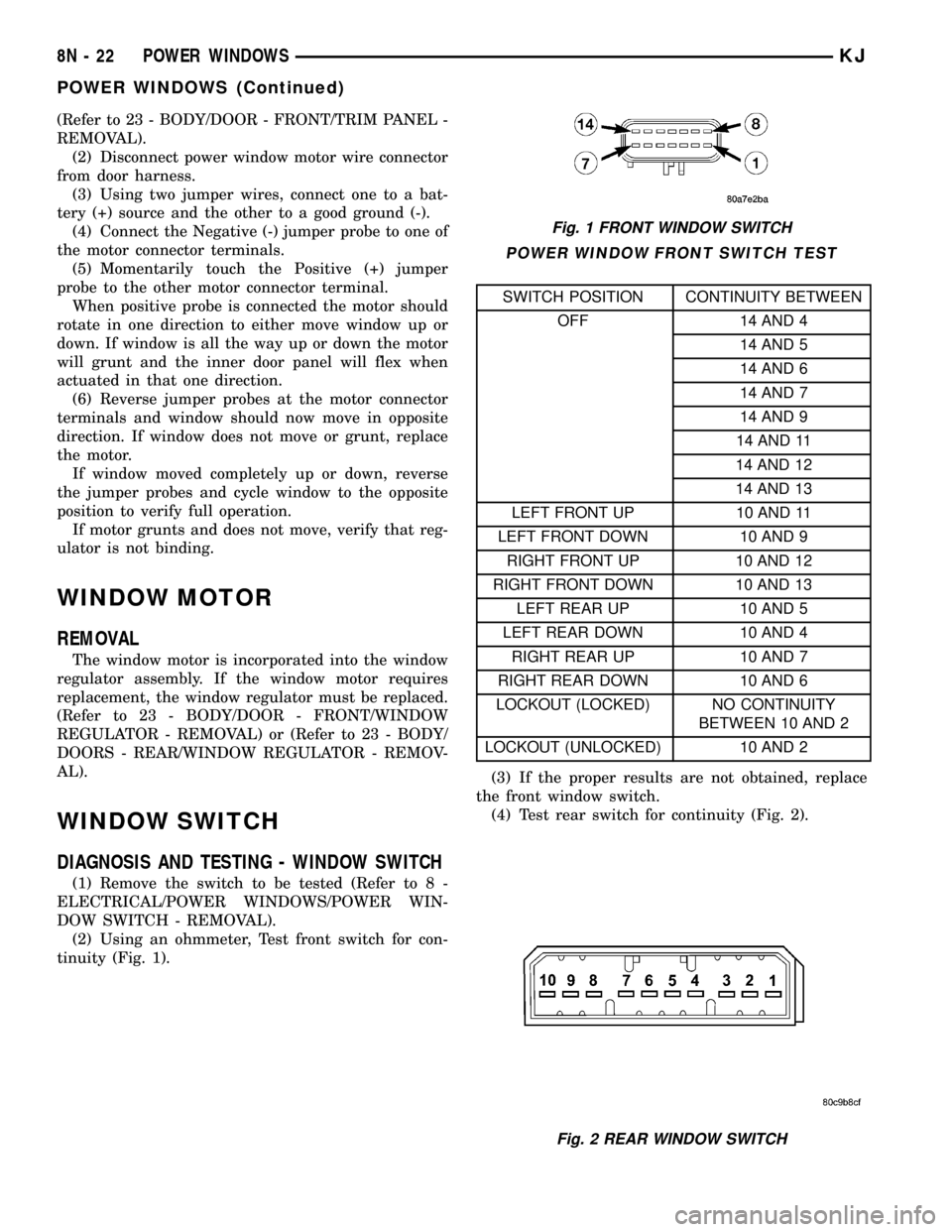
(2) Using an ohmmeter, Test front switch for con-
tinuity (Fig. 1).
POWER WINDOW FRONT SWITCH TEST
SWITCH POSITION CONTINUITY BETWEEN
OFF 14 AND 4
14 AND 5
14 AND 6
14 AND 7
14 AND 9
14 AND 11
14 AND 12
14 AND 13
LEFT FRONT UP 10 AND 11
LEFT FRONT DOWN 10 AND 9
RIGHT FRONT UP 10 AND 12
RIGHT FRONT DOWN 10 AND 13
LEFT REAR UP 10 AND 5
LEFT REAR DOWN 10 AND 4
RIGHT REAR UP 10 AND 7
RIGHT REAR DOWN 10 AND 6
LOCKOUT (LOCKED) NO CONTINUITY
BETWEEN 10 AND 2
LOCKOUT (UNLOCKED) 10 AND 2
(3) If the proper results are not obtained, replace
the front window switch.
(4) Test rear switch for continuity (Fig. 2).
Fig. 1 FRONT WINDOW SWITCH
Fig. 2 REAR WINDOW SWITCH
8N - 22 POWER WINDOWSKJ
POWER WINDOWS (Continued)
Page 633 of 1803

WARNING: THE FASTENERS, SCREWS, AND
BOLTS ORIGINALLY USED FOR THE RESTRAINT
SYSTEM COMPONENTS HAVE SPECIAL COATINGS
AND ARE SPECIFICALLY DESIGNED FOR THE
RESTRAINT SYSTEM. THEY MUST NEVER BE
REPLACED WITH ANY SUBSTITUTES. ANY TIME A
NEW FASTENER IS NEEDED, REPLACE IT WITH
THE CORRECT FASTENERS PROVIDED IN THE
SERVICE PACKAGE OR SPECIFIED IN THE
DAIMLERCHRYSLER MOPAR PARTS CATALOG.
WARNING: WHEN A STEERING COLUMN HAS AN
AIRBAG UNIT ATTACHED, NEVER PLACE THE COL-
UMN ON THE FLOOR OR ANY OTHER SURFACE
WITH THE STEERING WHEEL OR AIRBAG UNIT
FACE DOWN.
DIAGNOSIS AND TESTING - SUPPLEMENTAL
RESTRAINT SYSTEM
Proper diagnosis and testing of the supplemental
restraint system components, the PCI data bus, the
data bus message inputs to and outputs from the
ElectroMechanical Instrument Cluster (EMIC), the
Airbag Control Module (ACM), or the Side Impact
Airbag Control Module (SIACM) as well as the
retrieval or erasure of a Diagnostic Trouble Code
(DTC) from the ACM or SIACM requires the use of a
DRBIIItscan tool. Refer to the appropriate diagnos-
tic information.
WARNING: ON VEHICLES EQUIPPED WITH AIR-
BAGS, DISABLE THE SUPPLEMENTAL RESTRAINT
SYSTEM BEFORE ATTEMPTING ANY STEERING
WHEEL, STEERING COLUMN, DRIVER AIRBAG,
PASSENGER AIRBAG, SEAT BELT TENSIONER,
FRONT IMPACT SENSORS, SIDE CURTAIN AIRBAG,
OR INSTRUMENT PANEL COMPONENT DIAGNOSIS
OR SERVICE. DISCONNECT AND ISOLATE THE
BATTERY NEGATIVE (GROUND) CABLE, THEN
WAIT TWO MINUTES FOR THE SYSTEM CAPACI-
TOR TO DISCHARGE BEFORE PERFORMING FUR-
THER DIAGNOSIS OR SERVICE. THIS IS THE ONLY
SURE WAY TO DISABLE THE SUPPLEMENTAL
RESTRAINT SYSTEM. FAILURE TO TAKE THE
PROPER PRECAUTIONS COULD RESULT IN ACCI-
DENTAL AIRBAG DEPLOYMENT AND POSSIBLE
PERSONAL INJURY.
STANDARD PROCEDURE
STANDARD PROCEDURE - HANDLING
NON-DEPLOYED SUPPLEMENTAL RESTRAINTS
At no time should any source of electricity be per-
mitted near the inflator on the back of a non-de-
ployed airbag or seat belt tensioner. When carrying a
non-deployed airbag, the trim cover or airbag cushion
side of the unit should be pointed away from the
body to minimize injury in the event of an accidental
deployment. If the airbag unit is placed on a bench or
any other surface, the trim cover or airbag cushion
side of the unit should be face up to minimize move-
ment in the event of an accidental deployment. When
handling a non-deployed seat belt tensioner, take
proper care to keep fingers out from under the
retractor cover and away from the seat belt webbing
where it exits from the retractor cover. In addition,
the supplemental restraint system should be dis-
armed whenever any steering wheel, steering col-
umn, seat belt tensioner, driver airbag, passenger
airbag, front impact sensor, side curtain airbag, or
instrument panel components require diagnosis or
service. Failure to observe this warning could result
in accidental airbag deployment and possible per-
sonal injury.
All damaged, faulty or non-deployed airbags and
seat belt tensioners which are replaced on vehicles
are to be handled and disposed of properly. If an air-
bag or seat belt tensioner unit is faulty or damaged
and non-deployed, refer to the Hazardous Substance
Control System for proper disposal. Dispose of all
non-deployed and deployed airbags and seat belt ten-
sioners in a manner consistent with state, provincial,
local and federal regulations.
SUPPLEMENTAL RESTRAINT STORAGE
Airbags and seat belt tensioners must be stored in
their original, special container until they are used
for service. Also, they must be stored in a clean, dry
environment; away from sources of extreme heat,
sparks, and high electrical energy. Always place or
store any airbag on a surface with its trim cover or
airbag cushion side facing up, to minimize movement
in case of an accidental deployment.
STANDARD PROCEDURE - SERVICE AFTER A
SUPPLEMENTAL RESTRAINT DEPLOYMENT
Any vehicle which is to be returned to use follow-
ing a supplemental restraint deployment, must have
the deployed restraints replaced. In addition, if the
driver airbag has been deployed, the clockspring
must be replaced. If the passenger airbag is
deployed, the passenger airbag door and both passen-
ger airbag mounting brackets must be replaced. If a
side curtain airbag has been deployed, the complete
8O - 6 RESTRAINTSKJ
RESTRAINTS (Continued)