Body JEEP LIBERTY 2002 KJ / 1.G Workshop Manual
[x] Cancel search | Manufacturer: JEEP, Model Year: 2002, Model line: LIBERTY, Model: JEEP LIBERTY 2002 KJ / 1.GPages: 1803, PDF Size: 62.3 MB
Page 675 of 1803
A ªtap downº feature is used to decelerate without
disengaging the speed control system. To decelerate
from an existing recorded target speed, momentarily
depress the COAST switch. For each switch activa-
tion, speed will be lowered approximately 1 mph.
OVERSHOOT/UNDERSHOOT
If the vehicle operator repeatedly presses and
releases the SET button with their foot off of the
accelerator (referred to as a ªlift foot setº), the vehicle
may accelerate and exceed the desired set speed by
up to 5 mph (8 km/h). It may also decelerate to less
than the desired set speed, before finally achieving
the desired set speed.
The Speed Control System has an adaptive strat-
egy that compensates for vehicle-to-vehicle variations
in speed control cable lengths. When the speed con-
trol is set with the vehicle operators foot off of the
accelerator pedal, the speed control thinks there is
excessive speed control cable slack and adapts
accordingly. If the ªlift foot setsº are continually used,
a speed control overshoot/undershoot condition will
develop.
To ªunlearnº the overshoot/undershoot condition,
the vehicle operator has to press and release the set
button while maintaining the desired set speed using
the accelerator pedal (not decelerating or accelerat-
ing), and then turning the cruise control switch to
the OFF position (or press the CANCEL button if
equipped) after waiting 10 seconds. This procedure
must be performed approximately 10±15 times to
completely unlearn the overshoot/undershoot condi-
tion.
DIAGNOSIS AND TESTING - ROAD TEST
Perform a vehicle road test to verify reports of
speed control system malfunction. The road testshould include attention to the speedometer. Speed-
ometer operation should be smooth and without flut-
ter at all speeds.
Flutter in the speedometer indicates a problem
which might cause surging in the speed control sys-
tem. The cause of any speedometer problems should
be corrected before proceeding. Refer to Group 8J,
Instrument Cluster for speedometer diagnosis.
If a road test verifies a system problem and the
speedometer operates properly, check for:
²A Diagnostic Trouble Code (DTC). If a DTC
exists, conduct tests per the Powertrain Diagnostic
Procedures service manual.
²A misadjusted brake (stop) lamp switch. This
could also cause an intermittent problem.
²Loose, damaged or corroded electrical connec-
tions at the servo. Corrosion should be removed from
electrical terminals and a light coating of Mopar
MultiPurpose Grease, or equivalent, applied.
²Leaking vacuum reservoir.
²Loose or leaking vacuum hoses or connections.
²Defective one-way vacuum check valve.
²Secure attachment of both ends of the speed con-
trol servo cable.
²Smooth operation of throttle linkage and throttle
body air valve.
²Failed speed control servo. Do the servo vacuum
test.
CAUTION: When test probing for voltage or conti-
nuity at electrical connectors, care must be taken
not to damage connector, terminals or seals. If
these components are damaged, intermittent or
complete system failure may occur.
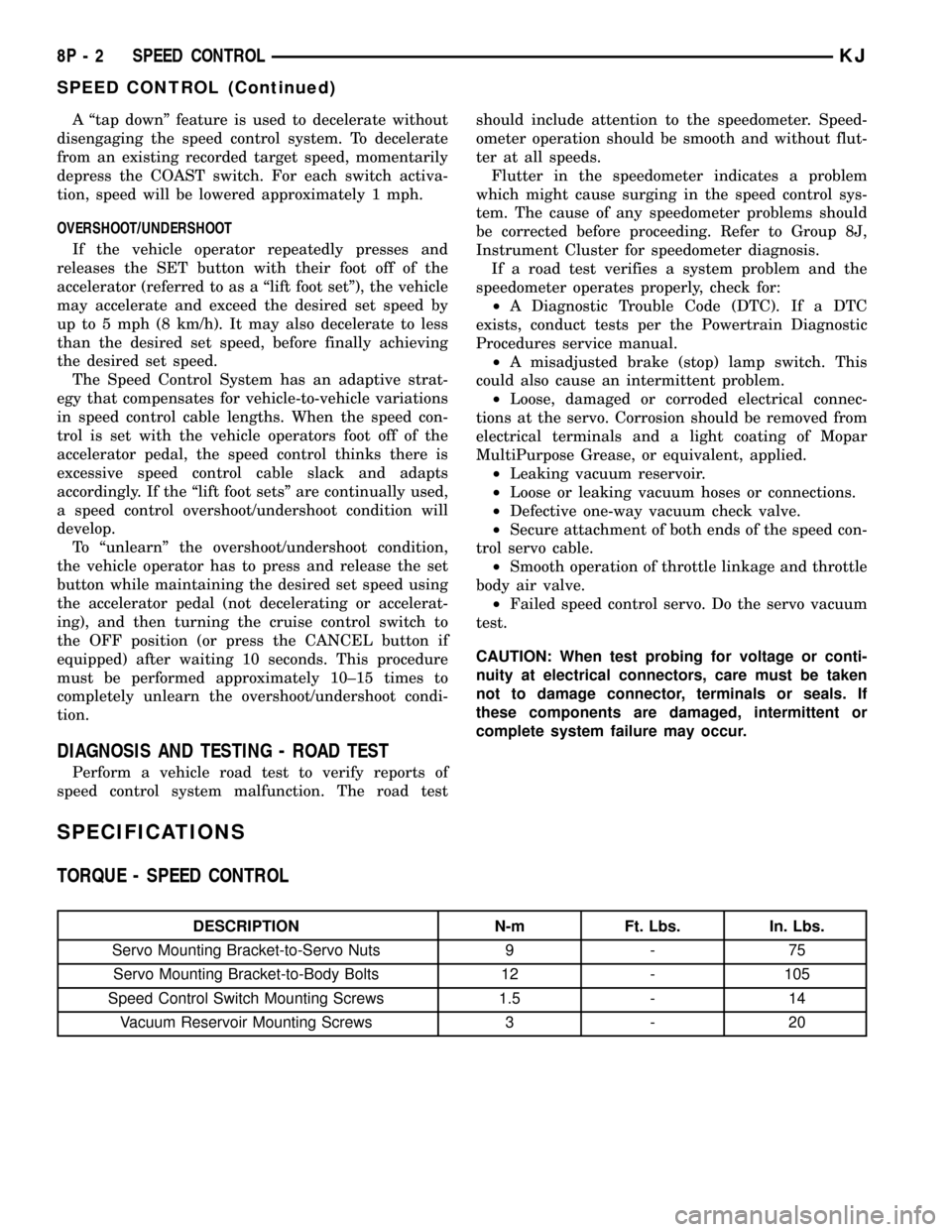
SPECIFICATIONS
TORQUE - SPEED CONTROL
DESCRIPTION N-m Ft. Lbs. In. Lbs.
Servo Mounting Bracket-to-Servo Nuts 9 - 75
Servo Mounting Bracket-to-Body Bolts 12 - 105
Speed Control Switch Mounting Screws 1.5 - 14
Vacuum Reservoir Mounting Screws 3 - 20
8P - 2 SPEED CONTROLKJ
SPEED CONTROL (Continued)
Page 676 of 1803

CABLE
DESCRIPTION
The speed control servo cable is connected between
the speed control vacuum servo diaphragm and the
throttle body control linkage.
OPERATION
This cable causes the throttle control linkage to
open or close the throttle valve in response to move-
ment of the vacuum servo diaphragm.
REMOVAL - 3.7L
(1) Disconnect negative battery cable at battery.
(2) Remove air filter resonator at throttle body.
The accelerator cable must be partially removed to
gain access to speed control cable.
(3) Hold throttle in wide open position. While held
in this position, slide throttle cable pin (Fig. 1) from
throttle body bellcrank.
(4) Using a pick or small screwdriver, press release
tab (Fig. 2) to release plastic cable mount from
bracket.Press on tab only enough to release
cable from bracket. If tab is pressed too much,
it will be broken.Slide plastic mount (Fig. 2)
towards right side of vehicle to remove throttle cable
from throttle body bracket.(5) Using finger pressure only, disconnect servo
cable connector (Fig. 3) at throttle body bellcrank pin
by pushing connector off bellcrank pin towards front
of vehicle.DO NOT try to pull connector off per-
pendicular to the bellcrank pin. Connector will
be broken.
Fig. 1 THROTTLE CABLE PIN
1 - THROTTLE CABLE PIN
2 - THROTTLE BODY BELLCRANK
3 - PUSH UP HERE
Fig. 2 THROTTLE CABLE RELEASE TAB
1 - THROTTLE CABLE
2 - RELEASE TAB
3 - PICK OR SCREWDRIVER
4 - PLASTIC CABLE MOUNT
Fig. 3 SPEED CONTROL CABLE AT BELLCRANK
1 - THROTTLE BODY BELLCRANK
2 - SPEED CONTROL CABLE CONNECTOR
KJSPEED CONTROL 8P - 3
Page 677 of 1803

(6) Slide speed control cable plastic mount towards
right of vehicle to remove cable from throttle body
bracket (Fig. 4).
(7) Remove servo cable from servo. Refer to Servo
Removal/Installation.
INSTALLATION - 3.7L
(1) Install end of cable to speed control servo.
Refer to Servo Removal/Installation.
(2) Slide speed control cable plastic mount into
throttle body bracket.
(3) Install speed control cable connector onto throt-
tle body bellcrank pin (push rearward to snap into
location).
(4) Slide throttle (accelerator) cable plastic mount
into throttle body bracket. Continue sliding until
cable release tab is aligned to hole in throttle body
mounting bracket.
(5) While holding throttle to wide open position,
place throttle cable pin into throttle body bellcrank.
(6) Install air filter resonator box to throttle body.
(7) Connect negative battery cable at battery.
(8) Before starting engine, operate accelerator
pedal to check for any binding.
SERVO
DESCRIPTION
The servo unit consists of a solenoid valve body,
and a vacuum chamber. The solenoid valve body con-
tains three solenoids:²Vacuum
²Vent
²Dump
The vacuum chamber contains a diaphragm with a
cable attached to control the throttle linkage.
OPERATION
The Powertrain Control Module (PCM) controls the
solenoid valve body. The solenoid valve body controls
the application and release of vacuum to the dia-
phragm of the vacuum servo. The servo unit cannot
be repaired and is serviced only as a complete assem-
bly.
Power is supplied to the servo's by the PCM
through the brake switch. The PCM controls the
ground path for the vacuum and vent solenoids.
The dump solenoid is energized anytime it receives
power. If power to the dump solenoid is interrupted,
the solenoid dumps vacuum in the servo. This pro-
vides a safety backup to the vent and vacuum sole-
noids.
The vacuum and vent solenoids must be grounded
at the PCM to operate. When the PCM grounds the
vacuum servo solenoid, the solenoid allows vacuum
to enter the servo and pull open the throttle plate
using the cable. When the PCM breaks the ground,
the solenoid closes and no more vacuum is allowed to
enter the servo. The PCM also operates the vent sole-
noid via ground. The vent solenoid opens and closes a
passage to bleed or hold vacuum in the servo as
required.
The PCM duty cycles the vacuum and vent sole-
noids to maintain the set speed, or to accelerate and
decelerate the vehicle. To increase throttle opening,
the PCM grounds the vacuum and vent solenoids. To
decrease throttle opening, the PCM removes the
grounds from the vacuum and vent solenoids. When
the brake is released, if vehicle speed exceeds 30
mph to resume, 35 mph to set, and the RES/ACCEL
switch has been depressed, ground for the vent and
vacuum circuits is restored.
REMOVAL
(1) Disconnect negative battery cable at battery.
(2) Disconnect vacuum line at servo (Fig. 5).
(3) Disconnect electrical connector at servo (Fig. 5).
(4) Remove coolant bottle nuts/bolts. Position bot-
tle forward a few inches.
(5) Disconnect servo cable at throttle body. Refer to
servo Cable Removal/Installation.
(6) Remove servo bracket mounting nuts (Fig. 5).
(7) Remove 2 mounting nuts holding servo cable
sleeve to bracket (Fig. 6).
(8) Pull speed control cable sleeve and servo away
from servo mounting bracket to expose cable retain-
ing clip (Fig. 6) and remove clip. Note: The servo
Fig. 4 SPEED CONTROL CABLE AT BRACKET
1 - THROTTLE CABLE BRACKET
2 - PLASTIC CABLE MOUNT
3 - SPEED CONTROL CABLE
8P - 4 SPEED CONTROLKJ
CABLE (Continued)
Page 678 of 1803

mounting bracket displayed in (Fig. 6) is a typical
bracket and may/may not be applicable to this model
vehicle.
(9) Remove servo from mounting bracket. While
removing, note orientation of servo to bracket.INSTALLATION
(1) Position servo to mounting bracket.
(2) Align hole in cable connector with hole in servo
pin. Install cable-to-servo retaining clip.
(3) Insert servo mounting studs through holes in
servo mounting bracket.
(4) Install servo-to-mounting bracket nuts and
tighten. Refer to torque specifications.
(5) Install servo mounting bracket-to-body nuts
and tighten. Refer to torque specifications.
(6) Connect vacuum line at servo.
(7) Connect electrical connector at servo.
(8) Connect servo cable to throttle body. Refer to
servo Cable Removal/Installation.
(9) Install coolant bottle.
(10) Connect negative battery cable to battery.
(11) Before starting engine, operate accelerator
pedal to check for any binding.
SWITCH
DESCRIPTION
There are two separate switch pods that operate
the speed control system. The steering-wheel-
mounted switches use multiplexed circuits to provide
inputs to the PCM for ON, OFF, RESUME, ACCEL-
ERATE, SET, DECEL and CANCEL modes. Refer to
the owner's manual for more information on speed
control switch functions and setting procedures.
The individual switches cannot be repaired. If one
switch fails, the entire switch module must be
replaced.
OPERATION
When speed control is selected by depressing the
ON, OFF switch, the PCM allows a set speed to be
stored in its RAM for speed control. To store a set
speed, depress the SET switch while the vehicle is
moving at a speed between approximately 35 and 85
mph. In order for the speed control to engage, the
brakes cannot be applied, nor can the gear selector
be indicating the transmission is in Park or Neutral.
The speed control can be disengaged manually by:
²Stepping on the brake pedal
²Depressing the OFF switch
²Depressing the CANCEL switch.
The speed control can be disengaged also by any of
the following conditions:
²An indication of Park or Neutral
²The VSS signal increases at a rate of 10 mph
per second (indicates that the co-efficient of friction
between the road surface and tires is extremely low)
²Depressing the clutch pedal.
²Excessive engine rpm (indicates that the trans-
mission may be in a low gear)
Fig. 5 SPEED CONTROL SERVO
1-9T9FITTING
2 - VACUUM LINE
3 - SERVO BRACKET MOUNTING NUTS
4 - SERVO MOUNTING BRACKET
5 - SERVO
6 - SERVO ELECTRICAL CONNECTOR
Fig. 6 SERVO CABLE CLIP REMOVE/INSTALL
TYPICAL
1 - SERVO MOUNTING NUTS (2)
2 - SERVO
3 - CABLE RETAINING CLIP
4 - SERVO CABLE AND SLEEVE
KJSPEED CONTROL 8P - 5
SERVO (Continued)
Page 683 of 1803

in vehicles manufactured for sale in certain markets
where it is required equipment. The ROW premium
version of the VTA provides the same perimeter pro-
tection features as the base version, but adds interior
vehicle intrusion protection. The ROW premium VTA
also replaces the pulsing horn feature of the base
version with an alarm siren as the audible deterrent,
while retaining the flashing exterior lamps visual
deterrent.The VTA includes the following major components,
which are described in further detail elsewhere in
this service information:
²Body Control Module- The Body Control
Module (BCM) is located on the Junction Block (JB)
under the driver side outboard end of the instrument
panel. (Refer to 8 - ELECTRICAL/ELECTRONIC
CONTROL MODULES/BODY CONTROL MODULE
- DESCRIPTION).
Fig. 1 Vehicle Theft Security System
1 - SIREN MODULE
2 - BODY CONTROL MODULE
3 - SENTRY KEY IMMOBILIZER MODULE4 - DOOR CYLINDER LOCK SWITCH (2)
5 - INTRUSION TRANSCEIVER MODULE
8Q - 2 VEHICLE THEFT SECURITYKJ
VEHICLE THEFT SECURITY (Continued)
Page 684 of 1803

²Combination Flasher- An electronic combina-
tion flasher is integral to the hazard switch located
in the center of the instrument panel above the
radio. (Refer to 8 - ELECTRICAL/LAMPS/LIGHT-
ING - EXTERIOR/COMBINATION FLASHER -
DESCRIPTION).
²Door Ajar Switch- A door ajar switch is inte-
gral to the latch of each door in the vehicle. (Refer to
8 - ELECTRICAL/LAMPS/LIGHTING - INTERIOR/
DOOR AJAR SWITCH - DESCRIPTION).
²Door Cylinder Lock Switch- For North
American vehicles only, a door cylinder lock switch is
located on the back of the lock cylinder of each front
door. (Refer to 8 - ELECTRICAL/VEHICLE THEFT
SECURITY/DOOR CYLINDER LOCK SWITCH -
DESCRIPTION).
²Flip-Up Glass Ajar Switch- A flip-up glass
ajar switch is integral to the rear flip-up glass latch,
located on the top of the tailgate near the center.
(Refer to 8 - ELECTRICAL/LAMPS/LIGHTING -
INTERIOR/FLIP-UP GLASS AJAR SWITCH -
DESCRIPTION).
²Hood Ajar Switch- A hood ajar switch is
located beneath the hood panel on the right inner
fender side shield of vehicles built for sale in certain
markets where it is required equipment. (Refer to 8 -
ELECTRICAL/VEHICLE THEFT SECURITY/HOOD
AJAR SWITCH - DESCRIPTION).
²Horn Relay- A horn relay is located on the
Junction Block (JB) under the driver side outboard
end of the instrument panel. (Refer to 8 - ELECTRI-
CAL/HORN/HORN RELAY - DESCRIPTION).
²Intrusion Transceiver Module- An Intrusion
Transceiver Module (ITM) is located near the center
of the headliner in the passenger compartment of
vehicles built for sale in certain markets where it is
required equipment. (Refer to 8 - ELECTRICAL/VE-
HICLE THEFT SECURITY/UK SECURITY SYSTEM
MODULE - DESCRIPTION).
²Security Indicator- A security indicator is
located in the ElectroMechanical Instrument Cluster
(EMIC) on the instrument panel in front of the driver
side front seat. (Refer to 8 - ELECTRICAL/INSTRU-
MENT CLUSTER/SECURITY INDICATOR -
DESCRIPTION).
²Siren- An alarm siren is located on the front
extension of the right front wheel house panel in the
engine compartment of vehicles built for sale in cer-
tain markets where it is required equipment. (Refer
to 8 - ELECTRICAL/VEHICLE THEFT SECURITY/
SIREN - DESCRIPTION).
²Tailgate Ajar Switch- A tailgate ajar switch is
integral to the latch for the tailgate in the vehicle.
(Refer to 8 - ELECTRICAL/LAMPS/LIGHTING -
INTERIOR/TAILGATE AJAR SWITCH - DESCRIP-
TION).SENTRY KEY IMMOBILIZER SYSTEM The Sen-
try Key Immobilizer System (SKIS) is available as a
factory-installed option on this model. Vehicles
equipped with the Vehicle Theft Alarm (VTA) are also
equipped with SKIS. The SKIS provides passive vehi-
cle protection by preventing the engine from operat-
ing unless a valid electronically encoded key is
detected in the ignition lock cylinder. The SKIS
includes the following major components, which are
described in further detail elsewhere in this service
information:
²Powertrain Control Module- The Powertrain
Control Module (PCM) is located on the left inner
fender shield in the engine compartment near the
dash panel. (Refer to 8 - ELECTRICAL/ELEC-
TRONIC CONTROL MODULES/POWERTRAIN
CONTROL MODULE - DESCRIPTION).
²Sentry Key Immobilizer Module- The Sentry
Key Immobilizer Module (SKIM) is located beneath
the steering column shrouds on the right side of the
steering column near the ignition lock cylinder hous-
ing. (Refer to 8 - ELECTRICAL/ELECTRONIC CON-
TROL MODULES/SENTRY KEY IMMOBILIZER
MODULE - DESCRIPTION).
²Sentry Key Transponder- The Sentry Key
transponder is molded into the head of the ignition
key, and concealed by a gray molded rubber cap.
(Refer to 8 - ELECTRICAL/VEHICLE THEFT SECU-
RITY/TRANSPONDER KEY - DESCRIPTION).
²SKIS Indicator- The SKIS indicator is located
in the ElectroMechanical Instrument Cluster (EMIC)
on the instrument panel in front of the driver side
front seat. (Refer to 8 - ELECTRICAL/INSTRU-
MENT CLUSTER/SPEED CONTROL INDICATOR -
DESCRIPTION).
OPERATION
The Vehicle Theft Security System (VTSS) is
divided into two basic subsystems: Vehicle Theft
Alarm (VTA) and Sentry Key Immobilizer System
(SKIS). Following are paragraphs that briefly
describe the operation of each of these two sub-
systems.
VEHICLE THEFT ALARM The Body Control Mod-
ule (BCM) is used on this model to control and inte-
grate many of the electronic functions and features
included in the Vehicle Theft Alarm (VTA). The BCM
receives hard wired inputs indicating the status of
the door ajar switches, the door cylinder lock
switches, the ignition switch, the tailgate ajar switch,
the tailgate cylinder lock switch, the flip-up glass
ajar switch, the power lock switches and, in vehicles
built for certain markets where it is required, the
hood ajar switch. The programming in the BCM
allows it to process the information from all of these
inputs and send control outputs to energize or de-en-
KJVEHICLE THEFT SECURITY 8Q - 3
VEHICLE THEFT SECURITY (Continued)
Page 685 of 1803

ergize the combination flasher, the horn relay (except
vehicles with the Rest-Of-World or ROW premium
version of the VTA), and the security indicator. In
addition, in vehicles built for certain markets where
the ROW premium version of the VTA is required,
the BCM also exchanges electronic messages with
the Intrusion Transceiver Module (ITM) over the Pro-
grammable Communications Interface (PCI) data bus
network to provide the features found in this version
of the VTA.
The hard wired circuits and components of the
VTA may be diagnosed and tested using conventional
diagnostic tools and procedures. However, conven-
tional diagnostic methods may not prove conclusive
in the diagnosis of the Body Control Module (BCM),
the ElectroMechanical Instrument Cluster (EMIC),
the Intrusion Transceiver Module (ITM), or the Pro-
grammable Communications Interface (PCI) data bus
network. The most reliable, efficient, and accurate
means to diagnose the BCM, the EMIC, the ITM,
and the PCI data bus network inputs and outputs
related to the VTA requires the use of a DRBIIIt
scan tool. Refer to the appropriate diagnostic infor-
mation. Following are paragraphs that briefly
describe the operation of each of the VTA features.
See the owner's manual in the vehicle glove box for
more information on the features, use and operation
of the VTA.
²ENABLING- The BCM must have the VTA
function electronically enabled in order for the VTA
to perform as designed. The logic in the BCM keeps
its VTA function dormant until it is enabled using a
DRBIIItscan tool. The VTA function of the BCM is
enabled on vehicles equipped with the VTA option at
the factory, but a service replacement BCM must be
VTA-enabled by the dealer using a DRBIIItscan
tool. Refer to the appropriate diagnostic information.
²PRE-ARMING- The VTA has a pre-arming
sequence. Pre-arming occurs when a door, the tail-
gate, or the flip-up glass is open when the vehicle is
locked using a power lock switch, or when the ªLockº
button on the Remote Keyless Entry (RKE) transmit-
ter is depressed. The power lock switch will not ini-
tiate the pre-arming sequence if the key is in the
ignition switch. When the VTA is pre-armed, the
arming sequence is delayed until all of the doors, the
tailgate, and the flip-up glass are closed.
²ARMING- Passive arming of the VTA occurs
when the vehicle is exited with the key removed from
the ignition switch and the doors are locked while
they are open using the power lock switch (see Pre-
Arming). Active arming of the VTA occurs when the
ªLockº button on the Remote Keyless Entry (RKE)
transmitter is depressed to lock the vehicle after all
of the doors, the tailgate, and the flip-up glass are
closed. The VTA will not arm if the doors are lockedusing the key in a lock cylinder or using a mechani-
cal lock button. Once the VTA begins the passive or
active arming sequence, the security indicator in the
instrument cluster will flash rapidly for about six-
teen seconds. This indicates that the VTA arming
sequence is in progress. If the ignition switch is
turned to the On position, if a door is unlocked with
the power lock switch or the RKE transmitter, or if
the tailgate is unlocked by any means during the six-
teen second arming sequence, the security indicator
will stop flashing and the VTA arming sequence will
abort. On vehicles equipped with the hood ajar
switch, the VTA arming sequence will occur regard-
less of whether the hood is open or closed, but the
underhood area will not be protected unless the hood
is closed when the VTA arming sequence begins.
Also, if the status of the hood ajar switch changes
from open (hood closed) to closed (hood open) during
the sixteen second arming sequence, the security
indicator will stop flashing and the VTA arming
sequence will abort. Once the sixteen second arming
sequence is successfully completed, the security indi-
cator will flash at a slower rate, indicating that the
VTA is armed.
²DISARMING- For vehicles built for the North
American market, disarming of the VTA occurs when
the vehicle is unlocked using the key to unlock a door
or the tailgate. Disarming of the VTA for any market
also occurs when the vehicle is unlocked by depress-
ing the ªUnlockº button of the Remote Keyless Entry
(RKE) transmitter, or by turning the ignition switch
to the On position using a valid Sentry Key Immobi-
lizer System (SKIS) key. Once the alarm has been
activated, any of these disarming methods will also
deactivate the alarm.
²POWER-UP MODE- When the armed VTA
senses that the battery has been disconnected and
reconnected, it enters its power-up mode. In the pow-
er-up mode the alarm system returns to the mode
that was last selected prior to the battery failure or
disconnect. If the VTA was armed prior to the battery
disconnect or failure, the technician or vehicle opera-
tor will have to actively or passively disarm the sys-
tem after the battery is reconnected. The power-up
mode will also apply if the battery goes dead while
the system is armed, and battery jump-starting is
then attempted. The VTA will remain armed until
the technician or vehicle operator has actively or pas-
sively disarmed the system. If the VTA is in the dis-
armed mode prior to a battery disconnect or failure,
it will remain disarmed after the battery is recon-
nected or replaced, or if jump-starting is attempted.
²ALARM- The VTA alarm output varies by the
version of the VTA with which the vehicle is
equipped. In all cases, the alarm provides both visual
and audible outputs; however, the time intervals of
8Q - 4 VEHICLE THEFT SECURITYKJ
VEHICLE THEFT SECURITY (Continued)
Page 687 of 1803

DIAGNOSIS AND TESTING - VEHICLE THEFT
SECURITY SYSTEM
The Vehicle Theft Security System (VTSS) is
divided into two basic subsystems: Vehicle Theft
Alarm (VTA) and Sentry Key Immobilizer System
(SKIS). Following are the recommended procedures
for diagnosis and testing of each of these two sub-
systems.
WARNING: ON VEHICLES EQUIPPED WITH AIR-
BAGS, DISABLE THE SUPPLEMENTAL RESTRAINT
SYSTEM BEFORE ATTEMPTING ANY STEERING
WHEEL, STEERING COLUMN, DRIVER AIRBAG,
PASSENGER AIRBAG, SEAT BELT TENSIONER,
FRONT IMPACT SENSORS, SIDE CURTAIN AIRBAG,
OR INSTRUMENT PANEL COMPONENT DIAGNOSIS
OR SERVICE. DISCONNECT AND ISOLATE THE
BATTERY NEGATIVE (GROUND) CABLE, THEN
WAIT TWO MINUTES FOR THE SYSTEM CAPACI-
TOR TO DISCHARGE BEFORE PERFORMING FUR-
THER DIAGNOSIS OR SERVICE. THIS IS THE ONLY
SURE WAY TO DISABLE THE SUPPLEMENTAL
RESTRAINT SYSTEM. FAILURE TO TAKE THE
PROPER PRECAUTIONS COULD RESULT IN ACCI-
DENTAL AIRBAG DEPLOYMENT AND POSSIBLE
PERSONAL INJURY.
VEHICLE THEFT ALARM
Models equipped with the Rest-Of-World (ROW)
premium version of the Vehicle Theft Alarm (VTA)
provide some preliminary diagnostic feedback by illu-minating the security indicator located in the Elec-
troMechanical Instrument Cluster (EMIC). If the
security indicator illuminates with the ignition
switch in the On position, it indicates that there is a
communication problem between the Intrusion
Transceiver Module (ITM) and the Body Control
Module (BCM), or between the ITM and the siren
module. The BCM will also turn on the security indi-
cator if it receives a message from the ITM indicating
that the ITM has stored a Diagnostic Trouble Code
(DTC) for a siren module fault.
The hard wired circuits and components of the
VTA may be diagnosed and tested using conventional
diagnostic tools and procedures. However, conven-
tional diagnostic methods may not prove conclusive
in the diagnosis of the Body Control Module (BCM),
the ElectroMechanical Instrument Cluster (EMIC),
the Intrusion Transceiver Module (ITM), or the Pro-
grammable Communications Interface (PCI) data bus
network. The most reliable, efficient, and accurate
means to diagnose the BCM, the EMIC, the ITM,
and the PCI data bus network inputs and outputs
related to the VTA requires the use of a DRBIIIt
scan tool. Refer to the appropriate diagnostic infor-
mation.
Refer to the appropriate wiring information. The
wiring information includes wiring diagrams, proper
wire and connector repair procedures, further details
on wire harness routing and retention, as well as
pin-out and location views for the various wire har-
ness connectors, splices and grounds.
8Q - 6 VEHICLE THEFT SECURITYKJ
VEHICLE THEFT SECURITY (Continued)
Page 691 of 1803

Theft Security System (VTSS) have a door cylinder
lock switch secured to the back of the key lock cylin-
der inside each front door (Fig. 2). The door cylinder
lock switch is a resistor multiplexed momentary
switch that is hard wired in series between the door
lock switch ground and right or left cylinder lock
switch mux circuits of the Body Control Module
(BCM) through the front door wire harness. The door
cylinder lock switches are driven by the key lock cyl-
inders and contain two internal resistors. One resis-
tor value is used for the Lock position, and one for
the Unlock position.
The door cylinder lock switches cannot be adjusted
or repaired and, if faulty or damaged, they must be
replaced.
OPERATION
The door cylinder lock switches are actuated by the
key lock cylinder when the key is inserted in the lock
cylinder and turned to the lock or unlock positions.
The door cylinder lock switch close a circuit between
the door lock switch ground circuit and the left or
right cylinder lock switch mux circuits through one of
two internal resistors for the Body Control Module
(BCM) when either front door key lock cylinder is in
the Lock, or Unlock positions. The BCM reads the
switch status through an internal pull-up, then uses
this information as an input for the Vehicle Theft
Security System (VTSS) operation.
The door cylinder lock switches and circuits can be
diagnosed using conventional diagnostic tools and
methods.
DIAGNOSIS AND TESTING - DOOR CYLINDER
LOCK SWITCH
Refer to the appropriate wiring information. The
wiring information includes wiring diagrams, proper
wire and connector repair procedures, further details
on wire harness routing and retention, as well as
pin-out and location views for the various wire har-
ness connectors, splices and grounds.
(1) Disconnect the door cylinder lock switch pigtail
wire connector from the door wire harness connector.
(2) Using a ohmmeter, check the switch resistance
checks between the two terminals in the door cylin-
der lock switch pigtail wire connector. Actuate the
switch by rotating the key in the door lock cylinder
to test for the proper resistance values in each of the
two switch positions, as shown in the Door Cylinder
Lock Switch Test table.
DOOR CYLINDER LOCK SWITCH TEST
Switch Position Resistance
( 10%)
Left Side Right Side
Lock (Clockwise) Unlock
(Counterclockwise)473 Ohms
Unlock
(Counterclockwise)Lock (Clockwise) 1.994 Kilohms
(3) If a door cylinder lock switch fails either of the
resistance tests, replace the faulty switch.
REMOVAL
(1) Disconnect and isolate the battery negative
cable.
(2) Remove the outside door handle unit from the
outer door panel. (Refer to 23 - BODY/DOOR -
FRONT/EXTERIOR HANDLE - REMOVAL).
(3) Remove the retainer clip from the pin on the
back of the door lock cylinder (Fig. 3).
(4) Remove the lock lever from the pin on the back
of the door lock cylinder.
(5) Remove the door cylinder lock switch from the
back of the lock cylinder.
INSTALLATION
(1) Position the door cylinder lock switch onto the
back of the lock cylinder with its pigtail wire harness
oriented toward the bottom (Fig. 3).
Fig. 3 Lock Cylinder Lever Retainer Remove/Install
1 - LEVER
2 - RETAINER
3 - LOCK CYLINDER
4 - SWITCH
5 - PLIERS
6 - OUTSIDE DOOR HANDLE
8Q - 10 VEHICLE THEFT SECURITYKJ
DOOR CYLINDER LOCK SWITCH (Continued)
Page 692 of 1803

(2) Position the lock lever onto the pin on the back
of the door lock cylinder with the lever oriented
toward the rear.
(3) Install the retainer clip onto the pin on the
back of the door lock cylinder. Be certain that the
center tab of the retainer is engaged in the retention
hole on the lock lever.
(4) Reinstall the outside door handle unit onto the
outer door panel. (Refer to 23 - BODY/DOOR -
FRONT/EXTERIOR HANDLE - INSTALLATION).
(5) Reconnect the battery negative cable.
HOOD AJAR SWITCH
DESCRIPTION
The hood ajar switch is a normally closed, single
pole momentary switch that is used only on vehicles
equipped with the Vehicle Theft Security System
(VTSS) for sale in certain markets where it is
required equipment (Fig. 4). This switch consists of a
molded plastic body with a molded plastic mounting
bezel. The switch body has an integral molded con-nector receptacle on the lower end, while the spring-
loaded switch plunger extends from the upper end.
Two external latches integral to the mounting bezel
lock the switch into a keyed mounting hole in the
stamped steel switch mounting bracket. The mount-
ing bracket is fastened with two screws to the right
inner fender shield near the fender ledge in the
engine compartment. A molded plastic striker with
an integral retainer and mounting tab is secured to
the underside of the hood panel inner reinforcement
to actuate the switch plunger as the hood panel is
closed (Fig. 5). A single take out of the headlamp and
dash wire harness connects the switch to the vehicle
electrical system. The switch receives a path to
ground at all times through another take out of the
headlamp and dash wire harness with an eyelet ter-
minal connector that is secured by a ground screw to
the left inner fender shield in the engine compart-
ment.
The hood ajar switch cannot be adjusted or
repaired and, if faulty or damaged, it must be
replaced. The hood ajar switch striker is not intended
for reuse. If the striker is removed from the hood
inner reinforcement for any reason, it must be
replaced with a new unit.
Fig. 4 Hood Ajar Switch
1 - INNER FENDER
2 - SCREW (2)
3 - BRACKET
4 - HOOD AJAR SWITCH
5 - WIRE HARNESS CONNECTOR
Fig. 5 Hood Ajar Switch Striker
1 - STRIKER
2-TAB
3 - INNER HOOD REINFORCEMENT
4 - RETAINER
KJVEHICLE THEFT SECURITY 8Q - 11
DOOR CYLINDER LOCK SWITCH (Continued)