Bus JEEP LIBERTY 2002 KJ / 1.G User Guide
[x] Cancel search | Manufacturer: JEEP, Model Year: 2002, Model line: LIBERTY, Model: JEEP LIBERTY 2002 KJ / 1.GPages: 1803, PDF Size: 62.3 MB
Page 42 of 1803
SUSPENSION
TABLE OF CONTENTS
page page
FRONT
SPECIAL TOOLS
FRONT SUSPENSION...................1
BUSHINGS
REMOVAL
REMOVAL - LOWER CONTROL ARM
BUSHING............................2
REMOVAL - CLEVIS BRACKET BUSHING....2
REMOVAL - UPPER CONTROL ARM
BUSHINGS...........................3
INSTALLATION
INSTALLATION - LOWER CONTROL ARM
BUSHING............................3
INSTALLATION - CLEVIS BRACKET
BUSHING............................4
INSTALLATION - UPPER CONTROL ARM
BUSHINGS...........................4
LOWER BALL JOINT
REMOVAL.............................5INSTALLATION..........................5
REAR
SPECIAL TOOLS
REAR SUSPENSION....................6
UPPER BALL JOINT
REMOVAL.............................6
INSTALLATION..........................6
BUSHINGS
REMOVAL
REMOVAL - LOWER SUSPENSION ARM
BUSHING............................7
REMOVAL - UPPER SUSPENSION ARM
BUSHING............................7
INSTALLATION
INSTALLATION - LOWER SUSPENSION
ARM BUSHING........................8
INSTALLATION - UPPER SUSPENSION ARM
BUSHING............................8
FRONT
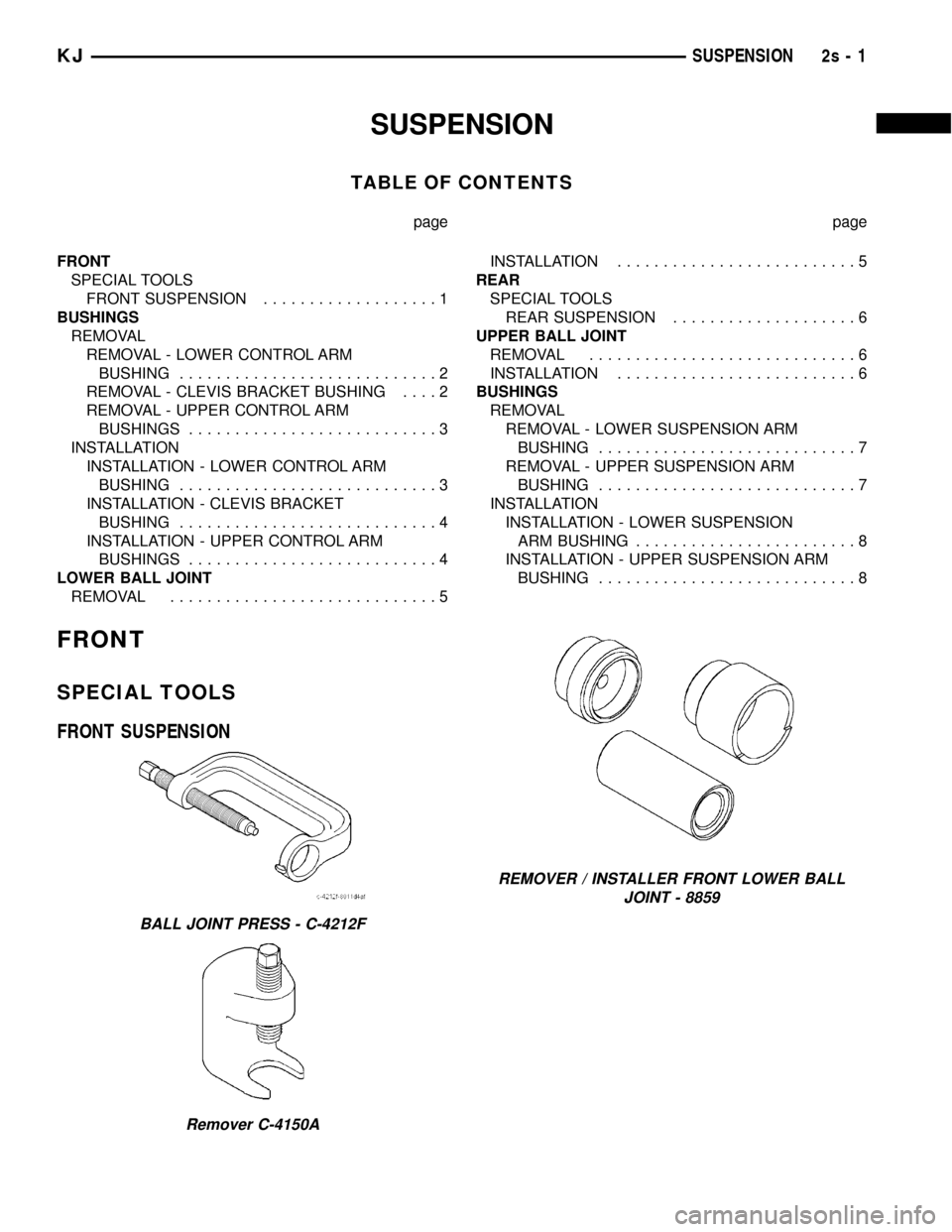
SPECIAL TOOLS
FRONT SUSPENSION
BALL JOINT PRESS - C-4212F
Remover C-4150A
REMOVER / INSTALLER FRONT LOWER BALL
JOINT - 8859
KJSUSPENSION 2s - 1
Page 43 of 1803
BUSHINGS
REMOVAL
REMOVAL - LOWER CONTROL ARM BUSHING
(1) Remove the lower control arm (Refer to 2 -
SUSPENSION/FRONT/LOWER CONTROL ARM -
REMOVAL).
(2) Secure the control arm in a vise.
NOTE: Extreme pressure lubrication must be used
on the threaded portions of the tool. This will
increase the longevity of the tool and insure proper
operation during the removal and installation pro-
cess.
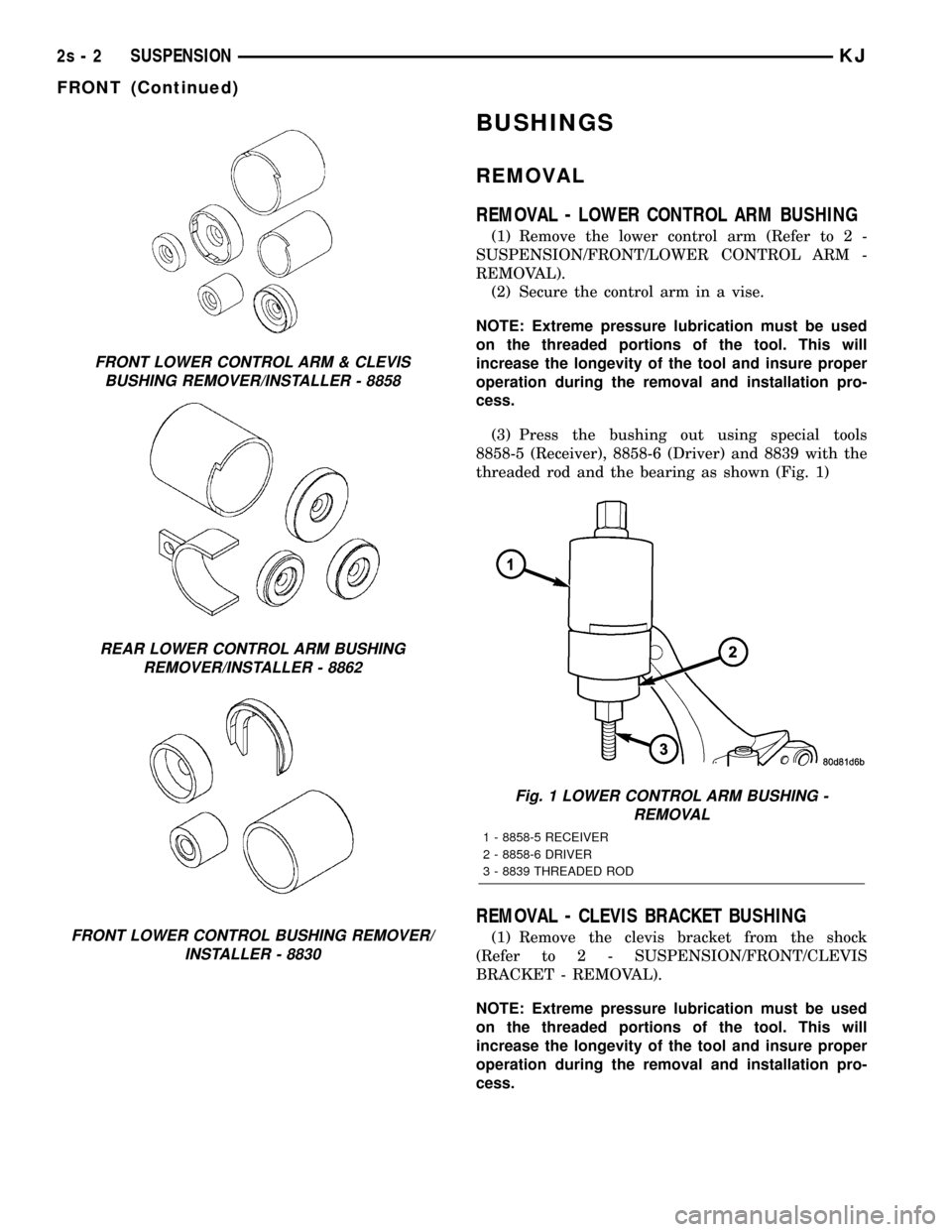
(3) Press the bushing out using special tools
8858-5 (Receiver), 8858-6 (Driver) and 8839 with the
threaded rod and the bearing as shown (Fig. 1)
REMOVAL - CLEVIS BRACKET BUSHING
(1) Remove the clevis bracket from the shock
(Refer to 2 - SUSPENSION/FRONT/CLEVIS
BRACKET - REMOVAL).
NOTE: Extreme pressure lubrication must be used
on the threaded portions of the tool. This will
increase the longevity of the tool and insure proper
operation during the removal and installation pro-
cess.
FRONT LOWER CONTROL ARM & CLEVIS
BUSHING REMOVER/INSTALLER - 8858
REAR LOWER CONTROL ARM BUSHING
REMOVER/INSTALLER - 8862
FRONT LOWER CONTROL BUSHING REMOVER/
INSTALLER - 8830
Fig. 1 LOWER CONTROL ARM BUSHING -
REMOVAL
1 - 8858-5 RECEIVER
2 - 8858-6 DRIVER
3 - 8839 THREADED ROD
2s - 2 SUSPENSIONKJ
FRONT (Continued)
Page 44 of 1803
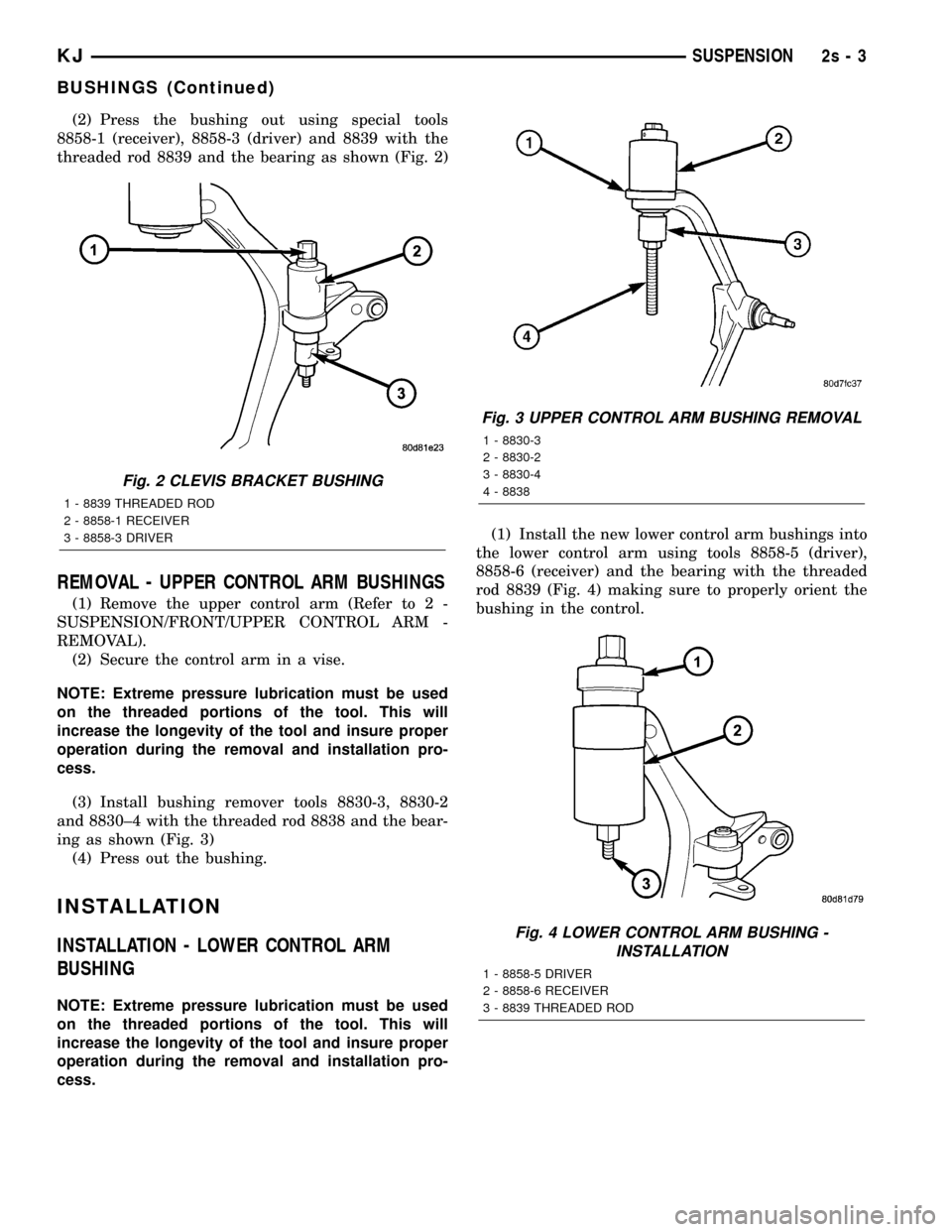
(2) Press the bushing out using special tools
8858-1 (receiver), 8858-3 (driver) and 8839 with the
threaded rod 8839 and the bearing as shown (Fig. 2)
REMOVAL - UPPER CONTROL ARM BUSHINGS
(1) Remove the upper control arm (Refer to 2 -
SUSPENSION/FRONT/UPPER CONTROL ARM -
REMOVAL).
(2) Secure the control arm in a vise.
NOTE: Extreme pressure lubrication must be used
on the threaded portions of the tool. This will
increase the longevity of the tool and insure proper
operation during the removal and installation pro-
cess.
(3) Install bushing remover tools 8830-3, 8830-2
and 8830±4 with the threaded rod 8838 and the bear-
ing as shown (Fig. 3)
(4) Press out the bushing.
INSTALLATION
INSTALLATION - LOWER CONTROL ARM
BUSHING
NOTE: Extreme pressure lubrication must be used
on the threaded portions of the tool. This will
increase the longevity of the tool and insure proper
operation during the removal and installation pro-
cess.(1) Install the new lower control arm bushings into
the lower control arm using tools 8858-5 (driver),
8858-6 (receiver) and the bearing with the threaded
rod 8839 (Fig. 4) making sure to properly orient the
bushing in the control.
Fig. 2 CLEVIS BRACKET BUSHING
1 - 8839 THREADED ROD
2 - 8858-1 RECEIVER
3 - 8858-3 DRIVER
Fig. 3 UPPER CONTROL ARM BUSHING REMOVAL
1 - 8830-3
2 - 8830-2
3 - 8830-4
4 - 8838
Fig. 4 LOWER CONTROL ARM BUSHING -
INSTALLATION
1 - 8858-5 DRIVER
2 - 8858-6 RECEIVER
3 - 8839 THREADED ROD
KJSUSPENSION 2s - 3
BUSHINGS (Continued)
Page 45 of 1803
(2) Remove the control arm from the vise.
(3) Install the lower control arm (Refer to 2 - SUS-
PENSION/FRONT/LOWER CONTROL ARM -
INSTALLATION).
(4) Reset the vehicle ride height (Refer to 2 - SUS-
PENSION/WHEEL ALIGNMENT - STANDARD
PROCEDURE).
(5) Perform a wheel alignment (Refer to 2 - SUS-
PENSION/WHEEL ALIGNMENT - STANDARD
PROCEDURE).
INSTALLATION - CLEVIS BRACKET BUSHING
NOTE: Extreme pressure lubrication must be used
on the threaded portions of the tool. This will
increase the longevity of the tool and insure proper
operation during the removal and installation pro-
cess.
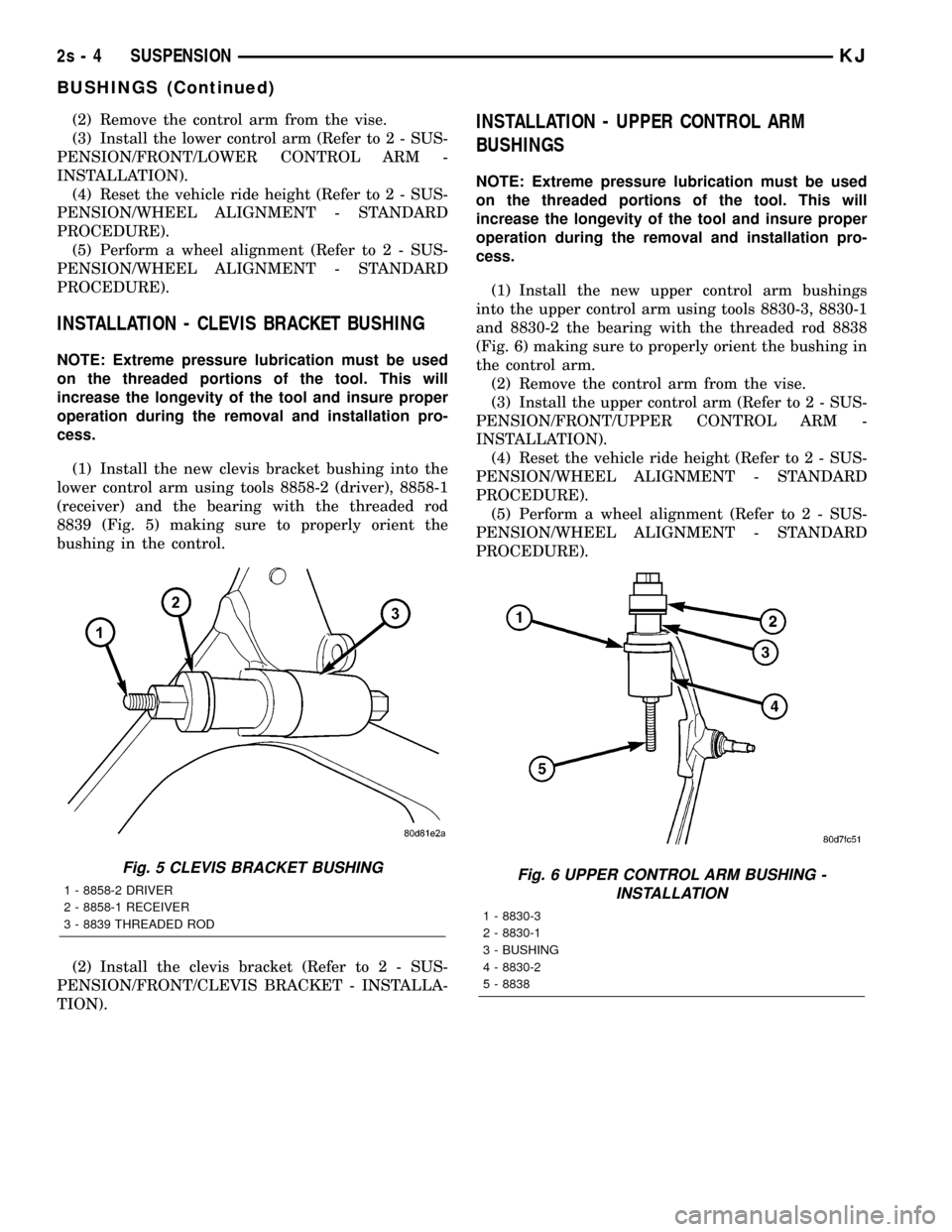
(1) Install the new clevis bracket bushing into the
lower control arm using tools 8858-2 (driver), 8858-1
(receiver) and the bearing with the threaded rod
8839 (Fig. 5) making sure to properly orient the
bushing in the control.
(2) Install the clevis bracket (Refer to 2 - SUS-
PENSION/FRONT/CLEVIS BRACKET - INSTALLA-
TION).
INSTALLATION - UPPER CONTROL ARM
BUSHINGS
NOTE: Extreme pressure lubrication must be used
on the threaded portions of the tool. This will
increase the longevity of the tool and insure proper
operation during the removal and installation pro-
cess.
(1) Install the new upper control arm bushings
into the upper control arm using tools 8830-3, 8830-1
and 8830-2 the bearing with the threaded rod 8838
(Fig. 6) making sure to properly orient the bushing in
the control arm.
(2) Remove the control arm from the vise.
(3) Install the upper control arm (Refer to 2 - SUS-
PENSION/FRONT/UPPER CONTROL ARM -
INSTALLATION).
(4) Reset the vehicle ride height (Refer to 2 - SUS-
PENSION/WHEEL ALIGNMENT - STANDARD
PROCEDURE).
(5) Perform a wheel alignment (Refer to 2 - SUS-
PENSION/WHEEL ALIGNMENT - STANDARD
PROCEDURE).
Fig. 5 CLEVIS BRACKET BUSHING
1 - 8858-2 DRIVER
2 - 8858-1 RECEIVER
3 - 8839 THREADED RODFig. 6 UPPER CONTROL ARM BUSHING -
INSTALLATION
1 - 8830-3
2 - 8830-1
3 - BUSHING
4 - 8830-2
5 - 8838
2s - 4 SUSPENSIONKJ
BUSHINGS (Continued)
Page 47 of 1803
REAR
SPECIAL TOOLS
REAR SUSPENSION
UPPER BALL JOINT
REMOVAL
(1) Raise and support the vehicle.
(2) Support the rear axle with a hydraulic jack.
(3) Remove the ball joint pinch bolt from the top of
the axle. (Fig. 9)(4) Separate the ball joint arm assembly from the
differential housing by prying upwards.
(5) Remove the upper suspension arm from the
vehicle (Refer to 2 - SUSPENSION/REAR/UPPER
CONTROL ARM - REMOVAL).
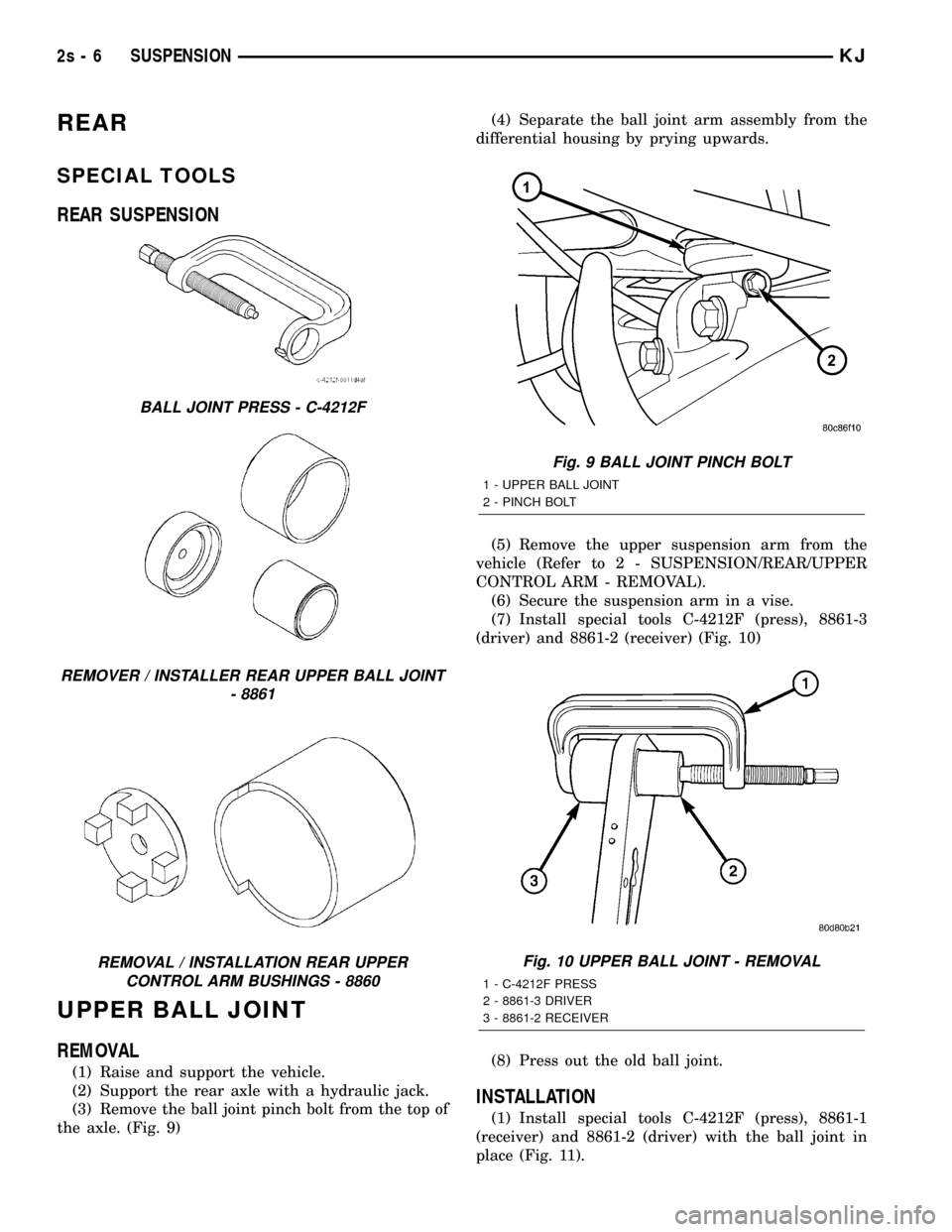
(6) Secure the suspension arm in a vise.
(7) Install special tools C-4212F (press), 8861-3
(driver) and 8861-2 (receiver) (Fig. 10)
(8) Press out the old ball joint.
INSTALLATION
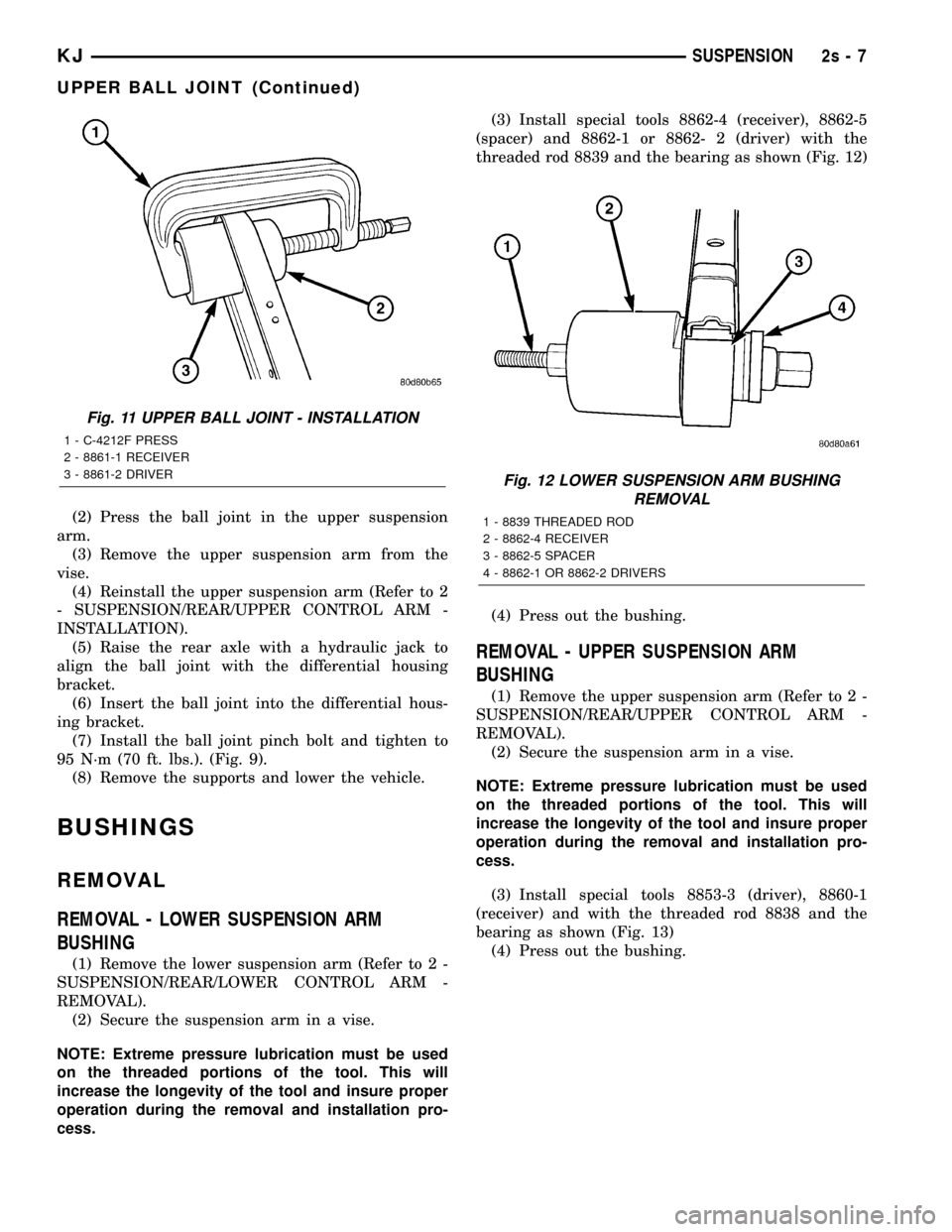
(1) Install special tools C-4212F (press), 8861-1
(receiver) and 8861-2 (driver) with the ball joint in
place (Fig. 11).
BALL JOINT PRESS - C-4212F
REMOVER / INSTALLER REAR UPPER BALL JOINT
- 8861
REMOVAL / INSTALLATION REAR UPPER
CONTROL ARM BUSHINGS - 8860
Fig. 9 BALL JOINT PINCH BOLT
1 - UPPER BALL JOINT
2 - PINCH BOLT
Fig. 10 UPPER BALL JOINT - REMOVAL
1 - C-4212F PRESS
2 - 8861-3 DRIVER
3 - 8861-2 RECEIVER
2s - 6 SUSPENSIONKJ
Page 48 of 1803
(2) Press the ball joint in the upper suspension
arm.
(3) Remove the upper suspension arm from the
vise.
(4) Reinstall the upper suspension arm (Refer to 2
- SUSPENSION/REAR/UPPER CONTROL ARM -
INSTALLATION).
(5) Raise the rear axle with a hydraulic jack to
align the ball joint with the differential housing
bracket.
(6) Insert the ball joint into the differential hous-
ing bracket.
(7) Install the ball joint pinch bolt and tighten to
95 N´m (70 ft. lbs.). (Fig. 9).
(8) Remove the supports and lower the vehicle.
BUSHINGS
REMOVAL
REMOVAL - LOWER SUSPENSION ARM
BUSHING
(1) Remove the lower suspension arm (Refer to 2 -
SUSPENSION/REAR/LOWER CONTROL ARM -
REMOVAL).
(2) Secure the suspension arm in a vise.
NOTE: Extreme pressure lubrication must be used
on the threaded portions of the tool. This will
increase the longevity of the tool and insure proper
operation during the removal and installation pro-
cess.(3) Install special tools 8862-4 (receiver), 8862-5
(spacer) and 8862-1 or 8862- 2 (driver) with the
threaded rod 8839 and the bearing as shown (Fig. 12)
(4) Press out the bushing.
REMOVAL - UPPER SUSPENSION ARM
BUSHING
(1) Remove the upper suspension arm (Refer to 2 -
SUSPENSION/REAR/UPPER CONTROL ARM -
REMOVAL).
(2) Secure the suspension arm in a vise.
NOTE: Extreme pressure lubrication must be used
on the threaded portions of the tool. This will
increase the longevity of the tool and insure proper
operation during the removal and installation pro-
cess.
(3) Install special tools 8853-3 (driver), 8860-1
(receiver) and with the threaded rod 8838 and the
bearing as shown (Fig. 13)
(4) Press out the bushing.
Fig. 11 UPPER BALL JOINT - INSTALLATION
1 - C-4212F PRESS
2 - 8861-1 RECEIVER
3 - 8861-2 DRIVER
Fig. 12 LOWER SUSPENSION ARM BUSHING
REMOVAL
1 - 8839 THREADED ROD
2 - 8862-4 RECEIVER
3 - 8862-5 SPACER
4 - 8862-1 OR 8862-2 DRIVERS
KJSUSPENSION 2s - 7
UPPER BALL JOINT (Continued)
Page 49 of 1803
INSTALLATION
INSTALLATION - LOWER SUSPENSION ARM
BUSHING
NOTE: Extreme pressure lubrication must be used
on the threaded portions of the tool. This will
increase the longevity of the tool and insure proper
operation during the removal and installation pro-
cess.
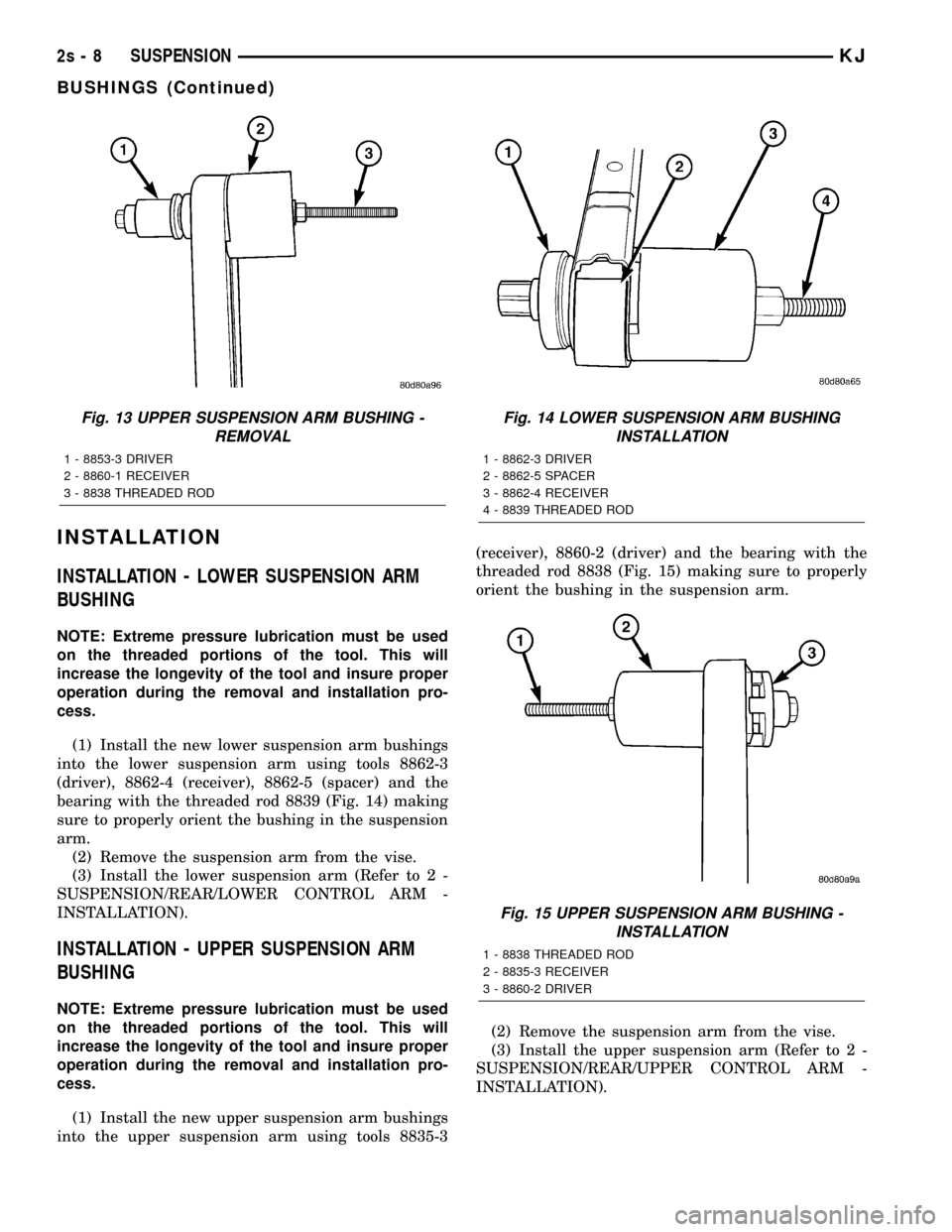
(1) Install the new lower suspension arm bushings
into the lower suspension arm using tools 8862-3
(driver), 8862-4 (receiver), 8862-5 (spacer) and the
bearing with the threaded rod 8839 (Fig. 14) making
sure to properly orient the bushing in the suspension
arm.
(2) Remove the suspension arm from the vise.
(3) Install the lower suspension arm (Refer to 2 -
SUSPENSION/REAR/LOWER CONTROL ARM -
INSTALLATION).
INSTALLATION - UPPER SUSPENSION ARM
BUSHING
NOTE: Extreme pressure lubrication must be used
on the threaded portions of the tool. This will
increase the longevity of the tool and insure proper
operation during the removal and installation pro-
cess.
(1) Install the new upper suspension arm bushings
into the upper suspension arm using tools 8835-3(receiver), 8860-2 (driver) and the bearing with the
threaded rod 8838 (Fig. 15) making sure to properly
orient the bushing in the suspension arm.
(2) Remove the suspension arm from the vise.
(3) Install the upper suspension arm (Refer to 2 -
SUSPENSION/REAR/UPPER CONTROL ARM -
INSTALLATION).
Fig. 13 UPPER SUSPENSION ARM BUSHING -
REMOVAL
1 - 8853-3 DRIVER
2 - 8860-1 RECEIVER
3 - 8838 THREADED ROD
Fig. 14 LOWER SUSPENSION ARM BUSHING
INSTALLATION
1 - 8862-3 DRIVER
2 - 8862-5 SPACER
3 - 8862-4 RECEIVER
4 - 8839 THREADED ROD
Fig. 15 UPPER SUSPENSION ARM BUSHING -
INSTALLATION
1 - 8838 THREADED ROD
2 - 8835-3 RECEIVER
3 - 8860-2 DRIVER
2s - 8 SUSPENSIONKJ
BUSHINGS (Continued)
Page 103 of 1803
REMOVAL
(1) Raise and support the vehicle.
(2) Position a lift/jack under the axle and secure
axle to device.
(3) Remove wheels and tires.
(4) Mark propeller shaft and pinion yoke for
installation reference.
(5) Remove propeller shaft and suspend under the
vehicle.
(6) Remove brake drums, parking brake cables and
speed sensor from the axle.
(7) Disconnect the brake hose at the body junction
block.
(8) Remove brakes and backing plates.
(9) Remove vent hose from the axle shaft tube.
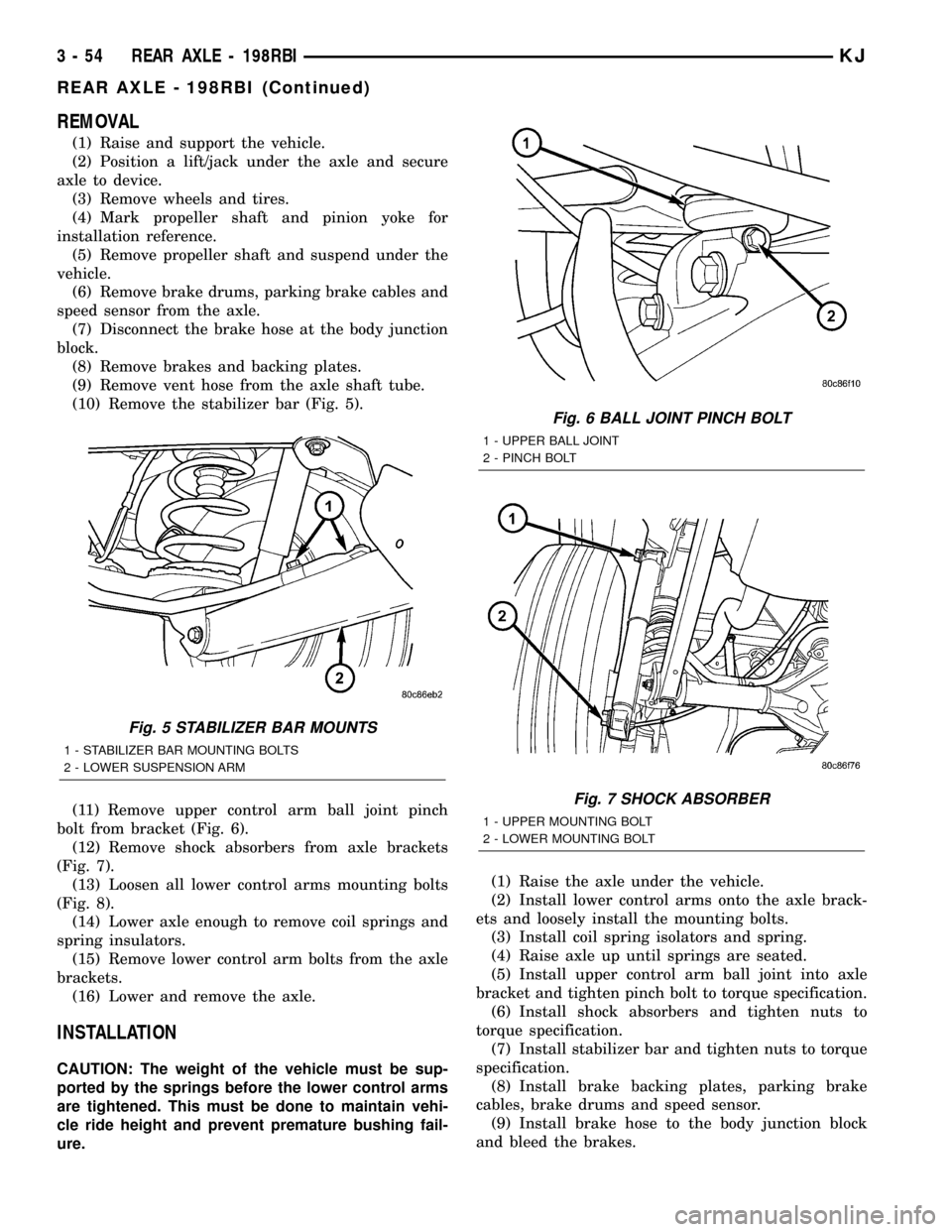
(10) Remove the stabilizer bar (Fig. 5).
(11) Remove upper control arm ball joint pinch
bolt from bracket (Fig. 6).
(12) Remove shock absorbers from axle brackets
(Fig. 7).
(13) Loosen all lower control arms mounting bolts
(Fig. 8).
(14) Lower axle enough to remove coil springs and
spring insulators.
(15) Remove lower control arm bolts from the axle
brackets.
(16) Lower and remove the axle.
INSTALLATION
CAUTION: The weight of the vehicle must be sup-
ported by the springs before the lower control arms
are tightened. This must be done to maintain vehi-
cle ride height and prevent premature bushing fail-
ure.(1) Raise the axle under the vehicle.
(2) Install lower control arms onto the axle brack-
ets and loosely install the mounting bolts.
(3) Install coil spring isolators and spring.
(4) Raise axle up until springs are seated.
(5) Install upper control arm ball joint into axle
bracket and tighten pinch bolt to torque specification.
(6) Install shock absorbers and tighten nuts to
torque specification.
(7) Install stabilizer bar and tighten nuts to torque
specification.
(8) Install brake backing plates, parking brake
cables, brake drums and speed sensor.
(9) Install brake hose to the body junction block
and bleed the brakes.
Fig. 5 STABILIZER BAR MOUNTS
1 - STABILIZER BAR MOUNTING BOLTS
2 - LOWER SUSPENSION ARM
Fig. 6 BALL JOINT PINCH BOLT
1 - UPPER BALL JOINT
2 - PINCH BOLT
Fig. 7 SHOCK ABSORBER
1 - UPPER MOUNTING BOLT
2 - LOWER MOUNTING BOLT
3 - 54 REAR AXLE - 198RBIKJ
REAR AXLE - 198RBI (Continued)
Page 140 of 1803
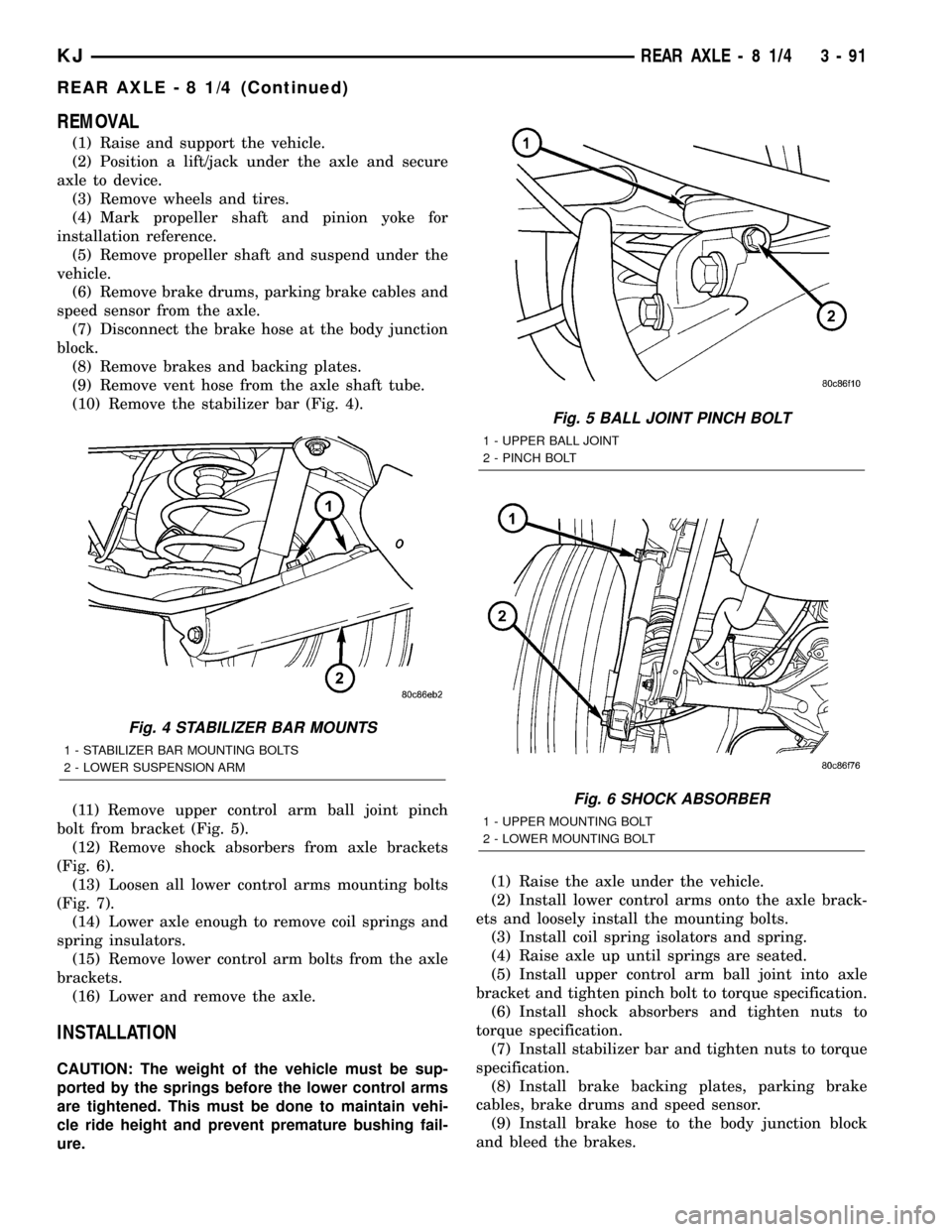
REMOVAL
(1) Raise and support the vehicle.
(2) Position a lift/jack under the axle and secure
axle to device.
(3) Remove wheels and tires.
(4) Mark propeller shaft and pinion yoke for
installation reference.
(5) Remove propeller shaft and suspend under the
vehicle.
(6) Remove brake drums, parking brake cables and
speed sensor from the axle.
(7) Disconnect the brake hose at the body junction
block.
(8) Remove brakes and backing plates.
(9) Remove vent hose from the axle shaft tube.
(10) Remove the stabilizer bar (Fig. 4).
(11) Remove upper control arm ball joint pinch
bolt from bracket (Fig. 5).
(12) Remove shock absorbers from axle brackets
(Fig. 6).
(13) Loosen all lower control arms mounting bolts
(Fig. 7).
(14) Lower axle enough to remove coil springs and
spring insulators.
(15) Remove lower control arm bolts from the axle
brackets.
(16) Lower and remove the axle.
INSTALLATION
CAUTION: The weight of the vehicle must be sup-
ported by the springs before the lower control arms
are tightened. This must be done to maintain vehi-
cle ride height and prevent premature bushing fail-
ure.(1) Raise the axle under the vehicle.
(2) Install lower control arms onto the axle brack-
ets and loosely install the mounting bolts.
(3) Install coil spring isolators and spring.
(4) Raise axle up until springs are seated.
(5) Install upper control arm ball joint into axle
bracket and tighten pinch bolt to torque specification.
(6) Install shock absorbers and tighten nuts to
torque specification.
(7) Install stabilizer bar and tighten nuts to torque
specification.
(8) Install brake backing plates, parking brake
cables, brake drums and speed sensor.
(9) Install brake hose to the body junction block
and bleed the brakes.
Fig. 4 STABILIZER BAR MOUNTS
1 - STABILIZER BAR MOUNTING BOLTS
2 - LOWER SUSPENSION ARM
Fig. 5 BALL JOINT PINCH BOLT
1 - UPPER BALL JOINT
2 - PINCH BOLT
Fig. 6 SHOCK ABSORBER
1 - UPPER MOUNTING BOLT
2 - LOWER MOUNTING BOLT
KJREAR AXLE - 8 1/4 3 - 91
REAR AXLE - 8 1/4 (Continued)
Page 168 of 1803

SPONGY PEDAL
A spongy pedal is most often caused by air in the
system. However, thin brake drums or substandard
brake lines and hoses can also cause a spongy pedal.
The proper course of action is to bleed the system,
and replace thin drums and substandard quality
brake hoses if suspected.
HARD PEDAL OR HIGH PEDAL EFFORT
A hard pedal or high pedal effort may be due to
lining that is water soaked, contaminated, glazed, or
badly worn. The power booster or check valve could
also be faulty.
PEDAL PULSATION
Pedal pulsation is caused by components that are
loose, or beyond tolerance limits.
The primary cause of pulsation are disc brake
rotors with excessive lateral runout or thickness vari-
ation, or out of round brake drums. Other causes are
loose wheel bearings or calipers and worn, damaged
tires.
NOTE: Some pedal pulsation may be felt during
ABS activation.
BRAKE DRAG
Brake drag occurs when the lining is in constant
contact with the rotor or drum. Drag can occur at one
wheel, all wheels, fronts only, or rears only.
Drag is a product of incomplete brake shoe release.
Drag can be minor or severe enough to overheat the
linings, rotors and drums.
Minor drag will usually cause slight surface char-
ring of the lining. It can also generate hard spots in
rotors and drums from the overheat-cool down pro-
cess. In most cases, the rotors, drums, wheels and
tires are quite warm to the touch after the vehicle is
stopped.
Severe drag can char the brake lining all the way
through. It can also distort and score rotors and
drums to the point of replacement. The wheels, tires
and brake components will be extremely hot. In
severe cases, the lining may generate smoke as it
chars from overheating.
Common causes of brake drag are:
²Seized or improperly adjusted parking brake
cables.
²Loose/worn wheel bearing.
²Seized caliper or wheel cylinder piston.
²Caliper binding on corroded bushings or rusted
slide surfaces.
²Loose caliper mounting.
²Drum brake shoes binding on worn/damaged
support plates.
²Mis-assembled components.²Long booster output rod.
If brake drag occurs at all wheels, the problem
may be related to a blocked master cylinder return
port, or faulty power booster (binds-does not release).
BRAKE FADE
Brake fade is usually a product of overheating
caused by brake drag. However, brake overheating
and resulting fade can also be caused by riding the
brake pedal, making repeated high deceleration stops
in a short time span, or constant braking on steep
mountain roads. Refer to the Brake Drag information
in this section for causes.
BRAKE PULL
Front brake pull condition could result from:
²Contaminated lining in one caliper
²Seized caliper piston
²Binding caliper
²Loose caliper
²Rusty caliper slide surfaces
²Improper brake shoes
²Damaged rotor
A worn, damaged wheel bearing or suspension
component are further causes of pull. A damaged
front tire (bruised, ply separation) can also cause
pull.
A common and frequently misdiagnosed pull condi-
tion is where direction of pull changes after a few
stops. The cause is a combination of brake drag fol-
lowed by fade at one of the brake units.
As the dragging brake overheats, efficiency is so
reduced that fade occurs. Since the opposite brake
unit is still functioning normally, its braking effect is
magnified. This causes pull to switch direction in
favor of the normally functioning brake unit.
An additional point when diagnosing a change in
pull condition concerns brake cool down. Remember
that pull will return to the original direction, if the
dragging brake unit is allowed to cool down (and is
not seriously damaged).
REAR BRAKE GRAB OR PULL
Rear grab or pull is usually caused by improperly
adjusted or seized parking brake cables, contami-
nated lining, bent or binding shoes and support
plates, or improperly assembled components. This is
particularly true when only one rear wheel is
involved. However, when both rear wheels are
affected, the master cylinder or proportioning valve
could be at fault.
5 - 4 BRAKES - BASEKJ
BRAKES - BASE (Continued)