fog light bulb JEEP LIBERTY 2002 KJ / 1.G User Guide
[x] Cancel search | Manufacturer: JEEP, Model Year: 2002, Model line: LIBERTY, Model: JEEP LIBERTY 2002 KJ / 1.GPages: 1803, PDF Size: 62.3 MB
Page 456 of 1803
SPECIFICATIONS - LAMPS/LIGHTING -
EXTERIOR
BULB SPECIFICATIONS
LAMP BULB
Backup 3157 P27/7W
Brake 3157 P27/7W
Center High Mounted
Stop921/W16W
Front Fog 9145
Front Park 3157 P27/7W
Front Position W5W
Front Side Marker 168
Front Turn 3157 P27/7W
Headlamp (North
America)9007QL
Headlamp (Rest-Of-
World)H-4 W0W6
License Plate (North
America)168
License Plate (Rest-Of-
World)W5W
Rear Fog 3157 P27/7W
Rear Park/Tail 3157 P27/7W
Rear Turn 3157 P27/7W
Side Repeater W5W
BACKUP LAMP SWITCH
DESCRIPTION
Vehicles equipped with a manual transmission
have a normally open, spring-loaded plunger type
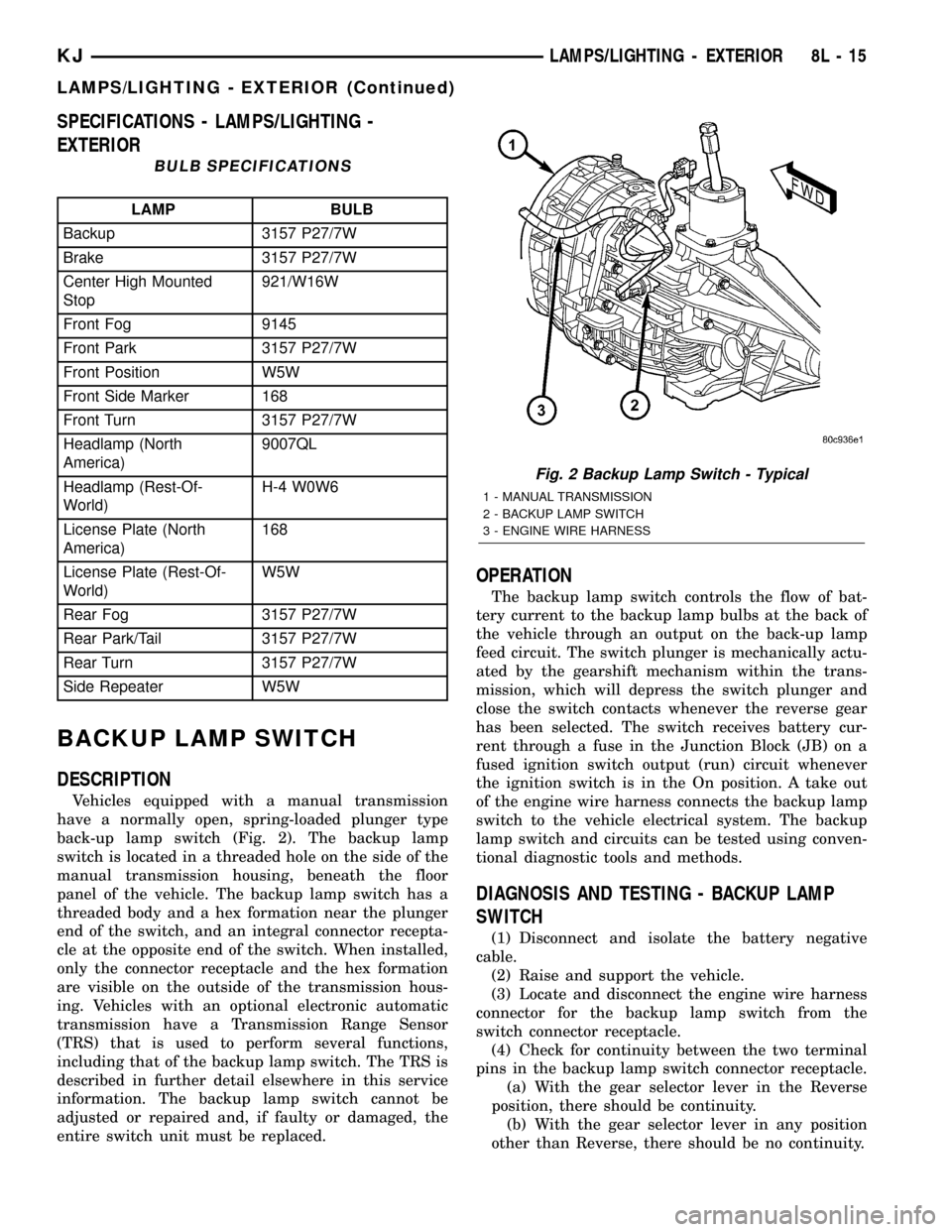
back-up lamp switch (Fig. 2). The backup lamp
switch is located in a threaded hole on the side of the
manual transmission housing, beneath the floor
panel of the vehicle. The backup lamp switch has a
threaded body and a hex formation near the plunger
end of the switch, and an integral connector recepta-
cle at the opposite end of the switch. When installed,
only the connector receptacle and the hex formation
are visible on the outside of the transmission hous-
ing. Vehicles with an optional electronic automatic
transmission have a Transmission Range Sensor
(TRS) that is used to perform several functions,
including that of the backup lamp switch. The TRS is
described in further detail elsewhere in this service
information. The backup lamp switch cannot be
adjusted or repaired and, if faulty or damaged, the
entire switch unit must be replaced.
OPERATION
The backup lamp switch controls the flow of bat-
tery current to the backup lamp bulbs at the back of
the vehicle through an output on the back-up lamp
feed circuit. The switch plunger is mechanically actu-
ated by the gearshift mechanism within the trans-
mission, which will depress the switch plunger and
close the switch contacts whenever the reverse gear
has been selected. The switch receives battery cur-
rent through a fuse in the Junction Block (JB) on a
fused ignition switch output (run) circuit whenever
the ignition switch is in the On position. A take out
of the engine wire harness connects the backup lamp
switch to the vehicle electrical system. The backup
lamp switch and circuits can be tested using conven-
tional diagnostic tools and methods.
DIAGNOSIS AND TESTING - BACKUP LAMP
SWITCH
(1) Disconnect and isolate the battery negative
cable.
(2) Raise and support the vehicle.
(3) Locate and disconnect the engine wire harness
connector for the backup lamp switch from the
switch connector receptacle.
(4) Check for continuity between the two terminal
pins in the backup lamp switch connector receptacle.
(a) With the gear selector lever in the Reverse
position, there should be continuity.
(b) With the gear selector lever in any position
other than Reverse, there should be no continuity.
Fig. 2 Backup Lamp Switch - Typical
1 - MANUAL TRANSMISSION
2 - BACKUP LAMP SWITCH
3 - ENGINE WIRE HARNESS
KJLAMPS/LIGHTING - EXTERIOR 8L - 15
LAMPS/LIGHTING - EXTERIOR (Continued)
Page 462 of 1803

REMOVAL
WARNING: ON VEHICLES EQUIPPED WITH AIR-
BAGS, DISABLE THE SUPPLEMENTAL RESTRAINT
SYSTEM BEFORE ATTEMPTING ANY STEERING
WHEEL, STEERING COLUMN, DRIVER AIRBAG,
PASSENGER AIRBAG, SEAT BELT TENSIONER,
FRONT IMPACT SENSORS, SIDE CURTAIN AIRBAG,
OR INSTRUMENT PANEL COMPONENT DIAGNOSIS
OR SERVICE. DISCONNECT AND ISOLATE THE
BATTERY NEGATIVE (GROUND) CABLE, THEN
WAIT TWO MINUTES FOR THE SYSTEM CAPACI-
TOR TO DISCHARGE BEFORE PERFORMING FUR-
THER DIAGNOSIS OR SERVICE. THIS IS THE ONLY
SURE WAY TO DISABLE THE SUPPLEMENTAL
RESTRAINT SYSTEM. FAILURE TO TAKE THE
PROPER PRECAUTIONS COULD RESULT IN ACCI-
DENTAL AIRBAG DEPLOYMENT AND POSSIBLE
PERSONAL INJURY.
(1) Disconnect and isolate the battery negative
cable.
(2) Remove the end cap from the driver side out-
board end of the instrument panel. (Refer to 23 -
BODY/INSTRUMENT PANEL/INSTRUMENT
PANEL END CAP - REMOVAL).
(3) Remove the Daytime Running Lamp (DRL)
relay by grasping it firmly and pulling it straight out
from the receptacle in the Junction Block (JB) (Fig.
9).
INSTALLATION
WARNING: ON VEHICLES EQUIPPED WITH AIR-
BAGS, DISABLE THE SUPPLEMENTAL RESTRAINT
SYSTEM BEFORE ATTEMPTING ANY STEERING
WHEEL, STEERING COLUMN, DRIVER AIRBAG,
PASSENGER AIRBAG, SEAT BELT TENSIONER,
FRONT IMPACT SENSORS, SIDE CURTAIN AIRBAG,
OR INSTRUMENT PANEL COMPONENT DIAGNOSIS
OR SERVICE. DISCONNECT AND ISOLATE THE
BATTERY NEGATIVE (GROUND) CABLE, THEN
WAIT TWO MINUTES FOR THE SYSTEM CAPACI-
TOR TO DISCHARGE BEFORE PERFORMING FUR-
THER DIAGNOSIS OR SERVICE. THIS IS THE ONLY
SURE WAY TO DISABLE THE SUPPLEMENTAL
RESTRAINT SYSTEM. FAILURE TO TAKE THE
PROPER PRECAUTIONS COULD RESULT IN ACCI-
DENTAL AIRBAG DEPLOYMENT AND POSSIBLE
PERSONAL INJURY.
(1) Position the Daytime Running Lamp (DRL)
relay to the proper receptacle in the Junction Block
(JB) (Fig. 9).
(2) Align the DRL relay terminals with the termi-
nal cavities in the JB receptacle.
(3) Push firmly and evenly on the top of the DRL
relay until the terminals are fully seated in the ter-
minal cavities in the JB receptacle.
(4) Reinstall the end cap onto the driver side out-
board end of the instrument panel. (Refer to 23 -
BODY/INSTRUMENT PANEL/INSTRUMENT
PANEL END CAP - INSTALLATION).
(5) Reconnect the battery negative cable.
FRONT FOG LAMP BULB
REMOVAL
(1) Turn the front wheels full lock in the direction
of the fog lamp bulb that is to be changed.
(2) Disconnect and isolate the battery negative
cable.
(3) Reach into the front wheel opening to unsnap
and lift the cover over the access hole at the front of
the front wheelhouse splash shield (Fig. 10).
(4) Reach through the access hole and firmly grasp
the socket on the back of the front fog lamp unit
housing.
(5) Rotate the socket on the back of the front fog
lamp unit housing counterclockwise about 30
degrees.
CAUTION: Do not contaminate the bulb glass by
touching it with your fingers or by allowing it to
contact other oily surfaces. Shortened bulb life will
result.
Fig. 9 Junction Block - Outboard Side (RHD Shown
- Rotate 180É for LHD)
1 - JB/BCM CONNECTOR
2 - HIGH BEAM RELAY
3 - DRL RELAY
KJLAMPS/LIGHTING - EXTERIOR 8L - 21
DAYTIME RUNNING LAMP RELAY (Continued)
Page 463 of 1803

(6) Pull the socket and bulb straight out of the
front fog lamp unit housing and through the access
hole into the front wheel opening area.
(7) Pull the bulb straight out of the front fog lamp
unit socket.
INSTALLATION
CAUTION: Always use the correct bulb size and
type for replacement. An incorrect bulb size or type
may overheat and cause damage to the lamp, the
socket and/or the lamp wiring.
CAUTION: Do not contaminate the bulb glass by
touching it with your fingers or by allowing it to
contact other oily surfaces. Shortened bulb life will
result.
(1) Align the base of the bulb with the receptacle
in the front fog lamp unit socket.
(2) Push the bulb straight into the front fog lamp
unit socket until it is firmly seated.
(3) Position the socket and bulb through the access
hole in the front wheelhouse splash shield and align
it with the socket opening on the back of the front
fog lamp unit housing (Fig. 10).
(4) Push the socket and bulb straight into the
front fog lamp unit housing until it is firmly seated.
(5) Rotate the socket on the back of the front fog
lamp unit housing clockwise about 30 degrees.
(6) Lower and snap shut the access cover over the
hole at the front of the front wheelhouse splash
shield.
(7) Reconnect the battery negative cable.
FRONT FOG LAMP RELAY
DESCRIPTION
The front fog lamp relay is located in the Junction
Block (JB) on the driver side outboard end of the
instrument panel in the passenger compartment of
the vehicle. The front fog lamp relay is a conven-
tional International Standards Organization (ISO)
micro relay (Fig. 11). Relays conforming to the ISO
specifications have common physical dimensions, cur-
rent capacities, terminal patterns, and terminal func-
tions. The relay is contained within a small,
rectangular, molded plastic housing and is connected
to all of the required inputs and outputs by five inte-
gral male spade-type terminals that extend from the
bottom of the relay base.
The front fog lamp relay cannot be adjusted or
repaired and, if faulty or damaged, the unit must be
replaced.
OPERATION
The front fog lamp relay is an electromechanical
switch that uses a low current input from the Body
Control Module (BCM) to control a high current out-
put to the front fog lamps. The movable common feed
contact point is held against the fixed normally
closed contact point by spring pressure. When the
relay coil is energized, an electromagnetic field is
produced by the coil windings. This electromagnetic
field draws the movable relay contact point away
from the fixed normally closed contact point, and
holds it against the fixed normally open contact
Fig. 10 Front Fog Lamp Bulb Remove/Install
1 - FRONT WHEELHOUSE SPLASH SHIELD
2 - ACCESS HOLE
3 - SOCKET
4 - BULB
Fig. 11 ISO Micro Relay
30 - COMMON FEED
85 - COIL GROUND
86 - COIL BATTERY
87 - NORMALLY OPEN
87A - NORMALLY CLOSED
8L - 22 LAMPS/LIGHTING - EXTERIORKJ
FRONT FOG LAMP BULB (Continued)
Page 466 of 1803

FRONT FOG LAMP UNIT
REMOVAL
(1) Turn the front wheels full lock in the direction
of the fog lamp bulb that is to be changed.
(2) Disconnect and isolate the battery negative
cable.
(3) Reach into the front wheel opening to unsnap
and lift the cover over the access hole at the front of
the front wheelhouse splash shield (Fig. 14).
(4) Reach through the access hole to remove the
three screws that secure the front fog lamp unit to
the front bumper fascia.
(5) From the front of the vehicle, pull the front fog
lamp unit out of the front bumper fascia far enough
to access and disconnect the wire harness connector
for the front fog lamp unit from the lamp socket con-
nector receptacle (Fig. 15).
(6) Remove the front fog lamp unit from the front
bumper fascia.
INSTALLATION
(1) Position the front fog lamp unit to the front
bumper fascia.
(2) Reconnect the wire harness connector for the
front fog lamp to the lamp socket connector recepta-
cle (Fig. 15).
(3) Position the front fog lamp unit into the front
bumper fascia.
(4) Reach into the front wheel opening and
through the access hole to install and tighten the
three screws that secure the front fog lamp unithousing to the front bumper fascia (Fig. 14). Tighten
the screws to 3 N´m (25 in. lbs.).
(5) Lower and snap shut the cover over the access
hole at the front of the front wheelhouse splash
shield.
(6) Reconnect the battery negative cable.
(7) Confirm proper front fog lamp unit alignment.
(Refer to 8 - ELECTRICAL/LAMPS/LIGHTING -
EXTERIOR/FRONT FOG LAMP UNIT - ADJUST-
MENTS).
ADJUSTMENTS
ADJUSTMENT - FRONT FOG LAMP UNIT
VEHICLE PREPARATION FOR FOG LAMP ALIGNMENT
(1) Repair or replace any faulty or damaged com-
ponents that could hinder proper lamp alignment.
(2) Verify proper tire inflation.
(3) Clean the front fog lamp lenses.
(4) Verify that the cargo area is not heavily loaded.
(5) The fuel tank should be Full. Add 2.94 kilo-
grams (6.5 pounds) of weight over the fuel tank for
each estimated gallon of missing fuel.
FOG LAMP ALIGNMENT
Prepare an alignment screen as illustrated. A prop-
erly aligned front fog lamp will project a pattern on
the alignment screen 100 millimeters (4 inches)
below the fog lamp centerline and straight ahead of
the lamp.
Fig. 14 Front Fog Lamp Unit Remove/Install
1 - FRONT FOG LAMP UNIT
2 - SCREW (3)
3 - FRONT WHEELHOUSE SPLASH SHIELD
4 - FRONT BUMPER FASCIA
5 - ACCESS HOLE
Fig. 15 Front Fog Lamp Unit
1 - ADJUSTING SCREW
2 - MOUNTING BRACKET
3 - HOUSING
4 - SOCKET & BULB
5 - LENS
KJLAMPS/LIGHTING - EXTERIOR 8L - 25
Page 467 of 1803

(1) Position the vehicle on a level surface perpen-
dicular to a flat wall 7.62 meters (25 feet) away from
the front of the front fog lamp lens (Fig. 16). If nec-
essary, tape a line on the floor 7.62 meters (25 feet)
away from and parallel to the wall.
(2) Measure up on the wall 1.27 meters (5 feet)
from the floor and tape a vertical line on the align-
ment screen at the centerline of the vehicle. Sight
along the centerline of the vehicle (from the rear of
the vehicle forward) to verify the accuracy of the cen-
terline placement.
(3) Rock the vehicle from side-to-side three times
to allow the suspension to stabilize, then jounce the
front suspension three times by pushing downward
on the front bumper and releasing. Measure the dis-
tance from the center of the front fog lamp lens to
the floor. Transfer this measurement to the align-
ment screen and tape a horizontal line on the wall at
this mark. This line will be used for up-and-down
adjustment reference.
(4) Measure the distance from the centerline of the
vehicle to the center of each front fog lamp beingaligned. Transfer these measurements to the align-
ment screen and tape a vertical line this distance to
each side of the vehicle centerline. These lines will be
used for left/right reference.
(5) Rotate the front fog lamp adjusting screws to
adjust the beam height as required (Fig. 17).
FRONT LAMP BULB
REMOVAL
The front lamp unit may contain either one or two
bulbs, depending upon the market for which the
vehicle was manufactured. The service procedures for
one bulb or for both bulbs is the same, only the bulb
sizes and types may differ. Be certain any removed
bulb is replaced with the same bulb size and type
that was removed.
(1) Disconnect and isolate the battery negative
cable.
(2) Remove the front lamp unit from the front
bumper fascia. (Refer to 8 - ELECTRICAL/LAMPS/
Fig. 16 Front Fog Lamp Alignment - Typical
1 - VEHICLE CENTERLINE
2 - CENTER OF VEHICLE TO CENTER OF FOG LAMP LENS
3 - HIGH-INTENSITY AREA
4 - FLOOR TO CENTER OF FOG LAMP LENS5 - 100 MILLIMETERS (4 INCHES)
6 - 7.62 METERS (25 FEET)
7 - FRONT OF FOG LAMP
8L - 26 LAMPS/LIGHTING - EXTERIORKJ
FRONT FOG LAMP UNIT (Continued)
Page 468 of 1803

LIGHTING - EXTERIOR/FRONT LAMP UNIT -
REMOVAL).
(3) Firmly grasp the socket on the back of the
front lamp unit housing for the bulb that is being
removed (Fig. 18).
(4) Rotate the socket on the back of the front lamp
unit housing counterclockwise about 30 degrees.
(5) Pull the socket and bulb straight out of the
back of the front lamp unit housing.
(6) Pull the bulb straight out of the front lamp
unit socket.
INSTALLATION
CAUTION: Always use the correct bulb size and
type for replacement. An incorrect bulb size or type
may overheat and cause damage to the lamp, the
socket and/or the lamp wiring.
(1) Align the base of the bulb with the receptacle
in the front lamp unit socket.
(2) Push the bulb straight into the front lamp unit
socket until it is firmly seated.
(3) Align the socket and bulb with the socket open-
ing on the back of the front lamp unit housing (Fig.
18).
(4) Push the socket and bulb straight into the
front lamp unit housing until it is firmly seated.
(5) Rotate the socket on the back of the front lamp
unit housing clockwise about 30 degrees.
(6) Reinstall the front lamp unit into the front
bumper fascia. (Refer to 8 - ELECTRICAL/LAMPS/
LIGHTING - EXTERIOR/FRONT LAMP UNIT -
INSTALLATION).
(7) Reconnect the battery negative cable.
FRONT LAMP UNIT
REMOVAL
(1) Disconnect and isolate the battery negative
cable.
(2) Remove the screw that secures the outboard
end of the front lamp unit to the front bumper fascia
(Fig. 19).
(3) Pull the outboard end of the front lamp unit
away from the front bumper fascia far enough to dis-
Fig. 17 Front Fog Lamp Adjusting Screw
1 - FRONT BUMPER FASCIA
2 - ADJUSTING SCREW
3 - FRONT FOG LAMP UNIT
Fig. 18 Front Lamp Bulb Remove/Install
1 - FRONT LAMP UNIT
2 - SIDE MARKER SOCKET
3 - FRONT FASCIA
4 - HEADLAMP & DASH WIRE HARNESS
5 - MOUNTING TAB
6 - PARK/TURN SIGNAL SOCKET
Fig. 19 Front Lamp Unit Remove/Install
1 - FRONT LAMP UNIT
2 - FRONT BUMPER FASCIA
3 - SCREW (1)
KJLAMPS/LIGHTING - EXTERIOR 8L - 27
FRONT LAMP BULB (Continued)
Page 487 of 1803

REST-OF-WORLD
(1) Disconnect and isolate the battery negative
cable.
(2) Remove the bulb and socket unit from the
license plate lamp unit housing that is being
removed. (Refer to 8 - ELECTRICAL/LAMPS/LIGHT-
ING - EXTERIOR/LICENSE PLATE LAMP BULB -
REMOVAL - REST-OF-WORLD).
(3) Remove the two screws that secure the license
plate lamp unit to the back of the license plate
bracket (Fig. 49).
(1) Remove the license plate lamp unit from the
back of the license plate bracket.
INSTALLATION
NORTH AMERICA
(1) Position the license plate lamp unit to the rear
bumper fascia.
(2) Reconnect the wire harness connector for the
license plate lamp unit to the lamp socket pigtail
wire.
(3) Position the license plate lamp unit into the
mounting hole in the rear bumper fascia (Fig. 48).
(4) Install and tighten the two screws that secure
the license plate lamp unit housing to the rear
bumper fascia. Tighten the screws to 2 N´m (20 in.
lbs.).
(5) Reconnect the battery negative cable.
REST-OF-WORLD
(1) Position the license plate lamp unit onto the
back of the license plate bracket (Fig. 49).(2) Install and tighten the two screws that secure
the license plate lamp unit to the back of the license
plate bracket. Tighten the screws to 2 N´m (20 in.
lbs.).
(3) Reinstall the bulb and socket unit into the
license plate lamp unit housing that is being
replaced. (Refer to 8 - ELECTRICAL/LAMPS/LIGHT-
ING - EXTERIOR/LICENSE PLATE LAMP BULB -
INSTALLATION - REST-OF-WORLD).
(4) Reconnect the battery negative cable.
MULTI-FUNCTION SWITCH
DESCRIPTION
The multi-function switch is located on the steering
column, just below the steering wheel (Fig. 50). The
only visible components of the multi-function switch
are two levers, or control stalks that extend through
dedicated openings in each side of the steering col-
umn shrouds. The remainder of the switch, its
mounting provisions, and its electrical connections
are all concealed beneath the steering column
shrouds. The switch housing and controls are con-
structed of molded black plastic. A saddle-like forma-
tion in the center of the multi-function switch
housing straddles the steering column tube just
below the column lock housing, and two posts inte-
gral to the lower surface of the switch housing
engage two holes on the forward-facing side of the
lock housing. Two integral ledge-like locating tabs
near the top of the rearward facing switch housing
surface are supported and located by two upright
stanchions that extend upward from the top of the
lock housing. Also on the rearward facing switch
housing surface near the center, an integral ledge-
like mounting tab rests on a similar ledge-like tab
that extends from each side of the steering column
lock housing. When the steering column shrouds are
installed on the column, the switch mounting tabs
are clamped along with the mounting tabs of the
clockspring between the integral mounting stan-
chions of the upper shroud and the lock housing tabs,
and are secured to the steering column lock housing
by the same two screws that secure the two shroud
halves to each other and the column.
There are several versions of the multi-function
switch to support both optional equipment and equip-
ment that is required only in certain markets. Each
multi-function switch control stalk has both white
nomenclature and International Control and Display
Symbol graphics applied to it, which clearly identify
its many functions. Each control stalk has a control
knob on its end with a flattened face to allow it to be
easily rotated. On vehicles equipped with optional
front fog lamps, the knob on the end of left control
Fig. 49 License Plate Lamp Bulb Remove/Install -
Rest-Of-World
1 - LAMP UNIT (2)
2 - LICENSE PLATE BRACKET
3 - SCREW (4)
4 - BULB & SOCKET (2)
8L - 46 LAMPS/LIGHTING - EXTERIORKJ
LICENSE PLATE LAMP UNIT (Continued)
Page 499 of 1803

and 30. If OK, reinstall the relay and use a DRBIIIt
scan tool to perform further testing. Refer to the
appropriate diagnostic information.
REMOVAL
WARNING: ON VEHICLES EQUIPPED WITH AIR-
BAGS, DISABLE THE SUPPLEMENTAL RESTRAINT
SYSTEM BEFORE ATTEMPTING ANY STEERING
WHEEL, STEERING COLUMN, DRIVER AIRBAG,
PASSENGER AIRBAG, SEAT BELT TENSIONER,
FRONT IMPACT SENSORS, SIDE CURTAIN AIRBAG,
OR INSTRUMENT PANEL COMPONENT DIAGNOSIS
OR SERVICE. DISCONNECT AND ISOLATE THE
BATTERY NEGATIVE (GROUND) CABLE, THEN
WAIT TWO MINUTES FOR THE SYSTEM CAPACI-
TOR TO DISCHARGE BEFORE PERFORMING FUR-
THER DIAGNOSIS OR SERVICE. THIS IS THE ONLY
SURE WAY TO DISABLE THE SUPPLEMENTAL
RESTRAINT SYSTEM. FAILURE TO TAKE THE
PROPER PRECAUTIONS COULD RESULT IN ACCI-
DENTAL AIRBAG DEPLOYMENT AND POSSIBLE
PERSONAL INJURY.
(1) Disconnect and isolate the battery negative
cable.
(2) Remove the steering column opening cover
from the instrument panel. (Refer to 23 - BODY/IN-
STRUMENT PANEL/STEERING COLUMN OPEN-
ING COVER - REMOVAL).
(3) Remove the rear fog lamp relay by grasping it
firmly and pulling it straight out from the receptacle
in the Junction Block (JB) (Fig. 58).
INSTALLATION
WARNING: ON VEHICLES EQUIPPED WITH AIR-
BAGS, DISABLE THE SUPPLEMENTAL RESTRAINT
SYSTEM BEFORE ATTEMPTING ANY STEERING
WHEEL, STEERING COLUMN, DRIVER AIRBAG,
PASSENGER AIRBAG, SEAT BELT TENSIONER,
FRONT IMPACT SENSORS, SIDE CURTAIN AIRBAG,
OR INSTRUMENT PANEL COMPONENT DIAGNOSIS
OR SERVICE. DISCONNECT AND ISOLATE THE
BATTERY NEGATIVE (GROUND) CABLE, THEN
WAIT TWO MINUTES FOR THE SYSTEM CAPACI-
TOR TO DISCHARGE BEFORE PERFORMING FUR-
THER DIAGNOSIS OR SERVICE. THIS IS THE ONLY
SURE WAY TO DISABLE THE SUPPLEMENTAL
RESTRAINT SYSTEM. FAILURE TO TAKE THE
PROPER PRECAUTIONS COULD RESULT IN ACCI-
DENTAL AIRBAG DEPLOYMENT AND POSSIBLE
PERSONAL INJURY.
(1) Position the rear fog lamp relay to the proper
receptacle in the Junction Block (JB) (Fig. 58).(2) Align the rear fog lamp relay terminals with
the terminal cavities in the JB receptacle.
(3) Push firmly and evenly on the top of the rear
fog lamp relay until the terminals are fully seated in
the terminal cavities in the JB receptacle.
(4) Reinstall the steering column opening cover
onto the instrument panel. (Refer to 23 - BODY/IN-
STRUMENT PANEL/STEERING COLUMN OPEN-
ING COVER - INSTALLATION).
(5) Reconnect the battery negative cable.
REAR LAMP BULB
REMOVAL
The rear lamp unit may contain up to four bulbs,
depending upon the market for which the vehicle was
manufactured. The service procedures for each bulb
is the same, only the bulb sizes and types may differ.
Fig. 58 Junction Block - Inboard Side (LHD Shown -
Rotate 180É for RHD)
1 - PASSENGER DOOR UNLOCK RELAY
2 - JB C3 CONNECTOR RECEPTACLE
3 - LOW BEAM RELAY
4 - CIRCUIT BREAKER #1
5 - CIRCUIT BREAKER #2
6 - CIRCUIT BREAKER #3
7 - DOOR LOCK RELAY
8 - DEFOGGER RELAY
9-SPARE
10 - FRONT FOG LAMP RELAY
11 - HORN RELAY
12 - SPARE
13 - SPARE
14 - REAR FOG LAMP RELAY
15 - PARK LAMP RELAY
16 - DRIVER DOOR UNLOCK RELAY
17 - JB C1 CONNECTOR RECEPTACLE
18 - JB C2 CONNECTOR RECEPTACLE
8L - 58 LAMPS/LIGHTING - EXTERIORKJ
REAR FOG LAMP RELAY (Continued)
Page 526 of 1803

LAMPS
TABLE OF CONTENTS
page page
LAMPS/LIGHTING - EXTERIOR
DESCRIPTION..........................2
OPERATION............................5
DIAGNOSIS AND TESTING - LAMPS/
LIGHTING - EXTERIOR..................7
SPECIFICATIONS - LAMPS/LIGHTING -
EXTERIOR...........................15
BACKUP LAMP SWITCH
DESCRIPTION.........................15
OPERATION...........................15
DIAGNOSIS AND TESTING - BACKUP LAMP
SWITCH............................15
BRAKE LAMP SWITCH
DESCRIPTION.........................16
OPERATION...........................16
DIAGNOSIS AND TESTING - BRAKE LAMP
SWITCH............................17
REMOVAL.............................17
INSTALLATION.........................18
CENTER HIGH MOUNTED STOP LAMP BULB
REMOVAL.............................18
INSTALLATION.........................19
CENTER HIGH MOUNTED STOP LAMP UNIT
REMOVAL.............................19
INSTALLATION.........................19
COMBINATION FLASHER
DESCRIPTION.........................19
OPERATION...........................19
DAYTIME RUNNING LAMP RELAY
DESCRIPTION.........................20
OPERATION...........................20
REMOVAL.............................21
INSTALLATION.........................21
FRONT FOG LAMP BULB
REMOVAL.............................21
INSTALLATION.........................22
FRONT FOG LAMP RELAY
DESCRIPTION.........................22
OPERATION...........................22
DIAGNOSIS AND TESTING - FRONT FOG
LAMP RELAY.........................23
REMOVAL.............................24
INSTALLATION.........................24
FRONT FOG LAMP UNIT
REMOVAL.............................24
INSTALLATION.........................25
ADJUSTMENTS
ADJUSTMENT - FRONT FOG LAMP UNIT . . . 25FRONT LAMP BULB
REMOVAL.............................27
INSTALLATION.........................27
FRONT LAMP UNIT
REMOVAL.............................27
INSTALLATION.........................28
FRONT POSITION LAMP BULB
REMOVAL.............................28
INSTALLATION.........................28
HAZARD SWITCH
DESCRIPTION.........................28
OPERATION...........................29
REMOVAL.............................29
INSTALLATION.........................30
HEADLAMP BULB
REMOVAL.............................30
INSTALLATION.........................32
HEADLAMP HIGH BEAM RELAY
DESCRIPTION.........................33
OPERATION...........................33
DIAGNOSIS AND TESTING - HEADLAMP
HIGH BEAM RELAY....................34
REMOVAL.............................34
INSTALLATION.........................35
HEADLAMP LEVELING MOTOR
DESCRIPTION.........................35
OPERATION...........................36
REMOVAL.............................36
INSTALLATION.........................36
HEADLAMP LEVELING SWITCH
DESCRIPTION.........................37
OPERATION...........................37
DIAGNOSIS AND TESTING - HEADLAMP
LEVELING SWITCH....................37
REMOVAL.............................38
INSTALLATION.........................38
HEADLAMP LOW BEAM RELAY
DESCRIPTION.........................39
OPERATION...........................39
DIAGNOSIS AND TESTING - HEADLAMP LOW
BEAM RELAY........................40
REMOVAL.............................40
INSTALLATION.........................41
HEADLAMP UNIT
REMOVAL.............................41
INSTALLATION.........................42
ADJUSTMENTS
ADJUSTMENT - HEADLAMP UNIT........42
KJLAMPS 8Ls - 1
Page 527 of 1803

LICENSE PLATE LAMP BULB
REMOVAL.............................44
INSTALLATION.........................45
LICENSE PLATE LAMP UNIT
REMOVAL.............................45
INSTALLATION.........................46
MULTI-FUNCTION SWITCH
DESCRIPTION.........................46
OPERATION...........................48
DIAGNOSIS AND TESTING - MULTI-
FUNCTION SWITCH...................50
REMOVAL.............................53
INSTALLATION.........................53
PARK LAMP RELAY
DESCRIPTION.........................54
OPERATION...........................54
DIAGNOSIS AND TESTING - PARK LAMP
RELAY..............................55
REMOVAL.............................55
INSTALLATION.........................56
REAR FOG LAMP RELAY
DESCRIPTION.........................56
OPERATION...........................57
DIAGNOSIS AND TESTING - REAR FOG
LAMP RELAY.........................57
REMOVAL.............................58
INSTALLATION.........................58
REAR LAMP BULB
REMOVAL.............................59
INSTALLATION.........................59
REAR LAMP UNIT
REMOVAL.............................59
INSTALLATION.........................60
REPEATER LAMP BULB
REMOVAL.............................60INSTALLATION.........................60
REPEATER LAMP UNIT
REMOVAL.............................61
INSTALLATION.........................61
TRAILER TOW CONNECTOR
REMOVAL.............................61
INSTALLATION.........................61
TRAILER TOW RELAY
DESCRIPTION.........................62
OPERATION...........................62
DIAGNOSIS AND TESTING - TRAILER TOW
RELAY..............................62
REMOVAL.............................63
INSTALLATION.........................63
TRAILER TOW WIRING
DESCRIPTION.........................64
LAMP BAR
DESCRIPTION.........................65
OPERATION...........................65
DIAGNOSIS AND TESTING - LAMP BAR.....65
STANDARD PROCEDURE - LAMP BAR
AIMING.............................65
REMOVAL
REMOVAL - LAMP BAR.................65
REMOVAL - LAMP.....................66
INSTALLATION
INSTALLATION - LAMP BAR.............66
INSTALLATION - LAMP.................66
LAMP BAR SWITCH
DESCRIPTION.........................67
REMOVAL.............................67
INSTALLATION.........................67
LAMPS/LIGHTING - EXTERIOR
DESCRIPTION
The exterior lighting system for this model
includes the following exterior lamps (Fig. 1):
²Backup Lamps- The backup (or reverse) lamps
are integral to the rear lamp units mounted to the
back of the quarter panel on each side of the tailgate
at the rear of the vehicle.
²Brake Lamps- The brake (or stop) lamps
include a lamp that is integral to the rear lamp units
mounted to the back of the quarter panel on each
side of the tailgate, and the Center High Mounted
Stop Lamp (CHMSL) that is centered on the rear
edge of the roof panel above the flip-up glass opening
at the rear of the vehicle.
²Daytime Running Lamps- Vehicles manufac-
tured for sale in Canada illuminate the high beam
filament in each headlamp bulb serves as the Day-
time Running Lamps (DRL).²Front Fog Lamps- Optional front fog lamps
include a single round front fog lamp unit with an
adjustable reflector and a removable bulb that is
secured behind a dedicated opening on each forward-
facing end of the front bumper fascia.
²Hazard Warning Lamps- The hazard warning
lamps include all of the right and left turn signal
lamps.
²Headlamps- A single round headlamp housing
with a fixed lens, an adjustable reflector, and a single
removable halogen bulb is secured to the grille open-
ing panel on each side of the grille opening at the
front of the vehicle. In certain markets where
required, a headlamp leveling actuator motor is
included on each headlamp.
²Park Lamps- The park lamps include the front
park lamps and front side marker lamps that are
integral to the front lamp units mounted at each end
of the bumper fascia at the front of the vehicle, as
well as the rear park lamps and rear side marker
lamps that are integral to the rear lamp units
8Ls - 2 LAMPSKJ