front pinion JEEP LIBERTY 2002 KJ / 1.G User Guide
[x] Cancel search | Manufacturer: JEEP, Model Year: 2002, Model line: LIBERTY, Model: JEEP LIBERTY 2002 KJ / 1.GPages: 1803, PDF Size: 62.3 MB
Page 76 of 1803
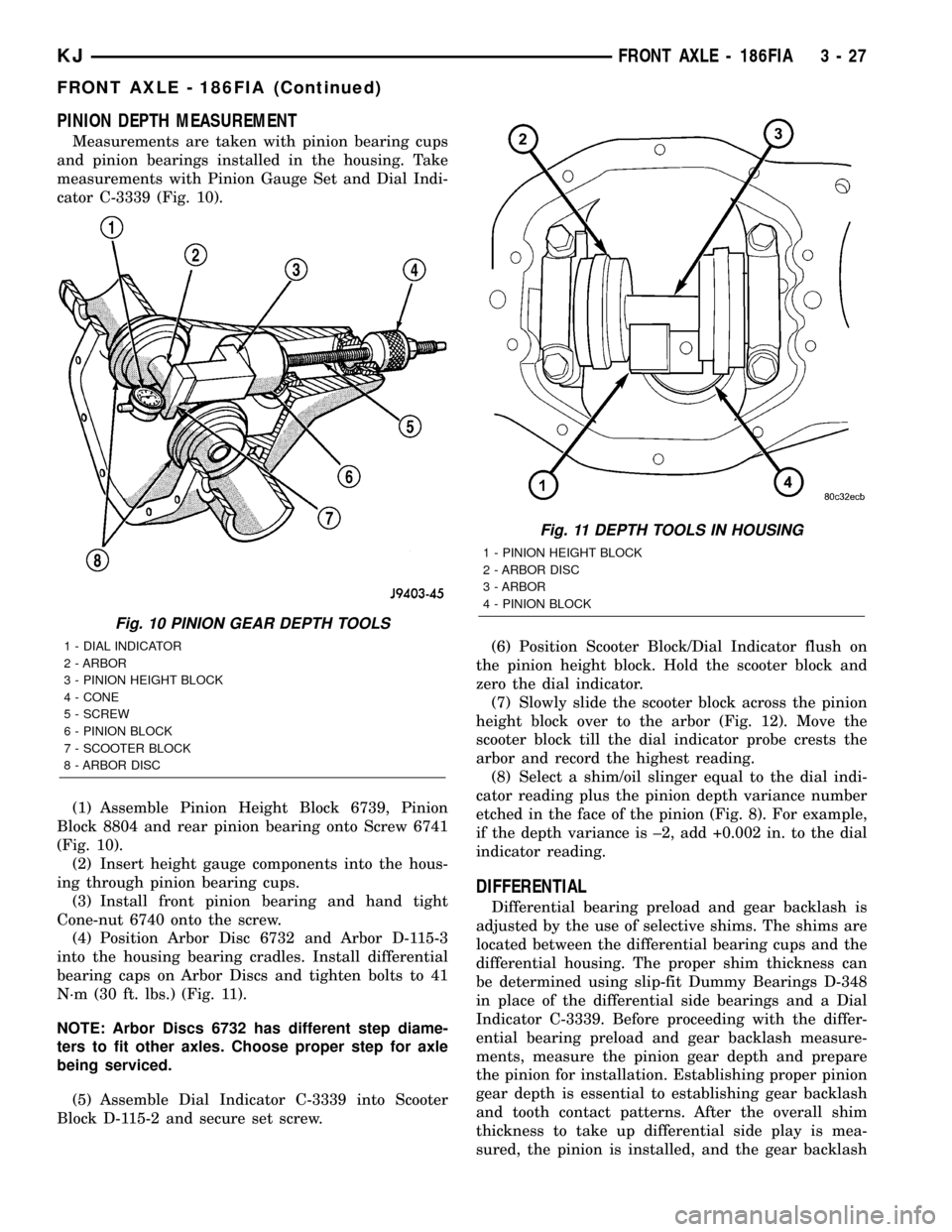
PINION DEPTH MEASUREMENT
Measurements are taken with pinion bearing cups
and pinion bearings installed in the housing. Take
measurements with Pinion Gauge Set and Dial Indi-
cator C-3339 (Fig. 10).
(1) Assemble Pinion Height Block 6739, Pinion
Block 8804 and rear pinion bearing onto Screw 6741
(Fig. 10).
(2) Insert height gauge components into the hous-
ing through pinion bearing cups.
(3) Install front pinion bearing and hand tight
Cone-nut 6740 onto the screw.
(4) Position Arbor Disc 6732 and Arbor D-115-3
into the housing bearing cradles. Install differential
bearing caps on Arbor Discs and tighten bolts to 41
N´m (30 ft. lbs.) (Fig. 11).
NOTE: Arbor Discs 6732 has different step diame-
ters to fit other axles. Choose proper step for axle
being serviced.
(5) Assemble Dial Indicator C-3339 into Scooter
Block D-115-2 and secure set screw.(6) Position Scooter Block/Dial Indicator flush on
the pinion height block. Hold the scooter block and
zero the dial indicator.
(7) Slowly slide the scooter block across the pinion
height block over to the arbor (Fig. 12). Move the
scooter block till the dial indicator probe crests the
arbor and record the highest reading.
(8) Select a shim/oil slinger equal to the dial indi-
cator reading plus the pinion depth variance number
etched in the face of the pinion (Fig. 8). For example,
if the depth variance is ±2, add +0.002 in. to the dial
indicator reading.
DIFFERENTIAL
Differential bearing preload and gear backlash is
adjusted by the use of selective shims. The shims are
located between the differential bearing cups and the
differential housing. The proper shim thickness can
be determined using slip-fit Dummy Bearings D-348
in place of the differential side bearings and a Dial
Indicator C-3339. Before proceeding with the differ-
ential bearing preload and gear backlash measure-
ments, measure the pinion gear depth and prepare
the pinion for installation. Establishing proper pinion
gear depth is essential to establishing gear backlash
and tooth contact patterns. After the overall shim
thickness to take up differential side play is mea-
sured, the pinion is installed, and the gear backlash
Fig. 10 PINION GEAR DEPTH TOOLS
1 - DIAL INDICATOR
2 - ARBOR
3 - PINION HEIGHT BLOCK
4 - CONE
5 - SCREW
6 - PINION BLOCK
7 - SCOOTER BLOCK
8 - ARBOR DISC
Fig. 11 DEPTH TOOLS IN HOUSING
1 - PINION HEIGHT BLOCK
2 - ARBOR DISC
3 - ARBOR
4 - PINION BLOCK
KJFRONT AXLE - 186FIA 3 - 27
FRONT AXLE - 186FIA (Continued)
Page 77 of 1803
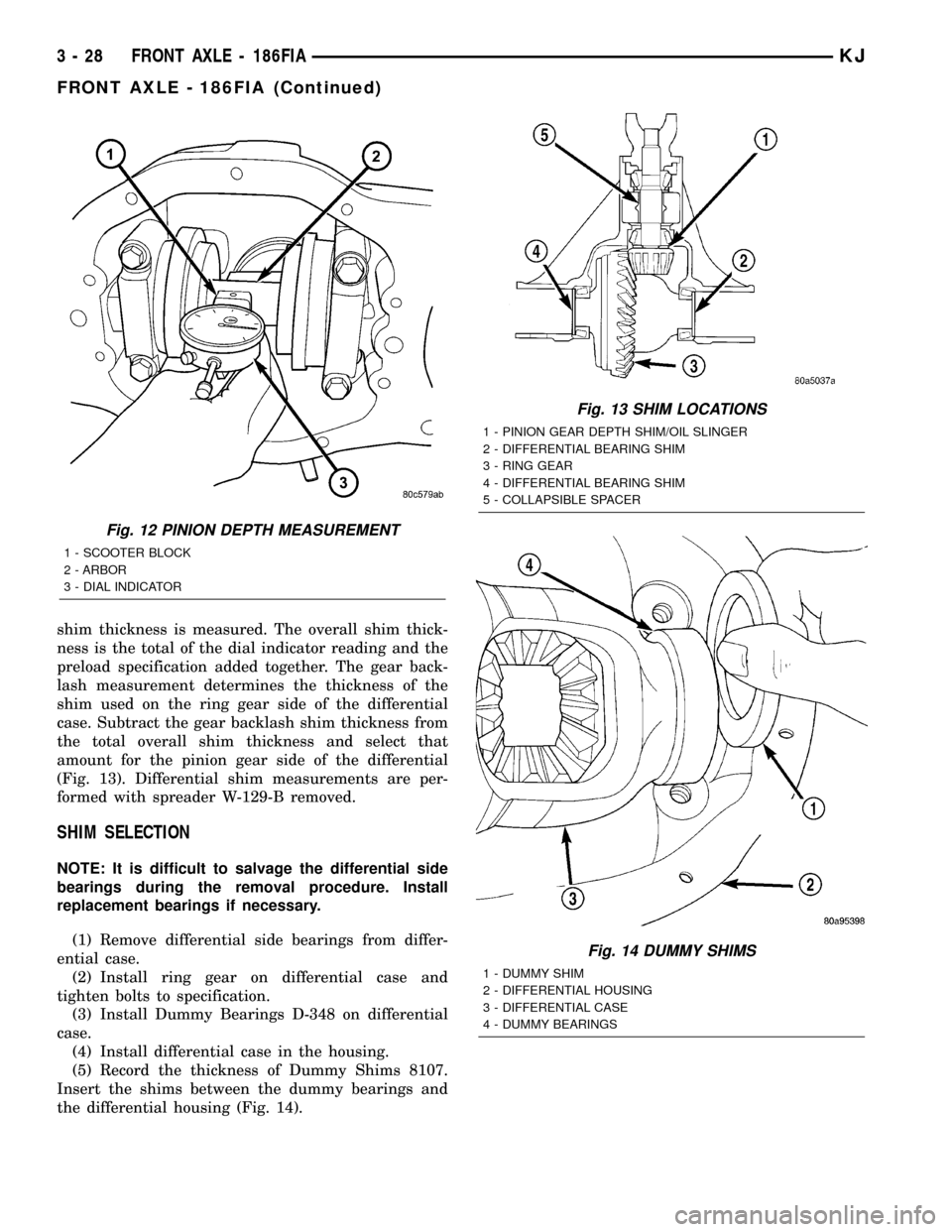
shim thickness is measured. The overall shim thick-
ness is the total of the dial indicator reading and the
preload specification added together. The gear back-
lash measurement determines the thickness of the
shim used on the ring gear side of the differential
case. Subtract the gear backlash shim thickness from
the total overall shim thickness and select that
amount for the pinion gear side of the differential
(Fig. 13). Differential shim measurements are per-
formed with spreader W-129-B removed.
SHIM SELECTION
NOTE: It is difficult to salvage the differential side
bearings during the removal procedure. Install
replacement bearings if necessary.
(1) Remove differential side bearings from differ-
ential case.
(2) Install ring gear on differential case and
tighten bolts to specification.
(3) Install Dummy Bearings D-348 on differential
case.
(4) Install differential case in the housing.
(5) Record the thickness of Dummy Shims 8107.
Insert the shims between the dummy bearings and
the differential housing (Fig. 14).
Fig. 12 PINION DEPTH MEASUREMENT
1 - SCOOTER BLOCK
2 - ARBOR
3 - DIAL INDICATOR
Fig. 13 SHIM LOCATIONS
1 - PINION GEAR DEPTH SHIM/OIL SLINGER
2 - DIFFERENTIAL BEARING SHIM
3 - RING GEAR
4 - DIFFERENTIAL BEARING SHIM
5 - COLLAPSIBLE SPACER
Fig. 14 DUMMY SHIMS
1 - DUMMY SHIM
2 - DIFFERENTIAL HOUSING
3 - DIFFERENTIAL CASE
4 - DUMMY BEARINGS
3 - 28 FRONT AXLE - 186FIAKJ
FRONT AXLE - 186FIA (Continued)
Page 78 of 1803
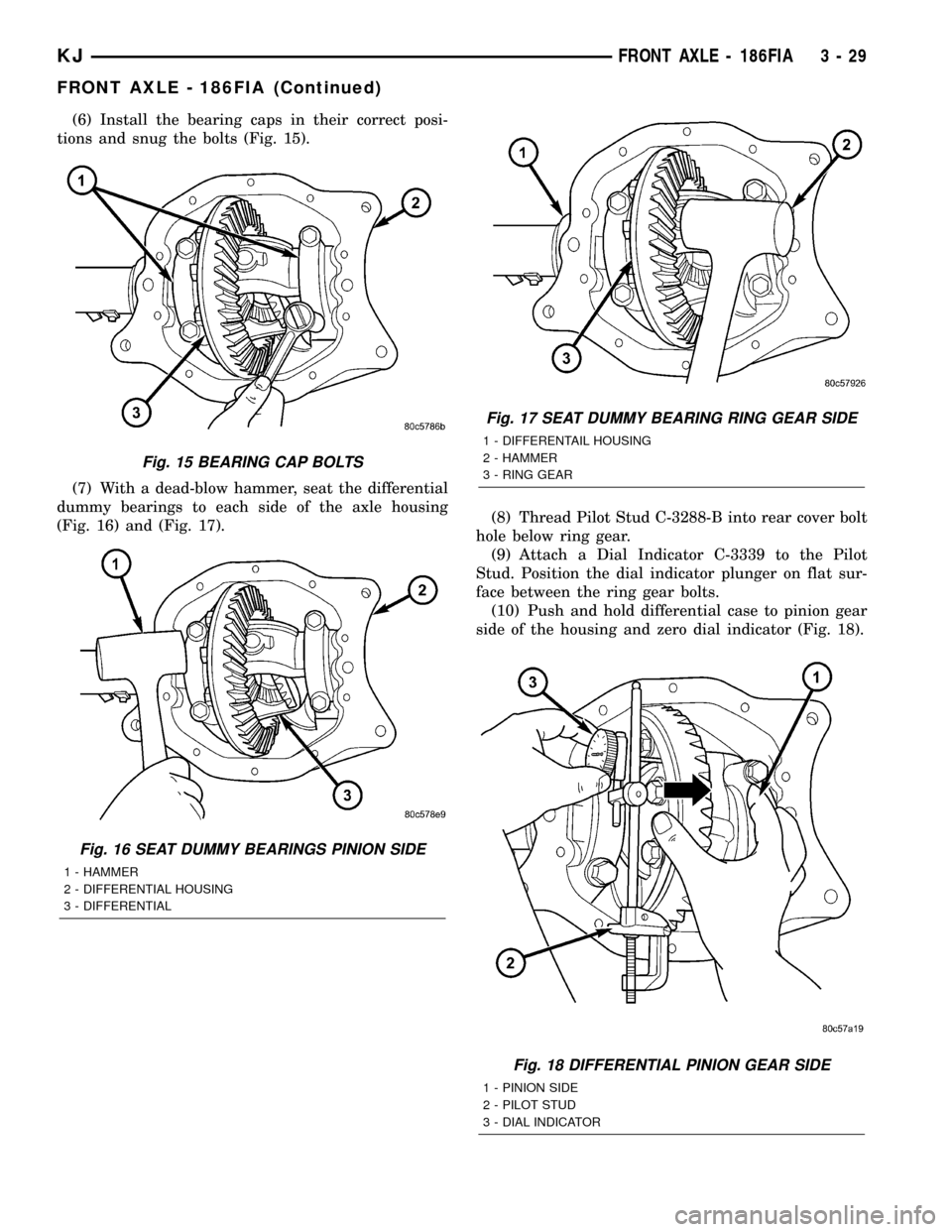
(6) Install the bearing caps in their correct posi-
tions and snug the bolts (Fig. 15).
(7) With a dead-blow hammer, seat the differential
dummy bearings to each side of the axle housing
(Fig. 16) and (Fig. 17).(8) Thread Pilot Stud C-3288-B into rear cover bolt
hole below ring gear.
(9) Attach a Dial Indicator C-3339 to the Pilot
Stud. Position the dial indicator plunger on flat sur-
face between the ring gear bolts.
(10) Push and hold differential case to pinion gear
side of the housing and zero dial indicator (Fig. 18).
Fig. 15 BEARING CAP BOLTS
Fig. 16 SEAT DUMMY BEARINGS PINION SIDE
1 - HAMMER
2 - DIFFERENTIAL HOUSING
3 - DIFFERENTIAL
Fig. 17 SEAT DUMMY BEARING RING GEAR SIDE
1 - DIFFERENTAIL HOUSING
2 - HAMMER
3 - RING GEAR
Fig. 18 DIFFERENTIAL PINION GEAR SIDE
1 - PINION SIDE
2 - PILOT STUD
3 - DIAL INDICATOR
KJFRONT AXLE - 186FIA 3 - 29
FRONT AXLE - 186FIA (Continued)
Page 79 of 1803
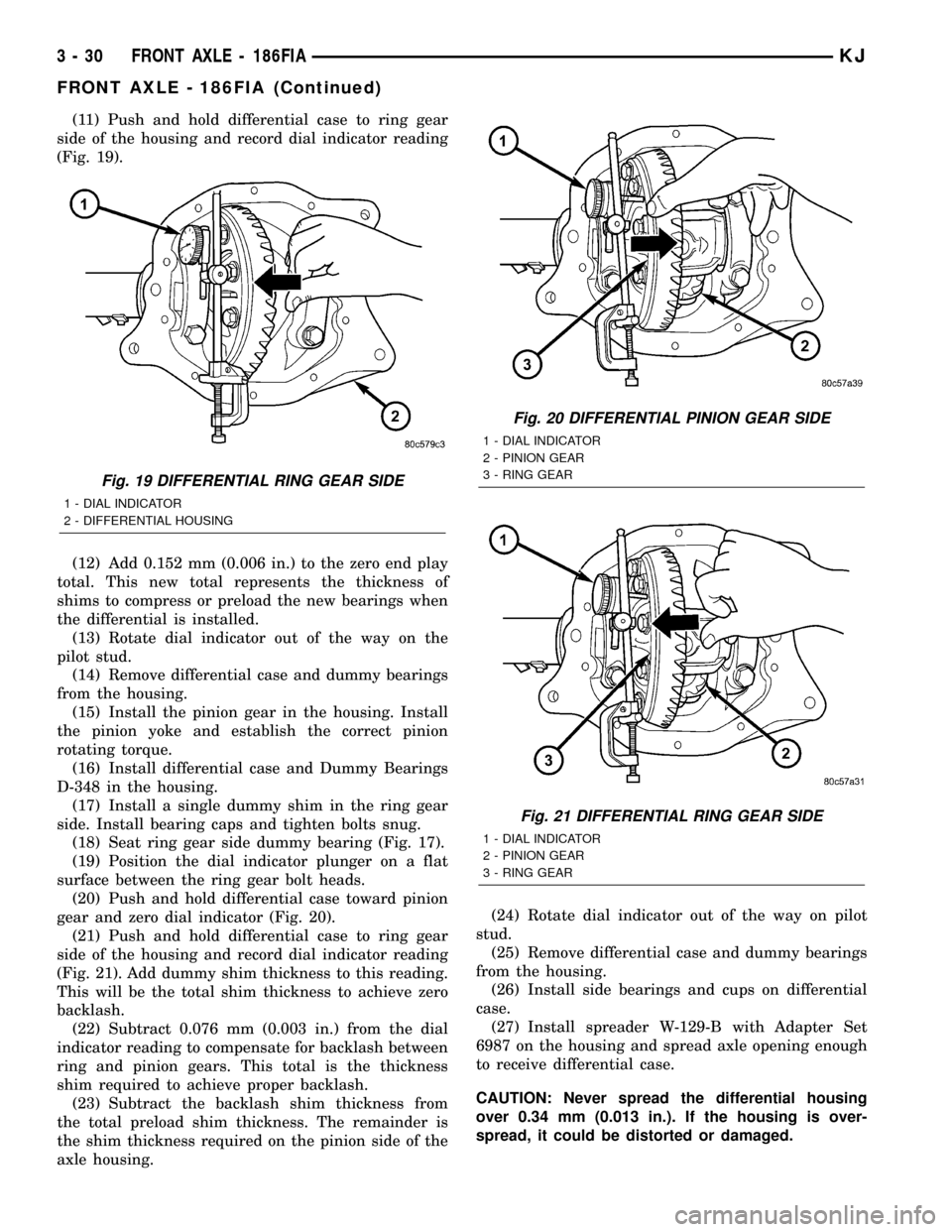
(11) Push and hold differential case to ring gear
side of the housing and record dial indicator reading
(Fig. 19).
(12) Add 0.152 mm (0.006 in.) to the zero end play
total. This new total represents the thickness of
shims to compress or preload the new bearings when
the differential is installed.
(13) Rotate dial indicator out of the way on the
pilot stud.
(14) Remove differential case and dummy bearings
from the housing.
(15) Install the pinion gear in the housing. Install
the pinion yoke and establish the correct pinion
rotating torque.
(16) Install differential case and Dummy Bearings
D-348 in the housing.
(17) Install a single dummy shim in the ring gear
side. Install bearing caps and tighten bolts snug.
(18) Seat ring gear side dummy bearing (Fig. 17).
(19) Position the dial indicator plunger on a flat
surface between the ring gear bolt heads.
(20) Push and hold differential case toward pinion
gear and zero dial indicator (Fig. 20).
(21) Push and hold differential case to ring gear
side of the housing and record dial indicator reading
(Fig. 21). Add dummy shim thickness to this reading.
This will be the total shim thickness to achieve zero
backlash.
(22) Subtract 0.076 mm (0.003 in.) from the dial
indicator reading to compensate for backlash between
ring and pinion gears. This total is the thickness
shim required to achieve proper backlash.
(23) Subtract the backlash shim thickness from
the total preload shim thickness. The remainder is
the shim thickness required on the pinion side of the
axle housing.(24) Rotate dial indicator out of the way on pilot
stud.
(25) Remove differential case and dummy bearings
from the housing.
(26) Install side bearings and cups on differential
case.
(27) Install spreader W-129-B with Adapter Set
6987 on the housing and spread axle opening enough
to receive differential case.
CAUTION: Never spread the differential housing
over 0.34 mm (0.013 in.). If the housing is over-
spread, it could be distorted or damaged.
Fig. 19 DIFFERENTIAL RING GEAR SIDE
1 - DIAL INDICATOR
2 - DIFFERENTIAL HOUSING
Fig. 20 DIFFERENTIAL PINION GEAR SIDE
1 - DIAL INDICATOR
2 - PINION GEAR
3 - RING GEAR
Fig. 21 DIFFERENTIAL RING GEAR SIDE
1 - DIAL INDICATOR
2 - PINION GEAR
3 - RING GEAR
3 - 30 FRONT AXLE - 186FIAKJ
FRONT AXLE - 186FIA (Continued)
Page 80 of 1803
(28) Place the bearing preload shims in the axle
housing, against the axle tubes.
(29) Install differential case into the housing.
(30) Remove spreader from the housing.
(31) Rotate the differential case several times to
seat the side bearings.
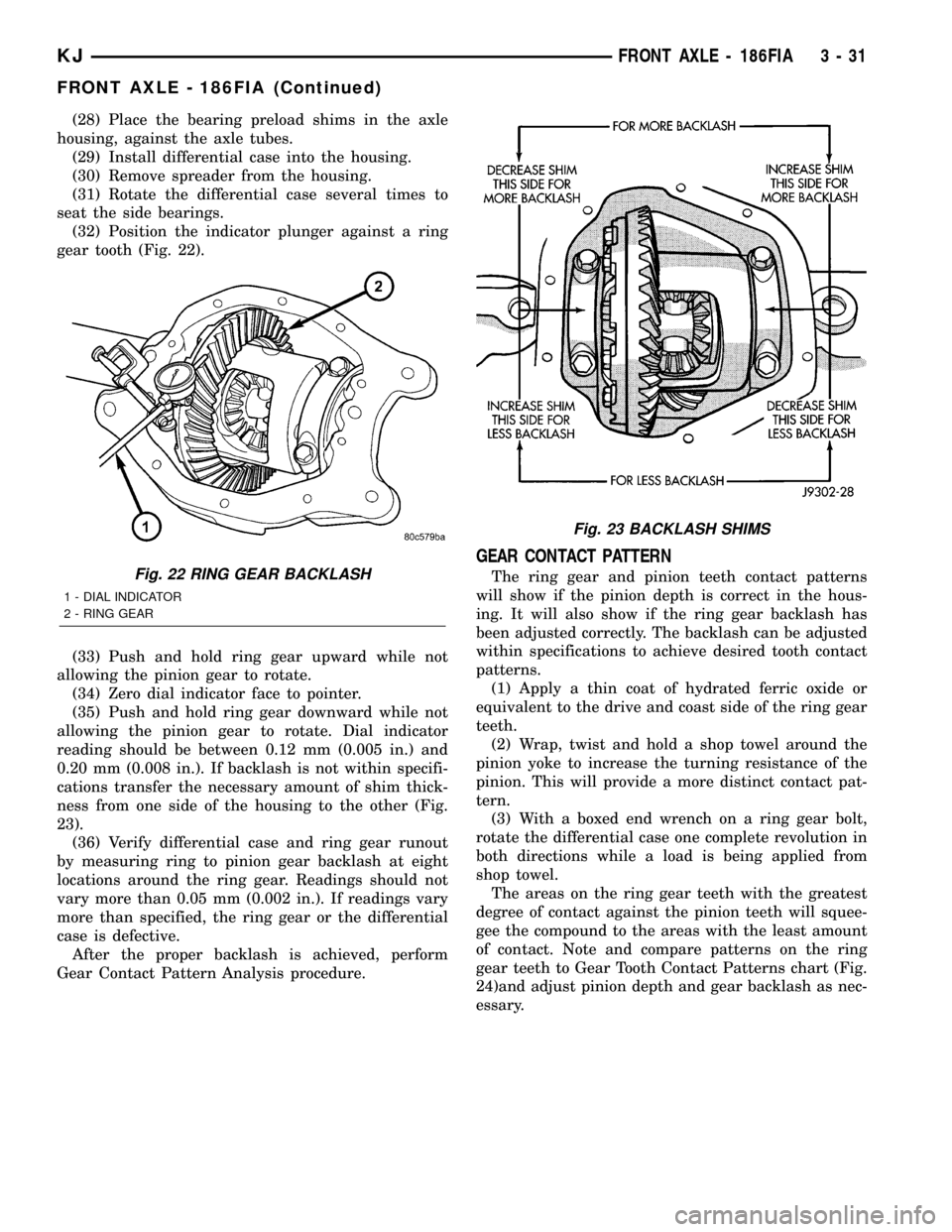
(32) Position the indicator plunger against a ring
gear tooth (Fig. 22).
(33) Push and hold ring gear upward while not
allowing the pinion gear to rotate.
(34) Zero dial indicator face to pointer.
(35) Push and hold ring gear downward while not
allowing the pinion gear to rotate. Dial indicator
reading should be between 0.12 mm (0.005 in.) and
0.20 mm (0.008 in.). If backlash is not within specifi-
cations transfer the necessary amount of shim thick-
ness from one side of the housing to the other (Fig.
23).
(36) Verify differential case and ring gear runout
by measuring ring to pinion gear backlash at eight
locations around the ring gear. Readings should not
vary more than 0.05 mm (0.002 in.). If readings vary
more than specified, the ring gear or the differential
case is defective.
After the proper backlash is achieved, perform
Gear Contact Pattern Analysis procedure.
GEAR CONTACT PATTERN
The ring gear and pinion teeth contact patterns
will show if the pinion depth is correct in the hous-
ing. It will also show if the ring gear backlash has
been adjusted correctly. The backlash can be adjusted
within specifications to achieve desired tooth contact
patterns.
(1) Apply a thin coat of hydrated ferric oxide or
equivalent to the drive and coast side of the ring gear
teeth.
(2) Wrap, twist and hold a shop towel around the
pinion yoke to increase the turning resistance of the
pinion. This will provide a more distinct contact pat-
tern.
(3) With a boxed end wrench on a ring gear bolt,
rotate the differential case one complete revolution in
both directions while a load is being applied from
shop towel.
The areas on the ring gear teeth with the greatest
degree of contact against the pinion teeth will squee-
gee the compound to the areas with the least amount
of contact. Note and compare patterns on the ring
gear teeth to Gear Tooth Contact Patterns chart (Fig.
24)and adjust pinion depth and gear backlash as nec-
essary.Fig. 22 RING GEAR BACKLASH
1 - DIAL INDICATOR
2 - RING GEAR
Fig. 23 BACKLASH SHIMS
KJFRONT AXLE - 186FIA 3 - 31
FRONT AXLE - 186FIA (Continued)
Page 82 of 1803
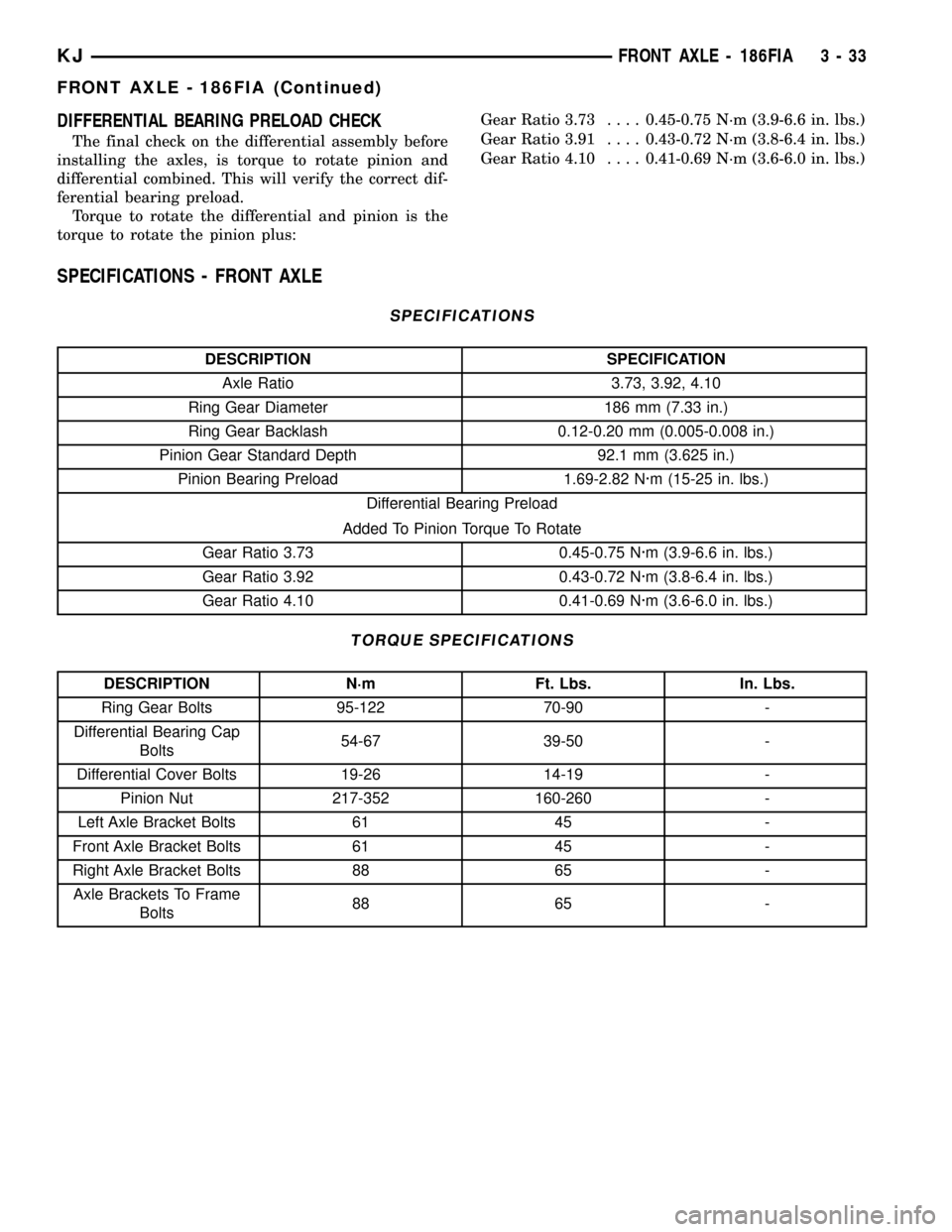
DIFFERENTIAL BEARING PRELOAD CHECK
The final check on the differential assembly before
installing the axles, is torque to rotate pinion and
differential combined. This will verify the correct dif-
ferential bearing preload.
Torque to rotate the differential and pinion is the
torque to rotate the pinion plus:Gear Ratio 3.73....0.45-0.75 N´m (3.9-6.6 in. lbs.)
Gear Ratio 3.91....0.43-0.72 N´m (3.8-6.4 in. lbs.)
Gear Ratio 4.10....0.41-0.69 N´m (3.6-6.0 in. lbs.)
SPECIFICATIONS - FRONT AXLE
SPECIFICATIONS
DESCRIPTION SPECIFICATION
Axle Ratio 3.73, 3.92, 4.10
Ring Gear Diameter 186 mm (7.33 in.)
Ring Gear Backlash 0.12-0.20 mm (0.005-0.008 in.)
Pinion Gear Standard Depth 92.1 mm (3.625 in.)
Pinion Bearing Preload 1.69-2.82 N´m (15-25 in. lbs.)
Differential Bearing Preload
Added To Pinion Torque To Rotate
Gear Ratio 3.73 0.45-0.75 N´m (3.9-6.6 in. lbs.)
Gear Ratio 3.92 0.43-0.72 N´m (3.8-6.4 in. lbs.)
Gear Ratio 4.10 0.41-0.69 N´m (3.6-6.0 in. lbs.)
TORQUE SPECIFICATIONS
DESCRIPTION N´m Ft. Lbs. In. Lbs.
Ring Gear Bolts 95-122 70-90 -
Differential Bearing Cap
Bolts54-67 39-50 -
Differential Cover Bolts 19-26 14-19 -
Pinion Nut 217-352 160-260 -
Left Axle Bracket Bolts 61 45 -
Front Axle Bracket Bolts 61 45 -
Right Axle Bracket Bolts 88 65 -
Axle Brackets To Frame
Bolts88 65 -
KJFRONT AXLE - 186FIA 3 - 33
FRONT AXLE - 186FIA (Continued)
Page 84 of 1803
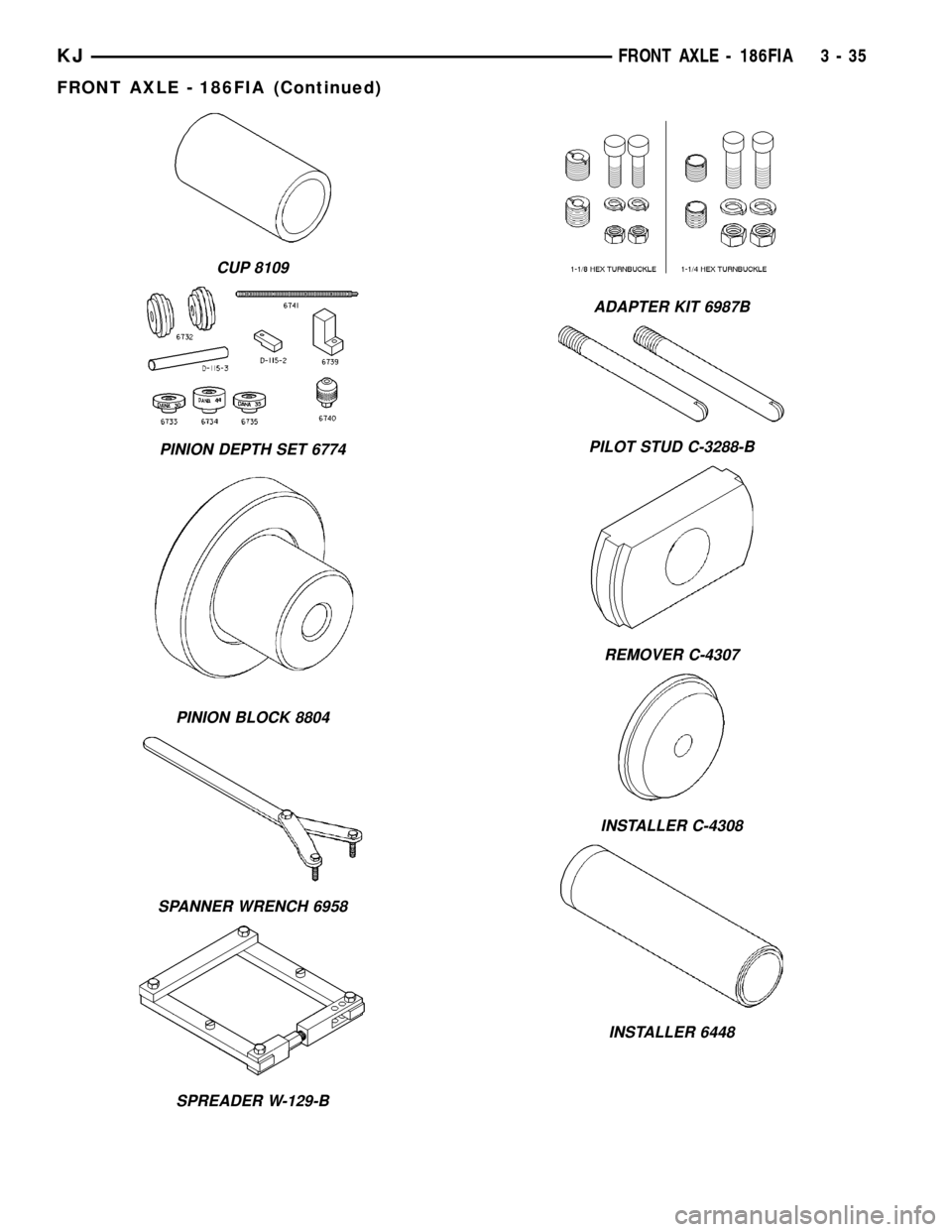
CUP 8109
PINION DEPTH SET 6774
PINION BLOCK 8804
SPANNER WRENCH 6958
SPREADER W-129-B
ADAPTER KIT 6987B
PILOT STUD C-3288-B
REMOVER C-4307
INSTALLER C-4308
INSTALLER 6448
KJFRONT AXLE - 186FIA 3 - 35
FRONT AXLE - 186FIA (Continued)
Page 87 of 1803
INSTALLATION
(1) Apply a light coat of lubricant on the lip of the
shaft seal.
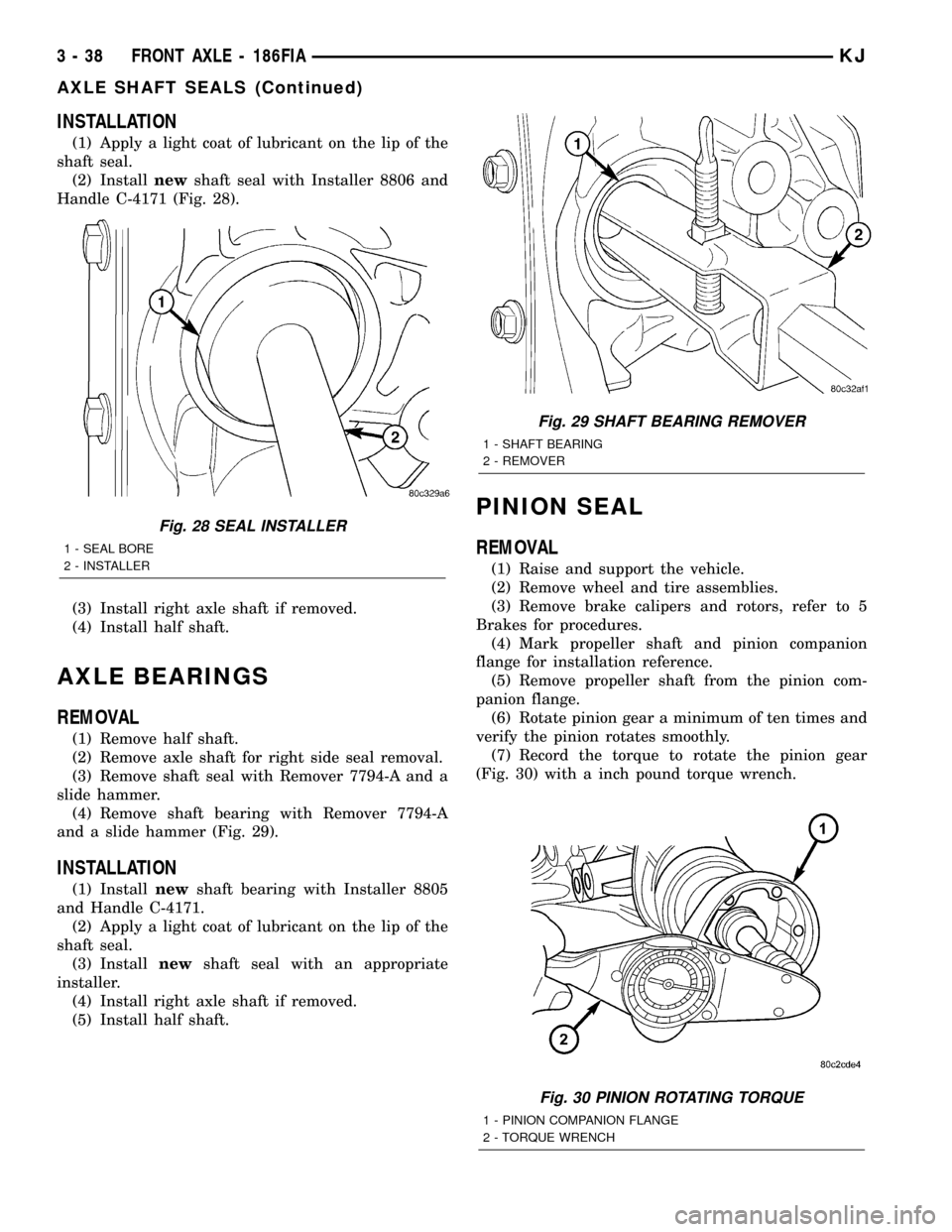
(2) Installnewshaft seal with Installer 8806 and
Handle C-4171 (Fig. 28).
(3) Install right axle shaft if removed.
(4) Install half shaft.
AXLE BEARINGS
REMOVAL
(1) Remove half shaft.
(2) Remove axle shaft for right side seal removal.
(3) Remove shaft seal with Remover 7794-A and a
slide hammer.
(4) Remove shaft bearing with Remover 7794-A
and a slide hammer (Fig. 29).
INSTALLATION
(1) Installnewshaft bearing with Installer 8805
and Handle C-4171.
(2) Apply a light coat of lubricant on the lip of the
shaft seal.
(3) Installnewshaft seal with an appropriate
installer.
(4) Install right axle shaft if removed.
(5) Install half shaft.
PINION SEAL
REMOVAL
(1) Raise and support the vehicle.
(2) Remove wheel and tire assemblies.
(3) Remove brake calipers and rotors, refer to 5
Brakes for procedures.
(4) Mark propeller shaft and pinion companion
flange for installation reference.
(5) Remove propeller shaft from the pinion com-
panion flange.
(6) Rotate pinion gear a minimum of ten times and
verify the pinion rotates smoothly.
(7) Record the torque to rotate the pinion gear
(Fig. 30) with a inch pound torque wrench.
Fig. 28 SEAL INSTALLER
1 - SEAL BORE
2 - INSTALLER
Fig. 29 SHAFT BEARING REMOVER
1 - SHAFT BEARING
2 - REMOVER
Fig. 30 PINION ROTATING TORQUE
1 - PINION COMPANION FLANGE
2 - TORQUE WRENCH
3 - 38 FRONT AXLE - 186FIAKJ
AXLE SHAFT SEALS (Continued)
Page 88 of 1803
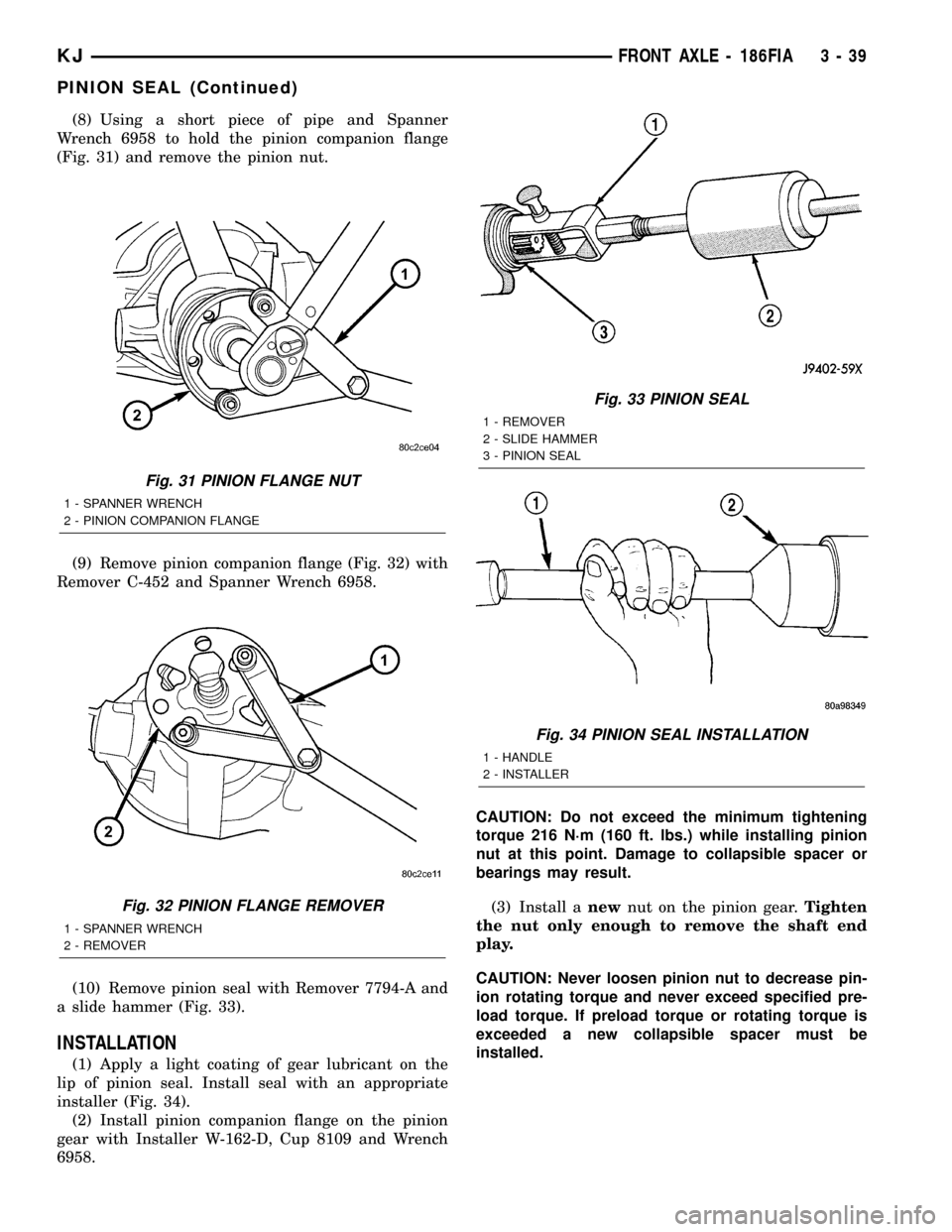
(8) Using a short piece of pipe and Spanner
Wrench 6958 to hold the pinion companion flange
(Fig. 31) and remove the pinion nut.
(9) Remove pinion companion flange (Fig. 32) with
Remover C-452 and Spanner Wrench 6958.
(10) Remove pinion seal with Remover 7794-A and
a slide hammer (Fig. 33).
INSTALLATION
(1) Apply a light coating of gear lubricant on the
lip of pinion seal. Install seal with an appropriate
installer (Fig. 34).
(2) Install pinion companion flange on the pinion
gear with Installer W-162-D, Cup 8109 and Wrench
6958.CAUTION: Do not exceed the minimum tightening
torque 216 N´m (160 ft. lbs.) while installing pinion
nut at this point. Damage to collapsible spacer or
bearings may result.
(3) Install anewnut on the pinion gear.Tighten
the nut only enough to remove the shaft end
play.
CAUTION: Never loosen pinion nut to decrease pin-
ion rotating torque and never exceed specified pre-
load torque. If preload torque or rotating torque is
exceeded a new collapsible spacer must be
installed.
Fig. 31 PINION FLANGE NUT
1 - SPANNER WRENCH
2 - PINION COMPANION FLANGE
Fig. 32 PINION FLANGE REMOVER
1 - SPANNER WRENCH
2 - REMOVER
Fig. 33 PINION SEAL
1 - REMOVER
2 - SLIDE HAMMER
3 - PINION SEAL
Fig. 34 PINION SEAL INSTALLATION
1 - HANDLE
2 - INSTALLER
KJFRONT AXLE - 186FIA 3 - 39
PINION SEAL (Continued)
Page 89 of 1803
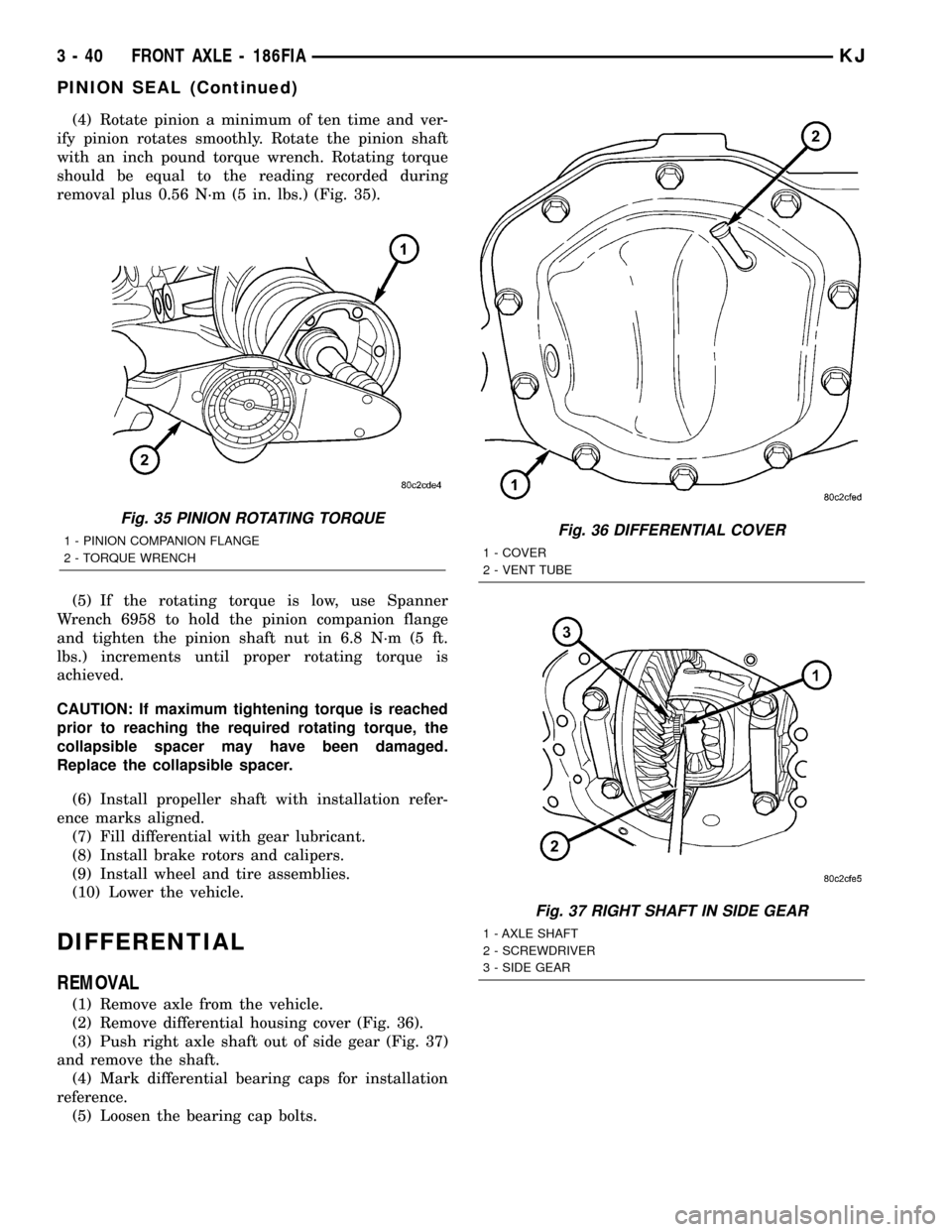
(4) Rotate pinion a minimum of ten time and ver-
ify pinion rotates smoothly. Rotate the pinion shaft
with an inch pound torque wrench. Rotating torque
should be equal to the reading recorded during
removal plus 0.56 N´m (5 in. lbs.) (Fig. 35).
(5) If the rotating torque is low, use Spanner
Wrench 6958 to hold the pinion companion flange
and tighten the pinion shaft nut in 6.8 N´m (5 ft.
lbs.) increments until proper rotating torque is
achieved.
CAUTION: If maximum tightening torque is reached
prior to reaching the required rotating torque, the
collapsible spacer may have been damaged.
Replace the collapsible spacer.
(6) Install propeller shaft with installation refer-
ence marks aligned.
(7) Fill differential with gear lubricant.
(8) Install brake rotors and calipers.
(9) Install wheel and tire assemblies.
(10) Lower the vehicle.
DIFFERENTIAL
REMOVAL
(1) Remove axle from the vehicle.
(2) Remove differential housing cover (Fig. 36).
(3) Push right axle shaft out of side gear (Fig. 37)
and remove the shaft.
(4) Mark differential bearing caps for installation
reference.
(5) Loosen the bearing cap bolts.
Fig. 35 PINION ROTATING TORQUE
1 - PINION COMPANION FLANGE
2 - TORQUE WRENCHFig. 36 DIFFERENTIAL COVER
1 - COVER
2 - VENT TUBE
Fig. 37 RIGHT SHAFT IN SIDE GEAR
1 - AXLE SHAFT
2 - SCREWDRIVER
3 - SIDE GEAR
3 - 40 FRONT AXLE - 186FIAKJ
PINION SEAL (Continued)