insid JEEP LIBERTY 2002 KJ / 1.G Owner's Manual
[x] Cancel search | Manufacturer: JEEP, Model Year: 2002, Model line: LIBERTY, Model: JEEP LIBERTY 2002 KJ / 1.GPages: 1803, PDF Size: 62.3 MB
Page 520 of 1803

READING LAMP BULB
REMOVAL
WARNING: ON VEHICLES EQUIPPED WITH AIR-
BAGS, DISABLE THE SUPPLEMENTAL RESTRAINT
SYSTEM BEFORE ATTEMPTING ANY STEERING
WHEEL, STEERING COLUMN, DRIVER AIRBAG,
PASSENGER AIRBAG, SEAT BELT TENSIONER,
FRONT IMPACT SENSORS, SIDE CURTAIN AIRBAG,
OR INSTRUMENT PANEL COMPONENT DIAGNOSIS
OR SERVICE. DISCONNECT AND ISOLATE THE
BATTERY NEGATIVE (GROUND) CABLE, THEN
WAIT TWO MINUTES FOR THE SYSTEM CAPACI-
TOR TO DISCHARGE BEFORE PERFORMING FUR-
THER DIAGNOSIS OR SERVICE. THIS IS THE ONLY
SURE WAY TO DISABLE THE SUPPLEMENTAL
RESTRAINT SYSTEM. FAILURE TO TAKE THE
PROPER PRECAUTIONS COULD RESULT IN ACCI-
DENTAL AIRBAG DEPLOYMENT AND POSSIBLE
PERSONAL INJURY.
(1) Disconnect and isolate the battery negative
cable.
(2) If the vehicle is not equipped with the optional
Compass Mini-Trip Computer (CMTC), remove the
reading lamp unit from the headliner mounting hole.
(Refer to 8 - ELECTRICAL/LAMPS/LIGHTING -
INTERIOR/READING LAMP UNIT - REMOVAL). If
the vehicle is equipped with the optional CMTC,
remove the overhead console from the headliner.
(Refer to 8 - ELECTRICAL/OVERHEAD CONSOLE -
REMOVAL).
(3) From the back of the unit while pulling the
reading lamp socket away from the outside of the
lamp unit bulb housing, use a small thin-bladed
screwdriver to release the integral latch tabs of the
socket from the inside of the bulb housing (Fig. 12).
(4) Pull the reading lamp socket and bulb unit
straight out from the lamp unit bulb housing.
(5) Pull the ash reading lamp bulb straight out of
the lamp unit socket.
INSTALLATION
WARNING: ON VEHICLES EQUIPPED WITH AIR-
BAGS, DISABLE THE SUPPLEMENTAL RESTRAINT
SYSTEM BEFORE ATTEMPTING ANY STEERING
WHEEL, STEERING COLUMN, DRIVER AIRBAG,
PASSENGER AIRBAG, SEAT BELT TENSIONER,
FRONT IMPACT SENSORS, SIDE CURTAIN AIRBAG,
OR INSTRUMENT PANEL COMPONENT DIAGNOSIS
OR SERVICE. DISCONNECT AND ISOLATE THE
BATTERY NEGATIVE (GROUND) CABLE, THEN
WAIT TWO MINUTES FOR THE SYSTEM CAPACI-
TOR TO DISCHARGE BEFORE PERFORMING FUR-THER DIAGNOSIS OR SERVICE. THIS IS THE ONLY
SURE WAY TO DISABLE THE SUPPLEMENTAL
RESTRAINT SYSTEM. FAILURE TO TAKE THE
PROPER PRECAUTIONS COULD RESULT IN ACCI-
DENTAL AIRBAG DEPLOYMENT AND POSSIBLE
PERSONAL INJURY.
CAUTION: Always use the correct bulb size and
type for replacement. An incorrect bulb size or type
may overheat and cause damage to the lamp, the
socket and/or the lamp wiring.
(1) Align the base of the reading lamp bulb with
the receptacle in the lamp unit socket.
(2) Push the reading lamp bulb straight into the
lamp unit socket until it is firmly seated.
(3) Align the reading lamp socket and bulb unit
with the mounting hole in the bulb housing (Fig. 12).
(4) Push the reading lamp socket and bulb unit
straight into the bulb housing until it is firmly
seated and the integral socket latches are engaged
within the bulb housing.
(5) If the vehicle is not equipped with the optional
Compass Mini-Trip Computer (CMTC), reinstall the
reading lamp unit into the headliner mounting hole.
(Refer to 8 - ELECTRICAL/LAMPS/LIGHTING -
INTERIOR/READING LAMP - INSTALLATION). If
the vehicle is equipped with the optional CMTC,
reinstall the overhead console onto the headliner.
(Refer to 8 - ELECTRICAL/OVERHEAD CONSOLE -
INSTALLATION).
(6) Reconnect the battery negative cable.
Fig. 12 Reading Lamp Bulb Remove/Install
1 - BEZEL
2 - BULB HOUSING
3 - SWITCH (2)
4 - BULB (2)
5 - SOCKET (2)
KJLAMPS/LIGHTING - INTERIOR 8L - 79
Page 612 of 1803

Press and hold the transmitter UNLOCK button
for four to ten seconds. While pressing the UNLOCK
button in, press the LOCK button. Release both but-
tons.
This will toggle between Driver door first and
Unlock all doors function.
STANDARD PROCEDURE - RKE TRANSMITTER
PROGRAMING
New Remote Keyless Entry (RKE) transmitters can
be programed using the DRBIIItscan tool and the
proper Diagnostic Procedures manual. The DRBIIIt
scan tool can provide confirmation that the PCI data
bus is functional, and that all of the electronic mod-
ules are sending and receiving the proper messages
on the PCI data bus.
The following procedure can be used as long as one
functioning transmitter is available:
(1) Using the original transmitter, press the
UNLOCK button for 4 to 10 seconds.
(2) Without releasing the UNLOCK button, press
the PANIC button (within the 4 to 10 second inter-
val).
(3) Release both buttons.
(4) Press LOCK and UNLOCK simultaneously on
the original transmitter.
(5) Release both buttons.
(6) Press any button on the ORIGINAL transmit-
ter. A chime tone from the instrument cluster will
confirm the programming of the ORIGINAL trans-
mitter.
(7) On NEW transmitter, press LOCK and
UNLOCK simultaneously.
(8) Release both buttons.
(9) Press any button on the NEW transmitter. A
chime tone from the instrument cluster will confirm
the programming of the NEW transmitter.
(10) Up to four transmitters can be programed for
one vehicle.
SPECIFICATIONS - REMOTE KEYLESS ENTRY
TRANSMITTER
RANGE
Normal operation range is up to a distance of 3 to
7 meters (10 to 23 ft.) of the vehicle. Range may be
better or worse depending on the environment
around the vehicle.
TAILGATE CYLINDER LOCK
SWITCH
DESCRIPTION
The tailgate cylinder lock switch is integral to the
key lock cylinder inside the tailgate. The tailgate cyl-
inder lock switch is a normally-open momentary
switch that is hard wired directly to the Body Con-
trol Module (BCM), and closes a path to ground
through an internal resistor when the lock cylinder is
rotated to the unlock or lock position.
The tailgate cylinder lock switch cannot be
adjusted or repaired.
OPERATION
The tailgate cylinder lock switch is actuated when
the key is inserted in the lock cylinder and turned to
the unlock or lock position. The tailgate cylinder lock
switch closes a path to ground through an internal
resistor for the Body Control Module (BCM) when
the tailgate key lock cylinder is in the lock or unlock
position, and opens the ground path when the lock
cylinder is in the neutral position. The BCM reads
the switch status, then sends the proper switch sta-
tus messages to other electronic modules over the
Programmable Communications Interface (PCI) data
bus network. The tailgate cylinder lock switch unlock
status message is used by the BCM as an input for
Vehicle Theft Security System (VTSS) operation and
to tell the BCM to lock or unlock the tailgate. There
is no mechanical linkage between the tailgate key
cylinder and the latches.
DIAGNOSIS AND TESTING - TAILGATE
CYLINDER LOCK SWITCH
(1) Disconnect and isolate the battery negative
cable.
(2) Remove tailgate trim panel (Refer to 23 -
BODY/DECKLID/HATCH/LIFTGATE/TAILGATE/
TRIM PANEL - REMOVAL).
(3) Disconnect tailgate cylinder lock switch har-
ness connector.
(4) Using a ohmmeter, test for resistances as
shown in the Tailgate Cylinder Lock Switch Table.
KJPOWER LOCKS 8N - 9
REMOTE KEYLESS ENTRY TRANSMITTER (Continued)
Page 621 of 1803
SWITCH
POSITIONCONTINUITY BETWEEN PINS
DRIVER SEAT PASSENGER
SEAT
OFF PIN1to3 PIN1to3
PIN1to6 PIN1to6
PIN1to7 PIN1to7
PIN1to8 PIN1to8
PIN1to9 PIN1to9
PIN1to10 PIN1to10
FRONT RISER
UPPIN1to8 PIN1to8
PIN5to9 PIN5to9
FRONT RISER
DOWNPIN1to9 PIN1to9
PIN5to8 PIN5to8
CENTER
SWITCH
FORWARDPIN1to6 PIN1to6
PIN5to3 PIN5to3
CENTER
SWITCH
REARWARDPIN1to3 PIN1to3
PIN5to6 PIN5to6
REAR RISER
UPPIN1to7 PIN1to7
PIN5to10 PIN5to10
REAR RISER
DOWNPIN1to10 PIN1to10
PIN5to7 PIN5to7
REMOVAL
(1) Disconnect and isolate the negative battery
cable.
(2) Using a push pin remover or another suitable
wide flat-bladed tool, gently pry the power seat
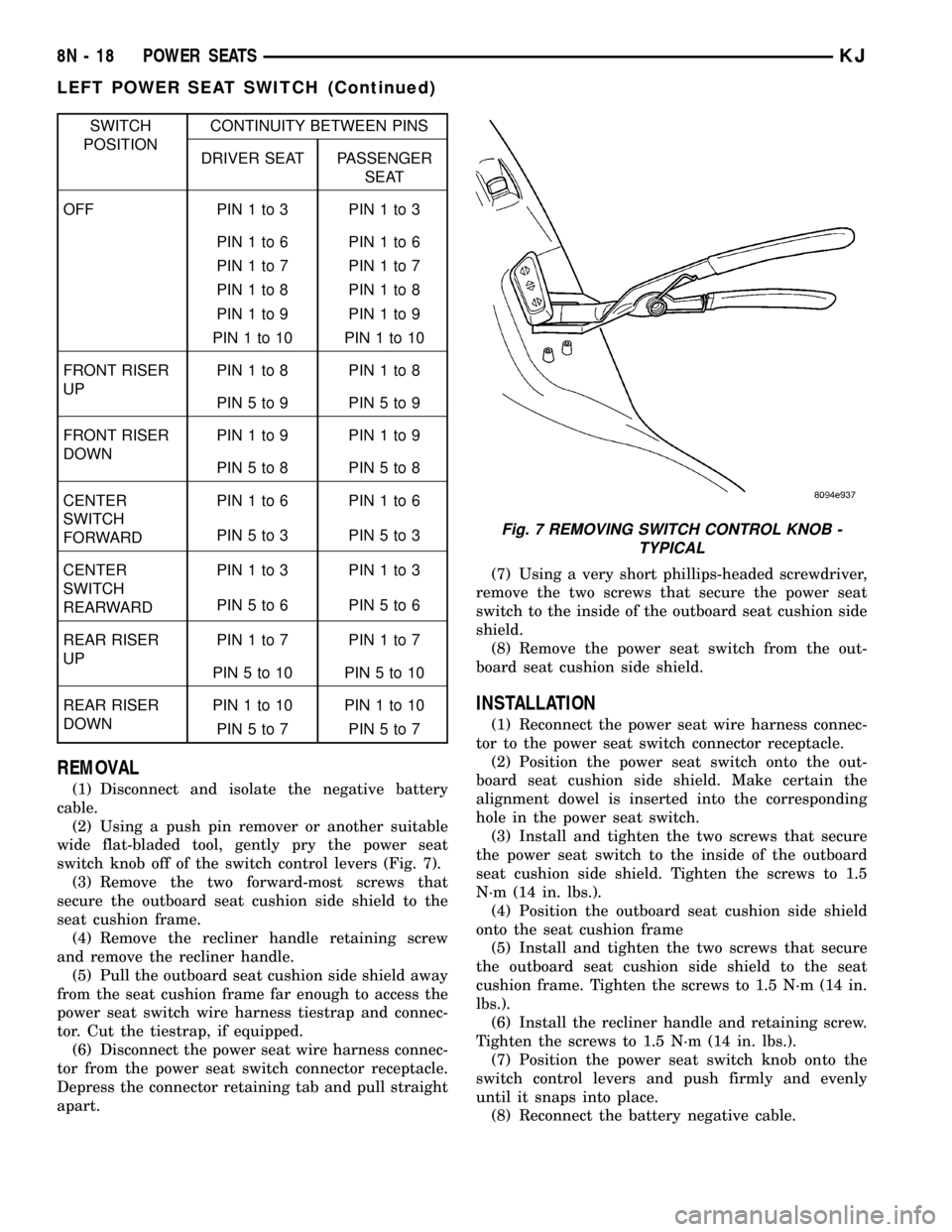
switch knob off of the switch control levers (Fig. 7).
(3) Remove the two forward-most screws that
secure the outboard seat cushion side shield to the
seat cushion frame.
(4) Remove the recliner handle retaining screw
and remove the recliner handle.
(5) Pull the outboard seat cushion side shield away
from the seat cushion frame far enough to access the
power seat switch wire harness tiestrap and connec-
tor. Cut the tiestrap, if equipped.
(6) Disconnect the power seat wire harness connec-
tor from the power seat switch connector receptacle.
Depress the connector retaining tab and pull straight
apart.(7) Using a very short phillips-headed screwdriver,
remove the two screws that secure the power seat
switch to the inside of the outboard seat cushion side
shield.
(8) Remove the power seat switch from the out-
board seat cushion side shield.
INSTALLATION
(1) Reconnect the power seat wire harness connec-
tor to the power seat switch connector receptacle.
(2) Position the power seat switch onto the out-
board seat cushion side shield. Make certain the
alignment dowel is inserted into the corresponding
hole in the power seat switch.
(3) Install and tighten the two screws that secure
the power seat switch to the inside of the outboard
seat cushion side shield. Tighten the screws to 1.5
N´m (14 in. lbs.).
(4) Position the outboard seat cushion side shield
onto the seat cushion frame
(5) Install and tighten the two screws that secure
the outboard seat cushion side shield to the seat
cushion frame. Tighten the screws to 1.5 N´m (14 in.
lbs.).
(6) Install the recliner handle and retaining screw.
Tighten the screws to 1.5 N´m (14 in. lbs.).
(7) Position the power seat switch knob onto the
switch control levers and push firmly and evenly
until it snaps into place.
(8) Reconnect the battery negative cable.
Fig. 7 REMOVING SWITCH CONTROL KNOB -
TYPICAL
8N - 18 POWER SEATSKJ
LEFT POWER SEAT SWITCH (Continued)
Page 623 of 1803
SWITCH
POSITIONCONTINUITY BETWEEN PINS
DRIVER SEAT PASSENGER
SEAT
OFF PIN1to3 PIN1to3
PIN1to6 PIN1to6
PIN1to7 PIN1to7
PIN1to8 PIN1to8
PIN1to9 PIN1to9
PIN1to10 PIN1to10
FRONT RISER
UPPIN1to8 PIN1to8
PIN5to9 PIN5to9
FRONT RISER
DOWNPIN1to9 PIN1to9
PIN5to8 PIN5to8
CENTER
SWITCH
FORWARDPIN1to6 PIN1to6
PIN5to3 PIN5to3
CENTER
SWITCH
REARWARDPIN1to3 PIN1to3
PIN5to6 PIN5to6
REAR RISER
UPPIN1to7 PIN1to7
PIN5to10 PIN5to10
REAR RISER
DOWNPIN1to10 PIN1to10
PIN5to7 PIN5to7
REMOVAL
(1) Disconnect and isolate the negative battery
cable.
(2) Using a push pin remover or another suitable
wide flat-bladed tool, gently pry the power seat
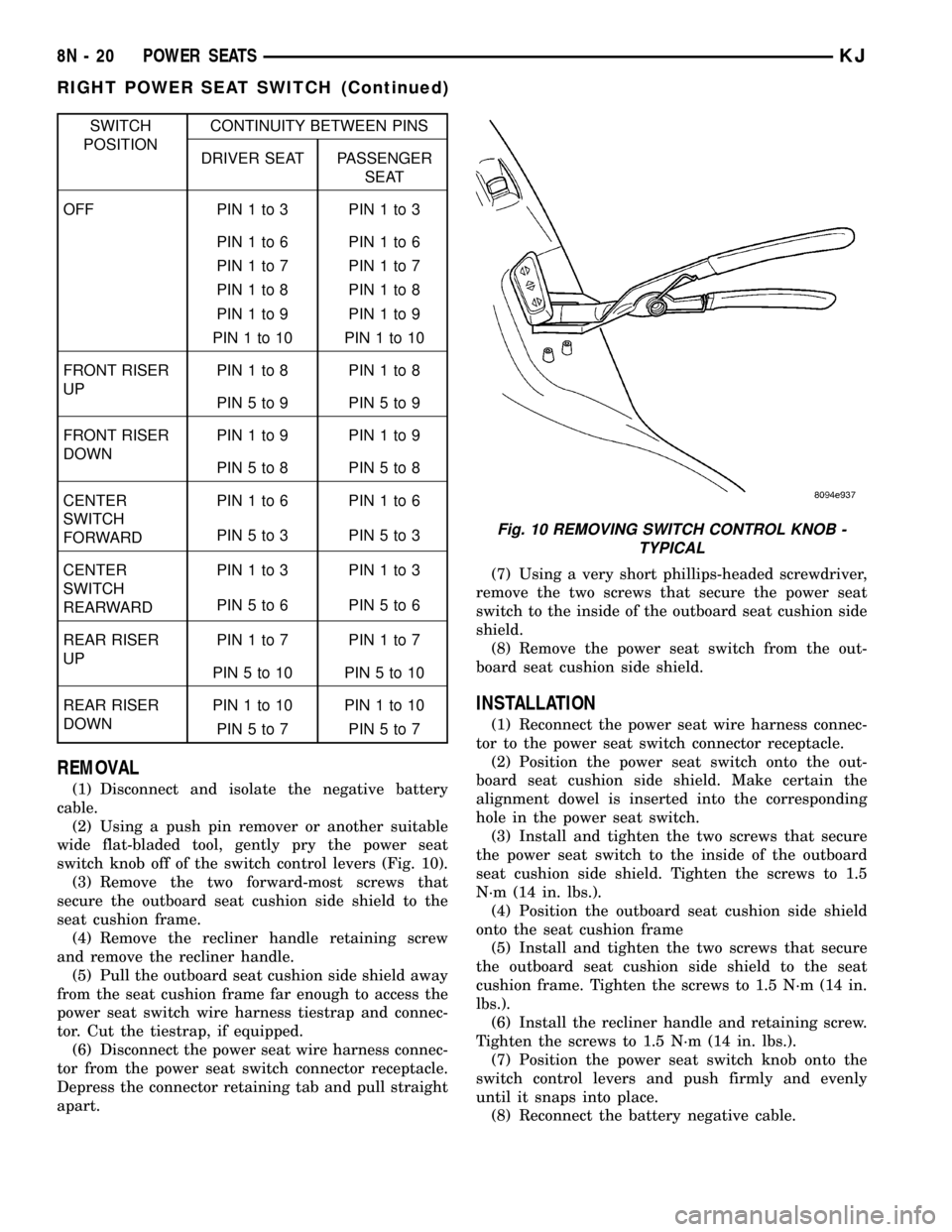
switch knob off of the switch control levers (Fig. 10).
(3) Remove the two forward-most screws that
secure the outboard seat cushion side shield to the
seat cushion frame.
(4) Remove the recliner handle retaining screw
and remove the recliner handle.
(5) Pull the outboard seat cushion side shield away
from the seat cushion frame far enough to access the
power seat switch wire harness tiestrap and connec-
tor. Cut the tiestrap, if equipped.
(6) Disconnect the power seat wire harness connec-
tor from the power seat switch connector receptacle.
Depress the connector retaining tab and pull straight
apart.(7) Using a very short phillips-headed screwdriver,
remove the two screws that secure the power seat
switch to the inside of the outboard seat cushion side
shield.
(8) Remove the power seat switch from the out-
board seat cushion side shield.
INSTALLATION
(1) Reconnect the power seat wire harness connec-
tor to the power seat switch connector receptacle.
(2) Position the power seat switch onto the out-
board seat cushion side shield. Make certain the
alignment dowel is inserted into the corresponding
hole in the power seat switch.
(3) Install and tighten the two screws that secure
the power seat switch to the inside of the outboard
seat cushion side shield. Tighten the screws to 1.5
N´m (14 in. lbs.).
(4) Position the outboard seat cushion side shield
onto the seat cushion frame
(5) Install and tighten the two screws that secure
the outboard seat cushion side shield to the seat
cushion frame. Tighten the screws to 1.5 N´m (14 in.
lbs.).
(6) Install the recliner handle and retaining screw.
Tighten the screws to 1.5 N´m (14 in. lbs.).
(7) Position the power seat switch knob onto the
switch control levers and push firmly and evenly
until it snaps into place.
(8) Reconnect the battery negative cable.
Fig. 10 REMOVING SWITCH CONTROL KNOB -
TYPICAL
8N - 20 POWER SEATSKJ
RIGHT POWER SEAT SWITCH (Continued)
Page 631 of 1803

is located on the back side of each vertical member of
the radiator support.
²Passenger Airbag- The passenger airbag is
located on the instrument panel, beneath the passen-
ger airbag door on the instrument panel above the
glove box on the passenger side of the vehicle.
²Passenger Knee Blocker- The passenger knee
blocker is a structural reinforcement that is integral
to and concealed within the glove box door.
²Seat Belt Tensioner- The seat belt tensioner
is integral to the driver side front seat belt retractor
unit on vehicles equipped with dual front airbags.
²Side Impact Airbag Control Module-Two
Side Impact Airbag Control Modules (SIACM) are
used on vehicles with the optional side curtain air-
bags, one left side and one right side. One SIACM is
located behind the B-pillar trim near the base of each
B-pillar.
²Side Curtain Airbag- In vehicles equipped
with this option, a side curtain airbag is located on
each inside roof side rail above the headliner, and
extends from the A-pillar to just beyond the C-pillar.
The ACM, both SIACMs, and the EMIC each con-
tain a central processing unit and programming that
allow them to communicate with each other using
the Programmable Communication Interface (PCI)
data bus network. This method of communication is
used by the ACM for control of the airbag indicator
on all models equipped with dual front airbags.
(Refer to 8 - ELECTRICAL/ELECTRONIC CON-
TROL MODULES/COMMUNICATION - DESCRIP-
TION).
Hard wired circuitry connects the supplemental
restraint system components to each other through
the electrical system of the vehicle. These hard wired
circuits are integral to several wire harnesses, which
are routed throughout the vehicle and retained by
many different methods. These circuits may be con-
nected to each other, to the vehicle electrical system,
and to the supplemental restraint system compo-
nents through the use of a combination of soldered
splices, splice block connectors, and many different
types of wire harness terminal connectors and insu-
lators. Refer to the appropriate wiring information.
The wiring information includes wiring diagrams,
proper wire and connector repair procedures, further
details on wire harness routing and retention, as well
as pin-out and location views for the various wire
harness connectors, splices and grounds.
OPERATION
ACTIVE RESTRAINTS The primary passenger
restraints in this or any other vehicle are the stan-
dard equipment factory-installed seat belts. Seat
belts are referred to as an active restraint because
the vehicle occupants are required to physically fas-ten and properly adjust these restraints in order to
benefit from them. See the owner's manual in the
vehicle glove box for more information on the fea-
tures, use and operation of all of the factory-installed
active restraints.
PASSIVE RESTRAINTS The passive restraints
system is referred to as a supplemental restraint sys-
tem because they were designed and are intended to
enhance the protection for the vehicle occupants of
the vehicleonlywhen used in conjunction with the
seat belts. They are referred to as passive systems
because the vehicle occupants are not required to do
anything to make them operate; however, the vehicle
occupants must be wearing their seat belts in order
to obtain the maximum safety benefit from the facto-
ry-installed supplemental restraint systems.
The supplemental restraint system electrical cir-
cuits are continuously monitored and controlled by a
microprocessor and software contained within the
Airbag Control Module (ACM) and, on vehicles
equipped with the side curtain airbags, both Side
Impact Airbag Control Modules (SIACM). An airbag
indicator in the ElectroMechanical Instrument Clus-
ter (EMIC) illuminates for about seven seconds as a
bulb test each time the ignition switch is turned to
the On or Start positions. Following the bulb test,
the airbag indicator is turned on or off by the ACM
to indicate the status of the supplemental restraint
system. If the airbag indicator comes on at any time
other than during the bulb test, it indicates that
there is a problem in the supplemental restraint sys-
tem electrical circuits. Such a problem may cause air-
bags not to deploy when required, or to deploy when
not required.
Deployment of the supplemental restraints
depends upon the angle and severity of an impact.
Deployment is not based upon vehicle speed; rather,
deployment is based upon the rate of deceleration as
measured by the forces of gravity (G force) upon the
impact sensors. When an impact is severe enough,
the microprocessor in the ACM or the SIACM signals
the inflator unit of the airbag module to deploy the
airbag. The seat belt tensioner is provided with a
deployment signal by the ACM in conjunction with
the driver airbag. During a frontal vehicle impact,
the knee blockers work in concert with properly fas-
tened and adjusted seat belts to restrain both the
driver and the front seat passenger in the proper
position for an airbag deployment. The knee blockers
also absorb and distribute the crash energy from the
driver and the front seat passenger to the structure
of the instrument panel. The seat belt tensioner
removes the slack from the driver side front seat belt
to provide further assurance that the driver is prop-
erly positioned and restrained for an airbag deploy-
ment.
8O - 4 RESTRAINTSKJ
RESTRAINTS (Continued)
Page 635 of 1803

Ifnone of the Driver or Passenger Squib 1 or 2
open are active codes, the status of the airbag squibs
is unknown. In this case the airbag should be han-
dled and disposed of as if the squibs were both live.
CLEANUP PROCEDURE
Following a supplemental restraint deployment,
the vehicle interior will contain a powdery residue.
This residue consists primarily of harmless particu-
late by-products of the small pyrotechnic charge that
initiates the propellant used to deploy a supplemen-
tal restraint. However, this residue may also contain
traces of sodium hydroxide powder, a chemical
by-product of the propellant material that is used to
generate the inert gas that inflates the airbag. Since
sodium hydroxide powder can irritate the skin, eyes,
nose, or throat, be sure to wear safety glasses, rubber
gloves, and a long-sleeved shirt during cleanup (Fig.
3).
WARNING: IF YOU EXPERIENCE SKIN IRRITATION
DURING CLEANUP, RUN COOL WATER OVER THE
AFFECTED AREA. ALSO, IF YOU EXPERIENCE IRRITA-
TION OF THE NOSE OR THROAT, EXIT THE VEHICLE
FOR FRESH AIR UNTIL THE IRRITATION CEASES. IF
IRRITATION CONTINUES, SEE A PHYSICIAN.
(1) Begin the cleanup by using a vacuum cleaner
to remove any residual powder from the vehicle inte-
rior. Clean from outside the vehicle and work your
way inside, so that you avoid kneeling or sitting on a
non-cleaned area.
(2) Be certain to vacuum the heater and air condi-
tioning outlets as well (Fig. 4). Run the heater and
air conditioner blower on the lowest speed setting
and vacuum any powder expelled from the outlets.
CAUTION: Deployed front airbags having two initiators
(squibs) in the airbag inflator may or may not have livepyrotechnic material within the inflator. Do not dispose
of these airbags unless you are sure of complete
deployment. Refer to AIRBAG SQUIB STATUS . Refer
to the Hazardous Substance Control System for
proper disposal procedures. Dispose of all non-de-
ployed and deployed airbags in a manner consistent
with state, provincial, local, and federal regulations.
(3) Next, remove the deployed supplemental
restraints from the vehicle. Refer to the appropriate
service removal procedures.
(4) You may need to vacuum the interior of the
vehicle a second time to recover all of the powder.
STANDARD PROCEDURE - VERIFICATION TEST
The following procedure should be performed using
a DRBIIItscan tool to verify proper supplemental
restraint system operation following the service or
replacement of any supplemental restraint system
component.
WARNING: ON VEHICLES EQUIPPED WITH AIR-
BAGS, DISABLE THE SUPPLEMENTAL RESTRAINT
SYSTEM BEFORE ATTEMPTING ANY STEERING
WHEEL, STEERING COLUMN, DRIVER AIRBAG,
PASSENGER AIRBAG, SEAT BELT TENSIONER,
FRONT IMPACT SENSORS, SIDE CURTAIN AIRBAG,
OR INSTRUMENT PANEL COMPONENT DIAGNOSIS
OR SERVICE. DISCONNECT AND ISOLATE THE
BATTERY NEGATIVE (GROUND) CABLE, THEN
WAIT TWO MINUTES FOR THE SYSTEM CAPACI-
TOR TO DISCHARGE BEFORE PERFORMING FUR-
THER DIAGNOSIS OR SERVICE. THIS IS THE ONLY
SURE WAY TO DISABLE THE SUPPLEMENTAL
RESTRAINT SYSTEM. FAILURE TO TAKE THE
PROPER PRECAUTIONS COULD RESULT IN ACCI-
DENTAL AIRBAG DEPLOYMENT AND POSSIBLE
PERSONAL INJURY.
Fig. 3 Wear Safety Glasses and Rubber Gloves -
Typical
Fig. 4 Vacuum Heater and A/C Outlets - Typical
8O - 8 RESTRAINTSKJ
RESTRAINTS (Continued)
Page 645 of 1803

The resistive membrane-type horn switch is
secured with heat stakes to the inside surface of the
driver airbag trim cover, between the trim cover and
the folded airbag cushion. The horn switch ground
pigtail wire has a female spade terminal connector
that receives a path to ground through a male spade
terminal that is integral to the driver airbag housing
stamping and is located near the upper right corner
on the back of the housing (Fig. 15). The horn switch
feed pigtail wire has a white, molded plastic insula-
tor that is secured by an integral retainer to a
mounting hole located near the lower left corner on
the back of the housing, and is connected to the vehi-
cle electrical system through a take out and connec-
tor of the steering wheel wire harness.
The airbag used in this model is a multistage, Next
Generation-type that complies with revised federal
airbag standards to deploy with less force than those
used in some prior models. A 67 centimeter (26.5
inch) diameter, radial deploying fabric cushion with
tethers is used. The airbag inflator is a dual-initiator,
non-azide, pyrotechnic-type unit with four mounting
studs and is secured to the stamped metal airbag
housing using four hex nuts with washers. Two
keyed and color-coded connector receptacles on the
driver airbag inflator connect the two inflator initia-
tors to the vehicle electrical system through two yel-
low-jacketed, two-wire pigtail harnesses of the
clockspring. The driver airbag and horn switch unit
cannot be repaired, and must be replaced if deployed
or in any way damaged.OPERATION
The multistage driver airbag is deployed by electri-
cal signals generated by the Airbag Control Module
(ACM) through the driver airbag squib 1 and squib 2
circuits to the two initiators in the airbag inflator. By
using two initiators, the airbag can be deployed at
multiple levels of force. The force level is controlled
by the ACM to suit the monitored impact conditions
by providing one of three delay intervals between the
electrical signals provided to the two initiators. The
longer the delay between these signals, the less force-
fully the airbag will deploy. When the ACM sends the
proper electrical signals to each initiator, the electri-
cal energy generates enough heat to initiate a small
pyrotechnic charge which, in turn ignites chemical
pellets within the inflator. Once ignited, these chem-
ical pellets burn rapidly and produce a large quantity
of nitrogen gas. The inflator is sealed to the back of
the airbag housing and a diffuser in the inflator
directs all of the nitrogen gas into the airbag cush-
ion, causing the cushion to inflate. As the cushion
inflates, the driver airbag trim cover will split at pre-
determined breakout lines, then fold back out of the
way along with the horn switch unit. Following an
airbag deployment, the airbag cushion quickly
deflates by venting the nitrogen gas towards the
instrument panel through vent holes within the fab-
ric used to construct the back (steering wheel side)
panel of the airbag cushion.
Some of the chemicals used to create the nitrogen
gas may be considered hazardous while in their solid
state before they are burned, but they are securely
sealed within the airbag inflator. Typically, both ini-
tiators are used and all potentially hazardous chem-
icals are burned during an airbag deployment event.
However, it is possible for only one initiator to be
used during a deployment due to an airbag system
fault; therefore, it is necessary to always confirm
that both initiators have been used in order to avoid
the improper disposal of potentially live pyrotechnic
or hazardous materials. (Refer to 8 - ELECTRICAL/
RESTRAINTS - STANDARD PROCEDURE - SER-
VICE AFTER A SUPPLEMENTAL RESTRAINT
DEPLOYMENT). The nitrogen gas that is produced
when the chemicals are burned is harmless. How-
ever, a small amount of residue from the burned
chemicals may cause some temporary discomfort if it
contacts the skin, eyes, or breathing passages. If skin
or eye irritation is noted, rinse the affected area with
plenty of cool, clean water. If breathing passages are
irritated, move to another area where there is plenty
of clean, fresh air to breath. If the irritation is not
alleviated by these actions, contact a physician.
Fig. 15 Driver Airbag Housing
1 - HOUSING
2 - HORN SWITCH GROUND WIRE
3 - HORN SWITCH FEED WIRE
4 - INFLATOR
5 - TRIM COVER
8O - 18 RESTRAINTSKJ
DRIVER AIRBAG (Continued)
Page 651 of 1803

(4) Remove the screw that secures the lower
anchor to the bracket on the outboard side of the
front seat cushion frame.
(5) Unsnap and lift the trim cover to access the
nut that secures the front seat belt turning loop to
the height adjuster on the upper B-pillar (Fig. 20).
(6) Remove the nut that secures the seat belt turn-
ing loop to the height adjuster stud on the upper
B-pillar.
(7) Remove the seat belt turning loop from the
height adjuster stud.
(8) Remove the upper and lower trim from the
inside of the B-pillar. (Refer to 23 - BODY/INTERI-
OR/B-PILLAR UPPER TRIM - REMOVAL) and
(Refer to 23 - BODY/INTERIOR/B-PILLAR LOWER
TRIM - REMOVAL).
(9) On the driver side only, disconnect the seat belt
tensioner pigtail wire connector from the body wire
harness connector.
(10) Remove the screw that secures the lower
retractor bracket to the lower B-pillar.
(11) Disengage the engagement tab on the upper
retractor bracket/seat belt web guide from the
engagement slot in the lower B-pillar.
(12) Remove the front seat belt and retractor from
the B-pillar as a unit.INSTALLATION
WARNING: ON VEHICLES EQUIPPED WITH AIR-
BAGS, DISABLE THE SUPPLEMENTAL RESTRAINT
SYSTEM BEFORE ATTEMPTING ANY STEERING
WHEEL, STEERING COLUMN, DRIVER AIRBAG,
PASSENGER AIRBAG, SEAT BELT TENSIONER,
FRONT IMPACT SENSORS, SIDE CURTAIN AIRBAG,
OR INSTRUMENT PANEL COMPONENT DIAGNOSIS
OR SERVICE. DISCONNECT AND ISOLATE THE
BATTERY NEGATIVE (GROUND) CABLE, THEN
WAIT TWO MINUTES FOR THE SYSTEM CAPACI-
TOR TO DISCHARGE BEFORE PERFORMING FUR-
THER DIAGNOSIS OR SERVICE. THIS IS THE ONLY
SURE WAY TO DISABLE THE SUPPLEMENTAL
RESTRAINT SYSTEM. FAILURE TO TAKE THE
PROPER PRECAUTIONS COULD RESULT IN ACCI-
DENTAL AIRBAG DEPLOYMENT AND POSSIBLE
PERSONAL INJURY.
WARNING: DURING AND FOLLOWING ANY SEAT
BELT SERVICE, CAREFULLY INSPECT ALL SEAT
BELTS, BUCKLES, MOUNTING HARDWARE, AND
RETRACTORS FOR PROPER INSTALLATION,
OPERATION, OR DAMAGE. REPLACE ANY BELT
THAT IS CUT, FRAYED, OR TORN. STRAIGHTEN
ANY BELT THAT IS TWISTED. TIGHTEN ANY
LOOSE FASTENERS. REPLACE ANY BELT THAT
HAS A DAMAGED OR INOPERATIVE BUCKLE OR
RETRACTOR. REPLACE ANY BELT THAT HAS A
BENT OR DAMAGED LATCH PLATE OR ANCHOR
PLATE. NEVER ATTEMPT TO REPAIR A SEAT BELT
COMPONENT. ALWAYS REPLACE DAMAGED OR
FAULTY SEAT BELT COMPONENTS WITH THE COR-
RECT, NEW AND UNUSED REPLACEMENT PARTS
LISTED IN THE MOPAR PARTS CATALOG.
(1) Position the front seat belt and retractor to the
B-pillar as a unit (Fig. 20). Be certain to engage the
engagement tab on the upper retractor bracket/seat
belt web guide into the engagement slot in the lower
B-pillar.
(2) Install and tighten the screw that secures the
lower retractor bracket to the lower B-pillar. Tighten
the screw to 43 N´m (32 ft. lbs.).
(3) On the driver side only, reconnect the seat belt
tensioner pigtail wire connector to the body wire har-
ness connector.
(4) Reinstall the upper and lower trim onto the
inside of the B-pillar. (Refer to 23 - BODY/INTERI-
OR/B-PILLAR UPPER TRIM - INSTALLATION) and
(Refer to 23 - BODY/INTERIOR/B-PILLAR LOWER
TRIM - INSTALLATION).
(5) Position the seat belt turning loop onto the
height adjuster stud on the upper B-pillar.
Fig. 20 Front Seat Belt Retractor Remove/Install
1 - ADJUSTER
2 - B-PILLAR
3 - RETRACTOR
4 - B-PILLAR TRIM
5 - CONNECTOR (DRIVER SIDE ONLY)
6 - LOWER ANCHOR
7 - NUT
8 - TURNING LOOP
9 - COVER
8O - 24 RESTRAINTSKJ
FRONT SEAT BELT & RETRACTOR (Continued)
Page 655 of 1803

The hybrid-type inflator assembly includes a small
canister of highly compressed gas. When the ACM
sends the proper electrical signal to the airbag infla-
tor, the initiator converts the electrical energy into
chemical energy. This chemical energy opens up a
burst disk to allow the inert gas to flow into the air-
bag cushion. The inflator is sealed to the airbag
cushion so that all of the released inert gas is
directed into the airbag cushion, causing the cushion
to inflate. As the cushion inflates, the passenger air-
bag door will split at predetermined tear seam lines
on the inside surface of the door and the door will
pivot downwards out of the way. Following a passen-
ger airbag deployment, the airbag cushion quickly
deflates by venting the inert gas through vent holes
within the fabric used to construct the sides of the
airbag cushion.
Typically, both initiators are used during an airbag
deployment event. However, it is possible for only one
initiator to be used during a deployment due to an
airbag system fault; therefore, it is necessary to
always confirm that both initiators have been used in
order to avoid the improper disposal of potentially
live pyrotechnic materials. (Refer to 8 - ELECTRI-
CAL/RESTRAINTS - STANDARD PROCEDURE -
SERVICE AFTER A SUPPLEMENTAL RESTRAINT
DEPLOYMENT).
REMOVAL
The following procedure is for replacement of a
faulty or damaged passenger airbag. If the passenger
airbag has been deployed, review the recommended
procedures for service after a supplemental restraint
deployment before removing the airbag from the
vehicle. (Refer to 8 - ELECTRICAL/RESTRAINTS -
STANDARD PROCEDURE - SERVICE AFTER A
SUPPLEMENTAL RESTRAINT DEPLOYMENT).
WARNING: ON VEHICLES EQUIPPED WITH AIR-
BAGS, DISABLE THE SUPPLEMENTAL RESTRAINT
SYSTEM BEFORE ATTEMPTING ANY STEERING
WHEEL, STEERING COLUMN, DRIVER AIRBAG,
PASSENGER AIRBAG, SEAT BELT TENSIONER,
FRONT IMPACT SENSORS, SIDE CURTAIN AIRBAG,
OR INSTRUMENT PANEL COMPONENT DIAGNOSIS
OR SERVICE. DISCONNECT AND ISOLATE THE
BATTERY NEGATIVE (GROUND) CABLE, THEN
WAIT TWO MINUTES FOR THE SYSTEM CAPACI-
TOR TO DISCHARGE BEFORE PERFORMING FUR-
THER DIAGNOSIS OR SERVICE. THIS IS THE ONLY
SURE WAY TO DISABLE THE SUPPLEMENTAL
RESTRAINT SYSTEM. FAILURE TO TAKE THE
PROPER PRECAUTIONS COULD RESULT IN ACCI-
DENTAL AIRBAG DEPLOYMENT AND POSSIBLE
PERSONAL INJURY.WARNING: WHEN REMOVING A DEPLOYED AIR-
BAG, RUBBER GLOVES, EYE PROTECTION, AND A
LONG-SLEEVED SHIRT SHOULD BE WORN. THERE
MAY BE DEPOSITS ON THE AIRBAG UNIT AND
OTHER INTERIOR SURFACES. IN LARGE DOSES,
THESE DEPOSITS MAY CAUSE IRRITATION TO THE
SKIN AND EYES.
(1) Disconnect and isolate the battery negative
cable. Wait two minutes for the system capacitor to
discharge before further service.
(2) Remove the passenger airbag door from the
instrument panel. (Refer to 8 - ELECTRICAL/RE-
STRAINTS/PASSENGER AIRBAG DOOR - REMOV-
AL).
(3) Remove the two screws on each side of the pas-
senger airbag that secure the passenger airbag to the
metal brackets on the instrument panel support
structure (Fig. 25).
(4) Disengage the passenger airbag wire harness
connector from the retainer securing the connector to
the metal bracket on the instrument panel support
structure above the airbag by sliding both halves of
the connector to the left.
(5) Disconnect the passenger airbag pigtail wire
connector from the instrument panel wire harness
connector for the airbag. To disconnect the connector:
(a) Slide the red Connector Position Assurance
(CPA) lock on the top of the connector toward the
side of the connector.
(b) Depress the connector latch tab and pull the
two halves of the connector straight away from
each other.
Fig. 25 Passenger Airbag Remove/Install
1 - PASSENGER AIRBAG
2 - WIRE HARNESS CONNECTOR
3 - SCREW (4)
4 - GLOVE BOX LATCH STRIKER
8O - 28 RESTRAINTSKJ
PASSENGER AIRBAG (Continued)
Page 664 of 1803

through the tube. The rack gear engages a pinion
gear that drives a gear set in the tensioner housing,
which drives the seat belt retractor spool causing the
slack to be removed from the driver side front seat
belt. Removing excess slack from the driver side front
seat belt not only keeps the occupant properly posi-
tioned for an airbag deployment following a frontal
impact of the vehicle, but also helps to reduce inju-
ries that the occupant of the driver side front seat
might experience in these situations as a result of a
harmful contact with the steering wheel and/or steer-
ing column. Also, the seat belt tensioner has a tor-
sion bar mechanism that is designed to deform in
order to control the loading being applied to the occu-
pant of the driver side front seat by the seat belt dur-
ing a frontal impact, further reducing the potential
for occupant injuries.
The ACM monitors the condition of the seat belt
tensioner through circuit resistance, and will illumi-
nate the airbag indicator in the ElectroMechanical
Instrument Cluster (EMIC) and store a Diagnostic
Trouble Code (DTC) for any fault that is detected.
For proper diagnosis of the seat belt tensioner, a
DRBIIItscan tool is required. Refer to the appropri-
ate diagnostic information.
SEAT BELT TURNING LOOP
ADJUSTER
REMOVAL
WARNING: ON VEHICLES EQUIPPED WITH AIR-
BAGS, DISABLE THE SUPPLEMENTAL RESTRAINT
SYSTEM BEFORE ATTEMPTING ANY STEERING
WHEEL, STEERING COLUMN, DRIVER AIRBAG,
PASSENGER AIRBAG, SEAT BELT TENSIONER,
FRONT IMPACT SENSORS, SIDE CURTAIN AIRBAG,
OR INSTRUMENT PANEL COMPONENT DIAGNOSIS
OR SERVICE. DISCONNECT AND ISOLATE THE
BATTERY NEGATIVE (GROUND) CABLE, THEN
WAIT TWO MINUTES FOR THE SYSTEM CAPACI-
TOR TO DISCHARGE BEFORE PERFORMING FUR-
THER DIAGNOSIS OR SERVICE. THIS IS THE ONLY
SURE WAY TO DISABLE THE SUPPLEMENTAL
RESTRAINT SYSTEM. FAILURE TO TAKE THE
PROPER PRECAUTIONS COULD RESULT IN ACCI-
DENTAL AIRBAG DEPLOYMENT AND POSSIBLE
PERSONAL INJURY.
WARNING: DURING AND FOLLOWING ANY SEAT
BELT SERVICE, CAREFULLY INSPECT ALL SEAT
BELTS, BUCKLES, MOUNTING HARDWARE, AND
RETRACTORS FOR PROPER INSTALLATION,
OPERATION, OR DAMAGE. REPLACE ANY BELTTHAT IS CUT, FRAYED, OR TORN. STRAIGHTEN
ANY BELT THAT IS TWISTED. TIGHTEN ANY
LOOSE FASTENERS. REPLACE ANY BELT THAT
HAS A DAMAGED OR INOPERATIVE BUCKLE OR
RETRACTOR. REPLACE ANY BELT THAT HAS A
BENT OR DAMAGED LATCH PLATE OR ANCHOR
PLATE. NEVER ATTEMPT TO REPAIR A SEAT BELT
COMPONENT. ALWAYS REPLACE DAMAGED OR
FAULTY SEAT BELT COMPONENTS WITH THE COR-
RECT, NEW AND UNUSED REPLACEMENT PARTS
LISTED IN THE MOPAR PARTS CATALOG.
(1) Disconnect and isolate the battery negative
cable. Wait two minutes for the system capacitor to
discharge before further service.
(2) Unsnap and lift the trim cover to access the
nut that secures the front seat belt turning loop to
the height adjuster on the upper B-pillar.
(3) Remove the nut that secures the seat belt turn-
ing loop to the height adjuster stud on the upper
B-pillar.
(4) Remove the seat belt turning loop from the
height adjuster stud.
(5) Remove the upper trim from the inside of the
B-pillar. (Refer to 23 - BODY/INTERIOR/B-PILLAR
UPPER TRIM - REMOVAL).
(6) Remove the screw that secures the seat belt
turning loop adjuster to the upper B-pillar (Fig. 35).
(7) Pull the upper end of the turning loop adjuster
away from the B-pillar far enough to disengage the
hooks on the lower end of the adjuster from the slots
in the B-pillar.
(8) Remove the seat belt turning loop adjuster
from the B-pillar.
Fig. 35 Seat Belt Turning Loop Adjuster Remove/
Install
1 - SCREW
2 - B-PILLAR
3 - ADJUSTER
KJRESTRAINTS 8O - 37
SEAT BELT TENSIONER (Continued)