length JEEP LIBERTY 2002 KJ / 1.G Owner's Manual
[x] Cancel search | Manufacturer: JEEP, Model Year: 2002, Model line: LIBERTY, Model: JEEP LIBERTY 2002 KJ / 1.GPages: 1803, PDF Size: 62.3 MB
Page 706 of 1803

Following are paragraphs that briefly describe the
operation of each of the front wiper and washer sys-
tem operating modes.
CONTINUOUS WIPE MODE When the Low posi-
tion of the control knob on the right (wiper) control
stalk of the multi-function switch is selected, the
Body Control Module (BCM) energizes the wiper
on/off relay. This directs battery current through the
normally open contacts of the energized wiper on/off
relay and the normally closed contacts of the de-en-
ergized wiper high/low relay to the low speed brush
of the front wiper motor, causing the front wipers to
cycle at low speed. When the High position of the
control knob is selected, the BCM energizes both the
wiper on/off relay and the wiper high/low relay. This
directs battery current through the normally open
contacts of the energized wiper on/off relay and the
normally open contacts of the energized wiper high/
low relay to the high speed brush of the front wiper
motor, causing the front wipers to cycle at high
speed.
When the Off position of the control knob is
selected, the BCM de-energizes both the wiper on/off
and wiper high low relays, then one of two events
will occur. The event that occurs depends upon the
position of the wiper blades on the windshield at the
moment that the control knob Off position is selected.
If the wiper blades are in the down position on the
windshield when the Off position is selected, the
park switch that is integral to the front wiper motor
is closed to ground and the wiper motor ceases to
operate. If the wiper blades are not in the down posi-
tion on the windshield at the moment the Off posi-
tion is selected, the park switch is closed to battery
current from the fused ignition switch output (run-
acc) circuit of the front wiper motor. The park switch
directs this battery current to the low speed brush of
the wiper motor through the wiper park switch sense
circuit and the normally closed contacts of the de-en-
ergized wiper on/off and wiper high/low relays. This
causes the wiper motor to continue running at low
speed until the wiper blades are in the down position
on the windshield and the park switch is again
closed to ground.
INTERMITTENT WIPE MODE When the control
knob on the right (wiper) control stalk of the multi-
function switch is moved to one of the Delay interval
positions, the BCM electronic intermittent wipe logic
circuit responds by calculating the correct length of
time between wiper sweeps based upon the selected
delay interval input. The BCM monitors the chang-
ing state of the wiper motor park switch through a
hard wired front wiper park switch sense circuit
input. This input allows the BCM to determine the
proper intervals at which to energize and de-energize
the wiper on/off relay to operate the front wipermotor intermittently for one low speed cycle at a
time. The BCM logic is also programmed to provide
an immediate wipe cycle and begin a new delay
interval timing cycle each time a shorter delay inter-
val is selected, and to add the remaining delay tim-
ing interval to the new delay interval timing before
the next wipe cycle occurs each time a longer delay
interval is selected.
MIST WIPE MODE When the right (wiper) control
stalk of the multi-function switch is moved to the
momentary Mist position, the BCM energizes the
wiper on/off relay for as long as the Mist switch is
held closed, then de-energizes the relay when the
state of the Mist switch input changes to open. The
BCM can operate the front wiper motor in this mode
for only one low speed cycle at a time, or for an
indefinite number of sequential low speed cycles,
depending upon how long the Mist switch is held
closed.
WASH MODE When the right (wiper) control stalk
of the multi-function switch is moved to the momen-
tary front Wash position while the control knob is in
the Low or High positions, the circuitry within the
switch directs battery current and ground to the
washer pump/motor unit. This will cause the washer
pump/motor unit to be energized for as long as the
front Wash switch is held closed, and to de-energize
when the front Wash switch is released. When the
right (wiper) control stalk of the multi-function
switch is moved to the momentary front Wash posi-
tion while the control knob is in one of the Delay
interval positions, the front washer pump/motor oper-
ation is the same. However, the BCM energizes the
wiper on/off relay to override the selected delay inter-
val and operate the front wiper motor in a continu-
ous low speed mode for as long as the front Wash
switch is held closed, then de-energizes the relay and
reverts to the selected delay mode interval several
wipe cycles after the front Wash switch is released.
The BCM detects the front Wash switch state
through a hard wired washer pump driver circuit
input from the multi-function switch.
WIPE-AFTER-WASH MODE When the right
(wiper) control stalk of the multi-function switch is
moved to the momentary front Wash position while
the control knob is in the Off position, the BCM
detects that switch state through a hard wired
washer pump driver circuit input from the multi-
function switch. The BCM responds to this input by
energizing the wiper on/off relay for as long as the
Wash switch is held closed, then de-energizes the
relay several wipe cycles after the front Wash switch
is released. The BCM monitors the changing state of
the wiper motor park switch through a hard wired
front wiper park switch sense circuit input. This
input allows the BCM to count the number of wipe
KJFRONT WIPERS/WASHERS 8R - 5
FRONT WIPERS/WASHERS (Continued)
Page 710 of 1803

OPERATION
The front check valve provides more than one func-
tion in this application. It serves as a wye connector
fitting between the cowl grille panel and washer noz-
zle sections of the front washer supply hose. It also
prevents washer fluid from draining out of the front
washer supply hoses back to the washer reservoir.
This drain-back would result in a lengthy delay when
the front washer switch is actuated until washer
fluid was dispensed through the front washer noz-
zles, because the washer pump would have to refill
the front washer plumbing from the reservoir to the
nozzles. Finally, the front check valve prevents
washer fluid from siphoning through the front
washer nozzles after the front washer system is
turned Off.
Within the check valve body, a small check valve is
held in place against a seat by a small coiled spring
to restrict flow through the unit until the valve is
unseated by a predetermined inlet fluid pressure.
When the washer pump pressurizes and pumps
washer fluid from the reservoir through the front
washer plumbing, the fluid pressure overrides the
spring pressure applied to the check valve and
unseats the valve, allowing washer fluid to flow
toward the front washer nozzles. When the washer
pump stops operating, spring pressure seats the
check valve and fluid flow in either direction within
the front washer plumbing is prevented.
REMOVAL
(1) Unlatch and open the hood.
(2) Remove both front wiper arms from the wiper
pivots. (Refer to 8 - ELECTRICAL/WIPERS/WASH-
ERS - FRONT/FRONT WIPER ARM - REMOVAL).
(3) Remove the cowl plenum cover/grille panel
from over the cowl plenum. (Refer to 23 - BODY/EX-
TERIOR/COWL GRILLE - REMOVAL).
(4) From the underside of the cowl plenum cover/
grille panel, disconnect the cowl plenum and washer
nozzle hoses from the three barbed nipples of the
front check valve (Fig. 4).
(5) Remove the front check valve from the under-
side of the cowl plenum cover/grille panel.
INSTALLATION
(1) Position the front check valve to the underside
of the cowl plenum cover/grille panel (Fig. 4). Be cer-
tain that the flow direction arrow molded into the
front check valve body is oriented towards the front
washer nozzles.
(2) From the underside of the cowl plenum cover/
grille panel, reconnect the cowl plenum and washer
nozzle hoses to the three barbed nipples of the front
check valve.
(3) Reinstall the cowl plenum cover/grille panel
over the cowl plenum. (Refer to 23 - BODY/EXTERI-
OR/COWL GRILLE - INSTALLATION).
(4) Reinstall both front wiper arms onto the wiper
pivots. (Refer to 8 - ELECTRICAL/FRONT WIPERS/
WASHERS/FRONT WIPER ARM - INSTALLATION).
(5) Close and latch the hood.
Fig. 3 Front Check Valve
1 - INLET NIPPLE
2 - FRONT CHECK VALVE
3 - OUTLET NIPPLE (2)
4 - FLOW DIRECTION ARROW
Fig. 4 Front Check Valve Remove/Install
1 - WASHER NOZZLE HOSE (RIGHT)
2 - FRONT CHECK VALVE
3 - COWL PLENUM WASHER HOSE
4 - ROUTING CLIP
5 - COWL GRILLE COVER (UNDERSIDE)
6 - WASHER NOZZLE HOSE (LEFT)
KJFRONT WIPERS/WASHERS 8R - 9
FRONT CHECK VALVE (Continued)
Page 711 of 1803
FRONT WASHER HOSES/
TUBES
DESCRIPTION
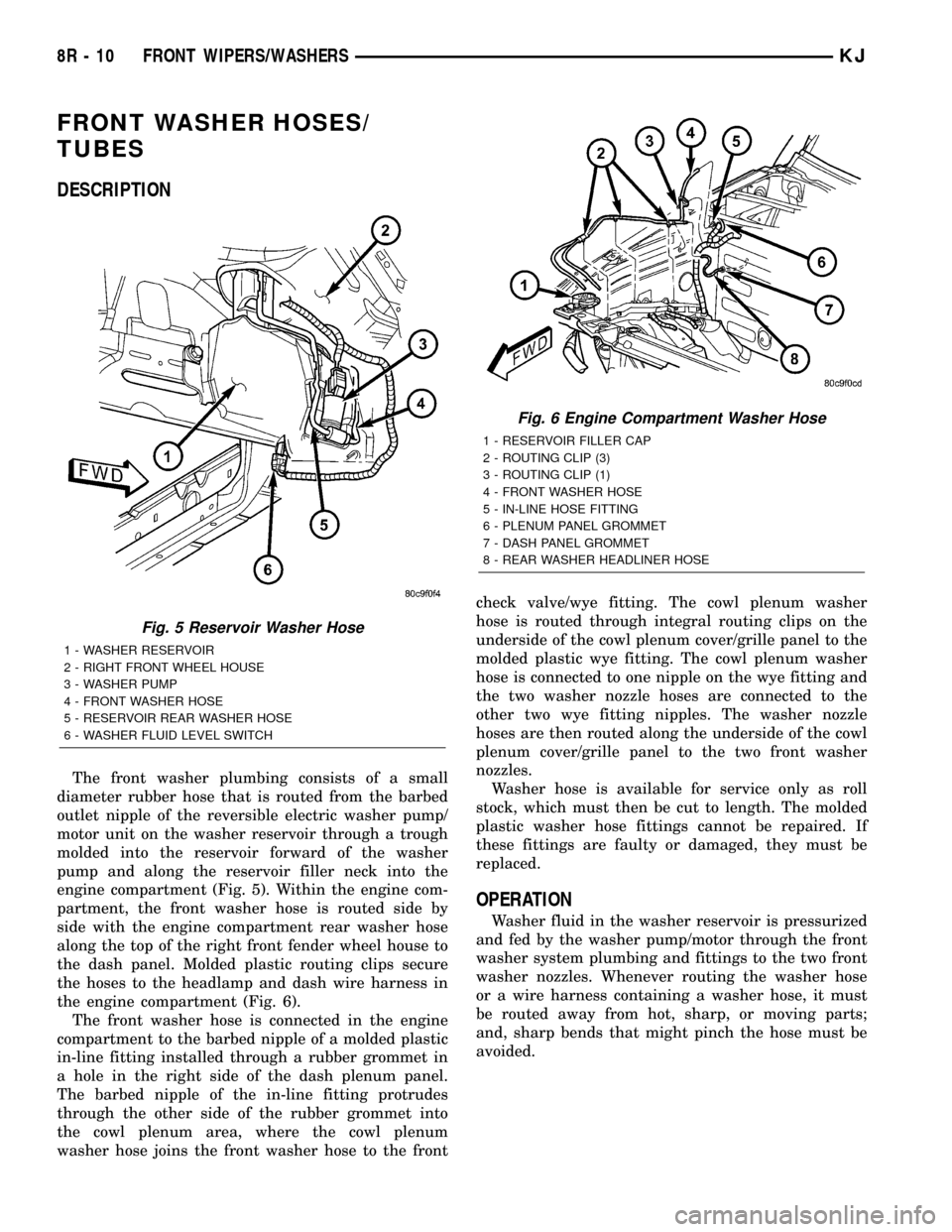
The front washer plumbing consists of a small
diameter rubber hose that is routed from the barbed
outlet nipple of the reversible electric washer pump/
motor unit on the washer reservoir through a trough
molded into the reservoir forward of the washer
pump and along the reservoir filler neck into the
engine compartment (Fig. 5). Within the engine com-
partment, the front washer hose is routed side by
side with the engine compartment rear washer hose
along the top of the right front fender wheel house to
the dash panel. Molded plastic routing clips secure
the hoses to the headlamp and dash wire harness in
the engine compartment (Fig. 6).
The front washer hose is connected in the engine
compartment to the barbed nipple of a molded plastic
in-line fitting installed through a rubber grommet in
a hole in the right side of the dash plenum panel.
The barbed nipple of the in-line fitting protrudes
through the other side of the rubber grommet into
the cowl plenum area, where the cowl plenum
washer hose joins the front washer hose to the frontcheck valve/wye fitting. The cowl plenum washer
hose is routed through integral routing clips on the
underside of the cowl plenum cover/grille panel to the
molded plastic wye fitting. The cowl plenum washer
hose is connected to one nipple on the wye fitting and
the two washer nozzle hoses are connected to the
other two wye fitting nipples. The washer nozzle
hoses are then routed along the underside of the cowl
plenum cover/grille panel to the two front washer
nozzles.
Washer hose is available for service only as roll
stock, which must then be cut to length. The molded
plastic washer hose fittings cannot be repaired. If
these fittings are faulty or damaged, they must be
replaced.
OPERATION
Washer fluid in the washer reservoir is pressurized
and fed by the washer pump/motor through the front
washer system plumbing and fittings to the two front
washer nozzles. Whenever routing the washer hose
or a wire harness containing a washer hose, it must
be routed away from hot, sharp, or moving parts;
and, sharp bends that might pinch the hose must be
avoided.
Fig. 5 Reservoir Washer Hose
1 - WASHER RESERVOIR
2 - RIGHT FRONT WHEEL HOUSE
3 - WASHER PUMP
4 - FRONT WASHER HOSE
5 - RESERVOIR REAR WASHER HOSE
6 - WASHER FLUID LEVEL SWITCH
Fig. 6 Engine Compartment Washer Hose
1 - RESERVOIR FILLER CAP
2 - ROUTING CLIP (3)
3 - ROUTING CLIP (1)
4 - FRONT WASHER HOSE
5 - IN-LINE HOSE FITTING
6 - PLENUM PANEL GROMMET
7 - DASH PANEL GROMMET
8 - REAR WASHER HEADLINER HOSE
8R - 10 FRONT WIPERS/WASHERSKJ
Page 714 of 1803

(4) If necessary, use a suitable battery terminal
puller to disengage the wiper arm from the wiper
pivot shaft (Fig. 11).
(5) Remove the front wiper arm pivot end from the
wiper pivot shaft.
INSTALLATION
NOTE: Be certain that the wiper motor is in the park
position before attempting to install the front wiper
arms. Turn the ignition switch to the On position
and move the control knob on the right (wiper) con-
trol stalk of the multi-function switch to its Off posi-
tion. If the wiper pivots move, wait until they stop
moving, then turn the ignition switch back to the
Off position. The wiper motor is now in its park
position.
(1) The front wiper arms must be indexed to the
wiper pivot shafts with the wiper motor in the park
position to be properly installed. Position the front
wiper arm pivot ends onto the wiper pivot shafts so
that the tip of the wiper blade is aligned with the
T-shaped wiper alignment lines located in the lower
edge of the windshield glass (Fig. 10).
(2) Once the wiper blade is aligned, lift the wiper
arm away from the windshield slightly to relieve the
spring tension on the pivot end and push the pivot
hole on the end of the wiper arm down firmly and
evenly over the wiper pivot shaft.
(3) Install and tighten the nut that secures the
wiper arm to the wiper pivot shaft. Tighten the nut
to 24 N´m (18 ft. lbs.).
(4) Wet the windshield glass, then operate the
front wipers. Turn the front wipers Off, then checkfor the correct wiper arm position and readjust as
required.
(5) Reinstall the plastic nut cap onto the wiper
arm pivot nut.
FRONT WIPER BLADE
DESCRIPTION
Each front wiper blade is secured by an integral
latching pivot block to the hook formation on the tip
of the front wiper arms, and rests on the glass near
the base of the windshield when the wipers are not
in operation (Fig. 12). The wiper blade consists of the
following components:
²Superstructure- The superstructure includes
several stamped steel bridges and links with claw
formations that grip the wiper blade element. Also
included in this unit is the latching, molded plastic
pivot block that secures the superstructure to the
wiper arm. The driver side front wiper blade has an
additional molded black plastic airfoil secured to the
superstructure, which is oriented toward the base of
the windshield when the front wipers are in their
parked position. All of the metal components of the
wiper blade have a satin black finish applied.
²Element- The wiper element or squeegee is the
resilient rubber member of the wiper blade that con-
tacts the glass.
²Flexor- The flexor is a rigid metal component
running along the length of each side of the wiper
Fig. 11 Wiper Arm Puller - Typical
1 - WIPER ARM
2 - WIPER PIVOT SHAFT
3 - BATTERY TERMINAL PULLER
Fig. 12 Front Wiper Blade
1 - SUPERSTRUCTURE
2 - ELEMENT
3 - PIVOT BLOCK
4 - RELEASE TAB
5 - PIVOT PIN
6 - CLAWS
7 - FLEXOR
KJFRONT WIPERS/WASHERS 8R - 13
FRONT WIPER ARM (Continued)
Page 715 of 1803

element where it is gripped by the claws of the
superstructure.
All models have two 47.50 centimeter (18.70 inch)
long front wiper blades with non-replaceable rubber
elements (squeegees). The wiper blades cannot be
adjusted or repaired. If faulty, worn, or damaged the
entire wiper blade unit must be replaced.
OPERATION
The wiper blades are moved back and forth across
the glass by the wiper arms when the wipers are
being operated. The wiper blade superstructure is
the flexible frame that grips the wiper blade element
and evenly distributes the force of the spring-loaded
wiper arm along the length of the element. The com-
bination of the wiper arm force and the flexibility of
the superstructure makes the element conform to
and maintain proper contact with the glass, even as
the blade is moved over the varied curvature that
may be encountered across the glass surface. The
wiper element flexor provides the claws of the blade
superstructure with a rigid, yet flexible component
on the element which can be gripped. The rubber ele-
ment is designed to be stiff enough to maintain an
even cleaning edge as it is drawn across the glass,
yet resilient enough to conform to the glass surface
and flip from one cleaning edge to the other each
time the wiper blade changes directions. The airfoil
used on the driver side wiper blade is designed to
reduce the lifting effect caused by air moving over
the vehicle at higher highway speeds.
REMOVAL
NOTE: The notched end of the wiper element flexor
should always be oriented towards the end of the
wiper blade that is nearest to the wiper pivot.
(1) Lift the front wiper arm to raise the wiper
blade and element off of the glass, until the wiper
arm hinge is in its over-center position.
(2) To remove the wiper blade from the wiper arm,
depress the pivot block latch release tab under the
tip of the arm and slide the blade away from the tip
towards the pivot end of the arm far enough to dis-
engage the pivot block from the hook formation on
the end of the arm (Fig. 13).
(3) Extract the hook formation on the tip of the
wiper arm through the opening in the wiper blade
superstructure just ahead of the wiper blade pivot
block/latch unit.
CAUTION: Do not allow the wiper arm to spring
back against the glass without the wiper blade in
place or the glass may be damaged.(4) Gently lower the tip of the wiper arm onto the
glass.
INSTALLATION
NOTE: The notched end of the wiper element flexor
should always be oriented towards the end of the
wiper blade that is nearest to the wiper pivot.
(1) Lift the front wiper arm off of the windshield
glass, until the wiper arm hinge is in its over-center
position.
(2) Position the front wiper blade near the hook
formation on the tip of the arm with the notched end
of the wiper element flexor oriented towards the end
of the wiper arm that is nearest to the wiper pivot.
(3) Insert the hook formation on the tip of the
wiper arm through the opening in the wiper blade
superstructure ahead of the wiper blade pivot block/
latch unit far enough to engage the pivot block into
the hook (Fig. 13).
(4) Slide the wiper blade pivot block/latch up into
the hook formation on the tip of the wiper arm until
the latch release tab snaps into its locked position.
Latch engagement will be accompanied by an audible
click.
(5) Gently lower the wiper blade onto the glass.
Fig. 13 Front Wiper Blade Remove/Install
1 - SUPERSTRUCTURE
2 - WIPER ARM
3 - PIVOT BLOCK
4 - RELEASE TAB
5 - HOOK
6 - ELEMENT
8R - 14 FRONT WIPERS/WASHERSKJ
FRONT WIPER BLADE (Continued)
Page 735 of 1803

REAR WASHER SYSTEM
The washer system components should be
inspected periodically, not just when washer perfor-
mance problems are experienced. This inspection
should include the following points:
(1) Check for ice or other foreign material in the
washer reservoir. If contaminated, clean and flush
the washer system. (Refer to 8 - ELECTRICAL/
REAR WIPERS/WASHERS - CLEANING).
(2) Inspect the washer plumbing for pinched, leak-
ing, deteriorated, or incorrectly routed hoses and
damaged or disconnected hose fittings. Replace dam-
aged or deteriorated hoses and hose fittings. Leaking
washer hoses can sometimes be repaired by cutting
the hose at the leak and splicing it back together
using an in-line connector fitting. Similarly, sections
of deteriorated hose can be cut out and replaced by
splicing in new sections of hose using in-line connec-
tor fittings. Whenever routing a washer hose or a
wire harness containing a washer hose, it must be
routed away from hot, sharp, or moving parts. Also,
sharp bends that might pinch the washer hose must
be avoided.
REAR CHECK VALVE
DESCRIPTION
A rear washer system check valve is standard
equipment on this model (Fig. 3). The rear check
valve is located in the washer plumbing between the
rear roof header and the roof outer panel near the
rear washer nozzle. The rear check valve consists of
a molded plastic body with a round center sectionand barbed hose nipples at each end. An arrow for-
mation molded into the center section of the valve
body indicates the direction of flow through the
valve. The rear check valve cannot be adjusted or
repaired and, if faulty or damaged, it must be
replaced.
OPERATION
The rear check valve prevents washer fluid from
draining out of the rear washer supply hoses back to
the washer reservoir. This drain-back would result in
a lengthy delay from when the rear washer switch is
actuated until washer fluid was dispensed through
the rear washer nozzle, because the washer pump
would have to refill the rear washer plumbing from
the reservoir to the nozzle. The check valve also pre-
vents washer fluid from siphoning through the rear
washer nozzle after the rear washer system is turned
Off.
Within the check valve body, a small check valve is
held in place against a seat by a small coiled spring
to restrict flow through the unit until the valve is
unseated by a predetermined inlet fluid pressure.
When the washer pump pressurizes and pumps
washer fluid from the reservoir through the rear
washer plumbing, the fluid pressure overrides the
spring pressure applied to the check ball within the
valve and unseats the valve, allowing washer fluid to
flow toward the rear washer nozzle. When the
washer pump stops operating, spring pressure seats
the check valve and fluid flow in either direction
within the rear washer plumbing is prevented.
REMOVAL
(1) Disconnect and isolate the battery negative
cable.
(2) Remove the Center High Mounted Stop Lamp
(CHMSL) unit from the rear of the roof panel. (Refer
to 8 - ELECTRICAL/LAMPS/LIGHTING - EXTERI-
OR/CENTER HIGH MOUNTED STOP LAMP UNIT
- REMOVAL).
WARNING: THE EDGES OF THE SHEET METAL
AROUND THE CENTER HIGH MOUNTED STOP
LAMP MOUNTING HOLE IN THE ROOF PANEL.
TAKE THE PROPER PRECAUTIONS TO AVOID PER-
SONAL INJURY.
(3) Reach through the CHMSL unit mounting hole
in the rear of the roof panel to access and disconnect
the rear washer hose at the barbed nipple of the rear
washer nozzle (Fig. 4).
(4) Pull the rear washer hose through the CHMSL
unit mounting hole far enough to access and discon-
nect the headliner washer hose from the barbed nip-
ple of the rear check valve.
Fig. 3 Rear Check Valve
1 - INLET NIPPLE
2 - REAR CHECK VALVE
3 - OUTLET NIPPLE
4 - FLOW DIRECTION ARROW
8R - 34 REAR WIPERS/WASHERSKJ
REAR WIPERS/WASHERS (Continued)
Page 737 of 1803

headliner hose is glued to top of the headliner and
routed along the right roof side rail to the rear of the
vehicle. At the rear of the vehicle, the headliner hose
passes through a hole at the rear portion of the roof
rear inner header panel and is connected to the rear
check valve. From the rear check valve, there is a
short section of hose that connects the rear check
valve to the rear washer nozzle.
Washer hose is available for service only as roll
stock, which must then be cut to length. The head-
liner washer hose is integral to the headliner unit
and, if faulty or damaged, the headliner unit must be
replaced. However, the headliner hose is marked
with a white cut line on the A-pillar where the hose
should be cut and spliced with a plastic in-line con-
nector fitting to facilitate headliner removal without
the need to remove the instrument panel. (Refer to
23 - BODY/INTERIOR/HEADLINER - REMOVAL
AND INSTALLATION). The molded plastic washer
hose fittings cannot be repaired. If these fittings are
faulty or damaged, they must be replaced.
OPERATION
Washer fluid in the washer reservoir is pressurized
and fed by the washer pump/motor through the rear
washer system plumbing and fittings to the rear
washer nozzle located on the roof panel above the
rear flip-up glass opening. Whenever routing the
washer hose or a wire harness containing a washer
hose, it must be routed away from hot, sharp, or
moving parts; and, sharp bends that might pinch the
hose must be avoided.
REAR WASHER NOZZLE
DESCRIPTION
The rear washer nozzle is a fluidic-type unit con-
structed of molded plastic (Fig. 6). The nozzle is
secured by a snap fit in a dedicated mounting hole
located in the rear edge of the roof panel above the
rear flip-up glass opening and to the right of the
Center High Mounted Stop Lamp (CHMSL) unit. A
rubber gasket on the back of the nozzle seals the noz-
zle to the roof panel opening. The back of the nozzle
includes an integral alignment feature on the left
side, an integral engagement tab on the top, an inte-
gral latch feature on the bottom, and the washer
plumbing nipple which are all concealed between the
outer roof panel and the rear roof inner header. The
rear washer nozzle latch feature is a one time com-
ponent, and will be damaged if the nozzle is removed
from its mounting hole for service. The rear washer
nozzle cannot be adjusted or repaired. If faulty or
damaged, the entire nozzle unit must be replaced.
OPERATION
The rear washer nozzle is designed to dispense
washer fluid into the wiper pattern area on the out-
side of the rear flip-up glass. Pressurized washer
fluid is fed to the nozzle from the washer reservoir by
the washer pump/motor through a single hose, which
is attached to a barbed nipple on the back of the rear
washer nozzle. The rear washer nozzle incorporates a
fluidic design, which causes the nozzle to emit the
pressurized washer fluid as an oscillating stream to
more effectively cover a larger area of the glass area
to be cleaned.
REMOVAL
NOTE: The rear washer nozzle latch feature is a one
time component, and will be damaged if the nozzle is
removed from its mounting hole for service. If
removed from its mounting hole for any reason, the
rear washer nozzle must be replaced with a new unit.
(1) Using a trim stick or another suitable wide
flat-bladed tool, gently pry the bottom of the rear
washer nozzle away from the roof panel until the
latch feature at the bottom of the nozzle that secures
it in the mounting hole of the roof panel snaps.
(2) Pull the rear washer nozzle out from the roof
panel far enough to access the washer hose (Fig. 7).
(3) Disconnect the washer hose from the barbed
nipple on the back of the rear washer nozzle.
(4) Discard the rear washer nozzle.
Fig. 6 Rear Washer Nozzle
1 - ENGAGEMENT TAB (TOP)
2 - GASKET
3 - REAR WASHER NOZZLE
4 - ALIGNMENT FEATURE
5 - ORIFICE
6 - LATCH FEATURE (BOTTOM)
7 - NIPPLE
8R - 36 REAR WIPERS/WASHERSKJ
REAR WASHER HOSES/TUBES (Continued)
Page 740 of 1803
(4) Install and tighten the nut that secures the
rear wiper arm to the rear wiper motor output shaft.
Tighten the nut to 18 N´m (13 ft. lbs.).
(5) Close the rear wiper arm pivot cover.
(6) Lift the rear wiper arm support away from the
park ramp, then place the wiper arm support in the
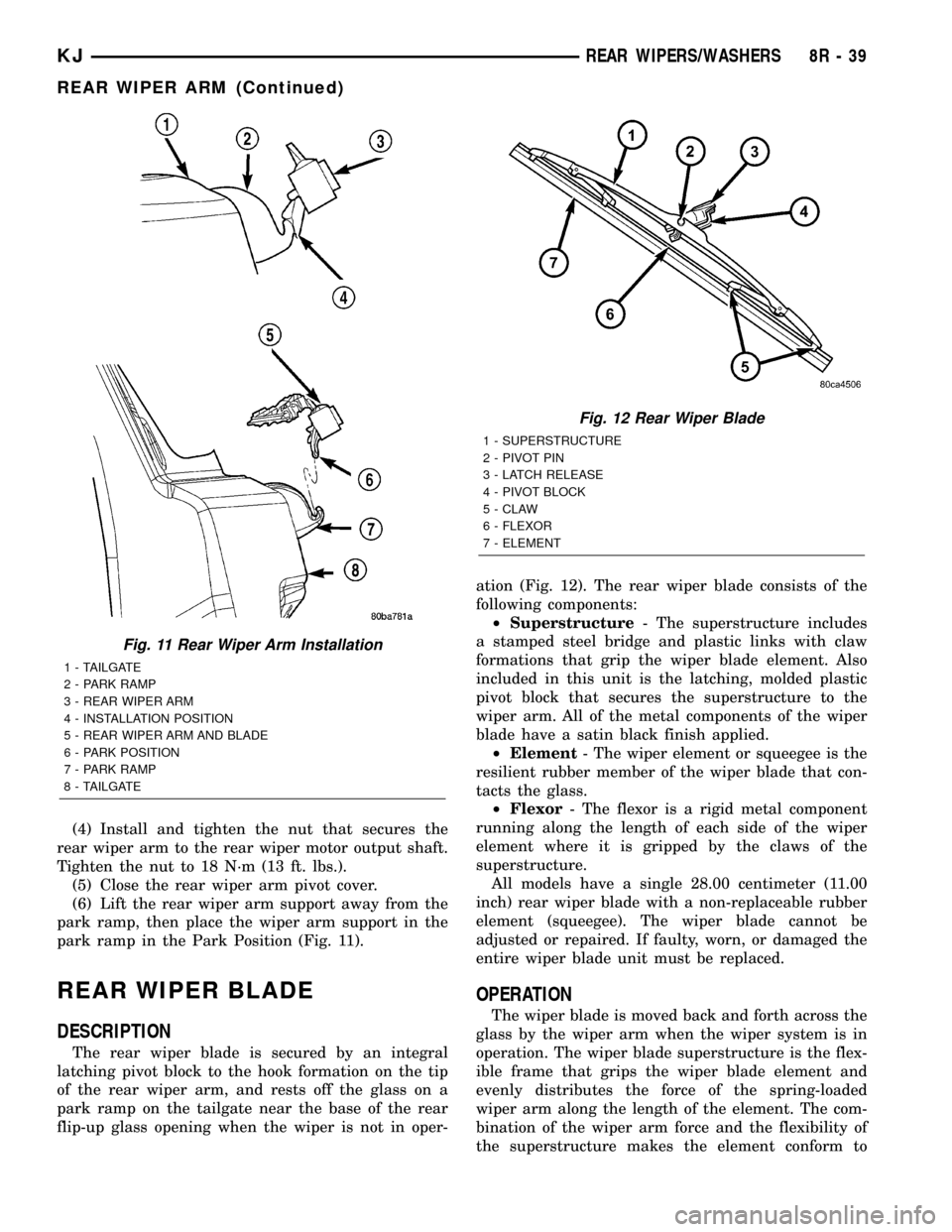
park ramp in the Park Position (Fig. 11).
REAR WIPER BLADE
DESCRIPTION
The rear wiper blade is secured by an integral
latching pivot block to the hook formation on the tip
of the rear wiper arm, and rests off the glass on a
park ramp on the tailgate near the base of the rear
flip-up glass opening when the wiper is not in oper-ation (Fig. 12). The rear wiper blade consists of the
following components:
²Superstructure- The superstructure includes
a stamped steel bridge and plastic links with claw
formations that grip the wiper blade element. Also
included in this unit is the latching, molded plastic
pivot block that secures the superstructure to the
wiper arm. All of the metal components of the wiper
blade have a satin black finish applied.
²Element- The wiper element or squeegee is the
resilient rubber member of the wiper blade that con-
tacts the glass.
²Flexor- The flexor is a rigid metal component
running along the length of each side of the wiper
element where it is gripped by the claws of the
superstructure.
All models have a single 28.00 centimeter (11.00
inch) rear wiper blade with a non-replaceable rubber
element (squeegee). The wiper blade cannot be
adjusted or repaired. If faulty, worn, or damaged the
entire wiper blade unit must be replaced.
OPERATION
The wiper blade is moved back and forth across the
glass by the wiper arm when the wiper system is in
operation. The wiper blade superstructure is the flex-
ible frame that grips the wiper blade element and
evenly distributes the force of the spring-loaded
wiper arm along the length of the element. The com-
bination of the wiper arm force and the flexibility of
the superstructure makes the element conform to
Fig. 11 Rear Wiper Arm Installation
1 - TAILGATE
2 - PARK RAMP
3 - REAR WIPER ARM
4 - INSTALLATION POSITION
5 - REAR WIPER ARM AND BLADE
6 - PARK POSITION
7 - PARK RAMP
8 - TAILGATE
Fig. 12 Rear Wiper Blade
1 - SUPERSTRUCTURE
2 - PIVOT PIN
3 - LATCH RELEASE
4 - PIVOT BLOCK
5 - CLAW
6 - FLEXOR
7 - ELEMENT
KJREAR WIPERS/WASHERS 8R - 39
REAR WIPER ARM (Continued)
Page 760 of 1803

INSTALLATION
(1) Insert the removed terminal in the same cavity
on the repair connector.
(2) Repeat steps for each terminal in the connec-
tor, being sure that all wires are inserted into the
proper cavities. For additional connector pin-out
identification, refer to the wiring diagrams.
(3) When the connector is re-assembled, the sec-
ondary terminal lock must be placed in the locked
position to prevent terminal push out.
(4) Replace dress cover (if applicable).
(5) Connect connector to its mating half/compo-
nent.
(6) Connect battery and test all affected systems.
DIODE
REMOVAL
(1) Disconnect the battery.
(2) Locate the diode in the harness, and remove
the protective covering.
(3) Remove the diode from the harness, pay atten-
tion to the current flow direction (Fig. 13).
INSTALLATION
(1) Remove the insulation from the wires in the
harness. Only remove enough insulation to solder in
the new diode.(2) Install the new diode in the harness, making
sure current flow is correct. If necessary, refer to the
appropriate wiring diagram for current flow (Fig. 13).
(3) Solder the connection together using rosin core
type solder only.Do not use acid core solder.
(4) Tape the diode to the harness using electrical
tape. Make sure the diode is completely sealed from
the elements.
(5) Re-connect the battery and test affected sys-
tems.
TERMINAL
REMOVAL
(1) Follow steps for removing terminals described
in the connector removal section.
(2) Cut the wire 6 inches from the back of the con-
nector.
INSTALLATION
(1) Select a wire from the terminal repair kit that
best matches the color and gage of the wire being
repaired.
(2) Cut the repair wire to the proper length and
remove one±half (1/2) inch of insulation.
(3) Splice the repair wire to the wire harness (see
wire splicing procedure).
(4) Insert the repaired wire into the connector.
(5) Install the connector locking wedge, if required,
and reconnect the connector to its mating half/compo-
nent.
(6) Re-tape the wire harness starting at 1±1/2
inches behind the connector and 2 inches past the
repair.
(7) Connect battery and test all affected systems.
WIRE
STANDARD PROCEDURE - WIRE SPLICING
When splicing a wire, it is important that the cor-
rect gage be used as shown in the wiring diagrams.
(1) Remove one-half (1/2) inch of insulation from
each wire that needs to be spliced.
(2) Place a piece of adhesive lined heat shrink tub-
ing on one side of the wire. Make sure the tubing will
be long enough to cover and seal the entire repair
area.
Fig. 13 DIODE IDENTIFICATION
1 - CURRENT FLOW
2 - BAND AROUND DIODE INDICATES CURRENT FLOW
3 - DIODE AS SHOWN IN THE DIAGRAMS
KJ8W-01 WIRING DIAGRAM INFORMATION8Wa-01-13
CONNECTOR (Continued)
Page 1229 of 1803
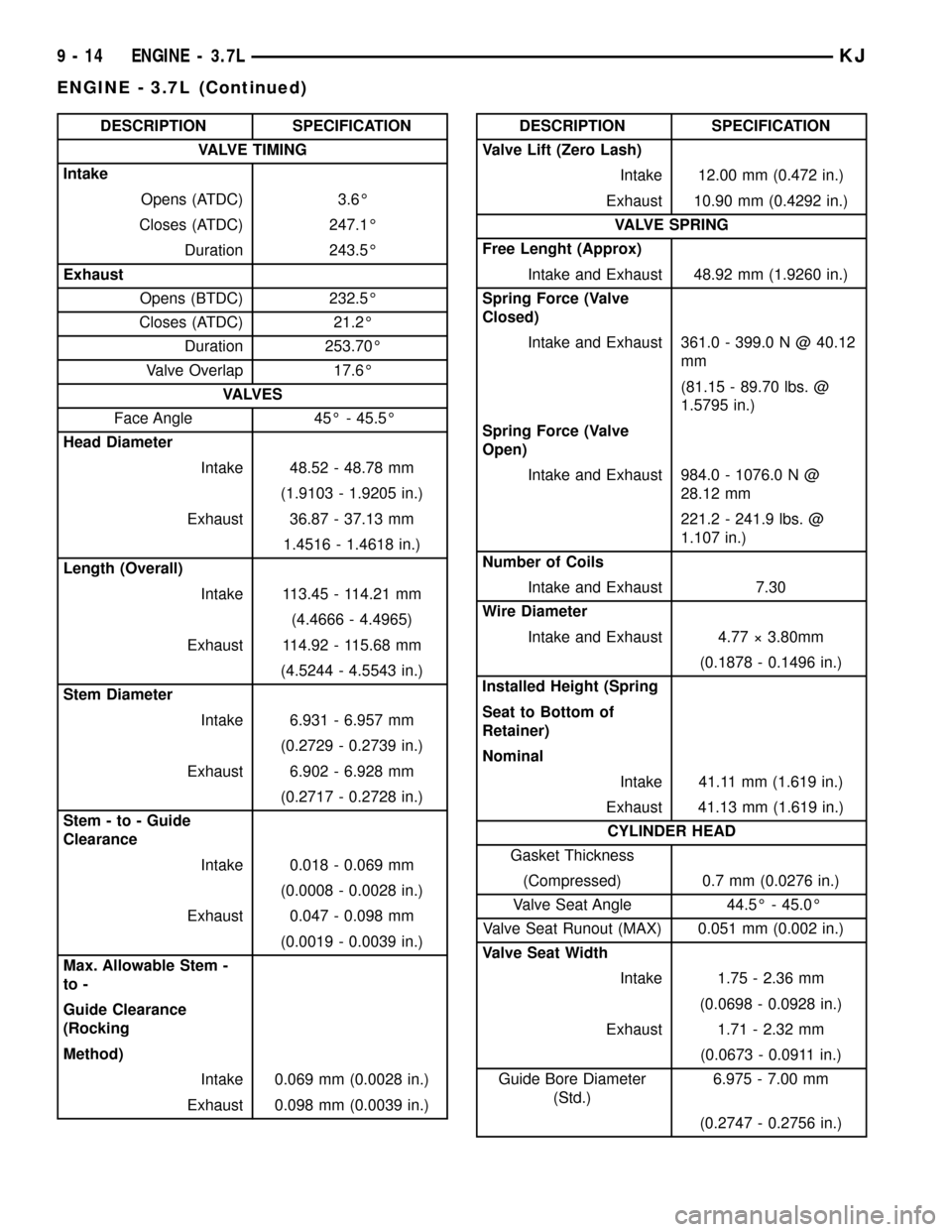
DESCRIPTION SPECIFICATION
VALVE TIMING
Intake
Opens (ATDC) 3.6É
Closes (ATDC) 247.1É
Duration 243.5É
Exhaust
Opens (BTDC) 232.5É
Closes (ATDC) 21.2É
Duration 253.70É
Valve Overlap 17.6É
VA LV E S
Face Angle 45É - 45.5É
Head Diameter
Intake 48.52 - 48.78 mm
(1.9103 - 1.9205 in.)
Exhaust 36.87 - 37.13 mm
1.4516 - 1.4618 in.)
Length (Overall)
Intake 113.45 - 114.21 mm
(4.4666 - 4.4965)
Exhaust 114.92 - 115.68 mm
(4.5244 - 4.5543 in.)
Stem Diameter
Intake 6.931 - 6.957 mm
(0.2729 - 0.2739 in.)
Exhaust 6.902 - 6.928 mm
(0.2717 - 0.2728 in.)
Stem - to - Guide
Clearance
Intake 0.018 - 0.069 mm
(0.0008 - 0.0028 in.)
Exhaust 0.047 - 0.098 mm
(0.0019 - 0.0039 in.)
Max. Allowable Stem -
to -
Guide Clearance
(Rocking
Method)
Intake 0.069 mm (0.0028 in.)
Exhaust 0.098 mm (0.0039 in.)DESCRIPTION SPECIFICATION
Valve Lift (Zero Lash)
Intake 12.00 mm (0.472 in.)
Exhaust 10.90 mm (0.4292 in.)
VALVE SPRING
Free Lenght (Approx)
Intake and Exhaust 48.92 mm (1.9260 in.)
Spring Force (Valve
Closed)
Intake and Exhaust 361.0 - 399.0 N @ 40.12
mm
(81.15 - 89.70 lbs. @
1.5795 in.)
Spring Force (Valve
Open)
Intake and Exhaust 984.0 - 1076.0 N @
28.12 mm
221.2 - 241.9 lbs. @
1.107 in.)
Number of Coils
Intake and Exhaust 7.30
Wire Diameter
Intake and Exhaust 4.77 ý 3.80mm
(0.1878 - 0.1496 in.)
Installed Height (Spring
Seat to Bottom of
Retainer)
Nominal
Intake 41.11 mm (1.619 in.)
Exhaust 41.13 mm (1.619 in.)
CYLINDER HEAD
Gasket Thickness
(Compressed) 0.7 mm (0.0276 in.)
Valve Seat Angle 44.5É - 45.0É
Valve Seat Runout (MAX) 0.051 mm (0.002 in.)
Valve Seat Width
Intake 1.75 - 2.36 mm
(0.0698 - 0.0928 in.)
Exhaust 1.71 - 2.32 mm
(0.0673 - 0.0911 in.)
Guide Bore Diameter
(Std.)6.975 - 7.00 mm
(0.2747 - 0.2756 in.)
9 - 14 ENGINE - 3.7LKJ
ENGINE - 3.7L (Continued)