removal JEEP LIBERTY 2002 KJ / 1.G Owner's Manual
[x] Cancel search | Manufacturer: JEEP, Model Year: 2002, Model line: LIBERTY, Model: JEEP LIBERTY 2002 KJ / 1.GPages: 1803, PDF Size: 62.3 MB
Page 48 of 1803
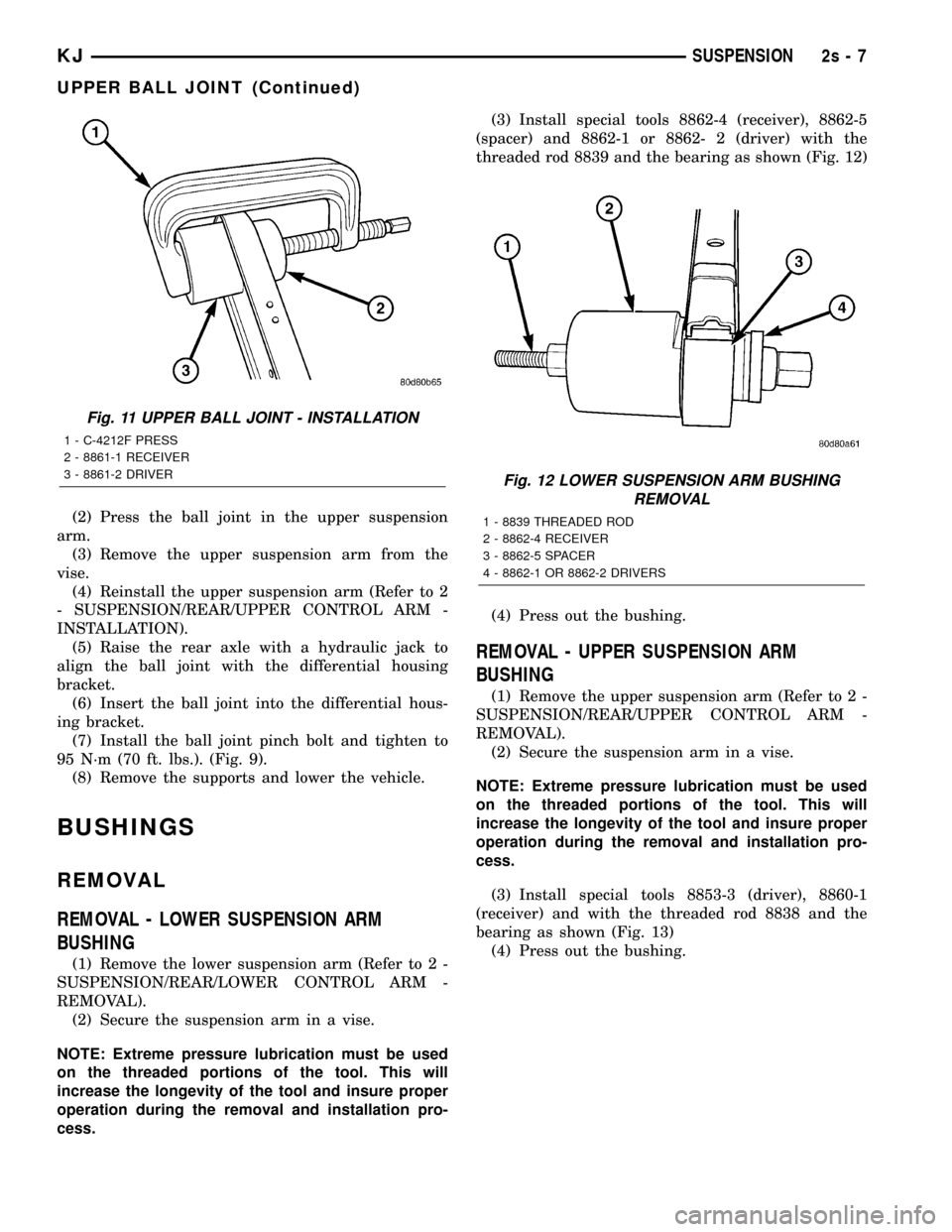
(2) Press the ball joint in the upper suspension
arm.
(3) Remove the upper suspension arm from the
vise.
(4) Reinstall the upper suspension arm (Refer to 2
- SUSPENSION/REAR/UPPER CONTROL ARM -
INSTALLATION).
(5) Raise the rear axle with a hydraulic jack to
align the ball joint with the differential housing
bracket.
(6) Insert the ball joint into the differential hous-
ing bracket.
(7) Install the ball joint pinch bolt and tighten to
95 N´m (70 ft. lbs.). (Fig. 9).
(8) Remove the supports and lower the vehicle.
BUSHINGS
REMOVAL
REMOVAL - LOWER SUSPENSION ARM
BUSHING
(1) Remove the lower suspension arm (Refer to 2 -
SUSPENSION/REAR/LOWER CONTROL ARM -
REMOVAL).
(2) Secure the suspension arm in a vise.
NOTE: Extreme pressure lubrication must be used
on the threaded portions of the tool. This will
increase the longevity of the tool and insure proper
operation during the removal and installation pro-
cess.(3) Install special tools 8862-4 (receiver), 8862-5
(spacer) and 8862-1 or 8862- 2 (driver) with the
threaded rod 8839 and the bearing as shown (Fig. 12)
(4) Press out the bushing.
REMOVAL - UPPER SUSPENSION ARM
BUSHING
(1) Remove the upper suspension arm (Refer to 2 -
SUSPENSION/REAR/UPPER CONTROL ARM -
REMOVAL).
(2) Secure the suspension arm in a vise.
NOTE: Extreme pressure lubrication must be used
on the threaded portions of the tool. This will
increase the longevity of the tool and insure proper
operation during the removal and installation pro-
cess.
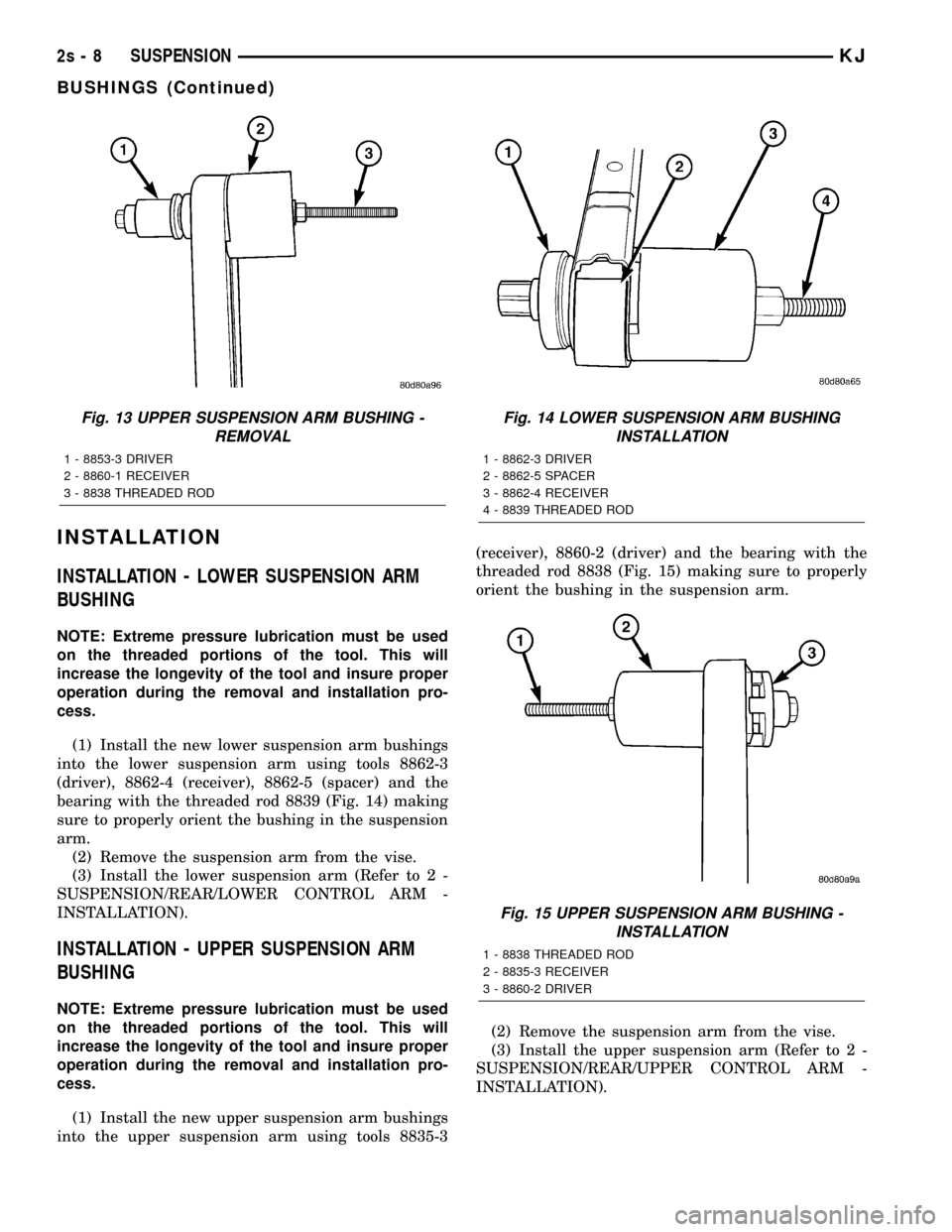
(3) Install special tools 8853-3 (driver), 8860-1
(receiver) and with the threaded rod 8838 and the
bearing as shown (Fig. 13)
(4) Press out the bushing.
Fig. 11 UPPER BALL JOINT - INSTALLATION
1 - C-4212F PRESS
2 - 8861-1 RECEIVER
3 - 8861-2 DRIVER
Fig. 12 LOWER SUSPENSION ARM BUSHING
REMOVAL
1 - 8839 THREADED ROD
2 - 8862-4 RECEIVER
3 - 8862-5 SPACER
4 - 8862-1 OR 8862-2 DRIVERS
KJSUSPENSION 2s - 7
UPPER BALL JOINT (Continued)
Page 49 of 1803
INSTALLATION
INSTALLATION - LOWER SUSPENSION ARM
BUSHING
NOTE: Extreme pressure lubrication must be used
on the threaded portions of the tool. This will
increase the longevity of the tool and insure proper
operation during the removal and installation pro-
cess.
(1) Install the new lower suspension arm bushings
into the lower suspension arm using tools 8862-3
(driver), 8862-4 (receiver), 8862-5 (spacer) and the
bearing with the threaded rod 8839 (Fig. 14) making
sure to properly orient the bushing in the suspension
arm.
(2) Remove the suspension arm from the vise.
(3) Install the lower suspension arm (Refer to 2 -
SUSPENSION/REAR/LOWER CONTROL ARM -
INSTALLATION).
INSTALLATION - UPPER SUSPENSION ARM
BUSHING
NOTE: Extreme pressure lubrication must be used
on the threaded portions of the tool. This will
increase the longevity of the tool and insure proper
operation during the removal and installation pro-
cess.
(1) Install the new upper suspension arm bushings
into the upper suspension arm using tools 8835-3(receiver), 8860-2 (driver) and the bearing with the
threaded rod 8838 (Fig. 15) making sure to properly
orient the bushing in the suspension arm.
(2) Remove the suspension arm from the vise.
(3) Install the upper suspension arm (Refer to 2 -
SUSPENSION/REAR/UPPER CONTROL ARM -
INSTALLATION).
Fig. 13 UPPER SUSPENSION ARM BUSHING -
REMOVAL
1 - 8853-3 DRIVER
2 - 8860-1 RECEIVER
3 - 8838 THREADED ROD
Fig. 14 LOWER SUSPENSION ARM BUSHING
INSTALLATION
1 - 8862-3 DRIVER
2 - 8862-5 SPACER
3 - 8862-4 RECEIVER
4 - 8839 THREADED ROD
Fig. 15 UPPER SUSPENSION ARM BUSHING -
INSTALLATION
1 - 8838 THREADED ROD
2 - 8835-3 RECEIVER
3 - 8860-2 DRIVER
2s - 8 SUSPENSIONKJ
BUSHINGS (Continued)
Page 50 of 1803
DIFFERENTIAL & DRIVELINE
TABLE OF CONTENTS
page page
PROPELLER SHAFT......................1
HALF SHAFT...........................10
FRONT AXLE - 186FIA....................19REAR AXLE - 198RBI.....................49
REAR AXLE-81/4.......................86
PROPELLER SHAFT
TABLE OF CONTENTS
page page
PROPELLER SHAFT
DIAGNOSIS AND TESTING - PROPELLER
SHAFT...............................1
STANDARD PROCEDURES - PROPELLER
SHAFT ANGLE........................3
SPECIFICATIONS
PROPELLER SHAFT....................6
SPECIAL TOOLS........................6
PROPELLER SHAFT - FRONT
REMOVAL.............................6INSTALLATION..........................6
PROPELLER SHAFT - REAR
REMOVAL.............................7
INSTALLATION..........................7
SINGLE CARDAN UNIVERSAL JOINTS
DISASSEMBLY..........................8
ASSEMBLY.............................9
PROPELLER SHAFT
DIAGNOSIS AND TESTING - PROPELLER
SHAFT
VIBRATION
Tires that are out-of-round, or wheels that are
unbalanced, will cause a low frequency vibration.
Brake rotors that are unbalanced will cause a
harsh, low frequency vibration.Driveline vibration can also result from loose or
damaged engine mounts.
Propeller shaft vibration increases as the vehicle
speed is increased. A vibration that occurs within a
specific speed range is not usually caused by a pro-
peller shaft being unbalanced. Defective joints or an
incorrect propeller shaft angle, are usually the cause
of such a vibration.
KJDIFFERENTIAL & DRIVELINE 3 - 1
Page 55 of 1803
SPECIFICATIONS
PROPELLER SHAFT
TORQUE SPECIFICATIONS
DESCRIPTION N´m Ft. Lbs. In. Lbs.
Front Shaft - Companion
Flange Bolts30 22 -
Rear Shaft - Yoke Nuts 18 13 -
SPECIAL TOOLS
PROPELLER SHAFT - FRONT
REMOVAL
(1) Shift transmission and transfer case into Neu-
tral.
(2) Raise and support the vehicle.
(3) Mark companion flanges and C/V joints at the
front and rear of the propeller shaft for installation
reference.
(4) Remove bolts from the front and rear C/V
joints.
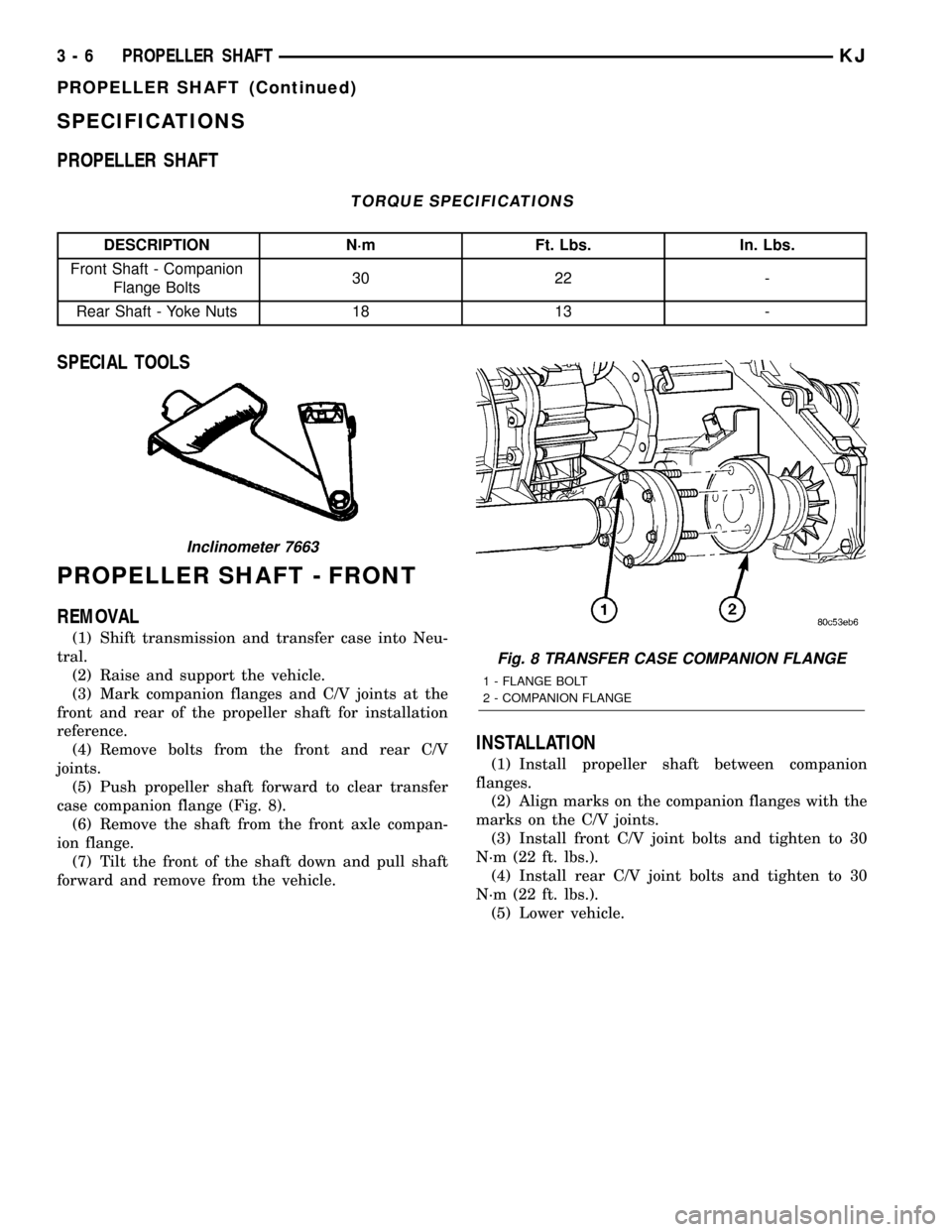
(5) Push propeller shaft forward to clear transfer
case companion flange (Fig. 8).
(6) Remove the shaft from the front axle compan-
ion flange.
(7) Tilt the front of the shaft down and pull shaft
forward and remove from the vehicle.
INSTALLATION
(1) Install propeller shaft between companion
flanges.
(2) Align marks on the companion flanges with the
marks on the C/V joints.
(3) Install front C/V joint bolts and tighten to 30
N´m (22 ft. lbs.).
(4) Install rear C/V joint bolts and tighten to 30
N´m (22 ft. lbs.).
(5) Lower vehicle.
Inclinometer 7663
Fig. 8 TRANSFER CASE COMPANION FLANGE
1 - FLANGE BOLT
2 - COMPANION FLANGE
3 - 6 PROPELLER SHAFTKJ
PROPELLER SHAFT (Continued)
Page 56 of 1803
PROPELLER SHAFT - REAR
REMOVAL
(1) Shift the transmission/transfer case into Neu-
tral.
(2) Raise and support vehicle.
(3) Mark a reference line across the pinion yoke
and propeller shaft for installation.
(4) Remove U-joint strap bolts at the pinion shaft
yoke.
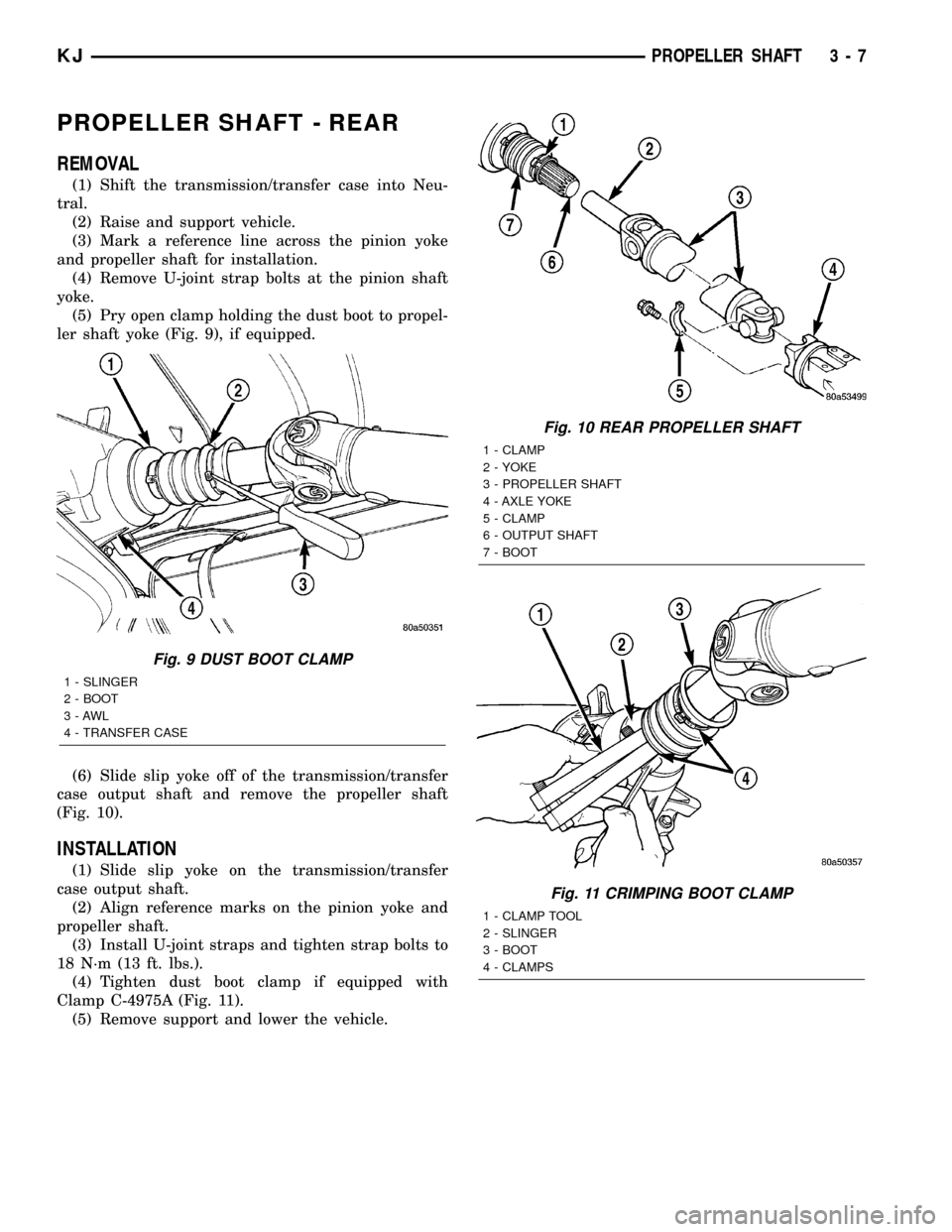
(5) Pry open clamp holding the dust boot to propel-
ler shaft yoke (Fig. 9), if equipped.
(6) Slide slip yoke off of the transmission/transfer
case output shaft and remove the propeller shaft
(Fig. 10).
INSTALLATION
(1) Slide slip yoke on the transmission/transfer
case output shaft.
(2) Align reference marks on the pinion yoke and
propeller shaft.
(3) Install U-joint straps and tighten strap bolts to
18 N´m (13 ft. lbs.).
(4) Tighten dust boot clamp if equipped with
Clamp C-4975A (Fig. 11).
(5) Remove support and lower the vehicle.
Fig. 9 DUST BOOT CLAMP
1 - SLINGER
2 - BOOT
3-AWL
4 - TRANSFER CASE
Fig. 10 REAR PROPELLER SHAFT
1 - CLAMP
2 - YOKE
3 - PROPELLER SHAFT
4 - AXLE YOKE
5 - CLAMP
6 - OUTPUT SHAFT
7 - BOOT
Fig. 11 CRIMPING BOOT CLAMP
1 - CLAMP TOOL
2 - SLINGER
3 - BOOT
4 - CLAMPS
KJPROPELLER SHAFT 3 - 7
Page 59 of 1803
HALF SHAFT
TABLE OF CONTENTS
page page
HALF SHAFT
CAUTION.............................10
DIAGNOSIS AND TESTING - HALF SHAFT....10
REMOVAL.............................10
INSTALLATION.........................11
SPECIFICATIONS
HALF SHAFT.........................11SPECIAL TOOLS.......................12
CV JOINT/BOOT-OUTER
REMOVAL.............................12
INSTALLATION.........................13
CV JOINT/BOOT-INNER
REMOVAL.............................15
INSTALLATION.........................17
HALF SHAFT
CAUTION
CAUTION:: Never grasp half shaft assembly by the
boots. This may cause the boot to pucker or crease
and reduce the service life of the boot.
Avoid over angulating or stroking the C/V joints
when handling the half shaft.
Half shafts exposed to battery acid, transmission
fluid, brake fluid, differential fluid or gasoline may
cause the boots to deteriorate.
DIAGNOSIS AND TESTING - HALF SHAFT
Check for grease at the inboard and outboard C/V
joint. This is a sign of boot or boot clamp damage.
NOISE AND/OR VIBRATION IN TURNS
A clicking noise or a vibration in turns could be
caused by a damaged outer C/V or inner tripod joint
seal boot or seal boot clamps. This will result in the
loss/contamination of the joint grease, resulting in
inadequate lubrication of the joint. Noise could also
be caused by another component of the vehicle com-
ing in contact with the half shafts.
CLUNKING NOISE DURING ACCELERATION
This noise may be a result of a damaged or worn
C/V joint. A torn boot or loose/missing clamp on the
inner/outer joint which has allowed the grease to be
lost will damage the C/V joint.
SHUDDER OR VIBRATION DURING ACCELERATION
This problem could be a result of a worn/damaged
inner tripod joint or a sticking tripod joint. Improper
wheel alignment may also cause a shudder or vibration.
VIBRATION AT HIGHWAY SPEEDS
This problem could be a result of out of balance
front tires or tire/wheel runout. Foreign material
(mud, etc.) packed on the backside of the wheel(s)
will also cause a vibration.
REMOVAL
(1) Raise and support vehicle.
(2) Remove wheel and tire assembly.
(3) Remove half shaft hub nut.
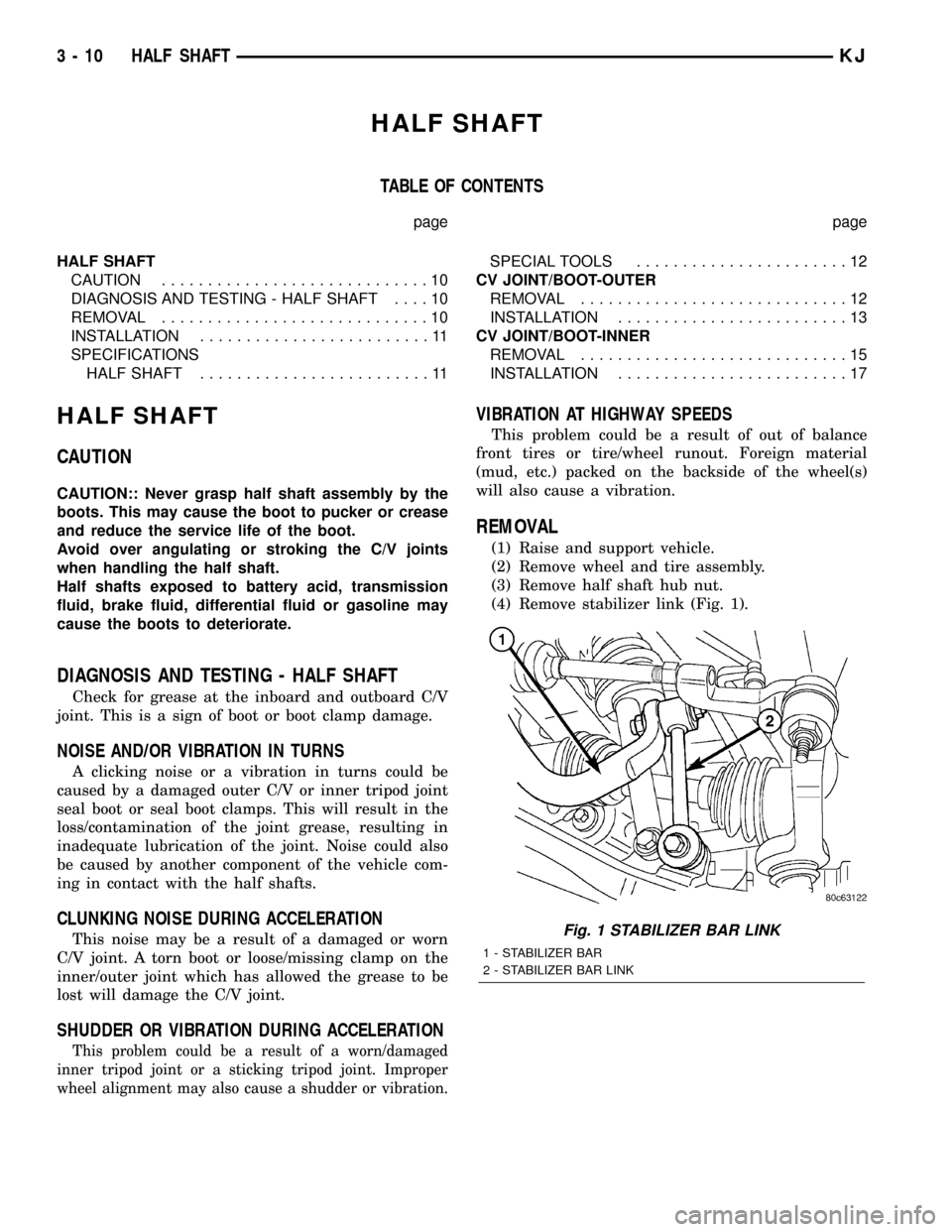
(4) Remove stabilizer link (Fig. 1).
Fig. 1 STABILIZER BAR LINK
1 - STABILIZER BAR
2 - STABILIZER BAR LINK
3 - 10 HALF SHAFTKJ
Page 61 of 1803
SPECIAL TOOLS
CV JOINT/BOOT-OUTER
REMOVAL
(1) Clamp shaft in a vise (with soft jaws) and sup-
port C/V joint.
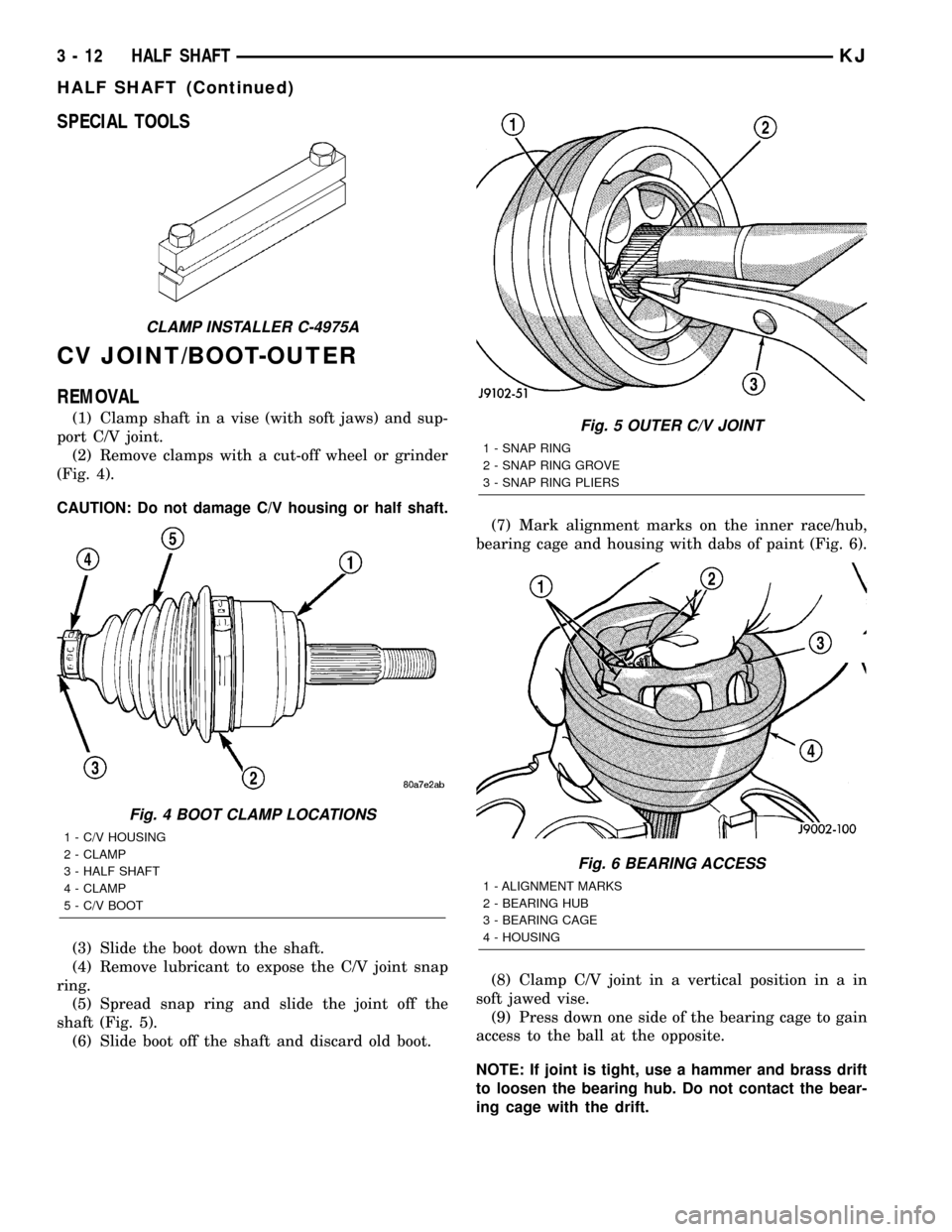
(2) Remove clamps with a cut-off wheel or grinder
(Fig. 4).
CAUTION: Do not damage C/V housing or half shaft.
(3) Slide the boot down the shaft.
(4) Remove lubricant to expose the C/V joint snap
ring.
(5) Spread snap ring and slide the joint off the
shaft (Fig. 5).
(6) Slide boot off the shaft and discard old boot.(7) Mark alignment marks on the inner race/hub,
bearing cage and housing with dabs of paint (Fig. 6).
(8) Clamp C/V joint in a vertical position in a in
soft jawed vise.
(9) Press down one side of the bearing cage to gain
access to the ball at the opposite.
NOTE: If joint is tight, use a hammer and brass drift
to loosen the bearing hub. Do not contact the bear-
ing cage with the drift.
CLAMP INSTALLER C-4975A
Fig. 4 BOOT CLAMP LOCATIONS
1 - C/V HOUSING
2 - CLAMP
3 - HALF SHAFT
4 - CLAMP
5 - C/V BOOT
Fig. 5 OUTER C/V JOINT
1 - SNAP RING
2 - SNAP RING GROVE
3 - SNAP RING PLIERS
Fig. 6 BEARING ACCESS
1 - ALIGNMENT MARKS
2 - BEARING HUB
3 - BEARING CAGE
4 - HOUSING
3 - 12 HALF SHAFTKJ
HALF SHAFT (Continued)
Page 64 of 1803
(8) Place new clamps onto new boot and slide boot
onto the shaft to it's original position.
(9) Apply the rest of lubricant to the C/V joint and
boot.
(10) Install the joint onto the shaft. Push the joint
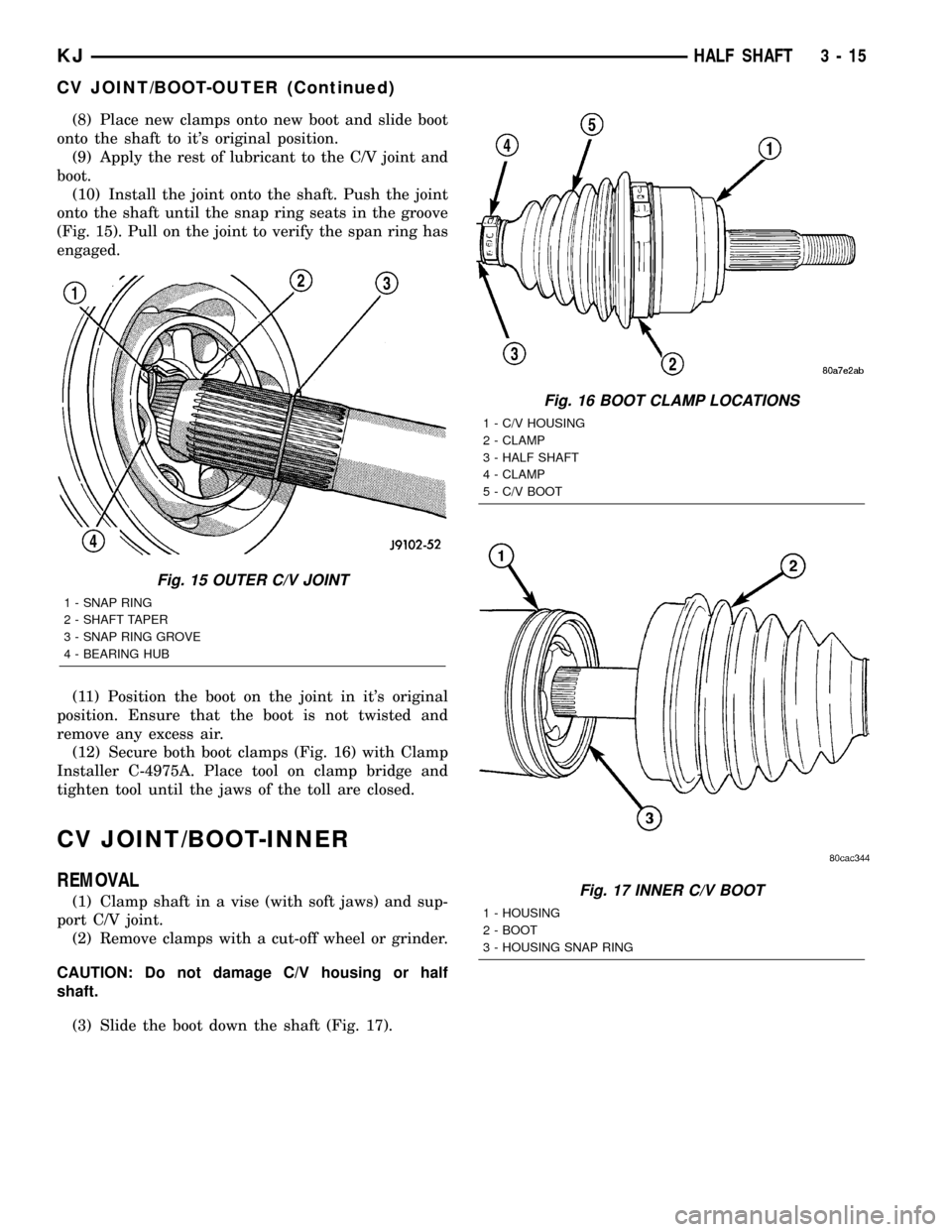
onto the shaft until the snap ring seats in the groove
(Fig. 15). Pull on the joint to verify the span ring has
engaged.
(11) Position the boot on the joint in it's original
position. Ensure that the boot is not twisted and
remove any excess air.
(12) Secure both boot clamps (Fig. 16) with Clamp
Installer C-4975A. Place tool on clamp bridge and
tighten tool until the jaws of the toll are closed.
CV JOINT/BOOT-INNER
REMOVAL
(1) Clamp shaft in a vise (with soft jaws) and sup-
port C/V joint.
(2) Remove clamps with a cut-off wheel or grinder.
CAUTION: Do not damage C/V housing or half
shaft.
(3) Slide the boot down the shaft (Fig. 17).
Fig. 15 OUTER C/V JOINT
1 - SNAP RING
2 - SHAFT TAPER
3 - SNAP RING GROVE
4 - BEARING HUB
Fig. 16 BOOT CLAMP LOCATIONS
1 - C/V HOUSING
2 - CLAMP
3 - HALF SHAFT
4 - CLAMP
5 - C/V BOOT
Fig. 17 INNER C/V BOOT
1 - HOUSING
2 - BOOT
3 - HOUSING SNAP RING
KJHALF SHAFT 3 - 15
CV JOINT/BOOT-OUTER (Continued)
Page 68 of 1803
FRONT AXLE - 186FIA
TABLE OF CONTENTS
page page
FRONT AXLE - 186FIA
DESCRIPTION.........................19
OPERATION...........................19
DIAGNOSIS AND TESTING - AXLE..........20
REMOVAL.............................24
INSTALLATION.........................24
ADJUSTMENTS........................25
SPECIFICATIONS - FRONT AXLE...........33
SPECIAL TOOLS
FRONT AXLE........................34
AXLE SHAFTS
REMOVAL.............................37
INSTALLATION.........................37
AXLE SHAFT SEALS
REMOVAL.............................37
INSTALLATION.........................38
AXLE BEARINGS
REMOVAL.............................38INSTALLATION.........................38
PINION SEAL
REMOVAL.............................38
INSTALLATION.........................39
DIFFERENTIAL
REMOVAL.............................40
DISASSEMBLY.........................41
ASSEMBLY............................41
INSTALLATION.........................42
DIFFERENTIAL CASE BEARINGS
REMOVAL.............................43
INSTALLATION.........................44
PINION GEAR/RING GEAR
REMOVAL.............................44
INSTALLATION.........................46
FRONT AXLE - 186FIA
DESCRIPTION
The 186FIA (Model 30) axle consists of an alumu-
num center section with an axle tube extending from
one side. The tube is pressed into the differential
housing. The integral type housing, hypoid gear
design has the centerline of the pinion set below the
centerline of the ring gear.
The differential case is a one-piece design. The differ-
ential pinion mate shaft is retained with a roll-pin. Dif-
ferential bearing preload and ring gear backlash is
adjusted by the use of shims (select thickness). The
shims are located between the differential bearing cups
and the axle housing. Pinion bearing preload is set and
maintained by the use of a collapsible spacer.
The power is transferred from the axle through two
constant velocity (C/V) drive shafts to the wheel hubs.
The differential cover provides a means for inspec-
tion and service without removing the axle from the
vehicle. The cover has a vent tube used to relieve
internal pressure caused by vaporization and inter-
nal expansion.
OPERATION
The axle receives power from the transfer case through
the front propeller shaft. The front propeller shaft is con-
nected to the pinion gear which rotates the differential
through the gear mesh with the ring gear bolted to thedifferential case. The engine power is transmitted to the
axle shafts through the pinion mate and side gears. The
side gears are splined to the axle shafts.
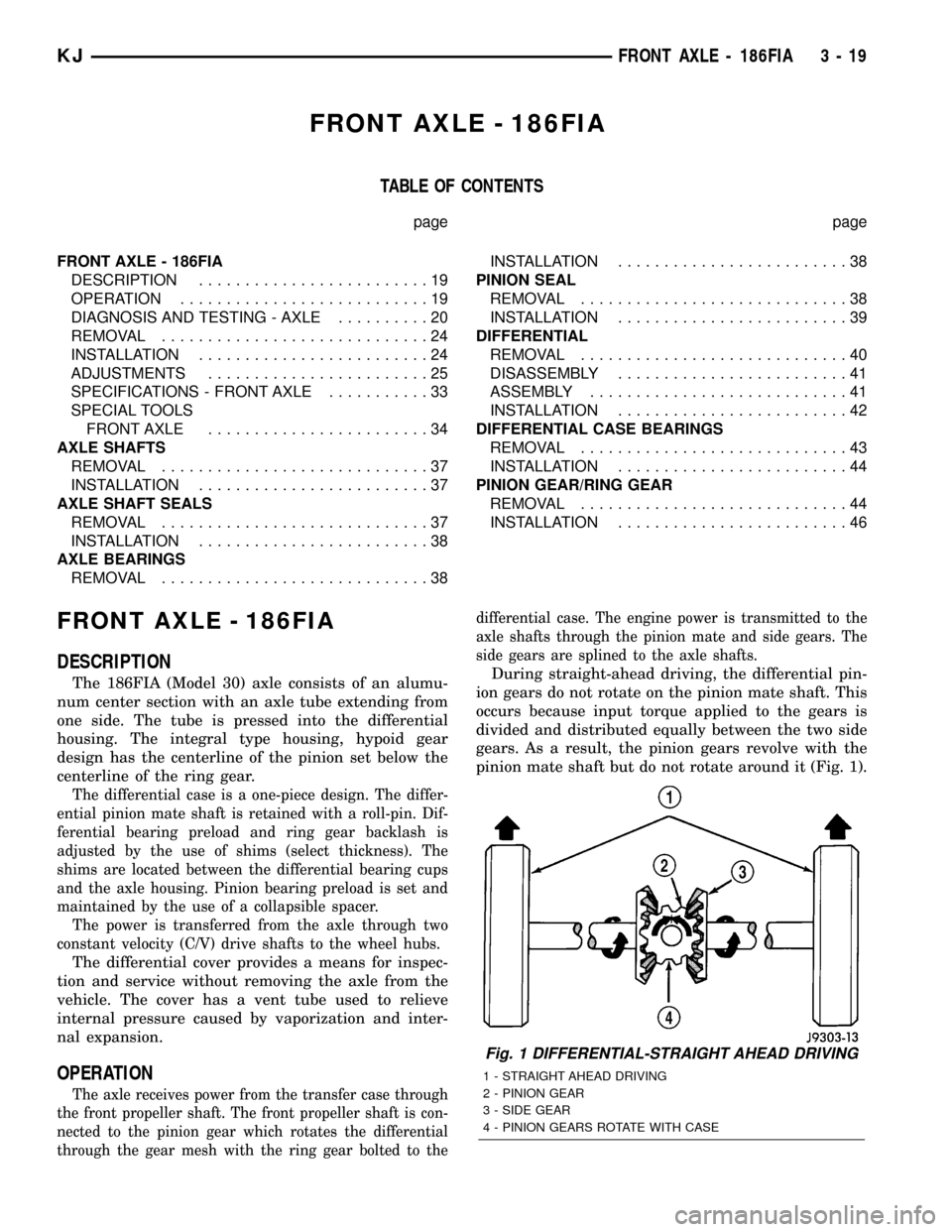
During straight-ahead driving, the differential pin-
ion gears do not rotate on the pinion mate shaft. This
occurs because input torque applied to the gears is
divided and distributed equally between the two side
gears. As a result, the pinion gears revolve with the
pinion mate shaft but do not rotate around it (Fig. 1).
Fig. 1 DIFFERENTIAL-STRAIGHT AHEAD DRIVING
1 - STRAIGHT AHEAD DRIVING
2 - PINION GEAR
3 - SIDE GEAR
4 - PINION GEARS ROTATE WITH CASE
KJFRONT AXLE - 186FIA 3 - 19
Page 73 of 1803
REMOVAL
(1) Raise and support vehicle.
(2) Remove wheel and tire assemblies.
(3) Remove half shaft hub nuts.
(4) Remove lower control arms. Refer to 2 suspen-
sion for procedure.
(5) Remove half shafts.
(6) Remove skid plate.
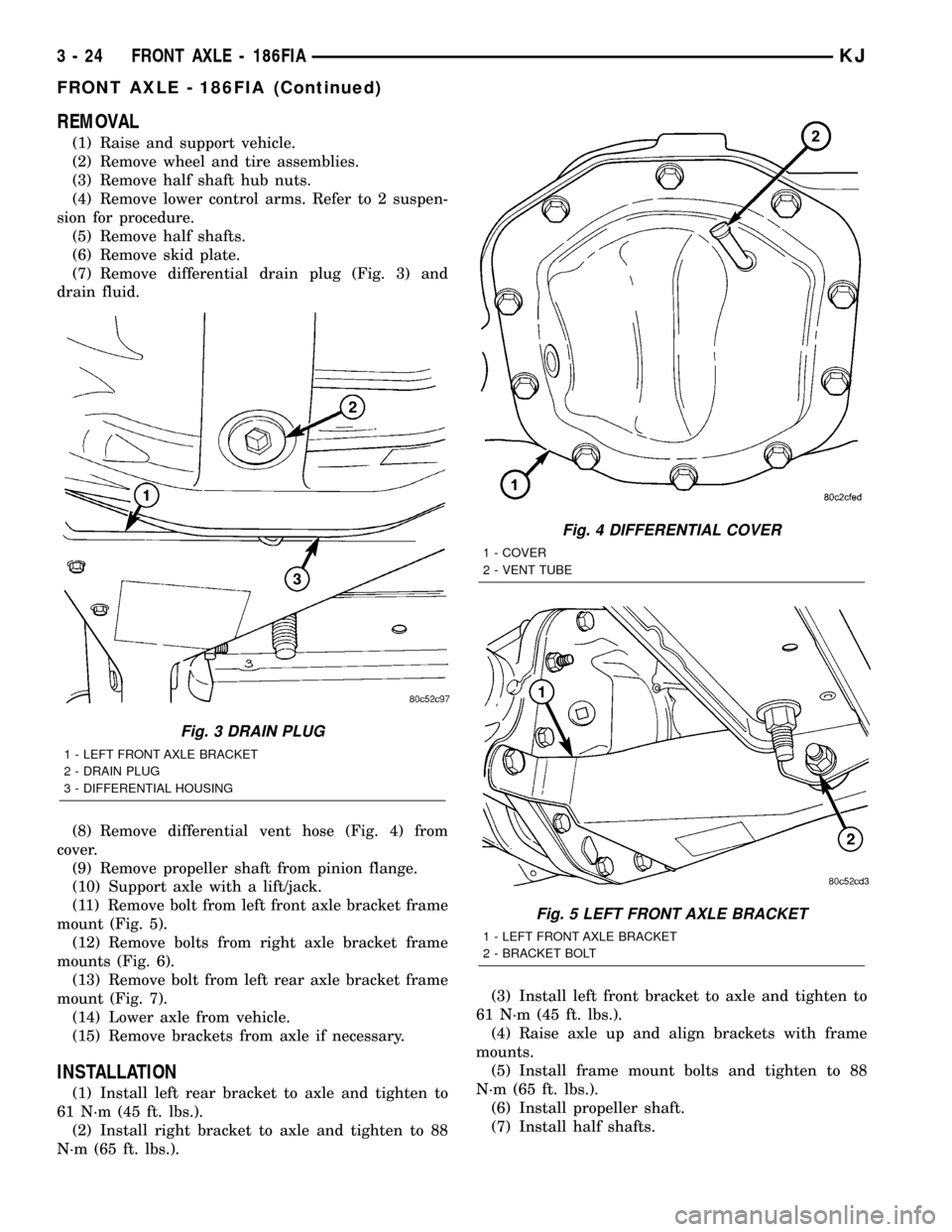
(7) Remove differential drain plug (Fig. 3) and
drain fluid.
(8) Remove differential vent hose (Fig. 4) from
cover.
(9) Remove propeller shaft from pinion flange.
(10) Support axle with a lift/jack.
(11) Remove bolt from left front axle bracket frame
mount (Fig. 5).
(12) Remove bolts from right axle bracket frame
mounts (Fig. 6).
(13) Remove bolt from left rear axle bracket frame
mount (Fig. 7).
(14) Lower axle from vehicle.
(15) Remove brackets from axle if necessary.
INSTALLATION
(1) Install left rear bracket to axle and tighten to
61 N´m (45 ft. lbs.).
(2) Install right bracket to axle and tighten to 88
N´m (65 ft. lbs.).(3) Install left front bracket to axle and tighten to
61 N´m (45 ft. lbs.).
(4) Raise axle up and align brackets with frame
mounts.
(5) Install frame mount bolts and tighten to 88
N´m (65 ft. lbs.).
(6) Install propeller shaft.
(7) Install half shafts.
Fig. 3 DRAIN PLUG
1 - LEFT FRONT AXLE BRACKET
2 - DRAIN PLUG
3 - DIFFERENTIAL HOUSING
Fig. 4 DIFFERENTIAL COVER
1 - COVER
2 - VENT TUBE
Fig. 5 LEFT FRONT AXLE BRACKET
1 - LEFT FRONT AXLE BRACKET
2 - BRACKET BOLT
3 - 24 FRONT AXLE - 186FIAKJ
FRONT AXLE - 186FIA (Continued)