wheel alignment JEEP LIBERTY 2002 KJ / 1.G Owner's Manual
[x] Cancel search | Manufacturer: JEEP, Model Year: 2002, Model line: LIBERTY, Model: JEEP LIBERTY 2002 KJ / 1.GPages: 1803, PDF Size: 62.3 MB
Page 208 of 1803

CONDITION POSSIBLE CAUSES CORRECTION
Facing on flywheel side of disc torn,
gouged, or worn.1. Flywheel surface scored or
nicked.2. Correct surface condition if
possible. Replace flywheel and disc
as necessary.
2. Clutch disc sticking or binding on
transmission input shaft.2. Lubricate splines with high
temperature graese.
Clutch disc facing burnt. Flywheel
and cover pressure plate surfaces
heavily glazed.1. Frequent operation under high
loads or hard acceleration
conditions.1. Correct condition of flywheel and
pressure plate surface. Replace
clutch cover and disc. Alert driver to
problem cause.
2. Driver frequently rides (slips)
clutch. Results in rapid wear and
overheating of disc and cover.2. Correct condition of flywheel and
pressure plate surface. Replace
clutch cover and disc. Alert driver to
problem cause.
Clutch disc binds on input shaft
splines.1. Clutch disc hub splines damaged
during installation.1. Clean, smooth, and lubricate hub
splines if possible. Replace disc if
necessary.
2. Input shaft splines rough,
damaged, or corroded.2. Clean, smooth, and lubricate
shaft splines if possible. Replace
input shaft if necessary.
Clutch disc rusted to flywheel and/or
pressure plate.1. Clutch not used for and extended
period of time (e.g. long term
vehicle storage).1. Sand rusted surfaces with 180
grit sanding paper. Replace clutch
cover and flywheel if necessary.
Pilot bearing seized, loose, or rollers
are worn.1. Bearing cocked during
installation.1. Install and lubricate a new
bearing.
2. Bearing defective. 2. Install and lubricate a new
bearing.
3. Bearing not lubricated. 3. Install and lubricate a new
bearing.
4. Clutch misalignment. 4. Inspect clutch and correct as
necessary. Install and lubricate a
new bearing.
Clutch will not disengage properly. 1. Low clutch fluid level. 1. Replace hydraulic linkage
assembly.
2. Clutch cover loose. 2. Follow proper bolt tightening
procedure.
3. Clutch disc bent or distorted. 3. Replace clutch disc.
4. Clutch cover diaphragm spring
bent or warped.4. Replace clutch cover.
5. Clutch disc installed backwards. 5. Remove and install clutch disc
correctly.
6. Release fork bent or fork pivot
loose or damaged.6. Replace fork or pivot as
necessary.
7. Clutch master or slave cylinder
failure.7. Replace hydraulic linkage
assembly.
6 - 4 CLUTCHKJ
CLUTCH (Continued)
Page 209 of 1803
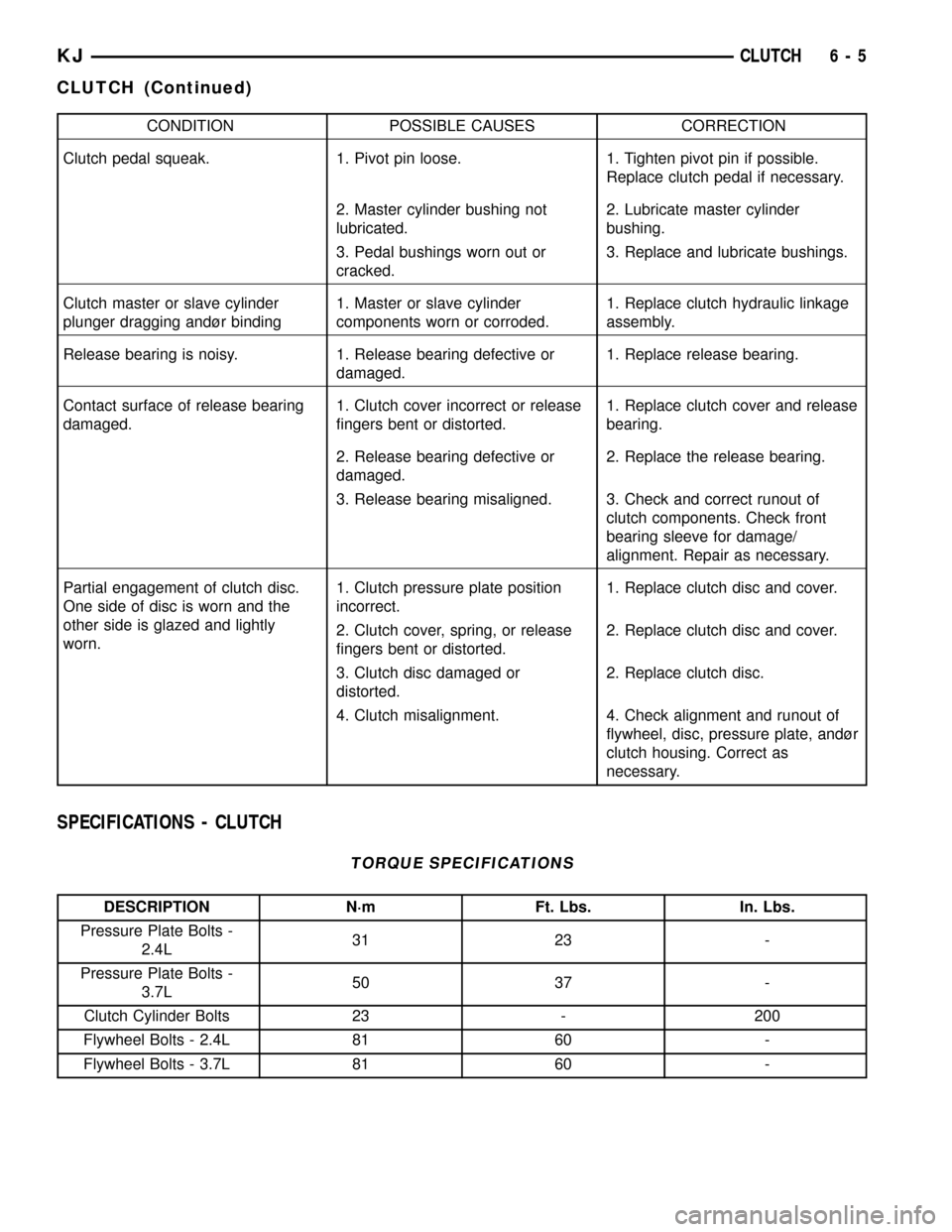
CONDITION POSSIBLE CAUSES CORRECTION
Clutch pedal squeak. 1. Pivot pin loose. 1. Tighten pivot pin if possible.
Replace clutch pedal if necessary.
2. Master cylinder bushing not
lubricated.2. Lubricate master cylinder
bushing.
3. Pedal bushings worn out or
cracked.3. Replace and lubricate bushings.
Clutch master or slave cylinder
plunger dragging andùr binding1. Master or slave cylinder
components worn or corroded.1. Replace clutch hydraulic linkage
assembly.
Release bearing is noisy. 1. Release bearing defective or
damaged.1. Replace release bearing.
Contact surface of release bearing
damaged.1. Clutch cover incorrect or release
fingers bent or distorted.1. Replace clutch cover and release
bearing.
2. Release bearing defective or
damaged.2. Replace the release bearing.
3. Release bearing misaligned. 3. Check and correct runout of
clutch components. Check front
bearing sleeve for damage/
alignment. Repair as necessary.
Partial engagement of clutch disc.
One side of disc is worn and the
other side is glazed and lightly
worn.1. Clutch pressure plate position
incorrect.1. Replace clutch disc and cover.
2. Clutch cover, spring, or release
fingers bent or distorted.2. Replace clutch disc and cover.
3. Clutch disc damaged or
distorted.2. Replace clutch disc.
4. Clutch misalignment. 4. Check alignment and runout of
flywheel, disc, pressure plate, andùr
clutch housing. Correct as
necessary.
SPECIFICATIONS - CLUTCH
TORQUE SPECIFICATIONS
DESCRIPTION N´m Ft. Lbs. In. Lbs.
Pressure Plate Bolts -
2.4L31 23 -
Pressure Plate Bolts -
3.7L50 37 -
Clutch Cylinder Bolts 23 - 200
Flywheel Bolts - 2.4L 81 60 -
Flywheel Bolts - 3.7L 81 60 -
KJCLUTCH 6 - 5
CLUTCH (Continued)
Page 210 of 1803

CLUTCH DISC
REMOVAL
(1) Remove transmission.
(2) Mark position of pressure plate on flywheel
with paint or a scriber for assembly reference, if
clutch is not being replaced.
(3) Loosen pressure plate bolts evenly and in rota-
tion to relieve spring tension and avoid warping the
plate.
(4) Remove pressure plate bolts and pressure plate
and disc.
INSTALLATION
(1) Lightly scuff sand flywheel face with 180 grit
emery cloth, then clean with a wax and grease
remover.
(2) Lubricate pilot bearing with Mopar high tem-
perature bearing grease or equivalent.
(3) Check runout and operation ofnewclutch disc.
NOTE: Disc must slide freely on transmission input
shaft splines.
(4) With the disc on the input shaft, check face
runout with dial indicator. Check runout at disc hub
6 mm (1/4 in.) from outer edge of facing. Obtain
another clutch disc if runout exceed 0.5 mm (0.020
in.).
(5) Position clutch disc on flywheel with side
marked flywheel against the flywheel.
NOTE: If not marked, the flat side of disc hub goes
towards the flywheel on the 3.7L engine and
towards the transmission on 2.4L engine.
(6) Insert clutch alignment tool through the clutch
disc and into the pilot bearing (Fig. 1).
(7) Position clutch pressure plate over disc and on
the flywheel (Fig. 1).
(8) Install pressure plate bolts finger tight.
CAUTION: Use only the factory bolts to mount the
pressure plate. The bolts must be the correct size.
If bolts are too short, there isn't enough thread
engagement, if too long bolts interfere with the Dual
Mass Flywheel.
(9) Tighten pressure plate bolts evenly and in rota-
tion a few threads at a time.
CAUTION: The bolts must be tightened evenly and
to specified torque to avoid distorting the pressure
plate.(10) Tighten pressure plate bolts to 31 N´m (23 ft.
lbs.) on 2.4L engines and 50 N´m (37ft. lbs.) on 3.7L
engines.
(11) Apply light coat of Mopar high temperature
bearing grease or equivalent to clutch disc hub and
splines of transmission input shaft.
CAUTION: Do not over lubricate shaft splines. This
will result in grease contamination of disc.
(12) Install transmission.
CLUTCH RELEASE BEARING
REMOVAL
(1) Remove transmission.
(2) Disconnect release bearing from release lever
and remove the bearing (Fig. 2).
(3) Inspect bearing slide surface of transmission
front bearing retainer. Replace retainer if slide sur-
face is scored, worn, or cracked.
(4) Inspect release fork and fork pivot. Be sure
pivot is secure and in good condition. Be sure fork is
not distorted or worn. Replace release fork retainer
spring if bent or damaged.
INSTALLATION
(1) Lubricate crankshaft pilot bearing with Mopar
high temperature bearing grease or equivalent. Apply
grease to end of long shank, small diameter flat
blade screwdriver. Then insert tool through clutch
disc hub to reach bearing.
Fig. 1 ALIGNING CLUTCH DISC
1 - FLYWHEEL
2 - PRESSURE PLATE
3 - CLUTCH DISC ALIGNMENT TOOL
6 - 6 CLUTCHKJ
Page 212 of 1803

On a Dual Mass Flywheel the additional secondary
mass coupled to the transmission lowers the natural
frequency of the transmission rotating elements. This
decreases the transmission gear rattle. The damper
springs between the two flywheel masses replace the
clutch disc damper springs and assist in a smooth
transfer of torque to the transmission.
CAUTION: The Dual Mass Flywheel is serviced as
an assembly only and should never be taken apart.
DIAGNOSIS AND TESTING - FLYWHEEL
Check flywheel runout whenever misalignment is
suspected. Flywheel runout should not exceed 0.08
mm (0.003 in.). Measure runout at the outer edge of
the flywheel face with a dial indicator. Mount the
indicator on a stud installed in place of one of the fly-
wheel bolts.
Common causes of runout are:
²heat warpage
²improper machining
²incorrect bolt tightening
²improper seating on crankshaft flange shoulder
²foreign material on crankshaft flange
Flywheel machining is not recommended. The fly-
wheel clutch surface is machined to a unique contour
and machining will negate this feature. Minor fly-
wheel scoring can be cleaned up by hand with 180
grit emery or with surface grinding equipment.
Remove only enough material to reduce scoring
(approximately 0.001 - 0.003 in.). Heavy stock
removal isnot recommended.Replace the flywheel
if scoring is severe and deeper than 0.076 mm (0.003
in.). Excessive stock removal can result in flywheel
cracking or warpage after installation; it can also
weaken the flywheel and interfere with proper clutch
release.
Clean the crankshaft flange before mounting the
flywheel. Dirt and grease on the flange surface may
cock the flywheel causing excessive runout. Use new
bolts when remounting a flywheel and secure the
bolts with Mopar Lock And Seal or equivalent.
Tighten flywheel bolts to specified torque only. Over-
tightening can distort the flywheel hub causing
runout.
PILOT BEARING
REMOVAL
(1) Remove the transmission.
(2) Remove pressure plate and clutch disc.
(3) Remove pilot bearing with an internal (blind
hole) puller.
INSTALLATION
(1) Lubricate new bearing with Mopar high tem-
perature bearing grease or equivalent.
(2) Start new bearing into crankshaft by hand.
Then seat bearing with clutch alignment tool (Fig. 5).
(3) Lightly scuff sand flywheel surface with 180
grit emery cloth. Then clean surface with wax and
grease remover.
(4) Install clutch disc and pressure plate.
(5) Install the transmission.
LINKAGE
REMOVAL
NOTE: The clutch master cylinder, slave cylinder
and connecting line are serviced as an assembly
only. The linkage components cannot be over-
hauled or serviced separately. The cylinders and
connecting line are sealed units.
(1) Raise vehicle.
(2) Remove fasteners attaching slave cylinder to
clutch housing.
(3) Remove slave cylinder from clutch housing
(Fig. 6).
(4) Disengage clutch fluid line from body clips, if
applicable.
(5) Lower vehicle.
(6) Verify cap on clutch master cylinder reservoir
is tight to avoid spilling fluid during removal.
(7) Remove clutch master cylinder attaching nuts
(Fig. 7).
(8) Disengage captured bushing on clutch master
cylinder actuator from pivot pin on pedal arm.
Fig. 5 Pilot Bearing Installer
1 - PILOT BEARING
2 - ALIGNMENT TOOL
6 - 8 CLUTCHKJ
FLYWHEEL (Continued)
Page 466 of 1803

FRONT FOG LAMP UNIT
REMOVAL
(1) Turn the front wheels full lock in the direction
of the fog lamp bulb that is to be changed.
(2) Disconnect and isolate the battery negative
cable.
(3) Reach into the front wheel opening to unsnap
and lift the cover over the access hole at the front of
the front wheelhouse splash shield (Fig. 14).
(4) Reach through the access hole to remove the
three screws that secure the front fog lamp unit to
the front bumper fascia.
(5) From the front of the vehicle, pull the front fog
lamp unit out of the front bumper fascia far enough
to access and disconnect the wire harness connector
for the front fog lamp unit from the lamp socket con-
nector receptacle (Fig. 15).
(6) Remove the front fog lamp unit from the front
bumper fascia.
INSTALLATION
(1) Position the front fog lamp unit to the front
bumper fascia.
(2) Reconnect the wire harness connector for the
front fog lamp to the lamp socket connector recepta-
cle (Fig. 15).
(3) Position the front fog lamp unit into the front
bumper fascia.
(4) Reach into the front wheel opening and
through the access hole to install and tighten the
three screws that secure the front fog lamp unithousing to the front bumper fascia (Fig. 14). Tighten
the screws to 3 N´m (25 in. lbs.).
(5) Lower and snap shut the cover over the access
hole at the front of the front wheelhouse splash
shield.
(6) Reconnect the battery negative cable.
(7) Confirm proper front fog lamp unit alignment.
(Refer to 8 - ELECTRICAL/LAMPS/LIGHTING -
EXTERIOR/FRONT FOG LAMP UNIT - ADJUST-
MENTS).
ADJUSTMENTS
ADJUSTMENT - FRONT FOG LAMP UNIT
VEHICLE PREPARATION FOR FOG LAMP ALIGNMENT
(1) Repair or replace any faulty or damaged com-
ponents that could hinder proper lamp alignment.
(2) Verify proper tire inflation.
(3) Clean the front fog lamp lenses.
(4) Verify that the cargo area is not heavily loaded.
(5) The fuel tank should be Full. Add 2.94 kilo-
grams (6.5 pounds) of weight over the fuel tank for
each estimated gallon of missing fuel.
FOG LAMP ALIGNMENT
Prepare an alignment screen as illustrated. A prop-
erly aligned front fog lamp will project a pattern on
the alignment screen 100 millimeters (4 inches)
below the fog lamp centerline and straight ahead of
the lamp.
Fig. 14 Front Fog Lamp Unit Remove/Install
1 - FRONT FOG LAMP UNIT
2 - SCREW (3)
3 - FRONT WHEELHOUSE SPLASH SHIELD
4 - FRONT BUMPER FASCIA
5 - ACCESS HOLE
Fig. 15 Front Fog Lamp Unit
1 - ADJUSTING SCREW
2 - MOUNTING BRACKET
3 - HOUSING
4 - SOCKET & BULB
5 - LENS
KJLAMPS/LIGHTING - EXTERIOR 8L - 25
Page 471 of 1803

REMOVAL
WARNING: ON VEHICLES EQUIPPED WITH AIRBAGS,
DISABLE THE SUPPLEMENTAL RESTRAINT SYSTEM
BEFORE ATTEMPTING ANY STEERING WHEEL,
STEERING COLUMN, DRIVER AIRBAG, PASSENGER
AIRBAG, SEAT BELT TENSIONER, FRONT IMPACT
SENSORS, SIDE CURTAIN AIRBAG, OR INSTRUMENT
PANEL COMPONENT DIAGNOSIS OR SERVICE. DIS-
CONNECT AND ISOLATE THE BATTERY NEGATIVE
(GROUND) CABLE, THEN WAIT TWO MINUTES FOR
THE SYSTEM CAPACITOR TO DISCHARGE BEFORE
PERFORMING FURTHER DIAGNOSIS OR SERVICE.
THIS IS THE ONLY SURE WAY TO DISABLE THE SUP-
PLEMENTAL RESTRAINT SYSTEM. FAILURE TO TAKE
THE PROPER PRECAUTIONS COULD RESULT IN
ACCIDENTAL AIRBAG DEPLOYMENT AND POSSIBLE
PERSONAL INJURY.
(1)Disconnect and isolate the battery negative cable.
(2)Remove the radio from the instrument panel.
(Refer to 8 - ELECTRICAL/AUDIO/RADIO - REMOVAL).
(3) Remove the screw at the top of the instrument
panel radio opening that secures the hazard switch
to the instrument panel trim (Fig. 22).
(4) Reach through and above the instrument panel
radio opening to access the two latch tabs of the
stamped metal hazard switch mounting bracket.
(5) Using two fingertips, pull rearward and down-
ward on the latch tabs on the back of the hazard
switch until it is disengaged from the instrument
panel trim.(6) Push the hazard switch button through the
button opening of the instrument panel far enough to
disengage the alignment pins on each side of the
switch housing from the saddle formations of the two
stanchions on the back of the instrument panel trim,
just below and to either side of the button opening.
(7) Disconnect the instrument panel wire harness
connector for the hazard switch from the switch con-
nector receptacle.
(8) Remove the hazard switch through the instru-
ment panel radio opening.
INSTALLATION
WARNING: ON VEHICLES EQUIPPED WITH AIRBAGS,
DISABLE THE SUPPLEMENTAL RESTRAINT SYSTEM
BEFORE ATTEMPTING ANY STEERING WHEEL,
STEERING COLUMN, DRIVER AIRBAG, PASSENGER
AIRBAG, SEAT BELT TENSIONER, FRONT IMPACT
SENSORS, SIDE CURTAIN AIRBAG, OR INSTRUMENT
PANEL COMPONENT DIAGNOSIS OR SERVICE. DIS-
CONNECT AND ISOLATE THE BATTERY NEGATIVE
(GROUND) CABLE, THEN WAIT TWO MINUTES FOR
THE SYSTEM CAPACITOR TO DISCHARGE BEFORE
PERFORMING FURTHER DIAGNOSIS OR SERVICE.
THIS IS THE ONLY SURE WAY TO DISABLE THE SUP-
PLEMENTAL RESTRAINT SYSTEM. FAILURE TO TAKE
THE PROPER PRECAUTIONS COULD RESULT IN
ACCIDENTAL AIRBAG DEPLOYMENT AND POSSIBLE
PERSONAL INJURY.
(1) Position the hazard switch through the instru-
ment panel radio opening.
(2) Reconnect the instrument panel wire harness
connector for the hazard switch to the switch connec-
tor receptacle.
(3) Reach through and above the instrument panel
radio opening to position the hazard switch for
installation.
(4) Guide the hazard switch button through the
button opening of the instrument panel, which will
engage the alignment pins on each side of the switch
housing with the saddle formations of the two stan-
chions on the back of the instrument panel trim, just
below and to either side of the button opening.
(5) Using hand pressure, press upward on the
back of the hazard switch until the latch tabs of the
mounting bracket on the back of the switch are both
engaged with the instrument panel trim (Fig. 22).
(6) Install and tighten the screw at the top of the
instrument panel radio opening that secures the haz-
ard switch to the instrument panel trim. Tighten the
screw to 2 N´m (17 in. lbs.).
(7) Reinstall the radio into the instrument panel.
(Refer to 8 - ELECTRICAL/AUDIO/RADIO -
INSTALLATION).
(8) Reconnect the battery negative cable.
Fig. 22 Hazard Switch Remove/Install
1 - WIRE HARNESS CONNECTOR
2 - HAZARD SWITCH
3 - ALIGNMENT PIN (2)
4 - STANCHION (2)
5 - INSTRUMENT PANEL
6 - SCREW (1)
7 - MOUNTING BRACKET LATCH TAB (2)
8L - 30 LAMPS/LIGHTING - EXTERIORKJ
HAZARD SWITCH (Continued)
Page 494 of 1803

(4) If the multi-function switch fails any of the
continuity or resistance tests, replace the faulty
switch unit as required.
REMOVAL
WARNING: ON VEHICLES EQUIPPED WITH AIR-
BAGS, DISABLE THE SUPPLEMENTAL RESTRAINT
SYSTEM BEFORE ATTEMPTING ANY STEERING
WHEEL, STEERING COLUMN, DRIVER AIRBAG,
PASSENGER AIRBAG, SEAT BELT TENSIONER,
FRONT IMPACT SENSORS, SIDE CURTAIN AIRBAG,
OR INSTRUMENT PANEL COMPONENT DIAGNOSIS
OR SERVICE. DISCONNECT AND ISOLATE THE
BATTERY NEGATIVE (GROUND) CABLE, THEN
WAIT TWO MINUTES FOR THE SYSTEM CAPACI-
TOR TO DISCHARGE BEFORE PERFORMING FUR-
THER DIAGNOSIS OR SERVICE. THIS IS THE ONLY
SURE WAY TO DISABLE THE SUPPLEMENTAL
RESTRAINT SYSTEM. FAILURE TO TAKE THE
PROPER PRECAUTIONS COULD RESULT IN ACCI-
DENTAL AIRBAG DEPLOYMENT AND POSSIBLE
PERSONAL INJURY.
(1) Disconnect and isolate the battery negative
cable.
(2) If the vehicle is equipped with the optional tilt
steering column, move the tilt steering column to the
fully lowered position and leave the tilt release lever
in the released (down) position.
(3) From below the steering column, remove the
two screws that secure the lower shroud to the upper
shroud (Fig. 52).
(4) Using hand pressure, push gently inward on
both sides of the upper shroud near the parting line
between the upper and lower shrouds to release the
snap features that secure the two halves to each
other.
(5) Remove both the upper and lower shrouds from
the steering column.
(6) Disconnect the two instrument panel wire har-
ness connectors for the multi-function switch from
the two connector receptacles on the back of the
switch housing.
(7) Remove the multi-function switch from the
steering column lock housing by carefully rocking the
switch and pulling the switch housing upward far
enough to disengage its alignment posts and locator
tabs from the lock housing.
INSTALLATION
WARNING: ON VEHICLES EQUIPPED WITH AIR-
BAGS, DISABLE THE SUPPLEMENTAL RESTRAINT
SYSTEM BEFORE ATTEMPTING ANY STEERING
WHEEL, STEERING COLUMN, DRIVER AIRBAG,
PASSENGER AIRBAG, SEAT BELT TENSIONER,FRONT IMPACT SENSORS, SIDE CURTAIN AIRBAG,
OR INSTRUMENT PANEL COMPONENT DIAGNOSIS
OR SERVICE. DISCONNECT AND ISOLATE THE
BATTERY NEGATIVE (GROUND) CABLE, THEN
WAIT TWO MINUTES FOR THE SYSTEM CAPACI-
TOR TO DISCHARGE BEFORE PERFORMING FUR-
THER DIAGNOSIS OR SERVICE. THIS IS THE ONLY
SURE WAY TO DISABLE THE SUPPLEMENTAL
RESTRAINT SYSTEM. FAILURE TO TAKE THE
PROPER PRECAUTIONS COULD RESULT IN ACCI-
DENTAL AIRBAG DEPLOYMENT AND POSSIBLE
PERSONAL INJURY.
CAUTION: Before attempting to install the multi-
function switch, be certain that the left control stalk
is in the neutral turn signal position and the turn
signal cancel actuator is in the retracted (neutral)
position.
(1) Position the multi-function switch to the steer-
ing column.
(2) Reconnect the two instrument panel wire har-
ness connectors for the multi-function switch to the
two connector receptacles on the back of the switch
housing (Fig. 52).
Fig. 52 Multi-Function Switch Remove/Install
1 - UPPER SHROUD
2 - MULTI-FUNCTION SWITCH
3 - CLOCKSPRING
4 - LOWER SHROUD
5 - SCREW (2)
6 - STEERING COLUMN
7 - WIRE HARNESS CONNECTOR (2)
KJLAMPS/LIGHTING - EXTERIOR 8L - 53
MULTI-FUNCTION SWITCH (Continued)
Page 550 of 1803

(5) From the front of the vehicle, pull the front fog
lamp unit out of the front bumper fascia far enough
to access and disconnect the wire harness connector
for the front fog lamp unit from the lamp socket con-
nector receptacle (Fig. 15).
(6) Remove the front fog lamp unit from the front
bumper fascia.
INSTALLATION
(1) Position the front fog lamp unit to the front
bumper fascia.
(2) Reconnect the wire harness connector for the
front fog lamp to the lamp socket connector recepta-
cle (Fig. 15).
(3) Position the front fog lamp unit into the front
bumper fascia.
(4) Reach into the front wheel opening and
through the access hole to install and tighten the
three screws that secure the front fog lamp unit
housing to the front bumper fascia (Fig. 14). Tighten
the screws to 3 N´m (25 in. lbs.).
(5) Lower and snap shut the cover over the access
hole at the front of the front wheelhouse splash
shield.
(6) Reconnect the battery negative cable.
(7) Confirm proper front fog lamp unit alignment.
(Refer to 8 - ELECTRICAL/LAMPS/LIGHTING -
EXTERIOR/FRONT FOG LAMP UNIT - ADJUST-
MENTS).
ADJUSTMENTS
ADJUSTMENT - FRONT FOG LAMP UNIT
VEHICLE PREPARATION FOR FOG LAMP ALIGNMENT
(1) Repair or replace any faulty or damaged com-
ponents that could hinder proper lamp alignment.
(2) Verify proper tire inflation.
(3) Clean the front fog lamp lenses.
(4) Verify that the cargo area is not heavily loaded.
(5) The fuel tank should be Full. Add 2.94 kilo-
grams (6.5 pounds) of weight over the fuel tank for
each estimated gallon of missing fuel.
FOG LAMP ALIGNMENT
Prepare an alignment screen as illustrated. A prop-
erly aligned front fog lamp will project a pattern on
the alignment screen 100 millimeters (4 inches)
below the fog lamp centerline and straight ahead of
the lamp.
(1) Position the vehicle on a level surface perpen-
dicular to a flat wall 7.62 meters (25 feet) away from
the front of the front fog lamp lens (Fig. 16). If nec-
essary, tape a line on the floor 7.62 meters (25 feet)
away from and parallel to the wall.
(2) Measure up on the wall 1.27 meters (5 feet)
from the floor and tape a vertical line on the align-
ment screen at the centerline of the vehicle. Sight
along the centerline of the vehicle (from the rear of
the vehicle forward) to verify the accuracy of the cen-
terline placement.
Fig. 14 Front Fog Lamp Unit Remove/Install
1 - FRONT FOG LAMP UNIT
2 - SCREW (3)
3 - FRONT WHEELHOUSE SPLASH SHIELD
4 - FRONT BUMPER FASCIA
5 - ACCESS HOLE
Fig. 15 Front Fog Lamp Unit
1 - ADJUSTING SCREW
2 - MOUNTING BRACKET
3 - HOUSING
4 - SOCKET & BULB
5 - LENS
KJLAMPS8Ls-25
FRONT FOG LAMP UNIT (Continued)
Page 555 of 1803

(2) Remove the radio from the instrument panel.
(Refer to 8 - ELECTRICAL/AUDIO/RADIO -
REMOVAL).
(3) Remove the screw at the top of the instrument
panel radio opening that secures the hazard switch
to the instrument panel trim (Fig. 22).
(4) Reach through and above the instrument panel
radio opening to access the two latch tabs of the
stamped metal hazard switch mounting bracket.
(5) Using two fingertips, pull rearward and down-
ward on the latch tabs on the back of the hazard
switch until it is disengaged from the instrument
panel trim.
(6) Push the hazard switch button through the
button opening of the instrument panel far enough to
disengage the alignment pins on each side of the
switch housing from the saddle formations of the two
stanchions on the back of the instrument panel trim,
just below and to either side of the button opening.
(7) Disconnect the instrument panel wire harness
connector for the hazard switch from the switch con-
nector receptacle.
(8) Remove the hazard switch through the instru-
ment panel radio opening.
INSTALLATION
WARNING: ON VEHICLES EQUIPPED WITH AIR-
BAGS, DISABLE THE SUPPLEMENTAL RESTRAINT
SYSTEM BEFORE ATTEMPTING ANY STEERING
WHEEL, STEERING COLUMN, DRIVER AIRBAG,PASSENGER AIRBAG, SEAT BELT TENSIONER,
FRONT IMPACT SENSORS, SIDE CURTAIN AIRBAG,
OR INSTRUMENT PANEL COMPONENT DIAGNOSIS
OR SERVICE. DISCONNECT AND ISOLATE THE
BATTERY NEGATIVE (GROUND) CABLE, THEN
WAIT TWO MINUTES FOR THE SYSTEM CAPACI-
TOR TO DISCHARGE BEFORE PERFORMING FUR-
THER DIAGNOSIS OR SERVICE. THIS IS THE ONLY
SURE WAY TO DISABLE THE SUPPLEMENTAL
RESTRAINT SYSTEM. FAILURE TO TAKE THE
PROPER PRECAUTIONS COULD RESULT IN ACCI-
DENTAL AIRBAG DEPLOYMENT AND POSSIBLE
PERSONAL INJURY.
(1) Position the hazard switch through the instru-
ment panel radio opening.
(2) Reconnect the instrument panel wire harness
connector for the hazard switch to the switch connec-
tor receptacle.
(3) Reach through and above the instrument panel
radio opening to position the hazard switch for
installation.
(4) Guide the hazard switch button through the
button opening of the instrument panel, which will
engage the alignment pins on each side of the switch
housing with the saddle formations of the two stan-
chions on the back of the instrument panel trim, just
below and to either side of the button opening.
(5) Using hand pressure, press upward on the
back of the hazard switch until the latch tabs of the
mounting bracket on the back of the switch are both
engaged with the instrument panel trim (Fig. 22).
(6) Install and tighten the screw at the top of the
instrument panel radio opening that secures the haz-
ard switch to the instrument panel trim. Tighten the
screw to 2 N´m (17 in. lbs.).
(7) Reinstall the radio into the instrument panel.
(Refer to 8 - ELECTRICAL/AUDIO/RADIO -
INSTALLATION).
(8) Reconnect the battery negative cable.
HEADLAMP BULB
REMOVAL
NORTH AMERICA
(1) Disconnect and isolate the battery negative
cable.
(2) Reach behind the headlamp unit from the
engine compartment side of the upper radiator cross-
member to access the headlamp bulb lock ring (Fig.
23).
(3) Firmly grasp the lock ring on the back of the
headlamp unit housing.
Fig. 22 Hazard Switch Remove/Install
1 - WIRE HARNESS CONNECTOR
2 - HAZARD SWITCH
3 - ALIGNMENT PIN (2)
4 - STANCHION (2)
5 - INSTRUMENT PANEL
6 - SCREW (1)
7 - MOUNTING BRACKET LATCH TAB (2)
8Ls - 30 LAMPSKJ
HAZARD SWITCH (Continued)
Page 578 of 1803

(4) If the multi-function switch fails any of the
continuity or resistance tests, replace the faulty
switch unit as required.
REMOVAL
WARNING: ON VEHICLES EQUIPPED WITH AIR-
BAGS, DISABLE THE SUPPLEMENTAL RESTRAINT
SYSTEM BEFORE ATTEMPTING ANY STEERING
WHEEL, STEERING COLUMN, DRIVER AIRBAG,
PASSENGER AIRBAG, SEAT BELT TENSIONER,
FRONT IMPACT SENSORS, SIDE CURTAIN AIRBAG,
OR INSTRUMENT PANEL COMPONENT DIAGNOSIS
OR SERVICE. DISCONNECT AND ISOLATE THE
BATTERY NEGATIVE (GROUND) CABLE, THEN
WAIT TWO MINUTES FOR THE SYSTEM CAPACI-
TOR TO DISCHARGE BEFORE PERFORMING FUR-
THER DIAGNOSIS OR SERVICE. THIS IS THE ONLY
SURE WAY TO DISABLE THE SUPPLEMENTAL
RESTRAINT SYSTEM. FAILURE TO TAKE THE
PROPER PRECAUTIONS COULD RESULT IN ACCI-
DENTAL AIRBAG DEPLOYMENT AND POSSIBLE
PERSONAL INJURY.
(1) Disconnect and isolate the battery negative
cable.
(2) If the vehicle is equipped with the optional tilt
steering column, move the tilt steering column to the
fully lowered position and leave the tilt release lever
in the released (down) position.
(3) From below the steering column, remove the
two screws that secure the lower shroud to the upper
shroud (Fig. 52).
(4) Using hand pressure, push gently inward on
both sides of the upper shroud near the parting line
between the upper and lower shrouds to release the
snap features that secure the two halves to each
other.
(5) Remove both the upper and lower shrouds from
the steering column.
(6) Disconnect the two instrument panel wire har-
ness connectors for the multi-function switch from
the two connector receptacles on the back of the
switch housing.
(7) Remove the multi-function switch from the
steering column lock housing by carefully rocking the
switch and pulling the switch housing upward far
enough to disengage its alignment posts and locator
tabs from the lock housing.
INSTALLATION
WARNING: ON VEHICLES EQUIPPED WITH AIR-
BAGS, DISABLE THE SUPPLEMENTAL RESTRAINT
SYSTEM BEFORE ATTEMPTING ANY STEERING
WHEEL, STEERING COLUMN, DRIVER AIRBAG,
PASSENGER AIRBAG, SEAT BELT TENSIONER,FRONT IMPACT SENSORS, SIDE CURTAIN AIRBAG,
OR INSTRUMENT PANEL COMPONENT DIAGNOSIS
OR SERVICE. DISCONNECT AND ISOLATE THE
BATTERY NEGATIVE (GROUND) CABLE, THEN
WAIT TWO MINUTES FOR THE SYSTEM CAPACI-
TOR TO DISCHARGE BEFORE PERFORMING FUR-
THER DIAGNOSIS OR SERVICE. THIS IS THE ONLY
SURE WAY TO DISABLE THE SUPPLEMENTAL
RESTRAINT SYSTEM. FAILURE TO TAKE THE
PROPER PRECAUTIONS COULD RESULT IN ACCI-
DENTAL AIRBAG DEPLOYMENT AND POSSIBLE
PERSONAL INJURY.
CAUTION: Before attempting to install the multi-
function switch, be certain that the left control stalk
is in the neutral turn signal position and the turn
signal cancel actuator is in the retracted (neutral)
position.
(1) Position the multi-function switch to the steer-
ing column.
(2) Reconnect the two instrument panel wire har-
ness connectors for the multi-function switch to the
two connector receptacles on the back of the switch
housing (Fig. 52).
Fig. 52 Multi-Function Switch Remove/Install
1 - UPPER SHROUD
2 - MULTI-FUNCTION SWITCH
3 - CLOCKSPRING
4 - LOWER SHROUD
5 - SCREW (2)
6 - STEERING COLUMN
7 - WIRE HARNESS CONNECTOR (2)
KJLAMPS8Ls-53
MULTI-FUNCTION SWITCH (Continued)