brake light JEEP LIBERTY 2008 KK / 2.G User Guide
[x] Cancel search | Manufacturer: JEEP, Model Year: 2008, Model line: LIBERTY, Model: JEEP LIBERTY 2008 KK / 2.GPages: 493
Page 274 of 493
NMP1522 Command-TractTransfer Case Ð
If Equipped.........................292
NMP3022 Selec-Trac IItTransfer Case Ð
If Equipped.........................298
mOn-Road Driving Tips...................303
mOff-Road Driving Tips...................304
NWhen To Use 4WD Low Range...........304
NDriving Through Water.................304
NDriving In Snow, Mud And Sand..........305
NHill Climbing........................306
NTraction Downhill.....................307
NAfter Driving Off-Road.................307
mParking Brake.........................308
mAnti-Lock Brake System..................310mPower Steering........................313
mElectronic Brake Control System............314
NABS (Anti-Lock Brake System)............315
NTCS (Traction Control System)............316
NBAS (Brake Assist System)...............316
NERM (Electronic Roll Mitigation)..........317
NTSC (Trailer Sway Control) ± If Equipped....318
NHSA (Hill Start Assist)..................319
NHDC (Hill Descent Control) ± If Equipped . . . 322
NESP (Electronic Stability Program).........324
NESP/BAS Warning Light & ESP/TCS
Indicator Light.......................328
mTire Safety Information...................329
274 STARTING AND OPERATING
Page 277 of 493
STARTING PROCEDURES
Before starting your vehicle, adjust your seat, adjust both
inside and outside mirrors, and fasten your seat belts.
WARNING!
Do not leave children or animals inside parked
vehicles in hot weather. Interior heat build up may
cause serious injury or death.
Automatic Transmission
Start the engine with the selector lever in the ªNº
(Neutral) or ªPº (Park) position. Apply the brake before
shifting to any driving range.
Manual Transmission Ð If Equipped
Apply the parking brake, place the gearshift control lever
in ªNº (Neutral) and depress the clutch pedal beforestarting vehicle. This vehicle is equipped with a clutch
interlocking ignition system. It will not start unless the
clutch pedal is pressed to the floor.
4WD Models Only
To enhance off-road performance, 4-wheel drive models
equipped with a manual transmission will start with or
without pressing the clutch pedal when in 4-wheel drive
low range. The 4 LOW indicator light will illuminate
when the transfer case is in 4-wheel drive low range.
Normal Starting
NOTE:Normal starting of either a cold or a warm
engine is obtained without pumping or depressing the
accelerator pedal.
For vehicles not equipped with Tip Start,turn the ignition
switch to the START position and release it when the
engine starts. If the engine fails to start within 10 seconds,
turn the ignition switch to the LOCK position, wait 10 to
15 seconds, then repeat the normal starting procedure.
STARTING AND OPERATING 277
5
Page 289 of 493
6-Speed Manual Transmission
WARNING!
You or others could be injured if you leave the
vehicle unattended without having the parking
brake fully applied. The parking brake should al-
ways be applied when the driver is not in the vehicle,
especially on an incline.
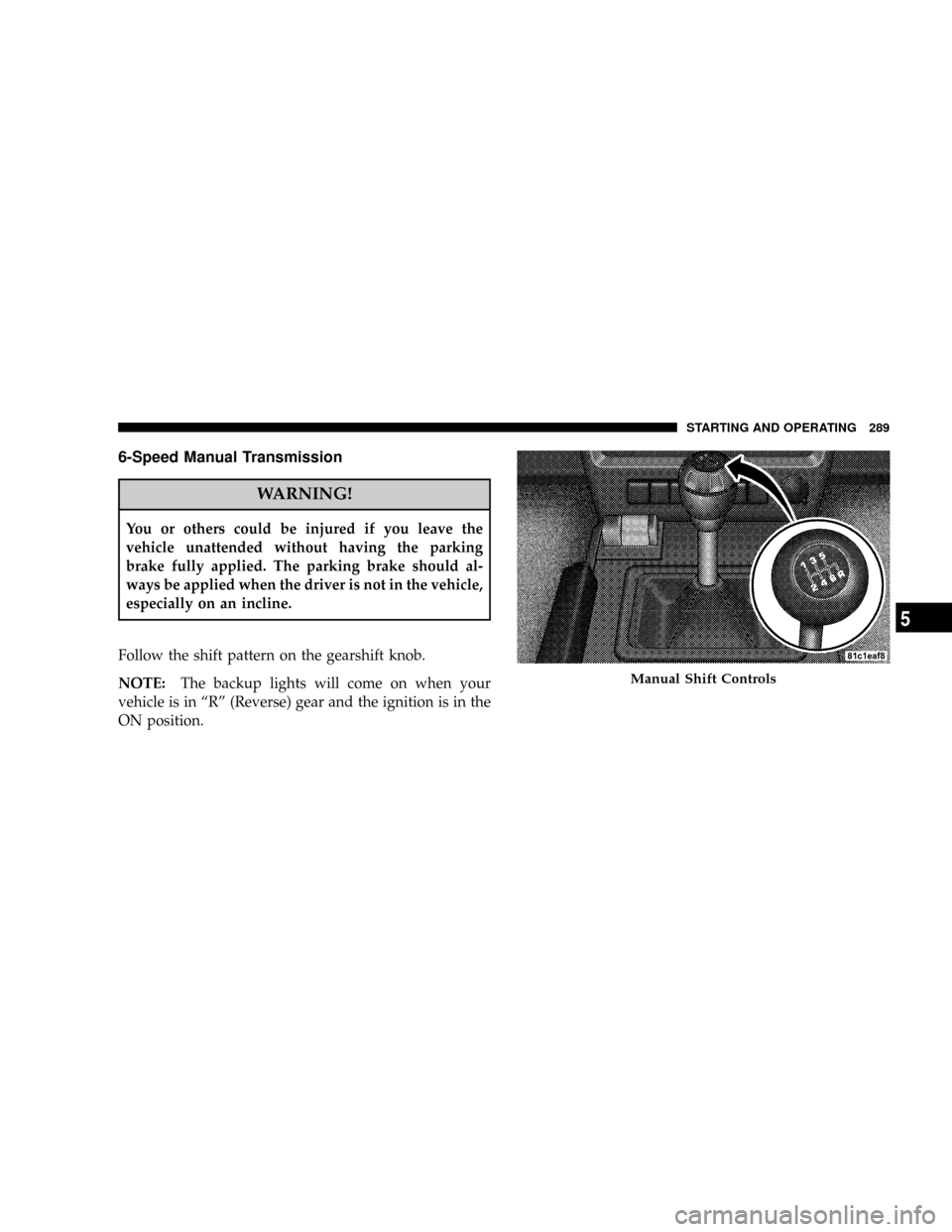
Follow the shift pattern on the gearshift knob.
NOTE:The backup lights will come on when your
vehicle is in ªRº (Reverse) gear and the ignition is in the
ON position.
Manual Shift Controls
STARTING AND OPERATING 289
5
Page 293 of 493
CAUTION!
²Do not attempt to make a shift while only the front wheels
or rear wheels are spinning. The MP1522 Command-Tract
transfer case is not equipped with a synchronizer and
therefore the speed of the front driveshaft and rear drive-
shaft must be equal for the shift to take place. Shifting
while only the front wheels or rear wheels are spinning can
cause damage to the transfer case.
²The 4WD Lock position and 4WD Low position are in-
tended for loose or slippery road surfaces only. Driving in
these positions on dry hard surfaced roads may cause
increased tire wear and damage to the driveline compo-
nents.
²When operating your vehicle in 4WD LOW, the engine
speed is approximately three times that of the 2WD posi-
tion or 4WD LOCK position at a given road speed. Take
care not to over-speed the engine and do not exceed 25 mph
(40 km/h).
²Proper operation of 4-wheel drive vehicles depends on tires
of equal size, type, and circumference on each wheel. Any
difference in tire size can cause damage to the transfer case.
WARNING!
²You or others could be injured if you leave the
vehicle unattended with the transfer case in the
Neutral (N) position without first fully engaging
the parking brake. The transfer case Neutral (N)
position disengages both the front driveshaft and
rear driveshaft from the powertrain and it will
allow the vehicle to move despite the transmission
position. The parking brake should always be
applied when the driver is not in the vehicle.
²Always engage the parking brake when powering
down the vehicle if the ªSERV 4WDº light is
illuminated. Not engaging the parking brake may
allow the vehicle to roll, which may cause personal
injury.
²Since 4-wheel drive provides improved traction,
there is a tendency to exceed safe turning and
stopping speeds. Do not go faster than road condi-
tions permit. You or others could be injured.
STARTING AND OPERATING 293
5
Page 299 of 493
CAUTION!
²The 4WD Low position is intended for loose or
slippery road surfaces only. Driving in this posi-
tion on dry hard surfaced roads may cause in-
creased tire wear and damage to the driveline
components.
²When operating your vehicle in 4WD LOW, the
engine speed is approximately three times that of
the 2WD position or 4WD AUTO position at a
given road speed. Take care not to over-speed the
engine and do not exceed 25 mph (40 km/h).
²Proper operation of 4-wheel drive vehicles de-
pends on tires of equal size, type, and circumfer-
ence on each wheel. Any difference in tire size can
cause damage to the transfer case.
WARNING!
²You or others could be injured if you leave the
vehicle unattended with the transfer case in the
Neutral (N) position without first fully engaging
the parking brake. The transfer case Neutral (N)
position disengages both the front driveshaft and
rear driveshaft from the powertrain and it will
allow the vehicle to move despite the transmission
position. The parking brake should always be
applied when the driver is not in the vehicle.
²Always engage the parking brake when powering
down the vehicle if the ªSERV 4WDº light is
illuminated. Not engaging the parking brake may
allow the vehicle to roll, which may cause personal
injury.
²Since 4-wheel drive provides improved traction,
there is a tendency to exceed safe turning and
stopping speeds. Do not go faster than road con-
ditions permit. You or others could be injured.
STARTING AND OPERATING 299
5
Page 306 of 493
Hill Climbing
NOTE:Before attempting to climb a hill, determine the
conditions at the crest and/or on the other side.
Before climbing a steep hill,shift the transmission to a
lower gear and shift the transfer case to 4WD Low. Use
first gear and 4WD Low for very steep hills.
If you stall or begin to lose headwaywhile climbing a
steep hill, allow your vehicle to come to a stop and
immediately apply the brakes. Restart the engine and
shift to R (Reverse). Back slowly down the hill allowing
the compression braking of the engine to help regulate
your speed. If the brakes are required to control vehicle
speed, apply them lightly and avoid locking or skidding
the tires.
WARNING!
If the engine stalls or you lose headway or cannot
make it to the top of a steep hill or grade, never
attempt to turn around. To do so may result in
tipping and rolling the vehicle. Always back straight
down a hill in R (Reverse) gear carefully. Never back
down a hill in N (Neutral) using only the brake.
Remember, never drive diagonally across a hill-always
drive straight up or down.
If the wheels start to slip as you approach the crest of a
hill, ease off the accelerator and maintain headway by
turning the front wheels slowly left and right. This may
provide a fresh ªbiteº into the surface and will usually
provide traction to complete the climb.
306 STARTING AND OPERATING
Page 308 of 493
WARNING!
Abrasive material in any part of the brakes may cause
excessive wear or unpredictable braking. You might
not have full braking power when you need it to
prevent an accident. If you have been operating your
vehicle in dirty conditions, get your brakes checked
and cleaned as necessary.
²If you experience unusual vibration after driving in
mud, slush, or similar conditions, check the wheels for
impacted material. Impacted material can cause a
wheel imbalance and freeing the wheels of it will
correct the situation.
PARKING BRAKE
To set the parking brake, pull the lever up as firmly as
possible. When the parking brake is applied with the
ignition ON, the ªBrake Warning Lightº in the instru-
ment cluster will light. To release the parking brake, pull
up slightly, press the center button, then lower the lever
completely.
NOTE:The instrument cluster ªBrake Warning Lightº
indicates only that the parking brake is applied. You must
be sure the parking brake is fully applied before leaving
the vehicle.
308 STARTING AND OPERATING
Page 311 of 493
WARNING!
Significant over or under inflation of tires or mixing
sizes of tires or wheels on the vehicle can lead to loss
of braking effectiveness.
The Anti-Lock Brake System conducts a low-speed self-
test at about 12 mph (20 km/h). If you have your foot
lightly on the brake while this test is occurring, you may
feel slight pedal movement. The movement can be more
apparent on ice and snow. This is normal.
The Anti-Lock Brake System pump motor runs during
the self-test at 12 mph (20 km/h) and during an ABS stop.
The pump motor makes a low humming noise during
operation, which is normal.
WARNING!
Pumping of the Anti-Lock Brakes will diminish their
effectiveness and may lead to an accident. Pumping
makes the stopping distance longer. Just press firmly
on your brake pedal when you need to slow down or
stop.
STARTING AND OPERATING 311
5
Page 318 of 493
WARNING!
Many factors, such as vehicle loading, road condi-
tions, and driving conditions, influence the chance
that wheel lift or rollover may occur. ERM (Electronic
Roll Mitigation) cannot prevent all wheel lift or
rollovers, especially those that involve leaving the
roadway or striking objects or other vehicles. Only a
safe, attentive, and skillful driver can prevent acci-
dents. The capabilities of an ERM-equipped vehicle
must never be exploited in a reckless or dangerous
manner, which could jeopardize the user's safety or
the safety of others.
TSC (Trailer Sway Control) ± If Equipped
TSC uses sensors in the vehicle to recognize an exces-
sively swaying trailer. TSC activates automatically once
the excessively swaying trailer is recognized. When TSC
is functioning, the ªESP/TCS Indicatorº light will flash,
the engine power will be reduced, and you will feel the
brake being applied to individual wheels in an attempt to
stop the trailer from swaying.
NOTE:The TSC is disabled when the ESP system is in
the ªPartial Offº mode and ªFull Offº mode.
318 STARTING AND OPERATING
Page 320 of 493
²For vehicles equipped with an automatic transmission,
the HSA will work in reverse gear and all forward
gears. The system will not activate if the transmission
is in ªPº (Park).
²For vehicles equipped with a manual transmission, the
HSA will work in reverse gear, neutral, and all forward
gears.
WARNING!
There may be situations where the HSA (Hill Start
Assist) will not activate and slight rolling may occur,
such as on minor hills (i.e., less than 7%), or with a
loaded vehicle, or while pulling a trailer. HSA is not
a substitute for active driving involvement. It is
always the driver 's responsibility to be attentive to
distance to other vehicles, people, and objects, and
most importantly brake operation to ensure safe
operation of the vehicle under all road conditions.
Your complete attention is always required while
driving to maintain safe control of your vehicle.
Failure to follow these warnings can result in an
accident or serious personal injury.
Towing with HSA
HSA will provide assistance during acceleration on an
incline while towing a trailer.
320 STARTING AND OPERATING